Chapter X · HISTORICAL SKETCH OF ARCTIC DISCOVERY.
Reading edition

In the reign of Henry VIII., Dr. Robert Thorne declared that “if he had facultie to his will, the first thing he would understande, even to attempt, would be if our seas northwarde be navigable to the Pole or no.” And it is said that the king, at his instigation, “sent two fair ships, well-manned and victualled, having in them divers cunning men, to seek strange regions; and so they set forth out of the Thames, the 20th day of May, in the nineteenth year of his reign, which was the year of our Lord 1527.” Of the details of this expedition, however, we have no record, except that one of the vessels was wrecked on the coast of Newfoundland.
In 1536, a second Arctic voyage was undertaken by a London gentleman, named Hore, accompanied by thirty members of the Inns of Law, and about the same number of adventurers of a lower estate. They reached Newfoundland, which, according to some authorities, was discovered by Sebastian Cabot in 1496, and here they suffered terrible distress; in the extremity of their need being reduced to cannibalism. After the deaths of a great portion of the crew, the survivors captured by surprise a French vessel which had arrived on the coast, and navigated her in safety to England.
But the true history of Arctic Discovery dates, as Mr. Markham observes, from the day when the veteran navigator, Sebastian Cabot, explained to young Edward VI. the phenomena of the variation of the needle. On the same day the aged sailor received a pension; and immediately afterwards three discovery-ships were fitted out by the Muscovy Company under his direction. Sir Hugh Willoughby was appointed to their command, with Richard Chancellor in the Edward Bonadventure as his second. The latter, soon after quitting England, was separated from the squadron, and sailing in a northerly direction, gained at last a spacious harbour on the Muscovy coast. Sir Hugh’s ship, and her companion, the Bona Confidentia, were cast away on a desolate part of the Lapland coast, at the mouth of the river Arzina. They entered the river on September 18, 1563, and remained there for a week; and “seeing the year far spent, and also very evil weather, as frost, snow, and hail, as though it had been the deep of winter, they thought it best to winter there.” But as day followed day, and week followed week, in those grim solitudes of ice and snow, the brave adventurers perished one by one; and many months afterwards their bleached bones were discovered by some Russian fishermen.
In the spring of 1556, Stephen Burrough, afterwards chief pilot of England, fitted out the “Search-thrift” pinnace, and sailed away for the remote north. He discovered the strait leading into the sea of Kara, between Novaia Zemlaia and the island Waigatz; but he made up his mind to return, because, first, of the north winds, which blew continually; second, “the great and terrible abundance of ice which we saw with our eyes;” and third, because the nights waxed dark. He arrived at Archangel on September 11, wintered there, and returned to England in the following year.
Twenty years later, on a bright May morning, Queen Elizabeth waved a farewell to Martin Frobisher and his gallant company, as they dropped down the Thames in two small barks, the Gabriel and the Michael, each of thirty tons, together with a pinnace of ten tons. They gained the shores of Friesland on the 11th of July; and sailing to the south-west, reached Labrador. Then, striking northward, they discovered “a great gut, bay, or passage,” which they named Frobisher Strait (lat. 63° 8’ N.), and fell into the error of supposing that it connected the Atlantic Ocean with the Pacific. Here they came into contact with some Eskimos; and Frobisher describes them as “strange infidels, whose like was never seen, read, nor heard of before: with long black hair, broad faces and flat noses, and tawny in colour, wearing seal-skins, the women marked in the face with blue streaks down the cheeks, and round about the eyes.”
Frobisher’s discoveries produced so great an impression on the public mind, that in the following year he was placed at the head of a larger expedition, in the hope that he would throw open to English enterprise the wealth of “far Cathay.” About the end of May 1577, he sailed from Gravesend with the Ayde of one hundred tons, the Gabriel of thirty, and the Michael of thirty, carrying crews of ninety men in all, besides about thirty merchants, miners, refiners, and artisans. He returned in September with two hundred tons of what was supposed to be gold ore, and met with a warm reception. It was considered almost certain that he had fallen in with some portion of the Indian coast, and Queen Elizabeth, naming it Meta Incognita, resolved to establish there a colony. For this purpose, Frobisher was dispatched with fifteen well-equipped ships, three of which were to remain for a twelvemonth at the new settlement, while the others, taking on board a cargo of the precious ore, were to return to England.
In the third week of June Frobisher arrived at Friesland, of which he took possession in the queen’s name. Steering for Frobisher Strait, he found its entrance blocked up with colossal icebergs; and the bark Dennis, which carried the wooden houses and stores for the colony, coming in collision with one of these, unfortunately sank. Then, in a great storm, the fleet was scattered far and wide,—some of the vessels drifting out to sea, some being driven into the strait; and when most of them rejoined their admiral, it was found they had suffered so severely that no help remained but to abandon the project of a colony. They collected fresh supplies of ore, however, and then made their way back to England as best they could. Here they were met with the unwelcome intelligence that the supposed gold ore contained no gold at all, and was, in truth, mere dross and refuse.
The dream of a northern passage to Cathay was not to be dissipated, however, by an occasional misadventure. Even a man of the keen intellect of Sir Humphrey Gilbert felt persuaded that through the northern seas lay the shortest route to the treasures of the East; and having obtained from Queen Elizabeth a patent authorizing him to undertake north-western discoveries, and to acquire possession of any lands not inhabited or colonized by Christian princes or their subjects, he equipped, in 1583, with the help of his friends, a squadron of five small ships, and sailed from England full of bright visions and sanguine anticipations. On board his fleet were smiths, and carpenters, and shipwrights, and masons, and refiners, and “mineral men;” not to speak of one Stephen Parmenio, a learned Hungarian, who was bound to chronicle in sonorous Latin all “gests and things worthy of remembrance.”
Sir Humphrey formed a settlement at Newfoundland; and then, embarking on board the Squirrel, a little pinnace of ten tons burden, and taking with him the Golden Hind and the Delight, he proceeded on a voyage of exploration. Unhappily, the Delight ran ashore on the shoals near Sable Land, and all her crew except twelve men, and all her stores, were lost. The disaster determined Sir Humphrey to return to England; and his companions implored him to embark on board the Golden Hind, representing that the Squirrel was unfit for so long a voyage. “I will not forsake,” replied the chivalrous adventurer, “the brave and free companions with whom I have undergone so many storms and perils.” Soon after passing the Azores, they were overtaken by a terrible tempest, in which the tiny pinnace was tossed about by the waves like a straw. The Golden Hind kept as near her as the rolling billows permitted; and her captain has left on record that he could see Sir Humphrey sitting calmly in the stern reading a book. He was heard to exclaim—“Courage, my lads; we are as near heaven by sea as by land!” Then night came on, with its shadows and its silence, and next morning it was perceived that the pinnace and her gallant freight had gone to swell the sum of the irrecoverable treasures of the deep.
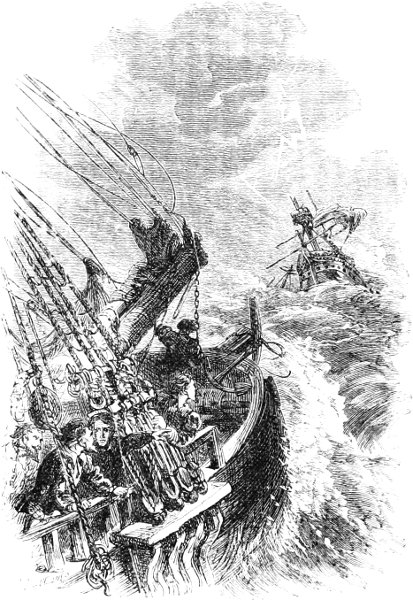
THE LOSS OF THE “SQUIRREL.”
But neither Frobisher’s mishap nor Sir Humphrey Gilbert’s melancholy fate could check that current of English enterprise which had set in for the North. There was an irresistible attraction in these remote northern seas and distant mist-shrouded lands, with all their possibilities of wealth and glory; and Arctic Discovery had already begun to exercise on the mind of the English people that singular fascination which the course of centuries has not weakened, which endures even to the present day. So, in 1585, Sir Adrian Gilbert and some other gentlemen of Devonshire raised funds sufficient to fit out a couple of vessels—the Sunshine of fifty, and the Moonshine of thirty-five tons—for the great work of discovery; and they gave the command to a veteran mariner and capable navigator, Captain John Davis, a countryman, or county-man, of their own. Towards the end of July he reached the west coast of Greenland, and its cheerless aspect induced him to christen it the “Land of Desolation.” His intercourse with the Eskimos, however, was of the friendliest character. Standing away to the north-west, he discovered and crossed the strait which still bears his name; and to the headland on its western coast he gave the name of Cape Walsingham. Having thus opened up, though unwittingly, the great highway to the Polar Sea, he sailed for England, where he arrived on the 20th of September.
In his second voyage, in 1586, when, in addition to the Sunshine and the Moonshine, he had with him the Mermaid of one hundred and twenty tons, and the North Star pinnace of ten, he retraced his route of the previous year. The Sunshine and the North Star, however, he employed in cruising along the east coast of Greenland; and they ascended, it is said, as high as lat. 80° N.
Davis in his third voyage pushed further to the north, reaching as far as the bold promontory which he named Cape Sanderson. He also crossed the great channel afterwards known as Hudson Bay.
The next Englishman who ventured into the frozen seas was one Captain Waymouth, in 1602; but he added nothing to the scanty information already acquired. An Englishman, James Hall, was the chief pilot of an expedition fitted out in 1605 by the King of Denmark, which explored some portion of the Greenland coast. He made three successive voyages; but while exhibiting his own courage and resolution, he contributed nothing to the stores of geographical knowledge.
We now arrive at a name which deservedly ranks among the foremost of Arctic explorers—that of Henry Hudson. He contributed more to our acquaintance with the Polar seas than any one who had preceded him, and few of his successors have surpassed him in the extent and thoroughness of his researches.
He first appears, says Mr. Markham, fitting out a little cock-boat for the Muscovy Company, called the Hopewell (of eighty tons), to discover a passage by the North Pole. On the 1st of May 1607 he sailed from Greenwich. “When we consider the means with which he was provided for the achievement of this great discovery, we are astonished at the fearless audacity of the attempt. Here was a crew of twelve men and a boy, in a wretched little craft of eighty tons, coolly talking of sailing right across the Pole to Japan, and actually making as careful and judicious a trial of the possibility of doing so as has ever been effected by the best equipped modern expeditions.... Imagine this bold seaman sailing from Gravesend, bound for the North Pole, in a craft about the size of one of the smallest of modern collier brigs. We can form a good idea of her general appearance, because three such vessels are delineated on the chart drawn by Hudson himself. The Hopewell was more like an old Surat buggalow than anything else that now sails the seas, with high stern, and low pointed bow; she had no head-sails on her bowsprit, but, to make up for this, the foremast was stepped chock forward. There was a cabin under the high and narrow poop, where Hudson and his little son were accommodated; and the crew were crowded forward.”
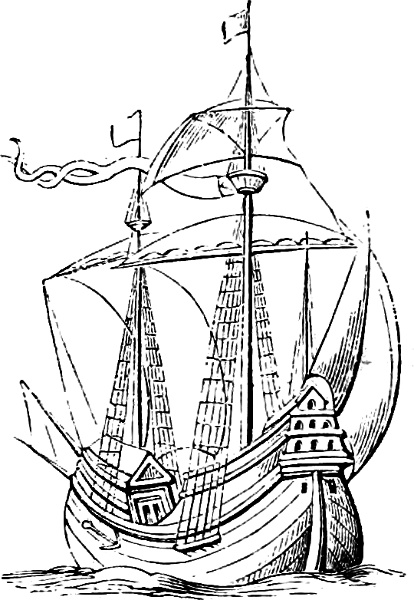
SHIP OF THE SEVENTEENTH CENTURY.
Hudson first sighted land beyond the Arctic Circle in lat. 70°. It was the cold, grim coast of East Greenland. Three degrees further north a chain of lofty peaks, all bare of snow, rose upon the horizon, and Hudson’s men noted that the temperature daily increased in mildness. Steering to the north-east, the great navigator arrived off the shores of Spitzbergen, where some of his men landed and picked up various fragments of whalebone, horns of deer, walrus-teeth, and relics of other animals. To the north-west point of Spitzbergen he gave the name which it still bears—Hakluyt’s Headland. At one time he found himself as far north as 81°; and it seems probable that he discovered the Seven Islands: he remarked that the sea was in some places green, in others blue; and he says, “Our green sea we found to be freest from ice, and our azure-blue sea to be our icy sea;” an observation not confirmed by later navigators. The greenness was probably due to the presence of minute organisms.
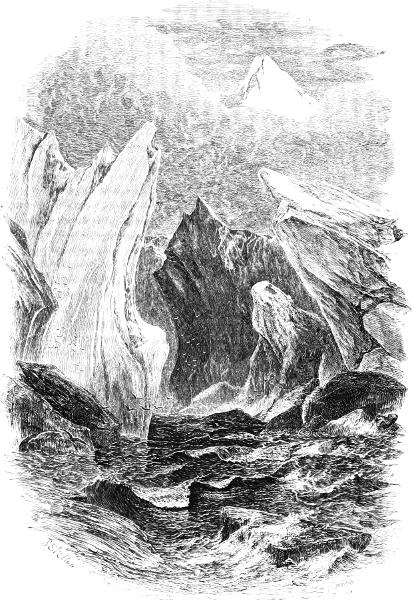
SCENERY OF JAN MAYEN.
Having completed a survey of the west coast of Spitzbergen, he resolved on sailing round the north end of Greenland, which he supposed to be an island, and returning to England by Davis Strait. With this view he again examined the sea between Spitzbergen and Greenland, but from the strong ice-blink along the northern horizon felt convinced that there was no passage in that direction. After sighting Spitzbergen, therefore, he determined to return to England; and on his homeward voyage discovered an island in lat. 71° N., which he named Hudson Sutches, and which has since been improperly named Jan Mayen. The Hopewell arrived in the Thames on the 15th of September.
The results of this voyage, says Mr. Markham, were very important, both in a geographical and a commercial point of view. Hudson had discovered a portion of the east coast of Greenland; he had examined the edge of the ice between Greenland and Spitzbergen twice—in June and in the end of July; and he had sailed to the northward of Spitzbergen until he was stopped by the ice, reaching almost as high a latitude as Scoresby in 1806, which was 81° 12′ 42″ N. Hudson’s highest latitude by observation was 80° 23’, but he sailed for two more days in a north-easterly direction. The practical consequence of his voyage was that his account of the quantities of whales and sea-horses in the Spitzbergen seas led to the establishment of a rich and prosperous fishery, which continued to flourish for two centuries.
In the following year Hudson made a second voyage, in the hope of discovering a north-eastern passage to China between Spitzbergen and Novaia Zemlaia. He exhibited his characteristic resolution, and forced his way to the very gate of the unknown region, which is still closed against human enterprise by an impenetrable barrier of ice; but all his efforts proved in vain, and he returned to Gravesend on the 26th of August.
In 1610, in a vessel of fifty-five tons, he once more entered the Polar seas, and gained the extreme point of Labrador, which he named Cape Wolstenholm. Here burst upon him the view of that magnificent sea which has since been associated with his name; and there can be no doubt that his enterprise would have anticipated the discoveries of later navigators, but for the mutiny which broke out among his crew, and eventually led to his being sent adrift, with nine faithful companions, in a small open boat. He was never again heard of.
The spirit of commercial enterprise and the love of maritime adventure were still strong enough in England to induce the equipment of further expeditions. In 1612 sailed Captain Button,—who discovered a stream, and named it Nelson River; where, at a later date, the Hudson Bay Company planted their first settlement. Here he wintered. In April 1613, on the breaking up of the ice, he resumed his work of exploration, and discovered, in lat. 65°, an island group, which he named Manuel, now known as Mansfield, Islands. Then he bore away for England, arriving in the Thames early in September.
Robert Bylot and William Baffin undertook a voyage in 1615. The latter had had some previous experience of Arctic navigation, which he turned to advantage in 1616, when he accompanied Bylot on a second expedition. Their ship, the Discovery, of fifty-five tons, reached Cape Hope Sanderson, the furthest point attained by Davis, on the 30th of May; and after meeting with some obstruction from the ice, proceeded northwards to 72° 45’, where she dropped anchor for awhile among the Women’s Islands. Baffin kept to the north until he found ice in 74° 15’ N., and he then ascended Melville Bay, touching the head of the great basin now known by his name, and sailing down its western coast. He arrived in Dover Roads on the 30th of August, after a brilliantly successful voyage, which had opened up the principal north-west channels into the Arctic Sea.
It is necessary here to interpolate a few remarks in explanation of the difficulties which beset the Baffin Bay route of Arctic exploration. Geographers assert, and the assertion seems confirmed by the experience of navigators, that a surface-current is constantly flowing down this bay, and carrying great fleets of icebergs and shoals of ice-floes into the Atlantic from its southern channels—Lancaster, Jones, and Smith Sounds. Hence, at the head of the bay there exists a considerable open and navigable expanse, which extends for some distance up Lancaster and Smith Sounds during the summer and early winter, and is known as the “North Water.” But between this open expanse and Davis Strait lies an immense mass of ice, averaging from one hundred and seventy to two hundred miles in width, and blocking up the centre of Baffin Bay, so as to interrupt the approach to the north-west end. This is known as the “middle pack,” and consists of some ancient floe-pieces of great thickness, which may have been brought down from a distant part of the Arctic seas; of a wide extent of ice accumulated during each winter, about six or eight feet in thickness; and of the grand and gigantic icebergs which are so characteristic a feature of the Melville Bay scenery. A very large quantity of this pack is destroyed in each succeeding summer by the thaws, or by the swell and warm temperature of the Atlantic as the ice drifts southward.
It is remarked of the Baffin Bay ice, that it is much lighter than that found in the Spitzbergen seas. The latter often occurs in single sheets, solid, transparent, and from twenty to thirty, and even forty, feet in thickness. In Baffin Bay the average thickness of the floes does not exceed five or six feet, and eight or ten feet is of very rare occurrence.
From Baffin’s voyage, in 1616, until 1817, no attempt was made to force this “middle pack” and enter the North Water; but now the voyage is made every year, and three routes have been opened up. The first is called the “North-about Passage,” and lies along the Greenland coast; the second, or “Middle Passage,” only possible late in the season, is by entering the drift-ice in the centre of the bay; and the third, or “Southern Passage,” also only possible late in the season, along the west side of Baffin Bay. Once in the North Water, whichever route be attempted, all obstacles to an exploration of the unknown region may be considered at an end. From Cape York to Smith Sound the sea is always navigable in the summer months.
It will thus be seen that the great highways to the Pole were discovered by William Baffin.
Our limits compel us to pass over the voyages of Stephen Bennet (1603–1610), Jonas Poole (1610–1613), and Captain Luke Fox (1631). In 1631 the merchants of Bristol despatched Captain Thomas James, but he made no additions to the discoveries of his predecessors. And then for nearly two centuries England abandoned her efforts to open up a communication between the Atlantic and the Pacific.
In 1818, however, the question of the existence of a North-West Passage once more occupied the public mind; and the British Government accordingly fitted out an exploring expedition, the Isabella and the Alexander, under the command of Captain Ross and Lieutenant Parry.
They sailed from England on the 18th of April, reached the southern edge of the Baffin Bay ice on the 2nd of July, and, after a detention of thirty-eight days, reached the North Water on August 8th. The capes on each side of the mouth of Smith Sound, Ross named after his two ships; and having accomplished this much, he affirmed that he saw land against the horizon at a distance of eight leagues, and then retraced his course, and sailed for England.
The British Government, however, refused to be discouraged by the failure of an expedition which had obviously been conducted with an entire absence of vigour and enterprise. They therefore equipped the Hecla and the Griper, and gave the command to Lieutenant Parry; who sailed from the Thames on the 5th of May 1819, and on the 15th of June sighted Cape Farewell. Striking northward, up Davis Strait and Baffin Bay, he found himself checked by the ice-barrier in lat. 73° N. A man of dauntless resolution, he came to the determination of forcing a passage at all hazards; and in seven days, by the exercise of a strong will, great sagacity, and first-rate seamanship, he succeeded in carrying his ships through the pack of ice, which measured eighty miles in breadth.
He was then able to enter Sir James Lancaster Sound; and up this noble inlet he proceeded with a fair wind, hopeful of entering the great Polar Sea. But after advancing a considerable distance, he was once more met by the frozen powers of the North, and this time he was forced to own himself vanquished. He accordingly returned towards the south, discovering Barrow Strait; and, more to the westward, an inlet which has since figured conspicuously in Arctic voyages—Wellington Channel. Bathurst Island he also added to the map; and afterwards he came in sight of Melville Island. On the 4th of September he attained the meridian of 110° W. long., and thus became entitled to the Parliamentary grant of £5000. A convenient harbour in the vicinity was named the “Bay of the Hecla and the Griper,” and here Lieutenant Parry resolved upon passing the winter.
In the following spring he resumed his adventurous course, and completed a very careful survey of the shores of Baffin Sea; after which he repaired to England, and reached the Thames in safety, with his crews in good health, and his ships in excellent condition, about the middle of November 1820.
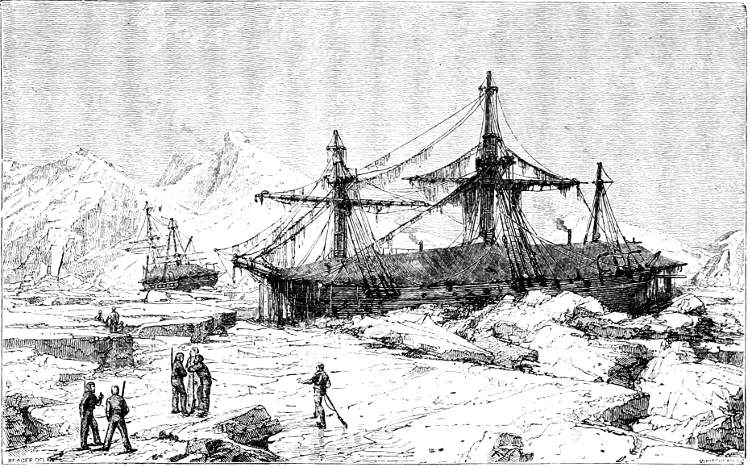
THE “HECLA” AND “FURY” WINTERING AT WINTER ISLAND.
Having done so much and so well, it was natural that Captain Parry should again be selected for employment in the Arctic seas in the following year. He hoisted his flag in his old ship, the Hecla, and was accompanied by the Fury; both vessels being equipped in the most liberal manner. He sailed from the Nore on the 8th of May 1821; he returned to the Shetland Islands on the 10th of October 1823. In the interval, a period of seven-and-twenty months, he discovered the Duke of York Bay, the numerous inlets which break up the northern coast-line of the American continent, Winter Island, the islands of Anatoak and Ooght, the Strait of the Fury and Hecla, Melville Peninsula, and Cockburn Island. During their winter sojourn on Winter Island, the English crews were surprised by a visit from a party of Eskimos, whose settlement Captain Parry visited in his turn. He found it an establishment of five huts, with canoes, sledges, dogs, and above sixty men, women, and children, as regularly, and, to all appearance, as permanently fixed as if they had occupied the same spot the whole winter. “If the first view,” says Parry, “of the exterior of this little village was such as to create astonishment, that feeling was in no small degree heightened on accepting the invitation soon given us to enter these extraordinary houses, in the construction of which we observed that not a single material was used but snow and ice. After creeping through two low passages, having each its arched doorway, we came to a small circular apartment, of which the roof was a perfect arched dome. From this three doorways, also arched, and of larger dimensions than the outward ones, led into as many inhabited apartments—one on each side, and the other facing us as we entered. The interior of these presented a scene no less novel than interesting: the women were seated on the beds at the sides of the huts, each having her little fireplace or lamp, with all her domestic utensils about her. The children crept behind their mothers, and the dogs shrank past us in dismay. The construction of this inhabited part of the hut was similar to that of the outer apartment,—being a dome, formed by separate blocks of snow laid with great regularity and no small art, each being cut into the shape requisite to form a substantial arch, from seven to eight feet high in the centre, and having no support whatever but what this principle of building supplies. Sufficient light was admitted into these curious edifices by a circular window of ice, neatly fitted into the roof of each apartment.”
In 1824–25 Captain Parry undertook a third voyage, but with less than his usual success. The Fury was driven ashore by the pressure of the pack-ice, and so damaged, that Parry found it needful to abandon her, and remove her crew and stores to the Hecla.
THE “FURY” ABANDONED BY PARRY—1824.
Sir John Parry’s fourth and last expedition, in 1827, was characterized by his bold attempt to cross the icy sea in light boats and sledges; resorting to the former when his progress was interrupted by pools of water, and to the latter in traversing the unbroken surface of the ice-fields. He was soon compelled, however, to abandon the sledges, on account of the hummocks and irregularities of the ice.
We agree with Mr. Cooley, that voluntarily to undertake the toil and brave the danger of such an expedition, required a zeal little short of enthusiasm. When the travellers reached a water-way, they were obliged to launch their boats and embark. On reaching the opposite side, their boats were then to be dragged, frequently up steep and perilous cliffs, their lading being first removed. By this laborious process, persevered in with little intermission, they contrived to accomplish eight miles in five days. They travelled only during the night, by which means they were less incommoded with snow-blindness; they found the ice more firm and consistent; and had the great advantage of lying down to sleep during the warmer portion of the twenty-four hours. Shortly after sunset they took their breakfast; then they laboured for a few hours before taking their principal meal. A little after midnight, towards sunrise, they halted as if for the night, smoked their pipes, looked over the icy desert in the direction in which the journey was to be resumed; and then, wrapping themselves in their furs, lay down to rest. Advancing as far north as 82° 40’, they were then compelled by the drifting of the snow-fields to retrace their steps. They regained their ships on the 21st of August, and sailed for England.
We must now go back a few years. In May 1819, an overland expedition was despatched to ascertain the exact position of the Coppermine River, to descend it to its mouth, and to explore the coast of the Arctic Sea on either hand. The command was given to Lieutenant Franklin, who was accompanied by Dr. Richardson the naturalist, by Messrs. Hood and Back, two English midshipmen, and two picked seamen. The expedition was spread over a period of two years and a half, and the narrative of what was accomplished and endured by its members reads like a romance. They reached the mouth of the Coppermine, and then launched their little barks on the chill waters of the Polar Sea. With much perseverance, and after encountering some serious obstacles, they made their way along its shores in a westerly direction as far as Point Turnagain, in lat. 68° 30’ N. Between this headland on the east, and Cape Barrow on the west, opens a deep gulf, stretching inland as far as the Arctic Circle, Franklin named it George the Fourth’s Coronation Gulf; and describes it as studded with numerous islands, and indented with sounds affording excellent harbours, all of them supplied with small rivers of fresh water, abounding with salmon, trout, and other fish.
Passing over Franklin’s after-labours in the great cause of Arctic Discovery, labours which secured him the well-merited reward of knighthood, we come to that last voyage, which helped, as we shall see, to solve the problem of a North-West Passage, but was the cause of one of the saddest chapters in the history of Maritime Enterprise.
It was in the spring of 1845 that Sir John Franklin, in command of the Erebus and the Terror, with Captain Crozier, an experienced Arctic navigator, as his lieutenant, and at the head of one hundred and thirty-seven picked seamen, brave, resolute, and hardy, once more sailed for the Polar waters.
On the 8th of June he left the Orkneys, and a month later arrived in Baffin Bay. About the end of July some whaling-ships in Melville Bay saw the Erebus and Terror contending gallantly with the ice which impeded their progress to Lancaster Sound. On the evening of the 26th the ice opened up, and the two discovery-ships sailed away into the north-western seas.
Two years passed, and no news reached England of Franklin and his companions. As day succeeded day, and week followed week, and still no tidings came, men grew anxious, and then alarmed; “expectation darkened into anxiety, anxiety into dread.” At last, it was determined to institute a search for the missing heroes. An expedition was sent out under Sir James Ross; another under Sir John Richardson; but neither obtained any information. By many all hope was then abandoned; and the fate of Franklin was regarded as one of those mysteries which the historian in vain attempts to unravel. He and his men had perished; of that there could be no reasonable doubt. Yet a few were sanguine enough to believe that they had taken refuge among the Eskimos, or were dragging out a weary existence in some remote wilderness, in expectation of help from home. Franklin’s brave and noble wife was one of those who, whatever they feared or hoped, were, at all events, determined not to rest until some accurate information had been gained. And round her gathered the most eminent scientific men of the day, whose influence combined with the general sympathy of the people to encourage the Government in a further effort.
It was in 1850 that the first clue to the position of the Erebus and Terror was secured in Beechey Island, through the accidental detention there of the searching expeditions of Captains Austin and Penny.
They were bound for Melville Island, but on reaching the entrance of Wellington Channel (August 1850), were met by such immense fields of ice sweeping down it and out of Barrow Strait, that they were glad to seek shelter in a great bay at the eastern end of the channel,—a bay almost bisected, as it were, by Beechey Island. On the 23rd, a boat from Captain Ommaney’s ship, the Assistance, happened to land on one of the extreme points of the bay; and the crew, in the course of their wanderings, were not a little surprised to discover traces of a former visit from Europeans. Under the lofty cliff of Cape Riley they came upon the groundwork of a tent, scraps of canvas and rope, a quantity of birds’ bones and feathers, and a long-handled rake which, apparently, had been used for collecting the rich rare weeds that cover the bottom of the Arctic waters.
That Europeans had been encamped there, was certain, but not a name or record associated the remains with Franklin’s expedition. News of the discovery, however, reached Captain Penny, an Aberdeen seaman, who had been employed by the British Admiralty as leader of a separate expedition; and in conjunction with Lieutenant de Haven, of the United States Navy, who was in command of the expedition liberally equipped by Mr. Grinnell, of New York, he resolved to examine the east coast of Wellington Channel with minute care, in the belief that some memorials of Franklin would thus be discovered.
From a point called Cape Spenser, the Americans, on foot, pursued the trail of a sledge up the east side of Wellington Channel, until, at one day’s journey beyond Cape Innis, it suddenly ceased, as if the party had there turned back again. A bottle and a piece of The Times newspaper were the only relics which fell into the hands of the searchers. Meantime, Captain Penny had anchored his ships under the western point of Beechey Island, and despatched a boat to take up the clue at Cape Riley, and follow it to the eastward, in the event of the traces being those of a party retreating from the ships, supposing them to have been ice-bound in the north-west, to Baffin Bay. This boat-party eventually returned unsuccessful; but, one afternoon, some men belonging to the Lady Franklin asked leave, and obtained it, for the purpose of a ramble over Beechey Island. They sauntered along towards the low projecting portion of the island which extends northward, choosing a convenient spot to cross the huge ridges of ice which lay piled up along the beach; they were seen to mount the acclivity or backbone of the point. In a minute afterwards their friends on board the ships (says Admiral Sherard Osborn) saw the party rush simultaneously towards a dark object, round which they collected, with signs of great excitement. Presently one ran hither, one thither. Feverish with anxiety, those on board knew immediately that some fresh traces had been found, and a general sortie took place to Beechey Island. “Eh, sir,” said a gallant Scotch mariner, when relating the discovery—“eh, sir, my heart was in my mouth, and I didna ken I could rin so fast afore.”
And what had been found?
A cairn, of a pyramidal form, which had evidently been constructed with much care. The base consisted of a series of preserved-meat tins, filled with gravel and sand; and more tins were so arranged as to taper gradually upwards to the summit of the cairn, in which was planted the fragment of a broken boarding-pike. To all appearance it had been purposely raised for the reception of some documental record, yet nothing could be found in or about the spot, in spite of the most persevering efforts. But presently looking along the northern slope of the island, other strange objects caught the eye. Another rush of anxious excited beings, and they stood before three graves; and many of them brushed away the unwonted tear as they read upon their humble tablets the words Erebus and Terror.
Captain Austin followed up Captain Penny in his explorations of the Arctic wastes, but no further information was obtained of Franklin’s movements. It was impossible to determine whether on his way home he had perished in Baffin Bay; whether he had struck to the north-west by Wellington Channel; or whether he was haply imprisoned in Melville Island.
We have no space, nor is it necessary, to dwell on the records of the various searching expeditions fitted out by the Government, or by Lady Franklin and her friends. It must be noted, however, that one of these, led by Captain (afterwards Sir) Robert M’Clure, succeeded in accomplishing the enterprise in which Franklin perished, and, entering the Northern Ocean by Behring Strait, actually forced its way, through snow and ice, into the Atlantic. The North-West Passage, so long sought, was thus discovered; but the discovery, though interesting and valuable from a geographical point of view, was followed by no commercial results. In truth, it proved that the route along the north-west of the American Continent could never be practicable for ordinary vessels.
It may be asserted that nearly all men had abandoned hope and expectation of ascertaining any exact particulars of the fate of Franklin and his followers, when, towards the close of the autumn of 1854, Dr. Rae, a well-known traveller and Arctic explorer, suddenly appeared in England, bringing with him the most curious evidence of the disasters which had overwhelmed a party that had evidently been travelling from the ice-bound Erebus and Terror towards the Great Fish River. Dr. Rae had ascertained from some Eskimos with whom he had been travelling that this party numbered forty persons, and that all had died of starvation four years prior to Dr. Rae’s visit. The unfortunate “white men” had been first seen on King William’s Land; later in the same year their dead bodies had been observed near or about the mouth of the Great Fish River (1850). Dr. Rae brought home numerous pieces of silver plate obtained from the Eskimos, which were marked with the names of officers of the two ships. Lady Franklin was encouraged by this intelligence to urge upon the Government the propriety of despatching an expedition to the points indicated by the Eskimos; but the Government contented themselves with applying to the Hudson Bay Company. The result was an overland expedition in 1855 to the mouth of the Great Fish River, by Mr. Anderson, one of the Company’s chief officers. He had no boat with him capable of reaching King William’s Land, though it was only sixty miles distant from the point he attained, nor was he accompanied by an Eskimo interpreter. He ascertained, however, that only a portion of the officers and men of the Erebus and Terror had reached the Great Fish River—some forty of them, very possibly, as Dr. Rae had been informed; these forty, with the three graves upon Beechey Island, still leaving ninety-five persons unaccounted for.
Lady Franklin and her friends continued to press upon Government the need for further inquiry; but finding the responsible ministers unwilling to interfere in what they had come to consider a hopeless enterprise, they contrived, with some help from the public, to purchase and fit out a strongly-built screw-schooner, of which Captain M’Clintock volunteered to take the command.
He sailed from England in the summer of 1857; reached Melville Bay in safety, but was then held fast by the floating ice. The winter, however, came and went without any injury to him and his gallant band; and on the 27th of July 1858, the Fox stretched across to Lancaster Sound. On the 11th of August she arrived at Beechey Island, and replenished her diminished stores from the depôts left there by previous expeditions. Then she pushed to the westward, past Cape Hotham and Griffith Island, southward through Sir Robert Peel Channel, and so into Prince Regent Inlet. Having arrived off the eastern entrance of Bellot Strait, she found it blocked up by a wall of ice, and from the 20th of August to the 6th of September she watched for an opportunity of breaking through it. On the 6th she made the passage, but only to find the other end obstructed by an impassable ice-barrier; and, after five fruitless attempts, her captain brought her to anchor for the winter in Port Kennedy, on the northern side of the strait.
When the new year opened, M’Clintock resolved on undertaking sledge excursions in various directions, with the view of obtaining some information of Franklin and his expedition. In one of them, at Cape Victoria, on the west coast of Boothia (lat. 69° 50’ N., long. 96° W.), he ascertained from the natives that, several years previously, a ship had been wrecked off the northern shores of King William’s Land; that all her crew landed safely, and set off on a journey to the Great Fish River, where they died. Again: in April, falling in with the same party of Eskimos, they learned further, that besides the ship which had sunk in deep water, another had been driven ashore by the ice. Captain M’Clintock thereupon crossed to Montreal Island, travelled round the estuary of the Great Fish River, and visited Point Ogle and Barrow Island. On May 7, he fell in with an old Eskimo woman, who told him that many of the white men dropped by the way as they made towards the Great Fish River; that some were buried, and some were not. Proceeding in what he conceived to have been the route of the retreating crews, he discovered, near Point Herschel, a bleached skeleton; evidently that of one who had fallen behind the main body, from weakness and fatigue, and had died where he had fallen.
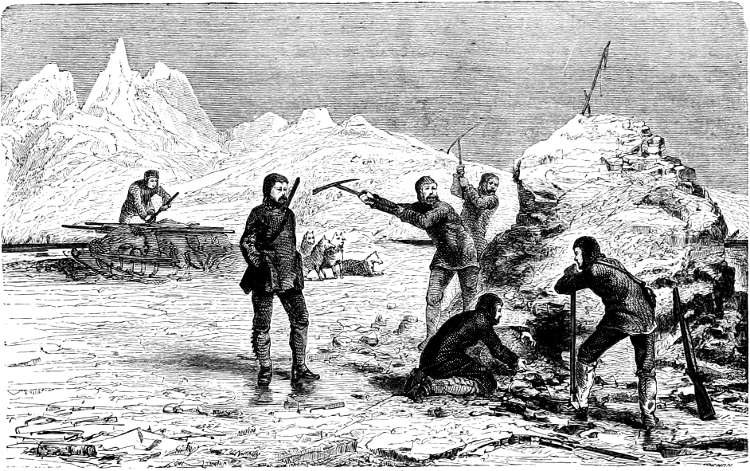
DISCOVERY OF THE CAIRN CONTAINING SIR JOHN FRANKLIN’S PAPERS.
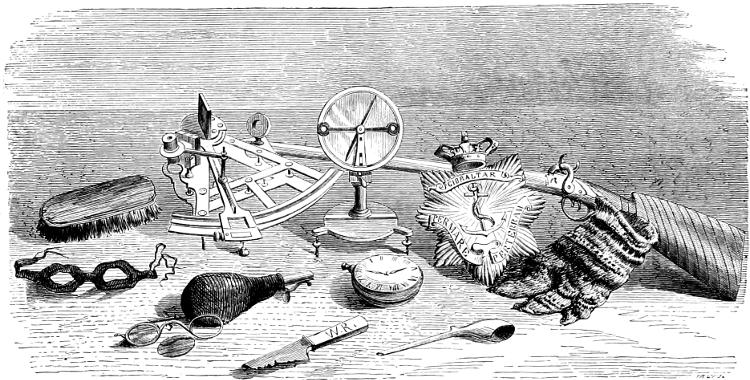
RELICS OF THE FRANKLIN EXPEDITION BROUGHT BACK TO ENGLAND.
Meanwhile, Lieutenant Hobson, who had started with another sledging party, had made the important discovery of a record, giving a brief account of the Franklin expedition up to the time when the ships were lost. It was found within a cairn constructed on Point Victory, and it set forth the following particulars:—
The Erebus and Terror spent their first winter at Beechey Island, in the spot discovered by Penny and Austin’s expedition; but they had previously explored Wellington Channel as far as 73° N., and passed down again into Barrow Strait, between Cornwallis and Bathurst Land. In 1846 the two ships seem to have sailed through Peel Channel, until caught in the ice off King William’s Land, on the 12th of September. In May 1847, Lieutenant Graham Gore and Mr. des Vœux landed, and erected a cairn a few miles south of Point Victory, and deposited in it a document which stated that, on that day, all were well, with Sir J. Franklin in command. Within a month, however, that illustrious navigator died (June 11), and thus was spared the terrible trials which afflicted his followers. The ice did not move, and the winter of 1847–48 closed in upon them. It proved fatal to nine officers and fifteen men. On April 22, 1848, the two ships, which had been imprisoned for upwards of nineteen months, were deserted, and the officers and crews, one hundred and five in number, under the command of Captains Crozier and Fitzjames, started for the Great Fish River.
At the cairn and all about it lay a great quantity of clothing and other articles, which the sufferers had found from experience of three days to be a heavier weight than their enfeebled strength was able to drag.
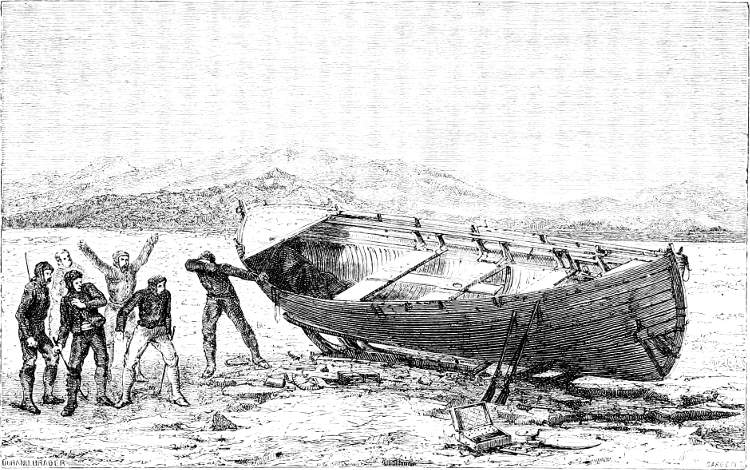
DISCOVERY OF ONE OF THE BOATS OF THE FRANKLIN EXPEDITION.
From this point to a spot about midway between Point Victory and Point Herschel nothing of much importance was discovered, and the skeletons as well as relics were deeply embedded in snow. At this midway station, however, the top of a piece of wood projecting out of the snow was seen by Lieutenant Hobson, and on digging round it a boat was discovered. It stood on a very heavy sledge, and within it were a couple of skeletons. The one in the bottom of the stern-sheets was covered with a great quantity of thrown-off clothing; the other, in the bows, seemed to have been that of some poor fellow who had crept there to look out, and in that position fallen into his last sleep. A couple of guns, loaded and ready cocked, stood upright to hand, as it they had been prepared for use against wild animals. Around this boat was another accumulation of cast-off articles; and it was the belief of M’Clintock that the party in charge of her were returning to the ships, as it they discovered their strength unequal to the terrible journey before them. It may be assumed, however, that the stronger portion of the crews still pushed on with another boat, and that some reached Montreal Island and ascended the Great Fish River.
The point, says Sherard Osborn, at which the fatal imprisonment of the Erebus and Terror in 1846 took place, was only ninety miles from the spot reached by Dease and Simpson in their boats in 1838–39, coming from the east. Ninety miles more of open water, and Franklin and his gallant crew would have not only won the prize they sought, but reached their homes to wear their well-earned honours. “It was not to be so. Let us bow in humility and awe to the inscrutable decrees of that Providence who ruled it otherwise. They were to discover the great highway between the Pacific and the Atlantic. It was given them to win for their country a discovery for which she had risked her sons and lavishly spent her wealth through many centuries; but they were to die in accomplishing their last great earthly task: and, still more strange, but for the energy and devotion of the wife of their chief and leader, it would in all probability never have been known that they were indeed the First Discoverers of the North-West Passage.”
We have thought it for the convenience of our readers to set before them an uninterrupted narrative of the exertions made to ascertain the fate of Franklin and his companions by English seamen under English influence; but we must now return to 1853, to chronicle the American expedition under Dr. Kane—which did not, indeed, succeed in its primary object, but made some remarkable additions to our knowledge of the Polar Regions.
Dr. Elisha Kane sailed from Boston in 1853, in command of the Advance, with a crew of seventeen officers and men, to whom two Greenlanders were subsequently added.
On the 7th of August he passed the two great headlands which guard the entrance of Smith Sound,—Cape Isabella and Cape Alexander, discovered and named in the preceding year by Captain Inglefield,—and after a voyage of equal difficulty and danger reached Rensselaer Bay on the east coast of the sound, where he passed the winter. A few extracts from his diary will show under what conditions, and in what circumstances, Kane and his followers passed the long and dreary winter months:—
“October 28th.—The moon has reached her greatest northern declination of about 25° 35’. She is a glorious object; sweeping around the heavens, at the lowest part of her curve, she is still 14° above the horizon. For eight days she has been making her circuit with nearly unvarying brightness. It is one of those sparkling nights that bring back the memory of sleigh-bells and songs, and glad communings of hearts in lands that are far away.
“November 7th.—The darkness is coming on with insidious steadiness, and its advances can only be perceived by comparing one day with its fellow of some time back. We still read the thermometer at noonday without a light, and the black masses of the hills are plain for about five hours, with their glaring patches of snow; but all the rest is darkness. The stars of the sixth magnitude shine out at noonday. Except upon the island of Spitzbergen, which has the advantages of an insular climate, and tempered by ocean-currents, no Christians have wintered in so high a latitude as this. They are Russian sailors who made the encounter there—men inured to hardships and cold. Our darkness has ninety days to run before we shall get back again even to the contested twilight of to-day. Altogether our winter will have been sunless for one hundred and forty days.
“December 15th.—We have lost the last vestige of our mid-day twilight. We cannot see print, and hardly paper; the finger’s cannot be counted a foot from the eyes. Noonday and midnight are alike; and, except a vague glimmer in the sky that seems to define the hill outlines to the south, we have nothing to tell us that this Arctic world of ours has a sun. In the darkness, and consequent inaction, it is almost in vain that we seek to create topics of thought, and, by a forced excitement, to ward off the encroachments of disease.”
But in due time the long Arctic night passed away, and the season came round for undertaking the sledge journeys which were the main object of the expedition. But Dr. Kane was then met by a new difficulty. Out of the nine splendid Newfoundland and thirty-five Eskimo dogs which he had originally possessed, only six had survived a peculiar malady that had seized them during the winter; and though some fresh purchases were made from the Eskimos who visited Rensselaer Harbour early in April, his means of transport remained wholly inadequate.
Kane, moreover, who though strong of heart was weak of body, had suffered much from the rigour of the climate, and was in a sadly feeble condition when, on the 25th of April 1854, he started on his northward journey. He found the Greenland coast, as he ascended Kane Sea, full of romantic surprises; the cliffs rising to a height of ten hundred and eleven hundred feet, and presenting the boldest and most fantastic outlines. This character is continued as far as the Great Humboldt Glacier. The coast is indented by four great bays, all of them communicating with deep gorges, which are watered by streams from the interior ice-fields. The mean height of the table-land, till it reaches the bed of the Great Glacier, Dr. Kane estimated, in round numbers, at 900 feet; its tallest summit near the water at 1300, and the rise of the background above the general level at 600 more. The face of this stupendous ice-mass, as it defined the coast, was everywhere an abrupt and threatening precipice, only broken by clefts and deep ravines, giving breadth and interest to its wild expression.
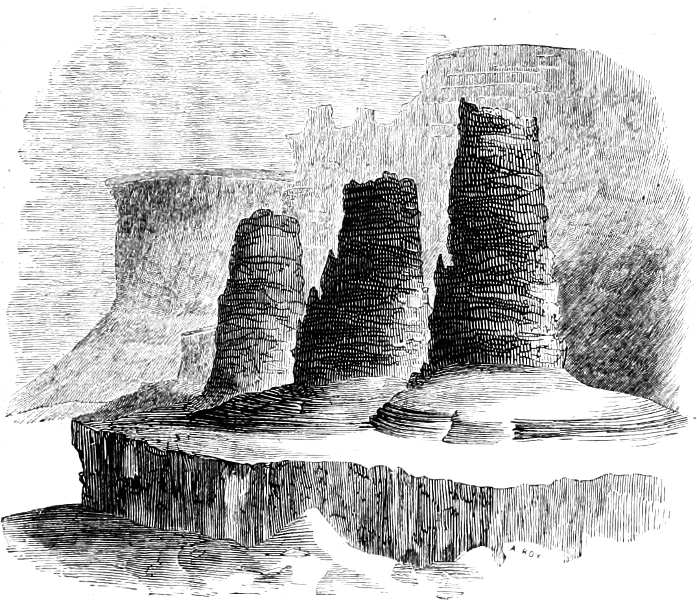
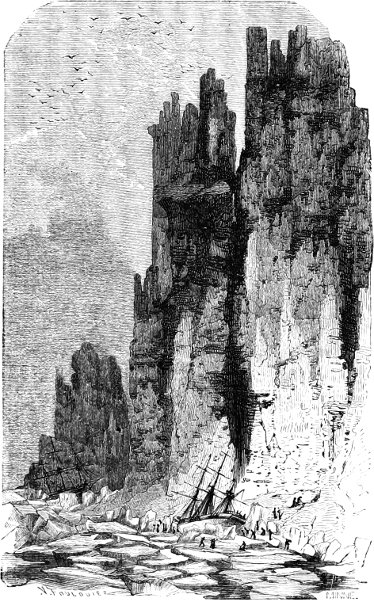
THE “THREE BROTHER TURRETS.”
Dr. Kane informs us that the most picturesque portion of the coast occurs in the neighbourhood of Dallas Bay. Here the red sandstones contrast very favourably with the blank whiteness, and associate the warm colours of more southern lands with the cold tints of the Arctic scenery. The seasons have acted on the different layers of the cliff so as to give them all the appearance of jointed masonry, and the narrow stratum of greenstone at the top surmounts them with boldly-designed battlements. To one of these “interesting freaks of Nature” Kane gave the name of the “Three Brother Turrets.” The crumbled ruin at the foot of the coast-wall led up, like an artificial causeway, to a ravine that blazed at noonday with the glow of the southern sun, when everywhere else the rock lay in blackest shadow. Just at the edge of this lane of light rose the semblance of a castle, flanked with triple towers, completely isolated and defined. These were the Three Turrets.
Still further to the north, a solitary cliff of greenstone, marked by the slaty limestone that once encased it, sprang from a mass of broken sandstone, like the rough-hewn rampart of an ancient city. At its northern extremity, on the brink of a deep ravine, wrought out among the ruin, stood a solitary column, or minaret-tower, the pedestal of which was not less than 280 feet in height, while the shaft was fully 480 feet. Dr. Kane associated this remarkable beacon with the name of the poet Tennyson.
Dr. Kane continued his advance, and on the 4th of May approached the Great Glacier. This progress, however, was dearly earned. Owing to the excessive cold and labour, most of his party suffered from painful prostration; three were attacked with snow-blindness; and all were troubled with dropsical swellings. Off Cape Kent, while taking an observation for latitude, Kane himself was seized with a sudden pain, and fainted. His limbs became rigid. He was strapped upon the sledge, and insisted that the march should be continued. But, on the 5th, he grew delirious, and fainting every time that he was taken from the tent to the sledge, he succumbed entirely.
“My comrades,” writes this heroic man, than whom no braver or more resolute spirit ever ventured into the dreary Northern wilds, “would kindly persuade me that, even had I continued sound, we could not have proceeded on our journey. The snows were very heavy, and increasing as we went; some of the drifts perfectly impassable, and the level floes often four feet deep in yielding snow. The scurvy had already broken out among the men, with symptoms like my own; and Morton, our strongest man, was beginning to give way. It is the reverse of comfort to me that they shared my weakness. All that I should remember with pleasurable feeling is, that to five brave men, themselves scarcely able to travel, I owe my preservation.”
They carried him back to the brig at Rensselaer Harbour, and for several days he lay fluctuating between life and death. As the summer came on, however, his health slowly improved; and though unable to undertake any sledge excursions in person, he organized a series of expeditions in which his stronger companions took part. Dr. Hayes crossed the strait in a north-easterly direction, reached the opposite coast of Grinnell Land, where the cliffs varied from 1200 to 2000 feet in height, and surveyed it as far as Cape Fraser, in lat. 79° 45’.
He returned on June 1st, and, a few days later, Morton departed to survey the Greenland shore beyond the Humboldt Glacier. His journey was a difficult one, for the obstacles offered by the ice hummocks were sometimes almost insurmountable, and the ice-field was intersected by chasms and water-lanes frequently four feet in width. After skirting the coast of what is now known as Morris Bay, Morton’s party came upon easier ground; and presently a long low country opened on the land-ice, a wide plain between large headlands, with rolling hills through it. A flock of brent geese came down this valley, with a whirr of wings, and ducks were seen in crowds upon the open water. Eiders and dove-kies also made their appearance; and tern were very numerous, and exceedingly tame. Flying high overhead, their notes echoing from the rocks, were large white birds, which Morton supposed to be burgomasters. There were also ivory gulls and mollemokes; the former flying very high, and the latter winging their way far out to sea.
The channel (Kennedy Channel) was here unobstructed by ice, and its waves rolled freely and noisily on the shore. Along its verdant margin Morton proceeded warily, and on the 26th of June, 1854, reached the striking headland of Cape Constitution, about 2000 feet in height. Its base was washed by a tremendous surf, through which it was impossible to pass—the ne plus ultra, as it seemed, of human enterprise. Climbing from rock to rock, he contrived to reach an elevation of 300 feet; from which he was able to trace the outline of the coast for fifty miles to the north. In the distance rose a range of mountains, very lofty, and rounded at their summits. To the north-west might be seen a bare peak, striated vertically with protruding ridges, and soaring to an altitude of between 2500 and 3000 feet. This peak, the most remote northern land then known upon the globe, was named after the great pioneer of Arctic travel, Sir Edward Parry.
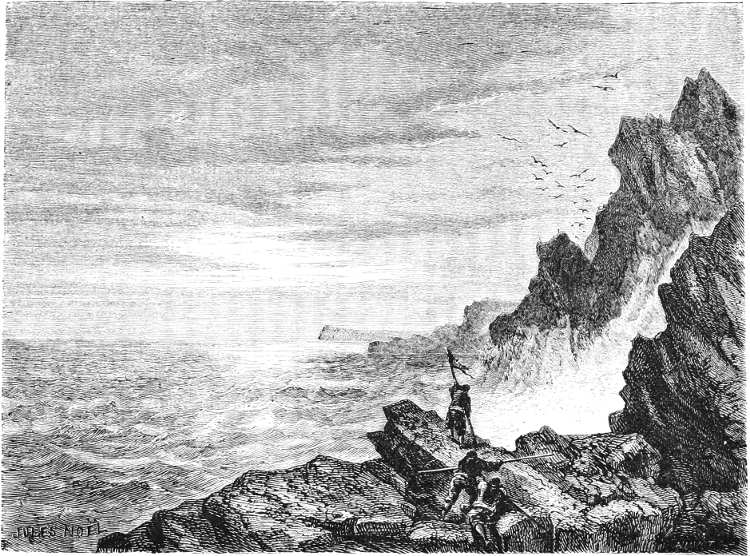
MORTON ON THE SHORE OF THE SUPPOSED POLAR OCEAN.
The range (Victoria and Albert Mountains) with which it was connected was much higher, Morton thought, than any they had seen on the southern or Greenland side of the bay. The summits were generally rounded, resembling a succession of sugar-loaves and stacked cannonballs declining slowly in the perspective.
All the sledge-parties were now once more aboard the brig, and the season of Arctic travel had ended. The short summer was rapidly wearing away, and yet the ice remained a rigid and impenetrable barrier. It was evident that the ship could not be liberated, and Kane found himself compelled to decide between two equally dismal alternatives,—the abandonment of the ship, or another winter among the Polar snows. For himself, he resolved to remain; but to those who were willing to venture on the attempt to reach the Danish settlement at Upernavik, he left the choice open. Out of the seventeen survivors of the party, eight, like Dr. Kane, decided to stand by the brig; the others, to push southward to Upernavik. These were provided with all the provisions and appliances that could be spared, and took their departure on Monday, August 28th; carrying with them a written assurance of a brother’s welcome should they be driven back—an assurance amply redeemed when severe trials had prepared them to share again the fortunes of their commander.
Dr. Kane confronted the winter with equal sagacity and resolution. He had carefully studied the Eskimos, and concluded that their form of habitation and peculiarities of diet, without their unthrift and filth, were the safest that could be adopted. He turned the brig, therefore, into a kind of igloë, or hut. The quarter-deck was well padded with moss and turf, and the cabin below, a space some eighteen feet square, was enclosed and packed from floor to ceiling with inner walls of the same material. The floor itself was carefully calked with plaster of Paris and common paste, and covered two inches deep with Manilla oakum and a canvas carpet. The entrance was from the hold by a low, moss-lined tunnel, the tossut of the native huts, with as many doors and curtains to close it up as ingenuity could devise. This was their sitting-room, dining-room, sleeping-room; but there were only ten of them, and the closer the warmer.
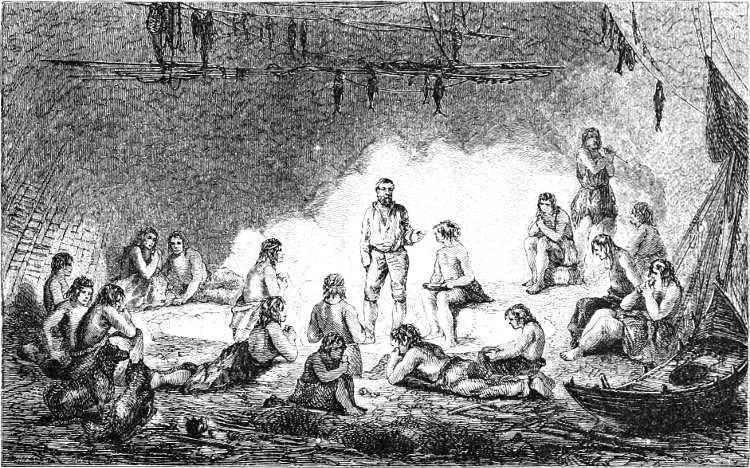
DR. KANE PAYING A VISIT TO AN ESKIMO HUT AT ETAH.
While they were engaged in these defences against the enemy, they contrived to open up a friendly intercourse with the Eskimos, visiting them in their snow-huts at the settlements of Etah and Anatoak, distant about thirty and seventy miles from the brig; and, in return for presents of needles, pins, and knives, they undertook to show the white strangers where game was to be procured, as well as to furnish walrus and fresh seal meat. The assistance rendered by the Eskimos was of the greatest value, and we may infer that, without it, Dr. Kane and his followers must have succumbed to the hardships of that dreadful winter.
On the 12th of December, the party which had abandoned the ship suddenly reappeared, finding it impossible to penetrate to the south. They had suffered severely; were covered with rime and snow, and fainting with hunger. It was necessary to use much caution in conveying them below; for after an exposure of such fearful intensity and duration as they had undergone, the warmth of the cabin would have prostrated them completely. They had journeyed three hundred and fifty miles; and their last run from the bay near Etah, some seventy miles in a right line, was through the hummocks with the thermometer at -50°. “One by one,” says Kane, “they all came in and were housed. Poor fellows! as they threw open their Eskimo garments by the stove, how they relished the scanty luxuries which we had to offer. The coffee, and the meat-biscuit soup, and the molasses, and the wheat-bread, even the salt pork, which our scurvy forbade the rest of us to touch—how they relished it all! For more than two months they had lived on frozen seal and walrus meat.”
We cannot dwell on the various little incidents which marked that sad and terrible winter, but an extract or two from Dr. Kane’s journal will show the reader how much the imprisoned explorers endured, and in what spirit they bore their trials:—
“December 1, Friday.—I am writing at midnight. I have the watch from eight to two. It is day in the moonlight on deck, the thermometer getting up again to 36° below zero. As I come down to the cabin—for so we still call this little moss-lined igloë of ours—every one is asleep, snoring, gritting his teeth, or talking in his dreams. This is pathognomonic; it tells of Arctic winter, and its companion, scurvy. Tom Hickey, our good-humoured, blundering cabin-boy, decorated with the dignities of cook, is in that little dirty cot on the starboard side; the rest are bedded in rows. Mr. Brooks and myself chock aft. Our bunks are close against the frozen moss-wall, where we can take in the entire family at a glance. The apartment measures twenty feet by eighteen; its height six feet four inches at one place, but diversified elsewhere by beams crossing at different distances from the floor. The avenue by which it is approached is barely to be seen in the moss-wall forward; twenty feet of air-tight space make misty distance, for the puff of outside temperature that came in with me has filled our atmosphere with vesicles of vapour. The avenue—Ben-Djerback is our poetic name for it—closes on the inside with a door well-patched with flannel, from which, stooping upon all fours, you back down a descent of four feet in twelve through a tunnel three feet high, and two feet six inches broad. Arrived at the bottom, you straighten yourself, and a second door admits you into the dark and sorrowing hold, empty of stores, and stripped to its naked ceiling for firewood. From this we grope our way to the main hatch, and mount by a rude stairway of boxes into the open air.”
“February 21, Wednesday.—To-day the crests of the north-east headland were gilded by true sunshine, and all who were able ascended on deck to greet it. The sun rose above the horizon, though still screened from our eyes by intervening hills. Although the powerful refraction of Polar latitudes heralds his direct appearance by brilliant light, this is as far removed from the glorious tints of day as it is from the mere twilight. Nevertheless, for the past ten days we have been watching the growing warmth of our landscape, as it emerged from buried shadow, through all the stages of distinctness of an India-ink washing, step by step, into the sharp, bold definition of our desolate harbour scene. We have marked every dash of colour which the great Painter in his benevolence vouchsafed to us; and now the empurpled blue, clear, unmistakable, the spreading lake, the flickering yellow; peering at all these, poor wretches! everything seemed superlative lustre and unsurpassable glory. We had so grovelled in darkness, that we oversaw the light.
“Mr. Wilson has caught cold, and relapsed. Mr. Ohlsen, after a suspicious day, startles me by an attack of partial epilepsy; one of those strange, indescribable spells, fits, seizures, whatever name the jargon gives them, which indicate deep disturbance. I conceal his case as far as I can; but it adds to my heavy pack of troubles to anticipate the gloomy scenes of epileptic transport introduced into our one apartment.”
“February 28, Wednesday.—February closes: thank God for the lapse of its twenty-eight days! Should the thirty-one of the coming March not drag us further downward, we may hope for a successful close to this dreary drama. By the 10th of April we should have seal; and when they come, if we remain to welcome them, we can call ourselves saved.
“But a fair review of our prospects tells me that I must look the lion in the face. The scurvy is steadily gaining on us. I do my best to sustain the more desperate cases; but as fast as I partially build up one, another is stricken down. The disease is perhaps less malignant than it was, but it is more diffused throughout our party. Except William Morton, who is disabled by a frozen heel, not one of our eighteen is exempt. Of the six workers of our party, as I counted them a month ago, two are unable to do out-door work, and the remaining four divide the duties of the ship among them. Hans musters his remaining energies to conduct the hunt. Petersen is his disheartened, moping assistant. The other two, Bonsall and myself, have all the daily offices of household and hospital. We chop five large sacks of ice, cut six fathoms of eight-inch hawser into junks of a foot each (for fuel), serve out the meat when we have it, hack at the molasses, and hew out with crowbar and axe the pork and dried apples, pass up the foul slops and cleansings of our dormitory; and, in a word, cook, scullionize, and attend the sick. Added to this, for five nights running I have kept watch from 8 P.M. to 4 A.M., catching cat-naps as I could in the day without changing my clothes, but carefully waking every hour to note thermometers.
“Such is the condition in which February leaves us, with forty-one days more ahead of just the same character in prospect as the twenty-eight which, thank God! are numbered now with the past. It is saddening to think how much those twenty-eight days have impaired our capacities of endurance. If Hans and myself can only hold on, we may work our way through. All rests upon destiny, or the Power which controls it.”
It is useless, however, to dwell longer on this melancholy record. Kane saw that to abandon the brig was now the only resource: the ice held it fast, there was no probability of its being released, and a third winter in Rensselaer Bay would have been death to the whole party. As soon, therefore, as the return of spring in some measure recruited the health of his followers, he made the necessary preparations for departure; and on the 20th of May the entire ship’s company bade farewell to the Advance, and set out on their homeward route. With considerable difficulty and arduous labour they hauled their boats across the rough, hummocky ice, and reached the open sea. On the 17th of June they embarked, and steered for Upernavik, which port they calculated upon reaching in fifty-six days. When they got fairly clear of the land, and in the course of the great ice-drift southward, they found their boats so frail and leaky that they could be kept afloat only by constant bailing; a labour which told heavily on men already weakened with disease and want. Starvation stared them in the face, when happily they fell in with and captured a large seal, which they devoured voraciously; and this opportune help recruited their failing energies. Thenceforth they were in no lack of food, as seals were plentiful; and early in August, after living for eighty-four days in the open air, they found themselves under the comfortable roofs of Upernavik, enjoying the hospitable welcome of the generous Danes.
Dr. Kane returned to New York on the 11th of October 1855, after an absence of thirty months. His discoveries had been important, his heroism worthy of the race from which he sprung, and none can deny that he had well merited the honours he received. Unfortunately, a frame never very robust had been broken down by the trials of two Arctic winters; and this gallant explorer passed away on the 16th of February 1857, in the thirty-seventh year of his age.
In 1860, Dr. Hayes, the companion of Dr. Kane, took the command of an expedition intended to complete the survey of Kennedy Channel, and to reach, if it were possible, the North Pole. His schooner, the United States, was brought up for the winter at Port Foulke, about twenty miles south of Rensselaer Harbour; and early in the following April, Dr. Hayes set out on a sledge and boat journey across the sound, and along the shores of Grinnell Land.
From the eloquent record of his adventures, which does so much credit to his literary skill, “An Arctic Boat Journey,” we have already quoted some stirring passages; but the following extract we may be allowed to repeat, on account of the clear light it throws upon the nature of the difficulties Hayes encountered on his northward advance:—
“The track,” he says, “was rough, past description. I can compare it to nothing but a promiscuous accumulation of rocks closely packed together, and piled up over a vast plain in great heaps and endless ridges, leaving scarcely a foot of level surface. The interstices between these closely accumulated ice-masses are filled up, to some extent, with drifted snow. The reader will easily imagine the rest. He will see the sledges winding through the tangled wilderness of broken ice-tables, the men and dogs pulling and pushing up their respective loads. He will see them clambering over the very summit of lofty ridges, through which there is no opening, and again descending on the other side—the sledge often plunging over a precipice, sometimes capsizing, and frequently breaking. Again he will see the party, baffled in their attempt to cross or find a pass, breaking a track with shovel and handspike; or, again, unable even with these appliances to accomplish their end, they retreat to seek a better track: and they may be lucky enough to find a sort of gap or gateway, upon the winding and uneven surface of which they will make a mile or so with comparative ease. The snow-drifts are sometimes a help and sometimes a hindrance. Their surface is uniformly hard, but not always firm to the foot. The crust frequently gives way, and in a most tiresome and provoking manner. It will not quite bear the weight, and the foot sinks at the very moment when the other is lifted. But, worse than this, the chasms between the hummocks are frequently bridged over with snow in such a manner as to leave a considerable space at the bottom quite unfilled; and at the very moment when all looks promising, down sinks one man to his middle, another to the neck, another is buried out of sight; the sledge gives way,—and to extricate the whole from this unhappy predicament is probably the labour of hours. It would be difficult to imagine any kind of labour more disheartening, or which would sooner sap the energies of both men and animals.”
After encountering difficulties like these, which wore out the strength of most of his party, so that they were compelled to return to the schooner, Dr. Hayes succeeded in crossing the sound, and began his journey along the coast. But the difficulties did not abate, and made such demands on the powers of endurance of the travellers, that the strongest among them broke down, and had to be left behind in charge of another of the party. The resolute Hayes then pushed on, accompanied by Knorr, and on the 18th of May reached the margin of a deep gulf, where further progress was rendered impossible by the rotten ice and broad water-ways. From this point, however, he could see, on the other side of the channel, and immediately opposite to him, the lofty peak of Mount Parry, discovered in 1854 by the gallant Morton; and more to the north, a bold conspicuous headland, which he named Cape Union, the most northern known land upon the globe. Beyond it, he thought he saw the open sea of the Pole, which, from Cape Union, is not distant five hundred miles; but the voyage of the Polaris, at a later date, has shown that what he saw was only a land-locked bay.
On the 12th of July, the schooner was set free from the ice, but she proved to be too much damaged to continue her dangerous voyage; and satisfied with having proved that a direct and not impracticable route to the Pole lies up Smith Sound and Kennedy Channel, Dr. Hayes returned to Boston.
It is the opinion, however, of some geographers, though scarcely warranted by ascertained facts, that the Pole may more easily be reached by what is known as the Spitzbergen route. They argue that to the east of this snow-crowned archipelago the influence of the Gulf Stream makes itself felt; and they conclude that this great warm current possibly strikes as far as the Pole itself. It is known that Parry, to the north of Spitzbergen, attained the latitude of 82° 45’; and it is recorded that a Hull whaler, the True-Love, in 1837, navigated an open sea in lat. 82° 30’ N., and long. 15° E.; so that she might probably have solved the problem and have gained the Pole, had she continued on her northerly course.
Holding this belief, the illustrious German geographer, Dr. Petermann, succeeded in raising funds for a German expedition in 1868; and the Germania, a brig of eighty tons, under the command of Captain Koldewey, sailed from Bergen on the 24th of May, for Shannon Island, in lat. 75° 14’ N., the furthest point on the Greenland coast reached by Sabine in 1823. She was accompanied by the Hansa, Captain Hegemann; and both ships were equipped in the most careful manner, and liberally supplied with appliances and stores.
On the 9th of July the expedition was off the island of Jan Mayen, and at midnight on that day was sailing direct to the northward. A heavy fog came on, and the two ships, even when sailing side by side, could not see one another, and communication could be maintained only by the use of the speaking-trumpet. Their crews might then conceive an idea of that impenetrable chaos which, according to Pythias, terminated the world beyond Thule, and which is neither air, nor earth, nor sea. It is impossible to imagine anything more melancholy than this gray, uniform, infinite veil or canopy; ocean itself, far as the eye can reach, is gray and gloomy.
For five successive days the weather remained in this condition, the fog alone varying in intensity, and growing thicker and thicker. On the 14th a calm prevailed, and the Germania lowered a boat to pick up drift-wood and hunt the sea-gulls. The ice-blink on the horizon showed that the ships were drawing near the great ice-fields of the Polar Ocean; and another sign of their proximity was the appearance of the ivory gull (Larus eburneus), which never wanders far from the ice. Occasionally the ships fell in with a rorqual, or nord-caper, as the seamen call it,—a species of whale distinguished by the presence of a dorsal fin.
On the morning of the 15th of July a light breeze blew up from the south, and the two ships sailed steadily on their north-western course through a sea covered with floating ice. An accustomed ear could already distinguish a distant murmur, which seemed to draw nearer and yet nearer; it was the swell of the sea breaking on the far-off ice-field. Nearer and yet nearer! Everybody gathered upon deck; and, suddenly, as if in virtue of some spell, the mists cleared away, and the adventurers saw before them, within a few hundred yards, the ice! It formed a long line, like a cliff-wall of broken and rugged rocks, whose azure-tinted precipices glittered in the sun, and repelled, unmoved, the rush of the foamy waves. The summit was covered with a deep layer of blinding snow.
They gazed on the splendid panorama in silence. It was a solemn moment, and in every mind new thoughts and new impressions were awakened, in which both hope and doubt were blended.
The point where the Germania had struck the ice was lat. 74° 47’ N. and long. 11° 50’ E., and the icy barrier stretched almost directly from north to south. The Hansa touched the ice on the same day, but in lat. 74° 57’ N., and long. 9° 41’ E.
The two ships, which had separated in the fog, effected a union on the 18th, and the Germania taking the Hansa in tow, they made towards Sabine Island. After awhile, the towing-rope was thrown off, the Germania finding it necessary to extinguish her fires and proceed under canvas. They then followed up, in a southerly direction, the great icy barrier, seeking for an opening which might afford them a chance of steering westward.
On the 20th, the Germania found the ice so thick in the south-west that she adopted a westerly Course, and hoisted a signal for the captain of the Hansa to come on board to a conference. The latter, however, misinterpreted it, and instead of reading the signal as “Come within hail,” read it as “Long stay a peak;” crowded on all sail, and speedily disappeared in the fog, which grew wonderfully intense before the Germania could follow her. Through this curious error the two ships were separated, and for fourteen months the crew of the Germania remained in ignorance of the fate of their comrades’.
Before following the Germania on her voyage of discovery, we propose to see what befell the Hansa among the Arctic ice.
Captain Hegemann had understood the signal of his senior officer to mean that the ships were to push on as far as possible to the westward, and, as we have seen, he crowded on all sail. But when the fog closed in, and he found himself out of sight of the Germania, he lay-to, in the hope that the latter might rejoin him. Disappointed in this, he kept on his way, and on the 28th of July sighted the rocky and gloomy coast of East Greenland, from Cape Bröer-Ruys to Cape James.
The weather continued fine. By the light of the midnight sun, which illuminated the fantastic outlines of the bergs, the adventurers engaged in a narwhal-hunt. Nothing is more extraordinary than the effect of the rays of the midnight sun penetrating into an ocean covered with floating ice. The warm and cold tones strike against each other in all directions; the sea is orange, leaden-gray, or dark green; the reefs of ice are tinged with a delicate rose-bloom; broad shadows spread over the snow, and the most varied effects of mirage are produced everywhere in the tranquil waters.
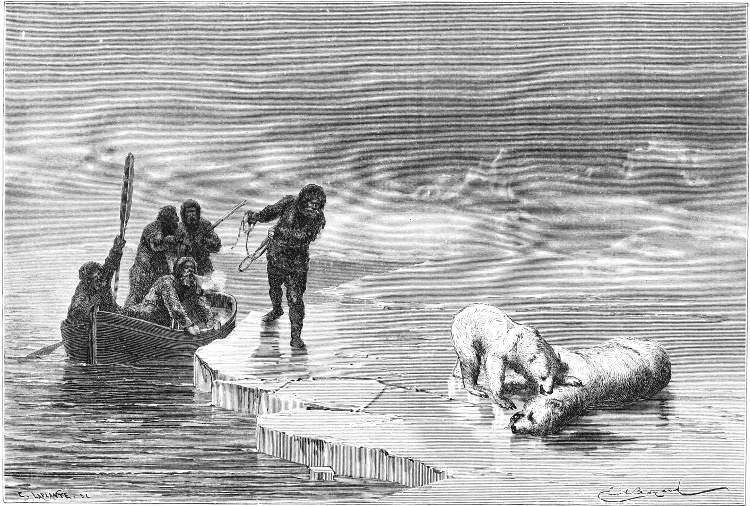
THE CREW OF THE “HANSA” TRYING TO LASSO A BEAR.
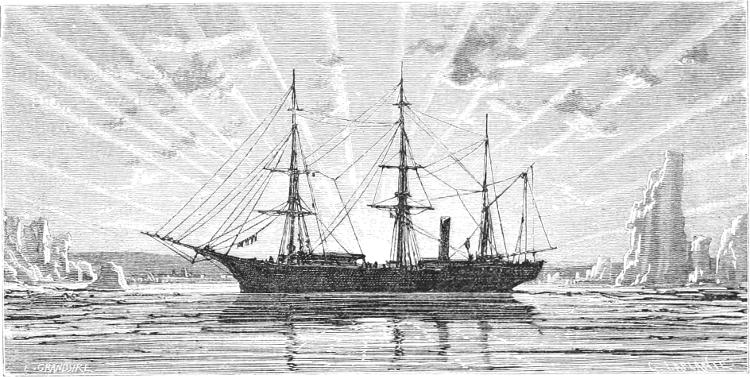
THE MIDNIGHT SUN, GREENLAND.
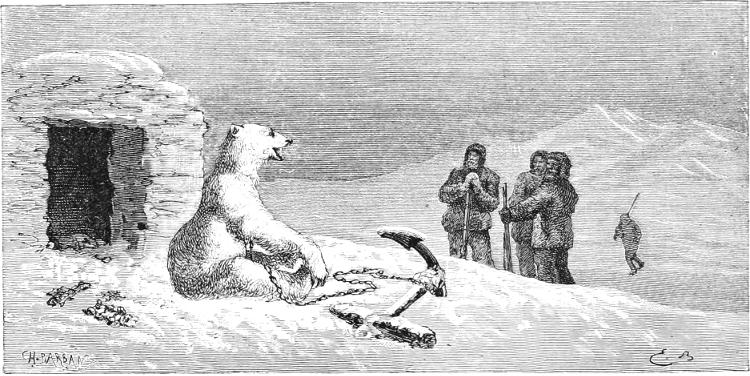
A BEAR AT ANCHOR.
On the 9th of September, the Hansa found the channel of free water in which she had been navigating closed by a huge mass of ice, and to protect her against the drift of the floating bergs she was moored to it with stout hawsers. A few days later, the ice was broken up by a gale of wind from the north-east, and the hawsers snapped. The ice accumulating behind the ship raised it a foot and a half. On a contiguous sheet of ice, the explorers discovered a she-bear with her cub, and a boat was despatched in pursuit. The couple soon caught sight of it, and began to trot along the edge of the ice beside the boat, the mother grinding her teeth and licking her beard. Her enemies landed, and fired, and the bear fell in the snow, mortally wounded. While the cub was engaged in tenderly licking and caressing her, several attempts were made to capture it with a lasso; but it always contrived to extricate itself, and at last took to flight, crying and moaning bitterly. Though struck with a bullet, it succeeded in effecting its escape.
On the 12th they again saw a couple of bears coming from the east, and returning from the sea towards the land. The mother fell a victim to their guns, but the cub was captured, and chained to an anchor which they had driven into the ice. It appeared exceedingly restless and disturbed, but not the less did it greedily devour a slice of its mother’s flesh which the sailors threw to it. A snow wigwam was hastily constructed for its accommodation, and the floor covered with a layer of shavings; but the cub despised these luxuries of civilization, and preferred to encamp on the snow, like a true inhabitant of the Polar Regions. A few days afterwards it disappeared with its chain, which it had contrived to detach from the anchor; and the weight of the iron, in all probability, had dragged the poor beast to the bottom of the water.
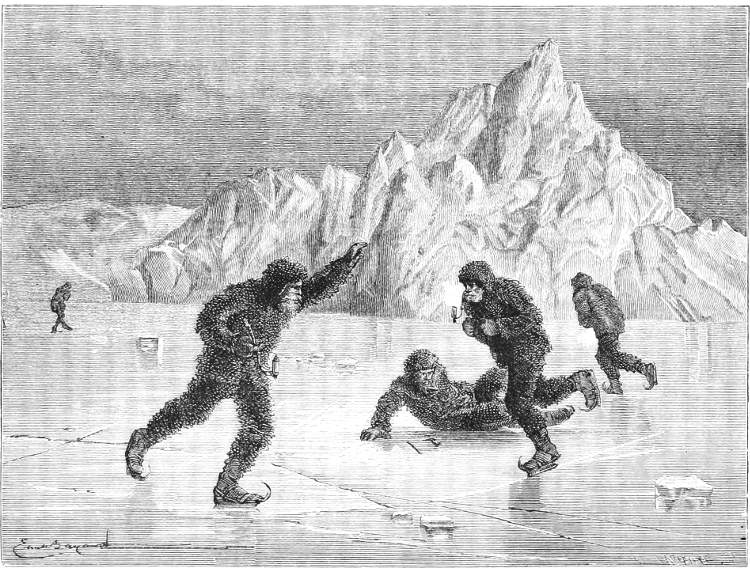
SKATING—OFF THE COAST OF GREENLAND.
The Hansa was now set fast in the ice, and no hope was entertained of her release until the coming of the spring. Her crew amused themselves with skating, and, when the weather permitted, with all kinds of gymnastic exercises. It became necessary, however, to consider what preparations should be made for encountering the Arctic winter, one of the bitterest enemies with which man is called upon to contend. The Hansa was strongly built, but her commander feared she might not be able to endure the more and more frequent pressure of the ice. At first, it was proposed to cover the boats with sail-cloth and convert them into winter-quarters; but it was felt that they would not afford a sufficient protection against the rigour of the Polar climate, its furious winds, its excess of cold, its wild whirlwinds of snow. And therefore it was resolved to erect on the ice-floe a suitable winter-hut, constructed of blocks of coal. Bricks made of this material have the double advantage of absorbing humidity, and reflecting the heat which they receive. Water and snow would serve for mortar; and a roof could be made with the covering which protected the deck of the Hansa from the snow.
The ground-plan of the house was designed by Captain Hegemann; it measured twenty feet in length, and fourteen feet in width; the ridge of the roof was eight feet and a half, and the side walls four feet eight inches in elevation. These walls were composed of a double row of bricks nine inches wide up to a height of two feet, after which a single row was used. They were cemented in a peculiarly novel fashion. The joints and fissures were filled up with dry snow, on which water was poured, and in ten minutes it hardened into a compact mass, from which it would have been exceedingly difficult to extract a solitary brick. The roof consisted of sails and mats, covered with a layer of snow. The door was two and a half feet wide, and the floor was paved with slabs of coal. Into this house, which was completed in seven days, provisions for two months were carried, including four hundred pounds of bread, two dozen boxes of preserved meat, a flitch of bacon, some coffee and brandy, besides a supply of firing-wood, and some tons of coal.
On the 8th of October, after the completion of the house, a violent snow-storm broke out, which would assuredly have rendered its construction impossible, and which, in five days, completely buried both the ship and the hut. Such immense piles of snow accumulated on the deck of the Hansa, that it was with the greatest difficulty the seamen could reach their berths.
From the 5th to the 14th of October the drift of the current was so strong, that the ice-bound ship was carried no fewer than seventy-two miles towards the south-south-east.
Meantime, the pressure of the ice continued to increase, and the Hansa seemed held in the tightening grasp of an invincible giant. Huge masses rose in front, and behind, and on both sides, and underneath, until she was raised seventeen feet higher than her original position. Affairs seemed so critical, that Captain Hegemann hastened to disembark the stores of clothing, the scientific instruments, charts, log-book, and diaries. It was found that through the constant strain on her timbers the ship had begun to leak badly, and on sounding, two feet of water were found in the pumps. All hands to work! But after half an hour’s vigorous exertions, the water continued to rise, slowly but surely; and the most careful search failed to indicate the locality of the leak. It was painfully evident that the good ship could not be saved.
“Though much affected,” says the chronicler of the expedition, “by this sad catastrophe, we endured it with firmness. Resignation was indispensable. The coal hut, constructed on the shifting ice-floe, was thenceforward our sole refuge in the long nights of an Arctic winter, and was destined, perhaps, to become our tomb.
“But we had not a minute to lose, and we set to work. At nine o’clock P.M. the snow-fall ceased; the sky glittered with stars, the moon illuminated with her radiance the immense wilderness of ice, and the rays of the Aurora Borealis here and there lighted up the firmament with their coloured coruscations. The frost was severe; during the night the thermometer sank to -20° R. One half the crew continued to work at the pumps; the other was actively engaged in disembarking on the ice the most necessary articles. There could be no thought of sleep, for in our frightful situation the mind was beset by the most conflicting apprehensions. What would become of us at the very outset of a season which threatened to be one of excessive rigour? In vain we endeavoured to imagine some means of saving ourselves. It was not possible to think seriously of an attempt to gain the land. Perhaps we might have succeeded, in the midst of the greatest dangers, in reaching the coast by opening up a way across the ice-floes, but we had no means of transporting thither our provisions; and it appeared, from the reports of Scoresby, that we could not count on finding any Eskimo establishments,—so that our only prospect then would have been to die of hunger.”
The sole resource remaining to the explorers was to drift to the south on their moving ice-floe, and confine themselves, meantime, to their coal hut. If their ice-raft proved of sufficient strength, they might hope to reach in the spring the Eskimo settlement in the south of Greenland, or come to gain the coast of Iceland by traversing its cincture of ice.
It was on the 22nd of October, in lat. 70° 50’ N., and long. 21° W., that the Hansa sank beneath the ice. Dr. Laube writes: “We made ourselves as snug as possible, and, once our little house was completely embanked with snow, we had not to complain of the cold. We enjoyed perfect health, and occupied the time with long walks and with our books, of which we had many. We made a Christmas-tree of birch-twigs, and embellished it with fragments of wax taper.”
To prevent attacks of disease, and to maintain the cheerfulness of the men, the officers of the expedition stimulated them to every kind of active employment, and laid down strict rules for the due division of the day.
At seven in the morning, they were aroused by the watch. They rose, attired themselves in their warm thick woollen clothing, washed in water procured by melting snow, and then took their morning cup of coffee, with a piece of hard bread. Various occupations succeeded: the construction of such useful utensils as proved to be necessary; stitching sail-cloth, mending clothes, writing up the day’s journal, and reading. When the weather permitted, astronomical observations and calculations were not forgotten. At noon, all hands were summoned to dinner, at which a good rich soup formed the principal dish; and as they had an abundance of preserved vegetables, the bill of fare was frequently changed. In the use of alcoholic liquors the most rigid economy was observed, and it was on Sunday only that each person received a glass of port.
The ice-floe on which their cabin stood was assiduously and carefully explored in all directions. It was about seven miles in circuit, and its average diameter measured nearly two miles.
The out-of-door amusements consisted chiefly of skating, and building up huge images of snow—Egyptian sphynxes and the like.
The borders of the ice-floe, especially to the west and south-west, presented a curious aspect; the attrition and pressure of the floating ice had built up about it high glittering walls, upwards of ten feet in elevation. The snow-crystals flashed and radiated in the sun like myriads of diamonds. The red gleam of morning and evening cast a strange emerald tint on the white surface of the landscape. The nights were magnificent. The glowing firmament, and the snow which reflected its lustre, produced so intense a brightness, that it was possible to read without fatigue the finest handwriting, and to distinguish remote objects. The phenomenon of the Aurora Borealis was of constant occurrence, and on one occasion was so wonderfully luminous that it paled the radiance of the stars, and everything upon the ice-floe cast a shadow, as if it had been the sun shining.
Near the coal-cabin stood two small huts, one of which served for ablutions, the other as a shed. Round this nucleus of the little shipwrecked colony were situated at convenient points the piles of wood for fuel, the boats, and the barrels of patent fuel and pork. To prevent the wind and snow from entering the dwelling-hut, a vestibule was constructed, with a winding entrance.
The greatest cold experienced was -29° 30’ F., and this was in December. After Christmas the little settlement was visited by several severe storms, and their ice-raft drifted close along the shore, sometimes within eight or nine miles, amidst much ice-crushing,—which so reduced it on all sides, that by the 4th of January 1870 it did not measure more than one-eighth of its original dimensions.
On the 6th of January, when they had descended as far south as 66° 45’ N. lat., the sun reappeared, and was joyfully welcomed.
On the night of the 15th of January, the colony was stricken by a sudden and terrible alarm. The ice yawned asunder, immediately beneath the hut, and its occupants had but just time to take refuge in their boats. Here they lay in a miserable condition, unable to clear out the snow, and sheltered very imperfectly from the driving, furious tempest. But on the 17th the gale moderated, and as soon as the weather permitted they set to work to reconstruct out of the ruins of the old hut a new but much smaller one. It was not large enough to accommodate more than half the colony; and the other half took up their residence in the boats.
February was calm and fine, and the floe still continued to drift southward along the land. The nights were gorgeous with auroral displays. Luminous sheaves expanded themselves on the deep blue firmament like the folds of a fan, or the petals of a flower.
March was very snowy, and mostly dull. On the 4th, the ice-raft passed within twenty-five miles of the glacier Kolberger-Heide. A day or two later, it nearly came into collision with a large grounded iceberg. The portion nearest to the drifting colony formed an immense overhanging mass; its principal body had been wrought by the action of the sun and the waves into the most capricious forms, and seemed an aggregate of rocks and pinnacles, towers and gateways. The castaways could have seized its projecting angles as they floated past. They thought their destruction certain, but the fragments of ice which surrounded the raft served as “buffers,” and saved it from a fatal collision.
On the 29th of March, they found themselves in the latitude of Nukarbik, the island where Graab, the explorer, wintered, from September 3rd, 1827, to April 5th, 1830. They had cherished the hope that from this spot they might be able to take to their boats, and start for Friedrichstal, a Moravian missionary station on the south coast of Greenland. However, the ice was as yet too compact for any such venture to be attempted.
For four weeks they were detained in the bay of Nukarbik, only two or three miles from the shore, and yet unable to reach it. Their raft was caught in a kind of eddy, and sometimes tacked to the south, sometimes to the north. The rising tide carried it towards the shore, the ebbing tide floated it out again to sea. During this detention they were visited by small troops of birds, snow linnets and snow buntings. The seamen threw them a small quantity of oats, which they greedily devoured. They were so tame that they allowed themselves to be caught by the hand.
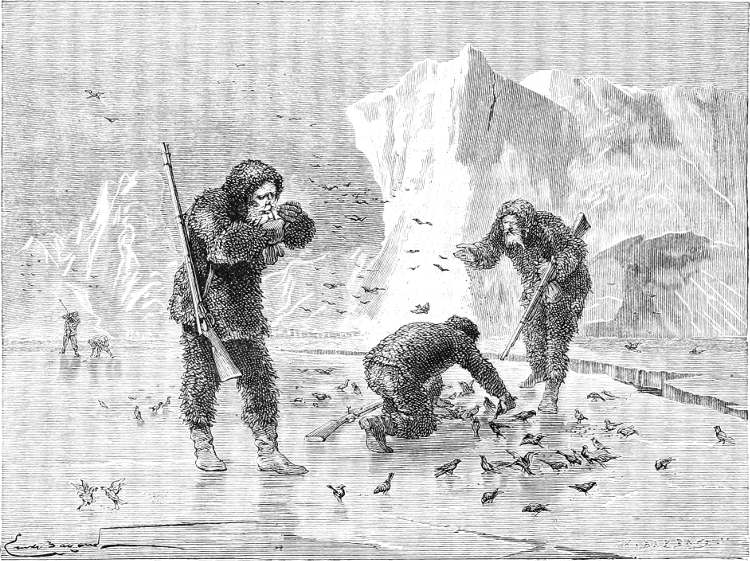
SNOW LINNETS AND BUNTINGS VISITING THE CREW OF THE “HANSA.”
From the end of March to the 17th of April, the voyagers continued their dreary vacillation between Skieldunge Island and Cape Moltke; a storm then drove them rapidly to the south. The coast, with its bold littoral mountain-chain, its deep bays, its inlets, its islands, and its romantic headlands, offered a succession of novel and impressive scenes; and specially imposing was the great glacier of Puisortok, a mighty ice-river which skirts the shore for upwards of thirty miles.
Early in May they had reached lat. 61° 12’.
On the 7th, some water-lanes opened for them a way to the shore; and abandoning the ice-raft, they took to their boats, with the intention of progressing southward along the coast. At first they met with considerable difficulty, being frequently compelled to haul up the boats on an ice-floe, and so pass the night, or wait until the wind was favourable. As this necessitated a continual unloading and reloading of the boats, the work was very severe. At one time they were detained for six days on the ice, owing to bad weather, violent gales, and heavy snow-showers. The temperature varied from +2° during the day to -5° R. during the night.
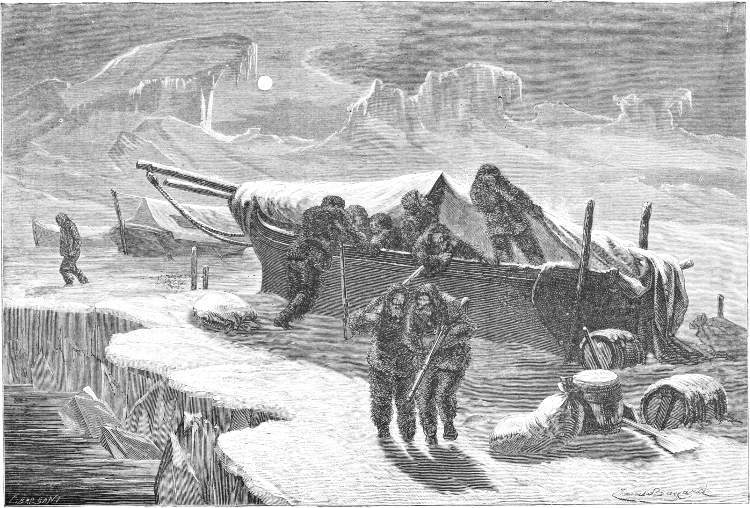
THE CREW OF THE “HANSA” BIVOUACKING ON THE ICE.
Their rations at this period were thus distributed:—In the morning, a cup of coffee, with a piece of dry bread. At noon, for dinner, soup and broth; in the evening, a few mouthfuls of cocoa, of course without milk and sugar.
They were compelled to observe the most rigid economy in the use of their provisions, lest, before reaching any settlement, they should be reduced to the extremities of famine. Yet their appetite was very keen; a circumstance easily explained, for they were necessarily very sparing in their allowance of meat and fat, which in the rigorous Arctic climate are indispensable as nourishment.
As no change took place in the position of the masses of ice which surrounded them, they resolved to drag their boats towards the island of Illiudlek, about three marine miles distant. They began this enterprise on the evening of the 20th, making use of some stout cables which they had manufactured during the winter, and harnessing themselves by means of a brace passed across the shoulders. That evening they accomplished three hundred paces. Snow fell heavily, and melted as fast as it fell, so that during their night-bivouac they suffered much from damp.
The next day they found before them such a labyrinth of blocks and fragments of ice, floating ice-fields, and water-channels, that they were constrained to give up the idea of hauling their boats across it, and resolved to wait for the spring tide—which, they knew, would occur in a few days. The delay was very wearisome. To beguile the time, some of the seamen set to work at wood-carving, while the officers and scientific gentlemen manufactured the pieces for a game of chess. Others prepared some fishing-lines, eighty fathoms long, in the hope of catching a desirable addition to their scanty bill of fare.