Part 3 — The Ancestor of the Trilobites, and the Descent of the Arthropoda.
Reading edition
The "annelid" theory of the origin of the Crustacea and therefore of the trilobites, originating with Hatschek (1877) and so ably championed by Bernard (1892), has now been a fundamental working hypothesis for some years, and has had a profound influence in shaping thought about trilobites. This hypothesis has, however, its weak points, the principal one being its total inhibition of the workings of that great talisman of the palæontologist, the law of recapitulation. Its acceptance has forced the zoologist to look upon the nauplius as a specially adapted larva, and has caused more than one forced explanation of the protaspis of the trilobite. When so keen a student as Calman says that the nauplius must point in some way to the ancestor of the Crustacea (1909, p. 26), it is time to reëxamine some of the fundamentals. This has been done in the preceding pages and evidence adduced to show that the primitive features of a trilobite indicate a swimming animal, and that the adaptations are those which enabled it to assume a crawling mode of existence. It has also been pointed out that in Naraoia there is preserved down to Middle Cambrian times an animal like that to which ontogeny points as a possible ancestor of the trilobites. Naraoia is not the simplest conceivable animal of its own type, however, for it has built up a pygidium of fourteen or fifteen somites. One would expect to find in Proterozoic sediments remains of similar animals with pygidia composed of only one or two somites, with five pairs of appendages on the cephalon, one or two pairs on the pygidium, a ventral mouth, and a short hypostoma. Anything simpler than this could not, in my opinion, be classed as a trilobite.
What the ancestor of this animal was is mere surmise. It probably had no test, and it may be noted in this connection that Naraoia had a very thin shell, as shown by its state of preservation, and was in that respect intermediate between the trilobite and the theoretical ancestor. Every analysis of the cephalon of the trilobite shows that it is made up of several segments, certainly five, probably six, possibly seven. Every study of the trilobite, whether of adult, young, or protaspis, indicates the primitiveness of the lateral extensions or pleural lobes. The same studies indicate as clearly the location of the vital organs along the median lobe. These suggestions all point to a soft-bodied, depressed animal composed of few segments, probably with simple marginal eyes, a mouth beneath the anterior margin, tactile organs at one or both ends, with an oval shape, and a straight narrow gut running from anterior mouth to terminal anus. The broad flat shape gives great buoyancy and is frequently developed in the plankton. Inherited by the trilobites, it proved of great use to the swimmers among them.
The known animal which most nearly approaches the form which I should expect the remote ancestor of the trilobites to have had is Amiskwia sagittiformis Walcott (Smithson. Misc. Coll., vol. 57, 1911, p. 112, pl. 22, figs. 3, 4). This "worm" from the Middle Cambrian is similar in outline to the recent Spadella, and is referred by Walcott to the Chætognatha. It has a pair of lateral expansions and a flattened caudal fin, a narrow median alimentary canal, and a pair of rather long simple tentacles. With the exception of a thin septum back of the head, no traces of segmentation are shown.
Some time in the late pre-Cambrian, the pre-trilobite, which probably swam by rhythmic undulations of the body, began to come into occasional contact with a substratum, and two things happened: symmetrically placed, i. e., paired, appendages began to develop on the contact surface, and a test on the dorsal side. The first use of the appendages may have been in pushing food forward to the mouth, and for the greater convenience in catching such material, a fold in front of the mouth may have elongated to form the prototype of the hypostoma. At this time the substratum may not have been the ocean bottom at all, but the animals, still free swimmers, may have alighted at feeding time on floating algæ from the surface of which they collected their food. While the dorsal test was originally jointed at every segment, the undulatory mode of swimming seems to have given way to the method of sculling by means of the posterior end only, or by the use of the appendages, and the anterior segments early became fused together.
The result of the hardening of the dorsal test was of course to reduce to that extent the area available for respiration, and this function was now transferred in part to the limbs, which bifurcated, one branch continuing the food-gathering process and the other becoming a gill. The next step may have been the "discovery" of the ocean bottom and the tapping of an hitherto unexploited supply of food. Upon this, there set in those adaptations to a crawling mode of existence which are so well shown in the trilobite. The crawling legs became lengthened and took on a hardened test, the hypostoma was greatly elongated, pushing the mouth backward, and new segments were added to produce a long worm-like form which could adapt itself to the inequalities of the bottom. That the test of the appendages became hardened later than that of the body is shown by the specimens of Neolenus, in which the dorsal shell as preserved in the shale is thick and solid, while the test of the appendages is a mere film.
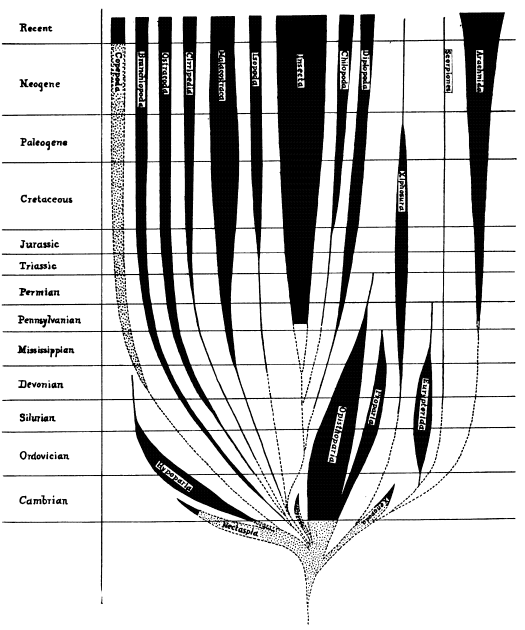
The late Proterozoic or very earliest Cambrian was probably the time of the great splitting up into groups. The first development seems to have been among the trilobites themselves, the Hypoparia giving rise to two groups with compound eyes, first the Opisthoparia and later the Proparia. About this same time the Copepoda may have split off from the Hypoparia, continuing in the pelagic habitat. At first, most of the trilobites seem to have led a crawling existence, but about Middle Cambrian time they began to go back partially to the ancestral swimming habits, and retained some of the trunk segments to form a larger pygidium. The functional importance of the pygidium explains why it can not be used successfully in making major divisions in classification. Nearly related trilobites may be adapted to diverse methods of life.
EVOLUTION WITHIN THE CRUSTACEA.
The question naturally arises as to whether the higher Crustacea were derived from some one trilobite, or whether the different groups have been developed independently from different stocks. The opinion that all other crustaceans could have been derived from an Apus-like form has been rather generally held in recent years, but Carpenter (1903, p. 334) has shown that the leptostracan, Nebalia, is really a more primitive animal than Apus. He has pointed out that in Leptostraca the thorax bears eight pairs of simple limbs with lamelliform exopodites and segmented endopodites, while the abdomen of eight segments has six pairs of pleopods and a pair of furcal processes, so that only one segment is limbless. Contrasted with this are the crowded and complicated limbs of the anterior part of the trunk of Apus, and the appendage-less condition of the hinder portion. Further, a comparison between the appendages of the head of Nebalia and those of Apus shows that the former are the more primitive. The antennules of Nebalia are elongate, those of Apus greatly reduced; the mandible of Nebalia has a long endopodite, and Carpenter points out that from it either the malacostracan mandible with a reduced endopodite or the branchiopodan mandible with none could be derived, but that the former could not have arisen from the latter. The maxillæ of Apus are also much the more specialized and reduced.
Nebalia being in all else more primitive than Apus, it follows that the numerous abdominal segments of the latter may well have arisen by the multiplication of an originally moderate number, and the last trace of primitiveness disappears.
It is now possible to add to the results obtained from comparative morphology the testimony of palæontology, already outlined above, and since the two are in agreement, it must be admitted that the modern Branchiopoda are really highly specialized.
As has already been pointed out, Hymenocaris, the leptostracan of the Middle Cambrian, has very much the same sort of appendages as the Branchiopoda of the same age, both being of the trilobite type. Which is the more primitive, and was one derived from the other?
The Branchiopoda were much more abundant and much more highly diversified in Cambrian times than were the Leptostraca, and, therefore, are probably older. Some of the Cambrian branchiopods were without a carapace, and some were sessile-eyed. These were more trilobite-like than Hymenocaris. Many of the Cambrian branchiopods had developed a bivalved carapace, though not so large a one as that of the primitive Leptostraca. The present indications are, therefore, that the Branchiopoda are really older than the Leptostraca, and also that the latter were derived from them. It seems very generally agreed that the Malacostraca are descended from the Leptostraca, and the fossils of the Pennsylvanian supply a number of links in the chain of descent. Thus, Pygocephalus cooperi, with its brood pouches, is believed by Calman (1909, p. 181) to stand at the base of the Peracaridan series of orders, and Uronectes, Palæocaris, and the like are Palæozoic representatives of the Syncarida. Others of the Pennsylvanian species appear to tend in the direction of the Stomatopoda, whose true representatives have been found in the Jurassic. The Isopoda seem to be the only group of Malacostraca not readily connected up with the Leptostraca. Their depressed form, their sessile-eyes, and their antiquity all combine to indicate a separate origin for the group, and it has already been pointed out how readily they can be derived directly from the trilobite.
While the Copepoda seem to have been derived directly from the Hypoparia, the remainder of the Crustacea apparently branched off after the compound eyes became fully developed, unless, as seems entirely possible, compound eyes have been developed independently in various groups. Most Crustacea were derived from crawling trilobites (Lower Cambrian or pre-Cambrian Opisthoparia), for they lost the large pygidium, and also the major part of the pleural lobes. In all Crustacea, too, other than the Copepoda and Ostracoda, there is a tendency to lose the exopodites of the antennæ.
These modifications, which produced a considerable difference in the general appearance of the animal, are easily understood. As has been shown in previous pages, the trilobites themselves exhibit the degenerative effect on the anterior appendages of the backward movement of the mouth, and the transformation of a biramous appendage with an endobase into a uniramous antenna is a simple result of such a process. The feeding habits of the trilobites were peculiar and specialized, and it is natural that some members of the group should have broken away from them. In any progressive mode of browsing the hypostoma was a hindrance, so was soon gotten rid of, and the endobases not grouped around the mouth likewise became functionless. The chief factor in the development of the higher Crustacea seems to have been the pinching claw, by means of which food could be conveyed to the mouth. It had the same place in crustacean development that the opposable thumb is believed to have had in that of man.
An intermediate stage between the Trilobita and the higher Crustacea is at last exhibited to us by the wonderful, but unfortunately rather specialized Marrella, already described. It retains the hypostoma and the undifferentiated biramous appendages of the trilobite, but has uniramous antennæ, there are no endobases on the coxopodites of the thoracic appendages, the pygidium is reduced to a single segment, and the lateral lobes of the thorax are also much reduced. Marrella is far from being the simplest of its group, but is the only example which survived even down to Middle Cambrian times of what was probably once an important series of species transitional between the trilobites and the higher Crustacea.
In this theory of the origin of the Crustacea from the Trilobita, the nauplius becomes explicable and points very definitely to the ancestor. According to Calman (1909, p. 23):
The typical nauplius has an oval unsegmented body and three pairs of limbs, corresponding to the antennules, antennas, and mandibles of the adult. The antennules are uniramous, the others biramous, and all three pairs are used in swimming. The antennæ may have a spiniform or hooked masticatory process at the base, and share with the mandibles which have a similar process, the function of seizing and masticating the food. The mouth is overhung by a large labrum or upper lip and the integument of the dorsal surface of the body forms a more or less definite dorsal shield. The paired eyes are as yet wanting, but the median eye is large and conspicuous.
The large labrum or hypostoma, the biramous character of the appendages, especially of the antennæ, the functional gnathobases on the second and third appendages, and the oval unsegmented shield are all characteristics of the trilobites, and it is interesting to note that all nauplii have the free-swimming habit.
The effect of inheritance and modification through millions of generations is also shown in the nauplius, but rather less than would be expected. The most important modification is the temporary suppression of the posterior pairs of appendages of the head, so that they are generally developed later than the thoracic limbs. The median or nauplius eye has not yet been found in trilobites, and if it is, as it appears to be, a specialized eye, it has probably arisen since the later Crustacea passed the trilobite stage in their phylogeny.
The oldest Crustacea, other than trilobites, so far known are the Branchiopoda and Phyllocarida described by Walcott and discussed above. It is important to note that while the former have already achieved such modified characteristics that they have been referred to modern orders, they retain the trilobite-like limbs and some of them still have well developed pleural lobes.
Calman (1909, p. 101) says of the Copepoda:
On the hypothesis that the nauplius represents the ancestral type of the Crustacea, the Eucopepoda would be regarded as the most primitive existing members of the class, retaining as they do, naupliar characters in the form of the first three pairs of appendages and in the absence of paired eyes and of a shell-fold. As already indicated, however, it is much more probable that they are to be regarded as a specialized and in some respects degenerate group which, while retaining, in some cases, a very primitive structure of the cephalic appendages, has diverged from the ancestral stock in the reduction of the number of somites, the loss of the paired eyes and the shell-fold, and the simplified form of the trunk-limbs.
If the Eucopepoda be viewed in the light of the theory of descent here suggested, it is at once seen that while they are modified and specialized, they more nearly approximate the hypothetical ancestor than any other living Crustacea. Compound eyes are absent, and it can not be proved that they were ever present, although Grobben is said to have observed rudiments of them in the development of Calanus. The "simplified limbs" are the simple limbs of the trilobite, somewhat modified. The absence of the shell-fold and carapace is certainly a primitive characteristic. Add to this the direct development of the small number of segments, and the infolded pleural lobes, and it must be admitted that the group presents more trilobite-like characteristics than any other. It seems very likely that the primitive features were retained because of the pelagic habitat of a large part of the group.
Ruedemann (Proc. Nat. Acad. Sci., vol. 4, 1918, p. 382, pl.) has recently outlined a possible method of derivation of the acorn barnacles from the phyllocarids. Starting from a recent Balanus with rostrum and carina separated by two pairs of lateralia, he traces back through Calophragmus with three pairs of lateralia to Protobalanus of the Devonian with five pairs. Still older is the newly discovered Eobalanus of the upper Ordovician, which also has five pairs of lateralia but the middle pair is reversed, so that when the lateralia of each side are fitted together, they form a pair of shields like those of Rhinocaris, separated by the rostrum and carina, which are supposed to be homologous with the rostrum and dorsal plate of the Phyllocarida. Ruedemann suggests that the ancestral phyllocarid attached itself by the head, dorsal side downward, and the lateralia were developed from the two valves of the carapace during its upward migration, to protect the ventral side exposed in the new position.
This theory is very ingenious, but has not been fully published at the time of writing, and it seems very doubtful if it can be sustained.
Summary.
The salient points in the preceding discussion should be disentangled from their setting and put forward in a brief summary.
It is argued that the ancestral arthropod was a short and wide pelagic animal of few segments, which so far changed its habits as to settle upon a substratum. As a result of change in feeding habits, appendages were developed, and, due perhaps to physiological change induced by changed food, a shell was secreted on the dorsal surface, covering the whole body. Such a shell need not have been segmented, and, in fact, the stiffer the shell, the more reason for development of the appendages. Activity as a swimming and crawling animal tended to break up the dorsal test into segments corresponding to those of the soft parts, and, by adaptation, a floating animal became a crawling one, with consequent change from a form like that of Naraoia to one like Pædeumias. (See figs. 36-40.) A continuation of this line of development by breaking up and loss of the dorsal test led through forms similar to Marrella to the Branchiopoda of the Cambrian, in which not only is there great reduction in the test, but also loss of appendages. The origin of the carapace is still obscure, but Bernard (1892, p. 214, fig. 48) has already pointed out that some trilobites, Acidaspidæ particularly, have backward projecting spines on the posterior margin of the cephalon, which suggest the possibility of the production of such a shield, and in Marrella such spines are so extravagantly developed as almost to confirm the probability of such origin. In this line of development two pairs of tactile antennæ were produced, while the anomomeristic character of the trilobite was retained. From similar opisthoparian ancestors there were, however, derived primitive Malacostraca retaining biramous antennæ, but with a carapace and reduced pleural lobes and pygidium. From this offshoot were probably derived the Ostracoda, the Cirripedia, and the various orders of the Malacostraca, with the possible exception of the Isopoda. I have suggested independent origins of the Copepoda and Isopoda, but realize the weighty arguments which can be adduced against such an interpretation.
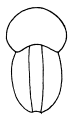

Fig. 36.—Naraoia compacta Walcott. An outline of the test, after Walcott. Natural size. Fig. 37.—Pagetia clytia Walcott. An eodiscid with compound eyes. After Walcott. × 5.
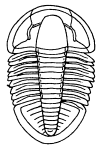
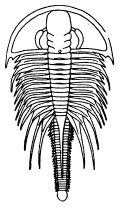
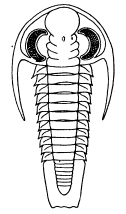
Fig. 38.—Asaphiscus wheeleri Meek. A representative trilobite of the Middle Cambrian of the Pacific province. After Meek. × 1/2. Fig. 39.—Pædeumias robsonensis Burling. Restored from a photograph published by Burling. × 1/4. Fig. 40.—Robergia sp. Restored from fragments found in the Athens shale (Lower Middle Ordovician), at Saltville, Va. Natural size.
It is customary to speak of the Crustacea and Trilobita as having had a common ancestry, rather than the former being in direct line of descent from the latter, but when it can be shown that the higher Crustacea are all derivable from the Trilobita, and that they possess no characteristics which need have been inherited from any other source than that group, it seems needless to postulate the evolution of the same organs along two lines of development.
I can not go into the question of which are more primitive, sessile or stalked eyes, but considering the various types found among the trilobites, one can but feel that the stalked eyes are not the most simple. While no trilobite had movable stalked eyes, it is possible to homologize free cheeks with such structures. They always bear the visual surface, and, in certain trilobites (Cyclopyge), the entire cheek is broken up into lenses. Since a free cheek is a separate entity, it is conceivable that it might lie modified into a movable organ.
EVOLUTION OF THE MEROSTOMATA.
It has been pointed out above that the Limulava (Sidneyia, Amiella, Emeraldella) have certain characteristics in common with the trilobites on the one hand and the Eurypterida on the other. These relationships have been emphasized by Walcott, who derives the Eurypterida through the Limulava and the Aglaspina from the Trilobita. The Limulava may be derived from the Trilobita, but indicate a line somewhat different from that of the remainder of the Crustacea. In this line the second cephalic appendages do not become antennæ. and the axial lobe seems to broaden out, so that the pleural lobes become an integral part of the body. As in the modern Crustacea, the pygidium is reduced to the anal plate, and this grows out into a spine-like telson.
From the Limulava to the Eurypterida is a long leap, and before it can be made without danger, many intermediate steps must be placed in position. The direct ancestor of the Eurypterida is certainly not to be seen in the highly specialized Sidneyia, and probably not in Emeraldella, but it might be sought in a related form with a few more segments. The few species now known do suggest the beginning of a grouping of appendages about the mouth, a suppression of appendages on the abdomen, and a development of gills on the thorax only. Further than that the route is uncertain.
Clarke and Ruedemann, whose recent extensive studies give their opinion much weight, seem fully convinced that the Merostomata could not have been derived from the Trilobita, but are rather inclined to agree with Bernard that the arachnids and the crustaceans were derived independently from similar chætopod annelids (1912, p. 148).
The greater part of their work was, however, finished before 1910, and although they refer to Walcott's description of the Limulava (1911), they did not have the advantage of studying the wonderful series of Crustacea described by him in 1912. While the evidence is far from clear, it would appear that the discovery of animals with the form of Limiting and the eurypterids and the appendages of trilobites means something more than descent from similar ancestors. Biramous limbs of the type found in the trilobites would probably not be evolved independently on two lines, even if the ancestral stocks were of the same blood.
The Aglaspidæ, as represented by Molaria and Habelia in the Middle Cambrian, are quite obvious closely related to the trilobites easily derived from them, and retain numerous of their characteristics. That they are not trilobites is, however, shown by the presence of two pairs of antennæ, the absence of facial sutures, and the possession of a spine-like telson.
The Aglaspidæ have always been placed in the Merostomata, and nearer the Limulidæ than the Eurypterida. The discovery of appendages does not at all tend to strengthen that view, but indicates rather that they are true Crustacea which have not given rise to any group now known. The exterior form is, however, Limulus-like, and since it is known from ontogeny that the ancestor of that genus was an animal with free body segments, there is still a temptation to try to see in the Aglaspidæ the progenitors of the limulids.
The oldest known Limulus-like animal other than the Aglaspidæ is Neolimulus falcatus Woodward (Geol. Mag., dec. 1, vol. 5, 1868, p. 1, pl. 1, fig. 1). The structure of the head of this animal is typically limuloid, with simple and compound eyes and even the ophthalmic ridges. Yet, curiously enough, it shows what in a trilobite would be considered the posterior half of the facial suture, running from the eye to the genal angle. The body is composed of eight free segments with the posterior end missing. Belinurus, from the Mississippian and Pennsylvanian, has a sort of pygidium, the posterior three segments being fused together, and Prestwichia of the Pennsylvanian has all the segments of the abdomen fused together. So far as form goes, a very good series of stages can be selected, from the Aglaspidæ of the Cambrian through Neolimulus to the Belinuridæ of the late Palæozoic and the Limulidæ of the Mesozoic to recent. Without much more knowledge of the appendages than is now available, it would be quite impossible to defend such a line. It is, however, suggestive.
EVOLUTION OF THE "TRACHEATA."
The trilobites were such abundant and highly variable animals, adapting themselves to various methods of life in the sea, that it appears highly probably that some of them may have become adapted to life on the land. The ancestors of the Chilopoda, Diplopoda, and Insecta appear to have been air-breathing animals as early as the Cambrian, or at latest, the Ordovician. Since absolutely nothing is yet known of the land or even of the fresh-water life of those periods, nothing can now be proved.
In discussing the relationship of the trilobites to the various tracheate animals, I have pointed out such palæontologic evidence as I have been able to gather. Studies in the field of comparative morphology do not fall within my province. I only hope to have made the structure of the trilobite a little more accessible to the student of phylogenies.
SUMMARY ON LINES OF DESCENT.
In order to put into graphic and concise form the suggestions made above, it is necessary to define and give names to some of the groups outlined. The hypothetical ancestor need not be included in the classification and for reasons of convenience may be referred to merely as the Protostracean.
The group of free-swimming trilobites without thoracic segments was probably a large one, and within it there were doubtless considerable variations and numerous adaptations. While the only known animal which could possibly be referred to this group, Naraoia, is blind, it is entirely possible that other species had eyes, and that the cephala and pygidia were variously modified. For this reason and because of the lack of all thoracic segments, it seems better to erect a new order rather than merely a family for the group, and Nektaspia (swimming shields) may be suggested. The only known family is Naraoidæ Walcott, which must be redefined.
Marrella and Habelia are types of Crustacea which can neither be placed in the Trilobita nor in any of the established subclasses of the Eucrustacea. They represent a transitional group, the members of which are, so far as known, adapted to the crawling mode of life, though it may prove that there are also swimmers which can be classified with them. To this subclass the name Haplopoda may be applied, the feet being simple.
The two known families, Marrellidæ Walcott and Aglaspidæ Clarke, belong to different orders, the second having already the name Aglaspina Walcott. The name Marrellina may therefore be used for the other.
For Sidneyia, Walcott proposed the new subordinal name Limulava, placing it under the Eurypterida. While Sidneyia, Emeraldella, and Amiella may belong to the group that gave rise to the Eurypterida, they are themselves Crustacea, and a place must be found for them in that group. The possession of only one pair of antennæ prevents their reception by the Haplopoda, and allies them to the Trilobita, but the modifications of the trunk and its appendages keep them out of that subclass, and a new one has to be erected for them. This may be known as the Xenopoda, in allusion to the strange appendages of Sidneyia.
Synopsis.
Class Crustacea.
Subclass Trilobita Walch.
Crustacea with one pair of uniramous antennæ, and possessing facial sutures.
Order Nektaspia nov.
Trilobita without thoracic segments. Cephala and pygidia simple.
Family Naraoidæ Walcott.
Cephalon and pygidium large, both shields nearly smooth. Eyes absent. A single species: Naraoia compacta Walcott, Middle Cambrian, British Columbia.
Subclass Haplopoda nov.
Crustacea with trilobate form, two pairs of uniramous antennæ, no facial sutures, sessile compound eyes present or absent, pygidium and pleural lobes generally reduced, large labrum present, appendages of the trunk biramous.
Order Marrellina nov.
Form trilobite-like, pleural lobes reduced, endobases absent from coxopodites of body, pygidium a small plate.
Family Marrellidæ Walcott.
Cephalon with long genal and nuchal spines. Eyes marginal. A single species: Marrella splendens Walcott, Middle Cambrian, British Columbia.
Order Aglaspina Walcott.
Body trilobite-like, with few thoracic segments, and a spine-like telson. Appendages biramous.
Family Aglaspidæ Clarke.
Cephalon trilobate, with or without compound eyes, seven or eight segments in the thorax.
Genus Aglaspis Hall.
Compound eyes present, seven segments in thorax. Upper Cambrian, Wisconsin.
Genus Molaria Walcott.
Compound eyes absent, eight segments in thorax. Middle Cambrian, British Columbia.
Genus Habelia Walcott.
Compound eyes absent. Not yet fully described. Middle Cambrian, British Columbia.
Subclass Xenopoda nov.
Crustacea with more or less eurypterid-like form, one pair of uniramous antennæ, biramous appendages on anterior part of trunk, modified endopodites on cephalon.
Order Limulava Walcott.
Cephalon with lateral or marginal eyes and large epistoma. Body with eleven free segments and a telson. Cephalic appendages grouped about the mouth.
Family Sidneyidæ Walcott.
Trunk probably with exopodites only, and without appendages on the last two segments. Telson with a pair of lateral swimmerets.
Genus Sidneyia Walcott.
Third cephalic appendage a large compound claw. Gnathobases forming strong jaws. Middle Cambrian, British Columbia.
Genus Amiella Walcott.
Middle Cambrian, British Columbia.
Family Emeraldellidæ nov.
Trunk with biramous appendages in anterior part, and appendages on all segments except possibly the spine-like telson.
Genus Emeraldella Walcott.
Cephalic appendages simple spiniferous endopodites. Eyes unknown. Middle Cambrian, British Columbia.
Click on image to view larger sized
Fig. 41.—A diagram showing possible lines of descent of the other Arthropoda from the Trilobita. The three recognized orders of the latter are shown separately. The known geological range is indicated in solid black, the hypothetical range and connections stippled. The short branch beside the Opisthoparia represents the range of the Haplopoda. The term Arachnida is used for all arachnids other than Merostomata, merely as a convenient inclusive name for the groups not especially studied.