Volume 8 — THE TEMPLE ON THE ACROPOLIS BURNT BY THE PERSIANS.
Reading edition
Whether we read Σπουδαίων δαίμων or σπουδαίων Δαίμων is, for our purposes immaterial. In either case, Verrall is right in calling attention to the connection between ες τα θεΐα σπουδή and the δαίμων Σπουδαίων (σπουδαίων), a connection which is now very striking, but which is utterly lost by inserting the description of a temple. At this point, then, the temple is not mentioned by Pausanias.
Pausanias, then, does not mention the temple under discussion.
Xenophon (Hell.I. 6) says that, in the year 406 Β.C. ό παλαιος ναος της Άθηνας ενεπρήσθη. Until recently this statement was supposed to apply to the Erechtheion, called "ancient temple" because it took the place of the original temple of Athena, from which the great temple (the Parthenon) was to be distinguished. Of course, the new building of the Erechtheion was not properly entitled to the epithet "ancient," but as a temple it could be called ancient, being regarded as the original temple in renewed form. If, however, the newly discovered temple was in existence alongside the Erechtheion in 406, the expression παλαιὸς ναός applied to the Erechtheion would be confusing, for the other temple was a much older building than the Erechtheion. If the temple discovered in 1886 existed in 406 B.C., it would be natural to suppose that it was referred to by Xenophon as ὁ παλαιὸς ναός. But this passage is not enough to prove that the temple existed in 406 B.C.
Demosthenes (xxiv, 136) speaks of a fire in the opisthodomos. This is taken by Dörpfeld (Mitth., xii, p. 44) as a reference to the opisthodomos of the temple under discussion, and this fire is identified with the fire mentioned by Xenophon. But hitherto the opisthodomos in question has been supposed to be the rear part of the Parthenon, and there is no direct proof that Demosthenes and Xenophon refer to the same fire. If the temple discovered in 1886 existed in 406 B.C., it is highly probable that the passages mentioned refer to it, but the passages do not prove that it existed.
This brings us to the discussion of the names and uses of the various parts of the older temple and of the new one (the Parthenon), the evidence for the continued existence of the older temple being based upon the occurrence of these names in inscriptions and elsewhere. As these matters have been fully discussed by Dörpfeld and Lolling, I shall accept as facts without further discussion all points which seem to me to have been definitively settled by them.
Lolling, in the article referred to above, publishes an inscription put together by him from forty-one fragments. It belongs to the last quarter of the sixth century B.C., and relates to the pre-Persian temple. Part of the inscription is too fragmentary to admit of interpretation, but the meaning of the greater part (republished by Dörpfeld) is clear at least in a general way. The ταμίαι are to make a list of certain objects on the Acropolis with certain exceptions. The servants of the temple, priests, etc., are to follow certain rules or be punished by fines. The ταμίαι are to open in person the doors of the chambers in the temple. These rules would not concern us except for the fact that the various parts of the building are mentioned. The whole building is called το Έκατόμπεδον; parts of it are the προνήϊον, the νεώς, the οίκημα ταμιείον and τα οίκήματα. There can be no doubt that these are respectively the eastern porch, the main cella, the large western room and the two smaller chambers of the pre-Persian temple. But most important of all is the fact that the whole building was called in the sixth century B.C. το Έκατόμπεδον. The word οπισθόδομος does not occur in the inscription, and we cannot tell whether the western half of the building was called opisthodomos in the sixth century or not. Very likely it was.
To recapitulate briefly, I hope that I have shown: (1) that Pausanias does not mention the temple excavated in 1886, and (2) that the existence of that temple during the latter part of the fifth and the fourth centuries is not proved. I believe that the temple continued to exist in some form until the completion of the Parthenon, but this belief is founded not so much upon documentary evidence as upon the consideration that the Athenians and their goddess must have had a treasure-house during the time from the Persian invasion to the completion of the Parthenon; especially after the treasure of the confederacy of Delos was moved to Athens in 454 B.C. As soon, however, as the Parthenon was completed, the temple burnt by the Persians was removed. This was before the fire of 406 B.C. The fire, therefore, injured, as has been supposed hitherto, the Erechtheion. The opisthodomos, which was injured by fire at some time not definitely ascertained (but probably not very far from the date of the fire in the Erechtheion), was the opisthodomos of the Parthenon.
HAROLD N. FOWLER. Exeter, New Hampshire, March, 1892.
POSTSCRIPT.--This article had already left my hands when I received the Journal of Hellenic Studies (XII. 2), containing an article by Mr. Penrose, On the Ancient Hecatompedon which occupied the site of the Parthenon on the Acropolis of Athens. Mr. Penrose contends that the old Hekatompedon was a temple of unusual length in proportion to its width, that it stood on the site of the Parthenon, and was built 100 years or more before the Persian invasion. He thinks, too, that the Doric architectural members built into the Acropolis-wall, which are referred by Dörpfeld to the archaic temple beside the Erechtheion, belonged to the building on the site of the Parthenon. He is led to these assumptions chiefly by masons' marks on some of the stones of the sub-structure of the Parthenon. He holds it "as incontrovertible that the marks have reference to the building on which they are found." The distances between these marks offer certain numerical relations which must, Mr. Penrose thinks, correspond to some of the dimensions of the building to which the marks refer. "If they had reference to the Parthenon, they would have shown a number of exact coincidences with the important sub-divisions of the temple." Of these coincidences Mr. Penrose has found but three, which he considers fortuitous. As accessory arguments he adduces the condition of the filling in to the south of the Parthenon, and the absence of old architectural material in the sub-structure of the Parthenon, etc. He seems, however, to rest his case chiefly upon the masons' marks.
I cannot even attempt to discuss this new theory in detail, but would mention one or two things which seem to tell against Mr. Penrose's view. The inscription published by Lolling mentions an οίκημα ταμιείον and οίκήματα as parts of the Hekatompedon, and such apartments evidently existed in the temple beside the Erechtheion. Mr. Penrose assumes that the temple beside the Erechtheion antedates his Hekatompedon, without regard to the fact that the use of the stone employed in the outer foundations of the archaic temple points to a much later period. The archaic temple was (at least approximately) 100 feet long, which makes it seem almost impossible that a new temple should be built on the Acropolis and called the Hundred-foot-temple (Hekatompedon). I cannot avoid attaching more importance to these considerations than to the arguments advanced by Mr. Penrose. It may be, however, that answers to these and other objections will be found.
If Mr. Penrose's theory is correct, it is evident that the old Hekatompedon must have ceased to exist before the building of the Parthenon. Whether the archaic temple excavated in 1886 continued to exist or not is, then, another matter. My main contention (that there is no good reason for assuming the continued existence through the fifth and fourth centuries B.C. of the archaic temple) is not affected by Mr. Penrose's theory, and I leave my arguments, such as they are, for the consideration alike of those who do and who do not agree with Mr. Penrose. Much of my article will appear irrelevant to the former class, but, as Mr. Penrose's views may not be at once generally accepted, it is as well to leave the discussion of previous theories as it was before the appearance of Mr. Penrose's article.
Η. Ν. F.
NOTE. -- For a discussion of Mr. Penrose's theories and conclusions, see now (Nov. 1892), Dörpfeld, Ath. Mitth., XVII, pp. 158, ff.
NOTES ON THE SUBJECTS OF GREEK TEMPLE SCULPTURES.
The following compilation is intended to present in compact form the evidence at present available on this question: How far did the Greeks choose, for the sculptured decorations of a temple, subjects connected with the principal divinity or divinities worshiped in that temple? We have omitted some examples of sculpture in very exceptional situations, e.g., the sculptured drums of the sixth century and fourth century temples of Artemis at Ephesos. Acroteria have also been omitted. But we have attempted to include every Greek temple known to have had pediment-figures or sculptured metopes or frieze, and have thus, for the sake of completeness, registered some examples which are valueless for the main question. The groups from Delos, attributed on their first discovery to the pediments of the Apollon-temple, have been proved by Furtwängler to have been acroteria (Arch, Zeitung, 1882, p. 336 ff.) It does not appear that Lebas had any good grounds for attributing to a temple the relief found by him at Rhamnus (Voyage archéologique Monuments figurés, No. 19,) and now in Munich. The frieze from Priene representing a gigantomachy was not a part of the temple there (Wolters, Jahrbuch des deutschen arch. Instituts, I, pp. 56, ff.) The Poseidon and Amphitrite frieze in Munich (Brunn, Beschreibung der Glyptothek, No. 115) has been, by some, taken for a piece of temple decoration, but is too doubtful an example to be catalogued. The statement of Pausanias (II. 11. 8) about the pediment-sculptures (τà έν τοίς àετοίς) of the Asklepieion at Titane is hopelessly inadequate and perhaps inaccurate.
The order of arrangement in the following table is roughly chronological, absolute precision being impossible. Ionic temples are designated by a prefixed asterisk, the one Corinthian by a dagger. The others are Doric, and, in the ease of these, "Sculptures of the Exterior Frieze" refers, of course, to sculptured metopes.
It has not been our purpose to discuss at length the conclusions to be drawn from this evidence. Briefly, the results may be summarized as follows:
The principal sculpture apparently did not include or especially refer to the temple-divinity in the following: 20, 24, 25. Practice would seem to have become somewhat relaxed after about 425 B.C. The very singular temple of Assos, (No. 5), though earlier, should perhaps be added.
The temple-divinity was represented in the western pediments of 7, 13 and perhaps of 20, but not of that in 9, 11, 24 (?) or 25.
The subjects of sculptured metopes and friezes were largely or wholly without obvious relation to the temple-divinity in the following: 1, 5, 9, 11, 12, 14, 1.9, 23, 29, 32.
P.B. TARBELL. W.N. BATES.
PLACE. DIVINITY. DATE. PEDIMENT-SCULPTURES. B.C. 1 Selinous Apollon (?) ca. 625 (Temple C) 2 Selinous ca. 625 3 Athens ca. 600 E.: (?) Zeus fighting Typhon; (Acropolis) Herakles fighting serpent. W. (?): Herakles fighting Triton; Kerkopes(?) 4 Athens ca. 600 E. (?): Herakles fighting (Acropolis) Hydra. W. (?): Herakles fighting Triton. 5 Assos VI cent. (?) 6 Metapontum Apollon VI cent. (?) Subject unknown 7 Aigina Athena ca. 530 (?) E. & W.: Combats of Greeks and Trojans; Athena in centre. 8 Athens Athena ca. 530 (?) E. (?): Gigantomachy, (Acropolis) including Athena (in centre?) 9 Delphi Apollon VI cent. after E.: Apollon, Artemis, 548 Leto, Muses. W.: Dionysos, Thyiads, Setting Sun, etc. 10 Selinous VI cent. (Temple F) 11 Olympia Zeus ca. 460 E.: Preparations for chariot-race of Pelops and Oinomaos; Zeus as arbiter in centre. W.: Centauromachy; Apollon (?) in centre.
OTHER SCULPTURES OF EXTERIOR FRIEZE SCULPTURED DECORATIONS. 1 E.: in centre, two quadrigae with unidentified figs., also Perseus slaying Medusa, Herakles carrying Kerkopes, etc. W.: Subjects unknown. 2 Europa on bull, winged sphinx, etc. 3 4 5 E. (and W. ?): Pair of sphinxes, Exterior architrave: pairs Centaur, wild hog, man pursuing of sphinxes in centre of E. & woman, two men in combat, W. fronts (?), Herakles and etc. Triton, Herakles and Centaurs, symposium, combats of animals. 6 7 None. 8 9 Herakles killing Hydra, Bellerophon killing Chimaera, combats of gods and giants, etc. 10 E.: Scenes from Gigantomachy. 11 12 metopes over columns and antæ of pronaos and opisthodomos: labors of Herakles.
=================================================================== | PLACE. | DIVINITY. | DATE. |PEDIMENT-SCULPTURES. ---+-----------+-----------+-----------+--------------------------- | | | B.C. | | Selinous | Hera (?) |ca. 450 (?)| 12| (Temple E)| | | | | | | | | | | | | | | | | | | 13| Athens | Athena |ca. 445-438|E.: Birth of Athena. |(Acropolis)| | |W.: Contest of Athena | | | | and Poseidon for Attika. | | | | | | | | | | | | 14| Sunjon | Athena |ca. 435 (?)| | | | | | | | | | | | | 15| Athens | |ca. 435 (?)|E. & W.: Lost; subjects | | | |unknown. | | | | | | | | | | | | *16| Athens | Athena | ca. 432 |None |(Acropolis)| Nike | | | | | | 17| Kroton | Hera | V cent., |Undescribed. | | | 2d half | 18| Agrigentum| Zeus | V cent., | | | | before 405| 19| Bassae | Apollon |ca. 425 (?)|None. | | | | | | | | | | | | | | | | | | | |
=================================================================== |SCULPTURES OF EXTERIOR FRIEZE| OTHER SCULPTURED DECORATIONS. ---+-----------------------------+--------------------------------- | | 12| None. |Metopes over pronaos: Herakles | | and Amazon, Zeus and | | Hera, Artemis and Aktaion, | | etc. | |Metopes over opisthodomos: | | Athena and Enkelados, etc. 13|E.: Gigantomachy; Athena |Ionic frieze around cella, | over central | pronaos and opisthodomos: | intercolumniation. | Panathenaic procession. |W.: Amazonomachy. | |S.: Centauromachy and seven | | scenes from Iliupersis. | |N.: Iliupersis and nine | | scenes from Centauromachy. | 14| |Ionic frieze on four inner sides | | of E. vestibule, between | | pronaos and outer columns: | | Gigantomachy, including | | Athena (over entrance to | | pronaos (?), Centauromachy, | | exploits of Theseus. 15|E.: Labors of Herakles. |Ionic frieze over pronaos |N. & S., at E. end (four | and across pteroma: battle | metopes on each side): | scene. | exploits of Theseus. |Ionic frieze over opisthodomos, | | Centauromachy. *16|E.: assemblage of gods, | | Athena in centre. | |N. W. S.: battle-scenes. | 17| | | | 18|E.: Gigantomachy. | |W.: Iliupersis. | 19|None. |Metopes over pronaos: Apolline | | and Dionysiac scenes. | | Interior cella-frieze: | | Amazonomachy, Centauromachy | | (Apollon and Artemis | | represented.)
=================================================================== | PLACE. | DIVINITY. | DATE. |PEDIMENT-SCULPTURES. ---+-----------+-----------+-----------+--------------------------- | | | B.C. | 20| near Argos| Hera | ca. 420. |E.: Birth of Zeus (?) | | | |W.: Battle of Greeks | | | | and Trojans. (?) *21| Athens |Erechtheus | 420-408 |None. |(Acropolis)| | | *22| Locri | | V cent., |E.: Lost. |Epizephyrii| |latter part|W.: Subject unknown, | | | | including Dioscuri (?) *23|Samothrace | Cabiri | ca. 400 | 24| Tegea | Athena | IV cent., |E.: Calydonian boar-hunt | | Alea |first half | (no divinity | | | | represented.) | | | |W.: Contest of Telephos | | | | and Achilles. 25| Epidauros | Asklepios |ca. 375 (?)|E.: Centauromachy. | | | |W.: Amazonomachy. 26| Thebes | Herakles |ca. 370 (?)|Labors of Herakles. *27| Ephesos | Artemis | ca. 330 | *28| Troad | Apollon | III cent. | | | Smintheus | | *29| Magnesia | Artemis | III cent. | 30|Samothrace | Cabiri | III cent. |N.: Demeter seeking | | | III cent. | Persephone (?) †31| Lagina | Hekate | | 32| Ilium | Athena (?)|II cent.(?)| | Novum | | | | | | | *33| Teos | Dionysos |Roman times| *34| Knidos |Dionysos(?)|Roman times|
=================================================================== |SCULPTURES OF EXTERIOR FRIEZE| OTHER SCULPTURED DECORATIONS. ---+-----------------------------+--------------------------------- | | 20|E.: Gigantomachy (?) | |W.: Iliupersis (?) | | | *21|Uninterpreted. | | | *22| | | | | | *23|Dancing women. | 24| | | | | | | | | | 25| | | | 26| | *27|Mythological scenes. | *28|Scenes of combat. | | | *29|Amazonomachy. | 30| | | | †31|Subjects unknown. | 32|Helios in chariot, Athena and| | Enkelados, other scenes of | | combat. | *33|Dionysiac procession. | *34|Dionysiac scenes, etc. |
[Line 1: BENNDORF, Metopen von Selinunt, pp. 38-50; SERRADIFALCO, Antichità di Sicilia, II, p. 16.]
[Line 2: Μonumenti Antichi, I, p. 950 ff.]
[Line 3: BRÜCKNER, Athenische Mittheilungen, 1889, pp. 67 ff.; 1890, pp. 84 ff.]
[Line 4: MEIER, Ath. Mitth., 1885, pp. 237 ff., 322 ff.]
[Line 5: CLARAC, Musée de Sculpture, II, pp. 1149 ff.; CLARKE, Report on Investigations at Assos, pp. 105-121. This temple has been usually assigned to the sixth century. Mr. Clarke brings it down to about the middle of the fifth. His arguments have not yet been published in full.]
[Line 6: LACAVA, Topografia e Storia di Metaponto, p. 81.]
[Line 7: Since the inscription which was at one time supposed to fix the divinity of this temple has been disposed of (by LOLLING, in Arch. Zeitung, XXXI (1874, p. 58, the designation given above rests solely on the prominence given to Athena in the pediment-sculptures. As for the date, the building is assigned by Dörpfeld to the sixth cent. (Olympia, Textband II, p. 20). The pediment-sculptures might be later, but are now confidently carried by STUDNICZKA (Ath. Mitth., 1886, pp. 197-8) some decades back in the sixth century.]
[Line 8: STUDNICZKA, Ath. Mitth., 1886. pp. 185, ff.; MAYER, Giganten and Titanen, pp. 290-91. According to DÖRPFELD, the metopes of this temple, or some of them, may have been sculptured.]
[Line 9: PAUS., X, 19. 4. EURIP., Ion, 184 ff. The temple seems to have been long in building. If AISCH, contra Cles., § 116, is to be believed, the dedication did not take place till after 479. According to Pausanias, the pediment-sculptures were the work of Praxias and Androsthenes. These sculptures have been generally supposed to have been executed about 424, but may have been considerably earlier, so far as Pausanias goes to show. The excavations now in progress will, it is to be hoped, clear up the whole subject.]
[Line 10: BENNDORF, op. cit., pp. 50-52.]
[Line 11: PAUS., V., 10. 6-9. For the date, see DÖRPFELD, Olympia, Textband II, pp. 19 ff. FLASCH, in Baumeister's Denkmäler, pp. 1098-1100.]
[Line 12: BENNDORF, op. cit., pp. 53-60. The attribution of the temple to Hera rests on the dubious ground of a single votive inscription to Hera found within the cella; op. cit., p. 34.]
[Line 13: PAUS., I. 24. 5; MICHAELIS, Der Parthenon, pp. 107-265; ROBERT, Arch. Zeit, 1884, pp. 47-58; MAYER, Giganten and Titanen, pp. 366-370.]
[Line 14: FABRICIUS, Ath. Mitth., 1884, 338 ff.; for the date, DÖRPFELD, ibid. p. 336.]
[Line 15: The so-called Theseion.]
[Line 16: ROSS, Temple der Nike Apteros, pls. 11-12; FRIEDERICHS, Bausteine, (ed. Wolters) Nos. 747-760. On the date, see WOLTERS, Bonger Studien Reinhard Kekulé gewidmet, pp. 92-101.]
[Line 17: Eighth Annual Report of the Archæological Institute of America, pp. 42 ff.]
[Line 18: DIOD. SIC., XIII. 82. It is disputed whether Diodoros speaks of pediment-sculptures or metopes; see PETERSEN, Kunst des Pheidias, p. 208, Note 4. Nothing can be made of the existing fragments; published by SERRADIFALCO, Antichità di Sicilia, III, pl. 25.]
[Line 19: COCKERELL. Temples of Aegina and Bassae, pp. 49-50, 52.]
[Line 20: PAUS, II. 17. 3. The distribution of subjects given above is that proposed by Dr. Waldstein, in the light of the discoveries made on the site of the Heraion under his direction in the spring of 1892. See Thirteenth Annual Report of the Archæological Institute of America, p. 64.]
[Line 21: FRIEDERICHS, Bausteine (ed. Wolters) Nos. 812-820. On the date see MICHAELIS, Ath. Mitth., 1889, pp. 349 ff.]
[Line 22: Notiziz degli Scavi, 1890, pp. 255-57; PETERSEN, Bull, dell' Istituto, 1890, pp. 201-27.]
[Line 23: CONZE, etc., Arch. Untersuchungen auf Samothrake, II, pp. 13-14, 23-25.]
[Line 24: PAUS., VIII. 45. 4-7; TREU, Ath. Mitth., 1881, pp. 393-423; WEIL, in Baumeister's Denkmäler, 1666-69.]
[Line 25. Έφημερίς Άρχαιολογική, 1884, pp. 49-60; 1885, pp. 41-44. For the date see FOUCART, Bull, de corr. hellén., 1890, pp. 589-92.]
[Line 26: PAUS., IX. 11. 4. The date given above conforms to the view of BRUNN, Sitzungsber. d. Münch. Akademie, 1880, pp. 435 ff.]
[Line 27: WOOD, Discoveries at Ephesus, p. 271.]
[Line 28: Antiquities of Ionia, IV. p. 46. Mr. Pullan is inclined to date the temple after Alexander; Prof. Middleton somewhat earlier (Smith's, Dict, of Antiq., 3d ed., II, p. 785).]
[Line 29: CLARAC, Musée de Sculpture, II, pp. 1193-1233; pls. 117 C-J. Additional pieces of the frieze have recently been found in the course of excavations conducted by the German Archæological Institute. The date given above for the building is that suggested by DÖRPFELD, Ath. Mitth., 1891, pp. 264-5. Most of the sculpture is generally regarded as of much later date.]
[Line 30: CONZE, etc., Untersuchungen auf Samothrake, I, pp. 24-7, 43-4.]
[Line 31: NEWTON, Discoveries at Halicarnassus, etc., II, pp. 554-67.]
[Line 32: MAYER, Giganten und Titanen, pp. 370-71.]
[Line 33: Antiquities of Ionia, IV, pp. 38-9.]
[Line 34. NEWTON, Discoveries at Halicarnassus, etc., II, pp. 449-50, 633.]
PAPERS OF THE AMERICAN SCHOOL OF CLASSICAL STUDIES AT ATHENS. THE RELATION OF THE ARCHAIC PEDIMENT RELIEFS FROM THE ACROPOLIS TO VASE-PAINTING.
[PLATE I.]
Enlarge
From one point of view it is a misfortune in the study of archæology that, with the progress of excavation, fresh discoveries are continually being made. If only the evidence of the facts were all in, the case might be summed up and a final judgment pronounced on points in dispute. As it is, the ablest scholar must feel cautious about expressing a decided opinion; for the whole fabric of his argument may be overturned any day by the unearthing of a fragment of pottery or a sculptured head. Years ago, it was easy to demonstrate the absurdity of any theory of polychrome decoration. The few who dared to believe that the Greek temple was not in every part as white as the original marble subjected themselves to the pitying scorn of their fellows. Only the discoveries of recent years have brought proof too positive to be gainsaid. The process of unlearning and throwing over old and cherished notions is always hard; perhaps it has been especially so in archæology.
To make now a definite application, it is evident that the connection between vase-paintings and painted terracottas must from the nature of the case be a very close one. But when these terracottas are found to reproduce throughout the exact designs and figures of vase-paintings, the line between the two fades away. All the most familiar ornaments of vase technic recur again and again, maeanders, palmettes, lotuses, the scale and lattice-work patterns, the bar-and-tooth ornament, besides spirals of all descriptions. In exception, also, the parallel is quite as close. In the great acroterium of the Heraion, for example, the surface was first covered with a dark varnish-like coating on which the drawing was incised down to the original clay. Then the outlines were filled in black, red and white. Here the bearing becomes clear of an incidental remark of Pausanias in his description of Olympia. He says (v. 10.): εν δε Ολυμπια (of the Zeus temple) λεβης επιχρυσος επι 'εκαστω του οροφου τω περατι επικειται. That is originally aeroteria were only vases set up at the apex and on the end of the gable. Naturally enough the later terracottas would keep close to the old tradition.
From this point of view, it does not seem impossible that pedimental groups might have fallen under the influence of vase technic. The whole architectural adornment of the oldest temple was of pottery. It covered the cornice of the sides, completely bounded the pedimental space, above and below, and finally crowned the whole structure in the acroteria. It would surely be strange if the pedimental group, framed in this way by vase designs, were in no way influenced by them. The painted decoration of these terracottas is that of the bounding friezes in vase-pictures. The vase-painter employs them to frame and set off the central scene. Might not the same end have been served by the terracottas on the temple, with reference to the scene within the typanum? We must remember, also, that at this early time the sculptor's art was in its infancy while painting and the ceramic art had reached a considerable development. Even if all analogy did not lead the other way, an artist would shrink from trying to fill up a pediment with statues in the round. The most natural method was also the easiest for him.
On the question of the original character of the pedimental group, the Heraion at Olympia, probably the oldest Greek columnar structure known, furnishes important light. Pausanias says nothing whatever of any pedimental figures. Of course his silence does not prove that there were none; but with all the finds of acroteria, terracottas and the like, no trace of any such sculptures was discovered. The inference seems certain that the pedimental decoration, if present at all, was either of wood or of terracotta, or was merely painted on a smooth surface. The weight of authority inclines to the last view. It is held that, if artists had become accustomed to carving pedimental groups in wood, the first examples that we have in stone would not show so great inability to deal with the conditions of pedimental composition. If ever the tympanum was simply painted or filled with a group in terracotta, it is easy to see why the fashion died and why consequently we can bring forward no direct proof to-day. It was simply that only figures in the round can satisfy the requirements of a pedimental composition. The strong shadows thrown by the cornice, the distance from the spectator, and the height, must combine to confuse the lines of a scene painted on a plane surface, or even of a low relief. So soon as this was discovered and so soon as the art of sculpture found itself able to supply the want, a new period in pedimental decoration began.
This process of development, so far as can be judged from existing types, reaches down to the beginning of the fourth century B.C. Steles of a different class are found, dating from a period long before this. Instead of a group, they bear only the dead man in a way to suggest his position, or vocation during life. All show distinctly a clinging to the technic of ceramic art. Sculptured steles and others merely painted exist side by side. The best known of the latter class is the Lyseas stele, in the Central Museum at Athens. Many more of the same sort have been discovered, differing from their vase predecessors in material and form, but keeping to the old principles. The outlines, for example, are first incised, and then the picture is finished with color. The Aristion stele may be taken as an example of the second order. Relief plays here the leading part; but it must still be assisted by painting, while the resemblance to vase-figures in position, arrangement of clothing, proportion and profile, remains as close as in the simply painted stele. An ever present feature, also, is the palmette acroterium, treated in conventional ceramic style. Loeschke thinks that the origin of red-figured pottery is to be found in the dark ground and light coloring of these steles. Whether the opinion be correct or not, it points to a very close connection between the two forms of art.
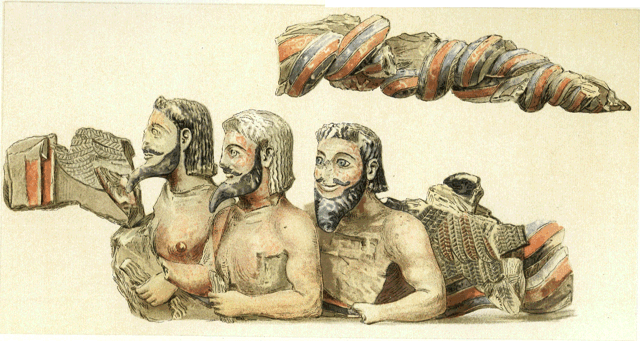
Speaking more generally, we find continually in the pediments reminiscences of ceramic drawing and treatment. The acroteria, painted in black and red on the natural surface of poros stone, take the shape of palmettes and lotuses. The cornices above and below are of clay or poros, painted in just such designs as appear on the Olympian terracottas; and these designs are frequently repeated in the sculptures themselves. The feathers of Typhon's wings are conventionally represented by a scale-pattern; the arc of the scales has been drawn with compass; we observe still the hole left in the centre by the leg of the compass. The larger pinions at the ends of the wings have been outlined, regularly by incised lines, and then filled up with color. All this is as like the treatment of vase-figures, as it unlike anything else in plastic art. In the former the scale-pattern is used conventionally to denote almost anything. Fragments of vases found on the Acropolis itself picture wings in just this way; or it may be Athena's aegis, the fleece of a sheep or the earth's surface that is so represented. On the body of the Triton and the Echidna of the pediments no attempt is made to indicate movement and contortion by the position of the scales; it is everywhere the lifeless conventionality of archaic vase-drawing. In sculptured representations the scale device is dropped, and with it the rigid regularity in the ordering of the pinions. Further, in drawing the scales of the Triton, the artist has dropped usual patterns and copied exactly a so-called bar-ornament which decorates the cornice just over the pediment. Here again he chooses one of the most common motives on vases. For the body of the Echidna, on the other hand, it is the so-called lattice-work pattern which represents the scale covering,--a pattern employed in vases for the most varied purposes, and found on the earliest Cypriote pottery. Even the roll of the snake-bodies of Typhon seems to follow a conventional spiral which we find on old Rhodian ware.
The outlining and coloring of the figures is most interesting. The poros stone of the reliefs is so soft that it could easily be worked with a knife; so incised lines are constantly used, and regular geometrical designs traced. Quite an assortment of colors is employed: black, white, red, dark brown, apparent green, and in the Typhon group, blue. It is very noticeable that these reliefs, unlike the others which in general furnish the closest analogies, the metopes of the temple at Selinous and the pediment of the Megarian Treasury at Olympia, have the ground unpainted. This is distinctly after the manner of the oldest Greek pottery and of archaic wall paintings. Herein they resemble also another archaic pedimental relief, found near the old temple of Dionysos at Athens, and representing just such a procession of satyrs and mænads as appears so often on vases.
To give a local habitation to the class of pottery which most nearly influenced the artist of these reliefs, is not easy. Perhaps it is a reasonable conjecture to make it Kamiros of Rhodes. Kamiros ware shows just such an admixture of oriental and geometrical designs as characterizes our pediments. Strange monsters of all kinds are represented there; while in the reliefs before us a goodly number of such monsters are translated to Greek soil.
CARLETON L. BROWNSON. American School of Classical Studies, Athens, Nov. 10, 1891.
PAPERS OF THE AMERICAN SCHOOL OF CLASSICAL STUDIES AT ATHENS. THE FRIEZE OF THE CHORAGIC MONUMENT OF LYSIKRATES AT ATHENS. 67
[PLATE II-III.]
enlarge
In the latter part of the eighteenth and the early part of the nineteenth century, Athens was visited by many strangers from western Europe, and the hospitable convent of the Capuchins and the enclosed "Lantern," which at this time was used as a closet for books, acquired some notoriety. Late in the year 1821, however, during the occupation of Athens by the Turkish troops under Omer Vrioni, the convent was accidentally burned, and its most precious treasure was liberated, to be sure, but, as may still be seen, sadly damaged by the fire, and what was still more unfortunate, left unprotected and exposed to the destructive mischief of Athenian street-arabs and their less innocent elders.
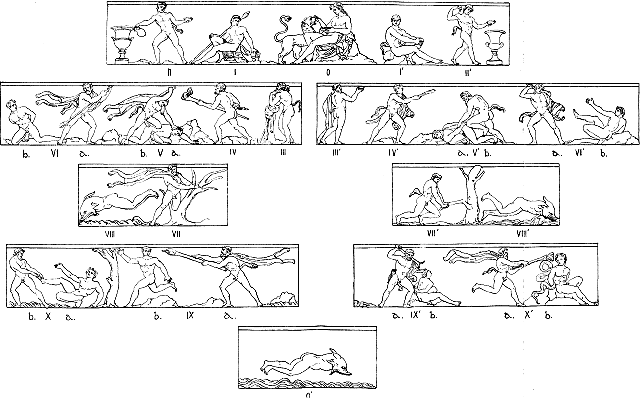
In our frieze, however, the myth is represented in an entirely different manner. The scene is not laid on shipboard, but near the shore of the sea, where, as the action shows, Dionysos and his attendant satyrs are enjoying the contents of two large craters, when they are attacked by pirates. The satyrs who are characterized as such by their tails, and in most cases (9 + 2:7) by the panther-skin, forthwith take summary vengeance upon their assailants, of whom some are bound, others beaten and burned, while others take refuge in the sea, only to be changed into dolphins by the invisible power of the god.
The general arrangement and technic of this relief, the skill with which unity of design is preserved despite the circular form, the energy of the action, and the variety of the grouping, have often been pointed out. More particularly, the harmony and symmetry, which the composition exhibits, have been noticed by most of the later writers who have had occasion to describe the frieze. It is here, however, that we find the divergencies and inaccuracies which have been alluded to above, and these are such as to merit a closer examination.
To begin with the central scene, which is characterized as such by the symmetrical grouping of two pairs of satyrs about the god Dionysos and his panther and is externally defined by a crater at either side, we observe that, while the two satyrs immediately to the right (I¹) and left (I) of Dionysos (0), correspond in youth and in their attitude toward him, the satyr at the left (I) has a thyrsus and a mantle which the other does not possess. These figures have unfortunately suffered much; the central group is throughout badly damaged, the upper part of the body and the head of Dionysos especially so. Of the tail of the panther as drawn in Stuart's work, no trace exists. The faces of the two satyrs and the head of the thyrsus are also much mutilated. The other two satyrs (II:II¹), whose faces are also mutilated, correspond very closely in youth, action, and nudity. In these two pairs of figures it is also to be noticed that the heads of I and II at the left face the central group, while the heads of I¹ and II¹ at the right are turned away from the centre, toward the right. By this device the sculptor has obviated any awkwardness which might arise from the necessity of placing Dionysos in profile.
These two pairs of satyrs serve to express the transition from the untroubled ease of Dionysos and his immediate attendants, to the violence and confusion of the struggle. Thus the first pair (III:III¹) seem to feel that their active participation is unnecessary, and so belong rather to the central scene; while the second pair (iv:iv¹), hurrying to the combat, are to be reckoned rather with those who are actively engaged. This is also emphasized by the symmetrical alternation of young and old satyrs, i.e.:
old young old young old young VIa Vb IV IV¹ V¹b VI¹b
and by their correspondence to VII:VII¹.
On the left side we have next a group, turned toward the right, consisting of a young satyr with flowing panther-skin (Vb), who places his left knee on the back of a prostrate pirate (Va) whom he is about to strike with a club which he holds in his uplifted right hand. The pirate (face now somewhat damaged) is, like all of his fellows, youthful and nude. The corresponding group on the right, faces the left, and represents a nude bearded satyr (V¹,) with left knee on the hip of a fallen pirate (V¹a), whose hands he is about to bind behind his back. Thus the arrangement of the two groups corresponds, but the action is somewhat different.
I now wish to point out an error which is interesting and instructive as illustrating how mistakes creep into standard archæological literature to the detriment of a proper appreciation of the original monuments; and I may perhaps hope not only to correct this error once for all, but also, in so doing, to make clearer certain noteworthy artistic qualities of this composition.
Now let us examine the symmetry as manifested in the corrected arrangement. After the figures which we have found to have a thoroughly symmetrical disposition, we have on the left side a group consisting of a bearded satyr (face damaged), with panther-skin (VI a), about to strike with his thyrsus a pirate kneeling at the left (VI b), with his hands bound behind his back. The face of this figure is also somewhat injured. The corresponding group on the right (VI¹ instead of the erroneous V¹), represents a youthful satyr with panther-skin thrown over his arm (VI¹ a), about to strike with the club which he holds in his uplifted right hand, a pirate (VI¹ b), who has been thrown on his back, and raises his left arm, partly in supplication and partly to ward off the blow. As in the groups V:V¹, so in VI:VI¹, persons, action, and arrangement, are closely symmetrical, while a graceful variety and harmony is effected by so modifying each of these elements as to repeat scarcely a detail in the several corresponding figures.
After these five fighters, we observe on the left a powerful bearded satyr (face much injured), with flowing panther-skin, facing the right, and wrenching away a branch from a tree (VII). The corresponding figure on the right side (VII¹) is a nude, bearded satyr, who is breaking down a branch of a tree. At first the correspondence does not seem to be maintained, for this satyr faces the right, whereas after the analogy of figures VII and IV we might expect him to face the left. But a closer examination shows that this lack of symmetry is apparent only when figures VII:VII¹ are considered individually, and apart from the scenes to which they belong. For while IV and VII, the outside figures of the main scene on the left, appropriately face each other, the figures IV¹ and VII¹, which occupy the same position with regard to the chief scene on the right, are placed so as to face in opposite directions. By this subtle device, for which the relation between the figures III¹ and IV¹ furnishes an evident motive, the sculptor has contrived to indicate distinctly the limits of these scenes, while the symmetry existing between them is heightened and emphasized by the avoidance of rigid uniformity.
After these dolphins, we have on each side another piece of land succeeded again by a stretch of sea. On these pieces of land are seen on each side two groups of two figures each, while a third incipient dolphin (0¹), which does not stand in group-relation with any of the other figures, leaps into the sea between them. In these groups there is a general correspondence, but it does not extend to particular positions or to accessories.
At the left we observe first a bearded satyr with torch and flowing panther-skin (IX a), pursuing a pirate, who flees to the left (IX b). The space between the satyr and his victim is in part occupied by a hole, which was probably cut for a beam at the time when the monument was built into the convent. In the corresponding places on the right side, we have a bearded satyr with panther-skin (IX¹ a), about to strike with the forked club which he holds in his uplifted right hand, a seated and bound pirate (IX¹ b), whose hair the satyr has clutched with his left hand. The heads of both figures are considerably damaged, and the lower part of the right leg of the pirate is quite effaced. To return to the left side, the tree at the left of the fleeing pirate (IX b), does not correspond with any thing on the right side. It serves to indicate the shore of the sea, while on the other side this is effected by the high rocks upon which the pirate (X¹ b) is seated.
There is, as we have already said, a general correspondence between these groups. This is effected, in such a way that the group ix resembles x¹ in action and arrangement, rather than 9¹, which, on the other hand, resembles group x, rather than group ix. In other words, the diagonalism which we have noticed above in the arrangement of young and old satyrs (vi a, v b, iv : iv¹, v¹ b, vi¹ a), is extended here to the groups themselves.
Moreover, the stretches of sea with the paired dolphins (viii : viii¹), which are introduced between these groups and those which had preceded, are not to be regarded as separating the composition into two parts, but as connecting the central scene with similar scenes in a different locality. These scenes are again joined by another stretch of sea with the single dolphin (0¹), which thus forms the centre of the back of the relief, opposite Dionysos, and the terminus of the action which proceeds from the god toward either side.
I do not mean to say, however, that these scenes beyond the dolphins (viii: viii¹), are to be looked upon as a mere repetition of those which have preceded, distinguished only by greater license in the symmetry, or that the changes of locality have no other purpose than to lend variety to the action. On the contrary, if we examine the indications of scenery in this relief, we see that those features by which the artist has characterized the place of this part of the action as the seashore, the trees near the water's edge, the alternating stretches of land and sea, the dolphins, the satyr pulling the pirate into the water (x), are confined to the space beyond the trees. In the scenes on the other side of the trees, there is not only no suggestion of the sea, but the rocks and the sequence of figures up to Dionysos indicate rather that his place of repose is some elevation near the seashore. The contrast between the more peaceful and luxurious surroundings of the god and the violent contest with the pirates, is thus carried out and enforced by the sculptural indications of landscape, as well as by the leading lines of the composition. Though I would not imply that the composition of this frieze was in any way governed by the laws which rule similar compositions in pediments, it is interesting and instructive to note that the general principles of distribution of subject which have been followed, are somewhat similar to those which we can trace in the best-known pediments extant; thus, as the god in his more elevated position would occupy the centre of the pediment, so the low-lying seashore and the scenes which are being enacted upon it correspond to the wings at either side.
To recapitulate, the concordance of figures in this relief is then briefly as follows: In the central scene, i.e., inside the vases, and in the first pair of transitional figures (III, II, I:I¹, II¹, III¹), equality of persons, but not of accessories (drapery, thyrsi); action symmetrical. In the immediately adjacent scenes, including the second pair of transitional figures and the satyrs at the trees (VII, VI, V, IV:IV¹, V¹, VI¹ , VII¹), the persons are diagonally symmetrical in VIa, Vb, IV:IV¹, V¹b, VI¹a (i.e., old, young, old: young, old, young), equal in VII:VII¹. The drapery is diagonally symmetrical in Vb, IV:IV¹, V¹b (i.e., panther-skin, nudity: panther-skin, nudity), equal in VIa:VI¹a, not symmetrical in VII:VII¹, and the weapons are not symmetrical, except in VII:VII¹ (i.e., thyrsus, club, torch: club, no weapon, club). The action is symmetrical throughout, although not exactly the same in V:V¹. In the scenes beyond the dolphins, the persons are equivalent (X, IX: IX¹, X¹), while the action, drapery and weapons are harmonious, but not diagonally symmetrical (i.e., IXa = X¹a, but Xb < IX¹a). At the left, a tree, at the right, a pile of rocks and a serpent.--The persons are, accordingly, symmetrical throughout; the action is so until past the dolphins (VIII:VIII¹); the drapery only in II: II¹, and in VI, V, IV:IV¹, V¹, VI¹; and the weapons not at all.
HERBERT F. DE COU Berlin, August 19, 1892.
PAPERS OF THE AMERICAN SCHOOL OF CLASSICAL STUDIES AT ATHENS. DIONYSUS εν Λίμναις. B
But while the date of the so-called Lenaea has been so long open to question, until recently it has been universally held that some portion at least of all the festivals at Athens in honor of the wine-god was held in the precinct by the extant theatre of Dionysus. With the ruins of this magnificent structure before the eyes, and no other theatre in sight, the temptation was certainly a strong one to find in this neighborhood the Limnae mentioned in the records of the ancients. When Pervanoglu found a handful of rushes in the neighborhood of the present military hospital, the matter seemed finally settled. So, on the maps and charts of Athens we find the word Limnae printed across that region lying to the south of the theatre, beyond the boulevard and the hospital. When, therefore, Mythology and Monuments of Athens, by Harrison and Verrall, appeared over a year ago, those familiar with the topography of Athens as laid down by Curtius and Kaupert were astonished to find, on the little plan facing page 5, that the Limnae had been removed from their time-honored position and located between the Coloneus Agoraeus and the Dipylum. That map incited the preparation of the present article.
While investigating the reasons for and against so revolutionary a change, the writer has become convinced that here, Dr. Dörpfeld, the author of the new view, has built upon a sure foundation. How much in this paper is due to the direct teaching of Dr. Dörpfeld in the course of his invaluable lectures An Ort und Stelle on the topography of Athens, I need not say to those who have listened to his talks. How much besides he has given to me of both information and suggestion I would gladly acknowledge in detail; but as this may not always be possible, I will say now that the views presented here after several months of study, in the main correspond with those held by Dr. Dörpfeld. The facts and authorities here cited, and the reasoning deduced from these, are, however, nearly all results of independent investigation. So I shall content myself in general with presenting the reasons which have led me to my own conclusions; for it would require a volume to set forth all the arguments of those who hold opposing views.
The passage Thucydides, II. 15, is the authority deemed most weighty for the placing of the Limnae to the south of the Acropolis. The question of the location of this section of Athens is so intimately connected with the whole topography of the ancient city, that it cannot be treated by itself. I quote therefore the entire passage:
το δέ προ τουτου η ακρόπολις ή νυν ούσα πόλις ην, καΐ το υπ' αυτήν προς νότον μάλιστα τετραμμενον. τεκμηριον δε · τα γaρ ιeρa εv αυτη τη άκροπόλει και άλλων θεών εστί, καΐ τα εζω προς τοuτο το μέρος της πολεως μάλλον ΐδρυται, το τε του Διός του Όλυμπίου, καϊ το Πύθιον, καϊ το της Γης, καΐ το εν Αίμναις Διονύσου, ω τα αρχαιότερα Διονύσια τη δωδέκατη ποιείται eν μηνΐ Άνθεστηριώνι · ώσπερ καΐ οι απ' 'Αθηναίων Ιωveς ετι καΐ νυν νομιζουσιν. ΐδρυται δε καΐ αλλά ιερα ταύτη αρχαια. και τη κρήνη τη νnν μeν των τυράννων ουτω σκευασάυτων Έννεακρούνω καλουμένη, το δε πάλαι φανερων των πηγων ούσων Καλλιρρόη ωνομασμένη, εκείνη τε εγγυς ουση τα πλείστου αξια εχρωντο, και νυν ετι απο του αρχαίου προ τε γαμικων και ες αλλα των ιερων νομίζεται τω uδατι χρησθαι.
Two assumptions are made from this text by those who place the Limnae by the extant theatre. The first is that υπ' αυτήν includes the whole of the extensive section to the south of the Acropolis extending to the Ilissus, and reaching to the east far enough to include the existing Olympieum, with the Pythium and Callirrhoe, which lay near. The second assumption is that these are the particular localities mentioned under the τεκμήριον δε. Let us see if this is not stretching υπ' αυτήν a little. I will summarize, so far as may be necessary for our present purpose, the views of Dr. Dörpfeld on the land lying υπο την ακρόπολιν, or the Pelasgicum.
The fortifications of Mycenæ and Tiryns prove that it was not uncommon in ancient Greek cities to divide the Acropolis, the most ancient city, into an upper and a lower citadel.
Finally, that the strip of hillside in question was in fact the Pelasgicum, we are assured by the existing foundations of the ancient walls. A Pelasgic wall extends as a boundary-wall below the Aesculapieum, then onward at about the same level until interrupted by the Odeum of Herodes Atticus. At this point there are plain indications that before the construction of this building, this old wall extended across the space now occupied by the auditorium. Higher up the hill behind the Odeum, and both within and without the Beulé gate, we find traces of still other walls which separated the terraces of the Pelasgicum and probably contained the nine gates which characterized it. Here then we have the ancient city of Cecrops, the city before Theseus, consisting of the Acropolis and the part close beneath, particularly to the south, the Pelasgicum. We shall find for other reasons also that there is no need to stretch the meaning of the words ὑπ αὐτὴν πρὸς νότον to make them cover territory something like half a mile to the eastward, and to include the later Olympieum within the limits of our early city.
The Olympieum mentioned by Strabo and Thucydides cannot therefore be the famous structure begun by Pisistratus and dedicated by Hadrian: we must look for another on the northwest side of the Acropolis. Here, it must be admitted we could wish for fuller evidence. Pausanias (I. 18. 8) informs us that "they say Deucalion built the old sanctuary of Zeus Olympius." Unfortunately he does not say where it was located.
The abandonment of work on the great temple of the Olympian Zeus from the time of the Pisistratids to that of Antiochus Epiphanes, would have left the Athenians without a temple of Zeus for 400 years, unless there existed elsewhere a foundation in his honor. It is on its face improbable that the citizens would have allowed so long a time to pass unless they already possessed some shrine to which they attached the worship and festivals of the chief of the gods.
The spade has taught us that the literary record of old sanctuaries is far from being complete. The new cutting for the Piræus railroad has brought to light inscriptions referring to a hitherto unknown precinct in the Ceramicus.
The stele being then visible to the public on but one day of the year it follows that the entire precinct of Dionysus εν Λίμναις must have been closed during the remainder of the year. This could not be unless we grant that, in the time of Demosthenes at least, the Lenaea and the Megala Dionysia were held in different precincts, and that the Lenaea and Anthesteria were one and the same festival.
From all these considerations it seems to be impossible that the precinct of the older temple by the extant theatre and the sanctuary εν Λίμναις could be the same. The suggestion that the gold and ivory statue of Alcamenes could have been the one borne in procession at the time of the Greater Dionysia is, of course, untenable from the delicate construction of such figures. The massive base on which it stood shows, too, that its size was considerable. The image borne in procession was clearly the xoanon which was brought by Pegasus from Eleutherae.
This gives a time, however remote it may be, when the Athenians still had the month Lenaeo, yet we hear of no festival Lenaea among the Ionian cities. It would thus seem that this had lost its force as an independent festival before the migration.
Gamelio is said to have received its name from the Gamelia, the festival of Zeus and Hera. It is hard to believe that while the much more brilliant Lenaea remained in the month, the name should have passed to the always somewhat unimportant Gamelia. What reason could be found for this naming, unless that the Lenaea had first been transferred to the Anthesteria, as all the testimony tends to prove? This supposition gives an easy explanation of the repeated reference to Lenaeo as an Attic month, of the change of the name to Gamelio, and even Tzetzes' association of the Pithoigia with the Lenaea,--an association which arises necessarily, if the Lenaea once formed part of the Anthesteria. The impossibility of transferring in its entirety a festival which has become rooted in the customs of a people, is also seen. That remnant of the Lenaea in Lenaeo, the Ambrosia, survived till quite late in Attic history. It is not difficult, then, to understand why the other references to the Lenaea as a separate festival do not agree as to the month.
There is no change of place in the course of the action. The scene, the Pnyx with the houses of Dicaeopolis, Lamachus, and Euripides near by, remains the same. There is no indication of a jump in time from Posideo to Gamelio, and again from Gamelio to Anthesterio.
Amid all the preparations for the Anthesteria made in the play, two statements cannot fail to attract attention. In v. 504 f. the poet informs us that this is not the Greater Dionysia, when strangers, tribute-bearers, and allies were present. It is the contest at the Lenaeum. In v. 1150 f. the chorus frees its mind concerning the miserly fashion in which Antimachus treated them at a previous celebration of the Lenaea. Shall we say that the poet, in order to speak of things present before the eyes of the Athenians, steps, in these two passages, entirely outside the action of the play? By no means. The poet is dealing with a vital issue. He is fighting against the ruinous war. The power of his genius is shown by the masterly manner in which he uses the moment which was present to his hearers. The victor at the Choes sat among the spectators; the very walls of the theatre had hardly ceased to resound with the din of the carousers. Here, or elsewhere, there is mention of but one επι Ληναίω αγων, that is the Lenaea, or the dramatic contest at the Anthesteria.
In fixing the date of the "Dionysia at the Lenaeum," we have the authority of some interesting inscriptions which have been collected in Dittenberger S.I.G. II. 374. They are the record of moneys obtained from the sale of the hides of the victims sacrificed at various festivals of the Attic year. A portion of each of four separate lists has been preserved. In the first and fourth of these, as they stand in Dittenberger, three Dionysiac festivals are mentioned: that at Piraeus, the Dionysia εν αστει, and the Dionysia επι Ληναίω. The third list ends with the Dionysia in Piræus. The remaining incription mentions two Dionysiac festivals, the one at the Lenaeum, and that εν αστει. The part of the record which should cover the Dionysia at Piræus is wanting. The calendar order of all the festivals mentioned is strictly followed.
Köhler in C.I.A., led by the other inscriptions found with these four, says that the lists do not contain mention of all the festivals at which public sacrifices of cattle were made in that portion of the year covered by the inscriptions, but that these are to be considered only as records of the hide-money which was to be devoted to particular uses. As a matter of fact, however, nearly all the public festivals of importance, as well as some of less note, are included in these lists; and it would be difficult to demonstrate that they do not contain a complete record of the public hide-money for the portion of the year in which these festivals fall.
The dramatic contests at the Lenaeum, like those at the Greater Dionysia, were undoubtedly preceded by sacrifices. The αγων επι Ληναίω could hardly be separated from the Dionysia επι Ληναίω Therefore the hide-money inscriptions are also authority that Lenaea and Anthesteria are but two references to the same festival.
It is interesting in connection with Thucydides' statement that the Ionian Athenians in his day still held the Anthesteria, to examine the record of this festival in the Ionic cities of Asia Minor. To be sure we have very little information concerning the details of this celebration among them; but we do find two statements of importance. C.I.G. 3655 mentions certain honors proclaimed at the Anthesteria in the theatre in Cyzicus. Comparison with similar observances at Athens indicates that theatrical representations were to follow. C.I.G. 3044, τώγωνος Άνθεστηριοισίν, refers to Teos. From the constant use of αγών referring to theatrical performances in connection with the festivals of Dionysus the word can hardly mean anything else here. So these two inscriptions, referring to two colonies, add their testimony that dramas were presented also at the Anthesteria in Athens.
Finally, Aristotle's Politeia falls into line with the hide-money records. In § 56, the statement is made that the Archon Eponymos had the Megala Dionysia in charge. In the following section, the Archon Basileus is said to have control, not of the Lemaea or of the Anthesteria--for neither is mentioned by name,--but of the Dionysia επι Ληναίω. The Basileus and the Epimeletae together directed the procession; but the basileus alone controlled the [dramatic] contest. Here again, it is inconceivable that either Anthesteria or Lenaea should be omitted; so both must be included under Dionysia επι Ληναίω.
We thus find our position supported by inscriptions of undoubted authority, and by a list of names ranging in time from before Aristophanes to the 9th century A.D., and in weight from Thucydides and Aristotle to the Scholiasts.
We know that from time immemorial the potters plied their trade in the Ceramicus, because here they found the clay suitable for their use. The so-called Theseum is 68.6 m. above the sea-level; the present level at the Piræus railroad station, 54.9 m.; at the Dipylum (and here we are on the ancient level), only 47.9 m. Out beyond the gate comes a long slope, extending till the Cephissus is reached, at an elevation of 21 m. So the Dipylum is over 43 m. below the present level of the theatre-precinct; and it is the lowest portion of the ancient city. Here, therefore, in the northwest part of the city, is where we should expect from the lay of the land and the nature of the soil to find the marshes. Out in the open plain beyond this quarter of the city to-day, after every heavy rain, the water collects and renders the ground swampy. With the Dipylum as a starting-point, there is no difficulty in supposing that, in very ancient times, the Limnae extended to Colonus Agoraeus, to the east into the hollow which became a portion of the agora in the Ceramicus, and to the west into the depression between Colonus Agoraeus and the Hill of the Nymphs. The exact extent and character of the low ground in these two directions can only be determined by excavating the ancient level, which, as it appears to me, has not been reached by the deep new railroad cutting running across this section north of the so-called Theseum.
The excavations of Dr. Dörpfeld between Colonus Agoraeus and the Areopagus, have shown that the ruins and the ancient street at this point have been buried to a great depth by the débris washed down from the Pnyx. Unfortunately, these diggings have not been extensive enough to restore the topography of the west and southwest slopes of Colonus Agoraeus.
The Lenaeum must lie εν Λίμναις, and therefore on the low ground. A passage in Isæus (8. 35) is authority that the sanctuary of Dionysus εν Λίμναις was εν αστει; i.e., within the Themistoclean walls. So we have it located within narrow limits, somewhere in the space bounded on the east by the eastern limit of the agora in Ceramicus, south by the Areopagus, west by the Pnyx and the Hill of the Nymphs, and north by the Dipylum.
From the neighborhood of the Dionysiac foundations and allusions mentioned by Pausanias immediately upon entering the city, we may be justified in locating this ancient cult of Dionysus εν Λίμναις still more exactly, and placing it somewhere on or at the foot of the southwestern slope of Colonus Agoraeus. More precise evidence of its site we may obtain from future excavation: though as this region lay outside the Byzantine city-walls, the ruins may have been more or less completely swept away.
In closing, it may not be without interest to review the picture presented of the most ancient Athens. Behind the nine-gated Pelasgic fortifications lay the city, with its temples, its palace, "the goodly house of Erechtheus," and its dwellings for the people, remains of which can even now be seen within the Pelasgicum. Immediately without the gate stood the Pythium, the Olympieum, the temple of Ge Kourotrophos, and other foundations. Directly before the entrance, some two hundred paces from the city-walls, was the spring Enneacrounus, whose water was most esteemed by the citizens. Not far from this was the wine-press. Here the people built the first altar, the first temple, the first orchestra, and instituted the first festival in honor of the wine-god, long before the new Dionysian cult was brought in from Eleutherae; and here for centuries were raised every year about the orchestra tiers of wooden seats in preparation for the annual dramatic contests.
JOHN PICKARD, American School of Classical Studies, Athens, 1891.