Part 3 — CHAPTER I THE AGRARIAN PROBLEM AND THE STATE (continued 2)
Reading edition
With the Protectorate of Somerset we enter upon a period of more violent agitation and more drastic expedients. There was a large difference between using the jurisdiction of the Council to redress individual cases of hardship and a deliberate attempt to effect a general settlement of the land question upon lines which would do substantial justice to the peasants. The former course involved no perilous assertion of principles, and could be pursued under the guise of a purely conservative policy, merely by referring disputes between landlords and tenants to the Courts of Star Chamber and Requests, which, though in fact administrative and governmental bodies, were none the less protected to some extent against criticism by wearing the appearance of mere legal tribunals. The latter might, perhaps, have been attempted with some faint hope of success, if statesmen had been much more careful than they were to discriminate between the different aspects of the problem with which they were confronted. To us, who look back on the situation from a distance of three and a half centuries, it seems that the one guiding thread, which might have led some way through the welter of confusion, was offered by the sharp distinction drawn by Hales between those enclosures which were made by the exchange and consolidation of strips, with a view to better husbandry, and those which had as their effect the conversion of arable land to pasture, the monopolising of commons, and the eviction of tenants. The arguments in favour of the first type of enclosure were too cogent for any policy which condemned enclosing in general to have the smallest prospect of success. The only possibility of averting the ruin to the peasantry which accompanied depopulation lay in encouraging them generally to follow the example of their brothers in Kent, Essex, Devonshire, and Cornwall, who had for centuries been substituting a more progressive husbandry for the “mingle mangle" of the open fields, without the disastrous consequences entailed by the spread of capitalist agriculture in other parts of the South and Midlands. But such a frank encouragement of certain kinds of enclosure for the sake of repressing others implied an appreciation of the economics of the problem to which comparatively few persons in our period had attained, and was quite beyond the grasp of Governments, which, at their worst, as under Warwick, were quite indifferent to the sufferings of the poorer classes, and, at their best, conceived public interests to be served best by a strict maintenance of customary conditions. Somerset’s policy of deliberately restoring ancient relationships with a strong hand could hardly even be begun without those who pursued it taking sides in a bitter economic agitation, and essaying openly to reverse the whole agrarian movement with which, in the course of the past half century, the wealth of the middle and upper classes, at any rate south of the Trent, had become inextricably identified. It involved in fact a return to the policy of Wolsey, and a return to it under conditions which made Wolsey’s policy doubly hard to carry out, inasmuch as, on the one hand, the position of Somerset as temporary head of a jealous aristocracy was far weaker than that of the omnipotent Cardinal, and, on the other hand, the lapse of twenty years had seen the growth of a generation to which enclosures were a vested interest.
Yet it would be a mistake to think of the whole agrarian episode between the death of Henry VIII. and the fall of Somerset as the mere freak of a misguided doctrinaire. If we can see difficulties which he did not, if we can smile at the thought of any Government at once so incompetent, and but for Somerset himself, so entirely selfish, carrying out a great conservative revolution in the teeth of the new wealth and power of the country, we must also remember that he was not alone in thinking the spoliation of the weaker rural classes not only, as it certainly was, illegal, but also so patently unjust as to amount to a national crime, and that in that age men overestimated the ability of a Government fiat to modify economic habits almost as much as they underestimated it two and a half centuries later. Somerset can hardly have been ignorant of the tremendous risks involved in his policy. But he may well have thought inaction not only baser than, but almost as dangerous as, action. It was certain that, unless the Government interfered to protect tenants, there would be a series of peasants' revolts. The best answer to the charge of stirring up class hatred, which was made against Somerset, as against all who call attention to its causes, was that agrarian rioting had begun in Hertfordshire[652] before the Commission on Enclosures was sent out, that in those counties where it took its work seriously order was maintained till the end of 1548, and that grave disturbances did not take place until the following year, when it became evident that, both in Parliament and on the Council, the Protector's policy had been beaten by the opposition of the great landowners. Nor is there any reason to doubt the sincerity of Somerset himself (though he, like every one else, had speculated in monastic estates), however much there may be to regret that his policy did not come into stronger hands, or fall upon times which were, from a political point of view, less hopelessly impracticable. An attempt was made to set a good example on the Crown Estates. In 1548, in response to complaints from the tenants at Walton, Weybridge, Esher, and Shepperton, that the making of the royal deer park at Hampton Court was ruining them through the loss of common rights which it entailed, an order[653] was issued dechasing the Park, and throwing open the enclosed lands to the commoners. In the following year Somerset secured the passage through Parliament of a Private Act[654] conferring a good title on those copyholders on his own manors to whom demesne lands had been let, and who, as occupiers of other than customary tenancies, could not claim the protection of manorial custom. It is plain from the comparatively few complaints which came in the sixteenth century from freeholders that, if such a course had been generally pursued, the chief objection to the changes grouped together under the name of enclosure would have been removed, because the harsh disturbance of vested interests which they involved would have been avoided. But that, of course, was quite outside the bounds of political possibility.
The story of Somerset’s attempt to deal with the land question is soon told. In 1548 agrarian discontent was at its height. Some time in that year there must have come to the hands of the Government the small tract on the effect of sheep-farming in Oxfordshire, Northamptonshire, Buckinghamshire, and Berkshire, which was printed in 1551 under the name of “Certayne causes of the Present Discontent.”[655] In spring and summer Latimer was thundering against the “Step-lords”[656] at Paul's Cross. In autumn Crowley published his “Information and Petition against the Oppressors of the Poor Commons.”[657] Above all, the poor commons had earlier in the year shown unmistakable signs of fending for themselves. The result of Somerset’s own sympathy with the prevalent discontent was the formation of something like a party, under the name of the “Commonwealth men,” with Latimer as its prophet and Hales as its man of action, which had a programme sufficiently definite to put heart into the peasantry and to terrify the great landed proprietors. On June 1st a Royal Commission[658] was appointed to inquire into offences committed against the Acts forbidding conversion of arable to pasture and depopulation. The Commission divided itself into several committees to deal with different parts of the country. Only one of them, however, consisting of John Hales and five of his colleagues, got seriously to work. It had a large area to cover—the counties of Oxfordshire, Berkshire, Warwickshire, Leicestershire, Bedfordshire, Buckinghamshire, and Northamptonshire—and one which was the centre of the agitation against enclosure. It seems to have interrupted its labours during autumn and winter, but it was busy in June, July, and August 1548, and again in the summer of 1549, by which time, however, the anger of the landed gentry against its proceedings, and of the peasants against the inactivity of the Commission as a whole, had reached a point which made it hardly possible for it to do more than collect information. Considering the difficulties of its task, and the wide tract of country to be covered, its behaviour appears to have been thorough and business-like. The usual procedure was to empanel a jury of twelve in each place visited, to whom Hales delivered an address explaining the objects and methods of the inquiry, as set out in the instructions issued by the Government to the Commissioners. These stated the Commission to have been formed in particular “for the maintenance and keeping up of houses of husbandry, for avoiding destruction and pulling down of houses for enclosures and converting of arable land into pasture, for limiting what number of sheep men should have and keep in their possession at one time, against plurality and keeping together of farms, and for maintenance of housekeeping, hospitality, and tillage on the sites ... of such monasteries, priories, and religious houses as were dissolved.”[659] Offenders were then presented by the jury, and though, on Hales' advice, a pardon was granted them for their past illegalities, their enclosures seem to have been thrown down, arable which had been turned into pasture to have been ploughed up, and farms which had been united to have been separated.[660]
In the meantime Somerset kept the general policy of agrarian reform alive on the Council. In the autumn of 1548 Hales had returned to London, and, as member for Preston, had prepared three Bills, dealing partly with enclosures and partly with the high prices. The first, requiring re-edification of decayed houses and the maintenance of tillage, and the second, forbidding speculation in food-stuffs, were introduced into the House of Lords. The third, which aimed at encouraging cattle breeding as distinct from sheep grazing, was read first in the House of Commons. Neither Bill came to anything, for Parliament was as angry as the Council with Somerset’s policy. But in May 1549 the Protector issued another proclamation against the decay of houses and enclosure; in June he infuriated the upper classes by a proclamation pardoning persons who had taken the law into their own hands by pulling down hedges; and throughout the whole period of his power he used the Court of Requests as an instrument for protecting tenants against landlords.[661] The Secretary[662] to the Council, who was quite ready for a reign of terror provided that the gentry began it, prophesied gloomily that the German peasants' revolt was to be re-enacted in England, and Warwick attacked Hales fiercely for venturing to discharge the duties laid upon him by the Government, of which Warwick was a member.[663] “Sir,” wrote a plaintive Norfolk gentleman to Cecil about the time of Ket’s rebellion, “Be plain with my Lord’s Grace, that under the pretence of simplicity and poverty there may not rest much mischief. So do I fear there doth in these men called Commonwealths and their adherents. To declare unto you the state of the gentlemen (I mean as well the greatest as the lowest) I assure you they are in such doubt that almost they dare touch none of them, but for that some of them have been sent up and come away without punishment, and that Commonwealth called Latimer hath gotten the pardon of others.... I may well gather some of them to be in jealousy of my Lord’s friendship, yea and to be plain, think my Lord’s grace rather to will the decay of the gentlemen than otherwise.”[664] Poor gentlemen! A Government which holds that laws do not exist only to preserve the rich in their possessions! Truly the mountains are removed.
Somerset’s Government had too short a life for us to judge how far, in happier political circumstances, he might have succeeded, not in checking agrarian changes, which would in any case have been impossible, but in securing that reasonable consideration should be given to the vested interests of the poorer classes. As Elizabethan statesmen discovered[665] at the end of the century, there was room for a policy which would prevent the wholesale displacement of tenants, and nevertheless offer an encouragement to the formation of the compact holdings out of the scattered strips and common pastures, which the agricultural experts were unanimous in condemning. There are faint indications of an understanding that a fair middle course was possible in a remarkable case which comes from the little Huntingdonshire town of Godmanchester.[666] At Godmanchester there had been the usual changes of the preceding half century. Rents had been raised, cottages pulled down, woods destroyed and turned to pasture, while the meadows, which under the Act of 1547 had been confiscated from the local gild, offered a tempting prey to some enterprising speculator. On complaints coming before the Council in the summer of 1549 a comprehensive scheme of reorganisation was drawn up. All persons with more than one house were to let at the customary rent that which they did not use themselves. All persons who had pulled down houses or converted them to other purposes than the accommodation of tenants were either to rebuild them or to build new ones, and to let them to any one offering the customary rent before Michaelmas 1549. The groves of wood converted to pasture were to be enclosed, so as to prevent the depredations made upon them by straying beasts, and, if necessary, the land was to be sown with acorns. With the gild lands a course was taken which, in the scramble for land which was going on in the middle of the sixteenth century, was unfortunately highly unusual. According to the Council’s directions they were to “be divided among the inhabitants thereof in this manner; that is to say to every ploughland five acres, and to every cottager and artificer there dwelling, or which hereafter upon the houses to be now builded shall dwell, one acre, and, if the number do not extend, then for every ploughland four, and so for lack of the rate every ploughland three, and the residue of the said acres falling after that rate to be divided among the cottagers, paying for every of the said acres 3/4." This case is the high water mark of administrative interference on behalf of the tenants. The action taken embraces nearly all the expedients of re-edifying decayed cottages, fixing fair rents, preventing common land from passing into the control of a single individual, and making equal allotment among the inhabitants, which had been demanded by the peasants and suggested by their friends. It shows that the enclosing of land hitherto used in common was not resented, provided that the division was made in such a way as to give a fair share to all the parties interested. It may perhaps be taken as a specimen of the kind of policy which lay behind Somerset’s expressions of sympathy with the peasantry, and which he would have pursued if his colleagues on the Council had permitted. As it was, he was not strong enough to carry out his programme. While the failure of the Commission resulted in the revolts of 1549, his reluctance to crush their authors, whom he believed to be men goaded into rebellion by intolerable grievances, united the whole weight of the greater property against him as a traitor to his order. In the attack made upon him as by his colleagues, the actions which evoked their special denunciation were those which embodied his agrarian policy, the use of the Court of Requests to protect tenants, the appointment of the Royal Commission to enforce the Acts against enclosures, the pardon granted in June 1549 to the riotous peasants, and the statements attributed to him that “the covetousness of the gentlemen gave cause to the common people to rise," and that “people had good cause to reform the things themselves," because “the lords of Parliament were loathe to incline themselves to reformation of enclosures and other things.”[667] To the last a popular hero, the “good Duke" could expect no help from those whom he had befriended, and no mercy from the sordid counter-revolution which he had provoked. His epitaph was given by the sad cries of “Too true,” with which the crowd about the scaffold greeted his dying declaration that he had “ever been glad of the furtherance ... of the commonwealth.”[668]
With the fall of Somerset in October 1549 the landowning classes had their revenge, and, under the guidance of Warwick, the policy of the Government swung violently in the opposite direction. The intervention of the Council to protect tenants of course stopped at once; in the two cases which are reported as having come before it in the year 1550 and 1551 the line taken was that the presumption was against the tenants who had broken open enclosures.[669] While, in the absence of John Hales, who appears to have found it convenient to leave the country, the Reports of the Royal Commission were allowed to slumber, the Government, by way of reducing opportunities for undesirable meetings, instructed the Bishop of London to prevent unseasonable preaching in his diocese, and set itself to establish the new agrarian régime by law. The ways in which men seek liberty are infinite in number, but the methods of tyranny are everywhere the same; and the nearest parallel to the behaviour of Somerset’s successors is the attitude of the panic-stricken aristocracy of the early nineteenth century towards trade unions. Under an Act of 1550 all meetings of the peasantry were treated as a sort of “illegal conspiracy.” Any forty of them who assembled to break down an enclosure might be condemned as traitors. Any twelve who assembled for the same purpose were guilty of felony, as also were those who summoned such a meeting, or who combined to reduce rents or the price of corn. Even the rusty legislation of the thirteenth century was revived by the re-enactment of the Statute of Merton of 1235,[670] which permitted lords to enclose as much as they pleased, provided that “sufficient” remained over for the tenants, with the significant improvement that the latter qualification was swept away by a clause declaring that enclosures might be made “notwithstanding their gainsaying and contradiction.” The tyranny of the oligarchy which ruled from 1549 to 1553 has been obscured by the more dramatic events which preceded and succeeded it. But it marks the bottom point in the condition of the sixteenth century peasantry. It indicates how the new agrarian régime will develop when the political forces impeding it are removed. More had asked, What is Government? and had answered that it is “a certein conspiracy of riche men procuringe theire owne commodities under the name and title of a Common Wealth.” His immortal definition does less than justice to the cynicism of the generation which succeeded his own. Mary executed Protestants for reasons of religion, as Elizabeth executed Catholics for reasons of State. But Warwick, a hypocrite in religion, was at least guiltless of the hypocrisy of sheltering his land policy “under the name and title of the Common Wealth.” It was exactly what it seemed to be, a straightforward attempt to prevent the poor from protesting when their possessions were taken from them by the rich.
The general policy of the Government during the reign of Elizabeth and the first half of the seventeenth century shows neither the desire of Somerset to undo the agrarian revelation, nor the complete indifference to the interests of the poorer classes of the party which succeeded him. During the reign of Elizabeth there was little agrarian agitation. It is possible that the limits of profitable pasture-farming had been reached. It is possible that the policy of encouraging the export of corn, which had been suggested by Hales, and which was adopted in 1563 and extended in 1571, reacted favourably on arable farming. It is possible, again, that Warwick’s measures had had their effect, and that the peasantry had been cowed into silence. Though, on the whole, the Government maintained the traditional attitude, it did not interfere except in circumstances of special hardship, or when there was danger of serious disturbance. Cases of this nature came before it fairly frequently in the reigns of Elizabeth, Charles, and James. One finds it intervening on the ground that the poverty of tenants makes it impossible for them to go to law, or that the offenders concerned are so powerful as to be able to disregard inferior authorities, or that the local authorities themselves have been unfairly biassed, or to prevent disturbances by hearing tenants' grievances, or to compel a great noble, like the Earl of Shrewsbury, to reinstate tenants whom it thinks to have been wrongfully evicted, or to stop action being taken by a landlord pending a decision by the courts in his favour. In 1579 the Council writes to the Lord President of Wales ordering him to take proceedings against two persons who have been enclosing part of the Forest of Fakenham, and have disturbed the copyholders; he is to prevent any further enclosures being made until the whole matter has been considered by the Government.[671] In 1581 it interferes to protect a copyholder who has been kept out of his holding by the Dean and Chapter of Peterborough.[672] In 1586 it directs the Cambridgeshire justices to inquire into the complaint of some tenants who claim that a piece of common pasture has been let over their heads, and to see that both parties to the dispute come before the Justices of Assize.[673] The Justices of Assize in Norfolk are to take action in the matter of a common at Kettlestone which two of the tenants allege to have been overstocked with sheep.[674] Several letters are addressed to the Council of the Marches of Wales ordering them to prevent the eviction of copyholders.[675] A landlord is requested to attend the Council and prove that his tenants' fines are uncertain, and not, as they allege, fixed.[676] The Court of Chancery has dismissed a case arising out of the enclosure of commons at Bath, and the Council orders a retrial.[677] Occasionally it cites offenders into the Court of Star Chamber,[678] and in 1592, just when the Court of Requests was beginning to be attacked by the common lawyers, we find a case as to fold-courses coming before the Court of Requests.[679] More often it appoints special Commissioners to act as arbitrators, or refers petitioners to the Justices of Assize in their county, with a request to take local evidence and inform the Council what they advise. Throughout the reigns of James and Charles we get glimpses of administrative activity which show that the traditional policy was, perhaps fitfully, maintained. In 1603 the Council of the North[680] were instructed to make “from time to time diligent and effectual inquisition of the wrongful taking in of commons and other grounds, and the decay of tillage and of towns or houses of husbandry,” and to correct offenders with “some notable punishment.” The rebellion in the Midlands in 1607 produced special measures, the chief offenders being summoned before the Council and bound over to rebuild houses which had fallen into decay, while in the following years two Commissions were appointed to compound with enclosers.[681] In Yorkshire the justices are evidently fairly active in 1607 and 1608. A Richmond freeholder who owns two-thirds of the manor is presented “for decaying five husbandries, and also for converting 30 acres of tillage ground to meadow and pasture,” and similar presentments are made at Malton, Thirsk, and Helmsley.[682] A Justice of Assize writes about the same time from the western counties to the effect that twenty-six houses of husbandry have been rebuilt and the offenders punished.[683] In 1614 the justices of Norfolk inform the Council that in accordance with its directions they have examined the enclosures made in the last two years, and have ordered the hedging and ditching of lands to be stopped till further notice.[684] In the following year one William Combe was negotiating with the corporation of Stratford for their consent to the enclosure and conversion to pasture of his freehold lands lying in the common fields at Welcombe; in 1615 an order made at Warwick Assizes was confirmed by the Chief Justice restraining him from doing so on the ground that it was “against the laws of the realm,” and in the following year a peremptory letter was addressed to him by the Council directing his compliance.[685] In 1619 there was a temporary reaction owing to the low price of grain, which led to the appointment of a Commission to grant pardons for breaches of the Acts forbidding enclosure, and in 1624 all the Statutes except the two passed in 1597 were repealed. But this did not stop administrative interference. In 1621 the Justices of Assize for Bedfordshire are directed to check encroachments on a common, and in 1623 a Commission is appointed to remove grievances arising in connection with enclosures at Cheshunt.[686] The rise in corn prices which occurred from 1629 to 1631 produced another burst of activity, which is to be attributed partly to a genuine desire to protect the poorer classes, and partly to the hope that the fines imposed upon enclosers might squeeze a few drops into the Government’s ever thirsty Exchequer. In 1630 directions were issued by the Council to the justices of five Midland counties to remove all enclosures made in the last two years on the ground that they led to depopulation and were particularly harmful in time of dearth.[687] In 1632, 1635, and 1636, three Commissions were appointed, and special instructions to enforce the Statutes against enclosure were issued to the Justices of Assize.[688] That the inquiry was not a mere formality is proved by the State Papers of the period. In part of the country, at any rate, land which had been pasture was ploughed[689] up in obedience to the Government’s orders, and a list of offenders, including—the Government must have seen his name with grim satisfaction—Lord Saye and Sele, was returned to the Council, some of whom were still being prosecuted in the Court of Star Chamber as late as 1639. This is the last occasion on which we can trace the administration of this part of the Tudor State policy. The agitation against enclosures was carried on under the Commonwealth. The diggers under Winstanley came into prominence for a moment, only to be disclaimed by the respectable[690] opponents of enclosure and to be instantly suppressed by the Government, and there was a crop of pamphlets in the years between 1650 and 1660 which dealt with the evils of depopulation in quite the old manner. But the traditional doctrine as to the importance of the peasantry had decayed, and the central machinery for forcing the justices to take action had been destroyed in 1641. The last Bill to regulate enclosures was introduced into the House of Commons in 1656, and was rejected on the second reading.[691]
(c) Success and Failure of State InterventionToC
It remains to ask how far the policy of trying to check the agrarian changes, which was pursued by Governments for nearly a century and a half, had any effect on economic practice. Statesmen were certainly biassed in favour of protecting the weaker landholding classes. But was their intervention simply the expression of a pious opinion? Was it so entirely futile as—to give a modern parallel—the Small Holdings Act of 1892? Or did it to any extent modify or retard the course of economic events? The view usually taken, that legislation was so ineffective as to be almost negligible, is in accordance with what we know of the character of local administration in the sixteenth century, and is supported by much contemporary evidence. The constant introduction of fresh proposals suggests that the previous laws were disappointing. The failure of existing Acts was the reason given in Somerset’s proclamation for the appointment of the Commission of 1548. Hales, who is certainly the most reliable authority on the situation between 1540 and 1550, speaks of them as being notoriously a dead letter.[692] If one looks at the Statutes passed against depopulation in the sixteenth century, with a view to discovering how far they really met the situation, one will be inclined to say that they quite failed to go to the root of the matter. The special evil which they were intended to combat was depopulation caused by evictions. But evictions could be checked only by giving tenants security, which would have meant turning customary into legal titles, and fixing judicial rents for leaseholders and immovable fines for copyholders; in short, the sort of interference which the peasants and their champions demanded, but on which no Government depending on the support of the landed gentry would venture, except upon an extraordinary emergency. In the absence of such an attempt to grapple directly with the fundamental fact that the peasants' insecurity made them liable to suffer whenever there was a change in the methods of agriculture, legislation designed merely to prevent those changes was almost certain to be evaded. Even with the best intentions the Statutes could never have been easy to administer. There was the difficulty inherent in the whole Tudor and Stuart policy of authoritative interference with trade and industry, the difficulty of making State action keep pace with economic changes. The Government is often like a man pursuing a tram from one stopping-place to another, and just missing it at each. It insists that land which has hitherto been in tillage shall remain in tillage. But there are a few years of bumper harvests, and the farmers complain that they cannot pay their way.[693] The Government tries to get over the difficulty by allowing them to convert arable to pasture, when a providence unversed in statecraft sends a wet summer, and it scrambles hastily back to the position which it has just abandoned.[694] By excepting from the operation of the Statutes certain districts which are specially suitable for grazing, it encourages a rough local division of labour, one part of a county confining itself to pasture-farming and another to tillage. But then, in pursuit of its traditional and quite reasonable policy of securing that food is cheap, it insists that all farmers are to supply the markets with grain, with the result that those who have specialised in corn-growing are threatened with ruin by the fall in prices which ensues, and that it is even questionable whether they will not convert arable to pasture to evade the obligation imposed upon them.[695] Old enclosures were tolerated and new forbidden. But how distinguish between old and new? Land turned to pasture simply to restore it to a condition in which it would be fit for tillage escaped the condemnation passed on other kinds of “conversion,” and one can imagine that nice arguments must have arisen as to a farmer’s motives. Again, suppose a man converted to pasture land which should have remained under the plough, and then leased it to some one else, who retained it as pasture, was the lessee guilty of an offence? In a case which came before the Court of Exchequer in 1582, the defendant pleaded that he merely “used” the land as pasture, and had not converted it, while the Crown argued that use was equivalent to conversion, that he was in the position of a man profiting by the continuance of a nuisance, and that a fine of 10s. an acre for each year since the original conversion ought to be imposed.[696] Points like this give colour to Coke’s complaint against the whole body of Acts against enclosure that “they were labyrinthes, with such intricate windings or turnings as little or no fruit proceeded from them.”
But, of course, the obscurity of the Statutes was the least part of the difficulty with which Governments who wished to protect the peasantry were confronted. Much more serious was the fact that the traditional policy could be carried out only by disregarding the financial interests of the wealthier classes, who could most easily influence Parliament and the Council, and who were locally omnipotent. In the first half of the sixteenth century the high position of many of those who were most deeply implicated in cutting land free from communal restrictions made them almost unassailable. The Royal Commission of 1517 returned among enclosers the names of the Duke of Norfolk, the Earl of Shrewsbury, the Duke of Buckingham, Lord Danbury, Sir William Bolen, Sir R. Sheffield, the Speaker of the House of Commons, Sir J. Witte, the Under-Treasurers of State, and Sir J. Cotton, who was himself one of the Commissioners.[697] The angry unanimity with which Somerset’s colleague turned against his land policy was not wonderful, for they were nearly all directly interested in the maintenance of the status quo. Warwick, who led the coup d'état, had enclosed on a large scale. Sir William Herbert had made extensive enclosures on the lands which he had acquired from the Abbey of Wilton. The St. John family, the Darcy family, the Earl of Westmoreland, had all local troubles with their tenants; and there are some indications that Sir William Paget and the detested and detestable Lord Rich were in the same position.[698]
It is not, however, material to trace the records of individual members of the Council, because their interest in checking the interference of the State with the free disposal of land is evident from the fact that many of them enormously increased their estates through the share which they obtained in the property confiscated from the religious houses and the gilds. A comparison of the lists of Privy Councillors for 1548 and 1552, published by Strype,[699] with Dr. Savine's[700] valuable analysis of the grantees of the monastic estates, show that out of thirty-one persons who got grants of land of £200 a year or more fourteen were members of the Privy Council in one or other of those years, exclusive of the Earl of Warwick and Sir William Herbert. This fact is by itself almost sufficient to explain the impossibility of enforcing the laws forbidding depopulation during the years which followed the death of Henry VIII., and the despair of legal protection which seems to have settled upon the classes affected by the movement. The view sometimes expressed that the religious houses had been easier landlords than the lay owners into whose hands their estates passed, though it can occasionally be corroborated from the complaints made by tenants to the Government, scarcely seems, as yet, to be satisfactorily proved. But the distribution among the wealthier classes of land producing a net income of not less than £110,000 gave them an enormous vested interest in preventing and evading legislation to check the most profitable use of the new possessions which were to endow the aristocracy of the future. The supposition of peculiar harshness in the owners to whom the land passed, though probably correct, is really not needed to explain the part which the transference of these vast quantities of land had in augmenting the distress of the rural classes. The worst side of all such great and sudden redistributions of property is that the individual is more or less at the mercy of the market, and can hardly help taking his pound of flesh. A buyer must sell at a profit, or he had much better not have bought. During the decade between 1540 and 1550 there was a furor of land speculation. To the Abbey lands, which came into the market after 1536, were added those of the gilds and chantries in 1547. It is quite clear that some of the grantees of estates did not acquire them with the intention of retaining them, but simply “bought for the rise." The lands of the Abbey of Whitby, for example, pass first to the Crown, and are then sold by it to the Duke of Northumberland, who in turn sells them to Sir John Yorke.[701] A small official in the Royal household buys the Cistercian nunnery at Brewood, and at once puts it up to sale “for suche a price that no man will gladly by hit at hys hand.”[702] Trentham is surrendered to the Crown in 1536; in 1540 the Duke of Suffolk obtains a grant of the rents and reversions reserved upon the Crown leases there, and in the same year sells it to one Leveson, who has already acquired lands belonging to Horlton Abbey, and already sold them again to Biddulph.[703] One finds even the champion of the tenants, Somerset himself, getting a grant of land from the Crown on July 1st, leasing part of it for eighty years on July 2nd, and transferring it back to the Crown, subject to the lease, on July 9th.[704] When property changed hands three times in the course of ten days, it could hardly fail to be rack-rented, or the transaction would not pay. What happened to the tenants? Here and there, as at Whitby and Washerne,[705] a bitter outburst against their new masters shows that the result has been what we should expect. But for the rest, a cloud descends and we cannot say. It is only in such occasional glimpses that we catch the solid earth shifting beneath the feet of those who till it. It was such a glimpse which led the last great English peasant, in a time of even more widespread misery, to say that the wretchedness of the landless labourer was the work of the Reformation. Cobbett, and those who follow Cobbett in representing the economic evils of the sixteenth century as the fruit of the religious changes, err in linking as parent and child movements which were rather brother and sister, twin aspects of the individualism which seems inseparable from any swift increase in riches. Their vision of a time when mild ecclesiastics administered their estates as a popular trust lays a spell upon the imagination. In the religious houses of Lancashire and Yorkshire and Northumberland there may, here and there, even on the eve of the dissolution, have been a reality corresponding to it. But we need hardly go further than Sir Thomas More[706] to learn that for parts, at least, of England it is only a vision; and More does not speak without book. Holy men enclose land, convert arable to pasture, claim villeins, turn copyholds into tenancies at will. If prominent ecclesiastics had really wanted to champion the cause of the peasantry, they had an excellent opportunity when Wolsey sent out the first great Commission into enclosures in 1517. But, in fact, there is no reason to suppose that any protest was made at all comparable to that which came thirty-two years later from Latimer. How could there be? The estates of the larger houses were often scattered over several different counties, and before the dissolution they were quite frequently managed by laymen. In such cases the monks were simply rentiers,[707] who needed to know no more about their tenants than the fellows of an Oxford college know about theirs at the present day.
Nevertheless, though facts will not allow us to accept the view which ascribes the agrarian distress of our period to the Reformation, or even to the particular changes brought about by the secularisation of religious endowments, there was a real connection between them. The Reformation in England is as much a social as a religious revolution. As a social revolution it is the work of the commercial and middle classes. It “made of yeomen and artificers gentlemen, and of gentlemen knights, and so forth upward, and of the poorest sort stark beggars.”[708] Their support is given, in the main, on strict business principles. It is purchased by ensuring that every one who counts shall have a solid material interest in supporting the new order. The great Elizabethan families, the Cecils, the Herberts, the Grenvilles, are well paid in advance for their services, and continue to be paid long after their services have ceased. The dissolution of the monasteries does for their plastic consciences what the foundation of the Bank of England did for the politics of the City Interest under William III. Having invested in the Reformation at a time when the Reformation is a gambling stock, they nurse the security with a solicitude which title-deeds have done more to inspire than the New Testament, and are zealous to lay up for themselves treasures in Heaven, as the best insurance for the treasures which they have already accumulated on earth. A man who looks from the window of his new mansion on the timber in his new park may well think it worth the sacrifice of many masses. Though the economic effect of endowing our landed gentry is not reducible to figures, it is not rash to say that men who have sprung into wealth by suddenly purchasing new estates will make those estates pay. And this means that ultimately the cost will be borne by their tenants. That the new proprietors will be extraordinarily sensitive to attacks on the rights of property goes without saying. The lectures[709] delivered to the peasants by the nouveaux riches of 1549 on the wickedness of agrarian spoliation have an irony which is eternal.
Apart from the special interest which the purchasers of the estates of monastic and gild estates had in keeping a completely free hand over their disposal, the normal organisation of English local government made effective State interference very difficult. As has often been pointed out, its peculiar strength lay in the success with which it made the ordinary relationships between social classes the machinery for executing the mandates of the State, by entrusting administration, not to officials of the Central Government, but to persons who already possessed local authority, and who were confirmed in it, rather than given it, by the Crown. Such a system was favourable to the development of representative government and of political freedom, because it strengthened instead of repressing the local initiative on which the success of representative government ultimately depends. But the very absence of bureaucracy had the disadvantage that it made it almost impossible to enforce the regular administration of the law, whenever it conflicted with the local interests of classes who sat on the county bench. A not unimportant chapter in English history is contained in the complaint of the Norfolk rebels that the legislation of the last fifty years had been “hidden” from them by the Justices of the Peace. The account of the proceedings of the Commission of 1548, which had to drag information out of juries packed with the employees of enclosing landlords, and from witnesses who gave it under threat of eviction—above all, the pained amazement of a great landowner who found that the Commission declined to accept evidence from his servants as unbiassed—is a specimen so typical, that, if it were found in isolation, we could hardly fail to fit it back into its English context.[710] Hales, the one statesman whom the agrarian problem produced, put his finger on the root of the difficulty in the third Bill which he introduced into Parliament in 1548. The substance of its proposals, though sufficiently rigorous to modern notions, was not in itself more drastic than others which actually became law. Its novelty lay in the machinery by which it was to be enforced. Surveys of pastures were to be made annually by the curate and two men of every parish, and those breaking the law were to be presented for trial. In other words, the initiative in returning offences was to be taken by those chiefly interested in preventing them. According to Hales, it was the last provision for making the administration of the Statute a reality which Parliament found intolerable.[711]
Must we, then, dismiss the efforts of the Tudor and Stuart statesmen to soften the harshness of the agrarian revolution as a mere piece of solemn futility? The simplicity of the solution makes it a tempting one; but it is too simple to be true. In the first place we must notice that our literary evidence is one-sided, because it is fullest for just those years during which an exceptional freedom from restraint was enjoyed by the great landlords. It is inevitable that Latimer and Hales should often be quoted. But one cannot argue from comments on the uselessness of legislation, uttered at a time when the Statutes against enclosing were virtually repealed, to show that the law was equally ineffective under Elizabeth and her two successors. And, in the second place, to hold that the frequent intervention of the Council had no result is really an unjustifiably high-handed proceeding. It runs counter to most of what we know of the administration of the period. A Statute might be a dead letter, but a letter from the Council was meant to be obeyed. By 1552 the Government has discovered the uselessness of relying for the enforcement of the law on the intervention of superior lords, and places its administration in the hands of special Commissioners directly responsible to the Central Government. Such a view runs counter to the opinion of the peasants and of the upper classes. The victims of agrarian oppression recognise that though they have little to hope from the local authorities, who are their landlords and employers, the Government’s policy is on the whole favourable to them, and they deluge it with appeals for protection. The justices are naturally no friends to that policy. But in the sixteenth and seventeenth centuries they are by no means the independent autocracy which they became later, and are watched closely by the Privy Council. From Norfolk, Nottinghamshire, Lincolnshire, Derbyshire, Leicestershire, and the west of England, they send returns to the Government of their action,[712] and the Government is quite ready, as we have seen, to revise the action of its delegates when it thinks they have been biassed by personal interests. In Yorkshire the juries of several townships present offenders before the justices. The authorities of Southampton[713] take steps to put the Acts against enclosure into force. The authorities of Norfolk[714] request that they may enjoy the exemption which has been granted them. When in 1597, a year in which legislation against enclosures is in the air, the Earl of Huntingdon asks the burgesses of Leicester to return his nominee to Parliament, they refuse bluntly to do anything of the kind, on the ground that the candidate in question is “an encloser himself and therefore unlikely to redress that wrong in others.”[715] The courts hear a large number of cases dealing with offences committed under the enclosing Statutes.[716] Individuals obtain special permission, either by royal license or by Act of Parliament, to use as pasture land which, like undrained marshes, is obviously unsuitable for ploughing. No one who is reported as having taken part in the Parliamentary discussions of proposed legislation in the closing years of Elizabeth suggests that it must necessarily be a dead letter. The chief fear that seems to have been felt was lest it should prove too effective. In introducing two Bills against enclosure and depopulation in 1597, Bacon apologised to the great landlords for taking action which was likely to prejudice their interests. When the question of continuing the Act against depopulation, which was in force in 1601, was under consideration in the House of Commons, both the members who argued for continuance and those who argued for repeal, assumed that the law was being administered in practice, one speaker urging that it had the result of keeping so much land in tillage as to destroy the farmer’s profits by causing excessive supplies of grain to be placed on the market in any but the worst years; another that it pressed hardly on the small farmer, who could not easily find the capital needed to sow as much land as he was legally bound to plough.[717] The ablest and most fully reported speech[718] which has come down to us is that of an anonymous member, who, while approving of the principle of the Bill, attacked it as too loosely drafted to meet the situation. His criticisms are those of a man who understands his subject, and are on just those points of detail which, though important in a measure which is to work, would not be worth considering at all if anything like effective interference were out of the question. After commending the clauses which excepted from the provisions of the Bill land lying temporarily fallow, and which punished the purchasers as well as the original converter of arable which was turned into pasture, he goes on to point out that loopholes have been left in the measure which are likely to stultify its effect. The exemption of Crown lands from its operation will encourage enclosing landlords to exchange properties with the Crown, and then take on lease as tenants the land which they have handed over, since by doing so, they will escape the risk of prosecution. The persistent lobbying of the interests affected—“the ears of our great sheepmasters do hang at the doors of this house"—has resulted in the fine for enclosing being placed as low as 10s. per acre, which is ridiculously disproportionate to the profits to be made by enclosures. The clause excluding from the reconversion prescribed in the Bill lands mown for hay plays into the hands of the enclosers by facilitating the winter feeding of their sheep. The failure to limit the acreage which a man may keep in his own hands will discourage the creation of small holdings. At a later date there is the same belief, both among those who approve, and among those who dislike, enclosure, that enclosing can be checked, at any rate, by the Government. In the keen controversy over enclosures which raged under the commonwealth the opponents of further restriction urged that the mere threat of legislation had resulted in checking agricultural enterprise.[719] Harrington,[720] a specialist, not to say a faddist, on agrarian policy, bases his interpretation of the history of the preceding century on the supposed success of the Tudors in keeping the small cultivator on the soil. Even in the middle of the eighteenth century, when the golden age of the enclosing landlord was just about to dawn, some dim memory of the earlier State policy seems in parts of England to have survived. “Why,” asked a foreign traveller,[721] “do your farmers not keep separate closes under turnips to feed sheep in the new approved manner?" “Partly,” answer the peasants, “because there is a common rotation of crops which all must follow. But the principal reason of all is that on a common land no one has freedom to enclose his strips without a special permission and Act of Parliament.”
What weight is to be attached to this body of opinion that enclosure and conversion to pasture were in practice checked by the opposition of the Government, it is not easy to say. If it is hardly compatible with the view that interference was entirely ineffective, it nevertheless need not imply anything more than a temporary retardation of the movement on those special occasions and in those particular parts of the country that were the object of peculiar attention. The test of comparison with facts by which one would like to try it is difficult to apply. Our knowledge of the real extent of enclosure in the sixteenth century is too scanty to permit of our following with confidence the line of argument which has been ingeniously worked out by Miss Leonard,[722] and which, starting from the indisputable fact that in those Midland counties where enclosure had been felt most acutely in the sixteenth century, there was still much land unenclosed in the seventeenth and eighteenth, suggests that the explanation is to be found in its temporary cessation under the authoritative pressure of the Tudor and Stuart Governments. Nevertheless, without going beyond our evidence, we may venture to put forward two propositions. The first is that it is extremely improbable that the anti-enclosing policy which we have traced succeeded in altering permanently or on a large scale the course of economic development. That suggestion is surely incredible in view of the continuance of the complaints against enclosure, and of what we know of the slack and biassed routine of rural administration. To expect the justices to stop enclosing, unless actually compelled to do so, was almost as Utopian as it was to expect them to administer the early Factory Acts two centuries later. The second is that the intervention of the Government certainly mitigated the hardships of the movement to the rural classes. The protection which the Court of Star Chamber and the Court of Requests offered to the equitable interests of tenants, while it could not turn the general course of events, tempered its harshness to individuals. A landlord who was determined to depopulate could hardly in the long run be prevented from succeeding in his object. But he might have to wait till leases or life tenancies had expired, instead of being able to clear his estate at one sweep. He might be compelled, as the St. Johns[723] were in the reign of Henry VIII., as Sir John Yorke in 1553, or Lloyd under Elizabeth, to bind himself to respect the titles of the existing generation of tenants. In the same way the occasional campaigns undertaken for the reconversion of pasture to arable, while they could not turn the tide, almost certainly slackened its course. There is no way of escaping from the positive evidence which we possess that in parts of the country houses which had been pulled down were rebuilt, and that land which had been turned from arable to pasture was turned back again, at the command of the Government, from pasture to arable. We have already described the doings of the justices under James I. Look for a moment at the similar agitation which was started in 1630. The agrarian policy of the Council is seen at its worst under Charles I., because the whole of it is smeared with the trail of finance. Some of the offenders were allowed to compound upon payment of a fine, and one’s first inclination is to believe that the Commissions of 1632, 1635, and 1636 were nothing but one of those odious financial engines, like the revival of forest claims and the exaction of fines for knighthood, by which Charles tried to dispense with Parliamentary taxation. That they were this among other things is certain. That they were nothing more than this must be denied, for we have clear evidence from enclosers themselves to the contrary. They do not only, like Lord Brudenell, write to the Council begging that their fines may be reduced from £1000 to £500, and explaining that “the enclosures made within man’s memory amount not to the decay of one farm.”[724] They are not only haled before the Star Chamber to be rebuked by Laud.[725] They beg to be allowed to pay a fine instead of being imprisoned. They reconvert pasture to arable. In Northamptonshire[726] a man turns thirty-five acres of arable into pasture. But he ploughs up ninety-five acres of ancient pasture to set off against it. From Nottinghamshire[727] comes a letter explaining that the petitioner has complied with the orders of the Commissioners of Depopulation to throw open all his enclosures, and apologising humbly for keeping hedges round three acres on the ground that they are necessary to mark the boundaries.
On the whole one is inclined to regard the Government’s intervention in this matter as resembling in its effects the attempts which were made at the same time to fix prices and wages. It retarded, though it could not check altogether, economic changes. It imposed a brake which somewhat eased the shock of sudden movements. But when the hand of authority was removed, when Commissions were called in and justices ceased to be admonished by the Council, affairs swung back into their original position. A rough attempt to illustrate the occasional retardation of pasture-farming by these spasmodic attacks upon it is given in the diagram opposite.
The figures are taken from a list of Final Concords as to land lying mainly in Staffordshire, but occasionally in other counties as well. The period selected is one in which there were two agitations among the peasants, two important Acts against depopulation, and a Royal Commission. It will be seen that while some of the fluctuations in the percentages of arable and pasture bear no relation to any known activity on the part of the Government, the repeal in 1593 of the Acts for the maintenance of tillage comes as a climax to a well-defined increase in the percentage of pasture, the passage of the two Acts of 1599 is followed by a similar though less marked rise in the percentage of arable, and the riots of 1607, which resulted in the appointment of a Royal Commission, appear to be accompanied by another increase in the area under the plough. Of course the acreage represented is absurdly small, and it is possible that the apparent correlation is a mere coincidence. Still, one is inclined to think that the fluctuations on the chart fit in very well with what we know from other sources of the temporary effect and subsequent ineffectiveness of these transient eruptions of governmental activity. The creation of social habits by continuous pressure, such as is exercised by modern states through their paid inspectorates, is quite foreign to the ideas of the age. The Government, when it is most active, never gets beyond making an example of a few notorious offenders whose sins are sufficiently black to bring in good round sums to the Exchequer, and having vindicated the majesty of the law and pocketed their fines, it leaves the small fry to wonder, and hastily set their house in order against the coming of the Judges of Assize, and then gradually to slide back into the ancient ways when the storm has blown over. After all, the fact that A was punished for enclosing last year is in itself sufficient to make it extremely probable that this year B will escape.
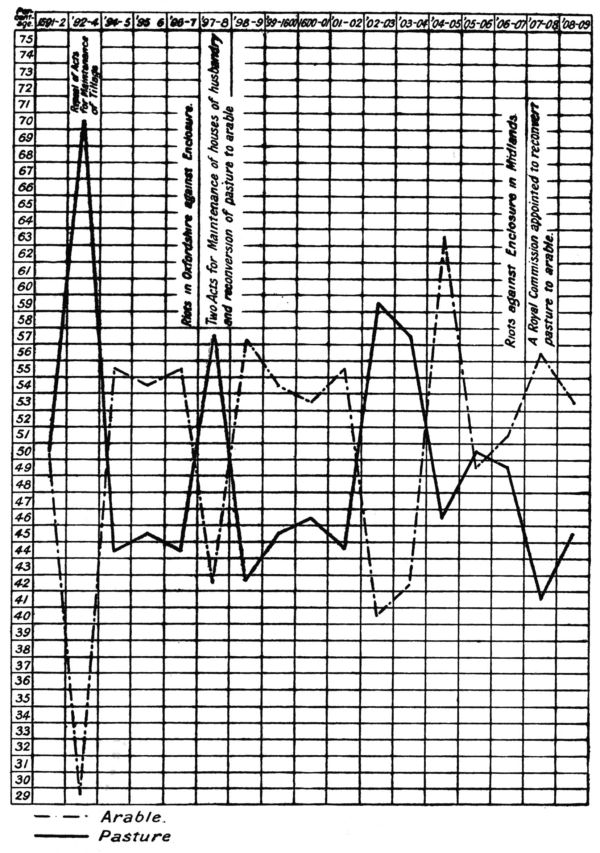
The figures for 1592–3 and 1593–4 have been combined, as the latter are too small to be given separately.
Such “occasional conformity" was, however, too much the rule in all economic matters that were the object of authoritative regulation—and few were not—to be by itself any cause for abandoning it. The real reason for the cessation of interference in the land question which we notice after 1640 is to be found, not in the fact that intervention had invariably proved too ineffective to be worth continuing, but in the change of policy caused by the unchecked domination of Parliament in domestic affairs. The victory of the Parliamentary forces over the Crown meant the triumph of the landed gentry over the only power which was strong enough to enforce the administration of unpopular Statutes in the teeth of their opposition. It prepared the way for the reign of the great landlord who regards himself as charged with a peculiar responsibility for promoting the needs of agriculture, which he alone is presumed to understand—and in fact, to do him justice, does sometimes understand very thoroughly—a weary Titan who pushes forward enclosure from a sheer sense of public duty. On the one hand there is a change in the standpoint from which agrarian policy is regarded. The aim of maintaining a prosperous peasantry becomes subordinate to that of obtaining the maximum output from the soil. This change materially affects the attitude adopted towards enclosure. The Tudor Governments had endeavoured to protect the rights of commoners, because commons were an indispensable adjunct to small-scale subsistence farming. The new view is that commons are waste lands which had much better be improved, and which are most likely to be improved if they pass into the control of men who have capital to spend upon them. Even under the Stuarts this doctrine begins to gather weight, and naturally so, for it both flattered their ambitious conception of the monarchy as a cornucopia whence all economic improvements should flow, and was in line with their general policy of trying to secure cheap food by regulating the supplies of grain. In 1623 Commissioners are busy improving Tiptree Heath, which squatters have occupied without any legal title.[728] In 1637 the King is approached by an influential syndicate which asks for a concession permitting it to reclaim the heaths and barren commons belonging to the Crown, and which displays a glowing prospectus of the advantages which will accrue in the shape of increased supplies of food-stuffs.[729] In 1629 the Commission of Sewers had engaged Vermuyden on his celebrated task of draining the great Level, and, in spite of the fierce opposition of the fenmen, the work was in 1637 adjudged to be completed.[730] All this is quite in the vein of the eighteenth century. It is quite in that vein also for a strong line to be taken against the wastefulness of those who impede good farming, even though the farmer be a grazier, by sowing a few acres here and a few acres there, instead of cultivating a compact holding; in short, by the immemorial system of strip cultivation. The last but one of the Statutes against depopulation[731] was itself the first expressly to authorise that exchanging of holdings for the purposes of more business-like husbandry, which, as we have seen, had been going on informally from an early date. In 1606 we get what may be called the first Enclosure Act of the modern pattern, under which certain Herefordshire parishes are allowed to separate and enclose one-third of the land lying in common in each parish.[732] In 1627 a case arising out of a dispute about fold-courses comes before the courts, and sound agricultural doctrine is laid down with a confidence of which Arthur Young himself might have approved. “This Court,” say the judges, “was now of opinion that the plowing and sowing of small quantities of land dispersedlye or disorderlye within ye shacks and winter feedinge of ye said ffouldcourses, and the refusal of a few wilfull persons to lett ye owners of ffouldcourses have their quillets of land (Llying intermixt in the places where ye sheep pasture is layd) upon indifferent exchange or other recompense for the same, are things very mischievous and will tend to ye overthrow of very many fould courses.”[733] Their opinion is enforced with a judgment decreeing an exchange of lands.
When the whole question comes up again towards the close of the Commonwealth, the old attitude is maintained by the opponents of enclosure, who protest, with all the fervour of Latimer, against the greed of landlords and the pauperising of commoners. But its defenders have overhauled their arguments, and the lines on which the controversy will be fought out for the next century and a half are already obvious. In the eyes of the austere moralists of the Restoration commoners are lewd people, who would be much better employed if at work for wages. All beneath the “nobility and gentry" are “the poor,” and the poor themselves (it is well known) are of two kinds, “the industrious poor," who make a living by working for their betters, and “the idle poor,” who make a living by working for themselves. Christianity and patriotism require that the latter should enter some “productive employment,” and this can best be secured by excluding them from the commons on which their distressingly irregular livelihood depends. Even so Europeans to-day teach habits of industry to the African savage, by taxing him until he can no longer live upon the lands which Europeans desire to exploit. Moreover, the commercial spirit of the later seventeenth century is impatient of antiquated restrictions, and is already groping blindly after some formula which may prove them to be superfluous. Enclosures will increase the output of wool and grain. Each man knows best what his land is best suited to produce, and the general interest will be best served by leaving him a free hand to produce it. “It is an undeniable maxim,” writes a pamphleteer, “that every one by the light of nature and reason will do that which makes for his greatest advantage. Whensoever corn bear a considerable rate, viz., wheat four or five shillings, and barley two shillings and sixpence, men may make more profit by ploughing their pasture, and consequently will plough for their own advantage.”[734] Hales had said something like this a hundred years before. He had said it to show the need of special measures to divert agricultural enterprise into beneficial channels. Now an identity between the interests of landowners and those of the public is assumed as part of a pre-established harmony, which human intervention may disturb, but which it is neither needed nor competent to secure. Authoritative statecraft fades out in the dawn of reason and the light of nature. With such a wind of doctrine in their sails men are steering for uncharted waters.
While opinion on the subject of enclosing was beginning to change even before the Civil War, the final blow at the maintenance of the old policy was struck by the destruction of the Court of Requests and Court of Star Chamber. The abandonment by Governments of all attempts to protect the peasantry against oppression was an indirect consequence of the victory of the Common Law over the prerogative jurisdiction of the Crown. The interference in agrarian matters of the administrative courts of the Tudor monarchy had always been detested by the landed gentry for the very reasons which made it popular with the peasantry. They were the last resort of men who could not get what they considered justice elsewhere. One finds a defendant in whose favour the Common Law Courts have given three decisions being sued again before the Court of Requests.[735] They were the only authority which could prevent a landlord from asserting his claims to a common or to a copyhold by means which the poorer classes found it impossible to resist. Complaints from aggrieved landowners that they are undermining the right of the lord of the manor to exercise jurisdiction over his own copyholders, by trying cases which ought to be heard in manorial courts, that they are interfering with the course of Common Law, that they make it impossible for a lord to “rule his lands" by the countenance which they lend to discontent, are not infrequent[736] in the sixteenth century, and both Wolsey and Somerset were in turn attacked by the upper classes for the favour which they showed to such unconstitutional interference with the rights of property. Such protests are the best proof that the Court of Requests and the Court of Star Chamber had exercised functions which were in some respects beneficial. The strictest constitutionalist will have some sympathy to spare for the address in which Lord Coventry in 1635 charges the Judges of Assize to “beware of the corruptions of sheriffs and their deputies, partiality of jurors, the bearing and siding with men of power and countenance in their country,” and to set on foot “strict inquiry after depopulation and enclosures, an oppression of a high nature and commonly done by the greatest persons that keep the juries under their awe, which was the cause there are no more presented and brought in question.”[737] Such words paint the ideal of Government by prerogative, parcere subjectis et debellare superbos, which may have floated before the minds of a Bacon or a Strafford, and which had been partially realised under the Government of Elizabeth. When set side by side with the actual practice of the Council under Charles I. they are its final and self-recorded condemnation. For we look for them to be made good in action, and we look, save during a few years, in vain. If much may be forgiven those who boldly do wrong believing it to be right, there is no mercy for “the unlit lamp and the ungirt loin" of a body which, believing a certain system of government to be right, entangles its execution with sloth, and makes a sordid financial instrument out of the very prerogative which itself has declared to be the gift of God for the protection of the poor. The defence which the Council and its courts had offered to the peasantry against economic evils, though real, was too irregular to do more than slightly mitigate the verdict which history has passed upon their employment in the hands of Charles I. Whether the peasants regretted their disappearance we do not know. To those contemporaries whose opinion counted, the occasional onslaughts made by the Council and Star Chamber upon enclosing landlords were an aggravation, not an extenuation, of the indictment brought against them. Though the Grand Remonstrance, in which the Long Parliament sought to unite all classes with a recital of grievance accumulated upon grievance, taunted the Government with its failure to check the conversion of arable land to pasture,[738] the authors of that tremendous indictment had no substitute to suggest for the interference by the Council with “freeholds, estates, suits, and actions,” which they denounced; and Laud, who, according to even a friendly critic, “did a little too much countenance the Commission for Depopulation,”[739] lived to be reminded in the day of his ruin of the sharp words with which he had barbed the fine imposed by that body upon an enclosing landlord.[740] The Court of Requests was never formally abolished, but from the closing decade of the sixteenth century it had been gradually stripped of its powers by prohibitions issued by the Common Law Judges, and forbidding plaintiffs to proceed with their cases before it, and after 1642 it quietly disappeared. With the destruction in 1641 of the Court of Star Chamber and the Councils of Wales and of the North, an end was put to the last administrative organs which could bridle the great landed proprietors. Clarendon, himself a relic of an age before the deluge, would seem to have added to his other offences by trying to revive the old policy in a world which would have none of it.[741] But the royalist squirearchy who in 1660 streamed back to their plundered manors, were, when their property was at stake, as sound constitutionalists as Hampden himself, and after 1688 that absorption of the “State” by “Society” which Gneist, a worshipper of the eighteenth century régime, dates with curious perversity from 1832, was, in his sense of the words, complete. Henceforward there was to be no obstacle to enclosure, to evictions, to rack-renting, other than the shadowy protection of the Common Law; and for men who were very poor or easily intimidated, or in enjoyment of rights for which no clear legal title could be shown, the Common Law, with its expense, its packed juries, its strict rules of procedure, had little help. Thus the good side of the Absolute Monarchy was swept away with the bad. Its epitaph was written by Locke:[742]—“The supreme power cannot take from any man any part of his property without his own consent.” But it was forgotten as soon as it was written. For to the upper classes in the eighteenth century the possession of landed property by a poor man seemed in itself a surprising impertinence which it was the duty of Parliament to correct, and Parliament responded to the call of its relatives outside the House with the pious zeal of family affection.[Next Chapter]