Front matter
Reading edition
Transcriber‘s Note: Typographical errors have been corrected, and inconsistent spellings regularized. For details, please see the End Notes. The original versions of any corrections may be viewed as mouseover text.
The numbered tables are provided with hyperlinks to the respective Notes supplied in Appendix I.
In Appendix II, there are a number of letters (m, n, u, v, r, t) that are printed with a backward curl, usually at the end of a word, but sometimes in mid-word. These are rendered here as:
m -> 'ᶆ',
n -> 'ɳ',
u -> 'ư',
t -> 'ȶ',
r -> 'ɽ'
v -> 'ⱱ'
These forms are intended to provide a visual indication of a letter‘s form, from the available set of unicode characters, but are not intended to convey phonetic value.
The letter 'p' appears with a curl that crosses the lower bar, which is rendered here as 'ᵱ'.
A doubled 'l' with a tilde across the middle is rendered as 'l̴l'.
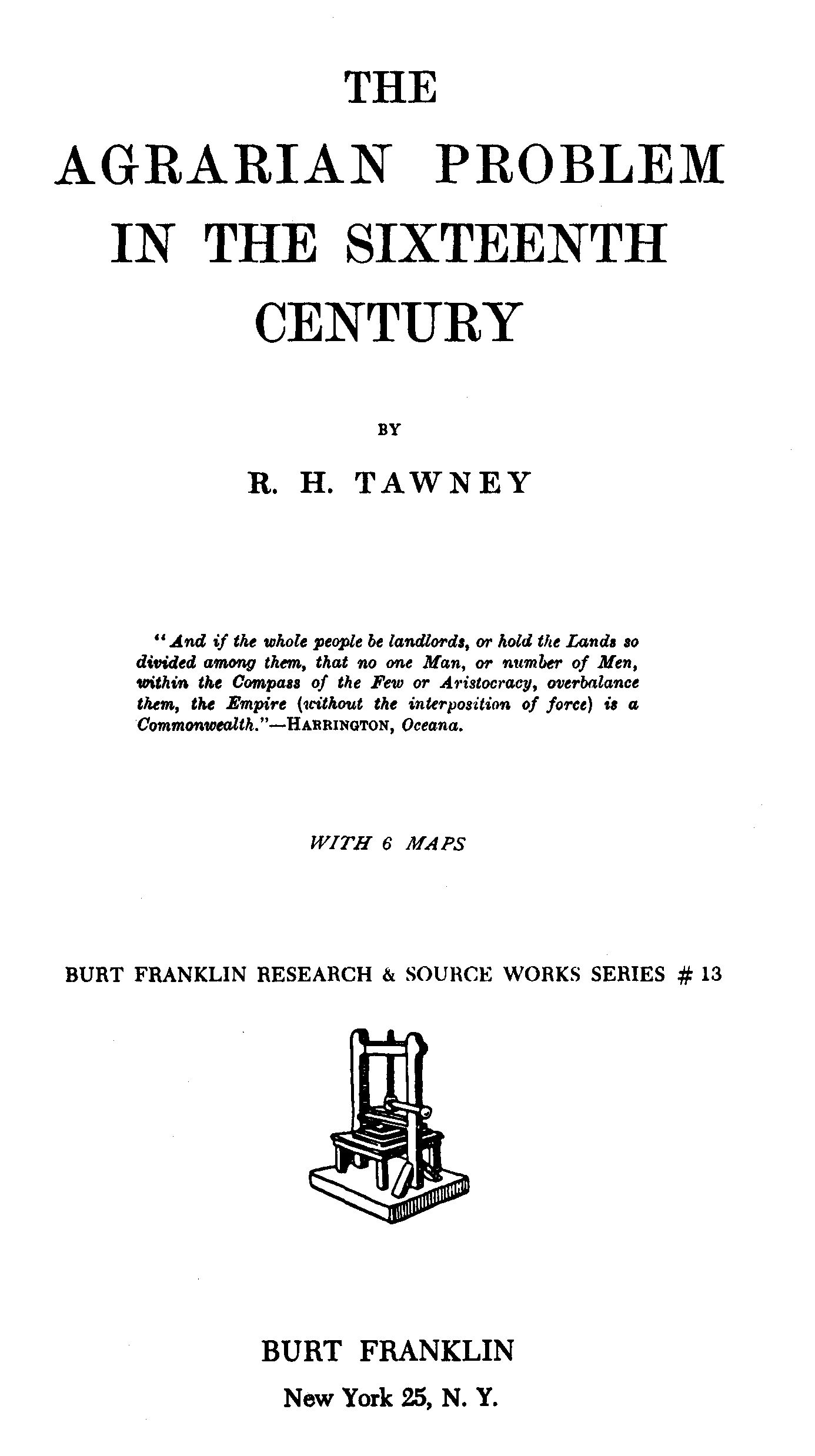
BURT FRANKLIN RESEARCH & SOURCE WORKS SERIES # 13
THE AGRARIAN PROBLEM IN THE
SIXTEENTH CENTURY
THE
AGRARIAN PROBLEM
IN THE SIXTEENTH
CENTURY
BY R.H. TAWNEY
“And if the whole people be landlords, or hold the Lands so divided among them, that no one Man, or number of Men, within the Compass of the Few or Aristocracy, overbalance them, the Empire (without the interposition of force) is a Commonwealth.”—Harrington, Oceana.
WITH 6 MAPS
BURT FRANKLIN RESEARCH & SOURCE WORKS SERIES # 13

BURT FRANKLIN
New York 25, N.Y.
Published by
BURT FRANKLIN
514 West 113th Street
New York 25, N.Y.
ORIGINALLY PUBLISHED IN
LONDON—1912
Printed in U.S.A. by
SENTRY PRESS, INC.
New York 19, N.Y.
TO
WILLIAM TEMPLE and ALBERT MANSBRIDGE
PRESIDENT AND SECRETARY
OF THE
WORKERS' EDUCATIONAL ASSOCIATION