THE ADVENTURES OF HARRY ROCHESTER (continued 8)
Reading edition
Harry felt a tightening at the heart as he realized the magnitude of the task he had set himself. His force, reduced by his losses to eighteen, including himself and the two English officers, who were scarcely effectives, was outnumbered by nearly eighteen to one. And the enemy were no feather-bed warriors. Looking at their motley array, he recognized that he had to contend with some of the fiercest, most desperate, least scrupulous men of war that Europe could produce. Their nationalities were as varied as their costumes. His inexperienced eye could not distinguish their types: but he saw small men and big men, men fair, men dark, old and young; some were born dandies, as their attempts at decoration in adverse circumstances showed; others born tatterdemalions, who even in affluence would have held the decencies of costume in derision. About a hundred seemed to be regular soldiers of the Elector of Bavaria's army. Only one bond held them together: a common love of lawlessness and rapine. He felt a new respect for Aglionby; only a man of some moral force, however perverted, could have imposed his leadership on such a heterogeneous crew.
At the moment Aglionby was in consultation with a few others at some distance, and out of range of the clumsy firearms of those days. Among the little group Harry singled out two men as of more consequence than the rest: a tall fellow matching the captain in height and bulk, wearing a red sash—the same man he had seen approaching the inn,—and a small active man in whose cap a peacock's feather was jauntily stuck. They were evidently discussing with great animation their plan of attack.
As nearly as Harry could judge, about a hundred men were crouching behind the parapet. A body nearly two hundred strong was held in reserve near the leaders. Against these Harry had five men in the gateway, three at the summit of the keep, three half-way up, and Max as lieutenant and aide-de-camp.
Suddenly the group of leaders parted, a bugle rang out, and simultaneously with a fierce discharge of musketry from the parapet two men dashed forward from each end of the gap on to the bridge. At a second's interval these were followed by another four, while several men rushed from the reserve towards the far end of the parapet to fill their places. Three fell under the first volley from the defenders, but the rest sprang forward unhurt, and gaining the other side began to clamber up the barricade, to tear down the stones, or, thrusting their muskets through the loopholes, to discharge them hap-hazard at the garrison within. But three of the defenders of the gate had held their fire, and, boldly mounting a low platform of stones just inside the barricade, they discharged their pieces point-blank into the mass of men now crowding with shouts across the bridge. The brigands, Harry noticed, were headed by the big red-sashed Croatian he had seen in consultation with Aglionby. They recoiled but for a second, then surged forward again, and, yelling with fury, hurled themselves against the breastwork. Eugene's troopers, led by Max, held their ground in silence, save for a muttered exclamation when one of their adversaries fell reeling into the fosse.
It was not long before the weight of numbers began to tell; portions of the barricade had been pulled down; the gallant defenders were hard beset. Calling to the two men in the keep, Harry rushed down and flung himself into the fray, shouting to Max to go to the top of the keep and carry out orders he had previously received. Max hurried away, and Harry lost count of time as he engaged in a desperate hand-to-hand fight across the fast crumbling barricade. Standing upon their platform the defenders still had the advantage of position, and Harry and his two men being fresh, the enemy for some few minutes gained but little. Then, as the attackers were once more beginning to make headway, there was a terrible crash on the bridge. The fighting ceased as by magic; all was still. A huge mass of stone, swung outwards from the top of the keep, had broken with terrific force through the light palisades, leaving only one section intact, and carrying with it into the fosse nearly a dozen men. The survivors on the castle side, seeing themselves almost cut off, were seized with panic and made a simultaneous rush for safety, the big Croatian pushing his weaker and wounded comrades into the fosse in his reckless haste to regain the opposite bank.
Harry gave a gasp of thankfulness and relief,—and turned to see Fanshawe and Buckley, who, weak as they were, had come up unknown to him towards the close of the fight to bear a hand.
"Thank you, old fellow!" he said to Fanshawe, "we have scored one."
But he turned again, and, leaning on the barricade, anxiously scanned the field. The leaders of the enemy were once more in earnest consultation. They must have lost at least twenty men in the short sharp struggle; but the defeat seemed only to have enraged them. During the first part of the fight Max had been full in their view, and as he still wore the prince's costume the brigands were no doubt convinced that Eugene himself was the head and front of the defence, and were buoyed up by the hope of capturing him. For some minutes the discussion among the leaders continued; then, as having come to a decision, they moved off with their men towards the copse, and, save for half a dozen who remained to watch the castle, were seen no more for some hours.
Their absence gave Harry an opportunity of attending to his wounded. He found that three were somewhat seriously hurt, and one was rendered hors de combat. His total force was now reduced to fourteen, including himself, his brother officers, and the two men on guard.
Towards mid-day, under a broiling sun, the enemy again appeared. This time, in addition to palisades freshly made, they carried with them a number of rough frameworks penthouse shaped, fashioned from stout saplings bound together, like the bridge, with withies from the marsh. Evidently there was a man of resource among them. Each of the frames formed a kind of wooden tent, two yards long, some three to four wide, and six feet high, requiring the united strength of half a dozen men to carry. But there was no lack of men, and the bearers, protected from bullets from above by the roof of these shelters, came safely almost to the edge of the fosse. The new palisades were thrown across, but this time the materials were stronger. One of the sheds, its end closed with light logs, was rushed across the bridge by a dozen strong men. A second was joined to it, then a third, and so on until a continuous corridor stretched across the fosse. The lashings holding the logs together at the inner end being cut, from out of this testudo sprang brigand after brigand, who came impetuously up to the barricade and instantly engaged the defenders in a furious hand-to-hand combat. Max, whose marksmanship with his huge sling had been so effective before, hurled stone after stone down upon the testudo, but they were turned off by the sloping roof, and though the bridge creaked and groaned under the impact it did not give way.
It was fortunate for the defenders that only a few men at a time could make their way through the shed, and the space at the end was too narrow to allow of a great accession of numbers unless the foremost could scale the barricade. The enemy had again lost heavily at their first onset, but as soon as one man fell his place was supplied, and no respite was given to the little band within. Shoulder to shoulder Eugene's men formed a wall of steel across the gateway: again and again they beat back the enemy at the breastwork. But against such odds they could not hope to escape unscathed; there were no reserves; and of the enemy there was still a host ready and eager to fill the gaps. One man and then another of the troopers fell, this one to rise no more, that to crawl away and stanch his wound. Seven men were now all that was left of the fighting line, and when Fanshawe and Buckley came up and insisted on sharing their comrades' peril, Harry felt that he dared no longer delay the playing of what might prove his last card. With a word to Max to keep up the fight, he slipped for a moment out of the press, struck a flint, kindled some tinder he had kept in readiness, and then, shouting to his men to make for the keep, and waiting till they had begun to run, he lit the train.
At the last moment a trooper fell, so badly hurt that he could not move. Harry sprang forward, caught the man by the belt, and dragged him into the courtyard towards the keep. The enemy, astonished at the sudden flight of the garrison, hesitated for a moment before charging across the obstacle which so far had held them off. Then, just as they leapt forward over the barricade, now an irregular heap of stones, there was a blinding flash behind them, and a deafening roar. The ground rocked; fragments of the dilapidated walls fell inwards and outwards; a dense cloud of dust and smoke bellied over the scene, and the air was rent by the cries of men in agony.
Disregarding the falling stone-work, Harry ran forward to the archway, his eyes smarting with the fumes. As the cloud gradually settled, he saw crowds of the enemy huddled together on the farther side of the fosse, their eyes aghast intently fixed on the archway. But of the bridge, and the sheds, and the stream of men who a minute before had been pressing forward exultantly across the fosse, not a vestige remained. Wood and men lay an indistinguishable mass at the bottom.
CHAPTER XXII
The Fight in the Keep
Soldiers All—The Silent Watches—Twice a Traitor—The Oubliette—The Horizon—Fanshawe Volunteers—A Powder Barrel—Nearing the End—Allies—Von Stickstoff—More Stickstoff—The Confederate Camp—The Anspach Dragoons—At the Sword Point—A Brief Respite—The Fight on the Stairs—The Last Stand—The Anspachers
Harry was sick at heart when he came to examine his losses. Three of his men were dead, nine badly wounded, there was not one but bore marks, in bruise or cut or strain, of the desperate strife in which they had played such manful parts. He arranged for the burial of the three gallant troopers; then, heavy-hearted as he was, set to work with indomitable pluck to repair the damage done to the defences. The prisoners were pressed into the service; the barricade was restored, and another mine was dug, though from the crack that showed in the masonry of the archway Harry feared that a second explosion would bring half the keep tumbling about his ears.
Having done all that could be done, and shared a meal with his devoted men, Harry went with Fanshawe and Buckley to the top of the keep to discuss the future.
"Our state is parlous, Fanshawe," he said. "Another assault will wipe us out."
"We have a breathing-space. The brigands have had enough for the present. Their ill-success must have daunted them."
"But Aglionby will not give up yet. He is playing for a high stake.—What is doing yonder?"
In the distance he saw two wagons and a band of some fifty men making their way across the hills towards the copse in which the enemy were encamped.
"Reinforcements, it appears," said Buckley. "Perhaps food; they will raid every farmhouse round."
"We must say nothing of this to the men," said Harry. "'Twould dishearten them."
"It seems you have no choice but surrender," remarked Buckley.
"Never—unless you and Fanshawe as my superior officers take the responsibility."
"Not I," said Fanshawe. "'Tis absurd to think of! The men are devoted to you; and Prince Eugene put you in command; you have done wonders, and whatever be the end, we'd be fools to interfere—eh, Buckley?"
"Certainly."
"Then I won't surrender. Say we make terms, think you the enemy would hold to them, finding the prince not here? They would wreak vengeance on us for their disappointment and their losses. They are in the main freebooters, the scum of the French and Bavarian armies, as near savages as men can be. We could expect no mercy at their hands. Besides, Aglionby will by and by discover, if he have not already done so, that I am here; and he has too many scores to pay off to deal very tenderly with me or my men. We can but hold out to the last, and hope that help may come in time."
"The prince must by this be in our camp," said Fanshawe. "What if we tell the enemy they are on the wrong scent?"
"'Twould avail us nothing. Aglionby would not believe the story, or, if he believed it, would scout it publicly so as to keep his men together. He would be the more deeply embittered against us."
"You are in the right," said Fanshawe. "Pray God help comes to us, then."
"We can still hold the keep," said Harry. "One man on the winding stair can hold many at bay; we must fight against time."
That night Harry could not sleep for the harassing problem of the continued defence of the castle. True, his object had been gained; Prince Eugene had got off in safety; he himself had fought a good fight; but it was clear that unless help came soon his defence must be broken through by sheer force of numbers. He was resolved to die rather than fall a captive into Aglionby's hands; but the longing for life was strong within him. He thought of all that had passed during the two years since his meeting with Lord Godolphin: the strange vicissitudes, the ups and downs of fortune; the inexplicable enmity of Mr. Berkeley; his pleasant relations with Mynheer Grootz and the ladies of Lindendaal; the chances which had served him so well and brought him so near the realization of his dearest longings. It was hard to think that at this moment, when the confederate army under the greatest generals of the age was moving towards events of high moment, he should be cut off in this obscure spot and robbed of the opportunity to which he had looked forward so eagerly.
He did not think only of himself. He remembered his companions—Fanshawe, Buckley, the faithful Max, the brave troopers whose fate was linked with his. Their lot was worse than his, for they had ties—parents, children, relatives, to whom they were dear: he himself was alone in the world. Apart from Mynheer Grootz, who he knew loved him; Madame de Vaudrey, whose feeling for him was warm; Sherebiah, whose affection was perhaps the closest of all; there was no one to be interested in his welfare. Thinking of Madame de Vaudrey he thought of her daughter, and was dimly conscious that he would have liked to stand well in her eyes—to break through that cold reserve of manner she had always shown to him, and win from her one look or word of approval. Fanshawe, he knew, still nourished a hope of winning her; it seemed to depend on him whether Fanshawe should have another chance.
He lay awake, thus musing, and gazing at a star that shone through the loophole in the wall. By and by he felt a strange uneasiness, unconnected with his previous train of thought. All was quiet; not even the hoot of an owl broke the stillness. Unable to account for his feeling, he rose and went to the top of the keep.
"Is all well?" he asked the sentry there.
"All is well, Monsieur."
"You have seen or heard nothing?"
"Nothing, Monsieur, but the scurry of rabbits in the fosse."
"Good-night!"
He returned to his bed and lay down again. But still he felt uneasy; again he was impelled to rise. This time he went down into the courtyard. Max was on duty there. The horses were ranged round the walls; the coach stood in the corner to which it had been hauled; everything was as it had been. He went into the large hall: the prisoners were all asleep, the sentry on guard. Something led him to continue his round; he was determined to allay his restlessness by examining every nook and cranny of the castle. Taking a lighted candle, he made his way into the lower part of the keep. He arrived at length at the chamber to which there was access from the tunnel. He started, and stopped short in amazement and consternation. The stones which had been heaped on the trap-door had been removed. With a muttered imprecation on the man who he supposed had carried the stones up the keep for use with the sling, he was turning to order someone to replace them when he noticed that several stones were piled in a corner near at hand. He stood still, puzzled at this strange meddling with his work.
At this moment he heard a slight sound beneath him, and saw a tremor in the stone trap-door. Could he believe his eyes? One end of the stone was rising. Quick as thought he blew out his candle, and backing behind a pillar drew a pistol from his belt. His fascinated eyes were fixed on the slowly moving stone. There was now a ray of light at its edge; he heard whispering voices. Steadily the heavy slab was pushed into a vertical position; then appeared the head, the shoulders, the body of a man. By the light of the sputtering candle he carried Harry recognized Otto the landlord. Now he saw the meaning of all that had puzzled him. The man, alarmed for his safety if, as must seem inevitable, the brigands captured the castle and found him there, apparently an accomplice in the trick played upon them, had sought to purchase his peace by leading them through the secret passage. Harry felt a keen pang of self-reproach that he should not have foreseen this development and taken steps to prevent it.
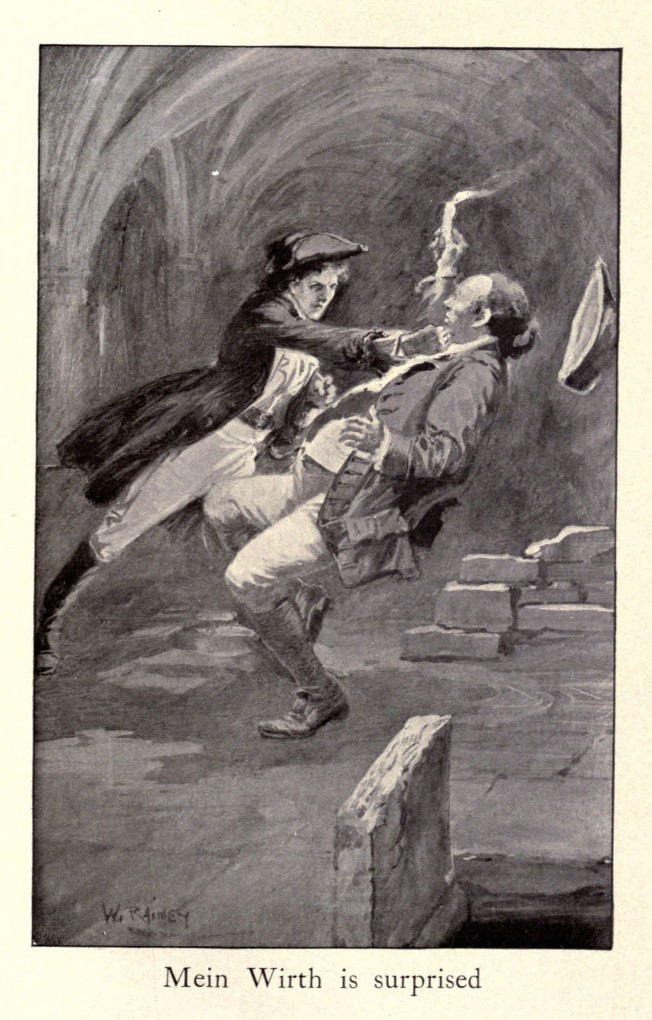
Mein Wirth is surprised
But he was instinctively bracing his muscles for the impending struggle. The landlord was now through the opening; he stepped on to the floor of the room and bent down to assist the next man. Slipping the pistol back into his belt, Harry made two bounds and was beside the stooping figure. The man heard his footfall and instantly straightened himself; but even as he raised the hand holding the candle to ward off the imminent blow, Harry struck him full upon the chin, and with a stifled gasp he fell headlong to the stone floor. Then Harry, throwing all his weight against the slab, hurled it with a crash into its place. The landlord's candle was guttering, still feebly alight, on the floor. By its glimmer Harry hauled from the corner one after another of the stones that had been removed, and piled them with desperate haste upon the trap until the way was again effectually blocked.
Then, picking up the candle, he examined the prostrate body. The man was stunned. Harry, for all his anger, could not help pitying the poor craven wretch. But only one course was open to him. The crashing sound had already brought Max and two other men to the spot.
"Lower him into the dungeon," cried Harry.
And the dark hole in which Fanshawe and Buckley had spent nights and days now received the senseless body of the traitorous landlord.
Sleep was banished for the rest of the night. The alarm had gone through the garrison, and every man was on the alert. It was clearly imperative to provide against a possible attack by way of the underground passage. Such an attack was, in truth, not very likely. Only one man could pass the slab at one time from below, and save by mining operations the enemy could scarcely force a way through the ton of stones which Harry now caused to be heaped above it. But it was necessary to set a watch at this point, and as he could not spare another man from his already too much diminished force he decided to withdraw the man from the tower by which he had escaped from the castle, and to release the prisoners.
Before he did this, however, he resolved to employ them once more in strengthening his defences. It was pretty evident that the result of another assault would be to drive him into the keep. The entrance to this from the courtyard was without a door; it was necessary to block it up, leaving only a narrow gap that could be easily closed. He employed the prisoners to pile the largest stones that could be found flush with the doorway, in such a manner that the enemy, approaching from the outside, should be unable to get a hold upon them or push them away. A narrow opening was left, and heavy stones were placed on the inside, near at hand, to block it up when the time should come. At the same time a large supply of missiles was conveyed to the top of the keep.
It was clear from the movements of the enemy during the day that they were far from abandoning the siege. No doubt they had been encouraged by the arrival of reinforcements. Sections for a new bridge were brought in the afternoon and placed close to the fosse, together with the sections of a second testudo. These were certain indications of another attempt on the gateway.
Many times during the day Harry went up the keep and looked anxiously northward for the expected succour, always to be disappointed. He could not believe that Prince Eugene had left him to his fate; something must have happened to detain the relieving force, and Harry thought with anguish of heart that it might arrive too late. Then an idea struck him. Why not send out a messenger to hasten the troops if they were indeed on the road? There was one serious objection: the garrison could not safely spare a man. He mentioned his idea to Fanshawe.
"Let me go," said his friend instantly. "I am of little use as a fighting man; my strength is not equal to a fight so desperate as the last. But if I can get away, I might find a horse in a neighbouring hamlet, and I could at least keep my seat in the saddle. And an officer would prove a better messenger than a trooper."
Harry accepted the offer. Fanshawe might fall into the hands of the enemy, but he was willing to face the risk, and under cover of night there was a reasonable hope that he might elude them. About ten o'clock he clambered along the battlements towards the rearmost tower, and there, assisted by a rope, he made his exit by the postern, slid down the slope more riskily ventured by Harry on his first visit to the castle, and, taking a wide sweep, disappeared into the darkness.
When Harry returned to the keep, he was informed by the sentry that he had heard dull movements beneath the trap-door. The sounds had now ceased. Harry's conclusion was that the enemy had been searching for a weak spot in the passage, and having failed had finally given up any notion of effecting an entrance there. He arranged with Buckley to take the watch from midnight till dawn.
With the first glimmers of daylight Harry carried out his resolve to release the prisoners. The odds were so heavy against him that one man inside was now worth thirty out, and with no prisoners to guard he could add one to his effective force. Rapidly marshalling them, he led them to the ruined tower, and let them down by a rope as Fanshawe had been let down in the night. The movement was seen by one of the enemy's scouts, and before the prisoners had all reached the ground a crowd of their comrades had gathered at the foot of the slope to meet them. Their appearance seemed to create great astonishment; they were surrounded and eagerly plied with questions. One result of their release was that a new point of attack was disclosed to the enemy, who had apparently not dreamt hitherto of making an attempt by the postern. Harry saw a small body detach themselves from the main force and approach the slope; but knowing the difficulty of an assault uphill upon such a narrow opening he doubted whether they would push an attack home; still, it would have the effect of engaging one at least of his men.
It was very early in the morning; the enemy had everything ready; but they appeared to be waiting for something. Once more Harry scanned the horizon vainly for sign of helmet or lance. Suddenly there was a deep rumbling roar from the interior of the keep; an exultant shout rose from the enemy's ranks, and rushing forward at full speed they began to throw their new bridge across the fosse. Shouting to his men to hold the gateway to the death, Harry hastened down to the entrance of the keep, where he was met by stifling fumes of gunpowder. Then he rushed up the winding stair to the first floor, and saw Buckley staggering towards him.
"I had just been relieved," panted Buckley. "The explosion occurred the moment after I left the spot. It stunned me for a few seconds. The poor fellow who took my place must have been blown to atoms."
"They laid a charge last night, 'tis clear," said Harry. "But they can't follow up at once; they must wait until the fumes have cleared away, and that will take time: there are no vent holes. Remain at the top of the stair; with your musket and pistol you can hold several off for a time. They are assaulting the gateway; I must go."
Harry, having proved the futility of dropping missiles upon the testudo, had concentrated his whole force, save Buckley and the man in the tower, at the gateway. He noticed that the new bridge was higher at the farther side of the fosse than at the end near the castle. The reason was soon evident. The testudo this time was not blocked up by logs, and Harry behind his barricade could see through its entire length. A screen of saplings was suddenly raised over the farther end of the bridge; it was as suddenly removed; and down the inclined plane rolled a small keg of powder, with a burning fuse attached.
"Back, men, back!" he shouted.
The command was only just in time. They were but a few yards from the barricade when there came a roar like thunder, followed by a second as Harry's own mine was exploded, and through the swirling smoke fierce and derisive cheers. Holding his breath and stooping low, Harry rushed back to see what damage was done. The barricade had disappeared; the archway was in ruins; and the enemy were flinging another bridge across the fosse to replace that destroyed by the explosion. So far as the defence of the gateway was concerned, Harry saw that the game was up. At the best he could but delay the enemy for a few minutes, and even then he would risk having his men cut off from the keep. Recalling the man from the farther tower, he collected his little band, ordered them to fire one volley into the advancing ranks, and then withdrew through the barricaded doorway into his last defence.
At that moment he heard the dull sound of a shot above. Buckley must be beset! Giving Max orders to hold the courtyard entrance, and sending a man to hurl down stones from the roof upon the enemy crowding below, he took two men with him to assist Buckley, whom he found hard pressed near the head of the other stairway. Sword in hand, he was holding the narrow winding passage against the big red-sashed Croatian, who was making a desperate thrust at him with a half-pike, the head of which had been severed by the Englishman's blade.
"Steady, Buckley! I am here!" shouted Harry.
He drew his pistol from his belt, slipped under Buckley's arm, and just as the Croatian hurled himself up the last step intervening between himself and his foe, Harry fired point-blank at his heart, and he fell back upon his comrades. The narrow stairway was choked with men; the din of their shouts echoed and re-echoed from the winding walls, and above all the uproar Harry distinguished the tones of Aglionby, yelling to his men to make way for him to pass.
When Fanshawe left the castle he walked steadily on for some hours, making a wide circuit round the enemy's position, guiding himself by the north star. His progress was difficult over the hills in the darkness. He had to scale bluffs, to creep up rocks, to spring across ravines, to wade through swamps at the risk of being engulfed, to skirt patches of wood—though in one case, finding that he was being taken too far out of his course, he plunged boldly into a copse, trusting to his good fortune to bring him safely out at the other side. Thus delayed, it was long before he felt sure that he was safe.
At last he struck into a narrow pathway leading north-west. Proceeding more rapidly along this, he was brought, after walking for some four hours, into what was apparently the highroad along which he had passed with Marlborough's letter about ten days earlier. He was very tired, but resolved to press on until he reached a village. Another hour's walk brought him to a hamlet with a modest Gasthaus. He knocked up the landlord, and with some difficulty persuaded the suspicious man to provide him with a horse. No troops, he learnt, had passed through. The landlord had been told that firing had been heard among the hills in the direction of Rauhstein; he did not understand what it could be, for the castle was in the possession of brigands, and he did not think the prince's men were near enough.
Staying at the inn but to eat a little food, Fanshawe rode on, and suddenly, some little while before dawn, came on a picket of four men upon the road. He was challenged; the speaker was evidently a German, and of German Fanshawe knew not enough to frame a sentence. He tried French; but that raised the sergeant's suspicions; he mentioned the names of Marlborough and Prince Eugene, with no better success; and he was marched off under guard into the neighbouring village.
His escort halted at a small cottage, and the sergeant entered. Colonel von Stickstoff was in bed. He was awakened, but the colonel was nothing if not a stickler for etiquette, and he declined to see Fanshawe until he had made some preparations. When Fanshawe was marched in, therefore, he found himself confronted by a short, stout, pompous little officer, with his tunic buttoned tight, a rug across his knees, which were guiltless of breeches, and a large flaxen wig set awry over his nightcap. The quarter-master was summoned, and an interrogation began.
"Who are you, sir, and what have you to say for yourself?" asked the officer in German.
Fanshawe tried to explain in French, of which he had obtained a smattering.
"Ha! You are a Frenchman! Take that down, quartermaster. Everything must be done in order."
This was somewhat embarrassing. Fanshawe might understand the German's French, but he must necessarily be ignorant of what was said to the quarter-master in German.
"I am an officer in my lord Marlborough's army," he said haltingly.
"Take that down, quarter-master. A Frenchman in Lord Marlborough's army. In what regiment, Monsieur?"
"In Schomberg's Horse."
"Take that down. Now, Monsieur, explain to me how it is that you, a Frenchman in Lord Marlborough's army, are here, ten miles from his camp at Gros Heppach."
This was good and unexpected news. Fanshawe at once proceeded to make it clear that he was an Englishman, then explained in as few words as possible whence he had come and the urgency of his mission.
"Take that down," said the colonel, translating to the quarter-master.
The man wrote slowly, and Fanshawe was growing more and more restive.
"I beg you to note, Monsieur," he said, "that while we are talking Prince Eugene's men are possibly being massacred by the brigands. They are at least forty to one."
"Ha! Take that down. The enemy is in force; we must adopt every precaution. No doubt they are an advance-guard of the Elector's army. How many do the enemy number?"
"Some three hundred."
"Three hundred!—And I have only two hundred and eighty-three. We are outnumbered. Take that down. We must arrange a postirung, according to rule, quartermaster; note that, strictly according to rule. I will write you the instructions. Lieutenant Spitzkopf will advance with ten men three hundred and twenty paces in front of our position; Lieutenant the Baron von Blindwurm will post himself with five men two hundred and sixty paces on our right flank—or is it two hundred and forty? Hand me my manual, quarter-master."
"There is a swamp there, Excellency," suggested the quarter-master doubtfully.
"Then they must post themselves in the swamp. A postirung is a postirung; let there be no mistake about that. Let me see; yes, here it is: page one hundred and nine: 'Superior force: detachment in presence of, what steps to take'. Yes, it is quite clear; we must secure our position and send for reinforcements. 'Send for reinforcements': that is it. You will at once send a messenger to Stuttgart; I will write a despatch to the general while he is saddling up."
Then turning to Fanshawe he said:
"I regret, Monsieur, that, having failed to give the countersign, you must consider yourself under arrest until your bona fides is established. Quarter-master, take the prisoner away; see that things are done in order, and be sure to wake me up when the enemy are sighted."
Fanshawe protested, but the colonel was evidently impatient to get back to bed, and waved him peremptorily away. He was led out and deprived of his arms, boiling with anger, and, feeling that every moment was of importance, in a state of desperation. This was the officer to whom Prince Eugene had entrusted the urgent task of relieving his hard-beset troopers! The confederate camp was only ten miles distant; if only he could find some means of sending word thither of the dire straits in which Harry was!
As he passed along the street with his escort, he saw a number of horses approaching, apparently from being watered. The first, a fine charger lighter in build than the average cavalry horse of the period, was led by a groom, who at this moment tethered the animal to a post a few yards from his commandant's cottage. The trooper into whose custody Fanshawe had been confided was marching on his right hand, carrying not only his own carbine but the prisoner's sword and pistols. Fanshawe saw a bare chance of escape and unhesitatingly took it. With a sudden movement he deftly tripped the man up, sprang to the post, unhitched the reins, and before the onlookers could collect their scattered wits was on the horse's back and twenty yards down the road. There was a great hubbub behind him; fortunately none of the troopers was at that time armed. Suddenly he bethought him of the vedette whom the extreme caution of the commandant had doubtless caused to be posted in the rear of his force. He might come upon him at any moment. Taking the first turning to the right he set spurs to his steed, dashed along a lane, leapt a fence, and plunged into an orchard. From his study of the map previous to his ride with Marlborough's message he remembered that Gros Heppach lay on the Göppingen road, to the north-east of his present position. If he could strike this by a path over the hills he might yet succeed. He spurred on, the rising sun enabling him to choose the easiest ground, and by and by came upon a rough country track leading in the right direction. He galloped along at break-neck pace, and gaining a little eminence, his eyes were gladdened by the sight of white tents dotting the valley some three miles below him.
He sped down the hill, and soon came plump upon a Dutch outpost, which had evidently seen him from afar and prepared to stop him. Reining up, he asked to be taken at once to Lord Marlborough. The Dutchman did not insist on explanations, recognizing him as an English officer, but sent a man at once to conduct him to headquarters. He had but just reached the outer circle of the camp, when he saw Colonel Cadogan riding slowly along in company with another officer whom he did not recognize. Without hesitation he rode up to the colonel, saluted, and begged to be allowed a word with him. His explanation was soon made, and to his surprise Cadogan burst into a great laugh and cried in French:
"This concerns your highness. The troopers who played the trick on the brigands, and that young daredevil Rochester, are trapped in a castle."
"Nom d'un tonnerre!" cried Prince Eugene. "Are they not relieved? I ordered a detachment of Würtembergers to ride out to them two days ago as I passed through Stuttgart. What has become of them?"
"It appears," said Cadogan, still laughing, "that they are on the road, but the colonel is learned in the art of war and is advancing by strategical moves."
"Sacrebleu! He must be one of Baden's men. That young countryman of yours, Colonel, must be saved."
"Yes, though he is a Dutchman now. Mr. Fanshawe, your friend's regiment is close by; you had better take a squadron and ride out at once. I suppose a troop or two of Dutch dragoons will be a match for the brigands?"
"Certainly, sir,—of the Anspach dragoons."
"Very well, lose no time. I will mention the matter to the duke, to whom you will, of course, report yourself at the earliest opportunity. Good luck to you!"
Fanshawe rode off, and within a quarter of an hour was leading some two hundred of Harry's troopers, Captain van der Werff at their head, and Sherebiah among them, along the shortest road to the castle of Rauhstein.
The winding staircase of the keep was ampler than in most castles of the kind. Two men could mount abreast, but it was only possible for one to find room for sword-play. The attackers soon adapted their tactics to the conditions. One man pushed to the front with sword and pistol; another just behind supported him with pistol and pike. Not long after Harry came upon the scene, Buckley, all but sinking under the strain, had to be assisted up the staircase. This gave the brigands a momentary advantage, for Harry was left with only one swordsman to stem the rush. There was no room for his companion by his side; he therefore sent him aloft to bring large stones to hurl upon the mob. Not for the first time he had reason to congratulate himself on the hours he had spent with Sherebiah and the Dutch instructor of his regiment in practising with sabre and rapier. His was the advantage of position, but the enemy were always two to one, and had they had patience to recharge their pistols after the failure of their first flurried snap-shots, or boldness enough to press forward regardless of the loss of the first few men, they could have borne him down with ease.
Only a few minutes had elapsed after Harry's arrival at the stairhead when he heard a well-known voice storming below. The enemy gave back for a moment, then Captain Aglionby pressed upward and engaged Harry hand to hand. Harry was sufficiently occupied in parrying the captain's vengeful attack without the necessity of guarding against the pike that threatened every moment to impale him. This he could only turn aside; he had no time for a sweeping cut to sever its head. Fortunately for him the captain and his supporter impeded each other on the stairway. Yet Harry saw that the struggle could not last long, and fervently hoped that the man he had sent for missiles would return in time. The clang of weapons and the shouts of men rang through the stone-walled spaces. Aglionby had learnt from the released prisoners of the trick that had been played upon him, and his fury found expression in the violence of his onslaught and the venom of the curses he hurled upon his nimble-wristed opponent. Harry said never a word, but kept his eye steadily upon the captain, turning aside stroke and thrust.
At length he heard a footstep behind him. A stone as large as a man's head struck the wall immediately below him on his left. Narrowly missing Aglionby, it rebounded from the curved surface and struck the pikeman below him with a terrible thud. With the steadiness of an old campaigner the captain did not so much as wince, but continued his attack with still more savage energy. When, however, another stone hurtled down the stairway, maiming two other men below him, the rest of his followers turned tail and fled helter-skelter to the foot. A third stone grazed Aglionby's arm; then, seeing himself deserted, he backed slowly down the stairs.
The attack having been thus for a time repulsed, Harry left two men on the stairs with pistols ready charged and a supply of stones, and hurried across to the other staircase to find how things had gone there. It was with unutterable relief he saw that the assault of the enemy on the entrance to the keep had so far been beaten off by the combined fire from the doorway and the hurling of heavy blocks of stone from the top of the building. But the enemy were preparing another move. Finding that they could not force the obstacle, nor approach near enough to tear it down, they were about to try the effect of an explosion. A keg of powder had been rolled to the entrance by a lucky rush between the falling of two of the dreaded stones from above; now, hugging the wall so as to avoid the fire of the defenders, they were laying a train.
Harry saw that it was only a matter of minutes before the barricade at the entrance to the keep would be blown in. He utilized the time by bringing down a further supply of stones from the battlements and storing them within easy reach of the inner stairway. He could not prevent the explosion, or raise further obstacles to the progress of the besiegers; he could but defend every inch of the staircase, and retreat, if it must be so, step by step to the top of the keep. Almost despairing now of relief, he was prepared to fight to the end, and, looking round on his little group of stalwarts, he saw no sign of wavering on their part. Eugene's men were worthy of their master.
Half an hour passed; the pause lengthened itself to an hour; yet the train had not been fired, the attack had not been renewed. Had the enemy some still more desperate device in preparation? Instinctively he looked far out over the country; but through the sun-shot haze he descried no sign of a friendly force. Then the watchman whom he had left on the roof saw a thin ribbon of flame dart from the outer gateway, along the wall, to the barred doorway of the keep. There was a deafening roar, followed by the crash of ruining stone-work and the vociferations of the exultant forayers, who swarmed forward to clear away the rubbish. Their ingenuity was inexhaustible. When the mingled smoke and dust had eddied away, Harry saw that they bore with them stout shields of wood, each carried by two men, intended to ward off the missiles he was preparing to launch upon them as they mounted the winding stairs. This was the explanation of their long stillness. Running down, he heard from his left the din of fierce strife in the stairway leading to the dungeons. The enemy were attacking at both points simultaneously.
Then began the last bitter struggle: the besiegers pushing relentlessly before them the long upright shields that occupied almost the whole height and breadth of the stairway; the besieged contesting every step, hacking and thrusting, splitting the shields with the jagged boulders from the ramparts, lunging with sword and pike through the narrow spaces at the sides, yet moment by moment losing ground as fresh men from below came up to replace their wounded or exhausted comrades. A din compounded of many separate noises filled the narrow space—the crash of stones, the creak of riven wood, the clash of steel upon steel or stone, the crack of pistols, the cries of men in various tongues—cries of pain, of triumph, of encouragement, of revenge. Desperately fought the little garrison, every man loyal, resolute, undismayed. They had no reserves to draw upon; theirs but to stand staunch against fearful odds, and, if it must be, die with courage and clear minds. With labouring breath, drenched with sweat, sickened by the reek, battle-worn and weary, they plied their weapons, hurled their missiles, grimly gave blow for blow. Back and ever back they were driven by the remorseless shields; forced from the lower stairways they are now collected—a little band of seven—on the single one above; Harry and Max in front, two pikemen behind, and behind these, three who turn by turn smite the mass thronging below, over the heads of their own comrades, with cyclopean masses which only the strength of despair enables them to lift and hurl. Now a stone crashes clean through one shield, ay, through two, making its account of the bearers, and giving pause to the brigands. Now a pike transfixes a limb, a sword cleaves a red path, a bullet carries death. But the enemy press on and up; like an incoming tide they roll back a little after every upward rush, rising, falling, yet ever creeping higher, soon to sweep all before them.
Now only six men hold the narrow stair. The dimness of the scarce lit space below is illumined from above; a yell of triumph breaks from the brigands' throats as they realize that they are nearing the top of the turret. The cry is like a knell to the hearts of Harry Rochester and his devoted five. Only a few steps, and they must be forced upon the roof, driven against the parapet, at bay to the horde of wolvish outlaws already exulting in their victory. Aglionby has gone, sore hurt by a thrust from a pike; but a doughty leader is still left, the lithe Frenchman whose peacock's feather flickers hither and thither in the van. Mechanically the defenders wield their weapons, cast their last stones; the force is gone from their strokes, their dints fall ever feebler and feebler upon the steel-edged wooden wall that thrusts them upward without mitigation or remorse. Never a man dreams of yielding; Buckley falteringly whispers a word of final cheer; there is no mercy for such obstinate fighters from the savage outlaws, afire with the lust of blood, infuriated by the checks and losses of the past desperate days.
They are at the upmost turn of the stairway now, their heads already in the pure clear air of the bright June morning. The imminence of the end nerves them for a last despairing rally. Through the gaping joints of the battered shields they make so sudden and trenchant an attack on the foe that for a brief moment the upward movement is checked. A rebound: already the feathered Frenchman leaps upward as on the crest of a wave, when a confused shout reverberates through the hollow turret, a message is sped with the rapidity of lightning from base to summit; all is hushed to a sudden silence; then, while the six stand in amazed stillness, the Frenchman swings round and, amid the clatter of wood and weapons, flees headlong down the stairs at the heels of his scurrying comrades. Bewilderment for a moment possesses the six, as, with the vision of death before their eyes, they rest heavily on their weapons. Then Buckley, nearest to the parapet, with a shout that breaks into a sob, cries:
"They flee! they flee!"
Three bounds bring Harry to his side. With elbows on the parapet he gazes hungrily into the open. The four press about him. Between the castle and the copse men are scampering like scared animals, a few on horseback, most of them on foot. And yes—in the distance, moving across the hills from the north-west,—what is it that causes Harry's heart to leap, his blood to sing a song of tempestuous joy in every vein? One look is enough; he cannot be deceived; in the horsemen galloping amain towards him he recognizes his own regiment, the Anspach dragoons. One moment of self-collection: then he turns to his men.
"We are saved, my men," he says quietly.
And from the parched throats of the five war-scarred warriors on that ancient keep rises a hoarse thin cheer, that floats away on the breeze, and meets the faint blare of a bugle.
CHAPTER XXIII
Blenheim
Compromising Papers—A Jacobite Agent—Praise from Eugene—A Contrast—Sherebiah Resigns—Foreign Ways—A Divided Command—The Duke's Day—The Field of Battle—"The Doubtful Day"—A Famous Victory—A Fugitive—Coals of Fire—A Revelation—Warnings—Silence—A Soft Impeachment—Down the Rhine
Never a more cordial meeting took place between friends than the meeting of Harry with Godfrey Fanshawe. The latter, with Sherebiah, rode straight for the castle, while Captain van der Werff and his dragoons swept upon the scattered forayers, exacting a terrible retribution from all within reach of their sabres. The moment when the friends met in the courtyard was too tense for speech. Buckley, weaker than the others after his imprisonment, almost sobbed; Eugene's three dragoons sat down on the flagstones and, resting their heads on their crossed arms, sought the blessed oblivion of sleep. Harry's overwrought body was all a-quiver; his trembling lips stammered out broken and inconsequent phrases; and Fanshawe wisely left him to Sherebiah's tendance.
It was not till much later in the day that the story of the siege was told. Harry's fellow-officers were unstinted in their admiration of his pluck and resourcefulness. He on his side was provoked to mirth by Fanshawe's story of the methodical Colonel von Stickstoff, though he was serious enough when, turning to his friend, he thanked him earnestly for what he had done to hasten the relief.
When Captain van der Werff arrived, he made a thorough search through the castle, and discovered in the cellars a large and motley collection of plunder gathered by the outlaws. There were costly church ornaments, bullion, pictures, pieces of tapestry, jewelry, arms, clothes, articles of furniture, but no plate; this, he concluded, had been melted down to avoid the risk of discovery. In the dungeon was found the shattered body of the landlord of the Zum grauen Bären, killed by the explosion engineered by his own friends. Harry could not but reflect on the nemesis which had pursued this man of crooked ways.
Preparations were made in the late afternoon for riding back to the confederate camp. Many of the stricken brigands had surrendered to Captain van der Werff's dragoons, and were escorted into Urach to be dealt with by the civil authorities. At Harry's suggestion the bodies of the slain were examined by Sherebiah, to see if Aglionby was among them; but he was not recognized; it was probable that he had escaped. Before the castle was finally deserted, Aglionby's room was searched. In a wallet beneath his bed a large number of papers was found, consisting of letters, tavern bills, private memoranda, gazettes, and a parchment conferring the rank of captain in the dragoons of the Elector of Bavaria upon Ralph Aglionby, late of the Preobrashenski regiment of his imperial majesty of Muscovy.
Harry looked through all these papers himself, hoping to find some clue to the inveterate animosity of Mr. Berkeley. But though he was disappointed in this, he discovered three papers which seemed to him of particular interest, and which he kept carefully apart from the others. The first was a brief note in French from Monsieur de Polignac, written from the head-quarters of Marshal Tallard, congratulating Aglionby on his commission in the Bavarian forces, and asking him to meet the writer as soon as circumstances permitted. From this Harry concluded either that Polignac had not been concerned in the attempt to drown Aglionby in the Merk, or that he was a man of consummate and unblushing duplicity.
The second was a letter from Mr. Berkeley himself, written long before. The squire spoke of enclosing money, and referred to the matter of H—— R——, hoping that the captain would make a better job of this commission than with the M—— M——, by which Harry understood the name of the vessel that had carried him down the Thames. The letter continued:
"I shall require of you cleare proofe of your profess'd Zeale in my service before I despatch any further Remittance. It will beseeme you to send me an Attested Copie of such Forme of Certificate as is usual in Holland. Let nothing stande in the way of this moste necessarie Document; I doubt not that among the Notable People with whom you at present consorte there will be founde a respectable Attorney to whom the Businesse may be with suretie confided."
This letter left no possibility of doubt that Mr. Berkeley was prepared to stick at nothing to remove Harry; but it threw no light on his motive, and Harry was as much perplexed as ever.
The third of the papers was a letter from a certain Anne Consterdine in Westminster, addressed to Aglionby at the Hague.
"This is to advise you", it ran, "that the Packett from M. de P—— despatch'd by the hands of the Honnest Captin came safely to my hands. The Gratification that you use to recieve will be pay'd to you at the same Place as afore. I am bid by the Friende at St. J—— to say that besides this your Name & Services have been noted with a speciall Marke, & will be rewarded with all Rightfull Diligence when the Good Shippe you wot of comes safe to Port."
To Harry this letter was a mere enigma; it bore no special significance; but he gained enlightenment when he showed it to Fanshawe. That young man was three years older than Harry, and had moved in a more varied society.
"By Jove!" he exclaimed, on reading the letter, "your friend Aglionby has many irons in the fire. 'Tis clear he is a go-between, and the correspondence, being betwixt Westminster and the Hague, can mean but one thing. The 'good ship', too—what can that be but the ship that is to convey the Pretender to England to assume his father's crown? Your Aglionbys and Polignacs are Jacobites, Harry; there will be another bone to pick with them."
The plunder was packed into Prince Eugene's coach; the wounded dragoons were set on horseback and taken into Urach for treatment. Then, after the destruction of what ammunition remained in the castle, Harry rode with his comrades and Eugene's three dragoons from the memorable scene, and before sundown entered the confederate camp at Gros Heppach. The news of their coming had been already spread by a man riding in advance, and their entry was made amid the clamour of thousands of shouting men and drums and fifes. In a sort of triumph Harry was escorted to head-quarters, where, in the presence of Marlborough and Eugene and officers of their staffs, he had to tell over the story of the ruse and the subsequent siege. He remembered afterwards how differently the two great generals had heard him. Prince Eugene ever and anon broke into exclamations, slapped the table, crossed and uncrossed his legs, was up and down, restless and excited. Marlborough listened throughout with the same tranquil attentiveness, scarce moving, saying never a word. When the story was ended, Eugene cried impetuously:
"Ma foi, my lord, this is a lad of mettle. He has done right worthily, and merits much at our hands. For myself, I beg him to accept at once this ring; you did me a gallant service, Monsieur, and it will not displease you to wear as a token of my thanks a ring from the finger of Eugenio von Savoye."
"I add my thanks to his Excellency's," said Marlborough quietly. "If I mistake not, my secretary already has your name on a list for advancement; it is a long list, but no name has more merit than yours. You will see to it, Mr. Cardonnel, that Mr. Rochester is not overlooked."
"Parbleu, my lord!" exclaimed Eugene, "I am for speedier measures. The lad is an officer of Dutch dragoons, I believe. I ask for his services as aide-de-camp to myself; and, ma foi, I give him a commission in my own hussars. Monsieur, you will not object to the transfer?"
"Your Excellency does me too much honour," said Harry, his breath almost taken away by such good fortune.
"That is settled then, with my Lord Marlborough's consent?"
"I have no objection, your Excellency. And the young man could not be in better hands."
"Then I will see your colonel, Monsieur, and the matter shall be arranged as speedily as possible."
Harry felt some natural elation at this surprising change in his fortunes. He was a little amused, too, to think that this was the third time he had come under Marlborough's notice, and each time the benevolent intentions of the duke had been anticipated. He could not but contrast Prince Eugene's impetuous generosity with Marlborough's placid goodwill; it was not till long afterwards that he understood what obstacles lay in the duke's way. Marlborough was continually being pestered with applications from people of importance at home on behalf of their friends and connections; and in the then state of politics he could not afford to set aside the requests of those whose support he was so deeply concerned in retaining. Harry never had reason to doubt the kindness of Marlborough's feeling towards him, and as he gained knowledge of the complex intrigues in which the public men of those days were enmeshed, he thought of the duke without bitterness.
Before many days he was gazetted captain in the Imperial service, and left his regiment to join Prince Eugene. His departure was signalized by a banquet got up by his fellow-officers, at which he was embarrassed by the many complimentary things said of him. He parted from his old comrades with regret, tempered by delight at the prospect of close service with the great general who had so highly honoured him.
Since his return to camp, he had remarked a strange and unaccustomed moodiness in Sherebiah. The worthy fellow went about his duties with his usual care and punctuality, but he was abnormally silent, seldom smiled or hummed country songs as he had been wont to do, and appeared to be in a state of chronic antagonism to Max Berens, whom Harry had taken as additional servant since their adventure together. Harry affected to ignore Sherebiah's change of manner; but in reality it amused him, and he was in constant expectation of something that would bring matters to a crisis.
One morning Max came to him in a state of exaltation. Prince Eugene, unwilling that a man who had worn his clothes to such good purpose should remain unrewarded, had not only presented him with the suit, but had purchased for him the Zum grauen Bären on the Urach road. Max said he was loth to leave his new master, but could not throw away so good a chance of settling in life, and added that as Mr. Rochester's Englishman apparently disliked him, the prince's gift had come most opportunely.
Max had hardly left Harry's presence when Sherebiah entered. He doffed his cap and fingered it uncomfortably, his usually cheery face wearing a portentously lugubrious look.
"Well, Sherry, what is it?" asked Harry.
"Well, 'tis like this, sir. 'Tis a sayen, a' b'lieve, when in Rome do as the rum uns do. These be furren parts, and there be furren ways o' doen things. Seems like now as if I bean't no more use, and I've been a-chawen of it over, and the end on't is, I be come to axe 'ee kindly to gi' me my discharge, sir."
"Indeed, Sherry! you surprise me."
"You see, sir, I be nowt but a Englishman,—a poor honest Wiltshire man; you can't make a silk purse out o' a sow's ear, and nothen'll make a furrener out of a home-spun countryman."
"That's true enough, Sherry, but you're right as you are."
"Nay, sir, axen your pardon. True, I ha' still got a bit o' muscle, and can handle a sword featly; but I'm afeard I can't brush a coat nor fold a pair of breeches like a furrener, let alone wearen on 'em. Zooks! suppose a man do get inside of a high prince's goodly raiment, do it make un a whit the better man?—I axe 'ee that, sir. Many's the time I've seed a noble coat on a scarecrow in a turmut-field, sir."
Harry remembered that of late Max had made the care of his clothes his special province.
"Furren ways and furreners," continued Sherebiah, "I can't abide 'em, and but for bein' a man o' peace I'd find it main hard to keep my hands off 'em, be they in prince's fine linen or their own nat'ral smalls, sir."
"You don't like foreigners, eh?—Katrinka, eh?"
Sherebiah was nonplussed for a moment, but recovered himself with his usual readiness.
"Ay, but there's a deal in the bringen up, sir. You can break a colt, and tame wild beasts, and make summat o' crabs wi' graften. Katrinka be a young wench, and teachable; bless 'ee, I've teached her how to fry a rasher and make a roly-poly; her be half Wiltshire a'ready, and sings the song o' turmut-hoein' like a bird. And 'tis my thought, sir, bein' discharged, to have our names cried and do the lifelong deed, and goo home-along and bide wi' feyther."
"Well, if your mind's set on it, I suppose I must be content to lose you both."
Sherebiah ceased twiddling his cap and looked startled.
"Both, sir!—did I rightly hear 'ee say both?"
"Yes, you and Max."
"Hoy! be it the holy state o' matrimony wi' he too?"
"I shouldn't wonder. Prince Eugene has made him a present of the Zum grauen Bären inn, and he'll want a wife to help him."
Sherebiah looked thoughtfully at the floor.
"The striplen be a good enough feller," he said slowly. "Barren his furren blood, which he couldn't help, poor soul, he bean't a bad feller. He looks uncommon spry in the prince's noble garments—ay, he do so."
Sherebiah paused, and began to twiddle his cap again. Harry waited patiently.
"I'm a-thinken, sir, 'twould be onbecomen in a Wiltshire man to let his duty goo by, in furren parts an' all. Bean't in reason for both to take our discharge all o' a heap, and if the young man Max goos, I bides, leastways till 'ee set eyes on a plain Wiltshire man as 'ee'll fancy better."
"Well, that's all right, Sherry. Now I think the best thing you can do is to go and wish Max good luck."
He could not help smiling at Sherebiah's obvious relief at the turn things had taken. Sherebiah heaved a deep sigh; then, as he observed Harry's amused expression, a broad grin overspread his features, and he moved away.
With the arrival of Prince Eugene the campaign entered upon a new phase. Dissimilar as they were in character and temperament, the prince and the duke at once became fast friends. Eugene not merely fell under the spell of Marlborough's personal force of character; he recognized his transcendent genius, and threw himself with enthusiasm into his plans. Unluckily, the Prince of Baden was a man of a different stamp. He was a soldier of the old school, brave as a lion, but wanting in judgment, cautious, methodical, a stickler for form. He joined the others in counsel at Gros Heppach, and being the eldest in rank expected that they would yield him the chief command. But the execution of their plan, so daringly conceived, demanded qualities he did not possess, and Marlborough had to exercise all the tact and patience of which he was so consummate a master. With much difficulty he persuaded the prince to share the command with him on alternate days, but not all his diplomacy availed to induce him to depart for the Rhine army. He insisted on remaining with Marlborough on the Danube, and Eugene had reluctantly to accept the other charge. On the 14th of June, therefore, Eugene left for Philipsburg, to watch Marshal Tallard, who was marching along the Rhine to join forces with the Elector of Bavaria. Harry accompanied him.
Then began a fortnight of wearisome marching, in cold and rainy weather. The Elector of Bavaria was by this time aware that Marlborough's design was to attack him, and in order to cover his dominions and check the confederate army until the expected reinforcements reached him he sent General D'Arco to occupy the Schellenberg, a height commanding Donauworth, on the north bank of the Danube. Hearing from Eugene that Tallard and Villeroy were at Strasburg organizing these reinforcements, Marlborough decided immediately to attack the Schellenberg. It happened to be his turn of command; he knew that if the day was allowed to pass Baden would find reasons for postponing the attempt, and after a hard march he threw his weary troops upon the position and carried it with heavy loss against an obstinate defence.
A diplomatic attempt to detach the Elector from his alliance with France having failed, Bavaria, now open to the confederates, was put to fire and sword. Marlborough, one of the humanest generals that ever lived, refused to allow his own forces to engage in the work of burning and pillage, and did his utmost to restrain the excesses of the German soldiery.
Eugene meanwhile, having failed to prevent the junction of Tallard with Marsin and the Elector of Bavaria, paid a hurried visit to Marlborough at his camp at Sandizell to concert operations against the now formidable enemy. Luckily, Prince Louis of Baden agreed to lay siege to Ingolstadt, and his colleagues were relieved of the presence of one whose captious temper was a continual stumbling-block.
During Eugene's absence news reached his camp that the enemy were hastening towards Lauingen with a design to cross the Danube. Harry was despatched to Sandizell with this important information. He met the prince on the road back; the latter immediately returned to Marlborough, who decided to reinforce him, and moved his own camp to Schönefelt, nearer the Danube, in order to be able to co-operate with him should occasion arise. Late at night on Sunday, August 10, Eugene sent word to Marlborough that the enemy had crossed the river at Lauingen. Marching out at once he joined the prince, and early on Tuesday morning they went towards Hochstadt, where they intended to make their camp. On a hill two miles east of that town they caught sight of some squadrons of the enemy. Not knowing whether this was merely a reconnoitring party or the advance-guard of the main force, the two generals mounted the church tower of Dapfheim, and through their glasses saw that the whole army of the enemy was in full march in their direction, and that a camp was being marked out on the very ground chosen by themselves. They instantly determined to attack.
On the north bank of the Danube, at the head of a loop of the river, lies the little village of Blindheim, or, as it was spelt by Marlborough, Blenheim. At the eastern extremity of the loop the Danube is joined by the brook Nebel, shallow and narrow, formed by many rivulets flowing from a range of wooded hills three miles to the north. In those days the ground between these various branches was an undrained swamp. The Nebel flows through two villages, Unterglau a mile above Blenheim, Oberglau three-quarters of a mile farther north.
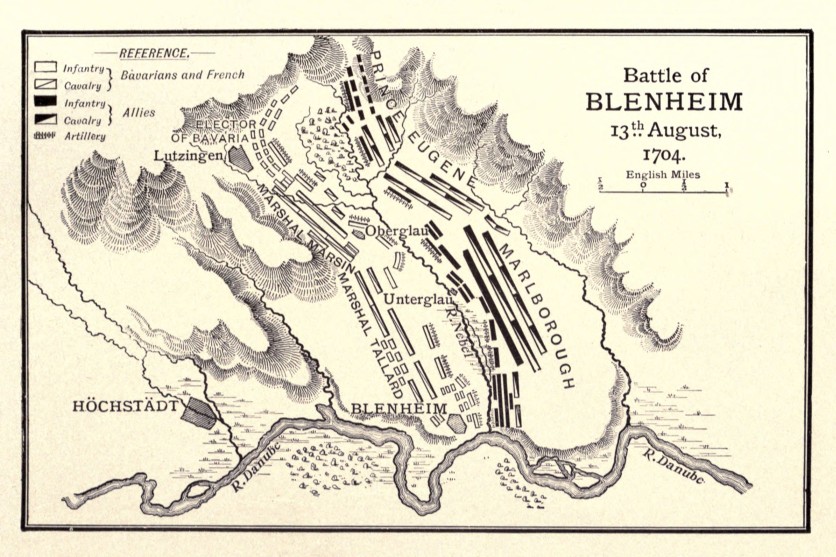
Battle of Blenheim, 13th August, 1704.
Tuesday night was spent in preparation for the coming battle. At three o'clock on Wednesday morning the confederate army moved slowly out. A light mist hung over the ground, but after three hours' march they came in sight of the enemy, and the cannon opened fire while the troops deployed into line.
The enemy, west of the Nebel, were in two main divisions, the right under Tallard resting on Blenheim, the left under Marsin and the Elector of Bavaria higher up the brook, occupying the villages of Oberglau and Unterglau, the rear being in the village of Lutzingen. On the confederate side, Eugene commanded the right, opposite Marsin, while Marlborough was opposed to Tallard.
The confederate troops, composed of English, Germans, Dutch, and Danes, were all in the highest spirits. The victory of the Schellenberg had heartened them; they had unbounded confidence in their generals. As he mounted his horse that morning Marlborough said quietly, "This day I conquer or die," and officers and men alike caught the infection of his brave, calm spirit.
The ground on which Prince Eugene's division was to be posted was broken by branches of the Nebel and became uneven as it rose towards the hills. For this reason it took the prince some time to get his men into position. Marlborough's force was earlier posted, and he occupied the interval until he should hear from Eugene that all was ready by having prayers read at the head of each regiment. About twelve o'clock a message came from Eugene that he was prepared. "Now, gentlemen, to your posts," cried Marlborough to the officers with whom he had been breakfasting. Up sprang the big Lord Cutts, deputed to open the attack on Blenheim—a gallant leader, nicknamed Salamander from his careless daring under fire. Up sprang General Churchill, and galloped off towards Unterglau, already set on fire by the cannonade. Up sprang General Lumley, hero of the cavalry charge at the Schellenberg. From brigadier to bugler, every man was determined to "conquer or die".
Blenheim was filled with French, seventeen battalions of Tallard's best troops hampering each other's movements there. So strongly was the village defended that the English troops were twice compelled to retire. Marlborough's foreseeing eye marked the urgency of the moment. The enemy must be prevented from pursuing their advantage. In spite of artillery fire in flank and cavalry charges in front he got his horse across the stream and the intervening marshes. Tallard was late in meeting the movement. He allowed the first line of English to form up on his own side of the brook before he ordered a strenuous attack. Then Marlborough reinforced his lines, and having assured himself that they could hold their own, galloped to the left to see how things were faring toward Blenheim.
Meanwhile on the right Eugene had fought with varying success. A dashing cavalry charge broke the enemy's front line, but from the second his horse recoiled, and he brought up his Prussian infantry to stem the tide. At Oberglau also the Prince of Holstein's division was thrown into confusion by the gallant Irish brigade, which flung itself upon the Germans with the fierce valour for which these exiles were renowned. Here, too, Marlborough's all-seeing eye marked the crisis. Galloping to the point of danger, he ordered up battalions and squadrons that had not yet been engaged, and in his turn threw the Irish into confusion.
The summer afternoon was drawing on; for five hours the battle had raged, and neither side had yet gained a substantial advantage. But soon after five, having seen all his cavalry across the Nebel, the duke rode along the front, and gave orders to sound the charge. At the trumpets' blare 8000 horsemen, splendidly mounted, moved up the slope in two lines towards the enemy, first at a gentle trot, quickening their pace until it became a gallop. One slight check from the terrible fire of the French musketeers, then they swept forward irresistibly. The enemy recoiled, broke, fell into disorder, and fled, the infantry towards Hochstadt, the cavalry towards Sondersheim, on the river bank. Then was seen Tallard's fatal mistake in crowding so many men into the narrow streets of Blenheim. Catching the panic from their flying comrades, they turned hither and thither, not knowing how to find safety. Some plunged into the river, only to be borne away on its swift current and drowned. Others sought to escape towards Hochstadt, but every avenue was blocked. In rage and despair they maintained a stubborn fight until the evening dusk descended, and the hopelessness of their plight counselled surrender.
At the head of his shouting cavalry Marlborough himself had chased thirty squadrons down the steep bank of the Danube to destruction. He had but just returned when he was met by an aide-de-camp with a prisoner no less notable than Marshal Tallard himself. The duke put him into his own coach, and sat down to pencil that famous note to his duchess which gave England the first tidings of this glorious victory.
The victorious army bivouacked on the field, taking possession of the enemy's standing tents, with a great store of vegetables and a hundred fat oxen ready skinned for the pot.
During this great action Harry had been hither and thither in all parts of the field, bearing Eugene's orders to his divisional commanders. Of the details of the fight he saw little, but was well pleased at the close of the day when the prince thanked him in the presence of his staff, and invited him to his own supper table.
During the next few weeks the troops marched towards the Rhine, the duke's objective being Landau, which he hoped to take before the close of the campaign. One afternoon Harry went on in advance with Sherebiah from Langenhandel to Weissembourg, to secure quarters for Prince Eugene. His errand accomplished, he was sitting at dinner in the inn when through the open window came the sound of hubbub in the street.
"What is it, Sherry?" he asked.
"'Pears to be a crowd of Germans a-setten on to a wounded Frenchman, sir. He have his arm strapped, and——why, sakes alive! 'tis black John Simmons hisself."
"Indeed!" cried Harry, rising. "Then the captain will be near at hand. Out and bring the fellow in."
Sherebiah issued forth and shouldered his way through the growing crowd. When Simmons caught sight of him, his jaw dropped and he turned to make away; but Sherebiah was at his heels in a twinkling, and soon he dragged him through the throng and into the inn. The man looked even more woebegone than when Harry had last seen him, and his drawn face betokened keen suffering.
"Cotched again!" said Sherebiah. "Stand there afore Master Harry and speak your mind."
"How come you here, Simmons?" asked Harry.
The man explained that after the rout at the castle he had escaped with his master to the Elector's camp and been with the army at the battle of Blenheim. He had ridden out of the fight with Aglionby, but being wounded had fallen from his horse and been callously left to his fate by the captain. Contriving to evade capture, he had wandered from village to village, and, reaching Weissembourg, had been sheltered there by a cottager until all his money was gone. Then he was turned out neck and crop, and was being hustled out of the village when Sherebiah intervened. His wound had not been properly treated, and he was in a sorry plight.
Harry could not help pitying the poor wretch whose service had been so ill-requited by his master. Properly he was a prisoner of war—one of the 13,000 who had fallen into the hands of the victors. But he was a fellow-countryman after all, and possibly had been an honest fellow until he came under Aglionby's sinister influence. Harry had not the heart to let him go to his fate.
"Sherry, look to his arm," he said. "Let us see what sort of a leech Jacob Spinney made of you. Then give him some food and find him a lodging."
Several days passed, and Harry, in the bustle of camp life, had almost forgotten the incident, when one morning Simmons presented himself and asked to be allowed to speak a word. His arm was nearly healed, and he looked a cleaner, trimmer fellow.
"Ah, Simmons!" said Harry, "you're better, I see. What have you got to say?"
"First to thank you, sir, for your kindness, which I know I don't deserve. Sherebiah Minshull has treated me well."
"I'm glad of that. Now is there anything else I can do for you?"
"I've been thinkin', these few days, sir, and ponderin' on my past life; and there's a thing I believe you ought to know."
"Well, speak up, man."
"'Tis summat I heard pass between Cap'n Aglionby and the Frenchman, sir."
"That's enough: I'm not interested in the doings of your rascally employer."
"But you are, sir, unless I be much mistaken. The matter concerns the French lady near Breda, and the young mistress—partickler the young mistress, sir."
Harry was now all attention.
"Speak on then, and use few words."
Simmons then related that, some few days before the battle of Blenheim, Monsieur de Polignac had come secretly into the camp and paid a visit to Aglionby. (Harry remembered the letter making the appointment he had found in the castle.) The opening of the interview had been stormy; Aglionby had accused Polignac of being a party to the attempt on his life at Breda, and at first refused to accept his assurances that he knew nothing whatever of the matter. But Polignac spoke him fairly, declaring that his connection with Mr. Berkeley had been limited to planning Aglionby's rescue from prison. The Captain's suspicions being at last lulled, Polignac opened up the subject of his visit. Of the remainder of the interview Simmons had but hazy ideas: he had listened through a hole in Aglionby's tent, and the conversation being conducted in low tones and in French, of which he had only a smattering, he had missed a good deal of it. But he had heard enough to know that the Mademoiselle of whom the two spoke was Mademoiselle de Vaudrey, and that Polignac was bargaining with Aglionby to aid him in an attempt to get possession of the young lady.
"One thing I heard plain, sir," said Simmons in conclusion, "and that was that the cap'n was to get a good bit o' gold when the Frenchman married the lady, and a good bit more when he came into the estates."
"What estates?"
"That I can't tell you, sir; 'the estates' was all I heard—terres was the word as was used."
"Oh! And why do you betray your master?"
"Well, sir, he've led me a dog's life for years; holds over me that hangin' business on the old road; and then after I'd served him faithful leaves me to shift for myself with a bullet in my arm. I don't owe him no thanks."
Harry stood in thought for a few moments.
"You're a Londoner, I think, Simmons?" he said at length.
"Ay, sir."
"What trade were you bred to?"
"A joiner, sir."
"Well, if you'll promise me to go straight back to London and work at your trade, I'll contrive to send you down the Rhine with the prisoners, and give you a little money to start you."
"Thank 'ee kindly, sir!"
"Very well. Sherebiah shall take you to Hanau and see you safely lodged. Remember, you've your character to build up afresh. If you stick to your trade, and keep out of the way of folk who want to use you for dirty work, you may become a decent citizen yet."
"On my soul I'll try, sir. 'Tisn't every one would give a poor fellow a chance, and I thank 'ee true, sir."
Harry dismissed the man in Sherebiah's care. He was greatly disturbed by his news. It was clear that Polignac, having failed to win Mademoiselle de Vaudrey by fair means, and by the attempt to bring pressure to bear, so happily frustrated by Mynheer Grootz, was now determined to resort to desperate measures. Something must be done at once to put Madame de Vaudrey on her guard. He would have liked to convey the warning himself, but felt the impossibility of asking from Prince Eugene leave of absence for so long a journey until the campaign was ended. The only other means open to him was to write. Couriers were constantly going backwards and forwards between the armies and the Hague and other towns; he might avail himself of one of these to send his urgent message.
Harry lost no time in putting his decision into effect. He wrote both to Madame de Vaudrey and to Mynheer Grootz, telling them that Aglionby and Polignac were scheming to abduct Mademoiselle, and also that they were in league with the Jacobites in France and England. This latter fact would give Grootz a free hand in dealing with them, even if he detected them in no overt act against Mademoiselle de Vaudrey. It was two days before Harry could send off his letters, which for greater safety he entrusted to an official despatch-rider, by permission of Prince Eugene. The post would take several days; it would be towards the end of the first week in October before a reply could be expected.
Time passed away, and Harry was anxiously waiting, when, two days before the earliest date on which a letter could be received from Grootz, he was unexpectedly sent by Prince Eugene on an urgent private errand to Vienna. He was accompanied by Sherebiah, now again his constant companion. They made as much speed as possible, but nearly a month elapsed before Harry was able to report the success of his mission to the Prince, then in the confederate camp before Landau. As soon as he had seen the prince, he enquired whether a letter had arrived for him during his absence, and felt a great sense of relief when a packet was given him addressed in Grootz's big business hand.
But his feeling was changed to the keenest anxiety when he found that the letter, though written more than a week after the date at which Grootz might reasonably be supposed to have received his letter, made no reference to the news he had sent, and had clearly been despatched in entire ignorance of the threatening danger. Long afterwards he learnt that the courier had been accidentally drowned in crossing a river at night, and his letters had been lost. He dreaded to think what might have happened in the interval. He wrote another urgent letter to Mynheer Grootz, and despatched it by a special messenger; but the bare possibility of a mishap alarmed him, and he could never put the subject from his thoughts. He woke at night under the pressure of his anxiety; if only he could himself go to Lindendaal to see that all was safe! But while the siege was still being prosecuted, and the prince had constant need of his services, he could not bring himself to ask for leave.
His difficulty was solved for him by the prince himself. His evident preoccupation, and a slight mistake he made in noting down a message, attracted that astute gentleman's attention. He spoke to Harry on the matter; by this time they were on such terms that Harry felt no difficulty in opening his mind; and he explained that having become aware of a plot likely to injure some friends of his, and fearing that his letter of warning had miscarried, he was in considerable anxiety on their behalf.
"Naturally," said the prince. "Who are these friends of yours?"
"A French refugee lady and her daughter, Monseigneur, who live near Breda."
"Ah! What is their name?"
"De Vaudrey, Monseigneur."
"Are they relatives of yours?"
"No, Monseigneur."
"A mere matter of friendship, eh?" The prince's eyes twinkled. "Now, my boy, confess: you are in love."
"No, indeed, Monseigneur."
"Well, the symptoms are not unusual. You ought to know best, of course; but in any case you had better get the matter off your mind. This weary siege cannot last more than a few days longer; we hear that the enemy are on the point of surrender; we shall go into winter quarters immediately, I suppose, and I shall be able to dispense with your services until the spring. Pack off to Breda and see your—friends, holding yourself in readiness, of course, to come back to me when summoned."
Harry was too much pleased at the opportunity of assuring himself that all was well to think it necessary to make any protestation about his motives. Thanking the prince, he finished off one or two small duties and went to arrange with Sherebiah for their journey. Before he left he came across Fanshawe in camp, and, without disclosing his reasons, told him where he was going.
"Then will you do something for me?" asked Fanshawe eagerly. "Will you carry a letter for me? I love that girl, Harry. I can't get over it. I made a mistake last time. I ought to have known that our English ways would not answer with French ladies. I spoke to Adèle herself; I ought to have spoken to her mother. If you will take it, I will write a letter to Madame de Vaudrey asking permission to pay my addresses to her daughter; that may give me a chance; don't you think so, Harry?"
"I don't know," said Harry. He felt strangely unsympathetic with Fanshawe at that moment. "I will take your letter if you are not long about it: I ride for Maintz to-night."
"Thanks, old fellow! Wait till you're in love; then you'll know how a fellow feels; I shall have no peace of mind till I know my fate."
A few hours after this, Harry left the camp with Sherebiah, carrying the letter on which Fanshawe's fate depended. To save time he had decided to take boat at Maintz, and sail night and day down the Rhine. Ten hours later he had bought a big boat, engaged a man who knew the river, and begun his journey. With the aid of the stream and oars, and proceeding continuously, he could save a day or two on the land journey. His plan was to engage fresh crews at every important stopping-place, so as to have relays of sturdy oarsmen and to get out of them all the work of which they were capable. The Germans were naturally not so eager as himself, and grumbled a good deal at the exertions demanded of them. "Unerhört! unerhört!" was the exclamation he frequently heard from their lips. But he never relaxed his determination, and found liberal pay a ready stimulus.
Thus, without mitigation of pace, the boat rushed down the river. As one after another the river-side towns were passed, Harry felt a satisfaction mingled with an impatience too great to allow of his taking much interest in the scenes. The ugly, dirty garrison town of St. Goar, the fortress of Hesse-Rheinfels, the famous Rat tower of the Hatto legend, Coblentz, Cologne, Düsseldorf, were only so many stages of his uneventful journey.
CHAPTER XXIV
The Wages of Sin
Promenade à Berlin—A Sudden Stop—Grootz Chuckles—Place aux Dames—The Last Two Miles—Polignac Pays the Penalty—Zo!
About four o'clock on a November afternoon, fine for the time of year, two horsemen rode up to the inn at Eyndhoven. Huge clouds of steam rose from their horses into the cold air; the panting of the beasts told of a forced pace. Dismounting, the riders called for refreshment and a change of horses: they were anxious to push on at once.
When their hasty meal was finished, while the master was paying the bill, the man went into the inn yard and tried to enter into conversation with a servant standing there in charge of a large empty travelling carriage.
"Whose carriage is that?" he asked.
"Monsieur de Polignac's," was the surly answer.
The man started slightly, but no one would have suspected anything but pure curiosity from the tone of his next question.
"Who is it waiting for?"
"Monsieur de Polignac."
The reply was still more surly.
"The roads will be heavy for travelling. Bad enough for horsemen, worse for coaches. Maybe the gentleman is not going far?"
"Maybe not."
"The Breda road?"
"What is that to you?"
"No offence, comrade. A man may ask a question, to pass the time. Bid you good-day!"
Seeing that he was unlikely to get any further information he sauntered off, but disappeared as quickly as possible into the inn.
"Mounseer's coach is in yard, sir," he said quietly, "and a-waiten for Mounseer."
"Ah! Are we in time, Sherry? Call the ostler."
When the man appeared, Harry slipt a coin into his hand.
"Monsieur de Polignac is making a journey. Tell me all you know about it."
The man replied that the coach had been sent to the inn two days before. Monsieur de Polignac was expected at any moment. He had recently sold his estate and was leaving for Germany. It was thought that he wished to take his departure quietly, for he had always been unpopular with his tenants, and he ran the risk of a hostile demonstration if the time of his setting out were known. He probably intended to slip secretly away from his house and make his real start from Eyndhoven. A large quantity of his baggage had passed through the town a few days before; but, strangely enough, a carter coming in had reported that Monsieur's wagons were going south, which was certainly not towards Berlin, the alleged destination. On the road they had taken there was great danger of their falling into the hands of the French, for it was not more than five or six leagues from Marshal Villeroy's lines, and Monsieur as a Huguenot refugee would meet with scant consideration from his countrymen.
"Has Monsieur de Polignac himself been to Eyndhoven lately?" asked Harry.
"No, Mynheer; the arrangements were made for him by an English officer who fought at Blenheim, where the great duke gave the French such a drubbing a few months back. He was a masterful man; gave orders that the horses were to be ready at a moment's notice and to be kept in good condition. Only this morning a messenger came with instructions for the coach to be ready by eight o'clock to-night, with a stock of wine and provisions which Monsieur will take with him."
Harry was perturbed at this news. It was clear that Polignac intended to depart in haste; but whether on political grounds, having found his character as spy detected, or in pursuance of the plot hinted at by Simmons, it was impossible to know. If the latter, there was certainly not a moment to lose, and it behoved to push on with all speed to Lindendaal. Fresh horses had been waiting for some minutes. Harry and Sherebiah were soon in the saddle, and set off at a gallop along the miry road, into the gathering night.
Some hours previously a traveller approaching Lindendaal from the opposite direction had passed through Breda. He had found it impossible there to get a change of team for his coach; all the horses in the town were out, conveying to their homes the gentry of the countryside who had come into Breda for a grand ball given the night before by the officers of the garrison, the finale of a week of entertainments. Not even Mynheer Grootz's liberal offers sufficed to secure a team at once. The motive of his journey was clearly urgent, for instead of waiting a few hours until some of the hacks returned, he pushed on at once with his tired animals to Tilburg, four leagues farther on the road. There he succeeded in hiring fresh horses, and without delay continued his journey.
He was himself very much fatigued, having risen from a sick bed on receiving the letter sent him by Harry from Landau. As he drew out of Oerschot, where the team was again changed, he pulled up the wooden slat blinds, and settled himself in the corner of his seat for a short nap. So much exhausted was he that he was still sound asleep when, nearly two hours later, the coach reached the end of the park wall of Lindendaal.
It was now growing dark. All at once Grootz was roused from sleep by the stopping of the coach. In his half-awake condition he thought that he was at his journey's end, and was rising to lower the blinds when there was a shout and the report of a pistol-shot. Wide-awake in an instant he groped in the darkness for his own pistol. But just as he laid his hand upon it the coach jolted on again, throwing him back into his seat. It was rattling and swaying from side to side, the horses being urged to their utmost speed. His first impulse was to let down the blinds and endeavour to get a shot at one of the men who had waylaid him. Then he hesitated; a sudden thought had occurred to him; he gave a quiet chuckle, and peeped through the slats of the blinds, first on one side, then on the other. He could just see that a horseman was riding at each side of the carriage, and through the small window at the back he saw a third following. He smiled grimly, and, holding his pistol ready, waited for what he suspected must happen before long.
His own postilion, he guessed, had been killed or wounded by the pistol-shot he had heard, and the coach was now driven by a stranger. He was thus one against four. He might shoot one of them, but would clearly be at the mercy of the three others. It was a lonely road; there was nothing for the present to be gained by resistance, and besides, he had a further reason for biding his time. Delay would not worsen his own situation; while if his suspicions were correct the longer he remained passive the better his purpose would be served.
After a headlong, rattling, bumping flight of about two miles, as it seemed to Grootz, he heard the horseman on his right shout an order to the postilion. The coach was pulled up; the horseman threw himself from the saddle, and wrenching open the door peered in.