THE ADVENTURES OF HARRY ROCHESTER (continued 2)
Reading edition
"Confound you, man, what have I done to you? Why the——"
"Off wi't, off wi't! Least said soonest mended. Great barkers be no biters, so it do seem; doff your coat, Cap'n Aglionby!"
"Well, if you will!" cried the captain, with a burst of passion. "I'll comb your noddle, I'll trounce you, for an insolent canting runagate booby!"
He flung his coat on the wet grass; Sherebiah laid down the cudgel and followed his example.
"Come on, Cap'n Aglionby!" he said. "'Tis not, as 'ee med say, a job to my liken, trouncen a big grown man like you; but 't ha' got to be done, for your good and my own peace o' mind. So the sooner 'tis over the better."
To a casual onlooker the two would have seemed very unequally matched. The captain stood at least a head taller than his opponent, and was broad in proportion. But he was puffy and bloated; Sherebiah, on the other hand, though thick-set, was hard and agile.
As if anxious to finish an uncongenial task with the least delay, he forced matters from the start. The captain had no lack of bull-dog courage, and he still possessed the remnant of great physical strength. To an ordinary opponent he would have proved even yet no mean antagonist; and when, after a few sharp exchanges, Sherebiah's punishing strokes roused him to fury, he rained upon the smaller man a storm of blows any one of which, had it got home, might have felled an ox. But Sherebiah parried with easy skill, and continued to use his fists with mathematical precision. Once or twice he allowed the captain, now panting and puffing, to regain his wind, and when the burly warrior showed a disposition to lengthen the interval he brought him back to the business in hand with a cheery summons.
"Now, Cap'n Aglionby," he would say, "let's to 't again. Come, man, 'twill soon be over!"
At last, beside himself with rage, the captain attempted to close with and throw his opponent. He could scarcely have made a more unfortunate move. For a few moments the two men swung and swayed; then Aglionby described a semicircle over Sherebiah's shoulder, and fell with a resounding thud to the ground. Neither combatant was aware that for some time a spectator had been silently watching them. Harry Rochester, coming whistling through the trees, had halted in surprise, at the edge of the glade, as his eyes took in the scene.
"There now, 'tis over and done," said Sherebiah, stooping to pick up his coat. "That score's wiped off. Stand on your feet, man! And I'll trouble 'ee for your sword."
The captain staggered to his feet. He was in no condition to refuse the victor's demand.
Sherebiah took the weapon and broke it across his knee. From his own pocket he then took the captain's pistols. He carefully drew their charges, and handed them back.
"Now, hie 'ee to Flanders," he said. "You've done more fighten this mornin' than you'll ever do there. You'll find Jenny on the road."
The captain glared at him, and seemed about to reply. But he thought better of it, and with a vindictive glare walked slowly away.
"What's it all about, Sherry?" said Harry, stepping forward when Aglionby had disappeared.
"Ah, that be 'ee, sir? 'Twas only a little small matter o' difference 'twixt Cap'n Aglionby and me. We're quits now."
"You'll have to get Mistress Joplady to give you a raw steak for your eye."
"Ay sure, Cap'n did get in a hit or two," replied Sherebiah placidly.
"I didn't know you were such a fighter."
Sherebiah gave him a quick look out of his uninjured eye.
"Nay, I bean't a fighter, not me," he said. "I'm a man o' peace; I be so."
CHAPTER IV
Mynheer Jan Grootz and Another
The Gaffer Chops Logic—In Print—The London Coach—Simple Annals—A Village Hampden—Bereft—An Offer of Service—A Hearty Send-off—Outside Passengers—Introductions—Contractor to the Forces—Followed—The Man on the Road—Sherebiah Muses
It was a dull, damp day towards the end of November, a little more than four months after Captain Aglionby's unhappy departure from Winton St. Mary. There was again great bustle at the Berkeley Arms; Mistress Joplady's ample face was red with exertion, and her voice, when she gave directions to her servants, was raised to an acrimonious pitch far from usual with her. The whole village appeared to be gathered either within or without the inn. Gaffer Minshull was there, seated with his back to the wall and leaning on his inseparable staff. Lumpy, Soapy Dick, Long Robin the tanner, Old Everlasting the miller, stood in a group about the door, talking to the ostler, who stood guard, with arms akimbo, over four brimming pails of water ranged along the wall.
Soft Jemmy was standing a yard or two away, watching with open mouth a man who, straddling across a step-ladder, was smearing the ancient sign-board with daubs of black paint, obliterating every trace of the crude heraldic design that had marked the inn's connection with the lord of the manor. When the board was one unbroken black, the painter descended the ladder with his brush and can, winked at Jemmy, and went into the inn to "mix the flavours", as he said in passing. The half-witted youth contemplated his handiwork for some minutes in mild surprise; then he walked towards old Minshull and addressed him timorously:
"Gaffer, I'm afeard my poor yead won't stand the wonder on't, but it med do me good to know why John painter ha' covered that noble pictur wi' the colour o' sut."
"Why, boy, black's for sorrow, as 'ee med know wi'out tellen an 'ee weren't so simple, and 'tis a black day for Winton Simmary, so 'tis."
"Why be it more black to-day than 'tis a-Sunday?" asked the youth. "'Tis Tuesday, gaffer, bean't it? and new pa'son didn't holler it in church for a holy day."
"Boy, your poor yead won't stand high things, 'tis true, but 'ee know young pa'son be off to Lun'on town to-day, an' that's why all the souls be here, to see the last on un."
Jemmy looked up again at the defaced sign-board, puzzling his poor brains to find some connection between it and the departure of "young pa'son".
"'Tis a shame, gaffer," said Honest John, "to deceive the poor lad, when you know the sign bean't painted out for no such thing."
"Why, there now," returned old Minshull, "bean't it all one? I axe 'ee that, souls. Young pa'son be a-gwine to Lun'on 'cause his poor feyther's dead an' gone; Pa'son Rochester be dead an' gone 'cause o' the fight; an I weren't afeard on un, I'd say the fight were all along o' Squire; and Mis'ess Joplady ha' changed the ancient sign of th' inn 'cause her can't abear to think on't. Bean't that gospel truth, souls all?"
The group looked impressed with the old man's logic. Mistress Joplady, coming for a moment to the door, had overheard his concluding sentences.
"'Tis true," she said, wiping away a tear. "I never liked Squire; nobody never did as I ever heerd on; but when pa'son died I couldn't abear him. One thing I'm thankful for from the bottom o' my heart, and that is, that my house is college property, like the church, and I can snap my vingers at Squire, and I do." She suited the action to the word. "Has been the Berkeley Arms for a hunnerd years, but 'twill be so no longer. When paint's dry, up goos the yead o' Queen Annie, bless her! a poor soul as ha' lost all her childer, like myself, and the Queen's Head it'll be for ever more."
"Ay, things be main different in village now, sure," said Lumpy. "To think what mighty changes come in a little time! Zeems only a few days sin' young pa'son won that noble match—you mind, souls, the day the lord's carriage broke under the weight of the Queen's purse—ay, the day afore he were stopped in old road. I never understood the rights o' that bit o' work. Gaffer, hav 'ee got that printed paper ye read, where the Lun'on talk be given like the words of a book?"
Old Minshull slowly drew from his pocket a folded sheet, rather dirty, worn at the edges, and falling apart at the folds. He opened it out with great care, and spread it on his knees.
"That's he," said Lumpy. "Gaffer, you be a scholard; read it out loud to us again."
"Ay, an' don't need spectacles neither," said Minshull proudly; "well, listen, souls."
Very slowly, and with as much deliberation as though he were reading it for the first instead of the hundredth time, and moving his forefinger along the line, the old man began to read the account of the attempted robbery of Lord Godolphin which the Daily Courant presented to the London public a week after the event. The names of the principal persons concerned appeared with a dash between the initial and final letters, and Godolphin's was read by Minshull as "Lard G line n". After briefly relating the incident, the writer of the paragraph added:
"'Tis said the Prisoner that broke jail was a Servant of a Captain A——y, a Guest at that time of Esq. N——s B——y. The gallant Captain's Commission (as it is credibly reported) is not under the seal of her Gracious Majestie, or King William lately Deceas'd of Noble Memorie, but of the Czar of Muscovy. 'Tis vouch'd by some 'twas none other than the Great Cham."
"Ay, that's print," said Soapy Dick at the conclusion of the reading. "The 'Cap'n A line y' was Cap'n Aglionby sure enough, an' some did zay as how 'twas he let the pris'ner out o' lock-up, and so brought shame to Will'm Nokes."
"Ay, an' some did say as how the Cap'n hisself made one o' the cut-purse rogues as waylaid the lard," said Honest John.
"Old wives' tales," said Minshull. "My boy Sherry be wise for his years, an' he says Cap'n couldn't ha' let prisoner out, 'cause a' were miles away at the time. And as for Cap'n bein' on the road—why, when Sir Godfrey coom in all the might o' the law to 'stablish the truth, Squire up and said as how Cap'n was abed and asleep on that early mornen when the deed was done."
"Ay true, Squire said so; but did a' take his dyin' oath like a common man? Tell me that, souls."
At this moment the conversation was interrupted, and the villagers were thrilled into excitement by the distant tootle of a horn.
"Here be coach at last," cried the ostler. "Ten minutes behind time, and no sign of young Master Rochester. Giles coachman won't wait, not he."
But as the coach came in sight at a bend of the road, two figures were seen hastening along from the direction of the rectory. One was a tall youthful form clad in black from his low felt hat to his buckle shoes. His steinkirk was black, and its fringed ends were tucked into a black waistcoat. Black were his plain drugget coat and breeches, black also his woollen stockings. Nothing redeemed the sable hue of his garments save his cambric shirt, the white front of which was much exposed, in the fashion of the time. Harry Rochester's face was pale, its expression sad.
His companion, a head shorter than himself, was Sherebiah Minshull, clad in the sober brown of ordinary country wear, and trudging along steadily under the weight of a fair-sized valise. Winter or summer, his appearance never varied: his firm round cheeks were always ruddy, his blue eyes always bright; and his expression, now as always, was that of placid self-content, well becoming "a man of peace".
The two drew nearer to the inn, where the group had by this time been enlarged by the accession of the greater part of the village population, women and children, workers and loafers, mingled in one interested throng. As Giles Appleyard was at that moment explaining to the passenger at his side, he had never seen such a crowd at Winton St. Mary before, though he had driven the coach, good weather and bad, for fifteen years come Christmas. It reminded him of the crowd at Salisbury Fair.
"And seein' as how I've been laid up wi' a bad leg for two months," he added, "I'm behind the times, I be; news travels slow to them as don't drive coaches, and, i' feck, I know no more than the dead what this mortal big crowd do mean, i' feck I don't."
But many voices were ready to tell him when, having pulled up his four steaming horses at the inn door, he descended with grave deliberation from his perch, saluted Mistress Joplady with the gallantry of the road, and entered her house "to warm his nattlens", as he said, with a tankard of her home-brewed. Young pa'son was a-gwine to Lun'on town! It seemed a slight cause for such an unwonted scene; in reality it was a momentous event in the life of Harry Rochester and in the history of his village. Small things bulk large in the imagination of rustic folk; a journey to London came within the experience of few of them; and the departure of young pa'son, following so closely upon two such notable events as the cricket match and the attack on the Lord High Treasurer, had already furnished unfailing material for gossip, and would be the theme of comment and speculation for a year to come.
It was all along of old Squire, they said; and the coachman, for the first and only time in his career, delayed his departure for some minutes after the horses had been watered, in order to listen to the story. A few days after Lord Godolphin's flying visit, Squire Berkeley had fenced in a piece of land which time out of mind had been regarded as part of the village common. Old Gaffer Minshull, whose memory went back fifty years, was called up to tell how in the year '53, just before Christmas, the then parson had held a prayer-meeting on that very spot to celebrate the making of Noll Crum'ell Lord Protector; he remembered it well, for it lasted five hours, and old Jenny Bates fainted on the ground and took to her bed from that day.
"Ay, 'twas a holy spot, an' Squire med ha' feared to touch un, as the old ancient folk feared to lay hands on the Lord's holy ark; but, bless 'ee, Squire bean't afeard o' nothen, nay, not o' the still small voice pa'son do zay be inside on us all."
When the ground was fenced in the good parson was disposed to carry the matter to law. But though he had already won one case (a matter of right of way) in the courts, the only result was that the squire had carried it to appeal, trusting in the power of the purse. The angry villagers therefore determined to take the law into their own hands. Without consulting the rector, they assembled one evening towards the end of October, and hastening in a body to the disputed space, began to make short work of the new fencing. But the squire had got wind of their intention, by some witchcraft of his own, they believed: he soon appeared on the scene at the head of a gang of his own men. There was a fight; heads were broken, and the squire's party were getting badly mauled when the rector suddenly arrived and rushed between the combatants.
"Ay, poor pa'son, I zee un now, I do," said Gaffer Minshull feelingly, "goen headlong into the rout wi' all his petticoats flyen! A fine upstanden man was pa'son, as ought to ha' been a man o' war. A' stood in the eye of Squire, an' Squire opened on un, gave tongue to a deal o' hot an' scorchen words, a' did. But pa'son took no heed to'n, not he: he spoke up fair an' softly to Squire's men, and wi' that way o' his a' made 'em feel all fashly like; a' had a won'erful way wi' 'n, had pa'son; an' they made off wi' their broken heads, they did; an' Squire was left a-frothen an' cussen as he were a heathen Frenchman or Turk. Ah, poor pa'son! Such a fine sperit as he had, his frame were not built for 't; wi' my own aged eyes I seed un go blue at the lips, and a' put his hand on his bosom, a' did, an' seemed as if all the breath was blowed out of his mortal body; and a' went home-along a stricken soul, and two days arter his weak heart busted, an' young pa'son had no feyther—ay, poor soul, no feyther, an' my boy Sherebiah be nigh varty-vour, and here I be. 'Tis strange ways Them above has wi' poor weak mortals—strange ways, ay sure!"
Mr. Berkeley took advantage of the rector's death to pay off old scores. The legal actions which Mr. Rochester had taken, on behalf of his flock, collapsed for want of further funds; he had already seriously impoverished himself by his open-hearted generosity; and when the squire came down on the dead man's estate for the law costs, Harry found that, after all debts were paid, he was possessed of some twenty guineas in all wherewith to start life.
His project of going to Oxford was necessarily abandoned. He was at a loss to find a career. Educated by his father with a view to entering the Church, he was fairly well grounded in classics and mathematics, and had in addition a good acquaintance with French, and a great stock of English poetry; but his knowledge was not marketable. He was too young for a tutor's place, and had no influence to back him; friendless and homeless, he was at his wits' end.
Then one day he bethought him of Lord Godolphin's promise. It had been frank and apparently sincere. My lord, it was true, had spoken of a country benefice when Harry's Oxford days were over; but Harry reflected that the slight service he had rendered was not likely to appear greater with the lapse of time, while his need was actual and urgent. Why not take the Lord Treasurer at his word, journey to London, and put his case before the man who, in all the kingdom, was the most able to help him if he would?
He mentioned the matter to Gaffer Minshull, rather expecting that the sturdy veteran would pour cold water on his idea. To his surprise the old man urged him to carry it out, and overbore the objections which every high-spirited lad, even in those days of patronage, must have had to soliciting favours from the great. His eagerness was partially explained to Harry when the old fellow added a suggestion of his own. He was seriously concerned about his boy Sherebiah. In spite of strict injunctions to have nothing to do with the expedition against the squire's fencing, Sherebiah, man of peace as he was, had been attracted to the scene as a moth to a candle. At first he had watched events from a distance, among other interested spectators; but when he saw the fight at its beginning go against the villagers, owing to the superior training of the squire's men, many of whom were old soldiers, he could contain himself no longer. At the head of the waverers he dashed into the affray, and set such an example of valour that it would have gone hardly with the enemy but for the opportune arrival of the rector.
From that moment Sherebiah was a marked man. Whatever reasons the father had for fearing Mr. Berkeley were strengthened when it became evident that the squire had marked and would resent the son's action. Sherebiah had been doing no good in the village since he suddenly returned to it, from no one knew where, a few years before. His father was anxious that he should go away for a time, at least until the squire's anger had cooled. He welcomed the opportunity afforded by the approaching departure of Harry.
"Let un goo wi' 'ee," he said. "'Tis a knowen boy, handy, with a head full o' wise things he's larned in the world. He'd be proud to sarve 'ee, ay, that he would."
"But, gaffer, I can't afford a servant. Twenty guineas are all I have, and I know not what may happen. If Lord Godolphin fails me, my money will soon be gone, and then there'll be two poor fellows instead of one."
"Never fear. I bean't afeard for 'ee. And what does the Book say? Why, 'twas the holy King David as said it hisself: 'Once I were young,' says he, 'and now I be old; but never ha' I knowed the righteous forsaken, nor his seed a-beggen bread neither.' That's what he said, and he knowed a thing or two, so he did."
"Perhaps he didn't know everything, gaffer. Well, you're set on it, I see. Sherry would certainly be better out of the squire's way; so he can come with me, and as soon as I find something to do he had better look for employment, and London ought to be a good place for that."
Thus it happened that, on this November morning, the two passengers who had booked places in the Salisbury coach for London were Harry Rochester and Sherebiah Minshull.
The story took a long time in the telling in the parlour of the inn, and Giles Appleyard was somewhat perturbed when he saw by the big clock in the corner that his departure was overdue. He drained his tankard, wiped his mouth with the back of his hand, and went out, calling loudly to the passengers to take their places. Harry shook hands all round; every man had something to say to him that was intended to be pleasant and encouraging, but was in many cases the reverse. His heart was full as he thought of leaving the good folk among whom he had lived and whose kindly feeling for him was so evident. When, last of all, Mistress Joplady flung her arms round his neck and hugged him to her ample bosom, and then wiped her eyes with the corner of her apron, he felt a lump in his throat, and was glad to escape and mount to his place on the roof of the coach.
"All right, Bill?" shouted the coachman over his shoulder.
"Ay."
"Let goo, ostler."
And gathering up the reins he cracked his whip, and with a clatter and rumble the heavy vehicle, amid a volley of cheers, lurched forward on the way to London.
The journey of nearly seventy miles was not likely to be pleasant. The stage-coaches of those days were large and clumsy structures, with hard springs. The inside passengers were jolted and jostled; the outside passengers had no proper seats, but found what sitting room they could among the packages and bundles. On this morning, there was only one other passenger on the roof of the coach, a stout broad-faced man dressed in brown clothes much like Sherebiah's. He had retained his seat during the scene of farewell, and sat solemnly munching a thick sausage, scanning the crowd out of shrewd little twinkling eyes that seemed a size too small for the other features. When his sausage was finished, he filled a huge pipe and sat puffing in stolid silence.
For some time after the coach started, no word was spoken by the three passengers. Harry was wrapt in his thoughts, brooding over the past, dreaming about the future. Sherebiah had lit his pipe as soon as he was settled, and smoked on contentedly, stealing a glance every now and then at the broad figure separated from him by a large travelling trunk. He seemed to find some amusement in these occasional peeps at his neighbour, who by and by returned his glance.
"Mizzly mornen," said Sherebiah, with a nod.
"Zo," grunted the other. His eyes were resting on Sherebiah's pipe.
"Tobacco be a great comfort," said the latter, noting the look. "Master Harry there, he bean't come to 't yet; true, 'tis not for babes an' sucklens; but I took to 'bacca when Susan wouldn't take me, and 'tis better nor any wife."
"Where you get dat pipe?" asked the stranger, in a slow pleasant voice with a foreign accent.
"This pipe! Why, over in Amesbury; see, 'tis marked wi' the gauntlet, sure token of a Amesbury pipe, an' there's no better in the land. Why med 'ee axe such a feelen question, now?"
"Once I zaw a pipe like it, wid de mark on it—de gauntlet, you zay."
"Oh! I say, master, what part o' the land med 'ee hail from? Your tongue makes me think 'ee med be a Dutchman, though I wouldn't say so to your face."
The man looked at his interrogator without replying. He stuffed the tobacco down into his pipe with a fat forefinger which exactly fitted the bowl.
"You know Amsterdam, my vrient?" he said.
"Ha' been there, mynheer; so 'tis Amsterdam you hail from! Well, I ha' been in wuss places. Ay, ha' seed summat o' the world, I have, and I knowed 'ee by your cut for a Dutchman."
There was silence again for a space. Both the men sat smoking, heedless of all things around them. They finished their pipes at the same moment, and, moved by a mutual impulse, each handed his pouch to the other.
"Virginia," said Sherebiah laconically.
"Ah! Barbados," returned the other. "My name, Jan Grootz."
"And it becomes 'ee," said Sherebiah. "Now mine bean't so good a match; 'tis over long for one o' my inches, and over proud for a man so meek: Sherebiah Stand-up-and-bless Minshull in the church book, but plain Sherry to them as I takes to, like young pa'son there."
Harry was roused from his reverie at hearing himself mentioned. He looked for the first time at his fellow-passenger, who at that moment lifted his podgy right hand and pointed to a windmill in full sail a little distance from the road.
"Ay sure, minds 'ee of home; your country's full of mills, to be sure. Mebbe you be a miller, now?"
The Dutchman waited to blow a great cloud from his mouth before he answered.
"A sailor," he said; "but I have mills."
"A skipper," rejoined Sherry, looking over his costume. "'Tis not for me to say, but to mortal eye you be more like a varmer.—'Tis a skipper from Holland," he added, including Harry in the conversation, "that has a mill or two to his name and smokes 'bacca out o' Barbados."
"Jan Grootz," said the Dutchman.
Harry acknowledged the introduction, and remarked on the slowness of their progress over the rough road. On this Mynheer Grootz volunteered the remark that, having come all the way from Bristol, he would be glad when the journey was ended. By degrees he became still more communicative; and when the coach pulled up at Basingstoke for the mid-day meal, Harry had learnt that the Dutchman had been to Bristol to inspect a vessel of which he was part-owner, and which had come most fortunately to port after being first knocked about by a French privateer, then badly damaged by a storm. It was to the storm that she owed her escape from the Frenchman, and to her captain's seamanship her escape from the storm. Grootz was particularly gratified at her safe arrival, for she represented a large amount not only to him personally, but to others who could ill afford to lose on a venture upon which he had persuaded them to embark.
When the journey was resumed, the conversation became still more friendly. Harry liked the look of the Dutchman. His broad face with its wide nose and little eyes was not handsome, but its expression inspired confidence; and the careful slowness of his speech, and his habit of pointing with his forefinger when he wished to be emphatic, were a little amusing. He asked no questions, but Harry by and by found himself explaining his own position and relating the events that had led to it, and told him of his projected visit to Lord Godolphin. At this up came the forefinger.
"Ah, my young vrient, you are de son of a minister: ver' well: you know de good Book: ver' well: 'Put not your drust in princes;' de words are drue. I tell you dis; besides my mills and my ships, I do oder dings; I supply food for de men and horses of de English and Dutch armies; and I have met princes; yes—I, Jan Grootz. I tell you dis; wid a good honest merchant of London or of Amsterdam, I care not, man knows where he stand; his foot is on de solid rock; but wid dukes and grand-dukes and oder princes—ah! man tread a quicksand. Dey promise, but do dey pay? You are good boy, I dink; mind you, I do not say I know, for outside do not always speak drue; de apple may be red, and all de time a maggot at core. I tell you dis; seven year ago I make contract over hay wid young captain of Bavarian Elector; it was in Namur campaign; he look good, he speak good, I am well content; but donder! my hay I lose, and 3242 thalers 3 groschen beside. Dis den I tell you; avoid arms and de law, drive some honest trade: zo you respect yourself, and oder people dey respect you. You owe noding; nobody owe you; you are a man."
Ever since the departure from Basingstoke, Sherebiah, sitting just behind Harry, had taken no part in the conversation, but appeared to find something curiously interesting in the road behind, for after once or twice looking over his shoulder he at last faced round altogether, and sat with his back to the horses. Just as the Dutchman finished his speech—the longest to which he had yet given utterance, and one that his slow delivery lengthened beyond its natural extent—Sherebiah turned round, tapped Harry on the shoulder, and in a low tone said:
"Summat's i' the wind."
"What do you mean, Sherry?"
"Wind yourself about and look down the road behind."
"Well, I see nothing—stay, there's a horseman just topping the hill, a good mile behind us: what of that?"
"Why, 'tis like this. He always is a mile behind: that's where 'tis. I seed him afore we come to Basingstoke; but he didn't come to the inn to eat his vittles, not he. I seed him again when we was a mile this side o' Basingstoke; what had he been doen, then, while we eat and drank? We stop, he falls behind; when we trot, he trots; 'tis as if he were a bob at th' end of a line, never nearer never vurther."
"You think we are being followed?"
"That's what I do think, sure enough."
"A highwayman?"
"Mebbe, mebbe not; most like not, for 'tis not dark enough, and he's always in sight."
"Perhaps he thinks he can't be seen."
"Not reckonen on the height of the coach roof? But I seed him, I did, two hours an' more agoo."
"Why should he follow the coach, I wonder? He may belong to someone inside."
"Mebbe, mebbe not; 'tis curious anyways."
"Well, the fellow is clearly dogging the coach; if your curiosity troubles you, suppose you slip off a mile before we reach the next post-house and try to get a nearer look at him as he passes? You can catch up the coach while they change horses."
"Ay, I will, sure. We be nigh the river now; over the bridge and we come to Hounslow heath, a fearsome place for highwaymen. We change at the Bull and Gate, then run straight into Lun'on: oh, I know the road."
It was late in the afternoon by the time the coach reached the inn where the last change of the journey was made. Ten minutes before, Sherebiah nimbly slipped down, crept through a gap in the hedge, and waited for the pursuer to appear. Presently he heard the clatter of hoofs; the sound grew louder, but all at once began to diminish. Scrambling back into the road, he was just in time to see the horseman strike off at full speed along a by-road to his left, which led, as Sherebiah knew, to London by a course only a mile or two longer than the main highway. The man must evidently have changed his horse somewhere on the road, and could only have taken the detour in a desire to arrive in London ahead of the coach.
Sherebiah stared long and earnestly at the retreating figure. He frowned and looked puzzled as he set off to overtake the coach. The driver was mounting the box as he came up.
"Well, what do you make of it?" asked Harry.
"He be gone off by a side road," replied Sherebiah.
"So your curiosity is not to be satisfied after all?"
"Well, he rid away hard to the left, wi' his back towards me, an' 'tis growen duskish, an' nowt but a owl could see clear."
But when Sherebiah clambered to his place he wore a sober look which did not escape the clear little eyes of Jan Grootz, who silently extended his pouch to him. Sherebiah refilled and puffed away, every now and then removing the pipe from his mouth and staring contemplatively at the bowl.
CHAPTER V
A Message from the Squire
The Old White Hart—A Letter for the Captain—Visions—Aglionby gives Instructions—The Watch—Half-Truths—Ways and Means—Hard Thinking
Sherebiah sat very silent for the rest of the journey. The coach jolted on rapidly towards the great city: passed the market-gardens of Hammersmith, the open fields of Kensington, along Piccadilly, where the first street-lamps shed a dim oily light, through Holborn, at last pulling up at the Angel and Crown in Threadneedle Street. It was past nine o'clock, dull and murky, and few people were about. But a small crowd was gathered at the door of the inn to meet the coach, and Sherebiah, as he shouldered the luggage and moved towards the door, shot a keen but unobtrusive glance at the faces of the men. His movements were somewhat too slow for Harry, who, eager to ease his limbs after a whole day's stiffness and discomfort, entered the hostelry first. All at once Sherebiah quickened his step, hastened into the lobby, set the luggage down at the foot of the stairs, and then, making a mumbled excuse to Harry, slipped out behind one of the inn servants, and looked narrowly at the diminishing crowd. He was just in time to see a man, whom he had already noticed on the outskirts of the group, saunter away in the direction of London Bridge. Appearances are deceptive, and Sherebiah was not sure that he was right, but he thought the man bore a resemblance to the rider whom he had seen following the coach, and of whom he had caught one nearer glimpse as he turned into the by-road. He followed the man, stepping as quietly as his heavy shoes allowed, accommodating his pace to that of the man in front, and taking advantage of the shadow afforded by the penthouse fronts of the closed shops. The man quickened his steps as he approached the bridge. Sherebiah pursued him at a discreet distance over the narrow roadway, beneath the rickety four-story houses that towered above the bridge over almost its entire length, through Traitor's Gate, and on into Southwark. The man went along one narrow street, and at last passed under a low archway. Walking even more stealthily, Sherebiah still followed, and found himself in the spacious yard of the Old White Hart Inn. This famous three-storied hostelry was built about three sides of a square. Along two sides of the upper story ran a balustraded gallery, with wooden pillars supporting the sloping roof. All was quiet. Sherebiah, keeping in the shadow of the arch, peeped round and saw the man he followed standing at the door waiting for an answer to his summons at the bell, which hung on the outer wall under a gabled cover. After a little time the door opened and the porter appeared.
"Be Cap'n Aglionby within?" said the man.
"Ay, and abed and asleep. What do you want wi' him?"
"I want to see un."
"A pretty time o' night! House was shut up an hour ago—no business doin' these hard times. Why didn't you come sooner?"
"A good reason, 'cause I be only just come to Lun'on. I has a message for Cap'n Aglionby."
"Well, needs must, I s'pose," grumbled the servant. "I'll go up and wake the captain, and be cursed horrible for my pains. Who shall I say wants him?"
"Tell un a friend from the country."
The porter went into the inn, and soon reappeared in the gallery at the top of the house, where he tapped at the door of one of the bedrooms opening from it. He tapped once, twice, thrice, and received no answer; then to his fourth knock came a response the tone of which, though not the words, could be heard in the yard below. A colloquy ensued, of which only the share of the inn servant was distinctly audible to Sherebiah.
"A man from the country, Cap'n, to see you."
Mumble from within.
"So I told him, but here he bides."
More mumbling.
"Didn't tell me his name; a man from the country was all he said, and I knows no more."
The answering mumble was of higher and impatient mood. Then the man came slowly downstairs, grumbling under his breath all the way.
"You're to go up," he said to the stranger. "'Tis number thirty-two. And fine tantrums he be in, waked out of sleep; as if I ain't waked out of sleep or kept from it day and night, and all year long."
The man entered the inn after the servant, and began to ascend. Sherebiah meanwhile, looking around, had espied another stairway at the opposite angle of the courtyard. Darting across on tiptoe, he mounted quickly, quietly, and reached the gallery above in time to see the messenger disappear into the captain's room. He hurried along, and, relying on the porter's complaint of the paucity of business, he opened the door of the adjacent room and slipped in, leaving the door ajar. Through the thin partition he heard the murmur of voices in the next room, but could not catch a word distinctly. In a few moments, however, there was a crash as of a chair being overthrown, followed by a torrent of execrations from the captain. Then the door of the next room opened, and Aglionby came out on to the gallery accompanied by his visitor.
"Hang you and the squire too!" said the angry warrior. "The tinder's wet, and I can't light my candle. Give me the letter and I'll read it by the light of the lantern yonder, and catch my death o' cold withal."
Shrinking back into the darkness of his room, Sherebiah caught sight of Captain Aglionby as he passed the half-open door on his way to the single lantern that feebly lit up the gallery. He had pulled on his breeches and stockings, but for the rest was in night attire. The lantern swung from a hook at the corner of the gallery, three rooms beyond that into which Sherebiah had ventured. Standing beneath it, the captain broke the seal of the letter given him by the visitor, and read rapidly under his breath. The reading finished, he stuffed the paper into his pocket and chuckled.
"Stap me, he begs and prays me now!" he exclaimed. "See, Jock, tell me what ye know of this. Ye ha'n't read the letter, ha' ye? By the Lord Harry, I'll slit—"
"Nay, nay, Cap'n," interrupted the man; "I know nought o' the letter. I'll tell 'ee how it all come about. I was openen the gate for Squire, when—"
"Speak lower, man; your brazen throat'll wake the house."
"I was openen the gate for Squire," resumed the fellow in a lower tone, which was, however, still audible to Sherebiah's straining ears, "when who should come by but young master popinjay dressed all in his black. He never bobbed to Squire, not he; never so much as cast eyes on un; but when Squire saw the young swaggerer he stopped still as a stone, and looked after un dazed like. Then he put his arm on the gate, a' did, and leant heavy on it, thinken mortal hard; 'twas a matter o' five minutes afore he lifted his head again, and never seed I a stranger look on any man's face than I seed then on Squire's. A' jumped when his eyes fell on me; 'What be staren at, fool?' says he, in one of his rages. 'Shall I run for doctor?' says I; 'you do look mortal bad.' 'Nay,' says he, ''tis nothen; a little faintness; 'twill pass.' I touched my cap, as becomes me, and Squire went into park and shut gate behind un. But a' hadn't walked more nor three steps when a' stops, swings about, and 'Jock!' says he, 'order post-horses for Hungerford road to-morrer. And come up to hall inside of an hour; I shall ha' a job for 'ee.'
"Well, I went up to hall after I'd ordered horses, and Squire give me this letter. 'You'll ride to Lun'on to-morrer, and take this letter to Cap'n Aglionby at White Hart, South'ark. And you'll tell the cap'n where young Master Rochester be stayen.' 'How'll I know that, Squire?' says I. 'Pon that he burst into one of his terr'ble rages again. 'How, fool!' says he; 'why, keep the coach in sight, and see that 'ee make no mistake.' So here I be, Cap'n, and young Master Rochester he's at Angel and Crown in Threadneedle Street."
"Thank 'ee, Jock; I know the house. And is the young springald alone?"
"Not he; has Sherry Minshull with un, a-carryen his belongens."
"Zounds and thunder! did Sherry see you?"
"No, i' feck; I kept too far from coach to be seen for sarten, and at Angel and Crown Sherry was too heavy laden to spy me."
"Well for you, well for you! Jock, you'll come and take up your quarters here; there's plenty of room. I'll tell 'em to gi' ye a bed."
"What about the horse, Cap'n? I left un at Angel and Crown."
"Let him bide till morning; then you can bring him here too."
"But Squire, Cap'n,—won't he expect us back, me and horse?"
"Not he; 'tis here written; I'm to keep you if there's any work for you, and odzooks! I'll ha' some work for you, never fear. Jock, if your story has made you as dry as it has made me you're main thirsty; go down and bring up beer for two, and a lighted candle. I'll ring and wake that rascal by the time you get to the foot of the stairs."
The man went down by the way he had come, and the captain returned to his room. As soon as the coast was clear, Sherebiah slipped out into the gallery, carrying his shoes to avoid noise, ran down the outer staircase, stood for a few moments at the foot to make sure that all was safe, then darted across the yard and out at the gate. The street was quite deserted, and Sherebiah, secure from molestation, walked slowly along towards London Bridge, deep in thought. His friend Harry had been followed to London at the orders of the squire; what was the meaning of that? Surely Mr. Berkeley did not intend to wreak vengeance on the son for the baffled opposition of the father? What had Captain Aglionby to do with the matter? Rumour the omniscient had informed the village that the captain's departure had been occasioned by a violent quarrel with the squire; yet it was plain that the squire knew the captain's whereabouts and was enlisting his aid in some project. Sherebiah wished that he could get a sight of Mr. Berkeley's letter; he was puzzled to account for the old man's shock as Harry passed the gate; but try as he might to piece these strange circumstances together, all his cogitation suggested no clue.
So absorbed was he, so mechanical his movements, that he started convulsively when, just as he had passed through Traitor's Gate, a man stepped suddenly before him from a narrow entry and bade him stop in the Queen's name. Looking up, he saw that his way was barred by a corpulent constable in cocked hat and laced coat, with a staff two feet longer than himself, and half a dozen ancient and decrepit watchmen with lanterns and staves.
"Stand!" cried the constable. "Give an account of yourself."
Sherebiah took his measure.
"Not so, neither, master constable. Out o' my way; 'tis a late hour, and I ought to be abed."
He made to move on, but the constable stood full in his path, and the watchmen grouped themselves behind their superior.
"You may be a villain for aught I know," said the constable, "or even a vagrom or thief. Why abroad at this hour o' night?"
"I'm as sober as a judge," replied Sherebiah, "and neither thief nor vagrom. Stand aside, master constable."
"Well, 'tis dry and thirsty work watching o' nights, and there be seven of us, and a shilling don't go far in these war times; we'll take a shilling to let ye pass; eh, men?"
The watchmen mumbled assent. Sherebiah laughed.
"A shilling? 'Tis a free country, master constable, and a sober countryman don't carry shillings to buy what's his. And seems to me, so it does, as ye've had drink enough a'ready; out o' my way, I say!"
"Arrest him, men!" cried the constable, angry at being disappointed of his expected tip.
The words were scarcely out of his mouth when with sudden energy Sherebiah threw himself against him, at the same time placing a leg behind his knee. As the constable fell, Sherebiah dashed at the watchmen, toppled two of them over, their fall being accompanied by the crash of their lanterns, scattered the rest, and ran rapidly across the bridge. This unexpected onset from one whom they had taken for a simple and timid country bumpkin was too much for the watch. They made no attempt to pursue the fugitive, but returned surly and crestfallen to their lair.
"Where on earth have you been, Sherry?" asked Harry, as his man re-entered the inn.
"Payen a visit to a cousin o' mine, Master Harry. And I was nigh put in lock-up, I was. Was stopped by the watch, but I toppled un over, I did. I'm a man o' peace."
"If you are let alone," said Harry, laughing. "I feared some harm had happened to you. Our Dutch friend tells me London is an ill place at night for a stranger."
"Ay, and by day too, Master Harry," rejoined Sherebiah earnestly. "If I med make so bold, I'd say, get 'ee to-morrow a good cane,—none of your little small amber-tipt fancies as fine gentlemen swing in their dainty fingers, but a stout length of oak or birch, fit to crack a pate."
"I have a sword, Sherry, and can use it, thanks to you."
"Ay, but 'tis not always easy to draw a sword in time in a street brawl, and there be light-fingered gentry as can coax a sword from the scabbard and the wearer none the wiser till it be too late. Be it your poor feyther's sword you ha' brought, sir?"
"Yes, the silver-hilted one; I showed it you once, Sherry."
"Well, 'tis right for a gentleman to wear a sword, though I marvel, I do, at a holy man o' peace like pa'son haven such a deadly piece o' furniture."
"Ay, and I've often wondered how a man of peace like yourself is able to handle a sword so well. You made a swordsman of me, Sherry; how did you become one yourself?"
"Ah, sir, 'tis a many things a man o' peace has to know in the way o' dressens. I believe in peace with a cudgel in your hand. Them as wants peace be most like to get it an they be ready for war."
"You remind me of what Master Butler says:
'There's but the twinkling of a star
Betwixt the man of peace and war'.
But the hour is late, Sherry, and I must be up betimes in the morning, for my visit to Lord Godolphin."
"You bean't gwine to see the high lard to-morrer, sir? Better larn to find your way about this tangle o' busy streets first. 'Tis as easy as sucken eggs to lose your way."
"I have made up my mind to go to-morrow. You see, I must lose no time. I have only twenty guineas, as you know, and by to-morrow two of those will be gone. And I sha'n't rest till I have tried my luck. Good-night, Sherry! Wake me at seven."
Left to himself, Sherebiah ordered a pint of small beer, and sat for an hour longer, ruminating, with knit brows and compressed lips. More than once he got up and walked round the deal table, stopping to take a pull at the tankard, heaving a sigh, then going on again. He was disquieted. The sudden discovery that the squire's animosity was pursuing Harry no less perplexed than disturbed him. Harry and Mr. Berkeley had never met at close quarters; there had been no intercourse between hall and parsonage. A personal cause of offence was, as it seemed to Sherebiah, out of the question; yet it was strange that the squire's hatred of the father should extend to the son. At length, muttering "No one can tell what's what with the likes o' old Squire," Sherebiah brought his big fist down on to the table with a bang that made the pewter jump and rattle, and fetched the drawer from his place in the bar.
"What d'ye lack?" said the man.
"Nothen, sonny, nothen. 'Tis a way o' mine to hit out when I be a-thinken, a bold way for a man o' peace, true. Bacon at half arter seven, drawer,—and we be country eaters, mind 'ee. Good-night!"
CHAPTER VI
My Lord Marlborough makes a Note
London Streets—A Chair!—A Great Man's Portals—An Effort of Memory—Patronage—Marlborough—A Step in the Peerage—A Memorandum—A Friend in London—A Dinner at Locket's—Mr. Colley Cibber—Great Expectations—A Thick Stick—Prevarication
Harry was awake long before Sherebiah tapped at his door next morning. His projected visit to Lord Godolphin gave him some concern. He had no tremors of shyness at the thought of meeting the Lord Treasurer; but, ignorant as he was of London ways, he knew not how to time his visit, and could hope for no counsel on that point from Sherebiah. He was too much excited to do justice to the crisp rashers which were placed before him at the breakfast-table, and felt little disposed to converse with Jan Grootz the Dutchman opposite. Sherebiah had taken upon himself to wait at table, but, as a privileged servitor, did not think it unbecoming to throw in a word here and there. He gave Grootz his views on the price of oats and the policy of King Louis of France with equal assurance.
"Know ye where de lord live?" asked the Dutchman suddenly.
Harry had forgotten that he had mentioned his errand to his fellow-passenger, and for the moment repented his confidence. Before he could reply, Grootz went on:
"He live over against the Queen's Wood Yard, by Thames-side, leading to Scotland Yard. My vrient John Evelyn built de house. I have been dere."
"Oh!" exclaimed Harry. "Then can you tell me the best time to visit him?"
"Ja! De best time, it is ten o'clock, before he go to de palace. He rise late; he has many visitors; I zee him myself in his dressing-gown before his zervant have curled his wig, and I wait my turn two hours. And when you zee him, you zall lose no time; he like man to speak out, mark you."
The Dutchman spoke very slowly, not interrupting his meal, and wagging his fat finger as he concluded.
"And how shall I go? Shall I walk?"
"I' feck, no," said Sherebiah from behind. "The night have been rainy, and the streets be mushed wi' mud; you'd be spattered from head to heel, Master Harry. Nay; you med walk as far as the Exchange and buy 'ee a pair o' gloves there for seemliness, and then get your shoes brushed by one o' the blackguards at the corner. Then you can take a chair; 'tis a shilling a mile, and easier goen nor the hackneys, for the chairmen walk on the pavement, and you won't get jolted nor splashed so bad."
"Ja, and I tell you dis," added the Dutchman. "Short poles, and short men; zo, dey take not zo much room, and if dey upzet you, why, you do not fall zo much."
"Ay, and don't let 'em chouse 'ee out o' more than their due," said Sherebiah. "I know they men. If they think a man be up from country, they look at un and then at the shilling, up and down, and miscall un wi' such brazen tongues that he'll pay anything to save his ears. A shilling a mile, Master Harry, no more."
"Zo! De counsel is good. But I give you a better: go not at all. Lords! I tell you dis before: an honest merchant is worth two, dree, no man zay how many lords; and de Book zay, 'Put not your drust in princes'. Still, I wish you good luck, my young vrient, Jan Grootz; zo!"
He squeezed Harry's hand in his own great fist, and then, having demolished his mountain of food, filled his pipe and set forth for the Custom House on Thames bank. Two hours later, Harry left the inn under Sherebiah's guidance, and for the first time in his life trod the streets of London. Filled though his mind was with the approaching interview, which might mean so much to him, he was yet able to take an interest in the strange scenes that opened before his inexperienced eyes: the brilliant shops, each with its sign of painted copper, pewter, or wood hanging from iron branches; the taverns and coffee-houses, already crowded with people eager to hear and discuss the news, and perhaps to get a peep at the morning's Courant; the court and porticoes of the Royal Exchange, to which merchants were flocking; the crowds of money-dealers in Change Alley, looking for clients. He went up to the gallery on the first floor of the Exchange, and bought a pair of gloves from a neat and pretty girl at one of the booths; then strolled along, admiring the rich and dazzling display of silks and jewellery which a few hours later would attract all the fine ladies in town.
Descending to the street again, he passed up Cheapside and through St. Paul's Churchyard, down Ludgate Hill and through Ludgate, where he beheld impaled on stakes a row of hideous heads of traitors, one of which, Sherebiah told him with indignation, was that of Noll Crum'ell. Then skirting the Fleet Ditch, once navigable, but now a noisome slimy sewer, he came into Fleet Street, through Temple Bar to the Strand, and at length arrived at Charing Cross, where he was nearly overturned by a hasty chair-man, whose "By your leave!" was not yet familiar to his ears. At Charing Cross stood a number of boys with boxes before them on the pavement, and cries of "Clean your shoes!" "London fucus!" "Best Spanish blacking!" came in eager competing tones. Sherebiah selected one whose stand was in front of a barber's shop.
"Here's the blackguard for 'ee, Master Harry," he said. "He'll shine your shoes while barber shaves my stubble. A penny; no more."
When the shoes were polished and the stubble mown, Sherebiah called up a couple of chairmen who were sitting on their poles near by.
"Do 'ee know my Lord Godolphin's noble house?" he asked.
"Ay; servant, sir."
"Well then, carry my young master to that very house, and see 'ee don't jolt 'n, or drop 'n, or let 'n get splashed. 'Tis under a mile, Master Harry," he whispered at parting.
Harry would rather have walked. The men took what care they could, but the press of people was so great that they had to dodge at every few steps, and their fare gripped the seat to prevent himself from being knocked against first one side, then the other, of the conveyance. At the corner of Whitehall, as they turned into Scotland Yard, a passing dray splashed up a shower of liquid mud, and Harry felt a moist dab upon his nose. Fortunately the spot was soon removed with his handkerchief; and when, after crossing by the Charcoal House and through the Wood Yard, the chairmen at length set him down at the door of Godolphin's house, he would have felt no anxiety about his personal appearance, if he had been sufficiently self-conscious to think about it. He had put on his best coat, silk stockings, and buckle shoes; at his side he wore the sword about which he had spoken to Sherebiah. He sprang alertly up the steps, and looked about him with a keen quick gaze that bespoke a definite purpose.
The great entrance-hall was thronged. Servants, officers, government officials, men about town, stood in groups or moved here and there in pursuit of their several objects of business or pleasure. No one appeared to remark the presence of the new-comer, who walked quietly through the throng towards the broad staircase. At the foot a gorgeously-dressed flunkey was standing, to whom one or two gentlemen had already applied for information. As Harry was about to address him, his attention was attracted by a woolly-pated wide-grinning black boy, who at that moment ran down the stairs. He carried a silver tray, on which a cup and jug of fine porcelain jingled as he ran.
"Done, Sambo?" asked the tall flunkey at the stair-foot.
"Yussir!" replied the boy with a white grin. "My lord jolly dis mornin; oh yes; drink him chocolate without one cuss. Gwine to begin work now; oh yes."
"Can I see the Lord Godolphin?" asked Harry, stepping up to the servant as Sambo disappeared.
The man gave Harry a stare, but answered respectfully: "My lord's levee is over, sir. The nigger brings down the tray when the last visitor has gone."
"I have come specially to see my lord, and——"
"Have you an appointment, sir?"
"I think if you will take my name to my lord he will see me."
Harry spoke quietly; he was determined not to be turned from his purpose by mere formality or red tape. The man eyeing him saw nothing but self-possession and confidence in his air.
"My lord is now engaged with his correspondence," he said. "He does not brook interruption."
"My name is Harry Rochester; I will answer for it that you will do no wrong in acquainting his lordship."
After a moment's hesitation the man beckoned to a fellow-servant, and gave him Harry's message. He went upstairs, and returning in a few minutes said:
"What is your business with my lord, sir? His lordship does not remember your name."
There was the suggestion of a sneer in the man's voice. With hardly a perceptible pause Harry replied:
"Tell his lordship I am from Winton St. Mary, at his invitation."
A faint smile curled the lips of the two flunkeys. The second again mounted the stairs. When he descended, his face wore its usual expression of deference and respect.
"Be so good as to wait upon his lordship," he said, and led the way.
In a few minutes Harry found himself, hat in hand, making his bow to Lord Godolphin in a large wainscoted apartment. Four large candles burnt upon the mantel-piece, daylight being kept out by the heavy curtains on either side of the narrow window. A huge log fire filled the chimney-place; beyond it stood a broad table littered with papers, which at that moment a young man was sorting by the light of a shaded candle. Lord Godolphin was in dressing-gown and slippers.
"Well, sir?" he said.
"My name is Rochester, my lord."
"I am aware of that. I do not recall it. Well?"
My lord's tone was cold and uninviting.
"Your lordship will permit me to mention a little incident on the Roman road by Sir Godfrey Fanshawe's park, when——"
"Stay, I remember now. You are the lad they called the young parson, eh? I have a poor head for names. When my man spoke of Winton St. Mary I supposed you might be a messenger from the gentleman who entertained us there."
Now that Harry was actually face to face with the Lord Treasurer, he felt some diffidence in opening the subject of his visit. My lord, in spite of his deshabille, seemed far less approachable than he had been on the old Roman road. Then he was the country sportsman; now he was the chief minister of the Queen.
"Your shouting friend with the scriptural name—how is he?" he asked in a somewhat more cordial tone.
"He is well, my lord; he is with me in London."
"And your father: has he won his case against the squire? I heard something of him at Sir Godfrey Fanshawe's, I think."
"My father is dead, my lord."
"Indeed! Pray accept my condolences. And now, tell me what brings you here."
"Your lordship may remember, after the scene with the highwaymen——"
"Yes, yes; you did me a service, you and your man; what then?"
"It was but a slight service, my lord; I do not presume on it; but you were so good as to say that if, at some future time, I should find myself in need of assistance, I was to come to your lordship."
"Why, I did speak of a country parsonage, I believe. But you,"—he smiled—"why, I really may not venture to set you up in a cure of souls. You have to take your degrees yet."
"That is impossible, my lord. My father impoverished himself in his feuds with Mr. Berkeley; when his affairs were settled I found myself possessed of but a poor twenty guineas. I have given up all thought of going to Oxford; I must seek a livelihood."
"H'm!"
Lord Godolphin looked him up and down, as though estimating his chances of making his way in the world.
"You wear a sword," he said. "Rochester—you are no connection of the earl's?—no, of course not, he is a Wilmot. Where do you spring from?"
"My grandfather was a soldier, my lord; I have heard that he died young, but my father seldom spoke of these matters; we have no relatives."
"H'm! I bethink me now, you yourself have an itch for martial life. All boys have, I suppose. Young Lord Churchill was cut to the heart a few months ago because my lady Marlborough would not permit him to follow his father to Flanders. Well, to be frank with you, I see no way of helping you. With twenty guineas you can no more buy a commission than you can enter yourself at a college. To enlist as a common soldier would be a last resource to one of your breeding. There are too many young scions of good stocks for the lesser places at court to go round among them. Yet I would fain do something for you."
He began to saunter up and down the room, his hands clasped behind him, stopping for a moment to listen as the sound of cheers came from the street. Suddenly the door was opened, and the voice of the servant was heard announcing a visitor.
"My lord Marlborough."
Harry looked with eager curiosity as the great soldier entered the room. He saw a tall, singularly handsome man, with short curved upper lip, firm chin, long almond-shaped eyes, and a calm benignity of expression. John Churchill, Earl of Marlborough, was at this time fifty-two years of age. As captain-general of the English forces, in the summer of this year, 1702, he had opened in concert with the Dutch a campaign in Flanders against Louis the Fourteenth of France,—a new campaign in the great war of the Spanish Succession which the policy of William the Third had bequeathed to his sister-in-law. Venloo and other towns had been captured by the confederate armies, Liège had been reduced, and the forces having gone into winter quarters, Marlborough had returned to England to support the Occasional Conformity Bill. He was a close personal friend of Godolphin, and allied to him by the marriage of Francis Godolphin to his daughter Henrietta.
"Welcome, my dear lord!" said Godolphin, starting forward to meet the earl. "I did not know you had arrived."
"I am but just come from waiting on the Queen," said Marlborough. "I arrived late last night."
"You are welcome indeed. All men's mouths are full of your praises."
"Ay," returned Marlborough with a smile; "your Londoners have lusty throats. And I have a piece of news for you." He dropped his voice: the secretary had vanished through a further door: Harry stood in a quandary, the noblemen both seeming to ignore his presence. "The Queen has been pleased to express her wish to make me a duke."
Godolphin laid his hand on his friend's arm, and said cordially: "I congratulate you, Jack, with all my heart. Why, this very morning I have a letter from Churchill at Cambridge; there are shrewd wits there; he says 'tis whispered you are to be raised in the peerage, and the boy, young dog, begs me to tell him what his own title will be then."
"Ah! 'tis over soon to talk of it. I must acquaint my lady first, and methinks she will object."
"Stap me, Jack! 'tis few women would hesitate to exchange countess for duchess.—God bless me, I'd forgotten the boy! My lord, this is the hero of the little adventure at Winton St. Mary I writ you of. 'Twas he that inspired the stout fellow to shout, and scared the highwaymen out of their five wits."
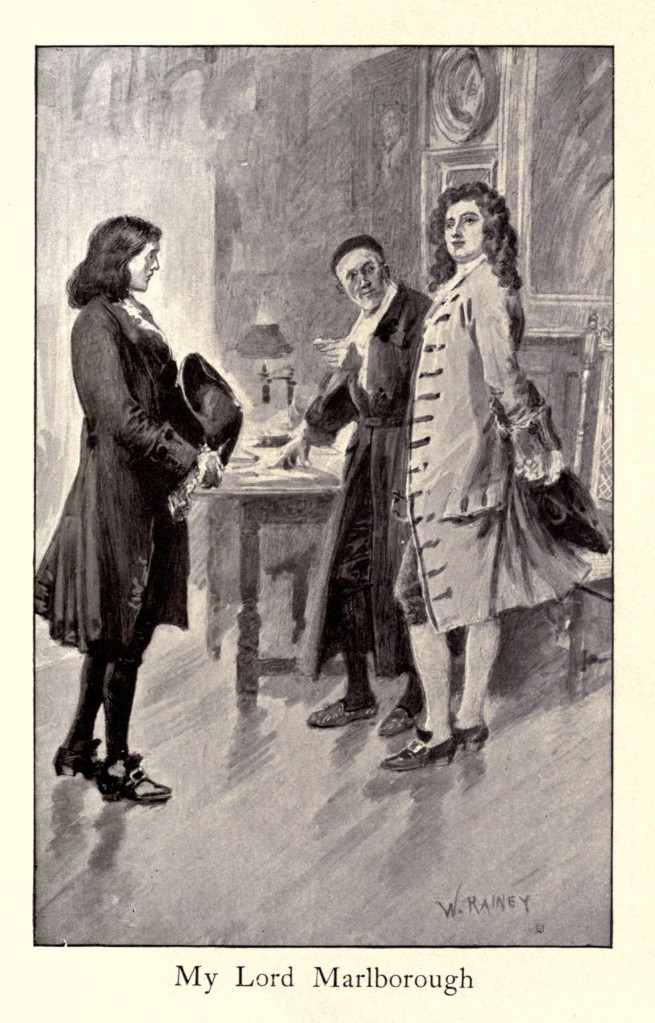
My Lord Marlborough
Marlborough looked towards Harry, who flushed and bowed. An idea seemed to strike Godolphin. Linking his arm with the earl's, he led him slowly to the other end of the room, and stood there talking earnestly to him in tones too low for Harry to catch a word. Once or twice both glanced at the tall youthful figure standing in some natural embarrassment near the door. Once Marlborough shook his head and frowned, upon which Godolphin took him by a button of his laced coat and spoke more earnestly than before. At length Marlborough smiled, laid a hand on Godolphin's shoulder, and spoke a few words in his ear. Then he turned about, and coming slowly towards Harry, said, in his clear bell-like tones:
"My lord Godolphin tells me you have lost your father and are all but penniless. 'Tis an unfortunate situation for a lad of your years. You would serve the Queen?"
"Ay, my lord."
"You have a quick wit, my lord says. I may make some use of you. Write your name on a piece of paper, and the name of your lodging."
Godolphin motioned him to the table, where he found paper and a pencil. He wrote his name and the name of his inn, and handed the paper to Marlborough, who said, as he folded it and placed it in his pocket:
"I will send for you, Master Rochester, if I can serve you."
"My lord, I am much beholden to you—" began Harry.
Marlborough interrupted him.
"'Tis my lord Godolphin you should thank for his good word."
"'Faith, my lord," said Godolphin, "'tis due to Master Rochester that the Queen is served by her present Lord Treasurer. I am glad, my lad, that my friend Lord Marlborough chanced to come upon us here, and I hope you will have reason to be glad also. Now, you will excuse us; we have matters of state to speak of; I wish you well."
Harry murmured his thanks and bowed himself out. His nerves were a-tingle with his unexpected good fortune. To have seen and spoken with the greatest man in the kingdom was itself an unforeseen privilege; and the prospect of assistance from such a powerful and august personage filled him with elation. The earl had shown no great cordiality, it was true; but Harry was inclined to draw good augury from the few words he had uttered. They were probably more sincere than a warm volubility would have been. He left the house with a sparkling eye and a springy gait, and looked eagerly around to see if Sherebiah were near at hand to hear his news. But Sherebiah was nowhere to be seen. Having no particular business, now that his great errand was accomplished, Harry walked through Whitehall into St. James's Park, in the hope that he might catch a glimpse of Queen Anne herself. The guard had just been changed at St. James's Palace, and a stream of people met him as he strolled along the Mall. He was interested in watching them—the fine ladies with their hoops and patches, the beaux with their many-coloured coats, canes dangling at their buttons, toothpicks between their teeth, and snuff-boxes in frequent use. So absorbed was he that he was startled when all at once a hand struck him a hearty blow on the shoulder, and a voice exclaimed:
"Hey, Harry, what make you, ogling the ladies?"
He turned and saw his friend Godfrey Fanshawe, the captain of the cricket team to whose victory he had so much contributed. The two young fellows shook hands heartily.
"What brings you to London?" continued Fanshawe.
"I've come in search of fortune, like Dick Whittington. You heard of my father's death?"
"Ay, but nothing since. They seldom write letters at home."
Harry then explained the course of events which had brought him to London, concluding with his recent interview with Marlborough and Godolphin.
"Egad, man!" exclaimed Fanshawe, "you're in luck's way indeed. Would that I stood so well with the two greatest men in England. My lord Marlborough will gazette you an ensign of foot or a cornet of horse; and my cornetcy, I may tell you, cost my father a pretty penny. What luck, Harry, if we make the next campaign together! The earl will surely go back to Flanders when the winter is over."
"I should like nothing better."
"Where are you staying?"
"At the Angel and Crown, in Threadneedle Street."
"You must leave that and come westward. Are you alone?"
"Sherry Minshull is with me at present; but he'll get work for himself as soon as I am settled."
"Sherry's a handy fellow; egad, I know no better! He'll tie a fly with any man, and is as good with sword or quarterstaff as he is with his fists. Well now, 'tis drawing towards dinner-time; come and dine with me; the people of fashion here dine at four, but I stick to country habits. We'll go to Locket's at Charing Cross; you're my guest to-day. And we'll go to the play this evening; the first time, I warrant you, you've seen a play. Come! I stand well with the people at Locket's, and the sharp air this morning has given me an appetite."
It was but five minutes' walk to Locket's tavern. Entering, Fanshawe bowed with elaborate courtesy to the fair dame in charge, and called for the card.
"There's boiled beef and carrots, I see, and a goose, and look, a calf's head. I adore calf's head. What say you? Yes? Boy, bring calf's head for two, and quickly."
With calf's head and cabbage and a wedge of Cheshire cheese, the two young fellows appeased their unjaded appetites. Fanshawe sat for some time finishing his bottle of wine, Harry contenting himself with small beer. Then, as there still remained a few hours to while away before theatre time, Fanshawe proposed a row on the river. Harry eagerly assented; they sallied forth, took boat at Westminster stairs and rowed up to Chelsea, returning to Westminster in time for the performance of Mr. Colley Cibber's new play, "She would and she would not", by Her Majesty's Servants at Drury Lane. Harry was delighted with his first visit to the theatre. He was tickled at the unabashed impertinence of Trappanti the discarded servant, played by Mr. Penkethman, one of the best comedians in London, as Fanshawe informed him; and fell in love with Hypolita the heroine, a part which suited Mrs. Mountford to perfection. But he was perhaps most interested in Mr. Colley Cibber himself, who played the part of Don Manuel the irascible father. His pleasure was complete when, after the performance, Fanshawe took him to the Bull's Head tavern, and showed him Mr. Cibber with his paint washed off, surrounded by a circle of actors, soldiers, lords, and even clergymen. He had never seen an author before. Mr. Cibber had no presence to boast of, with his thick legs, lean face, and sandy hair; but the liveliness of his conversation gave him a sort of pre-eminence among his coterie, and made a considerable impression on a youth ready to admire and wonder at anything.
Fanshawe appeared quite at home among the company. He was indeed a frequent visitor at the Bull's Head after the play, where all were welcome on condition of providing their quota towards the general hilarity. Fanshawe was the lucky possessor of a fine baritone voice, and his spirited singing of west-country songs had won him instant popularity. On this night, in response to the usual call, he began—
"Tom Pearce, Tom Pearce, lend me thy grey mare,
All along, down along, out along lee;
For I want for to go to Widdicombe Fair,
Wi' Bill Brewer, Jan Stewer, Peter Gurney, Peter Davy,
Dan Whiddon, Harry Hawk,
Old uncle Tom Cobleigh, and all";
and by the time he reached the end of the third of the eight stanzas, the whole company were ready to join him in trolling the chorus,
"Old uncle Tom Cobleigh and all".
It was late when Harry reached the Angel and Crown. Sherebiah was marching up and down before the tavern, blowing great clouds from his pipe.
"Hey now, Master Harry," he said, with an expression of mingled wrath and relief; "'tis a mighty scurvy trick you have played me, i' feck 'tis so. Here we are, your second day in London, and you must go off along by your lone self on who knows what errand o' foolery. Ay, 'tis strong words for me, and a man o' peace and all, but not too strong, seee'n as I knows the wicked ways o' the town and you be unfledged. Zooks, sir, I've been in a terrible way, thinken all manner of awsome an' gashly things, as how you med ha' been trepanned, or slit by the Scourers, or trampled by some high lard's horses, or rifled and beat by footpads, or 'ticed into a dicing den by sweetners always on the look-out for a country gudgeon, or——"
"Hold, Sherry, you forget yourself," said Harry, who was, however, not displeased to find the honest fellow so solicitous about him. "In truth, I forgot all about you. I can take care of myself, I think. I dined with Mr. Godfrey Fanshawe, whom I chanced to meet, and we went to the play afterwards, and I never laughed so much in my life. Mrs. Mountford's a beauty, Sherry, and Mr. Cibber—when he doesn't squeak—has the pleasantest voice ever I heard—nay, not that, after all; 'tis not so pleasant as my lord Marlborough's. What d'ye think, Sherry? I met the earl himself at Lord Godolphin's, and he has my name on a scrap of paper, and to-morrow or next day I shall hold the queen's commission, and then off with the troops to Flanders, and I shall make my fortune, man, and then——"
"Huh!" put in a voice from the doorway. "Haastige spoed is zelden goed."
Harry's excitement was dashed by the slow drawl of Mynheer Grootz, whose little eyes were twinkling as he puffed at his big pipe.
"Ay, a true word," said Sherebiah. "'More haste, less speed,' as the Dutch words mean put into rightful language. 'Counten chickens afore they be hatched,' as ye med say."
Though he was a little nettled, Harry had too much good sense not to see that his elation had carried him too far. He could laugh at himself—an excellent virtue in man or boy.
"I am an ass, Mr. Grootz," he said; "but really I did not expect such good luck. My lord Godolphin was very kind, and so was the earl, and as he used but few words I do think he meant what he said. I am sorry my absence made you uneasy, Sherry; but I don't understand why you should imagine all manner of harm."
"An ye knew——" began Sherebiah; but he paused, hemmed, and changed his sentence. "All's well as ends well, Master Harry; I axe your pardon for my free words; and here be a fine stout piece of ash I bought in Fleet Street for your hand. Feel un; 'twill crack a pate as quick as speaken, and I'll be more easy in mind knowen you have such a good staff in company."
"Thanks, Sherry!" said Harry with a laugh, weighing in his hand the stick with which the man presented him. "But I'm a man of peace, you know, eh?—at present. Now let's to bed."
As they went from the room Harry remarked, "By the way, Sherry, how is it that you know Dutch?"
"Me know Dutch? Why, sir, what makes ye think I know that outlandish tongue?"
"Why, didn't you tell me just now the meaning of what Mynheer Grootz said to me?"
"Ay, so I did, now. It must ha' been as a dog knows his master's speech, or just as I knowed the meanen o' the holy things your good feyther was used to speak in the high pulpit, for egad, word by word I knowed no more than the dead what a' said, not I."
The explanation struck Harry as rather lame, but he merely said, with a laugh:
"Well, you'll make a very faithful watch-dog, Sherry. Good-night! I shall sleep well;—if I don't dream too much of battle and glory."
CHAPTER VII
Snared
Hope Deferred—Motes in the Sunbeam—Mynheer makes an Offer—Sherebiah on Guard—New Quarters—Tumblers—Solvitur Ambulando—Doubling—Sick at Heart—Too Late—A Debit Balance—Gloom—Cold Streets—Three Sailors—Muffled
Several days passed—days of unfailing happiness for Harry. Though he spent hours in roaming the town, there was always something fresh to see, something novel to capture his interest. He saw the state entrance of the new Venetian ambassador. He visited the Tower, the Abbey, and St. Paul's, saw Winstanley's water-works in Piccadilly near Hyde Park, and witnessed a football match at Covent Garden. He accompanied Fanshawe several times to the theatre, and somewhat offended that sparkish young gentleman by constantly refusing to join him in card-parties and night escapades in the streets. He saw a back-sword match at the Bear Garden in Hockley in the Hole, and a billiard match at the Greyhound Coffee-house near Monmouth Street. Apart from these public sights, he found endless diversion in the ordinary street scenes: the markets, the itinerant vendors, the acrobats, or posture-masters as they were then called, who performed their dancing and tumbling in squares remote from the traffic. It amused Harry that Sherebiah never tired of these mountebank tricks, but would stand and watch them with unflagging interest by the hour, applauding every neatly executed feat, and criticising with unsparing severity every instance of clumsiness or bungling. Soldiers, on the other hand, apparently did not interest Sherebiah. Harry liked to watch them drilling on the Horse Guards' parade or in Hyde Park; but on these occasions Sherebiah always strolled away, waiting with impatience until his young master had satisfied his curiosity.
"They won't kill you, Sherry," said Harry once, laughing as the man sheered off. "Their muskets are not loaded."
"True. But 'tis no pleasure to me to see such men o' war. Feyther o' mine were a trooper; he be always talken on it; I be a man o' peace, I be."
Every day when he came down to breakfast, and when he returned in the evening, Harry eagerly looked for a message from Lord Marlborough. But the days passed; a week flew by; and still no message came. After the second day he made no reference to the matter; Sherebiah and Grootz considerately forbore to allude to it. But they watched him with shrewd eyes, and saw, through all the curiosity and pleasure he took in his new life, a growing sense of disappointment and anxiety. He had built high hopes upon the interview at Godolphin's; as boys will, he had allowed his fancy to outstrip his judgment, and had added a good deal of embroidery to the simple facts. Already in imagination he saw himself carrying the Queen's colours, performing heroic deeds in the field, winning golden opinions from the general, coming home laden with honour and substantial rewards, perhaps to gain, as the acme of bliss, an approving smile from the Queen herself. And he would wake from these day-dreams to the sober reality—-that the desired message from Marlborough had not come, and meanwhile time was fleeting by, and every day saw his little stock of money diminished.
He had resisted Fanshawe's recommendation to change his lodging. Charges were higher, Sherebiah informed him, in the more fashionable parts, and he knew that he could not afford to run risks. At first he had not been parsimonious; he was not extravagant by nature, but he had not hesitated to buy a trifle that pleased him, to give largesse to the ballad-singers and street musicians, to pay his eighteenpence for a seat in the pit at Drury Lane or Lincoln's Inn Fields. But he gave all this up, and thought twice about spending a penny. He bought only the strictest necessaries, and for his amusement depended on the sights of the streets, the parks, and the river, and such entertainment as could be had at the coffee-houses, where for a penny he could obtain a dish of coffee, read the Daily Courant with its manuscript supplement, or Dawks's News Letter, and hear all the news of the day discussed with more heat than information by arm-chair politicians.
One day the Courant announced that the Queen had been pleased to confer the dignity of a dukedom upon the Earl of Marlborough, and that the House of Commons would be asked to grant him an annual pension to match his new rank. Harry remembered what he had heard pass between Marlborough and Godolphin, and when the coffee-house gossips supplemented the official intimation with the rumour that the Countess Sarah had been violently opposed to her husband's elevation in the peerage, he understood the meaning of the peculiar tone in which Marlborough had spoken of acquainting her ladyship. The new duchess was the theme of much conversation and many jests in these free-spoken assemblies. Marlborough was a very great general; everybody was agreed on that; but it was doubted whether he was master in his own house; some said he was henpecked; one plain blunt fellow declared in Harry's hearing that the duke was as much afraid of his missis as any Thames bargee. Harry was not interested in Marlborough's domestic affairs, but his heart sank when he reflected on his own insignificance beside the great man whom the Queen was delighting to honour. After all, how could he expect a man of such eminence, immersed in state affairs, with all the responsibility for conducting a great campaign, to remember a country youth whom he had seen once, and who had made, perhaps, as deep an impression on him as a fly might make on a lion.
That night Harry was eating his supper, somewhat moodily, when Mynheer Grootz, sitting opposite, made him a sudden proposition.
"I tell you dis," he said. "I go back to my country zoon. I have business wid de armies; I sell hay for de horses, meal for de men. You are quick, I see dat; you speak French, enough for my purpose; I give you good wages if you come and help me in my business."
Harry flushed. The Dutchman dipped a hunk of bread into his soup and filled his mouth with it, looking down at the bare deal board the while.
"I thank you, Mynheer," said Harry with some constraint. "I have another purpose, as you know."
Up came the fat forefinger, moist with gravy.
"I speak plain to you. You have pride; I alzo. But I have mills, and ships, and vields; dey are mine; I am rich—ja, rich; I, Jan Grootz. My fader, he was a poor weaver in Dort; he work hard and die poor; I work hard, and grow rich. I have what for to be proud. You are a gentleman; dat is zo; it is good to be a gentleman; it is not good to be poor. And more, it is not good to zee money go every day, every day, and wait for some prince to fill de empty purse. You have pride; for what? For white hands, and by and by an empty stomach. My hands, dey are not white, naturlik; but my stomach is full, and I stand up before any prince; Jan Grootz; zo!"
He spread his broad hands before Harry, as though he were proud even of their horny skin. The action brought a smile to the lad's gloomy face and dulled the edge of his irritation.
"I won't debate the matter with you," he said. "I'm not afraid of work, I hope, and maybe my white hands may be red enough before long. I won't despair of my lord Marlborough yet; and I know your intention is friendly, Mynheer."
The Dutchman grunted, and applied himself again to his meal.
Great as were Harry's anxieties, Sherebiah's were perhaps even greater. He also was disappointed by the forgetfulness or neglect of Marlborough, and concerned at the constant drain upon his young master's purse; but he had further causes of trouble of which Harry was unaware. Ever since their arrival in London Sherebiah had been possessed by a dread of impending ill. He had always in mind the interview between Captain Aglionby and the squire's man at the White Hart tavern, and day by day expected it to bear fruit to Harry's harm; but for reasons of his own he hesitated to tell him the plain truth. He stuck like a leech to Harry when he went walking, and many times when the lad would rather have been alone with his dismal thoughts he found Sherebiah at his heel, like the watch-dog to which he had compared him. He did not know that even when he succeeded in eluding his too solicitous henchman, it was only in appearance; for Sherebiah, armed with a stout ash cudgel, was seldom many yards behind. Many a night after Harry had gone disconsolate to his bed, the man wended his way to Southwark in the hope of making a further discovery; but he never saw the captain or anyone whom he knew to be connected with him, and when at last he found an opportunity of making a discreet enquiry at the hostelry, he was more alarmed than pleased to find that Captain Aglionby had departed some time before, and that nothing had since been heard of him.
One morning, when they had been for about a month in London, when Parliament had been prorogued, and a new year had opened, Sherebiah surprised Harry by suggesting that they should remove to an inn near Leicester fields.
"Why, you were against it when Mr. Fanshawe proposed it. How is it that you have changed your mind, Sherry?"
"Well, sir, 'tis this way, if I med be so bold. Your money be gwine fast, and 'twould never do to begin a more humble way o' liven here. Nay, what I say is, if you must pare and scrape, go where you bean't so well known, and then nobody'll think the worse on 'ee for't."
"Hang me, who talked of paring and scraping, Sherry?" cried Harry impatiently.
"I axe your pardon, sir," said Sherebiah earnestly, "but I were not born yesterday. Here are we, four weeks in Lun'on, and you know yourself how many golden guineas you brought wi' 'ee, and how many be left. Sure I bean't a great eater myself, but even my little small morsel ha' got to be paid for. Master Harry, 'twill be best for 'ee to do as I say. Ay, an' if I knowed 'ee wouldn't up and rate me, I'd say another thing, I would so."
"Well—what's that?"
"Why, I'd say, hand over your purse to me. Nay, sir, don't be angry; ye're not wasteful, no; but if we go to another house, I can save 'ee many a penny here and penny there in ways you wouldn't so much as dream on. I know Lun'on folk, you see; ay, I know 'em well."
In the upshot, Sherebiah had his way on both points. The reason for his change of front was that on the previous afternoon he had seen the squire's man Jock hanging about the inn, and had found out subsequently that Captain Aglionby had returned to his old quarters at the White Hart. It was just as well, he thought, to take one step further from danger by changing their lodging. When this was done, and Sherebiah kept the purse, Harry was amazed to find how much further his money went. It would not have surprised him if the weekly bill had been reduced by a small amount; but when he discovered that, though he fared quite as well, the expenses were not half what they had been, he began to think that Sherebiah possessed some talisman against the cupidity of London innkeepers. He found, too, that he was left much more to himself, and wondered why, with the change of lodging, Sherebiah's watchfulness appeared to have diminished.
He was walking with Godfrey Fanshawe one cold January afternoon by Pye Corner, when he was attracted by a crowd of people gazing at a street show that, to judge by their laughter and applause, was exceedingly entertaining. Elbowing their way through the stragglers on the outskirts, the two young fellows arrived at a position whence they could see what was going on. A group of posture-masters were performing, and at the moment of Harry's arrival, a short thickset man, dressed in fantastic costume, and with painted face, was dancing on his knees with his toes in his hands, keeping time to the music of a flute and a violin. The tune was a merry one, and the movements of the acrobat irresistibly funny, so that every member of the crowd roared with laughter.
"Adzooks!" exclaimed Fanshawe, "the fellow's face is the funniest part of the performance. Look'ee, Harry, 'tis as sober as a judge's on assize; one would think 'twere a hanging matter."
Harry had been so tickled by this odd mode of dancing that he had not noticed the performer's features. He glanced at them now, started with a sudden gasp, and cried:
"By the Lord Harry, 'tis——"
"'Tis what?" said Fanshawe, looking at him in surprise.
"Oh, nothing!"
"Come, I scent a mystery. Unravel, sir!"
"'Tis nothing. See, Fanshawe, the dance is over. Let us go on."
Without waiting for his companion, he pushed his way back through the crowd.
"Faith, I don't understand you of late, Rochester," said Fanshawe in a half-vexed tone, when he overtook him. "You're moody, full of whimsies, all starts and surprises. Would to Heaven that the duke would bethink him of that paper you gave him! You need settling in life. Why don't you go to him, or to Lord Godolphin again? 'Tis few suitors but would show more perseverance."
"Not I. 'Twas against the grain to beg even one favour. I'd rather earn my bread by scraping a fiddle, or dancing on my knees like—like the poor fellow there."
"Well, let me tell you, you'll rue your independence. Adsbud, who would get on in this world if he didn't pay court to the great! Your starveling poet writes a flattering dedication to a lord—for pay! Your snivelling parson toadies to the lord of the manor—for a meal! I except your father, Harry; he was a rare one. 'Tis the way o' the world; we must all do it, or pay the penalty."
"Be the penalty what it will, I'll pay it rather than play lick-spittle to any man."
Fanshawe shrugged. "By the way," he said, "Mr. Berkeley is in town—to pay his court to someone, I swear. 'Tis said he is buying a commission for that cub his son; pray Heaven it be not in my regiment! That's the way o' the world again. Here's Piers Berkeley, the young popinjay, all grins and frippery, like to carry the Queen's colours in a fine regiment because his father has a long purse, and you, a deal more fit for it, kicking your heels for want of a rich father or a richer patron. I fear 'tis all up with your chances now; but I wish you luck. I go to Flanders in a week; home to-morrow to say good-bye; who knows when we may meet again!"
The two friends bade each other a cordial farewell; then Harry returned sadly to his lodging. Some two hours later Sherebiah came back.
"What do 'ee think, Master Harry?" he said. "I ha' seed old Squire."
"I knew he was in town," replied Harry. "And what do you think I've seen, Sherry?"
Detecting a something strange in his tone, Sherebiah gave him a hard look.
"I never was no good at guessen," he said. "Mebbe the German giant at Hercules' Pillars, or the liven fairy in Bridges Street."
"No, 'twas no giant and no fairy, but a short man—about your height, Sherry—with a round face—just as round as yours—and a solemn look—like yours at whiles; and what think you he was doing? He was dancing on his knees, with a crowd of numskulls round him grinning at his capers, and——"
"There now, 'twas sure to be found out, I knowed it. 'Twas me—I don't deny it, 'cos bean't no good."
"Now I know why you wanted to keep the purse, you old dissembler. You eke out my little store with the pence your antics fetch. Sherry, I love thee; I do indeed. But how did you learn those fantastic tricks with your knees?"
"Oh, I ha' done a bit o' tumblen in my time; ay sure."
"You seem to have done a bit of everything. But when? and why? You must tell me all about it."