THE ADVENTURES OF HARRY ROCHESTER (continued 5)
Reading edition
The temptation was strong, the inward struggle sharp. But it was only a few moments after the staggering announcement when he bent forward and said:
"Mynheer, I cannot accept this offer—this splendid offer. 'Tis exceeding kind of General van Santen; I owe him my hearty thanks; but 'tis not to be thought of, save you yourself wish to be rid of me, and that I must doubt, since 'tis but a week since you told me I was useful to you. I will see the general, and explain to him the reason why I decline this commission; I must do so at once."
He made towards the door, as though eager to avoid dalliance. Grootz's broad plain face was transfigured by delight and pride and gratification. Catching Harry by the arm, he drew him back, laid his hand on his shoulder, and said:
"No, Harry, my dear lad, I tell you dis; you must not do dis ding. I do not zay I shall not feel your loss"—there was an unusual note of tenderness in his voice—"true, it is not long dat we have worked togeder, but already I regard you—jawohl, regard you as a son, and to miss your bright face, your willing service——hoot! by den donder, I am not myself to-day."
"'Tis too kind of you, Mynheer."
"Nay, nay; I am not zo weak. I am at one wid General van Santen: you are made for a soldier. 'Tis de work you yourself would have chosen; now 'tis de tide of fortune, dat you dare not miss. I tell you dis; I am made up in my mind, fixed, noding can move me. I salute you, Mynheer Rochester, cornet in de Anspach dragoons."
"Indeed, 'tis too good of you, Mynheer."
"Not zo. And dis I tell you alzo. You know me, Jan Grootz; I prosper—God prospers me. I regard you as my son: well, 'tis a fader's pleasure to provide for his son at de beginning of dings, just as 'tis a skipper's pleasure to zee his ship sail taut and trim. You will have heavy charges: clothes, equipment, a horse to buy. Dose charges, you will permit me, zall be mine. 'Tis but right you should take your place wid de best. I have no kith nor kin, nor like to have; de pay for dragoons is little enough; I add a hundred guilders a month; dat will suffice, dink you?"
"But, Mynheer——"
"Poof! no buts. I zall do as please me. Now, I am hungry: let us go to de parlour. And dere is your man to tell; he will, no doubt, continue to be your servant."
They went from the room, Grootz keeping his hand affectionately on Harry's shoulder. The table in the parlour was already laid, and in answer to the bell old Gretel appeared with a tureen of soup.
"Gretel," said the merchant, "Mynheer Harry is about to leave us."
"There! Something inside told me, Mynheer, you would not keep him long."
"'Tis not of my own will, Gretel," said Harry at once.
"No," added Grootz. "The lad was not eager. He is to be an officer of dragoons."
The old woman curtsied and grunted.
"A rare exchange!" she said. "To my mind 'tis better to sell corn than to stand up to be shot at, and a deal safer. But I wish you good luck, Mynheer."
"Thanks, Gretel, for that and for all your kindness to me. Is Sherry downstairs?"
"Ja, Mynheer."
"Send him up, if you please. I must tell him the news."
"Oh! he will not be pleased. He has a scorn of soldiers, never a good word to say for them. He is in the right."
Harry smiled as the privileged old housekeeper hobbled out. Sherebiah soon appeared.
"Sherry," said Harry, "I have a thing to tell you. General van Santen has recommended me to the heads of the Dutch army, and I am made an officer of dragoons."
"Zooks!" was the man's astonished exclamation.
"We shall still be together, you and I. I shall want a man, of course; and you will not object to the place?"
"Well, sir," said Sherebiah slowly, looking down at his boots, "'tis an awk'ard matter for a man o' peace. 'Tis a line o' life I ha' no love for. To be sarvant to a man o' war is next to bein' a man o' war yourself. Not but what I'd be proud to sarve 'ee, Master Harry; no man more; but them as take the sword shall fall by the sword, as the Book says, and I take that for a warnen to have none on 't."
"A lame argument, Sherry."
"True, sir, haven no larnen I feel it so. And will 'ee go shoulder to shoulder with our English sojers?"
There was a note of anxiety in his voice.
"That I can't say. I hope that my regiment won't be left out in the cold."
"Well, sir, there's a providence in't. Them above knows what they're about, to be sure, in a general way, and I bean't agwine to set up for knowen better. I'll sarve 'ee, sir, polish your breastplate, currycomb your horse, oil your boots, clean your pistols, keep an eye on the sutlers, and——"
"You seem to have a good notion of your new duties," said Harry, laughing.
"Pretty good, sir, for a man o' peace," said Sherebiah imperturbably. "And when do 'ee mount your horse as a sojer, Master Harry?"
"Zoon," put in Grootz. "General van Santen himself will introduce him to his broder officers; he tell me zo."
"Ay, so. Well, 'tis a world o' changes. For you, sir, 'tis a change for the better, barren 'ee bean't killed; for me,—well, the truth on't is, I fear 'tis the beginnen o' the end for Sherebiah Stand-up-and-Bless."
CHAPTER XIII
Concerning Sherebiah
A Summons—Coy's Horse—Vain Search—A Clue—Sentenced—Confession—A Quiet Mind—A Friend in Camp—The Informer—Intercession—Who Goes There?—Hit—The Mantle of Night—In a Ditch
One evening, a few days after he had received news of his commission, Harry returned home somewhat later than usual from his customary stroll. He was fond of walking through the pleasant woods to Scheveningen, and watching the herring-boats as they sailed out for the night's work. He would chat with the fishermen, and had indeed by his frank manner, and perhaps an occasional gift of tobacco, established himself as a favourite with them.
On this evening, feeling a little tired, he threw himself into a chair in the parlour, and sat musing, gazing into the glowing sky as the sun went down. By and by old Gretel entered and began to lay the supper. She had gone in and out two or three times in silence before Harry bethought himself and said:
"Why, Gretel, how is it Sherry is not helping you to-night?"
"By den donder, Mynheer, you may well ask! He seems bewitched since the great news. Not half so helpful to my poor old bones as he was."
"But where is he?"
"He has not returned yet."
"Returned from where?"
"Why, Mynheer, he went out at once after receiving your message, and——"
"My message!"
"Ja, Mynheer, the message sent by the boy."
"What boy? Come, Gretel, I sent no message. I know nothing about a boy. Tell me all you know."
"It was about four o'clock, Mynheer, a boy of twelve or so came to the door—a stranger to me. He asked for Sherry Minshull—no mynheer to his tongue. I called to Sherry, and heard the boy say, 'Mynheer Rochester wishes you to come——' then the big bell of the Groote Kerk tolled, and I heard no more. But Sherry reached down his hat and said he was going to you, and he and the boy went away together."
Harry was puzzled, and a little uneasy. He rose from his chair.
"Are you sure you heard the boy mention my name?"
"Quite sure. And Sherry must have thought there was need for haste, for he left his dish of coffee half full, and he is too fond of mocha to do that without a reason."
Just then Mynheer Grootz came in to supper. When Harry had informed him of the strange message and Sherebiah's continued absence, he was at first disposed to make light of the matter.
"Gretel is growing hard of hearing," he said. "Maybe she mistook de name."
"Don't you think, Mynheer, 'twould be well to make enquiry before it is dark? I am strangely uneasy about Sherry."
The merchant consented to accompany Harry into the streets. Everybody knew him and answered his questions readily enough; but none of the porters of the neighbouring houses, or the watchmen who patrolled the streets, had seen Sherebiah or the boy, though some of them owned that they knew the former well by sight. By and by, however, they came upon an old soldier smoking his evening pipe outside his cottage—the lodge to one of the larger houses in Gedempte Spui. Grootz put the usual question.
"Did you see an Englishman—stout, with a beard, and his hat on one side, pass by a few hours ago with a boy of twelve or thereabouts?"
The soldier removed his long pipe, spat, and appeared to meditate before replying.
"Yes—now I think of it; I believe I did see a man of that cut, though I would not be sure. He might not have been an Englishman. He was stout, certainly, and had a beard; as for his hat, I didn't notice it, for the truth is, I had been looking at some other Englishmen, a party of Coy's Horse; my old corps served side by side with them in '97. Yes, and there was a man among them I knew too; a paymaster—Robins, I mind, was his name—donder! what a temper he had! It was a curse and a blow with him. Ay, it is a hard life, the soldier's. They halted at the inn over by there, and I was just going over to drink a glass with them for old times' sake when the Baron's coach came up and I had to open the gates. A lodge-keeper, see you, is a sentry with no change of guard."
"Ja, ja! But the Englishman and the boy—which way did they go?"
"Which way? Let me see. They might have gone down the road: no, now I bethink me, I believe they went up the road; but there, I can't be sure. The sight of the English horse, men I fought side by side with in '97, before I got my wound——"
"Ja, ja! Thank you!"
They escaped his further reminiscences by walking on, past the inn, past a row of cottages with the inevitable bright green shutters, until they came to the watch-house at the cross-roads. Grootz put the same question to the watchman.
"No," he replied. "I saw no Englishman with a boy. But I saw a party of English horse; they had come in from Rotterdam, and I heard afterwards at the inn they were on the track of a deserter."
It was now almost dark; to continue the search further would be vain. They returned home to their belated supper, Grootz promising to set exhaustive enquiries on foot in the morning.
That night, for the first time for many months, Harry was unable to sleep. He was oppressed by perplexity and uneasiness. From whatever point of view he looked at Sherebiah's disappearance it seemed equally inexplicable. He could divine no motive for a message sent to Sherebiah in his name; the man appeared to be on very good terms with Dutchmen and was unlikely to have private enemies. Harry was almost forced to the conclusion that Gretel had been mistaken, after all, and that Sherebiah would by and by return with a simple explanation of his absence. He might have met a friend, and be spending a convivial evening with him. Perhaps—the thought came like an illumination—one of the English troopers from Rotterdam was a friend of his—a Wiltshire man, possibly. The suggestion allayed his uneasiness, and he fell asleep half expecting to be called by Sherebiah as usual next morning.
But Sherebiah did not return that night. It happened next day that Mynheer Grootz was early summoned to a conference with a committee of the States General, and when after a prolonged discussion he was released he had to start at once for Leyden on important business. It was late before he returned. Harry meanwhile had lost no time in pursuing enquiries in every likely quarter, but in vain. Sherebiah had not returned; nothing had been heard of him; and there was nothing for it but to wait yet another day.
He was again wakeful, and his thoughts turned to the errand on which the party of English horse had come. He pitied the unfortunate wretch for whom they were in search—some poor fellow, perhaps, who had escaped in the hope that he would be less easily tracked in a foreign land. The punishment for desertion had become much more stringent and summary of late owing to the prevalence of the offence. Harry himself remembered one bleak morning in London when, having gone early into Hyde Park, he had been the unwilling spectator of the shooting of a deserter. Had they caught the man? he wondered. "I hope——" he thought, then suddenly a strange suspicion flashed upon him. Surely it was impossible; yet—— In a moment slumbering recollections awoke. He remembered that many times, when approaching English soldiers in London, Sherebiah had sidled away and disappeared. He remembered how, more than once, Sherry had shown a knowledge of military matters singularly intimate for a civilian; how insistently he had always proclaimed himself a man of peace; how hardily he had behaved in the fight at Lindendaal. These facts, and many a slight hint scarcely regarded before, combined to convert a chance surmise, almost dismissed as absurd, into a strong presumption little short of certainty.
He sprang out of bed, dressed quickly, ran downstairs with his slippers in his hands, and, noiselessly drawing the bolts, hurried along the silent street towards the inn on the Rotterdam Road at which the patrol had halted. Though it was late, the people of the inn were still up. He asked for the landlord, and had not conversed with him for more than a minute before he was convinced, from what was said of the prisoner, that it was indeed Sherebiah. The troopers had brought with them a led horse; on this they had mounted the deserter, strapping him on each side to a dragoon, and then ridden off at once towards Rotterdam, en route for Breda. Returning to the house, Harry woke Mynheer Grootz, told him of what he had learnt, and proposed to start at once for Breda to allay or confirm his suspicion. From this the merchant dissuaded him. A night ride would be attended with difficulty and danger; if he started early in the morning, he might still overtake the dragoons before they reached Breda. Accordingly he went back to bed for a few hours. At dawn he rose, and by five o'clock was galloping towards Rotterdam on the best horse in Grootz's stables.
At Rotterdam he learnt that a body of English horse, consisting of units of several regiments, had left for Breda on the previous afternoon. Waiting for an hour to rest and bait his horse he pushed on to Breda, arriving there about one o'clock in the afternoon. Without delay he sought out the officer to whom he had delivered his convoy of provisions a few weeks before, and enquired whether he knew of the arrest of an English deserter.
"Ay, and a notorious character, it appears. 'Twas not merely desertion they had against him, but mutiny, and a murderous attack on an officer. He fought like a cat when he was arrested; 'twas a foolish trick, for they were ten to one, and in a little he was overpowered. He was tried by court-martial this morning at nine, and the trial was short."
"Was sentence pronounced?"
"Of course; he had no defence; he was sentenced to be shot."
"There is no appeal?"
"None. The sentence will be laid before my lord Marlborough for confirmation; a matter of form. But pray why do you take so much interest in the man?"
"He is my servant, comes from my village, has done me right faithful service. Good God! to think that he should come to this end!"
The officer shrugged.
"Unhappy chance indeed. 'Tis seven years or more since he deserted; doubtless he felt secure. I am sorry for you. He'll get no more than he deserves."
"Could I see him?"
"Certainly; he is confined in the town-house; I will take you to him myself."
In a few minutes Harry was ushered into a dark room in the basement of the town-house. A candle was lit; he was left alone with the prisoner, and the door was locked behind him.
"Oh, Sherry, my poor fellow, who would have thought you would come to this!"
"Master Harry, 'tis good of 'ee to come and see me. Ay; poor feller! you med well say so; but to tell 'ee the truth, 'tis a load off my back."
"Yes, I understand. I know now why you always scouted the soldiers in London. Why didn't you tell me? I would never have brought you to this country, with our soldiers here, there, and everywhere."
"Tell 'ee! Not me. Why, you and me would 'a had to part company that minute. Besides, 'twarn't zackly a thing to be proud on, look at it how 'ee will. 'Twas ill-luck I were nabbed, to be sure; but I've had nigh eight year as a man o' peace, and I s'pose 'twas time the lid were putt on the copper."
"And they'll shoot you!"
"Bless 'ee, I bean't afeard o' that. I've been shot at; ay, many's the time: at Sedgemoor, and Walcourt, and other cities o' destruction. I can stand fire wi' any man. Nay, the one thing as troubles me is how poor old feyther o' mine'll take it. The poor ancient soul never dreams I desarted; and zooks! 'tis that'll hurt un more'n my bein' a corpse; his boy a desarter, and him a trooper of old Noll's! Ay, that'll hurt un, 'twill so. And then there's you, sir; how be I agwine to leave 'ee, wi' old Squire and Rafe Aglionby a-seeken whom they may devour, and no one you can trust to polish your breastplate and oil your boots? Ay, the way o' transgressors is hard; the wages o' sin is death; many's the time I've yeard they holy words from the lips of pa'son your good feyther, never thinken in my feeble mind he were aimen at me."
Harry was at a loss for words. Sherebiah was so perfectly resigned to his fate that any attempt at consolation would seem an impertinence.
"How came you to desert?" he asked, to gain time.
"Why, I'll tell 'ee about it. I was a corporal in Coy's horse; med ha' been a sergeant long agoo, indeed. But there was a paymaster o' that regiment, Robins by name; a good sojer, true, but with his faults, like any other mortal man. He was hot in his temper, and crooked in his dealens. Us men was bein' cheated, right and left; our pay was small enough, but we never got it: a penny here and a ha'penny there bein' took off for this or that. Ay, and he was a knowen one, he was. All done so soft and quiet-like. We stood it a long time; at long last, 'twas more'n Minshull blood could stomach, and one mornen I up and spoke out; you see, I warn't a man o' peace then. Well, Robins bein' fiery by nature, he got nettled; I should myself; but 'tis one thing to get nettled, and another to use yer fist. Robins he used his fist, and not bein' zackly meek as Moses, I used mine, and he fell under. Two or three of my mates standen by saw it all. Robins he raved and called on 'em to arrest me, but they wouldn't. But 'twas all up wi' me; I knowed that well enough; if Robins took a spite agen a man he med as well be a dead dog. I had no mind to be a dead dog just then, so I bolted; and that's how I come to be such a man o' peace."
"But surely if you explained that, your punishment wouldn't be so heavy."
"Explain! Bless 'ee, 'twould be no good in the world. To strike a officer be mortal sin. Nay, I've nowt to say for myself; I must just take my wages."
"How did you manage to elude them so long?"
"Oh! the regiment was out o' my way: been quartered this many year in Ireland. 'Twas just my bad luck that they should ha' been sent for on this campaign. Ah, well! a man can die but once; I've kep' the commandments, and that's more'n Robins can say; and there's no commandment 'Thee shall let a man hit 'ee and say thank 'ee'. I bean't afeard o' Them above, and I'll meet 'em with head up and eye clear, like a English sojer."
"When is it to be?"
"They didn't tell me that. 'Twill not be long, you may be sure. My lord Marlborough has only got to scribble his name on the paper, and he'll never remember 'twas me as held his horse at Salisbury in '88 and got nowt but a smile.—Master Harry, belike I sha'n't see 'ee again in this world. When you go home-along, you'll say a word o' comfort to the old ancient gaffer, won't 'ee? Tell un all the truth; tell un I be main sorry to vex his old gray hairs,—though not for punchen Robins. Gi' him my dear love: his boy, he calls me, poor soul: and say as how I were quite easy in mind and not a bit afeard. He's a trooper of old Noll's, you see."
"I'll give him your messages," said Harry with a gulp,—"if ever I get back alive."
"Ay true, ye med not. The corn-dealen was a safer line o' life.—What! time's up."—A sentry had thrown open the door.—"Good-bye, Master Harry; God bless 'ee! and I hope you'll get a man as'll polish your 'coutrements to your mind. This time to-morrow, belike, I shall be a true man o' peace."
Harry shook his hand in silence; he could not trust himself to speak. He was angry at what he thought the essential injustice of the sentence. Sherebiah had only struck the paymaster in self-defence, and in the original cause of dissension had right on his side. But Harry knew what military discipline meant; it was rigid as iron. Still, he could not help asking himself whether even now it was impossible to get the whole circumstances considered and the sentence revised. He thought of making a personal appeal to Marlborough, but soon dismissed the idea, for Marlborough had doubtless forgotten him, and he had no force of persuasion to bring to bear. Suddenly, as he walked slowly along the street, he remembered Godfrey Fanshawe; he was an officer in a companion regiment, Schomberg's Horse; he would ask his advice. He enquired for the quarters of the regiment, found that it was encamped a short distance out on the Tilburg road, and hastened thither with an anxious heart.
The troops were under canvas, and Harry found Fanshawe joint occupant of a tent with a fellow subaltern.
"Hullo!" he cried when he saw Harry. "I wondered when I should run up against you. I have heard all about your feat—rescuing beauty and all that. What in the world brought you to this country?"
"'Twould be long in the telling. You shall know all in season. I am here on a very special errand. You remember Sherry Minshull?"
"As well as I do you. Many's the trout we've caught together. A right good fellow!"
"At this moment he is lying under sentence of death in the town-house at Breda. Unknown to me, he had been a soldier, and deserted after thrashing an officer——"
"D'ye know him, then?" interposed the other lieutenant.
"He is my man."
"Oh! Sorry for you both. I had heard about it from an officer of Coy's—Cadogan's, I should say; their name's changed."
"Do you know, sir, how he came to be smoked?"
"'Twas an Englishman peached—a soldier of fortune, as it appears, who wished to be nameless. He met the men of Cadogan's when they landed at Rotterdam, and arranged a trick by which they got him alone on the open road. 'Twas rather cleverly managed."
"And a dirty mean thing to do," said Fanshawe warmly.
"Can't something be done for him?" asked Harry.
"'Tis hopeless," was Lieutenant Tettefall's reply. "Robins was very vindictive; he painted the man in the blackest colours in his evidence before the court-martial, and not one of the officers of the court knew your man. He has a double offence to answer for; 'tis certain he'll be shot as soon as the forms are completed."
Harry's face was then the picture of blank despair.
"On my life, 'tis a thousand pities!" said Fanshawe. "I fear there is not the ghost of a chance for him." His face gloomed for a moment; then his high spirits asserted themselves. "But come, Harry, 'tis no good taking on about it; come and forget it over a bottle. I want to hear your story."
"No, I'm in no humour for racketing. Would to God I could do something for the poor fellow! Would the colonel intercede if we asked him?"
"Not he. He would laugh and crack a joke. If Sherry were a Dutchman, now! The duke is very sweet to the Hollanders at this time, and a word from one of the States might turn him."
"General van Santen!" exclaimed Harry. "I had not thought of him. 'Twas he I happened to be of use to, and Sherry did his share too. Yes, 'twould be no harm to try him. Do you know where he is?"
"At Lillo," said Tettefall, "full thirty miles away."
"I'll ride there. Fanshawe, can you lend me a horse? Mine brought me from the Hague, forty miles and more, and is done up."
"I'll lend you mine. I'd like to save Sherry, but 'tis a poor chance. Leave your horse; I'll send him and another to meet you on the way back, in case you have to ride for it."
"'Tis good of you. Do you know the road?"
"The easiest for you is by Bergen-op-Zoom. You are less likely to be interrupted that way than by the Antwerp road; our forces are camped at Calmpthout on that road, and you might be delayed in passing through the lines, to say nothing of falling in with the French beyond."
"Thanks and thanks again!"
"You'll have to ride hard," added Tettefall. "The duke's at Thielen, twenty miles east of Lillo; and there's no time to lose."
"No, I will start at once."
"And good luck go with you!"
Harry was soon riding at a smart pace along the road to Bergen-op-Zoom, whence he made due south for Lillo, reaching that small fortified place about seven o'clock in the evening. To his intense disappointment he found that General van Santen was at the British head-quarters at Thielen. He had been absent all day, but was expected to return before night. Had it not been so late Harry would have started to meet him on the road, but he did not care to risk missing him. He waited impatiently; the general arrived soon after nine, and when he had heard Harry's story he consented at once to write to Marlborough, mentioning that the bearer of the letter had earned some consideration by his excellent stratagem at Lindendaal, where the condemned man also had done good service. Armed with the letter, Harry set off at ten, hoping to cover the twenty miles to Thielen before the duke had retired to rest.
Before starting, General van Santen warned him that parties of French horse were out observing the movements of the confederate army. Finding that he was not familiar with the road, the general sent one of his own orderlies with him, warmly wishing him success.
The two riders struck across the fields and by narrow bridle paths almost due east, and passing through one or two ruined villages—among them Eckeren, the scene of the Dutch defeat on June 30th—came to the site of the French camp, vacated and burnt on the approach of Marlborough some ten days before. The air was murky, the sky dark, and Harry was glad of his companion. He was oppressed by the louring prospect of Sherebiah's fate, and the heaviness of the night was not apt to lighten his care. They had ridden for about a third of the distance, and had just left the highway for a cross-road that saved a mile, when all at once, from behind a hedge, there came a sharp challenge in French.
"Who goes there?"
"A friend," said Harry, and, pulling up, walked his horse slowly forward.
"Halt, and give the countersign!" said the voice peremptorily, and dimly, a few yards before him, Harry saw a horseman come into the road.
"Now for a dash; keep close!" whispered Harry to the orderly.
Setting spurs to his horse, he rode straight at the piquet, hoping that when the inevitable shot was fired it would miss him in the darkness. As the horse sprang forward there was a report and a blinding flash, and a choking sob behind. Harry closed with the Frenchman. There was no time to draw his sword, and he did not wish to raise a further alarm by discharging his pistols. Forcing his horse against the flank of the enemy's, he struck the man with all the weight of his fist, and, taking him by surprise, knocked him from his saddle. He turned to look for his companion; he was prone on the ground, and his startled steed had taken flight. Dismounting in haste, Harry found in a moment that the man was dead, killed by the shot intended for himself. At the same instant he heard a sound of hoofs from behind on his right. Springing on to his horse he set him at the gallop across a flat grassy plain, bearing, as nearly as he could judge, due east. Suddenly he heard the thud of more hoofs, still on his right, but this time in front of him. Evidently he was being headed off by another party approaching from the south-east. He swerved to the left, intending to make a detour; as he did so, there was the report of a carbine from behind a hedge a few yards away. He felt his horse quiver, but it galloped on, the man who had fired plunging through the hedge in hot pursuit.
Harry's nerves were now at high tension. It was clear that he had stumbled upon a piquet or patrol, or even a more numerous party of the enemy, and the odds were in favour of his meeting the same fate as the poor fellow his guide. Unhappily his horse was beginning to flag. Bending forward to encourage it, and patting its neck, he felt that his hand was covered with blood. The horse had been struck. Harry remembered how it had quivered. The wound accounted for its laboured breathing; it was a good horse, and, not having as yet been seriously pressed, could have held its own with those of the troopers behind. But it was plain to Harry that, with the horse severely wounded, the race must now be short, and the result inevitable. The distance between himself and his pursuers was already lessening; a glance behind showed him four dark figures close upon his heels; a few seconds would decide his fate.
At the moment of danger, some men lose their heads, others are braced to the quickest exercise of their faculties. Harry, fortunately for himself, was of the latter class. He saw that to ride on must mean speedy capture; the only chance of escape was to dismount and slip away on foot. But the country here was quite open, he would instantly be seen. He peered anxiously ahead; yes, there, against the indigo sky, was a dense mass of black; it was a plantation of some kind; could he but gain that, there was a bare possibility. He dug his spurs into his panting steed, with pity for the poor wounded beast carrying him so gallantly; but he dared not spare it; apart from his own fate, another life hung in the balance. A brief effort was needed; the horse nobly responded, and by the time it reached the edge of the wood had slightly increased the gap between pursuer and pursued. Pulling up suddenly, Harry sprang from the saddle, struck the trembling animal with his scabbard, and as he slipped among the trees heard it dash forward.
Being wounded, Harry argued, the horse would certainly slacken its pace when no longer urged by the voice and spur of its rider, and must soon be overtaken. The enemy would immediately guess his device, and if the wood should be of no great extent, they would probably surround it, wait till morning, and capture him at their leisure. He waited breathlessly for the coming of the enemy; he saw them sweep past, bending low in their saddles, two men abreast, like phantom horsemen, so quietly did they ride on the turf. His heart gave a jump when he estimated them as at least half a troop. When they were past he left the wood, and ran across the open plain at right angles to his previous line of flight.
As he expected, his manoeuvre was soon discovered. He heard the Frenchmen call to one another; then the thud of returning hoofs on his right, and in a few minutes he saw several dark forms approaching. They were spreading out fanwise. Only the men at the right of the line were directly approaching him at a trot, searching the ground as they rode. The sky was lightening behind them; the moon was rising; fortunately, Harry being on foot, the pursuers could not see him so clearly as he saw them.
In a moment he perceived that it was a race between him and the man at the end of the line. If he could get beyond the point at which the trooper's present line of march would intersect his own path, he had a reasonable chance of safety. To his dismay he noticed that the man was edging still farther from his comrades, as though suspecting that he was not taking a sufficiently wide sweep. Harry was now panting with his exertions, and in a bath of sweat; he could run no faster over the heavy ground; he felt that the game was up, wondering indeed that the "view halloo!" had not already been given. Plunging blindly, despairingly, on, he was almost at his last gasp when he suddenly fell headlong. He had stumbled into an irrigation ditch. It was overgrown with weeds; in the stress of war the culture of the fields had been neglected; the bottom was dry. The weeds grew high on either side; Harry scrambled on hands and knees into the rank vegetation, and lay still, his flanks heaving, his breath coming and going in quick pants which he felt must be audible yards away.
For some seconds he heard nothing but his deep breathing and the thumping of his heart; then the beat beat of hoofs drawing nearer. A horseman passed within a few yards of him, luckily on the right. Another few seconds, and the Frenchman ejaculated an angry "Nom d'un tonnerre!" as his horse struck the ditch and stumbled. He called to his left-hand man, and Harry, cautiously peering through the enveloping weeds, saw him alight and begin to examine the ditch. But he moved away from the fugitive. As soon as he was at a safe distance, Harry, who had by this time recovered his breath, crept out and stealthily crawled along the watercourse on hands and knees. For some minutes he continued this arduous progress, rejoicing to hear the men's voices receding moment by moment. Then, judging it safe, he rose and broke into a trot, left the ditch by and by, and continued to pound over fields and paths, through hedges and over ditches, for what seemed to him miles. Then he stopped. All sounds had now ceased save the chirp of crickets, the raucous cry of the corn-crake, and the croak of frogs. He had lost his way; he knew not whether he was near a highway; he was dead tired, his knees trembling under him. But he remembered Sherebiah spending his lonely vigil in the town-house of Breda, waiting for the dawn of his last day, and he set his lips and breathed a vow that the faithful fellow should not die if the last ounce of energy would save him.
CHAPTER XIV
Harry Rides for a Life
The Hour before Dawn—A Trivial Interruption—Recollections—Another Memorandum—The Road to Breda—The Town Clock—Seven Minutes—Against Time—Orange Wins
Years afterwards, when Harry was a father and a grandfather, and the children came about his knees clamouring for a story, nothing held them more entranced, nothing caused them such delicious creepiness, as his account of the hours that followed his escape from the French.
"There was I," he would say, "in the dead of night, a white mist rising from the fields, growing thicker moment by moment—and I knew not where I was, knew not but an unlucky step might bring me again among the enemy. My knees were trembling under me; my mouth was parched; my breast like to burst with the striving of my breath; I was ready to drop and sleep as I fell. But the thought of my faithful servant in that prison; of his being led out and blindfolded, and standing up helpless to be the mark of bullets; of his poor old father that doted on him—ah! my boys, those thoughts were like a goad to me; 'twas as if I was urged on by some unseen power.
"I could not now see the stars, so thick was the mist. I could not choose my way. I could but go forward at a venture, praying that my steps might be directed aright. I staggered into slimy ditches; forced my way through quickset hedges, waded weedy streams; once I came full upon a river that I must needs swim. There was never a cottage light to guide me, for though I crossed many a field of corn and flax, many a broad space of pasture land, I came nowhere near a house or farm, and durst not turn aside, feeling as if some strange power bade me go on and on. I know not for how many hours I struggled on thus, taking no count of time; nor did I feel conscious of my great fatigue, but moved on as though I was a soul without body.
"It grew darker and darker. The night seemed to press upon me, the mist was like cold clammy hands seizing me to hold me back. Then all at once, going blindly as I did, I well-nigh struck my head against a low wall, and was immediately conscious of the smell of tobacco. 'Twas like a breath of heaven to me, boys. I cried aloud, and the echo of my voice seemed that of a startled ghost. A rough voice answered me; I stood still, my heart thumping against my ribs. Footsteps drew near, and I saw the blessed light of a lantern, and in a moment a man had me by the sleeve, and drew back his hand with a cry, for my garments were cold and wet, and the light was flashed in my face, and I saw a big Dutch farmer, who took his pipe from his mouth and bade me tell whence I had come and what was my business.
"What I said I know not now, boys, but soon I was wrapped in a cloak, lying upon hay in the bottom of a jolting wain, and my new-found friend driving through the dawn towards Thielen. I fell asleep, and when the farmer's heavy hand stirred me, I was in Thielen, and all around me were soldiers and horses and wagons; 'twas the great duke's camp. The village clock was striking four; the sky was already bright; the camp was astir, for the duke purposed that day to bridge the Nette.
"What figure I cut you may imagine. Wet, cold, dishevelled, my face and hands and clothes all bemired, I crawled as best I might from the cart, and staggered to the house where the duke was quartered. There was a sentry at the door: when I said I wished to see the duke he flouted me, laughed in my face, and was for turning me away. But I was in no mood to be delayed. I took from my tunic the sodden letter of General van Santen, and showed it to the fellow, bidding him on peril of his life to stay me. 'Twas enough: he called to a servant; they talked together, eyeing me as though I were some sorry cur: then the man roughly bade me follow him, and within a little I stood in a small chamber, looking with dazed eyes at the man seated at a table there: 'twas my lord Marlborough himself."
"A letter from General van Santen, my lord."
Marlborough looked up as the servant spoke, but did not straighten himself from his bent position at the table, nor remove his hands from the pair of compasses that were stretched on the map there outspread. Several officers were grouped about him; at a smaller table sat a gentleman dealing with a mass of correspondence.
"Mr. Cardonnel," said the duke briefly; then resumed his discussion with the officers.
The secretary turned sideways and took the letter. He broke the seal, ran his eye hurriedly over the paper, then laid it on the table.
"It shall be looked to," he said, and bent again to his writing.
Harry stood for a moment; all his blood seemed to run cold. Then, his whole body a-tingle, he stepped forward.
"Pardon me, sir, the matter is most urgent; 'tis a case of life or death. If you would be so good as to lay the letter at once before my lord——"
Mr. Cardonnel turned and stared with a sort of scornful wonder at the dishevelled, bedraggled object who addressed him in an English and a cultivated accent.
"'Tis too late. My lord's despatch left last night; the man will be shot in a few hours; the matter must e'en take its course."
"Sir, may I beg of you——" Harry's voice, unknown to himself, was raised to a tone of passionate entreaty. "My lord——"
"What is it, Mr. Cardonnel?" asked Marlborough.
"General van Santen, my lord, asks the pardon of the deserter Minshull, sentenced by court-martial to be shot. 'Tis too late."
"Write and tell the general so, and be done with it."
"My lord," broke in Harry, "do but read the general's letter. I have rid and run all night to deliver it; the execution will not yet have taken place, and I know well——"
"Who are you, sir?"
The duke looked puzzled at the discrepancy between the tone of voice and the disreputable appearance of the youth before him.
"My name is Rochester, my lord, the letter—I entreat your lordship to read it—will tell the rest."
Marlborough signed to the secretary, received the letter from his hand, and read it quickly. It was not long, and the last paragraph read as follows:—
"Perchance, my lord, you may feel that the man's gallantry in the affair at the Comtesse de Vaudrey's may be set against his offence, which though heinous was not unprovoked and is now some years old. If your lordship can reconcile it with the demands of discipline to pardon this unfortunate man, you will I trust find that your clemency is not ill-bestowed."
Marlborough fixed his eyes upon Harry. "I understand from this letter that the man is your servant?"
He spoke in the low pleasant tone that never varied, whether he addressed peer or peasant.
"Yes, my lord, a very true and faithful servant."
"And your name is Rochester? Have I not met you before?"
"Yes, my lord, well-nigh a year ago."
"Where?"
"At my lord Godolphin's."
"At my lord Godolphin's?" A slight ruffle marked his broad white brow. He looked keenly at Harry. All at once his expression changed. "I remember. I had clean forgotten it. You are the young fellow who intervened in my lord's roadside adventure? Ah! and now I bethink me, 'twas your man that did the shouting. The same man?"
"Yes, my lord."
"That is enough.—Mr. Cardonnel, make out at once an order pardoning the man—what is his name?—and discharging him from the army.—The man whose lungs saved the Lord Treasurer has decidedly a claim to indulgence. But I fear, Mr. Rochester, you are late. These little matters are usually determined by eight o'clock in the morning. It is near five: 'twill be some little time before I can despatch an orderly, and there are fifty odd miles to ride."
"With your leave, my lord, I will go myself."
"So be it. Mr. Cardonnel will give you the pardon and discharge. It rests with you. I hope you will be in time. Don't spare your horses."
"I thank you, my lord, from the bottom of my heart."
"There, no more: get to horse. Yet one moment: did I not—I seem to remember it—did I not promise to do something for you?"
"'Twas not a promise, my lord."
Marlborough smiled, and looked at the boy with approval.
"But I intended it as such. I wrote your name, I recollect; papers have a trick of losing themselves: I should have done something for you but for sheer forgetfulness.—Mr. Cardonnel, will you please make a note? Mr.—your full name, sir!"
"Henry Winterborne Rochester."
"Mr. Henry Winterborne Rochester for an ensigncy.—I had heard of the ruse at the Comtesse de Vaudrey's: naturally I did not connect it with you. You are with Grootz the contractor, I believe?"
"I was, my lord, but I have just been commissioned cornet in the Anspach dragoons."
Marlborough and the group of officers laughed outright.
"Begad, my lord, you're behind the fair," cried Colonel Cadogan, a big burly Irishman of twenty-eight, Marlborough's quartermaster-general.
"Ay, indeed, an angel has stirred the pool. But I am delaying you, Mr. Rochester; you must ride hard. Good-bye!"
Harry had been itching to get away. Every moment was of importance. Bowing himself out, he hurried to the inn where Fanshawe had promised to stable a horse. It was there ready saddled, in charge of a trooper of Fanshawe's regiment, who said that Harry's own charger Orange was awaiting him half-way to Breda. Harry leapt to the saddle, flung a coin to the man, and in less than two minutes was making his way at a sharp trot among the press of villagers and soldiers thronging the street. Clear of the village he went at a canter through the camp, where all was bustle in preparation for the day's march: then, gaining the free highroad, he set his steed to the gallop. Some minutes later he heard a village clock strike five.
Two hours after Harry started on his ride, Godfrey Fanshawe left his tent in company with Lieutenant Tettefall, and mounted his horse to ride into Breda. He had passed a sleepless and anxious night, his mind haunted by the impending fate of Sherebiah, with whom he had spent many a pleasant day on the banks of the Avon, or in the coverts of his father's estate. The execution had been fixed for eight by the clock of the Hervormde Kerk near the market-place, Marlborough's despatch confirming the sentence having arrived late on the previous evening. Fanshawe had seen the major in command, explaining that Harry had gone to see the duke with a view to a remission of the sentence. The major had laughed at the idea, swearing that he would not delay the execution a moment.
Galloping into Breda, Fanshawe's first care was to enquire whether Harry had arrived, or whether any message had come from Marlborough countermanding the execution. But nothing had been heard of the one or the other. Fanshawe made a last appeal to the major, but Robins had that officer's ear, and had convinced him that the condemned prisoner was a rascal of whom the army would be well rid.
At a quarter after seven the regiment was paraded and marched to the castle park, where the execution was to take place. Fanshawe meanwhile paced moodily up and down, watching the inexorable clock. Suddenly, as he looked at its face for the tenth time, he remembered a legend of the Civil War, which his father had told him: the story of a Royalist trooper who, condemned to die at the ringing of the curfew, had been saved by the heroism of his sweetheart, who climbed the belfry tower, caught the clapper of the bell, and with her delicate hands had prevented the fatal sound. His recollection suggested an idea. There was still forty minutes to spare.
At the park gate a knot of idlers had gathered to see the condemned man pass to his doom. Singling out from among these a likely youth, Fanshawe held with him a rapid conversation in whispers; and the two hurried away.
They went straight to the sacristan of the Hervormde Kerk, whose cottage was known to the Dutch youth. By the aid of this interpreter Fanshawe explained to the old man that, being much interested in church clocks, he would like to climb the tower and see the mechanism, at the same time slipping a coin into the man's hand. The sacristan was a feeble, tottering old fellow, and was persuaded without difficulty to hand over the key of the tower, on the promise of the English officer to return it within an hour. Armed with the key, Fanshawe then hurried under the boy's guidance to the chief clock-maker's in the town. His shop was not yet open for business, but when he learnt that a clock was in urgent need of attention he agreed to send a young apprentice to oblige the Englishman. At twenty minutes to eight Fanshawe with the young clock-maker ascended the church tower. The boy remained at the door.
The clock chimed the three-quarters.
"Pray God Harry arrive in time!" was Fanshawe's thought as he returned to the park gate.
The clock was too far off for any movement of the hands to be noted. Had it been nearer, a close observer comparing with his own watch might have seen that from this time the long hand of the clock advanced one minute for every two.
It still marked ten minutes to eight when Sherebiah, with bound wrists, came up under guard. He smiled serenely when, entering the park, he saw Fanshawe, whose pale anxious looks betrayed his suffering.
"Don't 'ee take on, now, Master Godfrey," he said. "Let 'em aim well and ha' done wi't. Bless 'ee, I bean't afeard. But, Master Godfrey, where be Master Harry? To say good-bye, I mean."
"He—he couldn't come, Sherry."
"Ah! Well, 'tis no sight for a man o' peace, and he ha'n't donned the breastplate yet. Gi' un my love and respect, an 'ee please, sir; and axe un to remember the old gaffer." Fanshawe gripped his hand, and he passed into the park. "Nay, I won't ha' my eyes tied up," he said to one of the firing squad who approached to bandage him. "Must, must I? Well, I'm not one to go agen the law at the last. Got a clean firelock, mate? Ah! there's the bell a-dingen. Tell Robins—nay, I was gwine to forgive un, but I won't; I'll leave that for Them above."
By this time he was standing, with eyes bandaged, against the wall. He ceased to speak; the last stroke of eight had already sounded from several steeples; but the clock of the Hervormde Kerk still wanted seven minutes of the hour. Fanshawe's eyes were riveted on the hands; the soldiers stood at ease, waiting.
Meanwhile, what of Harry?
The road through Turnhout to Breda passes through a wide moorland region and crosses the river Merk. It was a somewhat heavy road at the best, and the recent passage of troops and baggage wagons had made it rutty and uneven. Harry had started at a stiff gallop; his horse was fresh, and seemed to catch the infection of his eagerness. On he went, scarcely varying his pace, his head low, his ears bent back for his rider's encouraging words. At that hour the road was free; Harry met with no obstruction. He dashed through Turnhout, crossed the river to Hoogstraaten, and there found his own black charger awaiting him. He was not quite half-way to Breda.
"Orange, my beauty, you must go as you never went before," he cried, as he set the animal at a gallop. The horse pricked his ears in response. He galloped on for mile after mile, scattering dust around him, getting many a stare of wonderment from the peasants at work in the fields. As the miles slipped by, Harry anxiously watched his gallant steed. Great flakes of foam fell from the animal's quivering lips; his nostrils were distended wide; his white eye-sockets were rimmed with red; and still he galloped, panting, striving nobly to respond to the caressing pats and cheering words of his master.
"Twenty minutes more, old fellow!" whispered Harry in the beast's ear. "Twenty minutes; if you can only hold out!"
He was nearing the end of his ride, but the poor horse was in distress. Spots of blood crimsoned the white foam; Harry fancied that he saw despair in the animal's starting eyes; and when, still a mile on the wrong side of Ginneken, he heard the little church clock strike eight, his heart sank within him. He dared not press the horse further; he might urge it to a short spurt, but the effort would probably be its last; and he had still three miles to go!
"Well done, Orange, my beauty!" he cried, patting its ear. "Good horse! Near home now; a few minutes more, old fellow, and then——"
Thus he rode on, inspiriting words on his lips, black despair at his elbow. He knew what military punctuality meant; his ears were strained to catch the sharp rattle of musketry. How far could a volley be heard? He could not pause to speculate on the question; all he could hear was the ringing of his flagging steed's hoofs.
He was a mile from Breda. He saw the whole of the little town before him, smoke rising from the chimneys; he overtook a few carts slowly wending towards the market, and heard the wondering exclamations of the wagoners as his blood-flecked steed flashed by. His eyes were straining towards the church tower; pray God the Ginneken clock was fast! But he was too far away to see the hands. On he rode; he came to the open gate; the sentry challenged him, but he was gone before the man had finished the phrase. Now he dug his spurs into the horse's heaving flanks for a last spurt; he clattered through the ill-paved street, shouting to the pedestrians to make way; into the busy little market-place, cumbered with the stalls of apple-women, poulterers, and other purveyors. Boys scurried like rabbits out of his path; women raised shrill cries as stalls were thrown down and apples rolled wide; dogs barked and girls shrieked; but he was past; the church clock said one minute to eight! Out of the market-square, round the corner,—and there was Tettefall, hastening to meet him.
"To the park!" cried the lieutenant.
Harry shouted in the horse's ear. In half a minute he was in at the park gate, and saw as in a mist the red uniforms of the firing-party, the solitary figure of the condemned man, and the officer in advance of the line with his eyes on the clock.
"Saved!" he cried, flinging the duke's order into the air. In a moment he was off the horse, which sank a trembling, heaving heap upon the ground.
"Just in time—thank God!" gasped Harry, as he sat with the horse's head between his knees.
And upon his dazed ear there fell the first chimes of the beneficent clock, mingled with the loud curt tones of the officer in command as he gave his squad the order to march.
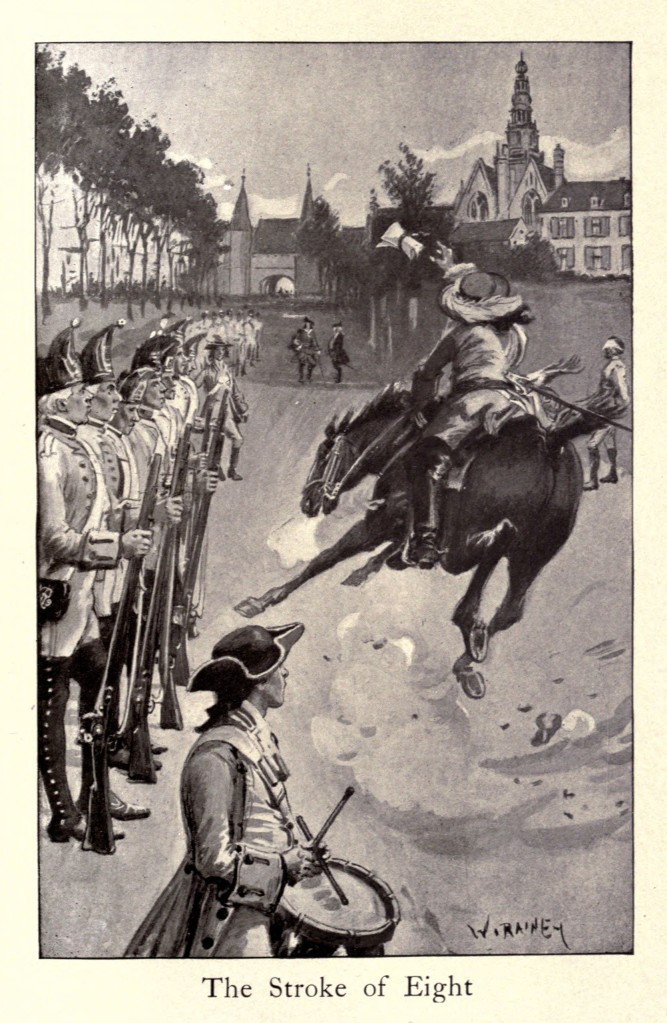
The Stroke of Eight
CHAPTER XV
The Water of Affliction
The New Cornet—A Visit to Lindendaal—Fanshawe is Presented—The Family Skeleton—Madame Protests—Mademoiselle Insists—Mynheer is Mysterious—A Silent House—The Law Allows It—Not in the Bond—In the Canal—Sherebiah Owns Up
By his famous ride from Thielen to Breda Harry became doubly a popular hero. Neither citizens nor soldiers, Dutch or English, felt any particular concern with Sherebiah; but Harry's feat, coming before the memory of his former exploit at Lindendaal had died out, raised him to a pitch of estimation that might well have made him vain, but which in truth he found only embarrassing. Fanshawe, on the other hand, whose ready device with the clock had, as Harry was the first to acknowledge, really been the means of saving Sherebiah, was regarded with cold unfriendliness and even dislike by the townsfolk. To tamper with the town clock they regarded as a monstrous and unpardonable offence, and there was some talk of laying a formal complaint before the Duke of Marlborough. The proposal was warmly debated in the borough council, and the burgomaster had to exercise all his tact to prevent the hotter heads from carrying the day.
As for Sherebiah, he was a different man. By his formal discharge from the army the cloud that had pressed upon him for nearly nine years was dissolved; and now that he had become by official licence, as it were, a man of peace in good earnest, he developed, not merely an unexpected lightness of spirits, but a surprising partiality for the company of soldiers. Every leisure moment he now spent in camp or barrack, retailing endless anecdotes of his former experiences as a man of war, and basing on these a right to criticise and instruct which younger men admitted with humility, to the immense disgust and chagrin of Robins.
A few days after the incident, Harry's regiment marched into quarters at Breda, and General van Santen himself paid a flying visit to the town in order to introduce the new cornet to his messmates. Harry was welcomed with open arms, less through the general's sponsorship than through the fame of his own exploits and the proof he had given of courage and daring. One little fact also, which leaked out in course of time, did much to consolidate Harry's reputation as a thoroughly good fellow. He made it his business to find out the relatives of the man who had been killed during the night ride from Lillo. The poor fellow had left a wife and six children, the eldest a boy of sixteen—a slow, earnest, dogged youth who was overcome with shyness when Harry, at the interview with his tearful mother, asked to see him. Harry liked the look of the boy, and offered to apprentice him to an armourer. The mother gladly accepted; and Mynheer Grootz further undertook, at Harry's persuasion, to provide employment for the widow and those of her children who were of age to work. This solicitude of Harry for the family of a man who after all had only been killed by the fortune of war, and had no claim upon him, made an impression on the officers of his regiment; and though it was never mentioned in his presence at mess, it doubtless accounted in large measure for his popularity with officers and men.
For some weeks Harry was fully occupied in learning his new duties, practising with sword and rapier, and improving his knowledge of Dutch: Sherebiah's command of the language was of course no longer a mystery. Schomberg's Horse, to which Fanshawe belonged, being likewise quartered outside Breda, Harry often had opportunities of conversation with his friend. Naturally Fanshawe was amazed to hear of the strange enmity of Mr. Berkeley, and shrewdly guessed that the soldier of fortune who had informed on Sherebiah was Captain Aglionby.
"And mark my words," he said, "'twas another move against you. Sherry seems to have been a sort of watchdog to you; him out of the way, so much the less difficulty in aiming at you. Though what cause the squire has to wish you ill it passes my wit to divine."
"And mine too. 'Tis a desperate revenge on me for being my father's son."
"Have a care, Harry. Having gone so far they will not easily be baulked, and in these cut-and-thrust times a blow in the dark, eh?—exit Harry Rochester."
"I'll be on my guard, never fear; and I still have Sherry."
Harry had not forgotten his friends at Lindendaal. He rode over one free afternoon some three weeks after joining his regiment, and found that the ladies had heard of his promotion, and of his ride, from Mynheer Grootz. Madame de Vaudrey was ecstatic in her congratulations, and only deplored that his new coat was not more brilliant.
"It suits you well, mon ami," she said, "but for myself I should like better the red than the blue."
"Indeed, Madame," replied Harry with a laugh, "I hadn't given it a thought. There's one advantage in a dull garb: it presents a less conspicuous mark to the enemy."
"A point, Monsieur, to which also you had not given a thought till this moment," said Adèle.
Harry laughed; then, changing the subject, he added: "Have you heard or seen anything more of Monsieur de Polignac and his friend?"
"Nothing, Monsieur Harry," said the comtesse. "And indeed we do not wish to. I only fear lest his silence augurs no good for us. As for his friend, that odious captain——prrrut!"
Madame's indignation was too great for articulate expression. The idea of Aglionby daring to pay his addresses to her was too monstrous. As was her wont in this mood, she prattled away about her late husband, Harry listening sympathetically and wondering at the half-smile on Adèle's face. When taking his leave, he said:
"An old friend of mine, an English officer, is in camp at Breda. May I bring him, Madame, to call on you one day?"
"I shall be charmed, mon cher ami."
"Fanshawe speaks little French, I fear, but——"
"Ah bah!" interrupted the lady, "that matters nothing at all. Adèle shall teach him."
"I shall be charmed, as Mamma says," said Adèle.
Harry smiled; nevertheless the suggestion set him thinking as he rode back, and he felt a shade of annoyance when Fanshawe, to whom he mentioned the circumstance, laughed heartily and quoted:
"'Amo, amas, I love a lass'. Is she pretty, Harry? By George! I like the notion."
The two rode out together in the following week; Fanshawe made a good impression on Madame de Vaudrey, and his stammering French and good-humoured laughter at his own mistakes appeared to form a bond of union between him and Adèle, for she was soon chatting and smiling with a friendliness and freedom quite different from her reserved attitude towards Harry. Fanshawe talked and laughed gaily all the way back; Harry on the contrary was decidedly glum; and when Sherebiah came to him at night as usual for orders his master's unaccustomed moodiness did not escape him.
"What med be the meanen o' this?" he muttered as he went away.
"'Yanker didee dudel down
Dida dudel launter——'
I must ride out-along to Lindendaal one o' these fine days, and putt a question to Katrinka—ay sure."
One afternoon in the second week of September Harry, having finished his duties for the day, paid a visit by himself to Madame de Vaudrey. He found the good lady in tears, and Adèle with very pale cheeks and a suspicious redness about her eyes.
"Oh, Monsieur Harry!" cried the comtesse as he was shown in, "how glad I am to see you! This is a moment when I need a friend. Look at this letter from that odious Monsieur de Polignac. My poor dear husband! I am glad—it is horrible to say it—but yes, I am glad he did not live to see this terrible day. Read it, cher ami."
Harry looked at the letter. It was a curt and formal note from Polignac intimating that, failing compliance with his suit, he was resolved to foreclose his mortgage on the estate one month from the date of the letter, as the terms of the deed provided. He still offered Mademoiselle his hand and heart; did she accept him as a husband he would immediately destroy the mortgage; he gave her a week to decide.
"The villain!" ejaculated Harry.
"He is within his right, Monsieur," said Adèle.
"Right! Legal right, yes; no doubt it is so; but who but a villain would put the matter in this way!"
"What I do not understand," said Madame de Vaudrey, "is his motive. If Adèle were a great heiress, I can understand that he should press his suit; but she is not; this poor little estate would not tempt an ambitious man; and as for herself, she has shown her aversion so plainly——"
"I hate him!" cried the girl, with a vehemence that surprised Harry, so unlike was it to her usual cold self-contained air.
"It is wrong to hate," said her mother; "but the dear girl has no liking for him, and how should a man desire for a wife one to whom he is so indifferent?"
"Tell me," said Harry, "is the mortgage for a large sum?"
"Alas! yes, for several thousand guilders; that is for the estate alone: the house is separately mortgaged, and the mortgagee in that case is content to receive his interest."
"Have you no relatives who would advance the money?"
"Not one. We are poor exiles, and have not, I believe, one relative in the wide world."
Harry was greatly distressed. It was clear that Adèle would never consent to marry Polignac, even if her mother wished it; and there was no escape from the dilemma save by raising the money.
"Are you quite sure you are so fully in the man's power?" he asked.
"I know it too well. There is no flaw in the documents; my dear husband's lawyer is a good man; we have no way of escape."
"Of course you have consulted him?"
"Yes; he can do nothing. It is law, he tells me; we have no other property the sale of which might pay off the mortgage; I have nothing but my jewels, the gifts of my dear comte, and they would not bring one-tenth of the sum we need. The income from the estate would enable us to pay off the mortgage in ten years if we were given time."
A ray of light struck suddenly upon Harry.
"Does Mynheer Grootz know?" he asked.
"Oh no! Mynheer Grootz is indeed a friend, but he could do nothing—nothing."
"I am not sure of that. I think he should be told. It is a matter of business; he is a shrewd man of business; he may be able to see a way out of the difficulty that we are ignorant of; with your leave I will put the case to him."
"No, Monsieur Harry, I forbid it. I prefer that Mynheer Grootz should not know. He has enough to do, I am sure, without being troubled with a poor woman's affairs. I do not say he has not a good heart; he has; he knows how fond I am of rare tulips, and has so kindly given me bulbs; but no, I could not seek other favours from him, I could not indeed. Besides, the lawyer has said, nothing can be done; Mynheer Grootz can do nothing against the law."
"True, Madame; and yet—it is a chance; it can surely do no harm——"
"You do not understand, Monsieur; it may do the very greatest harm."
Harry was mystified, especially as he fancied he detected the glimmer of a smile on Adèle's face.
"I do not understand——" he began.
"Mother cannot explain," said Adèle quietly. "I do not agree with her; I think she is quite mistaken; certainly Mynheer Grootz should be told."
"Adèle, you are a child; one cannot expect you to understand."
"Maman chérie, do you think so? You are a goose, petite Maman. Monsieur, believe me, it will be the very best thing in the world to consult Mynheer Grootz."
"Adèle!"
"It will, Mamma. It is a poor chance, I fear, but ought we to neglect even the least? and you do not wish me to marry Monsieur de Polignac?"
"Mon Dieu, non! A thousand times no! The odious man!"
"Then, Madame," said Harry, "I will venture to see Mynheer Grootz as soon as I can,—or perhaps write to him."
"Eh bien! it is against my will. I protest; I can do no more. You will tell him I protested?"
"Certainly, I shall not forget. I will let you know what he says; perhaps he will come himself. Madame, have a good heart; why, if all else fails, there is my man Sherry; you remember how he embraced the gentlemen?"
Adèle laughed, but the comtesse was too much distressed to see any humour in the situation. Harry was surprised at the flutter into which his simple suggestion had thrown her, and rode away feeling puzzled at the strange ways of women.
He was spared the necessity of writing to Mynheer Grootz, for on reaching his quarters he learnt that the merchant had called during the evening, and had left word that he might be seen next afternoon after his business with the commissary was concluded. He heard Harry's story quietly.
"Leave it to me, Harry," he said, his little eyes twinkling. "I will promise dis Monsieur de Polignac a little surprise. He is a noble; zo I guess by de name. Dey are all de same, dese nobles; and I promise Monsieur de Polignac zall be made to know dat dis is Holland, not France, and moreover dat one honest Dutchman is match for a score of rascal French. Dis man dink he have only a woman to deal wid; well, he zall be undeceive."
"Will you see Madame de Vaudrey, then, or write to her?"
"No, neider will I zee her, nor write to her. But you—you will tell her by no means to answer dis Monsieur de Polignac. He will foreclose in a month, you zay? Very well. He zall meet wid a surprise. Now tell me one ding. Madame la Comtesse—did she ask you to come to me?"
"Quite the contrary, Mynheer; she did not wish it, I did not understand why; the reasons she gave were somewhat lame."
Then for the first time in Harry's knowledge of the Dutch merchant he saw him excited.
"By den donder!" he exclaimed, slapping his thigh. Noting Harry's glance of astonishment he chuckled again, adding: "I tell you dis; you alzo zall zee someding." He wagged his forefinger knowingly.
"You have told me nothing," said Harry with a smile.
"No, dat is true. In good time. You do not yet know me, Jan Grootz."
Harry gave Madame de Vaudrey the Dutchman's message, and after that found only one opportunity of visiting her for nearly a month. On that occasion she showed him a final letter from Polignac, announcing that on a specified day he would attend at the house to receive payment of his mortgage, or, in default, possession of the property. The comtesse had heard nothing from Grootz, and was in great distress, refusing to be comforted when Harry assured her that all would be well. On his return to Breda he wrote to Grootz informing him of Polignac's letter, and next day received a reply asking him to arrange if possible to keep the day named free.
Early on the morning of that September day, Grootz with Harry, Sherebiah, and two men with large bags slung at their saddles, rode out from Breda to Lindendaal. When the door was opened by old Jean, and they had entered, Grootz bade him close it and slip one of the bolts half-way into its socket. After a short conversation with the servant he went into the reception-room, had the bags laid on the table, threw himself into the biggest chair, and calmly lit his pipe.
"Madame abhors tobacco, Mynheer," Harry ventured to say.
"Huh! Zo I now remember. It is a pity; I must put out my pipe, even though she be not here."
"She is gone from home, then? I fancied so by the manner of your entering."
"Ja! At dis moment she and de juffrouw are, as I suppose, fast asleep in Breda. Dey come dere last night."
"Oh! And we receive Monsieur de Polignac?"
"Dat is zo; we receive Monsieur de Polignac."
Deprived of the solace of his pipe, Grootz settled himself to sleep in his chair. An hour or more later he was wakened by Harry.
"Here they are, Mynheer!"
"Zo!"
He was up in a moment, and from the window saw Polignac, accompanied by Aglionby and two sturdy henchmen, walking up the drive towards the house.
"Zooks!" exclaimed Sherebiah, "here be Rafe Aglionby again. 'Twill be no cuddle this time if I lay hands on him. No thanks to he I be not a dead corpse to-day."
"Sherebiah, it is my turn," said Grootz solemnly.
"Zackly, Mynheer, all fair and no favour."
The four men came to the door, and the bell gave forth a resounding clang. All was silent within the house, and Jean at Grootz's orders paid no heed to the appeal. Again the bell sounded; again there was no response. Then Aglionby with an oath began to hammer on the door with his riding-whip. Even this noisy summons being disregarded, after a moment's consultation Polignac ordered one of his men to burst in the door. It yielded easily to his force, and the four trooped in—to find themselves confronted by Grootz, with Harry and Sherebiah behind him. At the same moment six of the men about the estate came quietly from behind the house and arranged themselves in two parties on both sides of the entrance, outside, and out of view from within. Jean had fulfilled his instructions.
Polignac halted in some embarrassment when he saw Grootz, and Aglionby looked far from comfortable at this unexpected meeting with the two men he had injured.
"Messieurs, I ask you," began Grootz in slow, halting French, "what is the meaning of this forcible entry?"
"Pardon, Monsieur," replied Polignac, recovering his sang-froid instantly. "I have not the pleasure. I came to see Madame la Comtesse de Vaudrey."
"Zo? And permit me to ask, what is your business with Madame la Comtesse de Vaudrey?"
"Before I reply, permit me to ask by what right you question me, and what you are doing here?"
"Decidedly, Monsieur. My name is Jan Grootz; I am here by the power of attorney I hold from Madame de Vaudrey. I beg you see it is in due form."
He exhibited a roll of parchment which Polignac glanced at; he was patently annoyed; his mouth twitched towards his left ear. Aglionby meanwhile had edged towards him, evidently with the intention of whispering something; but Sherebiah noted the movement and exclaimed:
"Keep a still tongue, Rafe Aglionby, 'ee were best, I tell 'ee."
"You are aware, then, Monsieur," said Polignac, "that I come according to due notice as required by law to demand payment of a bond, or possession of this estate, as provided in the deed?"
"Yes; I know it; what is the amount payable under the bond?"
"Fourteen thousand guilders, Monsieur."
Grootz pointed through the open doorway of the reception-room to the bags upon the table.
"There is the money, Monsieur. You will please to count it, and give me a quittance, and hand the bond to me to be destroyed."
With disappointment and rage written upon his face, Polignac proceeded to count the money with Aglionby's assistance. It was a longish process, and neither of the men felt quite at ease under the gaze of the onlookers. At last it was finished; Polignac wrote a receipt, and gave the cancelled bond to Grootz. Not a word was spoken while these formalities were complied with. Harry noticed that Sherebiah had placed himself between Aglionby and the door.
"Zo!" said Grootz. "Wait one minute, Monsieur." He unrolled the deed, ran his eye over it, then looked up and said with deliberate gravity: "Permit me to draw your attention to the fact that the property named in this document is the land belonging to the estate. It does not include the house and its appurtenances. Wherefore it appears, Monsieur, that you, with a band of ruffian hirelings, have violently broken into the private house of a lady who enjoys the protection of the Dutch flag. That is, permit me to observe, Monsieur, a breach of the law, and subjects you to a penalty—heavy, no doubt; I do not know the law. But for the present, since the law moves somewhat slowly, it would not surprise me if the servants of Madame la Comtesse, who are devoted to their mistress, should prefer to anticipate the sentence. They may be disposed to do what every honest and indignant Hollander would certainly do in the circumstances."
At a signal the half-dozen Dutch servants moved to the door and blocked the entrance.
"Men," said Grootz to them, "these gentlemen, who are not Hollanders, have broken into your mistress's house. I do not give you any advice; but for myself I do not think it would be a breach of the law if you should throw these gentlemen into the canal yonder.—Do not be alarmed, gentlemen; it is cold, I fear, and dirty, but as honest Hollanders Madame de Vaudrey's servants will not allow you to drown, for all their indignation."
Half-way through this speech Polignac and Aglionby had both made to draw their swords; but the six Hollanders seized upon them; in a trice they were overpowered. Their two men looked on, trembling. Polignac, white to the lips, held his peace; but Aglionby, after wriggling vainly in the hands of his captors, turned his head towards Sherebiah and cried:
"Zounds, Sherry, you will not stand by and see your own cousin so misused. 'Tis a vile plot. I have done nothing; what are the ladies to me? what is Polignac to me? Sherry, unhand these boors; I shall catch my death of cold; Sherry, I say, blood is thicker than water——"
"Ay sure, but it bean't so cold."
"Od rat you!" shouted the enraged captain as he was hauled with Polignac out of the house. He kept up his clamorous entreaties and oaths until the very moment when, with a sounding splash, he was heaved into the canal, and with spluttering breathlessness struck out with Polignac for the other side. A moment's observation sufficed to show the Hollanders that their victims could swim; they watched the scene with Dutch stolidity, Grootz placidly smoking his long-deferred pipe.
"Ay, 'tis the water of affliction, as the Book says," remarked Sherebiah sententiously as he watched the swimmers gain the farther bank, clamber up, and slink away, Aglionby obviously pouring out the vials of his wrath upon the miserable Frenchman. "'Tis the fust time for many a day cold water have gone down Rafe's throat, and mebbe he's changed his mind by now about blood bein' thicker 'n this water."
"I admire your strategy, Mynheer," said Harry to Grootz.
"Zo! We must send dis money to Polignac; his house is near at hand. Dere is one ding to zay: de house is mine, after all. I paid off de mortgage last week—let us zay, for a friend. Dat is all dat Madame need know: Grootz has paid de bonds—both bonds, house and land—for a friend: a matter of business; you understand."
"Very well, Mynheer; I will be diplomatic if she asks for more information."
But Harry was as much puzzled by Grootz's attitude as he had been by the lady's.
"So Captain Aglionby is your cousin?" he said to Sherebiah later in the day.
"Ay, to be sure: old feyther's sister's son. A fine loven feller for a coz, bean't he, sir?"
"He has got off too lightly, Sherry."
"Mebbe, but he'll come to his reckonen some day. You mind seein' me trounce un the day arter I shouted for the noble lord?"
"Yes, and you would not tell me the reason."
"Nay, I was 'shamed for my blood. Folks thowt 'twas Rafe as loosed John Simmons. 'Twarn't him; 'twas me."
"You!"
"Ay. I knowed as the highway business were a trick o' Rafe's, and I knowed as how Simmons would split on un. Fat'll be in fire then, thinks I. Rafe'll go to hangman, and poor old feyther o' mine'll die o' shame at such a kicken end for his own sister's child. I couldn't stand that, sir, so when Willum Nokes was a-snoren I took down keys from the nail and had Simmons out in a twink."
"But that doesn't explain why you fought the captain."
"Ay, but it do. Here was I, goen agen the law, diddlen Sir Godfrey and other high justices, cheaten hangman and all—and what for, I axe 'ee? 'Cos Minshull blood was cussed wi' mixen wi' Aglionby's. Aglionby blood had got to pay, someways, and so it did, to be sure, for I took a half-pint or so out of Rafe that mornen."
CHAPTER XVI
Knaves all Three
Labour Lost—Elegant Extracts—Hard Hit—A New Departure—Fishing—County Families—Sack
Captain Aglionby sanded the paper he had just written upon, and leant back in his chair with a sigh of satisfaction. He heard the sound of footsteps on the stairs.
"Here, Mynheer," said the voice of his landlord.
With an instinctive movement he covered the letter, and turned on his chair, in time to see the door open and a visitor enter. He stared for a moment in speechless amazement; then, attempting clumsily to shove the letter entirely out of sight beneath a plate containing the crumbs of a fish pâté, he got up and said:
"Why, Mr. Berkeley; adzooks! 'tis the last man I could have expected to see, the last man—though a pleasant surprise, an uncommonly pleasant surprise."
"Humph!" grunted the old man, with a glance round the mean room. "I feared you would resent my too abrupt entry. After what I had learnt in your letters about your magnificent, expensive, modish apartment, I could not suppose I was walking straight into your parlour—h'm! study; h'm! bedroom and—pantry, h'm!"
"No apologies, my friend, I beg. You take me at a disadvantage, having but just consumed my modest repast——"
"Fish! My nose informs me. 'Tis the fortieth smell that has offended my senses within a quarter of an hour. 'Twas somewhat difficult to discover your—mansion. You are not, it appears, so well known at the Hague as you give out; and when I named you at my inn, with your address, I was advised to bring an escort. I came alone——"
"Ah! Nicolas Berkeley knows how to take care of himself—eh, Squire?"
"But had I known to what an ordeal, to what a series of ordeals, my nostrils would be exposed, I doubt I could not have plucked up the courage."
"'Twas ill done to come upon me so suddenly. The smells—hang me, Squire, I have smelt worse when I was the guest of the Czar of Muscovy. But had you given me a week's, a day's notice, I would have made ready an entertainment worthy of you, my old friend."
"No doubt, no doubt——"
"And indeed I was on the point of writing you when you entered."
"Ay, on the point of; you write to me twice a day, do you? for unless I mistake, you have already writ once to-day. Under the plate, Captain Aglionby—surely I see writ on the paper there some semblance of my name."
"'Tis so; what eyes you have for your age, Squire! I was just trying a new pen, and so full were my thoughts of my generous friend and patron that the pen ran of its own accord, mark you, into the familiar curves. And as I know how you abhor a letter, I will e'en tear up the paper and——"
"Stay!" cried the old man, taking a sudden step forward; "knowing the pains you take in writing, 'tis pity they should be wasted. I set out designing to conduct my son to the army: I find I am embarked on a voyage of discovery; give me the paper."
The command was uttered in a tone that broke down Aglionby's bravado. He drew the letter from below the plate, and handed it in sullen silence to the squire. The old man pressed his lips grimly together as he unfolded the yet unsealed paper. Aglionby stuck out his legs wide apart, thrust his hands into his breeches pockets, and hung his head in moody dudgeon.
"'Tis excellent pen-work; your hand grows fluent. 'I thank you for the hundred guineas received'"—Mr. Berkeley read aloud with deliberation and a dry emphasis that made Aglionby wince—"'and trust the two hundred for which I beseeched you in my last will not tarry.' To pay your landlord, I take it, for this—magnificent apartment."
"A man must live," said the captain sullenly.
"Ay, eat and drink, and sponge upon his betters for his cakes and ale."
"Oons! Squire, 'tis rum."
"A foul-smelling liquor.—What is this?—'do violence to natural affection in the service of a munificent patron—inform on a cousin—Sherebiah Minshull condemned to be shot—my lord Marlborough—young Mr. Rochester—rid up in the nick of time.'"—Mr. Berkeley's brow darkened as he read.—"Let me come to the end of it. 'A visit to the Comtesse de Vaudrey in the interest of my patron—violent assault—in the mellay stumbled into a canal—costume totally ruined and cannot be replaced under ten guineas'—I observe 'tis shrunk at the sleeve; I thought maybe you had grown, to match your magnificent apartment! Now, sirrah, how much of this precious epistle do you expect me to believe? A fine story, in truth, of the ills you suffer in your constant zeal for your 'munificent patron': is it all of a piece with your 'magnificent apartment'? What have you done with, and for, my hundred guineas?—what, sirrah, your answer!"
Aglionby felt that he was being wronged; he had, in fact, done all in his power; it was not his fault that failure had dogged him. Undoubtedly appearances were against him, and the biting emphasis of the old man's delivery, the cold sneer that lurked in every repetition of his pet phrases, robbed him of speech. He writhed under the lash. Standing over him, the squire gave rein to his temper.
"You take me for a fool, do you, with your cock-and-bull stories!—you flam me off, rat me! with your 'magnificent apartment', your 'munificent patron', your 'constant zeal', which I—I, you swashbuckling villain—am to pay for! Where are the two hundred guineas paid to the captain of the Merry Maid?—the fifty guineas to your footpad friends in Wapping?—the hundred sent you but a few weeks past? How has your zeal furthered my interest? Zeal, forsooth! there's a many of your cut-throat gossips would sink you as a disgrace to the craft, for at least they hold to their bargains and are not swindlers as well as——"
"Fire and fury!" shouted Aglionby, springing to his feet and drawing his sword. "'Tis not to be borne! Clap a bridle on your canting tongue or I'll run your bloodless carcass through!—as I've done with many a better man. D'ye hear, you old Pharisee! Your white hairs under your wig sha'n't preserve you if Rafe Aglionby is roused. And where would you be, rot you—Squire Berkeley of Winton Hall—you and your guineas—if I told what I know?"
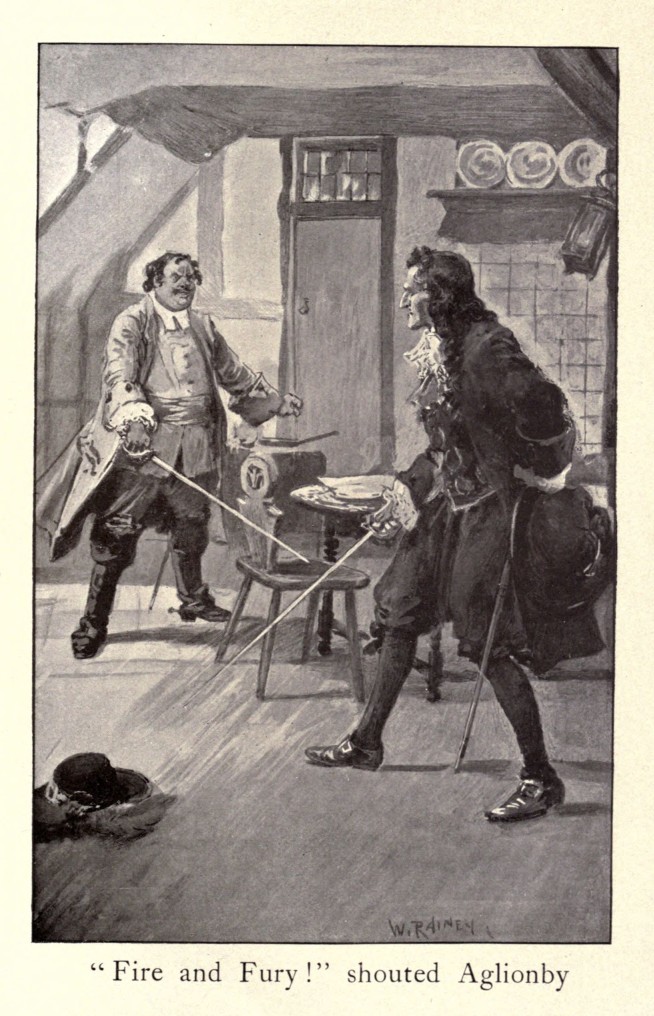
"Fire and Fury!" shouted Aglionby
Mr. Berkeley had drawn at the same moment, and the two stood glaring at each other over the chair. The old man, his face livid with passion, was in nowise daunted by the other's threats; Aglionby's cheeks were purple, and the veins on his brow stood up like whipcord. For some moments both stood tense, each leaning towards the other; then the squire dropped his sword back into the sheath, gulped, and said:
"Well, well, maybe I was hasty. But you have a great deal to explain, Aglionby—a very great deal to explain."
"As I could have done, had you but given me time instead of treating me as you would a common pickpocket. By George! Mr. Berkeley, Rafe Aglionby is not the man to stand that mode of dealing, as you well know, for all the luck has been against me these late years. Who could have supposed that young Rochester, sink him! would escape from the Merry Maid? Was that my fault, pray? By what I can make out he jumped overboard off Gravesend and got aboard a Dutch brig, and the rascally Hollander—one Grootz, a smug corn-dealer—refused to give him up. Could I help that? Then, when I had my snivelling cousin Sherebiah fast in the net, could I prevent my lord Marlborough from signing his discharge and undoing all my work? Could I? I've had the worst of luck all through; and foul words won't mend matters. And, beshrew me, you were not over successful yourself with the cockerel's father, for all your guineas. The youngster's a chip of the old block, and a precious hard chip too, rot him! But I've vowed to carry the thing through; besides your affair, I've now one or two private accounts to square with him; and if you have patience and a trifle more courtesy—by George! you'll have no cause to complain of Rafe Aglionby."
The words came from him in a torrent. He felt that he had a real grievance, and, as often with rogues, the possession of a grievance lent him words if not eloquence. But the squire still looking doubtful, Aglionby picked up a stained copy of the Amsterdam Courier that lay on a chair, and pointed to a paragraph giving in French an account, somewhat distorted but substantially accurate, of Harry's exploit on behalf of Sherebiah. As the old man read it he pressed his thin lips together in vindictive rage.
"There for you!" pursued the captain. "'Tis the talk of the town. The youngster is making friends on all sides; he owns a commission in the Dutch army——"
"What!"
"'Tis true; a booby general got him the commission, and the lubber Grootz pays. 'Tis becoming more and more difficult to get at him; but I have a scheme—a pretty scheme, egad!—that can scarcely fail this time. All I need is a small sum to go on with—rat me, Squire, will you still sneer? On my soul, I——"
"Tut, Captain, your skin is surely thinner than it was."
"And yours would be thin had ye not your guineas to line it with. Hang me, Berkeley, a word from me——"
"Come, come," said the squire quickly, "'tis not for old friends to fall out. You were talking of your scheme."
"I was saying that all I need is a small sum in advance—the rest may wait till the thing is done."
"And what is your scheme? You do not expect me—no offence, Aglionby—to buy a pig in a poke this time."
"'Twere better, maybe——" Aglionby was beginning, but just then a footstep was heard on the stairs. He evidently recognized it. Hesitating for a second he lowered his voice and continued hurriedly: "'Tis one of the men engaged in the job. I will call on you later at your inn. 'Twould be amiss were he to know you had any concern in it."
Berkeley looked suspiciously at the captain, but, unable to fathom his embarrassment, he picked up his hat and slowly moved towards the door. It opened in his face, and Polignac appeared. He stepped back courteously to allow the older man to pass. They bowed to each other, with a mutual glance of keen scrutiny. The squire bade Aglionby good-day, refusing his attendance; and as he passed down the stairs Polignac entered the room.
"Who is your visitor, captain?" he asked. "An English milord, by his appearance."
"Yes; a friend from England—an old friend of my family: a neighbour: in fact, our estates join—or all but, for 'tis but a narrow trout-stream divides 'em."
Aglionby's manner was still a little flurried. His mind was not very quick, and took time to adjust itself. Polignac threw his hat upon the table, sat astride of a chair, and went on with admirable gravity:
"And the fishing—it is often, without doubt, what we Frenchmen call an apple of discord. I have known so many disputes."
"The fishing! oh!—yes!—well, that arranges itself. It is quite simple: we take one day, he takes the next."
"Tour à tour. Admirable! You English are the people for transactions! I must make the acquaintance of your so accommodating friend and neighbour. Is he—how shall I say it?—one of us?"
"No. He takes no part in affairs. He cultivates his estate. His call now is merely in way of friendship."
"Ah! that is indeed amiable. Parbleu, he has the look! And what is he doing in this country?"
Aglionby was growing restive under the cross-examination. He had the air of a witness who fears that he may be enticed into an admission against his will. But he had not the wit to fence with his visitor.
"Nothing," he replied curtly. "He comes with his son, that is in the army, and now joins his regiment."
"He has a son in the army? My dear friend, certainly you shall present me. I desire of all things to extend my acquaintance among your countrymen—in furtherance, it is understood, of my cause—of our cause, pardon me."
"I fear you will find little encouragement with him. He hates your countrymen as one hates a toad."
"The amiable man!"
Aglionby's constrained manner had betrayed him to his astute visitor, whose curiosity was now effectually aroused.
"Then, my good captain," he continued, "it shall be my pleasing task to convert him. Indeed, you must present me. He shall be a recruit—a little aged, perhaps, but what matters that? In truth, it is an advantage, if his estates are as large as you say."
"I did not say his estates were large."
"But they march with your family's—is it not so? And unless I deceive myself, the D'Aglionbys are—how do you say it?—milords of the manor of half the comté of Viltshire. You remark, my dear captain, what a memory I have, even for your barbarous English geography."
The captain, more and more restive, fidgeted on his chair.