THE ADVENTURES OF HARRY ROCHESTER (continued 4)
Reading edition
Harry forbore to smile at Madame de Vaudrey's placid impersonation of a fury.
"They are a couple of villains indeed," he said. "It was truly fortunate that I came with Sherebiah at the right moment."
"Yes, indeed; a thousand thanks! And only think of it: just before you came Captain Aglionby, odious man, had dared to hint that when we were thrust out of our home he would do me the honour to marry me. Truly an honour! No, I never forget my dear husband; no, never! Ah, this is the dear brave man, your servant?"
The door had opened, and Sherebiah came in awkwardly, turning his hat between his hands. Madame de Vaudrey rose and, smiling upon him, said:
"I give you a thousand thanks. You are a hero; how strong! how bold!"
Sherebiah bobbed.
"Madame de Vaudrey thanks you," said Harry.
"'Tis handsome of the lady, sir, and I'm obleeged, and axes you to put my sarvices into French lingo, sir."
He bobbed again.
"What about Captain Aglionby?" asked Harry.
"Well, sir, I reckon he be madder than a March hare. Nigh to bust hisself, and hot as pepper. Would ha' slashed me, man o' peace as I be, if 'tweren't for half a dozen Dutch coofs wi' pitchforks and other articles o' warfare drawn up below, wi' the young lady at their head. Ay, she be a warrior bold, sure enough: I never seed such a piece of female manliness all my life long. 'Twas with a flashen eye and a pink rose on each pretty cheek her stood and ordered 'em out. Ay, an uncommon upstanden piece o' womankind her be, to be sure."
Harry was glad that Madame de Vaudrey's ignorance of English could not fathom this plain-spoken tribute to her daughter's charms.
"They are really gone, then?" he said.
"Why, yes, both on 'em; the long beetle chap as well. He be a next-door neighbour, it seems, and a mighty unpleasant neighbour he must be.—Thank 'ee kindly, mum," he added, as Madame de Vaudrey offered him a glass of wine, "but if 'ee don't mind, I'd rather wet my whistle with a mug of beer in the kitchen."
The lady smiled when this was interpreted.
"You English are like the Hollanders in that," she said. "Certainly. Jean, take the brave man to the kitchen and treat him well."
Sherebiah pulled his forelock and departed with alacrity.
"We must shortly be going on our way, Madame," said Harry. "I have a convoy of provisions for the garrison at Breda, and my wagoners are even now growing impatient, I doubt not."
"But, Monsieur, I cannot hear of it. You cannot reach Breda to-night; and suppose those odious men return? You must be tired. Do me the favour to stay here for the night; and we can find a bed for your man also."
"But the wagons?"
"Let them go on to the village; it is but half a league away. They can remain at the inn there. Monsieur, I insist; and besides, I have to write a letter of thanks to my friend Mynheer Grootz."
Harry had no reason for refusing an invitation so cordial. Madame de Vaudrey beamed when he accepted, and, begging to be excused, went off to make arrangements with her servants. Left to himself, Harry looked round the room. It was richly furnished; the tables, cabinets, and chairs were of French make, in highly polished rose-wood; chairs and sofas were covered with crimson velvet, and two cabinets were filled with beautiful porcelain and Dutch china. The pictures upon the walls were all French, except one—a portrait, evidently by a Dutch hand and of a comparatively recent date. It represented a man's head, with dark complexion and wistful melancholy eyes. Harry was attracted to it by a slight resemblance to his father; not in the features, which were quite unlike, but in the curious sadness of the expression. His thoughts were carried back to his old home at Winton St. Mary, and the quiet life with his father there; a mist came before his eyes, and he fell into a reverie, standing thus before the picture.
So rapt was he in recollection that he did not hear the door open behind him, nor turn to see the entrance of Adèle de Vaudrey. For a moment the girl stood in the doorway, holding the handle. An onlooker would have seen a strange shifting of expression upon her face as she paused in hesitation whether to advance or retire, to speak or to remain silent. It was but for a moment; her lips softened, her long lashes drooped down upon her eyes; and closing the door as noiselessly as she had opened it she slipped away.
CHAPTER X
Bluff
A Stroll—A Fair Cook—Love and Duty—An Arrival—General van Santen—Raiders—A Dozen all Told—Rallying the Peasants—Desperate Counsels—The Masqueraders—Strategy—A Ruse de Guerre—Stage Effects—Final Touches—In Sight—At the Door—Ransom—A Turn of the Screw—Phantom Forces—Dilemma—Discretion—Courtesies
"Ah, my dear Monsieur Rochestair, pardon me for leaving you so long. I have been to prepare your room."
"Thank you indeed, Madame!"
"You were looking at the portrait? It is my dear husband. Is it not a fine head? Can you imagine, after seeing it, that I could put that odious captain in his place? Not that I should think every man bad unless he resembled my husband. No, that would be unjust. But come and see my garden, Monsieur Rochestair. It is beautiful outside now that the sun is going down."
"I shall be delighted. I have noticed how the scent of the flowers comes to us here through the windows."
"Yes, I love flowers. Mynheer Grootz knows that."
Madame conducted Harry through the grounds. They were laid out with more freedom than was usual in Holland, and reminded him at many a turn of well-tended parks at home. The house was surrounded by its garden; beyond this was an expanse of lawn and thin park bounded by a wall. Beyond this again, Madame de Vaudrey explained, lay the orchard belonging to the far larger estate now owned by Monsieur de Polignac. At a considerable distance from the house on the eastern side Harry remarked a large open stretch of ground, roughly circular in shape, covered with grass that grew wild and was left uncropt, Across the middle of it ran a ditch, now apparently dry, passing under the garden wall and the road, and evidently connected with the canal. Near to the spot where the ditch disappeared beneath the wall stood a large dilapidated building, like the storehouse usually attached to a Dutch mill.
"You wonder at our neglect of this part of the grounds," said the lady with a smile. "But that is our skating pond. In winter we open the sluices at the canal end of the ditch; it fills, the water overflows, and thus we flood the field. Then comes the frost, and we have, I think, the finest skating pond in Holland, and quite safe. We used to hold tournaments, people came from miles around; but alas! since this terrible war has recommenced we have almost forgotten those pleasant sports of winter. I do hope it will soon come to an end. I never could understand what men are fighting about. My dear husband used to speak of the balance of power; the French king wishes to rule everybody, he told me; certainly King Louis is a bad man; he has behaved disgracefully to us poor Huguenots; and I dare say you English are quite right in helping the Dutch to punish him. But war is so terrible. My dear husband was trying to invent something that would enable one army to make another army senseless without killing them; I know nothing about it, but the idea was excellent; and if the truth were known I dare say it was that odious Captain Aglionby who spoilt that too."
Thus the good lady kept chattering to Harry as she conducted him over her little estate. The evening was drawing rapidly in; a light mist was rising, and Madame shivered a little as she turned back towards the house. A moment afterwards her daughter met her.
"Mother," she said, "you should not be out in the damp air. You know it is bad for you."
"Yes, my dear," replied Madame de Vaudrey, submitting to be enwrapped in a large woollen shawl which her daughter's fair hands wound about her head and shoulders. "I have been showing Monsieur Rochestair our little property—alas! soon to be ours no more. I told Monsieur why, Adèle."
The girl's cheeks flushed, but she said nothing.
"I did not tell you, Madame," said Harry, "that I happen to know something of Captain Aglionby."
"Indeed! nothing but what is perfectly odious, I am sure."
"I have reason to believe that he was concerned in an attempt to ship me to our plantations in Barbados. My man tells me——"
"Monsieur," interrupted the girl, "my mother is subject to chills. You are staying with us to-night; will you hasten to the house with my mother and tell us the story at supper?"
"With pleasure, Mademoiselle."
Harry felt a little in awe of this very decisive young lady, with her scornful lip and clear uncompromising tones. She hurried in advance to the house, and was waiting in the panelled dining-room when the others appeared. The table looked very inviting with its spotless napery, shining plate, and vases of flowers, and Harry found the meal much to his taste after the plain fare of Dutch hostelries. Besides such staple viands as Westphalian ham and bag-puddings—one variety of these, filled with raisins and spices, was excellent—there were dainty French dishes—confections of fruit and cream which surprised even Madame la Comtesse.
"Ah, you rogue!" she exclaimed; "I see now where you hid yourself this afternoon."
"Mademoiselle likes cooking?" Harry ventured to say.
"By no means, Monsieur, I dislike it exceedingly."
"Oh!"
"I knew we had nothing ready, Mamma," added the girl, "and you would not have liked Monsieur to think little of your hospitality."
During the meal Harry gave the ladies an account of himself, speaking of his early hopes and ambitions, his disappointments, the vain waiting for a message from Marlborough, the strange animus of the squire, the kidnapping, the interposition of Mynheer Grootz. His hearers were deeply interested; even Mademoiselle, though she said little, and seemed to curl her pretty lip when her mother's curiosity or indignation showed itself in little vivacious exclamations,—Mademoiselle kept her eyes fixed on Harry as he spoke, though whenever he happened to glance towards her she was looking away and appeared unconcerned.
"Ah, there now!" cried the comtesse, when Harry mentioned, without a trace of bitterness, Marlborough's failure to keep his promise; "that is my lord duke's character. He is mean, he is selfish, he loves no one but himself."
"And the duchess," put in Harry.
"But that is his duty. It is his duty to love his wife. I did not say he was a monster."
"Did you love papa from duty?" asked Adèle simply.
"I never said that, Adèle. Of course it is a woman's duty to love her husband, but your dear father was so good, so kind, so fond of me that no one could help loving him."
"Mynheer Grootz is good and kind, but you don't love him."
Madame de Vaudrey flushed.
"You say such odd things, Adèle. I can't think how it is. I never said such things when I was a girl. Mynheer Grootz is good, and kind; you are right; and if it were my duty——"
"Oh, Mamma," cried Adèle, "do forget the word duty! I am sure none of us either loves or hates from duty.—Would Monsieur like some strawberries and cream?"
Harry went to bed that night very well pleased with himself, his hostess, and her daughter. He liked the little, simple, talkative countess; he was piqued by Adèle's reserve, coolness, indifference—he hardly knew what to call it; the something which seemed to indicate that Harry Rochester was a creature far too insignificant for the notice of Mademoiselle Adèle de Vaudrey. "And she is clever, too," he thought. "Faith, how she sent Aglionby to the right-about! Polignac is a scoundrel; what will they do if he turns them out? And how did he come across Aglionby? She will not marry him, at any rate; that's one comfort."
It is very unromantic, but the truth must be told. Thoughts of Adèle did not keep Harry one instant from sleep. His bed was a dark mysterious-looking box, with brown damask curtains drawn closely round it. Withdrawing the curtains, he saw a magnificent quilt of crimson satin, snowy sheets, a lace-trimmed pillow. He scrambled up, barking his legs against the high boards composing the sides, and the moment he laid his head on the pillow forgot Aglionby, Marlborough, Adèle, and duty.
When Madame de Vaudrey bade good-night to her daughter she said:
"Eh bien, fillette; je l'aime, le bel Anglais. Il est brave, intelligent, modeste, parfaitement aimable, n'est-ce pas?"
"Oh, petite maman, que voulez-vous? Est-ce que je dois l'aimer, moi aussi?"
And kissing her mother on both cheeks Adèle ran off laughing.
Harry was awakened in the morning by the loud singing of the birds. He had left his window wide open, and the scent of flowers and perfume from the fir wood at the extremity of the estate gave him fragrant greeting. He sprang out of bed, and stood at the window inhaling the luscious odours, listening to the song of the birds and the incessant hoarse croak of the frogs, gazing at the grass glistening with dew. "I should like a week's holiday here," he thought. "Ay me! it is breakfast, and then for Breda!"
But he had only just left his room when he heard below a violent clanging of the bell, followed by a strange voice speaking in the hall, and a hasty running to and fro. Hurrying downstairs, he met Adèle de Vaudrey at the foot of the staircase.
"Come with me, Monsieur," she said the moment she saw him. "Mamma is not down yet."
She preceded him through the hall door, at which he now saw a light calash drawn up, and behind it ten horses, nine of them sat by Dutch dragoons, the tenth being the steed of the soldier who stood at the door, and whose voice it was that Harry had heard. From the horses, clouds of vapour rose into the fresh morning air; the pace had evidently been forced. In the calash were two men: the elder, in the uniform of a Dutch officer of high rank, reclined on the cushions, half-supported by a young aide-de-camp seated at his side. He was deathly pale; his eyes were closed.
As Mademoiselle de Vaudrey, followed by Harry, came to the door of the carriage, the aide-de-camp without changing his position addressed her in Dutch.
"It is as you see, mejjuffrouw. It is General van Santen; he is desperately wounded. We hoped to reach Breda, but the general swooned a few minutes ago and I dare not drive farther."
"Bring him in at once," said Adèle. "The soldiers can lift him. Never mind about explanations now. One of the soldiers must ride on to the village for the meester; it is only half a league. Monsieur," she added, addressing Harry in her quick, decisive tones, "assist; I will warn Mamma."
She ran back into the house. The inanimate general was carefully carried into the hall. He was a fine soldierly man, with a strong rugged face of English rather than Dutch cast. Harry remembered that Mynheer Grootz had mentioned General van Santen as a friend of his, and one of the ablest and most trusted of the lieutenants of William of Orange. Madame de Vaudrey had by this time come from above, and stood in pale expectation. The general was laid upon a sofa in the reception-room, and Adèle had already provided a basin of water and a bottle of smelling-salts with which she endeavoured to revive the wounded officer.
"What is it?" cried Madame de Vaudrey, who had left these ministrations to the hands of her capable daughter.
The aide-de-camp explained that General van Santen had left the Duke of Marlborough's camp late at night on his way to the Hague. In the faint dawn he had suddenly come upon a French raiding-party which had apparently made a dash from Lierre. It was known that Tserclaes had advanced from the main French army in order to protect Antwerp. The general had dashed through with his men, but not rapidly enough to escape a bullet which had lodged in his groin. With great difficulty he had kept the saddle as far as the next village; but there, exhausted by the effort and by loss of blood, he had been placed in a hastily prepared carriage and driven on in the hope of arriving at Breda in time to warn the garrison. His wound had proved even more serious than was supposed; he had lost consciousness, and his aide-de-camp had deemed it necessary to halt at the first house and ask for assistance.
"In what direction are the raiders coming?" asked Harry.
"In this direction, Mynheer," replied the aide-de-camp.
"And how far away were they when this happened?"
"About ten miles."
"So they may be here within an hour?"
"If they ride on at once, but they will probably stop to plunder."
"Can they be checked?"
"Alas, Mynheer! there is no force near at hand."
"Surely they will raise the country?"
"But they are mounted, and the country people cannot cope with them. Even if the news is carried to Helmund there are none but burghers there, and they are useless against cavalry, except behind their own walls."
"And how many do the raiders number?"
"More than a hundred, as I judge, Mynheer."
Madame de Vaudrey stood in agitated silence while this rapid colloquy was in progress. Adèle was still bathing the wounded man's temples; no one present had sufficient knowledge to attempt more than the roughest of means to bind the wound. In a few minutes the general opened his eyes.
"Where am I?" he asked, feebly.
"In the house of Madame de Vaudrey," said that lady.
"How far from where I was shot?"
"Only a few miles," replied the aide-de-camp.
"Then someone must ride to Breda for help, and take my despatches. They must be at the Hague to-night."
"I will write a note to the commandant," said the aide-de-camp, "and send one of the troopers."
"No, no, lieutenant, you must ride yourself. I can't trust the despatches to a trooper."
"But I do not care to leave you, general."
"It is my wish. The enemy can only capture me, but they may do unheard-of mischief around. Delay no longer: ride fast."
The exertion of talking was too much for him, and he swooned again. Loth as he was to go, the aide-de-camp could not ignore the general's express instructions. Before leaving he took Harry aside and asked him to consider himself in command of the troopers.
"You're not strong enough to beat off the enemy," he said, "but it will be well for the men to have someone to look to in emergency. Don't let the general fall into the enemy's hands if you can help it."
Harry hesitated. His first duty was undoubtedly to secure the safety of the convoy, for the sake both of the Breda garrison and Mynheer Grootz. On the other hand, he scouted the idea of deserting the ladies in their predicament. Further, the raiding-party were upon the road behind him; they had clearly swept round Eyndhoven, avoiding Helmund, and in all probability were on the heels of the general. Even if he got his convoy safely away from the village it could only move at a walking pace. In an hour or two it must be overtaken, and he would thus do no good either for himself or the ladies by instant flight. He therefore made up his mind to remain at Lindendaal, and assured the aide-de-camp that he would do his best. But when the lieutenant had ridden off, and Harry reflected on the position of the ladies, he thought it worth while to suggest that they should start at once for Breda in order to be out of harm's way. Adèle answered at once for her mother.
"Impossible, Monsieur! We cannot leave the general; we will not leave the house. Consult your own duty."
Her tone was not to be gainsaid. Harry went into the hall, wondering what he could do for the best. He met Sherebiah at the door.
"Eh, sir, 'tis a pretty pickle o' fish."
"What are we to do, Sherry?"
"As a man o' peace, I say cut and run."
"Can't we defend the house?"
"Wi' ten Dutch dragoons and a gardener and a maid or two? And two hundred French, so 'tis said!"
"But men will come in from the villages round."
"Ay, on foot, and with pitchforks and flails. Not much good against swords and carbines."
At that moment a man galloped up from a village some eight miles down the road, with news that the French were already sacking and burning. They had first demanded a ransom, and the sum required not being forthcoming within the short time allowed, they had begun their ruthless work. A few moments afterwards one of Harry's teamsters rode up on a cart-horse. He had heard the news from the aide-de-camp as he passed through the village where the convoy had put up for the night, and come back to ask for orders. Harry caught at the chance of delay. The French, it appeared, first demanded a ransom; could they be put off and time be gained for relief to arrive? The question suggested a plan that might be tried in default of a better.
"Ride back, Piet," said Harry, "and bring up the wagons as fast as you can, and as many of the villagers as you can muster—with arms, if they have them."
His idea was to barricade the road; every minute's delay was a minute gained, and as the news spread he believed that the Hollanders had courage and spirit enough to strike a blow in defence of their homes. In point of fact, Piet had hardly departed to fulfil his errand when Dutchmen came up in ones and twos and threes, some on great lumbering farm-horses, others on foot, all hastening towards Breda in the hope of escaping the devouring French behind them. A few had firelocks, some had bills, others staggered along under the burden of household valuables they hoped to save from ruin. Harry set Sherebiah to intercept them all as they came up and to bring them within the grounds, and as their number swelled he reverted to his original idea of defending the house.
It was a counsel of desperation. The house had several entrances, each one of which must be manned; it was too large to be held by so small a garrison. The outhouses would afford cover to an attacking force. Including the ten dragoons, there were only at present fourteen well-armed men among the ever-growing crowd; he could not improvise arms, and little effective work was to be expected from an untrained rabble, however courageous, pitted against regular troops. Further, to defend the house from within would inevitably lead to its being fired and blown up, and Madame de Vaudrey would profit not a jot. If the house was to be saved it must be by preventing the enemy from reaching it. What chance was there of effectually barring the road against the raiders? He went out to investigate.
As he reached the park gate he was met by two men who had just come on foot from the village. One was a yeoman, the other a soldier belonging to some infantry regiment—a man probably on furlough. Harry was struck by the similarity of their costumes. Their hats were almost alike; their doublets and knee-breeches of similar dark materials; but for the red collar and the bands around the sleeves, there was very little at a distance to distinguish the soldier from the civilian. A sudden notion flashed through Harry's mind. It was a chance in a thousand; the risks were great; the odds were all against success; but on the other side there was the imminent danger of destruction to the house, ruin to the owners, the capture of the Dutch general, and the subsequent burning of the village.
"We'll try it," he said to himself. "Sherry, send every man up to the house, and let me know the instant our wagons appear."
"Ay, I will, sir.—'Tis a pretty ticklish time o' day for a man o' peace," he muttered under his breath.
Harry ran back to the house. The doctor from the village overtook him on horseback, and they entered together. Mademoiselle de Vaudrey showed some surprise when she saw Harry, but she made no comment.
"Mademoiselle," said Harry, "the general is in good hands now. May I ask your assistance?"
She gave him a keen glance, rose at once from her knees, and followed him from the room.
"Mademoiselle," continued Harry eagerly, "have you any red ribbon, silk, stuff, anything, in the house?"
"Perhaps. Why do you ask?"
"Will you find all that you can, and with your maids sew red bands round the collars and cuffs of the men?"
"To make them look like soldiers—is that what you mean?"
"Yes," replied Harry, delighted that she seized his meaning so quickly.
"I will do so at once. Send the men to the hall."
Harry next called up old Jean, and bade him fetch the gardener. When the man appeared, Harry asked him to gather as many sticks as he could, by preference wood with the bark on, about five feet in length, and stack them at the back door. A few minutes afterwards a message reached him from Sherebiah that the wagons had arrived. He ran upstairs and, regardless of ceremony, called out: "Mademoiselle de Vaudrey!"
Adèle came out of a room, holding a strip of red ribbon.
"Mademoiselle," said Harry, "I must go to the gate. Will you make every unarmed man look as much like a soldier as possible, and see that each is provided with one of the sticks that the gardener is now collecting?"
"Yes. Is there anything else?"
"Is it possible to run up a flag on the belfry-tower?"
"If you say it is to be done, it shall be done."
"I do not want the flag hoisted at present; but if you will prepare to do so——'
"Very well," interrupted the girl.
Harry thanked her with a look, and ran downstairs three steps at a time. He called to one of the dragoons to accompany him, and hastened again to the gate, meeting on the way several men whom, in obedience to his instructions, Sherebiah had sent up from the road.
"Sherry," he said, "ask this fellow if a cavalry troop on the march is preceded by an advance guard. He won't understand my Dutch."
"I can tell 'ee that," said Sherebiah instantly. "They do so. A patrol goos ahead, mebbe a quarter of a mile."
"Oh! Now, mark my plan. Mademoiselle de Vaudrey is making some of the Dutchmen look like soldiers; we've no muskets for them, but at a distance I hope sticks may serve as well. I am going to post these make-believe soldiers around the wall of the estate among the trees; it will look as if the orchard and woods are manned. They will remain concealed until a flag appears on the tower; then their sudden appearance will, I trust, make an impression."
"Ay, sir, 'tis famous. But if the patrol gets much past the house, 'twill be labour lost, for they will be near enough to see 'tis all my eye."
"Yes, that must be avoided. What can be done?"
"I tell 'ee, sir. Leave three o' the wagons on the road, half a mile or so towards the village, where the road bends; I reckon Piet and Hans and me can keep any French patrol a-diddle-daddlen until the flag runs up. Then—do 'ee see, sir?—dragoons slip out of copse and trounce the Frenchmen, Piet and me and Hans draws the wagons across the road: and there be a barricade."
"A capital notion! I will leave that to you, then.—Ah! here is a man from the other direction. He may have news of the enemy."
A countryman, with his wife and family, had just driven up in a cart. From him Harry learnt that the French were sacking isolated farms on the road, and might be expected within the hour. Harry at once went back to the house, ran up the stairs, and again called for mademoiselle.
"May I go up to the roof and see if I can descry the enemy?" he asked.
"I will take you."
She led the way to the turret stair, and in a few moments Harry stood upon the roof, whence on fine days a clear prospect for many miles could have been obtained. The morning was somewhat overcast, and the haze limited his view. But in one quarter he seemed to see a blackness that could only arise from the smoke of burning houses. Between him and the cloud appeared the gables of a house larger than Madame de Vaudrey's chateau.
"That belongs to Monsieur de Polignac," said Adèle in reply to his question.
"The French will come to that first; that will gain a little time for us."
At that moment his eye caught the large barn-like building at the extremity of the Vaudrey estate, just beyond the ditch running into the canal. In a flash a new idea set his pulse leaping. Hitherto his only aim had been to delay or daunt the enemy until help could arrive from Breda or some nearer point. But the recollection of what he had seen when going round the estate on the previous evening suggested a daring scheme which made him tingle with excitement. Adèle looked at him in silent curiosity as he stood for a few moments pondering the situation. Then he turned suddenly to her.
"Mademoiselle, who opens the sluices of the ditch when you make your skating-pond?"
"Jacques the gardener."
"Thank you! I will go to him."
He turned at once to descend. As he came to the head of the staircase he noticed a mass of coloured stuff lying at the foot of the belfry.
"Ah, the flag!" he said. "Thank you, Mademoiselle!"
A glance upward assured him that the running-line was in order; then without another word he went down. Finding the gardener, he hurried with him to the park entrance. His wagons were drawn up outside. He ordered three of his teamsters to drive their carts into the thicket beyond the outbuilding down the road.
"The enemy will have a rearguard," he said. "As soon as that has well passed, bring your wagons into the road and block it between the wall and the canal. I will send a dozen men and two of the dragoons to remain in hiding with you. Now, Jacques, go to the ditch and open the sluices. How long will it take to flood the field to a depth of seven or eight inches?"
"Not more than half an hour, Monsieur."
"Very well. Stay; have you a boat anywhere on the estate?"
"A punt, Monsieur. I go to market in it on the canal."
"Where is it?"
"In the old barn yonder, Monsieur."
"Bring it out and float it in the ditch half-way across the field. Moor it so that it doesn't drift."
The man hurried away.
"'Tis all ready, sir," said Sherebiah, coming up. "The road is blocked towards the bend, and the men be hidden in the wood. Med I ask, sir, if shouten would be any use?"
Harry smiled.
"We found it useful once, eh, Sherry? Certainly; when you see the flag go up, the more noise you make the better, especially if you can make a din with garden tools, or anything of steel."
"Trust me, sir; I ha'n't served wi' a travellen show for nothen. I'll show 'em the way, ay sure."
"Mind, not a movement till you see the flag. Now, to your places."
He returned once more to the house. Adèle met him at the door.
"I have done all you said. Is there anything more that I can do?"
"Thank you, Mademoiselle! nothing, I think. I wish to see Madame de Vaudrey now."
They went together into the reception-room. The general had recovered consciousness, and lay prone on the couch. The doctor was at the window talking to Madame de Vaudrey, who was clearly in a state of intense agitation.
"Oh, Monsieur Rochestair," she said as Harry entered, "have they sent help to us yet?"
"No, Madame, I fear there has scarcely been time."
"What shall we do? what shall we do? I fear we shall all be ruined."
"Pray calm yourself, Madame," said Harry quietly. "Doctor, is it possible to remove the general to another room?"
"I do not advise it. He is comfortable; I hope he will sleep."
"Meester, let us take him to the dining-room," said Adèle in Dutch.
"It would be a pity, and——"
"Do you wish it, Monsieur?" she interrupted, turning to Harry.
"Yes, Mademoiselle."
"Then he shall be removed. Meester, be so good as to have the general removed at once. The men can lift sofa and all."
Adèle herself called four men in from the front of the house, and the general was quickly carried across the hall into the dining-room. Harry was left with the two ladies.
"Madame," he said, "will you remain here with Mademoiselle? Be seated; take up your needle-work; try to look as though there were nothing to fear."
"How can I? how can I? when every moment I fear to see my house in flames."
"Mamma," said Adèle, "it is necessary. Monsieur is planning to save us; we must help him. Come, I will fetch your spinning-wheel. Monsieur, we will do our best, I give my promise."
"Thank you, Mademoiselle! When the French arrive, an officer will enter; I will bring him in here; show no concern; leave the rest to me."
He went out, sent into the woods all the men who were still about the house save two of the dragoons, whom he placed in a cloak-room off the hall. Then he ran up again to the roof.
Looking eagerly down the road, he caught sight of four horsemen approaching at a trot. They were about a mile away. Beyond them the road was concealed from view by a clump of trees. He saw at a glance that Jacques had fulfilled his instructions to the letter. Where half an hour before had been a bare field there was now what appeared to be a broad lake, with a solitary punt floating at about the middle of its surface. Scanning the boundaries of the estate he failed to descry a single human figure. He drew a long breath; all his preparations were complete; what would be the outcome?
The four riders were drawing nearer, and behind them he now saw the helmets and lances of the main body. They were as yet too far away for him to estimate their number. Taking care to keep out of sight himself, he watched the patrol of four, and saw two of them dismount at the old barn and enter.
"They have left Monsieur de Polignac for the present," he said to himself. "I wonder why."
After a few minutes the two horsemen emerged from the building, remounted, and rode on with their companions. Then Harry slipped down the stairs, instructed old Jean, who was trembling in the hall, to conduct to the reception-room any soldier who came to the door, and then walked quietly in and rejoined the ladies.
"They are coming?" said Adèle.
"Yes. They will be here in a minute."
Madame de Vaudrey gave a gasp and let her hands fall to her sides. Adèle jumped up, slipped a skein of wool over her mother's hands, sat on a stool opposite her, and began to wind the wool into a ball. A few seconds later the clatter of hoofs and the clank of sabres came from without. Then a heavy tread was heard in the hall, and a loud voice called for the master of the house. There was a moment's pause; Jean opened the door, stood on one side, and in a quavering voice announced:
"Madame, Monsieur demande——"
His voice broke, he could say no more. The ladies looked up, Madame de Vaudrey with pale cheeks and twitching lips, Adèle with unmoved countenance and stony stare. After one glance she placidly resumed her winding; Harry, with his hands in his pockets, strolled over from the window.
"Well, my man, what do you want?" he said.
The sergeant involuntarily saluted. He looked by no means comfortable. His eyes went from one to another of the silent group.
"Monsieur—Mesdames——" he began; then, recovering his self-possession and putting on a swaggering air, he continued: "To resist is vain. The commandant will decide. I have warned you, Mesdames—Monsieur."
"It is very good of you," said Harry blandly. "Your boots are marking the carpet; perhaps you will wait outside."
The man's cheeks purpled; without another word he abruptly turned and went out. At the front door he stationed two of his companions, and rode back to meet the advancing troop, the sounds of whose approach were now echoed from the surrounding woods. From the window Harry saw the sergeant make his report to the officer at their head. The commandant smiled and rode on. Two minutes later his spurs rang on the stone steps, and Jean showed him into the room.
"Madame, voilà encore un visiteur."
In obedience to a hint from Adèle, Madame de Vaudrey rose and made a curtsy. Harry smiled as he saw Adèle's low mocking obeisance. The officer doffed his cocked hat, laid it with both hands upon his heart, and bowed.
"Madame—Mademoiselle—Monsieur," he said.
He was a tall, stout, florid man of some forty years, with large nose and bloated cheeks. His costume was very rich, plentifully bedecked with gold lace and decorations, spick and span in all its appointments. "More like a courtier than a soldier," was Harry's first impression. His few words of salutation had been uttered in a strong German accent.
"Madame, Monsieur," he said, "I have the honour to be a colonel of dragoons in the service of his highness the Elector of Cologne, who, as you are doubtless aware, is in alliance with His Majesty of France. I regret exceedingly to have to discommode you; it is a painful duty; but what would you?—war is war. My duty, Madame, Monsieur, is to levy contributions on the enemy's country. Alas! that I am obliged to treat you, Madame, Monsieur, Mademoiselle, as enemies, but duty is duty. Not for all the world would I render it more disagreeable than necessary to such charming ladies, and to your excellent son, Madame; but I must request you to hand over to me five thousand florins—that, I am sure, you will regard as a most modest estimate of the value of your delightful house. I regret that I can allow only five minutes for the completion of this little transaction; in five minutes, Madame, Monsieur, with five thousand florins I pass on with my men. It pains me to say it, but if the money, or its equivalent—in plate or jewels, Madame, what you please—is not forthcoming within five minutes, I must with the very greatest regret take what I can find and burn the place. The notice is short, it is true; but Madame will understand; we soldiers have no time to spare, and my orders are positive; every house that is not ransomed is to be burned. Ah!" he ejaculated as he caught sight through the window of smoke in the distance, "I fear my men have already set fire to your barn. It is an excess of zeal, but, as the proverb says, the appetite grows with eating; we have had to light many such bonfires of late!"
This speech had been delivered with the greatest deference. At its conclusion the colonel lugged out a big timepiece, and held it open in his left hand.
"From now five minutes, Madame, Monsieur."
Madame de Vaudrey had listened with terror in her eyes. She was beginning to speak, but Adèle called suddenly "Mamma!" in a warning tone, and the lady sank back in her chair, looking at Harry as he advanced a step or two towards the officer. Harry's throat felt somewhat dry; his heart was thumping unpleasantly; but he was to all appearance perfectly self-possessed as he said:
"Mademoiselle, will you see what can be done?" adding in an undertone the two words, "the flag!"
Adèle nodded.
"Pardon, Monsieur." She curtsied to the officer as she went past him into the hall.
"Before discussing the amount of our contribution, Monsieur le Colonel," said Harry, "may I enquire by what right you make this demand?"
The officer looked him up and down.
"Certainly, you may enquire, Monsieur. I answer: by the right of a hundred sabres, and the practice of war. In my turn, may I beg of you to let this explanation suffice. Time presses. But for the presence of Madame"—he bowed to Madame de Vaudrey—"I should have regarded your question as a mere impertinence, and treated it—and you—accordingly."
Madame de Vaudrey looked anxiously from one to the other, and heaved a sigh of relief as Adèle returned and resumed her seat by her mother's side.
"I marvel, Monsieur," said Harry, after a quick exchange of glances with the younger lady, "that a soldier of your rank and experience, acquainted with the practice of war, should, in your unfortunate position, permit himself such language."
"Comment! My unfortunate position!" The big man swelled, his red cheeks empurpled. Turning to the ladies he said: "Is the young man mad?"
"You shall judge, Monsieur," said Harry quietly. "Do me the favour to place yourself at the window."
He had just caught sight of one of the colonel's dragoons galloping up the drive towards the house.
"That is one of your hundred sabres, I presume. He is hastening to inform you that he has met Dutch troops belonging to General van Santen half a mile up the road. In the other direction—this way, Monsieur—you can just see our men barring your retreat. You observed, no doubt, a canal on your left as you rode along; it is twenty feet deep; and if you will condescend to come to the back windows"—the captain followed him as in a daze—"you will see a large Dutch force occupying yonder woods, which, save the lake on our right, are your only line of retreat."
The colonel's astonishment was no greater than Madame de Vaudrey's. She rose from her chair and moved towards the window, but was checked by Adèle's restraining hand. The girl's eyes were shining, a spot of red burned on either cheek. The colonel stared and stared at Harry, who stood with a slight smile upon his lips, at the ladies, at the figures which appeared among the trees beyond the wall—heads and shoulders, with cocked hats and red collars, and at every shoulder a musket.
"Comment! comment!" he spluttered; then without another word he hurried from the room, followed by Harry, just in time to meet the dragoon at the outer door. The man saluted.
"Mon Colonel," he said in a fluster, "there is a barricade at the bend in the road half a mile beyond us held by Dutch troops. My comrade Gustave was knocked off his horse by——"
"Donnerwetter!" cried the colonel, relapsing into his native language. He sprang heavily into his saddle on the charger held in waiting by one of his troopers.
"I suppose, Monsieur le Colonel," said Harry carelessly at his elbow, "you are counting the cost of resistance?"
The officer was looking anxiously and indecisively about him, clearly at a loss what course to take, but as clearly eager to make a fight of it.
"I must warn you, Monsieur," added Harry, "that the least resistance will rob you of all chance of quarter. The whole countryside is roused to fury by the news of your exploits. My general has with him not only his own men but a large force of peasants from the villages. If it comes to a fight, he may not have the power, even if he had the inclination, to protect you from their vengeance. They are barbarous in their methods, these peasants; but then, as you know, Monsieur, they have been provoked."
At this moment there was a sharp report. A cornet of the French horse, seeing the barricade of carts suddenly run across the road by the barn, had sent a party of his men back to investigate. One of the troopers as they approached was shot from behind the barricade and fell from his horse. The echo of the shot had hardly died away when there came two reports from the barricade up the road, accompanied by a faint shout. The colonel gathered up the reins; a dragoon came galloping up the drive crying:
"Mon Colonel, we are surrounded!"
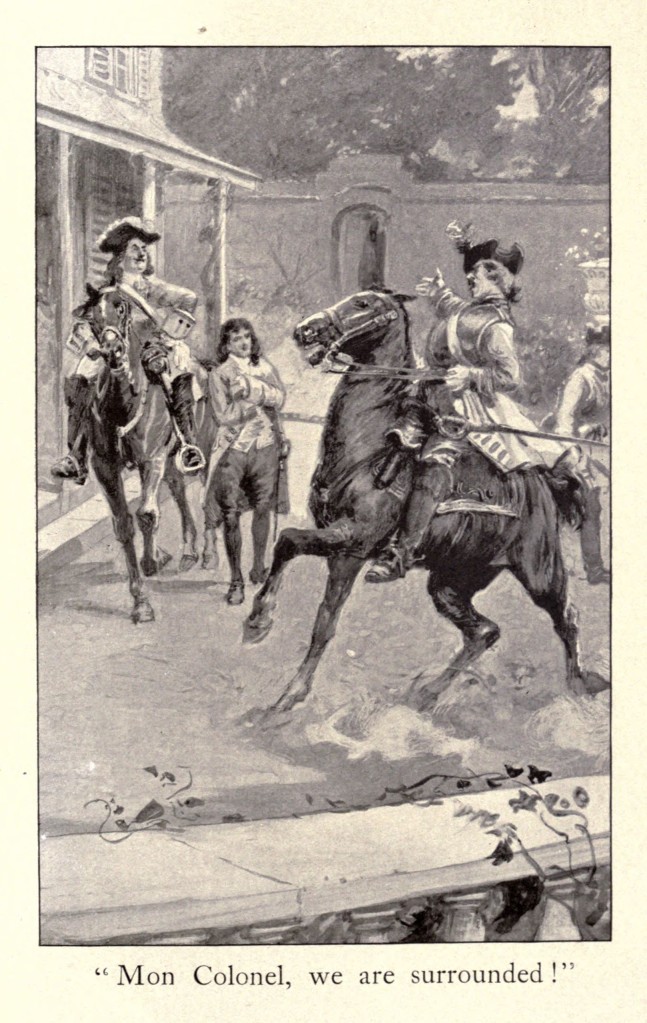
"Mon Colonel, we are surrounded!"
"You see, Monsieur," continued Harry, "you are in a ring fence. It is for you to make your choice, and at once, between surrender and—annihilation."
Harry had not misjudged his man. Utterly bewildered, the colonel gazed, like a caged animal, helplessly around him. At the end of the drive his men could be seen rigid and expectant. Behind him, beyond the wall, he saw the figures as he supposed of Dutch troops armed, and with all the advantage of position. The sun, breaking through the clouds, glinted upon steel which, at the distance, he could not be expected to recognize as bill-hooks, pruning-knives, and whatever other implements the premises had afforded. At a little distance down the road he saw, through gaps between the trees that lined the wall, his patrol galloping back to the main body. Trying to collect himself, he at length set off at a slow trot towards the gate. Harry at once signed to the two Dutch soldiers hidden in the cloak-room to come out, and ordered them to stand at attention one on either side of the door. The leader of the French patrol pulled his horse up on its haunches at the road end of the drive.
"The road is blocked, mon Colonel," he said, "with a barricade of carts and beams held by a strong force of the enemy. We cannot estimate their numbers; they keep under cover; but one of the men is killed by their fire, and by their shouts there must be at least a hundred."
Without a word the colonel rode across to the brink of the canal. The lowness of the water and the height of the bank showed at a glance that any attempt to swim his horses across would be disastrous; they could never scramble up the opposite side. The men might cross and crawl up, but a moment's reflection showed what the fate of a small body of men would be, retreating on foot through a hostile country. The colonel looked down the road; the blazing barn inspired uncomfortable thoughts. He had seen many such conflagrations of late, and knew well that the peasants would take a full toll of revenge if he fell into their power. Wheeling round, he for the first time caught sight of the two Dutch soldiers standing behind Harry on the steps of the house. This seemed to bring home to him the hopelessness of his position; muttering a curse he walked his horse slowly up the avenue. Harry came forward to meet the scowling officer.
"It is the fortune of war, Monsieur. I see you have chosen the wiser course. You surrender to superior numbers. I am authorized by my general to accept your surrender. You will receive honourable treatment; he knows how to appreciate a gallant warrior; but the peasants——"
The colonel tried to smile.
"I am concerned—I say it frankly—for the safety of my men. With your troops,"—he shrugged—"we might take our chance; but your peasants, your burghers—parbleu! we know them; they are savages, they are tigers. To whom, Monsieur, have I the honour of yielding my sword?"
"Immediately, Monsieur, to me; my name is Harry Rochester, an Englishman at present in the—in the Dutch service; ultimately to General van Santen, to whom I shall have the honour to introduce you in a few minutes. Now, Monsieur le Colonel, you will direct your men to ride up the avenue, dismount, stack their arms in front of the house, and fasten their horses to the garden palings behind. Sergeant," he added, turning to one of the sentinel dragoons, "ride at once to the general and acquaint him that Monsieur le Colonel——"
"Baron von Schummelpincken."
"That the Baron von Schummelpincken has surrendered. Send a dozen men to take charge of the horses. In twenty minutes we shall be in camp."
CHAPTER XI
The Battle of Lindendaal
A Hitch—A Charge in Flank—Irregular Warfare—Called Off—A Suggestion—Compliments—Thanks—Adieux—Luck—After the Fair—A Triumph
To his credit, Colonel the Baron von Schummelpincken did his best to put a good face on the predicament in which he found himself. He rode back to his men to inform them of the arrangement. The moment he had gone, Adèle de Vaudrey came out, her face aglow with excitement.
"Monsieur," she said, "General van Santen asks what the uproar, the firing, means; shall I tell him?"
"As you please, Mademoiselle."
"It is as you please, Monsieur."
"The day is not ended yet, Mademoiselle."
"I will say nothing, Monsieur." She went into the house.
The sergeant had spurred across the meadow behind, through a gate in the wall, into the orchard and wood. In a few minutes he reappeared with his comrades, who came at a trot towards the house. Their pace was leisurely, but a keener observer than the colonel, who at this moment was half-way up the avenue at the head of his troops, might have noticed that the horses' flanks were heaving violently. The men had in fact galloped at full speed from the horns of the position in obedience to the sergeant's signals, and only checked the pace in response to a suggestion of Sherebiah, who had made the best of his way after them. Harry ordered the ten dragoons to draw up in line at right angles to the house.
"Sherry," he said, as the man came up puffing, "bring me one of the dragoons' horses."
He mounted just as the colonel emerged from the avenue. Sherry stood by his side at the nearer end of the line of dragoons.
The colonel, some dozen yards ahead of his men, came to Harry and handed him his sword. Harry politely returned it, a compliment which the officer courteously acknowledged.
"Monsieur," said Harry, "we understand the arrangement? Your men will pile arms in front of the house, file off to right and left, tie their horses to the palings, then pass round on foot to the rear of the house."
"Certainly, Monsieur."
Harry watched eagerly as the troopers came two by two up the drive and did his bidding with the precision of automata. Events had crowded so thickly that he had scarcely had time to think; but now he could hardly sit still on his horse, so intense was his anxiety to get the whole scene over. Everything appeared to be answering to his wishes; his arrangement for the French dragoons to file off in opposite directions was a precaution to divide the force; they began to pass behind the house one by one. About half of the troop had thus piled their arms and fastened their horses; the clock in the belfry-tower struck the first note of noon, and Harry was already congratulating himself that almost by the time the last of the leisurely Dutch chimes was ended his ruse would have been completely successful, when a loud voice was heard from the road.
"Mon Colonel! mon Colonel! they are only peasants and burghers. It is a trick, a trick!"
There was an instant halt. Harry's heart was in his mouth; Sherebiah muttered, "Zooks! 'tis hot 'taties now!" The colonel, his face aflame, spurred his horse from the pillar at the end of the avenue, and, drawing his sword, vociferated:
"A moi! à moi!"
For a moment Harry felt that all was lost. But only for a moment, for in that instant he saw that with his handful of men in line he had the advantage of the troopers debouching two by two from the balustraded drive. Turning to the dragoons at his side he shouted "Charge!" and dashed straight at the enemy. It was in the nick of time. A few seconds later they would have been ready; at this precise moment they were awkwardly placed. Half a dozen men of the nearer file were leading their horses towards the palings; beyond them the armed and mounted men were approaching from the drive, and eight files presented their flank to Harry's little force of ten. As he charged, the dismounted men scattered like hares before him, and the sixteen armed troopers had barely time to wheel round to meet the onslaught before Harry and his Dutchmen were upon them. All the advantage of impetus and direct attack was with the Dutch. Harry, grasping his sword, came full tilt upon a burly Alsatian. Almost before he had realized it he had passed over the dragoon and his horse, and, parrying a swinging cut from the man behind, had shortened his arm and thrust him through the shoulder. The man dropped his sabre and fell from his horse, which wheeled round and plunged madly through the dismounted men on the farther side.
In a trice Harry was through the mellay, and bringing his horse up on its haunches, wrenched it round so that he might take stock of the new situation. He found that the majority of his Dutch troopers had stuck close to him, and with the readiness of old campaigners were already wheeling round to face the discomfited enemy. A dozen men were on the ground, including the portly colonel; several horses were careering wildly through the small open space, impeding the movements of the dismounted men who had made a dash for the piles of arms in front of the porch. The French troopers were still filing up the drive, but the sudden uproar had startled the horses. The riders were too much occupied with their steeds and too closely packed to make effective use of their pistols; the one or two who fired aimed erratically, and no one was hurt. But Harry saw that the only course open to him was to charge again and again until the peasants, summoned by the noise of the fray, could come to his assistance. It was fortunate that the remainder of the enemy's troop could only debouch two by two from the drive; the stone balustrade on each side of it prevented them from deploying until they entered the open space in front of the house. Two horses that had been rolled over near the entrance to the drive were plunging and kicking, hindering the advance of the leading troopers, who were now being pressed by the men behind. Once more the little band of Dutchmen hurled themselves at the head of the enemy's force, and with the same result, though Harry was instinctively aware, when he again emerged from the mellay, that his followers were fewer in number. Among them, however, he noticed Sherebiah, who had possessed himself of a sword and pistol from the stand of arms and a horse from the palings, and was comporting himself as though, so far from being a man of peace, he had as much experience of warfare as any trooper present. Two of Madame de Vaudrey's gardeners also had appropriated weapons, and were holding at bay a group of the disarmed enemy who hovered round, trying to dash in and recover their arms.
Harry saw little of this, however. He wheeled his horse once more to repeat the charge. He was followed now by only six men; at least a dozen fresh troopers had debouched from the drive, but, like their comrades, they had not time to form before the dauntless seven were upon them. The odds were heavier now; only two succeeded in getting through; the rest were checked. Then ensued a series of fierce duels, the little group of Dutch being broken up and driven back by the weight of the files pressing through as rapidly as they might into the open space. Harry, engaged with a stout trooper, felt with a sinking heart that the game was up; his arm was wrung with hacking and thrusting; his opponent, fresh to the fight, closed with him, leant over his saddle, and tried to grip him by the throat. At this moment there was a fierce shout, followed by a perfect babel of cries. The trooper fell from his horse, transfixed in the nick of time by Sherebiah's sword; and when Harry after a few seconds was able once more to take in what was happening, he saw the place thick with burghers and peasants who were falling upon the enemy from both balustrades. Some had leapt on to the coping and were dealing heavy blows at the dragoons and their horses with sticks, hooks, scythes, and all kinds of strange implements; others were jabbing through the interstices of the balustrades; all were shouting, smiting, felling with a fierce vehemence that brooked no resistance. A panic seized upon the enemy; the unarmed men bolted to the stables behind the house and barricaded themselves there; the last files of the dragoons threw down their arms and begged for quarter; and, turning to Sherebiah, Harry bade him cry to the peasants, with the full force of his lungs, to hold their hands.
A lull succeeded the turmoil. A crowd of the Dutch were hastening towards the stables to burst open the doors and make short work of the men sheltered there. To them Harry galloped up.
"Men," he said, "halt! in the name of General van Santen. The victory is ours. We must await the general's orders."
The mob hesitated, then, with obedience compelled by their young leader's mien, stood in sullen silence. Harry rode back to the opening of the drive, stationed two of the Dutch dragoons there, and addressed the colonel, who, with a lacerated cheek and contused shoulder, leant against the palings, a picture of chagrin, pain, and baffled rage.
"Monsieur, 'twas not well done. Your parole was given. But you are hurt; go to the house—you will find tendance there."
At this moment another horseman suddenly appeared on the scene, galloping up from behind the house. Wheeling his horse in some surprise, Harry found himself face to face with Madame de Vaudrey's neighbour, Monsieur de Polignac. He looked greatly perturbed; his mouth was twitching; the air of cynical detachment he had worn in Madame de Vaudrey's drawing-room had quite disappeared.
"Monsieur, what is this, what is this?" he cried.
"As you see, Monsieur—a skirmish," replied Harry. "We have captured a raiding-party—and doubtless saved your house from the flames."
"But—but—do you not see your peril? You are not a soldier; these men are not soldiers, the most of them; to wage war is for you quite irregular; if caught by the French—and I hear, Monsieur, rumours of a general advance in this direction—you will all be hanged."
"I will take my chance of that," said Harry. "I thank you, nevertheless, for your warning, Monsieur."
"Bah! I counsel you to release your prisoners—without arms, it is understood—and send them back to their lines."
"That is a matter for General van Santen, Monsieur. Would you care to repeat your advice to him?"
Polignac gave him a savage look, opened his mouth to speak, thought better of it, and, setting spurs to his horse, galloped away.
The scene of this tempestuous little fight differed greatly from its appearance a short half-hour before. Thirty men, of whom twenty-four were French, lay killed or wounded, with a few horses. The stone balustrades were broken in several places; the flower-beds were trampled; the gravel was ploughed up; shattered muskets, swords, scabbards, pistols, hats, cloaks, strewed the ground.
"Carry the dead to the garden," said Harry. "Take the wounded to the outbuildings and attend to them; there is a doctor in the house. A dozen of you take arms from the pile there and guard the prisoners; lock them up in the stables. Sherebiah, I leave you in charge."
Then, hot, weary, hatless, his coat showing several rents, Harry followed the wounded colonel into the house.
"Monsieur," said Adèle, meeting him, "the general insists on seeing you. He was with difficulty restrained from rising and taking part in the fray. You are weary; a cup of wine will refresh you."
Harry gladly quaffed at the cup she presented to him. Then he followed her into the dining-room. The general frowned when he saw him.
"I want to see the leader," he exclaimed testily.
"This is he, Monsieur," said Ad<ble.
"You, Monsieur!—Mademoiselle, a youth, a boy—absurd!"
"It has been my good fortune, Monsieur," said Harry.
The general looked blank with astonishment. He half-raised himself on his cushions, sinking back with a groan.
"They would tell me nothing, save that the French were discomfited. Explain, from the beginning."
Harry gave a rapid narrative of the late events. He spoke always of "we", seeming to include Adèle, the general himself, and even Madame de Vaudrey, who had joined them, among those who had planned the ruse. Every now and then the general broke into his story with exclamations of surprise and pleasure and praise.
"A daring, a clever scheme," he said as Harry concluded. "You are an Englishman, they tell me; a soldier, I presume?"
"No, Monsieur le General, I have not that honour."
"That is the army's loss. You have shown great quickness, great skill, and no less courage. I compliment you, Monsieur."
"I did what I could, of course, Monsieur; but things would have ended very differently but for the peasants' bold attack at the last."
"Bah! I know them; they would have done nothing without a leader, but with a leader they will fight—yes, and well. I doubt whether, in point of military honour, the French colonel—whom I will tax on the subject presently—did right to reassume command after he had yielded his sword; still, much may be forgiven him; naturally he was chagrined and perturbed; and he is moreover wounded, as I hear."
The general spoke with difficulty; he was very weak.
"You have saved your convoy; that is well. You will wish to take it to Breda. I fear I cannot move. Madame la Comtesse, I shall be your patient for a time——"
"Monsieur, I am honoured," said the lady.
"But the prisoners must be carried to Breda also. Monsieur, that duty—that honour—must be yours. You have laid many under an obligation: Mynheer Grootz, your excellent employer; the garrison at Breda; Madame la Comtesse, whose house you have saved; and myself—especially myself, for without doubt you preserved me from capture, and in my wounded state capture might very well have finished me."
"I hope for your speedy recovery, Monsieur."
"I thank you. Now, you will take six of my troopers with you; armed burghers will serve for the remainder of your escort. I marvel that help has not ere this reached us from Breda; you will report to my aide-de-camp, whom you will doubtless meet there or on the road. Your name, Monsieur, is——"
"Harry Rochester, Monsieur."
"Mademoiselle will note it down for me. My friend Mynheer Grootz will have a visit from me. I am fatigued; Mademoiselle, a little cordial from your fair hand. Monsieur, I bid you farewell."
Harry bowed and left the room, tingling with pleasure at the general's praise. He went to the reception-room and gladly stretched his weary limbs on a low couch there. Madame de Vaudrey followed him.
"How can I thank you!" she exclaimed. "I do thank you, from my heart, a thousand times. How brave! I trembled, I wept when I heard the horrid sounds; I could not look; Adèle looked and told me; I thought you would be killed; I was overcome, I could only pray. Oh! Monsieur, what can I say? I can say nothing; I can only—yes; tiens! I kiss you."
At another time Harry might have been embarrassed; he was now so tired that he could but accept passively all the motherly cares lavished on him by the comtesse. She brought him food with her own hands, smoothed his hair, begged him vainly to accept a ring as a token of her admiration and gratitude; offered to give him a coat of her late husband's to replace his own torn garment. Harry stood it all as long as he could; at last, parrying another kiss, he sprang up and declared it was time he set off with his prisoners and the convoy.
The prisoners capable of marching numbered eighty-five. The remainder were too badly wounded to be moved. Gathering his escort, he had the stable door unlocked and the prisoners paraded, and sent Sherebiah to marshal the convoy. All was at length ready. It was half-past one when he stood at the door to take leave of Madame de Vaudrey.
"Adieu, Monsieur Harry!" she said. "Au revoir!—that is what I mean. You will come and see us again?"
"Nothing would delight me more, Madame."
"And stay; convey my thanks to Mynheer Grootz for the tulip bulb; you will remember that? and yourself take the thanks of a mother and daughter. Adèle!" she called, "Monsieur Rochestair is departing. Come and bid him farewell."
"Adieu, Monsieur!" said Adèle, coming forward. "I add my thanks to Mamma's for the great service you have done us."
"I could have done little, Mademoiselle, without your aid."
A flicker of pleasure passed over the girl's face; then, with a return to her wonted coldness, she said:
"You are pleased to flatter, Monsieur. But I see there are still knights-errant in the world. Adieu!"
There were tears in Madame de Vaudrey's eyes as she put her arms up and kissed Harry on the cheek. He bowed over her hand, then sprang on to the horse of one of the captured dragoons, and cantered after the line of wagons and men already moving up the road. As he reached them he had the impulse to turn for a last look at the chateau. The turret was just visible above the tree-tops, and upon it he saw a female figure motionless.
"One of the maids hauling down the flag, I suppose," he thought.
Then he set his face towards Breda; it was Adèle who stood there watching until he was out of sight.
"What a lucky dog I am, Sherry!" he remarked to his sturdy henchman as they rode side by side.
"Ay sure, Master Harry, 'tis better to be born lucky nor rich. But speaken for myself, I doan't zackly see there be much luck about it."
"Oh yes! there is. 'Twas merely luck that Mynheer Grootz had to send me this way; mere luck that he had promised Madame de Vaudrey a tulip; mere luck that the French chose that very day to come raiding; mere luck that the place lent itself so easily to a trick——"
"Ay, and mere luck that 'ee happened to be born wi' a headpiece; mere luck that 'ee can handle a sword and sit a horse; mere luck that 'ee've got sojer's blood a-rompen through your veins. Daze me, if all that be luck—well, Them above med as well ha' no finger in poor mortal pies at all."
"Well, well, Sherry! But confess, 'twas odd to come upon Captain Aglionby again, and in that house; what do you say to that?"
"Say! I say 'tis old Satan hisself playen pranks, and we'll ha' to keep an eye on the villain."
"I laughed to see their heads in chancery; 'twas well done, Sherry, to haul them down the stairs as you did. What has become of the captain to-day, I wonder?"
"Trust me, he be doen mischief somewheres. I knows Cap'n, ay, I do."
From the stout Baron von Schummelpincken downwards the prisoners wore a crest-fallen air. Save for the colonel and his subalterns they all marched on foot, the horses being tied head to tail as Harry had often seen at English country fairs. They had been marching for about an hour when the head of the convoy met General van Santen's aide-de-camp galloping at breakneck speed. He reined up when he noticed soldiers among the men. Harry cantered to his side. Explanations were rapidly exchanged. The Dutchman laughed heartily when he heard how the enemy had been fooled.
"To tell the truth," he said, "I should never have thought the general capable of such a stratagem."
"Indeed!" said Harry.
"I wish I had been there. It would have been more fitting that I should take the prisoners to Breda than you, a sutler, I suppose you call yourself."
"I don't think it necessary to call anybody names, Mynheer, myself least of all. The general expected assistance; why has it not accompanied you, Mynheer?"
The officer explained that on reaching Breda he had found that practically the whole garrison was engaged in a reconnaissance in force towards Antwerp, where General de Bedmar was showing signs of activity that gave the confederate generals some concern. Only two troops of horse had been retained in the town, and these had strict orders not to leave the place. Infantry would be of little use against the French raiders, and indeed it was impossible that they should reach Madame de Vaudrey's house in time. The aide-de-camp had been accordingly provided with a fresh mount and sent on to the main body, from which a squadron had at once been detached. But the corps, when he overtook it, was a good ten miles beyond Breda, and the relief squadron could not start for the Helmund road until the afternoon. It was now some twenty minutes behind the aide-de-camp, who had ridden forward to convey to the general the news of the coming reinforcement.
He continued his journey, and Harry cantered on to overtake the convoy, which had moved on while the conversation took place. Some minutes later a cloud of dust in the distance heralded the approaching force. When the two bodies met, Harry had reluctantly to tell his story over again. The commander of the squadron pressed him for more details than the general's aide-de-camp had done, and being a shrewd man he soon put two and two together.
"The honour of the day is yours, my friend," he said to Harry, "and by my soul you shall ride into Breda at the head of the column."
Harry protested; he did not relish the idea of heading a sort of circus procession. But the Dutchman insisted; General van Santen had laid the duty upon Harry, and he saw no reason to relieve him of it. He sent a couple of his troopers on in advance to announce the event. Thus it happened that when, in the dusk, Harry headed his convoy through the gates, he was met by a great concourse of the populace, men, women, and children huzzaing and waving hats and kerchiefs with vast enthusiasm. All the pretty girls of the town, in their quaint bonnets and short skirts, pressed around the horse to see the young Englishman, and a comical little Dutch boy, with a toy drum slung over his shoulder, placed himself in front of Harry's horse and proudly tattooed him through the streets to the burgomaster's house. The burgomaster himself made a very flowery speech of congratulation, to which Harry returned the best acknowledgment he could; and he was heartily glad when the tide of compliments ebbed and he had leisure to make formal delivery of his prisoners.
He had not yet escaped, however. He was resting in his inn when a messenger entered with an invitation to an impromptu banquet organized at the burgomaster's. In vain Harry pleaded that he was in no trim for fine company. The burgomaster's own tailor undertook to make him presentable; he had to sit through a long Dutch feast and respond to the toast of his health. Even then his labours were not ended. After the banquet the company adjourned to the council chamber, where all the beauty of the town was assembled. Harry had to lead off the dance with the burgomaster's wife, a stout vrouw of forty-five years and fifteen stone. He did his duty manfully, dancing the stately dances of the day with unflagging spirit, and winning universal praise by the modesty with which he wore his honours. The assembly broke up at a late hour; Harry was dog-tired, and went to bed convinced that it was mighty hard work to be a popular hero.
CHAPTER XII
Harry is Discharged
Rheum and Rum—Gall—Without Ceremony—A Question of Precedence—Res Angustae—The Raw—To Scheveningen—Punctuality and Despatch—From the Dutch Side—Temptation—Renunciation—Gretel—Misgivings
"Atchew!—confusion! This pestilent country—atchew!—will be the death of me. 'Tis one eternal—-atchew!—rheum! Stap my vitals! I wish I were dead. Atchew! atchew!"
Captain Aglionby sat in the topmost room of a high house in one of the less savoury quarters of the Hague. His nose was redder than ever; his cheeks more puffed; his eyes looked like boiled oysters. A thick woollen comforter swathed his neck. Though it was the height of summer, a big log fire blazed in the hearth; window and door were fast shut; and in a temperature of something over eighty degrees the captain was doing his best, according to his lights, to cure a cold.
He was seated at a table drawn close to the fire. Upon the table stood a bottle nearly empty, a beaker, a basin of sugar, an inkhorn, a table-book of writing-paper, and a sheath containing quills. A kettle sang on the fire. When his sneezing fit was over, the captain poured the last of his rum into the beaker, sugared it, filled up with boiling water, and gulped half of the mixture into a throat inured to fiery passengers. Water streamed from his eyes, and his blotched brow broke into a profuse perspiration. He wiped his face with a large red handkerchief, smacked his lips, and, bending over the table, selected a quill.
"Hang writing!" he muttered. "I never writ a letter but I rued it. Atchew! And with this cursed cold! Well, the sooner begun, the sooner done; so here's to it. Atchew!"
He cut his quill, dipped it in the ink, and began:
"Mr. BARKLEY. Sir."
It would have been quite evident to an onlooker that the captain was not a practised penman. He wrote very laboriously, frowning at every stroke, and licking his lips often. Like most illiterate people, he repeated half aloud the words as he wrote them, and being so unused to giving visible expression to his thoughts, he commented as he went along. He was never at a loss how to spell a word, for in those days men spelt as they pleased, and bad spelling might almost have been regarded as one of the marks of a gentleman.
"Sir. This will, I hope, finde you well. For myself, I am afflicted [atchew!] with a voilent Rheum, the wch I feare will turne to an inflamatn of the Longs. [Egad! that'll please the old niggard!] I command the sarvices of the best Potticary in the place, but finding his nostrums vain, for three dayes have eate nought but Water Gruel. 'Tis said that Rumm is a speedie Cure, but that I eschew. [Atchew!] My Hande shakes with the feaver, & I shd not rite to you now had I not Surprizing Nuse to give. You must knowe that, visitting at the house of Mme de Vodray, where your he sarvant is ever an honour'd guest, [that's worth fifty guineas to me!] what was my vaste Amazement to finde there that yonge Cockerell H—— R—— swaggering it as one of the beste. It passes my wit to divine how he escap'd from the Merrie Maide, & hope y may recover the Passage Money, the wch methinks will be difficult. [Atchew! He won't get a penny o't.] 'Tis passing strange the boy is here, not lesse that he is acquaint with the Vodrays; & moreover with him is my pestilent cozn S—— M——, of whom more hereafter, 'twill be easie to deal with him, whereto I have already things in Traine. H—— R—— is employ'd with one Grootz, a merchant of Substance, & one that hath large Contracks with the confederate armies. The boy being out of yr way, y have belike no further cause against him, & wd wish no further stepps taken, comming & going is like at any time to Cooke his Goose, but if I mistake in this 'twould be well to sende 100 Guineas by the same Hande as wont, & I wd endevour to bring the matter to a safe and speedie End, in wch case I wd make bold to aske for a further Summe of 200 Guineas for to requite my Zeale in the sarvice of my honour'd Frende & Patron."
"Atchew! Writing is plaguily dry work," he muttered, breaking off at this point, "and the bottle's empty."
He tugged at a bell-pull, and resumed his letter.
"'Twill be no light Taske, seeing the yonge man hath captured of late a Partie of above 100 French in an Affaire near Breda, the wch I doubte not will give him some Consekence with the Dutch no less than himselfe, of the wch Affaire 'tis like an Account will be printed in the Courant. [Sure 'twill give Nick a start.] I must add that Living is verie Deare here. For my Creditt sake and the furtherance of youre Ends, I have hired a Magnifficent Appartment, for the wch I have to paye a sweete Rent. Hence it is verie nessessarie I have the Guineas without delai. Waiting yr commands & so subscribe myself yr ever humble and obediant
RALPH AGLIONBY, Captain."
"Atchew! There, 'tis done, and writ fair." He flung his pen on the table. "And I'd fain know what the squire has against the knave; 'tis more than pique, I promise you. Where's Simmons, confound him!"
He sanded the wet paper, folded it, sealed it with yellow wax, and wrote the superscription:
For Nicolas Barkley Esqre
at his house Winton St. Mary nr Salisbury, England
This done, he tugged again at the bell-pull, blew his nose with sounding ferocity, and stuck his legs into the hearth with the air of a man who had successfully achieved a stupendous task.
The door opened, and John Simmons entered.
"Hang you, sirrah! why don't you answer my bell at the very moment, sir? Go get me a bottle of rum."
Simmons, pallid, frowsy, scared-looking, stood hesitating in the doorway.
"Are you deaf, clodpoll?" roared the captain. "A bottle of rum, and instantly!"
"Yes, Captain, and the—and the money, sir?"
"The money, you dog! Where is the crown-piece I gave you this morning?"
"I had to buy the dinner, sir, and——"
"Zounds! You'll answer me, will you? You're the most pestilent knave man ever had to serve him. 'Tis money, money, all day with you. Would that Sherry Minshull had left you to the hangman! Begone, sirrah! and——"
"Pardon!" said a voice in French from the door. "If I am in the way——"
"Come in, Monsieur," said Aglionby, springing to his feet. "And you, booby, be off and do my bidding."
Simmons vanished precipitately. Monsieur de Polignac gasped as he entered the overheated room.
"Phew! It would roast an ox."
"Shut the door. I am nursing a pestilent rheum."
"So it appears. You are in an ill humour, my friend; I fear my news will not cheer you."
"Spit it out and have done with it, then."
"Well, this is it. A commission has been made out, I hear, appointing your young Englishman a cornet in the Anspach dragoons."
"What young Englishman?"
"The young man whom we met at Madame de Vaudrey's."
The captain swore a hearty British oath.
"Where learnt you that?"
"A la bonne heure! It is true. I have it on authority I cannot doubt. Van Santen pressed it; his influence prevailed. There were several vacancies in the regiment; it lost heavily in the action at Eckeren a few weeks ago. This boy gets the senior cornetcy. We owe it to ourselves, Monsieur le Capitaine, that the junior cornets get an early step."
"Peste! We do owe it to ourselves; or, I should rather say, we owe it to yourself. For me, I have knocked about the world too long to take umbrage easily; and look you, Monsieur, my family, although gentle, indeed I may say noble, cannot compare with yours in quartet-ings and such fal-lals. I understand your sentiments; as you say, something must be done."
"And at once, for which end I have come to see you. My position, as you perceive, is delicate; for myself, I would seek a quarrel with the bantling and spit him on my rapier without remorse. But affairs of state—you understand me; that alters the case. I must not appear. I propose to you this: to affront the boy, provoke him to a duel; you a veteran, he a tyro; it will be a matter of seconds. Voilà!"
The captain gazed steadily at Polignac for a few moments, then said:
"Look you, Polignac, no man ever accused Ralph Aglionby, late captain in the Preobrashenski Grenadiers, of lack of courage—no man, that is to say, that lived to tell of it. Had you made the proposition twenty years ago, I should by this time have been half-way down the stairs on the way to kill this young springald. But twenty years make a difference. My courage is the same, look you; but the years have enlarged my girth—and my discretion. On the point of honour I am as sensitive as ever I was, but I have learnt to have patience—and consideration. Say I engage this peddling fool; what happens? I kill him and baulk you of your revenge. Where are you, my friend? Or suppose, by some vile contrivance, he kills me; where am I? No, no, Monsieur; the right of place belongs to you. Who am I, a broken soldier, a poor unnecessary captain of grenadiers, to take precedence of you?"
"You have most admirable patience," sneered Polignac, "and I am overwhelmed by your consideration. I thank you, Monsieur le Capitaine, and bid you adieu."
"Stay, my friend; why this haste? I have consideration, as you say. Would the world be better for the loss of you or me? are there not more ways of getting even with a man than making one's self a target for his pistol or a sheath for his sword? You remember Marillier, and Aubin, eh? Sit down, and let us talk this over like reasonable men."
Polignac sat on one of the rickety chairs in silence.
"Your memory is jogged, eh? You remember the dark lane, and the light in the window, and——"
"Enough!" exclaimed the other impatiently. "My memory is as good as yours. This is different. I must be circumspect. Were we in Paris—then! But here at the Hague, I am not my own master; I have weightier interests to consider. An incautious step, even a chance word, may ruin a dynasty. My own life—I do not consider it; but when one is playing for a crown one has duties, responsibilities. If you see your way—well, I am not one to dissuade you; and if a few guilders——"
Aglionby's red eyes gleamed.
"Well, Monsieur, as you put it so, I own 'tis in a measure a question of money. In truth 'tis desperate hard lines that I, who have ruffled it with the best and got drunk with the Czar of Muscovy himself, should be so hard driven as that I cannot offer due hospitality to a friend. Look at this wretched lodging; was ever gentleman, by no fault of his own, mark you, reduced to such straits!"
Polignac, glancing at the mean furniture and the empty bottle, agreeably assented, but concealed a smile.
"Well," he said, "might I ask leave to send out for a bottle of wine?"
Aglionby jumped up with alacrity.
"You say so? 'Tis the mark of a true friend." He pulled hard at the bell-rope. "My man will be here instantly; and, Monsieur, let it be sack—sack, as you love me."
Simmons reappeared without delay, and was despatched for a bottle of sack. With the energy of pleasurable anticipation the captain pursued:
"Now, my dear Polignac, mark—before attempting the house 'tis well to poison the dog; aha! that is only my way of putting it, eh?"
"Of course. A figure of speech; but from the life!"
Aglionby flung him a suspicious glance; at times he had an uneasy feeling that Polignac was quizzing him. But after a momentary pause he went on as before.
"The dog in this case—and a low cur it is—is the young cockerel's servant—the same that embraced you so cordially at Madame de Vaudrey's. Ha! ha! I can relish the comical side of it e'en though he embraced me also!—and before the charming mademoiselle too!"
He guffawed uproariously. He felt that he was now getting tit for tat for Polignac's covert sneers, often rather suspected than understood. But he was not a little startled by the effect of his words and laughter. Polignac flushed purple with rage; his mouth took a very decided twist towards his left eye. Springing up suddenly he cried:
"Morbleu, Monsieur, a truce to your pleasantries! and keep the lady's name out of it, or by the——"
"No offence, no offence, my dear fellow," interposed the captain hastily. "I'm but a plain soldier—just an honest, bluff, outspoken old campaigner; we blades don't pick and choose our words like you fine gentlemen of the courts; though in truth when I was in Russia my manners were as good as the best."
Polignac resumed his seat reluctantly without a word. After a short, strained silence Aglionby went on:
"The first thing, as I was saying, is to get this dog out of the way. Burn him! he follows his master like a shadow. The man removed, the rest is easy. A week from now, and he shall lie his length in six feet of good Dutch soil, or my name isn't Ralph Montacute Aglionby. Leave it to me, Monsieur; there will be necessary expenses; say fifty guilders, a small sum, and at one time——"
"Send to my chambers; you shall have the money. And by the way, here is a packet for Captain Rudge of the Skylark. He sails with this evening's tide. Bid him have the greatest care of it; should he run into danger he must destroy it.—It is arranged, then? I shall hear from you?"
"Within a week, on the word of a gentleman."
"Then for the time, adieu!"
When Polignac had gone, Aglionby looked curiously at the packet entrusted to him. The address ran:
For Mistress Consterdine
to be left at the coffee-house, by the Cockpitt, Whitehall, London.
It was carefully but not conspicuously sealed. The captain turned it over and over in his dirty hands; they itched to open it. "To judge by his rage," he muttered, "he's certainly smit with Mademoiselle de Vaudrey. 'Tis not merely his interest is engaged." He sat musing for a moment. Then his eye fell on a broadsheet, marked with many circular stains, that lay on one of the chairs. He took it up and searched for a passage which he had clearly already read. Lighting upon it, he read:
"The report goes that Coy's Horse embark at Harwich for Ostend on Friday the 16th current. They will join the forces now operating under General Lumley in Dutch Flanders."
"With a fair wind they'll make port to-morrow. Then, Sherebiah Minshull, my sweet coz, we shall begin to square accounts,—you and I."
Stuffing the two packets into his capacious pocket, he clapped on his hat, flung a cloak over his shoulders, wound the comforter more tightly about his neck, and made his way out, sneezing half a dozen times as he met the cooler air of the street. He walked along the Lange Pooten, the chief business thoroughfare, into an open space known as the Plein. As he was crossing this he caught sight of a figure hastening into one of the larger houses, and almost involuntarily he stepped aside into a doorway until all danger of being seen was past.
"What is the puppy doing here?" he muttered, passing on his way to the old road to Scheveningen. After a pleasant woodland walk of two miles he reached that little fishing village, and found, as he expected, Captain Rudge, owner and skipper of the sloop Skylark, a fast sailer which ran to and fro between Scheveningen and Harwich. To him Aglionby confided his own letter and Polignac's. Then he retraced his steps, and at the Hague took horse for Rotterdam. It was near midnight when he returned and wearily climbed the lofty stair to his attic room; but though he was fatigued, and his cold perceptibly worse, he seemed well satisfied with himself, and chuckled many a time before he had drained to the dregs the bottle of sack he had broached with Monsieur de Polignac.
The person from whose sight he had shrunk in the afternoon was Harry Rochester himself, who had just returned from a visit to Marlborough's camp at Hanneff. Mynheer Grootz was up to his eyes in business, and the wide area over which the confederate forces were spread taxed his resources to the utmost. He had now come to the Hague to confer with a committee of the States General and arrange further contracts, and had instructed Harry to meet him there on the completion of his own errand.
"Well, my boy," said Grootz on his arrival, "I did not expect you zo zoon." They were now on such friendly and familiar terms that the Dutchman had dropped the formal address. "How have you fared?"
"Excellently, Mynheer," replied Harry. "The commissary was well content with your arrangements, and said—'tis no harm to repeat it—that were all Dutchmen like Jan Grootz he would be spared a peck of trouble."
"Dat is goot," said Grootz, evidently well pleased. "Dat is how I do my business; always in time, always ready, always sure."
"I had hoped to catch a glimpse of my lord Marlborough himself, but 'twas not to be. Whatever may be said of his meanness and selfishness, Mynheer, 'tis certain he is adored by his army. The soldiers are full of courage, confident in my lord's genius, and all afire to meet the French. They say, indeed, that if my lord were but free of restraint, not bound to take counsel with your politicians here, one campaign would see the end of the war."
"Dey zay!—Yes, well, it may be zo. My lord is a fine soldier—none would deny it—for all he dink little of de rules of war. But as for de field deputies—my countrymen—dey alzo have reason. To Lord Marlborough and you English, my boy, a defeat mean much; dat is zo; but to my country—ah! much more. To us it mean ruin, every village and town overrun, our polders spoiled, our homes destroyed, everywhere black misery. Dis poor country know it all too well; we have suffered—ah yes! we have suffered before too often. For my lord, it is a game wherein he can noding lose but glory; for us it is a struggle of life and death. True, for myself, I zay in war, as in business, to follow a bold course is best; but I do not derefore blame our statesmen dat dey move zlowly; no, I do not blame dem."
Harry had seen more than once lately that beneath the stolid exterior of the merchant beat a heart warm toward his fatherland and his friends. He could not but recognize much to sympathize with in the Dutch point of view, and began to realize what it meant to the Hollanders to have their country turned into a cockpit for the political contentions of rival monarchs.
A slight pause followed Grootz's earnest speech; then suddenly, with a change of tone, he said:
"Now, Mynheer Harry, I have a ding to zay. Dere are reasons why I find it now necessary to discharge you from my business."
Harry gasped and looked very blank. The merchant nodded solemnly; up came his fat forefinger; and he continued with even more deliberation than usual:
"Dat is zo. I tell you dis; I find no fault wid you; none in de world; but all de same, I zay dat it is necessary you go."
Harry was so much taken aback that he found it difficult to speak.
"Why—'tis sudden—what can—surely—" his tongue stumbled over half a dozen questions before, with an effort to command himself, he said: "Of course, Mynheer, if there is nothing more for me to do, I must perforce seek other work. You have been very kind to me; 'tis but poor thanks I can give you for what you have done."
"What I have done! Gunst! it is noding. And you: it needs not to zeek oder work; it is found. Hearken to dis."
He took up an official-looking paper that lay at his hand and read in Dutch:
"Mynheer Henry Rochester is appointed to a cornetcy in the Anspach dragoons in succession to Mynheer Lodewyk van Monnen deceased."
Harry flushed to the eyes.
"'Tis a mistake, Mynheer, surely. I have not sought this; I know nothing of it."
"A mistake! Not at all. General van Santen come to me and zay, 'Grootz, you have in your business a young man dat has no business to be in your business; he is a soldier, noding less, and we have need of such;' dat is what he zay, and more, and he go straight off to put down your name for a commission. And here it is, in de gazette. Dat is why I discharge you, before—" (Mynheer Grootz made a brave attempt to be jocular)—"before you discharge yourself."
Harry was silent. His nerves were tingling, his blood sang in his veins. Here was the opening to a career after his own heart. All his earlier longings came back to him; the inward struggle with which he had acquiesced in his father's desire that he should enter the Church; the light of hope that shone on him at his interview with Marlborough; the agonizing dissolution of his castle in the air. And now, unsought, what he had sought in vain had come to him, the aspiration of his boyhood was about to be fulfilled. All this flashed through his mind in a moment of time,—and there was Jan Grootz, smiling out of his kindly little eyes. Jan Grootz!—what he owed to him! But for Jan Grootz he might now be a hapless slave in the Plantations, with no ray of light upon the endless vista of the years. To Jan Grootz he owed his health and freedom, his training in dealing with men; more than all, he had met in Jan Grootz a man whose character compelled his respect and admiration, and whom indeed he had begun to love. Would it not be the worst of ingratitude to leave him now?