THE ADVENTURES OF FRANÇOIS (continued 5)
Reading edition
"Why not? The children are with my sister. They shall stay till to-morrow night."
He followed the overjoyed cobbler up to the room above his shop, sent him out to buy food and wine, and sat down to await events. The cobbler came back with a supply of diet and the gazettes. François sat behind the slats of the green window-shades, and laughed, or talked to Toto, or read, while at intervals he watched No. 33 bis. He read of how Charleroi had been taken, and of the recovery of Fleurus. It interested him but little.
"They have cut off the head of the devil, and got a new god, my good poodle. Tenes! Hold! Attention!" He saw Quatre Pattes clatter out. It was about 4 P.M. She had no market-net. She was decisively bent on some errand, and moved with unusual celerity, her back bent, her head strained upward to get a sufficient horizon.
"It is altogether pleasant, ami. She will not wait till twelve to-morrow. She has gone to denounce him. Get up. Here is a nice bite for thee. She is shrewd, our snake. If she plunders M. Grégoire,—and she will, too,—she knows what he will do when he is out. He will denounce her. The play is good, Toto. The money she will have, if we know her. But, mm ami, if he makes her believe through the door that he is the great Grégoire of the wart, and she lets him out, and is scared, and asks no pay, Toto, 't is nevertheless a scotched snake she will be. The Wart will want to be revenged for low diet and loss of the republic's time. Mordieu! Toto, let us bet on it."
He read his gazettes, and waited. At six that afternoon the Crab came home. At nine François went to bed. Twice he awakened, laughing; he was thinking about Grégoire. The cobbler came in at six with breakfast, and François warned him to be careful.
At ten in the morning Quatre Pattes appeared at her door, and chatted with one or two dames of the fish-market. She rattled her sticks, and talked volubly. She was in the best of humors.
No new thing took place till three o'clock, when two municipal guards paused at her door. She came forth, spoke to them, and went in, leaving the door open. A third joined them. They loitered about. Ten minutes went by. François grew more and more eager as he watched.
"Ho, ho, Toto," he exclaimed, "there was a noise! The fool! she has gone up alone to let him out."
It was true. Grégoire had yielded in all some three hundred francs, and, as ordered, had slipped the money under the door, piece by piece, while Quatre Pattes sat and counted it with eyes of greed. She came down and hid the last of it. Now she went up again, rather liking the errand. She was absolutely fearless. She opened the door, and stood aside. "Come out," she said, "little man."
Grégoire was past restraining his rage. "She-devil!" he cried, and struck at her in a fury of passion. He ran past her down the stairs, the terrible woman after him. She was wonderfully quick, but the man's fear was quicker. At the last stairway she found him beyond her reach, and, cursing him in fluent slang of the quarter, she threw one of her sticks at him. It caught him on the back of the neck, and he fell headlong into the hallway. In an instant he was up and staggering into the street. As he came forth two guards seized him. "In the name of the law!" Quatre Pattes came swiftly after him, screaming out: "Take him! I denounce him! He is an aristocrat!"
What she and François saw was unpleasant for her.
"Nom de Ciel! 't is the Citizen Grégoire!" cried the third guard.
Grégoire was for an instant speechless and breathless. The guards fell back.
"Arrest me?—me, Grégoire! Have you an order to arrest me?" He was not quite at ease.
"No, no, citizen. It is clearly a mistake. We were to arrest a ci-devant."
Quatre Pattes stood up, pallid.
"Take this woman!" cried Grégoire. "I will send an order. The Châtelet, and quick!"
"The little trap did work," cried François, behind his screen. "How she squeals—like a pig, a pig! She will give up the money. The citizens and she disappear within."
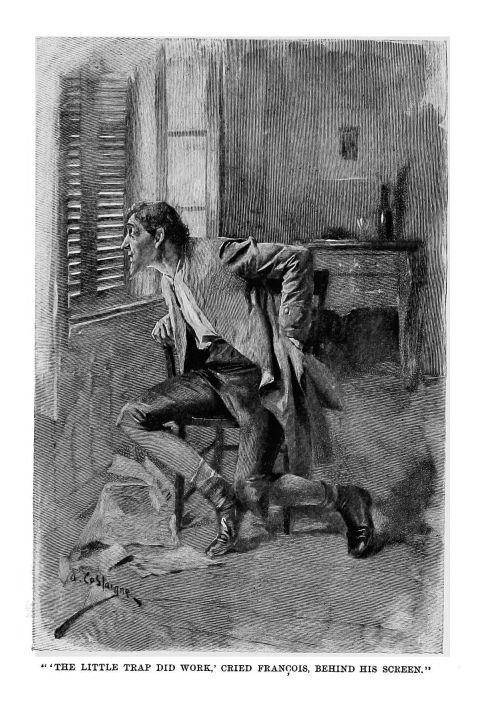
"'THE LITTLE TRAP DID WORK,' CRIED FRANÇOIS, BEHIND HIS SCREEN."
"This woman stole it!" roared the great man, as they came out. "Take her away."
When they came to lay final hands on her, she was like a cat in a corner.
"Chien de mon âme! 't is a fine scrimmage," cried François, "and the street full."
The sticks rattled; and when they were torn from her, she used tooth and claw, to the joy of a crowd appreciative of personal prowess. At last she was carried away, screaming, and exhausted as to all but her tongue.
The commissioner with the wart readjusted his garments and his dignity. The crowd cried: "Vive Grégoire!" and the hungry Jacobin went his way, furious, in search of dietetic consolation.
"The show is over, Toto," said François, as he sat down.
Presently came the cobbler, curious, and much relieved.
"Ask no questions," said François. "Here is a little money."
"But, citizen, it is a gold louis."
"The show was worth the price of admission. Thou art welcome. Hold thy tongue, if thou art wise. At dusk I shall slip out. Thou art safe. The Crab will denounce no more of her neighbors."
"Two she hath sent to the knife," said the cobbler.
"Dieu! how the tricoteuses will grin!"
XXIII
Of how François found lodgings where he paid no rent—Of the death of Toto—Of how his master, having no friends on the earth, finds them underground.
At dusk François went out, and was soon moving rapidly across Paris. He was in search of lodging, food, and security. In an hour or less he was in the half-peopled quarter of St. Antoine. Near the barrier he turned aside, and stood considering a little house in what seemed to have been a well-kept garden. On the gate was the large red seal of the republic. It was safe for a night. If he took a lodging, he must show all his papers, and have his name set out, with his business, on a placard such as was nailed to the outer door of every house in Paris. His name, as a new lodger, must be reported to the sectional committee. He was widely known, and, alas! too peculiar to escape notice long. Now he needed time to think. He wandered awhile, ate in a small café, bought wine and bread, at night climbed the garden wall, and without much trouble found his way into the house. It was a sorry sight. The arrests must have been sudden and pitiless. The kettle stood on the dead embers. The bread, burned black, was in the oven. A half-knit stocking lay on a chair. Up-stairs and down, it was the same. The open drawers showed evidence of search. A dead bird lay starved in a cage. The beds were unmade. The clock had stopped. He found some scant provisions, unfit for use. It seemed a gardener's house. The place oppressed him, but it answered his purpose. His dog troubled him. Toto was, like himself, conspicuous, and he felt forced during the daytime to leave him locked up in the house. But Toto was sagacious, and had learned to keep quiet. For several days François lived at daylight in the streets and cafés, returning at night, to get away again before dawn. In the quiet little taverns where he went for food and shelter he made himself small, and hid in corners; nor, at this time, did he laugh much. He bought the gazettes, and read them with intelligent apprehension of the fact that change was in the air. Robespierre had never had with him a majority of his colleagues, and now he was becoming more and more conscious of his insecure hold on the Convention. As long as the ex-nobles or the foes of the republic suffered, it was of little moment to the representatives; but when the craving for blood, not justified by any political reasons, sent too many of their body to the block, the unease of the Terror began to be felt within their own hall. To be timid, cautious, or obscure had once been security. It was so no longer. That terrible master still had his way, and, one by one, the best brains of the opponents of the Jacobins were sent to perish on the scaffold. The Convention began to feel the need for associative self-defense. Revenge, fear, and policy combined to aid the enemies of this extraordinary person. Like Marat, he began to show physically the effects of a life full of alarms; for this monster dreaded darkness, trembled at unusual noises, and remained to the last the most carefully dressed man in Paris. To understand him at all, one must credit him in his early political life with a sincere love of country, and with willingness to sacrifice himself for others. It is impossible to regard him as entirely sound of mind at a later date. He became something monstrous—a mixture of courage, cowardice, blood-madness, self-esteem, and personal vanity. But there were men who loved him to the last.
It was now early in July, the month Thermidor. François began, as usual, to weary of a life of monotonous carefulness. His supply of money was ample. He was well fed and, so far, safe. He sat night after night in darkness, and thought of the lady of the château. He knew that her father was thus far secure; his name was not in the daily lists of the victims; and these were many, for on the 22d Prairial (June 10) a decree deprived the accused of counsel, and of the right to call witnesses. The end was near.
One evening about nine, as he came near to the garden, he saw lights in the house. Toto was found waiting outside of the gate. A girl came forth, and soon returned with a net of vegetables.
"Ciel! Toto," said François, "the poor things have been released, and thou wert clever to get out. We are glad, thou and I; but they have our house." He had left nothing at this lodging, having nothing to leave. He walked away, puzzled, and, wandering, scarce aware of whither he went, found himself at last in the Rue de Seine. It was getting late, and he began to look about him for a new lodging.
"We must find an empty house, Toto. The seal of this cursed republic is our best chance." He did not need to look far. In the Rue de Seine he came upon a small two-story shop. Beside it was a wide gateway, on which he saw with difficulty, but felt readily, the seal no one dared to violate. He concluded that there must be a deserted house beyond it, in a garden. He passed around by the quai, and entered the Rue des Petits-Augustines, and stood before the mansion of Ste. Luce. A light was in an upper room. Some one was in charge. On either side were railings and a garden. It was now ten o'clock, and no one visible in the long street of old houses, once the homes of the great French nobles. He pushed the poodle between the rails, and readily pulled himself up and dropped at his side. Once within, he moved with care across to the wall behind the mansion, and soon saw that he was not in the garden of the marquis, but in the larger domain of the Duc de la Rochefoucauld-Liancourt. His object was to find his way into the house which had an outlet on the Rue de Seine. As he was arranging his clothing to climb a tree near to the wall, he suddenly paused. "Toto," he exclaimed, "we have been robbed,—we—first-class thieves,—and we know not when it was. Ah, it was at that café, as we came out. Well done, too. Not a sou. Weep, Toto; we are broken."
He lost no more time in lamentation, but climbed the tree, looked over, came down, pulled up the dog, and descended on the farther side of the wall.
He was now in a small garden. Near him, and close to the wall, was a little plant-house. On the farther side of a grassy space stood a hotel of moderate size, with the front court, as he presumed, opening on the Rue de Seine. On each side, as he saw clearly, for the night was bright and the moon rising, there were high flanking walls. After assuring himself that the house was empty, François found a trellis covered with old vines, and, climbing this, entered the hotel by a convenient balcony. He was safe for the night, and at leisure to explore his new dwelling. He feared to strike a light, but he could see dimly that there were pictures, books, china. Evidently this had been the home of people of wealth. As the moon rose higher, he saw still better, and began to realize the fact that here were evidences of hasty flight. In a room on the second floor was a secretary, and this François readily opened.
"Toto," he said, "we are rich again." He had found forty louis in a canvas bag which comfortably fitted his side pocket. In the larder he came upon meat, cooked and uncooked, mostly unfit for use, stale bread, and cheese. Once satisfied, he went over the house, and then the garden, taking pains at last to set a ladder against the wall of the Rochefoucauld property.
The glass-house was in disorder, the plants lying about, uncared for. His foot struck an iron ring attached to a trap-door. There were staples for padlocking it, but no padlock. He concluded this to be the opening to a wine-cave or -cellar, and lifted the trap. It was dark below. He ventured down the steps a little way, and then stood still to listen. Hearing noises below him, he retreated in haste. He was, as has been said, superstitious.
"That is strange! We will look about when it is day, Toto—not now."
Concluding to sleep out of doors, he accordingly arranged for his comfort by taking a pillow and blankets from the house; for now he had opened a door below, and was in full possession. Suites of apartments which he dared not use for sleep, and a pretty little library, overlooked the small estate of the garden.
No occupied dwelling was in view. Great trees in the grounds of La Rochefoucauld and Ste. Luce partially hid the houses, and, what was of more moment, shut off the sight of François's refuge. It was, of course, possible that at any time he might be disturbed by the coming of the officers, or, what was to be feared less, that of the owners. But he was not a man to be continually anxious. The outer front door had a bar, and this he dropped into its socket. The side walls were high. He could hear any one who attempted to enter. His way out at the back was made easy by the ladder he had set in place. At dusk he began to be fully at ease, and after a day or two was hardly less so in the sun-lit hours.
On the morning of the third day, much at home, he sat behind the little plant-house, with Toto at his feet, and a book in his hand, for in the library he found several which excited his interest. Now he was deep in a French translation of the travels of Marco Polo. Suddenly he heard a noise of steps. He fell back, caught Toto with a warning grasp on the jaw, and lay still. He was so hidden in the narrow space between the plant-house and the wall of the garden as to be for the time secure. No longer hearing anything alarming, he rose and looked cautiously through the double glass and the sheltering plants which were between himself and the mansion. In a few minutes a tall man came out of the plant-house, went into the dwelling, and by and by returning with blankets and a basket, passed into the plant-house, and was lost to sight. He soon came out again with a lad, and after several such journeys to the main house, whence each time he fetched something, they reëntered the plant-house, and came forth no more.
This incident greatly amazed the thief. "Toto," he said, "there must be a trap below! 'T is a lower cellar it leads to, and there are people beneath. Hélas, Toto! no sooner are we gentlemen with an estate than, presto! a change, and it is get up and go. It were better we took to the woods and saw far countries, like this M. Polo." Toto regarded his master with attentive eyes, the long black tail wagging. He seemed to comprehend François's difficulties, or at least to feel some vague desire to help and comfort.
"Yes, yes; it is time we settled down, mon ami. Behold, we get a little money and wherewithal to live; we hurt no one; we cultivate our minds with travel; we start fresh, and are honest, having enough,—which is a good foundation for honesty,—and then—eh bien! my friend; let us laugh"; and he lay on his back, and tumbled the dog about.
He was in the garden, near to the dwelling, a day later, when he heard noises as of steps in the La Rochefoucauld grounds. He climbed the ladder, and, without showing himself, listened. There were voices, and now and then he caught a phrase. These were municipal guards. He beckoned to Toto, and, crossing the garden, entered the house, meaning to watch his new neighbors from a window.
He went up-stairs to the third story under the roof. As he moved toward a window, he heard a sound below. He ran down the stair, and stood on the lower landing-place, facing the front door. "We are gone, Toto!" For once he was at a loss, and stood still, in doubt what to do.
There were voices outside. The hall door had been unlocked, but the bar held it fast. After a minute or two they seemed to have given up the idea of entering. François waited a few minutes, and began to descend the stairs. Then he heard quick footfalls in the room to the left on the level of the landing above him. Some one must have entered by a window on the second floor. He turned, perplexed, instinctively drew his useless pistol, and began to go faster. Suddenly the steps above him quickened.
A man on the staircase landing behind him cried: "Halloo! Surrender, in the name of the republic!" François jumped, taking the stairs below him in one leap, but, tripping over Toto, fell headlong in the hall. The dog sprang after him, and alighted on his master's back. A pistol-shot rang out. The dog fell dead with a ball in his brain. François was on his feet. He cast a glance at the faithful friend of many a day. His own long, strange face became like that of a madman. He dashed up the stair, a second ball missing him narrowly. Through the smoke he bounded on his enemy. He caught the man by the right arm, wrested the pistol from him, and, scarce feeling a blow from the fellow's left hand, struck him full in the face with the butt of the pistol. The blood flew, and the man staggered, screaming. A second blow and a third fell. Twisting his victim around, François hurled him down the stair.
"Beast!" he cried; and, leaping over him, stooped a moment, kissed the quivering little body of his friend, and, with tears streaming from his eyes, stood still. Loud cries from beyond the wall of the garden recalled his energies. The noise at the door was heard again. He ran out and across into the plant-house, pulled up the trap, and, descending, closed it. Then he stood puzzled. It was dark; he could see nothing. He fell on his knees, and began hastily to grope about until he felt an iron ring attached to the trap-door of what he presumed to be the entrance to a yet lower cellar.
"It is this or death," he muttered under his breath, and stood reflecting, having heard no sounds approaching overhead. Thinking it better to see and be seen by those below, he struck his flint on the steel, and, with the aid of a morsel of paper and his kindling breath, soon had a light. Then he saw near by a lantern with a candle within it. He lighted it, and held it in one hand. This done, he knelt again, and with a quick movement set open the trap-doorway. What he saw was a man and the muzzle of a pistol. The man cried out: "If you move, you are dead!"
"I am not a municipal, monsieur. I am only a thief. Let me come down, for God's sake! I am flying from those rascals who are in the house."
"I have half a mind to blow your brains out."
"Ciel! I hope you will not have a whole mind. It would only call those scoundrels. I stole a little from the house—I return it"; and he dropped the bag of louis. It fell on the head of a small boy below, unseen in the gloom. He howled lustily.
"Diantre! keep quiet!" cried the man.
"Oh, let him come down, duke; he is welcome." It was the voice of a woman out of the deep darkness. Tender and clear it was.
"Be quick, then, rascal! Down with you."
The thief waited for no second invitation. The duke descended; François's long legs came after. He paused to arrange some loose staves, that, in falling, they might conceal the trap. Then he blew out the candle, and was in total darkness, but where or with whom he knew not.
"Have a care how you move," said the voice of the woman. "We are in great peril. Come down quietly."
"May all the saints bless you!" said François, and sat down on the lower step. For a while all was still.
XXIV
Of how François got into good society underground—Of what he saw, and of the value of a cat's eyes—From darkness to light—Of how François made friends for life.
"It was dark indeed; I had never imagined such darkness," says François in his memoirs.[#] He adds that he has heard the story of this wonderful escape from the catacombs told over and over by M. des Illes. He does not consider that it did him (François), the principal person, sufficient justice. He had also heard the old Duke Philippe relate the matter, and it was incredible how crooked he got it. But, then, Duke Philippe was a man who had no sense of humor. As to his dear Mme. des Illes, when she did tell this story, the baby was the chief hero. Duke Henri,—that is, the present man,—although only a lad when these events took place, remembered them well.
[#] See Epilogue.
"When he was seventeen," says François, "we used to fence together. I have often heard him relate to the other young fellows how we made our escape; but Duke Henri has too much imagination, and that, you see, makes a man inaccurate. I knew two very accomplished thieves who were inaccurate. I am not. Duke Henri's tale got stronger, like wine, as time went on. The rats grew to be of the size of cats; three of them pulled the baby out of madame's lap. And as to the people we killed, it would have satisfied M. Dumas, who is the greatest and most correct of such as write history."
The present author grieves that he has not the narration of this famous escape at the hands of Mme. des Illes and the two dukes, father and son. Those who have found leisure to read "A Little More Burgundy" have heard Des Illes's narrative as M. des Illes related it. Those who have not read that rendering may incline to hear François's own statement of what happened after he thus found himself in darkness with people he had never seen. I have followed his memoir pretty closely. It tells some things of which the other people concerned did not know. Evidently he considered it a less tragic affair than did they. It has been needful to condense François's account, and to do this especially where he speaks of his own intermediate adventures, which were singular enough.
When, as I have said, François, obeying Duke Philippe, put out his lantern, he sat still awhile, and said nothing. Like the rest, he was fearful lest the officers he had disturbed so rudely should make a too effective search. Their inspection of the upper cellar would be perilous enough. The anxious people beneath held their breaths when a man overhead stumbled across the staves the thief had set to fall on the trap-door. After a while all noises faded away, and in the evening the duke proposed to reconnoiter once more; but when he tried to lift the trap, it was found impossible to do so. The municipals, in their examination, must have rolled a full barrel of wine upon the door. This discovery was, or seemed, an overwhelming calamity.
François during the day came to understand that here in the darkness were Duke Philippe de St. Maur, his son Henri, a lad, another rather older boy, Des Illes, Mme. des Illes, and the baby, who made himself terribly well known by occasional protests in the tongue of babyhood. As the thief became accustomed to the gloom and the company, his usual cheeriness returned; and when they could not open the trap he began to propose all manner of schemes. He would bore a hole and let out the wine, and so lighten the barrel. He would shoot a ball through the trap and the barrel, and thus let out the weight of wine. The duke, who never lost respect for his own dignity, was disgusted, and would listen to none of his counsels.
Toward bedtime the baby began to wail dismally; the boys sobbed; and Mme. des Illes cried out to them that they should be ashamed to complain, and then, by way of comment, herself burst into tears; while the duke stumbled about, and swore under his breath. This was all very astonishing to François, who had seen little of any world but his own, and to whom calamity served only as a hint to consider some way to escape its effects. He remained silent for a while, after the duke had let him plainly understand that he was a fool and had better hold his tongue. This lasted for a half-hour, during which he sat still, thinking, with full eyes, of his dead dog. By degrees the children grew quiet, and the baby, having exhausted his vocabulary and himself, fell asleep. Then the duke said irritably:
"Why the deuce don't you do something, Master Thief? If you can get into places where you do not belong, why cannot you get out of this abominable box?"
François laughed. "Get out I would, and gladly; but how? We might wait, monsieur, till they drink up the wine, or until it dries up, or—" But here the boys laughed, and even the duke forgot himself, and said François was a merry fellow. Indeed, he was of use to them all; for, soon becoming at ease, he regaled the boys with his adventures; but how many he invented I do not know. Some were queer, and some silly; but all tales are good in the dark, for then what can one do but attend?
After a while, all being still, François lighted his lantern, on which Duke Philippe said: "Put out that light; we have too few candles as it is; and keep quiet. You are prowling about like a cat on the tiles, and twice you have stumbled over my legs."
"But I have twice said I was sorry," said François, getting tired of this duke with an uncertain temper, who repeated: "Put out that light, and sit down."
Then madame spoke: "He may have a reason to want to see and to move about."
"'T is so," said François. "If I walk, my wits walk; if I sit, they go to sleep; and as to cats, madame, I am a street cat"; and, thinking of Suzanne, he laughed.
"Ah, confound your laughing!" The duke felt that to laugh at a joke he did not share was, to say the least, disrespectful. "What is there to laugh at?"
François, who had been moving as he spoke, was suddenly elated. He said it was Suzanne he was thinking of; and when madame would know if she were his wife, the duke was silent out of lack of interest for low company, and François began to tell about the elders and the Hebrew maid, and of the Amalekites who lived on the next roof. The boys were charmed, and madame said, "Fie! fie!" but it served to amuse. An hour later he began to move about restlessly, and at last cried out, from the far end of the cellar:
"This way, monsieur; what is this? A candle—and quick!" When they all came to see, he rolled aside an empty cask, and showed a heavy planking. He seized the decayed timbers and tore them away, so that as they fell a black gap was to be seen. The air blew in, cool and damp.
"Mon Dieu! 't is the catacombs. My husband's grandfather cut off this end for a wine-cave. It is strange I should have quite forgotten it."
"But what then?" said the duke. "It is only a grave you have opened. You might as well have kept quiet."
The thief's feelings were hurt; he began to care less and less for this useless nobleman.
Madame said thoughtfully: "It may be a way out. If it come to the worst, we can but try it."
"Madame is right; and as to keeping quiet, I never could. Sleeping cats catch no rats." He believed in his luck. "We shall get out," he said, with cool assurance. "I always do. I have been in many scrapes. I got out of the Madelonnettes, and I was once near to decorating a rope."
"A rope!" exclaimed madame.
"Yes. Parbleu! I wear my cravat loose ever since. I like to have full swing, but not in that way." He was gay and talkative. The boys liked it; but not so the duke, who said:
"Well, what next?"
"We must explore. I will enter and see a little."
"But," said the woman, "you will get lost; and then, what to do?" She had come to trust the thief. He saw this, and liked it. "If we lose you, what shall we do?—what shall we do?"
The thief turned to her as he stood, lantern in hand. He was grave. "Madame, I am a poor thief of the streets; I have had to live as I could; and since I was a boy I can count the kind words ever said to me by man or woman. I shall not forget."
Madame was moved, and said they were all alike come upon evil days, and that perhaps now he would turn from his wicked ways.
Poor François was not quite clear as to his ways having been wicked.
"Well, if you are going," said the duke, "you had better be about it."
It was then young Des Illes said he must have a string, like people who went into caves, else he might never find his way back. The thief thought it a fine idea; and here was madame's big ball of knitting-wool. With no more delay, he took it, and leaving an end in Des Illes's hand, boldly walked away into the darkness with his lantern, and was soon lost to view.
When he came back to this anxious company, he had to report such a tangle of passages as caused him to say that to try to escape through these must be a last resort. He thought they might live on the rats if provisions gave out, but they must eat them raw.
"Hélas! what a fate!" said madame.
The little Duke Henri spoke eagerly, and said the Chinese ate rats.
"But not raw," cried the young Des Illes, which set them all to laughing.
Soon again they were quiet, because talk in the dark does not prosper. A little later madame called softly to the thief to sit by her, and would hear of his life. François related his exploits with pride. She made no comment, but said at last: "Your name, my friend?" And when he replied, "François," she declared that he was no more to be any one's thief, but always François; and this was a hint to the duke, who took it in silence, and was evidently depressed.
After this, madame bade the boys say their prayers; and soon all were asleep, except François, who sat against a cask, and saw Toto's brown eyes in the darkness.
At last the morrow came. The provisions were shared, and, as usual with François, his spirits rose as he filled his stomach. He held the baby, and was queerly interested in this mystery of unwinking eyes. Might he give it of the bottle? He satisfied the child, who seemed fearless of that long, good-humored face. Might he hold it longer? It would relieve madame. He sang low to it a queer thief-song, and then another none there could understand.
"Ciel!" said the duke, who had slept off his splenetic mood; "you have a fine voice."
"Ah, would it were a hymn," said madame, "or a psalm of Clément Marot!"
"I know no hymns," said François, "but only some old choir chants."
Upon this he began to sing, low and sweet, one of the old Latin songs:
Salve, mundi salutare,
Salve, salve, Jesu care!
Cruel tuæ me aptare
Vellem vere, tu sols quare,
Da mihi tui capiam.
The rich voice which in his boyhood days had soared like a lark up among the arches of Notre Dame had come again. He heard himself with wonder and with sad thoughts of the chances his boyish haste had forever lost for him.
"And you a thief!" cried madame. "Where—where did you learn—"
But at this moment noises overhead put an end to all but listening. At last François said: "They move the casks. It were well to take to the caves." And this was hastily agreed to, when, of a sudden, the noises ceased.
François still urged instant flight; but the duke said, "No; we must wait," and gave no reasons. The thief did not agree, but held his tongue, as Mme. des Illes said nothing, and since, after all, this was a duke.
An hour later he started up. "By Heaven, they are at the trap!"
The duke was no coward. He ran up the steps, pistol in hand, and gave his second weapon to François, who stood below. The trap was cast wide open, and a big municipal was seen stooping over the open space; for beyond him the cellar was well lighted up. The duke fired without an instant's indecision.
"By St. Denis! 't is a man, this duke," cried François, as the officer pitched head down into the cave. The thief set a foot on him as he lay, and reached up the second pistol to the duke, while young Des Illes, too curious for fear, crawled up the broad stone stairs to see. The thief heard a second shot, and followed the lad. There were several candles set on casks, and through the smoke he saw a municipal in a heap at the far end of the upper cellar. He was groaning piteously.
"Load again, monsieur," cried François. "Quick! there may be more." He himself went past the duke, and young Des Illes after him. He turned the officer over.
"He is not dead," he said. "Best to finish him."
But here was madame at his side, saying: "No, no! No more—I will not have it. Mon Dieu! it is bad enough. I will have no murder."
"Then let us go back; he is as good as dead."
"Mon Dieu! Mon Dieu!" cried the woman; and so in haste the upper trap was closed, and all went again down to the cave.
The officer below was dead, with a ball through his head. Mother and children huddled away in the far corner, scared. The duke said:
"What now must we do?"
"We must go, and at once," said François. "They will soon come back, and then—"
"Yes, yes," cried madame; "you are right. You were right; we should have gone before, and saved all this bloodshed."
The duke made no comment, except to mutter, "I suppose so"; and at once began to assist François's preparations for flight.
And now the thief's readiness and efficiency were shown. He arranged every one's loads, filled baskets, laughed over a shoulder at the boys as he strapped blankets on the duke, and at last loaded himself with all that was left. They took the arms of the dead man, and soon trooped out into the darkness. The duke, who at once went on ahead, carried a lantern.
At the first turn, François called out to wait, and ran back. The duke swore. He was now eager to go on, and declared that the thief would deliver them up, and save his own head. But madame was of other mind, and so they stood expectant. At last came François, laughing.
"Ah, monsieur, this comes of honest company. I forgot the bag of gold. And these—these are priceless. I have the fellow's clothes. When a man does not resist, the temptation is great; neither did he assist."
"Stop that talk, and come on. Are we going to set up a shop for old clothes?"
François fell behind. "The duke would make a poor thief," he said to the boys. Young Henri de St. Maur said: "You are insolent. My father a thief!"
"Tiens! There are times when to steal is virtue. Allons donc!" and he strode on, laughing, and telling the boys stories.
There were many little incidents that day, but the worst was at evening, when they found a great cave, lofty and wide, where had been cast, long before, the bones out of the overfilled cemeteries. Here it was that skulls fell from the great heap, and rolled away on every side into the darkness, while the rats ran out in armies. The thief was of all the most alarmed, and stood still, saying paternosters and aves by the dozen. After this they went on aimlessly, now and then hearing overhead the roar and rumble of wagons. Their nights proved to be full of sore trials. The rats assembled, and grew bolder. One bit the baby, who cried until the thief lighted a candle and watched while the rest slept, or tried to do so.
The dismalness of, these underground labyrinths was such as no man could imagine. One day they walked a half-mile through a wet cave-passage so narrow that two persons could not move abreast. It ended in a blank wall, and they were forced to go back, over shoe-top in water. Or, again, they went up rude stairs, stumbling, but hopeful, only to descend once more into the depths of the earth. Now and then a putrid rain fell on them, and at every turn the rats fled by them, now one and now a scurry of countless troops. Twice a mass of rock fell in some distant passage, and strange echoes reverberated in cavern spaces, so that the boys cried out in terror, and even François shivered at the thought of how they might be buried alive by one of these downfalls. Each sad day of weariness had its incident of terror or disappointment; and still, with lessening hope, they trailed on after the dim light which the duke carried as he led them—none knew whither. Each morning they rose cold, wet, and unrefreshed, ate of their lessening food, and after some little talk as to how this day they should keep turning to left or to right, set out anew, the duke still in advance, with an ever-changing mind as to where they were or what they should do. As day followed day, their halts became more frequent. They lingered where the dripping rain from the sewage of the great city overhead was least; or at times paused suddenly to listen to mysterious sounds, or to let the rats go by them, splashing in the noisome puddles underfoot. The night was as the day, the day as the night. They had no way to tell the one from the other, except by the duke's watch.
So confusing was this monotonous tramp underground, the days so much alike, that at last these sad people became bewildered as to how long they had wandered. Their food was becoming less and less, and on the evening of the fifth day the duke and François knew that very soon their stock of candles would be exhausted. These had, in fact, been of small use, except to keep the scared children more cheerful when night came on and the rats grew bold.
This evening of the fifth day, and earlier than usual, Mme. des Illes declared of a sudden that she could go no farther, and must rest for the night. The duke had a new plan, and urged her to go on. She cried over the baby on her lap, and made no answer. They sat down to pass another night of discomfort. After a little talk with the boys, François drew apart from the rest, and began to think over the wanderings of the day. Their situation this evening was somewhat better than it had usually been, for they sat in a dry end of one of the many excavations, and did not feel the cold, moist winds which howled along these stony caves, carrying a changeful variety of unwholesome stenches. A silent hour went by in utter darkness. At times François rose to drive away adventurous rats. At last he lighted a candle, and set it at the open end of the cul-de-sac. When he saw that the rats would not pass the lantern, he whispered to madame of this, and that he meant to explore a little, and bade her have no fear. The duke had thus far had his own way, and it had not been to François's taste. He took a second lantern, and moved off around a corner, resolute to find a means of escape. The duke ordered him to return and to put out the candle. François made no reply. He counted the turns as he went on, and listened for the noise of vehicles above him.
"A pretty duke, that!" he said. "I should have made as good a one. I like better that devil of a marquis; but diantre! neither is much afraid—nor I, for that matter."
Sometimes he turned back, at others went on boldly, noting whence blew any current of warmer air. At last he came upon an enormous excavation. In the middle was a mass of partly tumbled stone, laid in courses. This broken heap was large, and irregularly conical. He moved around it in wonder, having seen nothing like it in his explorations. He turned the yellow and feeble lantern-light upon the heap, and at first concluded that the old makers of these quarries had here built for themselves a house, which had fallen to ruin.
But where was he, and what part of Paris was over his head? He remembered at last to have heard that these catacombs were once used as receptacles for the dead, in order to relieve the overpeopled graveyards. Had he been less alarmed, he might have guessed where he was when they came upon the bones; for that must have been near to the cemetery of the Church of the Innocents. But while the duke had led, François had taken less than his usual active notice, and had been content to follow. Here, now, was a new landmark. This before him could be no dwelling of quarriers, but must be a house fallen into the great cave. He had heard of such happenings. To be certain where and on what street so strange a thing had occurred would afford knowledge as to the part of Paris under which he stood. He would ask the duke; he might know. Thus reflecting, he began to walk around the tumbled mass. A vast amount of earth must have come down with it. He pried here and there, and at last found a gap in the ruin, and crawled in between fallen timbers until he could stand up. On one side was a wall and a wide chimney-place, and on the top of this wall the great beams of the ceiling still rested. Their farther ends lay on what seemed the wreck of the opposite wall, thus leaving a triangular space filled in at each side by broken stone. Amid this were the crushed steps of a staircase, quite blocked up. The lantern gave little light. Only close to the fireplace could the tall thief stand erect. He turned his lantern, and cried out:
"Ye saints!" Close beside him were the remains of a high-backed chair, and on these, and beside them, portions of the bones of a man. Two great jack-boots lay beside him, gnawed by rats. His skull was broken, and lay where the eager animals had dragged it.
Few could have stood here alone, and not felt its terror and its mystery. François stood a moment, appalled, and unable to think or to observe. At last he began to study the place with care and increasing interest. A rusty sword, sheathed, was caught in the arm of the ruined chair. Here and there lay bits of gold lace. He picked up the rusted clasp of a purse, gnawed by the rats. Near it lay scattered a number of gold and silver coins, a rosary, and a small ring set with red stones. He put them all in his pocket. There was scarce a remnant of the man's dress.
François looked at the tumbled bones. "Mon Dieu!" said he; "am I like that?" and turned to see what else was here. On the lowest stair was a glint of yellow—a cross of gold. "Good luck!" he cried. On the hearth was a copper kettle, green with rust. Soon he began to see better, and at last found a fragment of wood less damp than the rest of the floor and what lay upon it; for a steady, slow, irregular rain fell in drops, with dull patter here and there. He shaved off some slivers of the wood, and, getting at the drier inside, soon, with paper from his pouch, made a fire on the stone pavement. Presently he had a bright little blaze, and in the brilliant glow began to shed his terror. He found other wood, and nourished the flame. But when he saw that the fragments were from the end of a crushed cradle, he ceased to use them; because here were little bones lying scattered, and the man guessed at the extent of the tragedy, and was strangely stirred. He moved to and fro in the tent-like space in awe and wonder, in thought reconstructing the house, and seeming to share in the horror of its story.
Before leaving, he looked again at the overturned chair, the stones lying about it, and the moldering remains of the man. He must have been asleep, and died instantly when the house fell into the great cave. There was no more to be seen. "God rest his soul!" said the thief, and crawled backward out of the tangle of broken beams and stones.
In a few minutes he was again with those he had left, and, saying only, "'T is well, madame; we shall get out," fell into a peaceful sleep.
The next day every one dragged on wearily, the duke still leading, and François hoping that he would be asked advice. The water rained on them a noisome downfall, the rats came out in hordes; and still François cheered his companions, now carrying the baby, and now encouraging the tired boys.
I have not given in full detail all the miseries of these weary days and sorrowful nights. They have been more fully told elsewhere by one who felt them as more serious than did François, whose narrative I now am following. These unhappy victims of the Terror had been altogether six days in the cave, but François not so long. By this time their spirit was quite broken. The thief alone remained gay, hopeful, and even confident, but saw clearly enough that these people, used to easy lives, could not endure much longer the strain of this unguided wandering in the dark and somber alleys of this horrible labyrinth of darkness and foul odors. The duke seemed also to be of a like mind, for on the morning of the seventh day he awakened François at six, and, of a sudden grown sadly familiar, whispered low to him:
"Is there any hope? Madame and the boys are failing. Soon we shall have to carry them."
"We shall get out," said François.
"But how? how? Why to-day any more than yesterday? Do you think of any way to help us?"
"If monsieur will permit me to lead—"
"Good! Why did you not say so before?"
François made no direct reply, but asked: "Did ever a house fall into these quarry-caves?"
"A house? Why do you ask? Yes; it was long ago. The house of the lieutenant of the guard it was. I do not recall the date. A house in the Rue des Pêches."
"Will this help to know when it was?" and François showed his coins and told his story.
"Yes, yes; I see. How wonderful! These are of the time of Francis I."
"Rue des Pêches?"
"Yes; it is now the Rue des Bon Secours. It is close to the Asile des Innocents."
"Dieu! monsieur, then I know. I think we may get out to-day; but it may be well not yet to tell madame. I think we are still near to the fallen house."
"Then you shall lead," said the duke. "Tiens! a queer fellow, this thief," he muttered, and went to waken the sleeping children. No word was said as to the house of the lieutenant of the guard, but François refreshed the tired party by promising a speedy glimpse of day. For, now that the candles were few, they thought more of this than of the perils which the daylight might bring.
The thief led, and all day long they went on and on. Once he was quite dismayed to find that he had lost his way, and once came to the very entrance of the cave he had left the night before. The duke again became querulous and dissatisfied; but François only laughed, and, resolutely concealing his mistake, retraced his steps. It was near to seven o'clock in the evening of July 28 when the thief bade them rest, and he would be back soon. The duke said something cross; but François made no reply, and, turning a corner, lost sight of his party. He took careful note of the turns and windings of this maze, and now and then found himself in a blind alley, and must of need turn back. At the far end of one of these recesses he saw in the gloom two great, green, phosphorescent eyes. Like mighty jewels they were, set in the darkness. They were soon lost to view, and came and went. "They are cats," he murmured; "and what a hunting estate they have! Ye saints! if I had here my poor Toto!" He began to move toward these eyes, which shot back the light his lantern gave. There were three sets of the pale-green jewels, and now their owners were maneuvering to escape. He began to use caressing cat-talk, such as had won the heart of Suzanne, and, falling on his knees, crept closer. Then there was a quick rush past him of his feline game; but one cat was indecisive, and he had her by the leg. He paid well for his audacity, but held on, and pretty soon began to exercise the curious control he had over all animals. At last pussy lay still and panting. When the scared animal grew quiet, he set her down. For a moment she hesitated, and then began to move away. As he followed she ran. He cast the lantern-light before her, and pursued her with all speed. Once or twice she was nearly lost to view. Then she turned a corner, and another, and of a sudden fled toward a distant archway, through which he saw the light of day. A great rush of warm air went by him. He stood still, murmuring aves. To his surprise, he was near to the place where he had left his companions. He stood a moment in deep thought. "We are out at last," he murmured. "But ciel! there is much to think about. We may have too much light."
He went back and told of the discovery, but of the cat not a word. The duke said: "I thought we should soon get out; come, let us be off."
Madame said gently: "Let us kneel before we go, and thank the good God for this friend he sent us in our trouble." Then they all knelt, and she prayed, speaking her thankfulness to Heaven, with at the end a word as to her husband, and also asking God's mercy for him who had led them forth out of darkness into light. When François heard her, he was disturbed as he had never been in all his days. When a man like François sheds tears, it is a great event in his life. He rose from his knees, and asked the duke and the rest to go with him; and thus it was that in a few minutes they stood fifty feet from an open archway, through which came the level light from the western sky.
The duke was moved at last to say how clever François had been; and how had he managed it? The thief declared it had been easy; but the cat got no credit, and never was praised, then or ever, for her share of their escape. Set in this rocky frame before them was a picture as it were of a disused quarry, and beyond it vineyards, with yet farther a red-tiled housetop. Here it was, as they paused, that madame said solemnly, with tears in her eyes:
"'God said, Let there be light: and there was light. And God saw the light, that it was good.'"
After the duke and François had peeped out, and seen no one, the duke began to set forth a variety of schemes as to what they should do. None of these was very wise, and at last madame turned to François. He had disappeared, but presently came again, dressed in the clothes of the dead officer. He wore his sword and pistols, and now, as seen clearly in the light of day, was certainly a queer enough figure. The garments were too short below and too wide above, and over them rose the long face, the broad mouth, and the huge ears. The boys, who looked on their troubles as at an end, set up a shout of laughter.
"The deuce! I shall arrest you, citizens," cried François. "And first, monsieur." He explained that he proposed to tie the duke's hands behind his back, and with, as was usual, one end of the rope in his hand, would conduct the ci-devant into Paris by the Barrière d'Enfer. The weeping widow would follow, with the two children, to see the last of their poor papa.
The duke was disgusted, but pretended to be much amused. "Well, it is a pretty comedy," he said, as Mme. des Illes insisted.
"Dame!" said the thief, "but the tragedy is not far away."
"And what is to come after?" said she. "Had we not better wait till night?"
"No. The guards are doubled at night. It is boldness which will win."
"And what then, François?"
"I must find for you a refuge while I go to see if M. des Illes may not have returned; for, madame, you have assured me that he would be released. Pray God it is so. And what better is there?" The duke was forced to consent.
A rope found in the officer's pocket made part of François's spoil. He tied the duke's hands, and showed him how, at need, a pull would release them. The gold was divided. All else they left. François reported the way clear, and they set out. But the boys giggled so much at the duke and his indignant face that François paused.
"Dame!" he cried, "madame must weep." She was already doing that, her mind on the fate of M. des Illes. "If you boys are fools, and laugh, we are lost. Cry, if you can; but, for the love of Heaven, do not look about you, or smile. Take a hand of madame—so. Cry, if ever you mean to get away safe."
The road beyond the quarry was little used, and they went on, the duke furious. When they met any one, François cried: "Get on, aristocrat! Pig of a ci-devant, march!"
Duke Philippe muttered: "Sacré, thief!" and got a smart jerk of the rope, and more abuse, until the fun of it nearly upset the thief, who could scarce contain himself. At the Barrière d'Enfer were but two guards; nor were there as many people in the streets as usual.
Suddenly François halted at the summons to leave his prisoner with one of the two men, and to enter the little office and exhibit his papers, as was needful.
"Dame!" muttered the thief, "one cannot know all things. I forgot about the papers." He showed, however, no indecision. "Guard this wretch, citizen," he said. "Here, take the rope. He is a returned émigré." The man took the rope. "I shall not be long." So saying, he went in after the second guard, closing the door behind them. The man sat down at a desk, and opened a blank-book, saying: "The order, citizen."
"I am afraid it is lost," said François, eagerly searching his acquired pockets. "The mischief! What to do?"
"To do? Thou must wait till the lieutenant comes back. He has gone to see the fun."
"Fun! What fun?"
At this moment the man rose hastily. "Diable! thou art François! I thought I knew thy voice. There are orders to arrest thee. Citizen Amar desires thy society. Best make no fuss. I arrest thee. I am in luck. It is sure promotion. What trick art thou up to? And those folks outside, who axe they?"
"But thou, an old thief, to arrest a comrade! Surely thou wilt not."
"No use. Come! no nonsense."
François put out a pleading hand. "But they will kill me, comrade." He looked all the alarm needed.
"Bah!"
In an instant the strongest grip of the Cité was on the man's throat, and closed as a vise closes. A faint cry escaped as the man struggled. François threw a leg back of the fellow, and as he fell dropped on his chest. It was brief. The man's heels clattered on the floor; he was still. The thief rose. The man was to appearance dead. He would revive, perhaps. "Peste!" cried François, "it is hard to keep one's head."
Seizing a paper from the table, François went out of the door, closing it after him, and coolly caressing a cat on the step. He said to the guard that his comrade would be out by and by, and that it was all right. As he spoke he waved the paper, and, taking the rope, went on, crying: "Get up, ci-devant!" As they got farther away he hurried the duke. "Death is behind us. Get on. Faster—faster!" He twisted and turned, and was not at ease until they were deep in the sinuous, box-hidden paths of the Luxembourg.
Very few people were to be seen, and these looked at or after them with curiosity.
"We must be a queer party. Get on, citizen. Thou art lazy. Thou wilt soon have a fine carriage." He was terribly anxious. "Sacré, monsieur! For the love of the saints, go on, and quicker!"
"What the deuce is it?" said the duke.
"That beast at the barrier knew me. He was an old thief."
"And what then? Why were we not stopped if he knew you?"
"He does not know me nor anybody now."
"Foi d'honneur, but you are a brave fellow!"
"Thanks; but make haste."
At last they were in the long Rue de Varennes, where they saw a great crowd filling the street, and were soon in the midst of a mass of excited people.
François cried out: "Room, citizens, room!"
An old woman shook her fist at him, yelling furiously: "Cursed Jacobin!"
The people were wild; and presently a man hustled the supposed officer. Others cried fiercely: "Hang him!" Another screamed out: "Robespierre is dead!" and the crowd took up the cry. A dozen hands seized on François.
"What the deuce is all this?" he shouted. "Take care, or the law will have you."
"Robespierre is dead! À la lanterne!"
Upon this, the duke exclaimed: "Let him go; it is a good fellow, and not an officer"; and then, amid a maddening tumult, succeeded in hastily explaining enough to secure the release of the officer.
"À bas la guillotine!" cried François. "Down with the Terror!"
The crowd thickened, and went its way with wild cries. Meanwhile the boy Des Illes was lost, and madame in tears. They went on, asking questions, and hearing of the execution of Robespierre, Couthon, Saint-Just, and the rest. The thief said: "Let us go straight to M. des Illes's house."
At the door madame fell into her husband's arms; and soon after dusk the boy came running back with his father, who had gone out to search for him.
Then all was hastily made clear, and the long story told of Des Illes's release, and how he had found the dog, and in the cave the Jacobins both dead, and of his vain efforts to discover his own people. They were fed and reclothed; and now, it being ten at night of this 10th Thermidor, François rose. "I must go," he said.
"You? Never!" said madame. "Our house is your home for life. You will wander and sin no more."
On this, François looked about him, from one kind face to another, and sat down, and broke into tears.
"It shall be as madame desires. I am her servant."
And this is the end of the adventures of François, the thief. Let who will judge him.
EPILOGUE
Wherein is some further account of François and of those who helped him.
In a little book which has found many friendly readers I related a strange story of the French Revolution.[#] In it was promised some further account of the most remarkable of the personages concerned. I have now fulfilled my desire to relate the adventures of François. The singular incidents I record are not without foundation.
[#] "A Madeira Party," The Century Co., which contains a tale called "A Little More Burgundy," to which the reader is referred.
In the story above mentioned I have told how I chanced to meet François and those with whom he spent his days after the stormy period during which they first came together. My acquaintance with M. des Illes and the old Duc de St. Maur slowly ripened into friendship. I was a lonely student in the Latin Quarter, and felt deeply the kindness which never ceased insisting that their house should be to me a home. In the summer, and often after that, I was a guest at Des Illes's château in Touraine. There I came to know François, as one may know a French or an Italian servant. During these visits he acted as my valet, serving me with admirable care, and never better pleased than when I invited him to talk about himself. He had long since shed his thief-skin, but I fear that it was only the influence of fortunate circumstances which left him without excuse to be or to seem other than as honest as the rest of the world about him.
I have known a great variety of disreputable folk in my lifetime, but never one who had so many winning qualities, or who was so entirely at his ease. A scamp in the company of men of better morals usually becomes hypocritical or appears awkwardly aware of breathing an atmosphere to which he is unused. François had no such difficulties. For half a century he had been for Des Illes something between friend and servant. His former life and habits were well known to the few who came to his master's house. He was comfortable, with some forty thousand francs in the rentes, for his old acquaintance, the marquis, had not forgotten his services. He had no necessity to exercise what he still tranquilly called his profession. Like a clever street-dog adopted by a respectable family, though for a time uneasy, he ceased by degrees to wander for the joy of stealing a bone, and became contented with the better and less perilous chances of a dinner at home.
I learned from M. de St. Maur, the duke's son, that while Mme. des Illes lived François remained the most domestic of animals. Her death caused him a grief so profound that for a time his master was troubled lest his reason might suffer. She herself would never hear a word against him. Unlike her husband, she was a fervent Protestant, and had now and then some vain hope of converting François. While she lived he considered himself her special servant, but after her death transferred his regard to young Des Illes, the son. For many months François pined, as I have said. He then became restless, disappeared for a week at a time, and it is to be feared that once, or more often, he courted temptation. When I knew him all this was in a remote past. At the château he usually came to my bedroom an hour before dinner to set out my evening dress, and was pretty sure, when this was done, to put his head in my little salon and ask if I needed anything. Perhaps, like M. des Illes, I might desire a petit verre of vermuth for the bettering of appetite. As I soon found what this meant, I commonly required this sustaining aid. When by and by he returned, carrying a neat tray with vermuth and cognac, it came to be understood that he should be led into talk of himself over the little glass, which would, I am sure, have paid toll before it got back to the buffet. Pretty soon I got into the way of making him sit down, while I drew from by no means unwilling lips certain odd stories which much amused me. With an English or Irish servant such familiar intercourse would have been quite impossible; but François, who had none of the shyness of other races, soon came to be on as easy terms with me as he was with M. des Illes. When I asked him one evening to tell me his own story of the famous escape through the catacombs, he said, "But it is long, monsieur." When I added, "Well, sit down; I must have it," he replied simply, "As monsieur wishes," and, taking a chair, gave me an account of their escape, in which he drew so mirthful a picture of the duke's embarrassments that I saw how little of the humor of the tale M. des Illes had allowed himself to put into his recital.
Francis's long life amid people of unblemished character had by no means changed his views. Yes, he had been a thief; but now he was out of business. He had retired, just as M. des Illes had done, there being no longer any cause why he should relieve his own necessity by lessening the luxury of others; monsieur might feel quite secure.
As for politics, he was all for the Bonapartes, who, he said, were magnificent thieves, whereas he had never been able to rise to the very highest level of his business. M. des Illes objected, and the last time he had indulged himself in a prolonged absence—monsieur would comprehend that this was many years ago—there had been a serious quarrel; and how could he annoy so good a master, even though they disagreed as to matters political? If monsieur were still curious as to his life, he had a few pages in which he had set down certain things worth remembering, and would monsieur like to see them? Monsieur would very much like to read them. Thus came into my possession this astonishing bit of autobiography, which at last I had leave to copy. It was oddly written, in a clear hand, and in a quaint and abrupt style, from which, in my use of it, I have generally departed, but of which I fear some traces may yet be seen.
Two evenings later, and before I had found leisure to read all of it, François said to me, "Does monsieur think to give my poor little account to the world?" I said I did not. At this I saw his very expressive face assume a look which I took to mean some form of regret. As he spoke he was standing in the doorway, and was now and then mechanically passing a brush over my dress-coat. Presently he said: "I only desired not to have set forth in France, when I am gone, such things as might give concern to M. des Illes, or trouble him if he should outlive me."
I replied that it should never be published; and when, after this, he lingered, I added, "Is that as you desire?" It was not. His vanity was simple and childlike, but immense.
"Monsieur will find it entertaining," he said; and I, that this was sure to be the case, and that it were a pity the world should lose so valuable a work. At this his lean face lighted up. Perhaps in English it might some day be of interest to monsieur's friends; and as he understood that the English were given to stealing whole countries belonging to feeble folks, it might seem to them less unusual than it would to people like those of France. But monsieur was not English. He asked my pardon. I kept a grave face, and inquired if it were a treatise on the art of theft.
This embarrassed him a little, and he made answer indirectly: did monsieur entirely disapprove this form of transfer? He seemed to regard it as merely a manner of commercial transaction by which one man alone profited. I returned that as to this nations held diverse opinions, and that some Oriental people considered it a creditable pursuit, but that personally it did seem to me wrong.
M. des Illes was distinctly of that opinion; but, after all, his (François's) account of what he had seen and been was not limited to mere details of business, and I might discover his adventures to have other interest. When he heard at last that some day I might, through his writings, enlighten the nations outside of the pale of Gallic civilization, he went away with the satisfied air of a young author who has found a publisher with a just appreciation of his labors—a thing both rare and consolatory.
His personal history, as I have said, was well known to the entire household; nor did he resent a jest now and then as to his disused art, if it came from one of a rank above his own. The old duke would say, "Any luck of late in snuff-boxes, François?"
"M. le Duc knows they are out of fashion."
"Eh bien; then handkerchiefs?"
"Diable!" says François. "They are no more of lace; what use to steal them? M. le Duc knows that gentlemen are also out of fashion. M. le Bourgeois is too careful nowadays."
"True," says the duke, and walks away, sadly reflective.
This François was what people call a character. He had a great heart and no conscience; was fond of flowers, of birds, and of children; pleased to chat of his pilferings, liking the fun of the astonishment he thus caused. Had he really no belief in its being wrong to steal? I do not know. The fellow was so humorous that he sometimes left one puzzled and uncertain. He went duly to mass and confession, but—"Mon Dieu, monsieur; nowadays one has so little to confess, M. le Curé must find it dull."
When I would know his true ethics as to thine and mine, he cried, laughing, "Le mien et le tien; 't is but a letter makes the difference, and, after all, one must live." It seemed a simple character, but there is no such thing; all human nature is more complex than they who write choose to think it. If character were such as the writer of fiction often makes it, the world would be a queer place.
He is dead long ago, this same François, as my old friend Des Illes wrote me a few years later. He was very fond of a parrot he had taught to cry, "Vive Bonaparte!" whenever the aged duke came by his perch. One morning Poll was stolen by some adroit purveyor of parrots. This loss François felt deeply, and vastly resented the theft,—in fact, he described himself as being humbled by the power of any one to steal from a man bred up to the business,—and so missed his feathered companion that for the first time he became depressed, and at last took to his bed. He died quietly a few weeks after, saying to the priest who had given him the final rites of the church: "M. le Curé—the gold snuff-box the duke gave you—" "Well, my son?" "The left-hand pocket is the safer; we look not there." Then, half wandering, he cried: "Adieu, Master Time! Thou art the best thief, after all"; and so died, holding Des Illes's hand.
I learned from the duke and his son, as well as from M. des Illes, many more facts as to François than he himself recorded; the good old Curé Le Grand, who was a great friend of mine, also contributed some queer incidents of François's life; and thus it was that, when years had gone by, and I became dependent on my pen, I found myself able to write fully of this interesting product of Parisian life.
After considering the material in my possession, I soon discovered that it would not answer my purpose to let François's broken memoirs tell his story. There were names and circumstances in them which it were still unwise to print. Much of what I may call the scenery of his somewhat dramatic adventures was supplied by the singular knowledge of the Revolution which the curé delighted to furnish. The good priest was by far the most aged of this group, and yet to the last the most clear as to memories of a tragic past. Thus it came that I was led to write my story of François in the third person, with such enlightening aid as I obtained from those who knew him better than I.
In his defense I may be permitted to quote the curé's cautiously worded opinion:
"Oh, monsieur, no man knows another, and every man is ever another to himself. For you François is a thief, strangely proud of an exceptional career and of his victories over the precautions of those from whom he stole. Is it not so, monsieur?" I said it was. "But the bon Dieu alone knows all of a man. I was not a priest until after the great wars. God pardon me, but I like still to tell tales of Jena and Austerlitz, and of what we did in those days of victory. To kill men! The idea now fills me with horror, and yet I like nothing better, as monsieur well knows, than to talk of those days of battle. And François—'t is much the same. How could one live with these dear people, and get no lesson from their lives? Our gay, merry-minded François loved to surprise the staid folks who came hither to visit us; but I know that—ah, well, well, priests know many things."
I thanked him, but still had doubts as to whether the moral code of our friend François was ever materially altered by precept, example, or by the lack of necessity to carry on his interesting branch of industry.
Before telling his story I like to let him say for himself the only apologetic words I could discover in this memoir:
"I have no wish to write my whole life. I want to put down some things I saw and some scenes in which I was an actor. I am now old. I suppose, from what I am told, that I was wicked when I was young. But if one cannot see that he was a sinner, what then? The good God who made me knows that I was but a little Ishmaelite cast adrift on the streets to feed as I might. I defend not myself. I blame not the chances of life, nor yet the education which fate gave me. It was made to tempt one in need of food and shelter. 'T is a great thing to be able to laugh easily and often, and this good gift I had; and so, whether in safety or in peril, whether homeless or housed, I have gone through life merry. I had thought more, says M. le Curé, had I been less light of heart. But thus was I made, and, after all, it has its good side. I have always liked better the sun than the shadow; and as to relieving my wants, are the birds thieves?"
I noticed on the margins of François's memoirs remarks in a neat female handwriting, which he told me were made by Mme. des Illes, who alone had read his story.
At the end I found written: "If ever another should read what is set down in these pages, let them have the comment of charity. He who wrote them was by nature gifted with affection, good sense, and courage. He had many delicacies of character, but that of which nature meant to make a gentleman and a man of refinement, desertion and evil fortune made a thief and a reprobate. She who wrote this knew him as no one else did, and, with God's help, drew him out of the slough of crime and into a long life of honest ways. CLAIRE DES ILLES."