THE ADVENTURES OF FRANÇOIS (continued 3)
Reading edition
François locked the door after him, and went back to his room. He sat down on the floor beside the mattress.
"Now listen, Master Amar. Canst thou hear me? Ah, yes. Well, I have saved thy life. Oh, thou wilt get well,—more 's the pity!—and do some mischief yet. Now if I should kill thee I would be pretty safe. If I go away, and send thee a doctor, I am a lost man. What is that thou art saying? Ah!" and he leaned down to hear the broken whisper. "So thou wilt have my head chopped off. Thou art less afraid than I would be, were I thee. What shall we do, Toto?" and he laughed; somehow the situation had for him its humorous side.
"I can't murder a man," he said. "If ever I kill a man, I trust it may be one who hath not thy eyes and thy one-sided grin. To be haunted by a ghost like thee! The deuce! Not I! Sac à papier! I will take my chance." He sat down, and wrote a short note to a surgeon on the farther side of Paris, one whom he knew to have been much commended to his pupils by Gamel.
"My unforgiving friend," he said, "I shall lock thee in. Thou art too weak to move, and to try will cause thee to bleed. This note will get thee a surgeon in about six hours. I must leave thee. Be quiet, and be good. Here is a flask of eau-de-vie. Art still of a mind to give thy preserver to the guillotine?" The grim head nodded as the red froth leaked out over the lips. "'Yes, yes,' thou sayest. Thou art in a fine state of penitence. I hope we have seen the last of each other. One more chance. Promise me not to be my enemy. I will trust thee. Come, now."
But the Jacobin was past speech. As François knelt beside him, he beckoned feebly.
"What is it?" As he bent lower, a grim smile went over the one movable side of Amar's face, and, raising a feeble hand, he drew it across François's neck.
"Mon Dieu!" cried he, recoiling, "thou art ripe for hell. Adieu, my unforgiving friend; and as thou hast no God, au diable, and may St. Satan look after thee—for love of thy looks. Come, doggie!" He put his pistols in the back of his belt, set his rapier in the belt-catch, threw his cloak over all, and picked up his bag and knapsack. He took one last look at Amar, and saying, "By-by, my angel," left him, locking both doors as he went out.
François passed into the street, followed by the black poodle. In the Rue St. Honoré he paid the boy of a butcher with whom Gamel dealt to take his note when the midday meal should be over. And thus having eased his conscience and regulated the business of life, he set out to put between him and the Jacobin as many miles as his long legs could cover.
XIV
François escapes from Paris and goes in search of a father. He meets a man who has a wart on his nose, and who because of this is unlucky.
He had been fortunate. Not more than an hour and a quarter had gone by since Amar's entrance, and the mid-hour of breakfast had probably secured them from intrusion of foe or friend. François, who knew Paris as few men did, strode on through narrow streets and the dimly lighted passages which afforded opportunity to avoid the busier haunts of men. The barriers were carelessly guarded, and he passed unmolested into the country. Once outside of the city, he took the highroad to Evreux, down the Seine, simply because the passport of Jean François, juggler, pointed to Normandy as his destination. Naturally a man of forethinking sense, he had assumed that the village whence came Despard should be the home of that father who was ill. He knew from his former partner enough of the village to answer questions. It lay westward of Evreux. France was then less full of spies and less suspicious than it became in the Terror; and until he arrived at a small town on the north bank of the Seine, not far from Poissy, he had no trouble. He saw no couriers. The post went only once a week. He was safe, and, to tell the truth, merry and well pleased again to wander. His money was sewed in his garments. He wore his rapier under his cloak, but with it he carried the conjurer's thin, supple blade, which, when he feigned to swallow it, a spring caused to coil into the large basket-hilt. His pistols were strapped behind him, and on his back he carried his knapsack and small bag of juggling apparatus. Thus, clad in sober gray, with the tricolor on his red cap and a like decoration on the poodle's collar, he was surely a quaint enough figure. Long, well built, and wiry, laughing large between his two wing-like ears, he held his way along the highroad on the bank of the winding Seine.
He avoided towns and people, camped in the woods, juggled and told fortunes at farm-houses for a dinner, and, as I have said, had no trouble until he came at midday to the hamlet of Île Rouge. Here, being tired, and Toto footsore, he thought he might venture to halt and sleep at the inn.
It was a little gray French town in the noonday quiet, scarce a soul in sight, and a warmer sun than January usually affords on street and steaming roof-tiles. Hostile dogs, appearing, seemed to consider Toto a Royalist. François tucked him under his arm, and carelessly entered the stone-paved tap-room of the "Hen with Two Heads." He repented too late. The room was half full. One of the many commissioners who afterward swarmed through France was engaged with the mayor of the commune. François, putting on an air of humility, sought out the innkeeper, and asked meekly to have a room. As he did so, a fat man in the red bonnet of the Jacobins called out from the table where he sat, "Come here!"
François said, "Yes, citizen," and stood at the table where this truculent person was seated.
He was sharply questioned, and his papers and baggage were overhauled with small ceremony, while, apparently at his ease, he liberally distributed smiles and the kindly glances of large blue eyes. At last he was asked why he carried a sword; it was against the law. He made answer that he carried two tools of his trade—would the citizen see? And when he had swallowed two feet of his juggler's blade, to the wonder of the audience, nothing further was said of the rapier. At last, seeing that the commissioner still hesitated, he told, with great show of frankness, whither he was going, and named Despard as one who would answer for him. The mention of this name seemed to annoy the questioner, who said Despard was a busy fellow, and was stirring up the citizens at Musillon. He, Grégoire, was on his way to see after him. He should like to make the acquaintance of that sick father, and, after all, François might be an émigré. He must wait, and go with the commissioner to Musillon.
François smiled his best; and, when the citizen commissioner had done with business, might he amuse him with a little juggling? Citizen Grégoire would see; let him sit yonder and wait. After a few minutes the great man's breakfast was set before him; the room was cleared, and the citizen ate, while François looked him over.
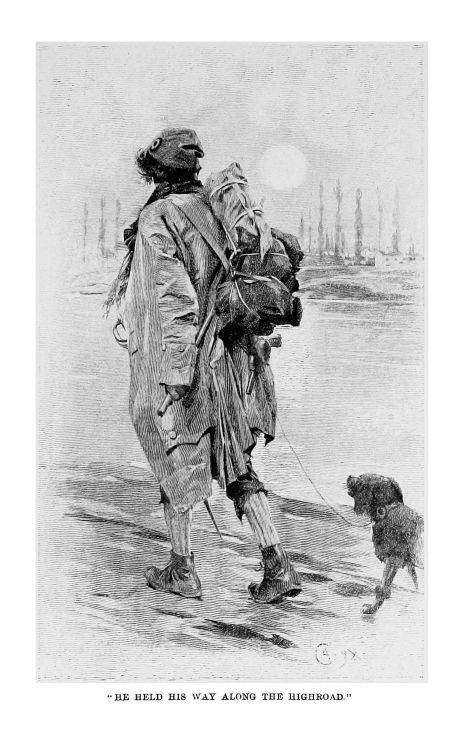
"HE HELD HIS WAY ALONG THE HIGHROAD."
Grégoire was a short, stout man with long hair, a face round, red, chubby, and made expressionless by a button-nose, which was decorated with a large rugose wart. The meal being over, he went out, leaving a soldier at the door, and taking no kind of note of his prisoner. François sat still. He was patient, but the afternoon was long. At dusk Citizen Grégoire reappeared, and, as François noted, was a little more amiable by reason of the vinous hospitality of the mayor. He sat down, and ordered dinner. When it came, François said tranquilly:
"Citizen Commissioner Grégoire, wouldst thou kindly consider the state of my stomach? Swallowing of swords sharpens the appetite."
The commissioner looked up from his meal. He was in the good-humored stage of drunkenness.
"Come and eat," he said, laughing.
"He hath the benevolence of the bottle," thought François. "Let us amuse him."
The commissioner took off his red bonnet, poured out a glass of wine, looked at a paper or two in his hand-bag, and set it on a seat near by, while the juggler humbly accepted the proffered place. Then the poodle was made to howl at the name of Citizen Capet, and to bark joyously at the mention of Jacobins. François told stories, played tricks, and drank freely. The commissioner drank yet more freely. François proposed to make a punch,—a juggler's punch,—and did make a drink of uncommon vigor. About nine the commissioner began to nod, and François, who had been closely studying his face, presently saw him drop into a deep slumber. The open bag looked tempting. He swiftly slipped a dexterous hand into its contents, and feeling a wallet of coin, transferred it to his own pocket. The temptation had been great, the yielding to it imprudent; but there was no one else about, except the careless guard outside the door. François concluded to replace the wallet; but at this moment the great Grégoire of the committee woke up. "That was funny," he said. "I did not quite catch the end of it."
"No," said François; "the citizen slept a little."
Grégoire became angry.
"I—I asleep? I am on duty. I never sleep on duty." The citizen was very drunk. He got up, and, staggering, set a foot on Toto's tail. The poodle yelped, and the Jacobin kicked him. "Sacrée béte!" The poodle, unaccustomed to outrage, retorted by a nip at a fat calf. Then the great man asserted himself.
"Hallo, there! Curse you and your dog! Landlord! landlord!" The host came in haste, and two soldiers. "Got a safe place? Lock up this sc-scoundrel, and k-kill his dog!" The landlord kindly suggested a disused wine-cellar. "Now, no delay. I'm Grégoire. Lock him up!" Having disposed of the juggler, the citizen contrived to get out of the room and to bed with loss of dignity and balance.
A few minutes sufficed to set François in a chilly cellar, the poodle at his heels; for no one took seriously the order to kill Toto. Of the two soldiers, one, who was young and much amused, brought an old blanket, and a lantern with a lighted candle set within it. Yes, the prisoner could have his knapsack and bag—there were no orders; but he must give up his sword. It was so dark that when François promptly surrendered his juggler's blade it seemed to satisfy the soldiers; for who could dream that a man would carry two swords? With a laugh and a jest, François bade them to wake him early. He called to the young recruit, as they were leaving, that he would like to have a bottle of wine, and gave him sufficient small change to insure also a bottle for these good-humored jailers.
They took the whole affair as somewhat of a practical joke. All would be well in the morning. When Grégoire was drunk he arrested everybody. The young soldier would fetch the wine in an hour. Good night.
François was alone and with leisure to consider the situation.
"Attention, Toto!" he said. This putting of thought into an outspoken soliloquy, with the judicial silence of the poodle to aid him, was probably a real assistance; for to think aloud formulates conditions and conclusions in a way useful to one untrained to reason. To read one's own mind, and to hear one's own mind, are very different things.
"Toto," he said, "we are in a bad way. Why didst thou bite that fat beast's calf? It did thee no good, thou ill-tempered brute. 'T is not good diet; a pound of it would make thee drunk. I shall have to whip thee, little beast of an aristocrat, if thou dost take to nipping the calves of the republic."
Toto well knew that he was being scolded. He leaped up and licked the thief's face.
"Down, Citizen Toto! Where are thy manners? I like better Citizen Grégoire drunk than Citizen Grégoire sober. How about my poor papa? Oh, but I was an ass to name Despard. Didst thou observe that the commissioner's eyebrows meet? And, Toto, he has a great wart on his nose. 'T is a man will fetch ill luck. I knew a thief had a wart on his nose, and he was broken on the wheel at Rouen. Besides, there was the wallet. Toto, attention! Thou dost wander. It is all the doings of that sacré marquis. À bas les aristocrates! Let us inspect a little." Upon this he pried about every corner, tried the heavy oaken door, still gaily talking, and at last sat on an empty cask and considered the grated window and the limited landscape dimly visible between its four iron rods. The end of a woodpile, about four feet away, was all that he could see. This woodpile set him to thinking.
An hour later the young recruit returned with the wine. "I came to see if thou wert safe," he said. "Like as not Grégoire will forget all about thee to-morrow. Wine hath a short memory."
François laughed. "Le bon Dieu grant it. I can tell fortunes, but not my own." And should he tell the citizen soldier's fortune? With much laughter it was told, and the gifts of fateful time were showered on the soldier's future in opulent abundance. He would be with the army on the frontier soon. He would marry—dame!—a woman rich in looks and lands. He would be a general one day. And this, oddly enough, came true; for he became a general of division, and was killed the morning after at Eylau. Seeing that this young man had agreeable fashions, the thief ventured to express his thanks.
"Monsieur—" he began.
"Take care! Mon Dieu! thou must not say that; 'citizen,' please. The messieurs are as dead as the saints, and the devil, and the bon Dieu, and the rest."
As he did not seem displeased, François said:
"Oh, thou art no Jacobin. Hast a De to thy name?"
This recruit's manners appeared to François a good deal like those of the young nobles whom he had taught to fence.
"What I was is of no moment," replied the young fellow. "The De's are as dead as the saints. I am a soldier. But, pardon me, the citizen may be as frank as suits his appetite for peril. I have had my bellyful."
"Frank? Dame! why not? Up-stairs I was a Jacobin; down here I am a Royalist. I was an aide in Gamel's fencing-school, and, pardie! I came away. Thou canst do me a little service."
"Can I help thee, and not hurt myself? We—my people—are grown scarce of late. I am the last; I take no risks."
"There will be none. Bring me a little steel fork and a good long bit of twine."
"A fork! What for?" He had a lad's curiosity.
"To eat with."
"But there is nothing to eat."
"Quite true. But it assists one's imagination; and, after all, there may be to-morrow, and to eat with decency a fork is needed. A citizen may use his bare paws, but a monsieur may not use the fingers of equality. Thou wilt observe how the thought of these tools of luxury reminds one of messieurs and the like."
The lad—he was hardly over twenty—laughed merrily. "Thou art a delightful companion. Gamel—thou didst say Gamel?"
"I did, monsieur. Gamel that was the master of arms in the Rue St. Honoré."
"My poor brother used to fence there. By St. Denis! thou must be François!"
"I am."
"Then thou shalt have the tool of luxury. But, good heavens! take care. Thou hast a tongue which—well, I have learned to bridle mine."
"My tongue never got me into trouble; like my legs, it is long, and, like them, it has got me out of a good many scrapes. I thank thee for the warning. One knows whom to talk to. I can be silent. Oh, you may laugh. I did not speak for a day after I first saw that juggler's tool, the guillotine, in the sun on the Place de la Révolution. Dieu! behold there is a man that talks and laughs; and, presto, pass! there is eternal silence."
"Âme de St. Denis! thou art not gay," cried the soldier.
"Tête de St. Denis were better. He was a fellow for these times—a saint that could carry his head under his arm when it was chopped off."
The young recruit laughed, but more uneasily. Not to laugh in some fashion was among the impossibilities of life when this face-quake of mirth broke out between those wing-like ears.
He would fetch the tools, and, in fact, did so in a few minutes. Then he bade François good night, and went away. As soon as he had gone, François retired to a corner with his lantern to inspect the wallet. There were three louis, a few sous, and no more. The risk was large, the profit small. In an inner pocket was a thin, folded paper. When opened it seemed to be a letter in due form, dated a month before, but never sent. It was addressed to Citizen de la Vicomterie of the Great Committee. François whistled. It was a furious attack on Robespierre and Couthon, and an effort to sum up the strength which an assault on the great leaders would command in the Convention—a rash document for those days. Clearly the writer, whose full signature of Pierre Grégoire was appended, had wisely hesitated to send it.
"It seems to have been forgotten. Was he drunk, Toto? Surely now we must get out and away. 'T is a letter of death; 't is a passport worth many louis, Toto." He pulled off a shoe, folded the paper neatly, and pulling up a tongue of leather on the inside sole, placed the letter underneath, and put on the shoe again. He took the louis, threw the wallet under a cask, and waited.
When the house was still he set to work. He had found behind a barrel a long staff used to measure the height of wine in casks. On the end of this he tied securely, crosswise, the steel fork, and then began to inspect the thin rods of the window, which were but ill fitted to guard a man of resources.
"Art still too fat?" he said, as he lifted Toto and managed to squeeze him between the bars. After that he began to fish with his stick and fork for a small log which had fallen from the woodpile and was just a foot or two out of reach. Twice he had it, and twice it broke loose, but now Toto understood, and, seizing the log, dragged it nearer. At last François had the prize. The rest was easy. He set the log between the thin bars, and threw on this lever all the power of one of the strongest men in Paris. In place of breaking, the iron rod bent and drew out of its sockets. A second proved as easy, and at last the window-space was free. It seemed large enough. He concluded to leave his bag; but the knapsack he set outside, and also his weapons and the conjuring-balls. Next he stripped off most of his clothes, and laid these too on the far side of the window. Finally his legs were through, and his hips. But when it came to the shoulders he was in trouble. It seemed impossible. He felt the poor poodle pulling at his foot, and had hard work to restrain his laughter. "Dame! would I grin at Mère Guillotine? Who knows? How to shrink?" He wriggled; he emptied his chest of air; he turned on his side; and, leaving some rags and a good bit of skin on the way, he was at last outside. Here, having reclothed himself, he broke up the wine-measurer and threw the fork over the wall. In a few minutes he was on the highway, and running lightly at the top of his speed. At dawn he found a farm-house which seemed to be deserted—no rare thing in those days. He got in at a window, and stayed for two days, without other food than the crusts he had carried from the cellar. The night after, weak and hungry, he walked till dawn; and being now a good ten leagues from that terrible commissioner, he ventured to buy a good dinner and to get himself set over the Seine. Somewhat reassured, he asked the way to Evreux, and, for once in his life perplexed and thoughtful, went along without a word to Toto.
He had been three weeks on the way, owing to his need to hide or to make wide circuits in order to avoid the larger towns. It was now the February of northern France, and there was sometimes a little snow, but more often a drizzling rain. He had suffered much from cold; but as he strode along, with a mind more at ease, he took pleasure in the sunshine. A night wind from the north had dried the roads. It was calm, cold in the shadows, deliriously warm on the sun-lit length of yellow highway. He had lost time,—quite too much,—but he still hoped to reach Musillon before that man with the wart arrived. If so, he would see Despard, warn him as to Grégoire, and, with this claim, and their old partnership, on which he counted less, he might get his passport altered, and lose himself somewhere. If he had to remain in the town, he must see, or be presumed to have seen, that sick father, and must be promptly adopted if by cruel circumstances he became unable to journey far enough from Paris to feel secure. The distorted face of Amar haunted him—the man who, to save his own life, would not even make believe to forgive. He had no power within him to explain a man like Amar; and because the Jacobin was to him incomprehensible, he was more than humanly terrible. What possessed that devil of a marquis to turn up! And was he now at his château? And why had Achille Gamel set down Normandy in the passport? And why had he himself been fool enough to fill up the vacant place for the name of his destination with that of the only small town he could recall in that locality? He had been in haste, and now a net seemed to be gathering about him. He must go thither, or take perilous chances. He was moving toward a fateful hour.
"Toto," he said, "let us laugh; for I like not the face of to-morrow."
XV
How François finds Despard and has a lesson in politics, and of what came of it.
At evening he ventured to enter an inn at Soluce. A good bed and ample diet restored his courage; but he learned that the citizen with a wart, and an escort of a dozen soldiers, had passed the day before, on their way to Bvreux. Would he remain there, this friendly commissioner? No one knew. Evreux was Jacobin to the core. Then he thought of the marquis; it was well to be informed.
Yes; the Citizen Ste. Luce lived beyond Musillon.
The citizen juggler declared that he had once been in his service, but now that all men were equal, he could not lower the dignity of an equalized nation by serving him longer. He learned that the château of the marquis had not suffered, nor he, as he was never known to be absent, and no one molested him. This did not surprise François. In the South, at an earlier date, the peasants had burned hundreds of châteaux, but these riots had been mercilessly put down. The Jacobins meant to have peace in France, and at cost of blood, if that was requisite. To have peace at home was essential to the success of national defense on the frontier. In many parts of France, throughout the whole of the Terror, very many large land-owners were undisturbed. In fact, the Terror, and its precedent punishments, fell with strange irregularity on the provinces. The Dukes de Bethune-Charost, de Luynes, de Nivernais, and others who had not been active in politics, remained unhurt on their estates. For the émigrés was reserved a bitter hatred. Nor can we wonder at this result of the vast exodus which took place from '89 to '91—"l'émigration joyeuse," as it was called by those who carried off means enough to live gay lives in Brussels while their country was in the convulsions of great social and political change.
François made haste to leave at dawn, and by nightfall was close to the town of Musillon. He found a wood road, and was soon deep in one of the marquis's forests. In a quiet glade among rocks he put his effects in security, and, charging Toto to guard them, set out to inspect the town. The poodle did not like it. He ran back and forth, whining.
"Oh, stop that!" cried François. "Go back! Dost thou hear?"
Toto lay down, and set himself to secure what comfort the situation afforded.
Meanwhile François took to the main road until close to the village, and then left it for the fields, cautiously nearing the town, a small place of some twelve hundred souls. A monotonous double line of scattered one-story stone houses lay along the highway. Avoiding the village, François moved past and around the red-roofed Norman farm-houses which lay off from the main highway. Mounds of earth set around the houses walled in an orchard and an inclosure of many acres, so that, seen from the exterior, they had the appearance of being fortified. The lights were out, and François saw no one. Now and then a sentinel dog barked as the wanderer went by the gateways, in wonder at this unusual style of fence. At last he turned again toward the road.
The town was quiet. It was after nine at night. Having purposely lingered thus long, François approached the back of the inn, and became sure that it was empty of guests. A little beyond it was the village church, and as this was lighted, he approached it with care. The crosses of the burial-ground were gone. He stumbled over graves, and at last, standing on a tomb, got a fair glimpse of the interior of the church, for many of its windows were broken. It was full of people, and the murmur of noisy debate came to his ears. He felt that he must learn what was going on. With this in view, he kept under the deep shadow of the wall, and soon saw that the outer porch was crowded with men and women, listening through the open door. Favored by the darkness, he got unobserved into this mass of deeply occupied people, and was able at last to catch a little of what was going on. Yes; this was the club of Jacobins which his partner Despard had been sent to organize, one of the hundreds which soon conquered and led opinion all through the provinces.
He caught the usual denunciation of émigrés and of the ci-devant aristocrats. He had heard it all before; it did not help him.
Very soon an elderly man in peasant dress arose near the door. He spoke of something which they had considered as well to be done soon. He thought it better to wait until Citizen Commissioner Grégoire arrived. To arrest a ci-devant aristocrat like Ste. Luce was of course proper; but the people were excited, and might do mischief, and they knew that the Great Committee did not approve of riots. France must have rest. These outbreaks had ended elsewhere in the deaths of hundreds of peasants. He bade them wait, and, in fact, spoke with rare good sense. He was roughly interrupted. His speech was received with laughter and contemptuous cries, and, to François's amazement, there was Despard on his feet, not twenty feet away. His old partner was somber-looking and red-eyed, but seemed to have lost his shyness of speech. He broke out into violent invectives, charging the previous speaker with indifference to the good of France. This man was no doubt a traitor. He had been in the service of the ci-devant. He had advised the people to wait. Were they not the rulers? The Jacobin clubs would see to this rat of a commissioner; let him come. Then, leaping on a chair, he began to contrast the luxury in which Ste. Luce lived with the meager life of the peasant. He talked of the great noble's younger life, of his debauchery and hardness. All knew what he meant. Not he alone had suffered. How many of the children men liked to call their own were of noble blood?
His fluent passion, his ease of speech, his apparent freedom from his usual mood of fear, astonished François. At last Despard became more excited, raved wildly, grew incoherent, paused, burst into horrors of blasphemous allusion, and, utterly exhausted, reeled, and dropped into his chair, amid wild applauding cries and a dozen vain efforts of speakers eager to be heard. As if satisfied, the crowd waited no longer to listen, and issued out in just the mood Despard had desired to create. François stepped aside, unnoticed. Among the last, surrounded by a gesticulating group, came Despard, silent, exhausted, his head bent down. A voice cried out: "To-night! Let us do it to-night!" Despard said slowly: "No, not to-night. He is not there—he is not there. Perhaps to-morrow; we shall see. I must have rest—rest."
"Is he mad?" thought François. "Diable! How he hates him! Why is he not afraid?" He had once heard the choir-master tell of a feeble, timid nun who had killed two people; and this man, he supposed, might be, like her, crazed. No matter; he must use him. The crowd dispersed, and, following Despard at a distance, François saw him enter the house of the village priest, who had long since said his last prayer in the garden of the Carmelites.
For an hour, and until all was still, François walked to and fro behind the house. Suddenly a door opened and closed. François moved around the house. He saw Despard go out on the road. After looking about him, the Jacobin walked swiftly away, and was soon past the farthest houses.
"Dame!" said François, "let us go after him. What can he mean? It becomes amusing." Moving with care in the shadows at the side of the road, he followed Despard, who walked down the middle of the highway, now and then stopping short and cracking his finger-joints, as he used to do when worried, or clasping his hands over the back of his neck.
The thief smiled as he went. He was again the savage of the streets, with all his keen wits in play, and vaguely aware of pleasure in the use of his training. He looked about him, or stole noiselessly from one depth of gloom to another across some less shadowed place. He put out with care one long leg and then the other tentatively, like great feelers, and yet got over the ground with speed, as was required, for Despard walked at a rate which was unusual. The great ears of his pursuer were on guard. Once, when Despard stopped of a sudden, François was near enough to hear him crack his knuckles as he pulled at them. As Pierre stood, he threw up a hand as it were in the eager gesture of a speech, or in silent, custom-born attestation of some mentally recorded vow. Then he went onward, silent, and was for a moment lost to view in the aisles of the forest into which he turned. François moved faster, dimly seeing him again. The Jacobin hurried on. The man who followed him was smiling in the darkness, and was feeding curiosity with the keen satisfaction he felt in a chase which was not without a purpose.
Despard seemed to know the great forest well. It soon became more open. He came to a low garden wall, and, climbing it, was heard to tumble on the farther side with a crash of breaking earthenware. He had come down on a pile of garden pots. The thief reflected for a moment that his partner must have lost the agility of his former business, and himself approached the wall with care. Moving to one side, he dropped to the ground, as quiet as a prowling cat.
There was no moon, but the night was clear, and over against the star-lit space he saw the silhouette of a vast château—angles, gables, turrets with vanes. The man whom he hunted moved across the garden, through rose-hedges, under trees, as if reckless as to being heard. Once he fell, but got up without even an exclamation; and so on and on in stumbling haste until he stood upon the broad terrace in front of the building.
François was for a little while at leisure to look about him. Despard, with a sudden movement, strode to the foot of the broad steps which led up to the lofty doorway of the château. Here again he stayed motionless. François, now used to the partial obscurity of the night, took quick note of the white gleam of vases, of a fountain's monotonous murmur, of statues, dim gray blurs seen against the dark wood-spaces beyond; the great size of the house he saw, and that three or four windows showed lights within.
What was Despard about to do? François waited. Then he heard now and then, rising and falling, the faint notes of a violoncello. At this moment he saw that Pierre was gesticulating, and at last caught sound of speech. He was too far away to be clearly seen or distinctly heard. François sat down, took off his shoes, tied them over his neck, and went down on all fours. It was one of his old tricks to amuse thus the children gathered before the show-booth. He could become a bear or an elephant, and knew how to simulate the walk of beasts. Now he approached Despard on his hands and feet, and, seen in the partial gloom, would have seemed a queer-looking animal. A closely clipped row of box lay between them and bordered the broad roadway leading to the portal.
His approach was noiseless. Even if it had not been, it is unlikely that Despard would have noticed it. The quadruped knelt, and set his eyes to see and his ears to hear, being now only six feet away. His own fate was deeply involved. He cared little for the marquis, but up out of the dark of memory came the tender sweetness of the face of the widowed daughter. No word of her brief pleading was forgotten by this man who craved regard, affection, respect, consideration—all that he had not. It was only a flash of thought, and again he was intently receptive.
Despard stood, shaking his arms wildly, looking here and there, up and down. At last he spoke, and so loud that François watched him, amazed at his unnatural lack of caution.
"To-morrow I, Pierre Despard, shall be master. I shall no more be afraid. I shall see thee tremble on the tumbrel. I shall see thee shudder at the knife."
François had an uncontrollable shiver, predictive, sympathetic. Could he trust this creature? There was no help for it. He recalled with a smile one of the Crab's proverbs: "Monsieur Must is a man to trust." She had many and vile sayings; this was one of the few that were not swine-wisdom.
As the man went on speaking, his hands threatened the silent house or snatched at some unseen thing. He stood again moveless for a moment, and then threw out his hands as if in appeal, and called aloud: "Renée! Renée! art thou here? Oh, could he not have spared thee to me—to me, who had so little? And he had so much! Oh, for the name he should have spared thee! For the shame—the shame. Renée, his own child's name. My Renée is dead, and his—his Renée lives; but not long—not long."
"Dieu!" murmured François. "Let him have the man. Dame! I should have killed him long ago."
Pierre was raving, and was only at times to be understood. He seemed to be seeing this lost Renée, and was now rational and again incoherent or foolishly vague.
François hesitated; but at this moment a window on the second floor was cast open, and a man, who may have heard Despard, showed himself. François looked up, and saw a slight figure framed in the window-space clear against the light behind him.
Despard cried out in tones of terror: "The marquis! the marquis!" and, turning, fled down the terrace and along the avenue.
"Queer, that," muttered François. "He is afraid. I must have him." He put on his shoes in haste, and with great strides pursued the retreating figure, hearing, as he ran, the servant crying from the window, "Who goes there?"
A hundred yards away from the house, Despard, terrified at the nearing steps, turned into a side alley, and at last tore through a thicket to the left.
In an instant François had him by the collar. The captured man screamed like a child in a panic of alarm, while François shook him as a terrier shakes a rat.
"Mille tonnerres! idiot, keep quiet! Don't kick; it is no use. Thou wilt have the whole house after thee. 'T is I—François. Keep quiet! Look at me—François. Dost not hear?" At last he was quieted.
"What scared thee, mon ami?"
"I saw him—I saw the marquis! I saw him!"
"Monsieur—the marquis? He is thrice that fellow's size."
They were now seated on the ground, Despard panting, and darting quick glances to right and left like a frightened animal.
"Come, Pierre, tell me what all this means. Art gone clean out of thy wits?"
"Why dost thou ask? Thou dost know well enough. I have waited—waited. Now I have him."
"Dame! Thou? Thou wilt never face him. Thou art afraid."
"I am now. I shall not be to-morrow night. There will be hundreds. I shall look! I shall see!"
"For Heaven's sake," cried François, "talk a little sense. A man who fears a mouse to talk of killing this terrible fellow!"
"The law will kill him, not I. The law—the knife."
"Stuff! A certain commissioner, Grégoire, is after thee, and, worse, after me. He hath a wart on his nose. I ran away to avoid those cursed Jacobins. Passport all right—name of Jean François. Mind thee! My father is old and failing. Thou wilt have to find me a papa. Grégoire has—he has doubts, this Grégoire. So have I. When I told him you were my friend, he shut me up in a cellar, and that I liked not. I was a fool to run away; but, mon Dieu! there was my errand—to see that poor father—all set out on my passport, and the man with the wart inquisitive. I had to get here and find my papa."
Another man's difficulties took off Pierre's mind from his own. He was clear enough now, and asked questions, some hard to answer, but all reasonable.
François related his story. The fencing-master had fallen under suspicion and run away. He, François, likewise suspected, had got a passport from a Jacobin fencing-pupil, and come hither to fall on the neck of his dear friend Pierre. It was neat, and hung together well. It had many omissions, and as a whole lacked the fundamental quality of truth, but it answered. When a man's head is set to save his head, it may not always be desirable to be accurate.
Pierre reflected; then he cried out suddenly: "This Grégoire! That for him! Let him take care. Art thou still a Royalist?"
François was a Jacobin of the best, unjustly suspected. He was eager to know what deviltry was in Pierre's mind as to this marquis; and there, too, was the daughter. If he meant to stir these peasants to riot in order to gratify himself and his well-justified hatred, that might sadly influence François's fate. The central power in Paris was merciless to lawless violence which did not aid its own purposes.
François talked on and on slackly, getting time to think. Pierre's speech had troubled him. He was puzzled as he saw more distinctly the nature of the man whom he was forced to trust. He did not analyze him. He merely apprehended and distrusted one who was to-day a shrinking coward and to-morrow a man to be feared less for what he might do than for what he might lead others to do when himself remote from sources of immediate physical fear. François did not—could not—fully know that he was now putting himself in the power of one who was the victim of increasing attacks of melancholy, with intervals of excitement during which the victim was eagerly homicidal, and possessed for a time the recklessness and the cunning of the partly insane.
"Come," said François, at last; "you must hide me until you can find me that papa, or until Citizen Grégoire has come and gone. I like him not."
"Nor I," said Pierre. "But let him take care; I am not a man to be played with."
François said he should think not, but that if he meditated an attack on that miserable ci-devant yonder, it were better to wait until Grégoire had come and gone.
This caution seemed to awaken suspicion. Pierre turned, and caught François's arm. "Thou art a spy—a spy of the Convention!"
"Thou must be more fond of a joke than was once thy way. Nonsense! I could go back and warn the marquis. That would serve the republic, and well, too; for, by Heaven! if thou art of a mind to burn houses, Robespierre will shorten thee by a head in no time."
"Who talks of burning houses? Am I a fool? I—Despard?"
"No, indeed. Thou—" François needed the man's help, and felt that he was risking his own safety. He must at least seem to trust him. "Dost thou mean to arrest Ste. Luce?"
"I do."
"But when?"
"Oh, in a day or two; no hurry."
François knew that he was hearing a lie. "Good," he said. "But I advise thee against violence."
"There will be none. I control these people. Thou shouldst see; thou shouldst hear me speak."
"Let us go," said François, and they returned to the village without a word on either side. The hamlet was quiet. At the priest's door François said: "Wait for me. I must fetch my bundle and Toto. I left them in the wood." Pierre would wait. In an hour his ex-partner came back, and before he could knock was admitted by the anxious Jacobin.
When they were within the house, he told François that he lived alone. An old woman cooked for him, and came in the morning and went away at dusk. He, François, should have the garret; and, this being settled, they carried thither cold meats, bread, cheese, wine, and water, so as to provision the thief for a few days. There would be time to talk later. François asked a single question, saying frankly that he had heard Pierre speak to his club. Certainly he had power over the people. What was it he had meant to do, and when? Despard hesitated. Then the cunning of a crumbling mind came to his aid, and he replied lightly:
"We shall wait till Grégoire has gone. I told thee so already. Thy advice was good. I do not know. We shall see—we shall see." The door closed after him. The man, descending the stair, paused of a sudden, the prey of suspicion. Why did François come hither? Was he a spy of the marquis—of the Convention? He feared François. To one in his state of mind little obstacles seem large, great obstacles small. He must watch him. He was in his power.
The man left within the room was not less suspicious. He hung a cover over the single window, locked the door, and lay down, with Toto at his feet, and at his side his rapier and pistols. He slept a tranquil sleep. Most of the next day he sat at the window, watching through a slit in the curtain the street below him. People came and went; groups gathered about the desecrated church; there was much excitement, but he could hear nothing. At dusk he saw a number of men, some with sticks and pikes, come toward the priest's house. Owing to his position, he lost sight of them as they came nearer, but from the noise below he presumed them to have entered. He was, for many reasons, indisposed to remain uninformed. He waited. The noise increased. Pierre had not come to visit him, as he had said he would; and where was that much-desired father? He laughed. "Ah, Toto, one must needs be his own papa." He had gone about all day in his stocking-feet to avoid being overheard. Now he bade Toto be quiet, and, opening the door, went cautiously down the stone stairway. It was quite dark. On the last landing he stood, intently listening. The hallway below was full of men, and evidently the two rooms on the ground floor were as crowded. He overheard Despard's voice, angry and strenuous. The words he could not catch, but the comments of those in the wide hall were enough. The commissioner was coming, and would interfere. Despard was right. The marquis was about to fly, to emigrate. He must be arrested. They poured out, shouting, tumultuous, to join the excited mob in the street.
François went quickly up the stair. He cared little for the marquis, but he cared much for the pale lady whose face was stamped in his memory. Moreover, all this ruin and threatened bloodshed were not to his mind. A day's reflection had enabled him to conclude that, between Grégoire and Despard, the situation was perilous, and that he had better disappear from the scene. Meanwhile he would warn the marquis, and then go his way.
He put on his shoes, took his bundle, his arms, and Toto, and, with his cloak on his shoulder, slipped quietly down-stairs. The house was empty. He went out the back way unseen, observing that the church was lighted, and seeing a confused mass of noisy peasants about the door.
XVI
How François warns the Marquis de Ste. Luce, and of the battle on the staircase between the old day and the new.
It was now close to nine, and again a bright, cold, starry night. A long circuit brought him to the highroad. A mile away he struck into a broad avenue, and, never pausing, pushed on. His sense of locality was acute and like that of an animal. Once or twice he was sure that he heard dull noises behind him when the sharp night wind blew from the village.'
"Ah, Toto," he murmured, "keep thou close to heel. This is our greatest adventure. I would we were out of it. Ah, the château!" He ran across the flowerbeds, and with long leaps up the steps, and sounded a strong summons on the knocker of the great door. A servant opened it. "Where is the marquis?" What the man said he did not wait to hear. The lofty hall was dark, but the principal staircase was lighted faintly from above. Without a word, François hurried past the servant and up the stairs. From the broad landing he saw beyond him a lighted drawing-room, and heard the notes of a violoncello. There was the woman, pale and beautiful, in black, her face upturned, the boy holding before her a sheet of music. The human richness of the cello's tones sounded through the great chamber. Where had he seen the like? Ah, that picture in the vestry of Notre Dame—the face of St. Cecilia! He had a moment of intense joy at having come. Till then he had doubted if it were wise. As he stood, the marquis came toward him quickly from the side of the room, and two gentlemen left a card-table and started up.
François went in at once, meeting the marquis within the room. The music ceased; the woman cried, "Mon Dieu!" Every one stared at this strange figure.
"What is it, my man? Venire St. Gris! 't is my thief! This way," and he led him aside into a little room, while the rest, silent and troubled, looked after them.
"Monsieur, to waste no words, these cursed peasants are on their way to do here what mischief the devil knows. It is you they want. There is a fool, one Despard, who leads them. But, Dieu! there is small time to think."
François, breathless, panting, stood looking about him, now as always observant, and curious as to this wonderful room and this impassive gentleman. Toto, as well blown as his master, recognizing the value of a soft rug, dropped, head on legs, meaning to have at least the minute's luxury and rest.
The marquis stood still in thought a moment. "I am greatly obliged to you; and this is twice—twice. I expected trouble, but not so soon. Come this way."
François followed. Toto kept one eye on him, and slept with the other. As they reëntered the great salon, the two gentlemen and Mme. Renée, all visibly agitated, came to meet them. "What is it?" they asked. The marquis forestalled further inquiry.
"My daughter, our kindly peasants will be here in an hour—no, half an hour, or less. Resistance is useless. To fly is to confess the need to fly; it is not to my taste. You gentlemen are better out of this. Go at once—at once!"
"Yes, go!" said madame. "You cannot help us, and can only make bad worse."
They wasted no time, and few words passed. The little drama played itself quickly.
"Adieu, madame!" Madame courtesied. The boy walked over and stood by his grandfather. He looked up at his clear-cut face, with its cold smile, and then at the backs of the retiring gentlemen. He had a boy's sense of these being deserters. They were gone in hot haste.
Mme. Renée came nearer. "We thank you—I thank you"; and she put out her hand. François took it awkwardly. A touch of the hand of this high-bred, saintly lady, grande dame and true woman, singularly disturbed the man. The tremor of a strange emotion ran over him. He let fall the soft hand, and drew himself up to the full of his unusual height, saying: "It is little—very little."
"And now you must go," she said; "and at once."
"Of course—of course," said Ste. Luce. "Out the back way. Victor will show you." There were no further thanks. All such common men had served the great noble; it seemed of the nature of things. But the woman said:
"God protect you! God will know to thank you. I cannot fitly. Go—go!"
"I do not mean to go," said François. "Hark! it is too late." He knew not then, or ever, why he stayed. The boy looked up at him. Here was another kind of man, and not a gentleman, either. Why did he not go?
An old majordomo came with uncertain steps of nervous haste, crying: "The servants are gone, monsieur! The people are coming up the avenue! Mon Dieu!"
"Indeed! Now be off with you, Master Thief."
"No." His head said, "Go"; his heart said, "Stay."
"By St. Denis, but you are a fool!"
François muttered that he had been that always, and then felt the hand of the boy touch his own. He called: "Toto! Toto! We will stay." And the dog, at ease in all society, selected a yet softer rug.
The marquis troubled himself no further as to François. He went out of the room, and was back in a minute, while the uproar increased, and Mme. Renée, at the window, pleaded with the thief, urging him to fly, or cried: "They are coming! Oh, a crowd—a mob—with torches and arms! The saints protect us! Why will you not go? Oh, mon père—father! thou hast thy rapier. What canst thou against hundreds—hundreds?"
The marquis smiled. "Costume de rigueur, my dear. There will be no bloodshed, my child."
"And they will all run," cried the boy. "And if grandpapa has to surrender, he must give up his sword. When my papa was taken in America, he had to—"
"Hush!" said the mother. The lad was singularly outside of the tragic shadows of the hour.
François all this while stood near the window, his cloak cast back, his queer, smile-lit face intent now on the mob without, now on the woman, the boy, the man. "Dame!" he muttered. "We are in dangerously high society." He set his knapsack aside, cast off his cloak, loosened his rapier in its sheath, looked to the priming of his pistols, and waited to see what would happen when this yelling thing out yonder should burst into action.
"They must have made mad haste, madame."
"They are on the terrace. Mother of Heaven!" cried the woman. "They wait! A man is speaking to them. They have torches. Some go—some go to right around the house." A stone splintered the window-glass, and she fell back. "Wretches!"
The marquis turned to her. "Stay here. I go to receive our guests."
"No, no!"
"Do as I tell thee. Be still." She caught the boy to her, and fell into a chair, sobbing. The marquis called to the quaking majordomo: "Take those two candelabra. Set them at the foot of the staircase—the foot." The old servant obeyed without words. The marquis went by him. He seemed to have forgotten François, who glanced at Mme. Renée and followed the master of the house.
There had been a moment's lull outside. The double stairway swept down to a landing, and then in one noble descent to the great deserted hall, where the faded portraits of lord and lady looked down among armor and trophies of war and chase.
"Put those lights there—and there. Get two more—quick! Set them on the brackets below. One must see. Put out the lights in the drawing-room. What, you here yet, Master Thief? What the devil are you doing here? The deuce!" As he spoke they were standing together on the broad landing, before them the great stair which led down to the illuminated hall below. The marquis had meant to meet these people outside; he was quiet, cool, the master of many resources. Surprised at the suddenness of the outbreak, he still counted, with the courage of habit, on his personal influence and address. As the marquis spoke, the roar without broke forth anew. A shower of stones clattered on door and wall and window with sharp crash and tinkle of breaking glass. It was followed by an indescribable tumult—shouts, laughter, the shrill voices of women, a multitudinous appeal to fear, ominous, such as no man could hear unmoved. The animal we call a mob was there—the thing of moods, like a madman, now destructive, now as a brute brave, now timid as a house-fly.
They beat on the great doors, and of a sudden seemed to discover that the servants, in flying, had not secured them. The doors gave way, and those in front were hurled into the hall by the pressure of those behind. In an instant it was half full of peasants armed with all manner of rude weapons. A dozen had torches of sheep's wool wrapped about pitchforks and soaked with tar. Their red flames flared up, with columns above of thick smoke. There were women, lads. None had muskets. Some looked about them, curious. Those without shouted and pressed to get in; but this was no longer easy. A few of the boldest began to move up the lower steps of the great staircase. At the landing above, in partial obscurity, stood the marquis and François. On the next rise behind them were Mme. Renée and her boy, unnoticed, unwilling to be left alone. The stairway and all above it were darker than the red-lighted hall, where ravage was imminent. A man struck with a butcher's mallet a suit of armor. It rang with the blow, and fell with clang and rattle, hurting a boy, who screamed. The butcher leaped on the pedestal and yelled, waving one of the iron gauntlets. They who hesitated, leaderless, at the foot of the dark ascent turned at the sound of the tumbled past.
The marquis cried aloud, "Halt, there!"
Some mischievous lad outside cast a club at the side window of the hall, and the quartered arms of Ste. Luce, De Rohan, and their kin fell with sharp, jangling notes on the floor and on the heads of the crowd.
"Halt, I say!" The voice rang out of the gloom, strong and commanding. The marquis's sword was out. "Draw, my charming thief. Morituri te salutant!"
"What?" cried François—"what is that?"
"Nothing. We are about to die; that is all. Let us send some couriers to Hades. You should have gone away. Now you are about to die."
François drew his long rapier. He was strangely elated. "We are going to die, Toto." The dog barked furiously. "Keep back!" cried his master. Then he heard Pierre Despard's shrill voice cry out: "Surrender, Citizen Ste. Luce, or it will be worse for thee." The mob screamed: "Despard! Despard!" He was hustled forward, amid renewed shouts, cries, crash of falling vases, and jangling clatter of broken glass. The reluctant leader tried to keep near to the door. The mob was of other mind. He was thrust through the press to the foot of the stair, with cries of "Vive Despard! Vive Despard!" The people on the stair, fearing no resistance, were pushed up, shouting, "À bas les émigrés!"
"Now, then!" cried the marquis. "Get back there, dogs!" The two blades shot out. A man fell; another, touched in the shoulder, screamed, and leaped over the balustrade; the rest fell away, one man on another, with shrieks and groans. François caught a lad climbing on the outside of the gilded rail, and, with a laugh, threw him on the heads of those below. A joy unknown before possessed the thief—the lust of battle, the sense of competency. He took in the whole scene, heart, mind, and body alive as never before.
"Sang de St. Denis! You are a gallant man. But we are lost. They will be on our backs in a moment; I hear them." Amid a terrible din, stones and sticks flew. A pebble struck the marquis in the face. "Dame!" he cried, furious, and darted down a step or two, the quick rapier mercilessly stabbing here and there. One madder than the rest set a torch to a priceless tapestry. It flared up, lighting the great space and the stair, and doing in the end no harm. Despard, terrified, was pushed forward to the edge of the fallen bodies on the staircase.
"Surrender!" he called out in a shriek of fear, for here before him were the two men he most dreaded on earth. The noise was indescribable. The butcher beat with the iron gauntlet on a shield beside him; then he threw the steel glove at François. It flew high. There was a cry from the space behind. The little boy screamed shrilly, "They have killed my mama!"
François looked behind him. There was now light enough, and too much. He saw the woman lying, a convulsed, tumbled heap, on the stair. The marquis glanced behind him, and lost his cool quietude. He ran down the stair, stabbing furiously. A half-dozen dead and wounded lay before him. In an instant he was back again beside François, his face bleeding from the stones and sticks thrown at him. François was standing, tall and terrible in his anger, a pistol in his hand.
"Shall I kill him, monsieur?"
"By Heaven, yes!"
The pistol resounded terribly in the vaulted space, and the brute who had thrown the gauntlet, swaying, screamed shrilly, and tumbled—dead.
"Give me your hand!" cried the marquis. "Thank you, monsieur; the devil hath a recruit. Now follow me. Let us kill and die. To hell with this rabble!"
"Wait," cried François, and, running down the steps, put out a long arm and caught Despard. He hauled him savagely after him, calling out, "Hold the stair a moment!" In an instant he was on the landing above, with his prey. His sword he let fall, and set a pistol to Despard's head. The terror of the trapped Jacobin was pitiful. He prayed for life. He would let them all go; he would—he would. François swung him round to face the suddenly silenced mob. "Keep still, or I will scatter your brains, fool! Tell them to go! Tell them to go, or, sang de Dieu! thou art a dead man!"
Pierre screamed out his orders: "Go—go—all of you. I order—go!"
The beast he had trained and led was of no such mind. A man called out, "Die like a man, coward!" A stone or two flew. One struck him. The storm broke out anew.
"Say thy prayers. Thou art dead. Shall I kill him, monsieur?"
"No, no; not that man—not him!"
"Mercy!" screamed Despard.
"The deuce!" laughed François. "It gets warm, monsieur. What to do with this coward? Keep still, insect!"
The mob had for a little time enough of these terrible swordsmen on the stair. It was awed, helpless. Below lay, head down or athwart, three dead men, and certain wounded, unable to crawl. The mob shrank away, and, with eyes red in the glare, swayed to and fro, indecisive, swearing. For a moment no more missiles were thrown. They awaited the expected attack from the rear of the house.
Pierre hung, a limp, inert thing, one arm on the balustrade, the thief's strong clutch on his neck, making his shivering bulk a shield against stick and stone.
"It will soon be over," said the marquis, quietly. "There! I thought so."
A dull roar was heard, and the crash of broken glass from somewhere behind them.
This signal set loose the cowed mob. Clubs and stones flew. Something struck Pierre. He squealed like a hurt animal, pain and terror in the childlike cry. More men crowded in, and the mass, with shout and cry, surged forward, breaking mirrors and vases, with frantic joy in the clatter of destruction.
"It is serious this time," cried the marquis. "Adieu, my brave fellow." Another tapestry flared up, slowly burning. "Let us take toll, François. Come!"
"Good, monsieur! But my fool here—"
At this moment the crowd at the door divided. A dozen soldiers broke in, and with them the man of the wart—Grégoire.
"Dame!" cried François; "the Commissioner Grégoire! The wart! It is time to leave."
"Order, here," shouted Grégoire, "in the name of the law!" The guard pushed in and made a lane. One or two persistent rioters were collared and passed out. A dead silence fell on all. The shreds of the tapestry dropped. The mob fell back.
"Help! help!" cried Pierre.
"Morbleu! dost thou want to die?"
"It is over," said the marquis. "I prefer my peasants."
Grégoire called out, "Where is the mayor?" A reluctant little man appeared.
"Commissioner, these men have slain citizens," he said.
"And they did well. France wants order. Out with you all, or I shall fire on you. Citizens indeed! See to that stuff burning."
The peasants, awed, slunk away. Grégoire coolly mounted the stairs.
"Hold!" cried the marquis.
"I arrest thee in the name of the law! Here is my order."
The marquis took it.
"The light is bad," he said; "but I see it is in good form. The law I obey—and muskets"; and then, in a half-whisper to François: "Run! run! I will hold the stairs."
Grégoire overheard him.
"The citizen émigré! I arrest him!" and he went up a step.
"Back!" cried the marquis, lunging fiercely at the too adventurous commissioner, who leaped down the stairway with the agility of alarm.
"Fire!" he cried.
"Thanks, monsieur; I can help you no more!" cried François. As he spoke, he hurled the unhappy Despard on top of the commissioner. They fell in a heap. The thief, catching up his rapier, was off and away through the drawing-room, seeing, as he went, the woman lying on the floor, her forehead streaming blood. He picked up his cloak and knapsack, and, followed by Toto, ran for his life down a long corridor to the left. At the end, he threw open a window, and dropped, with the dog under his arm, upon the roof of a portico over a side door. No one was near. He called the dog, and fled through the gardens and into the woods of the chase.
XVII
Of how François, escaping, lives in the wood; of how he sees the daughter of the marquis dying, and knows not then, or ever after, what it was that hurt him; of how he becomes homesick for Paris.
The forest was of great extent, and intersected by wood roads. Along one of these François ran for an hour or more, until he was tired, and had put, as he believed, some miles between himself and the citizen with the wart. The way became more narrow, the forest more dense. At last there was only a broad path. Now and then he saw the north star, and knew that he was traveling southward. He came out at dawn on an open space, rocky and barren, a great rabbit-warren, as he knew by the sudden stampede of numberless rabbits. He turned aside into the woods, and a few hundred yards away found a bit of marsh, and beyond it a brook, with leaf-covered space beneath tall plane-trees, now bare of foliage. He drank deep of the welcome water, and sat down with Toto to rest and think.
"Mon ami," he said, "we like adventures; but this was a little too much." Then he laughed at the thought of Pierre's terror; but the man with the wart was not so funny, and the poor lady who was St. Cecilia, and that cold-blooded devil of a marquis—"What a man!"
Here were rabbits for food, and only a forest bed, but, on the whole, better than the Conciergerie or the Châtelet. He slept long, and was cold, fearing to make a fire. About eleven next morning he left Toto, and went with care to the edge of the wood. He heard noises, and saw boys setting traps; for now my lord's rabbits were anybody's rabbits. The traps pleased him. He slipped away. At evening, being dreadfully hungry, he went to the warren, took two rabbits out of the traps, and went back. The man's patience was amazing: not until late at night did he make a fire to cook his meat; but Toto, less exacting, was fed at once with the raw flesh.
A week went by, with no more of incident than I have mentioned. He explored the woods day after day, and a half-mile away found a farm, whence at night he took toll of milk, having stolen a pail to aid him. It was all sadly monotonous, but what else could he do? Once, after a fortnight, he was bold enough to wander in daylight within the woods near the château. It was apparently deserted; at least, he saw no signs of habitation; nor, later at night, when he went back, were there lights, except in one room on the ground floor.
Francis approached with caution, and, looking through a window, saw an old man seated by the fire. Making sure that he was alone, the wanderer tapped on the pane. The man at the hearthside looked up, and François saw, as he had suspected, that he was the majordomo. Again François tapped, and observing the inmate move toward the door, he hurried thither. As they met, François hastened to say that he was the man who aided the marquis, having himself had the luck to escape. Once reassured, the old majordomo urged François to enter. But this he would not do. He had had enough of house-traps. In the forest they would be secure. To this the servant agreed, and followed him at once. When at last in the woodland shelter, François asked: "What of the marquis?" He had been taken by Grégoire toward Paris, but was said to have made his escape. "A hard man to hold is my master; and as to the village, it has had to pay right dearly, too." Pierre had been arrested, but was soon set free. And the little gentleman? He had been taken to a cousin's house in eastern Normandy. François hesitated over his final question; he himself could not have told why.
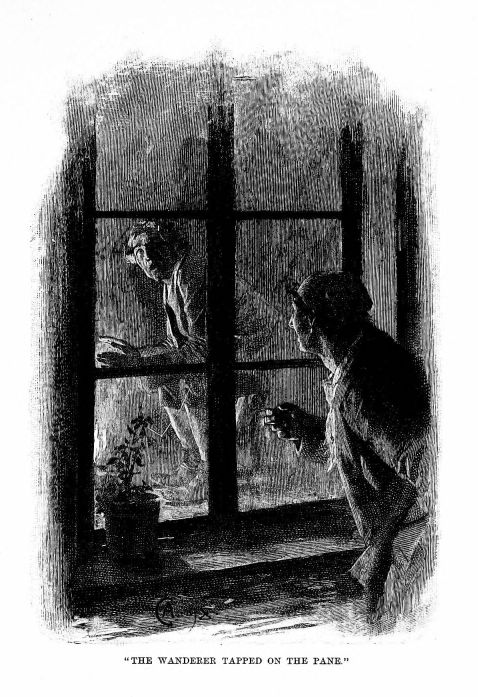
"THE WANDERER TAPPED ON THE PANE."
"And Mme. Renée?" he exclaimed, and bent forward, intent.
"The countess?"
"I did not know. Is she a countess? Mme. Renée—what of her?—she who was hurt. I passed her; she lay on the upper stair. There was blood—blood. The little boy cried to me to help her. My God! I could not. I—tell me, was she badly hurt?"
"She is dying, monsieur. Something—a gauntlet, they say—struck her head. She has known no one since."
"Where is she?"
"In the château, with a maid and her aunt. She was too ill to be taken away. She is dying to-night. They say she cannot last long. God rest her soul! 'T is the end of everything."
The thief stood still a minute; then he said resolutely, "I must see her." This the old servant declared impossible; but when François swore that he would go alone, he finally consented to show him the way, insisting all the time that he would not be let in.
In a few minutes they were moving down a long corridor on the second floor. All was dark until the majordomo paused at a door under which a line of light was to be seen. Here he knocked, motioning his companion to keep back a little. The door opened, and a gaunt middle-aged lady came forth.
"What is it?" she said.
"This man—this gentleman would see the countess."
"What do you want?" she said, facing François. "My niece is dying—murdered. You have done your cruel work. Would you trouble the dead?"
"Madame," said François, "I am he who held the stair with the marquis. I am no Jacobin. I shot the man who wounded the countess."
"You! He is dead."
"Thank God! May I see the lady?"
"She is dying; why should you see her?"
"Madame, I am a poor unhappy thief. Once this lady offered me help—a chance, a better life. I was a fool; I let it go by. I—let me see her."
"Come in," said the gentlewoman; and, with no more words, he entered after her, and approached the bed, leaving his dog outside. What he beheld he neither forgot nor, I believe, save in his memoirs, ever spoke of to any one.
He saw a white face on the pillow; a deep-red spot on each cheek; eyes with the glaze of swift-coming death. He fell on his knees beside her, and stayed motionless, watching the sweat on the brow, the breath quicken and then stop as if it would not come again. At last he touched the hand. It was cold, and he withdrew his own hand, shrinking back. He had seen death, but no death like this. He said, "Madame." There was no answer. He looked up at the older woman. "She is dying; she does not hear."
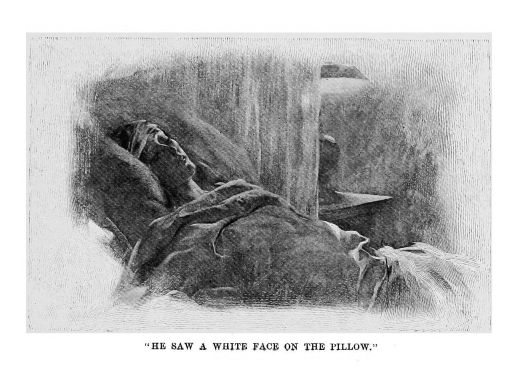
"HE SAW A WHITE FACE ON THE PILLOW."
"No; nor ever will in this world."
He turned, bent down, and kissed the fringe of the coverlet. Then he arose, shaken by the strongest emotion life had brought to him.
"I thank you," he said, and moved to the door. He paused outside.
"Are you sure the beast is dead—the man who did that—that?"
"Yes."
"I am sorry—sorry." He shook his long arms in the air. "I should like now to kill him again—again!" He walked swiftly away, and, not waiting for the servant, left the house and found his way back to his forest shelter.
All night long he sat without a fire, indifferent to poor Toto's efforts to get a little notice, not feeling the cold, a sorely wounded man, with a scar on his memory which no after happiness could ever erase.
The next night he found the majordomo, and learned that the countess was dead. He took away blankets and the provisions bountifully supplied, and once more rejoined his dog.
In this manner the last days of February were passed; and in March the spring began to appear, but with it a new peril. The woodmen went here and there at work, and thrice he narrowly escaped being seen. Early in April his friend the majordomo disappeared, and the great château was infested with men who came and went—for what he knew not.
He began to be troubled with a feverish desire to see the streets of Paris. At last he made up his mind to leave his forest shelter; and sometime in April, having hesitated long, he set out. He hid all day in woods, and walked at night, until he reached the Seine. With this as a guide, he went on, robbing hen-houses of eggs, and milking cows, until he was close to Paris. How to enter it he did not know. The times were doubly dangerous. Spies and suspicion were everywhere to be dreaded. His papers had no certifications from the places he was presumed to have visited. Formidable in the background he saw the man Grégoire, the commissioner with the wart of ill luck.
How the thief and his dog lived near to Paris in woods and fields, there is no need to tell in detail. The month of June was come in this year of 1793. Marat was ill, and Charlotte Corday on her way to forestall the decree of nature. La Vendée was up. The Girondists had fallen, the great cities of the South were in uproar, the enemy was on the frontier, and the rule of France in the competent and remorseless hands of the Committee of Public Safety. All around Paris the country was infested with wandering people who, for the most part, like François, had good reason to fear. There were beggars, thieves, persecuted nobles, those who had no mind to face the foe as volunteers. Now and then François, ever cautious, picked up a little news on a scrap of gazette found by the wayside. He read that Citizen Amar was of the Great Committee of General Security. François laughed.
"Toto, dost thou think this will add to thy master's security? That was the gentleman with the emigrative mouth. Ami, he is still alive. They must be tough, these Jacobins. What fun, Toto! I can see him pinned to the door like a beetle, and that marquis with a face, Toto, like a white plaster cast those Italians used to sell.
"I like not M. Amar. Toto, we are unhappy in our acquaintances. But the man of the wart is the worst." This was François's black beast; why, he could not have said. Amar, le farouche, was really a more fatal foe. The citizen who dressed neatly, and wore spectacles over green eyes, and was in debt to the conjurer for a not desirable forecast of fortune, was a yet more sinister acquaintance. Yet it was Citizen Grégoire who came to François in dreams, and the bare thought of whom could chop short a laugh as surely as Mother Guillotine, the merciless.
XVIII
Wherein is told how François reënters Paris, and lodges with the Crab; and of how Toto is near to death by the guillotine. François meets Despard and the marquis, who warns him and is warned.
A few days later, when lying behind a deserted hut at dusk, François heard a noise of military music, and ventured forth on the road leading to the barrier. Many hundreds of the wounded from the frontier were passing, in wagons or on foot. The communes and clubs were out to meet them. The cabarets outside of the gate poured forth a noisy company. The road was full. Who should stop the free citizens or the ladies of the fish-market, come to welcome patriot volunteers? Here was an escort of troops, wild, triumphant greeting of captured Austrian flags, many wounded in wagons, many more afoot, marching wearily. Those who walked the people must aid. The ranks were soon broken, and all was good-natured tumult. Here was help for heroes—wine, bread, eager aid of an arm. Some who were dragging along on crutches, to get a little relief from jolting wagons, were hoisted, to their discomfort, on the shoulders of friendly patriots not eager to volunteer.
François, tucking Toto under his cloak, edged himself into the broken ranks of the heroes of Hondschoote and Wattignies. "We are many," he said to a man beside him, as tattered as he, for there was scarcely a rag of uniform. "Jolly to get home again!"
"Sacré! not if they guillotined thy father a week ago."
"Dame! is that so? But patience, and hold thy tongue, citizen. Tonnerre! my leg." He was limping.
"Thy shoulder, friend"—to a blouse. "Tiens! that is better. The Austrian bullets have a liking for one's bones. Crack! crack! I can hear them yet. They do not spare the officers any more than they do the privates."
Should they carry the citizen officer—take care of his sword? François thanked them; the citizens must be careful of his leg; and there was François on the shoulders of two big Jacobins, like a dozen more; for it was who should help, and a shouting, good-humored crowd. François was not altogether well pleased at his elevation; he dropped forward his too well-known face. There was a jam at the barrier. Had these citizen soldiers their passes, as provided? François was weak; he suffered, poor fellow! The Jacobins and the women roared derisively: "Passes for heroes?" All order was lost. They were through, and in the Rue d'Enfer. Would the good citizens let him walk? He was heavy, and they were pleased to be relieved of one hundred and ninety-five pounds of wounded hero.
Meanwhile there was some renewed order in the broken formation; yet now and then men fell out to meet sweethearts or friends, usually coming back again to the ranks. The hint was good.
"Ciel! comrade, there is my mother!" The crowd gave way as the hero hobbled out of the line. He called out: "Mère, mère—mother! Here! 'T is I—Adolphe. The deuce! she is so deaf."
Where was she? Citizens were eager to help him.
"Ah," he cried, "she saw me not"; and, turning into a side street near the asylum, limped painfully in pursuit of the mother who was afflicted with deafness. Toto followed. Once around a corner, the lameness disappeared. In the gathering dusk he set out for the Cité.
"It must be Quatre Pattes, Toto. Come along. A bad year, my friend, to have lost a father and a mother. No matter; we are in Paris."
He loved the streets. "Ah, there is Notre Dame and the river!" He was happy, and went along laughing, and at last turned into a small café near to his old home in the Rue des Chanteurs.
He was tired and hungry, and, as he agreeably remembered, well off, having had small chance to spend the money with which he had been generously provided by Achille Gamel. The bread and cheese were good, and the wine was not bad. He asked for tobacco and a pipe. Would the host find him "L'Ami du Peuple"? He was a sublieutenant, wounded on the frontier; but, dame! to get home was happiness.
Two men sat down by him, and talked. Good Jacobins were these, in the dirty uniforms of the sansculotte army which kept Paris in order at the rate of forty sous a day. "Bad wages, citizen lieutenant," they said.
The hero of the frontier was worse off—no pay for three months. He related his battles; and now he must go.
"Come, Toto." Toto had been wounded at Wattignies; he was well now, and would be promoted. "Bon soir, comrades." In fact, he was wildly gay, glad to be back in Paris.
He paused, at last, before a house of the date of Henri II. Its heavy, narrow door, and a slit in the wall for a window, told of days when every man's house was a fortress.
"It is our best chance, Toto; but best may be bad. We must do something." He jingled the bell. The cord was drawn by the concierge within, so as to lift the latch, and François entered the hall. To right was the Crab's den, and there within was Quatre Pattes. He saw the thin purple nose, the bleared red eyes, the bearded chin, and the two sticks.
"Mille tonnerres! my child, it is thou. And where hast thou been? There is no thief like thee. Come and laugh for thy old mother." She welcomed him in thieves' slang, vile, profuse, and emphatic. Had he any money? Yes, a little; business was good in the provinces; and would she house him? Here was a louis d'or for maman; and what was this abominable carte de sûreté, this new trap? She explained. He need have no fear; she would get him one. He had been in bad company, she had heard; for a Jacobin had told her of the fencing-school, and thither, too late, she had gone to get a little help. He had nearly killed Amar, le farouche, and that injured citizen was said to desire his society. But that was long ago; and Paris lived fast, and was gay, and forgot easily.
François had no wish to refresh Citizen Amar's memory. He asked lightly if she had ever seen Grégoire, the commissioner to Normandy?
Mme. Quatre Pattes had never seen him. He was of the Great Committee—a patriot of the best, like herself. Did he know Grégoire? He told her frankly that he had been arrested by Grégoire, and had escaped.
"Thou art the first, my child!" she cried, her jaws champing as if she were eating. "Thou hast a fine taste in the choosing of enemies. I would not be in thy skin for a hundred louis; and now a cat of the night thou must be. I can hide thee awhile; and if thou dost feed me well, the mama-crab will care for thee. No one need know thou art here. Come, get thee a few louis, and we will buy a fine card of safety, and christen thee to suit. Ha, ha! my little one!" and she beat with her sticks on the floor.
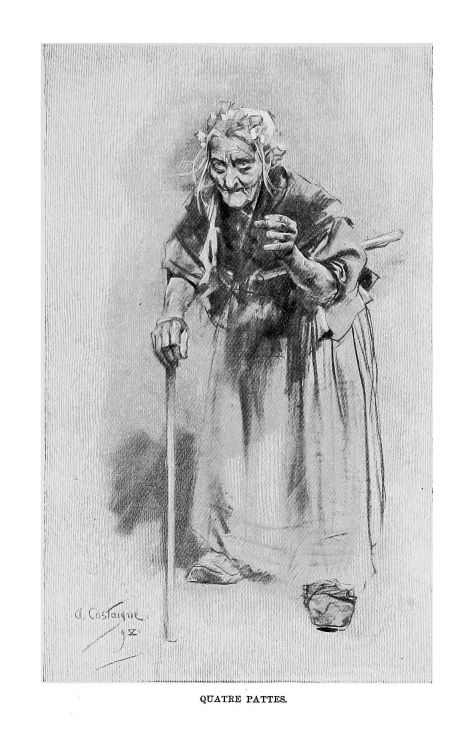
QUATRE PATTES.
Our thief was now back in his garret, having lost as many fair chances of prosperity as did Murad the Unlucky. He reflected much in these late autumn months of 1793, being for his wants rich, and therefore in no necessity to give a thought to methods of getting his daily diet. During the daytime Quatre Pattes insisted on his secluding himself in his garret. At night he left Toto with the Crab, who fed him well, and was therefore liked by a revolutionary dog without prejudices. From these night prowls François returned with sad complaints of the way the republicans guarded their slim purses; in fact, at this time he avoided adventures, stole from no one, and gave of his lessening store what barely contented Mme. Quatre Pattes. Were I to say that his goodness came from newly acquired views of life, I should mislead. He was as honest as ever, which is to say he took no thought at all as to ethical questions. We are said to be children of circumstance, which may be described as the environment of the hour. This is true of the feeble; but character was the more despotic parent in this resolute man, who could wrestle strenuously with circumstance. He was a Royalist because he liked show and color and the fine manners of the great; in the past he stole because he knew no other way to live. His admirable health was a contribution to his natural cheerfulness. He still had simple likings—for the country, for animals, and would have had for books had they been easy to get, or had he known how to get those which would have fed his mind and had sauce of interest.
His surroundings would have surely and hopelessly degraded a less permanent character, and a nature without his ingrained gaiety would have taken more steadily some thought of the far future. He knew too well how the thief's life ended: the galleys, the wheel, the lonely death-bed in the hospital. If he reflected on it at all, as he seems to have done at this time, it was because of his long, weary days in the attic. The immediate future at this period did disturb him, but never long. He liked to talk, and, lacking society, talked more and more to himself aloud, with Toto for an audience which never ceased to attend. He who is pleased with his own talk cannot easily be bored; and so he talked, until Quatre Pattes, who loved keyholes and to listen, thought he must be out of his head. She herself was always either silent or boisterous, and was as to this like other beasts of prey. When in calamity François was too busy to be serious. When at ease the mirthfulness of his natural man forbade argument as to what the dice-box of to-morrow would offer; for to laugh is to hope, and François, as we know, laughed much, well, and often.
There were many times in his life when to have been honestly loved by a woman capable of comprehending both his strength and his weakness would, I think, have given him the chance to live a better life. But how was this possible to one who lived as he lived—who was what he was?
To be merely liked was pleasant to François, and appealed with the most subtle form of flattery to his immense self-esteem. The man was sensitive, and in after days, when in an atmosphere of refinement, would never speak of the terrible women he had known too well in the Cité. Having no longer the distraction of the streets, he was at present condemned to live long hours with no society but that of Toto and the animal Quatre Pattes. He bought a small field-glass, and studied the habits of his neighbors far and near, and once more took interest in the feline owners of the roof-tops. Quatre Pattes fed him well, and brought him some of the old gazettes.
He read how, on that frightful 5th of September, now past, one of the five complementary days of the republican calendar, on motion of Barrere, "Terror" was decreed by the Convention to be the order of the day. It was indeed the birth-hour of the Terror. The Great Committee was in power. The revolutionary tribunals were multiplied. The law of suspected persons was drawn with care by the great jurist Merlin of Douai. Behind these many man-traps was the Committee of Public Safety, with despotic power over the persons of all men, and in full control of the prisons. To it the subcommittees reported arrests; it secured the prisoners who were to be tried; it saw to the carrying out of all sentences; it kept the peace in Paris with an array of sansculottes, and fed the guillotine daily. Of this stern mechanism, strong of head and incapable of pity, was Pierre André Amar; as, one day, François read with his full share of the Terror. There was soon enough of it to supply all France.
Before November came, François, pretending to have been in luck, supplied the Crab with six louis. She exacted two more, and how much she kept none may know. He had very few left.
She was as good as her word. "Here, my little one, is the carte de sûreté from the committee of this section." The description was taken from his passport. He was no more to be François, but François Beau. If he would denounce one or two people, the committee would indorse his card as that of "a good patriot who deserved well of the country." There was the lame cobbler over the way, who talked loosely, and to whom the Crab owed money; that would be useful and convenient. François shivered all down his long back; he would see. Meanwhile, as he considered, Quatre Pattes twisted her bent spine, rattled her two sticks, and looked up at him sidewise with evil eyes, bidding him have a care, and not get his good mama into trouble, or else, or else—François felt that some night he might have to wring that wrinkled neck. He was uneasy, and with good reason.
He could bear the confinement no longer, and in December began to find his cash getting low. He had let his beard grow, and taken to long, tight pantaloons and a red cap. He felt that, come what might, he must take the risks of daylight.
The chances against him were small. The numberless denunciations of the winter fell chiefly on the rich, the rash in talk, the foes of the strong heads who were ably and mercilessly ruling France. The poor, the obscure, and the cautious bourgeoisie were as a rule safe until, in the spring, something like a homicidal mania took possession of Robespierre and others, who, although they were the most intelligent of the Great Committee, were never in control of a steady majority, and began to fear for their own heads.
Outwardly Paris was gay. The restaurateurs made money; the people were fed by levies of grain on the farmers; and the tumbrel, on its hideous way, rarely excited much attention. The autumn and winter of '93 were not without peril or adventure for the thief. The Palais d'Égalité, once royal, was his favored resort, and with his well-trained sleight of hand he managed to justify the name of the place by efforts to equalize the distribution of what money was left to his own advantage and to the satisfaction of the Crab.
The dark drama went on; but, except the tricoteuses who, like Quatre Pattes, went daily to see the guillotine at work, comparatively few attended this daily spectacle. Paris, wearied of crime and too much politics, was tired of the monotony of slaughter, which had now no shadow of excuse.
"Would the citizen miss the death of the Austrian, the ex-queen?" He would not; he knew better than to say no to Quatre Pattes. Would he go with her? She could get him a good place, and all Paris would be there. All Paris was not to his desire. He said he would go alone. A walk with this four-footed creature and the rattle of her becketing sticks he liked not. He called his dog, and, avoiding the vast assemblage on the Place of the Revolution, found his way to the Rue St. Honoré.
He stood in a crowd against a house. The tumbrel came slowly, and, because of the surging mass of people, paused opposite to him. He looked about him. In a group at a window on the far side of the street he saw a man apparently sketching the sad figure in the cart. It seemed devilish to this poor outcast of the Cité. His face flushed; he asked who that was in the window, at which many were staring. The man he addressed was in black, and looked to be an ex-abbé.
"My son," he said quietly, and with no evidence of caution—"my son, 't is David the painter, he of the Great Committee. He hath no heart; but in another world he will get it again, and then—"
"Take care!" said François. The shouting crowd cried: "Messalina! Down with the Austrian!"
François looked, and saw the bent figure seated in the cart. Pale it was, with a red spot on each cheek, haggard; her gray hair cut close, pitiful; with pendent breasts uncorseted, lost to the horrors of the insults hurled at her abject state. François moved away, and the tumbrel went rumbling on. An hour later he was crossing the broad Elysian Fields amid the scattered crowd. It was over, and few cared. The booths were selling toy guillotines. Of a sudden he missed Toto. He called him, and, hearing him bark, pushed in haste into a large tent filled with women and children and with men in blouses.
"The citizen has not paid," cried the doorkeeper. François saw Toto struggling in the hands of a red-bearded man who was crying out: "Enter! enter! Trial and execution of an émigré dog. Voilà, citizens! Range yourselves." There was the red guillotine, the basket, the sawdust, and poor Toto howling. It was a spectacle which much amused the lower class of Jacobins. "À bas le chien aristocrate!"
François advanced with his cheerful smile. "The citizen is mistaken; it is my dog."
"Where is his carte de sûreté?" laughed the man. "Up with him for trial!"
Four monkeys were the judges. Jeers and laughter greeted François: "No, no; go on!"
He caught the man by the arm. The fellow let fall Toto, who made a hasty exit.
"I denounce thee for an enemy of the republic!" cried the showman. "Seize him! seize him!" Francois broke away, and, using his long arms, reached the entrance. There was no earnest desire to stop him. The doorkeeper caught him by the collar. He kicked as only a master of the savate knows how to kick, and, free of the grip, called to Toto, and plunged into a crowd which made no effort to recapture him. He moved with them, and soon turned to cross the river.
Midway on the bridge he came face to face with Despard. He was ragged and fleshless, the shadow of the well-fed Jacobin he had last seen in the château of Ste. Luce.
"Ciel!" exclaimed François, "thou art starved." He had no grudge against his old partner, but he fully appreciated the danger of this encounter.
He was comforted by the man's alarm. "Come," said François, and took him into a little drinking-shop. It was deserted at this time of day. He easily drew out all he desired to know. Mme. Renée was assuredly dead; and he who threw the gauntlet, the butcher, dead also; and three or more on the fatal stairway. Grégoire had punished the village severely; heads had fallen. Pierre's friend Robespierre had abandoned him, had even threatened him—Pierre! but he had escaped any worse fate. He was half famished; and would François help him? François ordered bread and cheese and wine. He would see what next to do. And what of the marquis? He had not appeared in the lists of the guillotined; but he might readily have died unnamed, and escaped François's notice.