THE ADVENTURES OF FRANÇOIS (continued 4)
Reading edition
"No," said Pierre, sadly; "he lives. Of course he lives. The devil cannot die. He got away from Grégoire. Who could keep that man? But for thee and the accursed commissioner, I should have had my revenge. We shall meet some day."
"Shall I find him for thee?"
"Dame! no. Let us go out. I am uneasy; I am afraid."
"But of what?"
"I do not know. I am afraid. I am accursed with fear. I am afraid as a man is in a dream. Somewhere else I shall cease to fear. Let us go." He was in a sweat of pure causeless terror, the anguish of an emotion the more terrible for its lack of reason. It was the inexplicable torment of one of the forms of growing insanity. François looked on, amazed and pitiful. The man's eyes wandered here and there; he got up, and sat down again, went to the door, looked about him, and came back. At last, as François began to consider how to be free of a dubious acquaintance, Pierre said drearily:
"Is it easy to die? I should like to die. If I were brave like thee, I should drown myself."
"Ah, well," laughed François, "there is the guillotine—short and comfortable."
"Thou wilt not denounce me?" he cried, leaping to his feet. "I have my carte; I will let thee see it." He was like a scared child.
"Nonsense!" cried François, with good-humored amusement. "I must go. Here is a gold louis. Why dost thou not rob a few Jacobins?"
"Hush! I dare not; I was brave once. Thou didst save me once; help me now. Thou wilt not let me starve?"
"No, indeed. I? Not I. Take care of thy louis; they are scarce. Meet me here at this hour in a week. Adieu. At this hour, mind."
"Art thou going to leave me alone?"
François was grieved, but could not remain, and hastened away, while Pierre looked after him with melancholy eyes.
"Come, Toto," he said, as he turned a corner. "The man is mad. Let us thank the bon Dieu we never have had a wife; and the rest of our relatives we have buried—papa and mama, and all the family."
It was not in the man to forget, and a week later he cautiously entered the little café to keep his engagement. It was noisy. To his surprise, he saw Pierre declaiming lustily to half a dozen blouses.
"Ah!" he cried, seeing François, "mon ami, here is a seat. There is good news from the frontier. A glass for the citizen." Clink, clink. "À vous*. Death to royal rats!" He went on in a wild way until the workmen had gone, and François stopped him with:
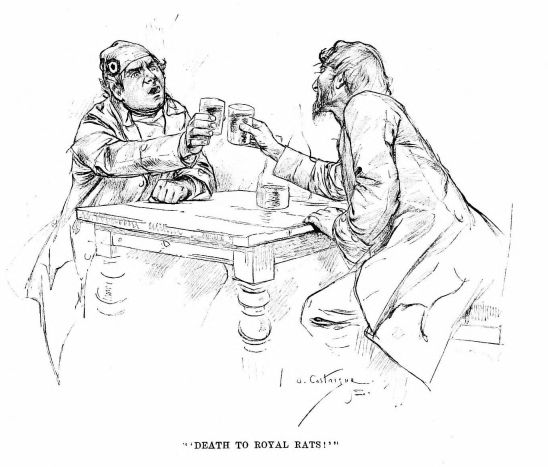
"'DEATH TO ROYAL RATS!'"
"What the deuce has come to thee?"
"Oh, nothing. I have had one of the fits you know of; I am always better after them. Diable! no marquis could scare me to-day. I saw him last week, I did. I followed him. It is he who would have been scared. I—I missed him in a crowd. In a minute I should have had him, like that," and he turned a glass upside down so as to capture a fly which was foraging on the table—"like that," he repeated triumphantly.
François watched him, and saw a flushed face, tremulous hands, staring eyes.
"He is afraid; he can't get out"; and the man laughed low, pointing to his prisoner.
"And thou wouldst have denounced him?" said Francis.
"Why not? He is one of them. He is hell; he is the devil! I saw no officers to help me."
"Thou art cracked; thou wilt denounce me next."
Pierre looked at François with unusual steadiness of gaze, hesitated, and replied:
"I thought of it; you are all for these people."
François, in turn, looked his man over curiously. He had now a queer expression of self-satisfied elation. "A good joke, that," said François. "Wait a moment; I left Toto outside." He went to the door, and looked up and down the street. "Wait," he cried to Pierre. "Hang the dog!" And in an instant he had left the citizen to abide his return. Once in his garret, he cried: "Toto, thou hast no sense. The sane scoundrels are bad enough, but why didst thou fetch on me this crazy rascal? And so the marquis got away, Toto. The man with the wart is not as clever as I thought him. But some folks have luck."
The sad winter of the Terror wore on, while François continued to live unmolested, and pursued his estimable occupation always with an easy conscience, but often with an uneasy mind.
It was near the end of the pleasant month of May, 1794—the month Prairial of the new calendar. The roses were in bloom. The violets were seeking sunshine here and there, half hidden in the rare grasses of the trampled space of the Place of the Revolution. On the six bridges which spanned the canals, its boundaries, children were looking at the swans. In the middle space, the scaffold and cross-beams of the guillotine rose dark red against the blue sky of this afternoon of spring. Two untidy soldiers marched back and forth beside it. The every-day tragedy of the morning was over; why should the afternoon remember? The great city seemed to have neither heart nor memory. The drum-beat of a regiment going to the front rang clear down the Quai des Tuileries. People ran to see; children and their nurses left the swans. The birds in the trees listened, and, liking not this crude music, took wing, and perched on the beams of the monstrous thing in the center of the Place.
François crossed the open ground, with Toto close to heel. The keeper of the little café where he liked to sit had just told him that the citizen with whom he had twice come thither had been asking for him, and that with this citizen had also come once a stout man, who would know where Citizen François lived. This last was of the fourth section, one Grégoire, a man with a wart.
"Thou didst notice the man?" said François, much troubled.
"Notice him? I should think so. Dame! I am of the Midi. A wart on a man's nose is bad luck; the mother of that man saw a cocatrice egg in the barn-yard."
"A cocatrice egg! What the mischief is that!"
"Tiens! if you were of the Midi, you would know. When a hen cackles loud, 't is that she hath laid a great egg; the father is a basilisk."
"Tonnerre! a basilisk?"
"Thou must crush the egg, and not look, else there is trouble; thy next child will have warts, or his eyebrows will meet, and then look out!" François's superstition was vastly reinforced by this legend.
"Mon Dieu!" he cried; "he hath both." This François was a bold man when he had to meet danger face to face, but, like a child as to many things, afraid where a less imaginative man would have been devoid of fear.
Just now he had been turning over in his mind the chance of the Crab's betraying him. She had been prowling about his garret, and had stolen a well-hidden score of francs. He dared not complain. What scant possessions he had would fall into her claws if at any minute she might choose to denounce him. Of late, purses were too well guarded. The display of luxury in lace handkerchiefs and gold seals no longer afforded an available resource. Except Robespierre, who defied popular sentiment, few men carried two watches. Quatre Pattes had the appetite of a winter wolf, and was becoming more and more exacting. She asked why he did not sell his rapier. If it were known that he withheld weapons such as the republic claimed, there might be trouble. Why had he not given up his pistols? They were gold-mounted, and had belonged to a grandee of Spain. Why not sell them? They would fetch a deal of money.
He was not inclined to part with his arms, and least of all with his rapier. At last he gave her one pistol, which she sold; the other he hung high up on a peg set within the chimney, having hidden in its barrel the precious little document he had captured from Citizen Grégoire in that pleasant inn on the Seine, where an agreeable evening had ended with such unaccountable abruptness.
Next to the Crab's treachery, he feared most to meet Despard when the Jacobin should chance to be in one of those aggressive moods which were so puzzling to François. But above all did he dread Grégoire, and grew terrified as he reflected on that business of the cocatrice egg and the basilisk.
It seemed as though he were doomed, and this most cheery of men became distinctly unhappy. "That sacré basilisk!" he muttered, and, less on guard than usual, wandered on, taking stock of his perplexities.
Near to the foundations of the Madeleine, where work had long since ceased, he paused to recreate himself with a puppet-show. The vanquished fiend was Citizen Jean Boule. He was soon guillotined. The crowd was merry, and François, refreshed, contributed his own share of appreciative mirth. In the throng he unluckily set his big foot on the toes of a little Jacobin dressed in the extreme of the fashions these gentry affected. The small man was not to be placated by François's abundant excuses, and demanded the citizen's card of safety. It was an everyday matter. No one dared to refuse. There were half-insane men, in those times, who satisfied their patriotism by continually exacting cards from timid women or from any well-dressed man. To decline was to break the law. François obeyed with the utmost civility. The little man returned the card.
"The citizen is of the best of the sections, but, sacré! he is heavy."
Much relieved, François went on. In the Rue St. Honoré the corner of a lace handkerchief invited a transfer, and lace handkerchiefs were rare. As there was a small, well-occupied group looking through a shop-window at a caricature of Mr. Pitt, the occasion appeared propitious, and the handkerchief changed owners.
A minute later a man touched François's shoulder.
"Thy card, citizen!"
"The deuce!" said the thief, as he turned. "This gets monotonous. Mon Dieu, the marquis!" he exclaimed.
"Hush! Your card. You are followed—watched. There is this one chance." Francis produced his card. The marquis murmured, "Take care; obey me." Holding the card in his hand, he called authoritatively to a municipal guard who was passing. The man stopped, but no one else paused. Curiosity was perilous.
"This good citizen is followed by that man yonder—the one with the torn bonnet. I know the citizen. Here is his card and mine. Just tell that fellow to be careful"; and he slipped his own card of safety into the guard's hand, and under it three louis. The guard hesitated; then he glanced at the card.
"'T is in order, and countersigned by Vadier of the Great Committee. These spies are too busy; I will settle the fellow. Good morning, citizens."
They moved away quietly, in no apparent haste. As they were turning a corner, the thief looked back.
"I am a lost man, monsieur!" He saw, far away, the man of the torn red bonnet, and with him Quatre Pattes. She was evidently in a rage. He understood at once. In the thieves' quarter denunciations were not in favor. She knew too well the swift justice of this bivouac of outcasts to risk being suspected as a traitor to its code. The night before, he had been unable to give her money, and had again refused to sell his weapons. She had angrily reminded him that he was in her power, and he had for the first time declared that he would let the Cité settle with her. He had been rash, and now, too late, he knew it.
He hastily explained his sad case to the disguised gentleman, and was on the point of telling him that this Quatre Pattes was that Mme. Quintette who had once been his agent, and would probably be an enemy not to be despised. He glanced at the marquis, and, wisely or not, held his tongue.
"We must part here," said the gentleman. He had hesitated when chance led him to the neighborhood of the thief in trouble; but he was a courageous man, and disliked to owe to an inferior any such service as François had more than once rendered him. Vadier's sign manual on his own card of safety was an unquestioned assurance of patriotism; it had cost him a round sum, but it had its value.
When he said, "I must leave you," the thief returned:
"I am sorry, monsieur; I know not what to do or where to go."
"Nor I," replied Ste. Luce, coldly. "Nor, for that matter, a thousand men in Paris to-day." He had paid a debt, and meant to be rid of a disreputable and dangerous acquaintance. "Better luck to you!" he added.
"May I say to monsieur, who has helped me, that Despard is in Paris, and has seen him?"
The marquis turned. "Why did not you kill him when you had the chance?"
"You forbade me."
"That is true—quite true. Had you done it without asking me, I had been better pleased."
"I had no grudge against him."
"Well, well, thank you, my man; I can look out for myself."
"Will monsieur accept the gratitude of a poor devil of a thief?"
"Oh, that is all right. One word more. It is as well to tell you, my man, how I came to speak to you. When first I observed you, as I fell behind, I saw that terrible old witch with two sticks pointing you out to the fellow with the torn cap; then he followed you."
"It was Quatre Pattes, monsieur. I lodge in her house."
"A good name, I should say. I wish you better luck and safer lodgings. Adieu"; and he went quietly on his way.
XIX
Of the sorrowful life of loneliness, of François's arrest, and of those he met in prison.
François stood still. He was alone, and felt of a sudden, as never before, the solitude of an uncompanioned life. The subtle influence of the Terror had begun to sap the foundations of even his resolute cheerfulness. It was this constancy of dread which to some natures made the terrible certainties of the prisons a kind of relief. He looked after the retreating figure as it moved along the quai and was lost to view in the Rue des Petits-Augustines.
"Toto," he said, "I would I had his clever head. When 't is a question of hearts, mon ami, I would rather have thine. And now, what to do?" At last he moved swiftly along the borders of the Seine, and soon regained his own room. The Crab would go to the afternoon market; her net swung over her arm at the time he had seen her; and, as she always moved slowly, he had ample leisure.
He packed his bag, and taking from his pistol the paper he had secured when in company with Grégoire, replaced it under the lining of his shoe. Its value he very well knew. After a moment's reflection, he put his pistol back on the peg high up in the chimney. He had been in the house nearly an hour, and was ready to leave, when he heard feet, and a knock at the locked door. A voice cried:
"In the name of the republic, open!" He knew that he was lost.
"Dame! Toto. We are done for, my little one"; and then, without hesitation, he opened the door. Three municipals entered. One of them said:
"We arrest thee, citizen, as an émigré returned."
"Émigré!" and he laughed in his usual hearty way. "If I had been that, no one would have caught me back in France. Ah, well, I am ready, citizen. Here is an old rapier. The woman will sell it; better to give it to thee or to the republic." He took up his slender baggage, and followed them. When they were down-stairs, he asked leave to see the Crab. The guard called her out of her den.
"Chère maman," said François, "this is thy doing. These good citizens have my rapier, and the pistol is gone. Not a sou is left thee. Thou hast killed the goose that laid the golden eggs. Alas!"
The Crab rattled her claws on the sticks, and these on the floor, and spat vileness of thieves' slang, declaring it a wicked lie. Would they take the silver-hilted sword? It was hers, and he owed her rent. At last, laughing, the guards secured the thief's hands behind his back, and marched him away to the revolutionary committee of the section Franklin. Here no time was lost with the émigré, who was sent off in a hurry to the prison of the Madelonnettes, with poor Toto trotting after him, much perplexed by the performance.
François was astounded at the celerity and certainty of the methods by which he, a free Arab of the streets, was thus caged. As usual, it acted on his sense of humor, and before the dreaded sectional tribunal and with the municipals he was courageously merry. When he heard that he was to be sent to the Madelonnettes, he said:
"But, citizens, I am not of the sex. Mon Dieu! the Madelonnettes! 'T is not respectable—'t is not decent"; and he laughed outright. As no man was ever so made as to be protected from the infection of such mirth as the thief's, the judges laughed in chorus. One of them, disturbed in his slumber, awoke, and seeing no cause for this long-visaged flap-ear so to mock the justice of the republic, he said:
"Thou wilt not laugh long, miserable aristocrat!"
This much delighted François. "By St. Jacobus, citizen, I swear to thee I am only an honest thief. I did not expect to be made of the fine nobility by a good democrat like thee."
"Off with him!" said the judge. "They laugh best who laugh last."
"No, no," cried the incorrigible; "they laugh best who laugh most. Au revoir."
"Take him away! The next case."
The thief was gay, and amused the officers; but his keen senses were now all on guard, and, too, like others, he felt relieved at the ending of his life of suspense and watchful anxiety. His misfortune was plainly due to the avarice and needs of the Crab, and to her belief that he had ceased to be available as a means of support.
There was a little delay at the front of the old house of detention; some formalities were to be gone through with. François took careful note of it all. The prison stood in the Rue des Fontaines: a gray stone building, with a lofty story on the first floor, and, above, three stories and an attic; a high wall to left shut in the garden.
On entering a long, dark corridor, his bonds were removed, his bundle was searched, and what little money he had was scrupulously restored to him. He was stripped and examined, even to his shoes; but as the tongue of leather was loose only at the toes, the precious document escaped a very rigorous search. Poor Toto had been left outside, despite François's entreaties. In the cell to which he was consigned were eight straw mattresses. He arranged his small baggage, and was told he was free to go whither he would above the rez-de-chaussée, which was kept for forgers of assignats and thieves. The corridor was some fifty feet long, and smelt horribly. On the main floor was the common dining-room. A separate stair-case led to a garden of considerable size, planted with box and a few quince- and other fruit-trees. At night two municipals guarded this space, while, outside, the steps of sentries could be heard when the hours of darkness brought their quiet. At 9 P.M. the prisoners, who assembled in the large hall, answered to their names; a bell rang, and they were locked in their cells, or slept as they could in the corridors. The richer captives were taxed to support their poor companions, and even to buy and feed the mastiffs which roamed at night in the garden.
Much of all this François learned as he arranged his effects and talked gaily with the turnkey, one Vaubertrand, a watchful but not unkindly little man. Thus informed, François, curious as usual, went down the corridor, and out into the garden. Here were quite two hundred men and women, some in careful, neat dress, many in rags. He saw, as he looked, curés, ladies, seamstresses, great nobles, unlucky colonels, and, as he learned later, musicians, poets; and, to his surprise, for he knew the theaters, actors such as Fleury, Saint-Prix, and Champville, whose delicious laughter the Comédie Française knew so well. Here, too, were Boulainvilliers, De Crosne, and Dozincourt, the ex-kings and heroes of the comic stage; and there, in a group apart, the fine gentles and dames who had exchanged Versailles and the Trianon for this home of disastrous fortunes.
"Yes," said the turnkey; "the citizen is right; 't is a droll menagerie," and so left him.
François looked at the walls and chained dogs, and knew at once that the large numbers in the prison made impossible that solitude in which plans of escape prosper. For a while no one noticed him so far as to speak to him. The ill-clad and poor kept to one side of the garden; on the other, well-dressed people were chatting in the sun. Women were sewing; a young man was reciting verses; and De Crosne, with the child of the concierge on his lap, was telling fairy-tales. Ignorant of the etiquette of the prison, François wandered here and there, not observing that he was stared at with surprise as he moved among the better clad on the sunny side of the yard. He was interested by what he saw. How quiet they all were! what fine garments! what bowing and courtesying! He liked it, as he always liked dress and color, and the ways of these imperturbable great folks. Beyond this his reflections did not go; nor as yet had he been here long enough to note how, day by day, some gentleman disappeared, or some kindly face of woman was seen no more. What he did observe was that here and there a woman or a man sat apart in self-contained grief, remembering those they had lost. The thief moved on, thoughtful.
At this moment he heard "Diable!" and saw the Marquis de Ste. Luce. "What! and have they trapped you, my inevitable thief? I myself was bagged and caged just after I left you. We are both new arrivals. Come aside with me."
François followed him, saying he was sorry to find the marquis here.
"It was to be, sooner or later; and I presume it will not last long. I was careless; and, after all, François, it was my fate—my shadow. A man does many things to amuse himself, and some one of them casts a lengthening shadow as time goes on. The shadow—my shadow—well, no matter. We all have our shadows, and at sunset they lengthen."
"'T is like enough, monsieur. 'T is like me. There is a man with a wart I am afraid of, and it is because of that wart. The man is a drunken fool."
"Despard is my wart," said the marquis, dryly. "As to being afraid, my good François, I never had the malady, not even as a boy."
"Dame! I have it now; and to get out of this is impossible."
"I think so. Did you mention Despard?"
"No; it was monsieur spoke of him."
"Quite true—quite true. He found me at last. Confound the fellow! I did not credit him with being clever."
"So this is his man with a wart?" thought François, but made no comment. He had not fully comprehended the simile with which this impassive seigneur illustrated the fact that but one of his many misdeeds had cast on his future a lengthening shadow of what he would have hesitated to call remorse.
"François," he said, "you and I are new additions to this queer collection. I may as well warn you that even here spies abound. Why? The deuce knows. Barn-yard fowls are not less considered than are we. It is the tribunal one day; then the Conciergerie; and next day, affaire finie, the business is over. Meanwhile, you are in the best society in France. There are M. de la Ferté, the Comte de Mirepoix, the Duc de Lévis, the Marquis de Fleury. I used to think them dull; calamity has not sharpened their wits. Diable! but you are welcome." The marquis had all his life amused himself with small regard to what was thought of him or his ways of recreation. "'T is a bit of luck to find you here in this hole." François could hardly agree with the opinion, but he laughed as he said so.
"Here comes my old comrade, De Laval Montmorency. He is still a gay jester. He says we are like Saul and that other fellow, Jonathan, except that in death we shall both of us to a certainty be divided."
"Ciel! 't is a ghastly joke, monsieur."
"It has decidedly a flavor of the locality. I must not play telltale about you, or they will put you in the rez-de-chaussée, and, by St. Denis! I should miss you. I shall have a little amusement in perplexing these gentlemen. Your face will betray you; it used to be pretty well known. However, we shall see."
The nobleman last named threaded his way through the crowd, excusing himself and bowing as he came.
"Ah," he said, "Ste. Luce, another new arrival. The hotel is filling up. Good morning, monsieur. Grand merci! 't is our old acquaintance who used to tell fortunes on the Champs Elysees; told mine once, but, alas! did not warn me of this. Well, well, we have here some queer society. Take care, Ste. Luce; this citizen may be a spy, for all thou knowest. I assure thee we have to be careful."
"I—I a mouchard—a spy?"
"M. de Montmorency has no such idea," said Ste. Luce. "I shall ask him to respect your desire to be known by a name not your own. Permit me to add that I have less reason to thank some of my friends than I have to thank this gentleman. He is pleased to have mystified Paris for a wager, or no matter what. Just now he is—what the deuce is it you call yourself at present?"
François was delighted with the jest. "Allow me, monsieur, to pass as Citizen François. My real name— But you will pardon me; real names are dangerous."
"And what are names to-day," said the marquis, "thine or mine? My friend here—well, between us, Montmorency, this is he who held the stair with me in my ci-devant château. Thou wilt remember I told thee of it. A good twenty minutes we kept it against a hundred or so of my grateful people. He is the best blade in Paris, and, foi d'honneur, that business was no trifle."
"Who you are, or choose to be, I know not," said the older noble, "but I thank you; and, pardieu! Ste. Luce is free with your biography."
This was François's opinion.
No one knew distinctly who was this newcomer, concerning whom, for pure cynical amusement, Ste. Luce said so much that was gracious. Any freshly gay companion was welcomed, if his manners were at all endurable. The actors and actresses were pleasantly received. The few who remembered the long face, and ears like sails, and the captivating laugh of the former reader of palms, were so bewildered by Ste. Luce's varied statements that the poor thief found himself at least tolerated. He liked it. Nevertheless, as the days went by, and while seemingly the gayest of the gay, François gave serious thought to the business of keeping his head on his shoulders. He told fortunes,—always happy ones,—played tricks, and cut out of paper all manner of animals for the little girl, the child of the turnkey. Toto he gave up for lost; but on the fourth day the dog, half starved, got a chance when a prisoner entered. He dashed through the guards, and fled up stairs and down, until, seeing his master in the big hall, he ran to him, panting. The head jailer would have removed him, but there was a great outcry; and at last, when little Annette, François's small friend, cried, the dog was allowed to remain.
He was, as the marquis declared, much more interesting than most of the prisoners, and possessed, as he added, the advantage over other prisoners of being permanent. In fact, they were not. Every day or two came long folded papers. The ci-devant Baron Bellefontaine would to-morrow have the cause of his detention considered by Tribunal No. 3. Witnesses and official defenders had been allowed; but of late, and to émigrés, these were often denied. Also, witnesses were scarce and easily terrified, so that batches of merely suspected persons were condemned almost unheard. To be tried meant nearly always the Conciergerie and death. All cases were supposed to be tried in the order of their arrests; but great sums were spent in paying clerks to keep names at the foot of the fatal dockets of the committee. The members of this terrible government survived or died with much judicial murder on their souls; but countless millions passed through their hands without one man of them becoming rich. Elsewhere, with the lower officers, gold was an effective ally when it was desired to postpone the time of trial.
XX
Of how François gave Amar advice, and of how the marquis bought his own head.
It was now about May 26, when, at evening, a commissioner in a cocked hat, much plumed and scarfed, came into the dining-hall. Toto was between his master's knees, and was being fed. François heard a gray-haired old lady exclaim to a neighbor: "Mon Dieu! chérie, look! 'T is the Terror in person."
The actor Champville cried out gaily: "I must practise that face. 'T is a fortune for the villain of a play. If ever I get out, it will be inestimable." Alas! he was in the next day's list,—the corvée, they called it,—and came no more to table. François looked up, caught a glimpse of that relentless visage, and dropped his head again over the slender relics of a not bountiful meal. It was Jean Pierre Amar!
The marquis looked up from his plate, but made no effort to conceal himself. Amar walked around the table. Now and then his mouth wandered to left. It was comical, and yet horribly grotesque. He seemed to notice no one, and went out to make his inspection. Presently a turnkey came and touched François's shoulder.
"The citizen commissioner would see thee."
"I am ruined—done for!" murmured the thief; and, followed by Toto, he went after the turnkey. In the room used as a registering-office, Amar, le farouche, sat handling a paper.
"Ah!" he said. "Citizen turnkey, leave the suspect with me, and close the door." The commissioner laid a pair of pistols on the table, and looked up at François.
"Well, citizen, we are met again. I am free to say that I had careful search made for thee, and now good fortune has brought hither not thee alone, but that infernal ci-devant who pinned me like a butterfly." As he spoke there was something fascinating in the concentration of emotion on the active side of this unnatural face. François felt the need to be careful.
"Why the devil don't you speak?"
"Will the citizen kindly advise me what answer it will be most prudent to make?" And for comment on his own words, which altogether pleased him, a pleasant smile drifted downward over his large features.
"Sacré! but thou art a queer one, and no fool," said the Jacobin. "Thou wilt be dead before long; a monstrous pity! I would give my place for thy laugh."
"'T is a bargain to my mind. Let us change. I shall set thee free at once—at once, citizen commissioner; I bear no malice."
Amar, silent for a moment, stroked his nose with thumb and finger.
"Thou dost not remind me thou didst save my life."
"No; what is the use?"
"Use? Why not?"
"Because men like the citizen commissioner do not lightly change. I have a too plain recollection of what I was promised in return for my benevolence. I should regret it except for—"
"For what?" said Amar.
Then François rose to the height of his greatness.
"I am a Frenchman, even if I am not of thy party. Had not the country needed thee, that day had been thy last. Citizen, as a man thou wouldst set me free; as a patriot thou wilt bow to the law of the republic. I am willing to die rather than soil the record of one to whom France owes so much." An overwhelming solemnity of aspect came upon this comedian's face as it met the gaze of the commissioner. "Alas! the country has few such citizens."
"Tonnerre! True—true; it is sad." The man's vanity was excelled only by that of the prisoner before him. François had personal appreciation of the influential value of the bait he cast. A great diplomatist of the older type was lost when François took to the war against society in place of that against nations.
"If the citizen commissioner has no more need of me, I will go! To waste his time is to waste the genius of France." Not for nothing had François been of late in the society of the Comédie Française.
"Tiens! Who told thee to go? I desire to do my own thinking. Why art thou here?"
François laughed, but made no other reply.
"Young man, art thou laughing at the Revolutionary Tribunal?"
"Thou art also laughing, monsieur." When François laughed, he who looked at him laughed also.
"Diable! yes. What right hast thou to make an officer of the Great Committee laugh? Thou wilt get into trouble."
"I am in it now, monsieur—up to the neck."
"No 'monsieur' to me, aristocrat! What brought thee here?"
'"A greedy woman denounced me. Could not I denounce her in turn?"
"Mort du diable! that is a fine idea—to let the denounced also denounce. It would make things move. I will mention that to Couthon." The half of the face that was able to express emotion manufactured a look of ferocious mirth; but it was clear that he took the proposition seriously.
"It appears that we do not go fast enough, citizen," said François. "In April, 257; in May, so far, only 308. So say the gazettes. What if we denounce Citizens Robespierre and Vadier? We might go faster. Let us denounce everybody, and, last, the devil."
Amar set an elbow on the table, and, with his chin in his hand, considered this novel specimen of humanity.
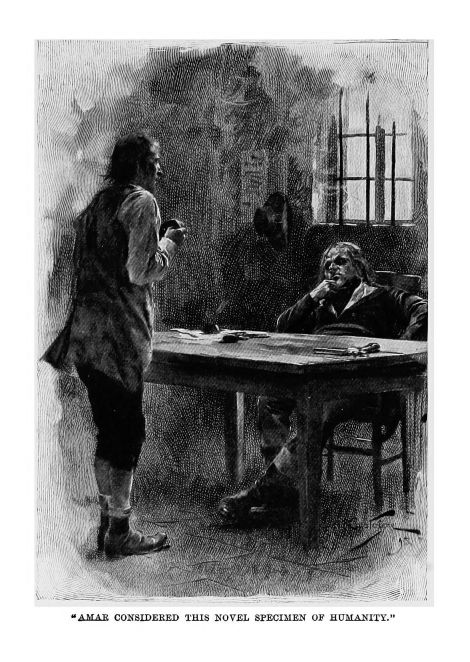
"AMAR CONSIDERED THIS NOVEL SPECIMEN OF HUMANITY."
François had a controlling idea that what chance of safety there was lay in complete abandonment to the natural recklessness of his ever-dominant mood of humor.
"Art thou at the end of thy nonsense, idiot?" said the Jacobin.
"Not quite; the citizen might denounce himself."
"By all the saints! Art making a jest of me—me, Jean Pierre Amar? Thou must value thy head but little."
"Dame! it was never worth much; and as to saints, one Citizen Montmorency said yesterday that the republic hath abolished the noblesse of heaven and earth too. Droll idea, citizen"; and he laughed merrily.
"Oh, quit that infernal laughing! Thou must be of the Comédie Française."
"No; I am of the comedy of France, like the rest—like the commissioner; but the citizen has two ears for a joke."
"I—I think so"; and he made it manifest by a twisted, unilateral grin of self-approval. "That idea of the citizen—prisoners denouncing—I shall not forget that. Wilt thou serve the republic?"
"Why not?"
"These common spies in the prisons are useless. I will put an 'M' to thy name on our list; 'M' for mouchard—spy. That will put thee down at the bottom whenever the Committee of Safety comes to thy case. I am not ungrateful."
"Very good," said François, promptly. "I am as honest a Jacobin as the best. I will serve the republic, citizen, to the best of my ability."
"Then thou wilt report once a week, especially on the ci-devants. The head keeper will give thee pen, ink, and paper, and a chance to write here alone. I will so order it. But beware, citizen! I am not a man to trifle with; I do not forget.'7
"I should think not," said François, humbly.
"And when Grégoire comes, in June, thou wilt report to him."
"I—Grégoire—report—"
"Certainly. What's the matter? Off with thee now. Ah, that sacré Citizen Ste. Luce! I forgot him. Tell him his case will come on shortly."
"I am sorry."
"That is to lack patriotism."
"But he and De Crosne are the only people who amuse me, and it is dull in this bird-cage. He swears thou art clumsy with the small sword."
"I—I clumsy! I should like to catch him somewhere. I was too fat; but now!" and he smote his chest. "Didst thou think me clumsy—me, Pierre Amar?"
"I? No, indeed. These aristocrats think no one else can handle a rapier. Ah, if I could fence with the citizen commissioner a little, and then—"
"Impossible."
"He swears thou art coward enough to use the guillotine to settle a quarrel, and that thou dost fence like a pigsticker."
Amar, le farouche, swore an oath too blasphemous to repeat. The great thick-lipped mouth moved half across so much of his face as could move at all. He was speechless with rage, and at last gasped, as he struck the table: "Me—Amar? Ah, I should like well to let him out and kill him; and I would, too, but there are Saint-Just, and Couthon, and the rest. Go; and take care how thou dost conduct thyself. Go! The sacré marquis must take his chance. Pig-sticker indeed!"
Thus terminated this formidable interview; but, alas! it was now close to the end of May, and in the background of June was the man with the wart.
The next day, in the garden, Francis related to the marquis his interview with the dreaded Jacobin. The gentleman was delighted.
"Mon Dieu! François, you are a great man; but I fear it will do no good; my turn must be near. De Crosne and poor Fleury got their little billets last evening, and are off on a voyage of discovery to-morrow, along with M. de la Morne, and De Lancival, and more. They will be in good society. Did you think that Jacobin Apollo would be pricked into letting me out for the chance of killing me?"
"It came near to that, monsieur. I did say that you were not much of a blade, after all; that Citizen Amar was out of condition when you last met; and that if he and I could fence a little,—outside, of course,—M. le Marquis would regret the meeting."
"Delicious! And he took it all?"
"Yes, as little Annette takes a fairy-tale of M. Fleury's—who will tell no more, poor fellow!"
"But, after all, we are still here. I envy you the interview. Parbleu! these fellows do their best, but they can't take the jests out of life. I hope the next world will be as amusing."
As he ceased, François exclaimed:
"By all the saints! there is that crazy fool Despard."
"Despard—Despard?" repeated the marquis. "That is a contribution to the show. How the mischief did he get here?"
The unlucky Jacobin was wandering about like a lost dog, a shabby, dejected figure. Toto, at play, recognized his master's former partner, and jumped up in amiable recognition. Despard kicked him, and the poodle, unaccustomed to rude treatment, fled to François. The thief's long face grew savage and stern; to hurt Toto was a deadly offense.
"Pardon, monsieur," he said to the marquis, and went swiftly to where Despard stood against the wall.
"Look here, rascal," said François; "if ever thou dost kick that dog again, I will twist thy neck."
Despard did not seem to take in his meaning.
"It is thou, François. There is the ci-devant—the marquis. I followed him. I—Pierre Despard—I denounced him. I did it. I am not afraid."
"Stuff! Didst thou hear me? What have I to do with ci-devant marquises? Thou hast kicked Toto."
"I see him; I must speak with him."
"Fichtre! he is mad," said the thief, and went after him.
At the coming of Despard, ragged, wild-eyed, excited, the group about the tall gentleman turned.
Despard paused before him. "It is my turn now! I followed—I followed—I denounced thee—I, Pierre Despard. They will let me out when thou art to die; it will be soon. I will take thy child—thy bastard—my wife's child. We will go to see thee—I and thy hunchback—to see thee on the tumbrel at the guillotine. She hath thy own cold eyes—frozen eyes. Thou wilt know her by those when thou art waiting—waiting—shivering."
The marquis listened with entire tranquillity.
"One or two more in the audience will matter little"; and, smiling, he walked away.
A strange tremor seized on the chin and lower lip of Despard. He said to François, "Come with me," and then, in a bewildered manner, "He isn't afraid yet. I—I want him to be afraid."
"Dame! thou wilt wait then till the cows roost and the chickens give milk."
"No; it will come."
"Stuff! How camest thou here? Didst thou denounce thyself? I have heard of men mad enough to do that."
"No. Do not tell. I trust thee; I always did trust thee. I am a spy. I am to stay here till I want to be let out, when he—he is tried. I wanted to watch him. Some day he will have fear—fear—and—I—"
"Well, of all the mad idiots! A mouse to walk into a trap of his own accord! Dieu! but the cheese must have smelt good to thee."
"I shall go out when I want to go. Didst thou know his daughter is dead? I am sorry she is dead."
"Yes—God rest her soul!"
"I am sorry she is dead because she cannot be here. I wish she were here. If only she were here, it would be complete. Then he would be afraid."
"Bon Dieu!" cried several, "he will kill him!" The thief had caught Pierre by the throat, and, scarce conscious of the peril of his own strength, he choked the struggling man, and at last, in wild rage, hurled him back amid a startled mass of tumbled people.
"Beast!" muttered François, at his full height regarding angrily the prostrate man.
In an instant the jailers were at his side. "What is this?" said they.
"He—he kicked my dog!"
"Did he? Well, no more of this, citizen."
"Then let him be careful how he kicks my dog; and take him away, or—"
Pierre needed no further advice.
Presently Ste. Luce came over to François.
"What is wrong?"
"He kicked my dog!"
"Indeed? Do you know this man well? Once you warned me about him. Where have you met?"
"We juggled together, monsieur, when I used to read palms. He is a bit off his head, I think."
"'T is common in France just now, or else the reverse is. But he has a damnably good memory. We of Normandy say, 'As is the beast, so are his claws.' The fellow is of good blood in a way; but, mon Dieu! he is a coward to be pitied. To be through and through a coward does much enlarge the limits of calamity. If I or if you were to hate a man, for reasons good or bad, we would kill him. But a coward! What can he do? He has his own ways, not mine or yours. His claws are not of the make of mine. I have no complaint to make as to his fashion of revenging himself; but really, revenge, I fancy, must lose a good deal of its distinctness of flavor when it waits this long. It is, I should say, quite twelve years—quite. There is a child, he says, or there was. Do you chance to know anything about it?"
"Yes."
"Did you ever see it? Is it male or female?"
"A girl, monsieur. I never saw it."
"How old?"
"I do not know."
"Penitence becomes a question of dates, François. But it is true—true that I never had the least talent for regret; and if a man is not capable of regret, why, François, how the deuce can he achieve penitence? Don't think I am joking, my most accomplished thief. There are men here who—there is M. de—well, no matter. There are men here who are honestly bewailing their past—well, amusements—sins, if you please. I cannot. There are some here who, because they are noble by descent, are making believe not to be afraid, and will make believe until the knife falls. I am not penitent, because I am not; and as to the knife, I have had a most agreeable life, and should never have gone on living if life had ceased to amuse me."
He was now silent awhile, his strong, handsome features clear to see, as they lay on the scant grass in the sunshine. The thief had learned that at times this great seigneur would talk, and liked to do so; and that at other times he was to be left to the long silences which were difficult to secure where this morbidly gay crowd, of all conditions of men, was seeking the distraction of too incessant chat.
He rose quietly, and went away to talk with Domville of the Comédie, who himself was always glad of the company of François's cheery visage.
In the salon, which was now deserted, he saw Despard. Pierre stood at an open window, and was pulling at his fingers, as François had so often seen him doing. He was gazing at the people in the yard. His eyes wandered feebly here and there, as if without interest or purpose. His attitude of dejection touched some chord of pity in his partner's heart.
"Dame! he must have thought I was rough with him for a dog—a dog." He had no mind to explain.
Pierre turned to meet him. He was not angry, nor was he excited. The shifting phases of his malady had brought to him again the horrible misery of such melancholy as they who are sound of mind cannot conceive. When this torture has a man in its grip, the past is as nothing; the present a curse; duty is dead; the future only an assurance of continued suffering; death becomes an unconsidered trifle; life—continued life—an unbearable burden.
Poor Pierre said no word of his ex-partner's recent violence. The tears were running down his cheeks. The man at his side was, as usual, gaily cheerful.
"What is wrong with thee?" said François. "I was hard on thee, but thou knowest—"
"What is it?" replied Pierre. "I—it is no matter."
François, surprised, went on: "Can I help thee?"
"No. I cannot sleep; I cannot eat. I suffer. I am in a hell of despair."
"But how, or why, mon ami?"
"I do not know. I suffer."
"Rouse up a bit. Why didst chance to come here? I asked thee that before. If thou canst get out, go at once. Thou art not fit to be in this place. This devil of a marquis excites thee. To be a spy thou shouldst be ashamed. Canst thou really get out when it pleases thee to go?"
"Why not?" said Pierre, in alarm. "Dost thou think they will not let me go? I did not want to be a spy, but I was half starved. All I could get I sent to keep my—his poor little hunchback. Vadier lent me some money. I kept none, not a sou. I asked him to let me come here as a spy. They say my reports are useless. I can't help that. I will go out. I want to see that man suffer; I want to see him afraid. He is not afraid. Dost thou think he is afraid?"
"No."
For a moment there was a pause, when Pierre, in a quiet, childlike manner, said: "Dost thou think he ever will be afraid?"
"No, Pierre; he never will be. What a fool thou art to have come here! 'T is not so easy to get out."
"Mon Dieu! don't say that. I—they said—"
"Dost thou believe a Jacobin—and Vadier, the beast, of all men?"
"Hush!" said Pierre, looking about him suspiciously. "I must go—I must go. I must walk; I cannot keep still."
He remained in this mood of subdued terror and the deepest melancholy for some days. Then for a few hours he followed the marquis about, proclaiming his own wrongs in a high-pitched voice. At last Ste. Luce complained to the keeper, Vaubertrand, who hesitated to interfere, being puzzled and fearful as to the amount of influence possessed by this spy of the Committee of Safety. He mustered enough courage at last to tell Despard that he must not speak to the marquis; and, as he luckily caught him in his mood of despair and depression, the man timidly promised to obey.
XXI
How François, having made a bargain with Citizen Amar, cannot keep it with the man of the wart—How Despard dies in the place of the marquis—Of François's escape from prison.
The second week of June was over. The keeper, who had taken a fancy to the merry thief, called him aside one afternoon, and said:
"Thou must write thy report, because to-morrow comes Citizen Grégoire. Thou canst use the office for an hour, as is permitted. But take care. Thou dost know how they are treated in the prisons who are suspected of making these reports to the committee. I will come for thee at dusk."
François thanked him, and at the time mentioned was locked up in the office; for despite Vaubertrand's amiability, he was careful as to the security of his prisoners. As it was now dark, the office table was lighted by two candles. He found pen and ink and paper, but no competent thoughts. What was he to say—whom to accuse? He had made a hasty contract with Amar, and was of no mind to fulfil his share of it. He got up from the desk, and walked about. "The deuce!" he said to Toto, who never left him. "'T is a scrape of our own making. I should have told that scamp with the pretty face to go to the devil with his spy business. Sacristie! doggie, I am like that fellow in the play I once saw. He sold his soul to the devil, and didn't want to pay up when the time came. What to do?" He had told the marquis, whom he trusted, of the difficulty he anticipated.
Ste. Luce, much amused, said: "Take me for a subject. I am as sure to die as an abbot's capon. If you have a conscience, it may rest easy so far as I am concerned."
François took it seriously. "I beg of you, monsieur—"
"Oh, a good idea!" laughed the nobleman, breaking in upon his remonstrance. "Tell them how you saw me kill three good citizens that night on the stairs. By Mars! François, those twenty minutes were worth living for. I was in a plot to rescue the king; tell them that."
"Not I," grinned the thief.
"Confound it! you are difficult."
And now, as François recalled their talk, his task was not more easy. He nibbled the end of his quill, and looked around him. At last, as he walked to and fro, he began to exercise his natural inquisitiveness. It was never long quiet. He stared at the barred windows. A set of pigeonholes attracted him. He glanced hastily over their contents. "Tiens!" he exclaimed.
Every day or two, about 3 P.M., a clerk of the Committee of Safety brought a great envelop stamped with the seal of the republic. Within was a paper on which were clearly set out the names and former titles of the citizen prisoners selected for trial the night before in joint counsel by the Great Committee and that of Security. The keeper copied each name on to the space in the blank summons kept for this use, and these fatal papers were then duly delivered after supper.
François looked at the packet. It was sealed. He knew well what it meant. It was labeled: "Mandate of the Tribunals Nos. 4 and 5."
"Toto, we may be among them; we must see." He looked about him. Here were all the writing-table implements then in use. He heated a knife, and neatly loosened the under wax of the seal. The death-call lay before him. He ran over it with shuddering haste.
"Dieu! we are not there. But, mon ami, here is the marquis!" His was the last name at the foot of the first page. François sat still, his face in his hands. At any moment he might be caught. He did not heed.
"I must do it," he said. He saw, as it were before him, the appealing face of the dead woman, and felt in remembrance the hand the great seigneur had given him on the stair. He had a glad memory of a moment which had lifted him on to the higher levels of self-esteem and manhood.
"I will do it, Toto; 't is to be risked; and, mon Dieu! the rest—the rest of them!" Some he knew well. Some had been kind to him. One had given him clothes when these were greatly needed. He was profoundly moved.
"If I burn it, 't is but to give them a day, and no more—if I burn it!"
He took scissors from the table, and carefully cut off the half-inch at the foot of the paper. It was now without the name "Ste. Luce, ci-devant marquis." He tore up the strip of paper, and put the fragments in the fireplace, behind the unkindled logs.
Next he casually turned the page. "Ciel! this calls for eleven. I have left but ten. They will think it a blunder. One will be wanting; that is all."
He used a little melted wax under the large seal, replaced the warrant in the outer cover, and returned the document to the pigeonhole whence he had taken it. This done, he sat down again, and began to write his report.
He found nothing to say, except that those he would have spoken of had been already disposed of; and now he thought again that he would burn the fatal paper. He rose resolute, but at this moment the head keeper came back.
François was sorry, but he was not used to writing, and made excuses until at last the man said impatiently:
"Well, thou must settle all that with Amar and Grégoire. I gave thee time enough." Could he have another chance? He was told that he should have it; but now it was supper-time; better not to be missing. He went out and up-stairs to his place at table.
He had lost his gaiety. Here and there at the table were the doomed men and women. He could not eat, and at last left the room to wander in the corridors. Pierre soon found him. He was eager, anxious, and full of strange news.
"When will that brute marquis be sent for? I was to go out to-day. They have forgotten. There is trouble in the Great Committee. I hear of it from Vaubertrand. Robespierre and Vadier think things go not fast enough; and the rest—the rest, except little cripple Couthon and Saint-Just, are opposing our great Robespierre."
François began to be interested, and to ask questions. The gazettes were no longer allowed in the prisons. The outer world was a blank to all within their walls.
Despard, flushed and eager, told him how daily the exit of the prisoners for trial was met by a mob clamorous for blood. Then he began to exhibit alarm. Did François think that he, Pierre, might by chance miss the execution of the marquis? He would speak to Grégoire, who was coming next morning. They should learn not to trifle with a friend of Robespierre. When François left him he was gesticulating, and, as he walked up and down the deserted corridor, was cracking his knuckles or gnawing his nails.
After supper the varied groups collected in the salon. The women embroidered. A clever artist was busy sketching the head of a girl of twenty for those she loved, who were to see her living face no more. Some played at cards. Here and there a man sat alone, waiting, stunned by the sure approach of death. The marquis was in gay chat with the Vicomte de Beauséjour.
"Ah, here is my mysterious gentleman!" cried Ste. Luce. "They have bets on you. Tell these gentlemen who you really are. They are puzzled."
François smiled. He was pleased to do or say anything which would take his thoughts off the near approach of the messenger of doom. He said:
"M. le Marquis knows that I am under an oath."
"Pardie! true, true; I have heard as much."
"The bets stand over," said a gray old man, M. de l'Antilhac. "We knew you as a juggler."
"Yes, and a fencing-master," said Du Pin.
"You are both right. These times and the king's service set a man to strange trades. Well, gentlemen, I am not to be questioned. Tales lose heads."
They laughed. "Pardon me," said a younger man. "The marquis was about to tell us of the delightful encounter you had on his staircase. 'T is like a legend of the days of Henri IV of blessed memory."
"Tell them," said Ste. Luce.
"The marquis does me much—Dieu!" François cried, and fell back into a chair, weak as a child. The turnkey went by him with the fatal missives.
"Art thou ill?" said De l'Antilhac. "What is it?"
"Yes," said François. "Excuse me. He—he—" And, as it were fascinated, he rose and went after the keeper.
Vaubertrand paused behind a gentleman who was playing piquet.
"Citizen Ste. Michel," he said, and passed on, as he laid the summons before the player.
"At last!" said the man thus interrupted. "Quatre to the king—four aces. Let it wait."
Vaubertrand moved on. François followed him.
The calls to trial and death were distributed. A man rolled up the fatal paper without a word, and lighted his pipe with it. One of those who sat apart took his summons, and fell fainting on the floor.
"Nothing for me?" said the marquis.
"Not yet, citizen."
"I was never before so neglected."
The game went on. Here and there a woman dropped her embroidery and sat back, thinking of the world to come, as she rolled the deadly call to trial in her wet fingers, and took refuge in the strength of prayer.
François felt as if it were he who had condemned these people. He went to his cell, and tossed about all night, sleepless. Rising early, he went out into the garden. After breakfast the keeper said to him:
"Thou shouldst have had thy report ready. Grégoire is coming to-day. He is before his time. If he is drunk, as usual, there will be trouble. That fool Despard is wild to-day. He will be sure to stir up some mischief. All the mouchards will be called."
"Despard is an idiot. He is raving one day, and fit to kill himself the next. Get him out of this."
"Dame! I should be well pleased. He swears I keep him here. He will—ah, mon Dieu! the things he threatens. I am losing my wits. My good François, I have been kind to thee, and I talk rashly. I wish I had done with it all."
"And I too, citizen; but thou art safe with me."
As the jailer spoke, he looked over his list of those summoned. "Sacré bleu! here is a list which calls for eleven, and there are only ten names!"
"Some one has made a mistake."
"No doubt. But Grégoire never listens. Pray God he be sober. Be in the corridor at nine; Grégoire will want to see thee."
François would be on hand. As to the report, he should wish to ask how to draw it up. He found a quiet corner in the courtyard, and began to think about the man with the wart—the man of whom he knew so little, and whom he feared as he had never before feared a man. The every-day horror and disturbance of the morning had begun. Officers were coming and going; names were called; there were adieus, quiet or heartrending. The marquis was tranquilly conversing, undisturbed by the scene, which was too common to trouble those who had no near friend or relation in the batch of prisoners called for trial. François had seen it all, day after day. It always moved him, but never as now.
He stood looking at a young woman who was sitting with the order in her lap, her eyes turned heavenward as if in dumb appeal. Now and then she looked from one man to another, as if help must come.
François glanced at the marquis; he was the center of a laughing group, chatting unconcerned.
"Ciel! has the man no heart?" he murmured. "Why did I save him even for a day? The good God knows. It must make life easy to be like him." The marquis would have been amazed to know that the memory of a white, sad woman's face, and of one heroic hour, had given him a new lease of life.
"Ah, Toto," said the thief to himself, "we held that stair together, he and I." The thought of an uplifting moment overcame him. A sudden reflection that he might have been other than he was flushed his face.
"Ah, my friend Toto, we could have been something; we missed our chance in the world. Well, thou dost think we had better make a fight for it. Life is agreeable, but not here. Let us think. There is one little card to play. Art thou up to it? Yes! I must go now. Thou wilt wait here, and thou wilt not move. In an hour I shall be with thee; and, meanwhile, behold a fine bone. No, not yet, but when I come. Attention, now!"
He turned his back to the prison, took off a shoe, and extracted a paper, which he folded so as to be small and flat. Then he produced a bit of a kid glove he had asked from Mme. Cerise of the Comédie Française. In it he laid the paper, and put the little packet, thus protected, in the dog's mouth. "Keep it," he said. "It is death—it is life." The dog lay down, his sharp black nose on his paws, shut his eyes, and seemed to be asleep. He had done the thing before.
When François entered the corridor he found the keeper.
"Come," said Vaubertrand. "The commissioner is in a bad way, and drunk, too. He is troubled, I think, and the citizens who are outside reproach him that the supply for the guillotine is small, and the prisons full. What have I done to be thus tormented? There will be a massacre. Ciel! I talk too much. I have favored thee. Take care—and thou canst laugh yet." Whereupon François laughed anew, and went after him.
The large hall on the first floor was unusually full. There was much confusion. The great street door, as it was opened wide and shut again in haste, gave a not reassuring glimpse of men in red bonnets roaring the Ça ira. Over all rose the shrill tongues of the women of the markets. A new batch of prisoners was pushed in, the keeper declaring he had no room. Officers of the Committee of Safety untied the hands of the newcomers, and ranged them on stone benches to the left. On the right were those who were called to trial. François stood aside, watchful.
Pierre Despard was waiting, flushed and anxious. As a spy, he had leave from Vaubertrand to descend in order to state his case to Grégoire. He went hither and thither, noisy, foolish, gesticulating. He was now in his alternate mood of excitement, and soon began to elbow his way toward the office.
"Citizen La Vaque is summoned."
A tall man answered from the bench. Then another and another was called. The officers went down the line, and, paper in hand, verified the prisoners. They were taken, one by one, into a side room by a second officer, and their hands secured behind their backs.
At last the first officer said: "Here are but ten, Citizen Vaubertrand, and the list calls for eleven. The keeper must see the commissioner." The officer in charge reproached Vaubertrand for neglect. The man with the wart came out from the office.
"Silence!" he cried. "What is this?"
The matter was explained, or was being set forth, when the door opened, and another half-dozen unfortunates were rudely thrust in, while the crowd made a furious effort to enter. Grégoire turned pale.
"Thou shalt answer for this. Find another. I shall hear of it, and thou, too."
Meanwhile, Despard, too insane to observe Grégoire's condition, and lost to all sense of anything but his own sudden wish to escape, was frantically pulling the furious commissioner by the arm.
"Citizen," he cried, "I must be heard! Dost hear? Thou wilt repent. I am the friend of Robespierre."
Grégoire paid no attention; he was half drunk, and raging at poor Vaubertrand.
"I will report thee," cried Despard. "I denounce thee!"
Grégoire turned upon him in a rage.
"Who is this?" he cried.
"I am Despard of the fourth section. I will let thee know who I am." In his madness he caught Grégoire by the collar and shook him.
Grégoire called out: "Take away this fool! What! threaten me—me—Grégoire! All, thou art the rascal who plunders châteaux. I know thee. Thou dost threaten an officer of the Committee of Safety. Tie this fellow; he will do for the eleventh. Quick, quick!"
There was no hesitation. The officers seized their prey, and Grégoire, growling, went again into the office.
Pierre fought like the madman he was, but in a minute was brought back screaming and added to the corvée. It was complete. He was carried out raving, amid the yells and reproaches of the mob, which broke up and went along with the wagons.
Again there was quiet in the hall, where the thief stood in wonder, horror-stricken. "It is I that have killed him—he who did long to see another die. And for him to die in the place of the marquis—dame! it is strange."
"Ciel!" cried Vaubertrand, wiping the sweat from his brow. "This is the second they took this way to make up for some one's blunder. Come, and have a care what you say. He is half drunk."
François entered the office.
"Who is this?" said Grégoire, facing him, with his large, meaningless face still flushed and angry.
Vaubertrand pushed forward the reluctant François. "It is one of the reporters, citizen commissioner."
"Ahem! One of Citizen Amar's appointments," said Grégoire. "Thou canst go, Citizen Vaubertrand"; and he looked up as he sat at the table.
"Thy name?"
"François," said the thief.
"Thy occupation?"
"Juggler."
The citizen commissioner was on the uncertain line between appearance of sobriety obtained by effort and ebriety past control. As he interrogated François his head dropped forward. He recovered himself with a sharp jerk, and cried sharply:
"Why dost thou not answer? I said, How didst thou get here, and who gave thee thy order to report?"
"Citizen Amar; he is a friend of mine."
"Is he? Well, where is thy sacré report?"
"I should like to tell the citizen commissioner what I have to say. I—I did not know just how to frame it."
Meanwhile Grégoire was considering him with unsteady eyes. "Ah, now I have it; now I remember thee. Thou art an ex-émigré. I shall attend to thee. It was thou who stole my wallet of papers; and thou couldst laugh, too. Ciel! what a laugh! Try it now."
François replied that he was no émigré; as to the rest, he could explain; and leaning over, he said quietly:
"You will do well to hear what I have to say."
"'You will do well'! Idiot! Why dost thou say 'you, you'? Cursed aristocrat that thou art! Say 'thou' when thou dost address me, or I shall—where is that report?"
"If the citizen will listen. There was in that wallet a little paper addressed to Citizen de la Vicomterie. Dame! it was good reading, and I have it still."
"Thou hast it? Thou wilt not have it long."
Grégoire was not over-intelligent, and had now the short temper of drink. The prisoner tried to get a moment in which to explain that another held the document.
Grégoire was past hearing reason. "Officers, here! here!" he cried. "Search this man! Search him. Strip him. Here! here!"
François did not stir. "When thou hast done we can talk."
"Hold thy tongue! Search him."
"Ma foi, marquis," said the thief, later, "they did it well. They even chopped up the heels of my shoes. And my coat! Sacre! The good keeper gave me another. In our cell, as I learned, they went through the beds and Heaven knows what else. I was well pleased, I can tell thee, when it was all over."
The commissioner had now cooled down. "Put on thy clothes," said Grégoire, and himself shut the door. It was François's turn.
"Citizen," he said, "didst thou think me fool enough to leave within reach that little letter of thine to the good citizen of the committee—to—ah, yes, La Vicomterie is his name. I am not an émigré, only a poor devil of a thief and a juggler. I do not love Citizen Robespierre any better than some others love him—some I could name. But one must live, and the day I go out to thy infernal tribunal, Robespierre will have thy letter. A friend will go himself and lay it before the committee."
Grégoire grew deadly pale, all but the wart, which remained red. "I am betrayed!"
"Wait a little. Thou art not quite lost, but thou wilt be unless—"
"Unless what?"
"Unless thou wilt open that door and set me free. I have no grudge against thee. I will arrange to have for thee the letter, and must receive from thee a new carte de sûreté, and a good passport on business of the Committee of Safety."
The commissioner was partly sobered. "How shall I know that thou wilt keep thy word?"
"Thou wilt not know until I do. Why should I not?"
"But the letter may be lost."
"Well, what then? Thou wilt be safe, and have one less life to answer for to the devil when he gets thee."
"Talk business. There is no devil."
"I don't agree with thee. His name is Robespierre. The mischief is that it is I who do not trust thee. Thou hast a wart, citizen. Men who have warts are unlucky to meet. But take care, because I am a desperate man, and most extremely value my head. If thou shouldst fail to—"
"No, no; I promise."
"Good, then."
"Wait; I will write out the papers."
"I shall not hurry thee. I must pack up. I will be back in half an hour. Be so kind as to arrange that I may return without hindrance."
François went at once to the garden, and called Toto. Then he hastened to his cachot, or cell, and, finding himself alone, shut the door, took the little packet from Toto's mouth, and gave him the promised bone. He placed the paper inside his stocking, and secured it with a pin. Next he gathered up his small effects, left his mangled coat on the bed of a fellow-prisoner, and descended thoughtfully to the office.
He was glad to see that the man of the wart was sitting apparently inattentive to the piles of accounts before him. "Clearly, the citizen is worried," said François to himself.
"I have thy papers. One had to be sent out for a signature. Here is thy card of safety, and reapproved as that of a citizen who has denounced an ex-émigré. Also, behold a passport, and an order from the Committee of Safety to leave Paris on business of the republic. All are in the name of Citizen François, juggler."
"The citizen has been thoughtful."
"Sacré! I never do things by halves; I am thorough. And now, as to the paper?"
"It will be best for thee to come, at twelve to-day, to No. 33 bis Rue Perpignan. There I will take thee to my old room, or another, and make good my side of the bargain. After that, I have the agreeable hope never to meet thee again."
"I will be there at noon."
François's watchful ear detected a certain emphasis on the "I" of this phrase, which made him suspicious. He said quietly:
"Citizen, thou hast sold me my head. I shall give thee thine. Afterward I shall be in thy power."
"Yes, yes; that might be so with Amar or Couthon, but not with André Grégoire."
"Tiens!" said the thief, "what is this? 'André'? This order is signed 'Alphonse Grégoire.' The citizen must have been absent-minded. Look!"
Grégoire flushed. "True, true. I will write a second. I was troubled."
François stood still, received the second order, and, saying, "Au revoir, citizen," was about to leave, when a thought seemed to strike him. He paused. "There is here a ci-devant marquis you may recall—Ste. Luce."
"Well?"
"Put his name at the foot of the file of the accused and keep it there. Get a clerk to do it. The citizen is aware that it is done every day."
"Impossible! Art thou insane? I run risk enough with thy order and passport. But this I dare not do. There are limits."
"Do it, or I throw up my bargain. By Heaven, I am in earnest! Come, what will it cost? Will one hundred louis d'or do the business?"
Grégoire reflected. What more simple than to say yes, pocket the money, and let things take their course?
"I will do it for that—I mean I can have it done."
"Then give me ten minutes."
"I will wait."
The rich throughout these evil days were allowed to have in prison as much money as they could get from without. About March of this sad year they were told that they must feed the poorer captives, and were regularly assessed. François was aware that the marquis was well provided. He found him in the garden, and asked him to step aside.
"I am free, monsieur," he said. "No matter how. And I have bargained for your own head." He briefly related so much of his talk with Grégoire as concerned the marquis.
Ste. Luce looked at him. "Pardie! You are an unusual type of thief—or man. I would thank you if I considered my head worth much. But, after all, it is a natural attachment one's body has for one's head, or one's head for one's body, to put it correctly. Will it be wasted money, my admirable thief, or will the rascal keep his word?"
"Yes; he will keep his word—after we get through with the affair."
"You are a great man, François, but I have not the money. I lost it last night to Delavigne. I will get the loan of it. Rather a new idea to borrow one's head! Wait a little." He came back in a few minutes. "It pretty well cleaned out two of them. Good luck to you; and if ever we are out of this hole, we must fence a little. By the way, I hear they took that poor devil Despard to-day. It is a relief. He bored me atrociously."
"Yes; they took him in your place, monsieur. It was to have been to-day—"
"To-day! In my place? Tiens! that is droll."
"Yes."
"But how—why?"
"No matter now. I will tell monsieur some day."
"Are you a magician, Master François?"
"I was. But I did not desire this man's death."
"And the guillotine will have him, and he will not be on hand to see me scared. Ciel! but it is strange. Alas! the disappointments of this mortal life! Good luck to you, and au revoir. I thank you."
A few minutes later, Grégoire, having carefully disposed of the gold about his ample person, escorted Citizen François to the outer door. The look with which the commissioner with the wart regarded the retreating back and the big ears of François was unfriendly, to say the least.
XXII
Wherein is told how François baits a crab-trap with the man of the wart.
François understood the risks of his position. For a time he was safe. After he gave up that precious paper he would be at Grégoire's mercy. "More or less," muttered the thief, with a laugh which set Toto to capering. He went toward the Seine, looked in the shop-windows, and had a bite and a good bottle of wine, for the marquis had insisted on giving him ten louis for his own use. About half-past eleven he turned into the Rue Perpignan, and rang the bell at No. 33 bis.
"Come, Toto," he said, as he went in. "We owe Mme. Quatre Pattes a little debt. Let us be honest and pay." He closed the door behind him, and heard the sharp voice of the concierge: "Who goes there? Speak, or I will be after thee." He drew back, and looked in through the glassed door of the Crab's room. He knew she would not sally out. Why should she? Her house was only a hive of thieves and low women, who were driven away when they could not pay, and who rarely plundered one another.
He had never before so carefully inspected his landlady. She was seated at a table, about to drink a cup of cocoa. The room, the table, the little well-swept hearth, were all as clean as care and work could keep them. The woman herself was no less neat than her surroundings, yet she seemed one who belonged to the sties of the Cité's lowest life. There was something strangely feline in the combination of animal appearance with the notable cleanliness of her patched clothes, her person, and her abode. Her back, bent forward from the waist, and rigid, forced her to turn her head up and to one side to attain a view of the face of man. The same need kept her red eyes wide open. The malady which caused this distortion had ceased to be active. It had scarcely affected her general health. Like many of those who have suffered from the more common forms of the disease which makes the hunchback, she possessed amazing strength.
Now, as François stood hesitating, watchful, she sat at table before him, intent on her meal, looking here or there for bread or salt, her head swaying from side to side.
"If she were to bite a man, he would be as good as dead," murmured the thief. "What is it she is like? Ah, 't is the vipers in the wood of Fontainebleau. Bonjour, maman," he cried gaily, as he went in.
Taken by a sharp surprise, she gripped at her two sticks on the table, but missed them. They fell clattering, and her shaky hands dropped on her lap. She lacked not courage. As she sat crouched, the bald head, red-eyed and vigilant, was held back to watch this enemy.
Toto ran in, and fawned at her feet.
"Enchanted to see you, maman." By this time she had her wits about her, and, hearing no accusing charges, felt more at ease.
"Come back again, art thou, my fine thief-bird? Did he fly to his nest? Ha! he knows who will take care of him. That sacré shoemaker it was who denounced thee. Didst thou think it was thy little maman? Thou didst scold me. But how didst thou get out?"
"Ah, no matter now," said François. "I have work on hand for thee. If I mistrusted thee, it is not here I should have come. Sometime we will have a little eau-de-vie and a pipe, maman, and I will tell thee all about it. Wouldst thou serve the republic, and be well paid for it? Here, take thy sticks; thou art fit for anything only when thou hast all thy four legs. Listen, now; and, to begin, thou canst read a little—enough to understand this passport, and this order from the Great Committee of Safety?"
She looked eagerly over the papers. "Yes, yes."
"And thou canst read this still better." He let a gold louis drop on the table. She put out a claw, and, failing through tremor to pick it up, drew it to the edge, and for a moment held it under her eyes; then she put it into her mouth, and, apparently satisfied, chewed on it, moving her lower jaw from side to side.
"A good purse, maman. It would be a bold man or a blind would steal thy head for the gold. Heads always lose in our France to-day; thy own is none too sure, maman."
"If thou art thinking to scare Quatre Pattes, it won't do. Ha! it won't pay." She looked as if it would not.
François saw that he had made a misplay. He laughed his best. "Nom de diable! thou didst like a joke once. No matter. My time is short. I expect a citizen in a few minutes. Is my old room empty?"
"Yes, and half the rest. I tell thee, mon fils, I have missed thee."
"Give me the key, and pen, ink, and paper. These will do. Thy ink is dry. A little water—so. I shall come down in a minute or two, and take the citizen up with me. After that I shall come down alone. The citizen will be locked up."
"Good. Will he be alive? I will have no tricks; they get one into trouble."
"Alive! Yes; he will howl."
"Ah, he will howl. What shall I get?"
"He will pay to get out."
"He will pay—how much?"
"One—two—three hundred francs."
"Pshaw! Paper?"
"No; gold. At four to-morrow—no later, no sooner—at four to-morrow thou wilt let him out; and, mind thee, Dame Quatre Pattes, this is business of the republic. What happens to him after he is let out is of no moment. He may very likely make a fuss; he is bad-tempered. Wilt thou take the risk?"
"I—Quatre Pattes? Three hundred francs! I?"
"If I return not to give further orders before twelve, thou mayst ask the municipals to be here at four. That will save trouble. He will then be in no way to swear thou hast his money. That may be the best plan. I have no mind to get thee into trouble. Now, hold thy tongue; and remember, it will be the little cripple Couthon who will reckon with thee if in this business thou dost fail."
"This is all very well if thou dost not return; but who will pay me if thou art of a mind to come and take him away thyself?"
"'T is a sharp old Crab," laughed François. "If I come for him, I promise thee he shall pay thee full rent; and here is his denier à Dieu, maman." He cast another louis in her lap. "If I come not by noon, get all you can, and denounce him as a suspect; but remember—not till four."
"Queue du diable! 'T is a fine transaction," cried the Crab, and knocked her sticks together for emphasis. "We will bleed him like a doctor; we will send in the bill under the door; and then—we will have some nice municipals for sextons. Ha! ha! It is well to have the credit on one's little carte de sûreté."
François assured her that the plan was good. At this point, however, she became suddenly suspicious. She stood crouching over her sticks, the snake-like head slowly moving from side to side, her eyes searching the thief's smiling face. "Why is the man to be kept? What is it?"
He expected this. "Ask Couthon the palsied that, thou imbecile. I will take him elsewhere. There are a dozen houses where they ask no questions. Yes or no?"
"Yes, yes!" Caution was put to sleep by greed; or, more truly, by want, which was nearing its extremity.
He felt secure. "If he should ring before I get down-stairs, let him wait. Now, the ink and key."
"Is he to make his will? Thou wilt not be long?"
"No; I want something that I left."
"Ah! thou didst leave something?"
"Yes, and thou didst not find it, maman. Fie, fie, for a clever woman! Well, if thou didst not find it, few could. Wait, now."
He went swiftly up-stairs with Toto, and unlocked the door, leaving the key outside in the lock. He put the writing-materials on a table. In the chimney, just within reach of his farthest touch, he found his pistol. It was not loaded, and he had no powder to recharge it. He laughed as, putting it behind him in his waist-belt, under his cloak, he descended the stair.
"All is right. Cordon, if you please," he cried from the hall. He had not waited outside five minutes when Grégoire appeared, in ordinary dress, without the official feathered hat or the scarf of a functionary. He was now sober enough, but uneasy, and looked about him as if fearing recognition.
"Come," said François. They mounted the ill-smelling stairway to the attic. Neither spoke. Once they were within the room, François said: "Sit down." He took a stool, placing himself between Grégoire and the door. "To business," he said, and slipped out the famous letter from Grégoire to De la Vicomterie. He glanced at it, laughing. "There are three or more heads in this," he said. "Robespierre would pay well for it, or Saint-Just. One might put it up at auction. There would be high bidding."
Grégoire said: "I have paid for it. Give it to me—give it to me!"
"No hurry, commissioner." The thief enjoyed the situation. "Let us talk a little. Let us make things a trifle safer. Have the kindness to write a receipt for one hundred louis d'or accepted by thee as security for the head of one Louis de Ste. Luce, ci-devant marquis."
"Not I!" cried Grégoire, starting up.
"Ah, I think thou wilt"; and, with this, François drew his quite harmless pistol, and cocked it.
"Dost thou mean to murder me? Help! help! Murder!"
François seized him by the throat and thrust him down on to the chair.
"The devil! Fat fool! must I really kill thee? Hold thy tongue. Toto," he said, "just look at this gentleman. He is afraid, a coward—he who has killed so many—so many brave men and women, who died and showed no fear. Keep the door, Toto. There, now, citizen; write it, and quick, too, or—"
"But it is my death."
"What do I care? It is certain death unless thou dost keep faith. Once the marquis is free, and I am secure, I will burn it. That is all. Thou art forced to trust me. The situation is simple, and rather different from what it was at nine this morning. Thou art trapped."
It was true, and Grégoire knew it. He drew his chair to the table, and wrote a few lines as the thief dictated. François added a request for a date. "Thou art not clever with a pen," he said; "thy hand shakes."
"I am a lost man!"
"No; by no means. But look out for my marquis. He ought to be very precious to thee, because—because if there should be any accident to him or to me, my friend will promptly place this harmless receipt in the hands of Saint-Just; and then—"
Grégoire sat in a cold sweat, saying at intervals: "I am lost. Let me go."
"Not quite yet. Give me ten louis."
"I—I can't. I left the money at home."
"Thou art lying. I heard it rattle when I shook thee. I might take it all. I am generous, just, like the incorruptible man with the green around his eyes, one Robespierre. Come, now."
Grégoire, reluctant, counted out the gold. "Let me go," he said. There were scarce left in him the dregs of a man. He rose, pale and tottering.
"Not quite yet, my friend. Thou wilt wait here a little while. Then a citizen hag will come up and let thee out. But be careful; no noise. The gentlemen who inhabit this mansion like not to be disturbed in their devotions. Moreover, they are curious, and generally inquisitive as to purses. Thou hast a few hours for reflection on thy sins. Pray understand that this little paper will be put in the hands of a friend of the marquis; I shall not keep it. The trap will be well set. Am I clear?"
The commissioner made no reply.
"I forgot," said Francis. "Here is thy letter. I keep my word. The receipt is enough."
The compromising document lay on the table, unnoticed by Grégoire. He fell back, limp and cowed, gripping the seat with both hands to save himself from slipping ont of the chair. The sweat ran down his face. When François, calling to the poodle, left him alone, he made no motion; he was like a beaten cur.
"Come, Toto," said François, as he locked the door. "That for his wart! It is not as big as it used to be, and it is not in the middle of his nose." He went down to the room of the concierge, and threw the key of his room in her lap.
"He is very quiet, thy patient up-stairs; he hath a chill."
Quatre Pattes, standing by, nodded, and looked up. "Is he alive? No lies, young man."
"Alive? Not quite; only well scared. Imagine thyself one day on the red stair, and the basket all ready, and so neat,—thou art fond of neatness,—all as clean as thy room; and the knife—"
"Shut up that big jaw! I am Quatre Pattes. Dost thou want to frighten me?"
"I? By St. Fiacre, no! I only want to let thee understand how the citizen on the fourth floor feels."
"He will bleed the better, my dear." She rattled the sticks, and looked up at François, her head swaying as the head of the cobra sways. She was still in some doubt as to this too ready pupil, whom she had taught so much. "Art thou trying to fool Mother Quatre Pattes?"
"Oh, stuff! Go up and speak to the man. But take care; this is no light matter to put thy claws into. The man will rage; but a day without diet will quiet him a good bit. Then thou canst begin to make thy little commercial arrangement."
"Two hundred—three hundred. No rags, no assignats."
"Might get four hundred, Mother Crabby. There will be two sides to the question."
The old woman laughed a laugh shrill and virulent.
"Two sides? I see—inside and outside. All right."
François stood in the doorway as she spoke.
"By-by, maman; and don't frighten him too much. Thy style of beauty is not to the taste of all men. Folks are really afraid of thee, maman. Don't make it a part of the bargain that he marry thee."
"Good idea, that! And when shall I see thee?"
"Possibly to-morrow; certainly within a week or so. I may have a few days' work for the committee in Villefranche—dirty country, filthy inns, not like thy room"; and he glanced at it. "I always do like to see how neat it is, and how clean. It would please Sanson. He is so particular; keeps things clean and ready—always ready."
"'T is true," said Quatre Pattes, and clattered away up the hall.
François heard her sticks on the stair, and her shrill laughter. "Thy cheese is poisoned, old rat," he said.
Once secure of the absence of his too observant landlady, François called to Toto and went out of the house. It was now about half-past one. No suspicious persons were visible. He had doubted this Grégoire. He had no mind to leave Paris, but when asking a passport he meant that Grégoire should think he had done so. He moved away, with the dog at his heels, and presently stood awhile in deep thought, at the end of the street. Grégoire was safe; he could harm no one for a day, and after that would be the last man in Paris to trouble François. Amar was to be feared, but that was to be left to chance and cautious care. Quatre Pattes? He smiled. "'T is as fine as a play, Toto. Here comes the last act. Can we go away and not see it?" He looked back. The shoemaker whom the Crab had wished him to denounce, with a view to the eternal settlement of her debts, was standing at his door in the sun, just opposite to No. 33 bis. It was a good little man, lame of a leg, hard-working and timid.
"It is not to be resisted, Toto. Come, my boy." He went back, and pulled the bell at No. 33 bis. No one answered. He rang three times, and became sure that, as he had anticipated, the Crab had at once gone up to see how much of truth there was in his statement.
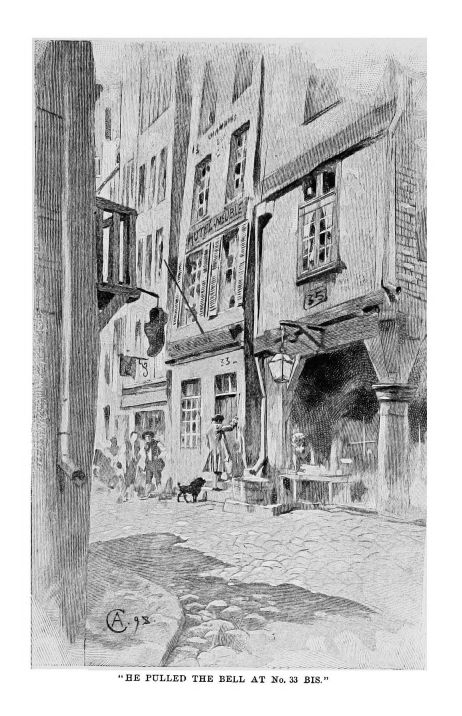
"HE PULLED THE BELL AT No. 33 BIS."
Thus assured, he looked about him. He saw no one he had need to fear. He crossed the street, and spoke to the cobbler.
"Come into thy shop; I want to speak to thee." When within, he said: "I have been arrested, and let out—praise be to the saints! I have just now seen the old Crab. She owes thee money?"
"Not much."
"No matter. She has asked me to denounce thee, my poor friend. I came to warn thee."
The cobbler gasped. "Dieu! and my little ones! I have done nothing—I assure thee, nothing."
"Nor I, my friend. Now, listen. I am lucky enough to be in a little employment for the Great Committee. I mean to save thee."
"And canst thou do that?"
"Yes, yes. Something will happen to-morrow, about four o'clock; and after that no fear of the hag. I must see it; it is my business. Can I stay a day—I mean until then—in the little room here above thy shop?"