THE ADVENTURES OF FRANÇOIS (continued 2)
Reading edition
His natural reticence and some too dreadful past combined to keep him silent. François was puzzled. He knew the man to be a coward; but his timidity, followed by this sudden outbreak of murderous fury, was inexplicable; nor did he comprehend it fully until later events revealed to him, as he looked back at this scene, the nature of the morbid changes which his partner's character had already begun to feel. "What does it all mean?" he demanded.
"Ask me no more," said Despard. "Not now—not now. She cannot hurt me or mine. It is hate, not fear, I have. But thou? Why didst thou pay?"
"For good enough reasons," said François; "but I can take care of myself." He was by no means sure of this. Nevertheless, he laughed as usual, and said: "Let us have supper; I cannot think when I am empty."
No more was said. They ate in silence, and then Pierre turned to his "L'Ami du Peuple," and François to a pipe and to his thoughts. Must he give up the booth, and wander? He knew the Crab well enough to fear her. The price of her silence would rise, and to deny her would bring about disaster. He began to wish he had been honest. It was too late now; but France was large, and, after all, he could laugh at his own embarrassment. There was time to think; he had bought that.
They spoke no further of the Crab; but from this time Pierre became depressed and suspicious at every knock on the door. Quatre Pattes came to the booth with her usual eagerness, and if she chanced to be full of bad brandy, and too noisy and unappeasable, François paid her something out of his own share of their growing profits. Had he been alone, he might have done otherwise; but Pierre was timid, watchful, and talked sadly of the little one at Sèvres. How should he manage if the show came to an end? It had not been worth much until François joined him. Before that he had been starving himself to keep the child in careful hands. He became increasingly melancholy, and this especially in the early mornings. He was apt to say at night, "A day is gone, and nothing has happened."
François was courageous, and mocked a little at the jade Fortune. "What could happen?" And yet this shrinking little man, fat, doleful, and full of fears, sat heavily upon him; and there, too, was this child whom he had never seen. Peste! The children he had known at the asylum were senseless, greedy little cattle, all of one make. Perhaps this girl at Sèvres was no better.
IX
In which François tells the fortune of the Marquis de Ste. Luce and of Robespierre, and has his own fortune told, and of how Despard saw a man of whom he was afraid.
François was soon to be further amazed by Pierre Despard. To the last of his life, François remembered that day. A cool October had stripped the king's chestnut-trees of their glory as clean as the king himself was soon to be shorn. The leaves were rustling at evening across the Place Louis XV, and covering the water of the canals. Here, of late, the tent-booth had been set up for the benefit of the better society, which still wore the white cockade of the Bourbons. A merry group of the actors of the Comédie was waiting to see François, the maker of faces. There were Chenard of the Opéra Comique; Fleury and Saint-Prix, whose gaiety no prison in after days could lessen, and no fear of death abate. "Behold, there is the great Talma," said Pierre, peeping out; "and the aristos are many to-day. Art ready, François?"
François was delighted. The great Talma here, and actually to see him—François! He had of late been acquiring stage ambitions, and taking great pains to improve the natural advantages of a face quite matchless in Paris.
Despard peeped in again. "Yes, François; they talk of thee, and there are many in the crowd. They gather to see Talma. There are Jacobins, and thy friends the aristocrats. Make thou haste. Art ready?"
"Yes, yes," said François. He felt it to be a great, an unusual occasion. He had a bright idea. He struck with a stick three times on the floor of the booth, the traditional signal at the Théâtre Français for the curtain to rise. A roar of applause outside rewarded his shrewd sense of what was due to this audience.
"Tiens! That is good," said La Rive.
The slit in the curtain opened, and, framed in the black drapery, appeared a face which seemed to have come out of the canvas of Holbein. It was solemn, and yet grotesque, strong of feature, the face, beard, and hair white with powder; the eyes were shut.
"Mon Dieu," said Talma, "what a mask! 'T is stern as fate." The crowd stayed motionless and silent.
"Look! look!" said Fleury. "'T is a study. To smile with closed eyes! Didst thou ever see a man smile in sleep, Talma?"
It was pretty and odd. Little curves of mirthful change crawled downward from the eyes over the large, grave features; the ears moved; the eyes opened; and a storm of liberal laughter broke up the quiet lines of cheek and mouth.
"Bravo! bravo!" cried Talma and the other actors, while the crowd burst into a roar of applause and responsive mirth.
"Angels of fun!" cried Saint-Prix, "what a face! 'T is a gargoyle come down from the roof of St. Jacques de la Boucherie. Does it go back of nights? I wonder what next will he do?"
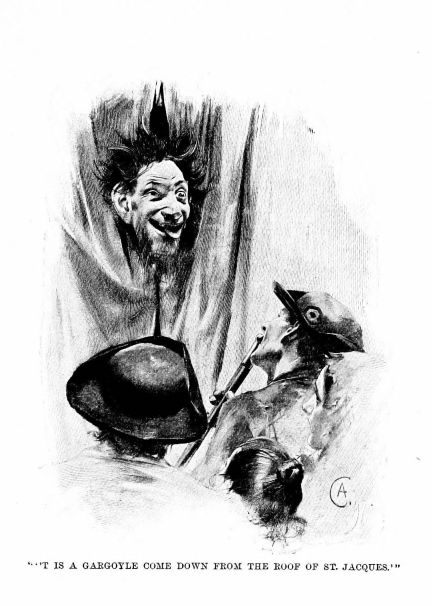
"''T IS A GARGOYLE COME DOWN FROM THE ROOF OF ST. JACQUES.'"
"Tiens! Wait," said La Rive.
The white face seen above in the slit of the black curtain became suddenly serious, with moveless eyes looking past the audience as if into futurity. Below appeared two large hands, scrupulously clean, while the man's figure remained hidden. There was something impressive in this artful pose.
"Fortunes, fortunes, messieurs et dames!" cried Pierre. "Who will have his hand read? Avancez—come!"
A shrill voice on the outskirts of the crowd cried, "Read Louis Capet's!" The white cockades turned to look. "It were easy to read," said a tall Jacobin. A gentleman in the black garments of the unprogressive noblesse turned: "Your card, citizen, or monsieur, as you like." The crowd was scarcely stirred by this politely managed difference. It was the year of duels.
Two lads pushed forward their tutor, an abbé, as was plain to see, although few clerics still ventured to wear their old costume. He laughed awkwardly, and timidly laid a fat, well-fed hand on that of François's. The grave face of the reader of palms fell forward to see the fateful lines. For a moment François was silent; then the voice which came from his stolid visage was monotonously solemn, and the words dropped from it one by one, as if they were the mechanical product of some machine without interest in the results of its own action. One long, lean forefinger traversed the abbé's palm, and paused. "An easy life thou hast had. A woman has troubled it." The two pupils were delighted; the crowd laughed. "The line of life is broken—broken"—François's hands went through the pantomime of the snapping of a thread—"like that." The abbé drew back, and could not be persuaded to hear further. Again there was a pause. A grisette advanced smiling, and was sent away charmed with the gifts a pleasant future held in store. Pierre exhorted for a time in vain. Presently the crowd made way. A slight man in breeches and silk stockings came forward; he was otherwise dressed in the extreme of the fashion still favored by the court party, but wore no cockade, and carried two watches, the heavy seals of which François greatly desired to appropriate. His uneasy eyes were covered with spectacles, and around them his sallow complexion deepened to a dusky, dull green. Altogether this was a singular and not a pleasant face, or so, at least, thought the palm-reader, a part of whose cunning was to study the expressions of those who asked his skill. The man who laid his hand on François's looked up at the motionless visage of the ex-thief. François said: "Is it for the citizen alone to hear, or for all?"
"For me—for me."
François's voice fell to a low whisper.
"Let the past go," said the listener; "what of the future?"
"It is dark. The lines are many. They are—citizen, thou wilt be a ruler, powerful, dreaded. Thou wilt have admiration, fame, and at last the hatred of man."
"I—I—what nonsense! Then?"—and he waited,—"then? What then? What comes after!"'
"I will tell thee"; and François whispered.
"No more—no more; enough of such foolishness!" He was clearly enough disturbed by what he had heard. "Thou must think men fools."
"Fate is always a fool, citizen; but the fools all win, soon or late."
"That, at least, is true, Master Palmister." Then a pair of sinister eyes, set deep behind spectacles, sought those of François. "Thou hast a strange face, Master Palm-reader. Dost thou believe what thou dost make believe to read on men's palms?"
"Sometimes."
"Now—now?—this time?"
"Yes; I believe."
"I shall not forget thee."
François felt something like a chill between his shoulders. The Jacobin stepped aside after depositing an ample fee in the basket which Toto presented.
There was a murmur in the crowd. Several persons looked with curious eyes after the retreating man, and the conjurer heard some one say: "Tiens! C'est drôle. It is Robespierre." His was at this time not more than a well-known name. For a minute no one else came forward. François saw Pierre slip hastily into the tent; he knew not why. A gentleman came up gaily. He was dressed splendidly, with no regard for the leveling tastes of the day.
"The deuce!" he said quickly; "you are my thief!"
"De grâce, monsieur!" exclaimed François; "you will get me into trouble."
"Not I. Happy to meet you. I am myself fond of palmistry. Come, read me my hand."
François bent over the palm. He began aloud: "Ah, here have been many loves." Then his voice fell. "Monsieur is a good swordsman."
"So-so," said the gentleman.
"Monsieur has been unfortunate in his duels."
"Mon Dieu! Yes; I always kill people."
"Monsieur has one remorse."
"Sapristi! Thou art clever, and I lucky to have but one. Go on; 't is vastly amusing. Shall I live to be old? My people do."
"Monsieur will have troubles, but he will live to be old—very old."
"Will he, indeed? I hardly like that. If I were you, I would tell more agreeable fortunes. To outlive the joys of life, to be left a stranded wreck, while the world goes by gay and busy—pshaw! I like not that. You do it well. Let me read your own palm. I have a taste for this art."
François was at once interested. The gentleman's strong left hand took that of the thief, and with a wandering forefinger he ran over the lines of the palm. He let it fall, and looked downward at his own hand. "It is strange that we shall meet again, and in an hour of danger. You will be fortunate, and I shall not. You will have—"
"Tenez, monsieur—stop!" cried François; "I will hear no more"; and he drew his hands within the tent-folds.
"Dame! and you are really a believer in it all, my good thief? Belief is out of fashion. I hope you did tell that cursed Jacobin he would go to a place he doesn't believe in, but which is a little like France to-day. Come and see me if ever you are in trouble and this trade comes to an end. I like men who can laugh. 'T is a pretty talent, and rather gone out just now. I am the Marquis de Ste. Luce—or was. Come and laugh for me, and tell me your story." He let fall a gold louis in Toto's basket, and elbowed his way through the crowd, with "Pardon, monsieur," to white cockades, and scant courtesy to the Jacobins and the demi-constitutionnels, who were readily known by their costumes.
As the marquis ceased to speak, François heard a singular noise in the tent back of him. He withdrew his head to see the cause, and a moment later, reappearing, said he must be excused, because his friend was ill. The crowd broke up. Within the tent lay Pierre on the ground, in a fit. François, greatly alarmed and utterly at a loss, threw water in his face, and waited. In a few moments it was over, and the man, flushed and breathing deeply, lay with red froth on his lips, as if in a deep sleep. He was no longer convulsed; but what further to do the partner knew not, and sat beside him, not more competent to deal with this novel situation than was Toto, who walked about, and scratched his nose, and gave it up. An hour went by with Pierre's head resting on François's lap.
At last Despard opened his eyes. "Take him away," he said. The man was delirious.
"Who?"
"Take him away. Will he kill me? He killed her." A half-hour he wandered in mind, while François bathed his flushed face. Then he drew a deep breath, and said: "What is this? Where am I?"
François replied: "Thou hast had a fit."
"A fit? Yes; I have them—not often. I remember now. Has he gone, that devil?—that marquis?"
"Who? Ste. Luce? Was it he that troubled thee?"
"Yes; he."
"But what then?"
By and by Pierre sat up. Seeing him to be quite himself, but staring about as if in fear, François said:
"Come, now; I must have the whole story. What the mischief has this fine gentleman done to thee? I am out of patience with thy tiresome mysteries. I know him; we have met before. Perhaps I can help thee."
"Thou?"
Pierre lay back on the floor, and covered his face.
"Mon Dieu!" he cried, "why wilt thou force me to talk of it? Oh, to hate, and to be afraid!" He started up. "I am afraid."
"If I hated a man," said François, "sacré bleu! I would twist his neck."
"If I could! if I could! I am not like thee. I am—am a coward. That's the truth."
"Dame! that is curious." He regarded the fat little man with attentive eyes. "Suppose we have it all out, and get done with it."
"Done with it?"
"Yes; done with it! Hast thou often had these fits before?"
"Yes; and then I am better for a while."
"Tell me all about this man. I will take care of thee."
"No; God did not: thou canst not."
"Then we must separate. I am tired of thy nonsense, and I do not care a rap how soon this business ends, what with your cursed melancholy and that jade Quatre Pattes. Now, out with it!"
Pierre, seated on the floor of the booth, red-eyed and dejected, looked up piteously at his questioner. "If I tell thee all, thou wilt despise me."
"Not I. Go on! If thou canst speak out like a man, I may be able to help thee; but if thou art of a mind to hold thy tongue, it were better we parted. I am tired of thy folly."
Thus urged, Pierre told his story, reluctant, with bowed head, and at times in tears. François sat over him on a stool, now and then asking a question, or waiting patiently when Pierre, choked by overmastering emotions, was silent for a while.
"I have been unhappy and unlucky from the time I can first remember," said Pierre. "My people belonged to the lesser noblesse, but my father was poor—oh, very poor. We had been ruined folks away there in Normandy for half a century, only a bit of farm and vineyard left to us. My mother was of the bourgeoisie, foolish and pretty. She died young, and I was left the only child. My father treated me ill. I had no courage, he said. It was true. As I grew up, I was timid like a girl, and fearful of quarrels. When I was about twenty years old I had a trouble with a brother of this marquis. He struck me with his whip because of something I said. My father learned that I had excused myself, and was wild with rage. It was my bourgeois mother, he said; we had lost all but honor, and now that too was gone. He died not long after, and I, with a few hundred francs, was driven out to care for myself. The marquis had a mortgage on the farm. I went to a village near by, and lived awhile as I could until I was down to my lust sou. I worked like a peasant in the fields; I was the servant at an inn. At last a mountebank company attracted me, and in despair I went with them to take care of the horses which served them in their performances. By and by I learned sleight of hand, and fared better. At last I married a girl who danced in our company. She was pretty,—oh, more than pretty,—and clever, too. When we came again to our town, a notary offered me a petty clerk's place, and I was well contented to settle down. My wife was too eager for the society of the bourgeoisie, and they would have none of that of the dancing-girl. Then, unhappily, this marquis saw my wife, and how I know not, but his fine clothes and cunning were too much for one who was eager for a society she could not have. I was busy, and often absent collecting small debts. No one warned me. I was satisfied, and even put by a little money.
"There was a woman in the village, Mme. Quintette, a dressmaker, a shameless creature of bad life. She might have been then some fifty years old. 'T is now twelve years ago. At her house the marquis met my wife. One day my Renée was gone, and this Quintette with her. It is she who is this Quatre Pattes."
"The deuce!" cried François. "Now I see."
"More than a year went by. Thou wouldst have killed the man. I could not. I am a coward, François—a coward! God made me so; I can't help it. One day an infant was brought to my door, with a note. Mon Dieu, such a note! The dying mother in the hospital with her last money paid a good sister to take the child to me—to me, of all men! And would I pardon her? François, it was that devil's babe and hers. Would I forgive her, and keep it? Wouldst thou have kept it?"
"No," said François; "not I."
"I did! I did! It was like her, all but the eyes. I grew to love it. Then there was an accident, a fall, and the little maid is crippled for life. It seemed horrible, but now I thank God, because she is safe from the baseness of men. I wanted to die, but I must live; she has no other friend."
François sat still, pitiful, and deep in thought. At last he said: "Why were you so terribly afraid of that woman? She could do no worse than ruin our business."
"I—hast thou ever been afraid thou wouldst murder some one? I was. I would have done it in a minute hadst not thou come in."
"Sac à papier! Afraid of thyself! How queer! Thou wert afraid of thyself?"
"Yes; I am—I was—I am often afraid of myself."
"Let us forget it."
"I cannot. What can I do?"
"Do? Nothing."
"But that man—"
"Well, thou art helpless. I should not be. Forget. Thy chance may come." He was at the end of his wisdom. He pitied this weak-hearted coward who so frankly avowed his defect. "We will speak of it no more, Pierre, or not now. But what brought you to Paris? Let us have it all, and get done with it."
"My poor little humpback was hardly six years old when she came to me, crying, to know why the village children would not play with her. She was a humpback and a bastard. What was 'bastard'? I have always fled from trouble. One day I took the child and what little I had, and was away to Paris. God knows how it hurt me to hear every evening how she had been mocked and tormented; one is so foolishly tender. In this great city I sought work, and starved. And when at last she was fading before my eyes, I stole—my God, I stole!"
"Dame! thou art particular. Must a man starve?"
"When I got money out of a full purse I took, I set up our little business, and then I found thee. And this is all. I dare say I shall feel better to have told some one. I did not want to steal. I did not steal after I began with the booth, unless I was in need—oh, sorely in need. It was so on that fortunate day when I was saved by thee. In thy place I should have kept the old fishwife's purse."
"And let me swing?"
"Yes—perhaps; I don't know. I—it is well for me thou wert not a coward."
"Sacristie! It appears that not to be a coward has its uses. Now bon jour and adieu to the whole of this business. Let the miserable past go. 'T is bad company, and not amusing. Have no fear; I will take care of thee. Come, let us go home."
"Thou wilt look about a little before we go?"
"Toto, he is mad, this man."
"I sometimes think I am. At night, in my dreams, I have him by the throat, and he laughs, and I cannot hold him. I wake up, and curse in the darkness because I cannot kill him. And then I know it is a debt never to be paid—never."
François had had enough of the small man's griefs. Contempt and pity were strangely mingled as he listened to his story.
"I shall let thee talk no more," he said. "But mille tonnerres! I cannot help thee to go mad. Let us go and wander in the country to-morrow, thou and I and Toto. It will comfort thee. But no more of this; I will not stand it."
The advice was wholesome, and, as usual, Pierre accepted the orders of his more sturdy-minded friend.
X
How Pierre became a Jacobin and how a nation became insane.
Although the marquis was not again upon the scene, as the months went by Despard became by degrees more gloomy. At night, in place of the gay little café, he went out to the club of the Jacobins, and fed full of its wild declamations against the émigrés and the aristocrats. It amused François, who saw no further ahead than other men. Despard came home loaded with gazettes and pamphlets, and on these he fed his excitement long after his partner was asleep.
When, as time went by, Pierre's vagaries increased, François found in them less subject for mirth. The fat little man sat up later and later at night. At times he read; at others he walked about muttering, or moving his lips without uttering a sound. What disturbed François most was that the poodle now and then showed fear of Pierre, and would no longer obey him as he had been used to do.
Meanwhile, as Pierre still attended sedulously to business, François could find no fault. He himself had become devoted to his art of palm-reading. He bought at the stalls old books, Latin and French, which treated of the subject, and tried to keep up the name his odd ways had made so profitable. Deceit was a part of his working capital; but deceit and credulity are apt to go together, as a great man has well said. Not for many louis would the conjurer have let any one read again the lines of his own hand. When Despard began to teach him the little he himself knew of palmistry, it had caused interest, and after a while a half-belief. This grew as he saw the evident disturbance to which the use of his art gave rise in certain of those who at first appeared to look upon it as an idle jest. The imaginative have need to be wary, and this man was imaginative, and had the usual notions of the gambler and thief as to omens and luck. I have said he had no definite working conscience. I have also said that he possessed an inborn kindness of heart; he had a long memory for benefits, and a short one for injuries. His courage was of fine quality: not even Quatre Pattes could terrify him.
The politics of the time were becoming month by month more troublous to such as kept their heads steady in the amazing tumble of what for centuries had been on top, and the rise of that which had been as long underneath. The increasing interest of Pierre in all that went on surprised François, and sometimes, as I have said, amused him. He could not comprehend why he should care whether the king ruled, or the Assembly. This mighty drama was nothing to him. He paid no taxes; he toiled not, nor spun, except nets of deceit; and whether or not commerce died and the plow stood idle in the furrow was to him of no moment. Meanwhile, before the eyes of a waiting, wondering world historic fate was shuffling the cards as neither war nor misrule had shifted them for many a day. Knave and king, spade and club, were now up, now down. Every one was in a new place. The old surnames were replaced by classical appellations. Streets, palaces, and cities were rebaptized with prenominal republican adjectives. Burgundy, Anjou, Navarre, and the other ancient provinces, knew no more their great names heroically famous.
All men were to be equal; all men were free to be what they could. But the freedom of natural or acquired inequality was not to be recognized. There were new laws without end. The Jacobin added a social creed. All men must tutoyer. "Your Majesty" was no more to be used. Because the gentles said "thou" and "thee" to one another and to an inferior, all men must "thou" as a sign that all are on a level.
A bit of paper was to be five francs—and take care of thy head if thou shouldst venture to doubt its value. As to all else, men accepted the numberless and bewildering decrees of the Assembly. But the laws of commerce no ruler can break. These are despotic, changeless, and as old as the act of barter between man and man. The assignats fell in value until two hundred francs would scarce buy a dinner. There, too, was a new navy and a new army, with confusing theories of equal rights for sailor, soldier, and captain.
A noble desire arose everywhere to exercise the new functions. What joy to cast a ballot, to act the part of officials, to play at soldiering! All the cross dogs in France are unchained and the muzzles off; and some are bloodhounds. What luxury to be judge, jury, and hangman, like the noble of long ago!
Even childhood caught the temper of the time. It played at being officer and prisoner, built and tore down bastilles, and at last won attention and a law all to itself when some young ruffians hung one of their number in good earnest for an aristocrat.
However indifferent was François at this time, the shifting drama amused him as some monstrous burlesque might have done. Its tragedies were as yet occasional, and he was by nature too gay to be long or deeply impressed. There was none he loved in peril, and how to take care of François his life had taught him full well.
"Allons zi gaiement!" he cried, in the tongue of his old quarter; and kept a wondering, anxious eye on Pierre.
XI
The juggling firm of Despard, François & Co. is broken up—Despard goes into politics, and François becomes a fencing-master.
January, 1791, François, having of late found business slack, had moved to the open place in front of the Palais Royal. He had taught Toto new tricks—to shoulder a musket and to die pour la patrie. Time was telling men's fortunes quite too fast for comfort. Neither his old devices nor Toto's recently acquired patriotism was of much avail. Moreover, Pierre was losing interest in the booth as he became absorbed in politics.
"Thou wilt not go to thy sacré club, Pierre," said François, one night late in February. "Here are two days thou hast left us, the patriot Toto and me, to feed thee and make sous for the poor little maid at Sèvres."
"She is not at Sèvres."
"Why not? Thou hast not said a word to me of this."
"No; I had more important matters to think of."
François, who was tranquilly smoking his pipe, looked up at his partner. The man had lately worn a look of self-importance.
"Well, what else?"
"The sisters are aristocrats. A good citoyenne hath her. I shall give up the show. The country calls me, Pierre Despard, to save her. The great Robespierre hath asked me to go into Normandy, to Musillon, whence I came. I am to organize clubs of Jacobins." He spoke with excitement, striding to and fro. He declared that he was not afraid now of any one. To serve France was to have courage.
"And how as to money?" asked François.
He said his expenses would be paid by the clubs. Barnave, Duport, and the deputies of the Right must be taught a lesson. There must be no more kings. The people must rule—the people! He declaimed wildly.
"Fichtre!" cried François, laughing. "It does seem to me that they rule just now."
Pierre went on with increasing excitement; and would not François go with him?
"Go with thee? Thou sayest we shall be deputies in the new Convention. A fine thing that! And Toto too, I suppose? Not I. I am an aristocrat. I like not thy Robespierre. As to the show, it pays no longer, and I have greased the claws of the Crab until there is no more grease left. I shall take to the streets, Toto and I. And so thou art to be a great man, and to play poodle on thy hind legs for Pétion and the mob?"
Pierre was offended. He rose and stood glaring at François with wide-open eyes; then he said, as if to himself: "The marquis is near Evreux. Let him take heed!"
"Mon Dieu! He will eat thee as he would the frogs of his moat, that man! I am not of those who fear, but if I had angered him—"
"I have named him to the great Robespierre, the just, the good. He will remember him."
"Then go; and the devil take the whole lot of you!"
"I shall go. But do not say thou art an aristocrat, for then I must hate thee."
"Grand merci! Thou poor, fat little pug, canst thou hate?"
"Aye, as hell hates." Upon this Toto took refuge under his master's bed.
François rose, and, standing in front of the flushed, fat little man, set a hand on each of Pierre's shoulders and stopped his excited march.
"I cannot understand thee. I never could contrive to hate even a gendarme, and if hell hates, I know not. Thou art helpless as a turtle that is on his back. What use to kick? No; do not answer me. Hear me out. I shall go my way—thou thy way. I served thee a good turn once, and thou hast helped me to a living. Now I like not thy ways; thou art going mad, I think."
"Perhaps—perhaps," returned Pierre, gloomily. "Well, c'est fini—'t is done. Now to settle."
They divided their spare cash; and after that Pierre went to his club, and François to bed and a dreamless sleep.
In the morning he rose early, left his share of the rent on the table, and with a little bag of clothes, and Toto after him, walked away across the Seine, and soon found a small room under the roof. He paid in advance the customary denier à Dieu, and settled down to think.
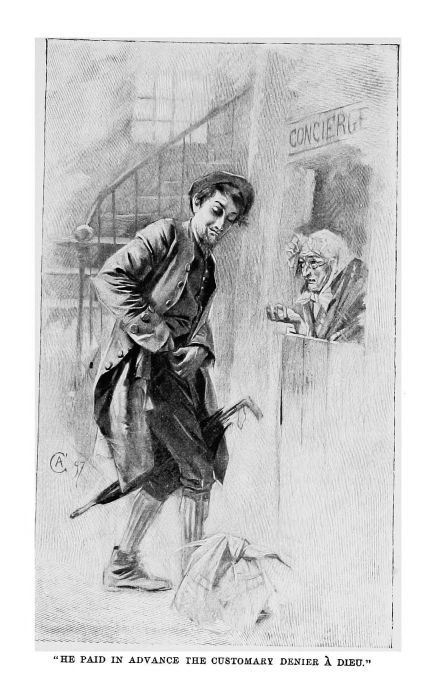
"HE PAID IN ADVANCE THE CUSTOMARY DENIER À DIEU."
He was tired of the show, and meant to resume his old trade. His conscience, or so much as he had, was at peace; all France was plundering. Now the nobles were robbed, and now the church.
"The world is on my side," he laughed, as he sat with Toto on his knees, looking over a wide prospect of chimney-pots and tiles.
Thus began again the life of the thief; but now, thanks to his long training as a juggler, he was amazingly expert. He took no great risks, but the frequent tumults of the streets were full of chances, although it must be said that purses were thinner, watches and gold snuff-boxes rarer, and caution less uncommon than it had once been. If business prospered, he and Toto took long holidays in the country, and did a little hunting of rabbits; for the gamekeeper was no longer a person to be dreaded. Sometimes, lying on the turf, he thought how pleasant would be a bit of garden, and assurance of good diet and daily work to his taste. I fear it would scarcely have been long to his taste. When something like a chance came, he could not make up his mind to accept the heaven-sent offer. He was to see many things and suffer much before his prosperous hour arrived.
One fine day in April, François, with whom of late fortune had quarreled, was seated in the sun on a bench in the now ill-tended garden of the Luxembourg. The self-made difficulties of the country were affecting more and more the business of the honest, and of that uncertain guild which borrows but never returns. He had a way of taking Toto into his counsels. "What shall we do, little devil?" The poodle barked. "No. These accursed Jacobins are ruining France. What, knock a man on the head at night! Bad dog, hast thou no morals? Va donc! Go to. Thou hast not my close experience of the lantern, and stone walls for a home I like not. Work, thou sayest? Too late; there is work for no one nowadays. Thou wilt end badly, little monster."
Toto whined, and having no more to say, fell asleep. At this moment François, looking up, saw go by a young woman in black, and with her a boy of perhaps ten years. On the farther side was a tall, well-dressed man of middle age, whom, as he was looking away, François did not recognize. Some bright thing fell unnoticed from the woman's wrist, and lay in the sun. "Hist, Toto! Look there—quick!" In a moment the dog was away, and back again, with a small miniature set in gold and surrounded by pearls. It was the portrait of a young officer. François hastily put it back into the dog's mouth, saying: "Go to sleep! Down! down quickly!" The dog, well taught, accepted the trust, and dropped as if in slumber, his head on his paws, while his master studied the weathercocks on the old gray palace. A moment later both the man and the woman turned to look for the lost miniature. Then François saw that it was his old acquaintance the marquis. He had more than once seen him in the garden, where he was fond of walking; but the great seigneur had passed him always without notice. The boy ran back ahead of his grandfather, and coming to François, said innocently:
"Monsieur, have you seen a little picture madame let fall? It is so big, and I saw it only just now on her wrist. Please to help us to look for it. It is my father; he is dead."
After the boy came the woman, looking here and there on the gravel.
"Dame de Dieu! she is beautiful," murmured François; "and that sacré marquis!"
The voice he heard was sweet and low, and tender with regret at her loss.
"Has monsieur chanced to see a little miniature?"
Monsieur was troubled, but his pocket and stomach were both empty. Monsieur was distressed. He had seen no miniature.
Next came the marquis.
"Ho, ho!" he said pleasantly. "Here is the citizen my thief again. Have you seen a small miniature?"
François had not.
"Diable! 'T is a pity, monsieur. Well, pardon a ci-devant marquis, but I do think monsieur knows a little too much of that miniature for his eternal salvation. Also, monsieur does not lie as well as might be expected from one in his line of life."
François rose. He was embarrassed as he saw the tearful face of the woman.
"I was about to say I would look—I would search."
Ste. Luce smiled. "Suppose we begin with you?"
"I have it not."
"Well, but where is it? I am not a man to be trifled with. Come, quick, or I must ask the gendarmes yonder for a bit of help."
François looked at him. There was menace in those cold gray eyes. Should he trust to his own long legs? At this instant he heard a sob, and glancing to the right, saw the woman seated on the bench with her face in her hands, the little fellow at her side saying: "Do not cry, mama; the gentleman will help us." The gentleman was ill clothed and seedy. He had seen women cry, but they were not like this woman.
"M. le Marquis does me injustice. Permit that my dog and I search a little."
The marquis smiled again. "Pardieu! and if you search, and meanwhile take a fancy to run, your legs are long; but now I have you. How the deuce can I trust a thief?"
The little lad looked up. "I will go with monsieur to look—and the dog; we will find it, mama."
"Monsieur may trust me; I will not run away," said François. "If monsieur desires to search me?"
"I do not search thieves."
François looked at this strangely quiet gentleman with the large, light-gray, unpleasant eyes, and then at the woman.
"Come, Toto; we must take a look."
The marquis stood still, quietly watching thief, dog, and boy.
"Renée," he said, "don't make a fool of yourself."
Then from a distance the boy cried, "We found it, mama!" and ran to meet her.
The marquis took it as François rejoined the group.
"Ah, Master Thief, you are clever; but it is a little wet, this trifle, and warm too. The dog had it all the while in his mouth. He is well taught. Why the deuce did you give it up?"
The boy began to understand this small drama. He had the courage of his breed, and the training.
"Did you dare to steal my mama's picture?"
"Yes; when she let it fall."
"I know now why you were glad to give it back. It was because she cried."
"Yes; it was because she cried."
"Venire St. Gris!" exclaimed the marquis, who was pleased to swear like Henry of Navarre. "You are a poor devil for a thief. You have temptations to be good. I never have them myself. I thank Heaven I have reasonably well used my opportunities to be agreeably wicked."
"Father!" said the young woman, reproachfully; and then to François: "If you are a thief, still I thank you; I cannot tell you how much I thank you."
"And how many louis do you expect, most magnanimous of thieves?" said the marquis.
The woman looked up again. "Come to me to-morrow; I will find a way to help you."
Something of yearning, some sense of a void, some complexity of novel distress, arose in the thief's mind.
"Mon Dieu! madame," he said, turning toward her, without replying to the marquis, "you are a saint. I—I will think. I am not fit for such as you to talk to."
"Quite true," said the marquis. "Hast thou thy purse, Renée? I forgot mine."
"No, no," she said. "Come and see us—Rue des Petits-Augustines—a great house with a gilded gate. You will come? I will say they are to let you in. Promise me that you will come."
"And bring that poodle," added the marquis; "I will buy him."
François laughed outright—that merry laugh which half Paris had learned to like, till Paris tired of it and of its owner.
"Monsieur will pardon me. I cannot sell my only friend. Good day." And he walked away, the boy crying after him: "You will come? Oh, you must come, because my mama says so."
The marquis muttered: "Animal! If I had your carcass—no, if I had had you awhile ago in Normandy, your manners would have been bettered. But now the world is upside down. He will come, Renée. If thou art quit of him for two hundred francs and a few lost spoons, thou mayest rest thankful."
François moved moodily away. Something was wrong in his world; an angel coming into his crude life would not have disturbed him as this lady's few kind words had done, and yet he had left her unanswered. He knew he had been a fool, but knew not why. He had, too, a notion that he and this marquis would meet again, but for this he was not eager. He recalled the palm-reading. Had the woman been alone, he would probably have said a glad "Yes"; but now his inclinations to obey her were sadly diluted by feelings which he did not analyze, or perhaps could not have analyzed. He did not accept the hand thus stretched out to save him, but for many a day her tender eagerness and the pleading face which had so attracted him came before him at times with a look of reproach. Is it strange that this glimpse of a nobler nature and a better life than his own should have had an influence on this man quite the reverse of that which its good will sought to effect? He cannot be said to have been refined, but he had in him tastes which are the germs of refinement, and which, when I knew him, had no doubt produced results. Probably he was in 1791 a coarser person, but he must always have been a man who could be forced by circumstances to think.
It may have been that the sense of a great gulf between him and a world he was by nature inclined to like caused one of those rare spells of despair to which the gay and over-sanguine are liable. Of course he had seen and for brief seasons shared the profligacy of the Cité,—his memoirs confess this with absolute frankness,—but these gross lapses had been rare and brief. Now he plunged headlong into the worst vileness of the most dissolute quarter, where few lived who were not saturated with crime. I have no desire to dwell on this part of his life. A month passed away, and he was beginning to suffer in health. This amazed him. He had not hitherto known a pang save that of hunger. He began to drink eau-de-vie to relieve his sense of impaired strength, and being off his guard and under the influence of the temporary mood of rashness which drink is apt to cause, he twice narrowly escaped arrest.
Under the vivid impression thus created he was wandering homeward late at night to some low resort in the Cité, when in the Rue aux Fèves he heard a cry in front of him. The moon was bright, and he saw a man set upon by two fellows. The person assailed was staggering from the blow of a club, and fell with the cry which the thief heard. Both bandits threw themselves upon him, and, as he unwisely struggled, François saw the glitter of a knife. Clearly this was no easy prey. As the three tumbled over in the mud of the street there was small chance for a decisive use of the blade. François, as I have said, had been always free from crimes of violence, but this affair was none of his business, and had his pocket been full he might have left the ruffians and their prey unmolested. His purse, however, was down to the last sou, and here was a chance.
He called, "Catch them, Toto!" and, leaping forward, seized one of the men by the throat and threw him on his back. The poodle took a good nip of the other rascal's leg, and when the man broke away and, stumbling, ran, pursued him until recalled by François's whistle. Meanwhile the assaulted man sat up, a bit dazed. The other fellow—it was he of the knife—was on his feet again, and at once turned furiously on the rescuer. François darted to one side, and, catching him by the neck, throttled him savagely. His great length of arm made it impossible for the scamp, who was short and strong, to reach any vital organ. But he stabbed François's shoulder over and over. François's grip on the throat was weakening, when the victim, now on his feet, struck the man under the ear, and thus knocked him clean out of François's failing grip. He fell headlong, but was up and away in a moment, while a crowd began to collect.
"Hi! it is François!" some one cried.
"Quick!" said the thief. "Room there! Let us get out of this." Seizing the man he had saved, he hustled his way through the crowd and hurried him toward the bridge. In a few minutes they were standing alone by the river, amid the tombs back of Notre Dame. Then the man spoke:
"By Heaven! thou hast saved my life. Hallo! thou art bleeding. Here!" and he tied a handkerchief about his shoulder. "We shall be in luck to find a chaise. Wait!" and he ran away.
François's head was dizzy. He sat on a tombstone, well sobered now, but bleeding freely. It was long before he heard a horse; and when in the chaise, where Toto promptly followed him, he fell back, and knew little more until they stopped in the Rue St. Honoré. Here his new acquaintance got out, and soon returned with a glass of eau-de-vie. With this aid, and the arm of his host, François was able to reach a large room in the second story. He fell on a couch, and lay still while the other man ran out to find a surgeon.
On his arrival, François was put to bed in an adjoining room, and for two weeks of care and good diet had leave to meditate on the changeful chances of this wretched world. For a while he was too weak to indulge his customary keenness of curiosity. His host, M. Achille Gamel, paid him brief visits, and was singularly unwilling to talk one day, and the next sufficiently so for the patient to learn that he had been in the army as a maître d'armes, and was now, in his own opinion, the best fencing-master in France. Through the partitions could be heard the click, click of the foils, and now and then the crack of pistols. After a fortnight François's wounds were fairly healed, and he began to get back his rosy complexion and his unfailing curiosity.
One pleasant evening in June, Gamel appeared as usual. It was one of his days of abrupt speech.
"Art well?"
"Yes."
"Thou art soon mended."
"Yes." His brevity begot a like form of answer, and François was now somewhat on his guard.
"I pay my debts."
"That is true."
"Now thou art well, what wilt thou do?"
"I—I—I shall go away."
"Why didst thou help me?"
"My pocket and paunch were empty. It seemed a chance."
"Thy two reasons are good. Who art thou?"
"Who is every one in the Cité? A thief."
"Diable! but thou art honest—in speech at least."
"Yes, sometimes. I was a conjurer too—for a while."
"Yes, yes, I remember now. Thou art the fellow with a laugh. I see not yet why thou hast helped me. Thou mightest easier have helped the rascals and shared their gains."
François began to be interested, and laughed a laugh which was the most honest of his possessions.
"I dislike clumsiness in my profession," he said. "Why should the brutality of war be brought into a peaceful occupation?" He was half in earnest, half in jest.
"That is a third reason, and a good one." It was difficult to surprise Gamel. "Suppose we talk business," he added.
"Mine or thine?"
"Mine. A moment, Citizen François—permit me. Pray stand up a moment."
François rose as the fencing-master produced a tape-measure. "Permit me," and with no more words he set one end of the tape on François's shoulder and carried the length of it to his finger-tips.
François stood still, wondering what it all meant.
"The deuce!" said Gamel, slowly rolling up the measuring-tape.
"Well, what is it? What is wrong?"
"Wrong? Nothing. It is astonishing!"
"What?"
"This arm of thine."
"Why?"
"It is one and a half inches longer than mine."
"Well?"
"A gift! To have the longest arm in Paris! Mon Dieu!"
"What of that?"
"A fortune! Phenomenal! Superb! And a chest—and muscles! By Hercules, they are as hard as horn!"
"Well?"
"Diable! Thou art dull for a thief."
François had a high opinion of himself. He said: "Perhaps. What next?"
"I need help. I will teach thee to fence and to shoot. Canst thou be honest? I ask not if thou art."
"Can I? I do not know. I have never tried very long." Then he paused. To fence like a gentleman, to handle a sword, had its temptations. "Try me."
"Good! Canst thou be a Jacobin to-day and a Royalist to-morrow?"
"Why not?"
"The messieurs and their kind fence here in the morning; after our breakfast come the Jacobins about two. I ask not thy politics."
"Why not?" said François, who was the frankest of men—"why not? I am an aristocrat. I am at the top of my profession. I like naturally the folks who are on top."
"France is like a ball now, no top, no bottom, rolling. Let us be serious."
"Dieu! that is difficult. I want to quit thieving. It doesn't pay at present. I accept the citizen's offer. Does it include my dog?"
"Yes, indeed! Toto—a treasure! He will delight our pupils."
"Good! He must have a little sword and wear a white cockade till noon, and then a tricolor."
"And will five francs a week suffice until thou art fit to teach? And thy board and lodging—that goes without saying. After a while we will talk again."
"'T is a fortune!" said François; and upon this agreement the pair fell to chatting about the details of their future work.
"One moment," said François, as Gamel rose. "What are thy own politics?"
"I will tell thee when I can trust thee," said the fencing-master. "Now they vary with the clock."
"I see. But I have told thee mine."
"Thou wert rash. I am not."
François laughed merrily, "Good night." He was happy to be at rest, well fed, and with something to do which involved no risk. Gamel went away, and François fell to talking to the poodle.
"Toto! Sit up, my sleepy friend! Attention! What dost thou think of M. Achille Gamel?" The poodle had been taught when questioned to put his head on one side, which gave him an air of intelligent consideration. "Ah, thou dost think he is as long-legged as I! Any fool of a cur can see that. What else?"
"He has great teeth—big—the better to eat thee, my dear! Curly hair, like thine, and as black; a nose—of course he has a nose, Toto. Art perplexed, little friend? Oh, that is it! I see. Thou art right. He smiles; he never laughs. 'T is that bothered thee. Thou dost like him? Yes. Thou art not sure? Nor I. We must laugh for two. The bones are good here. That is past doubt. We will stay, and we will keep our eyes open. And listen now, Toto. We are honest. Good! Dost thou understand? No more purses, or out we go. No stealing of cutlets. Ah, thou mayest lick thy chops in vain, bandit!"
A few days later Gamel began to fence with François, who liked it well. He was strong, agile, and like his old friends the cats for quickness of foot. Gamel was charmed.
"We must make no mistakes. The foil held lightly—so, so! If you grasp it too strongly you will not feel the other's blade. That is better. 'T is the fingers direct the point. Thy hand a little higher—so, so!"
They fenced before the pupils came and in the intervals when none was on hand. François was tireless.
It was June now, and Robespierre was the public prosecutor, with Pétion at his side. Gamel read aloud the announcement with a coldly stern face. François heard it with indifference.
"Tiens!" he cried. "What matters it? Dame!" as he lunged at the wall, "I do believe my arm is an inch longer." He was thinking, as he tried over and over a new guard, of what a queer education he had had. Gamel walked away into his own room. He was a man who often liked to be alone. Apt to be monosyllabic with his pupils, he could at times become seriously talkative at night over a pipe and a glass. François began to like him, and to suspect that he in turn was liked—a matter not indifferent to this poor devil, who had himself an undeveloped talent for affection.
"Mon ami, Toto! Let us think. I might have been a priest. What an escape! Or a great chorister. That is another matter. A thief, a street-dog, a juggler, a maître d'escrime. Parbleu! What next? We are getting up in the world. My palm, little rascal? Thou wouldst read it. Ah, bad dog, not I! Let us to bed; come along. It seems too good to last."
XII
In which Toto is seen to change his politics twice a day—the mornings and the afternoons quarrel—In which Jean Pierre André Amar, "le farouche," appears.
The fencing-master took great pains with his promising débutant, and now at last thought he could trust him to give lessons. He gave him much advice, full of good sense. He must dress simply, not in any marked fashion. And here were the two cockades, and two for Toto, who was fitted with a toy sword, and had been taught to howl horribly if François said, "Citizen Capet," and to do the like if he cried, "Aristocrat!"
François, gay and a little anxious, followed Gamel for the first time during the lesson-hours into the salle d'armes. Toto came after them in full rig, with a cap and a huge white cockade. A dozen gentlemen, most of them young, were preparing to fence.
The poodle was greeted with "Bravo!" and strutted about on his hind legs with evident enjoyment of the approval.
"Wait here," said Gamel to François. "I will by and by give thee a chance." François had, of course, been constantly in the room when the patrons were absent, and it was now familiar. It had been part of the old hotel of some extinct nobleman, and was of unusual height, and quite forty feet square, with tall windows at each end; a cushioned bench ran around the walls, and above it hung wire masks, foils, sabers, and a curious collection of the arms of past ages and barbarous tribes. Chiefly remarkable were the many fine blades, Spanish or Eastern. At the side of the hall, a doorway led into the shooting-gallery, a late adjunct since the English use of the pistol had been brought into the settlement of quarrels made savage by the angry politics of the day. On one of the walls of the fencing-room was a large sign on which was painted: "Achille Gamel, ci-devant Maître d'Armes, Régiment du Duc de Rohan-Chabot. Lessons in the small sword, saber, and pistol." The word "Duc" was chalked over, but was still easily to be made out.
Presently Gamel came to François in his shirt and breeches, foil in hand. "This way, François." As they slowly crossed the room, Gamel went on to say in a low tone of voice: "Don't be too eager. Take it all as a matter of course. Don't be nervous. One must have had a serious affair or two before one gets over the foil fever. Remember, you are here to teach, not to triumph. There are few here you cannot touch, but that is not business."
"I understand," said François.
"I will give you for your lesson the best blade in Paris. You can teach him nothing. He is my foster-brother, the Marquis de Ste. Luce."
"Ste. Luce!"
"Yes; he is here often."
As they approached, the great gentleman came to meet them, separating himself from the laughing group of younger men.
"Ma foi!" he exclaimed. "Is this your new blade, Gamel?" He caught François's appealing eye, and showed no sign of having known the thief until they were apart from the rest and had taken their foils. Then he said quietly, "Does Gamel know?"
"Yes, monsieur. I saved his life in a row in the Cité, and he gives me this chance."
"Good! I shall not betray you. But beware! You must keep faith, and behave yourself."
"Monsieur may trust me."
"And you can fence?"
"A little, monsieur."
"Well, then, on guard!" The marquis was pleased to praise the new teacher. "He has a supple wrist, and what a reach of arm!" At last he went away to Gamel's room, where they were absent a half-hour. These private talks, François observed later, were frequent, especially with certain of the middle-aged gentlemen who took here their morning exercise.
After this first introduction to business, François sat still when the marquis had left him. By and by the gentleman came back, and saying a word of encouragement to François, went away.
"Take M. de Lamerie, François," said Gamel; and turning to a gentleman near by, added, "À vous, monsieur." Others began to select foils and to fence in couples, so that soon the hall rang with the click, click of meeting steel. François was clever enough to let his pupil get in a touch now and then, and meanwhile kept him and those who looked on delighted with his natural merriment. He was soon a favorite. The dog was made to howl at a tricolored cockade, and proved a great success. As to the fencing-lessons, Gamel was overjoyed, and as time ran on came to trust and to like his thief, who began speedily to pick up the little well-mannered ways and phrases he heard about him. He liked well to be liked and to be praised for his skill, which week by week became greater, until none except M. Gamel and the marquis were able to meet him on equal terms. The master of arms was generous; the wages rose. The clothes François now wore were better, and when Gamel asked him to choose a rapier for wear in the street, which was not yet forbidden, the poor thief felt that he was in the full sunlight of fortune.
The afternoons were less to his taste. If a new pupil arrived, the cook, an old woman, let him in, and Gamel saw him in an anteroom and settled terms and hours. The Jacobins came after two o'clock. Then the room was unusually full. The poodle howled at the name of Louis Capet. Tricolored cockades were everywhere. The talk was of war and the frontier, the ways of speech were guarded, the manners not those of the morning. These citizens were awkward, but terribly in earnest. The pistol-gallery was much in favor; but at this deadly play François was never an expert. He did not like it, and was pleased when the Vicomte de Beauséjour, a favored pupil, said: "'T is a coarse weapon, François. Ah, well enough to enable bulldog English to settle their disputes over a bone; but, dame! quite unfit to be the arm of honor of gentlemen." This uncertain property of honor seemed to François a too insecure kind of investment. It was enough to have to take care of one's pocket; and his being now well lined, François began to resent the possibility of those sudden changes of ownership which under other conditions he had looked upon as almost in the nature of things.
During this summer, and in the winter of '91 and '92, Gamel was at times absent for days. Whenever he returned he was for a week after in his monosyllabic mood. François, who was keenly alive to his present advantages, and who saw how these absences interfered with their business, began to exercise his easily excited inquisitiveness, and to meditate on what was beneath Gamel's frequent fits of abstraction. His own life had known disappointments, not always of his own making. He dreaded new ones. The past of the Cité, Quatre Pattes, Despard, those haunting eyes of the marquis's widowed daughter, the choristers, the asylum, the mad street life—all the company of his uncertain days—were gone. Now, of late, he began to have a feeling of uneasy belief that things were once more about to change. Nor was the outer life of the capital such as to promise tranquillity. A nation was about to become insane. It was at this time like a man thus threatened: to-day it was sane, to-morrow it might be reeling over the uncertain line which separates the sound from the unsound. Had François been more interested and more apprehensive, he was intelligent enough to have shared the dismay with which many Frenchmen saw the growth of tumultuous misrule. Indeed, the talk of the morning fencing-school should have taught him alarm. But he had formerly lived the life of the hour, even of the minute, and as long as he was well fed, housed, and clothed, his normal good humor comfortably digested anxiety.
I should wrongly state a character of uncommon interest if I were to give the impression of a man who had merely the constant hilarity of a happy child. He was apt to laugh where others smiled; but, as he matured, cheerful contentment was his usual mood, and with it, to the last, the probability of such easily born laughter as radiated mirth upon all who heard it, like a companionable fire diffusing its generous warmth. He was at this time doing what he most fancied. The company suited him. He liked the tranquil ways of these courteous gentlemen. In a word, he was contented, and for a time lost all desire to seek change or adventure. His satisfaction in the life made him more quiet and perhaps more thoughtful. He had every reason to be cheerful, and cheerfulness is the temperate zone of the mind.
At times, on Sundays, in the summer of '92, he wandered into the country with Toto; but these holidays were rare. Now and then the habits of years brought again the longing for excitement; with the meal-hours he recovered his common sense, being a big fellow of sharp appetite and a camel-like capacity for substantial food.
The feud between the cockades broke out at this time in duels, which it became the fashion to drive to the Bois to see. Women of all classes looked on and applauded, and few liked it if the affair failed to prove grave. François found it entertaining. The duels were, in fact, many in the years of grace '91 and '92.
The morning pupils wore their hair in curls, dressed in short clothes, and defied the new-fashioned republican pantaloons, which were rising up to the armpits and descending the legs. They carried sword-canes, or sticks like the club of Hercules; a few still wore the sword. Brown and gray wore the afternoon citizens, with long straight hair, short waistcoats, and long and longer culottes above large steel shoe-buckles, all that were silver having been given to aid the funds of a bankrupt government. The morning, which knew very well who came in the later hours, abused the afternoon, and this portion of the day returned those compliments in kind.
Now and then the morning had a little affair with the afternoon, for the Terror was not yet. In cafés and theaters there were constant outbreaks, and men on both sides eager enough to sustain opinion by the sword or the pistol. When one of what François called "our little domestic difficulties" was on hand, there was excitement and interest among Royalists and Jacobins, with much advice given, and huge disgust when monsieur was pinked by Citizen Chose of the Cordeliers or of the Jacobin Club.
If the reverse obtained, and some gentleman of ancient name condescended to run Citizen Chose through the lungs, there was great rejoicing before noon and black looks after it. Here were a half-dozen affairs in a month, for these were the first blades in France.
There were laws against the duel, but the law changed too fast for obedience, and fashion, as usual, defied it. Hatred and contempt were ready at every turn. Two abbés fought, and what was left of the great ladies went to see and applaud.
This duel between morning and afternoon began to amuse Paris. But pretty soon neither the master of arms nor his assistant was as well pleased at the excessive attention thus drawn to the school of fencing. Gamel disliked it for reasons which he did not set forth, and François because he felt that his disturbing readiness to turn back to a life of peril and discomfort was like enough to be reinforced by coming events. He adored good living, yet could exist on crusts. He was intelligent, yet did not like to be forced to think. An overmastering sense of the ludicrous inclined him to take the world lightly. He liked ease, yet delighted in adventure. He distrusted his own temperament. He had need to do so. Excitement was in the air. The summer of '92 was unquiet, and pupils were less numerous, so that François found time to wander. The autumn brought no change in his life, but Gamel became more and more self-absorbed, and neglected his pupils. The gentlemen who fenced in the mornings began to disappear, and the new year of 1793 came in with war without and tumult within distracted France.
For several days before the 21st of January, 1793, strange faces were frequently seen in the morning hours, or more often late at night. These passed into Gamel's room, and remained long. The marquis, more thoughtful than usual, came and went daily. Early on the 20th, Gamel told François that he should be absent until after the 21st, the day set for the king to die. François asked no questions, and was not deeply grieved to be left in the dark as to what was in contemplation. During the previous week there had been sad faces in the morning hours. The pupils were fewer; they were leaving Paris—and too many were leaving France. The Jacobins, with whom François fenced in the latter part of the day, were wildly triumphant. They missed Gamel when he was absent, and asked awkward questions. It was plain enough to his assistant that the master of this turbulent school was a Royalist enragé, as men then said. The assistant was much of his mind, but he was also far more loyal to one François than to the unfortunate king.
He was not surprised that at the hour of opening on the 21st no one appeared. He sat thinking, and a little sorry for the humbled Louis rumbling over the crowded streets to his doom. The prisons were already becoming crowded; the richer bourgeoisie had become submissive. The more able and aggressive Jacobins were about to seize the reins of power from the sentimental Girondists.
"Let us think a little," said François to his friend and counselor Toto. The poodle woke up, and sat attentive. "It is disagreeable to have to think, mon ami; but there are our heads. Without a head one cannot eat or enjoy a bone. Shall we go to the frontier, and be shot at, and shoot? Dame! a thousand bullets to one guillotine. We do not like that. Let us change our opinions, Toto, join the clubs, and talk liberty. Yes; that is thy opinion. Must we go back to the streets? 'T is good nowadays to be obscure, and thou art becoming a public character, Toto."
He read the gazette awhile, practised with the pistol, and taught the dog a new trick. Still no one came, and the day wore on to noon. At this hour the bell rang, and the poodle barked, as was his custom. "Learn to hold thy tongue," said the master. The servant had gone, like all Paris, to see a brave man die.
François opened the outer door. A strongly built man he had never before seen entered, and, pushing by him, went without a word into the great room beyond.
"Hallo, citizen! What dost thou want?" said François, following him.
"Art thou Citizen Gamel?"
François was not; and what could he do for the citizen?
The man for a moment made no reply, but glanced searchingly about the hall, while the assistant looked him over as keenly. He was a personage not easily to be forgotten.
"No one else here?" he asked.
"No one."
The questioner was a man not over thirty-five, of colossal make, and with something about him which Toto resented. He began to bark, and then, of a sudden, fled under a bench, and watched the newcomer.
His features were out of keeping with his height and breadth. The Jacobin had small, restless eyes, a diminutive nose, perhaps broken, and a large-lipped mouth, which, as he talked, was drawn to one side as though from some loss of power on the other half of the face.
"I am Jean Pierre André Amar," he said, with an air of importance.
"Will the citizen be seated?"
He would not. He desired to see Citizen Gamel.
François regretted his absence on business. Amar, later known as le farouche, desired to see the list of pupils, in order to select an unoccupied morning hour. Unluckily, the master had the keys. The citizen wished to fence, and could come in the morning only; he was busy after that. François would mention his name; perhaps the hours of the morning were full, but Citizen Gamel would no doubt arrange.
The man with the wandering mouth stood in thought, said he would return, and then asked abruptly:
"Art thou his assistant?"
"Yes."
"And thy name?"
"François."
"Has Citizen François a carte-civique—a certificate of citizenship?"
François knew better than to refuse. "Fetch me the card, Toto. 'T is on the chair in my room. Va—go!"
"Thou art careless, Citizen François."
François, on this, became short of speech. Toto ran back. "Give it to the citizen."
Amar took it, saying: "It is correct. And so a dog is sent to fetch the safeguard the people provide?"
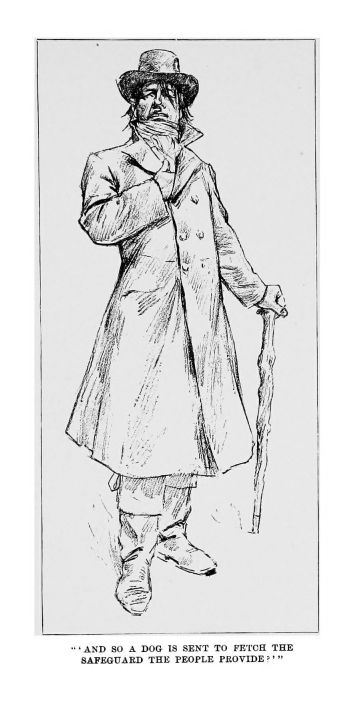
"'AND SO A DOG IS SENT TO FETCH THE SAFEGUARD THE PEOPLE PROVIDE?'"
François laughed. "The citizen is particular. But here we are good republicans, and have given our useful arms to the army, and think to go soon ourselves. Shall I give the citizen a lesson?"
No; he would call again. The section wished the names of all who fenced here. As the citizen reached the door, he said, turning:
"Thou art the man who used to laugh in the show. Robespierre told me of what fortune was read on his palm. A great man. Take care of thy own fortune. Thou art not of the club. It may be thou wilt laugh no more." This while the distorted mouth went to left and came back, and the small eyes winked and wandered. François thanked him. He would join the club, the list should be ready, and so on.
When alone again, François began to reflect on what was likely to happen. At any time, Amar might return with a guard. On the 23d, as usual during this sad week, there were no morning pupils; and still Gamel came not, and François had to manage the turbulent afternoon pupils alone.
XIII
Citizen Amar, meeting the marquis, is unlucky and vindictive.
A fear vast and oppressive was upon the great city. The white cockades were gone. François burned all he could find. For a week no one came to fence in the morning. The afternoons were full, and there was much inquiry for Citizen Gamel. On the night of the 24th of this terrible January, 1793, François went out. Paris was recovering, and, as usual, forgetful, was eating and drinking and dancing, while all Europe was ringing with the news of this murder of a good man too weak for a mighty task.
When, later, François returned to the school of arms he smelt the odor of a pipe. "Ah!" he cried, "Toto, he has come. 'T is none too soon." Candles lighted dimly the large hall and the rooms beyond it. He heard no sounds, and, suddenly becoming uneasy, hastened to enter the little salon. It was empty, as were all the rooms. On the bedroom floor lay scattered clothes. Scorched leaflets were fluttering like black crows over the ashes of a dying fire. They were fragments of burnt paper. An open desk was on the table, and everywhere were signs of haste.
François ran out to the kitchen, and called their only servant, a shrewd old woman. She said: "I heard thee, citizen. I was coming to tell thee that Citizen Gamel has gone."
"Gone! Mon Dieu!"
"He has paid me, and well; and here is a box for thee, Citizen François. I hid it under the mattress. Oh, I have waited, but I am afraid."
François took the box and its key, and went to his room. The box contained some five hundred francs in gold, and as much more in assignats—the notes of the day, and really worth but little. In a folded package were papers and a letter. It read thus:
"I am sorry to leave thee. A business affair has failed, and I go westward. I risk this to warn thee to fly. For two days thou art safe, but not longer. If a gentleman calls whom thou knowest, and asks for Monsieur Achille Gamel, tell him all. I inclose for thee a passport. No matter how I got it. It is good. Use it soon. I divide with thee my small store. Thou hast been honest; stay so. We may meet in better times."
François laughed. "We must go, Toto. Well, it has a good side; thou wilt get thinner." Then he read the passport. It described him well: Jean François, juggler ("Good!"), returning to Normandy; affairs of family; a father dying. "Good! Now I have one parent at least." It was in due order. "Thou hast no papers, Toto; but thy black head is secure."
At early morning on the 25th of January, he found a vender of antiquities, and quickly sold him, for two hundred francs, the antique arms in the fencing-room. He must remove them that coming night. Next he sought a maker of articles for the jugglers who were still to be found in every town; for neither at this time nor during the Terror did the people cease to amuse themselves. François bought a set of gaily tinted balls and the conjuring apparatus with which he was familiar. Once again in his room, he packed his clothes in a knapsack and his juggler's material in a bag that he could carry. A long cloak which his master had left he set aside to take, and, thus prepared, felt that on the whole he had better risk waiting until the dawn of the following day before he set out on his wintry journey. The old woman had already fled in alarm.
On the following morning, at 9 A.M., François went into the great hall to secure pistols and the fine Spanish rapier which Gamel had given him. Here he paused, and re-read the passport. A blank space had been left for the insertion of the special locality to which the bearer might wish to go in Normandy.
"Ah!" he exclaimed, "that must do. I will go to Musillon. Perhaps I shall find Despard. He will help me to recover that desirable papa." He went back to Gamel's room, and carefully completed the passport by inserting the name of the village Musillon.
After this he returned to the hall, talking to the poodle as he went. "Toto, thou art uneasy," he said; "and I too, my friend. Remember to howl no more at Jacobins. Thou art of the Left, a dog of the Left. Tiens! the bell." He caught up his rapier, and opened the door. A powerful, broad-shouldered man entered. He was clad in gray, and wore the red bonnet the extreme Jacobins affected, and which Robespierre so much despised.
"Ah, no one here. That is well. I trust Gamel has gone."
"Ah!" exclaimed François to himself. "'T is my confounded marquis. Now for ill luck."
"Is Monsieur Gamel at home? Monsieur Achille Gamel?" He emphasized the title.
François understood, with no great amazement, that this was the man of whom Gamel's letter spoke. He replied, "This way, please, monsieur."
The gentleman followed without a word.
"Read this," said François; "and, pardon me, but read it quickly. My head appears to me to be less securely attached to my body than common."
"Dame! You are as jolly as ever, my delightful thief."
"I beg that monsieur will read this letter, and at once. Nom de ciel! there is no time to be lost." And still he laughed. "We are in a trap, monsieur."
The marquis was not to be hurried; it was not his way. "St. Gris! you can laugh. I envy you. In France men grin, for they must; but laughter is dead. Ah!" and he fell to considering the letter. Then he folded it deliberately. "Burn it," he said. "So; that is well; and now, my good thief, I came to warn Gamel. He has wisely fled. Of course there was a plot, and, as usual, it failed. You, who are not in it, are like enough to pay other folks' debts. I have a certain mild interest in honest rascality. You are a marked man. No cabbage of the field is more sure of the knife. Go, and soon."
"I have heard from Gamel, monsieur. He assured me that I was safe here for a day or two—I know not how he knew that."
"I do, but I scarcely share his confidence. Go soon."
"I shall go at dawn to-morrow."
"No; go to-day—this evening."
"I will. Monsieur will pardon me if I ask if madame, monsieur's daughter, is well and safe? There are few who have been kind to me, and—"
"My child is well," said the marquis, "and in Normandy; but if safe or not, who can say, while these wolves destroy women and children? Safe! I would give my soul to be sure of that." His face showed the transient emotion he felt; and suddenly, as if annoyed at his own weakness, he drew himself up and said abruptly: "Go—and go quickly! I shall leave at once—"
At this moment the bell rang violently.
"The devil!" cried the marquis. "Go and see, and do not shut the inner door; I must hear." With this he entered the pistol-gallery and waited. François obeyed, and, with the sheathed rapier still in his hand, crossed the hall. Again the bell rang.
"He is in a mischief of a hurry. No noise, Toto!"
As he opened the outer door, the man of the warped face broke in, and, passing him at once, walked across the little reception-room and into the great hall beyond. Again his height and massive build struck the fencing-master.
"Where is Gamel, citizen?—and no lies to me! Where is Gamel, I say?"
"He has gone away. Why, I do not know. Will the citizen search his rooms?"
"Search! Not I. I will call the municipals. What are those rooms over there? And arms! Why have they not been sent to the committee for our patriot children on the frontier?"
"Perhaps Citizen Amar would kindly inspect them, and then, if required, we can send them. Many have been already sent. Behold, citizen, a war-club of Ashantee, a matchlock, a headsman's sword. Parbleu! the guillotine is better."
"I see, citizen; I see. But now of Gamel. He was to be here to-day, I hear. I will return presently with the officers; and, friend citizen, it will be well for thee to assist, and heartily. This Gamel was in some plot to save the Citizen Capet. Like master, like man. Have ready the lists of those aristocrats who fence here in the morning. Thou canst save thy head by making a clean breast of it. I shall return in half an hour. Have everything ready."
At this the dreaded Jacobin, having looked over the arms and duly impressed the fencing-master, moved toward the door of exit. Should Amar leave the room, François felt that his own fate was certain. He had been too much with Gamel. Less things every day cost the heads of men. There was death or life in the next five minutes. François was not one to hesitate. Preceding the Jacobin, he quietly set his back to the door, and, locking it, put the key in his pocket. This action was so dexterous and swift that for a moment the Jacobin did not perceive that he was trapped. He was thinking if there was anything more to be said. He looked up. "Well, open the door, citizen." As he spoke, the two strangest faces in Paris were set over against each other. Here was comedy, with long lean features, twinkling eyes above, and below the good humor of a capacious mouth set between preposterous ears. And there was tragedy, strong of jaw, long hair lying flat in black, leech-like flakes on a too prominent brow, and small eyes, deep-set, restless, threatening, seen like those of a wolf in cave shelters—a face no man trusted, a face on which all expressions grew into deformity; not a mere beast; a terribly intelligent bigot of the new creed, colossal, alert, unsparing, fearless, full of vanity.
When the citizen commissioner said, "Open," François replied:
"Not just yet, citizen."
"What is this?" shouted Amar. "Open, I say, in the name of the law!"
"Not I." And François, with a quick motion, threw off the sheath of the rapier. It fell with a great clatter on the far side of the room.
"Open, I say!"
At this moment Ste. Luce came across the hall.
"What the deuce is all this, François?"
Amar turned his square shoulders, and looked at the marquis.
"I presume thee, too, to be one of this rascal Gamel's band. If thou dost think I, Pierre Amar, am afraid of thee, thou art going to find out thy mistake. What is thy name?"
"Go to the devil!" cried the marquis. The Jacobin darted toward the window; but François was too quick for him, and instantly had him by the collar, the point of the rapier touching his back. "Move a step, and thou art a dead man." The face, crooked with passion, half turned over the shoulder.
"Misery! What a beauty! Didst thou think I valued my head so little as to trust thee, scum of the devil's dish-water?" For some reason this huge animal filled François with rage, and he poured out a flood of the abusive slang of the Cité as the marquis came up.
"Drop that window-curtain!" said the thief. "And now, what to do, monsieur?"
The captured man showed the utmost courage, and no small lack of wisdom. "Dog of an aristocrat! I know thee. It was thou didst kill Jean Coutier, last month. I saw thee, coward! We knew not thy name. Now we shall take pay for that murder."
The marquis grew white to the eyes, with a certain twitching of the lips to be seen as François again asked:
"What shall we do with him? Shall we tie him?"
"No; kill him. What! you will not? Give me your rapier. 'T is but one wolf less."
François was more than unwilling. The intense hatred of the noble for the Jacobin he did not share; indeed, he liked the man's fearlessness, but, nevertheless, meant to provide for his own security. His conscience, such as it was, refused to sanction cold-blooded murder.
"I cannot. Go away! I will take care of this rascal."
"There is no time to lose," said the marquis. "Kill the brute."
"Not I," said François.
"Thou art coward enough to kill a man in cold blood!" cried Amar. "This is the fine honor you talk of. Better go. All thy kind are running; but, soon or late, the guillotine will get thy hog-head, as it did thy Jew-nosed king's."
"The face and the tongue are well matched," said Ste. Luce, quietly. "It will take a good ten minutes to tie and gag him. You will not kill him? Then give the fellow a blade, and—I will see to the rest. Are you man enough to take my offer? Quick, now!"
"Try me. I am no weakling, like poor Coutier."
"Find him a blade, François. I will watch him. Be quick!" He took the rapier, and stood by the motionless figure, whose uneasy eyes followed the thief as he went and came again.
"The blades are of a length, François? Yes. Lock the door. Ah, it is done. Good! Now, keep an eye on him, François. Take care of yourself if he has the luck to kill me. However, that is unlikely. Ah, you have a sword, François."
"The citizen talks a good deal," said Amar, trying his blade on the floor.
"Yes," said the marquis, negligently untying his cravat. "It is so rare, in these democratic days, that one has a chance to talk with one of you gentlemen."
"Bah!" cried the Jacobin, "we shall see presently." As he spoke, he laid his sword on a chair and began to strip. As he took off his coat and waistcoat, he folded them with care, and laid them neatly on a bench.
The marquis also stripped to his waistcoat, but it was with more haste. He threw his coat to François, and took his place in the middle of the room, where he waited until his slower antagonist, in shirt and breeches, came forward to meet him. Both believed it to be a duel to the death, but neither face showed to François any sign of anxiety. The Jacobin said:
"The light is in thine eyes, citizen. If we were to move so as to engage across the room—"
"It is of no moment," returned the marquis. "Are you ready?"
"Yes."
François saw no better method of disposing of an awkward business. Nevertheless, he was uncomfortable. "What if this devil should kill the marquis?" He cried, "On guard, messieurs!" and stepped aside.
The marquis saluted with grave courtesy; but the Jacobin, obeying the fashion of the schools of fence, went through the formula of appearing to draw the sword, and certain other conventional motions supposed to be exacted by etiquette. The marquis smiled as Amar led off in this ceremonious fashion. These preliminaries of the salle d'armes were usually omitted or curtailed in serious combats. The seigneur, amused, and following Amar's lead, went through the whole performance. Meanwhile François looked the two men over, and was not ill pleased. This heavy fellow should prove no match for a practised duelist like Ste. Luce. He was soon undeceived.
Both men were plainly enough masters of their weapon, and for at least two minutes there was no advantage. Then Ste. Luce was touched in the left shoulder, and a distorted grimace of satisfaction ran over the face of the Jacobin. The marquis became more careful, and a minute or two later François saw with pleasure that Amar was breathing a trifle hard. He had half a mind to cry: "Wait! wait! He is feeling the strain." He held his peace, and, with Toto, looked on in silence. The marquis knew his business well, and noted the quickening chest movements of his adversary. He began to smile, and to make a series of inconceivably quick lunges. Now and then the point of either blade struck fair on the convex steel shell-like guard which protected the hand. When this chanced, a clear, sweet note as of a bell rang through the great hall. The Jacobin held his own, and François, despite his anxiety, saw with the satisfaction of a master how lightly each rapier lay in the grasp of the duelist, and how dexterously the fingers alone were used to guide the blades.
Of a sudden the strange face was jerked as it were to left, and a savage lunge in tierce came perilously near to ending the affair. Ste. Luce threw himself back with the quickness of a boy. The point barely touched him. "St. Gris!" he called out gaily. "That was well meant. Now take care!"
"By St. Denis! 't is a master," muttered François. The marquis seemed of a sudden to have let loose a reserve of unlooked-for power. He was here and there about the massive and by no means unready bulk of Amar, swift and beautifully graceful.
Then of a sudden the marquis's blade went out as quick as lightning, and just at the limit of a nearly futile thrust caught Amar over the right eye. "Dame! I missed those lanterns of hell!"
The Jacobin brushed away the blood which, running down his face, made his right eye useless for the time.
The marquis fell back, and dropped his point. "The deuce! The man cannot see. Tie a handkerchief around his head."
The Jacobin was not sorry to have time to breathe.
"Thou art more than fair, citizen," said Amar, getting his breath.
"Thanks," returned the marquis, coldly. "Make haste, François."
François took up a lace handkerchief which lay beside Ste. Luce's coat on the seat where he had cast his clothes. While François bound the handkerchief around the head so as to stop the flow of blood, Amar turned to his foe.
"Citizen," said the Jacobin, "thou hast been a gallant man in this matter. My life was thine to take. Let it end here. Thou art a brave man and a good blade."
Ste. Luce looked at him with an expression of amused curiosity.
"What else?"
"I will not have thee pursued—on my honor."
"Tie it firmly, François. You have just heard, my François, of the last Parisian novelty—a Jacobin's honor! Be so good as to hurry, François."
Had the stern Jacobin felt some sudden impulse of pity or respect? In all his after days he was unsparing, and certainly it was not fear which now moved him.
"As pleases thee," he said simply. Ste. Luce made no answer. Again their blades met. And now the marquis changed his game, facing his foe steadily, while François gazed in admiration. Ste. Luce's rapier was like a lizard's movements for quickness. Twice he touched the man's chest, and by degrees drove him back, panting, until he was against the door. Suddenly, seeming to recover strength, the Jacobin lunged in quarte, and would have caught the marquis fair in the breast-bone had he not thrown himself backward as he felt the prick. Instantly he struck the blade aside with his open left hand, and, as it went by his left side, drove his rapier savagely through Amar's right lung and into the panel of the door. It was over. Not ten minutes had passed.
"Dame!" he cried, withdrawing his rapier, and retreating a pace or two. "He was worth fighting."
The Jacobin's face moved convulsively. He coughed, spattering blood about him. His right arm moved in quick jerks. His sword dropped, and stuck upright in the floor, quivering.
"Dog of an aristocrat!" he cried. His distorted face twitched; he staggered to left, to right, and at last tumbled in a heap, a massive figure, of a sudden inert and harmless.
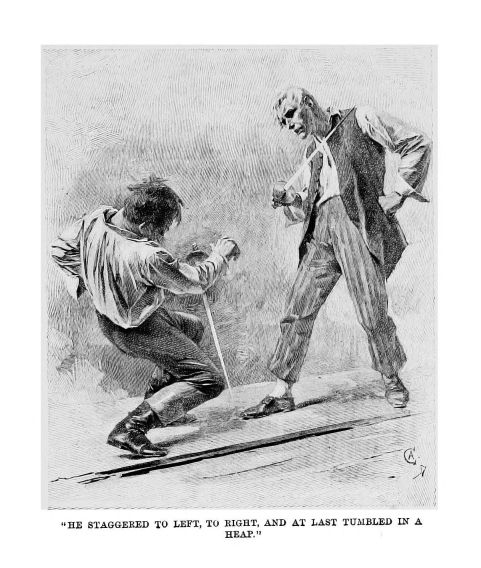
"HE STAGGERED TO LEFT, TO RIGHT, AND AT LAST TUMBLED IN A HEAP."
The marquis stood still and looked down at his foe.
"What the deuce to do with him?" said François.
"Take his head, and drag him into your room. We can talk then."
"Will monsieur take his feet?"
"What! I touch the dog? No, not I."
François did not like it; but making no reply, he dragged the Jacobin's helpless bulk after him, and, once in his room, pulled the mattress off the bed, and without roughness drew the man upon it.
Amar opened his eyes, and tried to speak. He could not; the flow of blood choked him. He shook his fist at Ste. Luce.
"Cursed brute," cried François, "be still! He will begin to howl presently. The sons of Satan are immortal."
"We must gag him, François."
"But he will die; he will choke. See how he breathes—how hard."
"Diable! it is he or I. Would he spare me, do you think? Don't talk nonsense. Do as I tell you."
François took up a towel. As he approached, Amar looked up at him. There was no plea in his savage face.
"Go on. What the deuce are you waiting for?" said Ste. Luce.
"I cannot do it," said François. "End it yourself."
"What! I? Strangle a dog! I! Dame! Let us go. What a fool you are!"
"Better go singly, then," said the thief. He had no mind to increase his own risks by the dangerous society of the nobleman.
Amar was silent. The handkerchief had fallen from his head, but the wound bled no longer.
"What shall I do with the handkerchief, monsieur?"
"Do? Burn it. Faugh!" François cast it on the still glowing embers. "Now my clothes and my cloak," said Ste. Luce; "and do not lose any time over that animal."
He washed off the little blood on his clothes, and dressed in haste, saying: "Lucky that his point struck on my breast-bone. 'T is of no moment. The fellow has left me a remembrance. I am sorry I did not have the luck to kill him. Good-by, François. May we meet in better days." He was gone.