PART THE FIRST. Church-vestments, Silk-stuffs, Needlework, and Dresses.
Reading edition
64.

Chinese Mandarin’s Tunic of Ceremony embroidered in various coloured flos-silks and gold upon an orange-red satin. Chinese. 4 feet high by 6 feet round, modern.
Sprawling all in gold and lively colours, both before and behind, upon this rich garment of state, is figured, with all its hideousness, the imperial five-clawed dragon, before which, according to the royal fancies of that land, the lion turns pale and the tiger is struck with dumbness. In the ornamentation the light blue quantity of silk is very conspicuous, more especially upon the broad lower hem of this robe.
78.

Chasuble of crimson velvet, with both orphreys embroidered; the velvet, pile upon pile, and figured with large and small flowers in gold and colour, and other smaller flowers in green and white; the orphreys figured with the Apostles and the Annunciation. Florentine, late 15th century. 4 feet 3½ inches by 2 feet 5½ inches.
Like most other chasubles, this has been narrowed, at no late period, across the shoulders. The velvet is very soft and rich, and of that peculiar kind that shows a double pile or the pattern in velvet upon velvet, now so seldom to be found. On the back orphrey, which is quite straight, is shown St. Peter with his keys; St. Paul with a sword; St. John blessing with one hand, and holding a chalice, out of which comes a serpent, in the other; St. James with a pilgrim’s hat and staff: on the front orphrey the Annunciation, and St. Simon holding a club, but his person so placed, that, by separating the archangel Gabriel from the Blessed Virgin Mary, a tau-cross is made upon the breast; St. Bartholomew with a knife, and St. James the Less with the fuller’s bat. For their greater part, the Gothic niches in which these figures stand, are loom-wrought; but these personages themselves are done on separate pieces of fine canvas and are applied over spaces left uncovered for them. Another curious thing is that in these applied figures the golden parts of the draperies are woven, and the spaces for the heads and hands left bare to be filled in by hand; and most exquisitely are they wrought, for some of them are truly beautiful as works of art.
79.
Cope, crimson velvet, with hood and orphrey embroidered, &c. Florentine, late 15th century. 9 feet 5½ inches by 4 feet 6 inches.
This fine cope is of the same set a part of which was the beautiful chasuble No. 78, and, while made of precisely the same costly materials, is wrought with equal care and art. Its large fine hood is figured with the coming down of the Holy Ghost upon the infant Church, represented by the Blessed Virgin Mary amid the Apostles, and not merely this subject itself, but the crimson colour of the velvet would lead us to think that the whole set of vestments was intended for use on Witsunday. On the orphrey, on the right hand, the first saint is St. John the Baptist, with the Holy Lamb; then, Pope St. Gregory the Great; afterwards, an archbishop, may be St. Antoninus; after him a layman-saint with an arrow, and seemingly clad in armour, perhaps St. Sebastian; on the left side, St. George with banner and shield; under him St. Jerome, below whom, a bishop; and lowermost of all St. Onuphrius, hermit, holding in one hand a cross on a staff, in the other a walkingstick, and quite naked, saving his loins, round which he wears a wreath of leaves. All these subjects are admirably treated, and the heads done with the delicacy and truth of miniatures.
84.

Hood of a Cope, figured with the Adoration of the Wise Men. Flemish, 16th century. 1 foot 8½ inches wide, 1 foot 4½ inches deep.
This is one of the best preserved and the most beautiful works of the period in the collection, and is remarkable for the goodness of the gold, which is so plentifully bestowed upon it. It is somewhat large, and the three long hooks by which it used to hang are still attached, while its fine green and yellow silk fringe is a pleasing specimen of such a kind of decoration.
540.

Purse in crimson velvet, embroidered with comic masks, and mounted in chased steel damascened in gold. Attached is a crimson Band with a Buckle of cut and gilt steel. Milanese, 16th century. 11½ inches by 11 inches.
The rich crimson velvet is Genoese; the frame, an art-work of the Milan school, is figured with two monsters’ heads, and two medallions, one containing a naked youth seated, the other a nude female figure standing. On the front of the bag are applied two embroideries in gold and coloured silk, one an owl’s head, the other that of a full-faced grotesque satyr; on the back is another satyr’s side-face. At one time, such bags or ornamental purses, under the name of “gibecières” in France and England, but known in Italy as “borsa,” were articles of dress worn by most people; and “the varlet with the velvet pouch” will not be forgotten by those who have read Walter Scott’s novel of “Quentin Durward.” The expressions, in English of “cut-purse,” in Italian “taglia borse,” for a pickpocket, are well illustrated by this gay personal appendage.
623.
Piece of Edging; ground, purple thread-net; pattern, bunches of flowers, of two sorts alternated, in various coloured flos-silks. Italian, 18th century. 5 feet 5 inches by 5 inches.
Intended for a border to a dress or to a bed-quilt, and no attention shown to the botanical exactness of the flowers, most of which are seemingly tulips. A large coverlet is edged with a broad piece of needlework, after this manner, in the collection.
624.
Piece of Edging; ground, purple thread-net; pattern, large flowers, mostly the same, embroidered in various coloured flos-silks, within scrolls and foliage. Italian, 18th century. 8 feet 3 inches by 11 inches.
Probably by the same hand as the foregoing piece, and equally care-less of botanical exactness in the flowers.
625.
Cushion-cover, oblong, centre in striped cherry-coloured silk, the border of open work embroidered in various coloured flos-silks upon a net of purple thread. Italian, 18th century. 2 feet 6 inches by 2 feet.
The only difference in the way of the stitchery is that the geometrical pattern shows the same on both sides.
626.

Quilt for a Bed; ground, an amber-coloured cotton, figured with a net-work of ovals and squares in diapered raised crimson velvet, the ovals filled in with a floriation of crimson and green raised velvet; the squares, with a small vase having a flower-bearing tree, crimson raised velvet. This is the centre, which is bordered by a like kind of stuff 11 inches deep; the ground, primrose yellow; the pattern, ovals, enclosing a foliage bearing crimson and amber-tinted flowers, and placed amid boughs bearing the same coloured flowers; on both edges this border has three stripes—two crimson raised velvet, the third and broader one a pattern in shades of purple—all on a light yellow ground; at the ends of the quilt hangs a long party-coloured fringe of linen thread; the lining of it is fine Chinese silk of a bright amber, figured with sprigs of crimson flowers, shaded yellow and white. Genoese, 17th century. 5 feet 11 inches by 3 feet 10½ inches.
627.
Quilt for a Bed; ground, brown canvas; pattern, all embroidered scales or scollops jagged like a saw, and overlapping each other in lines, some blue and green shaded white or yellow, some amber. The border is a broad scroll of large flowers, among which one at each corner, the fleur-de-lis, is conspicuous. This again has a scollop edging of flowers separated by what seem two Cs interlaced. French, 17th century. 7 feet 8 inches by 5 feet 8 inches.
673.
Chasuble of green silk, figured with animals and scrolls in gold, with an embroidered orphrey at back, and a plain orphrey in front. Sicilian, early 13th century. 3 feet 9¾ inches by 2 feet 2 inches.
This very valuable chasuble is very important for the beauty of its stuff; but by no means to be taken as a sample in width of the fine old majestic garment of that name, as it has been sadly cut down from its former large shape, and that, too, at no very distant period. Though now almost blue, its original colour was green. The warp is cotton, the woof silk, and that somewhat sparingly put in; the design showing heraldic animals, amid gracefully twining branches all in gold and woven, is remarkably good and free. The front piece is closely resembling the back, but, on a near and keen examination, may be found to differ in its design from the part behind; on this we see that it must have consisted of a lioncel passant gardant, langued, and a griffin; on that on the part in front, a lioncel passant, and a lioncel passant regardant. When the chasuble was in its first old fulness, the design on both parts came out in all its minuteness; now, it is so broken as not to be discernible at first. In front the orphrey is very narrow, and of a sort of open lace-work in green and gold; on the back the orphrey is very broad, 1 foot 1½ inches, and figured with the Crucifixion, the Blessed Virgin Mary standing on our Lord’s right hand, St. John the Evangelist on His left; below, the Blessed Virgin Mary crowned as a queen and seated on a royal throne, with our Lord as a child sitting on her lap; lower still, St. Peter with two keys—one silver, the other gold—in his left hand, and a book in the right; and St. Paul holding a drawn sword in his right, and a book in his left; and, last of all, the stoning of St. Stephen. All the subjects are large, and within quatrefoils; as much of the body of our Lord as is uncovered on the Cross, and the heads, hands, and feet in the other figures, as well as those parts of the draperies not gold, are wrought by needle, while the golden garments of the personages are woven in the loom.
This very interesting chasuble has a history belonging to it, given in “The Gentleman’s Magazine,” t. lvi. pp. 298, 473, 584, by which we are taught to believe that it has always been in England; belonging once to it were a stole and maniple, upon which latter appliance were four armorial shields, which would lead to the idea that it had been expressly made for the chapel of Margaret de Clare, Countess of Cornwall, who is known to have been alive A.D. 1294. That time quite tallies with the style of the stuff of which this chasuble is made; and though now so worn and cut away, it is one of the most curious in this or any other country, and particularly valuable to an English collection.
675.
Piece of the Bayeux Tapestry; ground, white linen; design, two narrow bands in green edged with crimson (now much faded) with a very thin undulating scroll in faded crimson, and green between them. English, 11th century. 3¼ inches by 2½ inches.
Though done in worsted, and such a tiny fragment of that great but debated historical work, it is so far a valuable specimen as it shows the sort of material as well as style and form of stitch in which the whole was wrought. In the “Vetusta Monimenta,” published by the Society of Antiquaries, plate 17, shows, in large, a portion of this embroidery where the piece before us is figured; and, from the writing under it, we learn that it was brought away from Bayeux by Mrs. Stothard, when her husband was occupied in making drawings of that interesting record. There is not the slightest reason for believing that this embroidery was the work of Matilda, or any of her ladies of honour, or waiting maids; but all the probabilities are that it was done by English hands, may be in London by order, and at the cost, of one or other of three knights from Bayeux, who came over with William, on whom he bestowed much land in England, as we have already shown in the Introduction to this Catalogue, § 4.
698.

Door-curtain, ground, yellow and gold; pattern, in rich raised green velvet, two small eagles with wings displayed, and between them a large vase, out of which issues a conventional flower showing the pomegranate, surmounted by a modification of the same fruit amid wide-spreading foliations. Milanese, 16th century. 8 feet 8 inches by 6 feet 6 inches.
Though the golden threads of the ground in this magnificent stuff are much tarnished, still this piece is very fine, and may have been part of some household furniture wrought at the order of the Emperor Charles V, whose German eagle is so conspicuous in the design, while the pomegranate brings to mind Spain and Granada.
699.
Piece of Embroidery; ground, a brown fine linen, backed with strong canvas; pattern, female figures, monkeys, flowers, shells, &c. in coloured worsteds. French, late 17th century. 8 feet 9 inches by 8 feet 3 inches.
This large work is admirably done, and a fine specimen both of the taste with which the colours are matched, and the stitchery executed; and it may have been intended as the hanging for the wall of a small room.
700.

Lady’s dress, white silk; embroidered with flowers in coloured silks and gold and silver threads. Chinese, 18th century. 4 feet 2½ inches.
Worked by order, very probably of some European dame, at Macao or Canton, and exactly like No. 713 in design and execution. The gold and silver, as in that, so in this specimen, are much tarnished.
701.
Lady’s Dress, sky-blue satin; brocaded with white flowers, in small bunches. French, late 18th century. 4 feet 7 inches.
702.
Christening Cloak of green satin, lined with rose-coloured satin. Chinese. 5 feet 8½ inches by 3 feet 6¾ inches.
A fine specimen, in every respect, of Chinese manufacture; the satin itself is of the finest, softest kind; whether we look at the green or the light rose-colour, nothing can surpass either of them in tone and clearness. Few European dyers could give those tints.
In its present form this piece constituted an article to be found, and even yet seen, in very many families in Italy, Germany, and France, and was employed for christening occasions, when the nurse or midwife wore it over her shoulders, like a mantle, for muffling up the new-born babe, as she carried it, in state, to church for baptism. In this, as in other specimens of the Museum, there was a running string at top by which it might be drawn tight to the neck. Those who have lived abroad for even a short time must have observed how the nurse took care to let a little of this sort of scarf hang out of the carriage-window as she rode with baby to church. The christening cloth or cloak was, not long since, in use among ourselves.
703.
Christening Cloak of bright red satin. Italian, 18th century. 5 feet by 5 feet 11 inches.
The material is rich, and of a colour rather affected for the purpose in Italy.
704.
Christening Cloth or Cloak of murrey-coloured velvet. Italian, 17th century. 8 feet by 5 feet 5 inches.
The pile is soft and rich, and its colour, once such a favourite in the by-gone days of England, of a delicious mellow tone. Like Nos. 702 and 703, it robed the nurse as she went to the baptismal font with the new-born child, and has the string round the neck by which it could be drawn, like a mantle, about her shoulders.
705.
Lady’s Dress of brocaded satin; ground, dull red; pattern, slips of yellow flowers and green leaves. Italian, late 18th century. 4 feet 10½ inches.
The satin is rich, but the tinsel, in white silver, tawdry.
706.

Skirt of a Lady’s Dress of brocaded silk; ground, white; pattern, bunches of flowers in pink, blue, yellow, and purple, amid a diapering of interlaced strap-design in white flos-silk. French, 18th century. 3 feet 3 inches.
Good in material, but in pattern like many of the stuffs which came from the looms of the period at Lyons.
707.
Christening Scarf of white brocaded silk. Lucca, 17th century. 5 feet square.
Of a fine material and pleasing design.
708.
Piece of green Silk Brocade; pattern, lyres, flowers, ribbons with tassels. French, 18th century. 5 feet 6 inches by 1 foot 8 inches.
709.
Skirt of a Lady’s Dress; ground, bright yellow, barred white; pattern, a brocade in small flowers in gold, green, and red sparingly sprinkled about. Italian, 18th century. 7 feet 8 inches by 3 feet 4 inches.
A pleasing specimen of the time.
710.
Piece of White Silk, brocaded with flowers in white flos-silk, and in silver, between bands consisting of three narrow slips in white. French, 17th century. 5 feet by 4 feet 6 inches.
When the silver was bright and untarnished, the pattern, so quiet in itself, must have had a pleasing effect.
711.
Christening Scarf of silk damask; ground, light blue; pattern, flowers in pink, white, and yellow. Levant, 18th century. 5 feet 5 inches by 5 feet.
Garish in look, still it has a value as a specimen of the loom in the eastern parts of the Mediterranean; the blue diapering on the blue ground shows, in the architectural design, a Saracenic influence.
712.
Piece of Damask Silk; ground, crimson; pattern, flowers and vases in white and green. Italian, 17th century. 8 feet 9 inches by 1 foot 9 inches.
Rich in substance, and intended for hangings in state rooms.
713.
Skirt of a Lady’s Dress; white silk embroidered with flowers in coloured silks, and gold and silver. Chinese, 18th century. 3 feet.
Though well done, and by a Chinese hand, very likely at Canton or Macao, for some European lady, it is far behind, in beauty, the Chinese piece No. 792.
714.
Christening Cloak of yellow silk damask; pattern, bunches of flowers. Lucca, 17th century. 7 feet 10 inches by 5 feet.
Like other such cloaks, or scarves, it has its running string, and is of a fine rich texture.
715.
Piece of Silk Damask; ground, dove-coloured white; pattern, large foliage in pale green. Italian, 18th century. 4 feet 8 inches by 3 feet 8 inches.
A fine material, and the bold design well brought out.
716.
Christening Cloak of pink satin damask. Italian, 18th century. 4 feet 8 inches by 4 feet 6 inches.
The little sprigs of fruits and flowers are well arranged; and the pomegranate is discernible among them.
717.
Piece of Silk Brocade; ground, stone-white chequered silk; pattern, deep blue garlands and bunches of flowers, both dotted with smaller flowers in silver. Italian, 17th century. 3 feet 8 inches by 3 feet.
718.
Piece of Embroidered Silk; ground, sky-blue; pattern, leaves, flowers, and fruit, in white silk. Italian, 18th century. 3 feet 8 inches by 3 feet.
The embroidery is admirably done, and the pomegranate is there among the fruit.
719.
Door-curtain, crimson worsted velvet; pattern, flowers and foliage. Italian, 17th century. 10 feet 3 inches by 4 feet 3 inches.
A very fine and rich specimen of its kind, and most likely wrought at Genoa.
720.
Piece of Silk; ground, white; pattern, flowers and foliage, embroidered in gold thread and coloured silks. Chinese, 18th century. 3 feet 2½ inches by 1 foot 6½ inches.
Another specimen of Chinese work done for Europeans, and most likely after an European design; in character resembling other examples in this collection from the same part of the world.
721.
Piece of Silk; ground, white; pattern, flowers and pomegranates embroidered in gold and coloured silks. Neapolitan, 17th century. 3 feet 3 inches by 1 foot 5 inches.
The design is rich, the flowers well-raised, and the gold unsparingly employed.
722.
Cradle-coverlet; white satin quilted, after a design of fruits, and branches of leaves upon a chequer pattern. French, 18th century. 3 feet 2½ inches by 3 feet.
Among the fruits the symbolic pomegranate is not forgotten, perhaps as expressive of the wish that the young mother to whom this quilt may have been given by a lady friend, might have a numerous offspring, hinted at by the many pips in the fruit.
723.
Door-curtain of silk damask; ground, crimson; pattern, scrolls in gold foliage, and flowers in coloured silks. Italian, early 17th century. 6 feet 7 inches by 3 feet 5 inches.
This is a fine rich stuff; it is lined with purple satin, and must have been very effective when in use.
724.
Chasuble of woven silk; ground, white; pattern, floral scrolls in green, and lined pink; the cross at the back and the two stripes in front in gold lace of an open design. French, 18th century. 4 feet 2 inches by 2 feet 5 inches.
The open-worked lace is good of its kind.
725.

Altar-frontal of crimson velvet, ornamented on three sides with a scroll ornamentation in gold, and applied; and with seven armorial bearings all the same. French, 17th century. 6 feet 1 inch by 2 feet 6½ inches.
The armorial shield, as it stands at present, is—azure a cross ankred sable between two fleur-de-lis argent. On looking narrowly at the azure velvet on which these charges are worked, it is evident that something has been picked out, and, in its place, the sable-cross has been afterwards wrought in, thus explaining the anomaly of colour upon colour not in the original bearing. The applied ornaments in gold are in flowers and narrow gold lace, and of a rich and effective manner.
726.
Cradle-coverlet of white satin; embroidered in white, with a roving border of flowers, and fringed. French, 18th century. 3 feet 5½ inches by 2 feet 8 inches.
Rich in its material, and nicely wrought.
727.
Skirt of a Lady’s Dress; sky-blue satin, quilted round the lower border with a scroll of large palmate leaves, and bunches of flowers, with an edging of fruits, in which the pomegranate may be seen. Italian, 18th century. 8 feet 9 inches by 3 feet.
The pattern in which the quilting comes out is very tasteful; and the body of this skirt has an ornamentation in quilting of a cinquefoil shape, and made to lap one over the other in the manner of tiles.
728.
Piece of Silk Damask; ground, bright yellow silk ribbed; pattern, white plumes twined with brown ribbons, and bunches of white flowers. Lucca, 17th century. 8 feet 10 inches by 7 feet.
Of rich material and wrought for household use.
729.
Door-curtain of yellow silk damask; pattern, strap-work and conventional foliage. Italian, 17th century. 7 feet 2 inches by 5 feet.
A bold design, and wrought in a good material.
730.
Cope of brocaded silk; ground, orange-red; pattern, foliage, and bunches of flowers amid white garlands, in coloured silks. French, 18th century. 10 feet 10 inches by 5 feet 6 inches.
The hood and morse are of the same stuff, which was evidently meant to be for secular, not liturgical, use.
731.
Door-curtain of crimson damask silk; pattern, a large broad conventional floriation. Italian, 17th century. 10 feet by 8 feet 10 inches.
732.
Curtain of pale sea-green damask; pattern, large leaves and flowers. Italian. 17 feet 8 inches by 13 feet 7 inches.
The satiny ground throws up the design in its dull tone extremely well; and the whole is edged with a border of narrow pale yellow lace, figured with small green sprigs.
750.

Table-cover; ground, fine ribbed cream-coloured linen; pattern, flowers, butterflies, and birds, embroidered in various-coloured flos-silks. Indian, 17th century. 7 feet by 5 feet 6 inches; fringe 3 inches deep.
The curiosity of this piece is that, like many such works of the needle from India, the embroidery shows the same on both sides; and there is evidently a Gothic feeling in the edgings on the borders of the inner square.
786.
Scull-cap of white satin; quilted after an elaborate running design. English, 17th century, 10½ inches diameter.
Tradition tells us that this scull-cap belonged to our King Charles the First, and says, moreover, that, at his beheading, it was worn by that unfortunate King. The style of design would not, as far as art-worth can speak, invalidate such a history of this royal ownership. Its lining is now quite gone.
792.
Piece of Chinese Embroidery; ground, greyish white satin; pattern, girls, flowers, birds, fruits, and insects in various-coloured flos and thread silks, and gold. 11 feet by 1 foot 7 inches.
Justly may we look upon this specimen as one among the best and most beautiful embroideries wrought by the Chinese needle known, not merely in this country, but in any part of Europe. Putting aside the utter want of perspective, and other Chinese defective notions of art, it is impossible not to admire the skilful way in which the whole of the piece before us is executed. In the female figures there seems to be much truthfulness with regard to the costume and manners of that country; and the sharp talon-like length of finger-nails affected by the ladies there is conspicuously shown in almost every hand. The birds, the insects, the flowers are all admirably done; and the tones of colour are so soft and well assorted, and there is such a thorough Chinese taste displayed in the choice of tints—tints almost unknown to European dyers—that the eye is instantly pleased with the production. The embroidery itself is almost entirely well raised.
839.
Piece of Velvet Hanging; ground, crimson velvet; pattern, large conventional flowers and branches in yellow applied silk. Italian, 17th century. 6 feet 4 inches by 1 foot 8 inches.
This piece is rather a curiosity for the way in which its design is done. On the plain length of velvet a pattern was cut, and the void spaces were filled in with yellow silk, and the edges covered with a rather broad and flat cording, and the whole—that is, velvet and silk—gummed on to a lining of strong canvas, having the cord only stitched to it.
840.
Piece of Applied Work; ground, crimson velvet; pattern, large conventional flowers in yellow satin. Italian, 17th century. 2 feet 6 inches by 2 feet 3 inches.
Here the same system is followed, but the ground is yellow satin uncut, the crimson velvet being cut out so as to make it look the ground, and the real ground the design, both are, as above, gummed on coarse canvas.
841.
Piece of Velvet Hanging; ground, yellow silk; pattern, scrolls and flowers in applied crimson velvet. Italian, 17th century. 6 feet 4 inches by 1 foot 9 inches.
Executed exactly as No. 840. In all likelihood these three pieces served as hangings to be put at open windows on festival days—a custom yet followed in Italy.
842.
Piece of Raised Velvet; ground, pale yellow silk; pattern, in raised velvet, a fan-like floriation in crimson and green. Florentine, 16th century. 3 feet 2 inches by 2 feet 1 inch.
A specimen of rich household decoration.
843.

Raised Velvet; ground, creamy white satin; pattern, the artichoke amid wide-spreading ramifications in crimson raised velvet. Genoese, 17th century. 2 feet 1 inch by 1 foot 8½ inches.
Intended for household furniture. When hung upon the walls of a large room this stuff must have had a fine effect.
882.
Skirt of Female Attire; ground, coarse white linen; pattern, a broad band of blue worsted, figured with flowers and animals in white thread, and the broad edging of crochet work. German, 17th century. 3 feet 8½ inches by 2 feet 8 inches deep.
This piece of embroidery must have been for secular personal use, and not for any ecclesiastical employment, and very likely was part of the holyday dress of some country girl in Germany or Switzerland. The blue embroidery, though of a bold well-raised character, is coarse; so, too, is the lace below it.
1029.
An Algerine Embroidered Scarf; ground, very thin canvas; pattern, a modification of the artichoke form, and ramifications in various-coloured flos-silks, and parted by short bands of brace-like work in white flos-silk. 2 feet 3¾ inches by 1 foot 3¾ inches.
Neither old, nor remarkable as an art-work.
1030.
Table-cover of linen, embroidered in white thread, with flowers, vases, trophies, and monograms. French, 18th century. 4 feet 4 inches by 3 feet 10 inches.
This beautifully-executed piece of needlework is richly deserving a notice from those who admire well-finished stitchery, which is here seen to advantage. In the centre is a basket with wide-spreading flowers, upon each side of which is a military trophy consisting of cannon-balls, kettle-drums, other drums, knights’ tilting-lances, halberts, swords, cannon, trumpets, all gracefully heaped together and upholding a herald’s tabard blazoned with a leopard rampant, by the side of which, and drooping above, are two flags, one showing the three fleurs-de-lis of France, and the other with a charge that is indistinct; and the whole is surmounted by a full-faced barred helmet wreathed with a ducal coronet, out of which arises a plume of ostrich feathers; on the other sides are two elegantly-shaped vases full of flowers. At each of the four corners of this inner square is the monogram A. M. V. P. T. between boughs, and surmounted by a ducal coronet; and at every corner of the border below is a flaming heart pierced by two arrows, while all about are eagles with wings displayed and heads regardant, seemingly heraldic.
1031.
Piece of Silk Brocade; ground, white; pattern, large red flowers seeded yellow, and foliage mostly light green. Lyons, 18th century. 2 feet 10 inches by 1 foot 9 inches.
A specimen of one of those large showy flowered tissues in such favour all over Europe during the last century, as well as in the earlier portion of the present one, for church use. The example before us, in all probability, served as a bishop’s lap-cloth at solemn high mass; for which rite, see “The Church of our Fathers,” i. 409.
1032.
Piece of Silk and Silver Brocade; ground, a brown olive; pattern, large flowers, some lilac, but mostly bright crimson, intermixed with much silver ornamentation. Lyons, 18th century. 2 feet 8½ inches, by 1 foot 8½ inches.
Another specimen of the same taste as No. 1031, but even more garish. Like it, it seems to have served the purpose of a liturgical lap-cloth, or, as it used to be called, a barm-cloth.
1033.
Lectern-veil; ground, yellow satin; pattern, conventional flowers in applied velvet in blue, green, and crimson. Italian, early 17th century. 6 feet 6 inches by 1 foot 8 inches.
In fact the whole of this liturgical veil for the deacon’s book-stand is of the so-called “applied style;” that is, of pieces of satin and of velvet cut out to the required shape, and sewed on the canvas ground, and the edges bordered with a cord of silk, mostly white; and altogether it has a rich appearance.
1035.

Bed-coverlet; ground, white thread net; pattern, flowers in white thread. Spanish, 17th century. 6 feet 5 inches by 5 feet 3½ inches.
This specimen of netting and crochet needlework displays much taste in its design of flowers, among which the rose and the pomegranate are very conspicuous. It was wrought in four strips joined together by narrow linen bands, and the whole edged with a shallow fringe.
1037, 1037A.
Pieces of Stuff for Silk Sashes; pattern, perpendicular bars, some whity-brown figured with gold and silver flowers, some plain olive green, and bordered on both edges of the stuff with bands of whity-brown ornamented with sprigs of gold flowers. Oriental, 16th century. 2 feet 4½ inches, by 11 inches.
The trimming and cross, done in tinsel, show that its last European use was for the church; in the East, such silken stuffs, in long lengths, are worn about the waist by men and women as a sash or girdle.
1038.
Chasuble-back; ground, green satin; design, scrolls in raised red silk thread. 18th century. Satin, French. 3 feet 8 inches by 2 feet 2 inches.
Very likely the satin formed some part of a lady’s gown, and for its richness was given to the church for making vestments. As a ritual garment it could not have looked well, nor is its gaudy red embroidery in good taste for any ecclesiastical purpose.
1039.

Waistcoat-pattern, embroidered and spangled. Second half of the 18th century. French. 10 inches by 7½ inches.
Of such stuffs were gentlemen’s vests made in Paris under Louis XV., and in London at the beginning of George III.’s reign.
1194, 1195.

Orphreys for a Chasuble; ground, crimson silk; design, an angel-choir in two rows amid wreaths, of which the flowers are silver and the leaves gold, some shaded green; on the back orphrey are two heraldic bearings. German, very late 15th century.
This beautifully-wrought specimen of Rhenish needlework, most likely done at Cologne, consists of twenty-six small figures of winged angels robed in various liturgical vestments, and playing musical instruments of all sorts—some wind, some stringed. Of these celestial beings several wear copes over their white albs; others have over their albs narrow stoles, in some instances crossed upon the breast as priests, but mostly belt-wise as deacons: other some are arrayed in the sub-deacon’s tunicle, and the deacon’s dalmatic: thus vested they hold the instrument which each is playing; and no one but a German would have thought of putting into angels’ hands such a thing as the long coarse aurochs’ horn wherewith to breathe out heavenly music. On the front orphrey are ten of such angels; on the one made in the shape of a cross, for the back of the chasuble, there are sixteen. At both ends of the short beam or transom of this cross we find admirably-executed armorial bearings. The first blazon—that to the left—shows a shield gules an inescutcheon argent, over all an escarbuncle of eight rays or, for Cleves; dimidiated by, or a fess checky argent and gules, for Marck; surmounted by a helmet argent crested with a buffalo’s head cabosed gules, having the shut-down bars of the helmet’s vizor thrust out through the mouth of the animal, which is crowned ducally or the attire argent passing up within the crown; and the mantlings gules. As if for supporters, this shield has holding it two angels, one in a tunicle, the other in a cope. The second shield—that on the right hand,—shows gules an inescutcheon argent, over all, an escarbuncle of eight rays or, crested and supported as the one to the left, thus giving, undimidiated, the blazon of the then sovereign ducal house of Cleves.
All these ornaments, armorial bearings, angels, flowers, and foliage, are not worked into, but wrought each piece separately, and afterwards sewed on the crimson silk ground, which is the original one; they are “cut work.” The angels’ figures are beautifully done, and their liturgic garments richly formed in gold, as are the leaves and stems of the wreaths bearing large silver flowers. From its heraldry we may fairly assume that the chasuble, from which these handsome orphreys were stripped, belonged to the domestic chapel in the palace of the Dukes of Cleves, and had been made for one of those sovereigns whose wife was of the then princely stirring house of De la Marck.
As was observed, while describing the beautiful Syon Cope, No. 9182, the nine choirs of angels separated into three hierarchies is indicated here also; and the distinction marked by the garments which they are made to wear in these embroideries; some are clothed in copes, others in tunicles, the remainder, besides their narrow stoles, in long-flowing white albs only—that emblem of spotless holiness in which all of them are garmented, as with a robe of light. The bushiness of the auburn hair on all of them is remarkable, and done in little locks of silk.
For a student of mediæval music, this angel-choir will have an especial interest; but, to our thinking, neither this, nor any other production of the subject, whether wrought in sculpture, painting, or needlework, hitherto found out on the Continent, at all comes up in beauty, gracefulness, or value, to our own lovely minstrel-gallery in Exeter Cathedral, or the far more splendid and truly noble angel-choir sculptured in the spandrils of the triforium arches in the matchless presbytery at Lincoln Minster. A cast of the Exeter minstrel-gallery is put up here on the western wall of the north court, and among the casts lent by the Architectural Society are those of the angels in Lincoln.
Of the musical instruments themselves, we see several in these two pieces of cut-work. Beginning with the back orphrey, marked No. 1194 at top, the first of the two angels is playing with the fingers of both hands an instrument now indiscernible; the second, the lute; below them one is beating a tabour with a stick; the other is turning the handle of the gita, our hurdy-gurdy. After these we have an angel blowing a short horn, while his fellow angel strikes the psaltery. Then an angel robed as a deacon in alb, and stole worn like a belt falling from his right shoulder to under his left arm, sounding the sistrum or Jew’s harp, and his companion fingers with his right hand a one-stringed instrument or ancient monochord. In the last couple, one with a large bow is playing the viol, a long narrow instrument with several silver strings.
On the orphrey,—made in the shape of a cross and worn on the back of the chasuble, No. 1195,—the first angel plays the pan-pipes; the second, a gittern, or the modern guitar; the next two show one angel, as a deacon in dalmatic, jingling an instrument which he holds by two straps, hung all round with little round ball-like bells; and his companion, robed in alb and stole crossed at the breast like a priest, ringing two large hand-bells; lower down, of the two angels both vested as deacons, one blowing a large, long curved-horn, like that of the aurochs, the other, the shalmes or double-reeded pipe. Below these, one in alb and stole, belt-wise as a deacon, blows a cornamuse or bag-pipe; the other, as deacon, the aurochs’ horn. Then a deacon angel has a trumpet; his fellow, a priest in alb and crossed stole, is playing a triangle; last of all, one plays a tabour, the other the monochord. So noteworthy are these admirable embroideries, that they merit particular attention.
1233.
A stole; ground, very pale yellow silk; design, an interlacing strap-work in the greater part; for the expanding ends, a diamond in gold thread, with a fringe of silk knots alternately crimson and green; the lining, thin crimson silk. English or French, 13th century. 9 feet 9 inches by 1¾ inches in the narrow parts, and 2½ inches in the expanded ends.
Another of those specimens of weaving in small looms worked by young women in London and Paris, during the 13th century, which we have met in this collection. As the expanded ends are formed of small pieces of gold web they were wrought apart, and afterwards sewed on to the crimson silk ground. The design of the narrow part has all along its length, at its two edges, a pair of very small lines, now brown, enclosing a dented ornament. As a liturgical appliance, this stole, for its perfect state of preservation, is valuable; Dr. Bock says that a stole called St. Bernhard’s, now in the church of our Lady at Treves, as well as another curious one in the former cathedral at Aschaffenburg, are in length and breadth, just like this.
1234.
Tissue of Silk and Cotton; the warp, cotton; the woof, silk; ground, green; design, so imperfect that it can hardly be made out, but apparently a monster bird in yellow, lined and dotted in crimson; standing on a border of a yellow ground marked with crosses and mullets of four points. Syrian, late 12th century. 6¾ inches by 4½ inches.
When perfect this stuff must have been somewhat garish, from its colours being so bright and not well contrasted.
1235.
Tissue of Silk and Cotton; the warp, silks of different colours; the woof, fawn-coloured fine cotton; design, stripes, the broader ones charged with wild beasts, eagles, and a monster animal having a human head; the narrow bands showing a pretended Arabic inscription. Syrian, 13th century. 13 inches by 2 inches.
So very torn and worn away is this piece that the whole of its elaborate design cannot be made out; but enough is discernible to prove an Asiatic influence. The monster, with the human face staring at us, calls to mind the Nineveh sculptures in the British Museum.
1236.
Silk Damask; ground, crimson silk; pattern, in gold thread, two very large lions, and two pairs, one of very small birds, the other of equally small dragons, and an ornament not unlike a hand looking-glass. Oriental, 14th century. 2 feet 5½ inches by 2 feet ½ inch.
A piece of this same stuff is described under No. 7034 in this catalogue; and Dr. Bock, in his useful work, “Geschichte der Liturgischen Gewänder des Mittelalters,” t. i. plate iv. has figured it.
1237.
Tissue of Silk; ground, dull reddish deep purple; design, a lozenged diapering. South Italian, 13th century. 6½ inches by 5½ inches.
So thin is this web that we may presume it was meant as a stuff for lining garments of a richer texture.
1238.
Piece of Linen, or the finest byssus of antiquity. Egyptian. 5½ inches by 3 inches.
Whether this very curious example of that rare and fine tissue known in classic times, and later, as byssus, was of mediæval production in Egypt, or found in one of the ancient tombs of that land, would be hard to determine. Another equally fine and no less valuable specimen may be seen in this collection, No. 8230.
From Dr. Bock we learn that the sudary of our Lord, given to the Abbey of Cornelimünster, near Aix-la-Chapelle, by the Emperor Louis the Pious, circa A.D. 820, was much like the present example.
1239.
Piece of Silk Damask; ground, creamy white; design, broad-banded lozenges, enclosing a two-headed displayed eagle, and a pair of birds addorsed, each within an oval. Greek, 11th century. 10¾ inches by 7½ inches.
It is said to have been a fragment of the imperial tunic belonging to Henry II, Emperor of Germany; and not unlikely. If wrought for the occasion, and a gift from his imperial brother-Emperors of Constantinople, Basil and Constantine, worthy was it for their sending and of his acceptance, since the silk is rich, the texture thick, and the design in accordance with the ensigns of German royalty. In shreds, and ragged as it is, we may prize it as a valuable piece.
1240.
Piece of Silk and Cotton Damask; ground, a yellowish green; design, large elliptical spaces filled in with Saracenic figurations. The warp is of green cotton, the woof, of pale yellow silk. South of Spain, 14th century. 16½ inches by 4¾ inches.
This strong stuff most likely came from the looms of Granada.
1240A.
Piece of Silk and Cotton.
Another piece of the same texture.
1241.
Silk and Cotton Damask; ground, blue; design, circles filled in with conventional ornamentation in crimson (now faded). Greek, 13th century. 15¼ inches by 7½ inches.
In some very small parts of the pattern, at first sight, indications appear of four-footed animals, but the outlines are a fortuitous combination. This stuff is poor in material, and the design not very artistic.
1242.
Silk and Cotton Damask; ground, light green; design, a Saracenic pattern formed by lines in long lozenges. South of Spain, 14th century. 9¾ inches by 7 inches.
Much like in tint and style of pattern the fine specimen at No. 1240. In both the Moslem’s sacred colour of green may be noticed, and the two pieces may have been woven at Granada.
1243.
Damask, silk and linen; ground, crimson and yellow stripes; design, on the crimson stripes, circles enclosing a lion rampant, and six-petaled flowers, in yellow; on the yellow, one stripe with flowers in white silk, the other with flowers in gold, now faded black. Syrian, 14th century. 7½ inches by 6¾ inches.
The quality of this damask is coarse, from the great quantity of thread of a thick size wrought up in it. The design has no particular merit.
1244-1244C.
Pieces of Damask; ground, gold; design, in crimson silk, broad round hoops, marked with a golden floriation, and enclosing a lion passant, the spaces between the hoops filled in with a floriated square topped by fleur-de-lis. Sicilian, 14th century. Each piece about 4½ inches square.
When whole the design of this rich stuff must have been effective, and the fragments we here have prove it to have been sketched in a bold free style. Unfortunately, so bad was the gold that, in places, it has turned green. The warp is of a thick linen thread, but, though it gives a strength to the texture, is not to be perceived upon its face.
1245.
Piece of Silk and Gold Damask; ground, crimson silk; design, a net-work formed by cords twined into circles enclosing four V’s, put so as to form a cross, and the meshes filled in alternately with a flower and a leaf, each surrounded by a line like an eight-petaled floriation, all in gold thick thread. Sicilian, 14th century. 5 inches by 4¾ inches.
The way in which the pattern affects the form of a cross in its design is remarkable.
1246.
Silk Damask; ground, brick-red; design, within broad-banded squares, ornamented with stars and flowers, a large double-headed eagle with wings displayed. Greek, 13th century. 12½ inches by 8 inches.
Being so very thin in texture, it is not surprising that this stuff is in such a tattered condition. When new, it must have been meant, not for personal wear, but rather for church purposes, or household use, as the hanging of walls. Its design is not happy, and the ornamentation about the eagle thick and heavy.
1247.

Narrow Web for Orphreys; ground, a broad stripe of crimson silk between two narrow ones of green; design, a succession of oblong six-sided spaces in gold, filled in with a sort of floriated cross having sprouting from both ends of the upright beam, stalks bending inwards and ending in a fleur-de-lis, all in red silk. French, 13th century. 3¾ inches by 1-⅞ inches.
Of this kind of textile, wrought by women in a small loom, we have before us in this collection several specimens; and what was done by poor females at the time in England and France, it is likely was performed by industrious women elsewhere. The fleur-de-lis upon this fragment leads us to think of France; but Dr. Bock informs us that laces much like this in pattern were observed upon the royal robes in which two princes of the imperial house of the Hohenstaufen were clad for their burial, when their graves were opened in the cathedral of Palermo.
1248.
Piece of Silk and Gold Brocade; ground, blue silk; design, a broad border with large pretended Arabic letters, and a griffin(?) segreant, both in gold. Sicilian, early 13th century. 8¼ inches by 4-⅞ inches.
The heraldic monster-bird here, supposed to be a griffin, is drawn and executed in a very spirited manner.
1249.
Linen, embroidered, in gold and silk, with the figure of a king. German, late 12th century. Diameter 6¾ inches.
The figure of this grim-bearded personage is carefully worked, and the gold employed is good though thin. Upon his head he wears a crown, such as are figured upon the monuments of the time; the face is badly drawn, but the ermine lining of his mantle is carefully represented.
1250.
An Orphrey; ground, gold; design, various subjects from Holy Writ, with borders; the whole length figured with monsters, floriations, and an inscription. French, 13th century. 4 feet 2 inches by 7 inches.
In all probability this orphrey belonged to the back of a chasuble, and, as such, the subjects figured in it would find an appropriate place there; but it ought to be observed that, in reality, it is made up of four portions, the two narrow bands, besides the long and the short lengths of the middle or broad parts which they border. At top we have the Crucifixion, wherein each of our Lord’s feet is fastened by its own separate nail. On one side of His head is the sun, on the other the moon; St. Mary and St. John are standing on the ground beside Him; and, at the cross’s foot, looks out a head, that of Adam, which, whether from accident or design, has very much the shape of a lion’s with a shaggy mane; one of the symbols belonging to our Lord is a lion, in token of the resurrection. Some way down a female, crowned and wimpled, bears in both her hands, which are muffled in a veil, a golden-covered cup,—very likely Mary Magdalen, with her vessel full of costly spikenard for anointing our Saviour’s feet against the day of His burying. Opposite to her is St. Michael, spearing Satan, an emblem of the great atonement, as is shown under No. 9182, while describing the Syon Cope. Lower down we have the three women or, as they are sometimes called, Maries, with their sweet spices, and the angel telling them of the uprising of our Redeemer. Lower yet, our Lord’s Ascension is represented by showing Him seated in majesty with both His arms outstretched, within an almond-shaped glory. On the second or shorter length, and, as far as the Gospel history is concerned, out of its due place, we behold the Annunciation, and a little under that subject a row of four nimbed and seemingly winged heads, like those of the cherubim, may be symbols of the four evangelists. At each side of these subjects runs a border of gold wrought with lions crowned, and imaginary winged monster-animals separated by graceful floriations; and on one of these borders, at the lower end, is worked this inscription—“Odilia me fecit,” in nicely shaped letters. This female name was common in Auvergne, where St. Odilo, the sixth abbot of Cluni, was born, a son of the noble house of Mercœur, and, to our thinking, it is very likely this Odilia was a daughter of one of the lords of that once great family in the South of France.
So worn away is this curious orphrey that often the several subjects figured on in the loom, and not by the needle, can be hardly made out till held in various lights.
1251.
Printed Silk Taffeta; ground, very light purple; design, a scroll, block-printed in deeper purple, and edged black. Sicilian, 13th century. 8¾ inches by 6 inches.
The boughs, sprouting into a sort of trefoil, are gracefully twined with a bold free hand; and the scroll reminds us of much of the like sort of ornament found, in this country, on various art-works of its time. As an early specimen of block-printing upon silk, it is valuable and rare.
1252.
Part of an Altar-Frontal, embroidered, in coloured threads, upon coarse canvas; design, within a medallion, the ground, light blue and broad border, fawn-colour, a figure, seated, holding in his left-hand a staff, and having on his knee an open book inscribed,—“Ego sum Liber Vite.” The figure is clothed in a girded white tunic, and a mantle now fawn-coloured; but the head is so damaged that the personage cannot be recognized; the probability is that it represents our Lord in majesty, having the staff of a cross in one hand and giving His blessing with the other. German, early 12th century, 12¾ inches by 10 inches.
1252A.
Part of an Altar-Frontal; design, the busts of two winged and nimbed angels, within round arches, bearing between them a white scroll with these words—“Deus Sabaoth.” This was a portion of the frontal mentioned above. German, early 12th century. 17 inches by 7¼ inches. In both pieces the parts now fawn-coloured have faded into such from crimson.
1253.
Silk Damask; ground, fawn-colour; design, in light green, a sprinkling of fleur-de-lis amid griffins, in pairs, rampant, regardant. Sicilian, 14th century. 10 inches by 8 inches.
The pattern is not of that spirited character found on many of the earlier specimens of the Sicilian loom; the griffins, especially, are weakly drawn. The fleur-de-lis would signify that it was wrought for some French family or follower of the house of Anjou.
1254.
Silk Damask; ground, crimson; design, a diapering of birds pecking at a cone-like ornament ending in a fleur-de-lis, all in yellow. Sicilian, 14th century. 5 inches by 4 inches.
A very thin stuff with a pattern of a small but pretty design. What the birds are with their long square tails is hard to guess; so, too, with respect to the ornament between them, like a fir-cone purfled at its sides with crockets, and made to end in a flower, which may have some reference to the French family of Anjou, once reigning in Sicily. The stuff itself is poor and may have been woven for linings to richer silks.
1255.
Shred of Silk Damask; ground crimson; design, seemingly horsemen separated by a large circular ornament in one row, and the gable of a building in the other, in yellow and blue. Greek, 12th century. 8 inches by 6¼ inches.
Though this stuff be thin and poor, the design, could it be well seen, would be curious. The circle seems a leafless but branchy tree, with a low wall round it; and the gable is full of low pillared arches with voids for windows in them.
1256.

Fragments of Narrow Orphrey Web; ground, crimson; design, in gold ramified scrolls, with beasts and birds. English or French, 13th century, 10½ inches by 3 inches.
This very handsome piece is another specimen of the small loom worked by young women, as before noticed; and may have served either for sacred or secular use. The band is parted into spaces by a thin chevron, and each division so made is filled in with tiny but gracefully-twined boughs, among which some times we have a pair of birds, at others a pair of collared dogs; at top another arrangement took place, but no more of it remains than the body of a lion.
1257.
Silk and Thread Tissue; ground, stripes of red, green, and yellow; design, rows of circles, large and small, with a conventional flower between, the large circles red, the small ones merely outlined in white. Greek, 13th century. 8¼ inches by 6 inches.
Even when new it must have been flimsy, and could have served but for a lining. Of exactly the same design, but done in other and fewer colours, a specimen now at Paris is figured in the “Mélanges d’Archéologie,” tome iii. plate 15.
1258.
Silk and Cotton Damask; ground, yellow; design, a net-work with six-sided meshes, each filled in with flowers and foliage in deep dull purple. Italian, late 13th century. 14 inches by 10 inches.
The well-turned and graceful foliation to be seen in architectural scroll-work, on monuments raised at the period, enters largely into the design; and for its pattern, though poor for the quantity of its silk, this specimen is very good.
1259.
Piece of a Napkin; ground, nicely diapered in lozenges, all white; design, horizontal dark brown stripes, with a lined pattern in white upon them. Flemish, 16th century. 24 inches by 13 inches.
Most likely Yprès sent forth this pleasing example of fine towel linen.
1260.

Embroidery for liturgical use; ground, dark blue silk; design, our Lord, as the “Man of Sorrows,” within a quatrefoil flowered at the barbs in gold thread sewed on with crimson silk. Italian, 15th century. 6 inches square.
The figure of our Redeemer, wrought upon linen with white silk, much of which is worn away, is holding His wounded hands cross-wise, and a scourge under each arm. From His brows, wreathed with thorns, trickle long drops of blood; and the whole, with the large bleeding gaping wound in His side, strikingly reminds us of the wood-cut to be found at the beginning of our Salisbury Grails, or choir-books, with those anthems sung at high mass, called graduals. In England such representations were usually known under the name of “S. Gregory’s Pity,” as may be seen in “The Church of our Fathers,” t. i. p. 53. This embroidery is figured by Dr. Bock, in his “Geschichte der Liturgischen Gewänder des Mittelalters,” I. Band, 11. Lieferung, pl. 14.
1261.
The Embroidered Apparel for an Amice; ground, crimson flos-silk, now faded; design, large and small squares, green, blue, and purple, filled in with gold, and modifications of the gammadion, in white or crimson silks. German, 14th century. 14 inches by 5¼ inches.
This apparel is made out of three pieces, and stiffened with parchment; and is bordered by a narrow but effective lace of a green ground, bearing circles of white and red, parted by yellow. The brown canvas upon which it is worked is very fine of its kind; and the gold, which is of a good quality, is of narrow tinsel strips. From age, or use, the design is worn away from a great portion of the ground, and the pattern was a favourite one for liturgical appliances up to the 16th century.
1262.

Maniple; embroidered, in various-coloured silk, upon brown canvas; design, a net-work in bright crimson, the lozenge-shaped meshes of which, braced together by a fret, are filled in with a ground alternately yellow charged with modifications of the gammadion in blue, and green, with the same figure in white voided crimson. The extremities are cloth of gold, both edged with a parti-coloured fringe, and one figured with a lion in gold on a crimson field. German, 14th century. 3 feet 11 inches by 3 inches.
1263.
Napkin of linen embroidered in white thread; ground, plain white linen; design, a conventional rectangular floriation, filled in with other floriations, and in the middle an eight-petaled flower, and in the square intervening spaces outside a fleur-de-lis shooting out of each corner, all in white broad thread. German, late 14th century. 23 inches by 13¼ inches.
Like many other examples of the kind, the present one can show its elaborate and beautifully-executed design only by being held up to the light, when it comes forth in perfection.
1264.
Silk Damask; ground, crimson; design, a net-work in broad bands of yellow silk and gold wrought like twisted cords, and the meshes, which are wreathed inside with a green garland bearing green and white flowers, filled in with a conventional artichoke in yellow silk mixed with gold thread, and edged with a green and white border. Spanish, early 16th century. 17 inches by 15½ inches.
As a furniture-stuff, this must have been very effective; and from the under side being thickly plastered with strong glue, the last service of the present piece would seem to have been for the decoration of the wall of some room.
1265.
Silk Damask; ground, deep blue, or violet; design, a sprinkling of small stars and rows of large angels, some issuing from clouds and swinging thuribles in the left hand, others kneeling in worship with uplifted hands, bearing crowns of thorns, and the last row kneeling and holding up before them a cross of the Latin shape. Florentine, late 14th century. 21½ inches by 13 inches.
From its form this piece seems to have been cut off from a chasuble; and the stuff itself, it is likely, was woven expressly for the purple vestments worn in Lent, and more particularly during Passion time. At No. 7072 another portion of the same damask is described.
1266.
Triangular Piece of Yellow Silk; ground, light yellow; design, a netting filled in with eight-petaled roses and circles enclosing other flowers, all in white. Greek, 14th century. 9½ inches.
Lined as it is with stout blue canvas, this piece may have been in liturgical use, and, in all likelihood, served as the hood to some boy-bishop’s cope.
About the boy-bishop himself and his functions, according to our old Salisbury Rite, see “Church of Our Fathers,” t. iv. p. 215.
1267.
Tissue, silk upon linen; ground, white; design, broad circles filled in with floriated ornamentation, bearing in the middle a five-petaled purple flower. Italian, early 14th century. 7 inches by 3 inches.
1267A.
Another Piece of the same Tissue. 12¼ inches by 2¼ inches.
The thread in the warp of this stuff is more than usually thick; and so sparingly is the silk employed on its pattern, that in its best days it could have looked but poor.
1268.
Silk and Cotton Damask; ground, yellow silk mixed with cotton; design, a sprinkling of eight-rayed voided stars, in dusky purple. Italian, 14th century. 5 inches by 2½ inches.
A thin stuff for linings.
1269.
Silk and Gold Damask; ground, light fawn-colour in silk; design, a large conventional flower enclosing another flower of the same character, which is filled in with a double-headed eagle displayed, and the spaces between the large flowers diapered with foliage shooting from a sort of fir-cone, at the top of which are birds in pairs hovering over the plant and having a long feather drooping from the head, all in gold thread. Sicilian, early 14th century. 10¾ inches by 9¾ inches.
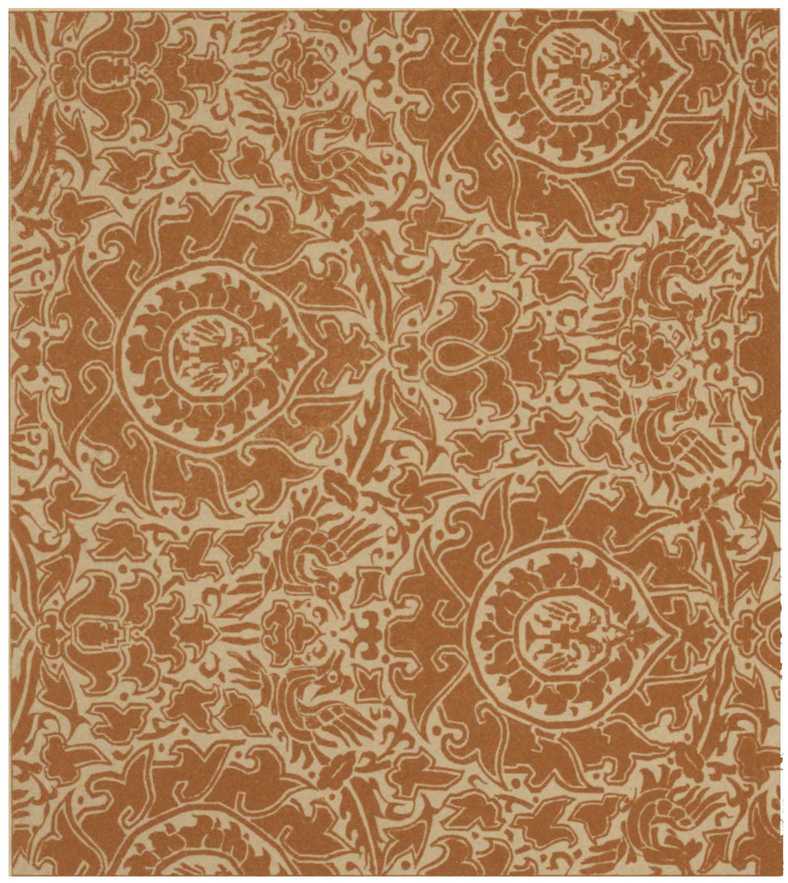
1269.
SILK AND GOLD DAMASK. Sicilian, 14th century.
Vincent Brooks Day & Son, Lith.
Though not so spirited in the drawing of its pattern, and the gold so poor and bad that it has become almost lost to the eye, this stuff is a valuable item in the collection. The eagle, with its double head, and wings displayed, would lead to the belief that it had been wrought to the order of some emperor of Germany, or for some Sicilian nobleman who cherished a love for the house of Hohenstaufen.
1270.
Part of a Maniple; ground, cloth of gold; design, in needlework, St. Blase and St. Stephen. English or French, 13th century. 12 inches by 6½ inches.
Both with regard to its golden cloth, and the figures upon it, this piece is very valuable. The stuff is of that kind which our countryman, John Garland, tells us was wrought by young women at his time, and shows, in its grounding, a pretty zig-zag pattern. The two kneeling figures, though done in mere outline of the scantiest sort, display an ease and gracefulness peculiar to the sculpture and illuminations in England and France of that period. St. Blase is shown us vested in his chasuble and mitre—low in form—with a very long grey beard, and holding a comb in one hand—the instrument of his martyrdom; St. Stephen is robed as a deacon, and kneeling amid a shower of large round stones, pelted at him on all sides.
1271.
Silk and Gold Damask; ground, light green silk; design, griffins passant and fleur-de-lis in one row, fleur-de-lis and slipped vine-leaves arising from two tendrils formed like the letter C, and put back to back, all in gold. Sicilian, 14th century. 12 inches by 7½ inches.
The whole of this pattern is thrown off with great freedom, and an heraldic eye will see the boldness of the griffins. The vine-leaves are as crispy as any ever seen upon such stuffs, and the whole does credit to the royal looms of Palermo, where it was probably wrought at the command of the prince, for himself, or as a gift to some French royalty. An exactly similar stuff to this may be found at No. 7061; and it is said that the robes now shown at Neuburg, near Vienna, are traditionally believed to have been worn, at his marriage, by Leopold the Holy.
1272.
Silk and Cotton Stuff; ground, light purple cotton; design, small but thick foliage, interspersed with birds of various kinds, in pairs and face to face, in amber-coloured silk. Sicilian, 14th century. 9½ inches by 7 inches.
Though so small in its elements, this is a pleasing design, and extremely well drawn, like all those from Palermo.
1273.
Silk and Cotton Damask; ground, of cotton, a light orange; design, within a ten-cusped circle, and divided by the thin trunk of a tree, two cocks, face to face, all in gold thread, upon a purplish crimson ground, and between the circles an ornamentation in which a small crown tipped with fleur-de-lis, over a lion passant gardant, is very frequent in gold. Sicilian, late 14th century, 10¼ inches by 3 inches.
Though such a mere rag, this piece is so far valuable, as it shows that France then got her silken stuffs from Sicily, and, in this instance, perhaps sent her own design with her Gallic cock, and her fleur-de-lis mingled so plentifully in it. How or why the lion is there cannot be explained.
1274.
Silk Damask; ground, fawn-colour; design, parrots, and giraffes in pairs, amid floriated ornamentation, all, excepting the parts done in gold, of the tint of the ground. Sicilian, 13th century. 20½ inches by 10½ inches.
Upon an egg-shaped figure, nicely filled in with graceful floriated ornaments, stand two parrots, breast to breast, but with heads averted, which (as well as their pinion-joints, marked by a broad circle crowded with little rings on their wings, and legs and claws) are wrought in threads of gold, all now so tarnished as to look as if first worked in some dull purple silk. Their long broad perpendicular tails have the feathers shown by U shaped lines, looking much like the kind of ornamentation noticed under Nos. 8591, 8596, 8599. Below, and back to back, or—as some may choose to see them—affronted, and biting the stems of the foliage, are two giraffes, with one leg raised—may be better described as tripping. They are specked all over with quatrefoil spots, and have head and hoofs done in gold, now faded to black. This stuff is as beautiful in design as substantial in its material, being all of good fine silk; though so poor and sparing was the gold upon the thread, that it has quite faded. From the curve at the upper end, this piece seems to have been cut out of an old chasuble.
1275.
Silk Damask (made up of four pieces); ground, brown, once purple; design, in gold thread and coloured silks, griffins, eagles, and flowers. Sicilian, early 13th century. 19½ inches by 19¼ inches.
At top we have a row of griffins looking to the east, mostly wrought in gold, but relieved on coloured silks, and having at the pinion-joints of the wing that singular circle, filled in with a small design; then a row of conventional flowers in red, crimson, green, and white, and, last of all, a row of eagles at rest, done mostly in gold, slightly shaded with green, and looking west. The beasts and birds are admirably drawn, and when the stuff was new it must have been very fine and effective, though now the gold looks shabby.
1276.
Stole, of silk and gold damask; ground, purple silk; design, mostly in gold, pricked out with green silk, a floriated oval, filled in with a pair of young parded leopards, addorsed regardant, and wyverns regardant in couples. Sicilian, late 13th century. 8 feet 4 inches by 3 inches, not including the expanded ends.
This is a magnificent stuff; but the stole itself could have been made out of it only in the middle of the 17th century.
1277.
The Hood of a Cope; silk and gold; ground, fawn-coloured silk; design, bands, in gold thread, alternately broad, figured with harts couchant, and flowers with an oblique pencil of rays darting down; and narrow, marked with rayless flowers. Underlying the latter gold band is a very broad one of silk, figured in green, with collared dogs running at speed towards a small swan, with sprigs of flowers, green and white, between them. Sicilian, late 13th century. 14½ inches by 13½ inches.
The very pointed shape of this hood is somewhat unusual in the form of this part of a cope, as made during mediæval times, in England. The stuff is of a spirited design, and shows a curious element in its pattern, in those golden flowers with their pencils of rays.
1278.
Silk and Cotton Damask; ground, black; design, a lion rampant amid trees, all in light green. Sicilian, 14th century. 15 inches by 7¾ inches.
Very few examples occur with ground coloured black, yet the bright green of the design goes well upon its sombre grounding. The animal and also the leaves and trees around him are all admirably and spiritedly drawn, and one regrets that a pattern of such merit should have been lost upon such poor materials.
1279.
Silk and Gold Damask; ground, bright green silk; design, in gold, conventional artichokes, large and small, and harts, and demi-dogs with very large wings, both animals having remarkably long manes streaming far behind them. Sicilian, 14th century. 27 inches by 14 inches.
This beautifully and richly wrought stuff, with its fantastic design drawn with such spirit, must have been, when seen in a large piece, very pleasing. Its last use was in a chasuble of rather modern cut, to judge from its present shape.
1280.
Small Bag to hold relics; ground, gold; design, all embroidered by needle, white rabbits(?) segreant, peacocks in couples, face to face, with the rabbits between them, two hearts and rows of black or purple spots, like women’s heads, one in the middle surrounded by a wreath of eight crimson stars, with small green flower-bearing trees, and the whole field sprinkled with letters, now, from the ill condition of the embroidery, not to be read. German, 16th century. 4½ inches square.
1281.
Part of a Liturgical Ornament; silk upon linen; ground, crimson, faded; design, in yellow flos-silk, beasts and birds. Syrian, late 13th century. 2 feet 6 inches by 7½ inches.
It does not seem to have last served as either stole or maniple, but, apparently, was part of an altar curtain of which two were hung, one at each side of the sacred table. Lions and dogs seated and eagles perched amid flowers and foliage form the pattern, which is not as well figured as those usually are which came from the eastern shores of the Mediterranean.
1282.
Silk and Cotton Damask; ground, green; design, large ovals filled in with foliation, enclosed with a net-work of garlands, the fruits of which might be mistaken for half-moons. North Italy, 14th century. 13½ inches by 7½ inches.
On better material, for the quantity of its silk is small, and in happier colours, this stuff might have been very pretty.
1283.
Silk Damask; ground, amber yellow; design, a hart, in gold, lodged beneath green trees in a park, the paling of which is light green, with a bunch of the corn-flower, centaurea, before it. Sicilian, 14th century. 7½ inches by 5½ inches.
1283A.
Silk Damask; ground, amber yellow; design, the sun in its splendour, an eagle in gold, a green tree. Sicilian, 14th century. 7¼ inches by 5½ inches.
1284.
Silk Damask; ground, amber yellow; design, a hart, in gold, lodged beneath green trees in a park, the paling of which is light green, with a bunch of the corn-flower before it. Sicilian, 14th century. 7 inches by 6½ inches.
1284A.
Silk Damask; ground, amber yellow; design, a running hart, in gold, amid foliage. Sicilian, 14th century. 8 inches by 4½ inches.
The last four pieces are, in fact, but fragments of the same stuff, and when put together make up its original pattern, and beautiful it must have seemed when beheld as a whole; the bird and animals are done with much freedom and spirit; so likewise the foliage: but two of the portions, by being more exposed to the light, are much faded, in such a manner that the green in them has almost fled. As usual, so poor was the golden thread that the bird and animals now look almost black, but here and there, with a good glass, shimmerings of gold may be found upon them. To some eyes the sun may look like a rose surrounded by rays. At one time or another an unfeeling hand has most plentifully sprinkled all these four pieces with flowers made from gilt paper stamped out, and pasted on the staff with stiff glue. The silk, especially the yellow, of this tissue was mixed with very fine threads of cotton.
1285.
One of the Ends of a Stole, embroidered in beads; ground, dark blue; design, very likely the head of an apostle, in various coloured and gold beads. Venetian, late 12th century.
So like both in design, execution, and materials to the portion of an orphrey, No. 8274, that it would seem this piece was not only worked by the self-same hand, but formed a part of the self-same set of vestments. The places, now bare, in the nimb and neck, were, no doubt, once filled in with fine seed-pearls that have been wantonly picked out. The other end of the same stole to which this belonged is the following.
1286.
Exactly like the foregoing; but if in its fellow piece seed-pearls are not to be seen, here they are left in part of the nimb, but especially over the left eye. Of the large piece with the head of the Blessed Virgin Mary, we have spoken at length, No. 8274.
1287.
Silk and Cotton Damask; ground, light yellow silk; design, a reticulation of vine-branches bearing grapes and leaves, and enclosing butterflies, an armorial shield having a royal crown over it, all in light purple cotton. Sicilian, early 14th century. 17½ inches by 15½ inches.
The design in all its elements is so like many other specimens wrought by the looms of Palermo at the period, that we are warranted to presume it came from that great mart of silken stuffs during the middle ages. So thin in its texture, it must have been meant for the lining of a heavier material. Père Martin has figured, in his very valuable “Mélanges d’Archéologie,” t. iv. plate xxii, a piece of silk, now in the Museum of the Louvre, almost the same in pattern, but differing much in colour, from the specimen before us. In the specimen at Paris little dogs and dragons, both in pairs, come in, but here they are wanting; so that we may learn that, to give variety to the pattern, parts were changed. Upon the shield there is a charge not unlike a star, rather oblong, of six points.
1288.
Damask, silk and cotton; ground, deep bluish green; design, pairs of monsters, half griffin, half elephant, in gold, a conventional flower in light green, enclosing a pair of wings in gold, and pairs of birds amid foliation, with short sentences of imitated Arabic here and there. Sicilian, early 14th century. 14 inches by 11 inches.
This is a fine and noteworthy production of the Palermitan loom, and shows in its pattern much fancy and great freedom of drawing; for whether we look at those very singular griffin elephants, sitting in pairs—and gazing at one another, or the two birds of the hoopoe family, with a long feather on the head, or the two gold wings conjoined and erect, so heraldically tricked, with that well-devised flower ending in a honeysuckle scroll, an ornament sprinkled all about, we cannot but be pleased with the whole arrangement. The combination of elephant and griffin in ornamentation is almost, perhaps quite, unique. The pretended Arabic points to a locality where once Saracenic workmen laboured, and left behind them their traditions of excellency of handicraft. In Dr. Bock’s “Geschichte der Liturgischen Gewänder des Mittelalters,” 4 Lieferung, pl. ix. may be seen this curious stuff figured.
1289.
Part of a Maniple, silk damask; ground, fawn-coloured; design, an ovate foliation amid monster beasts and birds, all in light blue silk, excepting the heads of the birds; the feet and heads of the animals done in gold. Sicilian, late 13th century. 13¼ inches by 7 inches.
1289A.
Part of a Maniple, silk damask; ground, fawn-coloured; design, an ovate foliation amid small lions and large monster beasts and birds, in light blue silk, excepting the small lions all in gold, and the heads and claws of the others in the same metal. Sicilian, late 13th century. 21½ inches by 6½ inches.
The two articles were evidently parts of the same maniple; a liturgical appliance of such narrow dimensions that we cannot make out the entire composition of the very fine and admirably drawn design upon the stuff, out of which it was cut originally. From what is before us we perceive that there were a pair of small lions, face to face, all in gold, a pair of wyverns segreant in green, a pair of griffins passant, with heads of gold, and a pair of other large animals, antelopes, with their horned heads and cloven hoofs in the same metal; slight indications of the fleur-de-lis here and there occur.
1290.
A bishop’s Liturgical Shoe, of silk and gold damask; ground, crimson silk; design, eagles, in couples, at rest, in gold, amid foliations in green silk; a small piece on the left side of the heel is of another rich stuff in gold and light green. Italian stuff, 14th century. 11½ inches.
Such old episcopal liturgic shoes are now great rarities; and a specimen once belonging to one of our English worthies, Waneflete, is given in the “Church of our Fathers,” t. ii. p. 250; it is of rich silk velvet, wrought with flowers, and still kept at Magdalen College, Oxford, built and endowed by that good bishop of Winchester. In the present example we have, in its thin leather sole for the right foot, a proof that making shoes right and left was well known then.
1291.
Silk and Gold Damask; ground (now very faded), crimson silk; design, animals, all in gold, and flowers in gold, pricked out, some in green, others in purple silk. Sicilian, 14th century. 14½ inches by 8½ inches.
The animals are large antelopes couchant, and smaller ones in the like posture, within flowers, along with large oddly-shaped wyverns with the head bent down; the flowers are roses, and a modification of the centaurea, or corn-flower. Though the gold be tarnished, the pattern is still rich.
1292.
Taffeta, silk and cotton; ground, dull crimson cotton; design, reticulated foliage with a conventional artichoke in the meshes, all in pale blue. Spanish, 15th century. 7½ inches by 6¾ inches.
1292A.
Taffeta, silk and cotton; ground, dull crimson cotton; design, reticulated foliage with a conventional artichoke in the meshes, all in pale blue. Spanish, 15th century. 5½ inches by 5¼ inches.
As poor in material as in design, and evidently manufactured for linings to silks of richer substances.
1293.
Silk and Cotton Damask; ground, bright crimson silk; design, floriated circles filled in with a pair of griffins rampant, addorsed, regardant, and the spaces between the circles ornamented with a floriated cross, all in yellow cotton. Sicilian, 14th century. 9¼ inches by 7 inches.
A good design bestowed upon somewhat poor materials. At first the yellow parts of the pattern had their cotton thread covered with gold, but of such a debased quality and so sparingly, too, that it has almost all disappeared, and, where seen, has tarnished to a dusky black.
1294.
Silk Damask; ground, purple; design, large fan-like leaves, between small fruits of the pomegranate, in dead purple. Spanish, late 15th century.
Upon this specimen there was sewed an inscription, now so broken as not to make sense, and from the style of letter, of the floriated form, done in red and gold thread upon purple canvas, as is all the scroll-work about it, some German hand must have wrought it.
1295.
Tissue of Cotton Warp and Silk and Gold Woof; ground, now yellow; design, eagles in pairs, divided by rayed orbs, amid foliage all in gold. Sicilian, middle 14th century. 6½ inches by 5½ inches.
The eagles are about to take wing, and are pecking at the rays of, seemingly, the sun which separates them. The foliage is much like, in form, that which so often occurs on works from the looms of Palermo; and, in all likelihood, the ground, now yellow, was once of a fawn-colour. Though good in design, this stuff is made of poor materials, the silk in it is small, and the gold of such a base quality that it has become a dusky brown.
1296.
Tissue of Flaxen Thread Warp and Silk and Gold Woof; ground, fawn-coloured; design, eagles in pairs affronted, with a pencil of sun-rays darting down upon their heads, and resting amid flowers all in gold. Sicilian, middle 14th century. 8 inches by 4¼ inches.
What we said of No. 1295 is equally applicable to this specimen, in which, however, may be seen, the corn-flower, centaurea, so often met with in Palermitan textures of the time.
1297.
Silk Damask; ground, light green; design, within a heart-shaped figure, a large vine-leaf, at which two very small hoopoes, one at each side, are pecking; outside the ovals, from which large bunches of small-fruited grapes are hanging, runs a scroll with little vine-leaves, all now of a fawn-colour, but at first in a rosy crimson hue. Italian, late 14th century. 15 inches by 5¼ inches.
The design for this tasteful stuff was thrown off by an easy flowing hand; and Dr. Bock has given a good plate, in his “Dessinateur des Etoffes,” 3 Livraison, of a silk almost the very same, the differences being some very slight variations in parts of its colours.
1298, 1298A.
Silk Damask; ground, purple; design, amid foliage and small geometrical figures, birds in pairs, all in rosy red, and beasts in gold. Sicilian, 14th century. 9½ inches by 3¾ inches, and 4½ inches by 4 inches.
Putting these two pieces together we make out this beautiful, elaborate, though small pattern. What the birds may be is hard to guess, but the beasts seem lionesses, with bushy tails, and bold spirited griffins. Dr. Bock has figured this stuff in the before-mentioned large work.
1299.
Damask, gold, silk, and thread; ground, dull purple; design, two broad horizontal bands, the first charged with a hound, green, collared, armed, and langued white, lying down with head upturned to a large swan in gold, with foliage all about them; on the second, a dog chasing a hart, both in gold, and between two cable ornaments in gold, and two scrolls of roving foliage, in light green pricked with white. Sicilian, late 14th century. 18 inches by 12 inches.
The beautiful and boldly-drawn pattern of these beasts and birds in pairs, and succeeding each other, is not duly honoured by the materials used in it; the quantity of thread is large, and the gold of the poorest sort.
1300.
Silk Damask; ground, blue; design, in yellow, a net-work done in ovate geometrical scrolls, and the meshes filled in with geometrical lozenges, and others showing an ornamentation of singular occurrence, somewhat like the heraldic nebule. Lucca, early 15th century, 10½ inches by 7½ inches.
After a pattern that seldom is to be found on mediæval stuffs.
1301.
Silk and Gold Damask; ground, bright crimson silk; design, in gold, fruit of the pomegranate, mingled with flowers and leaves of another plant. South of Spain, 15th century. 9 inches by 8¾ inches.
At a distance this stuff must have shown well, but its materials are not of the first class; though lively in tone, the silk is poor, and its gold made of that thin gilt parchment cut into flat shreds, like other examples here—Nos. 8590, 8601, 8639, &c.
1302.
Silk and Gold Damask; ground, fawn-coloured faded from crimson, in silk; design, large eagles perched in pairs, with a radiating sun between them, and beneath the rays dogs in pairs, running with heads turned back and looking on the foliage separating them, all in gold. Sicilian, 14th century. 17 inches by 8½ inches.
The fine and spirited pattern of this piece is now very indistinct, owing to the bad colour of the ground, which has so much faded, and the inferior quality of the gold upon the thread.
1303.
Silk Damask; ground, a rose-coloured tint; pattern, in a dull tone of the same, broad strap-work, in reticulations enclosing a circular conventional floriation. Moresco-Spanish, 14th century. 6 inches by 5½ inches.
The tone of the colour has changed from its first brightness, and the stuff is of a very thin texture.
1304.
Silk and Gold Damask; ground, crimson silk much faded; design, harts collared and flying eagles amid foliage, all in gold. Sicilian, 14th century. 2 feet 8 inches by 1 foot.
In this spirited pattern the running harts in the upper row have caught one of their hind-legs in the cord tied to their collar, and an eagle swoops down upon them; in the second row, the same animal has switched its tail into the last link of the chain fastened to its collar, and an eagle seems flying at its head, as it screams with gaping beak. The last use of this specimen of so magnificent a stuff appears to have been as part of a curtain (with its 15th century poor parti-coloured thread fringe) for hanging at the sides of an altar.
1305.
Embroidered Lappet of a Mitre; ground, linen; design, beneath a tall niche, a female in various coloured silks and gold; and under her, within a lower-headed niche, a male figure after the same style. German, late 14th century. 17½ inches by 3 inches.
The high-peaked canopy, with its crocketing and finial well formed and once all covered with gold, holds a female figure, crowned like a queen, with the banner of the Resurrection in one hand and a chalice, having on it the sacred host, in the other, which may be taken for the person of the Church, while the majestic prophet beneath her seems to be Malachi holding a long unfolded scroll significative of those words of his relating to the sacrifice in the New Law. In the embroidery of the figures this piece very much resembles the style of needlework in the part of an orphrey, No. 1313. In his “Geschichte der Liturgischen Gewänder des Mittelalters,” 2 Lieferung, pl. xii. Dr. Bock has given figures of this curious lappet.
1306, 1306A.
Silk Damask; ground, fawn-coloured; design, amid sunbeams, raindrops, and foliage, large birds clutching in their talons a scroll charged with a capital letter R thrice repeated, all in light green. Sicilian, late 14th century. 13 inches by 6½ inches; and 8 inches by 3¾ inches.
The design of this stuff is rather curious from the inscribed scroll, the letter R of which is very Italian.
1307.
Silk and Gold Damask; ground, fawn-colour; design, amid a conventional foliation shooting out in places with large fan-like flowers in gold, braces of small birds on the wing and pairs of running dogs with two antelopes, couchant, biting a bough, both in gold. Sicilian, 14th century. 12½ inches by 8½ inches.
A very good design well drawn, but unfortunately not quite perfect in the specimen, the golden parts of which are much tarnished.
1308.
Silk Damask; ground, rosy fawn-coloured; design, within a wreath made up mostly of myrtle-leaves and trefoils, a lion’s head cabosed, above which is a bunch of vine-leaves shutting in a blue corn-flower, and at each side, in white, a word in imitated Arabic; excepting the blue centaurea and two white flowers in the wreath, all the rest is in light green. Sicilian, 14th century. 22 inches by 10¾ inches.
This well-varied pattern is nicely drawn, and shows the traditions of the Saracenic workmen who once flourished at Palermo.
1309.
Embroidery of Thread upon Linen; design, in raised stitchery, the hunting of the unicorn. German, late 14th century. 26½ inches by 13½ inches.
This fine piece of needlework shows us a forest where a groom is holding three horses, on two of which the high-peaked saddles are well given; running towards him are two hunting dogs, collared. In the midst of the wood sits a virgin with her long hair falling down her back, and on her lap an unicorn is resting his fore-feet; behind this group is coming a man with a stick upon his shoulder, from which hangs, by its coupled hind-legs, a dead hare. Not only the lady, but the men wear shoes with remarkably long toes, and the gracefulness with which the foliage is everywhere twined speaks of the period as marked in the architectural decoration of the period here in England. In another number (8618) the same subject is noticed as significative of the Incarnation, and fully explained. No doubt, like the other piece of fine Rhenish needlework, this also formed but a part of a large cloth to hang behind an altar as a reredos. Those very long-toed shoes brought into fashion here by Ann of Bohemia, our Richard II.’s queen, were called “cracowes.”
1310.
Maniple of Crimson and Gold Damask; ground, bright crimson; design, stags and sunbeams. Sicilian, late 14th century. 3 feet 7½ inches by 4 inches.
Under No. 8624 there is a specimen of silk damask, without gold in it, of a pattern so like this that, were the present piece perfect in its design, we might presume both had come from the same loom, and differed only in materials. In that, as in this, we have a couple of stags well attired, with their heads upturned to a large pencil of sunbeams darting down upon them amid a shower of raindrops.
1311.
Silk and Gold Damask; ground, deep violet; design, St. Mary of Egypt, with her own hair falling all over her, as her only garment, on her knees before an altar on which stands a cross; behind her, a tree, upon which hovers a bird with a long bough in its beak; and high up over against her an arm coming from a cloud with the hand in benediction, and rays darting from the fingers, between two stars, one of eight, the other of six points, all mostly in gold. Venetian, 15th century. 12 inches by 11½ inches.
The materials and the weaving of this valuable tissue are both good, and figure a saint once in great repute in Oriental Christendom as well as among those Europeans who traded with the East, as an example of true repentance. A part of the design is, so to say, ante-dated, and to understand the whole of it we ought to know something of the life of this second Magdalen.
In the latter half of the fourth century St. Mary of Egypt, then a girl of twelve, fled to Alexandria, where she led an abandoned life.
It chanced that she went in a certain ship full of pilgrims to Jerusalem, where, on the feast of the Elevation of the Cross, she was hindered by a miracle from entering the church. Then, coming to herself, she made a vow of penance, and withdrew to the desert beyond the Jordan. There she lived unseen for forty years, till all her garments fell away and she had nothing wherewith to clothe herself but her own long hair.
On the stuff before us the anachronism of its design will be soon perceived from this rapid sketch of St. Mary’s life. Instead of being, as she must have been, arrayed in the female fashion of the time when she went to Jerusalem, the great penitent is represented so far quite naked that her own long tresses, falling all around her, are her only mantle—just as she used to be more than forty years afterwards. But yet the design well unfolds her story; the hand darting rays of light signifies the revelation given her from heaven, and the blessing that followed it; while the two stars tell of Jerusalem, as also does the elaborately-fashioned cross that is standing on the altar, the frontal to which, in the upper border, seems ornamented in purple, with an inscription, now unreadable, but the last letters of which look as if they are R L I. The bird, perhaps a dove, has no part in the saint’s history, but is a fancy of the artist. In Dr. Bock’s “Geschichte der Liturgischen Gewänder des Mittelalters,” 1 Band, 1 Lieferung, pl. xi. is a figure of this stuff.
1312.
Silk Damask; ground, crimson; design, a complication of geometric lines and figures in yellow, blue, green and white. Moresque, 15th century. 22½ inches by 18½ inches.
Those who know the ornamentation on the burned clay tiles and the gilt plaster ceilings in the Alhambra at Granada will recognize the same feeling and style in this showy stuff, the silk of which is so good, and the colours, particularly the crimson, so warm.
1313.
Part of an Orphrey; ground, deep crimson satin, edged with a narrow green band; design, three apostolic figures beneath Gothic canopies, all wrought in gold thread and coloured silks upon canvas and applied. German, early 15th century. 30 inches by 7¼ inches.
Each figure is nicely worked; and the first, beginning at the top, holding a sword erect in his right hand, is St. James the Greater; beneath him, with a halbert, St. Matthew; and last of all, holding in one hand a book, in the other a sword, St. Paul. The flowery crocketing running up the arches of the niches is particularly good.
1314.
Silk Damask; ground, crimson (now faded); design, two golden lions with their fore-paws resting on a white scroll, looking down upon an orb darting straight down its rays upon the heads of two perched eagles, amid foliation, all in green. Italian, late 14th century. 26 inches by 9¾ inches.
A fine design, and sketched with great freedom; but the silk and gold employed in it are not of the best.
1315.
Silk Taffeta; ground, brown; design, broad bands made up of eight red-edged orange stripes within two white ones. Egyptian, 10th century. 26 inches by 9¾ inches.
1316.
Silk Taffeta; ground, purple; design, narrow stripes made up of white purple and green lines. Egyptian, 10th century. 24 inches by 3½ inches.
These scarce examples of Oriental ability in the production of very thin substances for personal adornment and dress, under such a sun as even the north of Africa has, were originally wrought for ordinary, not religious use. They were brought to Europe as precious stuffs, and given as such to the Church and used for casting over the tombs of the saints, as palls, or as linings for thicker silken vestments. That these or any of the following specimens of gauze or taffeta were ever put to the purpose of making stockings, or rather leggings like boots, still worn by bishops on solemn occasions during the celebrations of the liturgy, cannot for a moment be thought of. Such appliances are, and always were, made either of velvet or strong cloth of gold or silver.
1317.
Silk Gauze; ground, light green; design, broad bands composed of white, black, and orange stripes. Egyptian, 10th century. 13 inches by 4 inches.
1318.
Taffeta, Silk and Cotton; ground and design, broad stripes of crimson, green, crimson and orange, separated by narrow lines of white; the warp is of brown fine cotton. Egyptian, 10th century. 12 inches by 2½ inches.
Of such stuffs the Orientals make their girdles to this day; and for such a purpose we presume this taffeta was woven at Cairo and for Moslem use, as the green of the so-called prophet is one among its colours.