PART THE FIRST. Church-vestments, Silk-stuffs, Needlework, and Dresses. (continued 5)
Reading edition
A rather showy piece, and very effective in its pattern, though the gold about the thread with which the design is brought out is sparingly employed, so that it looks more yellow than metallic. The sleeves now but eleven inches long, are slit quite up, and were very likely shortened when the slitting was inflicted on them, and that, within the last hundred years, in compliance with the somewhat modern practice that took its rise in France.
8388.

Piece of Embroidery of our Lord upon His mother’s lap. Florentine, 15th century. 8¼ inches by 5½ inches.
The Blessed Virgin Mary is robed in the usual crimson tunic, and sky-blue flowing mantle, and bearing, as is customary in the Italian schools of art, a golden star figured on her left shoulder. Sitting upon a tasseled cushion, and holding a little bird in His left hand, we have our Lord quite naked, with His crossed nimb about His head. Those who bring to mind that lovely picture of Raphael’s, the so-called “Madonna del Cardellino,” or our Lady of the gold-finch, will see that such an idea was an old one when that prince of painters lived. This piece of needlework was originally wrought for the purpose of being applied, and shows on the back proofs that, in its last use, it had been pasted on to some vestment or altar-frontal.
8561.

Small Piece of Silk; ground, purple; pattern, boughs of green leaves twining amid rosettes, green, some with crimson, some with yellow centres. Sicilian, late 14th century. 6½ inches by 3 inches.
Good in material and pretty in design, though the colours are not happily contrasted.
8562.
Piece of Silk; ground, purple; pattern, circles inclosing, some a tree which separates beasts and birds, some a long stripe which seemingly separates birds, all in yellow. Syrian, 14th century. 1 foot 1½ inches by 7½ inches.
The piece is so faded that with much difficulty its design can be traced, but enough is discernible to show the Persian feelings in it. No doubt the beasts are the cheetah or spotted hunting leopard addorsed and separated by the traditional “hom,” and the birds over them, put face to face, but parted by the “hom,” are eagles.
8563.
Piece of Yellow Silk; pattern, a broad oval, filled in and surrounded with floriations. Florentine, 15th century. 11 inches by 7½ inches.
The once elaborate design, now indiscernible, was brought out not by another coloured silk but by the gearing of the loom; some one, very recently, has tried to show it by tracing it out in lead-pencil.
8564.
Piece of White Silk; pattern, within circles, two birds addorsed, regardant, and separated by a tree. Syrian, 14th century. 12¼ inches by 9 inches.
The satin-like appearance and the creamy tone of this piece make it very pleasing, and in it we find, as in No. 8562, the same Persian influences; here, too, we have the mystic “hom,” put in, no doubt, by Christian hands.
8565.
Piece of Silk Tissue; ground, red; pattern, embroidery in various-coloured silks, gold thread, and coloured small beads. German, 14th century. 3-⅝ inches by 3¾ inches.
In most of its characters this end of a stole is just like those attached to the fine specimen noticed under No. 8588.
8566.
Piece of Silk Damask; ground, red; pattern, squares filled in alternately with a pair of animals and flower-like ornaments. Syrian, 13th century. 7 inches by 2 inches.
The old Persian tradition of the “hom” may be seen here dividing the two addorsed regardant lionesses, and the whole design is done with neatness.
8567.
Piece of Silk Damask; ground, red; pattern, two popinjays divided by a bowl or cup looking much like a crescent moon, in an octagonal frame-work, all yellow. Spanish, 13th century. 8½ inches by 6 inches.
This stuff is of very light material, which has, however, kept its colour very well.
8568.
Piece of Gold Tissue, embroidered with the needle; ground, gold; pattern, the Archangel Gabriel, with his head, hands, folds of his dress, and lines in his wings done by needle in different coloured silks. Italian, 14th century. 8½ inches by 5 inches.
This beautiful and rare kind of textile, combined with needlework, merits the particular attention of those occupied with embroidery. The loom has done its part well; not so well, however, he or she who had to fill in the lines, especially the spaces for the hands and head, on which the features of the face are rather poorly marked.
8569.

Two Portions (joined together) of Gold Tissue; ground, gold; pattern, in various-coloured silks, of birds, beasts, monsters, and foliage. English or French, 13th century. 13 inches by 2 inches.
Among the monsters, we have the usual heraldic ones that so often occur upon the textiles of that period; but the recurrence of the unmistakable form of the fleurs-de-lis, though sometimes coloured green, persuades us that this piece, entirely the produce of the loom, came from French, very likely Parisian hands, and was wrought for female use, as a band or fillet to confine the hair about the forehead, just as we see must have been the fashion in England at the time from the marked way in which that attire is shown in the illuminations of MSS. and sepulchral effigies of our Plantagenet epoch. Our countryman, John Garland, tells us, as we noticed in our Introduction, that women-weavers, in their time, wove such golden tissues, not only for ecclesiastical, but secular uses; and these two pieces seem to belong to the latter class.
8570.
Portion of an Orphrey; ground, crimson silk; pattern, foliage with fruit and flowers in gold. German, 14th century. 9½ inches by 3¾ inches.
So sparingly was the gold twined about the yellow thread, and of such a debased amalgamation that it has almost entirely disappeared, or where it remains has turned black.
8571.
Portion of Gold Tissue, figured with birds and beasts in gold upon a crimson ground. French or English, late 12th century. 9 inches by 2⅛ inches.
When new this textile must have been very pretty; but so fugitive was its original crimson, that now it looks a lightish brown. Within circles, divided by a tree made to look like a floriated cross, stands a lion regardant, and upon the transverse limbs of the cross, as upon the boughs of a tree, are perched two doves; while the spandrils or spaces between the circles are filled in with fleurs-de-lis growing out of leafed stalks. Though, in after times, it may have been applied to church use, it seems, like the specimen under No. 8569, to have been at first intended for female dress, either as a girdle or head attire.
8572.
Two Portions of Embroidery (joined together), the one showing, on a reddish purple silk ground, figures of birds and animals within circles, all embroidered in gold; the other, a similar ground and pattern within lozenges. German, 14th century. 2 feet 1½ inches by 2 inches.
The figures are heraldic monsters with the exception of the three birds, and are all done with great freedom and spirit; like the preceding piece, this looks as if it had originally been wrought for a lady’s girdle. The present two portions seem from the first to have formed parts of the same ornament, and to have been worked by the same needle.
8573.
Small Fragment of Red Silk, having a narrow border of purple with lozenge pattern, in gold. English or French, 13th century. 2 inches by ¾ inch.
Alike, in its original use, to the foregoing pieces.
8574.
Two Fragments (joined together) of Purple Silk, much faded, with a cotton woof. Byzantine, 12th century. 2½ inches by 1¼ inches.
8575.
Two Fragments (joined together) of Silk and Gold Tissue; ground, light crimson, now quite faded, bordered green; pattern, an interlacing strap-work, in gold. English or French, 13th century. 2 inches by 2 inches.
Like, for use, to the other similar specimens.
8576.

Very small Fragment of Gold Tissue on a red ground. 13th century. 1⅜ inches by ½ inch.
This cloth of gold must have been showy from its richness.
8577, 8577A.
Two small Pieces of Silk, Tyrian purple. Byzantine, 12th century. Each 1¼ inches square.
8578, 8578A.
Two Rosettes, in small gold thread on deep purple silk, bordered by an edging of much lighter purple. 14th century. 1½ inches square; 1 inch square.
8579.
Piece of Silk and Linen Damask; ground, green; pattern, a monster animal within a circle studded with full moons, and a smaller circle holding a crescent-moon studded in like manner. Syrian, 13th century. 1 foot 8¼ inches by 1 foot 2 inches.
This bold and effective design is somewhat curious, exhibiting, as it does, a novel sort of monster which is made up of a dog’s head and fore-paws, wings erect, and a broad turned-up bushy tail freckled with squares, in each of which is an ornament affecting sometimes the shape of an L, sometimes of an F, at others of an A. Around the neck of this imaginary beast is a collar which, as well as the root of the wing, shows imitations of Arabic characters.
8580.
Portion of Gold Embroidery; ground, dark blue silk; pattern, large griffins in gold. Early 13th century. 1 foot 4½ inches by 12½ inches.
Pity it is that we have such a small part, and that so mutilated, of what must have been such a fine specimen of the needle. Though the whole pattern may not be made out, enough remains to show that the griffins, which were langued gules, stood in pairs and rampant, both figured with two-forked tails ending in trefoils, all worked in rich gold thread.
8581.
Portion of an Orphrey; ground, crimson silk; pattern, stars of eight points, within squares, both embroidered in gold. 14th century. 5½ inches by 2 inches.
This is one of the very few specimens which have pure gold, or perhaps only silver-gilt wire, without any admixture of thread in it, employed in the stars and narrow oblong ornaments in the embroidery, the wire itself being stitched to its grounding by thin linen thread. The large and small squares, as well as the borders, are executed in gold-twisted thread, very poor of its kind. The glittering effect of the pure metal-wire is very telling.
8582.
Piece of Silk Damask; ground, crimson; pattern, conventional peacocks and foliage, in yellow. Syrian, 13th century. 13 inches by 9½ inches.
A good design bestowed upon very thin materials.
8583.
Portion of Gold Tissue; ground, light crimson, now quite faded, edged green; pattern, a diaper of interlacing strap-work. English or French, 13th century. 2½ inches by 1½ inches.
8584.
Portion of Gold Tissue; ground, green, edged crimson; pattern, lozenge-shaped diaper in gold. English or French, 13th century. 7½ inches by 1 inch.
8585.
Portion of Gold Tissue; ground, green, now quite faded; pattern, in gold, almost all worn away, a lozenge diaper. English or French, 13th century. 5 inches by 1½ inches.
This, as well as the other two pieces immediately preceding, were woven by female hands for the binding of the hair.
8586.

Fragment of Silk Tissue; ground, purple; pattern, small squares, green and black, enclosing a black disk voided in the middle. Byzantine (?), 12th century. 7 inches by 2 inches.
This stuff, which was thin in its new state, is now very tattered and its colours dimmed.
8587.
Fragment of Silk Tissue; ground, purple; pattern, a rosette within a lozenge, with a floral border. Italian, 14th century. 4 inches by 2 inches.
8588.
Stole of Gold Tissue, figured with small beasts, birds, and floriated ornaments, bordered on one side by a blue stripe edged with white and charged with ornamentation in gold, on the other, by a green one of a like character, as well as by two Latin inscriptions. The ends, four inches long, are of crimson silk, ornamented with seed-pearls, small red, blue, gold, yellow, and green beads, pieces of gilt-silver, and have a fringe three inches long, red and green. Sicilian, 13th century. 6 feet by 3¼ inches.
As a piece of textile showing how the weavers of the middle ages could, when they needed, gear the loom for an intricacy of pattern in animals as well as inscriptions, this rich cloth of gold is a valuable specimen. Among the ornaments on the middle band we find doves, harts, the letter M floriated, winged lions, crosses floriated, crosses sprouting out on two sides with fleurs-de-lis, four-legged monsters, some like winged lions, some biting their tails, doves in pairs upholding a cross, &c.; and above and below these, divided from them by gracefully ornamented bars, one blue the other green, may be read this inscription,—“O spes divina, via tuta, potens medicina ☩ Porrige subsidium, O Sancta Maria, corp. (sic) consortem sancte sortis patrone ministram. ☩ Effice Corneli meeritis (sic) prece regna meri. ☩ O celi porta, nova spes mor. (sic) protege, salva, benedic, sanctifica famulum tuum Alebertum crucis per sinnaculum (sic) morbos averte corporis et anime. Hoc contra signum nullum stet periculum. ☩ O clemen. (sic) Domina spes dese’erantibus una.”
The ends of this stole, German work of the 14th century, widen like most others of the period, and in their original state seem to have been studded with small precious stones, the sockets for which are very discernible amid the beads; and in each centre must have been let in a tiny illumination, as one still is there showing the Blessed Virgin Mary with our Lord, as a child, in her arms; and this appears to have been covered with glass. Amid the beads are yet a few thick silver-gilt spangles wrought like six-petaled flowers. As a stole, the present one is very short, owing, no doubt, to a scanty length of the gold tissue; in fact, it might easily be taken for a long maniple. When it is remembered that the Suabian house of Hohenstaufen reigned in Sicily for many years, till overthrown in the person of the young Conradin, at the battle of Tagliacozzo, by the French Charles of Anjou, A.D. 1268, we can easily account for Sicilian textiles of all sorts finding their way, during the period, into Germany. In his “Geschichte der Liturgischen Gewänder des Mittelalters,” 4 Lieferung, pt. xviii. fig. 3, Dr. Bock has given a figure of this stole.
8589.
Piece of Silk and Linen Tissue; ground, yellow, with a band of crimson; pattern, crowned kings on horseback amid foliage, each holding on his wrist a hawk, and having a small dog on the crupper of his saddle. Sicilian, early 13th century. 1 foot 4½ inches by 7 inches.
From a small piece to the left, figured with what looks like an English bloodhound or talbot, it would seem that we have not the full design in the pattern of this curious stuff, which speaks so loudly of the feudalism of mediæval Italy and other continental countries. Seldom was a king then figured without his crown, besides carrying his hawk on hand and being followed by his dogs, like any other lord of the land. The little hound behind him is somewhat singular. To us it appears curious that such an elaborate and princely design, meant evidently for the hangings of some palace, should have been done in the rather mean materials which we find. Parts seem to have been woven in gold thread; but so thin and debased was the metal that it is now quite black, and the linen warp far outweighs the thin silken woof.
8590.
Piece of Silk Tissue; ground, green; pattern, a so-called pomegranate of elaborate form, amid flowers of white and light purple, now faded, both largely wrought in gold. Spanish, 15th century. 1 foot 11 inches by 1 foot 2 inches.
Not only is the design of the pattern very effective, but the gold, in which the far larger part of it is done, looks bright and rather rich; yet, by examining it with a powerful glass, we may discover an ingenious, not to say trickish, way for imitating gold-covered thread. Skins of thin vellum were gilt, and not very thickly; these were cut into very narrow filament-like shreds, and in this form—that is, flat with the shining side facing the eye—afterwards woven into the pattern as if they were thread, a trick in trade which the Spaniards learned from the Moors.
The warp is of a poor kind of silk not unlike jute, and the woof is partly of cotton, partly linen thread, so that with its mock gold filaments we have a showy textile out of cheap materials; a valuable specimen of the same sort of stuff from a Saracenic loom will be found under No. 8639, &c.
8591, 8591A.
Two Pieces of Silk Tissue; ground, a bright green; pattern, not complete, but showing a well-managed ornamentation, consisting of the so-called pomegranate with two giraffes below, the heads of which are in gold, now so faded as to look a purplish black. Sicilian, early 14th century. 7½ inches by 4½ inches; 4½ inches by 4½ inches.
This is a specimen interesting for several reasons. When new and fresh, this stuff must have been very pleasing; the elaborate design of its pattern, done in a cheerful spring-like tone of green upon a ground of a much lighter shade of the same colour, makes it welcome to the eye. The giraffes, tripping and addorsed, with their long necks and parded skins, have something like a housing on their backs. From such a quadruped being figured on this stuff, he who drew the design must have lived in Africa, or have heard of the animal from the Moors; he must have been a Christian, too, for green being Mohammed’s own colour, and even still limited, in its use, to his descendants, no Saracenic loom would have figured this stuff with a forbidden form of an animal. Yet, withal, there may be seen upon it strong traces of Saracenic feeling in its pattern. That singular ornament, made up of long zero-like forms placed four together in three rows, which we find upon other examples in this curious collection (No. 8596, &c.), seems distinctive of some particular locality; so that we may presume this fine textile to have been wrought at the royal manufactory of Palermo, where the giraffe might have been well known, where Saracenic art-traditions a long time lingered; and people cared nothing for the prohibition of figuring any created form, or of wearing green in their garments, or hanging their walls with silks dyed green; in some specimens the zero-like ornamentation takes the shape of our letter U; moreover the large feathers in the bird’s long tail are sometimes so figured.
8592.
Piece of Silk Damask; ground, red; pattern, the castle of Castile and fleur-de-lis, both in yellow. Spanish, 13th century. 10 inches by 6¼ inches.
Though of poor and somewhat flimsy silk, this stuff is not without some merit, as it shows how exact were the workmen of those days to be guided by rule in the choice of colour; for instance, the tinctures here are correct, so far that metal or is put upon colour gules. It was woven in stripes marked by narrow blue lines.
8593.
Portion of some Liturgic Ornament (?); ground, deep blue; pattern, fleurs-de-lis embroidered in gold. French, 14th century. 7 inches by 3½ inches.
Whether this fragment once formed a part of maniple, stole, or orphrey for chasuble, cope, dalmatic, or tunicle, it is impossible to say; heraldically it is quite correct in its tincture, and that is its only merit.
8594.
Piece of Silk Damask; ground, fawn-colour; pattern, birds and beasts amid foliage, all in green. Sicilian, early 14th century. 10¼ inches by 4 inches.
Though every part of the design in the pattern of this charming stuff is rather small, the whole is admirably clear and well rendered, and we see a pair of hawks perched, a pair of lions passant, a pair of flags tripping, a pair of birds (heads reversed), a pair of monster-birds (perhaps wyverns), and a pair of eagles (much defaced) with wings displayed. The lions are particularly well drawn.
8595.
Fragment of Silk Tissue; ground, crimson and gold, with three white and green narrow stripes running down the middle, and an inscription on each side the stripes. Spanish, 14th century. 7 inches by 6 inches.
The warp is of thick cotton thread, the woof of silk and gold. Though very much broken, the inscription is Latin, and gives but a very few entire words, such as “et tui amoris in eis,” with these fragments, “—tus. Re—— le tuoru—.” From this, however, we are warranted in thinking this textile to have been wrought, not for any vestment—for it is too thick, except for an orphrey—but rather for hangings about the chancel at Whitsuntide. See Introduction, § 5.
8596.
Piece of Silk Damask; ground, light crimson; pattern, in deep brown, vine-leaves within an ellipsis which has on the outer edge a crocket-like ornamentation, and on both sides a cluster as if of the letter U, arranged four in a row, one row above the other. Sicilian, 14th century. 8½ inches by 6 inches.
As we saw in Nos. 8591, 8591A, so here we see that very curious and not usual ornamentation, in the former instances like an O or zero, in the present one like another letter, U. The same crispiness in the foliage may be observed here as there; and in all likelihood both silks issued from the same city, perhaps from the same loom, but at different periods, as the one before us does not come up, by any means, in beauty with those fragments at Nos. 8591, 8591A. In some instances the feathers in a bird’s tail are made in the shape of our capital letter U.
8597.
Piece of Silk Damask; ground, blackish purple; pattern, conventional foliage in greyish purple. Italian, 14th century. 1 foot 8 inches by 1 foot 6 inches.
The foliage, so free and bold, is quite of an architectural character, and shows a leaning to that peculiar scroll-form so generally to be seen on Greek fictile vases. Perhaps this stuff was wrought at Reggio in South Italy; but evidently for secular, not ecclesiastical use.
8598.
Piece of Silk Damask; ground, purple; pattern, large monster birds, and, within ovals, smaller beasts, all in gold thread, relieved with green silk. Sicilian, 14th century. 2 feet 4 inches by 10 inches.
The design is bold and very effective, and consists of an oval bordered very much in the Saracenic style, within which are two leopards addorsed rampant regardant. Above this oval stand two wyverns with heads averted and langued green or vert. This alternates with another oval enclosing two dog-like creatures rampant addorsed regardant; above this two imaginary birds, well crested, langued vert, with heads averted, and seem to be of the cockatoo family. From the shape of this piece, as we now have it, no doubt its last use was for a chasuble, but of a very recent make and period; and sadly cut away at its sides.
8599.
Piece of Silk Damask; ground, green; pattern, in light purple or violet, an ellipsis filled in with Saracenic ornamentation, having below two split pomegranates in gold, and above, two giraffes, which alternate with a pair of long-necked gold-headed birds that are flanked by an ornament made up of letters like U. Sicilian, 14th century. 1 foot 10½ inches by 2 feet 2 inches.
Though this specimen has been sadly ill-used by time, and made out of several shreds, it evidently came from the hands that designed and wrought other pieces (Nos. 8591, 8591A, 8596) in this collection. Upon this, as upon them, we have the same elements in the pattern—the ellipsis, the giraffes, and that singular kind of ornamentation, a sort of letter U or flattened O, not put in for any imaginary beauty of form, but to indicate either place or manufacturer, being a symbol which we have yet to learn how to read and understand. That in time we shall be able to find out its meanings there can be little or no doubt.
Though of so pleasing and elaborate a design, the stuff, in its materials, is none of the richest.
8600.
Piece of Silk Damask; ground, yellow; the pattern, in violet, an ellipsis filled in with Saracenic ornamentation. Sicilian, 14th century. 10 inches by 2¼ inches.
There can be little doubt that this inferior textile, showing, as it does, the same feelings in its pattern, came from Palermo.
8601.
Piece of Silk Damask; ground, yellow; pattern, a broad stripe of gold with narrow stripes, two in green, two in blue, and yellow bands charged with birds and flowers in gold. Spanish, late 14th century. 13 inches by 8 inches.
The narrow stripes running down the broad one, and constituting its design, are ornamented with square knots of three interlacings and a saltire of St. Andrew’s cross alternatingly. The bands display birds of the waterfowl genus—a kind of crested wild-duck—very gracefully figured as pecking at flowers, one of which seems of the water-lily tribe.
Here, as at No. 8590, we have the same substitution for gold thread, of gilt vellum cut into thread-like filaments, and so woven up with the silk and cotton of which the warp and woof are composed. This, like its sister specimen, so showy, is just as poor in material; and, from its thinness, if may have served not so much for an article of dress as for hangings in churches and state apartments.
8602, 8602A, B, C, D, E.
Six Fragments of Silk Damask; ground, fawn-colour; pattern, a floriated ellipsis enclosing a pair of eagles, with foliage between the elliptical figures. Sicilian, 14th century. Dimensions, all small and various.
In many respects these fragments of the same piece of tissue closely resemble the fine stuff under No. 8594; the ground, fawn-colour, is the same; the same too—green, and of the same pleasing tone—is the colour of its pattern, which, however, gives us the peculiarity of a knot of two interlacings plentifully strewed amid the foliage. It is slightly freckled, too, with white.
8603.
Piece of Silk Damask; ground, fawn-colour; pattern, birds in pairs amid foliage (all green) and flowers, some blue, some gold, now faded black. Italian, 14th century. 18 inches by 12¾ inches.
Not a satisfactory design, as the birds are in green and hard to be distinguished from the heavy foliage in which they are placed. The materials, too, are poor and thin, the warp being cotton.
8604.
Fragment of Silk Damask; ground, deep fawn-colour; pattern, birds pecking at a flower-stem amid foliage, all yellow, occasionally shaded deep green. Sicilian, 14th century. 6½ inches by 4½ inches.
As far as it goes, the design is neat and flowing, with the peculiarity of the deep green, now almost blue, shadings both in the birds and foliage. The warp is fine cotton, and the whole speaks of a Sicilian origin.
8605.
Piece of Damask; ground, light purple; pattern, in yellow, a net-like broad ribbon, within the meshes of which are eight-petaled conventional flowers. Italian, 14th century.
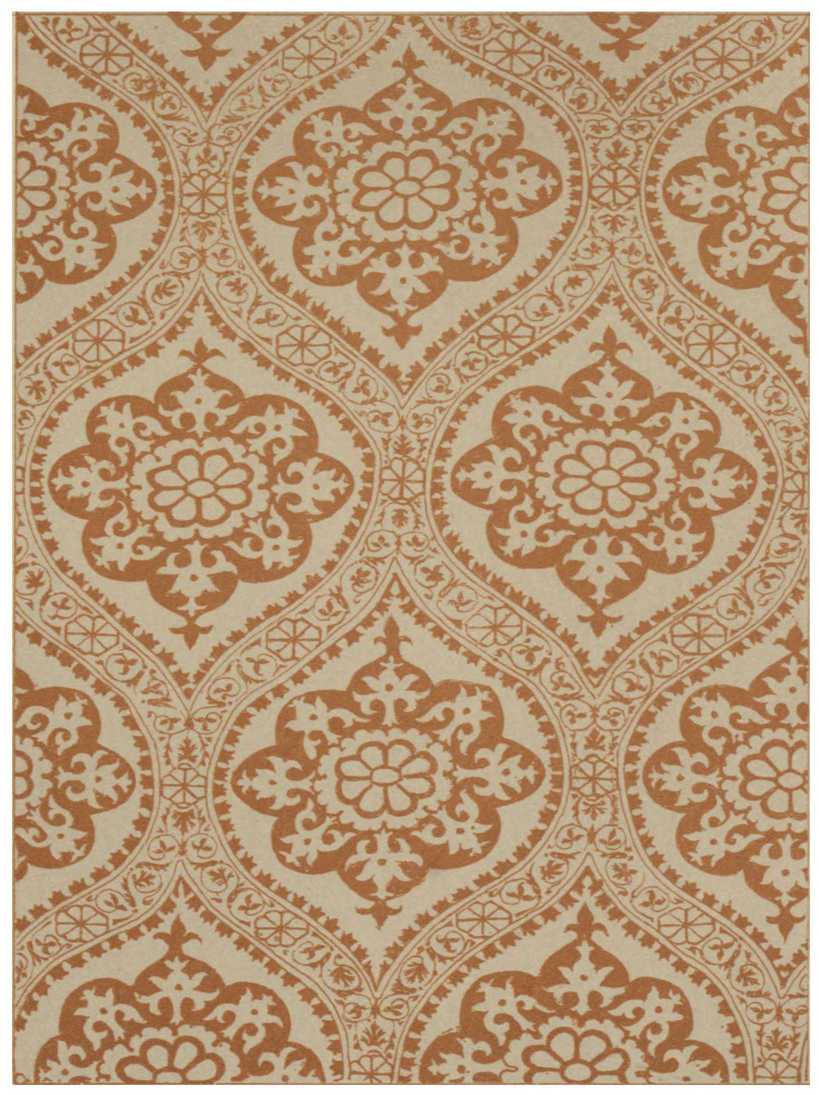
8605
SILK DAMASK.
Italian, 14th century.
Vincent Brooks Day & Son, Lith.
The texture of the specimen is somewhat thin, but the tones of its two harmonious colours are good, and its pattern, in all its parts, extremely agreeable; upon those broad ribbon lines of the net, the branches, sprouting out into trefoils, are gracefully made to twine; and an inclination to figure a crowned M on every petal of the flower inside the meshes is very discernible. Possibly Reggio, south of Naples, is the town where this showy stuff was wrought, serviceable alike for sacred and secular employment.
8606.
Piece of Silk Damask; ground, black; pattern, not easily discernible, though evidently elaborate. Italian, 14th century. 10 inches by 6¼ inches.
So much has damp injured this piece that its original black has become almost brown, and its pattern is well nigh gone. In its fresh state, however, the design, traces of which show it to have been sketched in the country and about the time mentioned, was thrown up satisfactorily, for it was woven in cotton from the silken ground of the piece.
8607.
Piece of Silk Damask; ground, fawn-colour; pattern, trefoils and vine-leaves, in green. Sicilian, 14th century. 8¾ inches by 4½ inches.
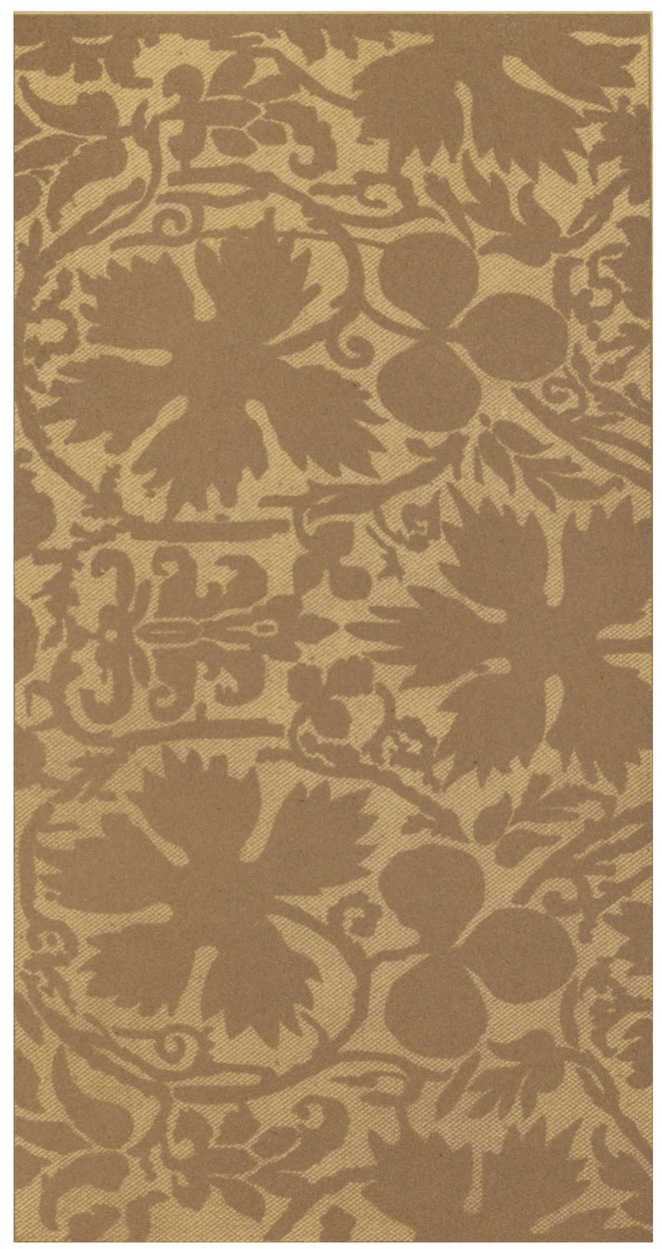
8607.
SILK DAMASK.
Sicilian, 14th century.
Vincent Brooks Day & Son, Lith.
Like all the other specimens of this kind, the present one is pleasing in its combination of those favourite colours—fawn and light green—as well as being remarkable for the elegance with which the foliage is made to twine about its surface; the materials, too, are thick and lasting.
8608.
Fragment of Silk Damask; ground, dark blue; pattern (very imperfect in the specimen), an ellipsis filled in with ornamentation and topped by a floriation, out of which issue birds’ necks and heads, all in lighter blue, edged with white, and two conventional wild animals in gold, but now black with tarnish. Sicilian, 14th century. 6 inches by 6 inches.
8609.
Piece of Silk Damask; ground, fawn-colour; pattern, wreaths of white flowers, green boughs bearing white flowers, forming part of a design in which an ellipsis in green constitutes a leading portion; and a broad band figured with scroll-work and an Arabic sentence, all in gold. Sicilian, 13th century. 1 foot 5½ inches by 5¾ inches.
Probably in the sample before us we behold a work from the royal looms or “tiraz”—silk-house—of Palermo, when Sicily was under the sway of France, in the person of a prince belonging to the house of Anjou. In the first place, we have the fawn—a tone of the murrey colour of our old English writers—and the light joyous green; in the second place, the ellipsis was there, though our specimen is too small to show it all. Those narrow borders that edge the large golden lettered band present us with a row of golden half-moons and blue fleurs-de-lis on one side; on the other, a row of golden half-moons and blue cross-crosslets: on the band itself we find, alternating with foliage, an oblong square, within which is written a short sentence in Arabic—a kindly word, a wish of health and happiness to the wearer—such as was, and still is, the custom among the Arabs. Sure is it that this textile, if wrought by Saracenic hands, was done under a Christian prince, and that prince a Frenchman.
8610.
Piece of Silk Damask; ground, fawn-colour; pattern, birds and dogs in green. Sicilian, 14th century. 1 foot 4½ inches by 10¼ inches.
Like so many other specimens of the Palermitan loom, both in colours and design, this piece is rather poor in its silk, which is harsh and somewhat thin. The birds are a swan ruffling up its feathers at the presence of an eagle perched just overhead, amid branches and foliage in which the trefoil abounds.
8611.
Piece of Silk Damask; ground, red; pattern, foliage in green, wild dogs in blue, gold, and white. South Italian, 14th century. 15 inches by 12½ inches.
The wild dogs are segeant face to face, in pairs; one blue, the other gold; one white, the other gold: and below are flowers blue, gold, and white, alternating like the animals. The warp is cotton, the woof silk, and altogether the stuff is coarse.
8612.
Fragments of Silk Damask; ground, black; pattern, a tower surrounded by water and a figure holding a hawk, and hawks perched, in pairs, on trees. Italian, 15th century. 9 inches by 5½ inches; 9 inches by 4½ inches.
Pity that this curious piece is so fragmental and decayed that its singular design cannot, as in another specimen of the very same tissue, all be made out. Whether it be man or woman standing on high outside the tower with a bird at rest on the wrist is here hard to say. The castle is well shown, with its moat, and its draw-bridges—for it has more than one—all down. Like No. 8606, it shows its pattern by the difference of material in the warp and woof. All over it has been thickly sprinkled with thin gilt trefoils that were not sewed but glued on; many have fallen off, and those remaining have turned black. See No. 7065.
8613.
Piece of Silk Damask; ground, black; pattern, in gold thread, birds amid foliage. Italian, 14th century. 14 inches by 7¼ inches.
The bold and facile pattern of this piece is very conspicuous, with its eagles stooping upon long-necked birds perched on waving boughs; to much beauty in design it adds, moreover, richness in material.
8614.
Piece of Silk Damask; ground, light brown; pattern, the same colour, palmettes and rosettes, with Arabic sentences repeated. Attached is a piece of green silk wrought with gold. Sicilian, 14th century. 16¼ inches by 15½ inches.
A quiet but rich stuff, and especially noticeable for its Arabic or imitated Arabic inscriptions, one within the rosettes, the other all round the inner border of the palmettes or elliptical ornamentations. The cloth of gold is plain.
8615.
Piece of Linen, block-printed in a pattern composed of birds and foliage. Flemish, late 14th century. 1 foot 9 inches by 3 inches.
Of this kind of block-printed linen, with its graceful design in black upon a white ground, there are other good examples (Nos. 7027 and 8303) in this collection. From the marks of use upon its canvas lining, this long narrow strip would seem to have once served as an apparel to an amice in some poor church.
8616.
Portions of Crimson Silk, brocaded in gold; the pattern, angels holding crescents beneath crowns, from which come rays of glory, and hunting leopards seizing on gazelles. Italian, end of 14th century. 2 feet 8¾ inches by 2 feet.
This rich stuff betrays in its design an odd mixture of Asiatic and European feeling; we have the eastern hunting lion spotted and collared blue, pouncing on the gazelle or antelope, which is collared too; so far we have the imitation, but without lettering, of a Persian or Asiatic pattern. With this we find European, or at least Christian, angels, clothed in white, but with such curious nebule-nimbs about their heads as to make their brows look horned, more like spirits of evil than of good. The open crowns are thoroughly after a western design; and the head and shoulders of a winged figure, to the left, show that we have not the entire design before us. From the graceful way in which the figures are made to float, as well as from several little things about the scrolls, we may safely conclude that the designer of the pattern lived in upper Italy, and that this costly and elegant brocade was wrought at Lucca. Of the Oriental elements of this pattern we have said a few words at No. 8288.
8617.
Stole of deep purple silk, brocaded in gold and crimson; pattern, a long flower-bearing stem, and large flowers. Italian, early 15th century. 9 feet 6 inches by 4 inches.
Like all the old stoles, this is so long as almost to reach down to the feet, and is rather broader than usual, but does not widen at the ends, which have a long green fringe. The stuff is of a rich texture, and the pattern good.
8618.
Part of a Linen Cloth, embroidered with sacred subjects, and inscribed with the names, in Latin, of the Evangelists. German, end of the 14th century. 6 feet by 4 feet.
Unfortunately, this curious and very valuable sample of Rhenish needlework is far from being complete, and has lost a good part of its original composition on its edges, but much more lamentably on the right hand side. Not for a moment can we think it to have been an altar-cloth properly so-called, that is, for spreading out over the table itself of the altar; but, in all likelihood, it was used as a reredos or ornament over but behind the altar, as a covering for the wall. Another beautiful specimen of the same kind has been already noticed under No. 8358, for throwing over the deacon’s and subdeacon’s lectern at high mass; and, from the fact that, in both instances, the subjects figured are in especial honour of the B. V. Mary, it would seem that, in many German churches, and following a very ancient tradition that the Blessed Virgin wrought during all her girlhood days ornaments for the Temple of Jerusalem with her needle, the custom was to have for the “Mary Mass,” and for altars dedicated under her name, as many liturgical appliances as might be of this sort of white needlework, and done by maidens’ hands.
In the centre we have the coronation of the B. V. Mary, executed after the ordinary fashion, with her hair falling down her shoulders, and a crown upon her head; she is sitting with arms uplifted in prayer, upon a Gothic throne, by her Divine Son, who, while holding the mund in His left, is blessing His mother with raised right hand; over-head is hovering an angel with a thurible; at each of the four corners is an Evangelist represented, not only by his usual emblem, but announced by his name in Latin. At first sight the angel, the emblem of St. Matthew might be taken for Gabriel announcing the Incarnation to the B. V. Mary. Above and around are circles formed of the Northern Kraken, four in number, put in orb, and running round an elaborately floriated Greek cross, symbolizing the victory of Christianity over heathenism. In many places, within a gracefully twining wreath of trefoil leaves and roses barbed, is the letter G, very probably the initial of the fair hand who wrought and gave this beautiful work to our Lady’s altar; and the spaces between the subjects are filled in with well-managed branches of the oak bearing acorns. To the left is seen a hind or countryman hooded, carrying, hung down from a long club borne on his shoulder, a dead hare; and further on, still to the left, an old man who with a lance is trying to slay an unicorn that is running at full speed to a maiden who is sitting with her hair hanging about her shoulders, and stroking the forehead of the animal with her left hand. The symbolism of this curious group, not often to be met with, significative of the mystery of the Incarnation, is thus explained by the Anglo-Norman poet, Phillippe de Thaun, who wrote his valuable “Bestiary” in England for the instruction of his patroness, Adelaide of Louvaine, Queen to our Henry I:—“Monoceros is an animal which has one horn on its head; it is caught by means of a virgin: now hear in what manner. When a man intends to hunt it and to take and ensnare it, he goes to the forest where is its repair, there he places a virgin with her breast uncovered, and by its smell the monoceros perceives it; then it comes to the virgin and kisses her breast, falls asleep on her lap, and so comes to its death: the man arrives immediately, and kills it in its sleep, or takes it alive and does as he likes with it.... A beast of this description signifies Jesus Christ; one God he is and shall be, and was and will continue so; he placed himself in the virgin, and took flesh for man’s sake: a virgin she is and will be, and will always remain. This animal in truth signifies God; know that the virgin signifies St. Marye; by her breast we understand similarly Holy Church; and then by the kiss it ought to signify that a man when he sleeps is in semblance of death; God slept as a man, who suffered death on the cross, and His destruction was our redemption, and His labour our repose,” &c.—“Popular Treatises on Science written during the Middle Ages, &c., and edited for the Historical Society of Science by T. Wright,” pp. 81, 82.
The figure of the countryman carrying off the hare is brought forward in illustration. As the rough coarse clown, prowling about the lands of his lord, wilily entraps the hare in his hidden snares, so does the devil, by allurements to sin, strive to catch the soul of man. These interesting symbolisms end the left-hand portion of the reredos. Going to the right, we find that part torn and injured in such a way that it is evidently shorn of its due portions, and much of the original so completely gone that we are unable to hazard a conjecture about the subject which was figured there.
8619.
Piece of Silk Damask; ground, rose-coloured; pattern, peacocks, eagles, a small nondescript animal, and a lyre-shaped ornament, all in green, touched with white. Italian, late 14th century. 11 inches by 10½ inches.
A curious design, in which the birds are boldly and freely drawn. Each horn of the lyre-shaped ornament ends, bending outwardly with what to herald’s eyes seems to be two wings conjoined erect.
8620.
Piece of Silk and Gold Damask; ground, dark blue, in some places faded; pattern, a band charged with squares in gold, every alternate one inscribed with the same short Arabic word, lions in gold beneath a tree in light blue shaded white, and cockatoos in gold. Syrian, 14th century. 19 inches by 13½ inches.
So strong is the likeness between this and the stuff at No. 8359, both in the texture of the silk and the treatment of the beasts and birds, that we are led to suppose them to have come from the same identical workshop. That tree-like ornament, under which the shaggy long-tailed lion with down-bent head is creeping, seems the traditionary form of the Persians’ “hom.” The gold is, in most parts, very brilliant, owing to the broadness of the metal wrapped round the linen thread that holds it; and, altogether, this is a rich specimen of the Syrian loom.
8621.
Piece of Silk Damask; ground, fawn-colour; pattern, foliage in green, flowers, some white, some in gold, and lions in gold. Sicilian, late 14th century. 22½ inches by 10 inches.
The warp is of linen, and the silken woof is thin; so sparingly was the gold bestowed, that it has almost entirely faded; altogether, this specimen shows a good design wasted upon very poor materials. In the expanding part of the foliage there seems to be a slight remembrance of the fleur-de-lis pattern, and the lions are sejant addorsed regardant.
8622, 8623.
Two Portions of Silk Damask; in both, the ground, fawn-colour; the pattern, in the one, ramified foliage, amid which two lions sejant regardant, in gold; in the other, two eagles at rest regardant, in green, divided by a large green conventional flower, including another such flower in gold. Sicilian, 14th century. 11 inches by 5¼ inches; 9½ inches by 4¾ inches.
Very likely from the same loom as No. 8621, and every way corresponding to it.
8624.
Piece of Silk Damask; ground, pale brown; pattern, in a lighter tone, stags and sunbeams, and below eagles within hexagonal compartments. Sicilian, late 14th century. 18 inches by 14 inches.
The stags, well attired, are in pairs, couchant, chained, with heads upturned to sunbeams darting down on them, with spots like rain coming amid these rays; beneath these stags are eagles. The material is very thin and poor for such a pleasing design. In a much richer material part of this same pattern is to be seen at No. 1310.
8625.
Piece of very fine Linen. Oriental. 2 feet 4 inches by 1 foot 5 inches.
This is another of those remarkably delicate textiles for which Egypt of old was, and India for ages has been, so celebrated. A fine specimen has been already noticed at No. 8230; but to indicate the country or the period of either would be but hazarding a conjecture. Surplices were often made of such fine transparent linen, as is shown by illuminated MSS. See “Church of our Fathers,” t. ii. p. 20.
8626.
Piece of Silk Damask; ground, fawn-colour; pattern, flowers and birds, both in green. Italian, end of 14th century. 11 inches by 8½ inches.
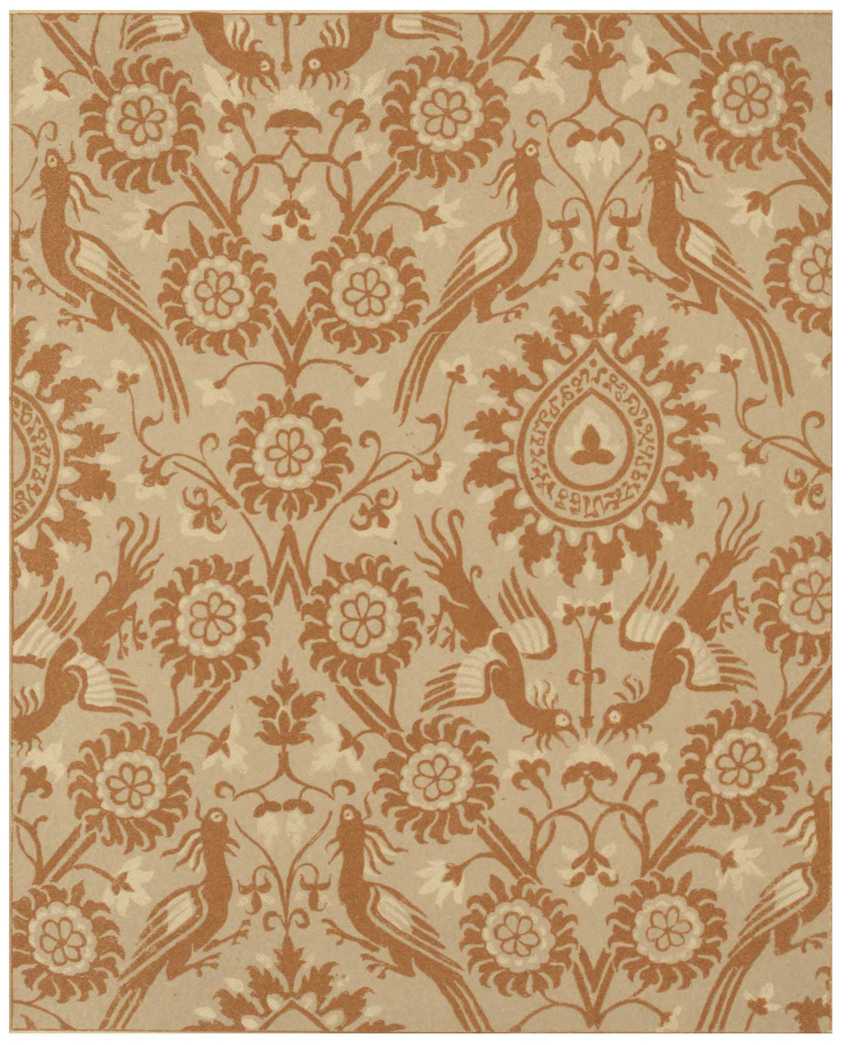
8626
SILK DAMASK.
Italian, 14th century.
Vincent Brooks Day & Son, Lith.
The birds are in two pairs, one at rest, the other on the wing darting down; between them is an ornament somewhat heart-shaped, around which runs an inscription of imitated Arabic. Most likely this silk is of Sicilian work.
8627.
Piece of Silk Damask; ground, dark blue; pattern, lozenge-shaped compartments, filled in with quadrangular designs varying alternately. Spanish, late 14th century. 10½ inches by 8 inches.
There is a Moorish influence in the design, which leads to the supposition that this stuff was wrought somewhere in the South of Spain.
8628, 8628A.
Two Fragments of Silk Damask; ground, light yellow; pattern, flowers and birds, with the letters A and M crowned, all in pale red. Italian, late 14th century. 6 inches by 5 inches; 6 inches by 3½ inches.
A very pleasing design, in nicely toned colours, and evidently wrought for hangings, or perhaps curtains, about the altar of the B. V. Mary, as we have the whole sprinkled with the crowned letters A M, significative of “Ave Maria.”
8629.
Fragment of Silk Damask; ground, purple; pattern, four green hares in a park walled, with conventional flowers, yellow. Italian, late 14th century. 5 inches by 4¾ inches.
The colours, both of the ground and design, of this piece are much faded, so that it becomes hard, at first sight, to make out the pattern, especially the four green hares tripping within a park, which, instead of being shown with pales, has a wall round it.
8630.
Fragment of Silk Damask; ground, red; pattern, foliage and flowers in green, with animals, alternately in gold and dark blue. Italian, late 14th century. 5 inches by 4 inches.
Though the materials be thin, the design is interesting and displays taste. The animals, seemingly fawns, are lodged, but so sparingly was the gold bestowed upon its cotton thread that it has almost entirely disappeared from the would-be golden deer.
8631.
Fragment of Silk Damask; ground, deep purple; pattern, a circle inclosing a heart-shaped floral ornament, in red, with an indistinct ornament, once gold. South of Spain, 14th century. 6¼ inches by 5½ inches.
The colours of what may have been a rich stuff, as well as the brightness of the gold, are much dulled.
8632.
Piece of Silk Damask; ground, pale yellow; pattern, vine-leaves and grapes, with the letter A, all in light purple. Italian, late 14th century. 11¾ inches by 3 inches.
One of those cheerful designs which are to be found in this collection; and had the specimen been larger, very likely an M would have been shown under the A.
8633.
Piece of Silk Damask; ground, purple; pattern, within interlacing strapwork forming a square, two parrots addorsed alternating with two dogs addorsed, all yellow, with ornamentations of small circles and flowers, once gold, but now so tarnished that they look black. Sicilian, 14th century. 5½ inches by 5 inches.
One of those specimens which will be sought by those who want examples of stuffs figured with animals. This stuff is shewn in Dr. Bock’s “Dessinateur pour Etoffes,” &c. 3 Livraison.
8634.
Piece of Silk Damask; ground, fawn and green; pattern, small squares enclosing leaves, birds, and beasts alternately. Italian, 14th century. 7½ inches by 3 inches.
Though small, the pattern is good and comes from either a Sicilian or a Reggio loom. Lions, and stags with branching horns, eagles, parrots, and undecipherable birds, in braces with necks crossing one another, are to be found upon it; among the foliage the vine-leaf prevails.
8635.

Altar Frontal of Linen, embroidered with the filfot in white thread freckled with spots in blue and green silk, and lozenge-shaped ornaments in blue, green, and crimson silk. German, 14th century. 3 feet 10 inches square.
There can be little doubt but this piece of needlework was originally meant for an altar frontal, and its curious but coarser lining, may have been wrought for the same separate but distinct purpose. The filfot or gammadion, a favourite object upon vestments, is its chief adornment, while its lining, a work of a century later, is worked with a palm-like design in thick linen thread. At a later time, it seems to have been employed as a covering to the table itself of the altar, and is plentifully sprinkled with spots of wax-droppings.
8636.
Piece of Linen Cloth, embroidered with filfots, some in white, some in blue silk. German, 14th century. 1 foot 11 inches by 9 inches.
This handsome piece of napery was evidently woven for the service of the church, and may have been intended either for frontals to hang in front of the altar, or as curtains to be suspended away from, but yet close to, the altar-table on the north and south sides. The favourite gammadion appears both in the pattern of the loom-work and in the embroideries wrought by hand, sometimes in blue, sometimes in white silk, upon it.
8637.
Piece of Silk and Gold Damask; ground, green; pattern, flower-bearing stems, in gold, amid foliated tracery of a deep green tone, all enclosed by a golden elliptical border. Italian, early 15th century, 11½ inches by 7½ inches.
This rich and pleasing stuff is most likely from the loom of some workshop in Lucca and was manufactured for secular purposes, and deserves attention not only for the goodness of its materials, but for the beauty of its design.
8638.
PIECE of Thread and Silk Damask; ground, purple slightly mixed with crimson; pattern, vine-branches bearing grapes and tendrils all in green, amid which are wyverns in gold, langued green. South Italian, 15th century, 1 foot 1 inch by 9½ inches.
The warp is of thread, and the woof of silk. Such was the poverty of the gold thread in the wyverns, that it has almost entirely dropped off or turned black. This specimen shows how, sometimes, a rich pattern was thrown away upon mean materials. Its uses seem to have been secular.
8639.
Piece of Silk Damask; ground, gold; pattern, a circle showing, in its lower half, a crescent moon and an eight-petaled flower, in the round centre of which is an Arabic inscription, all in black, and the spaces filled in with a Saracenic scroll in light blue, light green, and crimson (now faded). Moresco-Spanish, 14th century. 1 foot 1¾ inches by 5¾ inches.
This unmistakeable specimen of a Saracenic loom would seem to have been wrought somewhere in the south of Spain, may be at Granada, Seville, or Cordova.
As a sample of its kind it is valuable, showing, as it does, that the same feelings which manifested themselves upon Moorish ornamentation for architecture were displayed in the patterns of textiles among that people. The fraud, so to say, of gilt shreds of parchment for threads covered with gold is exemplified here; and hence we may gather that the Spaniards of the mediæval period learned this trick from their Saracenic teachers in the arts of the loom. As in No. 8590, &c., so here, the gold ground is wrought, not in thread twined with gold foil, but with gilt vellum cut into very narrow filaments, and worked into the warp so as to lie quite flat.
8640.
Piece of Silk Damask; ground, light blue; pattern, a circle elaborately filled in with a wreath of leaves edged with a hoop of fleur-de-lis, and enclosed in an oblong garland made up of boughs and flowers, in a slightly deeper tone of the same blue. Italian, early 15th century. 1 foot by 8½ inches.
So very like in design to No. 8637, that we may presume it to have been wrought at Lucca.
8641.
Part of an Orphrey; ground, once crimson, but now faded to a light brown colour; pattern, quatrefoils, with angles between the leaves, embroidered with male saints in various colours upon a golden ground. Each quatrefoil is separated by a knot of three interlacings, and the sides filled in with a pair of popinjays, gold and green, and two boughs of the oak bearing acorns, alternately. On both sides runs a border formed of a scroll of vine-leaves, done alternately in gold and silver, upon a green silk ground. North Italian, 15th century. 2 feet 7 inches by 5½ inches.
The whole of this elaborate piece of needlework has been done with much care, and in rich materials; but as the saints have no peculiar emblems given them, their identification is beyond hope. Whether for cope or chasuble—for it might have served for either vestment—this embroidery must have been very effective, from the bold raised nature of much of its ornamentation.
8642, 8642A.
Two Pieces of Silk Damask; ground, green and fawn; pattern, intertwining branches of the vine, with bunches of grapes. Sicilian, 14th century. 9¾ inches by 4½ inches; 6 inches by 4 inches.
Another of those graceful green and fawn-coloured silks almost identical in pattern with others we have seen from the same country.
8643.
Piece of Net-work; ground, reticulated pale brown silk; pattern, a sort of lozenge, in green and in brown silk, hand-embroidered. German, 14th century. 7 inches by 5 inches.
From the circular shape of this piece it seems to have been a portion of female attire, most likely for the shoulders. One of its ornaments looks very like a modification of one form of the heraldic mill-rind, with the angular structure.
8644.
Portion of an Orphrey; ground, gold; pattern, a shield of arms, and an inscription in purple letters, repeated. German, 15th century. 1 foot 9 inches by 2¼ inches.
This specimen of the German loom may have been woven at Cologne, probably for the narrow orphreys of a whole set of vestments given to the church by some Duchess of Cleves, of the name of Elizabeth Vancleve, since, to such a lady, the blazon and the inscription point. The shield is party per pale gules, an escarbuncle or; and purpure, a lion rampant argent, barred gules, ducally crowned and armed or.
8645.
Piece of Linen; ground, light brown; pattern, small blue squares or lozenges, separated into broad bands by narrow stripes, once ornamented with green lozenges and bordered all along by red lines. German, 15th century. 1 foot by 7 inches.
The warp and woof are linen thread; the green of the narrow stripes, from the small remains, appears to have been woollen.
8646.
Fragment of a Piece of Silk and Gold Embroidery on Linen; ground, as it now looks, yellow; pattern, interlacing strapwork, forming spaces charged with the armorial bearings of England, and other blazons, rudely worked. 14th century. 5 inches by 3½ inches.
So faded are the silks, and so tarnished the gold thread used for the embroidery of this piece, that, at first sight, the tinctures of the blazon are not discernible. In the centre we have the three golden libards or lions of England, and the silk of the ground or field, on narrow examination, we find to have been scarlet or gules; immediately below is a shield quarterly, 1 and 4 or, a lion rampant gules, 2 and 3 sable, a lion rampant or; immediately above, a shield gules, with three pales azure (?), each charged with what are seemingly tall crosses (St. Anthony’s) or; above, the shield of England; but to the right hand, on a field barry of twelve azure and or, a lion rampant gules; below this shield, another, on a field or, two bars sable; these two shields alternate on the other side. The strapwork all about is fretty or, on a field gules.
8647.
Piece of Silk and Gold Damask; ground, crimson, sprinkled with gold stars; pattern, the Annunciation. Italian, 14th century. 1 foot 1¼ inches by 8 inches.
In this admirable specimen of the Florentine loom we have shown us the B. V. Mary not quite bare-headed, but partly hooded and nimbed, as queen-like she sits on a throne, with her arms meetly folded on her breast, the while she listens to the words of the angel who is on his knees before her, and uplifting his hand in the act of speaking a benediction, while in his left he holds the lily-branch, correctly—which is not always so in artworks—blooming with three, and only three, full-blown flowers. Above the archangel the Holy Ghost is coming down from heaven in shape of a dove, from whose beak dart forth long rays of light toward the head of St. Mary. The greater part of the subject is wrought in gold; the faces, the hands, and flowers are white, and a very small portion of the draperies blue. The drawing of the figures is quite after the Umbrian school, and, therefore, not merely good, but beautiful. In his “Geschichte der Liturgischen Gewänder des Mittelalters,” 1 Lieferung, pl. xiii. Dr. Bock has figured it.
8648.
An Embroidered Figure of St. Ursula, within a Gothic niche, which with much of the drapery, was done in gold, on a ground now brown. Rhenish, 14th century. 8¾ inches by 3¾ inches.
So sadly has the whole of this embroidery suffered, apparently from damp, that the tints of its silk are gone, and the gold about it all become black. That this is but one of several figures in an orphrey is very likely; it gives us the saint with the palm-branch of martyrdom in one hand, a book in the other, and an arrow slicking in her neck, the instrument of her death; being of blood royal, she wears a crown; emblem of heaven and paradise, the ground she treads is all flowery.
8649.
Piece of Woollen Carpet; ground, red; pattern, a green quatrefoil bearing three white animals. Spanish, late 14th century. 1 foot 11 inches by 1 foot 1 inch.
A most unmistakeable piece of mediæval carpeting; the lively tone of its red is yet bright. The quatrefoils are quite of the period, and look like four-petaled roses barbed, that is, with the angular projection between the petals. So unlion-like are the animals, that we may not take them as the blazon of the Kingdom of Leon.
8650.
Piece of Silk Damask; ground, crimson; pattern, the so-called artichoke in yellow and green, lined white, and foliage of green lined white. Spanish, 15th century. 1 foot 9 inches by 1 foot 4½ inches.
A good example of this showy pattern, once so much in favour, and of which the materials are very good and substantial; much of the yellow portions of the design was in gold thread, the metal of which has, however, almost all gone. From the quantity of glue still sticking to the hind part of this silk, its last destination would seem to have been the covering of some state room.
8651.
The “Vernicle,” embroidered in silk, and now sewed on a large piece of linen. Flemish, middle of 15th century. 9½ inches by 7½ inches; the linen, 2 feet 10½ inches by 2 feet 9 inches.
To the readers of old English literature, especially of Chaucer, the term of “Vernicle” will not be unknown, as expressing the representation of our Saviour’s face, which He is said to have left upon a napkin handed Him to wipe His brows, by one of those pious women who crowded after Him on His road to Calvary. It is noticed, too, in the “Church of our Fathers,” t. iii. p. 438. This piece of needlework seems to have been cut off from another, and sewed, at a very much later period, to the large piece of linen to which it is now attached; for the purpose of being put up either in a private chapel, or over some very small altar in a church, as a sort of reredos; or, perhaps, it may have originally been one of the apparels on an alb: never, however, on an amice, being much too large for such a purpose. One singularity in the subject is the appearance of crimson tassels, one at each corner of the napkin figured with our Lord’s likeness, which is kept with great care still, at Rome, among the principal relics in St. Peter’s, where it is shown in a solemn manner on Easter Monday. It is one of those representations of a sacred subject called by the Greeks ἀχειροποίητος, that is, “not made by hands,” or, not the work of man, as was noticed in the Introduction to the present Catalogue.
8652.

Linen Towel, with thread embroidery; pattern, lozenges, some enclosing flowers, others, lozenges. German, 15th century. 3 feet 11 inches by 1 foot 6½ inches.
Most likely this small piece of linen was meant to be a covering for a table, or may be the chest of drawers in the vestry, and upon which the vestments for the day were laid out for the celebrating priest to put on. In the pattern there is evidently a strong liking for the gammadion—a kind of figuration constructed out of modifications of the Greek letter gamma. In England the gammadion became known as the “filfot,” and seems to have been looked upon as a symbol for the name Francis or Frances, and is of frequent occurrence in our national monuments—especially in needlework—belonging to the 14th and 15th centuries. From the presence of that large eight-petaled flower in this cloth we are somewhat warranted in thinking that the same hand that wrought the fine and curious frontal, No. 8709, worked this, and that her baptismal name was Frances.
8653-8661A.
Ten Fragments of Narrow Laces for edgings to liturgical garments, woven, some in gold, some in silk, and some in worsted. 8658 is a specimen of parti-coloured fringe; 8659 shows a two-legged monster as part of its design;
and in 8661 and 8661 A we find a knot much like the one to which Montagu gives the names of Wake and Ormond, in his “Guide to the Study of Heraldry,” p. 52.
8662.
The Napkin for a Crozier, of fine linen ornamented with two narrow perpendicular strips of embroidery of a lozenge pattern in various-coloured worsteds, and having, at top, a cap-shaped finishing made of a piece of green raised velvet, which is figured with a bird, like a peacock, perched just by a well, into which it is looking. At each corner of this cap is a small parti-coloured tassel, and, at the top, the short narrow loop by which it hung from the upper part of the crozier-staff. German, 15th century. 2 feet 2½ inches by 1 foot 8½ inches.
This is another of those liturgical ornaments, valuable, because so rare, of which we have spoken under No. 8279A. But in the specimen before us we find it in much diminished form—half only of its usual size. The design of the raised velvet, in its cap, is as unusual as curious.
8663.
Linen Cloth, embroidered in coloured silks with sacred emblems and hagiological subjects, and inscribed with names amid trees and flowers. German, 15th century. 1 foot 1¾ inches by 4 inches.
In all likelihood this needlework was meant as the covering for a table in the vestry of some church, or oratory in some lady’s room. On the left is figured St. George slaying the dragon; next, the pelican in its piety, above which is the “vernicle,” and over this the word “Emont,” with a ducal coronet above it. Then the names “Ihs,” “Maria,” and, above them, the word “Eva” crowned. In the middle of the cloth is a cross with all the emblems of the Passion around it, as well as a star and crescent. Then an animal spotted like a panther and chained to a tree; this is followed by the name “Meltinich;” last of all we find the name “Amelia,” and beneath, a half-figure of a woman having long hair with a large comb in her right hand, altogether resembling a mermaid. At bottom runs a narrow parti-coloured thread fringe.
8664.
Frontlet to an Altar-Cloth, embroidered in coloured silks upon fine linen, with flower-bearing trees and a shield of the Passion, along with saints’ names, &c. German, 16th century. 1 foot 1¾ inches by 4 inches.
The shield in the middle is charged with a chalice and consecrated host, and four wounds (hands and feet) of our Lord. Under one tree occur the names “Jhesus,” “Maria;” under another, “Andreas,” “Anna.” From amid the grass on the ground spring up tufts of daisies.
8665.
Piece of Embroidery, done upon fine linen in coloured silks and gold thread. German, middle of the 15th century. 7½ inches square.
The subject of this piece is the death of the Blessed Virgin Mary, figured according to the traditional manner much followed by the mediæval schools of art in most parts of Christendom. It is, however, to be regretted that this embroidery has been at some time mutilated; in its original state it may have, perhaps, served as an apparel to an alb, and occupied the place of one of those to be seen at No. 8710.
8666.
Fragment of thin Silk Damask; pattern, a lozenge-shaped diaper; colour, a much faded crimson. Oriental, 13th century. 8½ inches by 4½ inches.
Though small, the pattern is pretty, and much resembles a stuff of silk and gold very lately found in the tomb of one of the Archbishops of York, in that cathedral.
8667.
Portion of an Orphrey, wrought partly in the loom, partly by the needle, and figured with an angel-like youth holding before him an armorial shield, as he stands within a Gothic niche, with an inscription below his feet. German, very late 15th century. 10½ inches by 5½ inches.
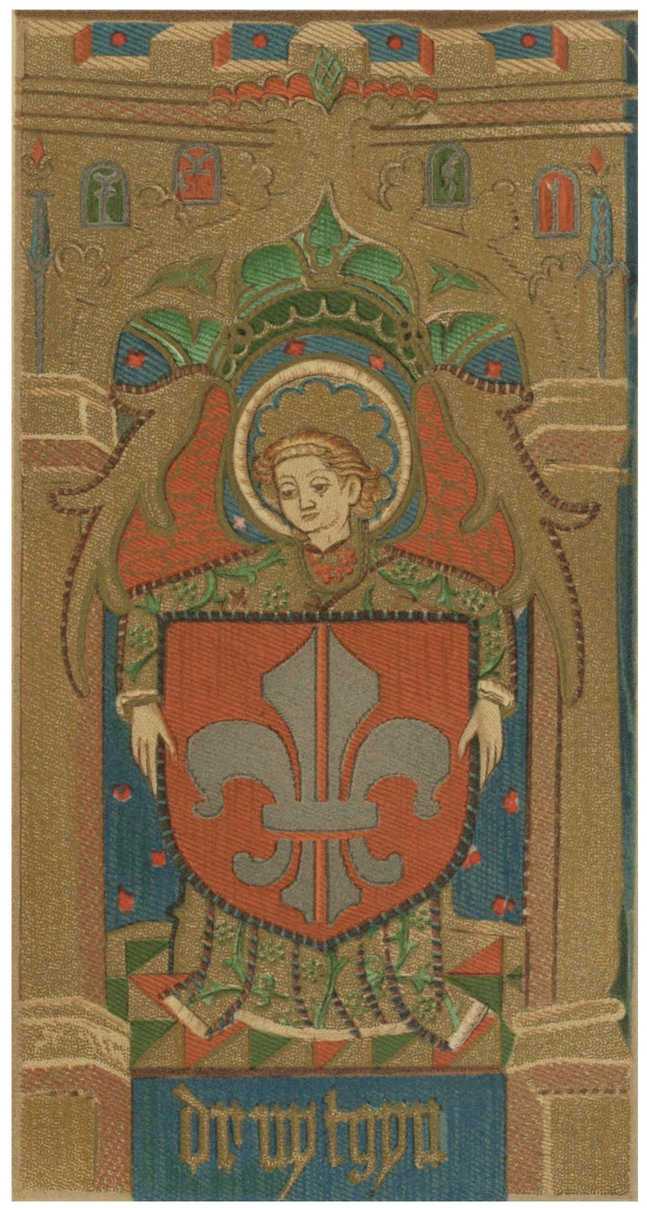
8667.
EMBROIDERY, SILK & GOLD
Under a Gothic canopy &c. __ German, late 15th century.
This instructive piece deserves the attention of those who study embroidery. The loom was geared in such a manner that the spaces for the head, face, neck, and hands were left quite empty, so that they might be filled in by the needle. But this was not all the hand had to do; the architectural features of the canopy, its shading in red, the nimb, and nicely floriated diapering all over the angel’s golden alb, were put in by the needle.
The inscription, woven in, reads “Johā vā geyē,” and the piece is figured in Dr. Bock’s “Geschichte der Liturgischen Gewänder des Mittelalters,” 2 Lieferung, pl. xv.
8668.
Part of an Orphrey, mostly loom-woven, and figured with the Crucifixion, on one side of which stands the Blessed Virgin Mary, on the other, St. John the Evangelist, German, late 15th century. 12¼ inches by 5 inches.
Like the preceding piece, the greater part is woven, even the body itself of our Lord, so that in His figure, as in those of His mother and the beloved disciple, the only embroidered portions are the head and face, besides those blood-spots all over His person, the tricklings from His five wounds, and the crossed nimb about His head.
8669.
Portion of a Maniple, in much faded tawny silk; pattern, a rose-like floriation. Flemish, 16th century. 1 foot 10½ inches by 3¼ inches.
Though peculiar, the pattern in the design of this silken stuff is very pretty; the piece of parti-coloured silken fringe that edges the end of this maniple is older than the textile to which it is sewed.
8670.
The hind Orphrey for a Chasuble, with embroidered figures applied upon a ground red and gold. The figures are a knight bareheaded and kneeling in prayer, with his helmet and shield before him, St. Catherine of Alexandria, and St. Anthony of Egypt reading a book. German, middle of the 15th century. 2 feet 11 inches by 5¼ inches.
The figures are well done, and all show the varieties of process then brought into use; they were worked on canvas, of which the portions for the face and hands were left untouched, saving by the few slight stitches required for indicating the hair and features of the countenance and indications of the fingers. Some of the dress was cut out of woven cloth of gold and sewed on; other parts worked with the needle, as were such accessories as books, instruments of martyrdom, and other such emblems. The knight, probably the giver of the chasuble, is meant to be indicated by his blazon, which is a shield or charged with eight torteaux in orle, and this is surmounted by a golden helmet with mantling, and a crest, consisting of golden horns fringed with four torteaux each. The ground upon which the embroideries are set is rich, and woven with golden wheel-like circles with wavy, not straight, spokes upon a bright red field.
8671.
Fragment of an Orphrey, woven in gold and coloured silks; pattern, intertwining brambles of the wild rose, bearing flowers seeded and barbed. German, beginning of the 16th century. 7¾ inches by 4½ inches.
Though the ground is, or rather was, of gold, so sparingly was the precious metal bestowed upon the thread, that it has been almost entirely worn away. The same may be said of the very narrow tape with which, on one of its edges, it is still bordered.
8672.
Part of an Orphrey, embroidered upon linen, in coloured silks, and figured with St. Anthony and a virgin martyr-saint, both standing beneath Gothic canopies. Rhenish, late 15th century. 1 foot 9 inches by 3¾ inches.
Notwithstanding the embroidery be somewhat coarse, like much of the same kind of work at the period, it is so far valuable as it instructs us how three methods were practised together on one piece. The canvas ground was left bare at the faces and hands, so that the features of the one and the joints of the other might be shown by appropriate stitches in silk. Pieces of golden web, cut to the right size, were applied for the upper garments of the figures, and the folds shaded by hand in red silk, and the borders of the robe edged with a small cording, while all the rest of the work was filled in with needlework. The closely fitting scull-cap, but more especially the staff ending in a tau-cross, indicate St. Anthony, but the female saint cannot be identified; her long hair flowing about her shoulders signifies that she was a virgin, and the green palm-branch in her right hand indicates that she underwent martyrdom.
8673.
Piece of Raised Velvet; ground, yellowish pink, the raised velvet, bright crimson; pattern, a large compound floriation within a circle formed by small hooked lines having flowers at the cusps, and the round itself springing out of a somewhat smaller floriation. Flemish, 16th century. 2 feet 3 inches by 1 foot 1¾ inches.
8674.
Piece of Raised Velvet; the ground, orange, the raised velvet, green; the pattern, of pomegranate form, within crocketed circles, and alternating with a large floriation. Flemish, 16th century. 2 feet 4½ inches by 11 inches.
The raised pattern, from its rich pile, stands up well, and was hung upon walls, or employed for curtains and other household appliances, for which such stuffs were generally produced.
8675.
Piece of Worsted Needlework; pattern, lozenges after several forms, and done in various colours. Flemish, 16th century. 18½ inches by 12 inches.
Worked after the same fashion, and with the same materials, that our ladies at this day employ upon their Berlin wool work.
8676.
Piece of Linen Damask; pattern, artichoke and pomegranate forms. Flemish, 16th century. 1 foot 3 inches by 1 foot 1¾ inches.
The design is carefully elaborated; and the piece itself is evidence of the beauty of old Flemish napery.
8677.
A Small Cloth for an Oratory, of fine linen, embroidered with sprigs of flowers in their proper colours, in silk, and with I. H. S. in red gothic letters, within a thorn-like wreath in green. Flemish, 16th century. 2 feet 6 inches by 1 foot 10 inches.
That this cloth has been cut down is evident; the sacred monogram is not in the middle, and the higher row of flowers is shortened. Though hemmed with tape on one side, and edged on two sides by very narrow strong lace, and on the fourth or front border by a broader lace, its last use was as a covering for some sort of table, not an altar properly so called; it is by far very much too small for any such purpose. In all likelihood, this cloth was made to overspread the top of a praying desk, or some little table strewed with devotional objects in a bed-room or private oratory.
8678.
Portion of Worsted Embroidery upon light brown linen; the pattern, a scroll of flowers and foliage in colours German, late 16th century. 1 foot 5¾ inches by 4¼ inches.
The design is made to run along well, and the colours are nicely contrasted.
8679.
Piece of Silk Damask, of a light red and straw colour; pattern, two varieties of the pomegranate mixed with large artichokes and small crowns, and separated by thick branches, which are purpled with broad ivy-like leaves. Italian, 16th century. 2 feet 10 inches by 1 foot 11 inches.
A bold pattern, remarkable for the originality of some parts of its design.
8680, 8680A.
Two Pieces of Raised Velvet, green and gold; pattern, a modification of the favourite pomegranate and its accompanying intertwining foliage; very large and incomplete. Florentine, early 16th century. 2 feet 1 inch by 9½ inches; 1 foot 3 inches by 10½ inches.
These two pieces give us specimens of those gorgeous stuffs so often sent forth to the world from the looms of Tuscany, and afford, in portions of the design, samples of velvet raised upon velvet so very rarely to be found. The little short loops, or spots, of gold thread, with which the velvet is in some parts freckled, ought not to go unnoticed.
8681.
Piece of Embroidery, wrought with a running pattern of leaves and flowers in coloured threads upon a golden ground, now much tarnished. German, 16th century, 1 foot 6 inches by 4½ inches.
Embroidery in thread is of somewhat rare occurrence.
8682.
Part of a Web for church use, wrought in thread and silk upon a golden ground, now much faded. The pattern, trees bearing white flowers, bunches of white lilies, wheels with stars, and the words “Jhesus, Maria.” Cologne, late 15th century. 6 feet by 5 inches.
That it once formed a frontlet or border to the front edge of an altar-cloth is very likely, not only from the spots of wax with which it is in some parts sprinkled, but more especially from the way in which its pattern is wrought, so as to be properly seen when stretched out horizontally.
8683, 8684.
Two Specimens of Web for church use; woven in silks, upon a golden ground; the first with the sacred name “Jhesus,” and a tree bearing white and red flowers, with daisies at its foot, and the name “Maria,” beneath which is a garland of white and red flowers twined about the letter M; the second, with a round ornament, having red and gold stars upon a tawny white ground between each of its eight radii, and underneath the sacred name, in dark blue silk. German, late 15th century. 1 foot 7½ inches by 2½ inches; 7 inches by 3¼ inches.
Like several other examples of the same kind to be found in this collection, and wrought for the same liturgical purposes.
8685.
Piece of Raised Velvet, dark blue; pattern, one of the several varieties of the pomegranate. Italian, 16th century. 1 foot 3½ inches by 1 foot 3 inches.
Rich neither in material nor design, this velvet may have been wrought not for ecclesiastical but personal use.
8686.
Piece of Silk Damask, purple; pattern, the pomegranate. Italian. 2 feet 5 inches by 11¾ inches.
Like the preceding, meant for personal use, but exhibiting a much more elaborate design, and the variety of the corn-flower (centaurea) springing forth all round the pomegranate, which itself grows out of a fleur-de-lis crown.
8687.
Piece of Embroidery, on canvas; ground, figured with St. John the Baptist and St. John the Evangelist. Rhenish, 16th century. 1 foot 4 inches square.
To the left is seen St. John the Baptist, clothed in a long garment of camel-hair and his loins girt with a light-blue girdle, preaching in the wilderness on the banks of the Jordan. In his left hand he holds a clasped book, upon which rests the “Lamb of God,” and just over, a flag, the white field of which is ensigned with a red cross; his upraised right hand, with the first two fingers elevated as in the act of blessing, is pointed to the lamb. To the right we have St. John the Evangelist, holding a cup in one hand, while with the other he makes the poisonous drug in it harmless by a blessing.
The grounding has been filled in mostly with golden thread, but of so poor a quality that the thin metal on it is scarcely discernible. In both figures the whole of the person, the fleshes, as well as clothing, are all done in woven white silk cut out, shaded, and featured in colours by the brush, with some little needlework here and there upon the garments and accessories. The figures of the saints are “applied;” and one cannot but admire the effect which a few stitches of rich green silk produce upon the canvas ground, while a piece of applied silk, slightly shaded by the brush, is an admirable imitation of a rocky cliff. The two tall trees and green garlands between them are telling in their warm tones. Altogether this is a precious specimen of applied work, and merits attention. It seems to have been the middle piece of a banner used for processions, and may have once belonged to some church at Cologne dedicated to the two SS. John.
8688.
Portion of an Orphrey, crimson satin, embroidered with flowers in coloured silk and gold thread. 17th century. 1 foot 3½ inches by 2 inches.
From what liturgical vestment this was taken it would be hard to guess, but there is no likelihood that it ever ornamented a mitre. The yellow flowers, of the composite kind, and heart’s-eases are very nicely done, whether the work of an Italian, French, or German hand. They have much about them that speaks of France.
8689.
Piece of Raised Velvet, brown, with floriated pattern in gold thread. North Italy, early 16th century. 1 foot 1½ inches by 6½ inches.
Most likely from the looms of Lucca, and with a pretty diapering in the gold ground where it is bare of the velvet pile.
8690.
Piece of Green Velvet, spangled with gold, and embroidered with three armorial shields in gold thread and coloured silks. German, 17th century. 10 inches by 9¾ inches.
All the shields are very German, especially in their crests. The shield on the right hand will attract notice by its anomaly; on a field azure it gives a rose gules barbed green, or colour upon colour; the crest, too, is a curiosity, at least in English blazon, displaying an Elector’s cap with very tall bullrushes, five in number, and coloured proper, issuing from between the ermine and the crimson velvet.
8691.
Linen Napkin, for liturgic use, embroidered, in coloured silks, with conventional flowers. German, end of the 16th century. 2 feet ½ inch by 1 foot 11 inches.
This is another of those liturgical rarities—Corpus Christi cloths—of which we have spoken at No. 8342, under the name of Sindons, or Pyx-cloths. Such appliances were employed for mantling the pyx or ciborium when shut up in the tabernacle—that little temple-like erection on the table, or rather step, on the wall-side of the altar—when the custom ceased of keeping the pyx hanging up beneath a canopy.
8692.

Hood of a Cope, silk damask, red and yellow, with the subject of the Assumption of the Blessed Virgin Mary woven in it. Florentine, late 15th century. 1 foot 5 inches by 1 foot 4½ inches.
Uprising from her grave, and amid rays of glory and an oblong or elliptic aureole, the Virgin Mary is being wafted to heaven by four angels, who are not, as of yore, vested in long close albs like deacons, but in flowing garments so slit up as to show their naked arms, bare legs, and lower thighs. Upon the empty tomb, from out of which are springing up lilies, is written “Assunta est;” and at one corner kneels the apostle St. Thomas who, with head uplifted and both his arms outstretched, is receiving from the mother of our Lord her girdle, which she is holding in her hands and about to let drop down to him. “La Madonna della cintola”—this subject—may often be met with in Italian, more especially Florentine, art of the middle ages, and is closely linked with the history of the fine old church of Prato, as we gather from Vasari, in his “Vite dei Pittori,” t. i. p. 279, Firenze, 1846; and the English translation, t. ii. p. 75.
8693.
Linen Napkin, for liturgic use, embroidered in white, brown, and blue thread, with figures of our Lord and the twelve Apostles. German, 4 feet 8 inches by 1 foot 4½ inches.
Like the valuable specimen of the needle described at No. 8358, the example before us served the purpose of covering the lectern in the chancel at the celebration of the liturgy.
As in the usual representations of the Jesse-tree, the bust of each of the thirteen figures is made to rest within a circular branch upon its tip, where it sprouts out like a wide flower. At the top of this tree we behold our Lord with His right hand uplifted in the act of benediction, His left rested upon a mund, and, about His head a scroll inscribed “Pax F(V)obis.” To the right is St. Peter—so inscribed—holding a key; to the left, St. John, as a beardless youth—inscribed “S. Johnis;” then St. Anderus (Andrew), with a cross saltire-wise; and St. Jacob (James), with his pilgrim’s staff in hand, and on his large slouched hat turned up in front he has two pilgrim-staves in saltire; St. Jacobi (James the Less), with fuller’s bat; St. Simonus (Simon), beardless, with a long knife or sword jagged or toothed like a saw; St. Thomas, with his spear; St. Bartlyme (Bartholomew), with the flaying knife; St. Judas Tadvs (Jude or Thaddeus), with a knotted club; St. Matheus (Matthew), with a hatchet, and beardless; St. Philippe, with a cross bottony, and beardless; St. Mathias, with a halbert. At bottom is marked, in blue ink, 1574; but it may be fairly doubted if this date be the true one for this embroidery, of which the style looks at least fifty years older.
8694.
Fragment of Silk and Cotton Tissue, green, with small flower pattern. Italian, late 16th century. 6½ inches by 4¼ inches.
A pleasing specimen, rich in material, and bright in its tones, very likely from the South of Italy.
8695.
Piece of Silk Damask, crimson and yellow; pattern, scroll and foliage. French, end of 16th century. 1 foot 7¾ inches by 1 foot 9 inches.
This piece, intended for household use, is not without effect in its design. Though the warp is silk, in the woof there is linen thread, though not easily perceived.
8696.
Piece of Fine Linen, with broad border of flowers in coloured silks. Syrian (?), 15th century. 12¼ inches by 1 foot 7 inches.
This very fine linen has all the appearance of having been wrought in some country on the eastern shores of the Mediterranean, and reminds us of those thin textures for which India was, and yet is, so celebrated. The embroidery, too, is but a timid imitation of flowers, and is so worked as to be equally good on both sides. To all appearance it is she end of a woman’s scarf.
8697.
Piece of Needlework in coloured worsteds, upon a canvas ground; pattern, zig-zag lozenges, containing tulips and other liliacious flowers. German, middle of 16th century. 1 foot 4¾ inches by 1 foot 1 inch.
Seemingly, this is but a small piece of a foot-cloth for the upper step of an altar.
8698.
Linen Damask Napkin; pattern, scrolls enclosing a pomegranate ornamentation; border, at two sides, rich lace. Flemish, 16th century. 4 feet 3 inches by 2 feet 3½ inches.
This napkin probably served for carrying to the altar the Sunday “holy loaf,” as it was called in England, the use of which is still kept up in France, and known there as the “pain benit.” For an account of this ancient rite, see the “Church of our Fathers,” i. 135.
8699.
Small Bag, silk and linen thread, embroidered in quadrangular pattern. German, 15th century. 3½ inches square.
Very like the one under No. 8313. It may have been used as a reliquary, or, what is more probable, for carrying the rosary-beads of some lady. Concerning the form of prayer itself, see the “Church of our Fathers,” t. iii. p. 320.
8700.
Piece of Embroidery, upon an older piece of white silk, brocaded in gold, three armorial shields in their proper tinctures, all within a golden wreath. German, late 16th century. 4 inches square.
8701.
Piece of Black Raised Velvet, with small flower pattern. Italian, 16th century. 1 foot by 7 inches.
A pleasing example of the Genoese loom.
8702.
Piece of Damask, silk and linen, tawny and yellow; pattern, a modification of the pomegranate within oblong curves, and other floriations. Florentine, 16th century. 2 feet 11½ inches by 1 foot 1½ inches.
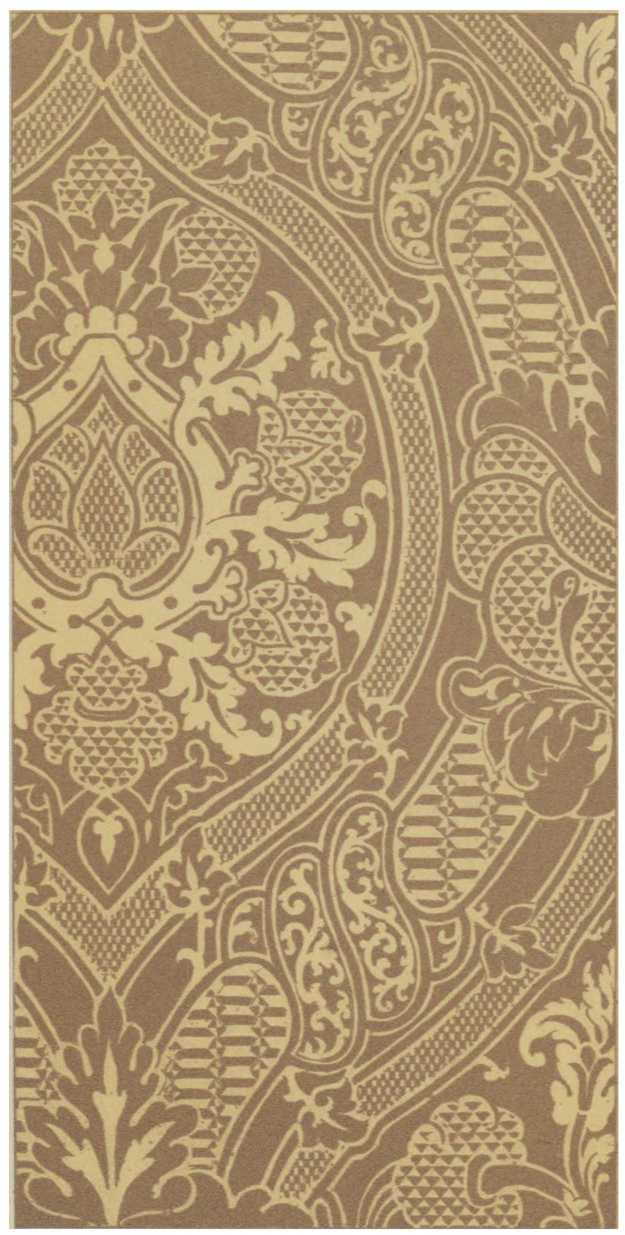
8702
DAMASK, SILK AND LINEN,
Florentine, 16th century.
Vincent Brooks Day & Son, Lith.
Of a large bold design, though not rich in material.
8703.
Piece of Damask, silk and linen, tawny and yellow; pattern, a slight variation of the foregoing, No. 8702. Florentine, 16th century. 3 feet 4 inches by 9½ inches.
So much alike are these two specimens, that at first sight they look parts of the same stuff; a near and close inspection shows, however, that for one or other there was a slight alteration in the gearing of the loom. Both may have originally been crimson and yellow: if so, the first colour has sadly faded. From the shape of this piece, its last use must have been for a chasuble, but of a very recent period, judging from its actual shape.
8704.

Chasuble, cloth of gold, diapered with a deep-piled blue velvet, so as to show the favourite artichoke pattern after two forms, with embroidered orphreys and armorial shields. Flemish, very late 15th century. 4 feet 4½ inches by 3 feet 10½ inches.
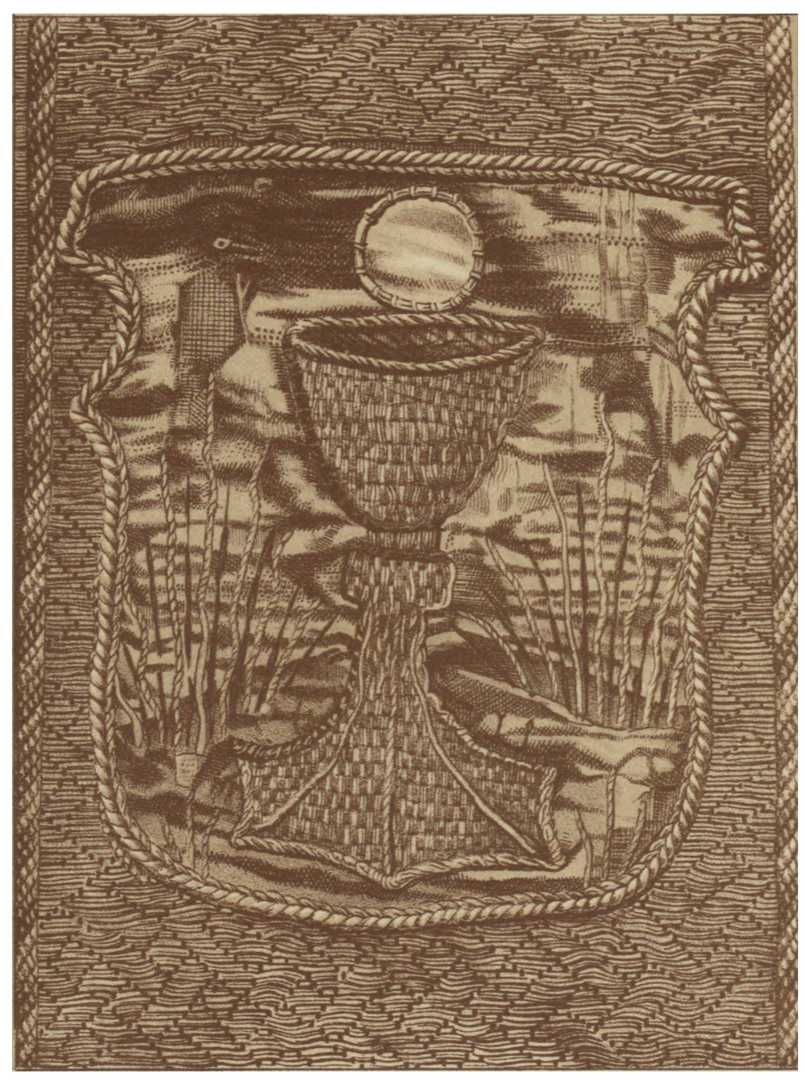
8704.
PART OF THE ORPHREY OF A CHASUBLE.
Flemish, 15th century.
Vincent Brooks Day & Son, Lith.
This chasuble, rare, because not cut-down, has been lately but properly repaired. The back orphrey, in the form of a cross, is figured with the Crucifixion, the B. V. Mary fainting and upheld by St. John; a shield gules, with chalice or, and host argent, at top; another shield at bottom, gules, a column argent, twined with cords or; the front orphrey is figured with the B. V. Mary crowned, and carrying our infant Lord in her arms; beneath her, the words inscribed in blue, “Salve Regina;” lower down, St. John the Evangelist blessing a golden chalice, out of which is coming a dragon, and having the inscription at his feet, “Sanctus Iohannes.” Lower still, St. Catherine with a book in her right hand, and in the left a sword resting on a wheel.
The front orphrey is done in applied work; the back orphrey consists of a web with a ground of gold, figured with green flower-bearing boughs, and having spaces left for the heads and hands to be filled in with needlework. The shield of arms or, with a chief azure, charged with three square buckles argent, we may presume to be the blazon of the giver of this gorgeous vestment.
8705.
Frontlet to an Altar-Cloth of diapered linen. The frontlet itself is the broad border of purple cloth on which is figured a Latin inscription within wreaths of flowers done in white linen. German, late 15th century. 10 feet 9 inches by 6½ inches; the linen, 9 inches.
This is another liturgical appliance, once so common everywhere, and so often mentioned in English ecclesiastical documents, which has now become a very great rarity. From the shred of the altar-cloth itself to which it is sewed, that linen, with its fine diapering and its two blue stripes, diapered, too, and vertically woven in, must have been of a costly kind, and large enough to overspread the whole table of the altar, so that this blue frontlet fell down in front. The Latin inscription, each word parted by a wreath, from four parts of which shoot sprigs of flowers, reads thus:—“O Gloriosum lumen ec(c)lesiarum funde preces pro salute populorum.” The letters, as well as all the floral ornamentation of this short prayer, are wrought in pieces of linen stitched on with red thread; and below is a worsted parti-coloured fringe, 1¾ inches deep. For the use of the frontlet in England, during the mediæval period, the reader may consult the “Church of our Fathers,” i. 238.
8706.
An Altar-Frontal in very dark brown coarse cloth, on which are applied armorial shields, and the ground is filled in with flower-bearing branches, in worsted and silk. German, beginning of 16th century. 7 feet 8 inches by 4 feet 1 inch.
Though of so late a period, this altar-frontal can teach those studious of such appliances how readily and effectively such works may be wrought. The whole is divided into eight squares; in the middle of each is put a shield alternating with another in its blazon, the first being or, three hearts gules, two and one, between three bendlets sable; the second, argent, an eagle sable on an arched bough raguly azure in the dexter base. The ramifications twining all over the ground are done in light brown broad worsted threads stitched on with white thread; and the flowers, all seeded and barbed, some white, some yellow, as if in accordance with the tints of the two shields, are done in silk. At bottom this frontal has been edged with a deep fringe, parti-coloured white and black.
8707.
Chasuble, blue cut velvet; pattern, one of the pomegranate forms, with orphreys. German, late 15th century. 9 feet 5 inches by 4 feet 9 inches.
To the liturgical student fond of vestments in their largest, most majestic shapes, this chasuble will afford great satisfaction, as it is one of the few known that have not been cut down. The front orphrey is a piece of narrow poor web, once of gold, but not much worn; the hind orphrey is a long cross, raguly or knotted, with our Lord nailed to it; above is the Eternal Father wearing an imperial crown of gold lined crimson, and in the act of blessing, between whom and our Saviour is the Holy Ghost in shape of a silver dove with outspread wings. At foot is the group of the Blessed Virgin Mary fainting, and hindered from falling by St. John.
8708.
The Blue Linen Lining of a Dalmatic, with the parti-coloured fringe bordering the front of the vestment, and some other fragments. 4 feet 1½ inches by 5 feet 7 inches. The silk Sicilian, 14th century.
The silk is much like the specimen fully described under No. 8263.
8709.
Altar-Frontal of grey linen, figured in needlework, with flowers, stars, and heraldic animals, on alternating squares of plain linen and net-work. German, 15th century. 9 feet 5½ inches by 4 feet 2½ inches.
This important piece of stitchery was never meant for a covering to the table or upper part of the altar; it served as a frontal to it, and was hung before, and at each corner of the altar so as to cover it and its two sides down to the ground. From all its ornaments having an armorial feeling about them, this elaborate piece of needlework would seem to have been wrought by the hands of some noble lady, who took the blazon of her house for its adornment. At the lower part, in the middle, is a shield of arms argent, charged with two bars once gules; high above, a star of eight points voided gules; below, a fleur-de-lis barred argent and gules; at each of the four corners of the square a maneless lion rampant barred argent and gules. To the right, on the same level, a square filled in with fleurs-de-lis; then a square with birds and beasts unknown to English heraldry: the birds, natant, have heads of the deer kind, horned, and the beasts a beaked head with a single arched horn coming out of the forehead with the point of the bow in front; both birds and beasts are paled argent and gules. On the next square are stars of eight points, and flowers with eight petals, within quatrefoils all argent, upon a field (the netting) gules. The last square is separated into three pales each charged with a flower-like ornament alternately argent and gules. Above this square is another of net gules, charged with four flowers argent; and, going to the left, we have a square showing two bears combatant barred argent and gules; still to the left, birds at rest, and stars alternating argent upon a square of net gules. Next to this a large antelope tripping paled argent and gules; then a square having lions rampant within lozenges with a four-petaled flower at every point, all argent, on a field (of net) gules. Following this is a large dog, maned and rampant barred argent and gules; to this succeeds a square of net gules charged with lozenges, having over each point a mascle, and within them stars of eight points all argent. The last square to the left on this middle row is charged with a heart-shaped ornament voided in the form of a fleur-de-lis, and put in three piles of four with flowers between. The only other square differing from those just noticed are the two charged with an animal of the deer kind, with antlers quite straight. The narrow borders at the sides are not the least curious parts of this interesting specimen; that on the left hand is made up of a dog running after a bearded antelope, which is confronted by a griffin so repeated as to fill up the whole line. The border on the right hand is made up of the beast with the one horn.
8710.
Alb of White Linen appareled at the cuffs, and before and behind at the feet, with crimson and gold stuff figured with animals and floriations of the looms of Palermo. Sicilian, 14th century. 5 feet 7 inches long, 4 feet across the shoulders, without the sleeves.
For those curious in liturgical appliances this fine alb of the mediæval period will be a valuable object of study, though perhaps not for imitation in the way in which it is widened at the waist. Its large opening at the neck—1 foot 4½ inches—is somewhat scalloped, but without any slit down the front, or gatherings, or band. On each shoulder, running down 1 foot 3¾ inches, is a narrow piece of crochet-work inscribed in red letters with the names “Jesus,” “Maria.” The full sleeves, from 1 foot 6 inches wide, are gradually narrowed to 6¼ inches at the end of the apparels at the cuffs, which are 4 inches deep and edged with green linen tape. At the waist, where it is 3 feet 10 inches, it is made, by means of gatherings upon a gusset embroidered with a cross-crosslet in red thread, to widen itself into 6 feet, or 12 feet all round. Down the middle, before and behind, as far as the apparels, is let in a narrow piece of crochet-work like that upon the shoulders, but uninscribed. The two apparels at the feet—one before, the other behind—vary in their dimensions, one measuring 1 foot 1 inch by 1 foot 1¾ inches, the other, which is made up of fragments, 1 foot by 11¾ inches. Very elaborate and freely designed is the heraldic pattern on the rich stuff which forms the apparels. The ground is of silk, now faded, but once a bright crimson; the figures, all in gold, are an eagle in demi-vol, langued, with a ducal crown, not upon, but over its head; above this is a mass of clouds with pencils of sun-rays darting from beneath them all around; higher up again, a collared hart lodged, with its park set between two large bell-shaped seeded drooping flowers, beneath each of which is a dog collared and courant. For English antiquaries, it may be interesting to know that upon the mantle and kirtle in the monumental effigy of King Richard II, in Westminster Abbey, the hart as well as the cloud with rays form the pattern on those royal garments, and are well shown in the valuable but unfinished “Monumental Effigies of Great Britain,” by the late brothers Hollis. This alb is figured, but not well with regard to the apparels, by Dr. Bock, in his “Geschichte der Liturgischen Gewänder des Mittelalters,” 4 Lieferung, pl. iii, fig. 1.