PART THE FIRST. Church-vestments, Silk-stuffs, Needlework, and Dresses. (continued 2)
Reading edition
1319.

Silk Gauze; ground, a light green. Egyptian, 10th century. 10 inches by 3½ inches.
Though without any pattern, such a specimen is very valuable for letting us see the delicate texture which the Saracens, like the ancient Egyptians, knew how to give to the works of the loom. This, like No. 1317, if ever used for church purposes, could only have been employed for spreading over shrines, or the lining of vestments; specimens like these are sometimes found between the leaves in illuminated MSS, to protect the paintings.
1320.
Silk and Gold Damask; ground, crimson (now faded) silk; design, lions in pairs addorsed, regardant, each with a swan swung upon its back, and held by the neck in its mouth, bounding from out a small space surrounded by a low circular paling, and amid two large conventional floriations; at the top of one of these are two squirrels sitting upright, or sejant, all in gold. Italian, late 14th century. 17½ inches by 10¾ inches.
Unfortunately this curious well-figured and interesting design is somewhat wasted upon materials so faded, as scarcely to show it now. The foliation is rather thick and heavy. In Dr. Bock’s work, “Geschichte der Liturgischen Gewänder des Mittelalters,” 1 Band, 1 Lieferung, pl. xiv. may be found this stuff, nicely figured.
1321.
Small Piece of Embroidery; background, canvas diapered with lozenges in brown thread; foreground, once partly strewed with streaks of gold; design, two men bearded and clad in long garments, seemingly personages of the Old Law, talking to each other. Florentine, 15th century.
With quite an Italian and Florentine character about them, these two figures, both worked in silk, have no great merit; though there are some good folds in the brown mantle, shot with green, of the hooded individual standing on the left-hand. That it has been cut away from some larger piece is evident, but what the original served for, whether a sacred or secular purpose, it is impossible now to say.
1322.
Stole; ground, light blue silk; design, a thin bough roving along the stole’s whole length in an undulating line, and sprouting out into fan-like leaves, and small flowers, and in a white raised cord, narrowly edged with crimson silk and gold thread. At one expanded end is the Holy Lamb upon a golden ground; at the other, the dove, emblem of the Holy Ghost, alighting upon flowers. German, 15th century. 8 feet 6½ inches by 3¾ inches.
Though the work upon this stole is rather coarse, still from its raised style it must have been effective; but its chief value is from having been a liturgic ornament. The diapering at the end figured with the Holy Lamb, done upon a yellow canvas ground, with its thin golden threads worked into three circles, with their radiations not straight but wavy, is remarkable, and may be found upon another work wrought by a German needle in this collection. Not only the Lamb and the Dove, but the floriation, are thrown up into a sort of low relief.
1323.

Embroidered Linen; design, barbed quatrefoils filled in with armorial birds and beasts, and the spaces between wrought with vine-leaves. German, 15th century. 16 inches by 11¾ inches.
This is but a piece of a much larger work, the pattern of which, in its entire form, can only be guessed at from a few remains. One quatrefoil is occupied by a pair of eagles (as they seem to be) addorsed regardant; and the two legs of another three-toed creature remaining near them prove that other things besides the eagles were figured. The whole is coarsely done in coarse materials, and, in workmanship, far below very many specimens here. It appears to have served for household not for church use.
1324.
Embroidered Cushion for the missal at the altar; ground, crimson silk; design, our Infant Lord in the arms of the Blessed Virgin Mary, with St. Joseph and four angels worshipping, on the upper side, in various-coloured silk; on the under side, a reticulation filled in with a pair of birds and a flowering plant alternately. German, late 13th century. 19 inches by 13 inches.
Such cushions, and of so remote a period, are great liturgical curiosities, and, fortunately, the present one is in very good preservation, and quite a work of art. Throned within a Gothic building, rather than beneath a canopy, sits the mother of the Divine Babe, who is outstretching His little hands towards the lily-branch which the approaching St. Joseph is holding in one hand, while in the other he carries a basket of doves. Outside, and on the green sward, are kneeling four angels robed as deacons, three of whom bear lily flowers, a fourth the liturgical fan; the whole is encircled by a garland of lilies. The under-side is worked with white doves in pairs, and a green tree blooming with red flowers; and though much of the needlework is gone, this cushion is a good example for such an appliance. Dr. Bock has figured it in his “Geschichte der Liturgischen Gewänder des Mittelalters,” 1 Band, 2 Lieferung, p. xiii.
1325.

Part of an Altar-cloth; ground, linen; design, amid foliage sparingly heightened with yellow silk, birds, and beasts, and one end figured with the gammadion. German, 14th century. 6 feet 4½ inches by 2 feet 2½ inches.
This altar-cloth, now shortened and without one of its ends figured with the gammadion, is made up of two different pieces, of which one showing two large-headed pheasants, put one above the other, amid foliage plentifully flowered with the fleur-de-lis and roses, is quite perfect in its pattern; but the other, marked with alternate griffins and lions, has been cut in two so as to give us but the hinder half of each animal, amid a foliage of oak-leaves. The whole design, however, is boldly drawn and spiritedly executed.
1326.

Damask, silk and cotton; ground, green; design, large and small conventional artichokes, in gold and yellow silk, amid garlands in white silk. Italian, 15th century. 2 feet 10 inches by 1 foot 3¼ inches.
Though much cotton is mixed up with the silk, and its gold was of an inferior quality, still the crowded and elaborate design of its pattern makes this stuff very pleasing.
1327.
Silk Net; green. Turkish, 16th century (?). 11½ inches by 4½ inches.
Such productions of the loom are used among the Moslem inhabitants of the East in various ways, for concealing their females when they go abroad in carriages, &c.
1328.

Linen Diaper. Flemish, 15th century. 2¾ inches square.
Very likely from the looms of Yprès, then famous for its napery, and which gave its name, “d’ypres,” to this sort of wrought linen.
1329.
Part of an Orphrey Web; ground, crimson silk; design, straight branches bearing flowers and boughs, in gold thread; and amid them St. Dorothy and St. Stephen. German, 15th century. 23 inches by 2¾ inches.
St. Dorothy is figured holding in her right hand a golden chalice-like cup filled with flowers, and in her left, a tall green branch blooming with white roses; St. Stephen carries a palm-branch, emblem of his martyrdom. Both saints are standing upon green turf sprinkled with crimson daisies, and beneath each is the saint’s name, written in gold. Though the persons of the saints are woven, the heads, hands, and emblems are wrought with the needle. The dalmatic of the proto-martyr is nicely shown, in light green, with its orphreys in gold. This piece is a favourable specimen of its kind, and very likely was produced at Cologne.
1330.

Frontlet to an Altar-cloth; ground, diapered white linen; design, embroidery of two large flower-bearing trees, with an uncharged shield between them, and under them inscriptions. German, 16th century. 15¾ inches by 5 inches.
So very like the piece No. 8864 that it would seem to have been wrought by the same hand. To the left we read—“Spes unica, stabat mater;” to the right—“Mater dolorosa juxta crucem,” &c.
1331.

Web for Orphreys; ground, crimson silk; design, two boughs with leaves and flowers twined in an oval form, all in gold thread. German, late 15th century. 10 inches by 4¼ inches.
Graceful in its design, but poor in both its silk and gold, the latter having become almost black.
1332.
Piece of Raised Velvet, brocaded in gold; ground, dark blue; design, a diapering in cut velvet on the blue ground, and large leaves and small artichokes in gold. Italian, early 16th century. 16½ inches by 15¾ inches.
This nicely diapered velvet, of a good pile and sprinkled with a gold brocade, may have been wrought either at Lucca or Genoa. Unfortunately, the gold thread was of an inferior quality.
1333.
Silk and Gold Damask; ground, crimson silk; design, broad garlands twined into a net-work, the almost round meshes of which are filled in with a conventional artichoke wreathed with corn-flowers, all in pure good gold, upon a ground specked with gold. Spanish, late 15th century. 22½ inches by 9 inches.
This is a fine rich specimen of an article of the Spanish loom, very likely from Almeria; its crimson tone is fresh and warm, while its gold is as bright now as when first woven into its present graceful pattern.
1334.
Web for Orphreys; ground, gold thread; design, two branches twined into large oval spaces, and bearing leaves and red and white flowers, having, in one space, the name Gumprecht and a shield, applied, or, a spread-eagle sable, langued and armed gules, (may be for Brandenburg); and under this, in the web itself, another shield or, a lion rampant gules, armed langued and crowned or, and double tailed, seemingly for Bohemia. German, 15th century. 16 inches by 5½ inches.
Though of poor materials, this piece is interesting from showing a name and armorial bearings.
1335.
Web for Orphreys; ground, fawn-coloured silk; design, almost all in gold, sitting on a throne beneath a Gothic canopy the Blessed Virgin Mary, crowned and nimbed, with our Lord as a child upon her lap, alternating with a circle bearing within it the sacred monogram (worked the wrong way) done in blue silk, surrounded by golden rays. German, middle of 15th century. 11¼ inches by 4½ inches.
The design of this orphrey-web is good, but the gold so amalgamated with copper that it has become quite brown. Though the monogram is that usually seen in the hands of St. Bernardinus of Sienna, and the drawing of the group of the Blessed Virgin Mary and the sacred Child is somewhat Italian, this was not the work of any Italians loom; for in no part of Italy would the monogram have had given it letters of such a German type.
1336.
Silk Damask; ground and pattern in rich crimson; design, eight-cusped ovals, each cusp tipped not with a flower, but tendrils; the ovals enclose a conventional artichoke purfled with flowers; and the spaces between the ovals are filled in with small artichokes in bloom. Spanish, 15th century. 20 inches by 14¾ inches.
This is a fine specimen both for the richness of its silk and the warm and mellow tint of its ground, upon which the pattern comes out in a duller tone. Further on we shall meet with another stuff, No. 1345, which must have proceeded from the same loom, and shows in its design many elements of the one in this. Either Granada or Almeria produced this fine piece, which affords us, in the brilliancy of its colour, an apt sample of our old poet Chaucer’s dress for one of his characters, of whom he tells us,—
“In sanguin and in perse he clad was alle;”
and helps us to understand Spenser’s allusion to the young maiden’s blushes:—
“How the red roses flush up in her cheekes ... with goodly vermill stayne, Like crimson dyde in grayne.”
1337.
Web for Orphreys; ground, crimson silk; design, in gold thread, a straight branch of a tree bearing pairs of boughs with flowers, alternating with other boughs with sprigs of leaves. German, early 16th century. 14½ inches by 2½ inches.
The warp of this web is thick linen thread, and where the woof of crimson silk is worn away, this thread, as if part of the design, shows itself; and, as the gold is poor and sparingly put on, the specimen now looks shabby. Like many other samples of the kind, woven, probably, at Cologne, this was intended as the narrow orphrey on liturgical garments.
1338.

An Apparel to an Alb; ground, strong linen; design, within twining boughs bearing flowers and leaves, a dove and a lamb, all in various-coloured silks and outlined in narrow strips of leather. Spanish, early 15th century. 13 inches square.
That the last liturgic use of this piece was as an apparel to an alb there can be little doubt, though, in all likelihood, it may have been cut off a larger piece of needlework wrought for the front border of an altar-cloth. The outline in leather is rather singular; though now black, it was once gilt, like those strips we see cut into very narrow shreds, and worked up, instead of gold thread, into silken stuffs from the looms of Almeria or Granada, specimens of which are in this collection. As an art-production of the needle, this is but a poor one.
1339.

Raised Gold Brocaded Velvet; ground, green silk; design, within an oval in crimson raised velvet of a floriated pattern, dotted with flowers and grapes in white, a large trefoil on raised crimson velvet, bearing inside an artichoke in green and gold, springing from a white flower. Italian, 16th century, 11¾ inches by 8 inches.
This tasteful and pleasing design is wrought in rich materials; and large state-chairs are yet to be seen in the palaces of Rome covered with such beautiful and costly velvets.
1340.
Silk and Gold Damask; ground, blue silk; design, ogee arches, over the finial of each a large conventional flower, and within and without the arches a slip of the mulberry-leaf and fruit, all in bright gold. Lucca, 16th century. 3 feet 5 inches by 2 feet 4 inches.
This fine rich stuff must have been most effective for wall-hangings. The blue silk ground is tastefully diapered in bright and dull shades of the silk itself; and in the fine gold design the artichoke is judiciously brought in upon the ogee arches. When nicely managed, nothing is better than a ground in one shade and a design in a deeper tone of the same colour.
1341.
Silk and Gold Damask; ground, fawn-coloured silk; design, pomegranates piled together in threes, all gold, and flowers in silk alternately crimson and green. Spanish, 16th century. 16¼ inches by 12 inches.
The rich ground of this fine stuff has a well-designed and rather raised diapering of geometrical scroll-work; the pomegranates are wrought in pure gold thread, and the tones of the flowers are bright.
1342.
Worsted Work; ground, black; design, flowers. German, 16th century. 21¼ inches square.
Very likely this was part of a carpet, embroidered by hand, for covering the top of the higher step at the altar, called by some a pede-cloth; the ground is of a black worsted warp, with a woof of thick brown thread. The flowers are mostly crimson-shaded pink, some are, or were, partly white, and seem to be made for sorts of the pentstemon, digitalis, and fritillaria; a butterfly, too, is not forgotten.
1343.
Cradle-quilt, linen, embroidered in coloured silks with flowers and names. German, late 15th century. 3 feet 4¼ inches by 1 foot 8¼ inches.
At each of its four corners, as well as in the middle, is wrought a large bunch of our “meadow pink;” between the flowers are worked these names,—“Jhesus, Maria, Johanes, Jaspar, Baltasar, Maria, Melchior, Johanes.” From the names assigned to the three wise men, whose relics are enshrined in the cathedral at Cologne, being so conspicuously wrought upon this piece, we may presume that the needlework was done in that great German city. By wear, the greens of the leaves have turned brown, and the pink of the flowers become pale. Those pieces of printed linen with which the holes in two places are mended will not be without an interest for those who are curious in tracing out the origin of such manufactures. Other examples of these cradle-quilts are in this collection.
1344.
Cradle-quilt, linen, embroidered in coloured silks; design, within a broad border of scroll-work in simple lines, the emblems of the four Evangelists, one at each corner; of the Crucifixion, with the Blessed Virgin Mary on the right, and St. John to the left, only a small part of the young apostle’s figure is to be found at present. German, early 16th century, 2 feet 6 inches by 2 feet 2 inches.
Though in mere outline, the whole design was well drawn, and the emblems at the corners have great freedom about them. On the popular use of the evangelists’ emblems upon such baby’s furniture, some observations are given on another good sample, No. 4644, in this collection. A cradle-quilt like the present one occurs at No. 4459.
1345.
Silk Damask; ground and pattern in reddish crimson; design, eight-cusped ovals,—each cusp tipped with a flower, ending in a fleur-de-lis above a crown, at top, and enclosing a conventional artichoke purfled with flowers. Spanish, 15th century. 14 inches by 13 inches.
From its present shape, this piece was evidently last in use as the hood to a liturgical cope.
1346.
Part of an Embroidered Orphrey; ground (now faded), crimson silk; design, a green silk bough so twined as to end in a long pinnatified leaf or flower, now white but once gold, with little rounds of gold sprouting from parts of the outside branches. German, 16th century. 16¾ inches by 3 inches.
A specimen as meagre in design as it is poor in materials.
1347.
Part of an Embroidered Orphrey; ground, crimson silk; design, a green silk bough, &c. German, 16th century. 17½ inches by 5 inches.
In all likelihood a part of the broader orphrey wrought for the same vestment as the one just before mentioned.
1348.
Web for Orphreys; ground, gold thread; design, the fleur-de-lis composed into a geometric pattern, outlined in dark brown silk. German, late 15th century. 14½ inches by 4¼ inches.
Both the brown colour and the design are somewhat rare, as found upon ecclesiastical appliances. Here, as elsewhere, the gold is so poor that it is hardly discernible. Under the canvas lining is a piece of parchment, on which is written some theological matter.
1349.
Web for Orphreys; ground, cloth of gold pricked with crimson; design, the names—“Jhesus,” “Maria,” done in blue silk, between two trees, one bearing heads of crimson fruit, the other lilies, parti-coloured white with crimson; and the green sward, from which both spring, covered with full-blown daisies in one instance, with unexpanded daisies in the other. German, late 15th century. 17½ inches by 4½ inches.
Like several other specimens in the collection, and most probably woven to be the orphreys sewed, before and behind, in a horizontal stripe, upon the dalmatics and tunicles for high mass. The student of symbolism will not fail to see in the tree to the right hand the mystic vine, bearing bunches of crimson grapes; while, to the left, the tree covered with parti-coloured lilies—white for purity, red for a bleeding-heart—is referrible to the Blessed Virgin Mary, whose heart, as she stood at the foot of the cross, underwent all the pains of martyrdom foretold her by Simeon when he said,—“And thine own soul a sword shall pierce,” Luke ii. 35.
1350.
Web for Orphreys; ground, narrow blue spaces alternating with wider crimson ones; design, the name of “Jhesus,” in gold upon the blue, between two borders checkered crimson blue and yellow, the crimson spaces charged with a floriation, alternately gold and yellow; the next blue space inscribed with the name “Maria” in gold. In the names, as well as the floriation, the metal has become tarnished so as to look a dull brown. German, late 15th century. 19 inches by 2¼ inches.
Of such webs there are several specimens in the collection; and their use was to ornament liturgical vestments, in those long perpendicular lines found upon tunicles and dalmatics.
1351.
Piece of Raised Velvet; ground, crimson; design, a conventional artichoke, wreathed with small flowers in green and yellow within a garland of the same colours. Italian, 16th century. 11½ inches by 11 inches.
1351A.
Piece of Raised Velvet. A part of the same stuff. Italian, 16th century. 9¾ inches by 1¾ by inches.
1351B.
Piece of Raised Velvet. A part of the same stuff. Italian, 16th century. 12½ inches by 1¾ inches.
These three pieces are portions of a material made of excellent rich silk, and of good tones in colour.
1352.
Piece of Raised Velvet, brocaded in gold; ground, crimson; design, an oval with cusps inside and enclosing a large artichoke, the whole wreathed with a garland, and in gold. Italian, 16th century. 2 feet 3¾ inches by 8¼ inches.
This magnificent stuff is rendered still more valuable, as a specimen, from having much of its design of that rare kind of velvet upon velvet, or one pile put over, in design, another but lower pile. The state-rooms of a palace could alone have been hung with such sumptuous wall-coverings. Perhaps church vestments and hangings about the altar may have been sometimes made of such a heavy material.
1352A.
Piece of Raised Velvet, brocaded in gold; ground, crimson; design, a cusped oval enclosing a conventional artichoke, and the whole wreathed with a broad garland, all in gold. Italian, 16th century. 18 inches by 7 inches.
This differs both in design and quality from the former, having no pile upon pile in it.
1352B.
Piece of Raised Velvet, brocaded in gold; ground, crimson; design, not very clear: though, from what can be observed, it is the same with No. 1352.
1353.
Web for Orphreys; ground, crimson silk; design, in yellow silk and gold thread, between two floriated borders, a series of foliated scrolls, with the open round spaces filled in with the Blessed Virgin holding our Lord as a naked child in her arms, and a saint-bishop wearing his mitre and cope, giving his blessing with one hand, and holding his pastoral staff in the other. Venetian, 16th century. 25 inches by 8¼ inches.
The materials are good, excepting the gold thread, which has turned black, though the large quantity of rich yellow silk used along with it somewhat hides its tarnish. In gearing his loom the weaver has made the mistake of showing the bishop as bestowing his benediction with his left, instead of his right hand.
1354.
Embroidered Linen; ground, very fine linen; design, separated by a saltire or St. Andrew’s cross, lozenges filled in with a Greek cross, and half lozenges, the whole ornamented with circles enclosing other small crosses. Italian, 16th century. 10¾ inches by 3½ inches.
This elaborate design is as delicately worked as it is beautiful in pattern.
1355.
Silk Damask; ground, sea-green; design, in the same tint, a conventional foliation of the pomegranate, surrounding a wide broad-banded oval filled in with a large fruit of the same kind. Spanish, early 16th century. 33 inches by 12½ inches.
In the beauty of its design, the rich softness of its silk, and its grateful tone, this is a pleasing specimen of the loom from the south of Spain.
1356.
Piece of Raised Velvet; black; design, foliated branches joined at intervals by royal crowns alternating with vases, and large artichokes in the intervening spaces. Italian, late 15th century. 25½ inches by 21¾ inches.
This truly beautiful velvet was, no doubt, meant for personal attire.
1357.
Raised Velvet; ground, olive-green silk; design, slips with flowers and leaves of a somewhat deeper tone, and outlined in a lighter coloured raised velvet. Lucca, 16th century. 8-⅞ inches by 8¾ inches.
This nicely-wrought stuff of pleasing pattern must have been made for personal attire.
1358.
Linen Crochet Work; design, saltires, between crosses formed of leaves, and a modification of the Greek meander. Flemish, 16th century. 21 inches by 7½ inches.
The convents in France, but more particularly in Flanders, were at all times famous for this kind of work; hence it is often called nun’s lace, because wrought by them for trimming altar-cloths and albs. The present one is a good specimen of a geometrical pattern, and the two borders are neatly done by the needle upon linen. In all likelihood this piece was the hem of an altar-cloth.
1359.
Linen Damask; design, scrolls and foliage, with a deep border showing ducal coronets, armorial shields, and the letters L and K. Flemish, early 17th century. 28¼ inches by 11½ inches.
An elaborate specimen of the way they geared their looms in Flanders, and more especially at Yprès, where most likely, this fine damask was woven. The shield is party per pale, 1st, two chevronels embattled; 2nd, three turreted towers, two and one. Seemingly this piece of Flemish napery was made for some nobleman whose wife was, or claimed to be, of the ancient blood of the royal house of Castile.
1360.
Silk Damask; ground, crimson; design, bunches of flowers, artichokes, and pomegranates, in yellow. Spanish, 16th century. 20 inches by 11¼ inches.
A rich stuff, whether colour or material be considered; and quite agreeing with other specimens in the love of the southern Spanish loom for the pomegranate, the emblem of Granada, where probably it was wrought.
1361.
Silk Damask; ground, dull violet; design, within reticulated squares, a conventional bunch of flowers much in the honeysuckle shape, in white and yellow. Italian, 16th century. 6 inches by 7½ inches.
Though the silk is good, the weaving is rather coarse and rough.
1362.
Silk Damask; ground, bright crimson; design, a conventional floriation in various-coloured silks. North Italian, 16th century. 9¼ inches by 6¾ inches.
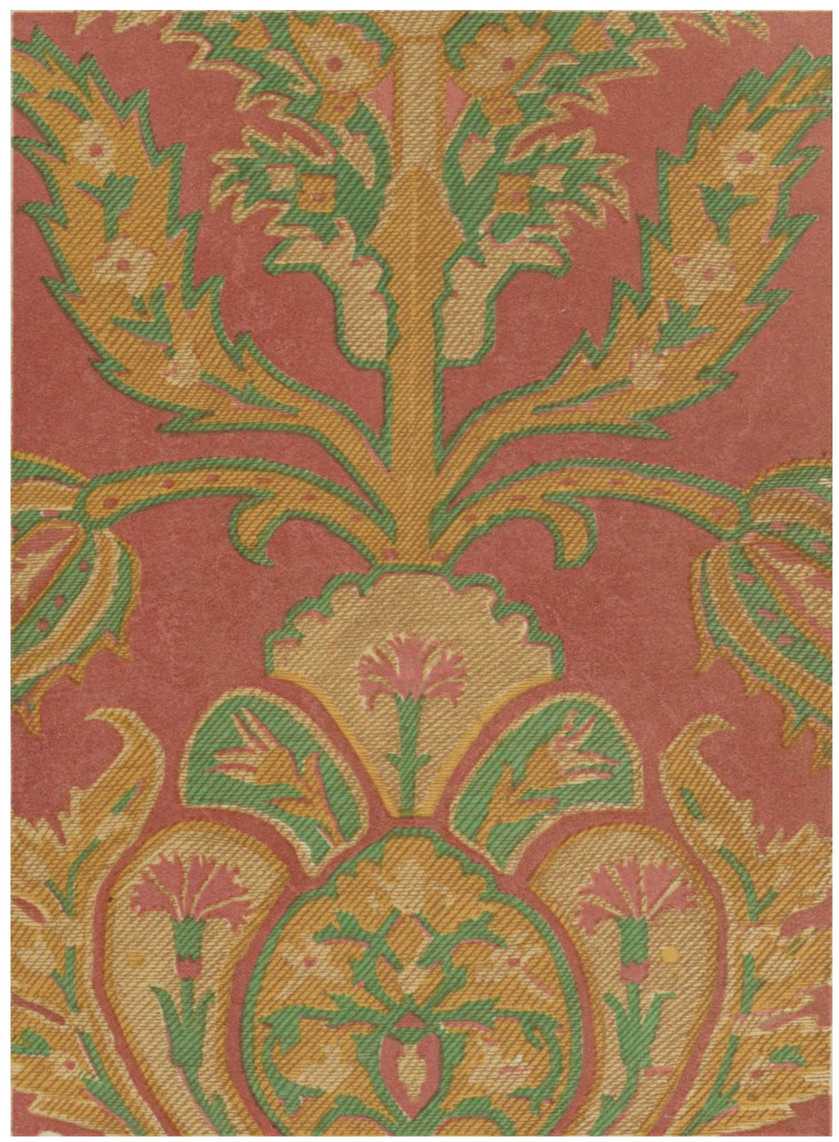
1362.
SILK DAMASK
Crimson ground with large branching pattern in coloured silk. Italian, 16th century.
Vincent Brooks Day & Son, Lith.
So thick is this somewhat showy stuff, that it must have been meant for furniture purposes.
1363.
Silk Damask; ground, reddish purple; design, slips of three kinds of flower-bearing plants, one of which is the pomegranate. Spanish, late 15th century. 10¾ inches by 6-⅞ inches.
From the south of Spain, and bearing a token, if not of the city, at least of the kingdom of Granada.
1364.
Damask, linen woof, silken warp; ground, yellow; design, a conventional floriation, showing a strong likeness to the whole plant of the artichoke, in white linen. Italian, 16th century. 10 inches by 9¾ inches.
A poor stuff in respect to materials, colour, and design; which latter is the best element in it. Intended for household decorative purposes.
1365.
Damask, silk woof, linen warp; ground, light red, now faded; design, vases filled with flowers, in yellow silk. Italian, late 16th century. 24 inches by 22 inches.
No doubt this stuff was meant for hangings in a palace or dwelling-house; and among the flowers may be seen the bignonia or trumpet-flower, and the pomegranate opening and about to shed its seed.
1366.
Linen Diaper; design, square made out of four leaves. Flemish, late 16th century. 20 inches by 9 inches.
The pattern, though so simple, is very pleasing, and the stuff itself speaks of Yprès as being the place of its origin.
1367.
Silk Taffeta; ground, purple; design, amid boughs, a pair of birds, with an artichoke between them, all in orange-yellow. Sicilian, 14th century. 9¾ inches square.
This light thin stuff, quiet in its tones and simple in its pattern, must have been wrought for lining robes of rich stuffs.
1368.
Silk Damask; ground, white satin; design, amid flowers, among which the chrysanthemum is very conspicuous, a group, consisting of a man inside a low fence looking upwards upon a blue lion and a golden tiger, seemingly at play, side by side, one of which is about to be struck by a long spear held by a man standing above, within a walled building. Just over him stands another man with a short mace in one hand, in the other a small bottle, out of which comes a large bough of the pomegranate tree in leaf, flower, and fruit. Chinese, 16th century. 2 feet 6¾ inches by 10¾ inches.
For the soft warm tints of its several coloured flos-silks, the pureness of the gold thread upon the human faces, the animals and the flowers, the correctness of the drawing, and the well-arranged freedom of the whole pattern, there are few pieces that come up to this in the whole collection. In all likelihood it was brought from China, perhaps made up as a liturgical chasuble, by some Portuguese missionary priest, in the latter portion of the 16th or beginning of the 17th century.
1369.
Dalmatic; ground, blue silk; design, narrow bands charged with circles enclosing a word in imitated Arabic, and conventional flowers separating two hounds couchant, gardant, each within his own circle, all in gold, and a large conventional floriation, at the foot of which are two cheetahs collared, courant, face to face, all in white silk, slightly specked with crimson, and between this group two eagles, in white silk, flying down upon two small hounds, sejant, gardant, both in gold. The orphreys, broad and narrow, are embroidered with heraldic shields set upon a golden ground. Sicilian, 14th century. 3 feet 5½ inches by (across the sleeves) 4 feet 2¾ inches.
Some ruthless hand has cut away from the back a large square piece of this vestment; and, to adopt it to modern fashion, its sleeves have been slit up at the under side. The armorial bearings are, on one shield, a chief or, gules, three stars, two, and one argent; on the other, purpure, two arrows in saltire or.
The cheetahs are well marked by the round spots upon them; and when new, this stuff, with its pattern so boldly figured, must have been pleasing.
1370.
Piece of Cut-work, for wall-hanging; ground, square of blue and red, with the upper border blue, the side one red; design, at top, knights and ladies talking, and each within a separate arch; in the body of the piece, the history of some dragon-slayer, figured in two horizontal rows of compartments, every one of which is contained within an archway with a head composed of three trefoil arches in a straight line, and resting on trefoil-brackets, and having, all through, birds and flowers in the spandrils. French, late 14th century. 7 feet 11 inches by 3 feet 4 inches.
Though now so rough and tattered this almost unique piece of “cut-work” (which French people would call appliqué, but better described by the English words), of so large a size, is valuable for its use in showing how, with cheap materials and a little knowledge of drawing, a very pleasing, not to say useful, article of decoration may be made, either for church appliance or household furniture.
Unfortunately the heads of the personages in the upper row are all cut away, but lower down we plainly see the history meant to be represented. Upon the first pane, to the left, we have a regal throne, upon which are sitting, evidently in earnest talk, a king, crowned and sceptred, and a knight, each belted with a splendid military girdle falling low down around the hips. Behind the knight stands his ’squire. In the next pane the enthroned king is giving his orders to the standing knight, toward whom his ’squire is bringing his sword, his shield, (argent a fess azure, surmounted by a demi-ox azure,) and a bascinet mantled and crested with the head of the same demi-ox or aurochs and its tall horns. After this we behold the knight with lance and shield, and his ’squire on horseback riding forth from the castle, at the gate of which stands the king, outstretching his hand and bidding farewell to the knight, who is turning about to acknowledge the good-bye. Going first upon the road, the knight, followed by the ’squire, seems asking the way to the dragon’s lair, from a gentleman whom they meet. The monster is then found in a wood, and the knight is tilting his spear into its fire-red maw. The next pane carrying on the romance is the first to the left in the second or lower series. Here the knight is unhorsed, and his good grey steed is lying on the field; but the knight himself, wielding his sword in both hands, is about to smite the dragon breathing long flames of fire towards him. Afterwards he catches hold of his fiery tongue, and is cutting it off. It would look as if the dragon, though wounded to the loss of its tongue, had not been worsted; for in the following compartment we behold the same knight all unarmed, but well mounted, galloping forth from a castle gate with a hound and some sort of bird, both with strings to them, by his horse’s side, and having found the dragon again, appears holding an argument with the beast that, for answer, shows the fiery stump of his tongue in his gaping mouth. But the dragon will not give himself up and be led away captive. Now, however, comes the grand fight. In a forest, with a bird perched on high upon one of the trees, the knight, dismounted from his horse, cuts off the head of the dragon, which, to the last, is careful to show his much shortened yet still fiery tongue to his victor. Now have we the last passage but one in the story. Upon his bended knee the triumphant knight is presenting the open-mouthed, tongueless, cut-off dragon’s head to the king and queen, both throned and royally arrayed, the princess, their daughter, standing by her mother’s side. The young maiden, no doubt, is the victor’s prize; but now—and it is the last chapter—the knight and lady, dressed in the weeds of daily life and walking forth upon the flowery turf, seem happy with one another as man and wife. The two panes at this part, and serving as a border, seem out of place, and neither has a connection with the other; in the first, just outside a castle wall, rides a crowned king followed by a horseman, evidently of low degree; and a column separates him from a large bed, lying upon which we observe the upper part of a female figure, the head resting upon a rich cushion; next to this, but put in anglewise to fill up the space, we have a crowned lady and a girdled knight, sitting beneath a tree, each with a little dog beside them.
The costume of both men and women in this curious piece of cut-work is that of the end of the 14th century. The parti-coloured dress of the men, their long pointed shoes, and the broad girdles, worn so low upon their hips by the king and knight, as well as the bascinet and helmet of the latter, with the horses’ trappings, all speak of that period; nor should we forget the sort of peaked head-dress, as well as the way in which the front hair of the ladies is thrown up into thick short curls. All the human figures, all the beasts, as well as the architecture, are outlined in thin leather or parchment once gilt, but now turned quite black. With the same leather, too, were studded the belts of the king and knight, and the spangles and golden enrichments of the ladies’ dress were of the same material. Saving here and there a few stitches of silk, everything else was of worsted, and that none of the finest texture. With such small means a good art-work was produced, as we see before us. The way in which each figure over the whole of this curious piece of cut-work is outlined by the leather edging strongly reminds us of the leadings in stained glass; in fact, both the one and the other are wrought after the same manner, and the principal difference between the window and the woollen hanging is the employment of an opaque instead of a transparent material. If the personages are dressed sometimes in blue, at others in crimson, it will be found that these colours alternate with the alternating tints of the panes upon which they are sewed.
So often do the passages in the romance here figured correspond with certain parts in the wild legend of our own far-famed “Sir Guy of Warwick,” that, at first sight, one might be led to think that as his renowned story was carried all through Christendom, we had before us his mighty feats and triumph over the dragon in Northumberland, set forth in this handiwork of some lady-reader of his story.
1371.
Worsted Work; ground, green; design, conventional flowers in yellow, with, at one end, a border of foliated boughs, the leaves of which are partly green, partly red, and an edging of a band made up of white, green, yellow, scarlet straight lines on the inner side; on three sides there is a narrow listing of bluish-green lace. German, 15th century. 4 feet 3¼ inches by 1 foot 10 inches.
In all probability this was intended and used as a carpet for some small altar-step. It is worked upon coarse canvas.
1372.
Piece of Needlework; pattern, upon bell-shaped spaces of silver thread, flowers mostly white and shaded yellow, divided by a sort of imperial high-peaked cap of blue shaded white, arising out of a royal crown. 17th century. 12½ inches by 7½ inches.
1372A.

Border to an Altar-cloth, embroidered; ground, crimson silk; design, animals and birds amid branching foliage and fleurs-de-lis, well raised in white and gold; the upper part linen, wrought into lozenges alternately crimson and yellow, braced together by a fret, and filled in with narrow bars saltire wise. German, 15th century. 3 feet 10¼ inches by 11½ inches.
Among the animals is the symbolic lamb and flag, with a chalice underneath its head. From the exact similarity of style in the ornamentation and needlework, there can be no doubt but the same hand which wrought the stole, No. 1322, worked this piece, and probably both formed a portion of the same set of ornaments for the chantry chapel of some small family.
1373.
Cope; ground, green raised-velvet; design, amid leaves of a heart-shape or cordate, freckled with a kind of check, large conventional artichokes. The orphreys are of web, figured, on a golden ground, with saints, inscription, and flower-bearing trees; the hood is ornamented with applied cut-work and needle embroidery, and the morse is of plain velvet. The raised velvet is Italian, 16th century; the orphrey web, German, 16th century; the embroidery of the hood, 16th century. 9 feet 2 inches by 3 feet 11¼ inches.
The raised velvet, though now so torn and stitched together, is of a very fine pile, and pleasing elaborate design. The hood is figured with the Annunciation, and the faces are applied pieces of white silk with the features and hair brought out by the needle in coloured silks; the other parts of the embroidery are coarse but effective. On the orphreys are shown, on one side, St. Peter and St. Katherine, on the other, St. Paul and St. Barbara. The ground for the name of the last saint looks very bright and fresh in its gold; but the gold is, so to say, a fraud. It is put, by the common gilding process, upon the web after being woven, and not twined about the thread itself. The fringe all round the lower part is rather unusual.
1374.
Applied Embroidery; ground, green silk; pattern, a flower-vase between two horns of plenty with flowers coming out of them, and separated by a conventional floral ornament, mostly done in amber-coloured cord. French, late 17th century. 2 feet 3 inches by 6½ inches.
Tame in its design, and easy in its execution.
1374A. ’64.
Chasuble of Silk Damask; ground, purple; design, a quatrefoil within another charged with a cross-like floriation, having a square white-lined centre, surmounted by two eagles with wings displayed and upholding in their beaks a royal crown, all in green. Italian, early 15th century. 4 feet 6 inches by 2 feet 7 inches.
By some unfeeling hand a large piece was, not long ago, cut out from the front of this fine old ample chasuble; and, very likely, the specimen of the same stuff, No. 7057, is that very portion.
1375. ’64.
Chasuble; ground, very rich velvet; design, in the middle of a large five-petaled flower, a pomegranate, and another pomegranate in the spaces between these flowers. The orphreys are, before and behind, of rich diapered cloth of gold, the one behind of the Y form, figured in embroidery with the Crucifixion; the one before on a piece of velvet of a different diapering from the back, with the Blessed Virgin Mary and our Lord, as a child, in her arms; and below, the figure of Religion. Spanish, late 15th century. 3 feet 2 inches by 2 feet 4¾ inches.
This chasuble must have been truly grand and majestic when new, and seen in all its sumptuous fulness, for it has been sadly cut away about the shoulders. It must, originally, have measured, on that part, at least some inches beyond four feet. The Y cross orphrey on the back is figured with the crucifixion, done after a large and effective manner, for the person of our Redeemer measures more than 1 foot 9 inches in length, and His, as well as all the other faces are thrown up in low relief. At the ends of the transom of the cross are four winged angels—two at each side, of whom one is catching, in a golden chalice, the sacred blood spirting from the wounds in the hands, the other flying down in sorrow from the clouds. High above the cross are two angels with peacock-feather wings, swinging two golden thuribles, which are in low relief; and between these angelic spirits, a golden eagle in high relief, with wings displayed, armed and beaked gules and holding in his once crimson talons a scroll which, from the letters observable, may have been inscribed with the motto, “(Respice) in fi(nem).” The front of the chasuble is made of a piece of velvet of another and much broader design—a large flower of five petals and two stipulæ—but equally remarkable for its deep mellow ruby tone and soft deep pile. Its orphrey of fine diapered gold-thread embroidery, but much worn away through being long rubbed by its wearers against the altar, is worked with the Blessed Virgin Mary carrying in her arms our Saviour, as a naked child, caressing His mother’s face; and, lower down, with a female figure crowned and nimbed, bearing in her right hand a golden chalice, at the top of which is a large eucharistic particle marked with a cross-crosslet; this is the emblem of the Church. Both figures are large and of a telling effect; and, like the other figures, have more of a naturalistic than ideal type of beauty about them.
1376.
Chasuble; ground, raised crimson velvet with concentric circles in cloth of gold, within garlands of which the leaves are green, the flowers gold. The orphreys are woven in coloured silks on cloth of gold, with inscriptions. The velvet, Florentine, late 15th century; the orphrey web, German, late 15th century. 3 feet 10¾ inches by 2 feet 10¼ inches.
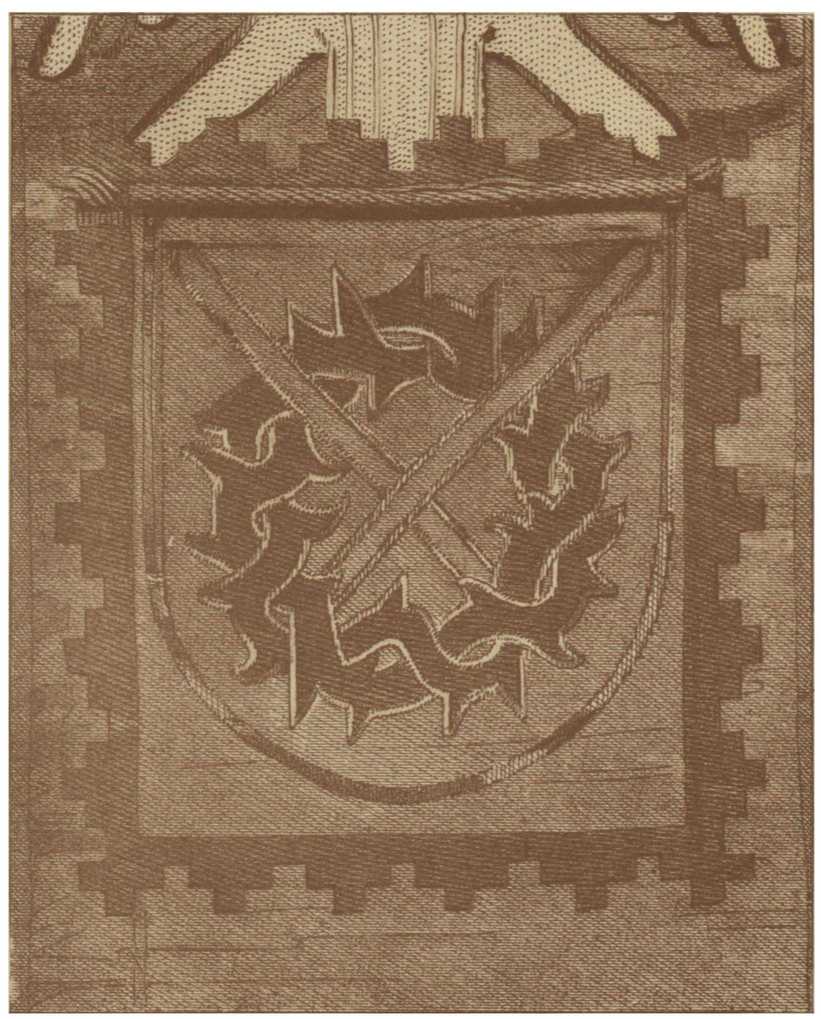
1376.
PART OF THE ORPHREY OF A CHASUBLE. German 15th century.
Vincent Brooks Day & Son, Lith.
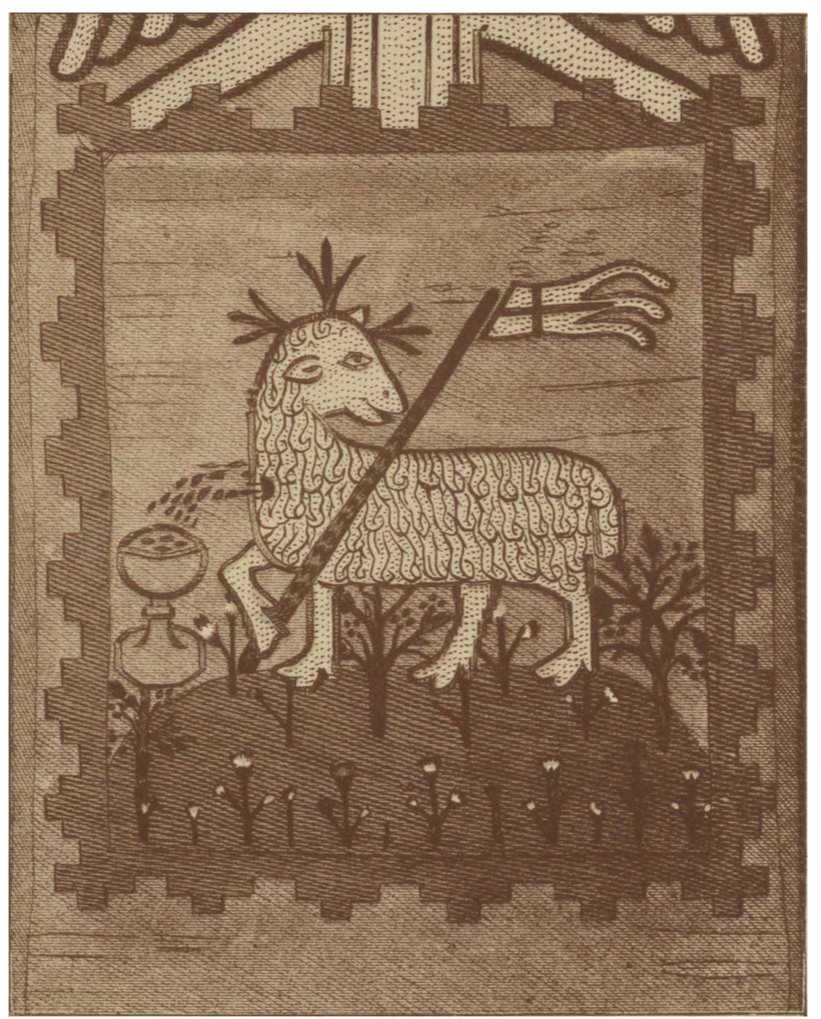
1376.
PART OF THE ORPHREY OF A CHASUBLE. German 15th century.
Vincent Brooks Day & Son, Lith.
The very rich stuff of this vestment far surpasses in splendour the orphreys, which ought to have been better. On the one behind, we have the Crucifixion with the words below, in blue silk, “O Crux Ave.” Further down an angel is holding a sheet figured with all the instruments of the Passion. After the word Maria, a second angel is shown with another sheet falling from his hands and figured with the Holy Lamb, having, beneath it, the words “Ecce Agnus Dei;” then a third angel, with the word, but belonging to another piece, “Johan.” On the orphrey in front a fourth angel is displaying a chalice surmounted by a cross and standing within a fenced garden, and beneath the sheet the word “Maria.” Lower down a fifth angel is showing the column and two bundles of rods, with “Jhesus.” Last of all there is an angel with a napkin marked with the crown of green thorns and two reeds placed saltire-wise, and the word “Maria.”
1375.
Saddle-bag of Persian carpeting; ground, deep crimson; pattern, stripes in various colours running up the warp. Persian. 3 feet 4 inches by 1 foot 5 inches.
The warp and weft are of a strong coarse texture, and not only at the corners but upon each pouch there are tassels.
1376.

Travelling-bag, of the same stuff, but varying in pattern. Persian. 1 foot 8 inches by 1 foot 7 inches.
1378.
Bag of woven worsted; ground, deep crimson; pattern, narrow stripes figured with diversified squares in different colours. Persian. 1 foot 3¾ inches by 1 foot 2¼ inches.
From the string of worsted lace attached to the side it would seem that this bag was meant to be slung across the person of the wearer. None of these three articles are very old.
1379.
Bag of woven silk and worsted; ground, deep crimson worsted; pattern, horizontal bands in silk figured, in places, with four-legged beasts, white, yellow, red, and green, and with vertical bands figured with a green net-work filled in with what look like birds, crimson, separated by a tree. Persian. 11¾ inches by 10 inches.
Most Persian in look is this bag, which, from the thick cord attached to it, seems to have been for carrying in the hand. It is lined with brown linen, and has two strings for drawing the mouth close up. The two birds repeated so often on the lower part, and separated by what looks like a tree, may be an ornament traditionally handed down from the times when the Persian sacred “hom” was usual in the patterns of that country. No great antiquity can be claimed by the textile before us.
1547, 1548.
Two Escutcheons of the Arms of France, surmounted by a royal crown, and encircled with the collars of two orders—one St. Michael, the other the Holy Ghost—embroidered upon a black ground, in gold and silver, and the proper blazon colours. French, 17th century.
All well and heraldically done.
1622.
Piece of Printed Chintz. Old English, presented by F. Fellingham, Esq.
2864A.
Frame for enamels; ground, purple velvet; pattern, scrolls in raised gold embroidery. French, late 17th century. 8 inches by 7 inches.
The velvet is put on pasteboard. In the centre, left uncovered, a larger enamel must have been let in; upon the four small circular and unembroidered spaces of the velvet, lesser enamels, or precious stones, were sewed.
2865.
Frame for enamels; ground, crimson velvet; pattern, scrolls in raised gold embroidery. French, late 17th century. 8 inches by 7 inches.
Though differing in its colour, this is evidently the fellow to the one just mentioned.
4015.

Mitre; crimson and gold velvet. Florentine, 15th century. 1 foot 10½ inches by 11 inches.
This liturgical curiosity is of that low graceful shape which we find in most mitres before the 16th century; in all probability this one was made not for real episcopal use, but to be employed in the service of the so-called boy-bishop who used, for centuries, to be chosen every year from among the boys who served in the cathedral, or the great churches of towns, at Christmas-tide, as well in England as all over Christendom; (see “Church of our Fathers,” t. iv. p. 215). As the rubrical colour for episcopal mitres is white, or of cloth of gold, a crimson mitre is of great rarity. The one before us is made of those rich stuffs for which Florence was so famous, as may be instanced in the gorgeous vestments given to Westminster Abbey by our Henry VII. The mitre itself is of crimson velvet, freckled with gold threads, raised in a rich pile upon a golden ground, with green fringed lappets; but the “titulus,” or upright stripe before and behind, along with the “corona,” or circular band, are all of a kind of lace or woven texture of raised velvet, green, white, and crimson, after a pretty design, upon a golden ground. The mitre is lined throughout with light-blue silk.
4016.
Bed-quilt; ground, cherry-coloured satin; pattern, birds amid flowers and foliage, in the centre a double-headed eagle, displayed. East Indian (?), early 17th century. 8 feet 6 inches by 6 feet 10 inches.
The satin is poor, and its colour faded; but the embroidery, with which it is plentifully overspread, is of a rich, though not tasty, kind. Birds of extraordinary, and, no doubt, fanciful plumage are everywhere flitting about it, among flowers as unusual as themselves; but the glowing tones of the many-coloured silks in which they are wrought must strike every one’s eye. From the double-headed eagle, done in gold, with wings blue, yellow, and green, displayed, it would appear that this quilt was wrought for some (perhaps imperial) house in Europe.
4018.
State-cap, of crimson velvet turned up with white satin, which is faced with crimson velvet, and all embroidered in gold and silver threads. German (?), late 17th century. 14½ inches by 10 inches.
By a very modern hand the words “King Charles” are written upon the green silk lining; what Charles, however, is not mentioned. There is much about the shape of the cap itself, and especially in the design of its embroidery, to induce the belief that it was wrought and fashioned by a German hand, and for German and not English use. In a piece of tapestry once belonging to the famous Bayard, and now in the Imperial Library at Paris, the same form of high-crowned crimson velvet cap is worn by Pyrrhus while he is being knighted, as may be seen, plate 42, in Shaw’s “Dresses and Decorations of the Middle Ages,” t. ii, borrowed from Jubinal’s fine work on “Early Tapestries.”
4024.
Altar-frontal; ground, crimson satin; subjects, five apostles, each under a Gothic canopy, with bunches of flowers between them wrought in coloured silks and gold thread. Italian, late 15th century. 7 feet 3 inches by 2 feet.
Beginning at the left-hand we have St. Paul holding a sword, then St. James the Greater with the pilgrim-staff; in the middle, St. Thomas holding in one hand a spear, and giving his blessing with the right, St. Andrew with a cross of large size leaning against his shoulder; and, last of all, St. John with an eagle at his feet. The figures are better done than the niches about them, which are very heavy and bad in taste, as are the bunches of flowers. The whole is applied, and upon a more modern piece of crimson satin. The back is lined with leaves of a printed book relating to the Abbey of Vallombrosa, near Florence.
Hanging behind this frontal, and put together as a background to it, are Numbers:—
4513-4516.
Fringed Panels of Domestic Furniture; ground, deep maroon velvet; pattern, a small arabesque within a square of the same design, in cloth of gold edged with gold cord. Italian, 16th century. Nos. 4513 and 4515, each 4 feet 6 inches by 1 foot 4 inches; Nos. 4514 and 4516, each 3 feet 7 inches by 1 foot 4 inches.
Bedsteads in Italy are so large that these pieces look far too small to have ever been applied to such a purpose as bed-furniture. They were, probably, the hangings for the head of a canopy in the throne-room of a palace during the year of mourning for the death of its prince.
4045.
Chasuble; the ground, tawny-coloured velvet; pattern, angels and flowers in coloured flos-silks and gold thread, the orphreys before and behind figured with saints. English, 15th century. 7 feet by 3 feet.
Though the needlework upon this chasuble is effective at a distance, like much of the embroidery of the time, both in this country and abroad, it is found to be very rude and coarse when seen near. The style of the whole ornamentation is so very English that there is no mistaking it. The back orphrey is in the shape of a cross; and on it, and figured at top, Melchisedek with three loaves in his hand; beneath him, the prophet Malachi, on the left of whom we have Abraham with a large broad sacrificial knife in his hand, on the right, King David and his harp; these three form the transom of the cross. Going downward, we see St. John the Evangelist with the chalice; below this apostle, David again; and, last of all, half the person of some saint. On the front orphrey are given St. James the Greater, and two prophets of the Old Law. This chasuble, with its stole and maniple, is said to have been found at Bath, hidden behind the wainscot of a house there. Certain it is that the chasuble has been much cut down. The original size was far larger.
4046, 4046A.
Stole and Maniple; ground, tawny-coloured velvet, embroidered with flowers in gold and coloured silks. English, 15th century. Stole, 8 feet 6 inches by 2¾ inches; maniple, 3 feet 3 inches by 2¾ inches.
The embroidery is quite of the style of the period, and in character with that usually found upon the commoner class of English vestments, done in flos-silk and gold thread, after a large design. The velvet is Italian, and this tone of colour seems to have been then in favour.
4059.
Piece of Woven Orphrey; ground, crimson silk; subject, the Assumption of the Blessed Virgin Mary, in yellow silk. Florentine, 15th century. 2 feet 9 inches by 8¾ inches.
This favourite subject of all art-schools in the mediæval period is treated here much after other examples in this collection, as No. 8977, &c., but with some variations, and better design and drawing. The Eternal Father, with glory round Him, and two cherubim, is putting a crown upon the head of St. Mary, who is seated upon sunbeams surrounded by angels, while she drops her girdle to St. Thomas as he kneels at her late grave, now filled with new-blown lilies, and bearing on its front the words “Assunta est.” “Assunta” for “Assumpta” is the weaver’s own blunder. Dr. Bock gives a plate of it in his “Geschichte der Liturgischen Gewänder des Mittelalters,” 1 Band, 2 Lieferung, pl. xvi.
4061.
Piece of Raised Velvet; ground, pale yellow silk; pattern, in raised velvet, a large oblong square, having within a border of corn-flowers a large star-like inflorescence, and each square separated by a border or band charged with liliaceous flowers, in crimson raised velvet, in part upon a silver ground, now blackened, surrounded by an ornament in amber-streaked green in raised velvet. Italian, late 16th century. 4 feet by 1 foot 1 inch.
Another of the several specimens of the rich raised velvet for furnishing purposes.
4062.
Purse in Green Velvet, embroidered with gold and silver threads, and at bottom emblazoned with a ducal crown and two shields of arms. French, 18th century. 4½ inches in diameter, 3 inches high.
Though so small, this little purse is tastefully and richly wrought, and has nicely worked double strings, with gold-covered knobs at their ends for drawing its mouth close, and two other like knobs for opening it. At bottom it is very richly ornamented with a golden mantle, upon which are two shields, the one on the man’s side is azure two lions passant gardant, royally crowned or; that on the woman’s side, azure a chevron or, between two four-petaled and barbed flowers, in chief, and a double transomed cross in base argent; over both shields is a ducal coronet. No doubt this purse, which is lined with white kid-leather, was one of those still used by ladies in France, and held in their hands as they stand at the doors or go about the church at service-time to collect the alms of the congregation, for the poor or other pious purposes; this one may have belonged to an heiress married to a duke.
4068.
Strip of Raised Velvet; ground, silver and white silk; pattern, a large crimson and green flower seeded gold, alternating with a floriation having flowers of crimson, tawny, and purple on green stems. North Italy, 16th century.
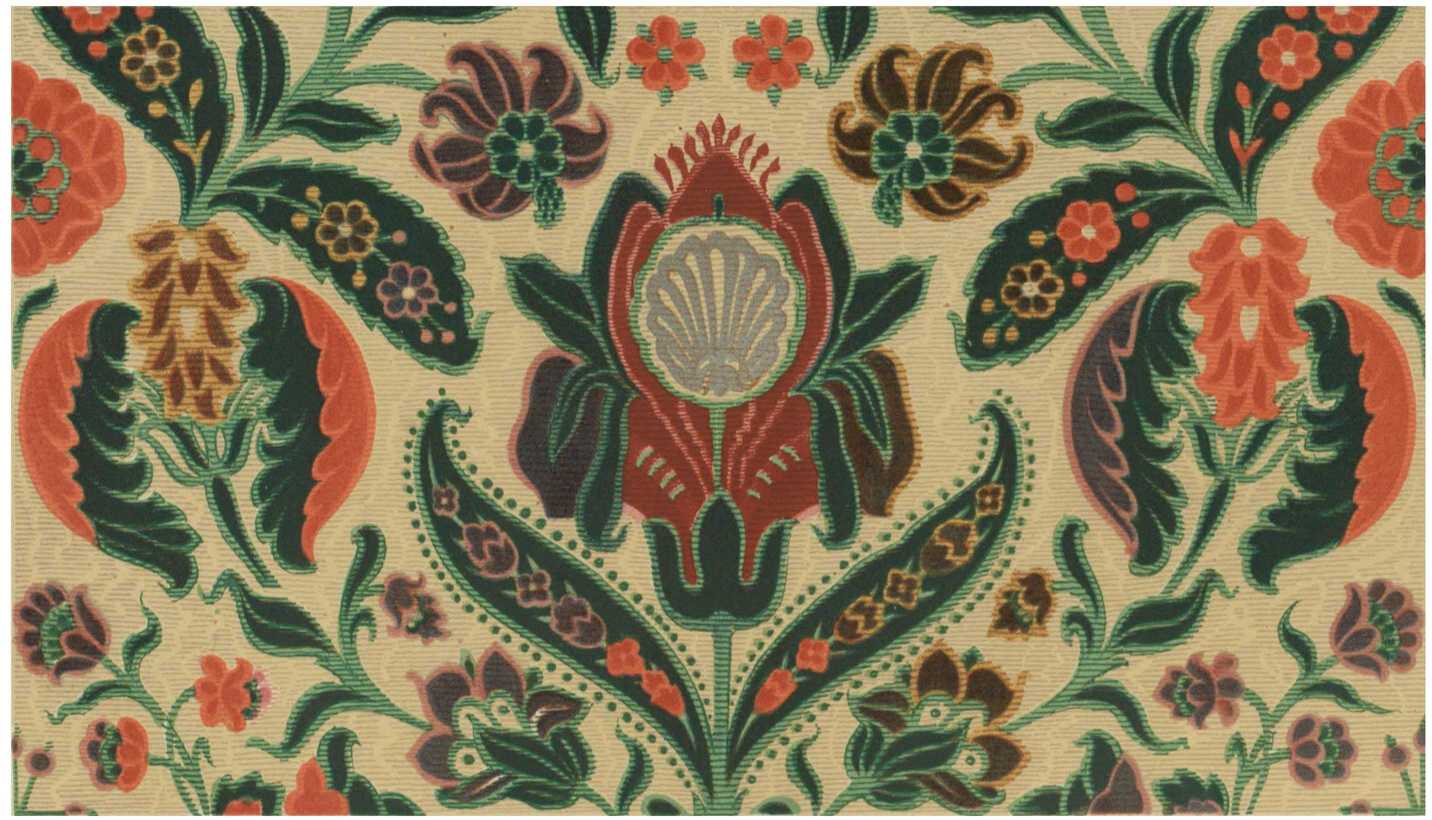
4068.
VELVET
Silver ground, raised floriated pattern, in various colours. Genoese, 16th century.
This fine specimen of raised velvet is of a deep pile and rich mellow colouring. The silver threads of the ground have become quite dimmed, while the gold in the flower is fresh and glowing. Seemingly, this piece last served as the hanging of a bed.
4069.
Piece of Raised Velvet on a gold ground; pattern, large conventional flowers and ears of corn issuing out of a ducal coronet. Genoese, early 17th century. 8 feet by 4 feet.
The gold of the ground is now so tarnished, and was, at first, so sparingly used that now it is almost invisible; but the pile of the velvet is deep and the pattern bold. Doubtless this stuff was for household decoration.
4070.
Piece of Silk Brocade; purple; pattern, in gold and silver, a large vase out of which spring two ramifications and two eagles, one on each side, alternating with a floriation bearing at top a pomegranate seeded; in the narrow border at top and bottom the fleur-de-lis is the chief ornament, while the tasseled fringe, designed at bottom, shows that this texture must have been intended as a hanging for a frieze. Lyons, late 16th century. 12 feet by 1 foot 10 inches.
The occurrence of birds or animals of any sort in stuffs of the period is unusual; and, in all likelihood, the last use of this piece was as a hanging in some large hall.
4209, 4210.
Pieces of White Brocaded Silk. Lyons, 18th century, 1 foot 4 inches by 11 inches.
The manufacture of this stuff is rather remarkable, not so much for that satin look, produced by flos-silk, in some parts of its design of flower-bearing branches, as by the way in which portions of it are thrown up in little seed-pearls.
4216.
Piece of Needlework figured with a female saint at her prayers before a picture of our Saviour, and a crowd of men standing behind her near a belfry, in which are swinging two bells. Italian, early 15th century. 1 foot 4½ inches by 11½ inches.
By the costume this work would seem to have been done in Tuscany, and it shows the bed-room of some saintly noble dame, wimpled and clad in a crimson mantle embroidered with gold. At the foot of her bed there is, wrought and diapered in gold, a praying desk on which lies open a book in silver having a large M in red marked on its first page; above is a picture of our Redeemer, known by His crossed glory, in the act of giving His blessing, before whom the saint is praying. At her knees are two green snakes, and above her two angels are carrying her soul, under her human form, up to heaven. Behind her, and close to a belfry, where the bells are swinging and the ropes of which are hanging down, is a group of men, one a tonsured cleric, seemingly, from his dalmatic, a deacon, with both hands upraised in surprise; near him other clerics tonsured, two of whom are reading with amazement out of a book held by a noble layman. This work contains allusions to several events in the life of St. Frances, widow, known in Italy, as Santa Francesca Romana; but a very remarkable one is here especially sketched forth. She is said to have often beheld the presence of her guardian angel, clothed as a deacon, watching over her. Such was the obedience and condescension yielded by her to her husband that, though wrapped in prayer, or busied in any spiritual exercise, if called by him or anywise needed by the lowliest servant in her family, she hastened to obey at the moment. It is told of her, that one day, being asked for as many as four times in succession, just as she was, each time, beginning the same verse again, of a psalm in the Office of the Blessed Virgin, on coming back for the fifth time she found that verse written all in gold. Here then we have the loving husband showing this prayer-book, with its golden letters, to a crowd of friends, among whom is his wife’s angel hidden under a deacon’s dalmatic; while the saint herself is at her devotions, foreseeing in vision the evils that are to befall Italy, through civil strife, shown by those serpents and the swinging bells betokening alarm and fright.
4456.
Table-cover; ground, coarse canvas; design, armorial bearings, symbolical subjects, fruits, and animals, besides five long inscriptions in German, dated A.D. 1585. German. 6 feet by 6 feet 6 inches.
The whole of this large undertaking was worked by some well-born German mother as an heirloom to her offspring. At the right hand corner, done upon a separate piece of finer canvas and afterwards applied to the ground, is a shield of arms, sable, three lions rampant or armed and langued gules two and one between a fess argent; at another corner, but worked upon the canvas ground itself, a shield, gules three bars dancetté argent; upon a third shield, argent, a fess dancetté sable; on the last corner shield, quarterly or and gules, a fess argent; upon a smaller shield in the middle of the border, sable a pair of wings expanded argent; on the border opposite, party per fess sable and or, two crescents argent; in the centre of the next border, gules two bars (perhaps) sable charged, the upper one with three, the lower with one, bezants or plates; and last of all, upon the other border, or, a lion rampant, gules with chief vair, sable, and or. Repeated at various places are a vase surmounted by a cross with two birds, half-serpent, half-dove, sipping out of the vessel; and below this group another, consisting of two stags well “attired,” each with one hoof upon the brim of a fountain out of which they are about to drink. This latter symbol is evidently a reference to the Psalmist’s hart that panteth after the fountains of water, while the former one is a representation of the union of the serpent’s wisdom with the simplicity of the dove. In many ancient monuments the upper half of the bird is that of a dove, the lower ends in a snake-like shape with an eye shown at the extremity of the tail. There are five long rhythmical inscriptions on this cloth, in German, one at every corner, and the longest of all in the middle; considering the period at which they were written, these doggerel verses are very poor, and run nearly as follows:—
“ALS . mAn . ZALT . FunFZEHN . HunDERT . JAHR . DARZu . nOCH . ACHTZiG . unD . FunF . ZWAR . HAT . DER . EDEL . unD . VEST . HEinRiCH . vOn . GEiSPiTZHEim . DiE . TuGEnTREiCH . AnnA . BLiCKin . Zum . GmAL . ERKORn . WELCHE . vOn . LiGTEnBERG . GEBORn . BEiD . ALTES . ADELiCHS . GESCHLECHT . ZuSAmmEn . SiCH . VERmEHLT . RECHT . DAmiT . nuHn . in . iHREm . EHESTAnDT . VLEiSiG . HAuSHALTunG . WuRDT . ERKAnDT . HAT . SiE . iHREm . TunCKERn . Zu . EHRn . DEn . HAuSRAHT . WOLLEn . ZiRn . unD . mEHRn . DARumB . miT . iHRER . EiGnEN . HAnDT . DiES . unD . nOCH . ViEL . ZiERLiCHS . GEWANDT . Zu . iHRER . GEDACHTniS . GEmACHT . miT . BEiDER . nECHSTEn . AnGHEn . ACHT . miT . GOTT . iHRH . TunCKERn . D . KinDER . ZART . AuCH . SiE . ERHALTE . BEi . WOHLFAHRTH . DARnEBEn . VERLEiHEn . GEDuLT . DAS . WiR . BEZAHLn . DER . nATuR . SCHuLT . nACH . VOLLPRACHTEm . LANGEn . LEBEn . unS . ALLEn . DiE . EWiG . FREuD . GEBEn . AmEn . OBGmELTER . HEinRiCH . DiCHTET . miCH .
“When one wrote the year Fifteen hundred and Eighty five, the noble and true Henry von Geispitzheim had chosen for his spouse the virtuous Anna Blickin von Lichtenberg. Both of them were of ancient noble descent. And she, to honour the esquire, her husband, wished to adorn and increase the house furniture, and there has worked with her own hand this and still many other pretty cloths, to her memory. Praying that God may preserve the esquire, and the tender children, and herself also, and that they may pay the debt of nature at the end of a long life, and eternal joy may be granted them.
Amen.
The aforesaid Henry has composed me (i.e. the doggerel verses).”
“nun . FOLGET . AuCH . BEi . DiE . ZEiT . unD . JAHR . DARin . iCH . ZuR . WELT . GEPOHREN . WAR . DES . WEn . mEin . DREi . DOCHTERLEin . AuCH . SOnn . ZuR . WELT . GEPOHREN . SEin . ALS . mAn . ZALTT . FuNFF . ZEHEn . HunDERT . Lii . ERFREuWET . mEin . muTTER . mEin . GESCHREi . An . DEm . JAR . ACHTZiG . FunFF . HER . nACH . iCH . mEinEm . JunCKERn . Ein . DOCHTER . PRACHT . EmiLiA . CATHARiEnA . iST . iHR . nAHm . vOn . JUGEnT . GERECHT . unD . LOBESAm . ZWEi . JHAR . DAR . nACH . im . JAnnER . HART . miCH . GOT . WiEDERum . ERFREuET . HAT . miT . EinER . DOCHTER . ZART . unD . FEin . SiE . DRinCKT . WASER . unD . KEinEn . WEin . mAGDALEnA . ELiSABETH . GEnnAnT . JHREm . VATER . WERTH . GAR . WOHL . BEKAnnT . nACH . GEHEnTS . JAHR . ACHTZIG . ACHT . mEinEn . SON . REiCHART . An . DAS . LiCHT . GEPRACHT DAS . WAR . DEm . VATER . GROSSE . FREuWDT . GOT . SEi . GELOBT . in . EWiGKEiT . DAS . VOLGT . JAHR . ACHTZiG . unD . nEun . BRACHT . iCH . ZUR . WELT . DiE . ZWiLinG . mEin . HAnS . CASPARn . ERST . DRAuFF . EmiCHEn . BALDT . DAS . SICH . ERFREUDT . DER . VATER . ALT . DAS . GESCHACH . DEn . iZ . HORnunGS . DAG . GOTS . ALLmACHT . nOCH . ViEL . mEHR . VERmAG . zu . LETZ . im . JAHR . nEunTZIG . unD . DREi . AnnA . mARGARETHA . KAm . AuCH . HERBEi . DEn . ZWOLFFTEn . FEBRuARiuS . DAMiT . iCH . DiSSE . SACH . BESCHLUSZ . O . iHR . HERTZ . LiEBE . KinDTER . mEIn . iCH . LASZ . EuCH . miR . BEFOHLEn . sEin . BEHTET . ALLEns . mORGENS . OHn . unDER . LASZ . in . FROLiGKEiT . HALT . GnAE . mASZ . ACH . iHR . HERTZ . LiEBE . KinDTER . mEin . mACHT . EUCH . miT . GOTTES . WORT . GEmEin . SO . WiRT . EUCH . GOT . DER . HER . ERHALTEn . DAS . iHR . EWEREm . VATER . nOCH . miT . EHRn . [some letters wanting] DiSEN . SPRUCH . mERCKT . EBEn . SO . WiRT . EUCH . GOT . GLiCK . unD . SGEn . GEBn .
“Now follows here my own birthday. When one wrote 1552 my mother’s heart was gladdened by my first cry. In the year 1585 I gave birth myself to a daughter. Her name is Emilia Catharina, and she has been a proper and praiseworthy child. Two years later, in a cold January, has God again gratified me with a daughter tender and fine, she drinks water and no wine, her name is Magdalena Elizabeth. In 1588 my son Richard came into this world, whose birth gave great pleasure to his father. In the following year, in February, I gave birth to my twins, Hans Caspar and Emich (Erich?). At last, in 1593, on the 12th of February, my daughter Anna Margaretha was born.—O you truly beloved children, I commend myself to your memory. Do not forget your prayers in the morning. And be temperate in your pleasures. And make yourselves acquainted with the Word of God. Then God will preserve you, and will grant you happiness and bliss.”
“DiSZ . HAB . iCH . EuCH . LiEBE . KinDER . mEin . in . REimEn . BRinGEn . LASZEn . FEiN . AuFF . DAS . iR . WuST . EuWERS . ALTERS . ZEiT . DuRCH . DiESE . MEiNER . HAnDT . ARBEiT . WELCHS . iCH . EuCH . ZuR . GEDECHTniS . LAS . unD . BiTT . EUCH . FREunDLiCH . ALLER . mASS . SEiDT . uFFRiCHTiG . in . ALLEn . SACHEn . DAS . WiRT . EUCH . GOSZ . unD . HERLiCH . MACHn . THuT . iEDEm . EHR . nACH . SEinEm . STAnDT . DAS . WiRT . EuCH . RumLiCH . mACHEn . BEKAnDT . unD . iHR . HERTZ . LiEBE . SOnE . mEin . WOLT . EuCH . HuTEn . VOR . VERiGEm (Feurigem). WEin . DRinCKT . DEn . WEin . miT . BESCHEiDEnHEiT . DA . SiCHS . GEBuRTT . DAS . PEHuT . VOR . LEiDT . unD . iHR . HERTZ . LiEBE . DOCHTER . mEin . LAST . EuCH . ALLE . TuGEnT . BETOLEn . SEin . BEWART . EuHER . EHR . HAPT . EuHR . GuT . ACHT . BEDEnCKT . Zu . VOR . JDE . SACH . DAn . VOR . GETHAn . unD . nACH . BEDRACHT . HAT . mAnCHEn . WEiT . ZuRuCK . GEBRACHT . DAS . miTELL . DiS . ALLES . Zu . GEPEn . iST . DiE . FORCHT . GOTTES . mERCKT . miCH . EBEN . GOTTS . FORCHT . BRinGT . WEiSHEiT . unD . VERSTANT . DAR . DORCH . GESEGnET . WiRDT . DAS . LANDT . GOTS . FORCHT . mACHT . REICH . BRinGT . FRED . u . muHT . ERFRiSCHT . DAS . LEBEn . unD . DAS . BLuT . GOTES . FORCHT . BEHuTT . VOR . ALLEm . LEiDT . unD . iST . Ein . WEG . ZuR . SELiGKEiT . GOTTES . FORCHT . iST . DAS . RECHT . FunDAmEnT . DARuFF . DES . mEnSCHEn . GLiCK . BEWEnDT . unD . iST . Ein . HAuPTmiTTEL . ALLER . DuGEnT . WER . SiCH . DER . AnimPT . in . DER . JuGEnT . DEm . GEHT . SEin . ALTER . An . miT . EHREn . unD . SEin . GLiCK . WiRD . SiCH . TAGLiCH . mEHREn . DAR . DuRCH . DER . mEnSCH . Zum . SELiG . EnDT . LETZLiCH . GELAnGT . ACH . HER . unS . SEnDT . DEin . HEiLiGER . GEiST . DER . unS . THuT . EinFREn . Zu . SOLCHER . FORCHT . DiE . WOL . EuCH . RiHREn . EWER . HERTZ . unD . Sin . iHR . SOLiCH . FORCHT . ERGREiFFEn . KOnT . unD . GOT . GEHRCHT . AmEn . DAS . WERDT . WARH . G . GOTT . DiE . ERH .
“This, O my dear children, has at my wish been put into rhymes, in order that you may know your age by this work of my own hand, which I leave to you as a memorial. I beseech you to be sincere in all matters; that will make you great and glorious. Honour everybody according to his station; it will make you honourably known. You, my truly beloved sons, beware of fiery wine, and drink with moderation; that will preserve you from evil. And you, my truly beloved daughters, let me recommend you to be virtuous. Preserve and guard your honour; and reflect before you do anything; for many have been led into evil by acting first and reflecting afterwards. The way to get to this end is the fear of God, mark me well! The fear of God brings wisdom and understanding. The fear of God makes rich, and gives joy and courage, refreshes life and blood. The fear of God protects us from all evil; and is the way to the state of bliss. The fear of God is the foundation on which the happiness of man rests; and is the chief way to all virtues. He who seeks it in his youth will live with honour till his old age; and his happiness will daily increase.
“Amen. Give to God all honour.”
“ALS . mAn . ZALT . FuFZEHn . HunDERT . JAHR . unD . nEunTZiG . nEun . DARZu . JST . WAR . DEn . ERSTEn . APRiL . nACH . miTnACHT . GLEiCH . umB . Ein . uHR . OFFT . iCHS . BETRACHT . DER . ALLERLiEBSTE . JunCKER . mEin . GEnAnDT . HEiNRiCH . VOn . GEiSPiTZHEim . ZU . DiR . O . GOTT . AUS . DiESER . WELT . ERFORDERT . WiRT . ALS . DiRS . GEFELLT . SEiN . ALTER . WAR . SECHZiG . unD . ACHT . DiE . WASSER . SUCHT . iHn . umGEPRACHT . DEn . WOLLEST . O . GOTT . GnED . GEBEn . SEin . PFLEGEn . nACH . DEm . WiLLEN . DEin . JCH . SEin . BETRuEBTE . nACHGELASSEn . Ann . BLiCKin . VOn . LiECHTEnPERG . GEnAnDT . HAB . miT . niCHT . unDER . LASSEn . WOLLEn . SOnDERn . Ein . SOLiCHES . HiE . mELDEn . SOLLEn . in . DiESEm . TuCH . miT . mEinER . HAnDT . DAmiT . ES . WERD . mEinEn . KinDERn . BEKAnDT . DiESES . mEin . GROSSES . LEiD . WELCHES . miR . VOn . GOTT . WARD . BEREiT .
“When one wrote the year Fifteen hundred and ninety-nine, on the first of April after midnight, just at one o’clock—often I think of it—my truly beloved husband, the Squire Henry von Geispitzheim, was called to Thee, O God! from this world, according to Thy will. His age was sixty and eight years. The dropsy has killed him. To him grant, O God! Thy mercy, after Thy will. I, his afflicted Anna Blickin von Liechtenperg who was left behind, have related it with my hand in this cloth, that it might be known to my children—this my great sorrow, which God has sent me.”
“DEn . FunFFTEn . AuGuST . BALDT . HERNACH . WiEDERum . SiCH . FUGT . EiN . LEiDiG . SACH . mEin . JUnGSTER . SOn . EimCH . Ein . ZWiLLinG . VOn . DiESER . WELT . ABSCHiEDT . GAB . GEHLinGS . DARDuRCH . WARDT . miR . mEin . LEiD . GEmERT . unD . ALLE . HOFFNUNG . umBGEKERTH . ACH . GOTT . LAS . DiCHS . miEnER . ERBARmEn . unD . KOm . ZU . TROST . unD . HiLFF . miR . ARmEn . HiLF . TREuWER . GOT . unD . STEH . BEi . miCH . TROST . miCH . miT . DEinEm . GEiST . GnEDiGGLiCH . unD . BEHuT . miR . mEin . LiEBE . KinDT . SO . BiSZ . nOCH . GESunD . uEBRiG . SinT . unD . SCHAFF . O . GOT . DAS . WiR . ZuGLiCH . DiCH . SCHAu . DEn . im . HimmEL . EWiGLiCH . DARZu . HiLFF . unS . GnEDiGKLiCH . ACH . HER . VER . GiEB . ALL . unSER . SCHuLT . HiLFF . DAS . WARTEn . miT . GEDuLT . BiES . unSER . STunTLin . nACHT . HERBEi . AuCH . unSER . GLAuBE . STETZ . WACKER . SEi . DEin . WORT . Zu . DRAuWEn . TESTiGKLiCH . BiS . WiR . EnDT . SCHLAFFEn . SELiGKLiCH .
“On the fifth of August soon afterwards another sorrowful event happened. My youngest son Eimah (Erich?), one of my twins, suddenly departed from this world; and therefore my sorrow was increased, and all hope overthrown. O God! have mercy upon me, and come to comfort and help me, poor one. Help, true God! and assist me, comfort me with Thy Spirit, and protect me and my dear children who are still left in good health. And grant, O God! that we then may behold Thee in Heaven eternally. O Lord! forgive us our trespasses, help that we may wait with patience until our last hour may come; and also that our faith may be true, to believe in Thy Word steadfastly until we sink into the slumber of death.”
4457.
Table-cover of white linen, figured in thread, with the “Agnus Dei,” or “Holy Lamb,” in the middle, and the symbolic animals of the four Evangelists, one at each corner. German, late 16th century. 6 feet 3 inches by 5 feet 8 inches.
For its sort and time there is nothing superior to this fine piece of needlework. About the evangelic emblems, as well as the Lamb in the centre, there is a freedom and boldness of design only equalled by the beauty and nicety of execution, making the piece altogether quite an art-work. The little dogs chasing the young harts, as well as the rampant unicorns, but especially the bird of the stork-kind preening its feathers, and the stag looking back at the hound behind, all so admirably placed amid the branches so gracefully twining over the whole field, show a master’s spirited hand in their design. Unfortunately, however, none of its beauty can be seen unless, like a piece of stained glass, it be hung up to the light. Its use was most likely liturgic, and occasions for it not unfrequently occur in the year’s ritual round; and on Candlemas-day and Palm Sunday it might becomingly have been spread over the temporary table on the south side of the altar, upon which were put, for the especial occasion, the tapers for the one service, and the palm-branches for the other, during the ceremony of blessing them before their distribution.
4458.
Linen Napkin; the four corners embroidered in crimson thread. German, 17th century. 3 feet by 2 feet 6½ inches.
The design consists of a stag at rest couchant, and an imaginary figure, half a winged human form, half a two-legged serpent, separated by a flower of the centaurea kind. This is repeated on the other side of the square, up the middle of which runs an ornamentation made out of a love-knot, surmounted by a heart, sprouting out of which is a stalk bearing a four-petaled flower, and then a stem with the usual corn-flower at the end of it. To all appearance, this linen napkin was for household use.
4459.
Linen Cradle-Coverlet; ground, fine white linen; pattern, the Crucifixion, with Saints and the Evangelists’ emblems, all outlined in various-coloured silk thread; dated 1590. German. 6 feet by 6 feet 6 inches.
This piece of needlework is figured with the Crucifixion in the middle, and shows us, on one side, the Blessed Virgin Mary and St. Christopher; on the other, St. John and the Blessed Virgin Mary holding our Lord in her arms, and, at her feet, a youthful virgin-saint, most likely St. Catherine of Sienna. From the cross itself flowers are in some places sprouting out, and three angels are catching, in chalices, the sacred blood that is gushing from the wounds on the body of our Lord. At each corner is an evangelist’s symbol, and the whole is framed in a broad border in crimson and white silk, edged by crochet-work, and at the corners are the letters A. H. A. R. Though the figures are in mere outline they are well designed, but poorly, feebly executed by the needle. Another specimen of a cradle-quilt, much like this, is No. 1344, and under No. 4644 notice is taken of feeling for the employment of the four Evangelists’ symbols at the corners of this nursery furniture.
4460.
Linen Napkin; embroidered at one end with two wreaths of flowers above a narrow floral border; it is edged with lace, and bears the date 1672, and the initials A. M. W. German, 3 feet 6 inches by 1 foot 6 inches.
Probably meant to hang in the sacristy for the priest to wipe his fingers on after washing the tips of them, before vesting for mass.
4461.
Linen Table-Cover; pattern, a wide floriation done in white and yellow threads; in the centre, a flag couchant within a wreath. German, late 16th century. 5 feet 4 inches by 4 inches.
Free in design and easy of execution.
4462.
Embroidery on Silk Net; ground, crimson; pattern, branches twined into ovals, and bearing flowers and foliage, in various-coloured silks, and heightened, in places, with gold and silver thread. Italian, late 17th century. 2 feet 8 inches by 9 inches.
A very pleasing and exceedingly well-wrought specimen of its style. Like in manner, but much better done than the examples at Nos. 623, 624. No doubt it was meant for female adornment.
4522.
Altar-frontal; embroidered in the middle with nine representations of the birth, &c. of our Lord; and four passages from the Saints’ lives on each side, all in gold and various-coloured silks, upon fine linen. Italian, 14th century. 4 feet 3 inches by 1 foot 8 inches.
This frontal is said to have been brought from Orvieto; but in it there is nothing about the celebrated relic kept in the very beautiful and splendid shrine in that fine cathedral. So very worn is this piece of embroidery, that several panels of it are quite indistinct. It may be, however, distinguished into three parts—the centre and the two sides. In the first we have, in nine compartments, the Annunciation, the Nativity, the coming of the Wise Men, the Blessed Virgin Mary, with St. Joseph, going to the temple and carrying in a basket her pair of turtle-doves, which she is giving to Simeon; the Last Supper; our Lord being taken in the garden; the Crucifixion; the burial; the Resurrection of our Saviour; on the right side, the legend of St. Christopher, mixed up with that of St. Julian Hospitaler; on the left are passages from the life of St. Ubaldo, bishop of Gubbio in the middle of the 12th century. In the first square is the saint mildly forgiving the master-mason who carried the new walls of the city across a vineyard belonging to St. Ubaldo, and, when reproved about the wrong thus done to private property, knocked down the saint; in the second we behold the saint at the bedside of a converted sinner, whose soul, just breathed forth, an angel is about to waft to heaven; in the third we have before us the saint himself, upon his dying bed, surrounded by friends, one of whom—a lady—is throwing up both her arms in great affright at the sudden appearance of a possessed man who has cast himself upon his knees at the bedfoot, and, with one hand outstretched upon the bed, is freed from the evil spirit, which is flying off over head in shape of a devil-imp; in the last the saint is being drawn in an open bier, by two oxen, to church for burial, followed by a crowd, among whom is his deacon.
From the subjects on this much-decayed frontal, figured, as it is, with the life of St. Ubaldo, known for his love of the poor, his kindness to wayfarers and pilgrims, and his healing of the sick, as well as with the legends of St. Julian and St. Christopher, remarkable for the same virtues, we may infer that this ecclesiastical appliance hung at the altar of some poor house or hospital, in by-gone days, at Orvieto.
4643.
Band of Gimp Openwork, crimson and gold thread. German (?), 18th century. 1 foot 10 inches by 1 inch.
Evidently for ladies’ use, but how employed is not so clear; from a little steel ring sewed to it, perhaps it may have been worn hanging from the hair behind the neck.
4644.
Cradle-quilt; ground, green satin, embroidered with armorial bearings, the four Evangelists, and flowers, all in coloured silks, and dated 1612. German. 2 feet 5 inches by 1 foot 9 inches.
Within a narrow wreath of leaves and flowers there are two shields, of which the first bears gules a wheel or, surmounted by a closed helmet, having its mantlings of or and gules, and on a wreath gules a wheel or as a crest; the second, azure, a cross couped argent between a faced crescent and a ducal coronet, both or, and all placed in pile, surmounted by a closed helmet having its mantlings of or and azure, and on a wreath or, a demy bear proper with a cross argent on its breast, crowned with a ducal coronet or, and holding in its paws a faced crescent or. At each of the four corners is the emblem of an evangelist with his name, and shown as a human personage nimbed and coming out of a flower, with his appropriate emblem upholding an open volume which he has in his hands, thus calling to mind those nursery rhymes:—
“Matthew, Mark, Luke, and John, Guard the bed I lie upon,” &c.;
which seem to be as well known in Germany as they were, and yet are, in England. See “Church of Our Fathers,” t. iii. p. 230.
4645.
Cradle-quilt; centre, crimson silk, embroidered with flowers in coloured silk, mostly outlined with gold thread, and here and there sprinkled with gold ornamentations, and surrounded by a broad satin quilting edged with a gold lace-like border. German, late 17th century. 2 feet 7 inches by 2 feet 2 inches.
The cradle-cloths, or quilts, are of common occurrence, and afford occasions for much elegance of design.
4646.
Cradle-quilt; ground, brown silk; pattern, a wreath of green leaves encircling two armorial shields, and filled in with flowers outside the spandrils; the whole surrounded by a border of flowers, all in various-coloured flos-silk. German, late 16th century. 3 feet by 2 feet 5 inches.
Of the two shields the first is party per fess azure and sable, a griffin rampant or holding three ears of wheat; the shield itself surmounted by a helmet closed, having green mantlings and crested with a ducal coronet out of which issues a demi-griffin rampant holding three ears of wheat or. The second shield is party per fess sable and or, a lion rampant or noued, and langued gules, counterchanged or and sable, surmounted by a closed helmet with green mantlings, and crested with a demy-lion rampant or, langued gules issuing from a wreath sable and or (now faded). By means of a long slit with hooks and eyes to it a blanket might be introduced to make this coverlet warmer.
4647.
Satin Bed-quilt; the middle a silk brocade diapered with a large floriation within a broad wreath-like band, all bright amber upon a crimson ground; the broad border is of crimson satin, quilted, after an elaborate pattern shown by a cording of blue and gold. French, 17th century. 6 feet by 5 feet 6 inches.
4648.
Satin Bed-quilt; the middle, silk brocade diapered with a somewhat small floriation, in bright amber and white upon a crimson ground. The wide border, in crimson satin of rich material and brilliant tone, is quilted after an agreeable design with yellow cord. French, 17th century. 7 feet 10 inches by 5 feet 4 inches.
4649.
Liturgical Scarf; ground, white silk; pattern, bunches of leaves and flowers, in various-coloured silk thread. French, 18th century. 11 feet 5 inches by 1 foot 4 inches.
Such scarves are used for throwing on the lectern, and to be worn by the sub-deacon at high mass; and, from its appearance, this one must have seen much service. All its flowers, as well as its two edgings, are worked in braid, nicely sewed on and admirably done.
4661.
Long Piece of Silk Brocade; ground, light maroon; pattern, creamy white scrolls, dotted with blue flowerets, and placed so as to form a wavy line all up the warp amid bunches of red and blue flowers and leaves. Lyons, late 17th century. 8 feet 6 inches by 1 foot 7 inches.
The colours are faded somewhat, and though showy, this stuff is not so glaring in its design as were the silks that came, at a later period, from the same looms.
If used in the liturgy, it must have been for covering the moveable lectern for holding the Book of the Gospels, out of which the deacon at high mass chants the gospel of the day. It might, too, have served as a veil for the sub-deacon for muffling his hands while he held the paten after the offertory.
4665.
Pair of Lady’s Gloves of kid leather, with richly embroidered cuffs. French, late 17th century. 13 inches by 7½ inches.
The hands are of a light olive tone, and embroidered on the under seams in gold; the cuffs are deep, and embroidered in gold and silver after a rich design upon crimson silk, and are united by the novelty of a gusset formed of three pieces of broad crimson ribbon.
4666.
Purse in gold tissue, embroidered with flowers in pots, and bound with ribbons in silver and colours. French, 18th century. 5 inches by 4½ inches.
Some of the flowers are springing up from silver baskets; others are tied up with silver ribbons, and the whole pleasingly done.
4667.
Purse in gold and silver embroidery, with gilt clasp. English, 19th century. 4½ inches by 4 inches.
The design of this is pretty, and consists of small gold and silver disks wrought in thread, and linked together by a strong green silk netting.
4894.

Velvet Hanging; ground, black; pattern, a frieze made up of a flower-bearing vase between two broad horns of plenty, full of fruits, and two imaginary heraldic monsters, one on each side, like supporters, fashioned as red-tongued eagles, with wings displayed in the head, but having a tailless haunch, and cloven-footed legs of an ox; the fimbriations are edged with green fringe, and the spaces filled with a conventional floriation; and the greater parts done in yellow satin, smaller parts in other coloured satins, all edged with gold cording and silver thread, and applied to the ground of black velvet. French, early 17th century. 25 inches by 12 inches.
The whole of this curious piece is designed with great boldness and spirit, and most accurately wrought.
5662.
Four Pieces of Raised Velvet, sewed into one large square; ground, yellow and crimson silk; pattern, a bold floriation in raised crimson velvet. Genoese, 16th century.
A fine specimen of the Genoese loom, showing a well-managed design composed of a modification of the artichoke, mixed with pomegranates, ears of corn (rather an unusual ornament), roses, and large liliacious flowers. Not unlikely this stuff was ordered by some Spanish nobleman for hangings in the state halls of his palace. Such stuffs are sometimes to be seen on the canopy in the throne-room of some Roman princely house, whose owners have the old feudal right to the cloth of estate.
5663.
Set of Bed Hangings complete, in green cut velvet raised upon a yellow satin ground, diapered in gold. Genoese, 16th century.
The foliated scroll pattern of this truly rich stuff is executed in a bold and telling manner; and the amber satin ground is marked with a small but pleasing kind of diaper, which is done in gold thread. To give a greater effect to the velvet, which is deep in its pile, a cord of green and gold stands stitched to it as an edging.
5664, 5664A.
Two Pieces of Embroidery; ground, light purple, thin net lined with blue canvas; pattern, nosegays of white and red flowers and large green branches tied up in bunches, with white and with yellow ribbons alternately; the narrow borders, which are slightly scolloped, are figured with sprigs of roses; and the whole is done in bright-coloured untwisted silks, and has throughout a lining of thin white silk. French, late 16th century. 10 feet 9½ inches by 2 feet 9¾ inches.
Each piece consists of two lengths of the same embroidery sewed together all along the middle; and served for some household decoration.
5665.
Embroidered Table-cover; ground, green cloth; pattern, within a large garland of fruits and flowers, separated into four parts by as many cherubic heads, two armorial shields and a scroll bearing the date 1598, and the four sides bordered with an entablature filled in with animals, fruits, flowers, and architectural tablets having about them ornaments of the strap-like form, and each charged with a female face. South Germany, 16th century. 5 feet 7 inches by 5 feet 3 inches.
The design of the embroidery, done in various-coloured worsteds, is admirable, and quite in accordance with the best types of that period; nor ought we to overlook the artistic manner in which the colours are everywhere about it so well contrasted. The animals are several, not forgetting the unicorn and monkey; though, from the frequency of the Alpine deer kind, it looks as if this fine piece of work had been sketched and executed by those familiar with the Alps. The shields are, first, barry of six argent and azure, with mantlings about a helmet closed and crested with a demi-bloodhound collared and langued, and, from the neck downward, barry like the shield; second, quarterly 1 and 4 or charged with a pair of pincers sable; 2 and 3 sable, a lion rampant or, and mantlings about a helmet closed and crested with a demi-lion rampant or, upon a wreath sable and argent. The silver has now become quite black.
5666.
Table-cover; ground, dark green serge; pattern, embroidered in silk and thread, the four seasons and their occupations, &c., and in the centre the Annunciation. German, early 17th century. 5 feet 3 inches by 4 feet 6 inches.
This piece, though much resembling the foregoing, No. 5665, is far below it as an art-work, and, by its style, betrays itself as the production of another period. Within a wreath, the Annunciation is figured, after the usual manner, but without gracefulness, in the middle of the cloth; at one corner Winter is shown, by men in a yard chopping up and stacking wood; then, by the inside of a room where a woman is warming herself before one of those large blind stoves still found in Germany, and a bearded man, seated in a large chair, doing the same at a brazier near his feet, while outside the house a couple are riding on a sledge drawn by a gaily caparisoned horse. At the corner opposite we have Spring—a farm-house, with its beehives, and a dame coming out with a jug of milk to a woman who is churning, near whom is a hedger at his work, and other men pruning, grafting, and sowing. For Summer, two gentlemen are snaring birds with a net; a woman and a man, each with a sickle in hand, are in a cornfield; two people are bathing in a duck-pond before a farm-house, on the roof of which is a nest with two storks sitting, one of which has caught a snake; and in a meadow hard by a man is mowing and a woman making hay. For Autumn, we see a vineyard where one man is gathering grapes and another carrying them in a long basket on his shoulders; and near, a man with a nimb, or glory, about his head, and lying on the ground with one leg outstretched, which a dog is licking above the thigh—perhaps the shepherd St. Rock, and, while a gentleman is walking past behind him, a girl, with a basket of fruit upon her head, is coming towards the spot. Between the seasons, and within circular garlands, are subjects akin to these parts of the year; in a boat, upon the water, a young couple are beginning the voyage of life together; a lady on a grey horse is, with hawk on hand, disporting herself in the flowery fields; a young lady is caressing a lamb with one hand and carries a basket of young birds in the other; last of all, another lady is kneeling at her prayers, with a book open before her on a table over-spread with a nicely worked cloth. A deep gold fringe runs all round the four sides of this table-cover.