PART THE FIRST. Church-vestments, Silk-stuffs, Needlework, and Dresses. (continued 3)
Reading edition
5670-5676.

Seven Chair-seat Covers; ground, yellow satin; pattern, birds, flowers, and a mask of an animal, all embroidered in various-coloured flos-silk. French, late 17th century. 2 feet 6 inches by 2 feet.
The satin is rich, and all the embroideries done in a bold effective manner; in some of these pieces the beak of each green parrot holds a strawberry or arbutus-fruit; and the lily and fleur-de-lis here and there betray a French feeling. It should be noticed, too, that much botanical knowledge is shown in the figuration of the flowers, which are more pleasing and effective from being thus done correctly.
5677.

Two Pieces of Raised Silk Brocade; ground, yellow; pattern, the artichoke amid strap-work ornamentation, all of a large bold character, in raised crimson. Italian, 16th century. 10 feet 1 inch by 4 feet 2 inches.
A rich stuff, and made up for household decoration, perhaps for the throne-room of some palace.
5678.

Cradle-coverlet, green silk, brocaded in gold and silver; pattern, imitation of Oriental design in gold and silver flowers, after a large form, lined in red. French, 18th century. 3 feet 6 inches square.
A specimen of a rich and telling, though not artistic, stuff.
5723.

Piece of Raised Velvet; green, on a light amber-coloured ground. Genoese, late 16th century. 7 feet 10 inches by 1 foot 8 inches.
The pattern, rich in its texture and pleasing in its colours, consists of large stalks of flowers springing out of royal open crowns, all in a fine pile of green velvet, and, no doubt, was meant for palatial furniture.
5728.

A Missal-Cushion; ground, white satin; pattern, flowers and fruit embroidered in coloured silks, amid an ornamentation of net-work, partly in gold; it has four tassels of green silk and gold thread. French, 17th century. 1 foot 5 inches by 10 inches.
One of those cushions once so generally used for supporting the Missal at the altar. It is figured only on the upper side, and underneath is lined with a silk diapered in a pleasing pattern, in amber-colour. Its tassels are rather large and made of several coloured silk threads and gold.
5788.

A figure of St. Mark, seated; embroidered, in part by the hand, in part woven. Florentine, early 16th century. 1 foot 3 inches by 8½ inches.
Beneath a circular-headed niche, with all its accessories in the style of the revival of classic architecture, sits St. Mark, known as such by the lions at his side. Within his right arm the Evangelist holds a large cross; and on his lap lies an open book, both pages of which are written with the words:—“Gloria in excelsis Deo, et in tēa.” Much of the architecture, as well as of the drapery of this personage, is loom-wrought, assisted in places by needle-embroidery. The head, the hands, the feet, are all done by the needle; but the head, neck, and beard are worked upon very fine linen by themselves, and afterwards applied, and in such a manner that the long white beard overlaps the tunic. His chair, instead of legs, is upheld upon the backs of two lions lying on the ground. The head is done with all the fineness and delicacy of a miniature on ivory, and the way in which the massive folds of his full wide garments are thrown over his knees is noteworthy and majestic.
5900.
Silk Damask Orphrey Web; ground, crimson; pattern, the Resurrection. Venetian, 16th century. 1 foot 4 inches by 8¾ inches.
One of those numerous examples of woven orphrey-work for vestments such as copes and chasubles. Our Lord is figured as uprising from the grave, treading upon clouds, giving, with His right hand, a blessing to the world, and holding the triumphal banner in the left. Glory streams from His person, and a wreath of Cherubim surrounds Him; while, from the top part of this piece, we know that two Roman soldiers were sitting on the ground by the side of the sepulchre, which they were charged to guard.
5958.

Box for keeping the linen corporals used at mass, in the vestry. It is covered with fine linen, of a creamy brown tint, embroidered with crimson silk and gold. Inside it is lined, in part green, on the lid crimson, where a very rude print of the Crucifixion, daubed with colour, has been let in. German, 17th century. 8½ inches by 7½ inches, 1¾ inches deep.
Such boxes seem to have been much used, at one time, throughout Germany, for keeping, after service, the blessed pieces of square fine linen called corporals, and upon which, at mass, the host and chalice are placed.
Before being employed all the year round as the daily repository for laying up the corporals after the morning’s masses, this sacred appliance, overlaid with such rich embroidery, and fitly ornamented with the illumination of the Crucifixion inside its lid, would seem to have been originally made and especially set aside for an use assigned it by those ancient rubrics, which we have noticed in our Introduction, § 5. As such, it is, like No. 8327 further on, a great liturgical rarity, now seldom to be found anywhere, and merits a place among other such curious objects which give a value to this collection.
At the mass on Maundy Thursday, besides the host received by the officiating priest, another host is and always has been consecrated by him for the morrow’s (Good Friday’s) celebration; and because no consecration of the Holy Eucharist, either in the Latin or in the Greek part of the Church, ever did nor does take place on Good Friday, the service on that day is by the West called the “Mass of the Pre-sanctified,” by the East, “Λειτουργία τῶν προηγιασμενῶν.”
Folded up in a corporal (a square piece of fine linen), the additional host consecrated on Maunday Thursday was put into this receptacle or “capsula corporalium” of the old rubrics, and afterwards carried in solemn procession to its temporary resting-place, known in England as the sepulchre, and there, amid many lights, flowers, and costly hangings of silk and palls of gold and silver tissue, was watched by the people the rest of that afternoon, and all the following night, till the morning of the next day, when, with another solemn procession, it was borne back to the high altar for the Good Friday’s celebration.
6998.
Piece of Green Satin; pattern, an arabesque stenciled in light yellow, and finished by touches done by hand. Italian, very late 18th century. 3 feet 1½ inches by 1 foot 6½ inches. (Presented by Mr. J. Webb).
This piece may have been part of a frieze, round the head of a bed; and have had a good effect at that height, though, in a manner, an artistic cheat, pretending to be either wrought in the loom or done by the needle. The design, in its imitative classicism, is bold and free, and the touches of the pencil effective. To this day stencil ornamentation upon house-walls is very much employed in Italy, where papering for rooms is seldom used even as yet, and not long ago was in many places almost unknown.
7004.
Piece of Silk Damask; ground, crimson; pattern, wheat-ears, flowers, and conventional foliage in gold, shaded white. Italian, late 16th century. 11 inches by 10¾ inches.
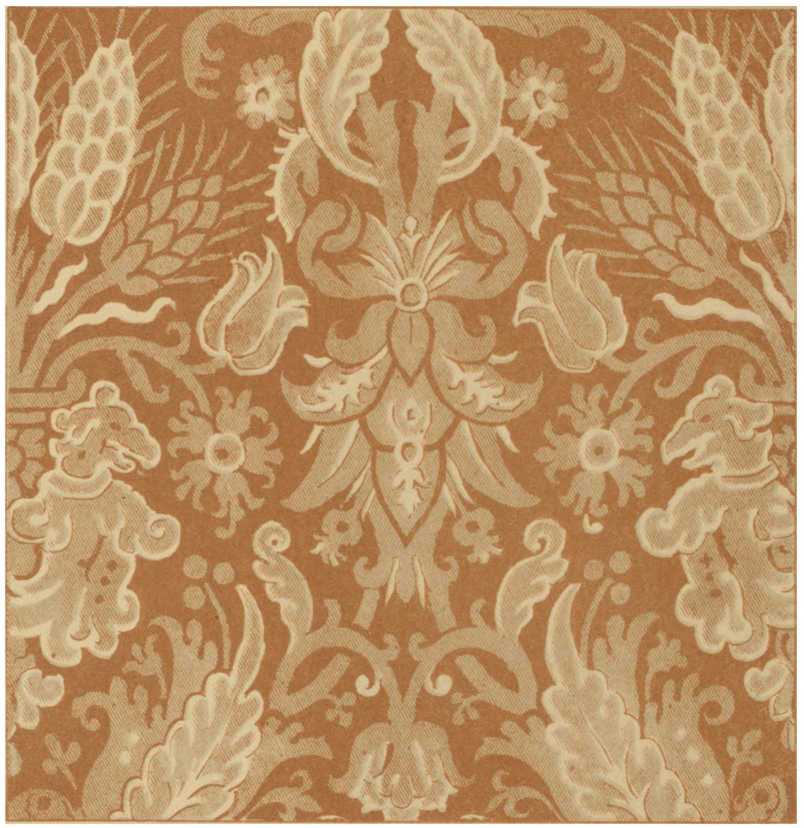
7004.
SILK DAMASK,
Italian, 16th century.
Vincent Brooks Day & Son, Lith.
A pleasing design, but the gold is very scant.
7005.

Woollen and Thread Stuff; ground, white; pattern, sprigs of artichokes and pomegranates. Spanish, 16th century. 11 inches by 7½ inches.
The warp is white linen thread, rather fine; and the weft of thick blue wool; and, altogether, it is a pleasing production, and the design nicely managed.
7006.
Satin Brocade; ground, bright green satin; pattern, sprigs of gold flowers. Genoese, late 16th century. 7½ inches by 6½ inches.
The flowers upon this rich and showy stuff are the lily, the pomegranate, and the artichoke in sprigs, each after a conventional form; and the gold in the thread is of the best, as it shows as bright now as almost on the first day of its being woven in the satin, which so seldom happens.
7007.
Silk Diaper; ground, creamy white; pattern, small bunches of leaves, flowers, and fruit, in white, green, and brown silk. Spanish, 16th century. 4¾ inches by 3½ inches.
Though the warp is woollen, the silk in the weft is rich and the pattern after a pretty design, where the pomegranate comes in often.
7008.
Piece of Silk Damask of the very lightest olive-green; pattern, a diaper of large sprigs of flowers. Italian, late 16th century. 1 foot 2¼ inches by 9¼ inches.
Pleasing in its quiet tone, and good design.
7009.

Damasked Silk; ground, light red, with lines of gold; pattern, leaves and flowers in deeper red. Sicilian, late 14th century. 10 inches by 6½ inches.
Very like several other specimens in this collection from the looms of Sicily, Palermo especially, in the pattern of its diapering, usually in green upon a tawny ground.
7010.
Silk Damask; ground, crimson; pattern, bunches of flowers of the pink and lily kinds, mingled with slips of the pomegranate. Spanish, 15th century. 12 inches by 10 inches.
The colour has much faded; but the design of the pattern, which is a crowded one, is very pretty; and the stuff seems to have been for personal wear.
7011.
Satin Damask; ground, green; pattern, an acorn and an artichoke united upon one small sprig, in yellow silk. Genoese, 16th century. 8 inches by 3½ inches.
Though small, this is a pretty design; and, perhaps, the great family of Della Rovere belonging to the Genoese republic may have suggested the acorn, “rovere” being the Italian word for one of the kinds of oak.
7012.
Satin Damask; the diapering is a sprig fashioned like the artichoke, and, in all likelihood, was outlined in pale pink. Italian, late 16th century. 1 foot 4½ inches by 9¼ inches.
A texture for personal attire which must have looked well.
7013.
Silk Damask; ground, crimson; pattern, a large artichoke flower bearing, in the middle, a fleur-de-lis. Genoese, late 16th century.
The design in the pattern is rather singular; and may have been meant for some noble, if not royal French family, connected with a house of the same pretensions in Spain.
7014.
Silk Brocade; ground, dull purple silk; pattern, flowers in gold, partially relieved in white silk. Spanish, late 16th century. 10 inches by 6 inches.
The flowers are mostly after a conventional form, though traces of the pomegranate may be seen; the gold thread is thin and scantily employed, and always along with broad yellow silk. With somewhat poor materials, a stuff rather effective in design is brought out.
7015.
Silk Web, on linen warp; ground, deep crimson; pattern, a quatrefoil with flowers at the tips of the barbs or angles at the corners, in gold thread, and filled in with a four-petaled flower in gold upon a green ground. German, 15th century. 14½ inches by 4½ inches.
Intended as orphreys of a narrow form; but made of poor materials, for the gold is so scant that it has almost entirely disappeared.
7016.

End of a Maniple; pattern, lozenges, green charged with a yellow cross, and red charged with a white cross of web; the end, linen embroidered with a saint holding a scroll, and fringed with long strips of flos-silk, green blue white and crimson. German, early 15th century. 15½ inches by 3 inches.
As this piece is put the wrong side out in the frame, the figure of the saint cannot be identified, nor the word on the scroll read.
7017.

Linen Web; ground, crimson and green; pattern, on the crimson square, a device in white; on the green, two narrow bands chequered crimson, white, and green, with an inscription (now illegible) between them. German, 15th century. 16 inches by 2½ inches.
Poor in every respect, and the small band of gold is almost black.
7018.

Orphrey Web; ground, gold; pattern, a flower-bearing tree in green, red, and white; and the sacred Name in blue silk. German, 15th century. 13½ inches by 3¾ inches.
The same stuff occurs at other numbers in this collection.
7019.
Orphrey Band; ground, gold thread; pattern, flowers in various-coloured silks. Flemish, 16th century. 19¾ inches by 2¾ inches.
The whole of this pretty piece is done with the needle, upon coarse canvas, and, no doubt, ornamented either a chasuble, dalmatic, or some liturgical vestment.
7020.
Crimson and Gold Damask; ground, crimson; pattern, a diaper of animals in gold. Italian, 15th century. 14¾ inches by 4 inches.
Exactly like another piece in this collection; a winged gaping serpent, with a royal crown just above but not upon its head, occupies the lowest part of the design; over it is the heraldic nebulée or clouds darting forth rays all about them, and above all, a hart, collared, and with head regardant lies lodged within a palisade or paled park.
7021.

Narrow Orphrey of Web; ground, red and gold diapered; pattern, armorial shields with words between them. German, 15th century. 1 foot 10 inches by 2 inches.
One of the shields is azure, two arrows argent in saltire; the other shield is argent, three estoils, two and one, azure; and on a chief or, two animals (indiscernible) sable: the words between the shields are so worn away as not to be readable.
7022.
Linen, block-printed; ground, white; pattern, two eagles or hawks crested, amid floriations of the artichoke form, and a border of roving foliage; all in deep dull purple. Flemish, late 14th century. 1 foot 8 inches by 6¾ inches.
The design is good, and evidently suggested by the patterns on silks from the south of Europe. Further on, we have another piece, No. 8303.
7023.
Orphrey of Web; ground, red and gold, figured with a bishop-saint. German, 15th century. 5 inches by 4½ inches.
The spaces for the head and hands are left uncovered by the loom, so that they may be, as they are here, filled in by the needle. In one hand the bishop, who wears a red mitre—an anomaly—and a cope with a quatrefoil morse to it, holds a church, in the other a pastoral staff.
7024.
Embroidery, in coloured silks upon fine linen damask. Flemish, 16th century. 10 inches by 2½ inches.
The fine linen upon which the embroidery is done, is diapered with a lozenge pattern: on one side of a large flower-bearing tree are the words:—“Jhesu Xpi,” and the other, “O crux Ave,” on each side of the tree is a shield unemblazoned but surrounded by a garland of flowers. Most likely this piece served to cover the top of the devotional table in a lady’s bed-room.
7025.
Embroidery, in coloured silks upon white linen; pattern, symbols of the Passion, flowers, and birds, with saints’ names. German, 17th century. 20½ inches by 6 inches.
Within a green circle, overshadowed on four sides by stems bearing flowers, stands a low column with ropes about it and a scourge at one side, and divided by it is the word Martinus, in red silk; amid the flower-bearing wide-spread branches of a tree are the names Ursula, Augustinus; within another circle like the first we see the cross with the sponge at the end of a reed, and the lance, having the name of Barbara in blue and crimson; and, last of all, another tree with the names Laurentius—Katerina. It is edged with a border of roses and daisies, and has a parti-coloured silk fringe. No doubt this piece served as the ornament of a lady’s praying-desk in her private room, and bore the names of those for whom she wished more especially to pray.
7026.
Orphrey of Web; ground, gold; pattern, two stems intertwined and bearing leaves and flowers, in crimson silk. German, 15th century. 9 inches by 2½ inches.
7027.
Linen, block-printed; ground, white; pattern, crested birds and foliage, just like another piece, No. 8615, in this collection. Flemish, late 14th century. 14 inches by 2¾ inches.
7028.
Small Piece of Orphrey; ground, yellow silk stitchery upon canvas, embroidered, within barbed quatrefoils in cords of gold, and upon a gold diapered ground, with the busts of two Evangelists in coloured silks, and the whole bordered by an edging of gold stalks, with trefoils. Italian, the middle of the 15th century. 10 inches by 5½ inches.
The quatrefoils are linked together by a kind of fretty knot, as well as the lengths in the two narrow edgings on the border by a less intricate one, all of which looks very like Florentine work. Most likely this orphrey served for the side of a cope.
7029.
Piece of a Liturgical Cloth, embroidered in white thread, very slightly shaded here and there in crimson silk, upon linen, with a quatrefoil at top enclosing the Annunciation and four angels, one at each corner swinging a thurible, and lower down, with St. Peter and St. Paul, St. James the Less and St. Matthias, St. James the Greater and St. Andrew; amid the leaf-bearing boughs, roving all over the cloth, may be seen an occasional lion’s head cabossed and langued gules. German, late 14th century. 2 feet 9½ inches by 1 foot 10½ inches.
This is but a small piece of one of those long coverings or veils for the lectern, of which such fine examples are in this collection.
The lion’s head cabossed would seem to be an armorial ensign of the family to which the lady who worked the cloth belonged, although such an ornament does sometimes appear, without any heraldic meaning, upon monuments of the period. In the execution of its stitchery the specimen before us is far below others of the same class.
7030.
Piece of a Stole or Maniple; ground, crimson silk (much faded); and embroidered with green stems twining up and bearing small round flowers in gold, and large oak leaves in white. Italian, 16th century. 13¾ inches by 3 inches.
The leaves, now so white, were originally of gold, but of so poor a quality that the metal is almost worn off the threads.
7031.
Silk Ribbon; ground, green and gold; pattern, squares and lozenges on one bar, spiral narrow bands on another, the bars alternating. Italian, early 17th century. 8 inches by 8¼ inches.
Both silk and gold are good in this simple pattern.
7032.
Silk Damask; ground, crimson; pattern, a square enclosing a floriation; both in bright yellow. Spanish, 15th century. 8 inches by 4½ inches.
Designed on Moorish principles, and coarse in its workmanship.
7033.
Silk Texture; ground, yellow; pattern, net-work, with flowers and mullets, all in dark blue. Sicilian, late 14th century. 10 inches by 3½ inches.
Of a simple design and poor in texture, and probably meant as the lining for a richer kind of stuff.
7034.
Silk Damask; ground, crimson silk; pattern, in gold thread, two very large lions, and two pairs, one of very small birds, the other of equally small dragons, and an ornament like a hand looking-glass. Oriental, 14th century. 2 feet 4 inches by 2 feet.
The large lions, which strongly resemble, in their fore-legs, the Nineveh ones in the British Museum, are placed addorsed regardant and looking upon two very small birds, while between their heads stands what seems like a looking-glass, upon a stem or handle; at the feet of these huge beasts are two little long-tailed, open-mouthed, two-legged dragons. The whole of this design now appears to be in coarse yellow thread, which once was covered with gold, but so sparingly and with such poor metal that not a speck of it can now be detected anywhere in this large specimen. The probability is that this stuff was wrought in some part of Syria, for the European market; at the lions’ necks are broad collars bearing two lines or sentences in imitated Arabic characters. Copes and chasubles for church use during the Middle Ages were often made of silks like this. Dr. Bock has figured this very piece in his “Geschichte der Liturgischen Gewänder des Mittelalters,” t. i. pl. iv.
7035.
Silk and Linen Texture; ground, crimson; pattern, star-like flowers. Spanish, 15th century. 5¾ inches by 2½ inches.
Poor in design as well as material.
7036.
Silk Diapered, with a man wrestling with a lion repeated; ground, crimson, the diaper in various colours, and the waving borders in creamy white, edged black, and charged with crimson squares, and fruits crimson and deep green. Byzantine, 12th century. 15¾ inches by 12½ inches.
This is one among the known early productions of the loom, and therefore very valuable. The lion and man seem to be meant for Samson’s victory over that animal, though, for the sake of a pattern, the same two figures are repeated in such a way that they are in pairs and confronted. Samson’s dress is after the classic form, and he wears sandals, while a long narrow green scarf, fringed yellow, flutters from off his shoulder behind him; and the tawny lion’s mane is shown to fall in white and black locks, but in such a way that, at first sight, the black shading might be mistaken for the letters of some word. This stuff is figured by Dr. Bock in his “Geschichte der Liturgischen Gewänder des Mittelalters,” t. i. pl. ii.
7037.
Silk and Linen Damask; ground, pale dull yellow-coloured linen; pattern, circles enclosing tawny foliation, in the midst of which is a purple cinquefoil, and the spandrils outside filled in with other foliations in the same tawny tone. Byzantine, 14th century. 13½ inches by 13 inches.
Of poor stuff, but of a rather pleasing design.
7038.
Silk Texture; ground, crimson; pattern, geometrical figures, mostly in bright yellow, filled in with smaller like figures in blue, green, and white. Moorish, 15th century. 1 foot 10½ inches by 1 foot 2¼ inches.
Most likely this garish and rather staring silk was woven either at Tangier or Tetuan, and found its way to Europe through some of the ports on the southern coast of Spain.
7039.
Silk Damask; ground, purple; pattern, lozenges, with so-called love-knots, one on each side, enclosing a flower and a lozenge chequered with Greek crosses alternately, all in yellow. Byzantine, 14th century. 8½ inches by 4 inches.
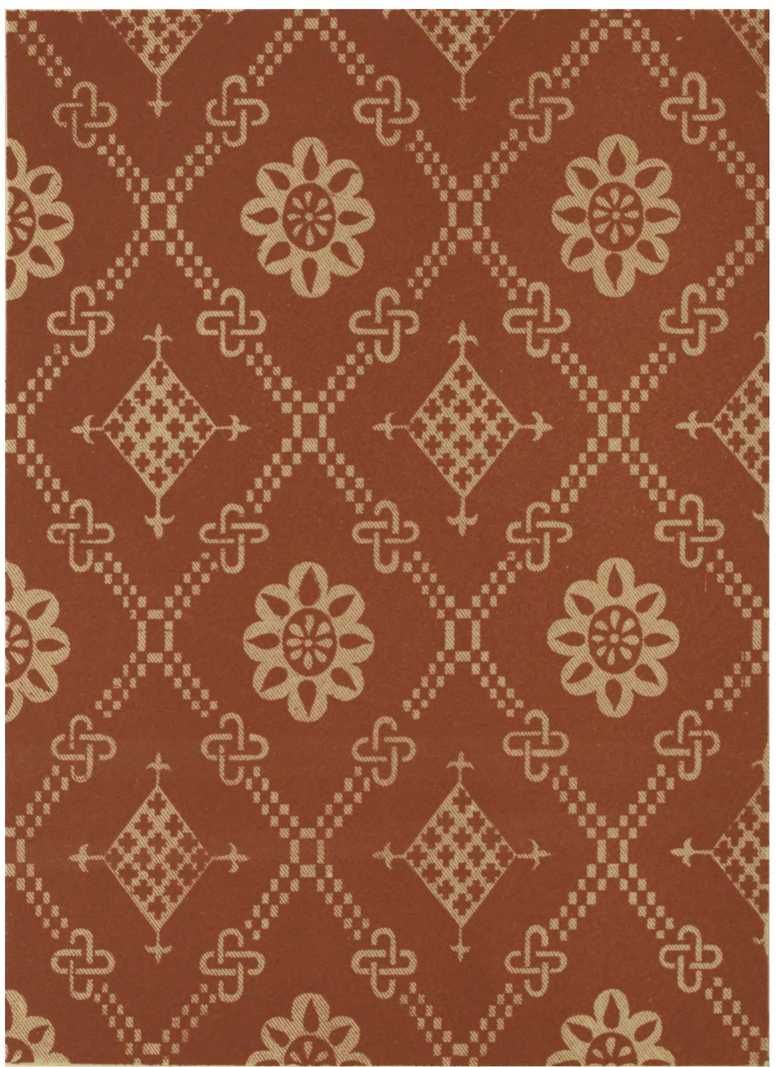
7039
SILK FABRIC,
Byzantine—— 14th century.
Vincent Brooks Day & Son, Lith.
Though poor in material this silk is so far interesting as it gives a link in that long chain of traditional feeling for showing the cross about stuffs, meant, as most likely this was, for ritual uses, and known among both the Latins and the Greeks as “stauracina.” To this day the same custom is followed in the East of having the cross marked upon the textiles employed in liturgical garments.
7040.
White Linen, diapered with a small lozenge pattern, and a border of one broad and two narrow bands in black thread. Flemish, 15th century. 12 inches by 11½ inches.
A good example of Flemish napery with the diaper well shown.
7041.
Silk and Linen Texture; ground, blue; pattern, a large petaled flower within a park fencing, upon the palings of which are perched two birds, and another somewhat like flower enclosed in the same way with two quadrupeds rampant on the palings. Italian, 15th century. 16 inches by 12¾ inches.
The birds seem to be meant for doves; and the animals for dogs. In design, but not in richness of material, this specimen is much like No. 7020.
7042.
Silk Damask; ground, deep blue; pattern, floriated lozenges, enclosing chequered lozenges in deep yellow. South of Spain, 14th century. 12 inches by 7¾ inches.
A tissue showing a Saracenic feeling.
7043.
Silk Damask; ground, tawny; pattern, a cone-shaped floriation amid foliage and flowers. Sicilian, 15th century. 13½ inches by 13 inches.
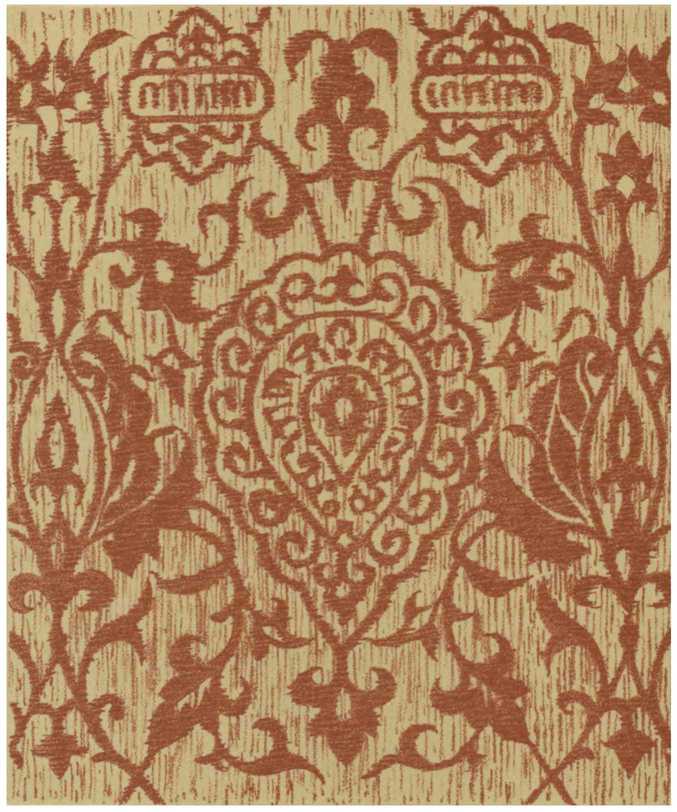
7043.
SILK DAMASK,
Sicilian—15th century.
Vincent Brooks Day & Son, Lith.
Both around the cone, as well as athwart the flowers, there are attempts at Arabic sentences, but in letters so badly done as easily to show the attempted cheat.
7044.
Silk Damask; ground, deep blue; pattern, six-sided panels filled in with conventional floriations, all in orange yellow. Spanish moresque, 15th century. 7 inches by 3½ inches.
If not designed and wrought by Moorish hands, its Spanish weaver worked after Saracenic feelings in the forms of its ornamentation.
7045.
Silk Damask; ground, amber, diapered in small lozenges; pattern, parrots in pairs outlined in blue and crimson, both which colours are almost faded, and having a border consisting of narrow parallel lines, some dark blue with white scrolls, others of gold thread, with deep blue scrolls. Oriental, late 12th century. 9 inches by 5¾ inches.
7045A.
Silk Border, torn off from the foregoing number. Both the one and the other are valuable proofs of the care taken by the Greek weavers, in the Greek islands, Greece proper, and in Syria, to give an elaborate design to the grounds of their silks.
7046.
Silk Brocade; ground, deep crimson; pattern, a diapering, in the same colour, of heart-shaped shields charged with a fanciful floriation, amid wavy scrolls bearing flowers upon them. South of Spain, 14th century. 6½ inches by 4¼ inches.
The fine rich tone of colour, so fixed that it is yet unfaded, is remarkable.
7047.
Silk Crape, deep crimson, thickly diapered with leaves upon the items. Syrian. 8¾ inches by 5¾ inches.
Not only the mellow tone, but the pretty though small pattern is very pleasing.
7048.
Silk and Cotton Texture; ground, white cotton; pattern, lozenges filled up with a broken fret of T-shaped lines and dots, and a cross in the middle; and with similar markings in the intervening spaces. Byzantine, 14th century. 14 inches by 5 inches.
Though of such poor materials this specimen is rather interesting from its design where the narrow-lined lozenges with their T’s and short intervening lines are all in green silk, now much faded; and the cross, known as of the Greek form, with those little dots are in crimson silk. Most likely it was woven in one of the islands of the Archipelago, and for liturgical use, such as the broad flat girdle still employed in the Oriental rituals.
7049.
Silk Damask; ground, fawn-colour; design, parrots and giraffes in pairs amid floriated ornamentation, all, excepting the portions done in gold, of the same tint with the ground. Sicilian, 13th century. 15 inches by 8 inches.
Like the specimen under No. 1274, where it is fully described.
7050.
Silk Damask; all creamy white; pattern, net-work, the oval meshes of which show floriations in thin lines upon a satiny ground. Syrian, 13th century. 11½ inches by 6 inches.
This fine rich textile is, in all probability, the production of a Saracenic loom, and from the eastern part of the Mediterranean.
7051.
Silk Tissue; ground, amber; pattern, a reticulation, each six-sided mesh filled in with alternate flowers and leaves, with here and there a circle enclosing a pair of parrots, addorsed, regardant; and between them a lace sort of column having, at top, a crescent all in dark blue. Oriental, late 12th century. 12½ inches by 6½ inches.
A good specimen, when fresh and new, of the eastern loom.
7052.
White Silk Damask, diapered with a chequer charged with lozenges, bearing the Greek gammadion, and sprinkled with larger flowers. Oriental, 14th century. 7½ inches by 5½ inches.
The pattern of this curious stuff is very small; and from the presence of the gammadion upon it, we may presume it was originally wrought for Greek liturgical use, somewhere on the coast of Syria.
7053.
Silk Damask; green; the pattern, an oval, enclosing an artichoke, and the spaces between filled in with foliations and pomegranates. Spanish, 16th century. 23 inches by 12½ inches.
Beautiful in tone of colour, and of a pleasing design, well shown by a shining satiny look of the silk; this is a specimen of a rich stuff.
7054.
Diapered Silk; ground, yellow; pattern, a large conventional foliation, in rows, alternating with rows of armorial shields, all in blue. Spanish, early 17th century. 20 inches by 17 inches.
A very effective design for household use: the shield is a pale, the crest a barred closed helmet topped by a demy wyvern.
7055.
Silk Diaper; ground, gold; pattern, flowers and fruits in crimson, slightly shaded in blue and green silk. Spanish, 16th century. 12½ inches by 8½ inches.
Though the gold on the ground be so sparingly put in, this stuff has a rich look, and the occurrence of the pomegranate points to Granada as the place of manufacture of this and other tissues of such patterns.
7056.
Silk Tissue, now deep amber, once bright crimson, diapered with a modification of the meander, and over that sprigs of flowers. Oriental, 13th century. 8 inches by 4½ inches.
To see the raised diapering of this piece requires a near inspection, but when detected, it is found to be of a pleasing type.
7057.
Silk Damask; ground, purple; pattern, a quatrefoil, within another, charged with a cross-like floriation, with a square white centre, surmounted by two eagles with wings displayed, upholding in their beaks a royal crown, all in green. Italian, early 15th century. 14 inches by 11½ inches.
Though the silk be poor the design is in good character, and the stuff would seem to have been wrought either at Florence or Lucca, for some princely German house.
7058.
Piece of Silk Damask; ground, red and gold; pattern, a pair of ostrich feathers, springing from a conventional flower, and drooping over an artichoke-like floriation, of a tint once light green, and shaded dull white. Spanish, 15th century. 14¾ inches by 7½ inches.
A curious mixture of silk, wool, linen thread and gold very sparingly employed. The ostrich feather is so unusual an element of ornamental design, especially in woven stuffs, that we may deem it a kind of remembrance of the Black Prince who fought for a Spanish king, Don Pedro the Cruel, at the battle of Navaretta, or Najarra, if not having a significance of the marriage of Catherine of Arragon, first with our Prince Arthur, eldest son of Henry VII, and after his death, with his younger brother, Henry VIII, each of whom was in his time Prince of Wales, whose badge became one or more ostrich feathers. In old English church inventories drawn up towards the middle and the end of the 15th century, mention is often found of vestments made of a Flemish stuff, called Dorneck, from the name in Flanders for the city of Tournay, where it was made, but spelt in English various ways, as Darnec, Darnak, Darnick, and even Darnep. Such an inferior kind of tissue woven of thin silk mixed with wool and linen thread, was in great demand, for every-day wear in poor churches in this country. Though not wrought at Tournay, the present specimen affords a good example of that sort of stuff called Dorneck, which, very probably, was introduced into Flanders from Spain. Besides the present textile, another, figured in the “Mélanges d’Archéologie,” t. iii. pt. xxxiii, furnishes an additional instance in which the ostrich feather is brought into the design.
7059.

Green Silk Damask; pattern, floriations and short lengths of narrow bands arranged zig-zag. Italian, 17th century. 8 inches by 6½ inches.
An extraordinary but not pleasing pattern.
7060.
Silk and Linen Damask; ground, creamy white; pattern, in light brown, once pink, a conventional artichoke. Italian, 16th century. 1 foot 5 inches by 9½ inches.
The warp is thread, but still the texture looks well.
7061.
Silk and Gold Damask; ground, light green silk; pattern, large vine-leaves and stars, with a border of griffins and fleur-de-lis, in gold. Sicilian, 14th century. 10¼ inches square.
This beautiful stuff was, in all likelihood, woven at the royal manufactory at Palermo, and meant as a gift to some high personage who came from the blood royal of France. The griffins, affronted or combatant, are drawn with much freedom and spirit, and though the gold be dull, the pattern still looks rich.
7062.
Gold Web, diapered with animals in green silk. French, late 13th century. 14¼ inches by 2¼ inches.
Probably wrought in a small frame, at home, by some young woman, and for personal adornment. So much is it worn away, that the green beardless lion, with a circle of crimson, can be well seen only in one instance. A narrow short piece of edging lace, of the same make and time, but of a simple interlacing strap-pattern, is pinned to this specimen.
7063.
Green and Fawn-coloured Silk Diaper; pattern, squares, green, filled in with leaves fawn-coloured, and beasts and birds, green. Sicilian, late 13th century. 8 inches by 3¼ inches.
Another of those specimens, perhaps of the Palermitan loom: all the animals look heraldic, and are lions, griffins, wyverns, and parrots. The stuff itself is not of the richest.
7064.
Gold Lace, so worn by use that the floriation on the oblong diaper is obliterated. French, 13th century. 9 inches by 1¼ inches.
7064A.
Gold Lace; pattern, interlacing strap-work. French, 13th century. 7 inches by 1½ inches.
Equally serviceable for personal or ecclesiastical use.
7065.

Black Silk Damask; figured with a tower surrounded by water, over which are two bridges; in the lower court are two men, each with an eagle perched upon his hand; from out the third story of the tower springs a tree, bearing artichoke floriations. Italian, 15th century. 11 inches by 8 inches.
Another piece of this identical damask occurs at No. 8612, but there the design is by no means so clear as in the piece before us.
7066.
Green Silk; pattern, a lozenge reticulation, each mesh filled in with four very small voided lozenges placed crosswise, in pale yellow. Oriental, 14th century. 5¼ inches by 4-⅝ inches.
7067.
Silk and Gold Damask; ground, green silk; pattern, conventional floriation, with a circular form of the artichoke. Spanish, early 15th century. 1 foot 3¾ inches by 4 inches.
One of those samples of that poor texture which came from the Spanish loom, with the sham gold, which we have before observed in other examples, of thin parchment gilt with a much debased gold.
7068.
Silk Damask; straw-colour; pattern, lozenge-shaped net-work, each mesh enclosing a flower. Spanish, 15th century. 13¾ inches by 12 inches.
So worn is this piece that it is with difficulty that its simple design can be made out.
7069.
Silk Damask; straw-colour; pattern, an imaginary eagle-like bird, enclosed by a garland full of ivy leaves. Sicilian, 14th century. 7¾ inches by 6 inches.
The ground is completely filled in with the well-designed and pretty diapering; but damp has sadly spoiled the specimen.
7070.
Silk Damask; ground, purple; pattern, heraldic figures, birds, and oval floriations, in gold thread. Oriental, 14th century. 16 inches by 9 inches.
On an oval, floriated all round, and enclosing two lionesses addorsed rampant regardant, are two wyvern-like eagles with curious feathered tails, regardant; below, are two cockatoos addorsed regardant, all in gold. The oval floriation is outlined with green. When new, this stuff must have had a brave appearance, and shows a Persian tradition about it.
7071.
Linen, embroidered in silk; ground, fine linen; pattern, a zigzag, alternating in light blue and brown. German, 15th century. 14 inches by 3½ inches.
The zigzag may be termed dancette, and all over is parted into lozenges, each lozenge charged with a cross made of mascles, and the spaces between the brown and the blue zigzags, filled in with others of a light brown coloured diapering.
7072.
Silk Damask; ground, violet or deep purple; pattern, angels with thuribles, and emblems of the Passion, in yellow and white. Florentine, late 14th century. 18¼ inches by 15¾ inches.
This truly artistic and well-executed stuff displays a row of angels in girded albs, all flying one way, as with the left hand they swing thuribles, and another row kneeling, each with a crown of thorns in his hands, alternating, with a second set of angels, in another row, each bearing before him a cross. All the angels are done in yellow, but with face and hands white, and the whole ground is strewed with stars. It is likely that this fine stuff was woven expressly for the purple vestments worn in Passion time, at the end of Lent.
7073.
Crimson Silk and Gold Brocade; ground, a diaper of crimson; pattern, an oval reticulation, in the meshes of which is an artichoke flower, all in gold. Genoese, 16th century. 16¾ inches by 9 inches.
The design of this rich stuff is well managed, and the diapering in dull silk upon a satin ground throws out the gold brocading admirably; the meshes which enclose the flowers are themselves formed of garlands.
7074.

Raised Crimson Velvet, damasked in gold; pattern, the artichoke and small floriations in gold. Genoese, 16th century. 15¾ inches by 11½ inches.
A specimen of what, in its prime, must have been a fine stuff for household decoration, though of such a nature as to have freely allowed it to be employed for ecclesiastical purposes. It has seen rough service, so that its pile is in places thread-bare, and its gold almost worn away.
7075.
Raised Velvet on Gold Ground; pattern, a very large rose with broad border in raised crimson velvet, filled in with a bush of pomegranates, in very thin lines of raised crimson velvet; the rest of the ground is diapered all over with the pomegranate tree in very thin outline. Genoese, early 16th century. 2 feet 9 inches by 2 feet.
The gold thread was so poor that the precious metal has almost entirely disappeared; but when all was new, this stuff must have looked particularly grand. The large red rose, and the pomegranate, make it seem as if it had been wrought, in the first instance, for either our Henry the Seventh, or Henry the Eighth, after the English marriage of Catherine of Arragon.
7076.
Raised Velvet and Gold; pattern, conventional flowers in gold, upon tawny-coloured velvet. Genoese, late 15th century. 12 inches by 8 inches.
The gold of the design is, in parts, nicely diapered; and the gold thread itself thin, and now rather tarnished.
7077.
Raised Crimson Velvet; pattern, an artichoke amid flowers. Genoese, late 15th century. 16½ inches by 11½ inches.
The pile is rich; and when it is borne in mind how the Emperor Charles V. honoured Andrea Dorea, it is not surprising that his countrymen had a partiality for the Spanish emblem of their great captain’s admirer.
7078.
Raised Blue Velvet; ground, deep blue; pattern, within an outlined seven-petaled floriation in silk, an artichoke, with sprigs of flowers shooting out of it. Genoese, late 15th century. 17½ inches by 10¼ inches.
Though much worn by hard usage, this stuff is of a pleasing effect, owing to its agreeable design, which not unfrequently occurs perfect, and consists of a kind of circle in narrow lines, somewhat in the shape of a flower, but having at the tips of its prominent feathering cusps of florets.
7079.

Figured Blue Velvet; embroidered in gold thread, with cinquefoils, enclosing a floriation of the artichoke form, with smaller ones around it. Spanish, 15th century. 15 inches by 9½ inches.
By the shape of this piece it must have been cut off from the end of a chasuble. Though the velvet is rich, the embroidery is poor, done as it is in thin outline, but still of a good form.
7080.
Orphrey Web, silk and gold; ground, crimson; pattern, on a gold diapering, conventional floriations and scrolls, in one of which is the bust of St. Peter, with his key in one hand and a book in the other. Florentine, late 15th century. 21 inches by 8 inches.
Like many other samples, this rich web of crimson silk and fine gold thread was wrought for those kinds of broad orphreys needed for chasubles and copes; and sometimes worked up into altar-frontals.
7081.
Silk Damask; ground, yellow; pattern, net-work, the meshes, which are looped to each other, filled in with a conventional floriated ornament, all in green. Italian, 16th century. 16½ inches by 10¾ inches.
Intended for household adornment. This stuff must have had an agreeable effect, though the green has somewhat faded.
7082.
Silk Damask; ground, yellowish pale green; pattern, a diapering of very small leaves and flowers. Oriental, 13th century. 6½ inches by 5¾ inches.
Just like No. 7056, and needing the same near inspection to find out its small but well-managed delicate design.
7083.
Silk and Linen Texture; ground, yellow; pattern, amid foliage, two cheetahs, face to face, all blue, but spotted yellow. Syrian, 14th century. 7¼ inches by 6½ inches.
At the same time that the warp is of linen, the woof of silk is thin; and a bold design is almost wasted upon poor materials. The specimen, however, is so far valuable, as it shows us how, for ages, a Persian feeling went along with the workmen on the eastern shores of the Levant.
7084.
Silk Damask; ground, tawny; pattern, birds, flowers, and heart-shaped figures, encircled with imitated Arabic letters, all mostly in green, very partially shaded white. Sicilian, 14th century. 19½ inches by 5½ inches.
Above a heart-shaped ornament, bordered by a sham inscription in Arabic, and surrounded by a wreath, are two birds of the hoopoe kind, and beneath, two other birds, like eagles; and this design is placed amid the oval spaces made by garlands of flowers. All the component elements of the pattern are in small, though well-drawn figures.
7085.
Silk and Gold Damask; ground, tawny; pattern, fruit, beasts, and birds. Sicilian, 14th century. 22¼ inches by 10 inches.
This rich stuff has an elaborate pattern, consisting of three pieces of fruit, like oranges or apples, with a small pencil of sun-rays darting from them above, out of which springs a little bunch of trefoils, which separate two lions, in gold, that are looking down, and with open langued mouths; below is another and larger pencil of beams, shining upon two perched eagles, with wings half spread out for flight. Between such groups is a large flower like an artichoke, with two blue flowers, like the centaurea, at the stalk itself; above which is, as it were, the feathering of an arch with a bunch of three white flowers, for its cusp. With the exception of the lions and flowers, the rest of the pattern is in green.
7086.
Silk and Gold Brocade; ground, dark purple; pattern, all in gold, floriations, birds and beasts. Oriental, 13th century. 18¼ inches by 7 inches.
When new, this rich stuff must have been very effective, either for liturgical use or personal wear. There is a broad border, formed by the shallow sections of circles, inscribed with imitated Arabic characters. Out of the points or featherings made by the junctions of the circular sections spring forth bunches of wheat-ears, separating two collared cheetahs with heads reversed; and from other featherings, a large oval well-filled floriation, upon the branches of which are perched two crested birds, may be hoopoes, at which the cheetahs seem to be gazing. Over the wheat-ears, drops are falling from a pencil of sunbeams above them; below are two flowers in silk, once crimson.
7087.
Silk Damask; ground, blue; pattern, birds, animals, and flowers, in gold, and different coloured silks. Oriental, late 13th century. 17½ inches by 7½ inches.
So fragmentary is this specimen, that it is rather hard to find out the whole of the design, which was seemingly composed of white cheetahs collared red, in pairs; above which sit two little dogs, in gold, looking at one another; and just over them a pair of white eagles, small too, on the wing, and holding a white flower between them. Running across the pattern was a band, in gold, charged with circles enclosing a sitting dog, a rosette, a circle having an imitated Arabic sentence over it.
7088.
Part of a Stole, or of a Maniple; silk brocade; ground, light crimson; pattern, floriations in green, with lions rampant in gold. Sicilian, late 14th century. 20½ inches by 3 inches.
The parti-coloured fringe to this liturgical appliance is of poor linen thread not corresponding to the richness of the stuff.
7089.
Silk and Gold Damask; ground, gold; pattern, branches of foliation, in yellow silk. Oriental, 15th century. 17½ inches by 3½ inches.
Though rather rich in material, the design is so obscure as hardly to be observable.
7090.
Silk Damask; ground, purple; pattern, a diaper of parrots, and floriations, in bright greenish yellow. Oriental, 14th century. 11 inches by 4½ inches.
Though of a poor silk, the design is pretty, and tells of the coast of Syria, where many of the looms were kept at work for European use.
7091.
Silk and Gold Damask; ground, purple; pattern, fleurs-de-lis in gold. Sicilian, late 14th century. 4 inches square.
Done, as was often the case, for French royalty, or some one of French princely blood, at Palermo, and sent to France. The stuff is rich, and well sprinkled with the royal golden flower.
7092.
Silk Damask; ground, amber (once crimson); pattern, a diaper of flowers and leaves, in yellow. Sicilian, late 14th century. 9 inches by 5¼ inches broad.
Of a quiet and pleasing kind of design, showing something like a couple of letters in the hearts of two of its flowers.
7093.
Embroidery in silk upon linen; pattern, men blue, women white, standing in a row hand in hand; the spaces filled up with lozenges in white. The women upon a green, the men upon a white ground. German, 16th century. 8¾ inches by 6½ inches.
So very worn away is the needlework, that it is very hard to see the design, which, when discovered, looks to be very stiff, poor, and angular.
7094.
Silk Damask; ground, straw-colour; pattern, net-work of lozenges and quatrefoils, filled in each with a cross pommée, amid which are large circles containing a pair of parrots, all in raised satin. Oriental, 13th century. 8¾ inches by 7¾ inches.
This fine textile was, in all likelihood, woven by Christian hands somewhere upon the Syrian coast, and while a religious character was given it both by the crosses and the emblematic parrots, a Persian influence by the use of the olden traditionary tree between the parrots, or the Persians’ sacred “hom,” was allowed to remain upon the designer’s mind without his own knowledge of its being there, or of its symbolic meaning in reference to Persia’s ancient heathen worship.
7095.
Blue Linen, wrought with gilt thin parchment; pattern, an oval, filled in with another oval, surrounded by six-petaled flowers, all in outline; this piece is put upon another of a different design, of which the pattern is an eagle on the wing. Spanish, 14th century. 7½ inches by 4-⅝ inches.
This is another specimen of gilt parchment being used instead of gold thread.
7099.
Foot-cloth; ground, green worsted; pattern, birds and flowers. German, 16th century. 4 feet 7 inches by 2 feet 7 inches.
In all likelihood, this piece of needlework served the purpose of a rug or foot-cloth, or, may be, as the cloth covering for the seat of a carriage. It is worked in thick worsted upon a wide-meshed thread net, and after a somewhat stiff design.
7218.
Table-cover, in green silk, with wide border of Italian point lace. Venetian, late 16th century. 5 feet 6 inches by 3 feet 2 inches.
The pattern of the lace is very bold and well executed, and consists of a large foliage-scroll of the classic type, ending in a lion’s head, so cherished by the Venetians, as the emblem of the Republic’s patron-saint, St. Mark. The poor thin silk is not worthy of its fine trimming.
7219.
Table-cover, in light blue silk, with wide border of Italian point lace. Venetian, late 16th century. 6 feet 5 inches by 4 feet.
The pattern of the lace, like the foregoing specimen, is after a classic form, consisting of two horns of plenty amid foliage and scroll-work; in both pieces we see the effect of that school which brought forth a Palladio.
7468.
A Lectern Veil of silk and gold cut-work; ground, crimson silk; design, of cut-work in cloth of gold and white and blue silk, ramifications ending in bunches of white grapes, horns of plenty holding fruit, and ears of wheat. French, 17th century. 9 feet by 1 foot 9¾ inches.
Such veils are thrown over a light moveable stand upon which the book of the Gospels and Epistles is put at high mass, for the deacon’s use as he sings the Gospel of the day. The cut-work is well-designed, and sewed on with an edging of blue cord in some places, of yellow in others. The cloth of gold was so poor that now it looks at a short distance like mere yellow silk.
7674.

Missal Cushion; ground, red silk; pattern, two angels standing face to face and holding between them a cross, all in gold, excepting the angels’ faces and hands, which are white; there are four tassels, one at each corner, crimson and gold. Florentine, early 15th century. 1 foot 3 inches by 1 foot.
The covering for this cushion is made of orphrey web, the gold of which is very much faded; and, like other specimens from the same looms, shows the nudes of the figures in a pinkish white. The use of such cushions for upholding the missal upon the altar is even now kept up in some places. According to the rubric of the Roman Missal, wherein, at the beginning among the “rubricæ generales,” cap. xx. it is directed that there should be “in cornu epistolæ (altaris) cussinus supponendus missali.”
7788.
Chasuble, in crimson velvet, with orphreys embroidered in gold and coloured silks. Florentine, 15th century. 4 feet long by 2 feet 5 inches broad.
This garment has been much cut down, and so worn that, in parts, its rich and curious orphreys are so damaged as to be unintelligible. Over the breast and on the front orphrey is embroidered the Crucifixion, but after a somewhat unusual manner, inasmuch as, besides our Lord on the Cross, with His mother and St. John the Evangelist standing by; two other saints are introduced, St. Jerome on one side, St. Lucy on the other, kneeling on the ground at the foot of the Cross, possibly the patrons, one of the lady, the other of the gentleman, at whose cost this vestment was wrought. Under this is St. Christina defending Christianity against the heathens; her arraignment, for her belief, before one of Dioclesian’s officials; her body bound naked, and scourged at a pillar. On the back orphrey, the same martyr on her knees by the side of another governor, her own pagan father, and praying that the idol, held to her for worship by him, may be broken; the saint maintaining her faith to those who came to argue with her before the window of the prison, wherein she is shut up naked in a cauldron, with flames under it, and praying with one of the men who are feeding the fire with bundles of wood, on his knees, as if converted by her words; then, the saint standing at a table, around which are three men; and below all, a piece so worn and cut, as to be unintelligible. Upon the last square but one is a shield argent, a bend azure, charged with a crescent or, two stars or, and another crescent or, probably the blazon of the Pandolfini family, to whose domestic chapel at Florence this vestment is said to have belonged.
7789, 7790.
Dalmatic, and Tunicle, in crimson velvet, with apparels of woven stuff in gold and crimson silk, figured with cherubic heads. Florentine, 15th century.
The velvet is of a rich pile, and the tone of colour warm. The orphreys, or rather apparels, are all of the same texture, woven of a red ground, and figured in gold with cherubic heads, having white faces; the lace also is red, and gold; but in both the gold is quite faded. The sleeves are somewhat short, but the garment itself is full and majestic. Doubtless the dalmatic and tunicle formed a part of a full set of vestments, to which the fine and curiously embroidered chasuble, No. 7788, belonged; and their apparels, or square orphreys, above and below, before and behind, are in design and execution alike to several others from the looms of Florence, which we have found among various other remains of liturgic garments in this collection.
7791.
Piece of Woven Orphrey; ground, crimson silk; design, in gold, an altar, with an angel on each side clasping a column, and above, other two angels worshipping; and upon the step leading to the altar, the words “sanctus, sanctus.” Florentine, early 16th century. 9 feet 7 inches by 9 inches.
The design is evidently meant to express the tabernacle at the altar, where the blessed sacrament is kept in church, for administration to the sick, &c., and, like all similar textiles, was made of such a length as to be applicable to copes, chasubles, and other ritual uses.
7792.

Veil for the subdeacon, of raised velvet and gold; ground, gold; pattern, a broad scroll, showing, amid foliation, a conventional artichoke in raised crimson velvet. Florentine, late 16th century. 14 feet 4 inches by 1 foot 10 inches.
The bright yellow ground is more of silk than gold thread, and the velvet design, deep in its rich pile and glowing in its ruby tint, is dotted with the usual gold thread loops; at each end is a golden fringe; both edges are bordered with poor gold open lace; and still attached to it are the two short yellow silk strings for tying it in front, when put about the shoulders of the subdeacon at the offertory, when the paten is given him to hold at high mass.
7793.

Hood of a Cope; ground, mostly gold, and a small part, silver; figured with two adoring angels; the centre piece gone, and in its place a saint standing, and done in woven work. Flemish, 15th century; the inserted saint, Florentine, 15th century. 1 foot 4½ inches by 1 foot 4½ inches.
The figures of the angels in worship are nicely done in flos-silk; and perhaps the original lost figure was that of our Lord, or of the B. V. Mary. The lay saint now inserted, bare-headed, and leaning on his sword, wearing a green tunic, and a blue mantle sprinkled with trefoils in red and gold, perhaps meant for fleurs-de-lis, seems to be intended for St. Louis of France. The broad green silk fringe, and the pointed shape of the hood will not escape notice; and behind may yet be seen the eyes by which this hood was hung upon the cope. The poor shabby silver tinsel round this king is an addition quite modern.
7794.
Burse for Corporals; ground, crimson satin; pattern, foliations and flowers in coloured silks and gold, with a phœnix rising from the flames in the middle. German, late 17th century. 11 inches by 10¼ inches.
7795.
Burse for Corporals; ground, crimson velvet; pattern, velvet upon velvet, lined at back with silk; ground, amber, figured with a modification of the artichoke, in deep crimson. Italian, 16th century. 10¾ inches by 10 inches.
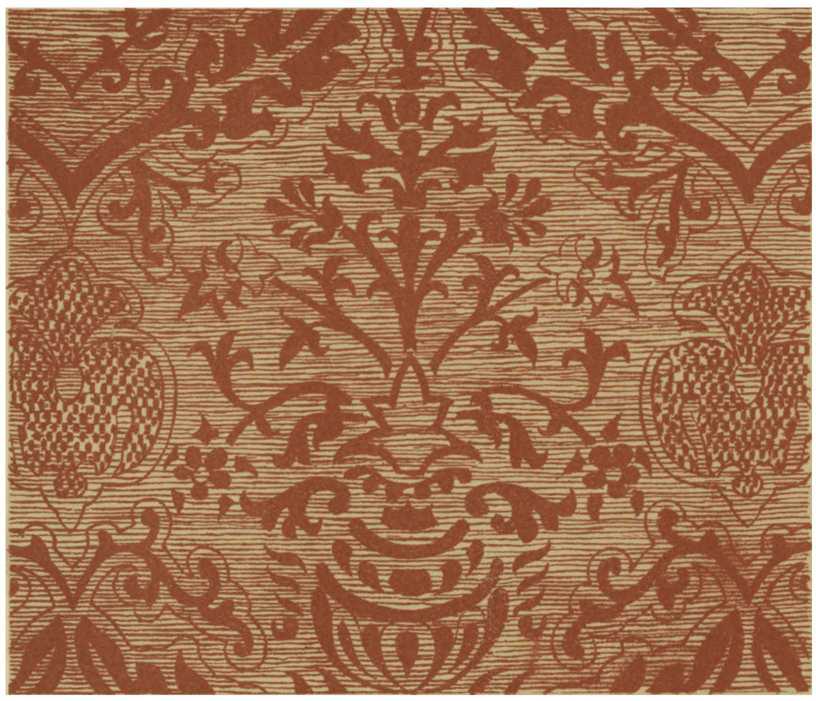
7795.
SILK DAMASK,
Italian—— 16th century.
Though probably this burse, like the one above, may have come from a church in Germany, its beautiful materials are of Italian manufacture; the fine deep piled velvet upon velvet, from Genoa, the well-designed and pleasing silk at back, from Lucca, and many years, may be a half century, older than the velvet, make this small liturgical article very noteworthy on account of its materials.
7799.
Veil of raised crimson velvet; ground, yellow silk and gold thread; pattern, large floriations all in crimson velvet, freckled with little golden loops. Florentine, 17th century. 11 feet 2½ inches by 1 foot 10 inches.
One of those magnificent textures of cut velvet, with a fine rich pile, sent forth by the looms of Tuscany. Its use may have been both for a veil to the lectern for the Gospel, and to be worn by the subdeacon at high mass; the two strings, attached to it still, evidently show its application to the latter purpose. A heavy gold fringe borders its two ends, the scolloped shape of which is rather unusual.
7813.
Front Orphrey of a Chasuble, embroidered with figures in niches. Italian, late 15th century. 3 feet 1 inch by 7 inches; at the cross, 1¾ inches.
The first figure is that of our Lord giving His blessing, and of a very youthful countenance; next, seemingly the figure of St. Peter; then St. John the Evangelist. All these are done in coloured silks, upon a ground of gold, and within niches; but are sadly worn. The two angels at our Lord’s head are the best in preservation; but the whole is rather poor in execution. As a border, there are two strips figured with silver crosses upon grounds of different coloured silks.
7813A.
Part of an Orphrey, embroidered with figures of the Apostles. Italian, late 15th century. 4 feet by 7½ inches.
Of the five personages, only the second, St. Paul, can be identified by his symbol of a sword. All are wrought upon a golden diaper, and standing within niches; but though the features are strongly marked in brown silk lines, as a specimen it is not remarkably good; and, most likely, served as the orphrey to some vestment, a chasuble, the orphrey of which for the front was the piece numbered 7813.
7833.
Piece of Applied Embroidery, upon silk of a creamy white, an ornamentation in crimson velvet and cloth of gold, scolloped and tasseled. Italian, early 17th century.
Rich of its kind, and probably a part of household furniture.
7900.
Silk Damask; ground, blue; pattern, diaper of stalks, bearing a broad foliation in whitish blue, and lions, and birds like hoopoes, all in gold, between horizontal bands inscribed with imitated Saracenic letters. Sicilian, 14th century, 10¾ inches square.
A beautiful design; and in the bands, at each end of the imitated word in Saracenic characters, are those knots that are found on Italian textiles. So poor was the gold on the thread, that it is sadly tarnished.
8128.
Apparels to an Alb; figured with the birth of the B. V. Mary, in the upper one; and in the lower, the birth of our Lord; with two armorial shields alternating between the spandrils of the canopies. English needlework, on crimson velvet, and in coloured silks and gold thread, done in the latter half of the 14th century. Each piece 2 feet 8½ inches by 10½ inches. Presented by Ralf Oakden, Esq.
In many respects these two apparels, seemingly for the lower adornment of the liturgical alb, one before, the other behind, are very valuable; besides the subjects they represent, they afford illustrations of the style of needlework, architecture, costume, and heraldry of their time.
In the upper apparel, we have the birth and childhood of the mother of our Lord, as it is found in one of the apocryphal books of the New Testament, entitled,—“Evangelium de Nativitate S. Mariae,” which the Latins got from the Greeks, as early, it would seem, as the second or third age of the Church. Though of no authority, this book was in especial favour with our countrymen, and it was not unfrequently noticed in their writings; hence, no doubt, the upper apparel was suggested by that pseudo-gospel. In its first compartment, we behold a middle-aged lady, richly clad, having a mantle of gold, lined with vair or costly fur, about her shoulders, seated on a cushioned stool with a lectern, or reading-desk before her, and upon it an open book of the Psalms, with the beginning of the fiftieth written on its silver pages,—“Miserere mei, Deus,” &c., and outstretching her hands towards an angel coming down from the clouds, and as he hails her with one hand, holds, unrolled, before her eyes, a scroll bearing these words:—“Occurre viro ad portam.” This female is Ann, wife of Joachim, and mother of Mary; and the whole is thus set forth in the Codex Apocryphus Novi Testamenti; where the angel, who appeared to her while she was at prayer, is said to have spoken these words:—“Ne timeas, Anna, neque phantasma esse putes.... Itaque surge, ascende Hierusalem, et cum perveneris ad portam quæ aurea, pro eo quod deaurata est, vocatur, ibi pro signo virum tuum obvium habebis,” &c.—Evangelium de Nativitate S. Mariae, c. iv. in Cod. Apocry. ed. Thilo, pp. 324, 325. This passage is thus rendered in that rare old English black-letter book of sermons called “The Festival,” which was so often printed by Caxton, Wynkyn de Worde, and other early printers in London:—“Anne was sory and prayed to God and sayde, Lorde, that me is woo. I am bareyne, and I may have noo frute ... and I knowe not whyther he (Joachim my husband) is gone. Lorde have mercy on me. Whene as she prayed thus an angell come downe and comforted her, and sayd: Anne, be of gode comfort, for thou shalt have a childe in thyne olde age, there was never none lyke, ne never shall be ... and whan he (Joachim) come nye home, the angell come to Anne, and bade her goo to the gate that was called the golden gate, and abide her husbonde there tyll he come. Thene was she glad ... and went to the gate and there she mete with Joachim, and sayd, Lord, I thanke thee, for I was a wedow and now I am a wyfe, I was bareyne and now I shall bear a childe ... and whan she (the child) was borne, she was called Mary.”—The Festival, fol. lxvi. In the second compartment we have a further illustration of the foregoing text in the representation of the golden gate at Jerusalem, and Anna and Joachim greeting one another as they meet there. In the third, there is the lying-in of Anna, who from her own bed is swathing her new-born child, whom the Almighty’s right hand coming from heaven is blessing. In the fourth is Anna bringing her little girl Mary, when three years old, as an offering to God, in the temple, before the High Priest. In the fifth and last compartment of this upper row of niches, we see Anna teaching her daughter, the B. V. Mary, to read the Psalter. In the first compartment in the lower apparel, or on the second row, the angel Gabriel, winged and barefoot, is represented standing before the B. V. Mary, whom with his right he is blessing, while in his left he holds out before her a scroll on which are the words:—“Ave Maria gracia.” She outstretches her hands, and gently bending her head forwards, seems to bow assent; between them is the lily-pot, and, as it should, holds but one flower-stem, with three, and only three, full-blown lilies (“Church of our Fathers,” t. iii. p. 247); above, is the Holy Ghost, figured as a white dove, coming down upon the Virgin. To this follows St. Elizabeth’s visit to the B. V. Mary, or the Salutation, as it is often called in this country. Then we have the Nativity, after the usual manner, with the ox and ass worshipping at the crib wherein our Lord is lying in swaddling clothes; and St. Joseph is figured wearing gloves. Filling the next niche, we behold the angel coming from the skies, with a scroll in his hands inscribed,—“Gloria in excelsis Deo,” to the shepherds, one of whom is playing on a bag-pipe with one hand, as with the other he is ringing a bell, which draws the attention of his dog that sits before him with upturned head and gaping mouth. In the last compartment we have the three wise men, clothed and crowned as kings, going to Bethlehem with their gifts, but none of them is a negro. Of the two shields hung alternately between every spandril, one is,—barry of ten argent and gules, which was the blazon of Thornell de Suffolk; and the other,—azure three cinque-foils argent, that of the family of Fitton, according to a MS. ordinary of arms, drawn up by Robert Glover, some time Somerset herald. In the subject of the shepherds, the ground is so plentifully sprinkled with growing daisies, that it seems as if it were done on purpose to tell us that she whose hands had wrought the work was called Margaret; as the flower was in French designated “La Marguerite,” it became the symbol of that saint’s name, and not unfrequently was the chosen emblem of the females who bore it.
8226.
Gold Embroidery on purple silk over a white cotton ground, with figures of our Saviour and of the apostles St. Peter, St. Simon, and St. Philip. Sicilian work, done about the end of the 12th century. 14½ inches by 7 inches.
This piece of needlework with its figures, as well as its architectural accessories, wrought in gold thread, though rude in its execution, is not without an interest. In it the liturgical student will find the half of an apparel (for it has been unfeelingly cut in half at some remote time) for the lower hem in front of the linen garment known as the alb. Originally it must have consisted of seven figures; one of our Lord, in the middle, sitting upon a throne in majesty with the Α on the one side and the Ω on the other side of His nimbed head, and His right hand uplifted in the act of bestowing His benediction. To the left must have been three apostles; to the right are still to be seen the other three, nearest our Saviour, St. Peter, holding in his left hand a double-warded key, next to him St. Simon, with his right hand in the act of blessing, and holding in his left a saw fashioned not like ours, but as that instrument is still made in Italy, and last of all St. Philip, but without any symbol. What look like half-moons with a little dot in the inside, and having a cross between them, are nothing more than the word “Sanctus,” thus contracted with the letter S written as the Greek sigma formed like our C, a common practice in Italy during the middle ages, as may be seen in the inscriptions given by writers on Palæography.
Our Lord is seated within an elongated trefoil, and, at each corner at the outward sides, is shown one of His emblems, better known as the Evangelists’ symbols hinted at by the prophet Ezekiel, i. 10: of these, two are very discernible, the winged human bust, commonly called St. Matthew’s emblem, at top, and the nimbed and winged horned ox or calf for St. Luke. The Apostles all stand within round-headed arches, the spandrils of which are filled in with a kind of diaper ornamentation.
8227.
Piece of Crimson Silk, with pattern woven in gold thread. Sicilian, early 13th century. 10½ inches by 7 inches.
This rich sample of the looms of Palermo betrays the architectural influences, which acted upon the designers of such stuffs, by the introduction of that ramified ornamentation with its graceful bendings, that is so marked a character in the buildings of England and France at the close of the 12th and opening of the 13th century. The fleur-de-lis is rather an accidental than intentional adaptation, years before the French occupation of Sicily.
8228.
Piece of Purple Silk Embroidery in gold and silver; pattern of interlaced dragons, human figures, and birds. North German, 12th century. 8½ inches by 7¼ inches.
This small sample of needlework is as remarkable for the way in which it is wrought, as for the wild Scandinavian mythology which is figured on it.
The usual process for the application of gold and silver in textiles and embroidery is to twine the precious metal about cotton thread, and thus weave it in with the shuttle or stitch it on by the needle. Here, however, the silver, in part white in its original condition, in part gilt, is laid on in the form of a very thin but solid wire, unmixed with cotton, and the effect is very rich and brilliant.
In the middle of this piece are shown two monsters interlacing one another; within the upper coil which they make with their snake-like lengths, stands a human figure which, from its dress, looks that of a man who with each outstretched hand, seems fondling the serpent-heads of these two monsters; that at the other end terminates in the upper portion of an imaginary dragon with wings on its shoulders, its paws well armed with claws, and a wolfish head largely horned, and jaws widely yawning, as eager to swallow its prey. To our thinking, we have shown to us here the Scandinavian personification of evil in the human figure of the bad god Loki (the embroidery of whose face is worn away) and his wicked offspring, the Midgard serpent, the wolf Fenrir, and Hela or Death, who may be identified in that female figure seated within the smaller lower coil made by the twining serpents. Amid some leaf-bearing branches to the right is perceived a man as if running away affrighted; to the left we behold Thor himself, mallet in hand, about to deal a heavy blow upon the scaly length of this Midgard serpent. About the same time this embroidery was worked the bishop’s crozier began to end in the serpent’s head. A good figure of this piece is given by Dr. Bock, in his “Geschichte der Liturgischen Gewänder des Mittelalters,” 1 Band, 2 Lieferung, pt. vi.
8229.
Piece of Crimson Silk, with interlacing pattern woven in gold; the centre occupied with representations of flat-shaped fish, and, as we learn from Dr. Bock, like to an imperial robe at Vienna, made A.D. 1133. Oriental. 11 inches by 5 inches.
Though of a very tame design and rather striking for the sparing way in which the dim gold is rolled about its thread, still it is not fair to judge of what this stuff might have once been when new, fresh from the loom and unfaded. If, in the first half of the 12th century, silks so wrought with the representation of fishes were deemed worthy of being put into use for state garments of a German Emperor; a short hundred years later, they were for their symbolism thought even more fitting to be employed for making the chasubles and copes worn at divine service in the cathedral of London. From the inventory drawn up, A.D. 1295, of the altar vestments belonging to old St Paul’s, we learn that among them there were:—“Capa magistri Johannis de S. Claro, de quodam panno Tarsico, viridis coloris, cum plurimis piscibus et rosis de aurifilo, contextis.” Dugdale’s “History of St. Paul’s,” new ed. p. 318. “Item casula de panno Tarsico indici coloris cum pisculis et rosulis aureis, &c.” Ib. p. 323. In all likelihood, the fish here shown was meant for what we oddly call “John Dory,” a corruption of the Italian “Gianitore,” or gate-keeper, the name of this fish in some parts of Italy, in reference to St. Peter, who is deemed to have found the tribute-money in the mouth of this fish, hence denominated St. Peter’s fish.
8230.
Piece of so-called Bissus, of a yellowish white, with squares formed by intersecting bars of dark brown. 11¼ inches by 8½ inches.
Though so unattractive to the eye, this fragment of one of the most delicate sorts of textile manufacture is one among the most curious and interesting specimens of this valuable collection. Unfortunately, Dr. Bock does not furnish us with any clue to its history, nor tell us where he found it. The large whitish squares measure 4¼ inches by 3¾ inches, and those deep brown bars that enclose them are a quarter of an inch broad, and meant evidently to have not a straight but wavy form. Another piece of this curious textile may be seen under No. 1238.
8231.
Piece of Yellow Silk, with a diapering of an artichoke shape marked with lines like letters. Moresco-Spanish, 14th century. 6 inches by 3 inches.
The texture of this silk is rather thick; and though resembling Arabic letters, the marks in the diapering are not alphabetical characters, but attempts to imitate them.
8231A.
Piece of Dark Blue Purple Stuff, partly silk, partly cotton, double-dyed, with a diapering of small hexagons. Oriental. 5 inches by 2½ inches.
This somewhat strong texture seems to have come from Syria and to be of the 14th century.
8232.
Piece of Silk and Gold Embroidery. German, 8½ inches by 3 inches.
It is said that an imperial tunic, now kept in the Maximilian Museum at Munich, once belonged to the Emperor Henry II., and was spoken of as such in a list of the treasures of Bamberg Cathedral in the 12th century. From the border of this tunic the piece before us is reported to have been cut off.
That in the 12th century Bamberg Cathedral had the imperial (probably the coronation) tunic of its builder and great benefactor, and as such reckoned it among its precious things, was but natural; it, however, by no means follows that this is the garment now at Munich and brought from Bamberg six hundred years after its reputed owner’s death, and put into the museum in his palace by the Elector Maximilian, A.D. 1607. Keeping in mind that the Emperor Henry II. was crowned at the very beginning of the 11th century, about the year 1002, and seeing in the piece before us the style of the end of the 12th century—with thus a period of almost two hundred years between the two epochs—we cannot recognize this specimen to have ever formed a portion of the real tunic of the above-named German emperor. Besides its style, its materials forbid us to accept it as such. Its design is set forth in cording of a coarse thread roughly put together; the spaces between are filled in with shreds of red silken gold tissue, and of gold stuff sewed on to very coarse canvas. That, in this condition, it had been much used, and needed mending through long wear, is evident from other pieces of a gold and velvet texture of the 14th century being let in here and there over the frayed portions, thus showing a second example of what is called “applied.” Like Germany, England, too, has made its mistakes on such matters, for we are told that “as the kings of England are invested with the crown of St. Edward, their queens are crowned with that of St. Edgitha, which is named in honour of the Confessor’s consort.”—Taylor’s “Glory of Regality,” p. 63. In the inventory, drawn up in the year 1649, “of that part of the Regalia which are now removed from Westminster to the Tower Jewel House,” we find entered “Queen Edith’s crowne, King Alfred’s crowne,” &c.—Taylor’s “Glory of Regality,” p. 313. The likelihood is that, in the 17th century, these supposed Anglo-Saxon crowns were not 200 years old.
8233.
Piece of White Silk, with rich pattern of circles enclosing leopards and griffins, and a diaper of scrolls and birds. Oriental, 13th century. 1 foot 11 inches by 9 inches.
Like the piece immediately preceding, this too comes to us with an account that it once formed a part of the white silk imperial tunic belonging to the same holy Emperor Henry II., and was cut off from that garment now preserved in the Maximilian Museum in the royal palace at Munich. That it could have been wrought so early as the beginning of the 11th century, that is, about the year 1002, we are hindered from believing by the style of the ornamentation of this very rich stuff. As a specimen of the Arabic loom in the 13th century it is most valuable, and looks as if its designer had in his mind Persian traditions controlled by Arabic ideas while he drew its pattern. A remembrance of the celebrated Persian Hom, or sacred tree, which separates both the griffins, the leopards, and the birds—seemingly peacocks in one place, long-tailed parrots in another—was clearly before him. The griffins are addorsed regardant and sketched with spirit; so too are the leopards, which are collared, and like the “papyonns,” or present East Indian “cheetahs,” of which mention is made at No. 8288. Altogether this pattern, which is thrown off with so much freedom, is among the most pleasing and effective in the collection, and the thickness of its silken texture renders it remarkable.
8234.
Piece of Purple Silk, double-dyed, the pattern formed of squares filled in with a Greek cross amid conventional ornaments. Sicilian, 12th century. 7½ inches by 9 inches.
The warp is of linen thread, the woof of silk, and as the two materials have not taken the dye in the same degree, the ground is of quite another tone from the pattern, which is, in a manner, fortunate, as thus a better effect is produced.
Not for a moment can we look upon this piece as a specimen of real imperial purple wrought at Byzantium for royal use, and so highly spoken of by Anastasius Bibliothecarius, and called by him “blatthin,” with the distinguishing adjunct of “holosericus,” or made entirely of silk, and sometimes noticing it as “porphyreticum,” while enumerating the gifts of rich silks bestowed upon the churches at Rome by pontifical and imperial benefactors.
8235.
Piece of Yellow Silk, with pattern of circles enclosing griffins, the interspaces filled in with hawks. Byzantine, 11th century. 12 inches by 10½ inches.
This well woven and thickly bodied stuff shows its Byzantine origin in that style of ornamentation seen in the circles so characteristic of a Greek hand, as may be found in the Byzantine MSS. of the period. What makes this specimen somewhat remarkable, is the rare occurrence of finding the birds and animals figured in lines of silver thread. Dr. Bock tells us that the chasuble of Bishop Bernward, who died in the 11th century, is decorated with a similar design.
8236.
Piece of Silk, Tyrian purple, diapered with palmette pattern. Oriental, 11th century. 1 foot 4 inches by 8½ inches.
The hundreds of years that have passed over this remnant of the Eastern looms have stolen from it that brightness of tone which once, no doubt, shone about its surface.
8237.
Portion of Silk Border, crimson wrought in gold, with circles containing grotesque animals. Italian (?), middle of the 13th century. 1 foot 5½ inches by 3½ inches.
This well filled piece contains birds and beasts, among the latter two dogs addorsed, embroidered with circles, upon plain red silk. By the ornamentation, the embroidery must be about the middle of the 13th century, and is of that general character which hinders national identification, though there can be no doubt it must have been wrought by some hand in Western Europe.
8238.
Three Pieces of Silk, discoloured to dull olive, diapered with a closely foliated pattern. Sicilian, 13th century. Respectively 6 inches by 4 inches, 4½ inches by 4 inches, and 6 inches by 3 inches.
The design of the pattern is very elaborate and worthy of attention for the tasteful way in which it is arranged.
8238A.
Piece of Silk, with lilac pattern, enclosing grotesque animals. Sicilian, 13th century. 3¾ inches by 1¾ inches.
There is no reason for assuming that this piece of woven stuff formed the orphrey of a stole or any other liturgical ornament. It is, however, a fine specimen in its kind, and is one of the very many proofs to be found among the textiles and embroideries in the Museum, of the influence exercised by heraldry upon the looms of Western Europe. The beasts and birds are evidently heraldic, and are heraldically placed, especially the beasts, which are statant regardant.
8239.
Maniple in Crimson Silk, embroidered in colours and gold with emblematical animals. The ends contain within circles, one the lion, symbolical of Christ, the other the initial M, but of much later work. The silk, Oriental; the embroidery, German, early 14th century. 3 feet 8 inches by 7 inches.
This valuable specimen of mediæval church-embroidery is very curious, inasmuch as it contains three distinct periods of work; the middle part of the earliest portion of the 14th century, embroidered with so many fantastic figures; the lion passant with the human head, at the left end, of the beginning of the 13th; and the green letter M, poorly worked on the red garment laid bare at the right end by the loss of the circular piece of embroidery once sewed on there, no doubt in the style and of the same period of the human-faced lion, of the latter part of the 15th century.
The whole of the middle piece is of needlework, and figured with sixteen figures, four-legged beasts in the body, and human in the heads, all of which are seen, by the hair, to be female. All are statant gardant or standing and looking full in the face of the spectator. Eight of them are playing musical instruments, most of which are stringed and harp-shaped, one a clarionet-like pipe, another castanets, and two cymbals, and are human down to the waist; the other eight seem meant for queens wearing crowns, and having the hair very full, but reaching no further than the shoulders, while the minstrel females show a long braid of dark brown hair falling all down the back. The queens have wings, and are human only in head and neck; the musical figures are wingless, and human as far as the waist. All these monsters display large tails, which end in an open-mouthed head like that of a fox, and are all noued. Each of these figures stands within a square, which is studded at each corner with the curious four-pointed love-knot, and in the ornamentation of its sides the crescent is very conspicuous; besides which, upon the bodies of these figures themselves numerous ring-like spots are studiously marked, as if to show that the four-legged animal was a leopard. Grotesques like those in this curious piece of embroidery abound in the MSS. of the 14th century; and those cut in stone on the north and south walls outside Adderbury Church, Oxon, bear a strong likeness to them. These fictitious creatures, made up of a woman, a leopard—the beast of prey, a fox—the emblem of craftiness and sly cunning, wielding too the power of wealth and authority, shown in those regal heads, and bringing those siren influences of music, love, and revelry into action, lead to the belief that under such imagery there was once hidden a symbolic meaning, which still remains to be found out, and this embroidery may yield some help in such an interesting study.
All the figures are wrought on fine canvas in gold thread, and shaded with silk thread in various colours, the ground being filled in, in short stitch, with a bright-toned crimson silk that has kept its colour admirably. The narrow tape with a gold ornament upon a crimson ground, that encloses the square at each end of this liturgical appliance, is very good, and perhaps of the 13th century, as well as the many-coloured fringe of the 15th. There is no doubt this maniple, for such it is, was made out of scraps of secular adornments of various dates; and gives us remarkable examples of embroidery and weaving at various periods. One end of it is figured in Dr. Bock’s “Geschichte der Liturgischen Gewänder des Mittelalters,” 1 Band, 2 Lieferung, part vi.
8240, 8240A.
Two Pieces of Silk Border; red purple, embroidered with monsters, birds, and scroll patterns. To No. 8240 is attached a portion of edging, embroidered in gold, with the rude figure of a saint, on a blue-purple ground. Sicilian, 13th century. 8240, 1 foot 3¼ inches by 5 inches; 8240A, 1 foot 11 inches by 2 inches.
Among the animals figured on these pieces may be discerned a wolf passant, the fabulous heraldic wyvern, an eagle displayed, and a stag. The figure, however, of the saint, done in gold now much faded, is of the 12th century.
8241.
Piece of Tapestry, the warp cotton, the woof partly wool, partly silk; in the centre, a grotesque mask, connecting scroll-patterns in blue, bordered with Tyrian purple. Sicilian, late 12th century. 1 foot 2¾ inches by 6 inches.
This is a rare as well as valuable specimen of its kind, and deserves attention, not only for the graceful twinings of its foliage, but the happy contrast of its colours.
8242.
Portion of Gold Embroidery, on red-purple silk, over a dark blue cotton ground, figure of St. Andrew within an arch. German work, 12th century. 9¾ inches by 5¼ inches.
8243.
Piece of Silk, dark Tyrian purple ground, with dark olive pattern of angular figures, and circles enclosing crosses, composed of four heart-shaped ornaments. Byzantine, beginning of the 12th century. 6 inches by 6 inches.
8243A.
Piece of Silk Border, ground alternately lilac, purple, and yellowish, with figures of animals within the spaces of the patterns; edging, green. Sicilian, 13th century. 3¼ inches by 1 inch.
Though small, this is a beautiful sample of textile excellence; on it various animals are figured, of which one is the heraldic wyvern.
8244, 8244A.
Two Pieces of Crimson, embroidered, in gold, with a scroll-pattern. Sicilian, 13th century. 8244, 6½ inches by 2½ inches; 8244A, 6¼ inches by 2½ inches.
8245.
Piece of Silk Tissue; the ground of pale purple, woven in a diaper with stripes of yellow and blue; the pattern formed of parrots perched in pairs. Sicilian, 12th century. 1 foot 6½ inches by 10 inches.
It is said that St. Bernard, abbot of Clairvaux, when his grave was opened, was found vested in a chasuble made of a stuff much like this.
8245A.
Piece of Tissue, like the foregoing (No. 8245), with a centre stripe woven with gold thread and dark blue, and two side-stripes with figures of parrots. Sicilian, early 13th century.
Though seemingly so slight and insignificant, these two pieces will richly repay a close examination, exhibiting, as they do, great beauty of design.
8246.
Piece of Border, of silk and gold thread, pale purple ground, with pattern of animals and flower (?) ornament. Sicilian (?). 10½ inches by 1¼ inches.
From age, the design of the pattern is so very indistinct that it becomes almost a puzzle to make it out.
8247.
Three Pieces of Silk, orange-red ground, with yellow pattern, apparently composed in part of grotesque animals. Oriental, 13th century. 6 inches by 4½ inches; 3 inches by 2½ inches; 4½ inches by 2 inches.
This last piece shows signs of having been waxed, and probably is the fragment of a cere-cloth for the altar, to be placed immediately on the stone table, and under the linen cloths.
8248.
Piece of Tissue, woven of silk and linen; ground, Tyrian purple, with a Romanesque pattern in white. Moresco-Spanish, 13th century.
The design of this specimen is very effective; and, as the materials of this stuff are poor and somewhat coarse, we may perceive that, even upon things meant for ordinary use, the mediæval artisans bestowed much care in the arrangement and sketching of their patterns.
8249.
Piece of Silk; purple ground, and yellowish pattern in lozenge forms, intersected by interlaced knots. Byzantine, end of the 12th century. 6½ inches by 5 inches.
The knots in this piece are somewhat like those to be found upon Anglo-Saxon work, in stone, and in silver and other metals; and the lozenges powdered with Greek crosses, and stopped at each of the four corners of the lozenge by a three-petaled flower ornament—not, however, a fleur-de-lis,—make this piece of stuff remarkable.
8250.
Piece of Broad Border of Gold Tissue, portion of a vestment. Sicilian, 13th century. 6 inches by 5 inches.
This was once part of the orphrey of some liturgical garment, and is figured with lions rampant combatant, and foliage in which a cross flory may be discovered.
8250A.
Piece of Silk; green ground, with a stripe diapered in silver. Byzantine, end of 12th century. 4¾ inches by 2 inches.
The design of the stripe not only shows the St. Andrew’s cross, or saltire, but, in its variety of combination, displays other forms of the cross, that make this stuff one of the kind known among Greek writers as “stauracinus” and “polystauria,” and spoken of as such by Anastasius Bibliothecarius in very many parts of his valuable work.
8251.
Portion of a Maniple, linen web with an interlaced diamond-shaped diapering, in silk. 12th century. Byzantine. 1 foot 9 inches by 2¾ inches.
This curious remnant of textiles, wrought on purpose for liturgical use, shows in places another combination of lines, or rather of a digamma, so as to form a sort of cross: and stuffs so diapered were called by Greek, and after them by Latin, Christian writers, “gammadia.” It was a pattern taken up by the Sicilian and South Italian looms, whence it spread so far north as England, where it may be found marked amid the ornaments designed upon church vestments figured in many graven brasses. From us it got the new name of “filfod” through the idea of “full foot,” which by some English mediæval writers was looked upon as an heraldic charge, and is now called “cramponnée.” During the 13th century, in this country, ribbon-like textiles, for the express purpose of making stoles and maniples to be worn at the altar, were extensively wrought, and constituted one of the articles of trade in London, for a distinguished citizen of hers, John de Garlandia, or Garland, tells us:—“De textis vero fiunt cingula, et crinalia divitum mulierum et stole(ae) sacerdotum.” These “priests’ stoles,” in all likelihood, were figured with the gammadion or filfod pattern; and, perhaps, many of them which are to be found in foreign sacristies to this day came from London.
The piece before us is figured in Dr. Bock’s “Geschichte der Liturgischen Gewänder des Mittelalters,” 4 Lieferung, pt. iii. fig. 3.
8252.
Piece of Silk and Gold Tissue, lilac-purple with fleur-de-lis diapering in gold. South Italian, end of 14th century. 5 inches by 4½ inches.
This stuff seems to have been made expressly for French royalty, perhaps some member of the house of Anjou.
8253.
Piece of Dark Blue Silk, with pattern in yellow, consisting of centre ornaments surrounded by four crowned birds like parrots. South Italian, 14th century. 9 inches by 7 inches.
8254.
Piece of Silk Net, embroidered with crosslets and triangular ornaments charged with chevrons in lilac and green. North Italian, 14th century. 7 inches by 5 inches.
This is a good specimen of a kind of cobweb weaving, or “opus araneum,” for which Lombardy, especially its capital, Milan, earned such a reputation at one time.
8255.
Piece of Silk, crimson ground, with pattern in violet and green, consisting partly of wyverns. Sicilian, end of 13th century. 10 inches by 5 inches.
Another good specimen of the Sicilian loom, and very likely one of those “cendals” for which Palermo was once so famous.
8256.
Piece of Silk, pink-buff colour, with pattern, in green, of vine-leaves and grapes. South Italian, middle of 14th century. 8 inches by 5½ inches.
The design of this silk is remarkably elegant, and exemplifies the ability of the weaver-draughtsmen of those times.
8257.
Piece of Crimson Silk, damasked with a pattern in which occur leopards and eagles pouncing upon antelopes. Sicilian, end of 13th century.
The design of this piece of what must have been such a beautiful stuff is very skilfully imagined, and the whole carried out in a spirited manner. The leopards are collared, and from the presence of, as well as mode of action in, the eagles stooping on their prey, a thought may cross the mind that some political or partisan meaning is hidden under these heraldic animals.
8258.
Piece of Silk; ground, lilac-purple; pattern, in bright yellow, composed of stags, parrots, and peacocks, amid foliage. Italian, 14th century. 10 inches by 4½ inches.
A pretty design, in cheerful colours, and a pleasing example probably of the Lucca loom towards the close of the 14th century.
8259.
Piece of Tissue, with hemp warp and silk woof; ground, dark blue; pattern, yellowish, representing a tree imparked, with eagles, and leopards having tails noued or tied in a knot. Italian, early 15th century. 1 foot 7 inches by 1 foot.
Though somewhat elaborate, the design of this piece is rather heavy.
8260.
Piece of Silk and Gold Tissue, lilac-purple ground, with a green pattern, showing eagles statant regardant, with wings displayed. Sicilian, 14th century. 7 inches by 4¾ inches.
The design is very good.
8260A.
Piece of Silk, lilac-purple ground with green pattern, and gold woven border, exhibiting an antelope courant regardant. Sicilian, early 14th century. 6½ inches by 3½ inches.
Good in design.
8260B, C.
Two Pieces of Silk, green ground and lilac-purple pattern, with dragons and cranes. Sicilian, early 14th century. 4½ inches by 4 inches; and 4½ inches by 2½ inches.
A pleasing design.
8261.
Portion of an Orphrey embroidered in silk and gold, with figures of two Apostles beneath crocketed canopies. German, early 14th century.
8262.
Piece of Silk, rose-coloured ground, with pattern of eagles rising from trees, both green, and wild beasts spotted (perhaps leopards) in gold, and lodged in a park, paled green. South Italian, 14th century. 2 feet by 10½ inches.
8263.
Piece of Silk, rose-coloured ground, pattern in green and gold, of two female demi-figures addorsed, gathering date-fruit with one hand, with the other patting a dog rampant and collared with bells, and other two female demi-figures holding, with one hand, a frond of the palm-tree out of which they are issuing, and with the other hand clutching the manes of lions rampant regardant and tails noued. Sicilian, 14th century. 1 foot 9 inches by 1 foot 2 inches.
This valuable and important piece displays an intricate yet well-managed and tastefully arranged pattern. One must be struck with the peculiar style of assortment of pink and green in its colours, the somewhat sameness in the subjects, and the artistic and heraldic way in which these silks (very likely wrought at Palermo) are woven. Dr. Bock has given a fine large plate of this stuff in his “Dessinateur pour Etoffes,” &c. Paris, Morel.
8264.
Piece of Silk and Gold Tissue; the ground black, with pattern, in gold, of a rayed star, with eagles statant and swans naiant (swimming) upon water on a foliated scroll. Sicilian, early 14th century. 1 foot 2 inches by 1 foot 1½ inches.
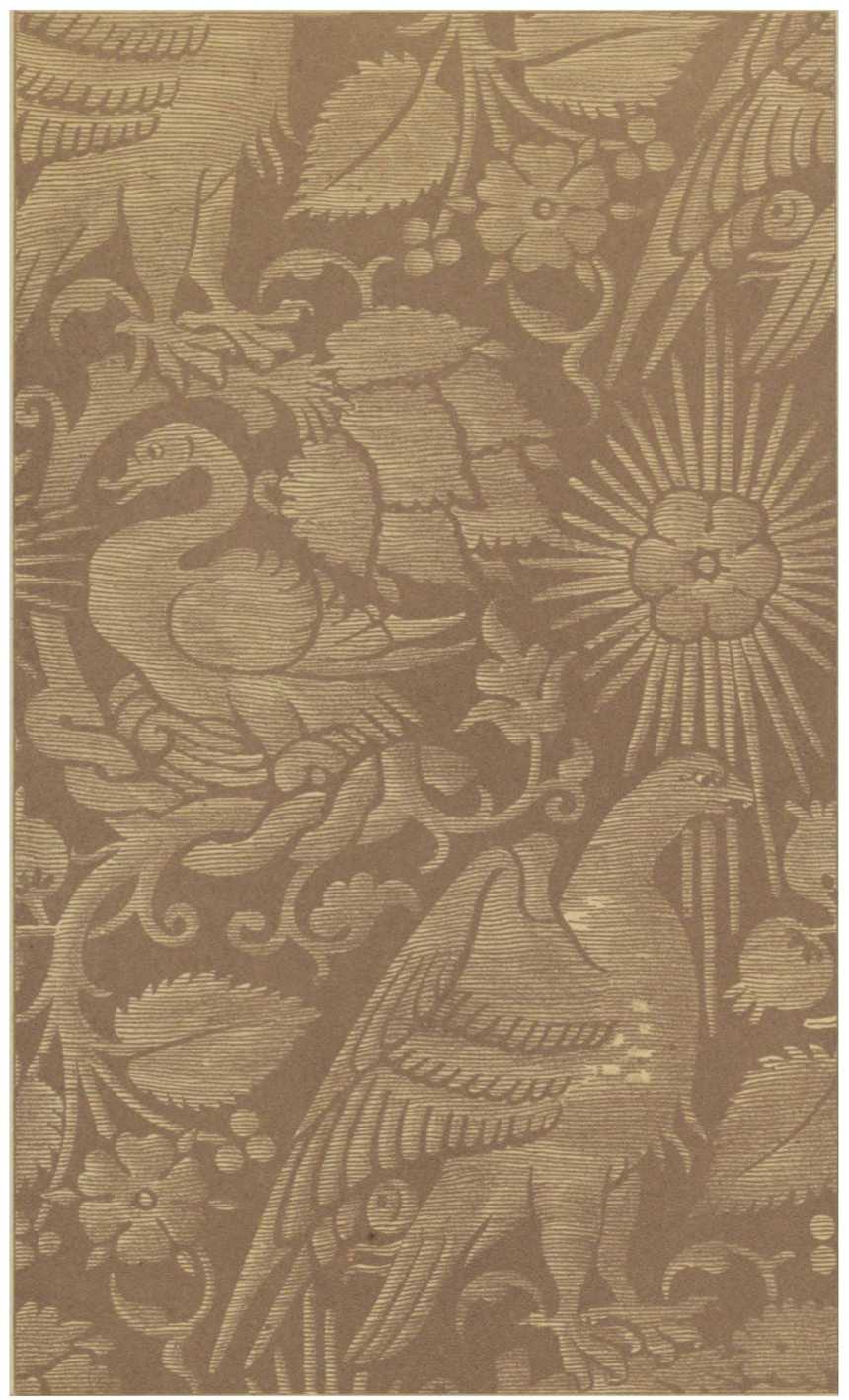
8264
SILK AND GOLD TISSUE,
Sicilian, 14th century.
Vincent Brooks Day & Son, Lith.
The design of this piece is as easy and flowing as it is bold; and the specimen affords us a very choice example of fine manufacture.
8265.
Piece of Linen and Silk Textile; the ground, dark blue; the pattern, yellow, consisting of arcades beneath which are rows of parrots and hawks alternately, both gardant, and perched upon a vine; the initial M surmounted by a crown or fleur-de-lis in gold thread is inserted in the alternate range of arches. Southern Spanish, late 14th century. 1 foot 6 inches by 10 inches.
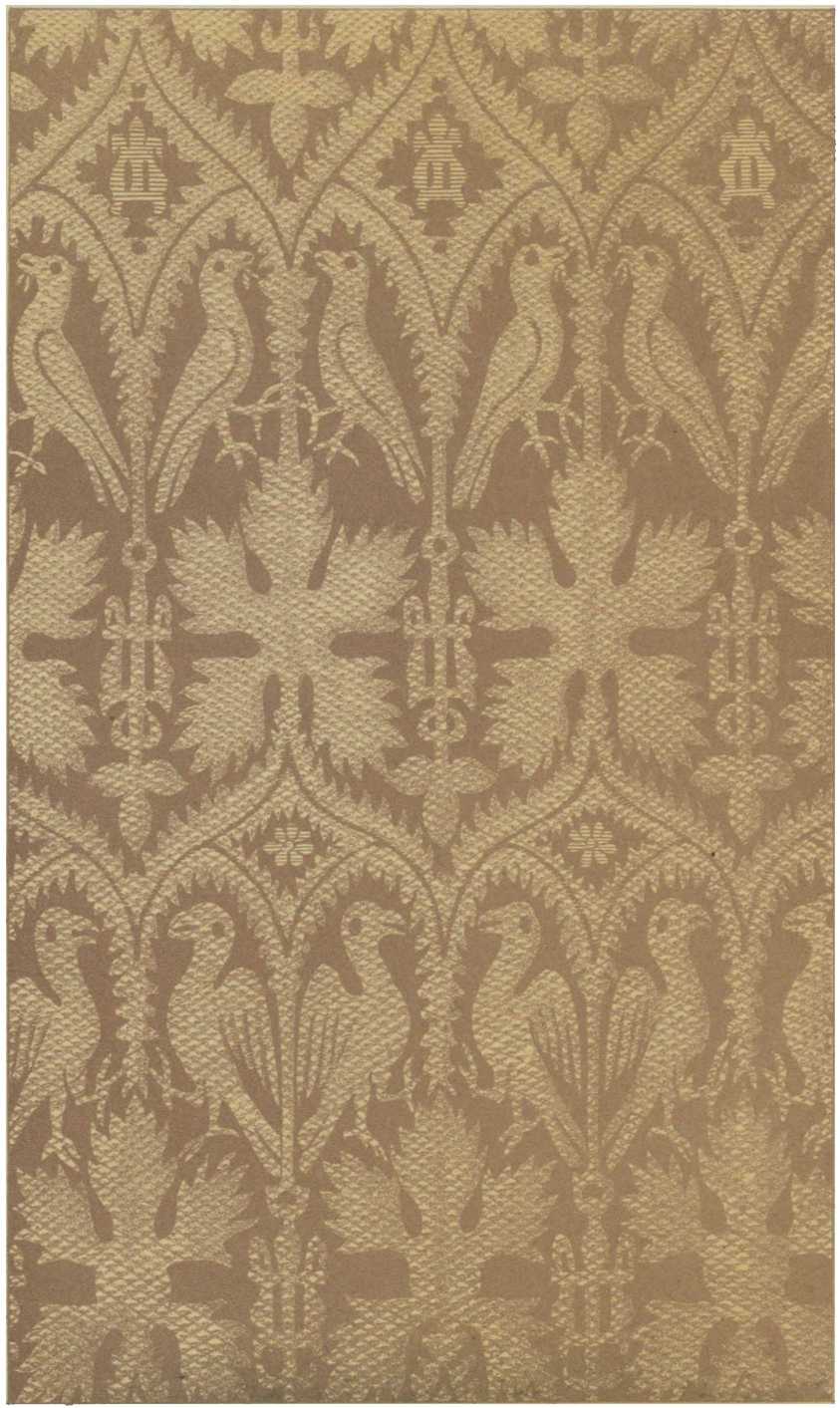
8265
LINEN AND SILK TEXTILE,
Spanish, 14th century.
Vincent Brooks Day & Son, Lith.
As a specimen of the Andalusian loom, and wrought by Christian hands, perhaps at Granada, while that part of Spain was under Moorish rule, this piece has a peculiar interest about it.
8266.
Maniple, embroidered in silk, inscribed in Gothic letters with “Gratia + plena + Dom ...” German, end of 14th century. 3 feet 10 inches by 2 inches.