DESCRIPTIONS OF SPECIES
Reading edition
WATER-PLANTAIN FAMILY (Alismaceae)
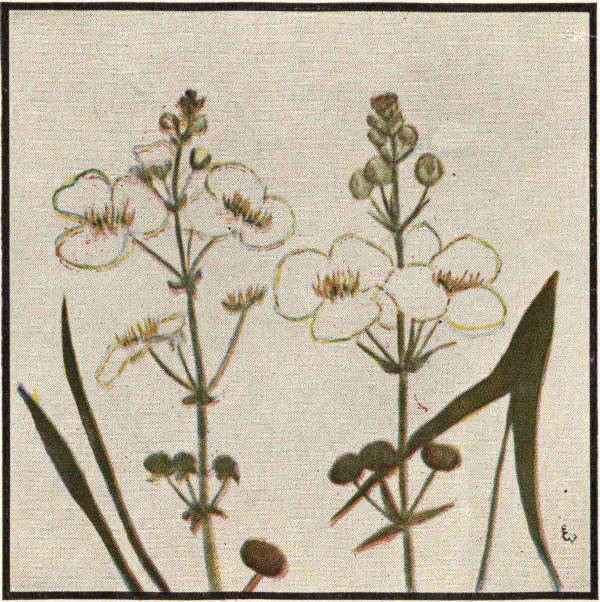
SMALL ARROWHEAD LONG-LOBED ARROWHEAD
Marsh or water plants; leaves mostly basal; sepals 3; petals 3, white or pink, tender; stamens 6 or more; pistils many, free; fruit a head of achenes.
Small Arrowhead (Sagittaria papillosa) is a common pond dweller in Texas and Louisiana. Like other arrowheads the flowers are borne in whorls, the upper having many stamens and the lower producing the seeds. It may be distinguished from other narrow-leaved forms by the rough (papillose) surface of the floral leaves.
Plains or Long-Lobed Arrowhead (Sagittaria longiloba) is common in shallow water on the plains from Nebraska to Mexico from April to October. The shape of the leaf of this and other species has given the common names of arrowhead and arrowleaf to this group. Like the water-plantain and bur-head the flowers have 3 tender white petals. The wapato duck potato (S. latifolia) may be found in East Texas. Growing in great abundance along the coast, the water potato or scythe-fruited arrowhead (S. falcata) is a showy plant 2-4 feet high with large lance-shaped leaves. The tubers and young shoots of both of these are considered excellent foods for ducks. Indians also valued the starchy tubers for food, and it was the duty of the women to grub in the mud for them.
3
PINEAPPLE FAMILY (Bromeliaceae)
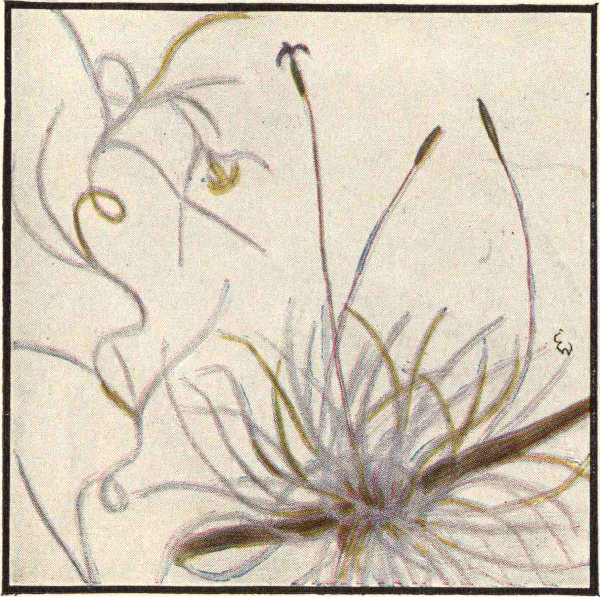
SPANISH MOSS BALL MOSS
Chiefly air-plants, some rigid-leaved land plants; floral leaves often conspicuous; 3 sepals; 3 petals; stamens 3-6; pistil 3-celled.
Spanish Moss (Dendropogon usneoides) has long zig-zag stems hanging in gray masses from the branches of many trees, especially live oaks, from the Coastal Plain of the United States to South America. Sometimes called Florida-moss, wool crape, crape-moss, and long moss, it has long been renowned in literature and industry. Indians and pioneers found many uses for it, and it is still used for padding, fodder for cattle, decoration, and the making of mattresses. The short leaves are scattered on the slender stem, which may be 1-6 yards long. The fragrant flowers are small and inconspicuous, being about ¼ inch long, blooming in early summer. The name means “tree-beard.”
Ball Moss. Bunch Moss (Tillandsia recurvata) has small and inconspicuous purple flowers which appear in the summer. Like the Spanish moss, it gets its nourishment from the air but may injure trees by crowding out the leaves. Both mosses bear no relation to the true mosses but belong to the same family as the pineapple. The ball moss is found on trees, wires, rocks, and other places. Bailey’s bunch moss is a large-flowered form growing in the lower Rio Grande Valley.
4
SPIDERWORT FAMILY (Commelinaceae)
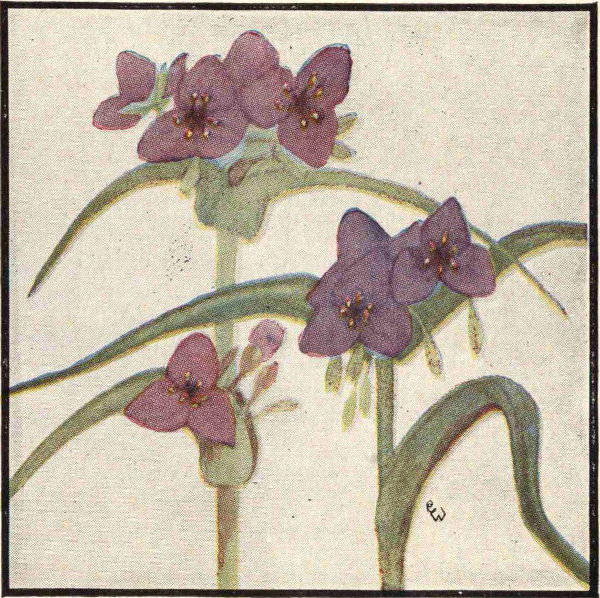
GIANT SPIDERWORT PRAIRIE SPIDERWORT
Mostly succulent herbs with tuberous or fibrous roots; flowers arising from a cluster of leaf-like bracts; sepals 3; petals 3; stamens 6; ovary 3-celled; fruit capsular.
Giant Spiderwort (Tradescantia gigantea) grows in clumps of stout stems 2-3 feet high. The numerous flowers on short slender stalks hang out of a cluster of 2-3 upper leaves which have sac-like bases, velvety with soft hairs. The 3-petaled flowers vary in color from purplish-blue to rose or white and close at noon. The 6 stamens are adorned with lovely violet hairs. It is found in Central Texas in April and May.
The spiderwort group was named for Tradescant, gardener to Charles I. It is well represented in Texas, all of the many different species being easy to transplant and making attractive garden plants. The wandering jew, a well-known spiderwort in cultivation, is a native of South America.
Prairie Spiderwort (T. bracteata) is a smaller plant with bluer flowers. Ranging from Minnesota to Texas, it has its blooming season in Texas in April and May.
5
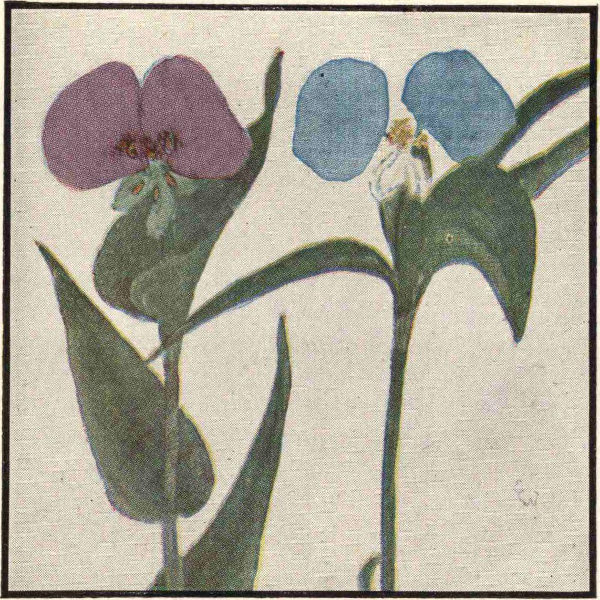
TEXAS DAYFLOWER WIDOW’S TEARS
Curly-Leaved Dayflower. Widow’s Tears (Commelina crispa) has two large blue petals and a third, minute, white, and inconspicuous. The upper three stamens are 4-lobed and sterile, quite different from the 3 lower pollen-producing stamens, one of which is larger than the others. The petals are very tender and last only one morning. This dayflower may be distinguished from several others in the state by its crisped leaf-margins. It is very common on the South Central Plains from May to September. The name is given in honor of early Dutch botanists by the name of Commelyn.
Texas Dayflower (Commelinantia anomala) has two large petals like the dayflowers, but may be distinguished from them by their lavender color and by having the leaf around the flower-cluster more like the lower leaves in shape. The three upper stamens are bearded with violet hairs like those of spiderworts. It grows in rich moist soil in the limestone hills of the southern part of the state and the adjoining part of Mexico.
6
PICKEREL-WEED FAMILY (Pontederiaceae)
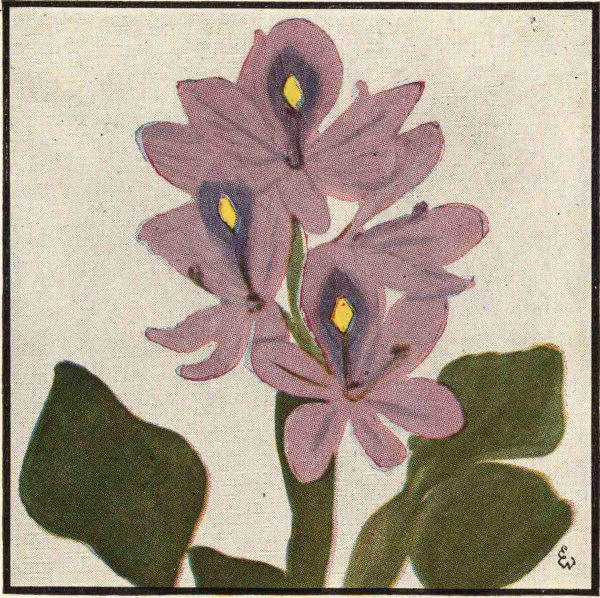
WATER HYACINTH
Aquatic plants; leaves alternate, often basal; sepals 3, petal-like; petals 3, sepals and petals partly united; ovary 3-celled.
Water Hyacinth (Eichhornia crassipes) is also called wampee, river raft, and water orchid. It grows so thick in places that water channels may be blocked, and island-like masses may serve as rafts. With its large spikes of lavender flowers and its broad shining leaves with their curious bulbous floats, it is the queen of our water plants. Many streams, lakes, and canals along the coastal highway offer living pictures which will not soon fade from the memory. The plants float by means of the bulbous enlargement of the leaf stalk. The flowers are somewhat 2-lipped, the 3 sepals and 3 petals somewhat alike but with a yellow spot on the upper petal.
Pickerel Weed (Pontedaria cordata) may be found growing in the mud of inland waters along the coast. It is a taller plant than the water hyacinth, the spikes are narrower, the flowers are a deeper purple, and the leaves are narrower and have no float.
7
LILY FAMILY (Liliaceae)
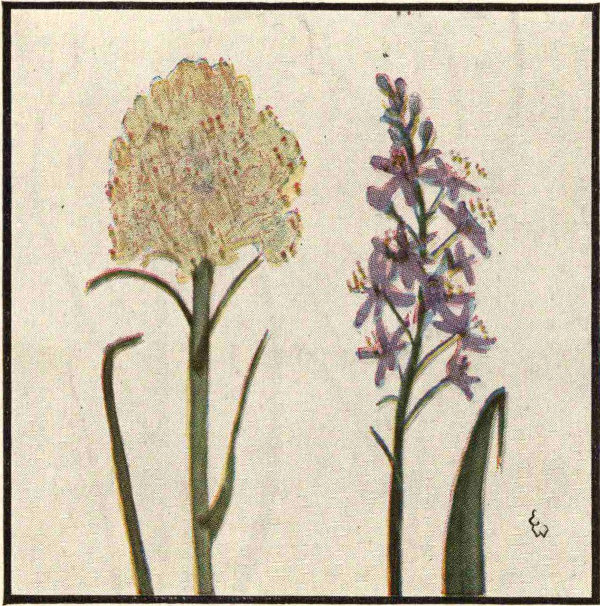
NUTTALL’S DEATH CAMASS WILD HYACINTH
Aquatic plants; leaves alternate, often basal; sepals 3, petal-like; petals 3, sepals and petals partly united; ovary 3-celled.
Nuttall’s Death Camass (Toxicoscordion nuttallii) is a common prairie bunch-flower from Texas to Tennessee and Kansas. The leaves, which are mainly basal, long, narrow, and curved, and the stout stems 1-2 feet high arise from a large black-coated bulb which is poisonous. Many cream-colored flowers are borne in a round-topped cluster. The 3 sepals and 3 petals are alike, and the 6 stamens have large yellow anthers. The 3-beaked capsules have numerous seeds. The flowers bloom in April and May. The poisonous bulb is responsible for the name, which is derived from the Greek meaning “poison-onion.”
Wild Hyacinth (Quamasia hyacinthina) is also called indigo-squill or meadow hyacinth. Growing from a deep-rooted edible bulb, a slender stalk 1-2 ft. high bears a spike-like cluster of hyacinth-blue flowers at the top. The flowers are about ½ inch broad and have a most delightful fragrance. It is widespread from Pennsylvania to Texas, common in Texas along railroads in April.
8
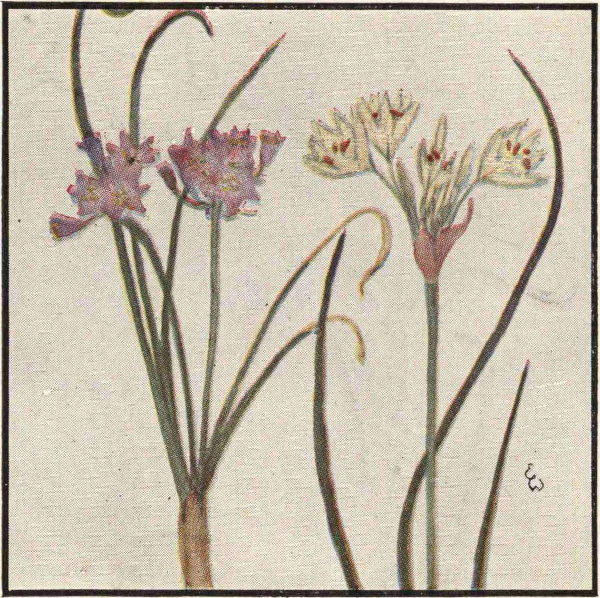
PRAIRIE ONION CROW POISON
Prairie Onion (Allium nuttallii) has short flower stalks 4-6 inches high growing from a very small bulb which has a brown, finely-woven outer coat. The flowers are nearly half an inch broad and vary from pale pink to a deep rose. Allium is the Latin for “garlic,” and both the cultivated garlic and onion are members of this group. There are nearly twenty different wild onions in the state, many of which make lovely garden plants. Allium mutabile, a taller onion with very numerous white flowers, blooms in May. The prairie onion is the same as Heller’s onion (Allium helleri) and blooms in April.
Crow Poison. False Garlic (Nothoscordum bivalve) is one of the first flowers to appear in the spring on lawns, meadows, and roadsides throughout the Southern States and may bloom again in the autumn. It looks very much like the onions, but has fewer, larger flowers on long stalks and does not have the onion odor. It grows from an onion-like bulb. The name is from the Greek meaning “false garlic.”
9
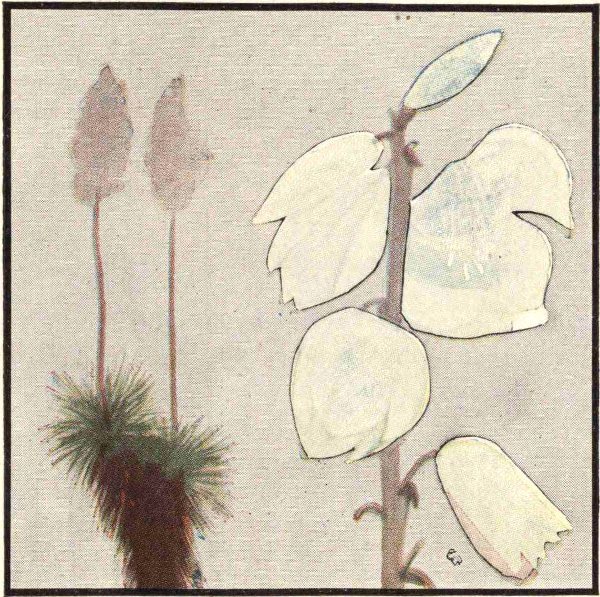
FINE-LEAVED TREE-YUCCA SOAPWEED
Beargrass. Fine-Leaved Tree-Yucca (Yucca elata) belongs to a group widely represented in Texas by many different forms, those with thin thready leaves being known as beargrass, soapweed, “palmillo,” and Adam’s needle and those with thick, stiff, sharp-pointed leaves as Spanish bayonet or dagger. All have creamy or greenish-white bell-shaped drooping flowers borne in dense clusters on a long stalk growing out of a rosette of leaves. The fine-leaved tree-yucca sometimes grows 20 ft. high and is very abundant west of the Pecos River to Arizona. The budding flower stalk is quite tender and palatable and was often used as a food by early settlers. It is an excellent food for cattle, and they keep the stalks stripped of budding shoots, making the absence of seed pods quite conspicuous on the cattle ranges. Indians used the leaf fibers for making sandals.
Soapweed (Yucca glauca), the common yucca of the Panhandle of Texas and adjacent states, has an unbranched flower stalk. As in other yuccas, the roots yield soap when the bark is removed and crushed in water. The fruits of the stiff-leaved tree-yuccas are edible.
10
AMARYLLIS FAMILY (Amaryllidaceae)
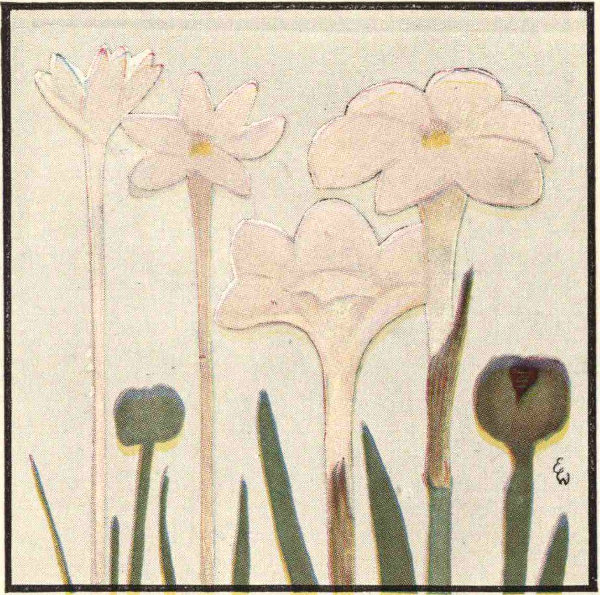
SMALL RAIN LILY GIANT RAIN LILY
Plants with bulbs or fibrous roots; leaves basal; sepals 3, petal-like; petals 3, sepals and petals united into a tube below; stamens 6; ovary inferior, 3-celled.
Small or Drummond’s Rain Lily (Cooperia drummondii) is known in cultivation as evening star. It does not have a stalked seed pod like the giant rain lily and has smaller flowers with much longer tube and shorter and narrower leaves. It blooms in the late summer and fall.
The cooperias were named in honor of Joseph Cooper, an English gardener. Drummond’s rain lily honors Thomas Drummond, a Scottish plant collector who visited the southeastern part of Texas in 1833-34.
Giant Rain Lily (Cooperia pedunculata) has lovely fragrant white flowers which last only a day or two. The tubular flowers appear funnel-shaped for some hours after opening, but the six broad lobes spread widely as the flowers mature. The leaves are all basal and grow from a large black-coated bulb; they are about a foot long and nearly half an inch wide. Shortly after heavy rains in spring and early summer, lawns, meadows, and woods in Louisiana, Texas, and Mexico are covered with the lovely blossoms. It is also called prairie lily, field lily, crow poison, and fairy lily.
11
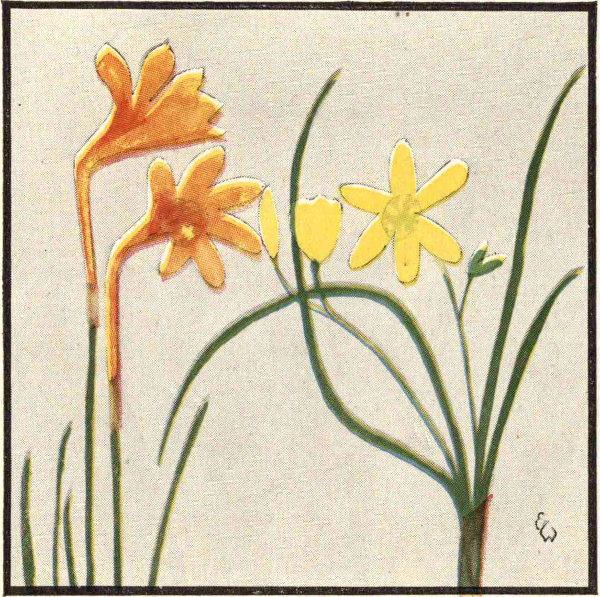
COPPER LILY YELLOW STAR GRASS
Copper Lily. Texas Atamosco Lily. Stagger Grass (Zephyranthes texana) is a copper-colored lily blooming in August and September in Central Texas. The inner surface of the petals is yellow and shows a purple veining. The flowers stalks are 6-12 inches long, growing from a cluster of very slender leaves. The yellow atamosco (Zephyranthes longifolia) has yellow flowers. It may be found in West Texas to Arizona and Mexico in the late summer and fall.
Yellow Star Grass (Hypoxis erecta) has yellow flowers about an inch broad. It is one of the earliest and commonest spring flowers in the eastern pine woods, blooming in Texas in March and April.
The common century plant of the Big Bend is Agave havardiana. It is not as large as the widely cultivated American century plant introduced from Mexico. A candelabrum-like cluster of yellow flowers, which are provided with a vast quantity of nectar, grows at the top of a stout stalk, which is commonly 12-15 feet high. The stalk grows from a cluster of broad gray leaves, 1-1½ feet long, bordered with recurved prickles and ending in a sharp-pointed spine. Lecheguilla (Agave lecheguilla) is a much smaller plant with narrow spikes of greenish-white flowers.
12
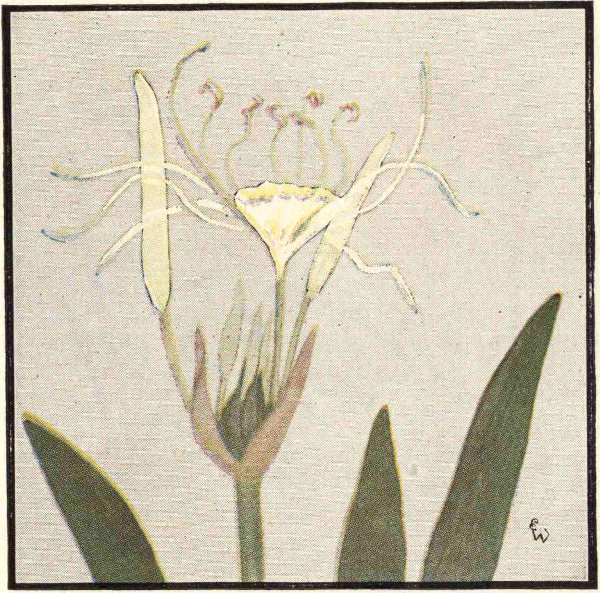
TEXAS SPIDER LILY
Texas Spider Lily (Hymenocallis galvestonensis) grows in moist soil, in ditches, or on the edges of ponds. It is particularly abundant on the coastal prairie. A thick, fleshy flower stalk grows from a cluster of strap-shaped leaves about an inch broad and bears 4—6 white flowers in a cluster at the top of the stalk. The scientific name means “beautiful membrane” and refers to the delicate white funnel-tube uniting the bases of the 6 stamens. The 3 linear petals and the three similar sepals are about 6 in. long, united at their lower half into a slender tube. The upper half spreads, giving rise to the common name of spider lily. The flowers bloom from March to May. It was long ago introduced into cultivation and is considered quite hardy in the North.
Western Spider Lily (Hymenocallis occidentalis) has similar flowers, but blooms in the summer after the leaves die back. It is found in moist soil and on shaded hillsides from Northeast Texas to Indiana and Georgia.
13
IRIS FAMILY (Iridaceae)
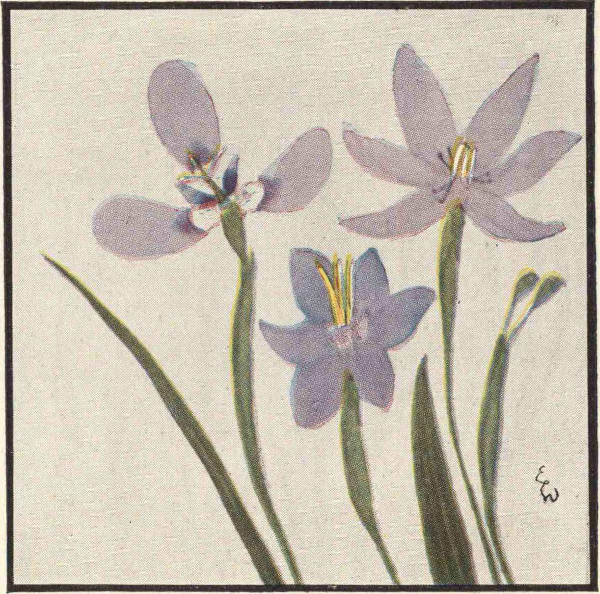
PLEATED-LEAF IRIS PRAIRIE CELESTIAL WOODLAND CELESTIAL
Perennial herbs with bulbs, corms, or rhizomes; leaves usually basal and flattened at the sides; 3 sepals and 3 petals nearly equal; stamens 3; ovary below the perianth; fruit a 3-celled capsule.
Pleated-Leaf Iris (Herbertia caerulea) has pleated leaves like the celestials, but the flowers are quite different, the 3 sky-blue sepals being large and spreading and the 3 petals small and inconspicuous. The bases are white with violet markings. It is very abundant on the Coastal Plain of Louisiana and Texas in April and May. The name is in honor of William Herbert, a distinguished English botanist.
Prairie Celestial (Nemastylis acuta) has 6-parted sky-blue flowers with the 3 sepals and 3 petals nearly equal, white at the base. The 2-branched thread-like styles, from which the name is derived, spread horizontally between the 3 erect stamens. It grows on the prairies of North Texas to Kansas and Tennessee.
Woodland Celestial (Nemastylis texana) with its steel-blue flowers is more abundant in the southern part of the state in open post oak woods. Like the pleated-leaf iris, the flowers of the celestials open late in the morning and remain open only a few hours.
14
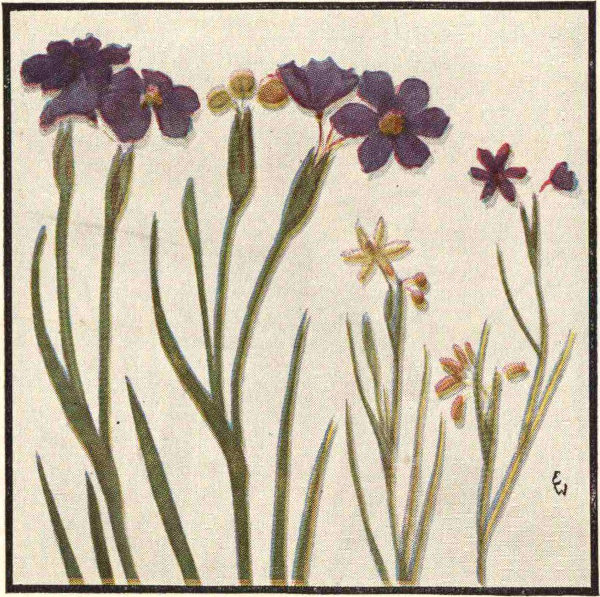
BLUE-EYED GRASSES SWORD-LEAVED THUROW’S DWARF
Sword-Leaved Blue-Eyed Grass (Sisyrinchium ensigerum) is one of many blue-eyed grasses in the state, most of which have purplish-blue flowers, 6-parted and about half an inch broad, marked at the base with yellow. The flower has 3 erect united stamens. The flowers hang on thread-like stalks from two boat-shaped leaves about an inch long. The stems are winged, sword-shaped or outcurved, and have very fine saw-toothed edges. South-central to Northwestern Texas in April and May. In East Texas the prairie blue-eyed grass (Sisyrinchium campestre) is common. It has pale blue flowers, and the outer floral leaf is prolonged to a slender point, being 1½-2 in. long.
Dwarf Blue-Eyed Grass (Sisyrinchium minus) has small reddish-purple flowers and an oblong seed capsule. Coastal Plain, Louisiana to Texas. Spring.
Thurow’s Blue-Eyed Grass (Sisyrinchium thurowi) is a very small plant with small yellow flowers found in the southeastern part of the state in damp places. Spring.
15
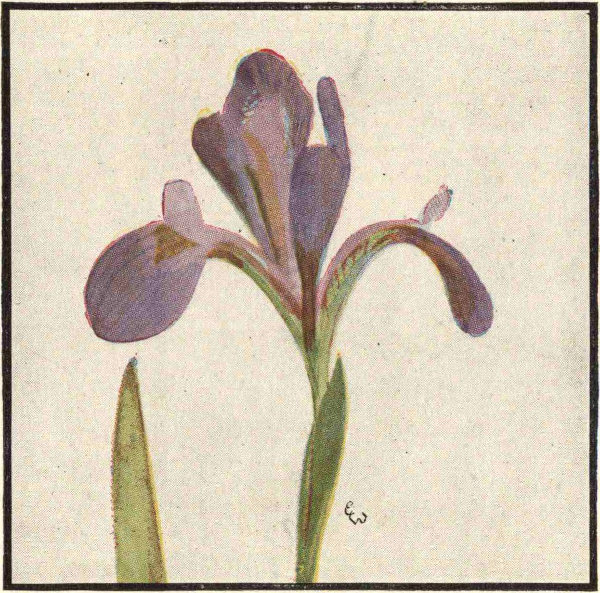
GIANT IRIS
Giant Blue-Flag or Iris (Iris giganticaerulea) is a tall iris found in swampy places in East Texas and Louisiana, blooming in late April and May. The color of this iris is quite variable, ranging from dark violet to lavender and white. The recurved spreading sepals are 3-4 inches long, and the petals are shorter and erect. The capsules are 3-4 in. long with 6 rounded ridges.
Narrow Blue-Flag (Iris virginica) has been confused with the Carolina iris, according to Dr. Small of the New York Botanical Garden, who has recently described many new irises from Louisiana. The narrow blue-flag is colored similarly to the giant iris, but has shorter 3-angled capsules, very narrow leaves, and zig-zag stems. It is abundant on the Coastal Plain in early spring.
Red-Brown Flag (Iris fulva) is also found in the swamps in East Texas.
16
ORCHID FAMILY (Orchidaceae)
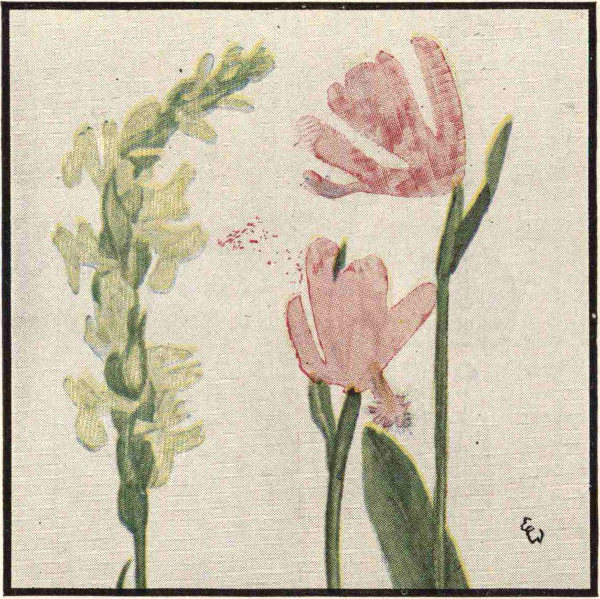
SLENDER LADIES’-TRESSES ROSE POGONIA
Air plants or tuberous-rooted; leaves alternate, undivided; sepals 3; petals 3, the middle one, or “lip,” often complex in structure; stamens 2 or 1, united to pistil; ovary below the perianth.
Slender Ladies’-Tresses (Ibidium gracile) is also called twisted-stalk or corkscrew-plant because of the twisting of the flower-stalk. The stems, which are 8 in. to 2 ft. high, grow from a cluster of tuberous roots and have two broad leaves at the base. This flower ranges from Texas to Nova Scotia.
Rose Pogonia. Snake-Mouth (Pogonia ophioglossoides) grows in swampy places from Texas to Newfoundland. Pogonia is from the Greek, meaning “bearded” and refers to the bearded lip.
Grass-Pink (Limodorum tuberosum) is a pink-flowered orchid of East Texas and the Eastern States similar to the rose pogonia, but does not have the short clasping leaf on the stem.
The orchid family is a large group of more than 15,000 species. Some orchids are air-plants, attaching themselves to tree-trunks, but none of these are found among the 25 orchids growing in Texas. Perhaps the handsomest orchid in the state is the red-flowered flame orchid (Stenorrhynchus cinnabarinus) found in the mountains of the Big Bend. All the Texas orchids are rare enough to need protection.
17
BUCKWHEAT FAMILY (Polygonaceae)
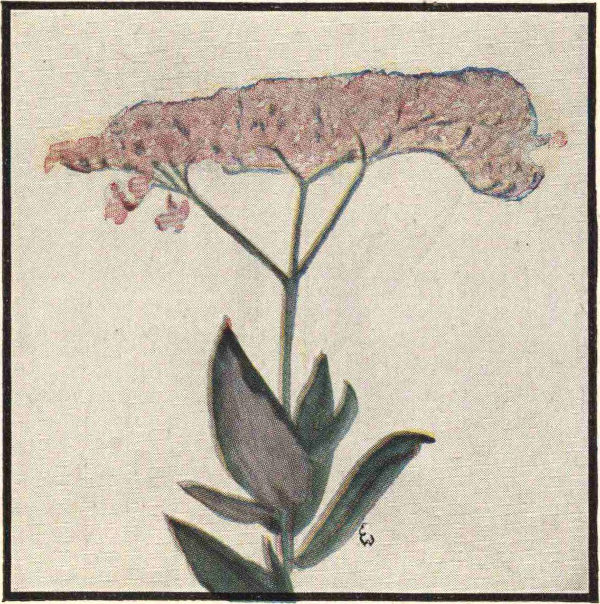
MANY-FLOWERED BUCKWHEAT
Leaves usually alternate; sepals 3-6, sometimes petal-like; petals absent; stamens usually 6-9; ovary 1-celled.
Many-Flowered Buckwheat (Eriogonum multiflorum) is also called umbrella-plant because of its spreading clusters at the top of the stem. It grows about 2 ft. high, being very abundant in sandy soil from South-central Texas to Arkansas and Louisiana in the late summer and fall. The name means “woolly knees,” referring to the jointed stems.
Buckwheat flour is made from the seeds of Fagopyrum esculentum, a closely related plant, similar in size, white-flowered, and with large 3-angled seeds. Queen’s crown or wreath (Antigonon leptopus), a lovely pink-flowered vine widely cultivated in Texas, is a member of the buckwheat family.
Annual Buckwheat (Eriogonum annuum), similar to the many-flowered buckwheat, but with leaves white-woolly on both sides and narrowed at the base, is very abundant in the northwestern part into New Mexico and Mexico. Acre after acre along the highways is often covered with it. Many other white-, yellow-, and red-flowered buckwheats are found in the mountains of West Texas.
18
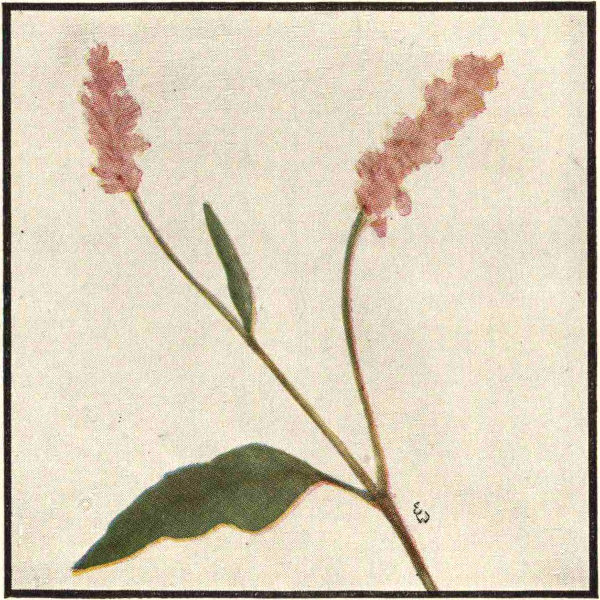
SOUTHERN SMARTWEED
Southern Smartweed (Persicaria longistyla), ranging from Mississippi to New Mexico is also called gander-grass or knotweed. It grows in wet places throughout the state and blooms in the late summer and fall. The dense spikes of small pink flowers are very attractive, the flowers having 5 pink sepals but no petals. The seeds are lens-shaped and covered with a black shining coat. The seeds of many of the smartweeds are considered good food for ducks.
Dotted Smartweed (Persicaria punctata) has scattered greenish-white flowers and 3-angled seeds. The leaves are much narrower than those of the Southern smartweed. Many other smartweeds are found in the state.
Curly-Leaved Dock (Rumex crispus), as well as several other docks, is common in the state. The leaves of some of them are used for greens. Canaigre is the dock of Western Texas and New Mexico, the roots of which have furnished tannin for commercial purposes.
19
FOUR-O’CLOCK FAMILY (Nyctaginaceae)
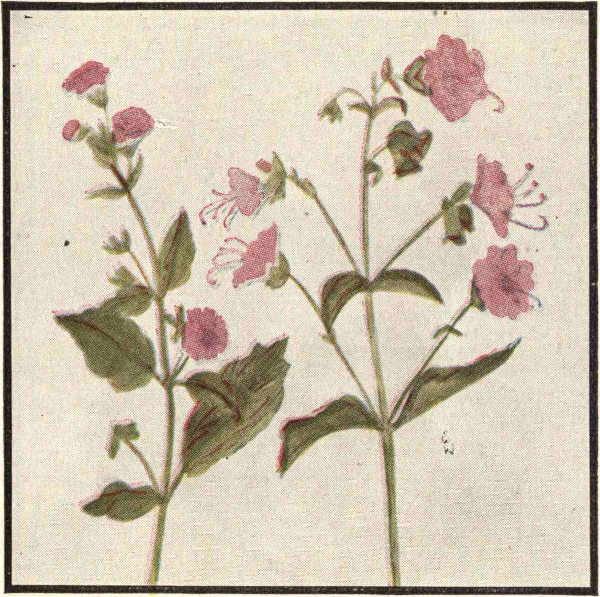
SMALL-FLOWERED FOUR-O’CLOCK PINK FOUR-O’CLOCK
Leaves opposite or alternate; flowers often surrounded by colored bracts; calyx tubular, often petal-like; petals absent; stamens 1 to many; ovary 1-celled.
Gray’s Umbrella-Wort. Pink Four-O’clock (Allionia grayana) has delicate pink flowers which have no petals, but the 5 united sepals are petal-like in appearance. The flowers are spreading or funnel-shaped and open in the afternoon. Several flowers are borne together and are surrounded at their bases by 5 short united floral leaves, forming a pale green veiny involucre which is sometimes mistaken for the flower. The clusters terminate the branches on a widely spreading plant about 2 ft. high.
Small-Flowered Four-O’clock (Allionia incarnata) is very abundant in Southwestern Texas to Arizona and South America. It forms a low, spreading plant, which is profusely covered with small pink blooms less than half an inch broad.
Narrow-Leaved Sand-Verbena (Abronia angustifolia) is a low plant with a dense head of pink flowers which are so fragrant that one plant will perfume the air for some distance. In favorable seasons the hills around El Paso are pink with the lovely blooms. It is called sand-verbena because of the verbena-like clusters.
20
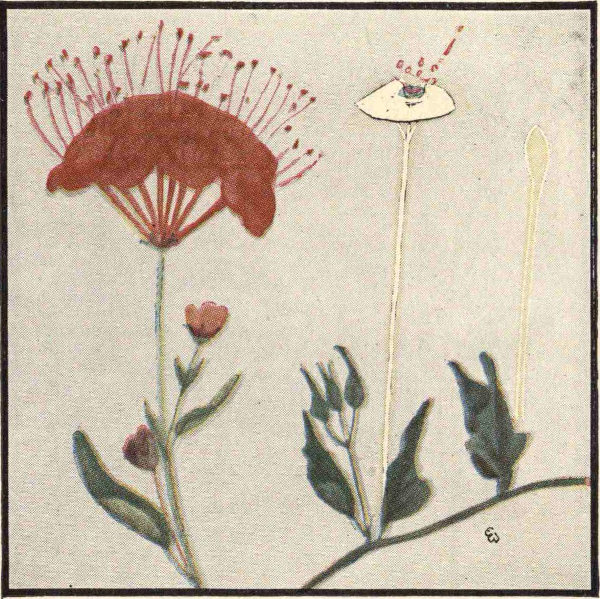
DEVIL’S BOUQUET ANGEL’S TRUMPET
Devil’s Bouquet (Nyctaginia capitata) is also called skunk flower because of its heavy, disagreeable odor. The head-like clusters of scarlet flowers are very showy, being 2-3 in. broad. The 5-lobed flowers resemble those of the umbrella-worts and likewise open in the afternoons. The plants are low and scattered, but are quite common from Central and Southern Texas to Mexico and New Mexico from May to October.
Angel’s Trumpet (Acleisanthes longiflora) grows from long spreading stems with the long-tubed flowers sharply erect. The flowers are over an inch broad with a tube 4-6 in. long. It is most abundant in the spring, but may be found until October in the same range as the devil’s bouquet. Jimson-weed (Datura) is also called angel’s trumpet.
Bougainvillea is a member of this family frequently cultivated in the southern part of the state. The common four-o’clock is often seen in gardens and in some places has escaped cultivation.
21
POKEWEED FAMILY (Phytolaccaceae)
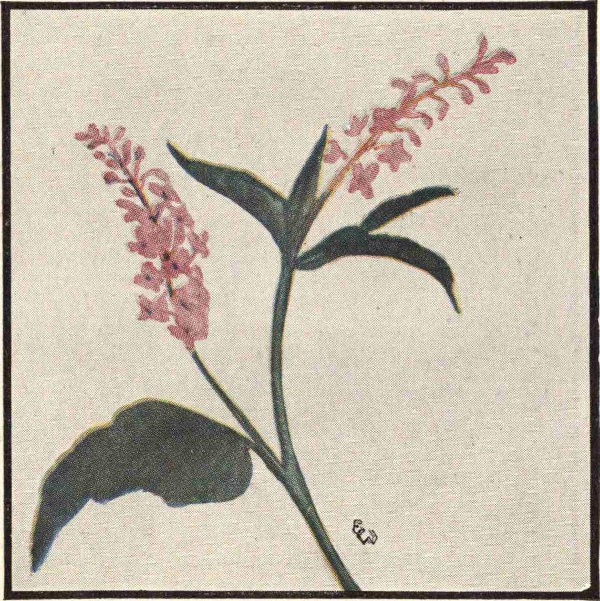
ROUGE PLANT
Leaves alternate, entire; sepals 4-5; petals absent; stamens 3 to many, sometimes united at the base; ovary with 1 to many distinct or united carpels.
Rouge Plant. Small Pokeberry (Rivina vernalis) was named for A. Q. Rivinus, a botanist of Leipzig. It was known as Rivina humilis, the latter name meaning low. It has small flowers, about ¼ in. broad, with 4 white or pink petal-like sepals and 4 stamens. The bright red berries often occur on the stems while flowers are still present. The low plants, a foot or more high, grow profusely in woods in Central Texas, but may be found from Arkansas to the tropics. When vegetable dyes were in common use, a red dye was obtained from the berries.
Ink-Berry. Large Pokeberry (Phytolacca americana) is a leafy, stout, branched plant 3-9 ft. high, with large leaves and spike-like clusters of white flowers and purple berries. It is a perennial that grows from a poisonous root. With special care in the picking and preparation, the young shoots are sometimes used for greens. The shoe-button-like berries were used for ink in pioneer days. Maine to Texas. Summer and fall.
22
PURSLANE FAMILY (Portulacaceae)
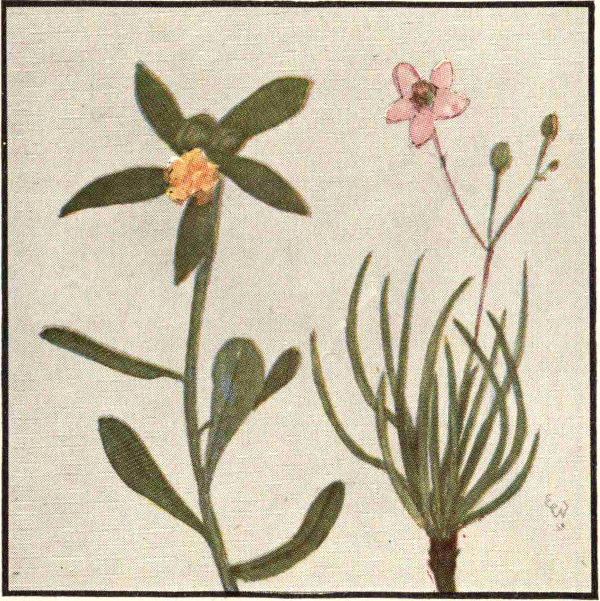
LANCE-LEAVED PORTULACA SMALL-FLOWERED TALINUM
Herbs or undershrubs, often succulent; sepals 2; petals 4-6, soon falling; stamens few or many; ovary 1-celled; fruit a capsule opening by valves or a transverse split.
Lance-Leaved Portulaca (Portulaca lanceolata) is a weed found in sandy soil from Central and Southern Texas to Arizona. The flowers are less than half an inch broad with 5 pinkish-yellow petals and 7-27 stamens. It may be distinguished from other portulacas by the crown-like rim around the capsule. Hairy rose moss (Portulaca pilosa) is more abundant and showy, with purplish-red flowers nearly an inch broad, greatly resembling the large-flowered rose moss in cultivation. The capsule of the portulacas opens by a cap.
Small-Flowered Talinum (Talinum parviflorum) has small pink flowers about ½ in. broad, which, like those of the portulacas, require bright sunlight for opening. These dainty flowers grow on slender stalks from a cluster of short, rounded leaves and may be found in rocky soil from Minnesota to Texas during the summer months.
23
PINK FAMILY (Caryophyllaceae)
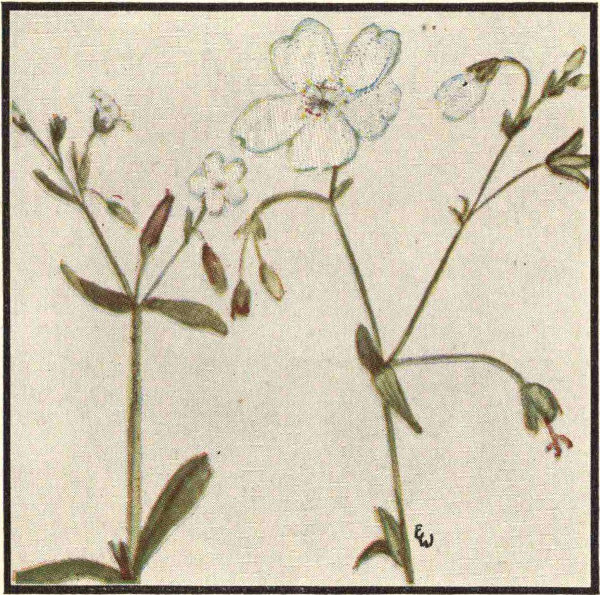
WESTERN CHICKWEED NUTTALL’S STARWORT
Stems usually swollen at the joints; leaves opposite; sepals 4-5; petals 4-5, or absent; stamens usually 8-10; ovary usually 1-celled.
Western Chickweed (Cerastium brachypodum) is one of the early spring flowers to be found throughout the state, ranging from Illinois to Oregon and Mexico. The 5 small white petals are notched at the apex. The name is derived from the Greek meaning “horny” and refers to the horn-shaped capsule from which the seeds are scattered through the opening at the top. Several other chickweeds are found in the state in early spring.
Nuttall’s Starwort or Chickweed (Stellaria nuttallii) is a lovely white-flowered chickweed found on moist sandy prairies or in open woods in Texas, Arkansas, and Louisiana in March and April. The flowers are about 1 in. broad, and the 5 broad petals are deeply notched at the apex.
The pink family is well represented in cultivation, including the carnation, sweet William, garden pink, baby’s breath, and others. The red-flowered catch-fly (Silene laciniata), found in the mountains of West Texas to Mexico and California, is known in cultivation.
24
WATER-LILY FAMILY (Nymphaeaceae)
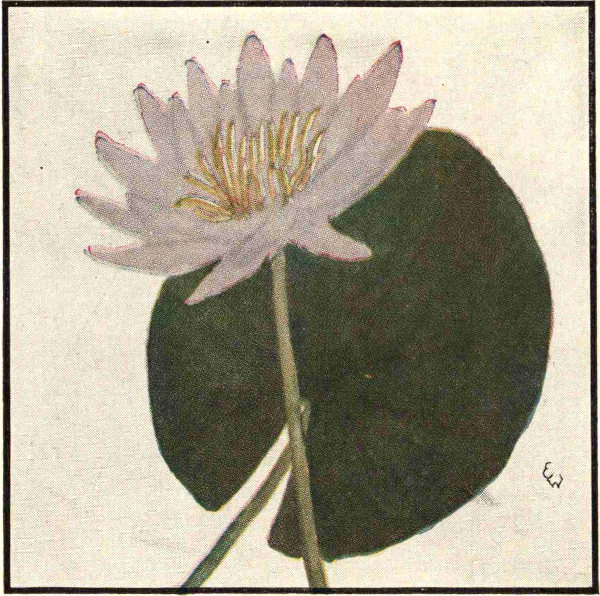
BLUE WATER-LILY
Aquatic herbs; leaves long-stalked, often floating; flowers solitary, large; sepals 3-6; petals numerous; stamens numerous; carpels 8 or more.
Blue Water-Lily (Nymphaea elegans) is a common water-lily along the coast of Texas and Mexico, particularly in the vicinity of Corpus Christi. The flowers vary from nearly white to a purplish-blue or lilac and are 3-6 in. broad. The floating leaves, about 7 in. broad, are dark purple below and nearly round; sometimes they have a few scattered teeth on the margins. The blooms last 3 days, opening about 8 o’clock in the morning and closing shortly after noon.
Yellow Water-Lily (Nymphaea flava) is a yellow-flowered water-lily found on the Texas and Florida coasts. The sweet-scented white water-lily is abundant in the southeastern part of the state.
Spatter Dock. Yellow Pond Lily (Nuphar advena), with yellow cup-shaped flowers 2-3 in. broad, is the common water-lily of slow streams and ponds throughout the state and ranges to Labrador, Florida, and Utah.
The water-lilies form an important food and cover for fish; ducks and muskrats feed upon the many seeds produced.
25
CROWFOOT FAMILY (Ranunculaceae)
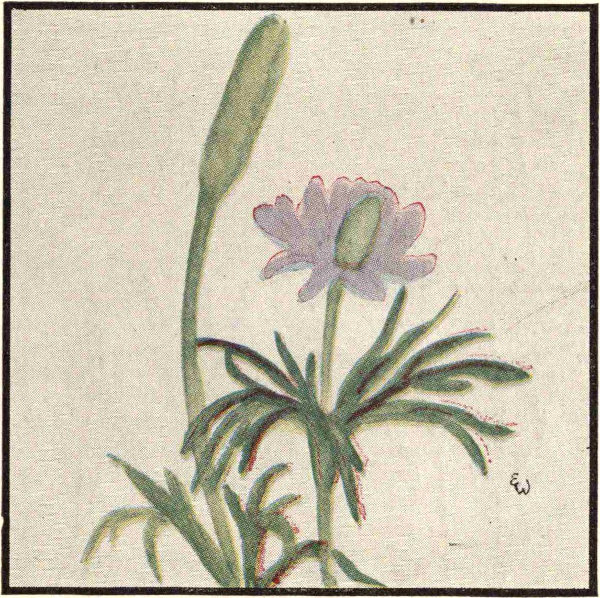
SOUTHERN ANEMONE
Perennials, annuals, or climbing soft-wooded plants; sepals 3 to many; petals few to many; stamens and carpels usually many.
Southern Anemone or Windflower (Anemone decapetala) has 10-20 sepals which resemble petals, varying from a greenish white and pink to the common pale purplish-blue. The plants are commonly low, about 6 in. high in flower, with a few leaves growing from a tuberous root. The leaves are 3-parted, the segments lobed and toothed. The anemone is the Texas harbinger of spring, appearing in late January, February, or March on plains and prairies, and in the chaparral. It ranges from the Southern United States to South America. The Carolina anemone, with bluer flowers and more finely-divided leaves, is abundant in the woods of East Texas.
The crowfoot or real buttercup family (the yellow evening primrose is also called buttercup) is considered by most botanists as the plant family from which other plants have been derived. In many the fruits look very much like the fruit head of the arrowleaf. The columbine is a member of this family frequently cultivated in the gardens of the state, but the few native ones are not very abundant.
26
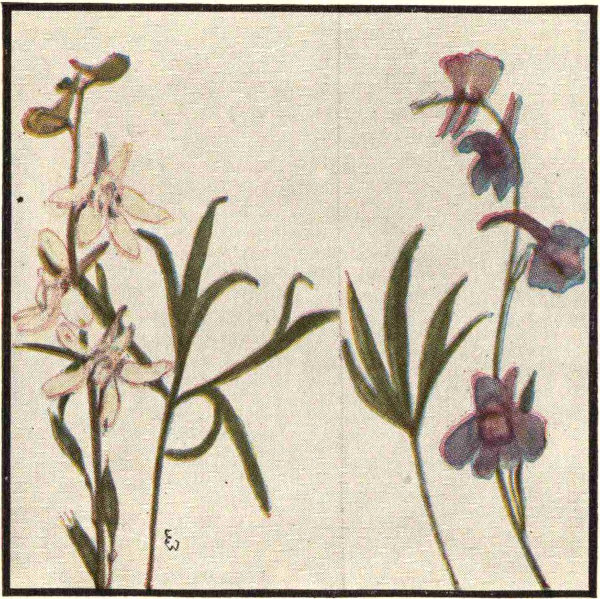
WHITE LARKSPUR CAROLINA LARKSPUR
White Larkspur (Delphinium albescens) is the common larkspur of prairies and plains of Texas and ranges to Southern Canada. In Texas it blooms most abundantly in May. The white flowers resemble rabbit faces and are tinged with green and purple. It is the bane of ranchmen, for it is poisonous to cattle.
Carolina Larkspur (Delphinium carolinianum) commonly has lovely deep blue flowers, though white forms may be found. It is very abundant in East Texas in March and April, growing 1½-2 ft. high. The plants have few leaves, and these are 3-5 parted, each part being divided into narrow linear lobes. It is very much like the Texas larkspur (Delphinium vimineum), which has blue or white flowers, grows taller, and is more leafy than the Carolina larkspur.
“Delphinium” is derived from the Latin meaning “dolphin,” so-called because of the resemblance of the spurred flowers to a dolphin. The common garden larkspur is native to Southern Europe. Some of the larkspurs furnish drugs.
27
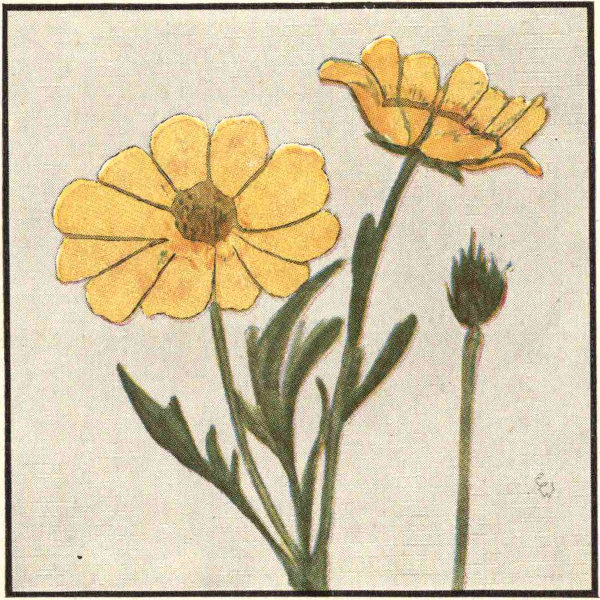
LARGE BUTTERCUP
Large Buttercup (Ranunculus macranthus) has handsome, golden-yellow flowers about 2 in. broad. There are 10-15 broad yellow petals which are longer than the sepals and have a nectar pit at their base. The leaves are mainly basal, long-stalked, and divided into wedge-shaped lobes. It ranges from Central to Southwestern Texas and is most abundant in April. It is a plant which does well in cultivation but requires plenty of water; it blooms in the shade better than most garden plants.
Many of the buttercups grow in marshy places, a fact which is responsible for the old Latin name meaning “little frog.” Many different kinds are found along roadside ditches and in marshy places in East Texas. Some members of the crowfoot family, including the wood-anemone and the marsh marigold, common in the Northern States but not native to Texas, yield poisonous honey.
28
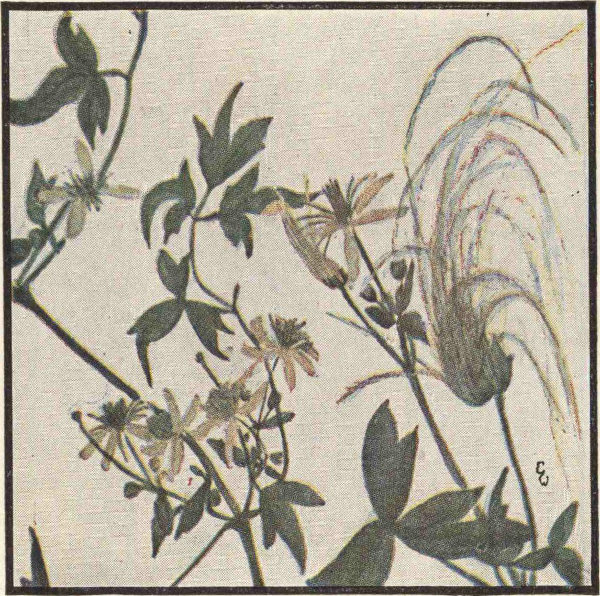
OLD MAN’S BEARD
Drummond’s Virgin’s Bower. Old Man’s Beard (Clematis drummondii) is a vine growing in great profusion, covering shrubs and fences from Central Texas to Arizona and Mexico. The 4 petal-like sepals are pale greenish-yellow, almost white, narrow and thin with margins somewhat crinkled, about ½ in. long. The flowers bloom in the summer, being inconspicuous among the branching leafy stems. The stamen-bearing flowers are on a separate vine from the seed-producing flowers. The seeds mature in a few weeks, and soon the vine is covered with iridescent masses of silky, feathery plumes, 2-4 in. long, which grow out from the seed cover. These plumes are elongated, persistent styles and are responsible for many common names given to the vine, including grandfather’s beard, gray beard, goat’s beard, and love-in-the-mist.
Western Virgin’s Bower (Clematis ligusticifolia), with white flowers and leaves with 5-7 leaflets, has been reported from the mountains of West Texas.
29
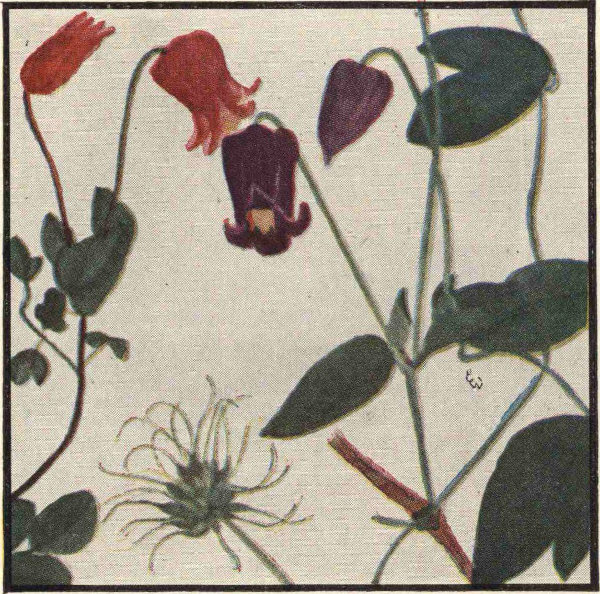
SCARLET CLEMATIS PURPLE LEATHER FLOWER
Texas Leather Flower. Scarlet Clematis (Clematis texensis) has maroon or scarlet bell-shaped flowers about 1 in. long. It is a climbing vine found along streams in Central Texas, growing 6-10 or more feet high. The leaves are thickened, entire or lobed, ovate to rounded. This clematis is a hardy climber, well known in cultivation, giving rise to many hybrids when crossed with the marsh leather flower (Clematis crispa), which is a low climber, 3-4 ft. high, with lavender bell-shaped flowers. The leather flowers have no petals, the showy bells being made up of 4 thickened sepals. The flattened fruits grow in head-like clusters about an inch thick and have plumose tails 1-2 in. long.
Purple Leather Flower (Clematis pitcheri), together with the marsh leather flower, is often called blue bell. Except in color, the flower is very much like the scarlet clematis. The leaflets are more frequently 3-lobed, and the tails on the fruits are silky but not plumose. It grows in damp woods from Indiana to Mexico, beginning to bloom in Texas in April and continuing into the summer.
30
BARBERRY FAMILY (Berberidaceae)
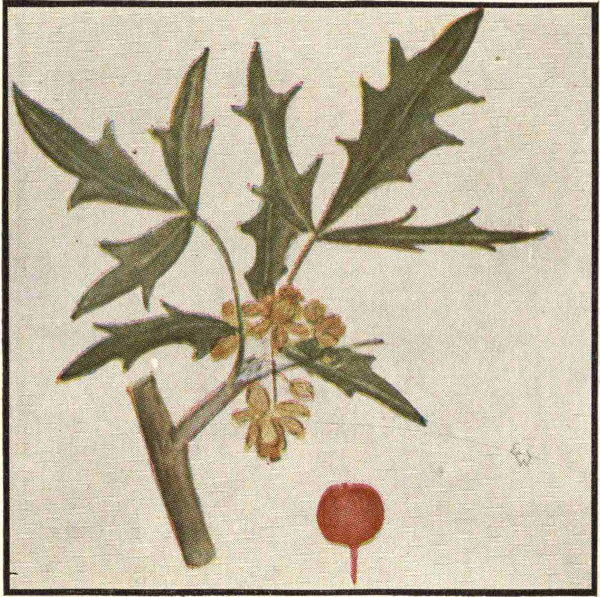
AGARITA
Herbs or shrubs; leaves simple or compound; sepals 6, similar to petals; petals 6; stamens 6, irritable, opening by valves; ovary 1-celled; fruit a berry.
Agarita. Texas Barberry (Berberis trifoliolata), known also as agrito (meaning “little sour”), chaparral berry, and wild currant, is an evergreen shrub forming an important part of the chaparral in the central and southwestern parts of the state and adjacent Mexico. The thick gray-green leaves are divided into three leaflets which have 3-7 lobes ending in sharp spines. The stiff spreading branches form a compact shrub 4-5 feet high.
The clusters of fragrant flowers are among the first spring blossoms to appear in late February and March. With 6 spreading yellow sepals and 6 yellow petals forming a cup around the stamens and pistil, the small flowers are somewhat like those of the narcissus. The acid berries ripen in May and June, being used for jellies and wines; the flowers are an important source of nectar; and the wood and roots furnish a yellow dye which was used by Indians and pioneers.
May Apple. Mandrake (Podophyllum peltatum) is abundant in moist woods in East Texas. The white flower growing in the fork of the stem is overtopped by the two umbrella-shaped leaves.
31
MOONSEED FAMILY (Menispermaceae)
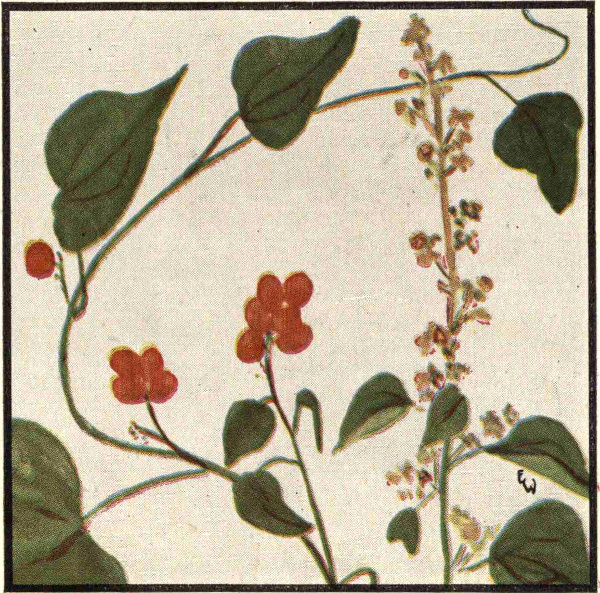
MOONSEED VINE
Usually twining shrubs or small trees; flowers small, unisexual and perfect; sepals 6; petals 6, or absent; stamens 6-12; carpels 3-6; fruit berry-like, 1-seeded.
Moonseed Vine (Cebatha Carolina) is a vine with clusters of small red berries. It is very abundant throughout the state in woods and on fences, ranging north to Kansas and Virginia. It is also called coral-bead, margil, coral-vine, and red-berried moonseed. “Cebatha,” from the Greek, alludes to its climbing habit, while “moonseed” refers to the curved seed of the fleshy red berries which ripen in the fall and remain on the vines long after the leaves have fallen. The small white flowers bloom during the summer and fall. The leaves are quite variable, sometimes entire and sometimes distinctly 3-lobed and rarely 5-lobed, being smooth above and downy beneath.
The berries of the Indian moonseed contain an acrid poison which is used by the Chinese in catching fish, as it will temporarily stun or intoxicate the fish.
32
POPPY FAMILY (Papaveraceae)
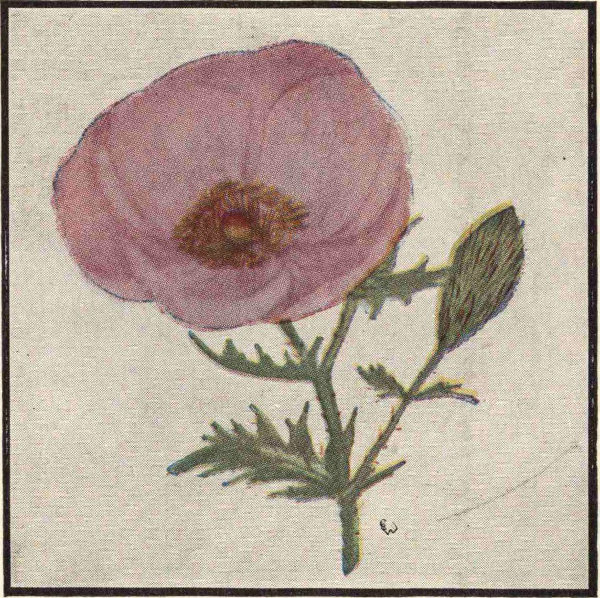
ROSE PRICKLY POPPY
Annuals or perennials with colored juice; sepals 2-3; petals 4-6, rarely more or wanting; stamens numerous; carpels 2 or more united; capsules opening by valves or pores.
Rose Prickly Poppy (Argemone rosea) is one of the loveliest flowers of South Texas. It is very abundant along the Rio Grande, extending into Mexico and northward almost to San Antonio. The large flowers vary in color from pale pink to rose and purple-rose and are more cup-shaped than the white-flowered species. It has gray-green leaves conspicuously blotched with white along the midribs, the slightly wavy margins being armed with sharp spines. Like other prickly poppies, the flowers have 6 petals, the 3 outer a little different in shape from the 3 inner, and an orange-colored sap. Long considered a variety of the western prickly poppy (Argemone platyceras), which has very spiny leaves and stems and white flowers, it may readily be separated because of its seed-pods, which are about 2 in. long and decidedly broader above the middle.
Argemone is from the Greek meaning an eye disease, supposedly cured by the plant. The opium poppy (Papaver somniferum) has been widely planted in gardens, and has escaped in places in the state.
33
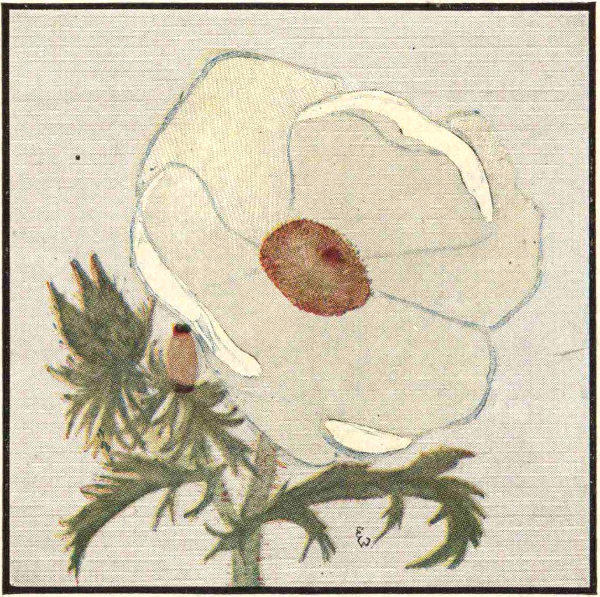
ROUGH-STEMMED PRICKLY POPPY
Rough-Stemmed or White Prickly Poppy (Argemone hispida) is a bushy, leafy-stemmed plant growing about 2-3 ft. high. It is distinguished from several other very abundant white-flowered poppies by the fact that it has rough hairs as well as spines on the stem. The flowers as a rule are larger, often being 4-6 inches broad. The unusual sepals of the prickly poppies should be noted, as they sometimes cause the flower buds to be confused with the fruits. There are usually 3 sepals, which are horned or hooded, armed with spines, and snugly overlapping each other by a narrow margin. In the rough-stemmed prickly poppy the horns are large and triangular in shape. It ranges from Texas to Kansas and California.
Texas Prickly Poppy (Argemone delicatula) is not so branched or leafy and has flowers somewhat smaller, 2½-3 in. broad. The stigmas are purple instead of red, and the capsules are less than an inch long. This poppy grows in dry soil in Central Texas. The prickly poppies bloom most profusely in April, but scattered blooms appear throughout the summer and fall.
34
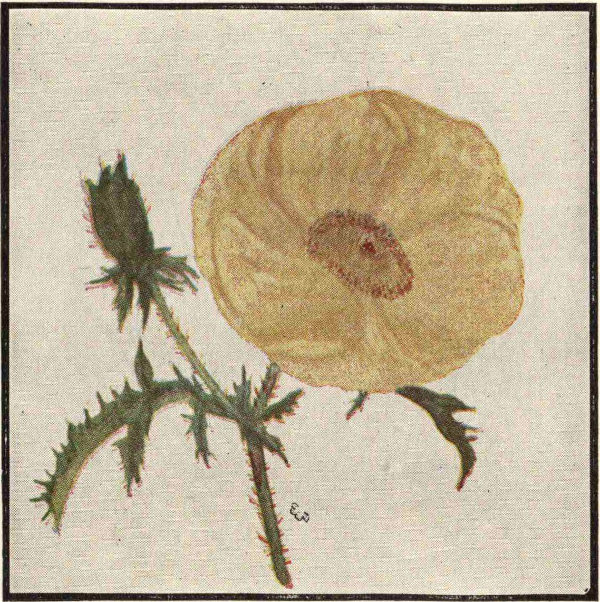
YELLOW PRICKLY POPPY
Yellow Prickly Poppy. Mexican Poppy (Argemone mexicana) is a common weed in tropical America, extending into Southwest Texas in the vicinity of Laredo and Del Rio, and has been introduced into many other countries. It is also called bird-in-the-bush, devil’s fig, flowering or Jamaica thistle, and Mexican thorn poppy. It has smaller flowers than the white and rose prickly poppies. It blooms in Texas in March and April and throughout the summer if the stems are cut. For cut flowers, the stems should be burned immediately upon gathering; otherwise the flowers soon wither.
The seeds of the Mexican poppy are valued for the painter’s oil obtained from them. The oil from the seeds is also said to act as a mild cathartic, the plant otherwise possessing emetic, anodyne, and narcotic properties.
35
FUMITORY FAMILY (Fumariaceae)
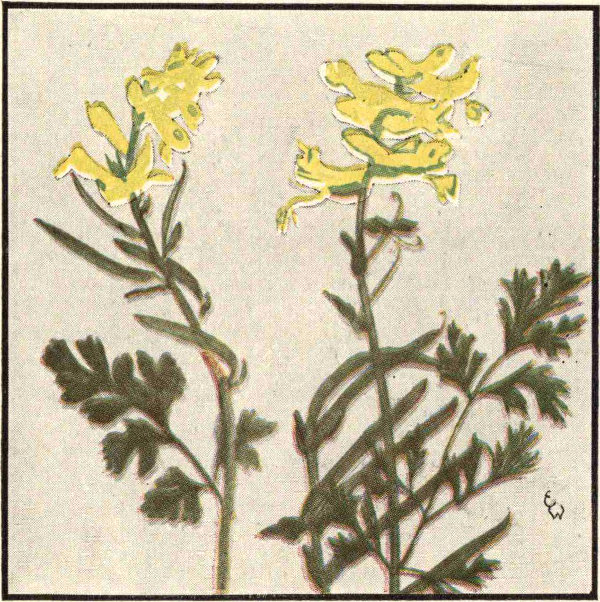
GOLDEN CORYDALIS TEXAS CORYDALIS
Leaves usually much divided; sepals 2; petals 4 in 2 series, outer usually spurred, the 2 inner usually crested and united; stamens 4 or 6; seeds shining.
Golden Corydalis. Plains Scrambled-Eggs (Capnoides montanum) is a common plant throughout the central and western parts of the state, ranging to Arizona and Montana, and blooming in Texas with the earlier spring flowers in March and April. By some botanists it is placed in the Corydalis group, which was named because of the resemblance of the flower spur to that of a lark. The pods are about an inch long, and the seeds are black, smooth, and shining. The short-podded scrambled-eggs (Capnoides crystallinum) comes into the northern part of the state from Kansas and Missouri. The pods are over half an inch long, about ¼ in. broad, and covered with blisters.
Texas Corydalis or Scrambled-Eggs (Capnoides curvisiliquum) grows in the sandy regions of the state. It is usually a more bushy plant than the preceding ones, with longer 4-angled pods.
Dutchman’s breeches (Dicentra cucullaria), so called because of the shape of the flower, does not come into the state. The plant in Texas which is called Dutchman’s breeches from the shape of the seed case is Thamnosma texana, a member of the rue family.
36
MUSTARD FAMILY (Cruciferae)
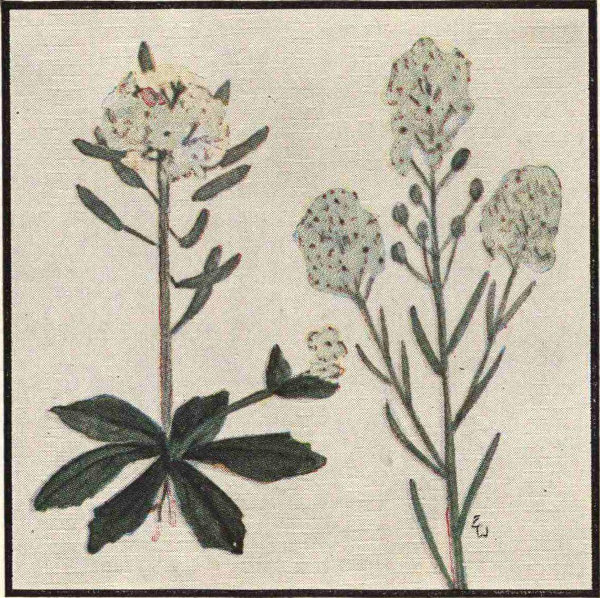
WHITLOW-GRASS PEPPERGRASS
Annual or perennial herbs; sepals 4; petals 4, standing opposite each other in a square cross; stamens, 4 long and 2 short; fruit a special pod called a silique.
Wedge-Leaved Whitlow-Grass (Draba cuneifolia) is so small that it might be overlooked if it bloomed at any other time than early spring. Growing from a cluster of basal leaves, the stems are topped by the cluster of small, alyssum-like flowers. It grows throughout the Southern United States and Mexico.
Alyssum-Flowered Peppergrass (Lepidium alyssoides) is a low bushy perennial plant with numerous clusters of small white flowers. It grows in the western part of the state, ranging to Arizona and Colorado. Many other peppergrasses are found in the state, some with inconspicuous flowers, but all having the small, flat, roundish seed-pod which is usually notched above. The foliage and pods have an aromatic-peppery flavor. In some species the leaves are used for salad and the seeds for bird food, but the seeds from some native species have been fed to canaries with fatal results.
The mustard family is a large group well represented in Texas among the early spring flowers and includes many of our vegetables, such as mustard, cabbage, cauliflower, radish, and water-cress.
37
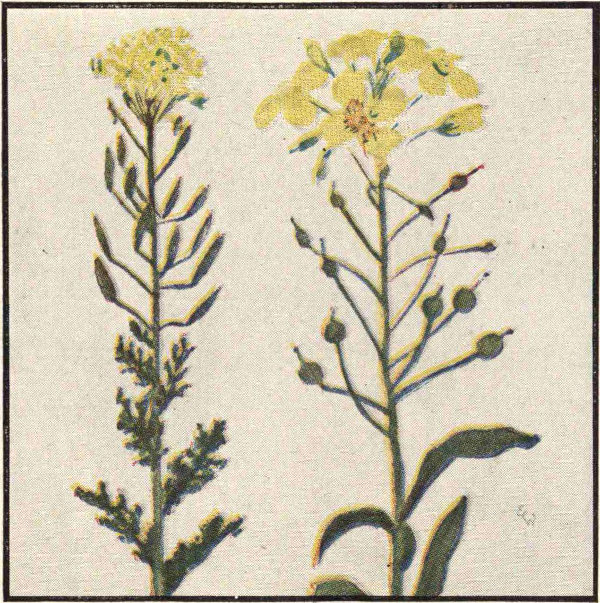
TANSY MUSTARD SLENDER BLADDER-POD
Tansy Mustard (Sophia pinnata) grows in dry soil across the continent, blooming in Texas in March and April. The narrow pods are about half an inch long, erect or ascending. The flowers are small, the petals yellow. In the southern part of the state it is very abundant and grows 2-3 ft. high. The name was given because of medicinal properties accredited to the plant.
Slender Bladder-Pod. Cloth-of-Gold (Lesquerella gracilis) can be recognized by its bladder-like pods, which are responsible for its common name of pop-weed. The yellow petals are narrowed at the base and streaked with orange. The first flush of yellow on plains and prairies is usually due to the bladder-pods. There are more than 20 species in the state, most of them being very abundant. The scientific name is in honor of Leo Lesquereux, a Swiss and American botanist.
The western wall-flower (Erysimum asperum), which grows in sandy areas in West Texas, is one of the showiest yellow mustards in the state. Several large-flowered purple mustards are common, including Streptanthus bracteatus.
38
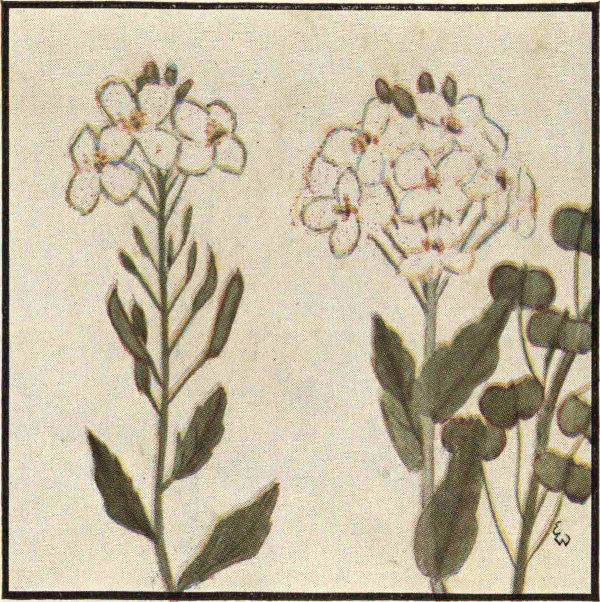
GREGGIA SPECTACLE-POD
Greggia (Greggia camporum) is a white-flowered mustard which looks like the yellow western wall-flower. The flowers are about half an inch broad and sometimes tinged with purple. The stems are about a foot high and almost concealed by the broad gray-green leaves. The woolly pods are narrow, flattened, and about half an inch long. It is one of the commonest flowers in Southwestern Texas, blooming in April, May, and June.
Spectacle-Pod (Dithyraea wislizeni) is a common plant on sandhills and gravelly mesas in Western Texas and ranges to Utah and Mexico. Any one seeing the seed pods will think that the common name is most appropriate. The plants grow 1-2 ft. high and are topped by the showy clusters of white flowers. The leaves and flowers are very much like those of greggia, but the fruits easily distinguish them. It was first collected by Wislizenus in New Mexico in 1846.
39
PITCHER-PLANT FAMILY (Sarraceniaceae)
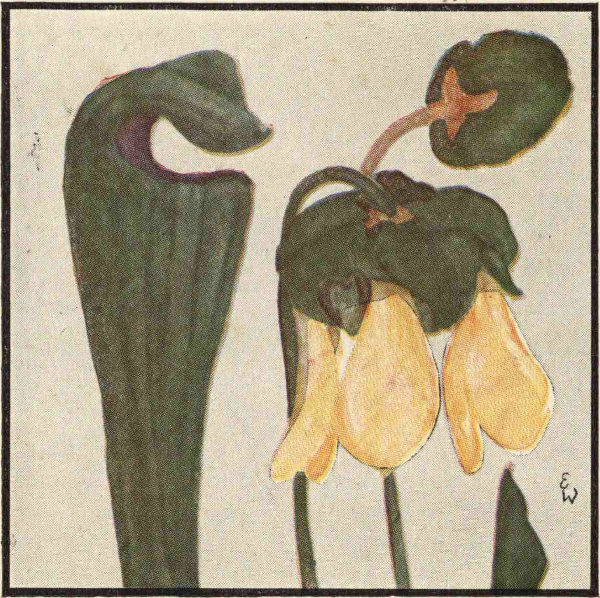
YELLOW PITCHER-PLANT
Herbs with tubular leaves; flowers nodding; sepals 4-5; petals 5, or absent; stamens numerous; style often umbrella-like; ovary 3-5-celled.
Yellow Pitcher-Plant. Trumpet-Leaf (Sarracenia sledgei) is also called trumpets, water-cup, watches, and biscuits. The last two names are suggestive of the broad, umbrella-shaped structure bearing the stigmas and occupying the center of the flower. The other names refer to the tubular, ribbed, trumpet-shaped leaves. The flowers are drooping at maturity, with 5 fiddle-shaped yellow petals and 5 shorter yellow sepals tinged with brown or red. It grows in swamps from East Texas to Alabama and is quite similar to the eastern Sarracenia flava. April-May.
The pitcher-plant is a most efficient collector of insects. The upper part of the leaf bends over, forming a lid whose inner surface is covered with minute honey-glands attractive to insects. The upper part of the tube is smooth, affording little foothold and causing the insect to fall into and drown in the sticky fluid given off in the lower part of the tube. Downwardly directed hairs prevent his escape. After a time his body is dissolved and absorbed by the plant. An overdose of animal food causes the browning and decay of the leaves.
40
ORPINE FAMILY (Crassulaceae)
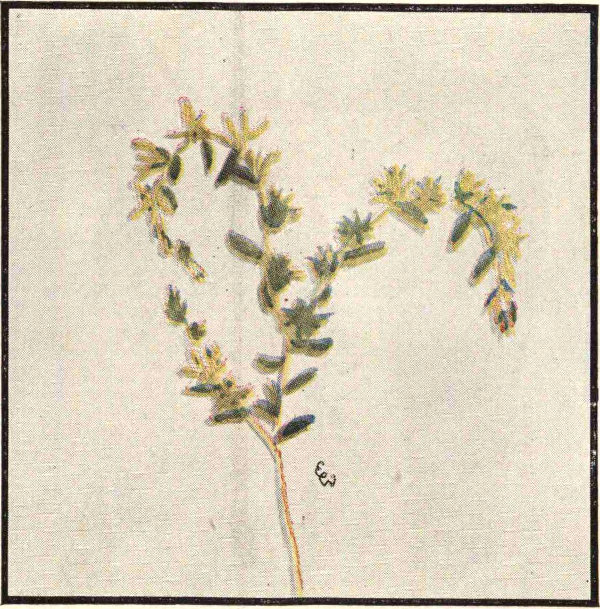
PRAIRIE STONECROP
Usually succulent herbs; leaves opposite or alternate; sepals 4-5; petals 4-5; stamens 5 or 10; carpels 4-5, free.
Prairie or Nuttall’s Stonecrop (Sedum nuttallianum) is an annual with forking branches covered with small yellow star-like flowers. The succulent leaves are short and rounded. The sedums are characterized by 4-5 sepals and petals, 8-10 stamens, and 4-5 small spreading seedcases. The prairie stonecrop grows in dry, open places from Missouri to Texas and blooms from April to June. It makes an excellent carpeting plant when used in sunny places.
The stonecrop belongs to a large group of plants, including live-forever and many other cultivated favorites, most of which are used for rockeries. Wright’s stonecrop (Sedum wrightii) is a white-flowered plant, very much like the prairie stonecrop, found in the mountains in the western part of the state, New Mexico, and Mexico. Sedum is from the Latin meaning “to sit” and refers to the low growth habit. In the same family are included the house-leeks, some of which are known as hen-and-chickens, or old-man-and-woman, because of the detached offshoots which form new plants.
41
ROSE FAMILY (Rosaceae)
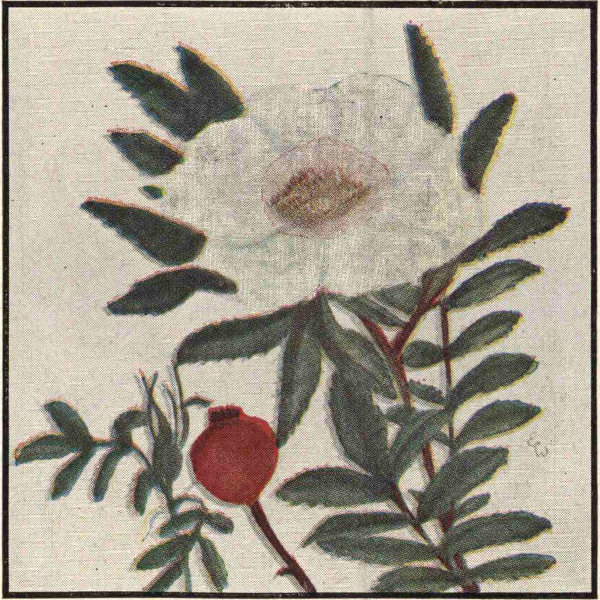
WHITE PRAIRIE ROSE
Trees, shrubs, or herbs; leaves simple or compound, stipules present; sepals 5; petals 5; stamens numerous; carpels 1 or more; sepals and petals borne on rim of calyx-tube.
White Prairie Rose or Woods’ Rose (Rosa woodsii) at first glance may be confused with the dewberry because of the low, bushy creeping stems and similar white flowers. The stems are 1-3 ft. high and are armed with straight prickles, usually in pairs; the leaves have 5-9 oval leaflets ½-1½ in. long. The flowers bloom in late May and early June, the dark red globe-shaped hips maturing in the late summer and fall. It may be found from Texas to Minnesota and Colorado. The white flowers are commonly two inches broad and very much like those of the McCartney rose, but it is more closely related to the cinnamon rose.
The McCartney rose (Rosa bracteata), early introduced from China into the Southern States and planted for windbreaks, is still very abundant on the coastal prairie, often forming great mounds about 10 ft. high. The thick evergreen leaves are divided into 5-9 oval leaflets, which are bright green and shining above. The sepals and the broadened portion of the stem below the white flower are densely silky.
42
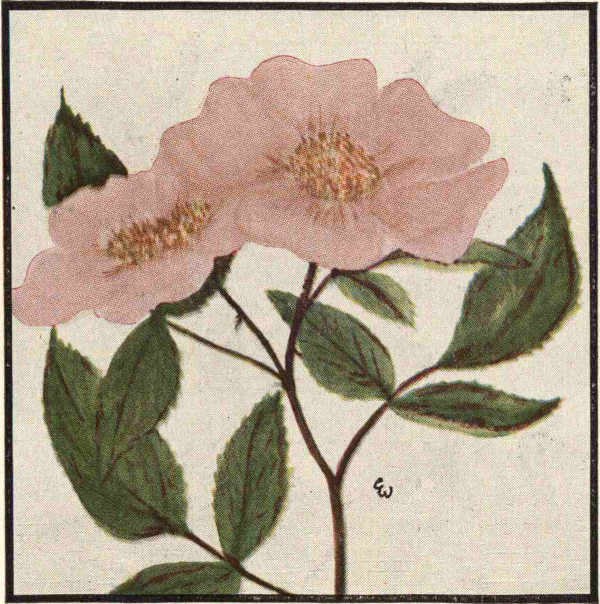
PINK PRAIRIE ROSE
Pink Prairie Rose or Climbing Rose (Rosa setigera) has climbing branches 6-15 ft. long with straight scattered prickles. The leaves are divided into 3-5 leaflets which are sharply pointed and 1-3 in. long. The showy pink flowers, 2 in. broad, grow in terminal clusters. This plant is considered one of the finest foods and covers for quail, grouse, and other birds. Native from Ontario to Texas and Florida, it is a hardy climber which has been widely introduced into other places, Baltimore Belle being one of the early cultivated forms. It is particularly abundant in Texas in the vicinity of Tyler, blooming in late May and June.
The wild roses are fairly rare in the state, but many cultivated roses are grown. Tyler has recently become a center of rose-growing, and carloads of rose plants are shipped throughout the United States. The scientific name retains the ancient Latin name.
43
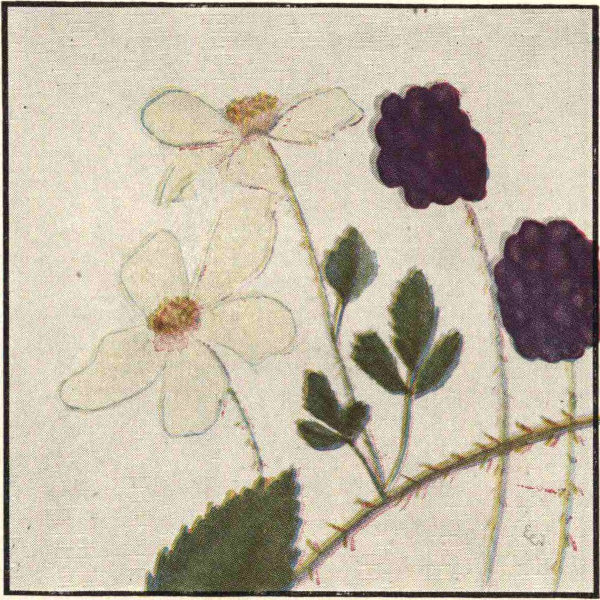
SOUTHERN DEWBERRY
Southern Dewberry (Rubus trivialis) has large white flowers very much like those of the wild rose, but the petals are narrower, particularly at the base. The fruit is a head of small, fleshy-seeded fruits, purplish-black when ripe. The flowers bloom in March and early April, the sweet and palatable berries ripening in the latter part of April. The plant is an evergreen shrub with trailing or low climbing stems, 10-15 ft. long, heavily armed with prickles. Fences along the roadside are often covered with dense masses of the stems.
Bush Blackberry (Rubus argutus) grows in moist woods in East Texas and on through the Gulf States to New Jersey. The stems are 3-4 ft. high, the branches erect. The flowers are white and grow in thick clusters. The berries are somewhat dry, oblong, and edible, but not very palatable.
44
MIMOSA FAMILY (Mimosaceae)
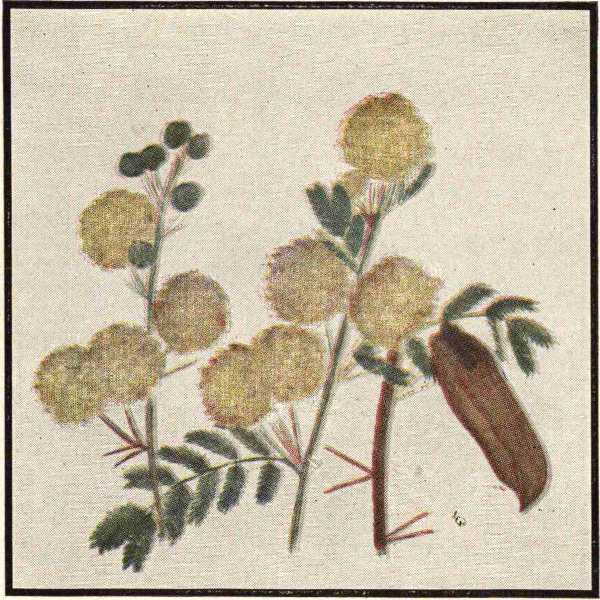
HUISACHE (Pronounced wee satch)
Usually trees or shrubs; leaves mostly twice pinnate; flowers small, in heads or spikes; sepals 5, calyx tubular; petals 5; stamens 5 or more; ovary 1-celled; fruit a pod.
Huisache (Acacia farnesiana), also known as opoponax, popinac, cassie, and sweet acacia, is a tropical shrub or small tree native to the Americas but widely introduced in other countries. The wide-spreading, graceful trees are almost evergreen, as the leaves are not shed before new ones appear unless affected by the cold. The slender, sharp spines occur in pairs at the base of the fern-like leaves, which are dark green and have 2-5 pairs of divisions with 10-25 pairs of narrow leaflets about ¼ in. long. The ball-like clusters of deep-yellow fragrant flowers usually appear before the leaves. The clusters are over half an inch broad, the many tubular flowers bearing numerous stamens, which give a feathery appearance to the clusters.
Various products from the trees are in use in many countries—forage from leaves, honey and perfume from the flowers, tannin from the bark and fruit, ink from the fruit, and medicinal products from nearly every part. In Southern Texas it is highly valued as a honey crop, the flowers blooming from February to April as a rule, but occasionally as early as December.
45
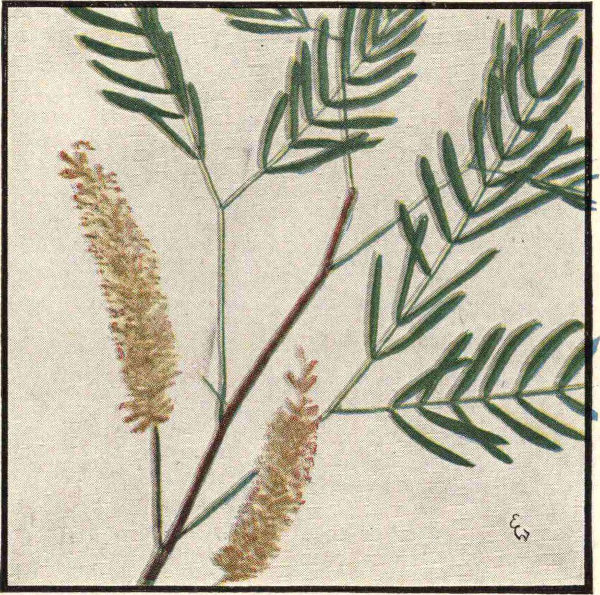
MESQUITE
Mesquite (Prosopis juliflora glandulosa) is found on prairies throughout the state but grows luxuriantly in the southwestern part. In moister regions it is a graceful tree with lacy yellow-green leaves and is armed with stout, vicious spines over an inch long, but in the drier regions it is a spreading shrub with large underground roots which Mexicans dig up for fuel. Spikes of greenish-white or cream flowers appear at intervals during the warm months. Long beans, 4-8 in. long, soon turning pale yellow, mature in a few weeks. The leaves have 2 or 4 widely spreading divisions and commonly bear 6-15 pairs of leaflets about 1 in. long.
Like the huisache, the mesquite has many uses. The beans are edible, the pulp containing 25-30 per cent grape sugar. The Indians used the beans for a food, first grinding them into meal in holes in the rocks. They form a valuable stock food in Hawaii, where the trees have been introduced. The wood is hard and takes an excellent polish, but is chiefly used for fence-posts, railroad ties, fuel, and paving blocks. The honey produced from the flowers is not so good as huisache honey nor is so much produced.
46
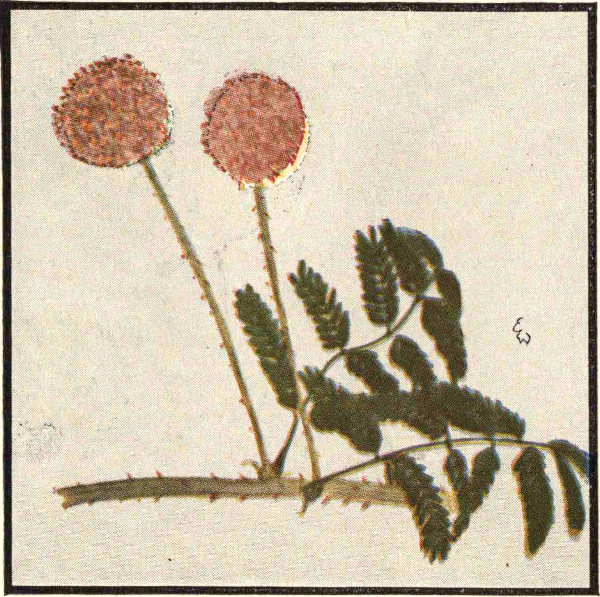
PINK SENSITIVE BRIAR
Pink Sensitive Briar (Leptoglottis uncinata) is also called pink mimosa and shame-vine, the latter name being given because of the leaf’s habit of closing when touched. The vines sprawl on the ground, growing out 2-4 ft. They are densely covered with small, recurved prickles. The leaves are divided as in other mimosas, having 4-8 pairs of divisions each bearing 8-15 pairs of short leaflets. The small, fragrant pink flowers are borne in dense heads. The pods are nearly round, densely covered with spines, and about 1½ in. long. It grows in dry soil from Virginia to Mexico, blooming in Texas in April and May.
Yellow Sensitive Briar (Neptunia lutea) is very much like the pink briar but has oblong heads of yellow flowers. The pods are smooth and flat and markedly narrowed at the base. The yellow briar grows in sandy soil from Oklahoma and Texas to Florida, blooming in June.
47
SENNA FAMILY (Cassiaceae)
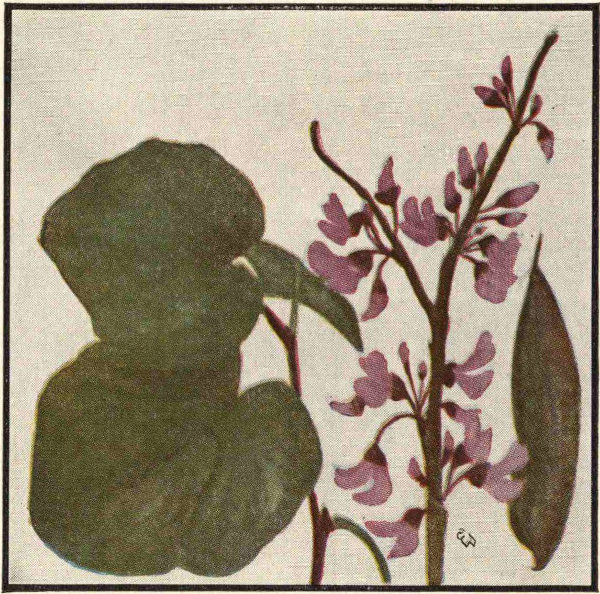
TEXAS REDBUD
Trees, shrubs, or rarely herbs; leaves usually once or twice pinnate; flowers mostly showy; sepals 5; petals 5; stamens mostly 10; ovary 1-celled; fruit a pod.
Texas Redbud (Cercis reniformis) is one of the handsomest shrubs of the limestone hill region of Texas and New Mexico. The pea-shaped flowers appear on last year’s wood in February or March, often remaining lovely for a month before the leaves appear. The leaves are a glossy green above, rounded and sometimes deeply notched or kidney-shaped (reniform), and usually 3-4 in. broad. The clusters of numerous red seed-pods are very conspicuous in the summer and autumn. The flat pods have a narrow wing on one side and are pointed at both ends, 2½-3 in. long and over ½ in. broad.
The Canadian or eastern redbud is found in the northern and eastern part of the state. It has smaller flowers and very pointed leaves. The western redbud grows in the mountainous region of the state and has similar leaves but smaller flowers.
The Asiatic redbud is called Judas-tree because Judas is supposed to have hanged himself from one of the trees. Redbud flowers, served either fried or pickled for salads, are sometimes eaten by people. It is an excellent shrub or small tree for highway and garden planting.
48
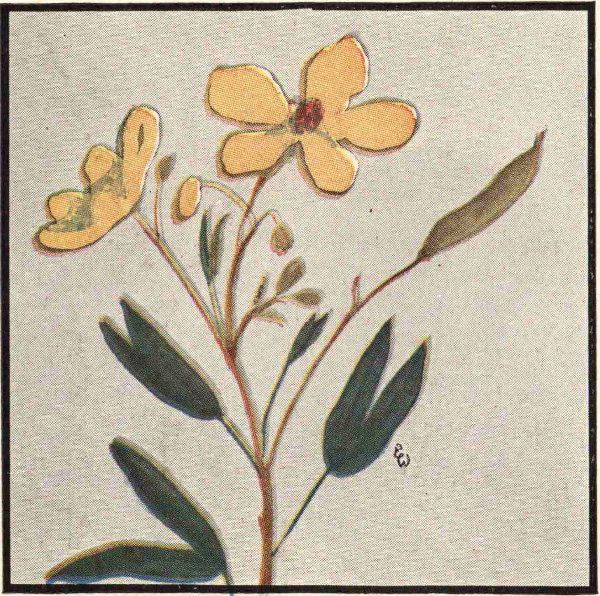
TWO-LEAVED SENNA
Two-Leaved Senna (Cassia roemeriana) gets its common name from the two spreading leaflets into which the leaf is divided. They are 1-2 in. long and have a slender stalk about the same length. The stems are commonly about 8-12 in. high, growing from a woody perennial root. The sparsely-flowered clusters of yellow flowers appear from spring until fall. The seed-pods are about an inch long and half an inch wide. This senna is very abundant from Central Texas into Mexico and New Mexico. It bears the name of Roemer, a geologist sent from Germany to study the geology of the grant made to the German colonists at New Braunfels. He was in Texas from 1845 to 1847, visited and botanized with Lindheimer at New Braunfels, and carried many new Texas plants back to Germany.
The senna group is very large and mainly tropical in distribution, many species being noted for medicinal properties. The coffee senna (Cassia occidentalis) and the American senna (Cassia marilandica) are common weeds in the eastern part of the state. The velvet-leaved or Lindheimer’s senna grows in the western part of the state.
49
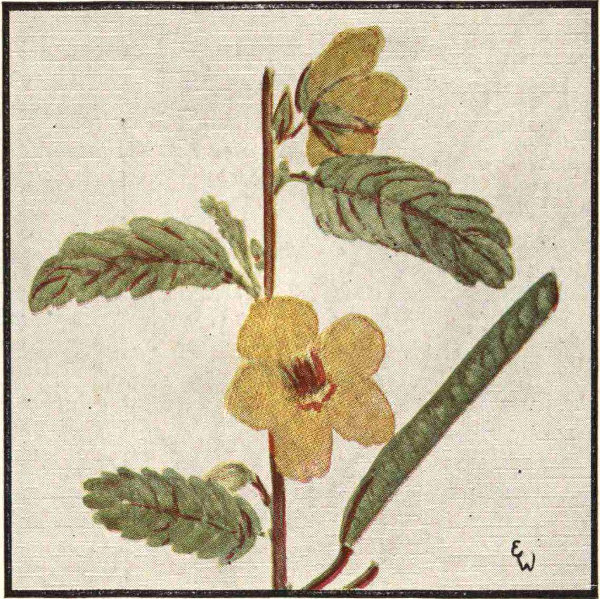
PARTRIDGE PEA
Partridge Pea. Prairie Senna (Chamaecrista fasciculata) is also called large-flowered sensitive pea, dwarf cassia, and magoty-boy-bean. It blooms in the summer months and is very abundant in sandy soil in Central and Eastern Texas, ranging to Mexico and the northern part of the United States. The oblong leaves have 8-14 pairs of linear leaflets and a conspicuous orange or brown gland near the base. The flowers have five yellow petals, somewhat unequal and irregular in shape. Several buds grow on a short stalk between the leaves, but usually only one flower on the stalk opens at a time. It is an erect annual plant growing about 2½ feet high and often widely branched above. The pods are flattened, about ¼ in. wide and 2 in. long.
Several shrubs of the senna family are popular in Texas gardens, among them the bird-of-paradise (Poinciana gilliesii). It is a South American plant with showy yellow flowers which have 10 long brilliant red stamens protruding 3-5 inches from the flower.
50
RETAMA. HORSE BEAN
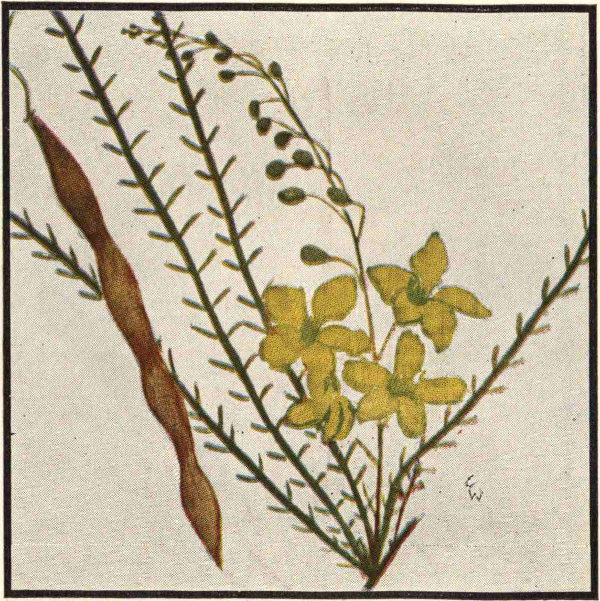
Retama. Horse Bean (Parkinsonia aculeata) is also known as Jerusalem-thorn, shower-of-gold, and palo verde, the latter meaning “green timber” from the green trunk and branches. It forms a spiny shrub or small tree with long, graceful, somewhat drooping branches, bearing bundles of leaves and sprays of yellow flowers. The long divided leaves are somewhat unusual. The leaf-stalks are green, broad, and flattened, performing the functions of the small leaflets which often drop off quite early. The 5 yellow petals are almost equal, but one bears a honey gland at its base and soon becomes red, remaining on the stalk longer than the others. The pods are 3-5 in. long, very narrow and constricted between the seeds. It ranges from Central Texas to Mexico and tropical America, bearing a profusion of blooms through the warm months after rains.
Besides being a very ornamental shrub of value in landscaping, the plant has various other uses. The seeds are edible and have long been used as food by Indians, Mexicans, and many animals. Mrs. Quillin, author of Texas Wild Flowers, reports the use in the treatment of diabetes of a tea the Mexicans make from the branches and leaves.
51
KRAMERIA FAMILY (Krameriaceae)
PRAIRIE SAND-BUR
Shrubs or perennials, leaves small; flowers irregular; sepals 4-5, petal-like; petals 4-5, smaller than sepals; stamens 3-4, united at base; fruit woody, armed with spines.
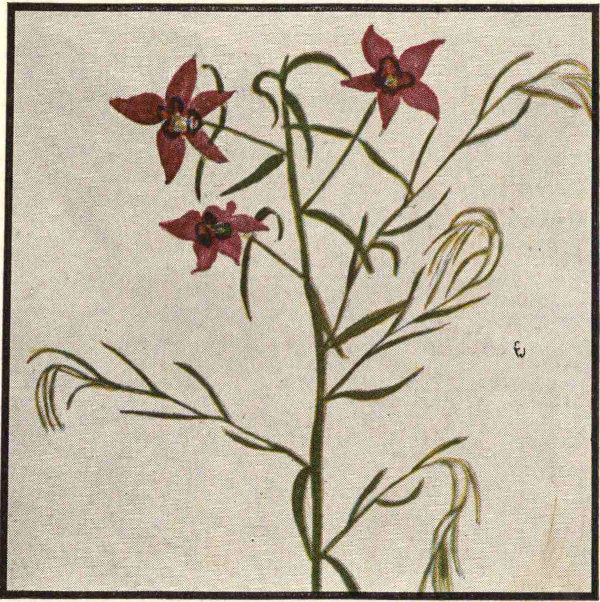
Prairie Sand-Bur. Linear-Leaved Krameria (Krameria lanceolata) is not the sand-bur of the grass family with which all children of the South are familiar; however, the burs are just as spiny, but are densely covered with white hairs. The flowers and short silky leaves grow on prostrate branches from a thick woody root. The 5 wine-red sepals may be mistaken for the petals which are smaller than the sepals and tinged with green, the 3 upper being united. The flowers are about an inch broad. The plant is not conspicuous but is quite abundant in dry, rocky soil from Kansas to Mexico, blooming from April to June.
Several shrubby kramerias grow in the southwestern part of the state. The name is in honor of an Austrian physician, Johann Kramer. Medicinal properties are reported for some of the species.
Chacate (Kameria grayi) is a densely branched shrub, 1-3 ft. high, with purple flowers. The bark of the root is used by Mexicans in dyeing leather a reddish-brown. It is found in the mountains of West Texas and Mexico.
52
PEA FAMILY (Fabaceae)
TEXAS MOUNTAIN LAUREL
Leaves simple or compound; flowers pea-shaped; sepals 5, united in a tube; petals 5; stamens often 10 and united in 1 or 2 groups; fruit a 1-celled pod.
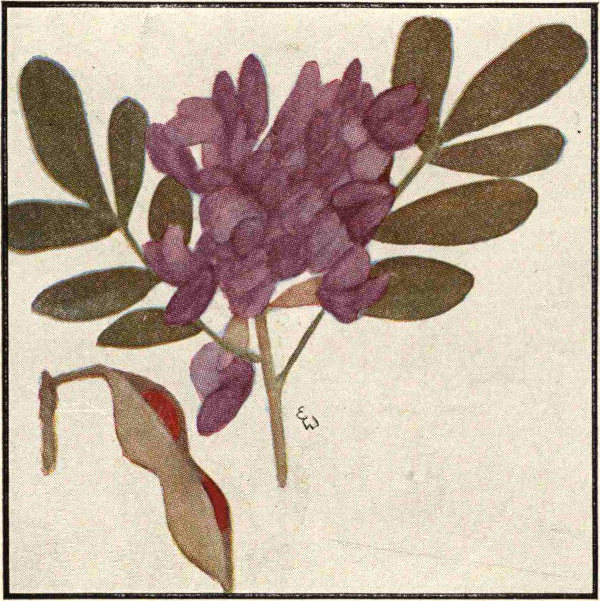
Texas Mountain Laurel (Sophora secundiflora) is an evergreen shrub or small tree growing on limestone hillsides from Texas to New Mexico and Mexico; it is particularly abundant in Southwest-Central Texas. The dense clusters of violet-blue flowers, at their best in the latter part of March but blooming earlier or later in different sections, are very showy against the glossy dark-green, leathery leaves. Many variations in color exist in nature from dark violet-blue to violet-tinged and white. The flowers have a strong, heavy scent which is disagreeable to most people. The brilliant scarlet beans, which mature in a few weeks, contain a poisonous alkaloid.
The Texas mountain laurel is not at all related to the southern mountain laurel (Kalmia latifolia), a rose-flowered shrub of the heath family. The sophoras have retained the Arabian name and include in their group many handsome ornamental shrubs, among which is the Japan pagoda tree. The Texas sophora can be readily grown from seed but is seldom successfully transplanted.
53
BUSH PEA
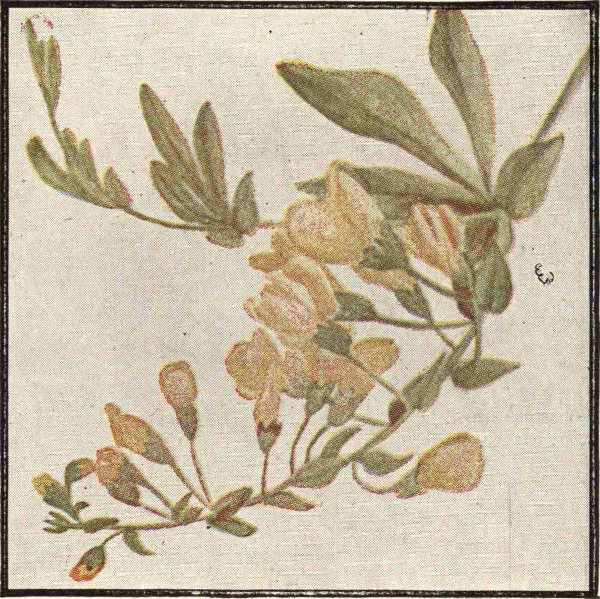
Bush Pea. Large-Bracted False Indigo (Baptisia bracteata) is sometimes called hen-and-chickens pea from the growth habit of the plant. The clusters of cream-colored flowers grow downward and peep out from the bushy leaf-growth. The flowers are about 1 in. long, and the 3 gray-green leaflets are 1-3 in. long. It grows on sandy slopes or moist prairies from the eastern part of Texas to Minnesota and South Carolina, blooming in Texas in April.
Texas Bluebonnet (Lupinus texensis) (see frontispiece) was widely known in pioneer days as buffalo clover. It grows in great abundance on limestone hillsides between the Brazos and Pecos Rivers from Dallas southward into Mexico. Seed-houses sell the Texas bluebonnet under the name of Lupinus subcarnosus, the bluebonnet of sandy areas. It has narrower flower spikes and rounded leaf-tips. Several other lupines are found in Texas but are not very common. The name is from the Latin meaning “wolf,” because it was thought the plants ruined the fertility of the soil. On the contrary, the lupines are excellent fertilizers, as the small nodules on the roots contain nitrogen-fixing bacteria which add to the soil nitrates. It blooms from March to early May. The bluebonnet was adopted as the state flower in 1901.
54
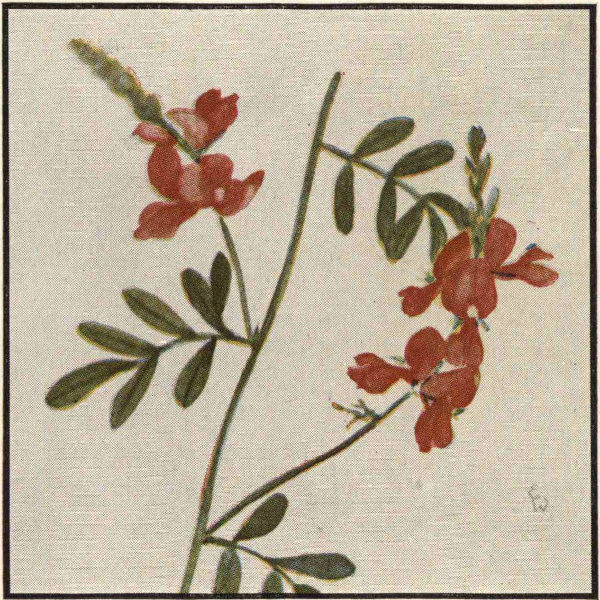
INDIGO-PLANT
Indigo-Plant. Scarlet Pea (Indigofera leptosepala) has prostrate branches growing from a woody root. The short, erect spikes of scarlet, pea-shaped flowers are borne near the ends of the branches, blooming from early spring until late summer, their blossoms forming an ever-increasing scarlet circle after each rain. The leaves are divided into 5-9 leaflets, narrowed at the base and about half an inch long. A small amount of indigo may be extracted from the foliage. While this is not a very conspicuous plant, it is one of the most widely distributed in the state and ranges to Mexico, Kansas, and Florida.
The indigo-plant belongs to a large group, mostly tropical, and many species, as the name indicates, are indigo-bearing. Commercial indigo, now a coal-tar product, was formerly obtained from a shrub (Indigofera tinctoria) introduced for cultivation into South Carolina in 1742. Several shrubby species of indigo-plants are found in the state, but none of them are very abundant.
55
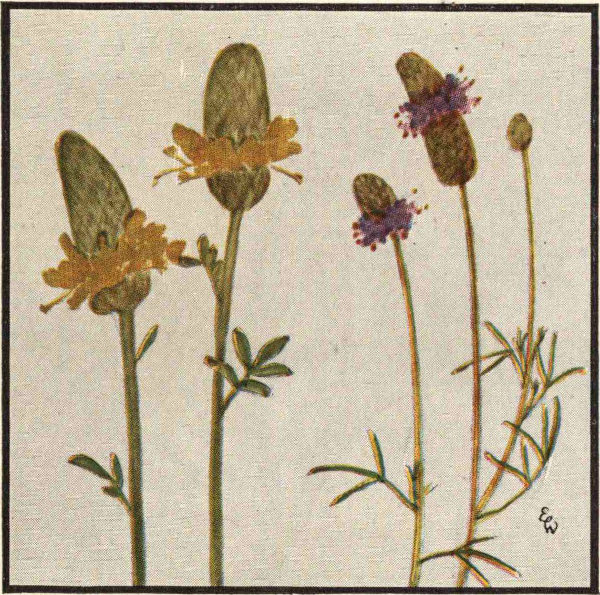
GOLDEN DALEA PURPLE PRAIRIE CLOVER
Golden Parosela or Dalea (Parosela aurea) may not be recognized at first glance as a member of the pea family, since the flowers grow in dense clusters at the top of erect branches, 1-1½ ft. high, which grow from a thick, woody root. The yellow flowers are small and pea-shaped, with a calyx which has slender, silky-plumose lobes. It may be found on chalky slopes of prairies from Texas to Missouri and South Dakota in June and July.
Several shrubby paroselas, very handsome when in full bloom, are found in the southwestern part of the state. Purple parosela (Parosela pogonathera) is a vivid, reddish-purple flowered species of the southwestern part.
Purple Prairie Clover (Petalostemon purpurea) is quite similar to the golden parosela in its growth habit, narrow glandular leaflets, and head-like flower clusters. It grows on prairies from Minnesota to Texas. The white prairie clover (Petalostemon multiflorum), with ball-shaped clusters of white flowers, is common on prairies from Kansas to Texas. Both prairie clovers bloom in June and July.
56
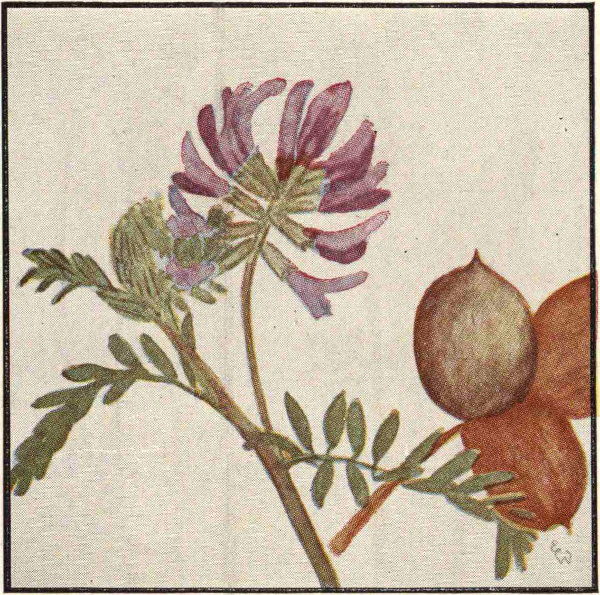
LARGER GROUND PLUM
Larger Ground Plum (Geoprumnon mexicanum) blooms with the first flowers of spring, forming conspicuous clumps on prairies from Illinois to Nebraska and Texas. The spreading prostrate branches grow 6-12 in. long and are covered with spike-like clusters of pale-purple flowers. The fleshy pods soon turn red and plum-like, maturing several weeks after flowering. The pods are edible and may be found in prairie-dog holes among the foods these animals have stored for the winter.
Loco Weeds are closely related to the ground plum, two of them being found in Texas and causing much loss to stockmen. They cause a slow poisoning of horses, sheep, and cattle but are particularly injurious to horses. The poisoning is chiefly due to the barium salts in the plant and is characterized by symptoms of staggering, some paralysis, and emaciation. The woolly loco weed (Astragalus mollissimus) has woolly leaves with 19-27 oval leaflets about half an inch long and spikes of violet-purple flowers. The stemless loco weed (Oxytropis lamberti) has basal leaves with 9-19 nearly linear leaflets about an inch long. Both are common on the plains, but the latter ranges into Southern Canada.
57
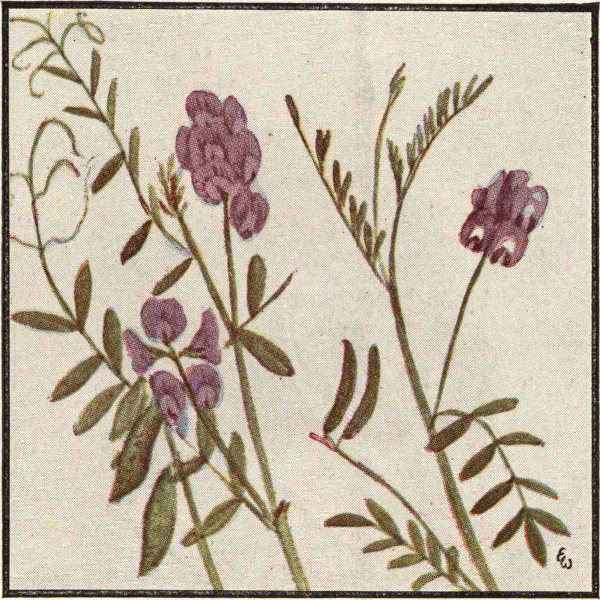
TEXAS CLIMBING VETCH NUTTALL’S MILK VETCH
Nuttall’s Milk Vetch. Turkey Pea (Hamosa nuttalliana) is a low plant with few-flowered clusters of small flowers. Although it is inconspicuous, it is so common in yards and fields from Arkansas to Arizona that many people are familiar with it. It blooms in March in the southern part and May and June in the northern part of its range. The narrow pods are slightly curved and nearly an inch long. There are several hamosas with similar pods which are common in the state.
Texas Climbing Vetch (Vicia texana) has prostrate branches, 1-2 ft. long, and divided leaves terminating in branched tendrils by which the branches climb over the low plants with which they come in contact. Clusters of the dainty, pale bluish-purple flowers appear in late March and April, the plants forming masses of bloom along roadsides in the sandy regions of the state from Central Texas to Arkansas and Mississippi.
Many of the climbing vetches are planted for cover crops, and one is a garden bean. Many of the garden beans belong to the Phaseolus group, among these being the tepary bean (Phaseolus acutifolius latifolius), a native bean from West Texas to Arizona.
58
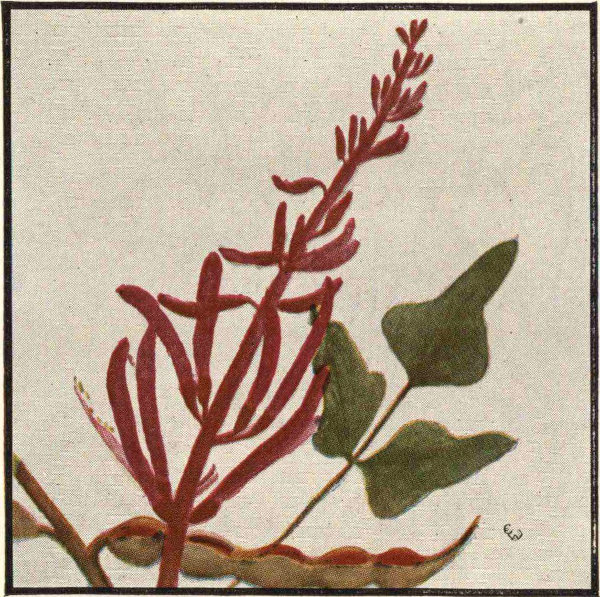
CORAL-BEAN
Coral-Bean (Erythrina herbacea) grows in woods along the coast from Texas to North Carolina. It has erect, herbaceous stems growing from a woody root. The flowers appear before the leaves in spike-like clusters at the ends of the branches. “Erythrina” is from the Greek, meaning “red” and refers to the color of the flowers, which are over an inch long and have the upper petal wrapped around the other petals. The leaves are 6-8 in. long and slender-stalked; they are divided into 3 broad leaflets.
The coral-bean belongs to a group of highly ornamental tropical plants. It does well in cultivation in Southern and Central Texas but is not suitable for a cut-flower, as the flowers soon drop off. The red beans are often used for necklaces. When the pods begin to open, the clusters may be gathered for winter decorations. The coral-tree (Erythrina cristagalli) from Brazil is common in cultivation and has broader and showier flowers than the coral-bean.
59
GERANIUM FAMILY (Geraniaceae)
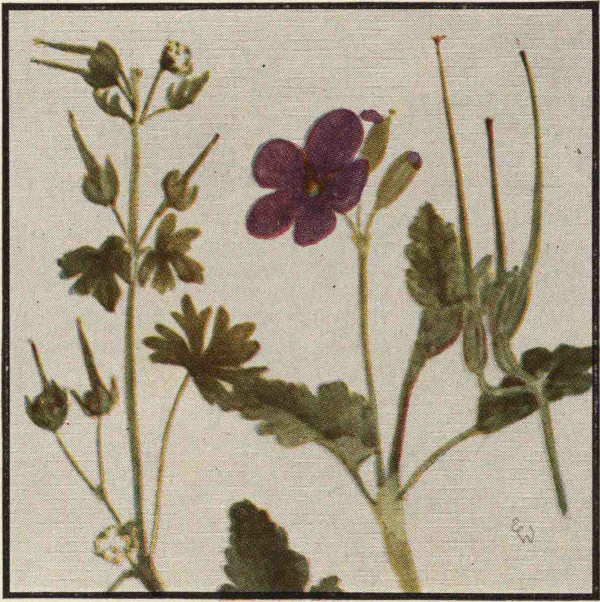
CRANE’S BILL STORK’S BILL
Leaves simple or compound; sepals 4-5; petals mostly 5; stamens 5, 10, or 15, more or less united at base; carpels 3-5, prolonged into styles.
Crane’s Bill. Texas Geranium (Geranium texanum) is very much like the Carolina geranium. The small white flowers are inconspicuous, but the seed capsules with their long beaks resembling the crane’s bill are very noticeable. The scientific name is from the Greek meaning “crane.” The Texas geranium differs from the Carolina geranium in having pitted seed and fewer flowers. The cultivated geraniums belong to the Pelargonium group.
Stork’s Bill. Pine Needle (Erodium texanum) has fruits similar to the Texas geranium, but the beaks are much longer, 1-2 in. long. The short-stalked flowers are quite showy while they are open, but they close in the heat of the day. The wine-red petals are marked with delicate purple veins. The low spreading branches are 2-12 in. long. This plant grows on rocky limestone hillsides from Texas to California and blooms in April and May.
Pin-Clover. Filaree. Alfilaria (Erodium cicutarium) has finely-divided, lacy leaves and small pink flowers. It is used in some places as a forage crop.
60
FLAX FAMILY (Linaceae)
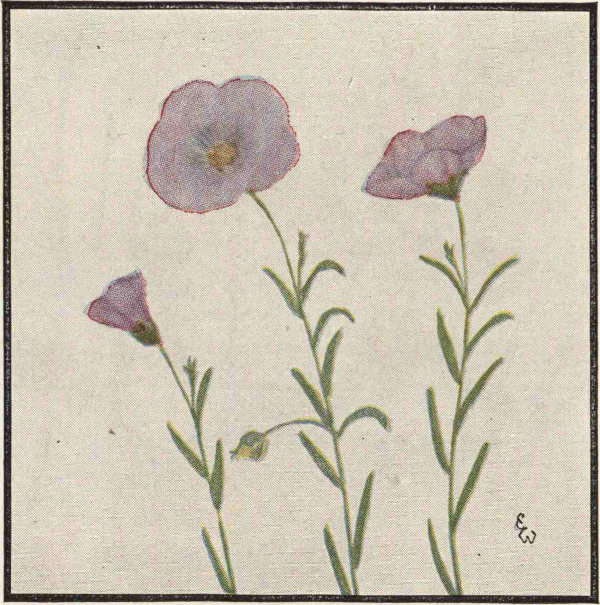
BLUE PRAIRIE FLAX
Leaves simple; sepals usually 5, free or united at base; petals usually 5, soon falling; stamens 5, united at base; styles 3-5, thread-like; capsules 3-5-celled.
Blue Prairie Flax (Linum lewisii) has lovely sky-blue flowers, 1-1½ in. across. The petals are veined with purple and drop off in the heat of the day or upon being disturbed. This flax is a slender, branched plant with a perennial root. It is very abundant on the prairies in the vicinity of Ft. Worth and Dallas, blooming there in May, and ranges to Arizona and Southern Canada. It may grow 1-2 ft. high, but in Texas it is often only about 8 in. high.
This flax is very much like the European perennial flax (Linum perenne) and the cultivated flax (Linum usitatissimum), from which flax fiber is obtained. “Linum” is the ancient Latin name for the flax plants. Many of them are showy plants of horticultural importance; for even though the flowers last only a few hours, the plants bear a profusion of blooms. They are valuable for Texas gardens, as they do best in sunny places. Flaxes may often be identified by the dropping off of the petals.
61
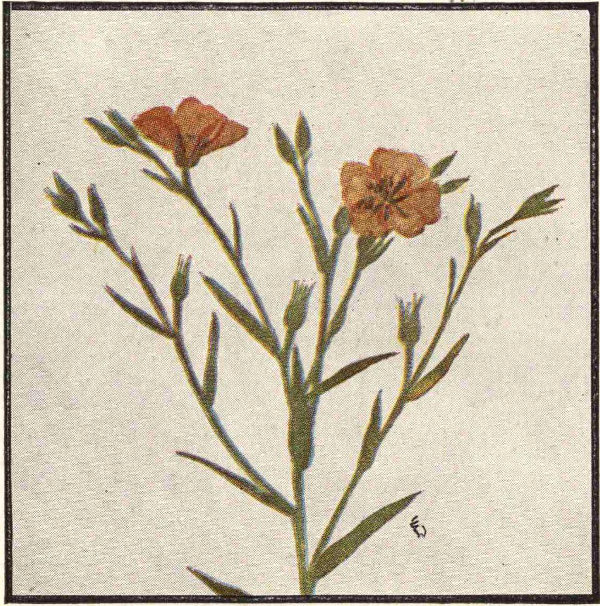
YELLOW PRAIRIE FLAX
Yellow Prairie Flax (Linum sulcatum) is a leafy, much-branched plant, 8-16 in. tall, with large yellow petals, orange-red and veined at the base. The leaves are narrow, about 1 inch long. The flaxes have 5 styles, sometimes united, as in this plant, and sometimes separate, but often remaining on the capsule until the seeds are shed.
The yellow flaxes are sometimes separated from the blue-flowered ones and called Cathartolinum. There are many of them in the state, most of them so closely related that only an expert can distinguish them. They bloom from March until June. In the southern part the commonest one is the dwarf flax (Linum multicaule), which has its stems densely covered with short leaves. Linum rigidum is a large-flowered flax with stiff stems common on prairies from Texas to Southern Canada. It has been reported as poisonous to sheep in the Pecos Valley.
62
WOOD-SORREL FAMILY (Oxalidaceae)
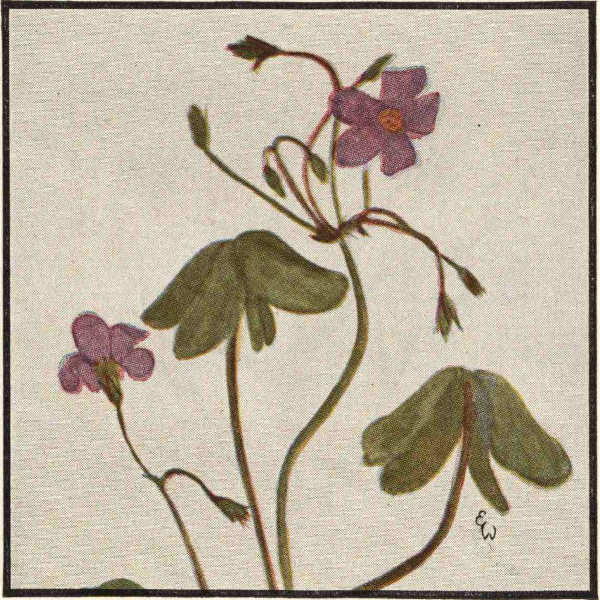
DRUMMOND’S WOOD-SORREL
Leaves digitately or pinnately divided; sepals 5; petals 5; stamens 10, slightly united at base; ovary 5-celled; styles 5, free; fruit a capsule.
Drummond’s Wood-Sorrel (Oxalis drummondii) is also called sour-grass, vinegar-grass, oxalis, and violet wood-sorrel. It grows in dry soil from Central Texas to New Mexico, blooming in the late summer and fall. It has flowers like the violet wood-sorrel with similar basal leaves growing from a bulb. As a rule, the plants and flowers are larger and the leaflets are crescent-shaped. Oxalis flowers usually open in bright sunlight, and the leaves close at night.
Violet Wood-Sorrel (Oxalis violaceae) is very abundant in the woods of East Texas and on into the Western United States. The plants are generally about six inches high. Children often eat the leaves, but a considerable quantity will cause violent convulsions. The poisoning is due to the presence of oxalic acid crystals, which give a sour taste to the leaves.
The bulbs of many wood-sorrels are potted in the fall to provide house flowers in February and March. Drummond’s wood-sorrel makes an excellent border plant.
63
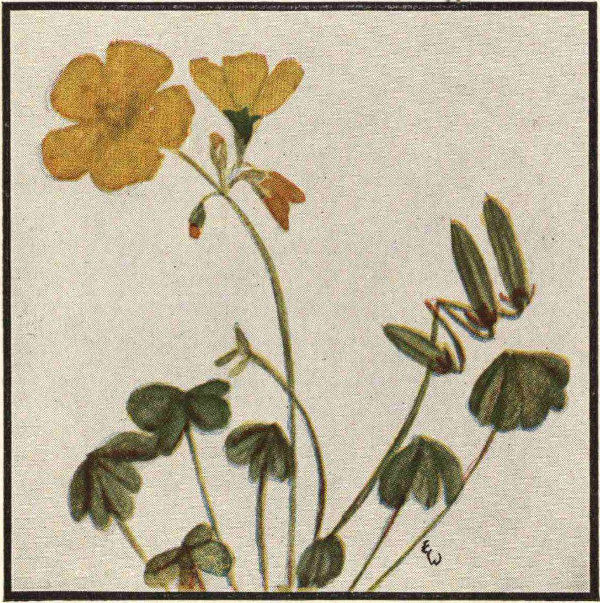
YELLOW WOOD-SORREL
Yellow Wood-Sorrel (Oxalis texana) is a large flowered wood-sorrel in East Texas. The golden-yellow petals are about ¾ in. long. The flower stalk is about twice the length of the stem and leaves. It differs from the large-flowered wood-sorrel of the Southern States (Oxalis macrantha) by having smooth instead of hairy stamen filaments.
Many of the yellow wood-sorrels are common weeds throughout the state. There are many different species. The white or pink-flowered wood-sorrel (Oxalis acetosella) is considered by many people as the shamrock of Ireland; but others consider white clover (Trifolium repens) as the true shamrock.
Dichondra-Leaved Wood-Sorrel (Oxalis dichondraefolia) is a low plant of Southern Texas and Mexico which has pale yellow flowers like the yellow wood-sorrels, but the leaflets differ in being rounded and entire and resemble the leaves of the dichondras (see page 101).
64
MILKWORT FAMILY (Polygalaceae)
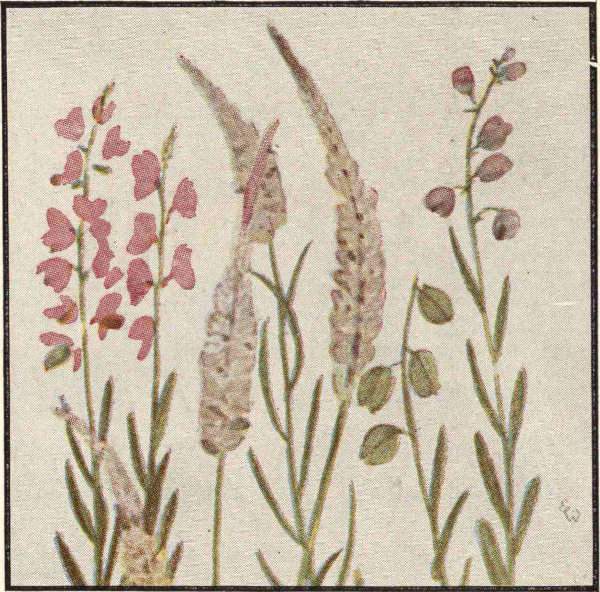
PINK MILKWORT WHITE MILKWORT PURPLE MILKWORT
Flowers pea-shaped; sepals 5, the 2 inner larger and often petal-like; petals 3 or 5, the lower concave, often fringed; stamens 8, united, opening by apical pores; fruit a 2-celled capsule.
Pink or Bitter Milkwort (Polygala polygama) is a showy-flowered milkwort growing in sandy woods in East Texas. It has erect branches with slender clusters of pink flowers about ¼ in. long and horizontal branches under the soil bearing closed flowers which are self-fertilized. It blooms in Texas in April.
White Milkwort (Polygala alba) has densely-flowered spikes of greenish-white flowers, the buds often tinged with purple. A drug obtained from the dried root is used as an irritant. Like the closely related Seneca snake-root (Polygala senega), it probably contains saponin, which will dissolve the red blood-corpuscles. The roots of the latter are used in medicine to produce vomiting and as an antidote for snake-bite. The white milkwort is common on prairies and chalky slopes from Montana to Mexico from April to July.
Purple Milkwort (Polygala puberula) grows in the mountains of West Texas, Arizona, and Mexico. It has much larger seed capsules than the two preceding. The capsule is one of the chief features for identifying the milkworts, being 2-celled and flattened.
65
SPURGE FAMILY (Euphorbiaceae)
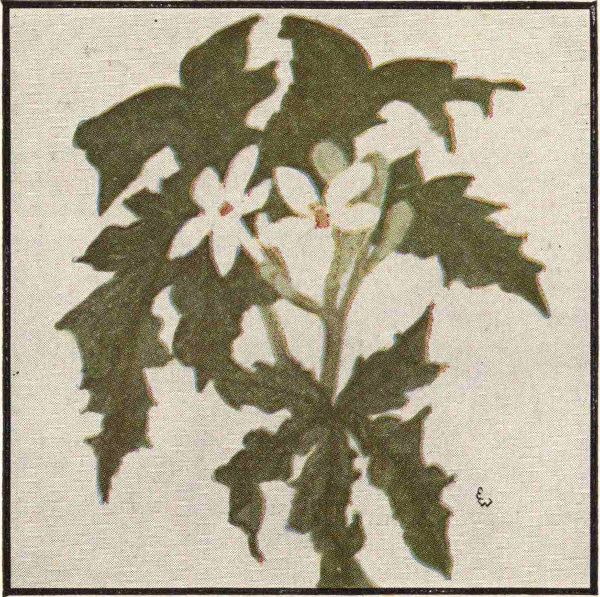
BULL NETTLE
Flowers staminate and pistillate, often borne in an involucre; sepals sometimes reduced or absent; petals usually absent; stamens 1 to 1,000; styles free or united at base; fruit usually a 3-lobed capsule.
Bull Nettle (Cnidoscolus texanus), also called tread-softly, spurge-nettle, and “mala mujer” (bad woman), is a vicious plant thickly clothed with stinging hairs and bearing clusters of tubular white flowers quite similar to the tuberose in appearance and fragrance. The plants grow 2-3 ft. high. The upper flowers bear stamens, and the flowers in the lower forks of the cluster produce seeds. The seed-capsules resemble those of other members of the spurge family in being nearly ball-shaped and deeply three-lobed. The seeds are large, edible, and very palatable. The plants are very abundant in waste places and sandy soil from Texas to Arkansas and Oklahoma, blooming from late spring until fall.
Some familiar commercial products are obtained from members of the spurge family; e.g., rubber, tapioca, and castor oil. In horticulture, the cactus-like spurges and the Christmas poinsettia are well-known favorites. The Chinese tallow-tree (Sapium sebiferum) is used as an ornamental tree, its leaves being very decorative in the fall.
66
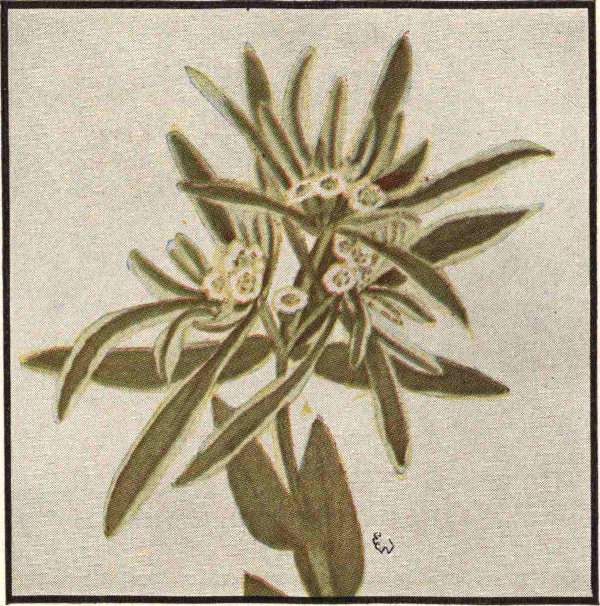
SNOW-ON-THE-MOUNTAIN
Snow-on-the-Mountain. Ghost-Weed (Euphorbia bicolor) grows in great abundance on the plains of Arkansas, Oklahoma, Louisiana, and Texas, being especially thick along dry creek margins. The plants are lovely in late August and September, their showy appearance being due to the green and white leaves surrounding the flower clusters. It bears rather unusual flowers which yield a poisonous honey. The green calyx-like structure is an involucre bearing numerous flowers, each consisting of a single stamen or pistil. Around the top of the involucre are 4-5 small glands each bearing a white appendage which is mistaken for the petals. The cultivated snow-on-the-mountain (Euphorbia marginata) has broader and shorter leaves. It is native on hillsides of Central Texas north to Minnesota.
Texas Croton (Croton texensis) is a weed, 2-3 ft. high, growing in conspicuous masses, particularly in the western part of the state. The flowers are inconspicuous among the gray-green foliage, the widely branched stems bearing numerous linear leaves. The fragrant leaves and stems from some of the crotons are gathered and dried by the Mexicans to use for tea or meat seasoning.
67
HOLLY FAMILY (Aquifoliaceae)
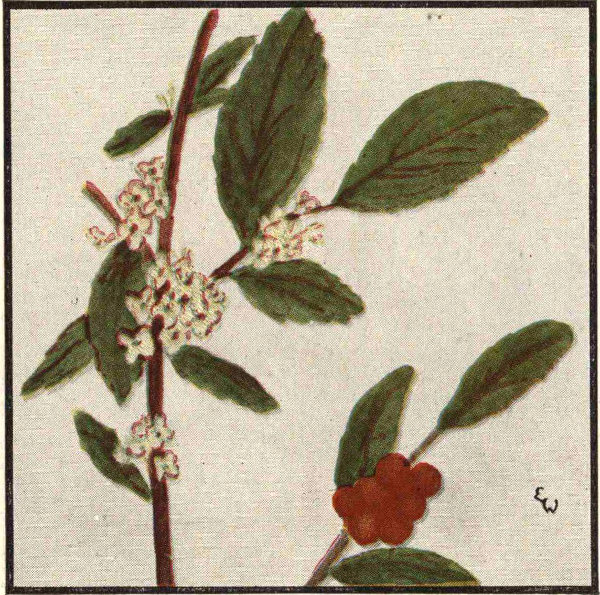
YAUPON
Trees or shrubs, mostly evergreen; sepals 3-6; petals 4-5; stamens 4-5, opposite petals; carpels 3 or more; fruit a drupe.
Yaupon. Cassine (Ilex vomitoria) with dark glossy evergreen leaves and red berries forms lovely hedges along the highways and fields and is scattered through woods in Central and East Texas, ranging to Virginia. The berries, an excellent bird food, usually remain on the shrubs until the small white flowers appear in late March or April. The plant forms a dense widely-branched shrub, which is of slow growth and very desirable for hedges. As the berries are produced on separate bushes from the pollen-bearing flowers, care should be taken to plant those producing berries if ornamental shrubs are desired. Cassine tea is made from the leaves, but it is bitter and contains much caffein and tannin. Like the American holly, which grows in East Texas, the yaupon is being exterminated for Christmas decorations. The deciduous holly (Ilex decidua) has larger leaves, which are shed in the early fall, and larger orange-red berries, which remain on the shrub or tree until late winter.
68
BUCKEYE FAMILY (Aesculaceae)
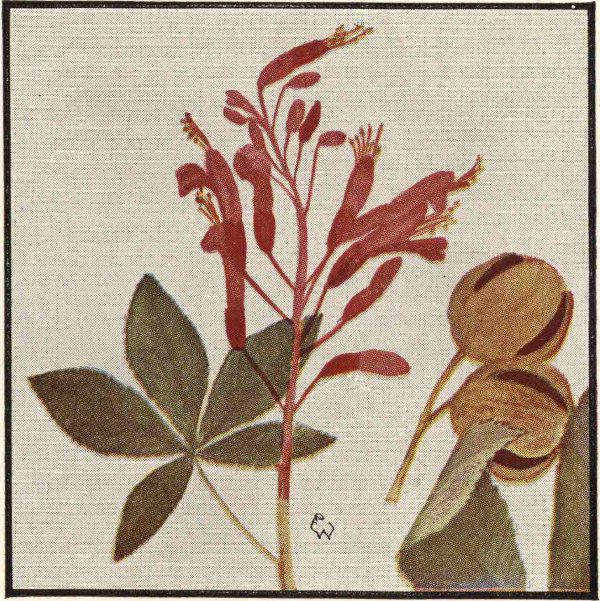
SOUTHERN BUCKEYE
Leaves digitate; calyx tubular, 5-lobed; petals 4-5, unequal; stamens 5-8, inserted on disk; capsules leathery, usually 3-celled; seeds large, shining.
Southern Buckeye (Aesculus discolor) is a handsome shrub or small tree with showy spike-like clusters of deep red or yellow flowers. The yellow-flowered shrub formerly known as Aesculus octandra is now called variety flavescens. The finely-toothed leaves are a glossy dark green above and whitish beneath. The red flowers have a red tubular calyx and 4 red petals, and the yellow variety has all-yellow flowers. Seldom more than 2 large brown seed develop in the 3-lobed leathery capsule.
The seeds and young shoots of buckeyes are usually considered poisonous, those of the horse chestnut (Aesculus hippocastanum) being especially so. Soap may be obtained from the roots and a black dye from the wood.
Western Buckeye (Aesculus arguta) is a yellow-flowered buckeye with leaves divided into 7-9 leaflets. It is found along streams in the western part of the state north to Iowa and Missouri. The buckeyes bloom in March or April. They shed their leaves quite early in the fall and are conspicuous in the winter because of their large buds.
69
MALLOW FAMILY (Malvaceae)
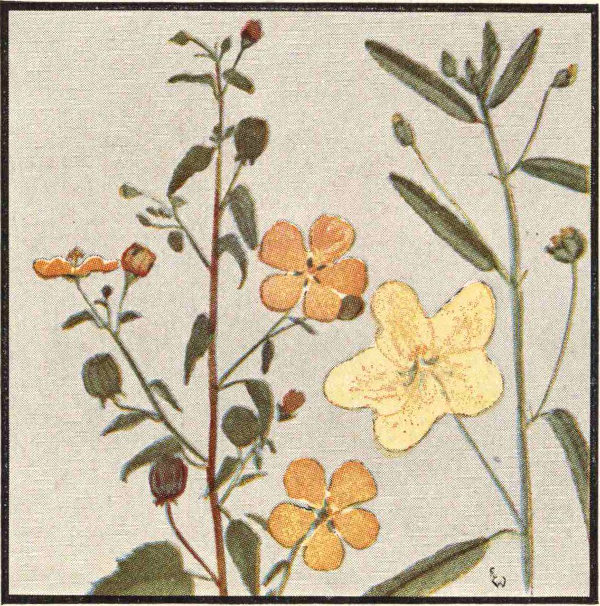
INDIAN MALLOW LARGE-FLOWERED SIDA
Leaves mostly palmately nerved; sepals 3-5, more or less united; petals 5; stamens numerous, united into a column; style branched above.
Indian Mallow (Abutilon incanum) is a much branched plant, commonly 2-4 ft. tall, with rather small ovate leaves, and yellow flowers nearly an inch across. It is a profuse bloomer in the summer and fall. Like other abutilons, it is sometimes called flowering maple because of the maple-like leaves, and may be easily recognized by the seed-capsules, which are about ½ inch high and divided into 7-9 cells. The flowers are typical of the mallow group, having 5 separate petals and numerous stamens united in a tube around the styles. The plants grow in dry soil from Arkansas to Mexico and Arizona.
Large-Flowered Sida (Sida texana) is a common perennial plant in the sandy regions of South Texas. The slender, erect stems bear a few linear-oblong leaves, paler below, and long slender-stalked flowers. The flowers are pale orange-yellow and have the irregularly-lobed petals characteristic of the sidas.
The mallow family includes the commercial plants cotton and okra, and numerous ornamentals, such as hibiscus, hollyhock, and althea.
70
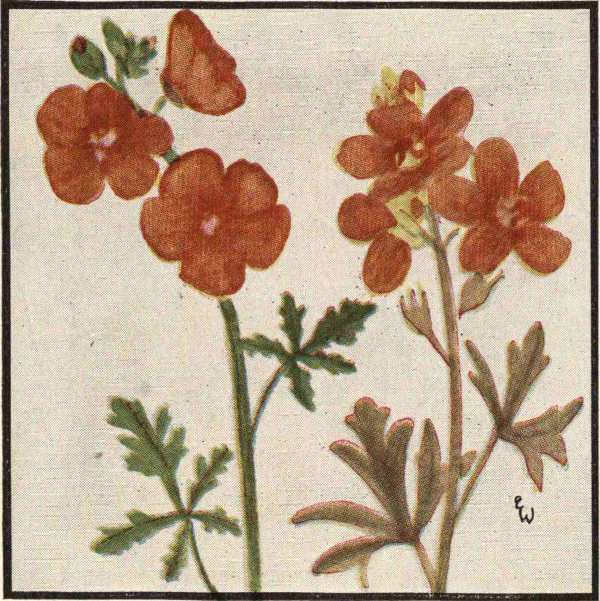
COPPER MALLOW RED STAR-MALLOW
Copper Mallow (Sphæralcea pedatifida) is often confused with the following mallow, but may be distinguished by its thin leaves clothed with a few star-shaped hairs, the 3 linear leaves (bractlets) under the calyx, and the seed capsules, which have one seed in each division completely filling the cell. Both have upper leaves divided into 5 parts and lower leaves into 3 parts. This plant is a low, spreading perennial which forms clumps about 1½ ft. broad. It grows in sandy or gravelly soil, Southwestern Texas, in April and May. Several copper mallows are very abundant in the Southwest.
Red Star-Mallow (Malvastrum coccineum) also has star-shaped hairs on the leaves, but they are very dense and give the leaves a gray, scurfy appearance. The cells are usually 1-seeded with an empty terminal portion above. The plant is also called prairie mallow, red false mallow, and rose moss. It grows in low clumps, spreading or erect, on prairies from Texas to Southern Canada and blooms from May to August.
71
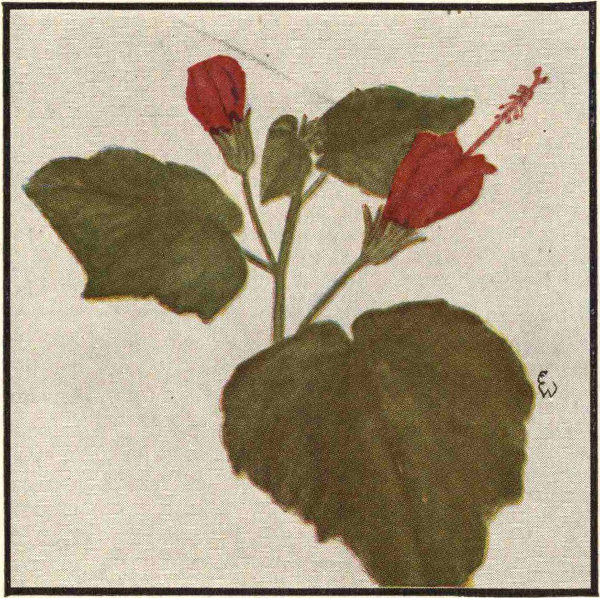
MEXICAN APPLE
Mexican Apple. Turk’s Cap (Malvaviscus drummondii) is also called red mallow. The showy red flowers somewhat resemble a Turkish fez. The broad petals remain closely wrapped around one another at the base but spreading above; the stamen column is conspicuously prolonged beyond the petals. The red apple-like fruits are nearly an inch broad and half as high. They have a delicious flavor and may be eaten raw or cooked. The fruits ripen in the late summer and fall, a few weeks after the blooms appear. They begin to dry soon after ripening and split into sections, scattering the seeds which are borne in the center.
The plants are perennial, the leafy stems branching and spreading, forming a clump which is commonly 2-3 feet high. Growing abundantly in shade along streams in the central and southern parts of the state and in moist woods in East Texas, it ranges from Florida to Mexico. It is a desirable plant for cultivation and is hardier but not as showy, as the large-flowered Turk’s cap (Malvaviscus grandiflora), a Mexican plant now widely cultivated for ornamental purposes in South Texas.
72
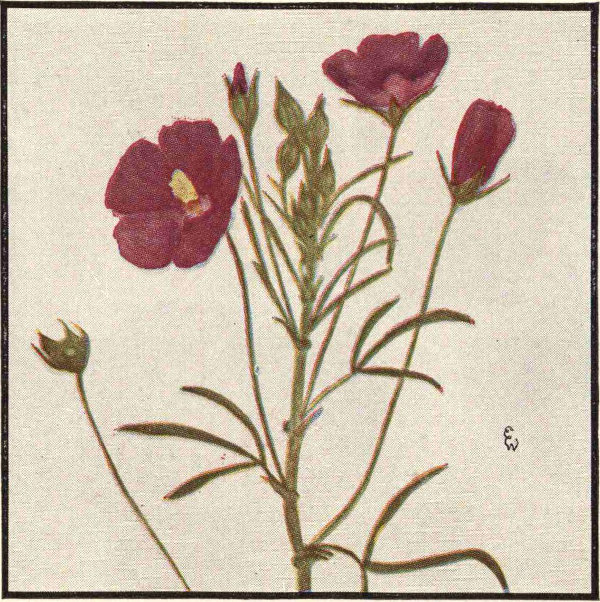
WILD HOLLYHOCK WINE CUP
Wild Hollyhock. Wine Cup. Fringed Poppy-Mallow (Callirrhoë digitata) grows in dry soil from Illinois and Kansas to Texas, blooming in Texas in April and May. It is a perennial, 1-1½ ft. high, with smooth, erect, gray-green stems topped by the flower cluster. The cup-shaped flowers are on slender stalks, the lower longer than the upper. The upper leaves are divided into 1-3 linear divisions and the lower into 5-7 divisions. The petals vary in color from cherry-red to pink and white, often being quite fringed across the top. The slightly yellow stamens are borne in a dense oblong column from which the 10 red styles appear after the flower has been opened several days.
Wine Cup. Red Poppy-Mallow (Callirrhoë involucrata) is the common poppy-mallow throughout the state and ranges from Minnesota to Mexico, a solitary flower standing erect from a prostrate branch. The five-pointed leaves are more or less divided or lobed, sometimes with very linear divisions. Covering acres and acres of the southern coastal prairie in March and April, and more or less common on the drier prairies, this wine cup is a favorite flower. White and pink forms of it exist, but the wine-red color is predominant.
73
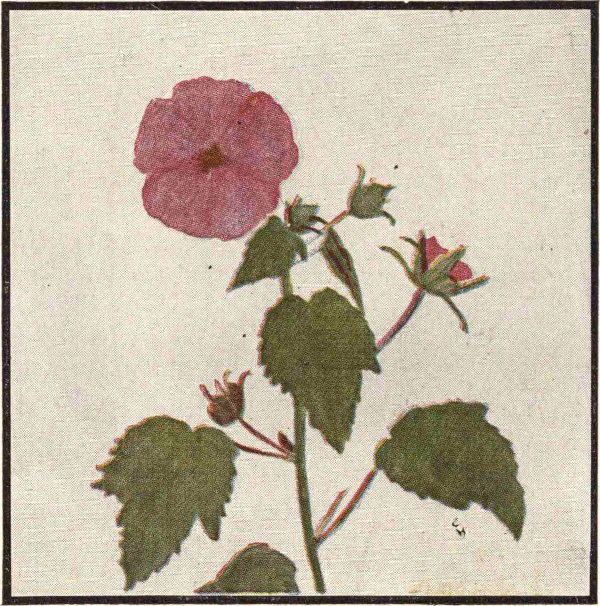
ROCK ROSE. PAVONIA
Rock Rose. Pavonia. Pink Mallow (Pavonia lasiopetala) has attractive, deep-pink flowers, which are broadly spreading, about 1½ in. wide. The plant is branching and shrubby, commonly growing about 2 ft. high, with ovate or rounded leaves 1-2½ in. long. It is not extremely showy but makes an excellent low shrub for the garden and will produce an abundance of blossoms from late spring until fall. It is found in dry, rocky woods from Central Texas to Mexico.
Pavonia gets its name from the botanist, J. Pavon, who worked particularly with South American plants. Several South American species are in cultivation. The Texas pavonia is being introduced in gardens and rivals the shrubby althea as a summer bloomer, but the plants and flowers are much smaller.
74
VIOLET FAMILY (Violaceae)
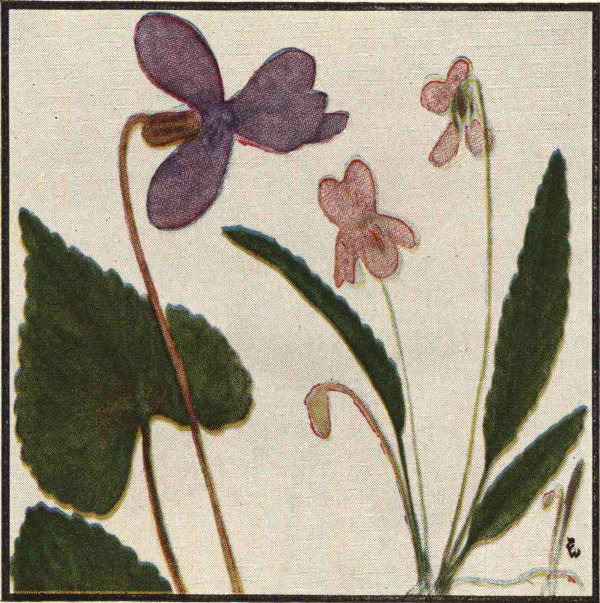
MISSOURI VIOLET LANCE-LEAVED VIOLET
Small or leafy stipules on leaves; sepals 5; petals 5, the lower usually larger and spurred; flowers often cleistogamous; fruit usually a capsule.
Missouri Violet (Viola missouriensis) grows in low grounds and moist woods from Missouri to Louisiana and Texas, the flowers blooming in Texas in March and April. They are very much like the common cultivated violet (Viola odorata) introduced from Europe.
Water or Lance-Leaved Violet (Viola lanceolata) is a small violet found in swampy places in East Texas and north to Nova Scotia. It resembles the white violet, Viola vittata, so abundant on the Coastal Plain, which has narrower leaves and is taller.
About twenty different violets have been reported from the state, mostly from the eastern part. The bird’s-foot violet (Viola pedata) comes into East Texas. It has large flowers, 1-1¾ in. across, the 3 lower petals much lighter than the dark purple upper ones. It resembles the cultivated pansy, which, however, has been derived from Viola tricolor of Great Britain. The native violets bloom from February to May.
75
LOASA FAMILY (Loasaceae)
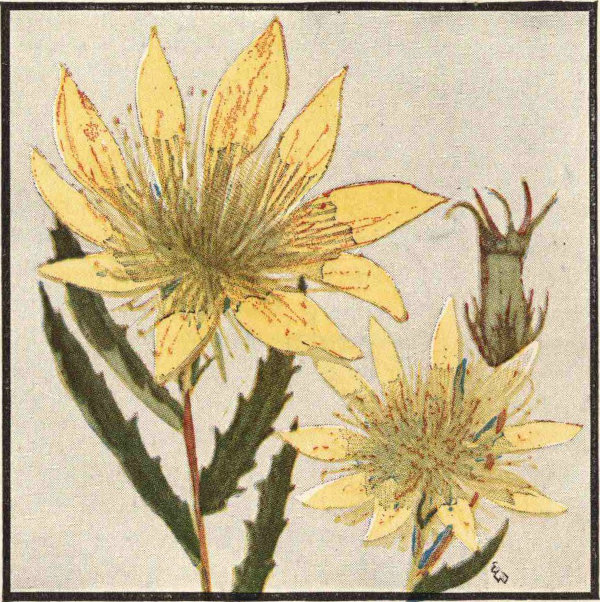
PRAIRIE-LILY STIFF NUTTALLIA
Usually herbs which are clothed with rough, bristly hairs; sepals usually 5, calyx tube joined to ovary; petals usually 5; stamens numerous, the outer petal-like; ovary inferior.
Prairie-Lily. Showy Mentzelia (Mentzelia decapetala) is a handsome-flowered plant which ranges from the Panhandle to Southern Canada. The large flowers, 3-5 inches across, greatly resemble those of the cactus group and have the same tendency to open in the afternoon. The stout, branching plant grows 2-2½ feet high. The stems are quite conspicuous, as they soon become white and shining; the leaves are noticeable because they cling very closely to the clothing by means of barbed hairs. This clinging characteristic is responsible for the Mexican name of “buena mujer” (good woman), applied to this and other similar species.
Stiff Nuttallia (Mentzelia stricta) has smaller, paler flowers, but otherwise it is very much like the showy mentzelia except for the small leaves on the seed capsule. It grows in sandy soil, blooming in the summer and fall. Other common names include stick-leaf, poor-man’s patches, star flower, and good woman. Bartonia aurea of garden culture is a member of the group which was introduced from California.
76
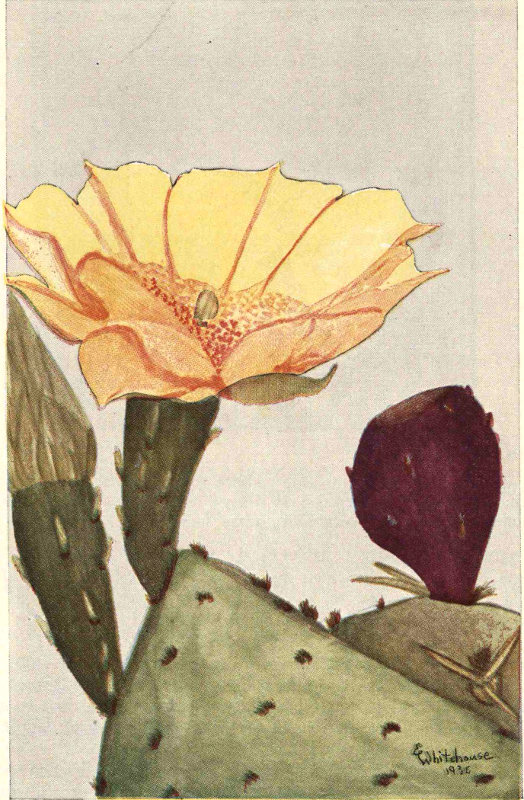
LOW PRICKLY PEAR TEXAS PRICKLY PEAR
77
CACTUS FAMILY (Cactaceae)
Succulent herbs and shrubs; stems usually spiny and leafless; sepals and petals not differentiated, few or many; stamens many; ovary inferior; fruit pulpy, often edible.
Devil’s Tongue. Low Prickly Pear (Opuntia humifusa) grows in dry, rocky or sandy soil from Texas to Missouri, the flowers blooming in May and June and the fruits ripening to a rose-red in the late summer and fall. The flat-jointed stems are often oval but vary in shape and in the number of large spines growing from the spine cushions scattered over the stems. Sometimes no spines are present, but often 1-2 occur along the margins. Numerous short leaves, which are present only in the spring in this and other cacti, grow from the spine cushions. The spine cushions also bear dense clusters of slender, short brown spines. The flowers are yellow with red centers, 3-4 in. broad, widely spreading. Like many other cacti, they open in bright sunlight. The plant is low and has tuberous roots.
Texas Prickly Pear. Lindheimer’s Cactus (Opuntia lindheimeri) has flowers which are yellow upon opening but which take on a lovely saffron-red the next day. Flowers of both colors are often present on the same joint. The large purple pear-shaped fruits are edible and ripen in the summer and fall. The plants often grow in large clumps and attain a great height. The spine cushions of the oval joints bear 2-3 rather short, stout, stiff spines. It is the common prickly pear from Central Texas south into Mexico.
The pencil cactus or tasajillo (Opuntia leptocaulis), conspicuous for its small stems and bright red fruits, is abundant in the state and Mexico. “Cholla,” or walking-stick cactus (Opuntia imbricata), with long slender stems and purple flowers, is common on western plains.
The cactus family has numerous representatives in Texas, but drastic legislation is needed to save some of the natural beauty spots of the western part of the state. The showy “viznaga” or barrel-cactus, used in making cactus candy, is almost exterminated in the vicinity of El Paso; and cactus fanciers are making great ravages on many others. The fruits of many are edible; the young leaves of the prickly pears are cooked for greens; and the stems are used for cattle feed after the spines have been burned.
78
LOOSESTRIFE FAMILY (Lythraceae)
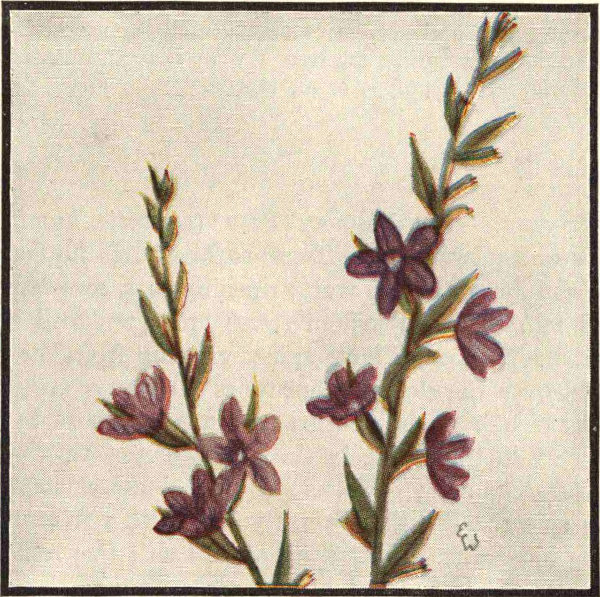
LANCE-LEAVED LOOSESTRIFE
Leaves opposite or whorled; sepals 4-6, united into a tube; petals 4-6, or absent, attached on calyx tube; stamens few or many; ovary superior.
Lance-Leaved Loosestrife (Lythrum lanceolatum) grows in low grounds or swamps from Texas to Oklahoma and South Carolina. The loosestrife family is close kin to the evening-primrose family and has 4-6 petals borne above the seed capsule. “Lythrum” is from the Greek meaning “gore” and refers to the red-purple color of some of the flowers. The common name of loosestrife comes from an old legend that they free from strife. The plant has slender stems 2-4 ft. high and numerous flowers borne in loose spikes. The short, narrow leaves are seldom more than 1-2 in. long. The delicate petals are somewhat darker veined and do not last long. It blooms in the late spring and summer.
Crape Myrtle (Lagerstroemia indica), native of China or India, is widely cultivated in the state and is being planted along highways. It has escaped cultivation in the woods in East Texas. It is a shrub or small tree which is covered during the summer months with a profusion of white, pink, lavender, or rose flowers.
79
EVENING-PRIMROSE FAMILY (Epilobiaceae)
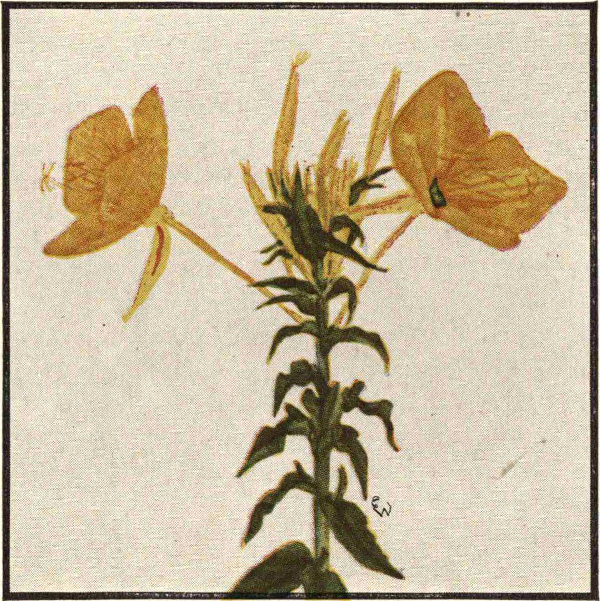
ERECT EVENING-PRIMROSE
Calyx joined to ovary and often produced beyond it; petals usually 4; stamens usually 4 or 8; ovary inferior; seeds numerous.
Erect Evening-Primrose (Œnothera heterophylla) grows in sandy soil in Florida and on the edge of post oak woods in South-central Texas. The plants bloom in April and May. It is very much like the rhombic evening-primrose (Œnothera rhombipetala) but has slenderer, shorter stems and is not often branched. The petals are similar, and their rhombic shape easily distinguishes both of these plants from other evening-primroses. The rhombic primrose grows 2-3 feet high and is very abundant throughout the sandy area of North-central Texas to Minnesota and Indiana.
There are many yellow evening-primroses very much alike in flower which are usually called buttercups, a name first applied to the crowfoots. The flowers usually have four showy petals which last only a day, opening in the late afternoons and closing in the heat of the following day. The seed capsules are usually long and narrow and are borne below the petals. The fireweed is a well-known member of this group. The water evening-primrose (Jussiæa diffusa) is abundant in ponds in Central and East Texas.
80
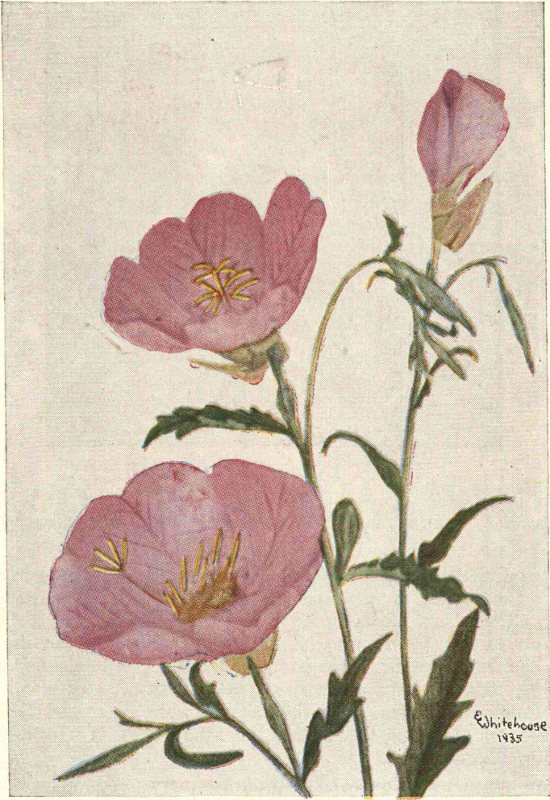
PINK EVENING-PRIMROSE
81
Pink Evening-Primrose. Pink Buttercup (Hartmannia tetraptera) blooms best in April, but a few scattered plants may continue to bloom through the summer months. It is a perennial plant which does well in cultivation. White, pink, blush, and other shades were introduced by Childs in 1892 from seeds collected in Texas and were known as the Mexican evening-primrose.
The earlier flowers are usually much larger than those which bloom late in the season. The flowers are cup-shaped, 2-4 inches broad, with 4 broad petals marked with deeper-colored veining and greenish-yellow at the base. The sepals are united into a narrow tube above the seed capsule and below the petals. This tube is about as long as the capsule, sometimes a little shorter. The sepals do not overlap, are slow about splitting, and are pushed to one side of the flower by the opening petals. The seeds are borne in a club-shaped capsule which is prominently ridged, the slender base being as long as the enlarged seed-bearing portion.
The stems are usually trailing and branched at the base, sometimes forming clumps two or more feet broad. The leaves are quite variable in shape but are generally oblong and narrowed at the base, with margins ranging from entire to deeply lobed and divided.
The group name honors Emanuel Hartmann of Louisiana; “tetraptera” is from the Greek meaning “four-winged” and refers to the shape of the seed-capsule. The plants in this group are sometimes placed with the yellow evening-primroses of the Œnothera group, but characteristics other than color separate them.
Showy Primrose (Hartmannia speciosa) is a large-flowered white primrose found on plains and prairies from North Texas to Missouri. The seed-capsules are narrowed at the base but are not stalked, and the calyx tube is longer than the capsule.
Rose Primrose (Hartmannia rosea) is a small-flowered primrose found in Southern and Southwestern Texas and Mexico. The flowers are small, an inch or more broad, with rounded deep-pink petals. The calyx tube is much shorter than the long-stalked capsule.
82
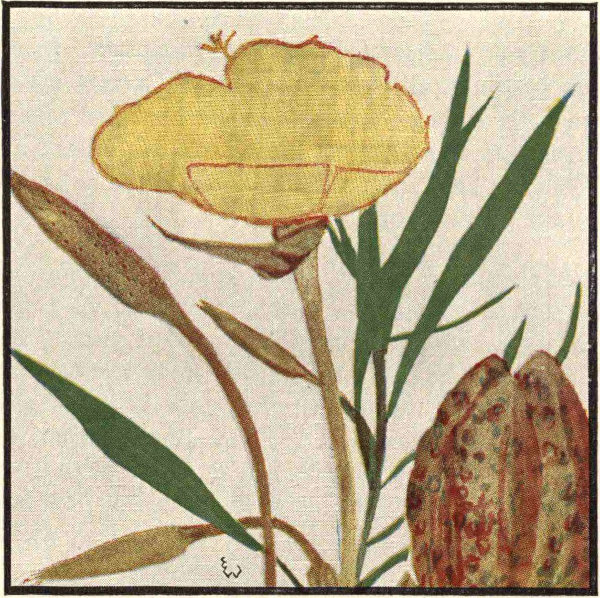
FLUTTER-MILL
Missouri Primrose. Flutter-Mill. Broad-Winged Evening-Primrose (Megapterium missouriense) clings to the side of a gravelly cliff or grows on rocky limestone hillsides from Missouri to Colorado and Texas. The flowers bloom in Texas in April and May, opening in the afternoon and closing the next morning. The plants grow in low clumps about a foot high. Numerous flowers are borne on the stem along with the slender leaves. Four broad yellow petals make up the cup-shaped portion of the flower above the slender calyx-tube, which is 4-6 in. long. The seed-capsules at the base of the flower develop four broad papery wings and reach at maturity a width of 3 in. These broad wings are responsible for the scientific name of the plant. The capsules are easily blown about by the wind, and the seeds are widely scattered.
The evening-primroses usually produce large, thready masses of pollen. Every child is initiated into a buttercup fraternity at some period in his life by being invited to smell of the flower and having his nose smeared with the profuse pollen.
83
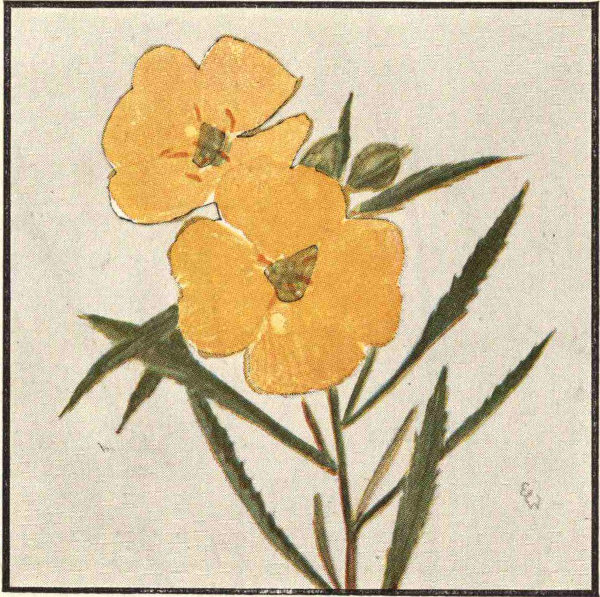
SQUARE-BUD PRIMROSE
Square-Bud Primrose. Day Primrose. Creamcups (Meriolix spinulosa) has yellow cup-shaped flowers which last only twenty-four hours but which are open during the day. It may readily be distinguished from other evening-primroses by the slender woody stems which soon become reddish or straw-colored. The stems grow 1-1½ ft. high with clusters of flowers at the top. The flowers are nearly two inches broad and have four petals. The short, broad sepals are winged on the back and make the buds appear square and pointed.
Another distinguishing feature is the disk-shaped stigma which is sometimes yellow and sometimes black or dark brown. In the evening-primroses previously mentioned, the stigma is divided into four narrow lobes. The plants grow on gravelly hillsides from Arkansas to Mexico. The slender capsules are over an inch long. Several other day primroses are found in the state. They are all sometimes grouped with the œnotheras.
84
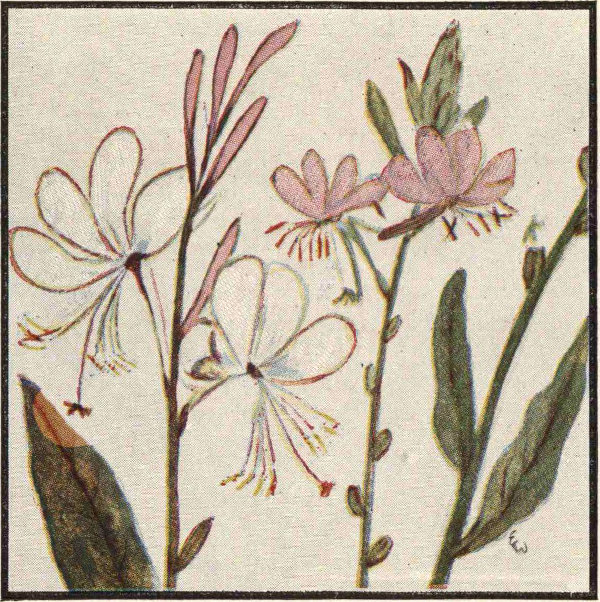
LARGE-FLOWERED GAURA WILD HONEYSUCKLE
Large-Flowered or Lindheimer’s Gaura (Gaura lindheimeri) is, like other members of this group, called kisses and wild honeysuckle because of its sweet fragrance. Most of them produce an abundance of nectar and make excellent honey plants. This is the handsomest member of the group in Texas and is known in cultivation as a hardy plant. It is native to the prairies of Southeast Texas and Louisiana and blooms from March to May.
The four white petals have the group characteristic of turning fan-wise toward the upper side of the flower, and the 8 long stamens and the long style hang toward the lower part. Only a few flowers open at one time around the spike, but numerous buds are densely crowded above the open flowers. This plant has erect-ascending branches and grows 2-5 feet high.
Prairie Gaura. Wild Honeysuckle (Gaura brachycarpa) sometimes grows 2-3 feet high, but is usually much lower. With favorable rains, the flowering spikes grow quite long. This gaura may be recognized by its stalkless 4-angled seed capsules. It blooms on Texas prairies in April and May. Many other gauras are found in the state.
85
DOGWOOD FAMILY (Cornaceae)
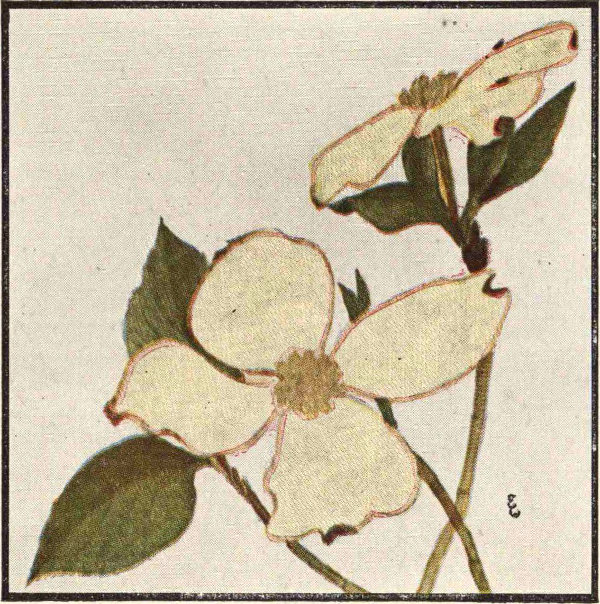
FLOWERING DOGWOOD
Leaves usually opposite; sepals usually 4, calyx tube joined to the ovary; petals usually 4, or absent; stamens 4, alternate with the petals; ovary inferior; fruit a drupe.
Flowering Dogwood (Cornus florida) grows from Massachusetts to Ontario, Texas, and Mexico, but few people realize that it grows very luxuriantly and is widespread in the woods of East Texas. The beauty of the dogwood is not in the flowers, as one might expect, but in the four broad white floral leaves (bracts) which surround the flower-cluster. These bracts are a creamy white but are often tinged with pink. The minute greenish-white flowers have four petals and bloom in March before the leaves appear. The oblong scarlet fruits, about half an inch long, ripen in the fall.
It is said that dogwood gets its name from the fact that the bark of an English dogwood was used to treat mangy dogs. Another source for the name is given in a recent magazine which shows a photograph of a section of wood from a dogwood tree. By means of the growth rings of the tree, the section depicted the head of a swimming dog. Among the useful substances obtained from the tree are quinine from all parts, scarlet dye from the bark, and wood for tools. Enough quinine is obtained by chewing the twigs to ward off malarial fever.
86
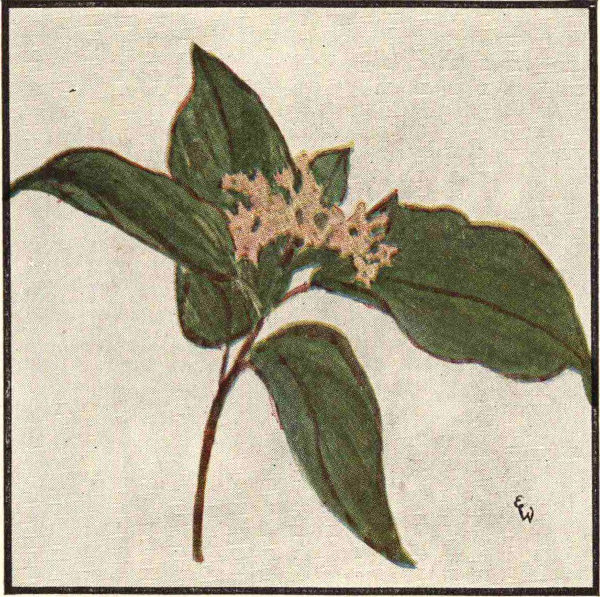
SMALL-FLOWERED DOGWOOD
Rough-Leaved Cornel. Small-Flowered Dogwood (Cornus asperifolia) is hardly recognized as a dogwood because it does not have showy floral bracts. The rough leaves become very lovely in the fall as the veins take on a reddish-purple color. It is a very common shrub in thickets along streams or in moist ground from Texas to Southern Ontario. The flowers bloom in Texas from April to June, and the white fruits mature in the fall. The fruits are about ¼ inch in diameter and contain 2 seeds with a stony coat which is covered by a thin pulp.
The dogwood family includes several other trees and shrubs which are common in Texas. Black gum (Nyssa sylvatica) has 2-3 blue oval fruits about half an inch long in a cluster. It is one of the first trees in East Texas whose foliage takes on an autumnal coloring. Lindheimer’s garrya (Garrya lindheimeri), an evergreen shrub with thick leathery leaves, is very abundant in the hills of Central and West Texas. It bears dense clusters of small blue berries less than ¼ inch in diameter.
87
CARROT FAMILY (Umbelliferae)
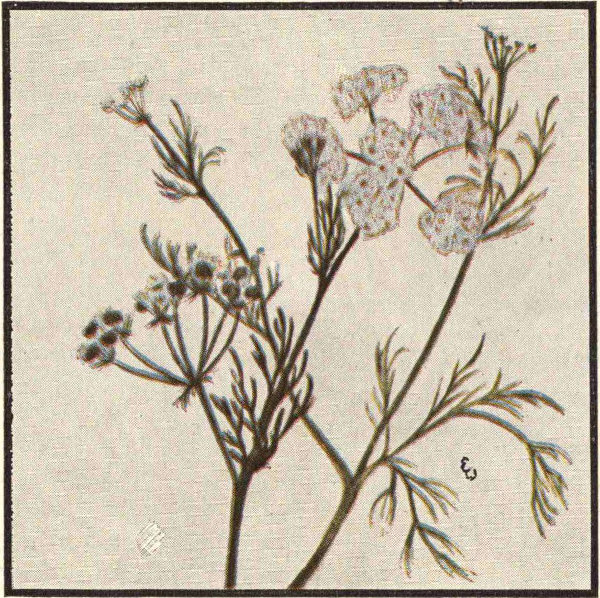
PRAIRIE LACE
Furrowed stems; leaves usually much divided, sheathing at the base; sepals 5, calyx tube joined to ovary; petals 5; stamens 5; ovary inferior; fruit 2-celled, prominently ribbed and often with resin canals.
Prairie Lace. Dwarf Queen Anne’s Lace (Bifora americana) is the pride of the North Texas prairie in late April and May. It is also found in Oklahoma and Arkansas. In favorable seasons it grows in great masses with the Indian blankets and the false coreopsis. The umbrella-clusters of white flowers are very showy. The plants do not have oil tubes, as do most members of the carrot family, and so lack the strong scent common to many.
It usually grows about a foot high and is widely branched at the top. The leaves are finely divided with numerous thread-like divisions. The flowers are one-fourth inch broad and have five notched petals which are broader than long. The fruits have two ball-shaped divisions, each about one-eighth inch in diameter and faintly ridged.
88
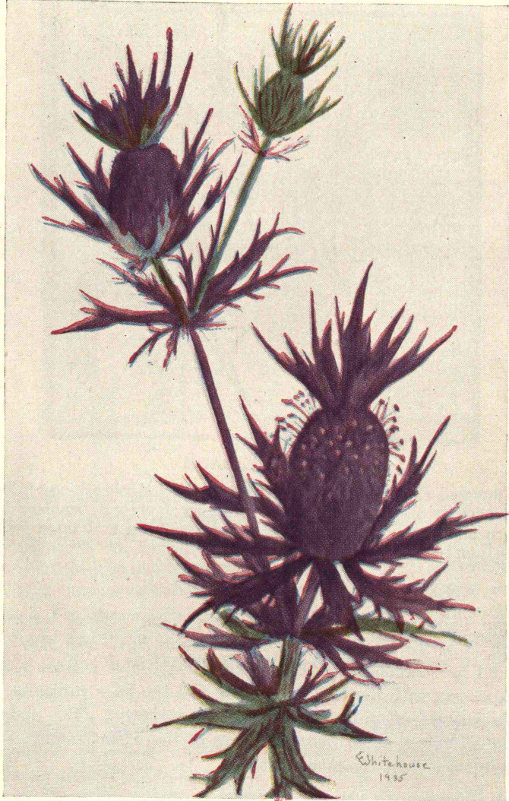
FALSE PURPLE THISTLE. ERYNGO
89
False Purple Thistle. Eryngo (Eryngium leavenworthii) is not a true thistle, but it is popularly known as one. The ancient Greeks had the same idea, for the name “Eryngium” is their name for a kind of thistle. Correctly speaking it is a purple carrot, as it belongs to a large group of the carrot family, some of which are widely cultivated abroad for their striking purple foliage. The flowers are clustered in an oblong head, quite different from the dainty flower clusters of Queen Anne’s lace. Other common names of this group include sea-holly, rattlesnake master, and button snake-root, the two latter from their accredited property of curing snake-bites. Candelabrum plant is a name sometimes given which is very appropriate because of its branching habit of growth.
The plants grow one to three feet high, usually in dense masses along roadsides and fields and on prairies from Central Texas to Kansas. In August the gray-green foliage of the plants is quite conspicuous against darker greens, but it gradually takes on a royal purple hue. Few plants can rival it for beauty in late August and September. The dense heads of purple flowers with their long, slender dark-blue stamens add to the vividness. The dried plants are often kept for winter decoration, but the purple does not remain so intense.