DESCRIPTIONS OF SPECIES (continued 3)
Reading edition
181
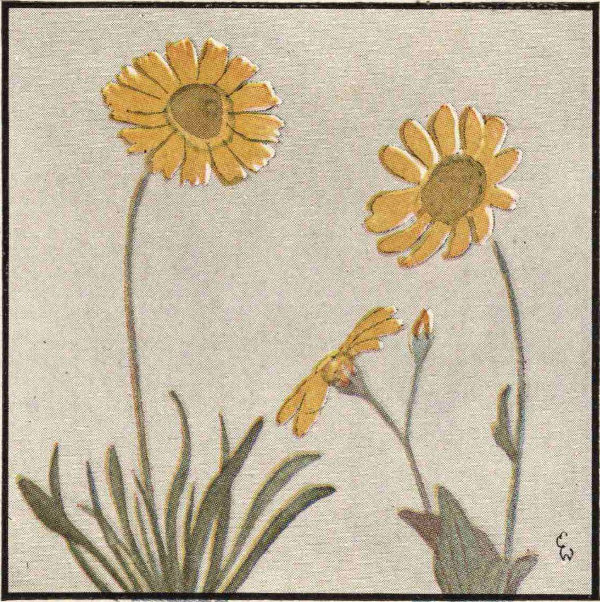
FOUR-NERVED DAISY SILVER-LEAF DAISY
Actinella Daisy. Four-Nerved Daisy (Tetraneuris linearis) grows with small tufts of narrow leaves from a woody perennial root. The heads, which are borne on stalks 2-8 inches long, close at night. The plants often bloom throughout the year in Central and South Texas. They grow on rocky limestone hillsides in Texas and New Mexico. The broad, four-nerved ray flowers form a close border around the conic disk, which is covered with small yellow tubular flowers. The veins of the outer flowers, which give rise to the scientific name, are sometimes purplish.
Silver-Leaf Daisy (Bahia dealbata) is common in the western part of the state into Arizona and Mexico. It grows 1-2 feet high from a woody perennial root and often blooms throughout the year. The long-stalked heads are a little over an inch broad with 9-12 yellow ray flowers. On the silvery-gray stem the few leaves are commonly opposite, broad and short-stalked, with a pair of lateral lobes near the base.
182
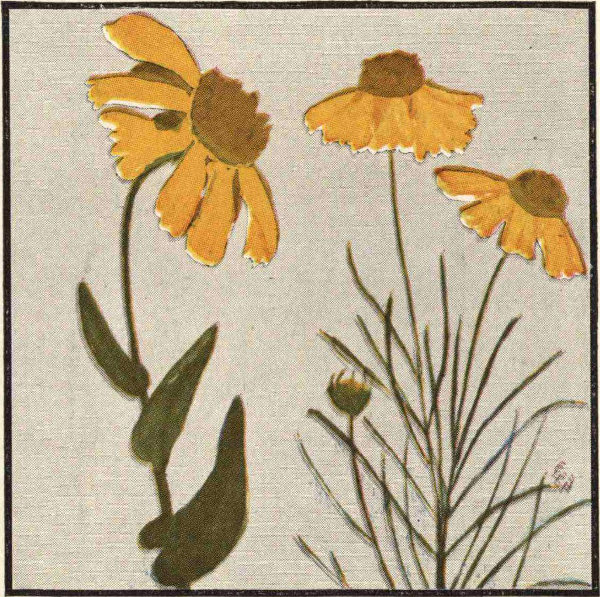
HUISACHE DAISY BITTERWEED
Huisache Daisy (Amblyolepis setigera) is so called because it often forms a carpet of gold under huisache (pronounced wee satch), mesquite, or other chaparral bushes in Southwest-central Texas from March to June. It is also called honey or butterfly daisy and clasping-leaved bitterweed. It has the strong scent common to the bitterweed, but is fragrant in drying. The plants are often loosely branched, growing 6-12 inches high, and the yellow heads are about 1½ inches broad.
Sneezeweed. Fine-Leaved Bitterweed (Helenium tenuifolium) is often found in pastures which have been over-grazed. It has a strong-scented foliage which gives milk a bitter flavor. The ball-shaped mound of disk-flowers (reminding one of camomile) and the few drooping ray flowers, which have a broad 3-toothed edge and a narrow base, are characteristic of the group. The seeds are small and are said to cause sneezing when they are thrown into the air. The bitterweed blooms from May to October and ranges from Texas to Virginia.
183
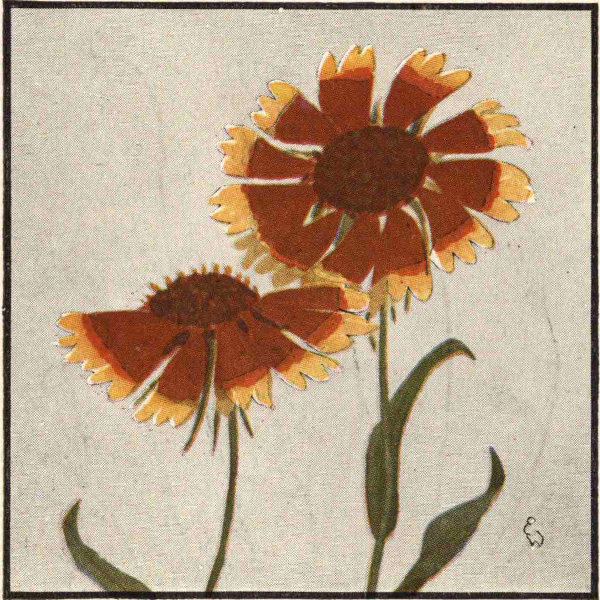
INDIAN BLANKET
Indian Blanket. Firewheel. Beautiful Gaillardia (Gaillardia pulchella) is the pride of Texas prairies. The landscape becomes a vivid red and yellow in April, May, and early June when the firewheels are in bloom. It is a highly-prized cultivated plant, and many varieties have been developed. There are several species of gaillardias and many of them are native to Texas. The beautiful one is the most widespread, ranging from Texas to Louisiana, Nebraska, Arizona, and Mexico. The gaillardias are named for a French botanist, Gaillard.
The heads are usually two or three inches across and are long-stalked. Each head has 10-20 broad ray flowers which are sometimes all red but usually are marked with a brilliant yellow across the three lobes. The upper leaves are lance-shaped, and the lower are oblong and marked with a few teeth or lobes. It is an annual plant which is widely branched and grows one to one and a half feet high.
184
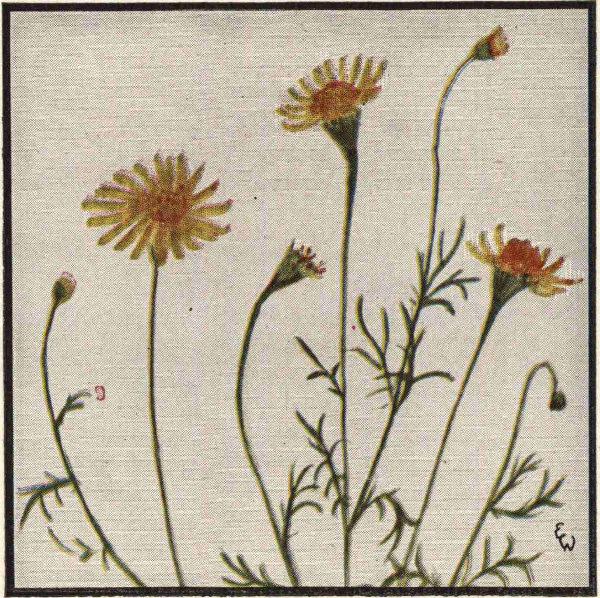
TINY TIM
Tiny Tim. Spreading Thyme-Leaf (Thymophylla polychaeta) is found on sandy prairies from South Texas to Mexico and New Mexico. There are several thyme-leaf species in the state. They may be recognized by their scented foliage and the cup-like base of the flower heads, the bracts of the head being marked with large yellow or orange glands. There is something appealing about the tiny Tim, as the name would indicate. The branching stems with their lacy green leaves form rosettes which are dotted with the yellow daisy-like flowers.
Dwarf Thyme-Leaf. Tiny Tim (Thymophylla pentachaeta) clings to cliffs and rocky hillsides. It is a perennial plant with short stems four to six inches high. The leaves are short and needle-like and are borne in dense clusters around the stem. The flower heads are about half an inch broad. Tiny Tim ranges from Texas to Arizona and Mexico.
185
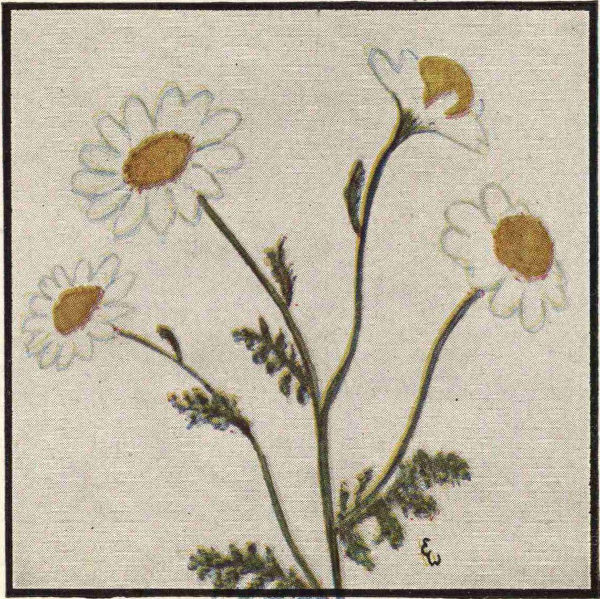
DOG’S CAMOMILE
Dog Fennel. Mayweed. Dog’s Camomile (Anthemis cotulla) is a strong-scented herb widely scattered in America, naturalized from Europe. It is very abundant in sandy soil in the eastern part of the state. The plants are widely branched and bear numerous heads about an inch broad. The rays are broad and wide and the disk flowers are yellow. It begins to bloom in Texas in March, but the plants are at their best in May and June. It is close kin to the European camomile, which is used medicinally, a soothing tea being made from the dried ball-shaped heads of yellow flowers.
Closely related to camomile and yarrow are the artemisias, which include many species known as dusty miller, wormwood, sage-brush, and purple sage. The silvery wormwood or thread-leaved sage-brush (Artemisia filifolius) is very abundant in the sandy areas of West Texas and throughout the Rocky Mountain States and Mexico. It blooms from July to October.
186
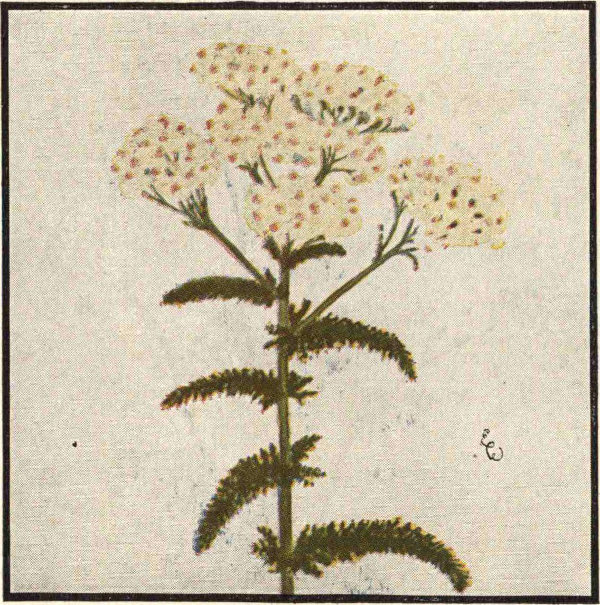
YARROW
Yarrow. Woods Milfoil (Achillea millefolium) was named in honor of Achilles, to whom is attributed the discovery of its healing properties. It is supposed to stop bleeding, relieve spasms, produce sweating, and act as a tonic. The woods milfoil is widely distributed in woods in the United States, Europe, and Asia. It makes a nice garden plant, for the lacy fern-like leaves remain green all winter. The stems grow one to two feet high and are topped by the flat flower-cluster. The ray flowers are white or sometimes pale pink or lavender, and the disk flowers are pale yellow.
Plains Yarrow. Woolly Milfoil (Achillea lanulosa) grows in moist places on the plains from Texas to Canada, Mexico, and California. It is very much like the woods yarrow but differs in that it has fewer gray-green leaves and round-topped flower clusters. Its blooming season is a little later than that of the woods yarrow, which blooms in April and May.
187
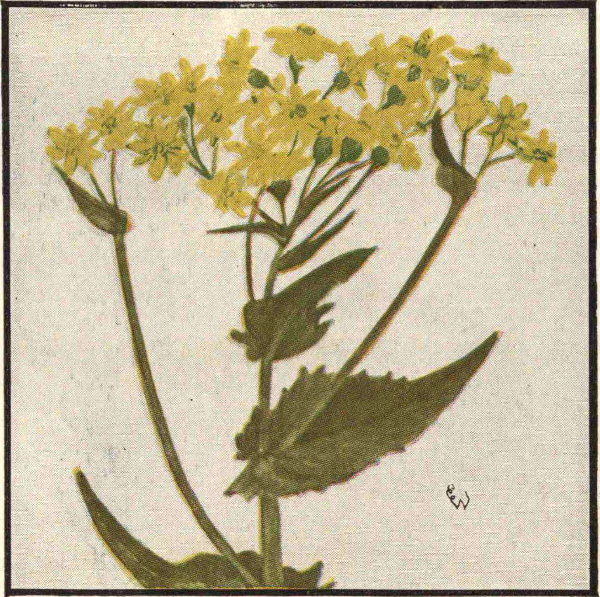
TEXAS SQUAW-WEED
Texas Squaw-Weed. Clasping-Leaved Groundsel (Senecio ampullaceus) is an annual plant which grows so abundantly on the sandy prairies of Texas that it forms a carpet of gold for miles and miles. It is one of the earliest spring flowers to bloom in such showy profusion. The plants commonly grow 1½-2 feet high, being branched above and forming flat-topped flower-clusters which are often a foot broad. When quite young, the plants are densely white-woolly but become smooth and shining with age. The irregularly toothed leaves are 3-6 inches long and have a broad clasping base. The groundsel belongs to one of our largest groups of plants, some 1200 species being widely distributed over the earth.
Fine-leaved or woolly groundsel (Senecio filifolius) has woolly leaves divided into narrow segments. The large heads are often in bloom throughout the year in West Texas and New Mexico.
188
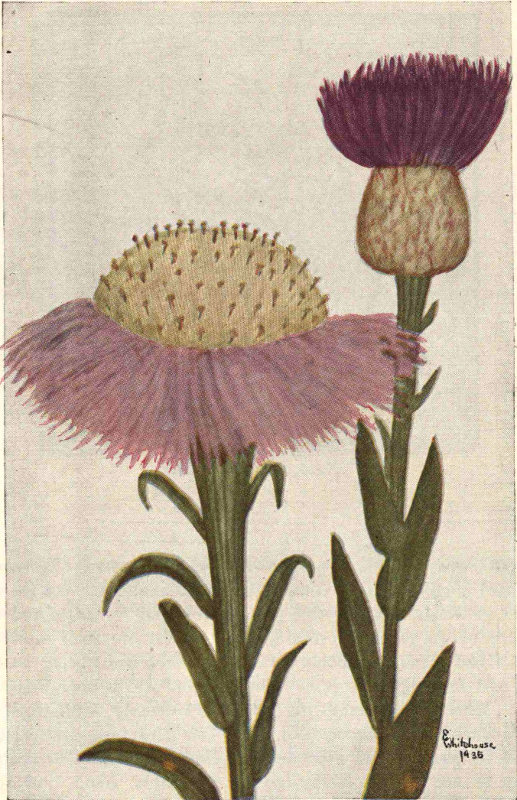
AMERICAN STAR THISTLE
189
American Star Thistle. Basket Flower (Centaurea americana) is often called spineless thistle because the leaves do not bear spines as do the leaves of its close relative, the purple thistle. It is also known as powder puffs, sweet sultan, and “cardo del valle.” It is a hardy annual which is widely cultivated. Basket flower is the name under which it is known in cultivation—a name which refers to the stiff, straw-colored bracts of the flower head. These bracts are not spiny but are divided at the tip into finger-like projections.
Before the flowers are fully opened, the heads resemble a shaving-brush, and this is a common name frequently applied to this and other thistles. All the flowers are tubular and divided into five long narrow lobes. In one variety the fully-opened flower cluster has an outer border of numerous lavender flowers with cream-colored flowers in the center. There is another variety which has outer flowers a deep rose or reddish purple and center flowers pale pink or rose; sometimes there is little difference in shade between the inner and outer flowers.
The stems are usually branched and grow about two feet high. They are marked with wing-like ridges and are covered with the overlapping, ascending leaves. In Texas the flowers begin to bloom in May and continue into June, being at their best the first week in June. After the flowering season, the foliage becomes yellow and dried, and the old stalks remain conspicuous in the fields for several months. The star thistle is found on plains from Missouri to Louisiana, Mexico, and Arizona. The variety which has reddish-purple flowers is very abundant in the vicinity of Waco and Fort Worth.
The scientific name meaning “of the Centaurs” refers to the use by the Centaurs of certain species for healing. The cornflower or bachelor’s button (Centaurea cyanus) is a well-known garden annual.
190
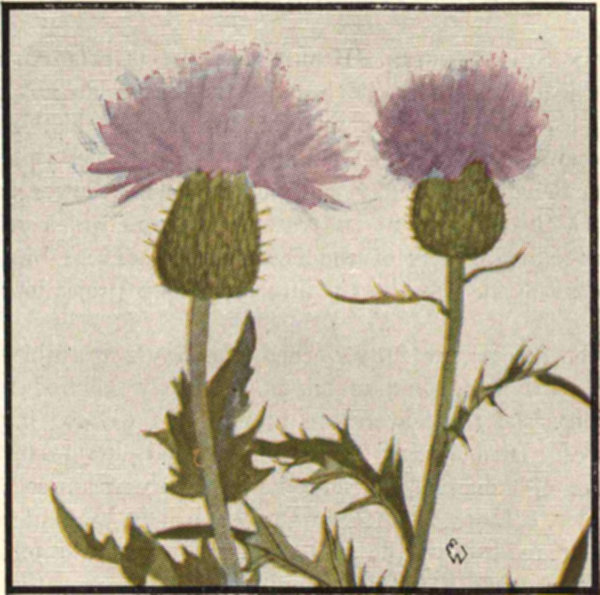
WAVY-LEAVED THISTLE PURPLE-THISTLE
Wavy-Leaved Thistle (Carduus undulatus) is the common prairie thistle and is particularly abundant in the vicinity of Fort Worth. It grows only 1-2 feet high, and the upper leaf-surfaces are yellow-green. The heads are nearly twice as large as those of the purple thistle, and the flowers are a lovely lavender color. It ranges from Southern Canada to Texas and Arizona and blooms in Texas from April to June.
Purple Thistle (Carduus austrinus) is the common thistle in the south-central part of the state. It is a tall, much branched plant, 3-4 feet high, with long-stalked heads of purple flowers. The stems are white-woolly, and the leaves are white-felty beneath and dark-green above, wavy-margined, lobed or divided, the segments being tipped with spines. The heads are about 1½ inches high and broad. The numerous light purple flowers are all tubular with narrow lobes. The thistles belong to a large group, its most renowned representative being the Scotch thistle.
191
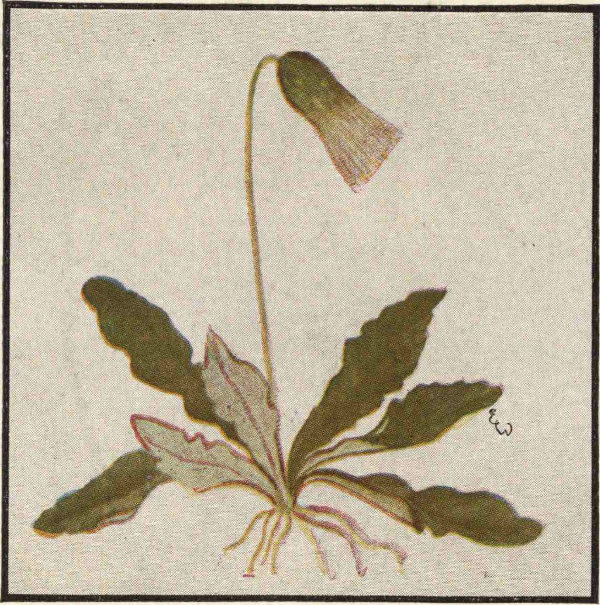
NODDING THISTLE
Nodding Thistle. Silver Puffs. Sunbonnet Babies (Thrysanthema nutans) lacks the spines of the true thistles, but other characters show that this interesting little plant is closely related to the thistle group. The leaves form a basal rosette from which grows the slender, leafless flowering stalk bearing the nodding flower head. The lyre-shaped leaves are wavy-margined, dark-green above and white-felty below, 2-4 inches long. The stalk is sometimes 15 inches long but is commonly about 8 inches high. The creamy-white flowers are rather inconspicuous, but as the seeds mature, the soft white bristles spread into a showy whorl. The plants are found in scattered places in rich soil from Central Texas to Mexico.
Closely kin to the nodding thistle is the desert holly (Perezia nana), which has salmon-pink flowers and holly-like leaves. It is a low plant seeking the shelter of creosote bush, yucca, and other shrubs in West Texas.
192
CHICORY FAMILY (Cichoriaceae)
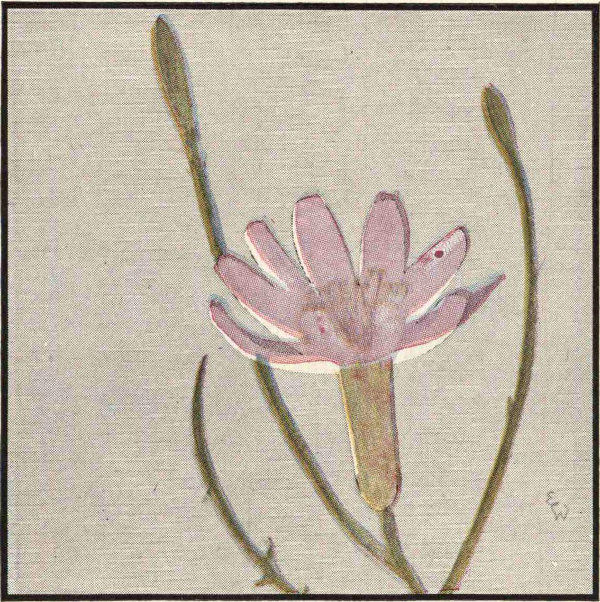
PURPLE DANDELION
Plants with milky juice; all flowers strap-shaped, in dense heads, surrounded by involucral bracts; corolla 5-lobed; stamens 5; ovary inferior.
Purple Dandelion. Flowering Straw (Lygodesmia texana) can nearly always be found in the prairie sections of the state from spring to fall, but the lovely flowers seldom make a showy display along the roadsides. Only one head blooms at a time on the slender forking stems, and that remains open only in the mornings. The heads are made up of 8-12 pale purple strap-shaped corollas, with the lavender styles conspicuously erect in the center. The tip of the corolla is divided into five minute lobes. The stems are almost leafless but have a cluster of short-lobed, narrow gray-green leaves at the base.
Small-Flowered Straw (Ptiloria pauciflora) is a white-flowered chicory with low spreading stems. It is abundant in West Texas and New Mexico.
193
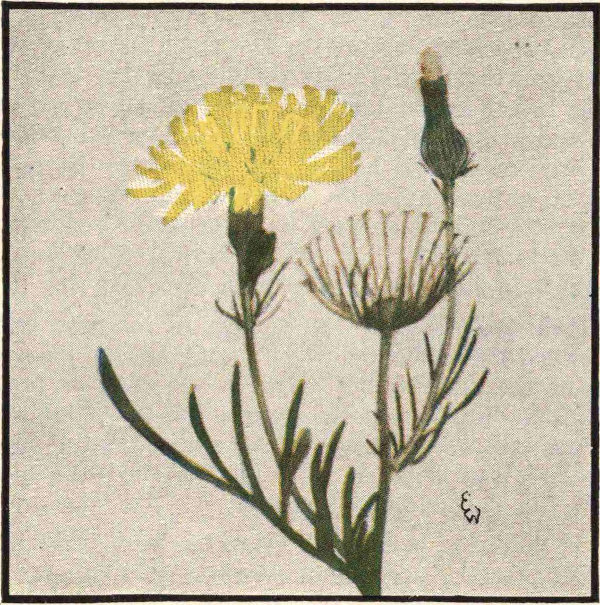
FALSE DANDELION
Many-Stemmed False Dandelion (Sitilias multicaulis) has lemon-yellow flower heads which closely resemble those of the true dandelion, but the plants grow much taller and are often widely branched. From early spring through June, the false dandelion is very abundant on the coastal and western prairies. The heads are made up of several rows of strap-shaped corollas. The fruits are narrow and have attached a spreading tuft of bristles which makes the head in fruit look like a puff ball of lace. This tuft is a parachute device for scattering the seeds far and wide.
White Dandelion (Pinaropappus roseus) has flower heads very much like those of the yellow dandelions, but the flowers vary in color from white to pale pink, and the heads are larger. It is very abundant in March and April in Southwest-Central Texas.
Several garden plants belong to the chicory family, among them being lettuce, salsify, and chicory. The orange hawkweed is often cultivated for ornament.
194