DESCRIPTIONS OF SPECIES (continued 2)
Reading edition
The stems are branched at the top, the flower heads growing on short stalks in the forks of the branches. The deeply lobed leaves clasp the stem, the leaf segments bearing many spiny-teeth. A tuft of small, rigid, spiny leaves grows out of the top of the flower head.
Several eryngoes are found in the state. The yucca-leaved eryngo (Eryngium aquaticum) grows in the summer in sandy areas or low grounds from Texas to Minnesota and Connecticut. It bears little resemblance in habit of growth or coloring to the purple thistle. Most of the long leaves are clustered at the base, and a stout flower stalk bears at the top several head-like clusters of white flowers.
The carrot family is a large group of plants, most of which have lacy, fern-like leaves and dainty umbrella-clusters of small flowers and fruit which separates into two ribbed 1-seeded divisions. The plants are usually rich in oil tubes, and some contain deadly poisons.
90
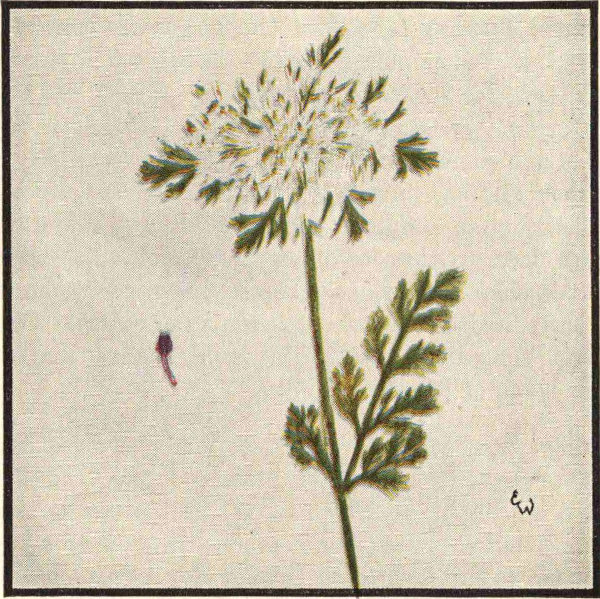
BEGGAR’S TICKS
Beggar’s Ticks. Seed-Ticks. Bird’s Nest Carrot (Daucus pusillus) is probably more familiar in fruit than in flower. The clusters of seeds resemble a bird’s nest. The fact that the seeds are covered with several rows of barbed prickles makes them very difficult to remove from clothing. Their presence in wool renders it inferior in quality. It is very abundant throughout the state from April to June and occurs in most of the Southern and Western States.
The small white flowers grow in a dense, lace-like cluster at the top of slender stems 1-2 ft. high. The leaves are finely divided. The flower cluster is long-stalked and is surrounded by a circle of the green leaves; thus the flowers as well as the seeds have a nest-like appearance.
Wild Carrot. Queen Anne’s Lace (Daucus carota), the ancestor of the garden carrot, was introduced from Europe and may be found in scattered places over the state. It is a larger plant than the beggar’s ticks, with very wide-spreading and dainty flower clusters. It does not bloom until summer.
91
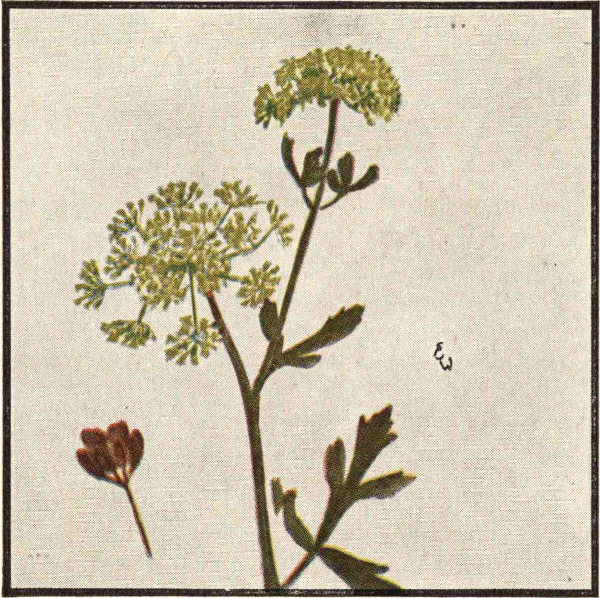
WILD DILL
Wild Dill. Prairie Parsley (Pleiotaenia nuttallii) is a conspicuous plant on prairies throughout the state and ranges to Michigan and Alabama. The flowers bloom in April and May, and the seeds mature and fall in June and July. The stiff, stout stems, commonly two feet high, become dry and brown but remain standing through the winter months. The upper leaves are not divided so much as the lower, which are deeply divided and have broad segments. The flowers are small and greenish-yellow and grow in clusters about 2 inches broad.
The foliage and seeds were used for seasoning by pioneers. It is very much like the cultivated dill (Anethum graveolens), a native of Southeastern Europe. The latter is taller and has leaves with threadlike divisions.
Other well-known members of the carrot family include the parsnip, parsley, myrrh, chervil, caraway, and celery. The well-known poison hemlock (Conium maculatum), by which Socrates met his death, is a native of Europe but may now be found in North and South America. It grows in great abundance along the streams of the Edwards Plateau between Fredricksburg and Austin.
92
HEATH FAMILY (Ericaceae)
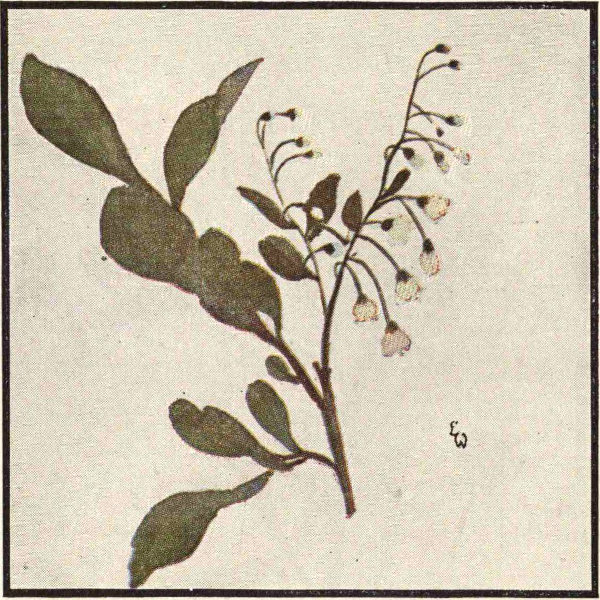
TREE-HUCKLEBERRY
Herbs or shrubs; sepals 4-5; corolla urn-shaped or cylindric, 4-5-lobed; stamens 8 or 10; anthers opening by terminal pores; ovary superior or inferior.
Tree-Huckleberry. Farkleberry (Batodendron arboreum) is also known as upland-huckleberry, sparkleberry, and gooseberry. The name is Greek and means “blackberry tree.” The huckleberries are often placed in a family separate from other heaths. The tree-huckleberry is a shrub or small tree, very abundant in the woods of East Texas and the Southern States. The dainty, drooping sprays of white bell-shaped flowers remind one of the lily-of-the-valley. The shining oval leaves are short-stalked, 1-2 in. long. The black berries are not edible.
Well-known members of the heath family include the trailing arbutus, cranberry, blueberry, bean-berry, winter-green, rhododendron, and azalea. Thickets of the pink azalea or swamp-honeysuckle (Azalea nudiflora) occur in a few places in East Texas. In the mountains of Southwest Texas may be found the arbutus-tree, madroña, or naked Indian, so called because of its red wood and scaling bark. Its small, red fleshy fruits look like strawberries. Stagger-bush (Neopieris mariana) is a common shrub in swampy places.
93
PRIMROSE FAMILY (Primulaceae)
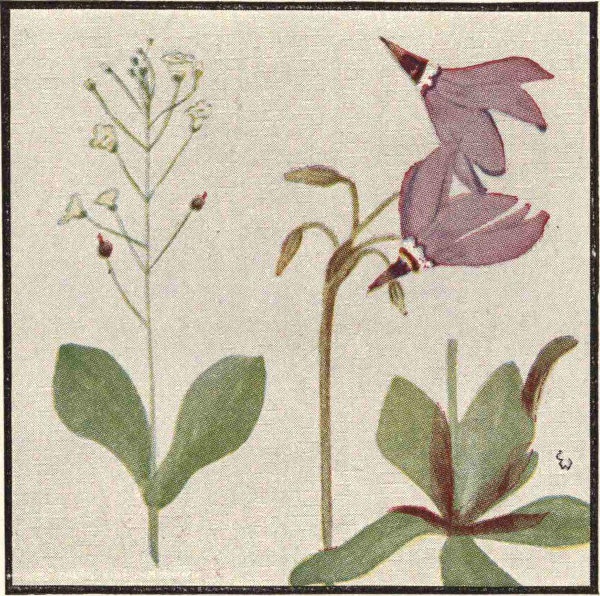
TEXAS WATER-PIMPERNEL SHOOTING STAR
Leaves often basal; sepals usually 5, often leafy; corolla tubular, 5-lobed; stamens 5, opposite the petals; ovary superior; fruit a capsule.
Texas Water-Pimpernel. Brookweed (Samolus cuneatus) is a plant found wherever springs or moist ledges occur in limestone hills of Texas. The plants have a basal rosette of broad rounded leaves. The slender stems are 6-12 inches high and bear a few leaves which are narrowed at the base. The 5-lobed white flowers are short and bell-shaped and appear from April to September. The pink water-pimpernel (Samolus ebracteatus) grows in sandy soil along the coast.
Shooting Star (Dodecatheon stanfieldia) is a rare plant and should be afforded protection. It is found in rich, moist soil from Central Texas to Louisiana. The flowers are very much like those of Dodecatheon meadia but are larger and have broader petals.
The primrose family is represented in horticulture by many primroses from Asia, cyclamens from Greece to Syria, and the cowslip from Europe. The scarlet pimpernel (Anagallis arvensis) is found on sandy prairies in South Texas in the spring.
94
EBONY FAMILY (Ebenaceae)
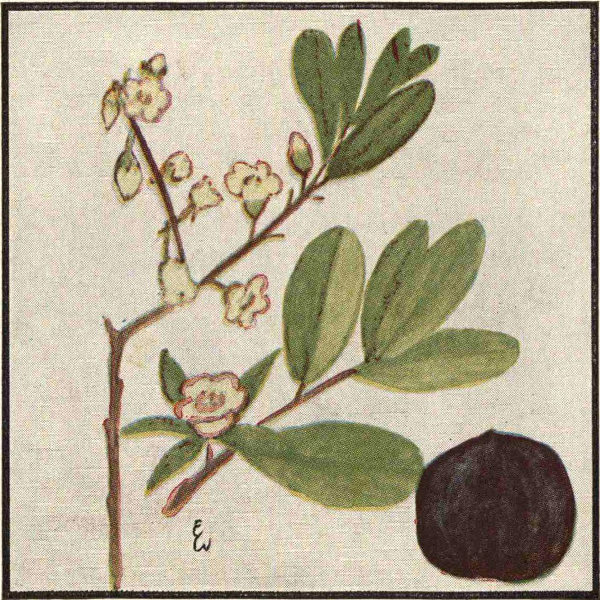
MEXICAN PERSIMMON
Trees or shrubs; leaves usually leathery; calyx 3-11-lobed; petals united, 3-7; stamens 6-14, or more; ovary superior.
Mexican Persimmon (Diospyros texana) is also called ’possum plum, “chapote,” and black persimmon. It is a shrub or small tree found in river-valleys and on limestone hills from Central Texas to Mexico. It may be easily recognized by its smooth, light-gray bark, small leaves, and creamy heath-like flowers. The bell-shaped flowers are in dense clusters on the tree which has pollen-bearing flowers, whereas the seed-bearing flowers, which grow on a separate tree, are larger and fewer in number. The black fruits ripen in August, when the pulp becomes juicy but somewhat insipid.
The black wood is hard and, like other species of ebony, takes an excellent polish. It is used for making tools. The Mexicans use a black dye obtained from the fruits in dyeing sheep-skins. The common persimmon (Diospyros virginiana) is found wild from Connecticut to East Texas, where the sprouts are vicious pests in plowed lands.
95
GENTIAN FAMILY (Gentianaceae)
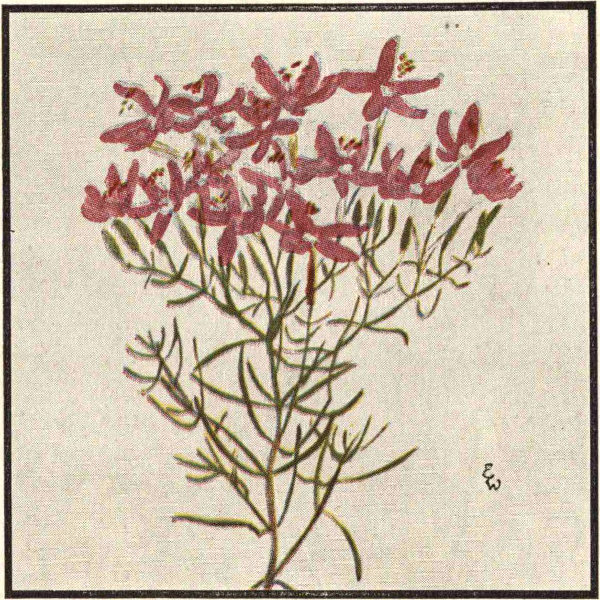
MOUNTAIN PINK
Leaves opposite; calyx usually tubular, 5-lobed; petals united at base, 4-12; stamens as many as petals; ovary superior.
Mountain Pink. Showy Centaury (Erythraea beyrichii) grows on gravelly limestone hills in Texas and Arkansas. The stems are branched near the base and often form hemispherical clumps a foot in diameter which are covered with pink flowers in June. The plants are being rapidly exterminated for ornamental purposes, for they are very showy and the flowers will last two weeks or more. The flowers have a united tubular corolla with 5 lobes.
The scientific name is from the Greek meaning “red.” The flowers of some species are red, but those in Texas are pink. The Texan centaury (Erythraea texense) is a very small plant with small flowers. It is found from Texas to Missouri in June and July. Buckley’s centaury or pink gentian (Erythraea calycosa) is found in moist soil in the western part of the state. It is a tall, slender plant 1-2 ft. high. It ranges from Missouri to Mexico. The centaury plants were formerly valued as a medicine for fever. They were gathered and dried at flowering time.
96
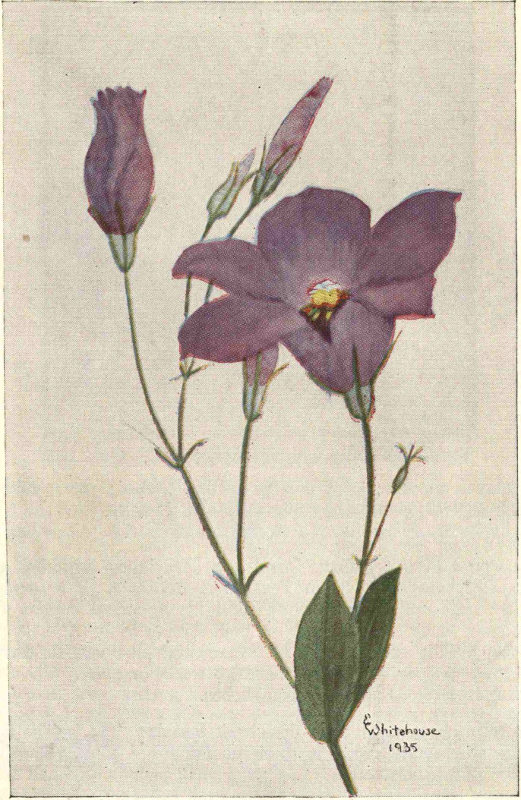
PURPLE GENTIAN. BLUEBELL
97
Purple Gentian. Bluebell (Eustoma russellianum) is also called Russell’s eustoma, Texas bluebell, blue gentian, blue marsh lily, and bosque blue gentian. The latter name is used in El Paso, where the purple gentian grows on the flood plain of the Rio Grande River. It is one of the loveliest flowers in the state, sometimes occurring in great profusion on moist prairies from Mexico to Colorado and Louisiana. It is especially abundant in Southeast Texas, where it is gathered in wholesale quantities by florists. It is an excellent cut-plant, the flowers lasting for several days and new buds continually opening.
Few people have had success in transplanting the purple gentian into their gardens. Only recently has there been a report of seeds successfully germinated. It is said that soaking for 48 hours in water will produce germination. Each flower produces a number of very minute seeds.
The large, bell-shaped flowers, 2-3 inches broad, are a bluish-purple; in fading, they spread widely and take on more of the blue tinge. They are constricted into a short narrow tube at the base. Inside, the flowers are marked with yellow at the base and have purple markings in the throat. The five stamens with large anthers are attached to the corolla tube. At the time the pollen is shed, the anthers lie in a horizontal position around the style. The stigmas are interesting. There are two diamond-shaped lobes which are erect until they are ready to receive pollen, and then they take a horizontal position. The calyx has five linear lobes which are united at the base with a colorless membrane. The oblong capsules are about half an inch long.
The plants are very smooth and are erect, with a few erect branches. The leaves are ovate-oblong and are usually 1-2½ inches long.
“Eustoma” means “open mouth”, referring to the large throat of the flower. The smaller bluebell in Southern Texas and Northern Mexico is Eustoma gracile.
98
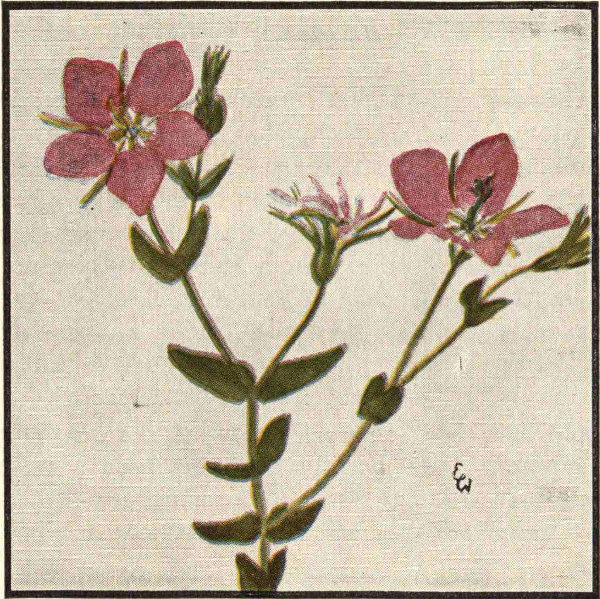
PINK TEXAS STAR
Pink Texas Star. Prairie Sabbatia (Sabbatia campestris) is also known as meadow pink, rose pink, pink prairie gentian, marsh pink, and sea star. It ranges from Missouri and Kansas to Texas and is found on moist prairies throughout Central Texas from April to June. It is particularly abundant on southern coastal prairies where it makes a showy landscape display with phlox, coreopsis, and other plants in March and April. The sabbatias are named in honor of two Italian botanists, L. and C. Sabbati.
The plants are low, 3-12 inches high, and have wing-angled stems and short smooth leaves about ½-1¼ inches long. The flowers are about 1½ inches broad, much larger than those of the mountain pink, and more cup-shaped. They are usually deep pink in color, but purplish-pink and white forms may occasionally be noted. Around the throat are yellow, star-shaped markings over the white base of the petals. The long, linear calyx lobes are quite conspicuous when the flower is in bud or after the corolla has wilted.
99
DOGBANE FAMILY (Apocynaceae)
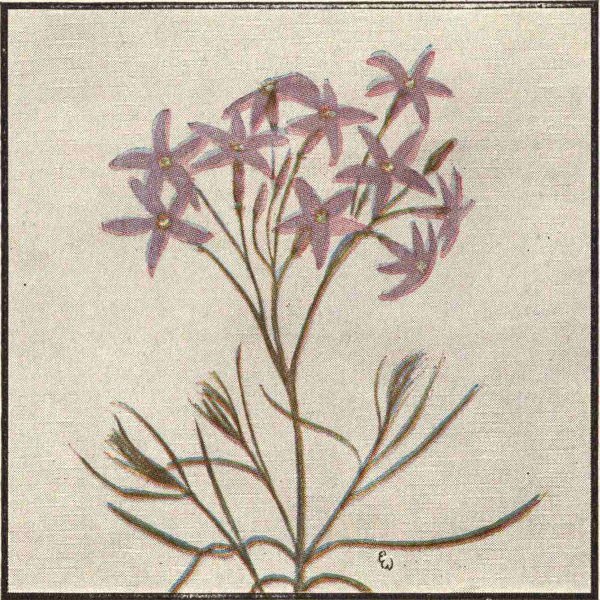
BLUE TEXAS STAR
Plants with milky juice; sepals usually 5; corolla tubular, 5-lobed; stamens usually 5, inserted on corolla tube and alternate with the lobes; ovary superior; fruit mostly of 2 spreading follicles.
Blue Texas Star. Texas Dogbane. Blue-Star (Amsonia texana) belongs to a group named in honor of Charles Amson, a colonial physician. The stems are usually unbranched, 8-12 inches high, and are covered with narrow linear leaves. Like that of other amsonias, the tubular throat is lined with white hairs. The name of twin-pods might be given to the amsonias. The numerous seeds are borne in two narrow, erect pods which are united at the base and split along the inner sides. The pods are 3-4 inches long. The plant is perennial, growing in low clumps on limestone hillsides of Texas. The plants in North Texas form a conspicuous bluish-green line on low hills, when the flowers bloom in late March and April.
The oleander, periwinkle, and vinca are well-known members of the dogbane family. They all have a milky sap which is quite poisonous in the oleander, Indian hemp, and others. “Bane” is the common word in Northern Europe for “murderer” and is applied to poisonous plants.
100
MILKWEED FAMILY (Asclepiadaceae)
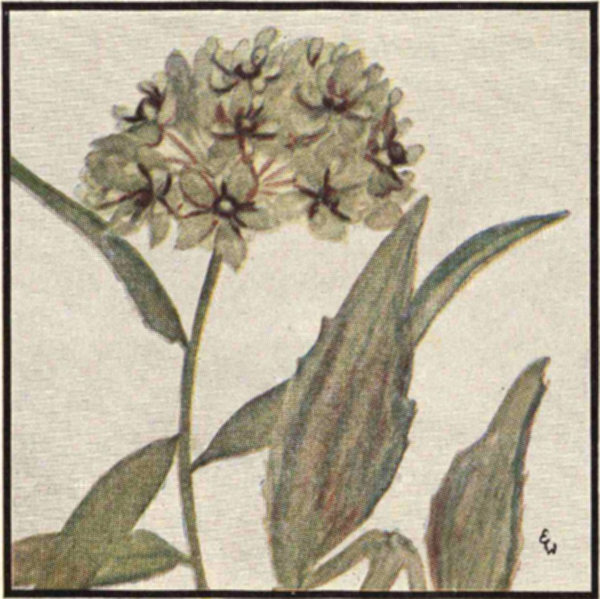
GREEN-FLOWERED MILKWEED
Leaves usually opposite or whorled; sepals 5; petals 5, usually reflexed and with a 5-lobed crown; stamens 5, the pollen united into 1 or 2 waxy masses in each sac; carpels 2, free except for the united disk-like stigma.
Green-Flowered Milkweed. Silkweed (Asclepiodora decumbens) is a widespread plant from Arkansas to Utah and Northern Mexico. It is found on the central and western plains, blooming in early spring and sometimes again in the fall. The stout, leafy stems, topped by the ball-shaped heads of flowers form conspicuous clumps about a foot high. The flowers have a sweet nectar which draws many insect visitors. They bloom in April and early May, and the large warty pods mature in a few weeks. As the seeds bear a tuft of hairs at one end, they are easily scattered by the wind and other agents. It is one of the first plants to appear on burned-over areas.
The milkweeds get their name from the bitter milky sap. The flowers are quite different from other flowers in that there is a crown between the petals and the stamens. In many the pollen is borne in two pear-shaped masses with a thread-like connection. In the green-flowered milkweed, purple hoods are attached to the crown and hang over the pollen-sacs.
101
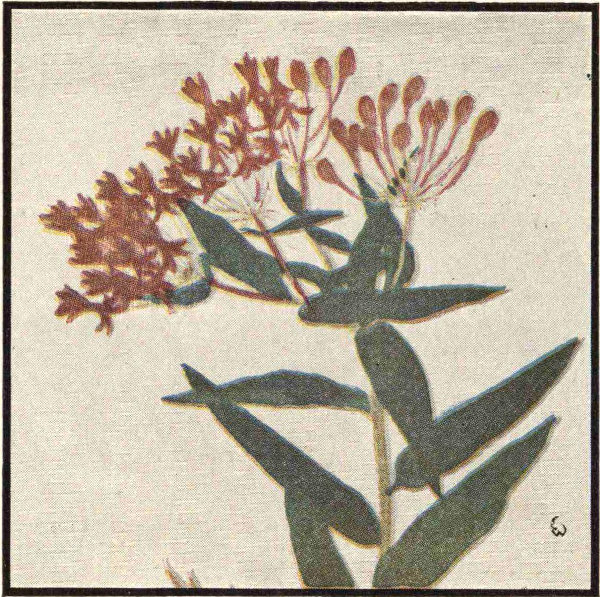
BUTTERFLY-WEED
Butterfly-Weed. Pleurisy-Root (Asclepias tuberosa) is a well-known plant in dry fields from Maine and Ontario to Northern Mexico. In Texas it is found in the sandy areas of the eastern and central parts. It blooms in the late spring and summer. Other common names include orange milkweed, orange-root, Indian posy, and orange swallow-wort. The leaves are poisonous to stock, but the honey is not considered poisonous. The monarch butterfly is a voracious feeder on the plant. It was at one time valued for its medicinal properties, but is now little used. Several plants are known by the common name of “swallow-wort” and are so called because they bloom in the spring when the swallows appear.
The leafy stems often grow one to two feet high. At the top of the stem are several clusters of small orange-colored flowers. The petals hang down when the pollen is ready to be shed. There is a crown of five erect, orange-colored hoods around the flat stigma.
102
DICHONDRA FAMILY (Dichondraceae)
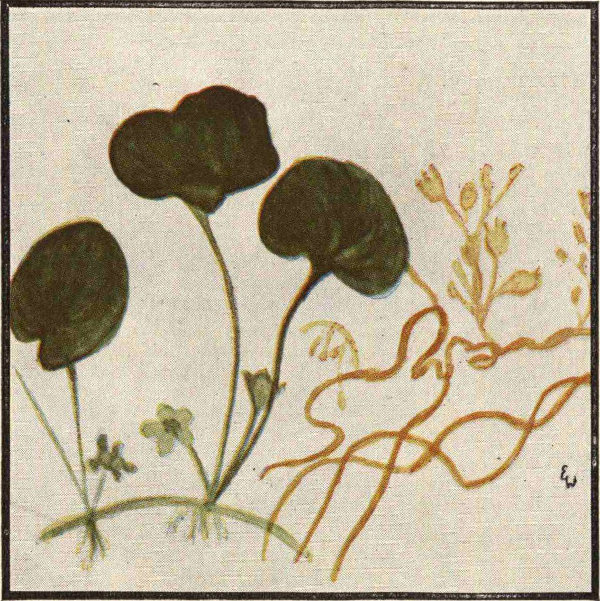
CAROLINA DICHONDRA PRETTY DODDER
Herbs with creeping stems; sepals 5; corolla bell-shaped, 5-lobed; stamens 5; carpels 2, separate.
Carolina Dichondra. Ground Ivy (Dichondra carolinensis) is, of course, not even kin to the ivy, but it does form a green carpet over the ground in places. It is widely scattered in the state and in many other localities. The greenish-white flowers are small and inconspicuous under the round leaves and are almost buried in the soil. The leaves are about an inch broad and are slender stalked. The plant is a perennial which is often hard to remove from lawns. The silvery-leaved dichondra (Dichondra argentea) occurs in West Texas.
DODDER FAMILY (Cuscutaceae)
Pretty Dodder. Love Vine. Strangle-Weed (Cuscuta indecora) may be noted in conspicuous orange or gold masses covering other plants. It is a leafless parasitic vine bearing small clusters of white flowers. The flowers are less than one fourth inch broad and have the petal-tips turned inward. There are many dodders in the state, and each kind is parasitic only on certain plants. The pretty dodder attacks the wild verbena and other herbs and low shrubs from Illinois to Texas and other parts of America.
103
MORNING-GLORY FAMILY (Convolvulaceae)
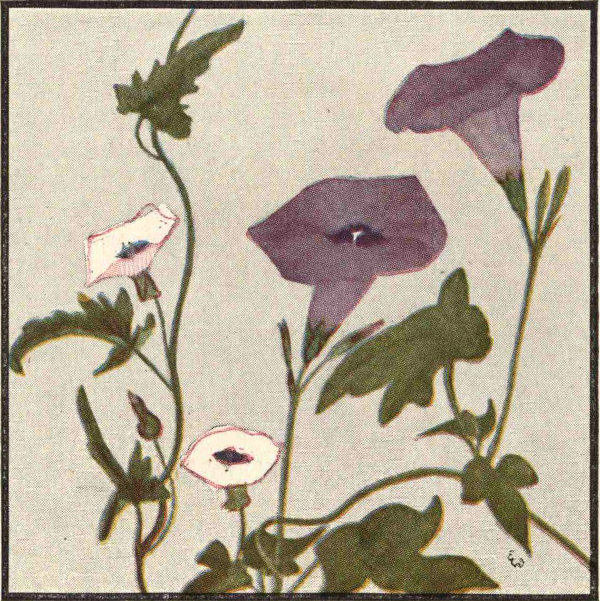
TEXAS BINDWEED PURPLE MORNING-GLORY
Plants twining or erect; sepals 5; corolla mostly funnelform, 5-lobed; stamens 5, on corolla tube; ovary superior; fruit usually a ball-shaped capsule separating into 2-4 lobes.
Texas Bindweed (Convolvulus hermannioides) has small white morning-glory flowers with a dark-red center. They are seldom more than an inch broad. The spreading or twining vines reach a length of several feet. The leaves are very variable in shape and often have spreading lobes at each side of the base like the hoary bindweed (Convolvulus incanus). Both grow on Texas plains, but the hoary bindweed is widely distributed from Kansas and Arkansas to Mexico. The Texas bindweed may be distinguished by the ear-like projections at the base of the sepals. The flowers bloom from April to August.
Purple Morning-Glory. Bindweed. Tie-Vine (Ipomoea trifida) is a lovely but pernicious vine of Texas, Mexico, and tropical America. The roots are perennial and very difficult to eradicate from cotton and corn fields. It blooms from spring to fall, the flowers opening only in the morning. The morning-glory group is very large, and many showy forms are found in Texas. The sweet potato (Ipomoea batatas) and others are valued for their tuberous roots.
104
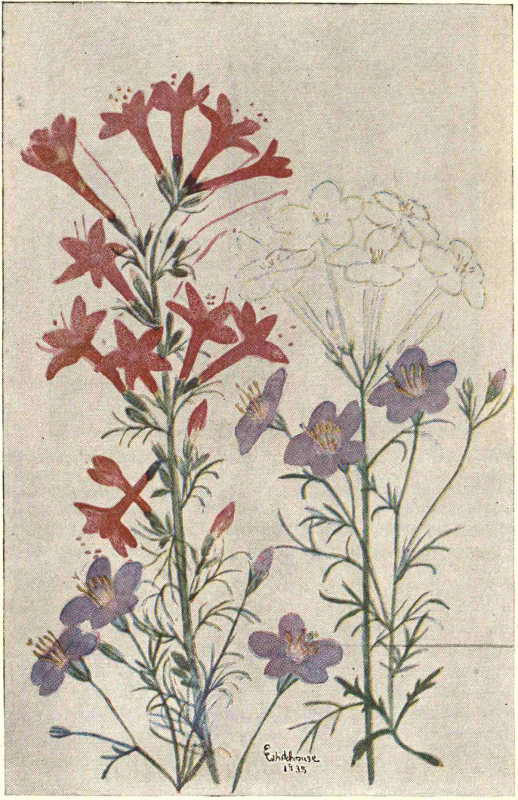
STANDING CYPRESS BLUE GILIA WHITE GILIA
105
PHLOX FAMILY (Polemoniaceae)
Mostly annual and perennial herbs; calyx 5-lobed; corolla tubular, 5-lobed; ovary usually 3-celled; style often 3-parted; stamens 5, inserted on corolla-tube; capsules small.
Standing Cypress. Red Gilia (Gilia rubra) might also be called torch flowers, for the tall spikes with their masses of red tubular flowers make flaming spots of color on the edges of the post oak woods in May and June. It is sometimes known as Indian plume, Texas plume, or red Texas star.
The plants are usually unbranched and grow two to three feet high; however, if the top of the stem is removed or injured near the time of flowering, it will branch into several flowering spikes. The stems are pale green and quite leafy with the finely dissected leaves. The narrow tubular flowers are over an inch long and have broad spreading lobes which, on their inner surface, are a pale orange-red dotted with a darker red. The flowers, which resemble those of the cypress vine, are closely clustered on the stem, those at the top opening first. The capsules are nearly an inch long and contain numerous papery seeds.
Blue Gilia. Golden Eye (Gilia rigidula), differing markedly from the red gilia in the shape of the flowers, has a short, broadly flaring corolla with a conspicuous yellow center. The flowers are nearly an inch broad. The plants are perennial and are often widely branched at the base, forming clumps nearly a foot broad. The blue gilia is found on hills and stony plains from Central Texas to Mexico and New Mexico and blooms from March to October.
White Gilia. Long-Flowered Gilia (Gilia longiflora) has slender, erect stems, 1-2 feet high, terminated by a flat-topped cluster of tubular white flowers. The flowers have a narrow tube, about 1½ inches long, and 5 broad, spreading lobes. The leaves have threadlike divisions. The plants are very showy when they are in bloom and are especially abundant in sandy regions of Northwest Texas in the late summer and fall.
Few flower groups show such a decided red, white, and blue as the gilias. The group is a large one, mostly of Western North America, and is named in honor of the Spanish botanist, Philipp Salvador Gil. Some of the gilias are known in cultivation and are considered hardy plants of easy culture. The standing cypress may be grown from seeds planted in August or September, or plants may be transplanted in the spring.
106
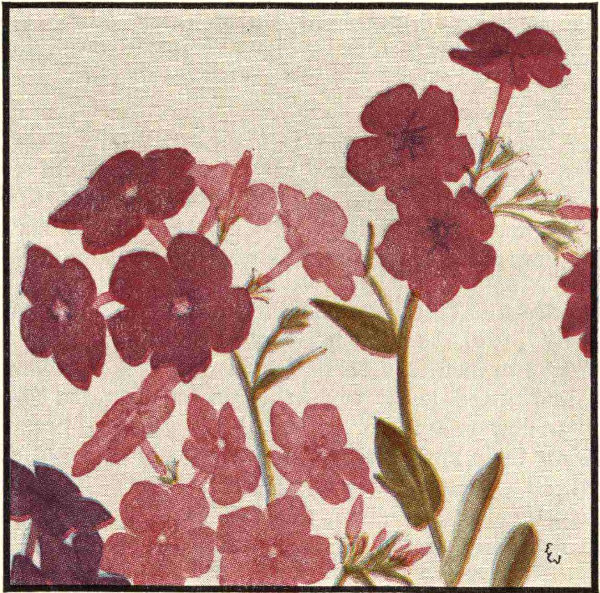
DRUMMOND’S PHLOX
Drummond’s Phlox (Phlox drummondii) has rightly been called “Texan pride.” A drive late in April through the post oak sandy region east of Austin to the Brazos River and southeast to Victoria will disclose it in all its glory. The seeds were collected by Thomas Drummond in 1834 and sent to W. J. Hooker in the spring of 1835. Hooker, an eminent botanist, described it from the plants grown from those seeds in the Kew Gardens in London. According to his description, the plants were mostly of a brilliant rose-red with more or less purple in the flowers of some plants and darker red eyes in nearly all. It is quite probable that Drummond collected his seeds in the vicinity of Gonzales, the western limit of his Texas trip, where today wild phloxes which match his description occur in great profusion. The seeds collected may have included some from hybrid plants, as red phloxes with a white eye are found on the eastern edge of the red-phlox area, and the dark-eyed purple and red are found on its western limits in close proximity to the “phlox purple” variety.
The plant has long been a horticultural favorite, and more than 200 varieties have been described, few of which excel the native varieties in size or coloring.
107
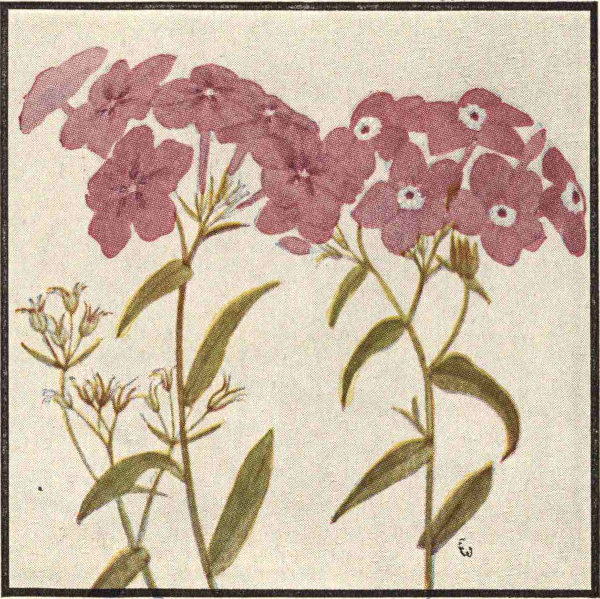
PURPLE PHLOX
Purple Phlox (Phlox drummondii-purple varieties) grows in sandy soil in Central Texas. The variety with the white throat and red-star eye is common in the southeastern part of the state. It is especially abundant in Wilson and Karnes Counties, where extensive masses of purple may be noted in open sandy places among mesquite and post oak trees. This is a very vigorous phlox and produces large stems and flowers. Studies are being made to determine whether these purple phloxes are varieties of Drummond’s phlox or should be called by other names.
The variety with the purple throat and the two white marks at the base of each corolla lobe grows northwest of the range of the red-flowered Drummond’s phlox. It blooms from April to June and seems to withstand cold better than any of the annual phloxes except the dwarf phlox.
108
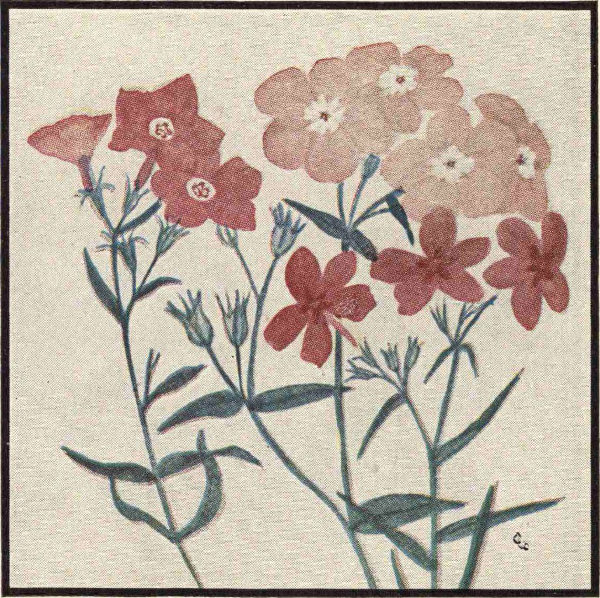
HELLER’S PHLOX BERLANDIER’S PHLOX THARP’S PHLOX
Berlandier’s Phlox (Phlox glabriflora) differs from Drummond’s phlox in many particulars. The flowers are usually a bluish-lavender which at a distance suggests the wild verbena. Like the other phloxes on this page, it has both stem and leaves clothed with scattered, long, soft hairs. The large corolla is marked with white at the base of the lobes and has a short, smooth tube. The vigorous plants branch profusely and often form masses two and three feet broad. This phlox may be found on sandy prairies south of Kingsville and west of Hebbronville in the winter and spring months but is at its best in February and March. It was first collected by Louis Berlandier at several places along the southern coast in 1828 and 1829.
Heller’s Phlox (Phlox helleri) is a close relative of Berlandier’s phlox but has a hairy corolla-tube, smaller flowers, and shorter leaves. It is found from March to May in sand near the coast around Copano, Aransas, and Nueces bays.
Slender Phlox (Phlox tharpii) has a long, hairy corolla-tube, and the slender stems are usually unbranched. Only four flowers are borne in a cluster. It is very abundant in Frio and Dimmit Counties in April. Theodore Roosevelt, in describing a peccary hunt south of Uvalde in April, 1904, mentions these fields of purple.
109
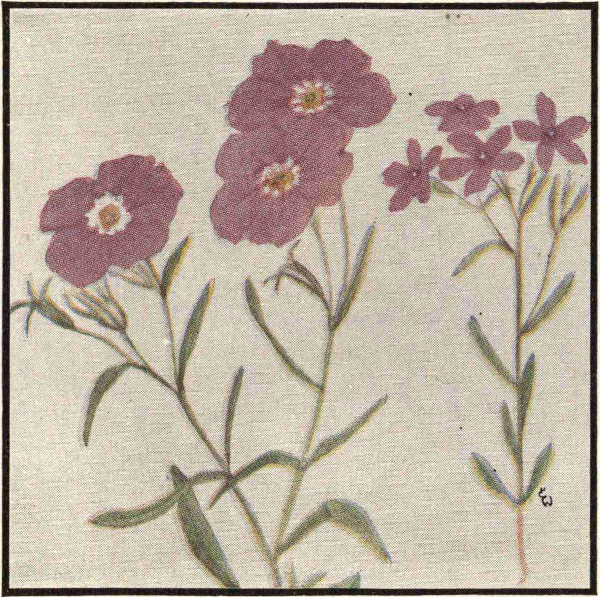
ROEMER’S PHLOX DWARF PHLOX
Roemer’s Phlox (Phlox roemeriana) has lovely flowers which vary in color from deep rose to phlox purple or pink. It is the only annual phlox marked with yellow around the eye or throat. Its large capsule, containing 12 or 15 seeds, is another conspicuous feature and shows its relationship with the perennial phloxes of West Texas. It forms a lovely display with bluebonnets and low prairie spider-worts in the limestone hill region in April and early May.
Dwarf Phlox (Phlox tenuis) is the smallest and most widely distributed of the annual phloxes, ranging from the south-central coast to Louisiana and into Southern Oklahoma. It is found on the coastal prairie and in sandy soil along the edges of post oak woods from March to May. The plants are usually six to eight inches high and unbranched, but branched varieties are known. The flowers are about half an inch broad, with narrow lobes which are marked with two reddish-purple lines at their base.
110
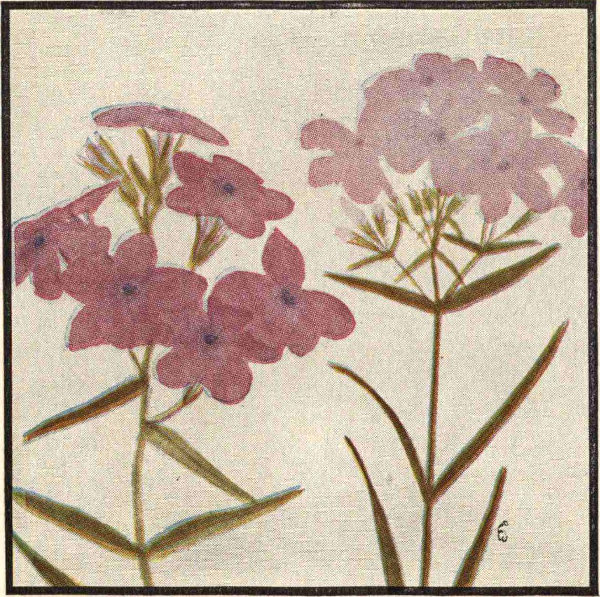
LARGE-FLOWERED PRAIRIE PHLOX PRAIRIE PHLOX
Prairie Phlox. Prairie Sweet William (Phlox pilosa) has a delightful fragrance common in lesser degrees to many of the phloxes. The widespread prairie phlox was named in 1753 from plants taken to France from Virginia. The stems are low and have a few opposite leaves which are pointed and widely spreading. The flat-topped clusters of pale pink, blue, white, or purple flowers bloom in March and April in Texas. The stems and flower clusters are clothed with soft hairs.
Large-Flowered Prairie Phlox (Phlox villosissima) grows in a strange environment for a phlox. Charles Wright found it in 1849 on the gravelly bars of the Nueces River, where it still grows. It is also found on other rivers in Southwest Texas. It has long, woody roots reaching toward the necessary moisture. The flowers are very large, and only a few are open at a time. It differs from the prairie phlox in its shorter and more numerous leaves, its larger flowers with their broader lobes, and alternate branches in the flower cluster. The prairie phloxes are perennial and are easily grown in Southwest gardens.
111
WATER-LEAF FAMILY (Hydrophyllaceae)
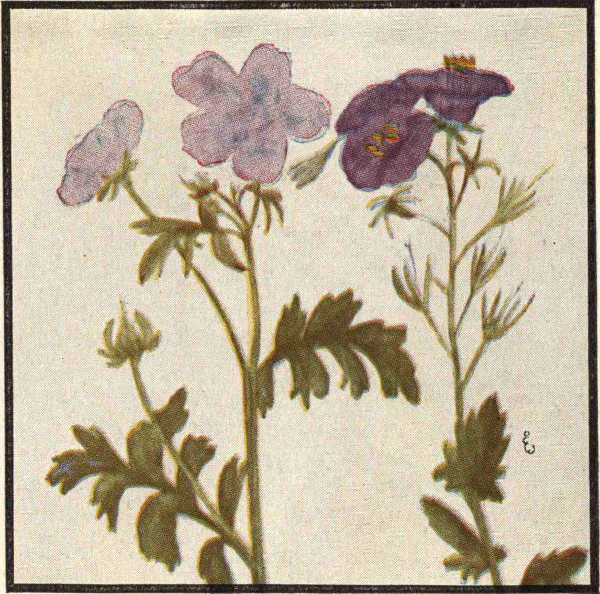
BABY BLUE-EYES PURPLE PHACELIA
Flowers usually in curled clusters; calyx deeply 5-lobed; petals united, usually 5; stamens 5, on corolla-tube; ovary superior; styles 2.
Baby Blue-Eyes. Flannel Breeches (Nemophila phacelioides) forms a lovely carpet on banks and in moist woods near the prairie regions of Texas and Arkansas. The dainty flowers are about one inch broad, with 5 broadly-spreading lobes of lavender, paler at the base. The leaves are divided into 5-9 broad segments which are irregularly toothed. It is not known in cultivation, but a similar plant from California is used to cover beds in which bulbs are planted.
Purple Phacelia (Phacelia patuliflora) is a low, spreading annual growing on sandy prairies in the southern part of the state. “Patuliflora” means “spreading flower” and refers to the royal purple corollas which are widely spreading and nearly an inch broad. It is the handsomest phacelia among the fifteen or more species found in the state. It blooms from February to May.
Blue nama (Nama ovatum) is a water-leaf growing in ponds and streams of East Texas and blooming in the summer. It has lovely sky-blue flowers nearly an inch broad and spiny stems. Sand bells (Nama hispidum) has small, reddish-purple, bell-shaped corollas.
112
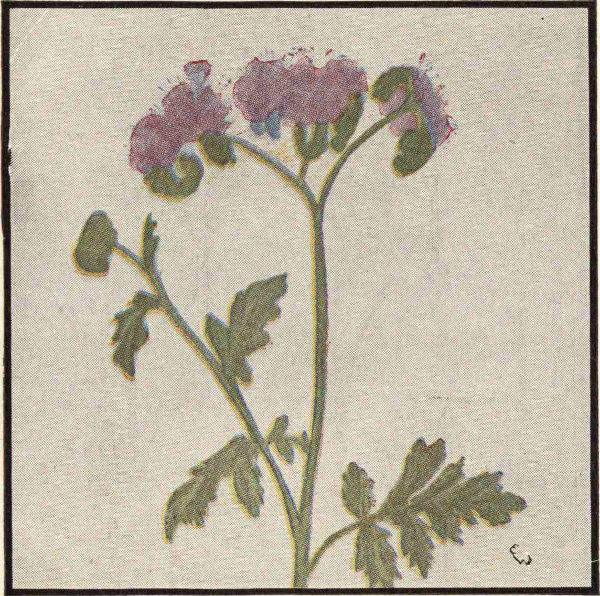
BLUE CURLS
Blue Curls. Fiddle-Neck (Phacelia congesta) is also known as spider-flower, caterpillars, snail-flower, and wild heliotrope. It has curled flower clusters and lavender-blue flowers very much like those of some of the heliotropes and borages. A California borage is also called fiddle-neck. The flowers are tubular at the base with 5 broadly spreading lobes. The 5 spreading stamens extending from the flowers are responsible for the name of “spider-flower.”
The erect, unbranched stems may be seen on gravelly limestone slopes or in open woods from Central to Southwestern Texas. The large, thin leaves are finely divided and clothed with soft hairs. In woods the plants may grow 1½-2 ft. high, but on rocky slopes they are seldom more than a foot high. The flowers bloom in April and May, a long blooming season resulting from the numerous flowers which open as the curling stems unfold. It is an annual plant which does well in cultivation and makes a lovely addition to the flower garden.
Nearly a hundred phacelias are found in Western North America. The name is from the Greek meaning “cluster.” Most of them are showy plants, but few are known in cultivation.
113
BORAGE FAMILY (Borraginaceae)
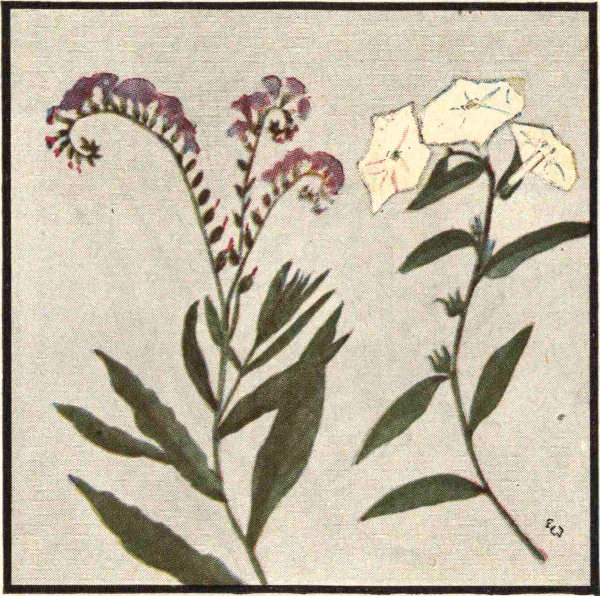
SOUTHERN HELIOTROPE BINDWEED HELIOTROPE
Leaves usually alternate; flowers often in curled clusters; sepals 5; petals 5, united; stamens 5, on corolla-tube; ovary often deeply 4-lobed; fruit a drupe or of 4 nutlets.
Southern Heliotrope (Cochranea anchusaefolia) grows in limestone soil from Central Texas to Florida and tropical America. It may often be found from spring to fall in the shelter of mesquite or prickly pear. The white-flowered sea-heliotrope (Heliotropium curassavicum) is very abundant in saline soil in South and West Texas. Plains heliotrope (Heliotropium tenellum) does not have curled clusters of flowers but has a few small white ones borne on short branches. It is widespread in the South-central United States.
Bindweed Heliotrope (Heliotropium convolvulaceum) has white flowers quite similar to those of the bindweed, about one inch broad. It is found in sandy soil in South and West Texas to California and Nebraska from spring to fall. The plant has widely branching stems, about a foot long, and the foliage is somewhat rough-hairy. The heliotropes get their name from Greek words which mean “sunturning.”
114
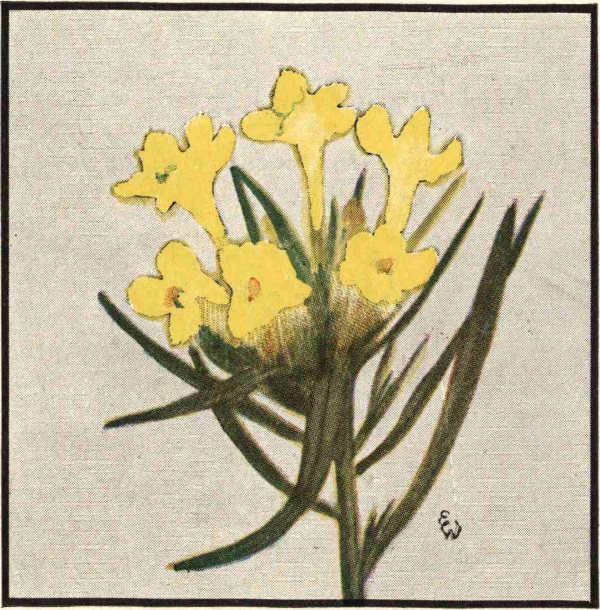
GOLDEN PUCCOON
Golden Puccoon. Narrow-Leaved Puccoon (Lithospermum linearifolium) is another harbinger of spring on the prairies. The scattered plants may be found throughout Texas to British Columbia and Indiana. Several slender stems grow from a long, thick black root. The plant gets its name from the Greek word meaning “stone-seed” and refers to the hard nutlets of the fruit. In the narrow-leaved puccoon, the nutlets are ovoid, white, shining, and more or less pitted. The flowers have a narrow tube with 5 spreading lobes which have crinkled margins.
Orange Puccoon (Lithospermum gmelinii) is a striking woodland plant of the Eastern States which is widespread in East Texas. It can be easily identified by its showy yellow-orange flowers. The clustered stems, 1-1½ feet high, grow from a deep root. It blooms in April and May.
Most of the puccoons have a red root from which a dye is obtained. Some of the European forms have blue flowers and are known in cultivation.
115
VERBENA FAMILY (Verbenaceae)
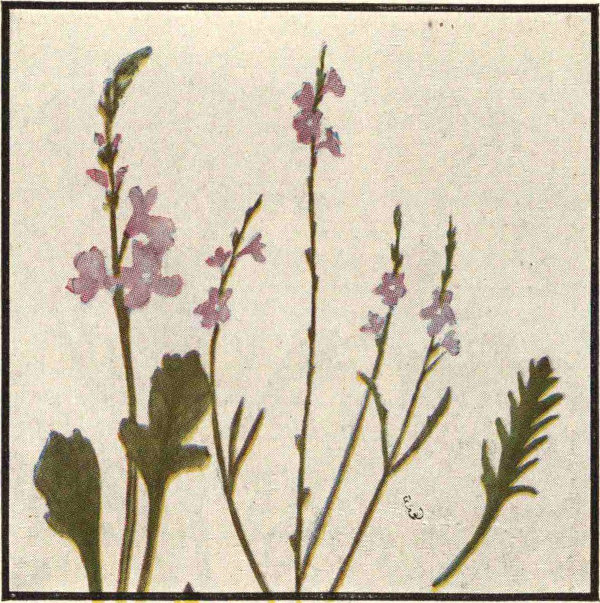
LARGE-FLOWERED VERVAIN SLENDER VERVAIN
Branches often 4-angled; leaves opposite; flowers often whorled; calyx 5-lobed; petals 4-5, united; calyx and corolla often 2-lipped; stamens 4, on corolla-tube; ovary often 4-celled.
Slender Vervain (Verbena halei) was, until a few years ago, considered the same as the European vervain (Verbena officinalis), but it is now recognized as a different plant. Misty-looking purple patches on the roadside ahead usually turn out to be masses of the slender vervain. It is a perennial which takes on renewed blooming activity from early spring until fall, but usually only scattered plants bloom after June. It is very abundant in this state and other Southern States.
The flowers are small and scattered along the slender branches at the top of the stem. The upper leaves are narrow, those of the mid-stem divided; and the lower are broad and irregularly toothed.
Large-Flowered Vervain (Verbena plicata) shows some variation in color from white to lavender, the flowers commonly being a bluish-lavender. The flowers are about half an inch broad and grow in long showy spikes. The plants are perennial, and numerous stems form erect clumps 1-2 ft. high. It is especially handsome southwest of San Antonio and ranges into Mexico. It blooms from February to May.
116
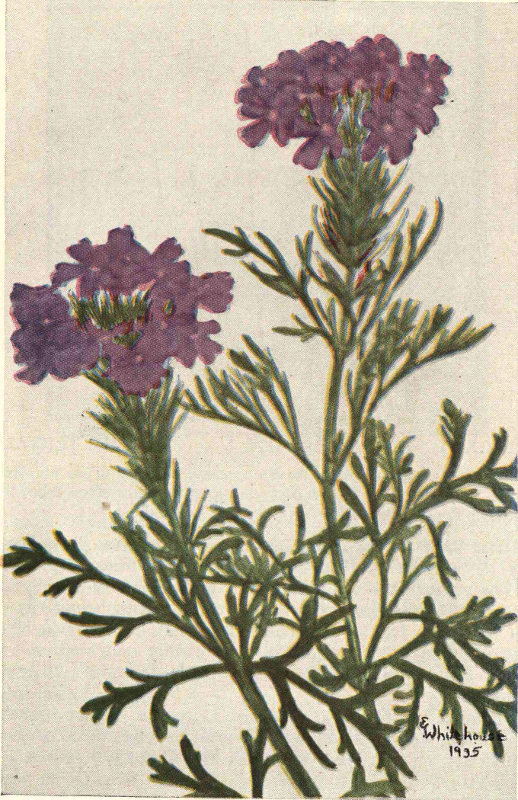
PLAINS VERBENA
117
Wild or Plains Verbena (Verbena bipinnatifida) is sometimes called sweet William, a name which properly belongs to the blue woodland phlox (Phlox divaricata) or to the clove pink. There is only a faint fragrance to the wild verbena.
Along highways and in the fields the wild verbena blooms in great profusion from spring until the plants are killed by a severe freeze. The flower stalks often grow quite long and are topped by a flat cluster of flowers around the new buds. The old calyx tubes surrounding the small nutlets remain on the stalk for many weeks. Children delight in pulling off the purple tubular corollas so that they can suck the abundant nectar from the tube and then string them together for a necklace, which they make by inserting the base of one tube into the throat of the adjoining corolla.
The wild verbena is a perennial plant with many prostrate branches. The leaves are thick, rough, and divided into narrow segments. It is one of the most familiar plants of the South Plains region, ranging from Missouri and Arizona to Northern Mexico. It is seldom used in gardens, but it is one of the plants used by the highway department for roadside planting. Where it has been used in gardens for low border mass effects, it has been a delight throughout the warm months with its showy, profuse blooms.
“Verbena” is the Latin name for a sacred plant. There are nearly one hundred species of verbenas, one of which is European and the others American. About twenty-five of these are found in Texas, part of them belonging to the vervain group. The plains verbena and the slender vervain are the ones most widely distributed. Among other very lovely verbenas found in the state are Wright’s verbena in West Texas and Lambert’s verbena in East Texas. A South American verbena (Verbena venosa), with brilliant purple flowers, has escaped cultivation in Southeast Texas.
Wright’s Verbena (Verbena wrightii) is quite similar to the plains verbena but has larger flowers of a reddish-purple color. The plants are larger, and the foliage is coarser.
Lambert’s Verbena (Verbena canadensis) has ovate leaves which are toothed or lobed but not divided. The flowers are a reddish-purple and have a white eye surrounded by a line of black. This is a handsome verbena which does well in cultivation but is little used. Garden hybrids have been reported from it. The origin of the common garden verbena is not definitely known.
118
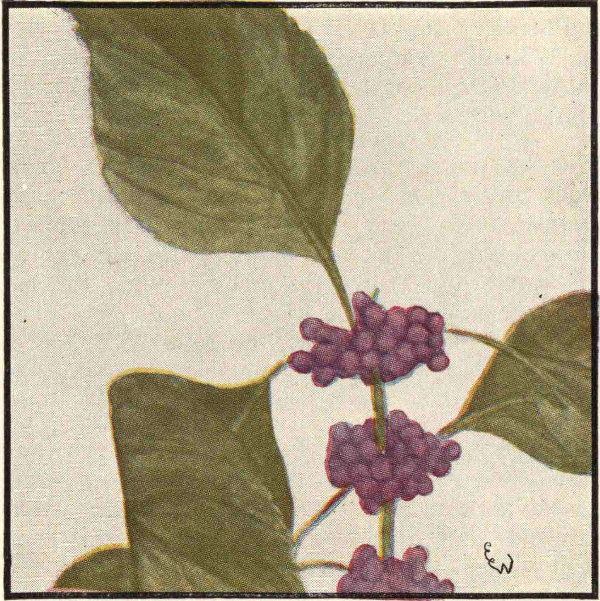
FRENCH MULBERRY
French Mulberry (Callicarpa americana) is a low shrub 3-6 ft. high, also known as the Bermuda mulberry or sour-bush. It is easily recognized in the fall by the clusters of reddish-purple berries and large ovate leaves 3-6 in. long. The showy berries are responsible for the scientific name which means “beautiful fruit.” It grows in woods of sandy areas from Central Texas to Florida and Virginia, and also in the West Indies. The variety with white fruit is not so common as the purple-fruited variety. The flowers are inconspicuous, pale pink or white. The shrub is well-known in cultivation but is not so hardy as the Japanese callicarpa.
The verbena family includes many tropical and sub-tropical shrubs, some of which are widely cultivated in Texas. Lantana (Lantana camara) has orange and yellow flowers and is a profuse summer bloomer. The common lilac lantana in cultivation was introduced from Brazil, but there are two native lilac lantanas in Southern Texas. Lavender, or vitex, introduced from Europe, is an excellent shrub for summer bloom.
119
MINT FAMILY (Labiatae)
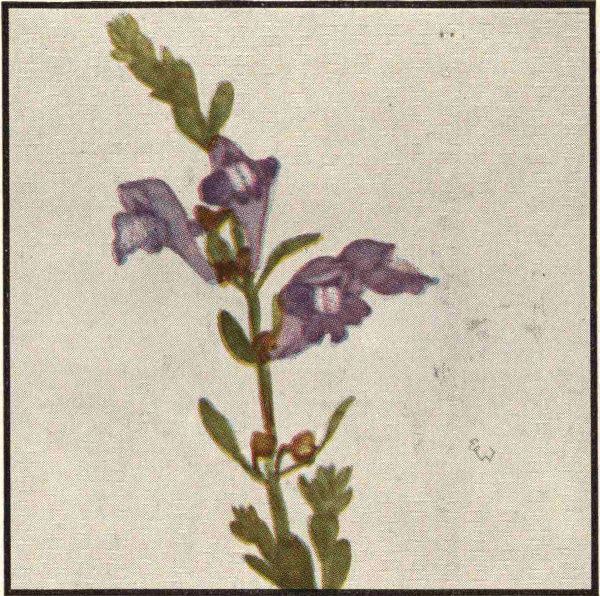
PRAIRIE SKULLCAP
Stems usually 4-angled; leaves opposite; calyx 5-lobed, often 2-lipped; corolla 4-5-lobed, usually 2-lipped; stamens 4 or 2, on corolla-tube; fruit of 4 nutlets.
Prairie Skullcap (Scutellaria resinosa) turns its saucy flowers upward and covers the dense clumps with a purple glow. The tubular flowers are nearly an inch long and 2-lipped, with two short lobes forming the velvety, arched upper lip and with three broad lobes forming the spreading lower lip. The middle lobe is marked by a conspicuous white spot dotted with purple. Numerous stems grow from a woody, perennial root on rocky prairies and limestone slopes from Texas to Arizona and Nebraska.
The many skullcaps in the state are easily distinguished from other mints by the crest on the upper surface of the calyx. Most of them have small oval or rounded leaves, and all have purple flowers. They get their scientific name from the Latin word meaning “dish,” referring to the shape of the calyx.
The mint family is a large one, well represented in Texas. The European horehound (Marrubium vulgare) has become a pernicious weed in the pastures of Central Texas. Rosemary, sage, thyme, lavender, majoram, and the mints are familiar members of the mint family.
120
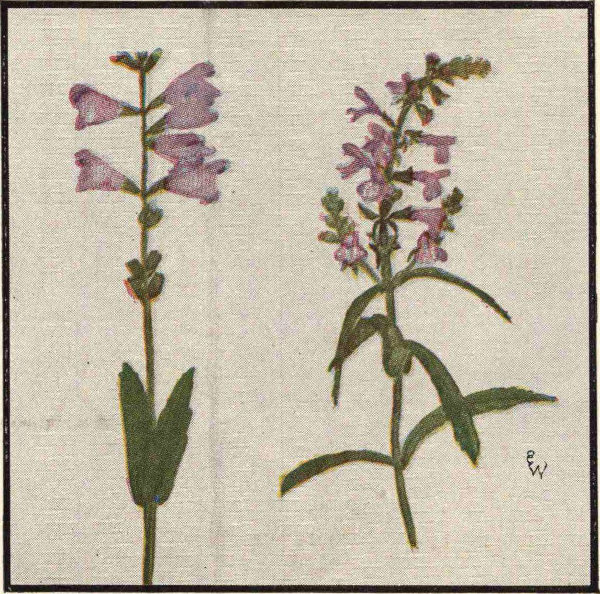
SLENDER DRAGON-HEAD BRAZOS MINT
Slender Dragon-Head or Lion’s Heart (Physostegia intermedia) has spikes of delicate lavender flowers. The slender stems, 1-3 ft. high, grow from perennial roots in moist soil on prairies from Texas and Louisiana to Missouri and Kentucky from April to July. The physostegias are rapidly growing in favor as garden flowers, as different species will produce blooms throughout the season, if the flowering spikes are cut and not allowed to seed.
Brazos Mint (Brazoria scutellarioides) is a lovely little annual found on the plains of Central Texas. The plants are usually less than a foot high and seldom branched, but the dense spikes of lavender flowers make it quite conspicuous during favorable seasons. Although the name indicates a resemblance to the skullcap, it might be mistaken for a dwarf physostegia. The corollas have much the same delicate lavender coloring, but the flaring calyx more closely resembles that of the Texas salvia. It is also called twin-flower, wild lilac, and honey plant.
Brazoria truncata, with larger and paler flowers, is very abundant in sandy soil in Central Texas, being especially common in Gonzales County. This plant was first collected near the Brazos River, a fact commemorated in the scientific name of “Brazoria.”
121
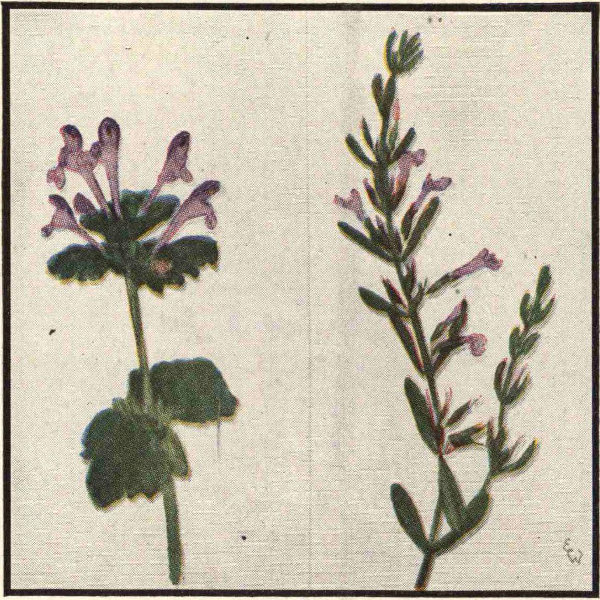
HENBIT PRAIRIE PENNYROYAL
Henbit. Dead Nettle (Lamium amplexicaule) is a troublesome weed on lawns everywhere in the state and in most of the United States. It is a winter annual introduced from Europe and Asia. The flowers often begin to bloom in December and continue until March or April. The stems branch from the base, and the flowers grow in stalkless clusters with the upper leaves.
Prairie Pennyroyal. Lemon Mint. Mexican Tea (Hedeoma drummondii) is a low perennial plant characterized by the lemon-like odor of the foliage, the narrow, tubular lavender corollas, and the bulging finely-ribbed tubular calyx. The flowers and leaves are about half an inch long. The low, bushy clumps grow on rocky plains and hillsides throughout Texas, the flowers blooming during the late spring and summer. A tea made from the foliage, either fresh or dried, is considered of value for its soothing effect. A few leaves in iced tea add a piquant flavor. The name is from the Greek and means “sweet smell.”
The American pennyroyal is Hedeoma pulegioides. The leaves and flowering tops are collected in July and August and dried. It yields an oil used in medicine.
122
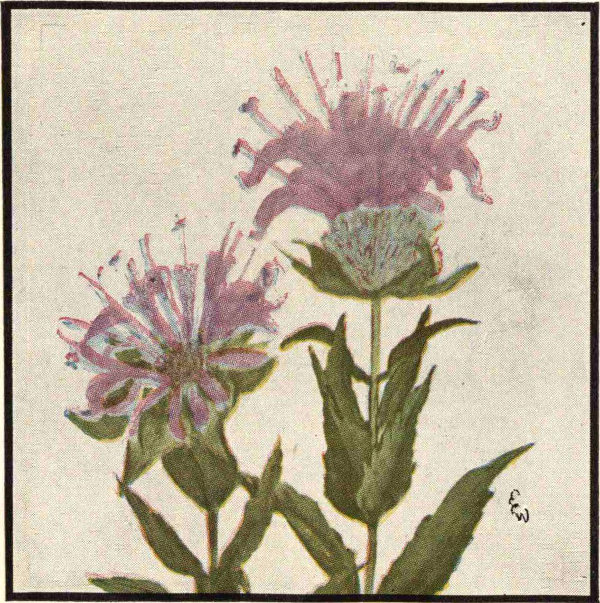
PALE WILD BERGAMOT
Pale Wild Bergamot (Monarda fistulosa mollis) is a very lovely member of the horsemint group. The slender stems are branched at the top, each branch having a terminal cluster of lavender flowers. The flowers are tubular and two-lipped, 1-1½ in. long, the upper lip narrow and the lower broad and three lobed. The upper lip is clothed with soft hairs.
The wild bergamot grows in the states east of the Rocky Mountains, and several varieties are known. In Texas it grows in moist woods in the eastern part and along streams in North Texas. It is a perennial which is sometimes cultivated. The stems are usually about two feet high. The leaves are short-stalked and lance-shaped, the margins having a few short teeth. The leaves have a pleasant aroma and are used in flavoring tea. Medicinally they are used as a stimulant and as a remedy for colic pains.
The brilliant, scarlet-flowered Oswego tea (Monarda didyma) of the Eastern States is not native to Texas. It is used as a substitute for tea.
123
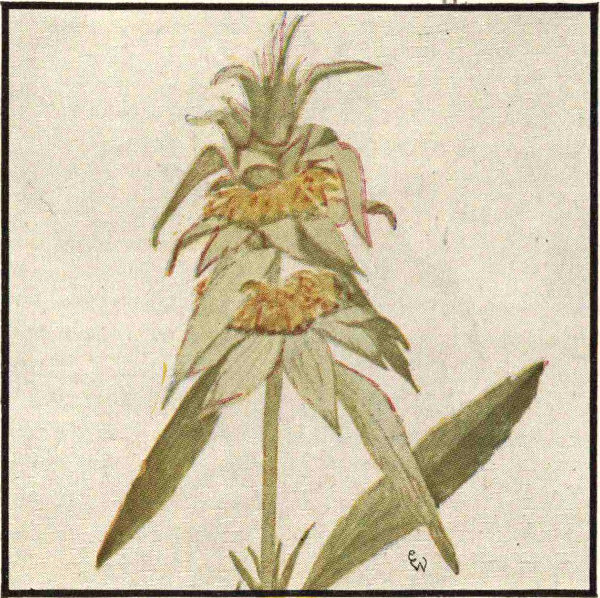
GREEN HORSEMINT
Green or White Horsemint (Monarda punctata) differs from the wild bergamot in having numerous clusters of flowers at the top of the stem. These clusters are surrounded by many short, drooping floral leaves which are blotched with white or occasionally have a purplish tinge. The yellow corollas are dotted with purple and are about an inch long. The calyx tube is ribbed, and the lobes are short and triangular. In growth habit and shape of leaves it is very much like the purple horsemint, but in flower it is readily distinguished by the yellow flowers and green and white floral leaves. The plants are perennial, much-branched, and somewhat downy. They are found in the Eastern and Central States and bloom in Texas from late May to July.
Dwarf Horsemint (Monarda clinopodioides) is another horsemint of sandy plains in Texas and Oklahoma. The plants are usually less than a foot high. They have white corollas, and the short bracts are purplish-brown with hairy margins. This horsemint is not so widespread as the green and purple horsemint.
124
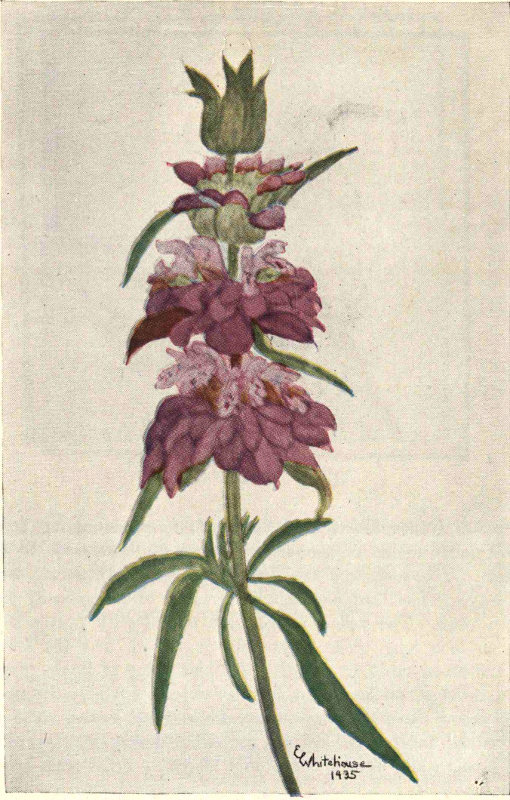
PURPLE HORSEMINT
125
Purple Horsemint. Lemon Monarda (Monarda citriodora) is lovely not only because of its dainty flowers but especially because of the floral leaves or bracts surrounding the flowers. These bracts take on a reddish-purple color and may be marked with white and green. The purple varies from rosy tints to a royal hue.
The flowers grow in whorls or rosettes at the top of the stem, new ones appearing with continued growth until there may be ten or more clusters on a stem. The corollas are narrow, tubular, and two-lipped, varying in color from lavender to white and commonly marked with small purple dots. The tubular calyx has five very narrow lobes, which are hairy and as long as the tube; the throat of the calyx is closed by a dense ring of white hairs.
Growing in erect clumps one to two feet high, the plants form conspicuous patches along highways and cover many pastures. The leaves are short-stalked and narrowed at both ends, the margins being sharply toothed. The purple floral leaves are oblong, with the midrib prolonged into a slender bristle or awn. These numerous bracts curve downward and overlap, the lower ones being longer.
The purple horsemint is common on plains from Mexico to Missouri and Kansas and ranges eastward to Florida. It blooms from May to August but is most profuse in June.
The monardas are North American plants named in honor of Nicolas Monardes, a Spanish physician and botanist. Some are valued for their perfume oils, and some have a slight medicinal value. The purple horsemint is rich in nectar, but the honey produced is not of the first quality. The dried plants are used in hens’ nests to drive off mites and fleas.
Plains Lemon Monarda (Monarda pectinata) is the common horsemint on the dry western plains in the state and ranges to Arizona and Nebraska. The flowers are pink or white but are not spotted with purple. The floral leaves are lance-shaped.
126
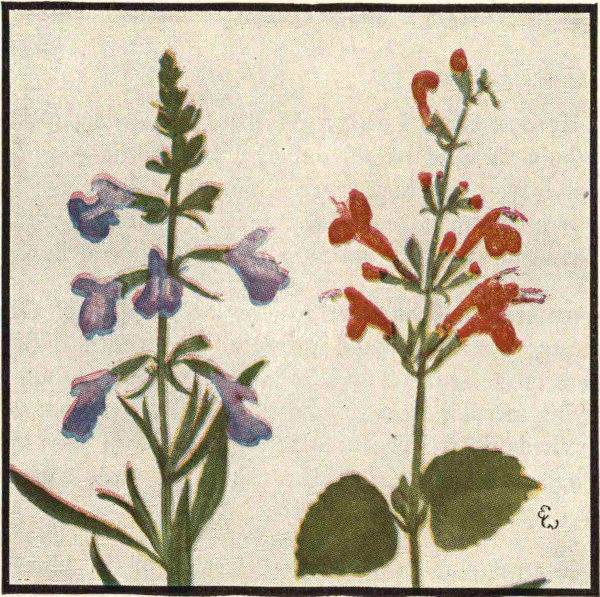
PRAIRIE SAGE RED SAGE
Prairie Sage (Salvia pitcheri) grows in scattered clumps throughout the central prairie region from Texas to Illinois and Minnesota. Because of its sky-blue, tubular, 2-lipped flowers, it is one of the plants most easily identified. The gray-green leaves have the characteristic sage odor and can be used for sage tea. The plants are two to three feet high and bloom from late spring to November.
Red Sage or Salvia. Indian Fire (Salvia coccinea) is a hardy plant in cultivation and blooms nearly all the year. It is native to the Gulf States, in Texas growing in woods near the coast. The red flowers are nearly an inch long.
There are nearly five hundred salvias known. Three European species are cultivated for their leaves, and many others are grown for ornamental purposes. The common bedding salvia is Salvia splendens, native of Brazil. The handsomest flower in the state is the red-flowered Salvia regla, found in a few mountain canyons in West Texas. Cancer weed (Salvia lyrata) is the common salvia of East Texas woods.
127
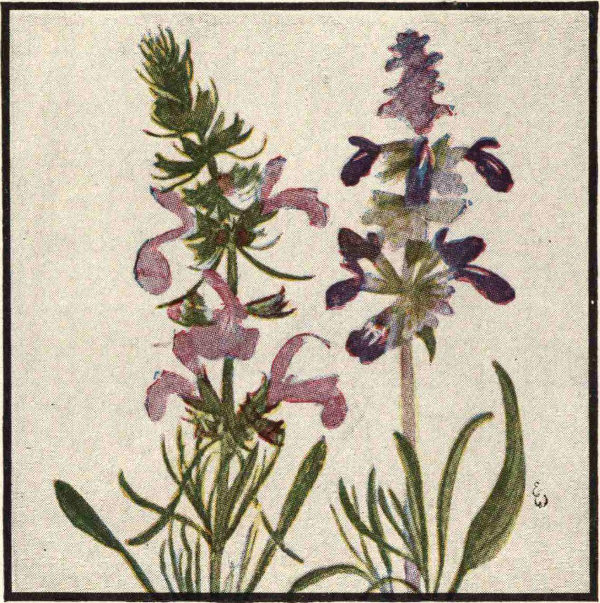
TEXAS SAGE BLUE SAGE
Blue Sage. Blue Salvia (Salvia farinacea) is a lovely plant which is native and abundant in the limestone regions of the state. It has long been known in cultivation, being especially adapted for rock gardens and highway plantings. It blooms with renewed activity after every rain from April to November. The corollas are usually purple but vary to blue and white. They have a narrow upper lip which is velvety with violet hairs on its outer surface. The calyx is velvety with violet-gray hairs. The stems grow from perennial roots and form clumps two to three feet high.
Texas Salvia. Texas Sage (Salviastrum texanum) blooms from March to May, growing in a low bushy clump 12-18 inches high on limestone hillsides from Central Texas to New Mexico. The spikes are densely covered with lavender flowers about an inch long. Unlike the true salvias, it has a flaring calyx which is densely bearded in the throat.
128
POTATO FAMILY (Solanaceae)
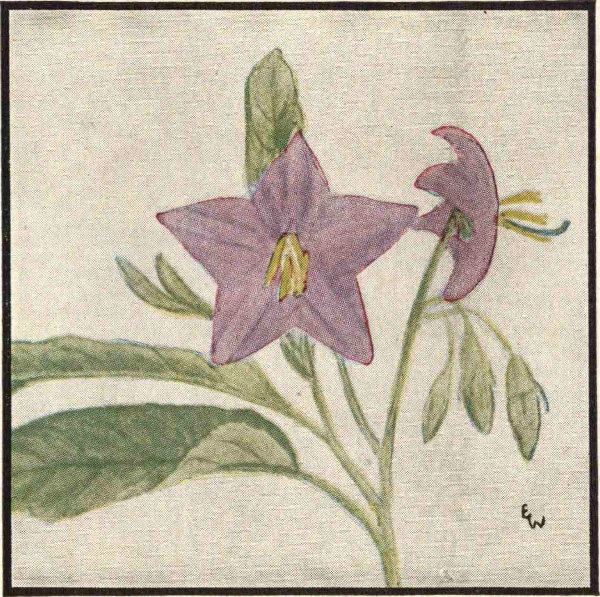
PURPLE NIGHTSHADE
Leaves alternate; calyx 4-6-lobed; petals united, 5; stamens 5, on corolla-tube, anthers often opening by apical pores; ovary 2-celled; fruit a capsule or berry.
Purple Nightshade (Solanum elaeagnifolium) is sometimes called silver-leaved nightshade or “trompillo.” Although bearing lovely star-shaped lavender flowers, the purple nightshade is considered a pernicious weed in fields and gardens. It grows from deep, woody perennial roots and blooms profusely even in seasons of drouth from May to October. It is found on plains from Missouri to Texas and Arizona. The branched plants grow 1-3 ft. high and are more or less covered with prickles. The yellow fruits resemble small tomatoes and remain on the old stalks for months. They are said to be poisonous.
Torrey’s Nightshade (Solanum torreyi) is a plant similar to the purple nightshade, but it has broader, irregularly-toothed leaves and larger flowers and seldom grows as high.
The solanum group comprises nearly a thousand species and includes many well-known plants, among which are the Irish potato and the egg-plant. Bitter-sweet and Jerusalem cherry are cultivated for their showy fruits. Several members of the group are said to be very poisonous.
129
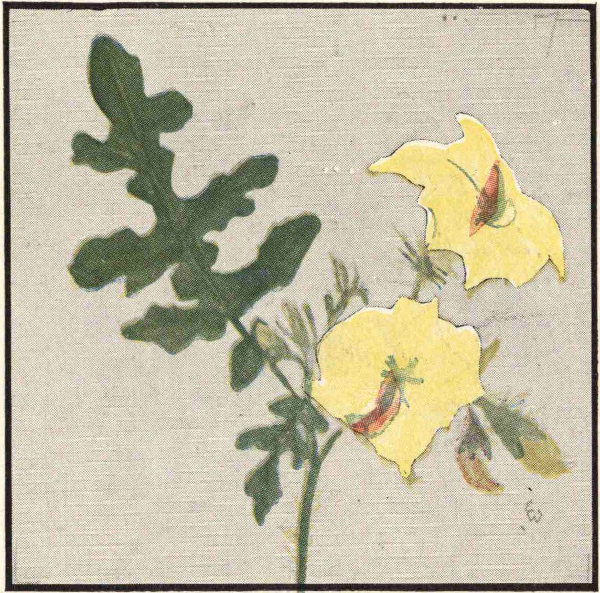
BUFFALO-BUR
Buffalo-Bur. Yellow Nightshade (Solanum rostratum) is a common weed in waste places and on prairies from Tennessee to Mexico, but the spreading plants are often covered with their yellow star blossoms. Children call them sticker-weeds because of the vicious prickles on the foliage. They are also called tread-softly, Texas nettle, prickly potato, and bumble-bee bush, the latter name being given because of the numerous bee visitors. The name of buffalo-bur dates back to the days when buffaloes roamed the plains, the prickly fruits clinging to the shaggy coats of the huge beasts.
The yellow flowers which bloom from May to October resemble those of the purple nightshade in shape and size. The stamens of the nightshades shed their pollen through small openings at the top of the pollen-sac. The buffalo-bur has one stamen very much larger than the other four. The leaves are once or twice divided into broad rounded segments. The berries are enclosed in the enlarged and spiny calyx.
130
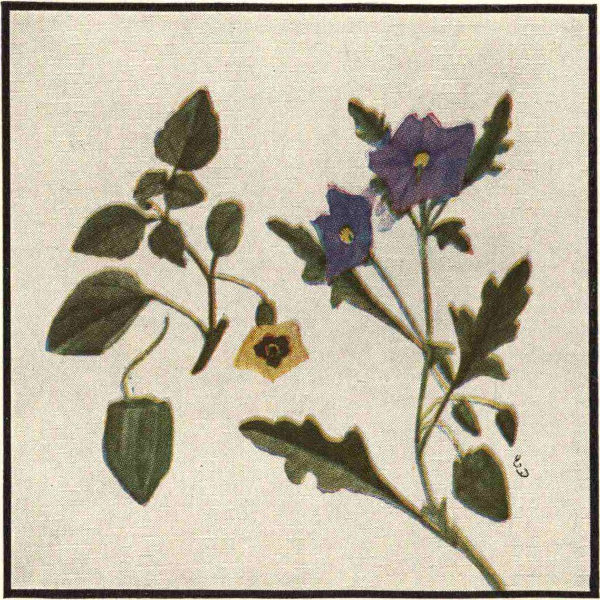
LOW GROUND CHERRY PURPLE GROUND CHERRY
Low Ground Cherry (Physalis mollis) is a common weed throughout the state and ranges to Arkansas, Mexico, and California. The flowers and fruits are usually hidden beneath the leaves. The fruit, a berry very much like a small tomato, is enclosed in the enlarged sac-like calyx. The scientific name is from the Greek word meaning “bladder” and refers to the inflated calyx. Some ground cherries are cultivated for their fruits which are edible and are used for making preserves and pies.
Purple Ground Cherry (Physalis lobata) flaunts its gay purple flowers for all to see. The plant has low, spreading branches which are covered with purple blooms, one inch broad. It ranges from Mexico to Kansas and California, blooming in Texas from spring to fall.
The potato family includes the tomato and tobacco plants. Wild tobacco (Nicotiana repanda) is very abundant in the southern part of the state. The white flowers resemble those of the cultivated petunia, which also belongs to this family.
131
FIGWORT FAMILY (Scrophulariaceae)
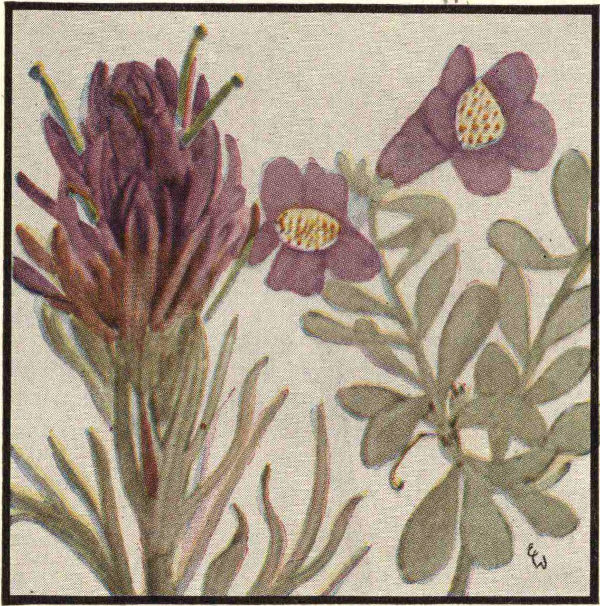
PURPLE PAINT-BRUSH CENIZO
Leaves alternate, opposite, or whorled; sepals, 4-5; corolla tubular, 4-5-lobed, 2-lipped; stamens often 4, in pairs on corolla-tube, sterile stamen often present; ovary 2-celled, superior.
Purple Paint-Brush (Castilleja purpurea) grows on limestone slopes and rocky prairies in North-central Texas. The low stems grow from a woody perennial root. The flowers and floral leaves are both conspicuously colored, varying from rose to purple. The divided leaves are a lovely ashy-gray.
Leucophyllum. White Leaf. Cenizo (Leucophyllum texanum) covers hillsides in the southern and southwestern parts of the state. The low bushes seldom grow more than three or four feet high. It is a startling and lovely sight to see a hillside which was a mass of gray transformed overnight into a delicate hue of lavender. This happens shortly after heavy rains, and for this reason the plant is sometimes called barometer bush. Leucophyllum has been widely introduced as a shrub in Texas gardens, where the ashy-gray leaves are quite effective against dark green shrubbery. The name is Greek and means “white leaf.”
132
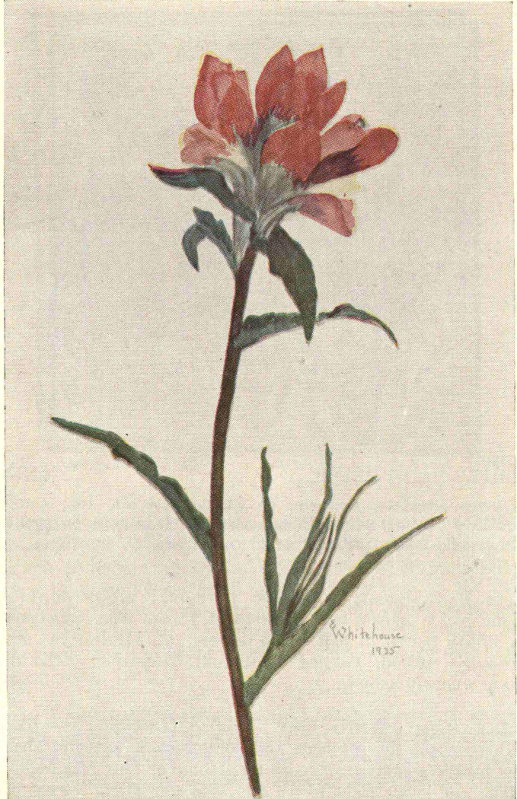
SCARLET PAINT-BRUSH
133
Scarlet Paint-Brush (Castilleja indivisa) is also called Indian paint-brush, painted-cup, entire-leaved paint brush, and Indian pink. One of the most inspiring landscape displays of native flowers is formed by the scarlet paint-brush. It is found in sandy soil from the northeastern to southwestern parts of the state and blooms from March to May but is at its best in April. The paint-brush display of red is equalled or excelled only by that of two other wild-flower favorites—the red Drummond’s phlox in south-central sandy regions and the beautiful gaillardia of black land prairies.
The intense scarlet-red is due to the coloring of the broadened floral leaves (bracts) at the tip of the stem. These bracts almost hide the inconspicuous cream-colored flowers which are about an inch long. The bracts are oblong, the tips being broader than the base and deeply stained with scarlet.
The scarlet paint-brush is an annual plant, commonly six to twelve inches high, and is sometimes branched at the base. The leaves are rough-nerved and wavy-margined. Occasionally the leaves have two linear basal lobes somewhat like those of the eastern or swamp scarlet paint-brush (Castilleja coccinea), which has similar flower clusters but grows in swampy places.
The castillejas are mostly Western American plants, some being parasitic on the roots of other plants. They are named in honor of D. Castillejo, a Spanish botanist. In addition to the scarlet and purple paint-brushes, several other castillejas are found in the state. Lindheimer’s paint-brush (Castilleja lindheimeri) is very much like the purple paint-brush, but it has red or orange bracts. It is a perennial plant which grows on limestone hillsides of Southwest-central Texas. The woolly-stemmed paint-brush (Castilleja lanata) has woolly-gray stems and leaves and red flower clusters. It may be noticed in chaparral thickets and canyons in West Texas.
134
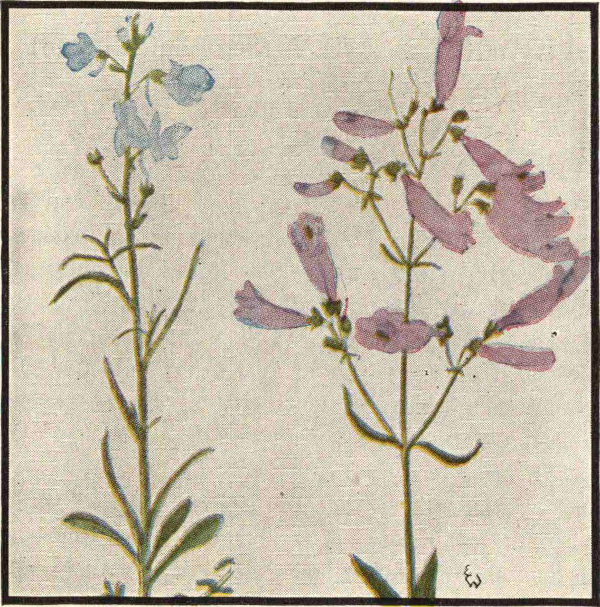
TEXAS TOAD-FLAX SMALL-FLOWERED BEARD-TONGUE
Small-Flowered Pentstemonor or Beard-Tongue (Pentstemon laxiflorus) grows in the sandy soil of post oak woods in Central and East Texas. The slender stems are 1-2 ft. high and are topped by slender-stalked flower clusters. The corollas are a pale lavender, about an inch long. This is a very common plant in the state and has been given various names by botanists, the latest one being laxiflorus. It is a close relative, probably a variety, of the slender beard-tongue (Pentstemon gracilis) of moist prairies from Minnesota to Oklahoma.
Texas Toad-Flax (Linaria texana) has pale blue flowers similar to those of the Canada toad-flax. The corollas have a slender spur about half an inch long. The slender stems are 1-2 feet high, growing from a cluster of basal leaves which are finely divided into somewhat rounded segments. It is widespread in sandy soil from Florida to California and blooms early in the spring.
Many other figworts are found in the state. The nearest relative to the garden snapdragon is the climbing snapdragon (Maurandia antirrhiniflora). Mullein is widespread in the state. The common monkey-flower is Mimulus glabratus.
135
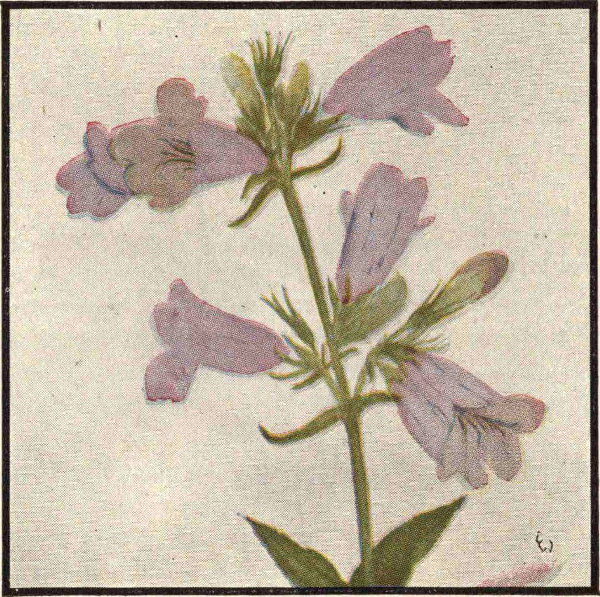
LARGE-FLOWERED BEARD-TONGUE
Large-Flowered Beard-Tongue or Pentstemon (Pentstemon cobaea) is also known as false foxglove, dew flowers, fairy thimbles, wild belladonna, and balmony. It was called “balmony” by early settlers, who made a tea from the leaves to be used as a laxative. Several erect stems from perennial roots grow on the rocky slopes of prairies from Texas to Missouri and Kansas. It blooms in Texas in April and May.
The flowering spikes of bell-shaped flowers are large and showy. The corollas are usually pale, tinged with reddish-purple and marked with darker lines. The fifth stamen is sparingly bearded. The stems are 1-1½ feet high, and the flowers are 1½-2 inches long. The leaves are broad and partly clasping at the base, the margins usually indented with sharp teeth. It is thought that the common garden pentstemon is a hybrid derived from this beard-tongue and Hartwig’s pentstemon, a Mexican plant.
136
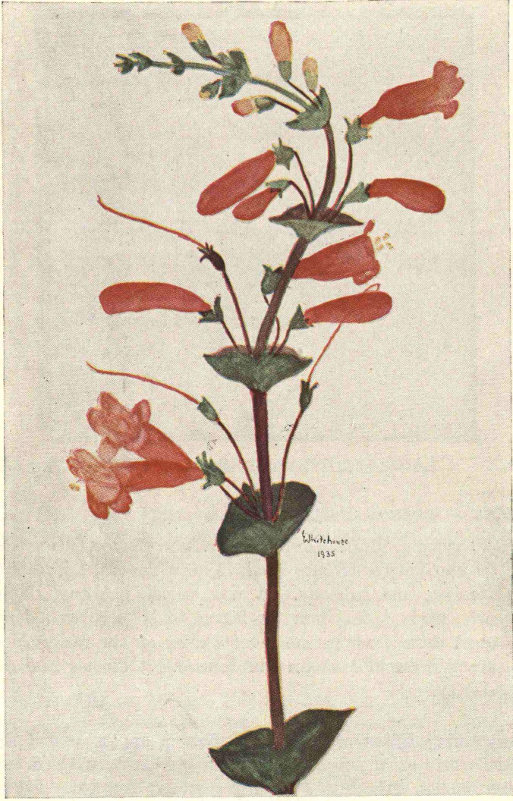
SCARLET PENTSTEMON
137
Scarlet Pentstemon or Beard-Tongue. Murray’s Pentstemon (Pentstemon murrayanus) is a very lovely plant growing in sandy soil in post oak woods of Central and East Texas and Arkansas. The plants are three feet high, the reddish stems having a few opposite, clasping leaves, those on the upper part being united and cup-shaped. The foliage is very smooth and has a somewhat downy covering.
The flowering upper portion of the stem is often over a foot long and bears a profusion of tubular scarlet flowers about an inch long. The stamens extend beyond the corolla, and the fifth stamen is not bearded. The long slender style remains on the capsule long after the corollas have fallen away. The flowers usually bloom the latter part of March in South Texas and the middle of April in North Texas. The plants are quite hardy and may be successfully transplanted or grown from seeds, but should be planted in sandy soil.
“Pentstemon” is Greek meaning “five stamens.” Nearly all members of the figwort family have only four stamens, but the pentstemons have five; however, the fifth stamen does not bear a pollen-sac and is often bearded. “Beard-tongue” refers to this bearded stamen. There are nearly a hundred and fifty species of pentstemons, about thirty of them being found in Texas. With the exception of one found in Southeastern Asia, they are all North American plants.
Murray’s pentstemon is quite similar to two red-flowered pentstemons of the mountains of West Texas. These two are likewise tall, vigorous plants and have showy clusters of flowers. Torrey’s pentstemon (Pentstemon barbatus torreyi) has narrow pointed leaves, and the superb pentstemon (Pentstemon superbus) has broad oblong leaves. The common blue-flowered pentstemon in West Texas is Pentstemon fendleri, with leaves nearly as broad as long.
138
TRUMPET-CREEPER FAMILY (Bignoniaceae)
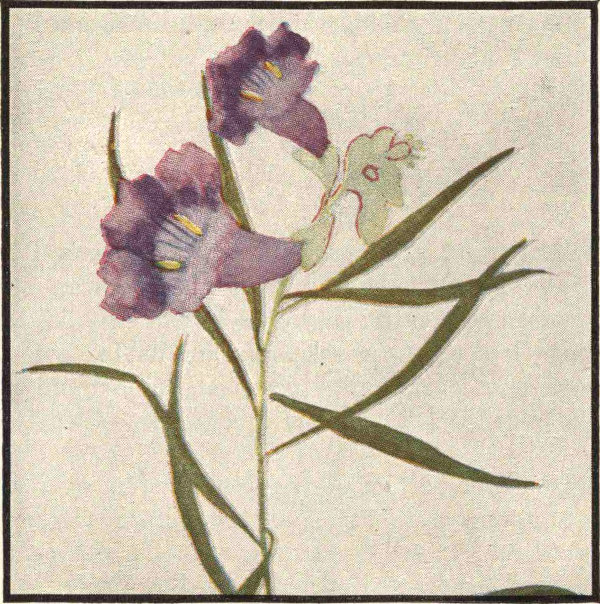
DESERT WILLOW
Leaves opposite, mostly compound; flowers showy, often 2-lipped; calyx tubular, 5-lobed; petals 5, united; stamens 4 or 2, in pairs on corolla-tube; capsules often long, with winged seeds.
Desert Willow (Chilopsis linearis), also called flowering willow, willow-leaved catalpa, and “mimbre,” is a common shrub along water courses from West Texas to Southern California and Northern Mexico. When it is not in flower or fruit, it may be mistaken for the black willow (Salix nigra), which has similar leaves. The delicate, lavender, trumpet-shaped flowers are about two inches long. White and pale-lavender forms occur. It is a shrub or small tree frequently cultivated for ornament in Texas and California. It blooms from May through the summer months. Mexicans use the wood for fence-posts and the branches for baskets. A tea made from the flowers is used as a remedy for heart and lung diseases.
Several other members of this family are native to the state and are well-known in cultivation. Among these are the red-flowered trumpet-creeper (Campsis radicans), the yellow-red cross-vine (Bignonia capreolata), the catalpa found in East Texas woods, and the yellow-elder (Tecoma stans) in South Texas and the mountains of West Texas.
139
ACANTHUS FAMILY (Acanthaceae)
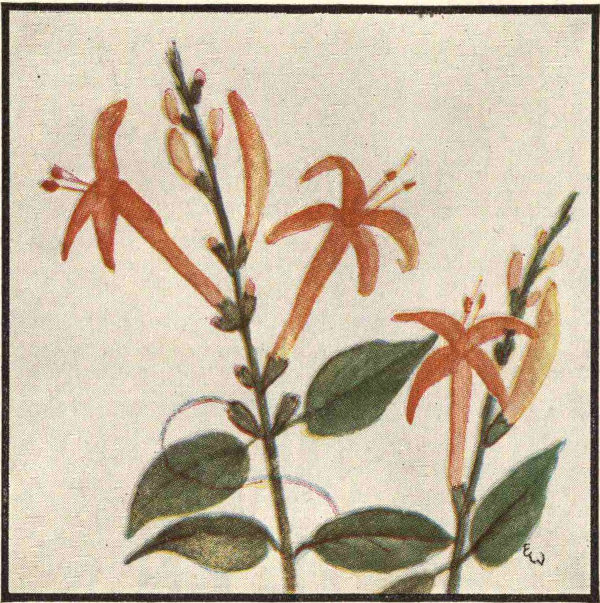
FLAME ACANTHUS
Leaves opposite; calyx 4-5-lobed; sepals 5; petals 5, united, sometimes 2-lipped; stamens on tube, 2 or 4 in 2 pairs; fruit a capsule, often club-shaped, opening elastically.
Flame Acanthus (Anisacanthus wrightii) is covered with scarlet flowers from early summer until frost. It is a low, widely branched shrub, about 2 feet high, found in rocky soil of the mountains of West Texas. The corollas have a narrow tube and five narrow, spreading lobes which are nearly equal but somewhat 2-lipped. The two stamens and the style extend beyond the corolla. The small leaves are ovate-lanceolate in shape and are 1-2 inches long.
The flame acanthus is an excellent garden shrub for dry regions and has been known in cultivation for some time. This species is named in honor of Charles Wright, an early collector of Texas plants and one of the first teachers in the state. Wright was a Yale graduate who collected plants in Texas from 1837 to 1852 for Dr. Asa Gray of Harvard University. He accompanied a baggage train to El Paso in 1849, and in 1851 he joined the Graham Boundary Survey. On both of these trips he collected many plants not previously known to science.
140
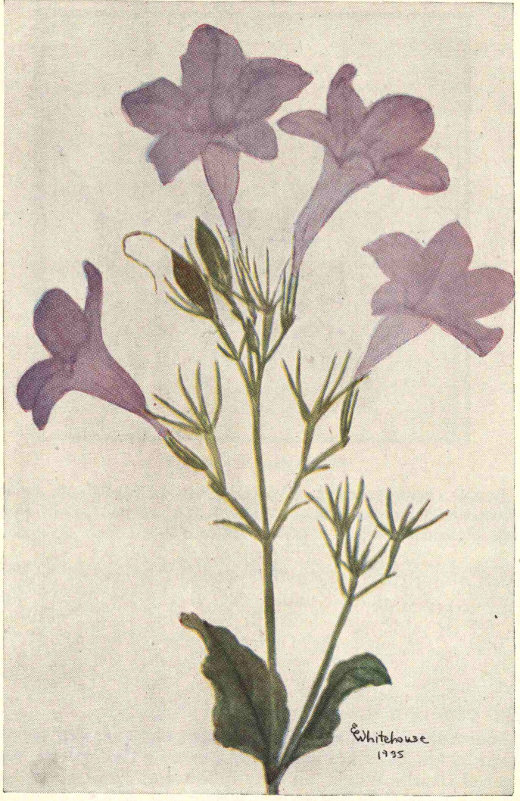
WILD PETUNIA
141
Wild Petunia. Ruellia (Ruellia nudiflora) has flowers very much like those of the cultivated petunia, a member of the potato family. It is a very common plant in Central and South Texas, growing in open woods or on rich prairies. It frequently takes possession of lawns and flower beds.
The plants are erect, 12-16 inches high, and have few branches. The few leaves are oval, narrowed at the base, wavy-margined, and blunt or rounded at the apex. The forking flower clusters have one to five flowers open at the same time. The flowers do not last very long. Leaves and stem are often marked with red or purple.
The delicate, funnel-shaped corollas have five spreading lobes and are about two inches long. The four stamens are inclosed in the tube. The seed-capsules are nearly an inch long and turn brown as they mature.
This ruellia was formerly confused with Ruellia tuberosa, a tropical plant with tuberous roots. The ruellias belong to a large group of plants with about 200 species most of which are found in tropical South America. They are named for Jean de la Ruelle, an early French physician and botanist.
There are several other ruellias widely distributed in the wooded sections of the state. The hairy ruellia (Ruellia ciliosa) is abundant on the prairies in Texas and the Eastern States. Miss Eaton, in an article in the National Geographic in 1925, reports that carpenter-bees use circular pieces of the corolla to plug off their nesting cells made in tunnels in soft wood. Drummond’s ruellia (Ruellia drummondiana) is found in woods in Central Texas. The flowers are rather small and are nearly hidden by the leaves.
142
PLANTAIN FAMILY (Plantaginaceae)
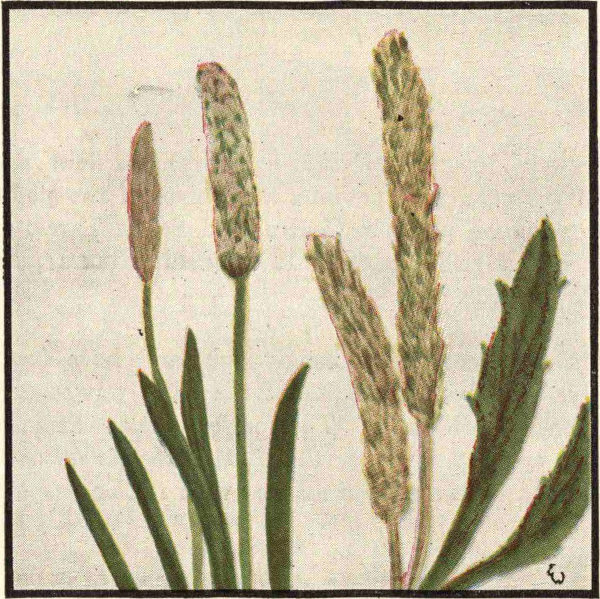
TALLOW-WEED RED-SEEDED PLANTAIN
Herbs; leaves basal; calyx 4-lobed; corolla papery, 3-4-lobed; stamens 4, on corolla-tube; capsule (in ours) opening by a horizontal division.
Tallow-Weed. Wright’s Plantain (Plantago wrightiana) is a common plant on prairies from Texas to Arizona and blooms from April to June. It is called tallow-weed because cattle fatten on the plants. The stems are 6-8 in. high, and the numerous basal leaves are half as long, narrow, smooth, and dark green. The small 4-lobed flowers have a stiff, papery white corolla with spreading lobes. The small capsules open by a lid.
Red-Seeded Plantain or Ribwort (Plantago rhodosperma) has broad leaves, 3-5-ribbed, and narrow spikes of flowers. The leaf-rosettes are often a foot broad. The corolla lobes are erect and are closed over one another. The ribwort is a very common weed in sandy soil from Missouri to Texas and Arizona.
There are many other plantains in the state, all more or less abundant. The group has retained the old Latin name. Scilla-seed, a laxative in recent use, is obtained from a South American plantain. The seeds of the lance-leaved plantain are sold as food for birds.
143
MADDER FAMILY (Rubiaceae)
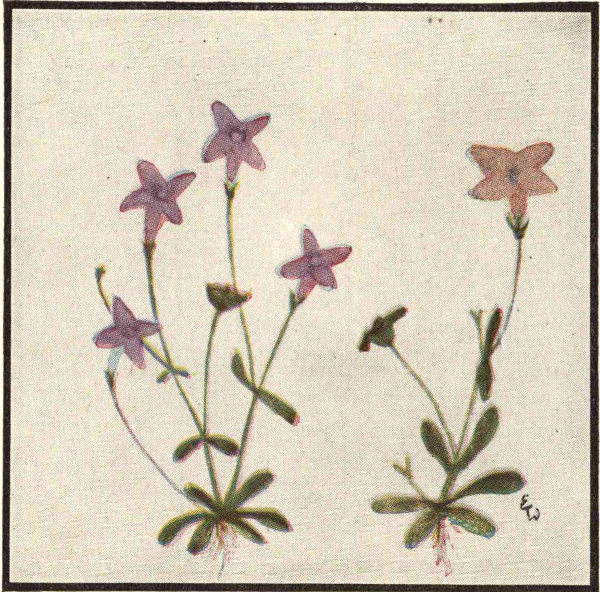
SMALL BLUET LEAST BLUET
Leaves opposite or whorled; in ours, sepals and petals usually 4, but may be 4-10, calyx joining ovary wall; stamens 4-10, on corolla-tube; ovary inferior, 2-5-celled.
Small Bluet (Houstonia patens) has violet-blue flowers which are among the first blossoms of spring. They dot golf courses and sandy meadows from Texas to Virginia and Illinois in February and March. The bluets are also called innocence and angel-eyes.
Least Bluet (Houstonia minima) is a smaller plant than the small bluet, but the flowers are a little larger and are pale pink. They bloom at the same time of year and may often be found together. The least bluet ranges from Texas to Illinois and Kansas.
The madder-family is mainly tropical but is represented in Texas by nearly forty species. Nearly all of these have inconspicuous, 4-lobed white flowers and include many bedstraws and bluets, the button-weed, and button-bush. From some members of the family valuable commercial products—coffee, quinine, and a red dye—are obtained; the cape-jasmine or gardenia is a well-known ornamental plant.
144
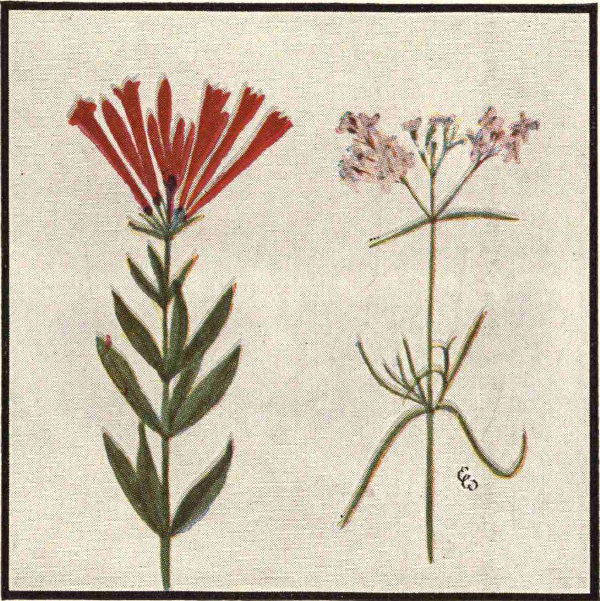
BOUVARDIA BABY’S BREATH
Baby’s Breath. Narrow-Leaved Houstonia (Houstonia angustifolia) is not the garden plant (Gypsophila paniculata) which is known as baby’s breath, but it is equally dainty. The stems grow from woody perennial roots and form erect clumps about a foot high. The small flowers are borne in flat-topped clusters and vary in color from white to pale pink or lavender. This plant is widely distributed on prairies from Illinois to Texas and Florida.
Bouvardia (Bouvardia ternifolia) is a low shrub, 2-6 ft. high, which grows in the mountains west of the Pecos River to Arizona and Mexico. The leaves are short and grow in whorls of 3’s or 4’s. The narrow, red tubular flowers are about one inch long. The Bouvardias were once popular as greenhouse plants but are little used now. This one was introduced into England more than one hundred years ago.
145
HONEYSUCKLE FAMILY (Caprifoliaceae)
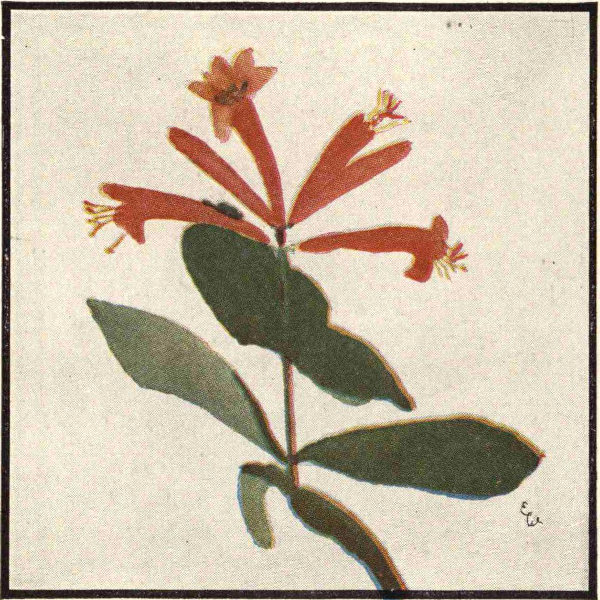
CORAL HONEYSUCKLE
Usually shrubs; leaves opposite; calyx joining ovary wall, 5-lobed; corolla 5-lobed, tubular and often 2-lipped; stamens 4-5, on corolla-tube; ovary inferior; fruit a fleshy berry.
Southern Woodbine. Coral or Trumpet Honeysuckle (Lonicera sempervirens) is quite common in the woods of East Texas and other Southern States, blooming in Texas in late March and continuing until fall. It is an evergreen vine that has been widely introduced into cultivation. The flowers are not so conspicuously two-lipped as in the white honeysuckle, the corolla-lobes being nearly equal. The scarlet berries are ¼ inch long, ripening in the summer. This is one of a number of plants which are commonly called woodbine. The group was named in honor of Adam Lonitzer, an early German botanist.
The black haw (Viburnum prunifolium) is very abundant in Texas woods. The showy ball-like clusters of white flowers appear with the leaves in April and May, following the dogwood and red haws. The American elder (Sambucus canadensis) is found along streams in Central and East Texas.
146
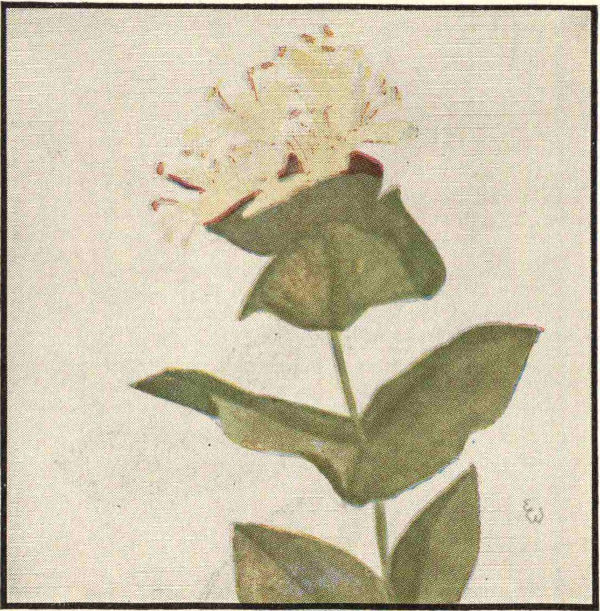
WHITE HONEYSUCKLE
White Honeysuckle (Lonicera albiflora) is a straggling bush which usually grows in the shelter of a tree. The pale broad, oval leaves are opposite and united at their bases, the uppermost pair being cup-shaped and surrounding the cluster of flowers borne at the tip of the stem. The fragrant flowers are less than an inch long with a narrow tube and 5 lobes, the lower lobe long and narrow and the 4 upper shorter, very much like those of the common cultivated Japanese honeysuckle. The five spreading stamens extend conspicuously beyond the corolla.
This plant blooms in April and May. It is scattered throughout the central and western parts of the state, being especially abundant in the western mountains, and ranges to Arkansas and Arizona. The Japanese honeysuckle has escaped cultivation in places along the bayous of East Texas.
147
VALERIAN FAMILY (Valerianaceae)
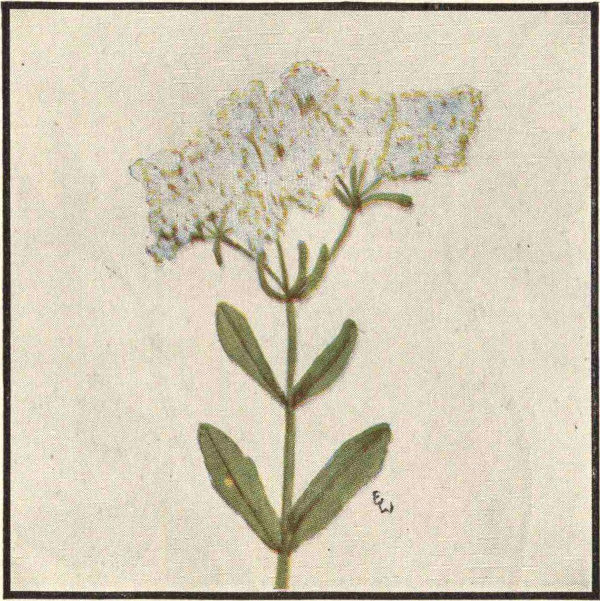
LAMB’S LETTUCE
Leaves opposite; calyx of several bristles or absent; petals 2-5, partly united; stamens usually 4, on corolla-tube; ovary inferior, 3-celled but only 1 cell fertile.
Lamb’s Lettuce. Texas or Dwarf Corn Salad (Valerianella amarella) is one of the first white-flowered spring plants, growing in such abundance that the prairies are white with the blooms. It is a much smaller plant than the dwarf Queen Anne’s lace which is so lovely late in April and May. In the field it is usually about 6 in. high but grows a little higher in cultivation when used as a border plant. It is easily identified by its flat-topped clusters of flowers grouped in squares at the end of the widely forking branches. The smooth foliage is yellow-green in color.
There are several corn salads which grow in moist places in the state. The dwarf corn salad may readily be distinguished from these, as its minute seed-pod is covered with woolly hairs. The European corn salad is cultivated, and the leaves are used for salad.
148
GOURD FAMILY (Cucurbitaceae)
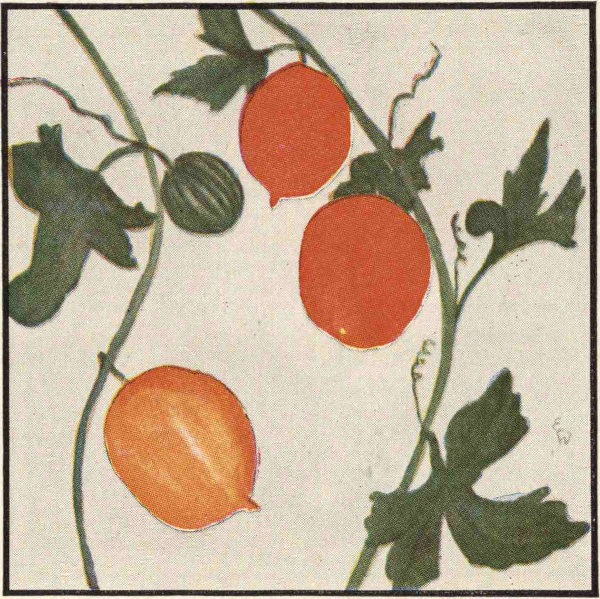
WILD BALSAM GOURD
Tendrils mostly present, stems often prostrate; flowers usually unisexual; calyx tubular, 5-lobed; petals united or separate; stamens usually 3, one anther always 1-celled, the other two 2-celled; ovary inferior.
Wild Balsam Gourd (Ibervillea lindheimeri) has bright scarlet balls about an inch in diameter and makes conspicuous spots of color on fences in the fall. The vine is slender, bearing small yellow flowers in the spring. The fruits are green at first, turning orange and then a scarlet red. Sometimes they are a little longer than broad and pointed at the end. The few leaves are thick and deeply 3-5-lobed. It ranges from Texas to California.
The garden balsam (Impatiens balsamina) bears no relation to this plant. The vines in cultivation known as balsam apple and balsam pear are, however, members of the gourd family and were introduced from the Old World tropics. Watermelons, cantaloupes, cucumbers, squashes, pumpkins, and gourds are well-known members of the gourd family.
149
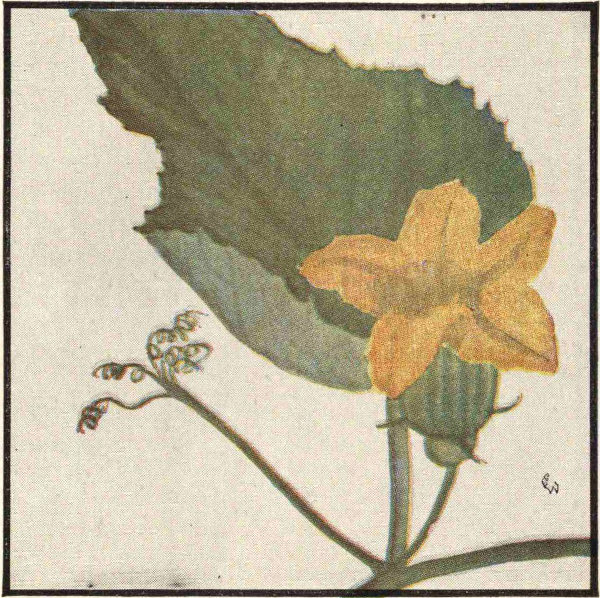
WILD GOURD
Wild Gourd. Mock Orange (Cucurbita foetidissima) has long trailing stems which are often 15 feet long and may be 25 feet long. It is readily distinguished by its large gray-green triangular leaves which are somewhat 3-5-lobed. The leaf-blades are 4-12 inches long, and the leaf-stalk is about half the length of the blade. The star-shaped yellow flowers, about three inches broad, are almost hidden by the leaves, the staminate and pistillate flowers being borne on different plants.
The ovoid gourds, which at first are green variegated with a lighter green, turn quite yellow at maturity. The resemblance of the yellow fruit to oranges has given rise to the common name, mock orange. The gourds are about three inches long. They are not edible, as the pulp is fibrous and bitter. Mexicans use the plant as a soap substitute by mashing the gourds or the roots in water. They call it “chilicoyote” or “calabacilla.” The pumpkins and squashes, whose origin is somewhat obscure, are close relatives of the gourd.
150
BELL-FLOWER FAMILY (Campanulaceae)
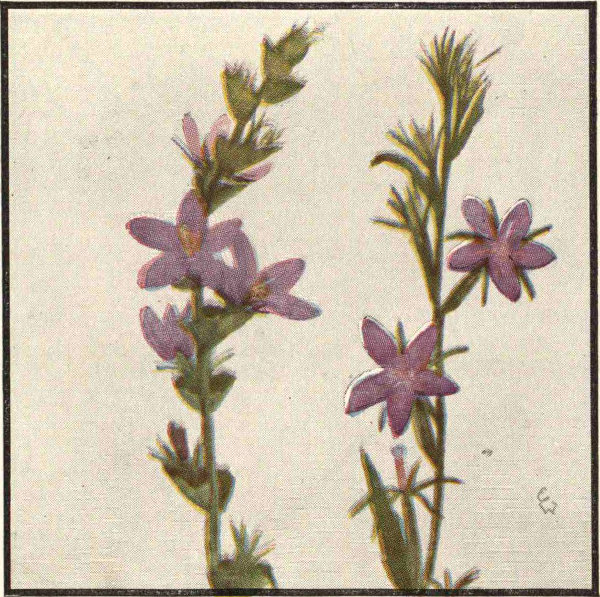
VENUS’ LOOKING-GLASS WESTERN VENUS’ LOOKING-GLASS
Juice usually milky; leaves alternate; calyx tube joined to ovary, 3-10-lobed; corolla tubular or bell-shaped, sepals and petals usually 5; stamens 5; ovary inferior, 2-10-celled.
Venus’ Looking-Glass (Specularia perfoliata) is a very common American plant blooming in Texas in the early spring. Like the later flowers of many violets, the first flowers never open and are self-fertilized. The later flowers have a showy 5-lobed purple corolla about an inch long. The seeds are dispersed from a small opening in the lower part of the capsule. The leaves are small and clasping, usually broader than long.
Western Venus’ Looking-Glass (Specularia leptocarpa) has flowers very much like the preceding, but the stamens and calyx lobes are longer. The long, slender capsules have the opening pore near the top. The showy flowers appear in late April and May. This plant is abundant on the northern prairies of Texas and ranges to Missouri and Montana.
151
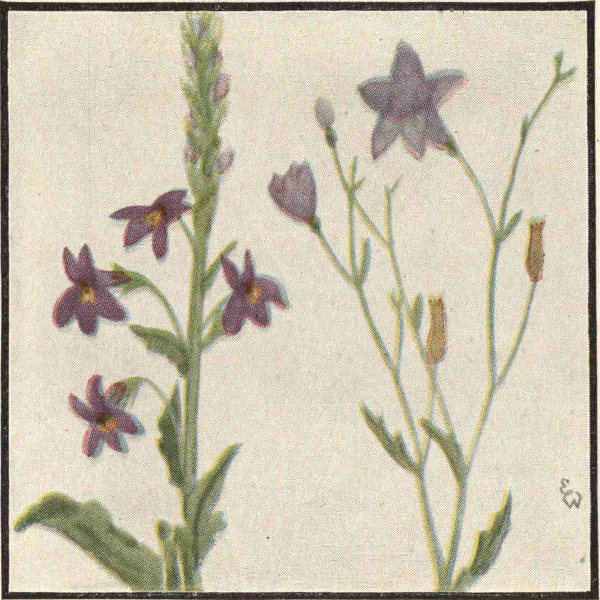
PRAIRIE LOBELIA TEXAS HAREBELL
Texas Harebell. Bluebell (Campanula reverchonii) is one of the rarer plants in the state, and care should be taken to preserve it. It is lovely against the granite rocks and boulders of Central Texas. The dainty, slender plants are often much branched and have blue flowers about half an inch long. The bluebell of Scotland is a renowned member of the group; Canterbury bells and the balloon-flower are well-known in gardens.
LOBELIA FAMILY (Lobeliaceae)
Juice often milky; sepals 5; corolla 1-2-lipped, united; stamens 5, anthers joined into a tube.
Prairie Lobelia (Lobelia brachypoda) grows on sandy prairies in Southern Texas and the adjacent part of Mexico. It is very abundant west of Falfurrias in March. The Texas lobelias may usually be recognized by the five united stamens which have gray anthers bearded at the top. The plants often have a milky sap containing a poisonous alkaloid which is used in medicine. The red cardinal flower (Lobelia splendens) is rather widely scattered in moist places throughout the state but is rare enough to need protection.
152
COMPOSITE FAMILY (Compositae)
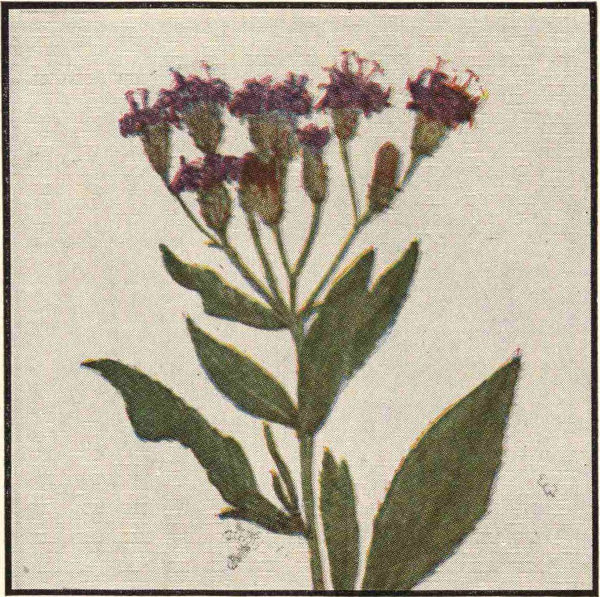
BALDWIN’S IRONWEED
Flowers crowded into heads surrounded by bracts; outer flowers often strap-shaped and are called ray flowers; inner flowers are tubular and are called disk flowers; sometimes flowers are all of one type; calyx usually modified into bristles or awns (pappus); petals united, tubular, 4-5-lobed; stamens 5, anthers united into a tube; styles 2-lobed; ovary 1-celled, inferior. (See p. xii.)
Baldwin’s Ironweed (Vernonia baldwinii) has broad, flat-topped clusters of purple heads. It forms a pleasing contrast to the abundant yellow flowers of the summer months. The plant is a hardy perennial and grows in ditches and river bottoms from Central Texas to Iowa. The stems are 3-4 feet high and conspicuously leafy. The ironweeds get their common name from the fact that the stems are very hard and difficult for farmers to chop down.
About one-fifth of the plants found in Texas belong to the composite family. It is generally divided into groups or tribes, the more important being the ironweed, mist-flower, aster, everlasting, sunflower, bitterweed, dog-fennel, and thistle groups. The composites in this book are grouped together in tribes in the above order, but the tribes are not separated or differentiated. Identification of composites is much easier if the resemblance to a particular group can be noted.
153
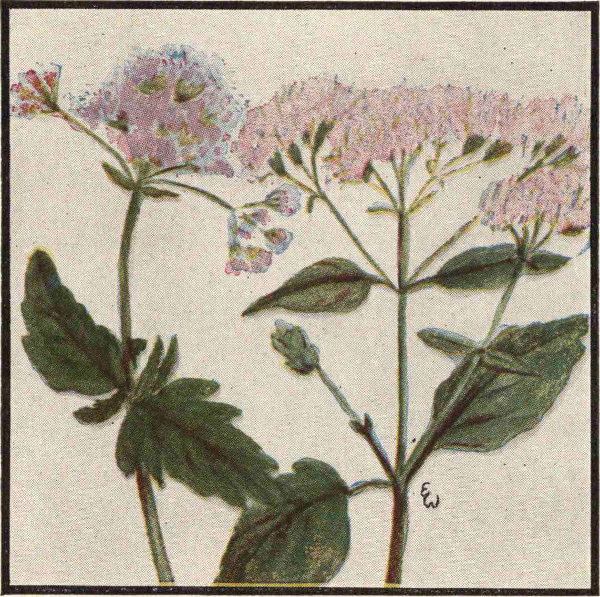
BLUE MIST-FLOWER BLUFF THOROUGHWORT
Bluff Thoroughwort (Eupatorium ageratifolium) is a widely branched shrub of the rocky hillsides of Central and West Texas. The bushes are covered with flat-topped clusters of pale-pink or white flowers. The long, protruding styles, which are divided into two recurved parts, have given the name of mist-flower to this and other plants of the group.
Milk-sick plant (Eupatorium ageratoides) is a closely related plant which causes in cattle a disease called “trembles.” The milk from affected cows will cause sickness and death among humans. The late-flowering thoroughwort (Eupatorium serotinum) is very abundant in river bottoms throughout the state. Yankee-weed (Eupatorium compositifolium) grows in big feathery clumps often 10 feet high. It is a pernicious weed in East Texas and soon covers cut-over pine lands. The dried flower-tops of several species were used by pioneers as fever medicines. One of these plants was called Joe-pye weed in honor of the Indian doctor, Joe Pye.
Blue Mist-Flower (Conoclinium coelestinum) is sometimes called ageratum and is used for a summer and fall border plant. It grows in moist, shaded places from Central Texas to New Jersey.
154
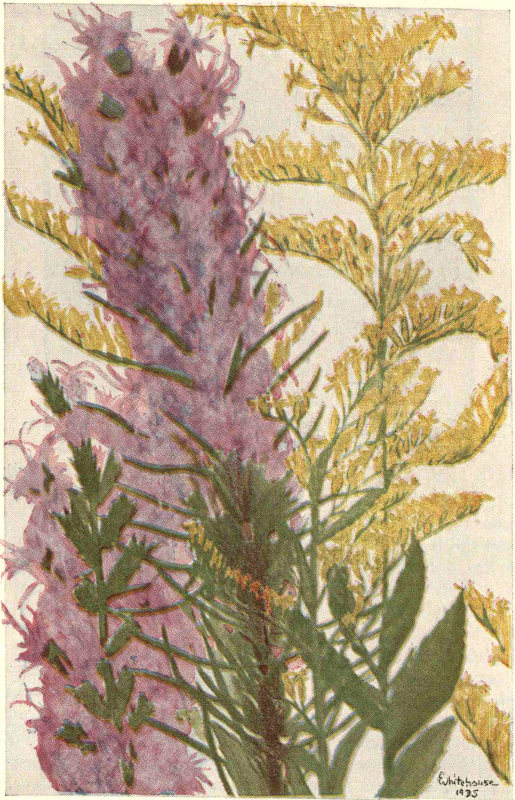
PRAIRIE BLAZING STAR DWARF GOLDENROD TALL GOLDENROD
155
Prairie Blazing Star. Button Snakeroot (Laciniaria punctata) is sometimes called liatris from the scientific group to which these plants are sometimes referred. A similar prairie blazing star is called gay-feather. On the dry prairies in the western part of the state the blazing star has short stems and short spikes of flowers; but where moisture is more abundant, the plants are one to two feet high. The plant does well in cultivation and is easily grown from the seed. It ranges from Southern Canada to Texas and New Mexico.
The stems are closely covered with the narrow leaves, which are marked with minute glandular dots. The spikes are densely covered with long, narrow heads of purple flowers. There are only a few star-shaped tubular flowers in a head. The seeds are widely scattered by their crown of plumose bristles. The lovely spikes are often dried for winter bouquets.
Many eastern blazing stars are found in the woods of East Texas, where they make showy displays from July to October. They are called snakeroots from their reputed property of curing snake-bites. A tea made from the plant will cause profuse perspiration; the perspiration was probably responsible for the reported snake-bite cures. They are also called devil’s bit or devil’s bite, because of the bitten-off appearance of the rootstock. The rootstock was considered such a powerful remedy for human ills that the devil bit off a part for spite.
Tall Goldenrod (Solidago altissima) grows 2-8 ft. high, has rough leaves which are sharply toothed and prominently triple-nerved, and is topped by dense clusters of yellow flowers. Most of the goldenrods are widely distributed in North America; the tall goldenrod is abundant in dry soil from Maine to Nebraska and Texas.
Gray, Field, or Dwarf Goldenrod (Solidago nemoralis) has flower heads all turned to one side of the branches which top the slender wand-like stems. The stems are one half to two feet high. This is one of the most abundant goldenrods in the central and western parts of the state from July to November and ranges from Canada to Florida and Arizona.
In Texas the goldenrods are usually found only in moist soil, many eastern species growing profusely in East Texas. The three-nerved goldenrod (Solidago trinervata) is the common one in Southwest Texas.
156
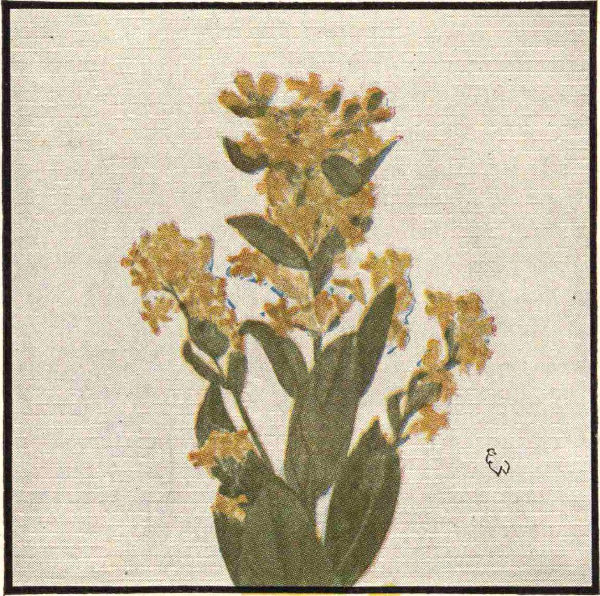
STIFF GOLDENROD
Stiff or Hard-Leaved Goldenrod (Solidago rigida) is one of about thirty-five goldenrods found in the state. It belongs to the type which is responsible for the common name, as the yellow flowers are in heads arranged in rod-like clusters at the top of the stem. The scientific name of “Solidago,” meaning “to make whole,” had its origin in the healing properties of certain species.
The stiff goldenrod grows in dry rocky or sandy soil east of the Rocky Mountains from Southern Canada to Texas. It grows 1½-2 feet high and has broad leaves 1-2 inches long. Lindheimer’s goldenrod (Solidago lindheimeriana) is a similar stout, leafy-stemmed plant which is abundant in Central Texas and ranges to Kansas and Mexico. Bigelow’s goldenrod (Solidago bigelovii) is another species with rod-like clusters. It is found in the mountainous regions of West Texas and New Mexico.
157
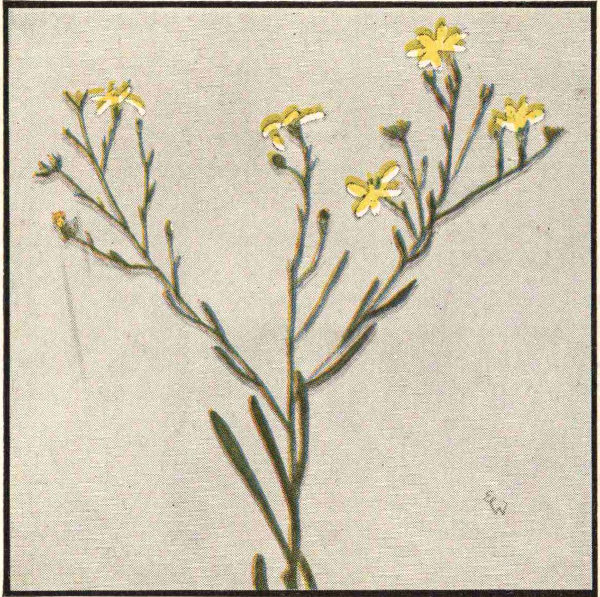
BROOM-WEED
Broom-Weed. Kindling-Weed (Amphiachyris dracunculoides) is a pasture pest in the southern part of the Great Plains region. The slender stem is unbranched near the base, but above the middle the numerous spreading branches form a flat-topped plant which bears many small heads of yellow flowers. The plants are often 2-4 feet high and grow in dense masses. It has been used as a broom by early settlers, Mexicans, and children at play. The resinous foliage of the dried plants was also highly valued for kindling fires.
The broom-weed is closely related to the rabbit-brush which is so abundant in West Texas and New Mexico. The Texas rabbit-brush (Gutierrezia texana) of West Texas is so much like the broom-weed that only a close observer can distinguish them. Both have 5-8 flowers with strap-shaped corollas in the outer part of the head and a few tubular flowers in the center; both bloom in the late summer and fall.
158
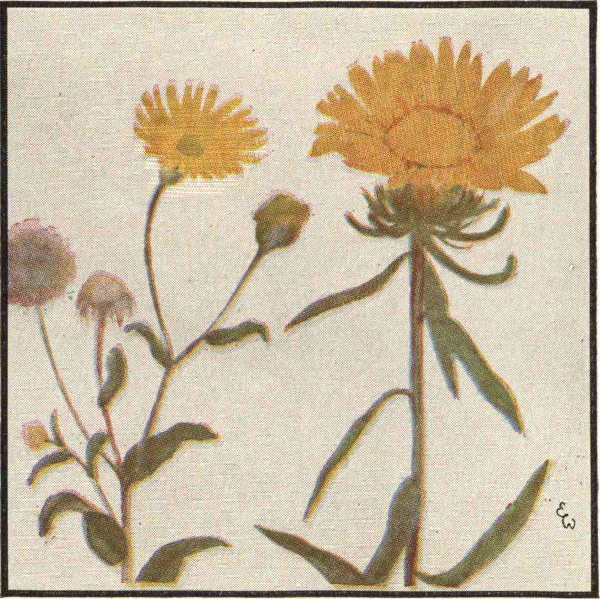
CAMPHOR DAISY TEXAS GUMWEED
Camphor Daisy (Heterotheca subaxillaris), so called because of the camphor-like odor of the rough foliage, is a common summer pest to the farmer. The plants often grow 3 feet high and are much branched, bearing heads of golden-yellow flowers nearly an inch across. The upper leaves are broad and clasping, but the lower are narrowed at the base. The scientific name refers to the dissimilar fruits of the ray and disk flowers, those of the ray flowers having no bristles. It ranges from Delaware to Arizona and Mexico.
Texas Gumweed (Grindelia texana) belongs to a group easily recognized because of its sticky, bur-like heads and thick leaves. This one is common on rocky limestone slopes in Central Texas in the fall and ranges to Southwest Missouri. The wand-like stems, covered with the overlapping leaves, are topped by large heads of yellow flowers. Many gumweeds are found in Texas. Some of them were used to relieve colds, asthma, and rheumatism.
159
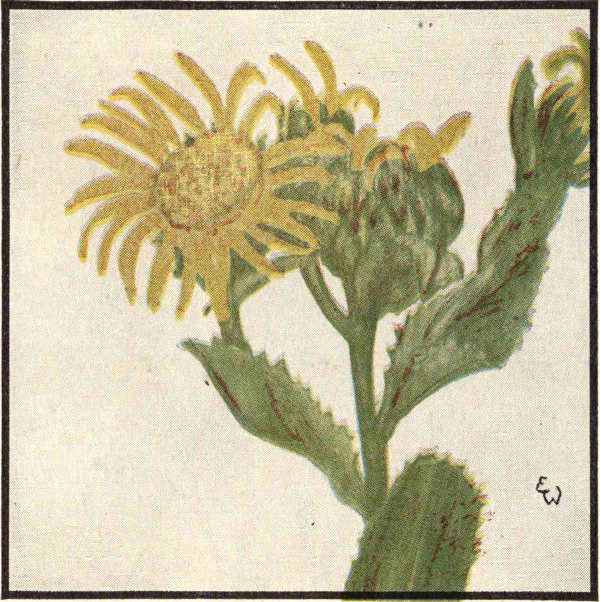
BIG GUMWEED
Big Gumweed. Saw-Leaf Daisy (Prionopsis ciliata) is easily recognized by its straight, stiff stalks which are closely covered with broad oval leaves. Dense masses of the sentinel-like plants may be seen along fence-rows in North-central and West Texas in August and September. It ranges north to Kansas and Missouri. The stems are topped by short clusters of large heads, 2-3 inches broad. The leaves are thick, gummy, and closely beset with bristle-tipped teeth. Sometimes an injury to the stem may cause it to become widely branched.
The scientific name means “resembling a saw” and refers to the leaf-margins. It is not a true gumweed but has similar bur-like heads. It differs from the gumweeds in having several unequal hair-like bristles on the seed, whereas the seeds of gumweeds have 2-8 stiff bristles.
160
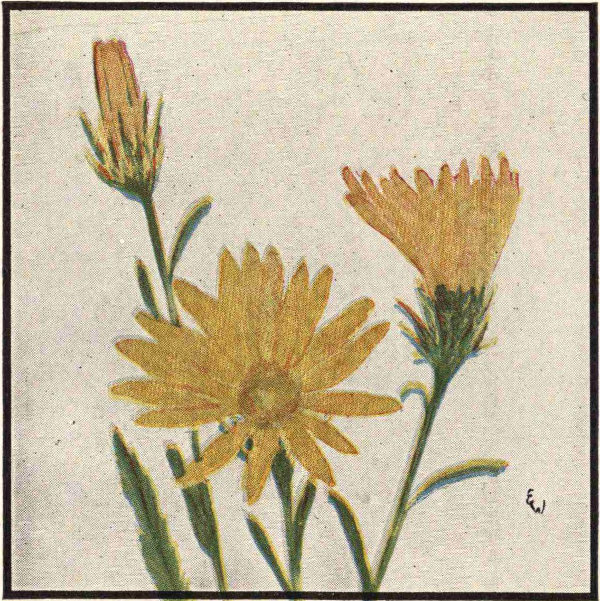
YELLOW SLEEPY DAISY
Yellow Sleepy Daisy (Xanthisma texanum) is a yellow daisy with lazy habits, for the heads do not open until noon. It is close kin to the white lazy daisy (Aphanostephus skirrobasis), and the two may often be found growing in the same fields. The large heads of lemon-yellow flowers are quite showy and attractive, 1½ inches broad, solitary at the ends of the branches. The ray flowers are narrow, about one inch long, and conspicuously lance-shaped at the tips.
This plant blooms in the late spring and summer and is found on sandy prairies or open woods in Central Texas. It is an annual, the stem branched above, commonly about 1-1½ feet high. The leaves are glossy green, somewhat narrow, and one to two inches long. It has been introduced into cultivation in the North and East. The name is Greek, meaning “dyed yellow.”
161
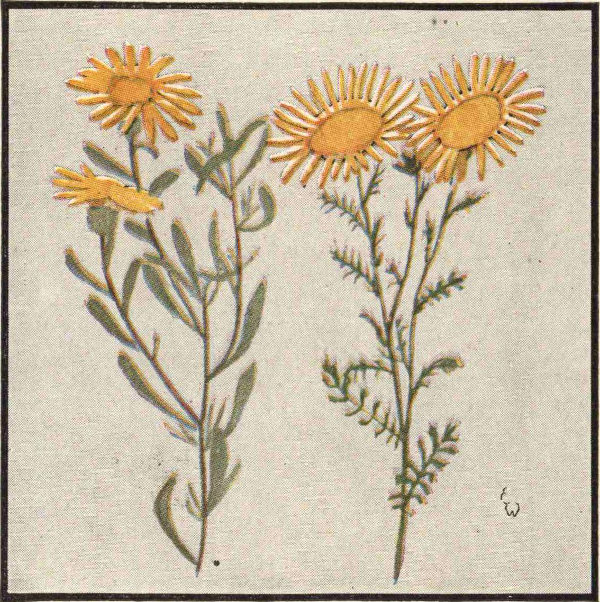
BERLANDIER’S GOLDEN ASTER IRON FLOWER
Berlandier’s Golden Aster (Chrysopsis berlandieri) is common on roadside banks and prairies of Central and West Texas. Growing from a perennial root, the branched stems sprawl in clumps about a foot broad and are thick with yellow heads soon after a heavy rain. The heads are nearly an inch broad, the flowers all yellow. The leaves are whitish and somewhat woolly. It blooms in the summer and fall.
Spiny-Leaved Yellow Aster. Iron Flower (Sideranthus spinulosus) has yellow heads much like the preceding, but the leaves are quite different, being divided into narrow segments which are bristle-pointed rather than spiny as the name indicates. “Sideranthus” means “iron flower.” It is very abundant on prairies and hills in the western part of the state and ranges to Canada and Mexico. It blooms from March to October. The iron flowers are often called gold daisies. The southern iron flower (Sideranthus australis) is common in Southwest Texas.
162
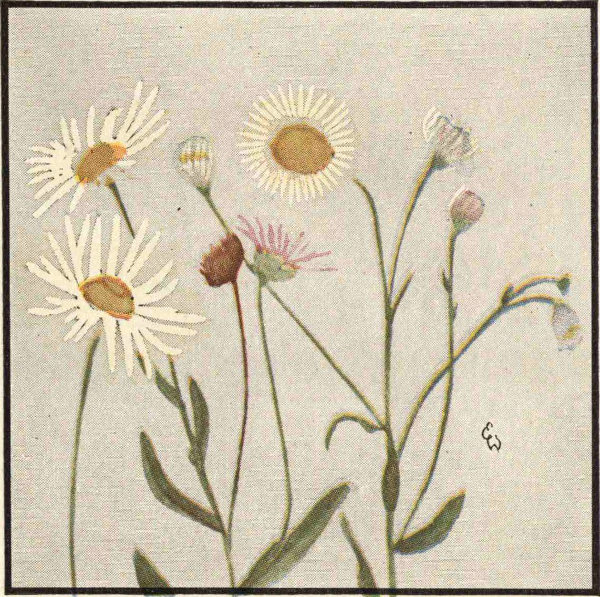
WHITE LAZY DAISY OAK-LEAVED FLEABANE DAISY
White Lazy Daisy (Aphanostephus skirrobasis) grows very abundantly in sandy soil in spring and summer. It ranges from Kansas to Mexico and Florida. The morning traveller does not appreciate its beauty, for it is truly a lazy daisy, not opening its heads until nearly noon. The plants are usually branched and grow 6-18 inches high. The large, showy heads are 1-2 inches across and are usually long-stalked. Unlike those of many other daisies, the seeds are not topped by slender bristles but have an inconspicuous crown, as is denoted by the scientific name, which is Greek for “faint crown.”
Oak-Leaved Fleabane Daisy (Erigeron quercifolius) is very abundant in the spring in the East Texas woods and ranges through the Southern States. The lower leaves resemble oak leaves, but those on the stem are narrow and pointed. The numerous fleabane daisies in the state may be readily recognized by means of the many, very narrow ray flowers which are usually white, pale pink, or pale lavender. Kiss-me-and-I’ll-tell-you (Erigeron annuus) is a taller daisy and is very abundant in East Texas.
163
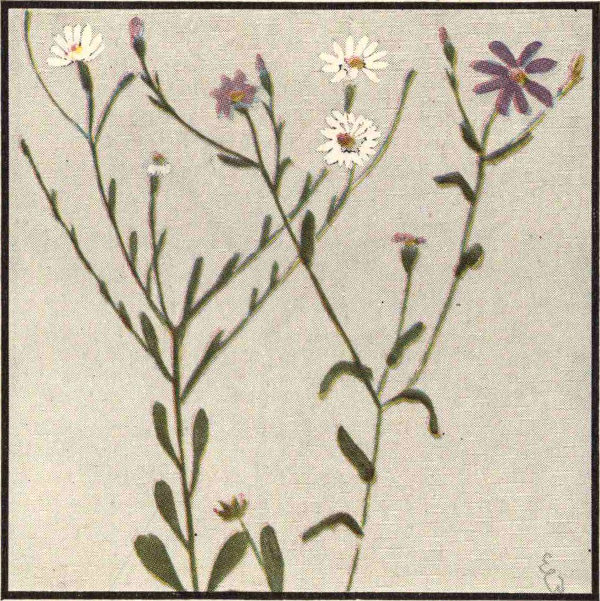
DWARF WHITE ASTER DWARF BLUE ASTER
Dwarf Blue Aster (Keerlia bellidiflora) is a shade-loving, sprawling plant growing in moist soil in Central Texas. Its small heads, less than half an inch across, have the aster habit of closing at night and opening in bright light. The outer ray flowers are bluish-lavender, and the tubular inner flowers are yellow. It blooms from late March to May.
Dwarf White Aster (Chaetopappa asteroides) is a very small and wiry plant, growing two to ten inches high and becoming much branched with age. The small narrow heads with white rays and yellow disk flowers are less than half an inch broad. The leaves are narrow, commonly broader about the middle, and about half an inch long. The scientific name refers to the bristles on the seed. It is very abundant in sandy soil throughout the state and ranges to Missouri and Mexico. It blooms from March until early summer.
164
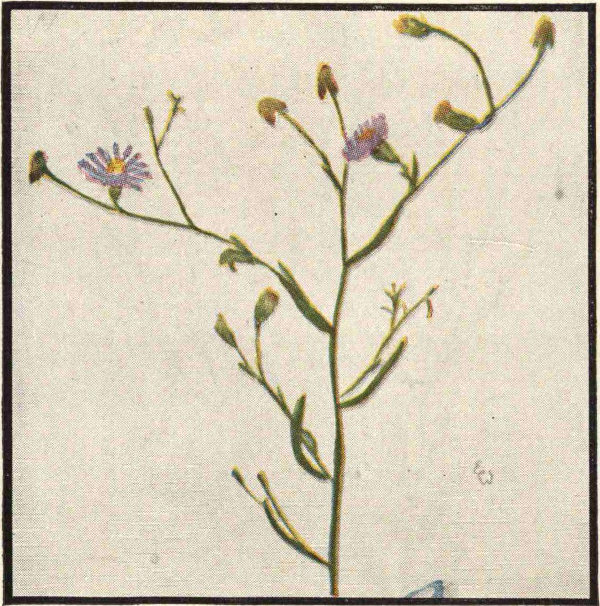
ROADSIDE ASTER. BLACKWEED
Blackweed. Roadside Aster (Aster exilis) is probably the least showy of the asters but is very abundant in Texas. It ranges from Kansas to Texas and Florida. The white, daisy-like heads may be noted against the dark-green foliage in roadside ditches, or it may appear as a violet haze along the highway. Although it is considered one of the common lawn pests in the fall, yet even there it is a thing of beauty; for when the slender stems are cut, numerous branches spread out from the base, and soon the grass is studded with the tiny white or lavender heads. Keepers of bees on the coastal prairie highly prize it as the source of their most palatable honey.
Spiny Aster (Aster spinosus) is quite similar to the roadside aster and has inconspicuous leaves which are sometimes reduced to spines. The flower heads are less than an inch broad with white outer flowers. It forms dense growths in river bottoms and along irrigation ditches and is especially abundant in the vicinity of El Paso.
165
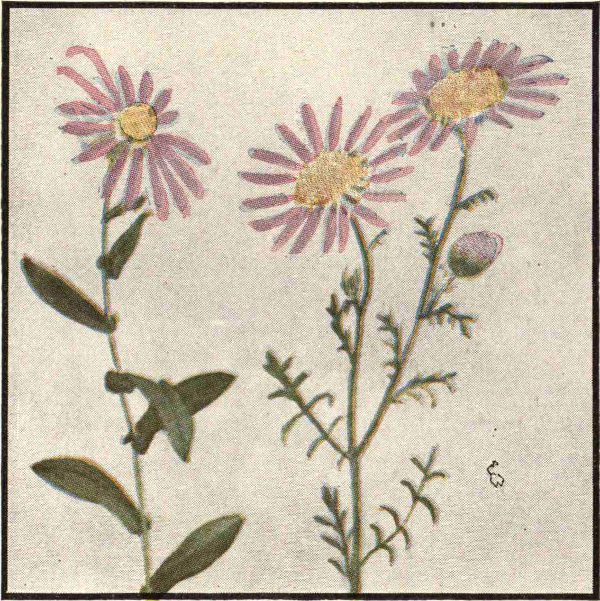
LATE PURPLE ASTER TANSY ASTER
Late Purple Aster (Aster patens) shows its lovely heads in October and November along the edges of post oak woods throughout the state. It is easily recognized by the short, broad, and roughened leaves on the wand-like stems. The illustration given is that of variety gracilis which is abundant in the vicinity of Fort Worth. Many asters are found in the state, but very few make a conspicuous floral display except along the coastal plain and river bottoms.
Tansy Aster. Dagger-Flower (Machaeranthera tanacetifolia) has leaves much like those of the spiny-leaved yellow aster, but the purple-flowered heads are much larger and very showy, 1-2 inches broad. The heads are surrounded by bracts with green spreading tips. The inner tubular flowers are yellow but soon turn reddish-brown. It ranges from Nebraska to Mexico and California. This is one of the loveliest flowers on the western plains, blooming from May to October.
166
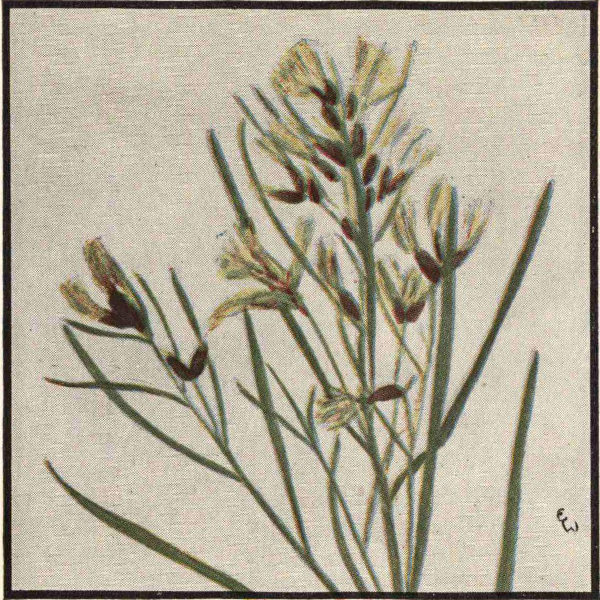
OIL WILLOW
Narrow-Leaved Baccharis. Oil Willow (Baccharis angustifolia) looks very much like the black willow, to which, however, it bears no relationship. The leaves of baccharis have a resinous texture, and the flowers appear in the late summer and fall. The pollen-bearing flowers are not borne on the same shrub with the seed-bearing flowers. The flowers, all small, inconspicuous, whitish, and tubular, are borne in a narrow head of ovate bracts which soon turn brown.
It is called the oil willow by some of the older residents because it is said to be an indicator of oil, just as the black willow is said to be a good indicator of water. It is also called brittle willow, false willow, and resin willow. It grows in brackish marshes throughout the state and may be found eastward to North Carolina. The soft white plumy bristles on the seed give the shrub the feathery appearance of the Yankee-weed. Along the coast in the southeastern part, the groundsel-tree or pencil-tree (Baccharis halimifolia) is a lovely sight in the fall.
167
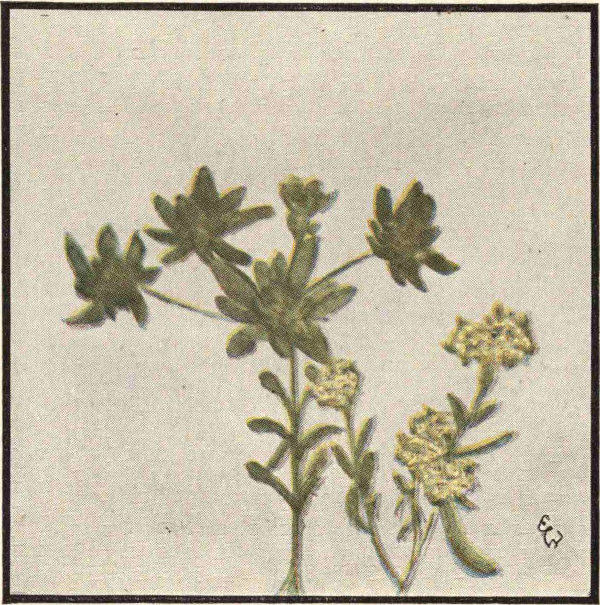
LARGE RABBIT TOBACCO SMALL RABBIT TOBACCO
Large Rabbit Tobacco (Filago prolifera) is a low plant less than six inches high with a few short branches at the top of the stem and sometimes a few at the base. The flowers are small and inconspicuous, being borne in woolly, rather flattened heads which are about half an inch broad. It blooms from January to June and ranges from Texas to South Dakota.
Small Rabbit Tobacco (Filago nivea) is a smaller plant but is more densely clothed with woolly hairs. The minute, ball-like heads are clustered together. Both of these plants are also known as poverty-weed, chewing gum, and ladies’ tobacco. Poverty-weed is a suitable name for them in the sheep-grazing section of Central Texas which has been heavily over-grazed. In many pastures they take the place of grasses as a ground cover. The leaves may be chewed for gum. The rabbit tobacco is closely related to the cudweeds and everlastings. The plantain-leaved everlasting grows in moist woods in East Texas.
168
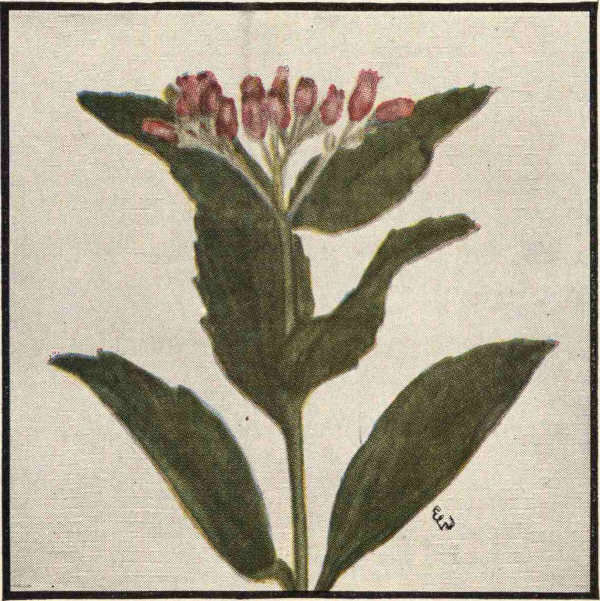
SOUTHERN MARSH FLEABANE
Southern Marsh Fleabane (Pluchea purpurascens) grows only in marshes or in continually moist places. The flowers are more rose-colored than purplish, as the name would indicate, and the tawny bristles on the seeds soon give a brownish tint to the heads. It often grows in pleasing combination with the blue mist-flower. It ranges from Texas to Florida and tropical America and blooms in the summer and fall.
The plants are commonly about two feet high, the stems being unbranched below and very leafy. The broad leaves are pointed at the tip and narrowed into stalk-like bases except on the upper part of the stem. The leaf-margins are irregularly toothed. The fragrant flowers are borne in small oblong heads in a flat-topped cluster.
The cudweeds are closely related to the marsh fleabane. They are particularly abundant in the mountains of West Texas, the loveliest one being Wright’s cudweed or everlasting (Gnaphalium wrightii), which has white flowers and foliage.
169
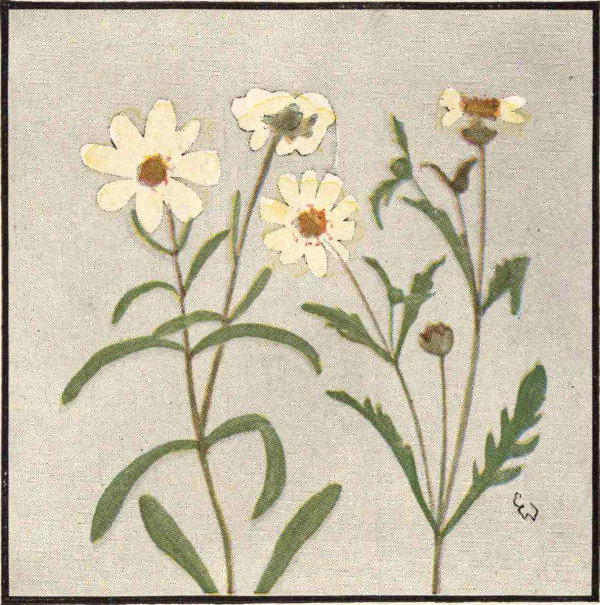
ROCK DAISY BLACKFOOT DAISY
Prairie Blackfoot Daisy. Mountain Daisy. Rock Daisy (Melampodium cinereum) is very abundant on limestone slopes and in dry soil from Texas to Arkansas, Kansas, and Arizona. The scientific name is from the Greek words meaning “black foot” and refers to the blackened roots and stalks.
Blackfoot Daisy (Melampodium ramosissimum) grows from a black woody base and has many branched stems which form a dense rounded mound one to two feet broad. After sufficient rainfall from early spring until winter, this mound is covered by the saucy heads of white daisy-like flowers. The heads are about three-fourths inch across and have an outer row of 8-11 broad white ray-flowers. This is the most vigorous one of the blackfoot daisies and makes an excellent plant for the rock garden. It grows in Southwest Texas. The seeds are enclosed in a thickened cornucopia-like floral bract which has a flaring rim and many warty projections.
170
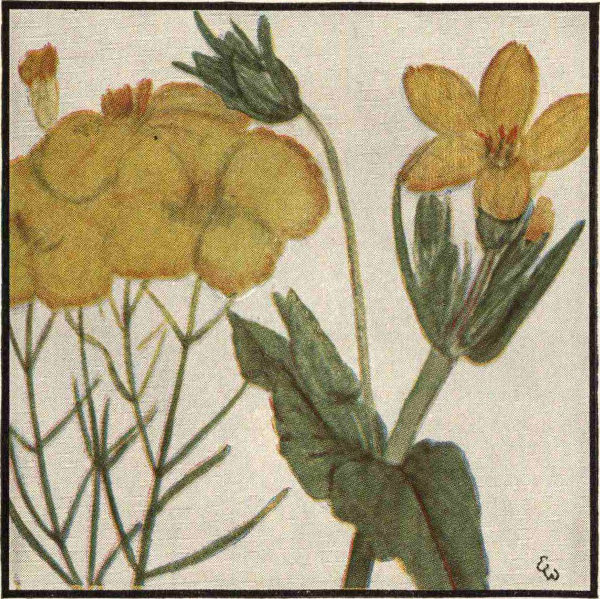
PRAIRIE ZINNIA TEXAS STAR DAISY
Texas Star Daisy. Lindheimer’s Daisy (Lindheimera texana) shows its star-like flower heads early in the spring while the plants are low and the leaves are closely clustered. By June the plants are tall and widely branched above. This plant honors by its name Ferdinand J. Lindheimer, an early settler of New Braunfels and editor of the “Neu Braunfelser Zeitung.” Lindheimer began his collection of Texas plants in 1836 and continued until his death in 1879. With the assistance of Dr. George Engelmann of St. Louis and Dr. Asa Gray of Harvard University, Lindheimer’s collections between 1842 and 1852, representing more than 1400 species of plants, were classified and distributed to the leading herbaria of Europe and America. A part of this collection is owned by the University of Texas Herbarium.
Prairie Zinnia (Zinnia grandiflora) grows in low, rounded clumps from Kansas to Mexico and Arizona and blooms from June to September. The bright yellow ray flowers are nearly round and remain on the seeds. With age they become papery, and the yellow disk flowers turn reddish-brown. The common zinnia in cultivation was introduced from Mexico.
171
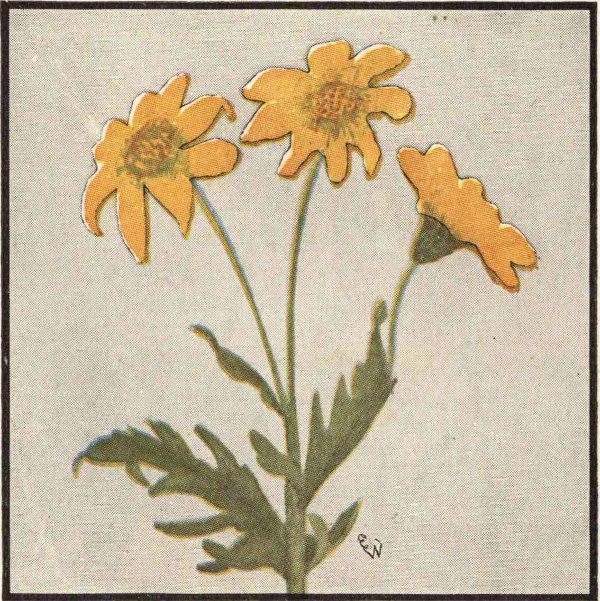
CUT-LEAVED DAISY. ENGELMANN’S DAISY
Cut-Leaved Daisy. Engelmann’s Daisy (Engelmannia pinnatifida) is closely related to the sunflowers but has the daisy habit of closing the flower heads at night and opening them in bright sunlight. It is one of the commonest plants on prairies from Kansas to Louisiana and Arizona and grows in dense patches along roadsides and pastures from April to July.
The rough, hairy plants grow one to three feet high and are topped by broad clusters of long-stalked, showy yellow heads which are 1½-2 inches broad. The divided leaves are short-stalked on the lower part of the stem and on the upper part have clasping basal lobes.
This daisy honors the name of Dr. George Engelmann, an eminent botanist of St. Louis, who died in 1884.
172
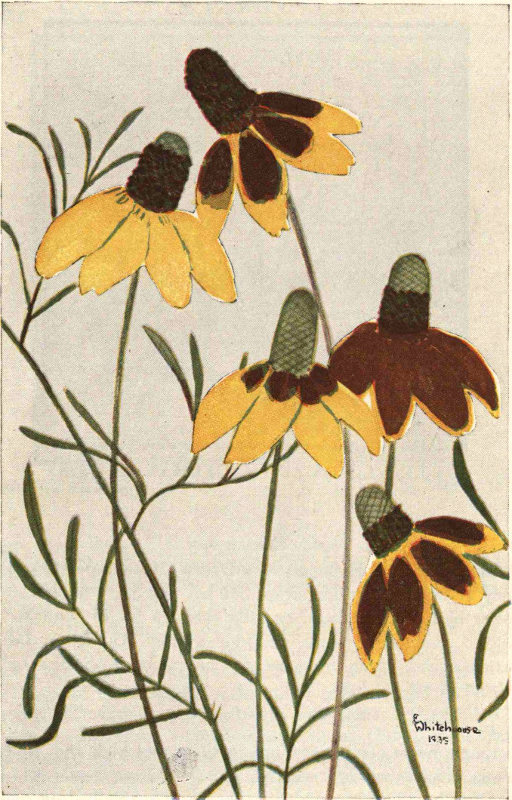
NIGGERHEAD
173
Niggerhead. Thimble Flower (Ratibida columnaris) is also called Mexican hat, niggertoe, “gallitos,” long-headed or prairie cone-flower, and black-eyed Susan, though the last term is erroneously used. It is a very handsome plant, which is widely distributed on plains from Southern Canada to Arizona, Texas, and Tennessee. In South Texas it is at its best in April and May; in North Texas it is lovely in late May and June.
Numerous erect stems grow from a woody perennial root and are commonly two to two and a half feet high. The long-stalked heads terminate the branches. The leaves are finely divided into long narrow segments, both leaves and stem being somewhat rough.
The showy flowers have drooping, velvety rays which are entirely yellow or reddish-brown or partly colored yellow and brown. The small tubular flowers are brown and are borne on a thimble-shaped or columnar disk which varies greatly in size on different flowers, sometimes being nearly two inches long, but it is usually about an inch long. The disk is gray-green before the flowers open.
The dwarf niggerhead (Ratibida tagetes) is quite similar to the large niggerhead in growth habit and coloring, but it is a smaller plant and has smaller flowers. It is found from Kansas to Mexico on dry plains and blooms a month later than the large niggerhead.
The niggerhead belongs to a small group of showy American plants. It was introduced into European gardens many years ago, whence it later made its way back to American gardens. The niggerhead group is closely related to the black-eyed Susan and other cone-flowers. Several giant yellow-flowered cone-flowers grow in East Texas.
174
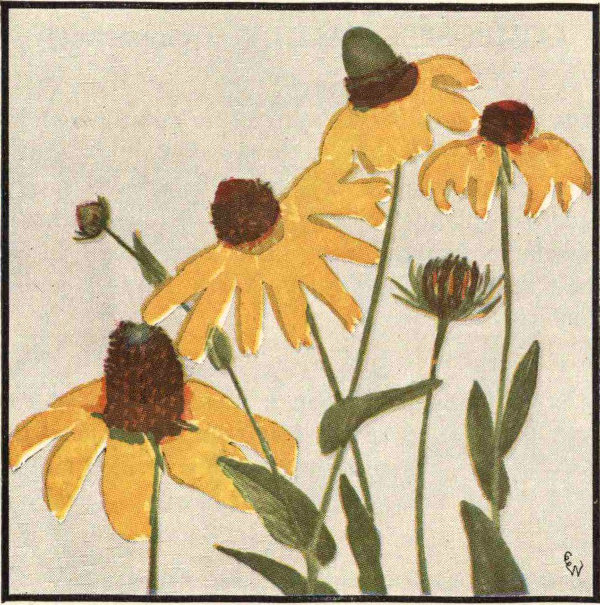
CLASPING-LEAVED CONE-FLOWER BLACK-EYED SUSAN
Clasping-Leaved Cone-Flower (Dracopis amplexicaulis) makes a showy display in roadside ditches from Central Texas to Louisiana and Missouri. It is a handsome plant with smooth branched stems one to two feet high. The slightly drooping rays commonly have brown spots at the base but may be all yellow. It is often called niggerhead or black-eyed Susan, but it may be distinguished from the latter by the thimble-shaped heads, which are green before the brownish disk flowers open. In South Texas it is at its best the latter part of April, but in North Texas June is its best month.
Black-Eyed Susan (Rudbeckia hirta) is a common daisy of the plains region from Southern Canada to Texas and Florida. It is a rough, hairy plant which grows from one to three feet high. Closely resembling it is Rudbeckia bicolor, which has shorter ray flowers marked with a reddish-brown base. The ray flowers of Rudbeckia hirta may also show a dark base. Both are widely cultivated. The group was named in honor of Claus Rudbeck, a Swedish botanist.
175
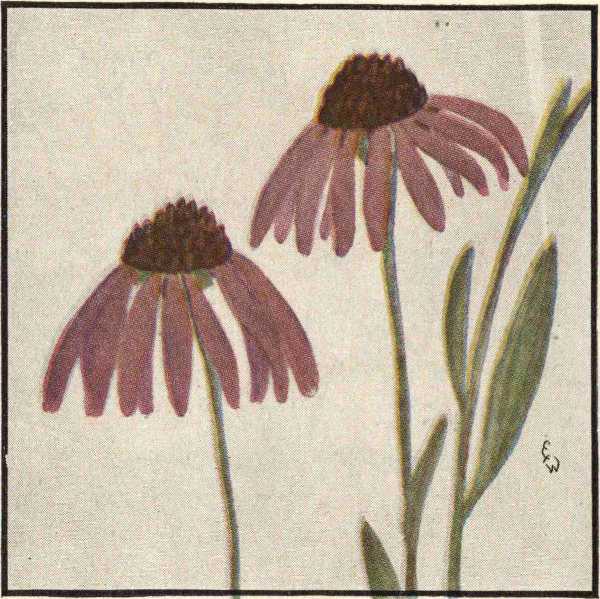
SAMPSON’S ROOT. PURPLE CONE-FLOWER
Sampson’s Root. Narrow-Leaved Purple Cone-Flower (Echinachea angustifolia) is easily recognized by the spreading or somewhat drooping rose-colored rays. The heads terminate the stiff, unbranched stems which, like the narrow leaves, are very rough and bristly. The stems grow one to two feet high and are scattered on limestone hillsides but may occasionally be found in dense patches along the roadsides. The leaves have three prominent nerves.
The scientific name is derived from the Greek and refers to the stiff reddish-brown chaff on the flower head. This chaff obscures the brown disk flowers and remains on the heads long after the seeds have fallen. This plant is hard to distinguish from the pale purple cone-flower (Echinachea pallida), which grows in the woods in the eastern part of the state. The latter has longer and more drooping ray flowers. The purple cone-flowers are well known in cultivation.
176
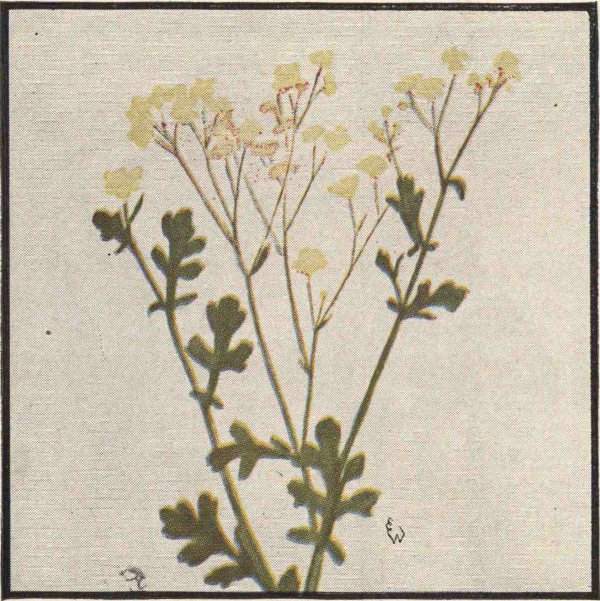
RAGWEED. LYRE-LEAVED PARTHENIUM
Ragweed. Lyre-Leaved Parthenium (Parthenium lyratum) blooms from early spring until fall in Southwest Texas. This is a smaller plant than the common parthenium (Parthenium hysterophorus), which is widespread in the Gulf States and tropical America. The latter is a widely branched plant two to three feet high and grows in dense masses. They have similar flower clusters with small heads of greenish-white flowers. Neither of these is the ragweed or bloodweed commonly associated with hay fever; however, the common parthenium is listed as a poisonous plant. Wild quinine or feverfew (Parthenium integrifolium), used as a pioneer drug to relieve fever, has been reported from the state.
Several shrubby partheniums are found in West Texas. The most important member of the group is the silver-leaved guayule or rubber plant (Parthenium argentatum), found in West Texas and Mexico. It is a commercial source of rubber but is not yet profitable, as the plants are of slow growth.
177
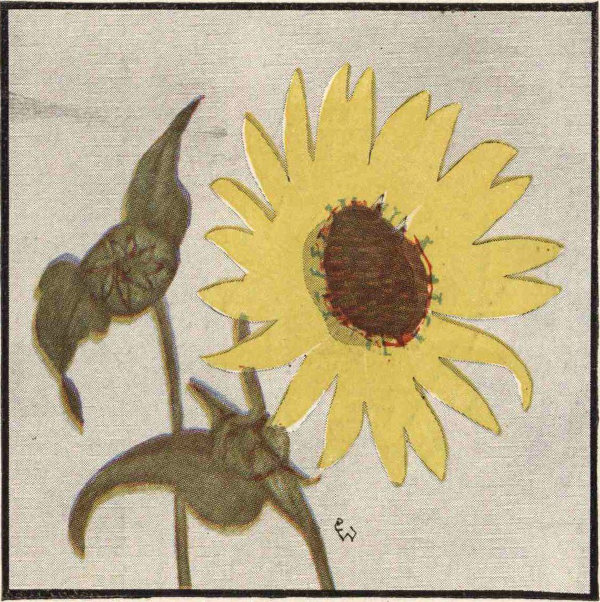
COMMON SUNFLOWER
Common Sunflower (Helianthus annuus) has been known in cultivation for many years but is considered native from Minnesota to Texas and Mexico. It is the state flower of Kansas. The stout, erect stems are widely branched above the base and are very sticky, 2-10 feet high. The flower heads, 3-6 inches broad, have many yellow ray flowers about an inch long and numerous tubular disk flowers. It is grown commercially for its fiber and seeds. The seeds make an excellent food for poultry and furnish an oil used in making soap, candles, and salad dressing.
Two other sunflowers are widely distributed in the state. The orange sunflower (Helianthus cucumerifolius) grows in the sandy post oak belt, and the blue-weed (Helianthus ciliaris) is very abundant in West Texas. The latter is a low, branching perennial which is poisonous to sheep.
178
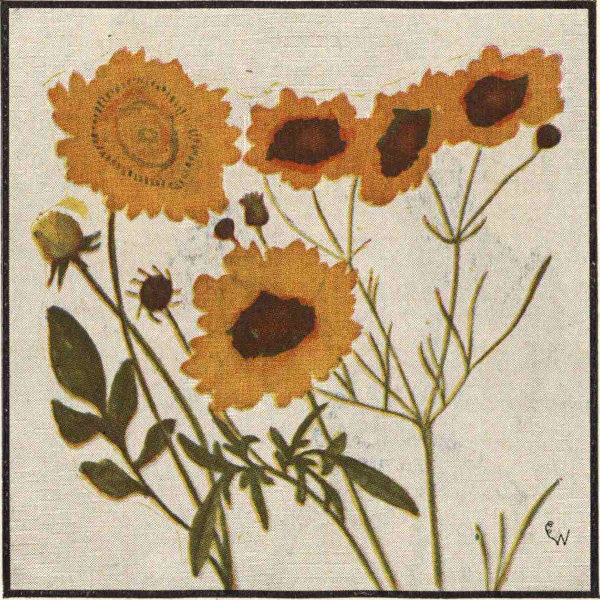
TEXAS COREOPSIS GOLDEN WAVE CALLIOPSIS
Texas Coreopsis (Coreopsis nuecensis) was first described from plants found on the lower part of the Nueces River. It is quite widespread on the southern coastal prairie from March to May. It may be distinguished from other annual species of coreopsis by the circle of reddish-brown marks near the base of the yellow rays. The leaves are mostly basal and long-stalked.
Golden Wave. Drummond’s Coreopsis (Coreopsis drummondii) has showy, long-stalked heads, about 2 in. broad. They are borne on widely branched plants about a foot high. The leaves are divided into broad segments, and both leaves and stems have scattered soft hairs. It is very abundant on sandy coastal prairies in April and May and is well known in cultivation.
Calliopsis. Prairie Coreopsis (Coreopsis cardaminefolia) is a late-blooming annual plant, the flowers appearing in North Texas about the middle of June. It ranges from Kansas to Mexico and Louisiana. This plant greatly resembles the golden coreopsis (Coreopsis tinctoria), which is abundant on the coastal prairies in March and April. “Coreopsis” is derived from the Greek, meaning “bug-like,” and refers to the seed. The plants are often called tickseeds.
179
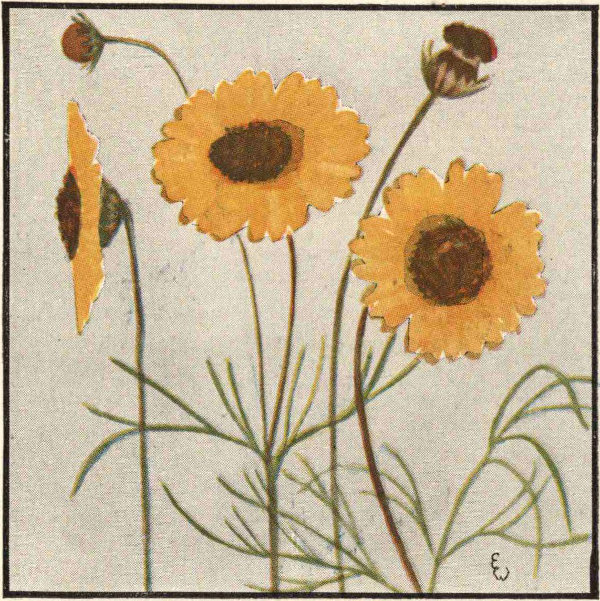
FALSE COREOPSIS
False Coreopsis. Fine-Leaved Thelesperma (Thelesperma trifidum) is sometimes erroneously called black-eyed Susan. It closely resembles the coreopsis when the flowers are in the bud stage. The flowers may readily be distinguished from those of the coreopsis because the ray flowers are not marked with a brown spot at the base and are divided into three equal lobes at the tip. The ray flowers of the coreopsis are commonly divided into four lobes, the two lateral being shorter than the two middle lobes. The leaves are finely divided into long, narrow segments.
This is one of the most widely distributed plants on the prairies from Mexico to Colorado, South Dakota, and Missouri. The yellow of Central Texas landscapes in late April and May is due to thelesperma. Scattered plants continue to bloom through the summer and fall. The plants grow 1-2 feet high and become widely branched. The disk flowers are a reddish-brown.
180
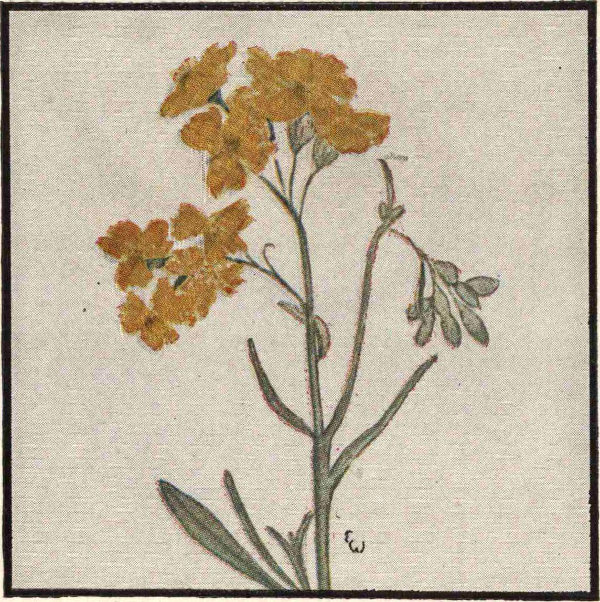
PLAINS PAPER-FLOWER
Plains Paper-Flower (Psilostrophe villosa) is another western plant which has foliage covered with a dense white woolly coat of hairs. This hairy coat is a plant device for enabling it to withstand dry growth conditions. There are only three or four ray flowers which are much broader than long and are conspicuously three-lobed. The heads are densely clustered on short branches at the top of the stems, which are from six inches to two feet high.
Near El Paso is found the lovely western paper-flower or Cooper’s psilostrophe (Psilostrophe cooperi). It grows in spreading clumps about two feet broad and bears long-stalked heads over an inch wide. As the flowers are bright yellow and remain lovely for months, they are often gathered for winter bouquets. Eventually they become white and papery. Psilostrophe tagetinae has somewhat larger flowers than the plains paper-flower and is probably the most abundant paper-flower in the state. When cattle graze upon it for several weeks, they suffer a slow poisoning. The marigold is a close relative, both the African and French marigolds being derived from Mexican plants introduced into cultivation about 1573.