Volume 2 — INTRODUCTION. (continued 2)
Reading edition
After the Restoration Evelyn’s life as a courtier was practically at an end, as he never quite approved the enforced abdication of King James. So henceforth he spent his time, without further attendance at Court or seeking after office or appointment, in study, literary work, and retirement. He did not like the new régime, with its ‘Court offices distributed amongst Parliament men.... Things far from settled as was expected, by reason of the slothfull, sickly temper of the new King, and the Parliament’s unmindfullness of Ireland, which is likely to prove a sad omission.’ He even seems to have regretted that his son was in March 1692 made ‘one of the Commissioners of the Revenue and Treasury of Ireland, to which employment he had a mind far from my wishes.’ This son contracted serious illness in Ireland, and died ‘after a tedious languishing sickness’ early in 1699, aged 44 years, leaving one son, then a student at Oxford.
Some time before this his elder brother, George, having lost his last son and heir, had settled the Wotton estate upon John Evelyn. In May 1694, yielding to the request to make Wotton his home, he went to Wotton, leaving Sayes Court in charge of his daughter Susanna and her husband William Draper, whose marriage had been celebrated about a year previously. In 1696 it was let for three years to Admiral Benbow, who sublet it in 1698 to Peter the Great, then visiting the Deptford Dockyards for three months as his Majesty’s guest. So great was the destruction done to the gardens, trees, and holly-hedges, that Wren was asked to report on the compensation suitable, and £162-7-0 were paid to Evelyn for damage to the house and garden.
Early in 1695 Evelyn accepted the offer of the Treasurership of Greenwich Hospital, then about to be rebuilt and endowed for the maintainence of decayed seamen, which was made to him by Lord Godolphin, who had been the husband of his former friend Miss Blagg. During the days of Charles II. some such transformation of the Palace had been under consideration, but it was the 30th June 1696 before Evelyn and Sir Christopher Wren ‘laid the first stone of the intended foundation, precisely at 5 o’clock in the evening, after we had din’d together.’ This appointment carried with it ‘the salary of £200 per ann. of which I have never yet receiv’d one penny of the tallies assign’d for it, now two years at Lady-day; my son-in-law Draper is my substitute.’ When the new Commission for Greenwich Hospital was sealed in August 1703 Evelyn resigned his office of Treasurer in favour of Draper.
His brother George dying in October 1699, Evelyn then became the owner of Wotton, and looked to his grandson, the Oxford Student, to ‘be the support of the Wotton family.’ The lad had a bad attack of small-pox in the autumn of 1700, a malady that had caused many gaps in the family circle; but, coming safely through this illness, he was in July 1701, by the patronage of Lord Godolphin, made one of the Commissioners of the Prizes, with a salary of £500 a year, while he was still an undergraduate at Oxford. And in January 1704 the same noble patron appointed him Treasurer of the Stamp Duties, with a salary of £300 a year. He afterwards married Ann, daughter of Hugh Boscawen (afterwards Lord Falmouth), Lord Godolphin’s niece, and was created a baronet in 1713. It was through him that the present family of Evelyn of Wotton directly descend, though the baronetcy lapsed on the death of his grandson Frederick in 1812.
As he had done twenty years before, so also on now attaining his 80th birthday on 31st. October 1700 Evelyn rendered thanks for mercies with his characteristic religious feeling. ‘I with my soul render thanks to God, who of his infinite mercy, not only brought me out of many troubles, but this yeare restor’d me to health, after an ague and other infirmities of so greate an age, my sight, hearing and other senses and faculties tolerable, which I implore him to continue, with the pardon of my sins past, and grace to acknowledge by my improvement of his goodnesse the ensuing yeare, if it be his pleasure to protract my life, that I may be the better prepar’d for my last day, through the infinite merits of my blessed Saviour, the Lord Jesus, Amen.’
Five times more was he to be privileged to record his thanks and prayers on successive returns of this anniversary. One of the very last entries in his memoirs is that on 31st. October 1705 ‘I am this day arriv’d to the 85th year of my age. Lord teach me so to number my days to come that I may apply them to wisdom’. And numbered, indeed, they then were; for on the 27th of February 1706 he passed quietly and peacefully away, retaining his faculties to the last. And he was laid at rest in the Chancel of Wotton Church.
During the course of his long and distinguished life he had seen many stirring events, had taken part in many important affairs, had achieved much, and had suffered much. He had outlived four reigns, two of which were terminated by a natural death, one by public execution, and one by abdication. He had served many public and other distinguished offices with zeal, ability, integrity, and success. He had given to English literature some of the classic works that are among the treasures of our literature of the Restoration period. He had outlived all of his six sons, most of whom had died in childhood, as well as his eldest and favourite daughter. Of all his nine children, the sole survivors were his daughter Elizabeth, who was soon afterwards married to a son of Sir John Tippet, and Susanna, wife of William Draper, afterwards of Adscomb near Croydon. After nearly 60 years of pure domestic wedded life, in marked contrast to the prevailing dissoluteness of the time, Evelyn was survived for nearly three years by his widow, who died in 1709, aged 74 years, cherishing to the last her love and affection for him to whom her destiny had been committed whilst she was still a mere child. ‘His care of my education’, she wrote in her last Will and Testament, ‘was such as might become a father, a lover, a friend, and a husband; for instruction, tenderness, affection and fidelity to the last moment of his life; which obligation I mention with a gratitude to his memory ever dear to me; and I must not omit to own the sense I have of my parents’ care and goodness in placing me in such worthy hands.’ Surely no husband ever had a nobler epitaph.
In an age of fierce political and ecclesiastical conflict, Evelyn, often, no doubt, strongly tempted to partisanship, managed to steer his course with prudence and great worldly judgment. But for that, his industry and business talent would probably have brought him more prominently into office under Charles II. In a corrupt and profligate age, however, his character stands out as that of one unsullied by excesses, impurities, or vices. And it is not the least of his merits that, in an age of bigotry and narrow-mindedness, he was not intolerant towards those whose religious views happened to differ from his own.
VII Evelyn’s Literary Works.
Evelyn’s earliest publications, some of which have already been referred to, consisted mostly in translations from the French, Latin, and Greek, that of the first book of Lucretius’ De Rerum Natura being in verse. Their authorship was usually veiled either under Greek pseudonyms or else more thinly under the initials ‘J.E.’ That on A Character of England (1659), a tract purporting to have been written by a foreigner, appeared anonymously.
Of all these seven publications appearing before the Restoration, the only one of any importance was The French Gardener, the translation of a work by N. de Bonnefons, which appeared at the end of 1658 and was thus referred to in the diary,—‘Dec. 6th. Now was publish’d my “French Gardener,” the first and best of the kind that introduc’d ye use of the Olitorie garden to any purpose.’ Subsequent editions of it appeared in 1669, 1672, 1691, bearing Evelyn’s name on the titlepage in place of the Philocepos on its first publication.
With the Restoration, bringing to him greater personal freedom of thought and speech, came the most active period of Evelyn’s literary production. His loyalty at once found opportunity to answer a libel on King Charles (entitled News from Brussels) in The late News from Brussels unmasked, a long vindication of his Majesty from the calumnies and scandal therein fixed on him. From a literary and antiquarian point of view, however, far greater interest attaches to a much shorter treatise entitled Fumifugium: or the Inconvenience of the Aer and Smoak of London Dissipated, together with some Remedies humbly proposed. As this is the earliest reference to the great London Smoke Nuisance, which, like the poor, we have always with us, it is of more than passing interest to know how large this difficult problem of curing it loomed about two and a half centuries ago. Moreover, this short work affords a very typical example of Evelyn’s literary style, while at the same time well exemplyfying his profusely enthusiastic outbursts of devoted and loyal attachment to the King’s person and interests.
In the dull days of autumn and winter, when the heavy, damp air wafted inwards from the sea shrouds London with a dirty pall of fog thickened and discoloured with the smoke belched forth skywards from the long throats of thousands of tall factory chimneys and emitted from hundreds of thousands of household and workshop fires, the dweller in this vast overgrown city is tempted to range himself for the moment among the belauders of better times in the past. Almost groping his way along the streets in semi-darkness, and half choked with the sulphurous surcharge in the atmosphere, this latter-day growler may perhaps be astonished to learn that his complaint is of very old standing, and that long before the days of his great-great-grandfather, in fact more than seven generations ago, this poisoning of the atmosphere with the impurities given off from ‘sea-coal’ and other combustibles had already come to be looked on by some as a public nuisance. It will, therefore, interest Londoners in general, and will delight the hearts of Sir William Richmond R.A. and the County Council in particular, to know that their great precursor in this matter of reform nearly 250 years ago considered the question even then one of urgency, admitting of no delay. How graphic, and how refreshing, is the pithy point thus neatly scored—
‘I propose therefore, that by an Act of this present Parliament, this infernal Nuisance be removed.’
There is no beating about the bush here, and no mincing of phrases. The matter is at once probed with the needle.
Evelyn was not merely a rather notable person in the London society of that period. As a man of science he was one of the most prominent pillars of the then recently founded Royal Society. As an official he was His Majesty’s Commissioner for improving the streets and buildings of London, in addition to various other particular duties. But finally,—and, at the same time, first of all, if it be permissible to emphasise the fact in so paradoxical a manner—he was a courtier; and that at a time when expressions of loyalty to His Gracious Majesty, King Charles II., were somewhat too highly coloured, too servile and sycophantic, to suit our modern taste.
This short work Fumifugium, really only a pamphlet, was therefore dedicated to the King in language of the period extravagant in the highest degree, though eminently typical of the Royalists during the early days of the Restoration. The treatise was thus occasioned:— ‘It was one day, as I was Walking in Your Majesty’s Palace at White-Hall (where I have sometimes the honour to refresh myself with the Sight of Your Illustrious Presence, which is the Joy of Your Peoples hearts) that a presumptuous Smoak issuing from one or two tunnels near Northumberland House, and not far from Scotland-yard did so invade the Court; that all the Rooms, Galleries, and Places about it were fill’d and infested with it; and that to such a degree, as Men could hardly discern one another from the Clowd, and none could support, without manifest Inconveniency. It was not this which did first suggest to me what I had long since conceived against this pernicious Accident, upon frequent observation; But it was this alone, and the trouble that it must needs procure to Your Sacred Majesty, as well as hazzard to Your Health, which kindled this Indignation of mine against it, and was the occasion of what it has produc’d in these Papers.
Sir, I prepare in this short Discourse an expedient how this pernicious Nuisance may be reformed; and offer at another also, by which the Aer may not only be freed from the present Inconveniency; but (that remov’d) to render not only Your Majesties Palace, but the whole City likewise, one of the sweetest, and most delicious Habitations in the World; and this, with little or no expence; but by improving those Plantations which Your Majesty so laudably affects, in the moyst, depressed and marshy grounds about the Town, to the Culture and production of such things, as upon every gentle emission through the Aer, should so perfume the adjacent places with their breath; as if, by a certain charm, or innocent Magick, they were transferred to that part of Arabia, which is therefore styled the Happy, because it is amongst the Gums and precious spices.’
Objectionable cottages had thus apparently only recently, probably during the democratic Commonwealth, been erected to the east of Whitehall, and were surrounded by fields. These fields were to be divided into blocks of about 20 to 40 acres, and palisades or fences of shrubs were to enclose belts of 150 feet or more between the various fields. The fences were to be formed or filled with sweetbriar, periclymena, woodbine, jessamine, syringa, guelder-rose, musk and other roses, broom, juniper, lavender, and so on,—‘but above all Rosemary, the Flowers whereof are credibly reported to give their sent above thirty Leagues off at Sea, upon the coasts of Spain. Those who take notice of the Sent of the Orange-flowers from the Rivage of Genöa, and St. Pietro dell’ Arena; the Blosomes of Rosemary from the Coasts of Spain many leagues off at Sea; or the manifest and odoriferous wafts which flow from Fontenoy and Vaugirard, even to Paris in the season of Roses, with the contrary Effects of those less pleasing smells from other accidents, will easily consent to what I suggest: And, I am able to enumerate a Catalogue of native Plants, and such as are familiar to our Country and Clime, whose redolent and agreeable Emissions would even ravish our senses, as well as perfectly improve the Aer about London; and that, without the least prejudice to the Owners and Proprietors of the Land to be employ’d about it.’ Evelyn further recommended ‘That the Spaces, or Area between these Pallisads, and Fences, be employ’d in Beds and Bordures of Pinks, Carnations, Clove, Stock-gilly-flower, Primroses, Auriculas, Violets, not forgetting the White, which are in flower twice a year, April and August; Cowslips, Lillies, Narcissus, Strawberries, whose very leaves as well as fruit, emit a Cardiague, and most refreshing Halitus: also Parietria Lutea, Musk, Lemmon, and Mastick: Thyme, Spike, Cammomile, Balm, Mint, Marjoram, Pimpernel, Serpillum, etc., which upon the least pressure and cutting, breathe out and betray their ravishing Odors.’ Plantations of trees were also to be made and nurseries formed, which would have the additional advantage, besides mere beauty and ornament, of providing for the fields—‘better Shelter, and Pasture for Sheep and Cattel then now; that they lie bleak, expos’d and abandon’d to the winds, which perpetually invade them.’ It is said that the planting of Lime trees in St. James’ Park was due to these suggestions. Evelyn’s recommendations concluded with the exhorting that ‘the further exhorbitant encrease of Tenements, poor and nasty Cottages near the City, be prohibited, which disgrace and take off from the sweetness and amoenity of the Environs of London, and are already become a great Eye-sore in the grounds opposite to His Majesty’s Palace of White-hall; which being converted to this use, might yield a diversion inferior to none that could be imagin’d for Health, Profit, and Beauty, which are the three Transcendencies that render a place without all exception. And this is what (in short) I had to offer, for the Improvement and Melioration of the Aer about London, and with which I shall conclude this discourse.’
Besides dedicating his pamphlet especially to the King, as well as proposing, on the title-page, the remedy “To His Sacred Majestie, and To the Parliament now Assembled”, Evelyn likewise adresses himself “To the Reader” by way of a second introduction; and he does so in these plainer and rather contemptuous terms:— ‘I have little here to add to implore thy good opinion and approbation, after I have submitted this Essay to his Sacred Majesty: But as it is of universal benefit that I propound it; so I expect a civil entertainment and reception....’ Confessing himself ‘frequently displeased at the small advance and improvement of Publick Works in this nation,’ he further expresses himself as ‘extremely amazed, that where there is so great affluence of all things which may render the People of this vast City the most happy upon Earth; the sordid and accursed Avarice of some few Particular Persons should be suffered to prejudice the health and felicity of so many: That any Profit (besides what is absolute necessity) should render men regardlesse of what chiefly imports them, when it may be purchased upon so easie conditions, and with so great advantages: For it is not happiness to possesse Gold, but to enjoy the Effects of it and to know how to live cheerfully and in health, Non est vivere, sed valere vita. That men whose very Being is Aer, should not breath it freely when they may; but (as that Tyrant us’d his Vassals) condemn themselves to this misery and Fumo præfocari, is strange stupidity: yet thus we see them walk and converse in London, pursu’d and haunted by that infernal Smoake, and the funest accidents which accompany it wheresoever they retire.’
Surely, if John Evelyn could in spirit revisit the metropolis he loved so well and was so much at home in, he would, while lamenting the continuation and the now much more acute form of the “infernal Nuisance”, to a certainty find ample cause for rejoicing at the admirable work of late years carried out in the London Royal Parks and Pleasure Grounds, and in the Parks and Open Spaces under the administration of the County Council.
It was in 1664, however, that Evelyn achieved his greatest literary triumph by the publication of his three masterpieces, Sylva: or a Discourse of Forest Trees, and the Propagation of Timber in His Majestie’s Dominions; Pomona: or an Appendix concerning Fruit Trees in relation to Cider, the Making and several ways of Ordering it; and Kalendarium Hortense: or the Gard’ners Almanack, directing what he is to do Monthly throughout the Year.’
The manner in which the idea of the Sylva originated is clearly shewn by what is noted in his Diary on 15th October, 1662.—‘I this day deliver’d my “Discourse concerning Forest Trees” to the Society, upon occasion of certain queries sent to us by the Commissioners of his Majesties Navy, being the first booke that was printed by order of the Society, and by their printer, since it was a Corporation.’ This latter reference evidently anticipates events, as one often had reason to note in this so-called diary, because Sylva was not actually published until the beginning of 1664, when along with it were included Pomona, and the Kalendarium Hortense. In February, 1664, ‘16th, I presented my “Sylva” to the Society; and next day to his Majestie, to whom it was dedicated; also to the Lord Treasurer and the Lord Chancellor.’
There is no doubt that Sylva was a work of national importance. Then, as now, England was dependent on her Navy. But the stock of Oak timber suitable for the requirements of the naval dockyards had become almost exhausted. From a tonnage of 17,110 tons in 1603, our fleet had risen to 57,463 tons in 1660, and during the 25 years of Charles II’s reign it increased to 103,556 tons. To supply these rapidly expanding requirements the stock of timber in the country was feared to be inadequate. From 197,405, loads of timber fit for the Navy in the New Forest in 1608, the stock sank later to 19,873 in 1707; and in the royal forests in Gloucestershire a similar state of affairs obtained. At a meeting of the Council of the Royal Society in November 1662, Evelyn followed up his recent Sylva by suggesting a discourse ‘concerning planting his Majesty’s Forest of Deane with oake, now so much exhausted, of ye choicest ship-timber in the world.’ This was before the days of steam or even of macadamized roads, when we had to grow our own supplies of food and Navy timber. True, oak for wainscoting and the like had long been imported from the Continent; but if we had been anything like dependent on foreign oak, the Dutch War which shortly afterwards broke out would probably have cut off the same entirely from reaching our ports.
It is unnecessary to say much about this charming classic of Forestry, of whose various excellences the reader can herein judge for himself. Gracefully written in nervous English and in a cultured style, ornately embellished according to the then prevailing custom by apt quotations from the Latin poets, it contains an enormous amount of information in the shape of legends and of facts ascertained by travel, of observation, and of experience. No man of his time could possibly have been better qualified than Evelyn for undertaking the special duty laid upon him; and he carried out his task in a brilliant manner. Sylva soon ran into several editions. The fourth edition appeared in the year of his death (1706) and a fifth in 1729. From 1776 to 1812 other four editions were published, with notes by Dr. A. Hunter of York, the last of which served as the text for the celebrated forestry article in the Quarterly Review for March, 1813. A later issue of Hunter’s editions appeared in 1825; but in 1827 ignorant and wanton hands were with much bombastic language and buffoonry laid on this great classic, when James Mitchell, an agriculturist, published Dendrologia; or a Treatise of Forest Trees, with Evelyn’s Silva, revised, corrected, and abridged by a Professional Planter and Collector of practical Notes forty years. Since then no other edition of Sylva has appeared until the present reprint of the 4th edition, making the 12th edition of this classic work.
The publication of Sylva gave an enormous stimulus to planting in Britain, the benefits from which were subsequently reaped at the end of the XVIII and the beginning of the XIX century, when during our war with France the supply of oak timber for shipbuilding almost entirely ran out. Dr. Hunter’s editions did much to revive the ardour for planting, which was further stimulated by the Quarterly Review article and by the advice which Sir Walter Scott put into the mouth of the Laird o’ Dumbiedykes to his son: ‘Jock, when ye hae naething else to do, ye may be aye sticking in a tree; it will be growing, Jock, when ye’re sleeping.’ To the impetus then given to planting, many of the woods now growing in different parts of Britain, and especially in Scotland, owe their origin.
As Evelyn had given the copyright to Allestry, the Royal Society’s printer, Sylva brought no pecuniary profit to its author; and indirectly it was the cause of disappointment to him. How this came about may be seen from the following extract from a letter, dated 4th August 1690, to his friend the Countess of Sunderland, which is further of interest as giving Evelyn’s own account of the origin of Sylva—‘when many yeares ago I came from rambling abroad, observ’d a little time there, and a greate deale more since I came home than gave me much satisfaction, and (as events have prov’d) scarce worth one’s pursuite, I cast about how I should employ the time which hangs on most young men’s hands, to the best advantage; and when books and severer studies grew tedious, and other impertinence would be pressing, by which innocent diversions I might sometime relieve my selfe without complyance to recreations I took no felicity in, because they did not contribute to any improvement of the mind. This set me upon planting of trees, and brought forth my “Sylva,” which booke, infinitely beyond my expectation, is now also calling for a fourth impression, and has been the occasion of propagating many millions of usefull timber trees thro’out this nation, as I may justifie (without im’odesty) from ye many letters of acknowledgement receiv’d from gentlemen of the first quality, and others altogether strangers to me. His late Majesty Charles the 2nd. was sometimes graciously pleas’d to take notice of it to me, and that I had by that booke alone incited a world of planters to repaire their broken estates and woodes, which the greedy rebells had wasted and made much havock of. Upon this encouragement I was once speaking to a mighty man, then in despotic power, to mention the greate inclination I had to serve his Majesty in a little office then newly vacant (the salary I think hardly £300) whose province was to inspect the timber trees in his Majesties Forests, etc., and take care of their culture and improvement; but this was conferr’d upon another who, I believe, had seldom been out of the smoake of London, where though there was a greate deale of timber, there were not many trees. I confesse I had an inclination to the imployment upon a publique account as well as its being suitable to my rural genius, borne as I was at Wotton, among the woods.’
A still greater success was achieved by the Kalendarium Hortense, which reached its tenth edition (1706) during Evelyn’s lifetime, and of which two reprints have subsequently been made. This small work was the forerunner of the more modern books on English gardening, the names of which are now almost legion.
Previous to this, Sculptura: or the History and Art of Chalcography and Engraving in Copper and Mezzo-tinto, had been published in 1662, being the first work on this subject that had appeared in England. But it was a poor production, and ran into no second edition while the author lived. His chief subsequent literary successes were Terra: a Philosophical Discourse of Earth relating to the Culture and Improvement of it for Vegetation, and for the Propagation of Plants, (1676), which was first read before the Royal Society on 29th April 1675, and of which the third edition was printed in 1706, and The Compleat Gardiner, or Directions for cultivating and right ordering of Fruit Gardens and Kitchen Gardens; with divers Reflections on several parts of Husbandry, (1693), which went into five editions by 1710. His History of the Dutch War, already referred to (page xliii) would have been by far his most important work in point of length had its completion been allowed, but only the introductory portion saw the light as Navigation and Commerce; their Original and Progress, Containing a succint account of Traffick in general; etc. etc...... to the beginning of our late differences with Holland; in which his Majesties title to the Dominion of the Sea is asserted against the Novel and later Pretenders. (1674). His own account of the stoppage of the work is given in the diary for 19th August 1674,—‘His Majesty told me how exceedingly the Dutch were displeas’d at my treatise of the “Historie of Commerce;” that the Holland Ambassador had complain’d to him of what I had touch’d of the Flags and Fishery, etc., and desired the booke might be call’d in; whilst on the other side he assur’d me he was exceedingly pleas’d with what I had done, and gave me many thanks. However, it being just upon conclusion of the treaty of Breda (indeed it was design’d to have been publish’d some moneths before and when we were at defiance), his Majesty told me he must recall it formally, but gave order that what copies should be publiqly seiz’d to pacifie the Ambassador, should immediately be restor’d to the printer, and that neither he nor the vendor should be molested. The truth is, that which touch’d the Hollander was much lesse than what the King himself furnish’d me with, and oblig’d me to publish, having caus’d it to be read to him before it went to the presse; but the error was, it should have been publish’d before the peace was proclaim’d. The noise of this book’s suppression made it presently be bought up, and turn’d much to the stationer’s advantage. It was no other than the Preface prepar’d to be prefix’d to my History of the whole Warr; which I now pursued no further.’ Years afterwards, however, he wrote somewhat bitterly on this subject to his intimate friend Pepys, in a letter dated 28th April 1682, in which he says, ‘In sum, I had no thanks for what I had done, and have been accounted since, I suppose, an useless fop, and fit only to plant coleworts, and I cannot bend to mean submissions; and this, Sir, is the history of the Historian. I confess to you, I had once the vanity to hope, had my patron continued in his station, for some, at least, honorary title that might have animated my progress, as seeing then some amongst them whose talents I did not envy: but it was not my fortune to succeed.’ This certainly seems as if Evelyn had been hoping for knighthood from King Charles. If his desire lay this way, it is difficult to reconcile such private admission with the definite statement made in the diary of 19th April, 1661, that ‘he might have receiv’d this honour,’ of Knighthood of the Bath ‘but declined it.’
Evelyn’s other publications, works of considerably less importance, include Tyrannus or the Mode, in a Discourse of Sumptuary Laws (1661); A Parallel of the Ancient Architecture with the Modern (1664), and An Idea of the Perfection of Painting, Demonstrated from the Principles of Art (1668), both translated from the French of Roland Freart; Another Part of the Mystery of Jesuitisim, also from the French (1665); Publick Employment, and an Active Life preferr’d to Solitude (1667: a reply to Sir George Mackenzie’s Work on Solitude); The History of three late famous Imposters (Padre Ottomano, Mahomed Bei, and Sabatei Sevi: 1669); Mundus Muliebris: or the Ladies Dressing-room Unlock’d and her Toilette spread (1690: a burlesque poem, ‘A voyage to Marryland,’ cataloguing female follies of the time, by his daughter Mary, who died in 1685); Numismata: a Discourse of Medals, Antient and Modern: &c. (1697); and Acetaria: a Discourse of Sallets (1699), which was merely a chapter, written many years previously, of an extensive work he intended writing under the comprehensive title of Elysium Britannicum. There is no doubt that, but for his immersion in public affairs in middle life, Evelyn would have been a much larger producer of literary work than he actually was. But it seems very questionable if this would in any substantial way have added to the enduring reputation he won for himself by Sylva.
In addition to his published works, however, he left numerous manuscripts, which he had noted as ‘Things I would write out faire and reform if I had leisure,’ comprising poems, mathematical papers, religious meditations, and biographies. The most ambitious of his poems is Thyrsander, a Tragy-Comedy, which is probably one of those referred to by Pepys in his Diary for 5th Novr. 1665, when, visiting Evelyn at Sayes Court, he says that ‘He read me part of a play or two of his making, very good, but not as he conceits them, I think, to be.’ Some of these, including My own Ephemeris or Diarie, an autobiographical memoir based on the journal or common-place book kept by him ever since being eleven years of age, and his correspondence, were published posthumously as Memoirs illustrative of the Life and Writings of John Evelyn Esqre. F.R.S. in 1818. This has gone through nine editions and reprints; and it affords, along with Pepys’ diary, one of the best views of the life of those times. Each is the complement of the other, and the only matter of regret is that the original manuscript of Evelyn’s actual diary has not hitherto been forthcoming, as it would be infinitely preferable to the compilation he made therefrom, which often refers to future events. Other of his MSS. appeared as Miscellaneous Writings of John Evelyn Esq. F.R.S. in 1825, The Life of Mrs. Godolphin (see page xlv) in 1847, and subsequently in five or six editions and reprints, and The History of Religion: A Rational Account of the True Religion in 1850. Of these the so-called Diary is by far the most interesting and important, and it is on it and on the Sylva that his literary reputation rests and has a sure and abiding foundation.
VIII Evelyn’s Influence on British Arboriculture.
There can be no doubt that John Evelyn, both during his own lifetime and throughout the two centuries which have elapsed since his death in 1706, has exerted more individual influence, through his charming Sylva, or a Discourse of Forest Trees and the Propagation of Timber in His Majesty’s Dominion (first published in 1664) than can be ascribed to any other individual. The attention drawn to the subject of Arboriculture by Dr. Hunter towards the end of the eighteenth and the beginning of the nineteenth centuries was in connection with several new editions of that classic work, while the impulse given to the formation of large plantations between 1800 and 1830 by Sir Walter Scott and the celebrated Quarterly Review articles was connected very closely indeed with the appearance of fresh editions of Sylva.
It is easy to understand the success of Evelyn’s work and the influence he exerted on British Arboriculture. First and foremost, he held the brief in an excellent cause, because the maintenance of adequate supplies of oak timber for shipbuilding ever remained a question of very serious national importance right down to the time when this pressure was removed by the introduction of steam communication and the use of Indian Teak and subsequently of iron for purposes of construction. Then again, his position as a courtier and a country gentleman, and as one of the most prominent members of the recently established Royal Society, gave him a much higher degree of prominence than such adventitious aids would ensure in our present far more democratic days. Finally, he had no small confidence in his own ability (‘conceit’ his friend Mr. Samuel Pepys calls it in his diary); and this has been recognised in the numerous editions of Sylva that have from time to time been found worthy of publication.
Although by far the most celebrated of English writers on Arboriculture, Evelyn was by no means the first who wrote on this subject. That honour belongs to Master Fitzherbert, whose Boke of Husbandrie was published in 1534. But it is a curious fact that the most important previous contribution towards the propagation of timber—leaving Manwood’s Treatise of the Forrest Lawes (1598) out of consideration—is apparently never mentioned by Evelyn. This was a small booklet of 34 pages, a mere pamphlet in size, published in 1613 by Arthur Standish and entitled New Directions of Experience ... for the Increasing of Timber and Firewood. In this, Standish strongly urged sowing and planting on an extensive scale; and the pamphlet was so highly approved by King James I., that in 1615 a second edition was issued. This included, among the prefatory matters, a royal proclamation ‘By the King, To all Noblemen, Gentlemen, and other our loving Subjects, to whom it may appertaine,’ which set forth the ‘severall good projects for the increasing of Woods’ and recommended them to ‘be willingly received and put in practise’ with a view to restore the decay of timber ‘universally complained of’ within the realm.
Although exhortations and royal proclamations had previously been issued more than once by James I. relative to the ‘storing’ of timber trees when falls were being made in copsewoods, and generally to ensure better effect being given to the intentions of Henry VIII’s Statute of Woods of 1543, as amended during Queen Elizabeth’s reign (in 1570), yet Standish’s treatise was the first occasion (so far as I have been able to discover) on which a private subject had endeavoured to stimulate the progress of British Forestry by means of the publication of his views in the form of a small book. His aims and objects are thus described on the title-page of the second or royal edition of 1615:—“NEW DIRECTIONS OF EXPERIENCE authorized by the King’s most excellent Majesty, as may appeare, for the increasing of Timber and Fire-wood, with the least waste and losse of ground. With a Neare Estimation, what millions of acres the Kingdome doth containe; what acres is waste ground, wherever little profit for this purpose will arise—which waste being deducted, the remaine is twenty-five millions; forth of which millions, if two hundred and forty thousand Acres be planted and preserved according to the directions following, which is but the hundred part of the twenty-five millions, there may be as much timber raised, as will maintaine the Kingdome for all uses for ever. And how as great store of Fire-wood may be raised, forth of hedges, as may plentifully mainetaine the Kingdome for all purposes, without losse of ground; so as within thirty years all Spring-woodslxvii:1 may be converted to Tillage and Pasture. By Arthur Standish. Anno Domini MDCXV.”
This was the only work of the sort which had been published up to the time of Evelyn’s Sylva appearing about fifty years later, in 1662. It is curious that he made no reference to this work written with similar objects to those he himself had in view. Another work, however, he does mention, evidently that of a practical horticulturist and arboriculturist, probably belonging to a lower status of society than himself. Writing of the New Orchard and Garden (1597, 2nd. edit. 1623), he patronises the author by calling him ‘our countryman honest Lawson’; and after giving a long quotation from it with regard to pruning, he complacently concludes by adding ‘Thus far the good man out of his eight and forty years experience concerning timber-trees.’
Evelyn had the satisfaction of seeing his work bear much fruit during his own life-time, and this must have occasioned a quite exceptionally keen pleasure to a man of his disposition. In his preface, dated 5 December 1678, to the fourth edition of Sylva, he writes in ‘The Epistle Dedicatory’ to the King that ‘I need not acquaint your Majesty how many millions of timber-trees, besides infinite others, have been propagated and planted throughout your vast dominions, at the instigation, and by the sole directions of this work; because your gracious Majesty had been pleased to own it publickly for my encouragement, who in all that I here pretend to say, deliver only those precepts which your Majesty has put in practise; as having, like another Cyrus, by your own royal example, exceeded all your predecessors in the plantations you have made, beyond, I dare assert it, all the Monarchs of this nation, since the conquest of it.’
Apart from the planting done in the royal woods and forests, details of Evelyn’s diary shew that he was frequently called upon to give advice with regard to laying out private plantations,—as well as of ornamental gardens, on which subject he was also considered one of the leading authorities of the time.
More than a century after Evelyn’s death, during the time of our wars with France, the demand for timber and the serious outlook with regard to future supplies once more drew marked attention to the propagation of timber throughout Britain, and many plantations of oak were then made which have not yet been entirely cleared to make way for other and now more profitable crops of wood. A very decided impetus was given in this direction by the re-publication of the text of the fourth edition of Sylva (as finally revised by the author in 1678), with copious notes by Dr. A. Hunter F.R.S. in 1812. A most appreciative and favourable review of this work is contained in the Quarterly Review for March 1813 (Vol. ix), which was of much assistance in drawing the attention of our great landowners to the advantages of growing timber. Plantations could then be made at about one-fourth to one-third (and often less than that) of what it now costs to make them, while the market for timber and wood of all sorts was then favourable, with a steady demand likely to increase as time rolled on and the national commerce and industries expanded,—because in those days the economic revolution, accomplished through the subsequent discoveries of the great uses to which steam and iron are now put, were not then dreamed of.
This Quarterly Review article was an appreciation of Evelyn,—and not the only one made by that celebrated periodical, as we shall see presently. It traced the history of the work, showing how Charles II. ‘was too sensible a man to think of compelling his subjects to plant, by fines and forfeitures for the omission. Example he knew would do something, and he had scope enough for the purpose in his own wasted forests; but an animated exhortation from the press, in an age when the nobility and gentry began to read and to reflect, he knew would do more. A proper person for the purpose therefore was sought and found; a man of family, fortune, and learning; an experienced planter; a virtuoso, and not a little of an enthusiast in his own walk. Such was Mr. Evelyn: and to this occasion we are indebted for the Sylva, which has therefore a title to be regarded as a national work... It sounded the trumpet of alarm to the nation on the condition of their woods and forests.’
The re-publication of the Sylva by Dr. Hunter, coming at an appropriate moment, revived the ardour which the work had excited about 60 years previously, and ‘while forests were laid prostrate to protect our shores from the insults of the enemy, the nobility and gentry began once more to sow the seeds of future navies.’
Previous to 1812, planting on any large scale whether for profit or ornament seems to have been confined chiefly to great estates, and ‘if a private gentleman, in the century preceding, planted an hedgrow of an hundred oaks, it was recorded, for the benefit of posterity, in his diary.’ The trade in the supply of plants had previously been in the hands of a few nurserymen, but on the appearance of Dr. Hunter’s new edition many private nurseries were established. This was more especially the case in Scotland, where the Scottish nobility took the lead ‘in this national and patriotic work,’—which promised to be very profitable, owing to the recent introduction of the larch. The well-deserved eulogy given in the Quarterly Review article to the rapid growth of fine timber of this valuable forest tree was the direct cause of larch plantations being largely extended, because it was said that ‘a tree which, if the oak should fail, would build navies, and if the forests of Livonia or Norway or Canada were exhausted, would build cities, is an acquisition to this island almost without a parallel.’ And it still is one of the most valuable of our woodland trees, despite the cankerous fungus-disease which has certainly been (indirectly) due in no small degree to injudicious planting in pure woods on unsuitable soils and situations.
This Quarterly Review article of 1813 probably did quite as much to stimulate planting throughout Great Britain as the Sylva itself had previously done; but as Evelyn’s classic formed the text for the exhortation, the beneficial effects must of course in great part be ascribed to his influence.
A few years later, the Quarterly Review in an article on Evelyn’s Memoirs (April, 1818), again sings the well-deserved praise of his influence on British Arboriculture. ‘The greater part of the woods, which were raised in consequence of Evelyn’s writings, have been cut down: the oaks have borne the British flag to seas and countries which were undiscovered when they were planted, and generation after generation has been coffined in the elms. The trees of his age, which may yet be standing, are verging fast toward their decay and dissolution: but his name is fresh in the land, and his reputation, like the trees of an Indian Paradise, exists and will continue to exist in full strength and beauty, uninjured by the course of time.
Thrones fall and Dynasties are changed: Empires decay and sink Beneath their own unwieldy weight; Dominion passeth like a cloud away. The imperishable mind Survives all meaner things.
No change of fashion, no alteration of taste, no revolutions of science have impaired or can impair his celebrity.’
Another of the celebrated Quarterly Review articles on Forestry is that On Planting Waste Lands (October, 1827); and even though it was Robert Monteath’s Foresters Guide and Profitable Planter which furnished the peg for a discourse on this occasion, still the spirit breathing throughout the exhortion was the revivification of Evelyn’s influence. And the same must also be said about the article on Loudon’s ‘Trees and Shrubs’ (Quarterly Review; October, 1838), which opens with a eulogy of our great English enthusiast of Arboriculture. ‘The good and peaceful John Evelyn was a great benefactor to England. He was a country gentleman of independent fortune; he held an office under Government; and was personally familiar with Charles II. and James II; yet, in spite of the influence which he then possessed, his example effected little for his favourite object till the publication of the Sylva. Half the charm of this work lies in his contriving to make us feel interested about his trees; he gossips about them, he tells us where they came from and what they are used for, and has a few marvels—not of his own—but told with such perfect good faith that we can hardly help believing them with him. This was the secret by which he managed to attract the attention of even the wits and gallants of ‘the gay court;’ and thus it was that he gave an impulse to planting those ‘goodly woods and forests,’ the absence of which, in his own time, he so feelingly laments, and which now crown our hills and enrich our valleys. Mr. Loudon has followed Evelyn’s track. Tradition—history—poetry—anecdote enliven his pages; the reader soon feels as if his instructor were a good natured and entertaining friend. He has also not contented himself with merely recalling old favourites to our memory, but has introduced to us numerous agreeable foreigners whose acquaintance we ought to rejoice to make, since by their aid we may hope, in the course of another half century, to see our woods and plantations presenting the richness and variety of the American autumns, the trees which produce those ‘lovely tints of scarlet and of gold,’ of which travellers tell us, are all to be obtained at moderate cost in every nursery; and that they will thrive perfectly in this country Fonthill and White Knights bear ample testimony.’
Hardly anything can well be added to the above testimony regarding Evelyn’s influence on Arboriculture throughout the British Isles. Economic conditions have changed entirely since his time, but the spirit living and breathing in Sylva is still that which is found influencing many of our great landowners. And it is an influence which cannot be indicated in any mere enumeration of the number of trees planted or of acres enclosed as woodlands either for purposes of profit or of ornament.
Far more is, of course, now known with regard to the physiology and the natural requirements of our forest trees—e.g. with reference to soil and situation, demand for light and capacity of enduring shade, etc.,—than was known in Evelyn’s time. Many of his arguments could easily be shown to be wrong, and many of his recommendations could equally easily be proved to be inefficacious and inexpedient, just as old works on Agriculture can no longer be accepted as trustworthy text-books for the teaching of modern farming; because Vegetable Physiology forms the true and scientific basis of both the arts relating to the cultivation of the soil, Agriculture and Forestry; and Vegetable Physiology is a branch of botanical science which is only of comparatively recent growth.
Many works on Sylviculture or Forestry, on business principles, have appeared in England and Scotland within the last fifteen years, but this new edition of Sylva makes no pretence to belong to such an up-to-date class of works. It is merely a reprint of the last edition that was revised by Evelyn himself; and no notes of any description have been added, such as those to be found in the several editions published by Dr. Hunter. The present reprint is intended for those who love our forests and woodlands and the old trees surviving in parks and chases as links with the distant past; and it will also, for its own sake, appeal no less strongly to those who love to peruse a classic work, written in the very highly polished and ornate style affected by writers of distinction in the seventeenth century.
John Nisbet.
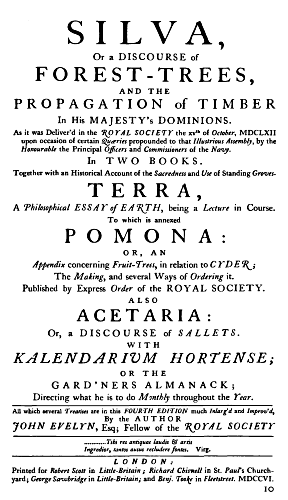
S I L V A, Or a DISCOURSE of FOREST-TREES, AND THE PROPAGATION of TIMBER In His MAJESTY’s DOMINIONS.
As it was Deliver’d in the ROYAL SOCIETY the xvth of October, MDCLXII upon occasion of certain Quæries propounded to that Illustrious Assembly, by the Honourable the Principal Officers and Commissioners of the Navy.
In TWO BOOKS.
Together with an Historical Account of the Sacredness and Use of Standing Groves.
TERRA, A Philosophical ESSAY of EARTH, being a Lecture in Course.
To which is annexed POMONA: OR, AN Appendix concerning Fruit-Trees, in relation to CYDER; The Making, and several Ways of Ordering it.
Published by Express Order of the ROYAL SOCIETY.
ALSO ACETARIA: Or, a DISCOURSE of SALLETS.
WITH KALENDARIVM HORTENSE; OR THE GARD’NERS ALMANACK; Directing what he is to do Monthly throughout the Year.
All which several Treatises are in this FOURTH EDITION much Inlarg’d and Improv’d, By the AUTHOR JOHN EVELYN, Esq; Fellow of the ROYAL SOCIETY
........Tibi res antiquae laudis & artis Ingredior, tantos ausus recludere fontes. Virg.
LONDON: Printed for Robert Scott in Little-Britain; Richard Chiswell in St. Paul’s Churchyard; George Sawbridge in Little-Britain; and Benj. Tooke in Fleetstreet. MDCCVI.