Volume 2 — Appendix. VARIANTS AND ANALOGUES OF SOME OF THE TALES IN THE SUPPLEMENTAL NIGHTS. VOLS. I. AND II. (continued 2)
Richard Francis Burton translation · Edition 2
And after they had finished their dinner, the king dismissed the Bráhmans to their apartments, and sent for the loveliest lady of his court. And in the evening he sent that fair one, all whose limbs were of faultless beauty, splendidly adorned, to the second Bráhman, who was so squeamish about the fair sex. And that matchless kindler of Cupid’s flame, with a face like the full moon of midnight, went, escorted by the king’s servants, to the chamber of the Bráhman. But when she entered, lighting up the chamber with her brightness, that gentleman who was so fastidious about the fair sex felt quite faint, and stopping his nose with his left hand, said to the king’s servants, “Take her away; if you do not, I am a dead man: a smell comes from her like that of a goat.” When the king’s servants heard this, they took the bewildered fair one to their sovereign, and told him what had taken place. And the king immediately had the squeamish gentleman sent for, and said to him, “How can this lovely woman, who has perfumed herself with sandal-wood, camphor, black aloes, and other splendid scents, so that she diffuses exquisite fragrance through the world, smell like a goat?” But though the king used this argument 322to the squeamish gentleman he stuck to his point; and then the king began to have his doubts on the subject, and at last, by artfully framed questions, he elicited from the lady herself that, having been separated in her childhood from her mother and nurse, she had been brought up on goat’s milk.
Then the king was much astonished, and praised highly the discernment of the man who was fastidious about the fair sex, and immediately had given to the third Bráhman, who was fastidious about beds, in accordance with his taste, a bed composed of seven mattresses placed upon a bedstead. White smooth sheets and coverlets were laid upon the bed, and the fastidious man slept upon it in a splendid room. But, before half a watch of the night had passed, he rose up from that bed, with his hand pressed to his side, screaming in an agony of pain. And the king’s officers, who were there, saw a red crooked mark on his side, as if a hair had been pressed deep into it. And they went and told the king, and the king said to them, “Look and see if there is not something under the mattress.” So they went and examined the bottom of the mattresses one by one, and they found a hair in the middle of the bedstead underneath them all. And they took it and showed it to the king, and they also brought the man who was fastidious about beds, and when the king saw the state of his body, he was astonished. And he spent the whole night in wondering how a hair could make so deep an impression on his skin through seven mattresses.[500]
And the next morning the king gave three hundred thousand gold pieces to those three fastidious men, because they were persons of wonderful discernment and refinement. And they remained in great comfort in the king’s court, forgetting all about the turtle, and little did they reck of the fact that they had incurred sin by obstructing their father’s sacrifice.[501]
The story of the brothers who were so very “knowing” is common to most countries, with occasional local modifications. It is not often we find the knowledge of the “quintessence of things” concentrated in a single individual, as in the case of the ex-king of our tale, but we have his exact counterpart—and the circumstance is significant—in No. 2 of the “Cento Novelle Antiche,” the first Italian collection of short stories, made in the 13th century, where a 323prisoner informs the king of Greece that a certain horse has been suckled by a she-ass, that a jewel contains a flaw, and that the king himself is a baker. Mr. Tawney, in a note on the Vetála story, as above, refers also to the decisions of Hamlet in Saxo Grammaticus, 1839, p. 138, in Simrock’s “Quellen des Shakespeare,” 1, 81–85; 5, 170; he lays down that some bread tastes of blood (the corn was grown on a battlefield); that some liquor tastes of iron (the malt was mixed with water taken from a well, in which some rusty swords had lain); that some bacon tastes of corpses (the pig had eaten a corpse); lastly, that the king is a servant and his wife a serving-maid. But in most versions of the story three brothers are the gifted heroes.
In “Mélusine”[502] for 5 Nov. 1885, M. René Basset cites an interesting variant (in which, as is often the case, the “Lost Camel” plays a part, but we are not concerned about it at present) from Radloft’s “Proben der Volksliteratur der türkischen Stamme des Süd-Siberiens,” as follows:
SIBERIAN VERSION.
Meat and bread were set before the three brothers, and the prince went out. The eldest said, “The prince is a slave;” the second, “This is dog’s flesh;” the youngest, “This bread has grown over the legs of a dead body.” The prince heard them. He took a knife and ran to find his mother. “Tell me the truth,” cried he—“were you unfaithful to my father during his absence? A man who is here has called me a slave.” “My son,” replied she, “if I don’t tell the truth, I shall die; if I tell it, I shall die. When thy father was absent, I gave myself up to a slave.” The prince left his mother and ran to the house of the shepherd: “The meat which you have cooked to-day—what is it? Tell the truth, otherwise I’ll cut your head off.” “Master, if I tell it, I shall die; if I don’t, I shall die. I will be truthful. It was a lamb whose mother had no milk; on the day of its birth, it was suckled by a bitch: that is to-day’s ewe.” The prince left the shepherd and ran to the house of the husbandman: “Tell the truth, or else I’ll cut off your head. Three young men have come to my house. I have placed bread before them, and they say that the grain has grown over the limbs of a dead man.” “I will be frank with you. I ploughed with my plough in a place where were [buried] the limbs of a man; without knowing it, I sowed some wheat, which grew up.” The prince quitted his slave and returned to his house, where were seated the strangers. He said to the first, “Young man, how do you know that I am a slave?” “Because you went out as soon as the repast was brought in.” He asked the second, “How do you know that the meat which was served to-day was that of a dog?” “Because it has a disagreeable taste like the flesh of a dog.” Then to the third: “How come you to know that this bread was grown over the limbs of a dead person?” “What shall I say? It smells of the limbs of a dead body; that is why I 324recognised it. If you do not believe me, ask your slave; he will tell you that what I say is true.”
In the same paper (col. 516) M. René Basset cites a somewhat elaborate variant, from Stier’s “Ungarische Sagen und Märchen,” in which, once more, the knowledge of the “quintessence of things” is concentrated in a single individual:
HUNGARIAN VERSION.
A clever Magyar is introduced with his companions in disguise into the camp of the King of the Tátárs, who is menacing his country. The prince, suspicious, causes him to be carefully watched by his mother, a skilful sorceress. They brought in the evening’s repast. “What good wine the prince has!” said she. “Yes,” replied one, “but it contains human blood.” The sorceress took note of the bed from whence these words proceeded, and when all were asleep, she deftly cut a lock of hair from him who had spoken, crept stealthily out of the room, and brought this mark to her son. The strangers started up, and when our hero discovered what had been done to him, he cut a lock from all, to render his detection impossible. When they came to dinner, the king knew not from whom the lock had been taken. The following night the mother of the prince again slipped into the room, and said, “What good bread has the prince of the Tátárs!” “Very good,” replied one, “it is made with the milk of a woman.” When all were asleep, she cut a little off the moustache of him who was lying in the bed from which the voice proceeded. This time the Magyars were still more on the alert, and when they were apprised of the matter, they all cut a little from their moustaches, so that next morning the prince found himself again foiled. The third night the old lady hid herself, and said in a loud voice, “What a handsome man is the prince of the Tátárs!” “Yes,” replied one, “but he is a bastard.” When all were asleep, the old lady made a mark on the visor of the helmet of the one from whence had come the words, and then acquainted her son of what she had done. In the morning the prince perceived that all the helmets were similarly marked.[503] At length he refrained, and said, “I see that there is among you a master greater than myself; that is why I desire very earnestly to know him. He may make himself known; I should like to see and know this extraordinary man, who is more clever and more powerful than myself.” The young man started up from his seat and said, “I have not wished to be stronger or wiser than yourself. I have only wished to find out what you had preconcerted for us. I am the person who has been marked three nights.” “It is well, young man. But prove now your words: How is there human blood 325in the wine?” “Call your butler and he will tell you.” The butler came in trembling all over, and confessed that when he corked the wine he had cut his finger with the knife, and a drop of blood had fallen into the cask. “But how is there woman’s milk in the bread?” asked the king. “Call the bakeress,” he replied, “and she will tell it you.” When they questioned her, she confessed that she was kneading the bread and at the same time suckling her baby, and that on pressing it to her breast some milk flowed and was mixed with the bread. The sorceress, the mother of the king, when they came to the third revelation of the young man, confessed in her turn that the king was illegitimate.
Mr. Tawney refers to the Chevalier de Mailly’s version of the Three Princes of Serendip (Ceylon): The three are sitting at table, and eating a leg of lamb, sent with some splendid wine from the table of the emperor Bahrám. The eldest maintains that the wine was made of grapes that grew in a cemetery; the second, that the lamb was brought up on dog’s milk; while the third asserts that the emperor had put to death the son of the wazír, and that the latter is bent on vengeance. All these statements turn out to be well-grounded. Mr. Tawney also refers to parallel stories in the Breslau edition of The Nights; namely, in Night 458, it is similarly conjectured that the bread was baked by a sick woman; that the kid was suckled by a bitch, and that the sultan is illegitimate; and in Night 459, a gem-cutter guesses that a jewel has an internal flaw, a man skilled in the pedigrees of horses divines that a horse is the offspring of a female buffalo, and a man skilled in human pedigrees that the mother of the favourite queen was a rope-dancer. Similar incidents occur in “The Sultan of Yemen and his Three Sons,” one of the Additional Tales translated by Scott, from the Wortley-Montague MS., now in the Bodleian Library, and comprised in vol. vi. of his edition of “The Arabian Nights Entertainments,” published at London in 1811.
An analogous tale occurs in Mr. E. J. W. Gibb’s recently-published translation of the “History of the Forty Vezírs” (the Lady’s Fourth Story, p. 69 ff.), the motif of which is that “all things return to their origin.”
TURKISH ANALOGUE.
There was in the palace of the world a king who was very desirous of seeing Khizr[504] (peace on him!), and he would even say, “If there be any one who will show me Khizr, I will give him whatsoever he may wish.” Now there was at 326that time a man poor of estate, and from the stress of his poverty he said to himself, “Let me go and speak to the king, that if he provide for me during three years, either I shall be dead, or the king will be dead, or he will forgive me my fault, or I shall on somewise win to escape, and in this way shall I make merry for a time.” So he went to the king and spake these words to him.[505] The king said, “An thou show him not, then I will kill thee,” and that poor man consented. Then the king let give him much wealth and money, and the poor man took that wealth and money and went to his house. Three years he spent in merriment and delight, and he rested at ease till the term was accomplished. At the end of that time he fled and hid himself in a trackless place and he began to quake for fear. Of a sudden he saw a personage with white raiment and shining face, who saluted him. The poor man returned the salutation, and the radiant being asked, “Why art thou thus sad?” But he gave no answer. Again the radiant being asked him and sware to him, saying, “Do indeed tell to me thy plight, that I may find thee some remedy.” So that hapless one narrated his story from its beginning to its end, and the radiant being said, “Come, I will go with thee to the king, and I will answer for thee.” So they arose.
Now the king wanted that hapless one, and while they were going some of the king’s officers who were seeking met them, and they straightway seized the poor man and brought him to the king. Quoth the king, “Lo, the three years are accomplished; come now, and show me Khizr.” The poor man said, “My king, grace and bounty are the work of kings—forgive my sin.” Quoth the king, “I made a pact; till I have killed thee, I shall not have fulfilled it.” And he looked to his chief vezír and said, “How should this be done?” Quoth the vezír, “This man should be hewn in many pieces and then hung up on butchers’ hooks, that others may see and lie not before the king.” Said that radiant being, “True spake the vezír;—all things return to their origin.” Then the king looked to the second vezír and said, “What sayest thou?” He replied, “This man should be boiled in a cauldron.” Said that radiant being, “True spake the vezír;—all things return to their origin.” The king looked to the third vezír and said, “What sayest thou?” The vezír replied, “This man should be hewn in small pieces and baked in an oven.” Again said that elder, “True spake the vezír;—all things return to their origin.” Then quoth the king to the fourth vezír, “Let us see what sayest thou?” The vezír replied, “O king, the wealth thou gavest this poor creature was for the love of Khizr (peace on him!) He, thinking to find him, accepted it; now that he has not found him he seeks pardon. This were befitting, that thou set free this poor creature for the love of Khizr.” Said that elder, “True spake the vezír;—all things return to their origin.” Then the king said to the elder, “O elder, my vezírs have said different things contrary the one to the other, and thou hast said concerning each of 327them, ‘True spake the vezír;—all things return to their origin.’ What is the reason thereof?” That elder replied, “O king, thy first vezír is a butcher’s son; therefore did he draw to his origin. Thy second vezír is a cook’s son, and he likewise proposed a punishment as became his origin. Thy third vezír is a baker’s son; he likewise proposed a punishment as became his origin. But thy fourth vezír is of gentle birth; compassion therefore becomes his origin, so he had compassion on that hapless one, and sought to do good and counselled liberation. O king, all things return to their origin.”[506] And he gave the king much counsel, and at last said, “Lo, I am Khizr,” and vanished.[507]
The discovery of the king’s illegitimate birth, which occurs in so many versions, has its parallels in the story of the Nephew of Hippocrates in the “Seven Wise Masters,” and the Lady’s 2nd Story in Mr. Gibb’s translation of the “Forty Vezírs.” The extraordinary sensitiveness of the third young Bráhman, in the Vetála story, whose side was scratched by a hair that was under the seventh of the mattresses on which he lay, Rohde (says Tawney), in his “Greichische Novellistik,” p. 62, compares with a story told by Aelian of the Sybarite Smindyrides, who slept on a bed of rose-leaves and got up in the morning covered with blisters. He also quotes from the Chronicle of Tabari a story of a princess who was made to bleed by a rose-leaf lying in her bed.[508]
The eleventh recital of the Vetála is about a king’s three sensitive wives: As one of the queens was playfully pulling the hair of the king, a blue lotus leaped from her ear and fell on her lap; immediately a wound was produced on the front of her thigh by the blow, and the delicate princess exclaimed “Oh! oh!” and fainted. At night, the second retired with the king to an apartment on the roof of the palace exposed to the rays of the moon, which fell on the body of the queen, who was sleeping by the king’s side, where it was exposed by her garment blowing aside; immediately she woke up, exclaiming, “Alas! I am burnt,” and rose up from the bed rubbing her limbs. The king woke up in a state of alarm, crying out, “What is the meaning of this?” Then he got up and saw that blisters had been produced on the queen’s body. In 328the meanwhile the king’s third wife heard of it and left her palace to come to him. And when she got into the open air, she heard distinctly, as the night was still, the sound of a pestle pounding in a distant house. The moment the gazelle-eyed one heard it, she said “Alas! I am killed,” and she sat down on the path, shaking her hands in an agony of pain. Then the girl turned back, and was conducted by her attendants to her own chamber, where she fell on her bed and groaned. And when her weeping attendants examined her, they saw that her hands were covered with bruises, and looked like lotuses upon which black beetles had settled.
To this piteous tale of the three very sensitive queens Tawney appends the following note: Rohde, in his “Greichische Novellistik,” p. 62, compares with this a story told by Timæus, of a Sybarite who saw a husbandman hoeing a field, and contracted rupture from it. Another Sybarite, to whom he told the tale of his sad mishap, got ear-ache from hearing it. Oesterley, in his German translation of the Baitál Pachísí, points out that Grimm, in his “Kindermärchen,” iii. p. 238, quotes a similar incident from the travels of the Three Sons of Giaffar: out of four princesses, one faints because a rose-twig is thrown into her face among some roses; a second shuts her eyes in order not to see the statue of a man; a third says, “Go away; the hairs in your fur cloak run into me;” and the fourth covers her face, fearing that some of the fish in a tank may belong to the male sex. He also quotes a striking parallel from the “Elites des contes du Sieur d’Onville:” Four ladies dispute as to which of them is the most delicate. One has been lame for three months owing to a rose-leaf having fallen on her foot; another has had three ribs broken by a sheet in her bed having been crumpled; a third has held her head on one side for six weeks owing to one half of her head having three or more hairs on it than the other; a fourth has broken a blood-vessel by a slight movement, and the rupture cannot be healed without breaking the whole limb. [Poor things!]
THE PRINCE WHO FELL IN LOVE WITH THE PICTURE. Vol. I. p. 226.
In the Persian tales of “The Thousand and One Days,” a young prince entered his father’s treasury one day, and saw there a little cedar chest “set with pearls, diamonds, emeralds, and topazes;” on opening it (for the key was in the lock) he beheld the picture of an exceedingly beautiful woman, with whom he immediately fell in love. Ascertaining the name of the lady from an inscription on the back of the portrait, he sets off with a companion to discover her, and having been told by an old man at Baghdád that her father at one time reigned in Ceylon, he continued his journey thither, encountering many 329unheard-of adventures by the way. Ultimately he is informed that the lady with whose portrait he had become enamoured was one of the favourites of King Solomon. One should suppose that this would have effectually cured the love-sick prince; but no: he “could never banish her sweet image from his heart.”[509]
Two instances of falling in love with the picture of a pretty woman occur in the “Kathá Sarít Ságara.” In Book ix., chap. 51, a painter shows King Prithvirúpa the “counterfeit presentment” of the beauteous Princess Rapalatá, and “as the king gazed on it his eye was drowned in that sea of beauty her person, so that he could not draw it out again. For the king, whose longing was excessive, could not be satisfied with devouring her form, which poured forth a stream of the nectar of beauty, as the partridge cannot be satisfied with devouring the moonlight.” In Book xii., chap. 100, a female ascetic shows a wandering prince the portrait of the Princess Mandáravatí, “and Sundarasena when he beheld that maiden, who, though she was present there only in a picture, seemed to be of romantic beauty and like a flowing forth of joy, immediately felt as if he had been pierced with the arrows of the god of the flowery bow [i.e. Káma].” In chapter 35 of Scott’s translation of the “Bahár-i-Dánish,” Prince Ferokh-Faul opens a volume, “which he had scarcely done when the fatal portrait of the fair princess who, the astrologers had foretold, was to occasion him so many perils, presented itself to his view. He instantly fainted, when the slave, alarmed, conveyed intelligence of his condition to the sultan, and related the unhappy cause of the disorder.” In Gomberville’s romance of Polexandre, the African prince, Abd-el-Malik, falls in love with the portrait of Alcidiana, and similar incidents occur in the romance of Agesilaus of Colchos and in the Story of the Seven Wazírs (vol. vi.); but why multiply instances? Nothing is more common in Asiatic fictions.
THE FULLER, HIS WIFE, AND THE TROOPER. Vol. I. p. 231.
In addition to the versions of this amusing story referred to on p. 231—all of which will be found in the second volume of my work on “Popular Tales and Fictions,” pp. 212–228—there is yet another in a Persian story-book, of unknown date, entitled “Shamsa ú Kuhkuha,” written by Mirza Berkhorder Turkman, of which an account, together with specimens, is given in a recently-published little book (Quaritch), “Persian Portraits: a sketch of Persian History, Literature, and Politics,” by Mr. F. F. Arbuthnot, author of “Early Ideas: a Group of Hindoo Stories.”
330This version occurs in a tale of three artful wives—or, to employ the story-teller’s own graphic terms, “three whales of the sea of fraud and deceit: three dragons of the nature of thunder and the quickness of lightning; three defamers of honour and reputation; namely, three men-deceiving, lascivious women, each of whom had from the chicanery of her cunning issued the diploma of turmoil to a hundred cities and countries, and in the arts of fraud they accounted Satan as an admiring spectator in the theatre of their stratagems.[510] One of them was sitting in the court of justice of the kazi’s embrace; the second was the precious gem of the bazaar-master’s diadem of compliance; and the third was the beazle and ornament of the signet-ring of the life and soul of the superintendent of police. They were constantly entrapping the fawns of the prairie of deceit within the grasp of cunning, and plundered the wares of the caravan of tranquillity of hearts of strangers and acquaintances, by means of the edge of the scimitar of fraud. One day this trefoil of roguery met at the public bath, and, according to their homogeneous nature they intermingled as intimately as the comb with the hair; they tucked up their garment of amity to the waist of union, entered the tank of agreement, seated themselves in the hot-house of love, and poured from the dish of folly, by means of the key of hypocrisy, the water of profusion upon the head of intercourse; they rubbed with the brush of familiarity and the soap of affection the stains of jealousies from each other’s limbs. After a while, when they had brought the pot of concord to boil by the fire of mutual laudation, they warmed the bath of association with the breeze of kindness, and came out. In the dressing-room all three of them happened simultaneously to find a ring, the gem of which surpassed the imagination of the jeweller of destiny, and the like of which he had never beheld in the storehouse of possibility. In short, these worthy ladies contended with each other for possession of the ring, until at length the mother of the bathman came forward and proposed that they should entrust the ring to her in the meanwhile, and it should be the prize of the one who most cleverly deceived and befooled her husband, to which they all agreed, and then departed for their respective domiciles.”[511]
331Mr. Arbuthnot’s limits permitted only of abstracts of the tricks played upon their husbands by the three ladies—which the story-teller gives at great length—and that of the kazi’s wife is as follows:
The kazi’s wife knows that a certain carpenter, who lived close to her, was very much in love with her. She sends her maid to him with a message to say that the flame of his love had taken effect upon her heart, and that he must make an underground passage between his house and her dwelling, so that they might communicate with each other freely by means of the mine. The carpenter digs the passage, and the lady pays him a visit, and says to him, “To-morrow I shall come here, and you must bring the kazi to marry me to you.” The next day the kazi goes to his office; the lady goes to the carpenter’s house, and sends him to bring her husband, the kazi, to marry them. The carpenter fetches him, and, as the kazi hopes for a good present, he comes willingly enough, but is much surprised at the extreme likeness between the bride and his own wife. The more he looks at her, the more he is in doubt; and at last, offering an excuse to fetch something, he rushes off to his own house, but is forestalled by his spouse, who had gone thither by the passage, and on his arrival is lying on her bed. The kazi makes some excuses for his sudden entry into her room, and, after some words, goes back to the carpenter’s house; but his wife had preceded him, and is sitting in her place. Again he begins the ceremony, but is attracted by a black mole on the corner of the bride’s lip, which he could have sworn was the same as that possessed by his wife. Making more excuses, and in spite of the remonstrances of the carpenter, he hurries back to his house once more; but his wife had again got there before him, and he finds her reading a book, and much astonished at his second visit. She suggests that he is mad, and he admits that his conduct is curious, and returns to the carpenter’s house to complete the ceremony. This is again frequently interrupted, but finally he marries his own wife to the carpenter, and, having behaved in such an extraordinary manner throughout, is sent off to a lunatic asylum.
For the tricks of the two other ladies, and for many other equally diverting tales, I refer the reader to Mr. Arbuthnot’s pleasing and instructive little book, which is indeed an admirable epitome of the history and literature of Persia, and one which was greatly wanted in these days, when most men, “like the dogs in Egypt for fear of the crocodiles, must drink of the waters of information as they run, in dread of the old enemy Time.”
I have discussed the question of the genealogy of this tale elsewhere, but, after a somewhat more minute comparative analysis of the several versions, am disposed to modify the opinion which I then entertained. I think we must consider as the direct or indirect source of the versions and variants the “Miles Gloriosus” of Plautus, the plot of which, it is stated in the prologue to the second act, was taken from a Greek play. It is, however, not very clear whether Berni adapted his story from Plautus or the “Seven Wise Masters”; probably from 332the former, since in both the lady is represented, to the captain and the cuckold, as a twin sister, while in the S. W. M. the crafty knight pretends that she is his leman, come from Hungary with tidings that he may now with safety return home. On the other hand, in the S. W. M., as in Plautus, the lovers make their escape by sea, an incident which Berni has altered to a journey by land—no doubt, in order to introduce further adventures for the development of his main plot. But then we find a point of resemblance between Berni and the S. W. M., in the incident of the cuckold accompanying the lovers part of their way—in the latter to the sea-shore; while in Plautus the deceived captain remains at home to prosecute an amour and get a thrashing for his reward (in Plautus, instead of a wife, it is the captain’s slave-girl). It is curious that amidst all the masquerade of the Arabian story the cuckold’s wife also personates her supposititious twin-sister, as in Plautus and Berni. In Plautus the houses of the lover and the captain adjoin, as is also the case in the modern Italian and Sicilian versions; while in Berni, the S. W. M., the Arabian, and the Persian story cited in this note they are at some distance. With these resemblances and variations it is not easy to say which version was derived from another. Evidently the Arabian story has been deliberately modified by the compiler, and he has, I think, considerably improved upon the original: the ludicrous perplexity of the poor fuller when he awakes, to find himself apparently transformed into a Turkish trooper, recalls the nursery rhyme of the little woman “who went to market her eggs for to sell,” and falling asleep on the king’s highway, a pedlar cut off her petticoats up to the knees, and when she awoke and saw her condition she exclaimed, “Lawk-a-mercy me, this is none of I!” and so on. And not less diverting is the pelting the blockhead receives from his brother fullers—altogether, a capital story.
TALE OF THE SIMPLETON HUSBAND.—Vol. I. p. 239.
The “curious” reader will find European and Asiatic versions of this amusing story in “Originals and Analogues of some of Chaucer’s Canterbury Tales,” published for the Chaucer Society, pp. 177–188 and (in a paper contributed by me: “The Enchanted Tree”) p. 341–364.
TALE OF THE THREE MEN AND OUR LORD ISA. Vol. I. p. 250.
Under the title of “The Robbers and the Treasure-Trove” I have brought together many European and Asiatic versions of this wide-spread tale in “Chaucer Analogues,” pp. 415–436.
333
THE MELANCHOLIST AND THE SHARPER. Vol. I. p. 264.
A similar but much shorter story is found in Gladwin’s “Persian Moonshee,” and story-books in several of the Indian vernaculars which have been rendered into English:
A miser said to a friend, “I have now a thousand rupees, which I will bury out of the city, and I will not tell the secret to any one besides yourself.” They went out of the city together, and buried the money under a tree. Some days after the miser went alone to the tree and found no signs of his money. He said to himself, “Excepting that friend, no other has taken it away; but if I question him he will never confess.” He therefore went to his (the friend’s) house and said, “A great deal of money is come into my hands, which I want to put in the same place; if you will come to-morrow, we will go together.” The friend, by coveting this large sum, replaced the former money, and the miser next day went there alone and found it. He was delighted with his own contrivance, and never again placed any confidence in friends.
One should suppose a miser the last person to confide the secret of his wealth to any one; but the Italian versions bear a closer resemblance to the Arabian story. From No. 74 of the “Cento Novelle Antiche” Sacchetti, who was born in 1335 and is ranked by Crescimbini as next to Boccaccio, adapted his 198th novella, which is a most pleasing version of the Asiatic story:
ITALIAN VERSION.
A blind man of Orvieto, of the name of Cola, hit upon a device to recover a hundred florins he had been cheated of, which showed he was possessed of all the eyes of Argus, though he had unluckily lost his own. And this he did without wasting a farthing either upon law or arbitration, by sheer dexterity; for he had formerly been a barber, and accustomed to shave very close, having then all his eyes about him, which had been now closed for about thirty years. Alms seemed then the only resource to which he could betake himself, and such was the surprising progress he in a short time made in his new trade that he counted a hundred florins in his purse, which he secretly carried about him until he could find a safer place. His gains far surpassed anything he had realised with his razor and scissors; indeed, they increased so fast that he no longer knew where to bestow them; until one morning happening to remain the last, as he believed, in the church, he thought of depositing his purse of a hundred florins under a loose tile in the floor behind the door, knowing the situation of the place perfectly well. After listening some time without hearing a foot stirring, he very cautiously laid it in the spot; but unluckily there 334remained a certain Juccio Pezzichernolo, offering his adoration before an image of San Giovanni Boccadoro, who happened to see Cola busily engaged behind the door. He continued his adorations until he saw the blind man depart, when, not in the least suspecting the truth, he approached and searched the place. He soon found the identical tile, and on removing it with the help of his knife, he found the purse, which he very quietly put into his pocket, replacing the tiles just as they were, and, resolving to say nothing about it, he went home.
At the end of three days the blind mendicant, desirous of inspecting his treasure, took a quiet time for visiting the place, and removing the tile searched a long while in great perturbation, but all in vain, to find his beloved purse. At last, replacing things just as they were, he was compelled to return in no very enviable state of mind to his dwelling; and there meditating on his loss, the harvest of the toil of so many days, by dint of intense thinking a bright thought struck him (as frequently happens by cogitating in the dark), how he had yet a kind of chance of redeeming his lost spoils. Accordingly in the morning he called his young guide, a lad about nine years old, saying, “My son, lead me to church,” and before setting out he tutored him how he was to behave, seating himself at his side before the entrance, and particularly remarking every person who should enter into the church. “Now, if you happen to see any one who takes particular notice of me, and who either laughs or makes any sign, be sure you observe it and tell me.” The boy promised he would; and they proceeded accordingly and took their station before the church.
When the dinner-hour arrived, the father and son prepared to leave the place, the former inquiring by the way whether his son had observed any one looking hard at him as he passed along. “That I did,” answered the lad, “but only one, and he laughed as he went past us. I do not know his name, but he is strongly marked with the small-pox and lives somewhere near the Frati Minori.” “Do you think, my dear lad,” said his father, “that you could take me to his shop, and tell me when you see him there?” “To be sure I could,” said the lad. “Then come, let us lose no time,” replied the father; “and when we are there tell me, and while I speak to him you can step on one side and wait for me.” So the sharp little fellow led him along the way until he reached a cheesemonger’s stall, when he acquainted his father, and brought him close to it. No sooner did the blind man hear him speaking with his customers than he recognised him for the same Juccio with whom he had formerly been acquainted during his days of light. When the coast was a little clear, our blind hero entreated some moments’ conversation, and Juccio, half suspecting the occasion, took him on one side into a little room, saying, “Cola, friend, what good news?” “Why,” said Cola, “I am come to consult you, in great hopes you will be of use to me. You know it is a long time since I lost my sight, and being in a destitute condition, I was compelled to earn my subsistence by begging alms. Now, by the grace of God, and with the help of you and of other good people of Orvieto, I have saved a sum of two hundred florins, one hundred of which I 335have deposited in a safe place, and the other is in the hands of my relations, which I expect to receive with interest in the course of a week. Now if you would consent to receive, and to employ for me to the best advantage, the whole sum of two hundred florins, it would be doing me a great kindness, for there is no one besides in all Orvieto in whom I dare to confide; nor do I like to be at the expense of paying a notary for doing business which we can as well transact ourselves. Only I wish you would say nothing about it, but receive the two hundred florins from me to employ as you think best. Say not a word about it, for there would be an end of my calling were it known I had received so large a sum in alms.” Here the blind mendicant stopped; and the sly Juccio, imagining he might thus become master of the entire sum, said he should be very happy to serve him in every way he could, and would return an answer the next morning as to the best way of laying out the money. Cola then took his leave, while Juccio, going directly for the purse, deposited it in its old place being in full expectation of soon receiving it again with the addition of the other hundred, as it was clear that Cola had not yet missed the money. The cunning old mendicant on his part expected that he would do no less, and trusting that his plot might have succeeded, he set out the very same day to the church, and had the delight, on removing the tile, to find his purse really there. Seizing upon it with the utmost eagerness, he concealed it under his clothes, and placing the tiles exactly in the same position, he hastened home whistling, troubling himself very little about his appointment of the next day.
The sly thief Juccio set out accordingly the next morning to see his friend Cola, and actually met him on the road. “Whither are you going?” inquired Juccio. “I was going,” said Cola, “to your house.” The former, then taking the blind man aside, said, “I am resolved to do what you ask; and since you are pleased to confide in me, I will tell you of a plan that I have in hand for laying out your money to advantage. If you will put the two hundred florins into my possession, I will make a purchase in cheese and salt meat, a speculation which cannot fail to turn to good account.” “Thank you,” quoth Cola, “I am going to-day for the other hundred, which I mean to bring, and when you have got them both, you can do with them what you think proper.” Juccio said, “Then let me have them soon, for I think I can secure this bargain; and as the soldiers are come into the town, who are fond of these articles, I think it cannot fail to answer; so go, and Heaven speed you.” And Cola went; but with very different intentions from those imagined by his friend—Cola being now clear-sighted, and Juccio truly blind. The next day Cola called on his friend with very downcast and melancholy looks, and when Juccio bade him good day, he said, “I wish from my soul it were a good, or even a middling, day for me.” “Why, what is the matter?” “The matter?” echoed Cola; “why, it is all over with me; some rascal has stolen a hundred florins from the place where they were hidden, and I cannot recover a penny from my relations, so that I may eat my fingers off for anything I have to expect.” Juccio replied, “This is like all the rest of my speculations. I have invariably lost where I expected to 336make a good hit. What I shall do I know not; for if the person should choose to keep me to the agreement I made for you, I shall be in a pretty dilemma indeed.” “Yet,” said Cola, “I think my condition is still worse than yours. I shall be sadly distressed, and shall have to amass a fresh capital, which will take me ever so long. And when I have got it, I will take care not to conceal it in a hole in the floor, or trust it, Juccio, into any friend’s hands.” “But,” said Juccio, “if we could contrive to recover what is owing by your relations, we might still make some pretty profit of it, I doubt not.” For he thought, if he could only get hold of the hundred he had returned it would still be something in his way. “Why,” said Cola, “to tell the truth, if I were to proceed against my relations, I believe I might get it; but such a thing would ruin my business, my dear Juccio, for ever: the world would know I was worth money, and I should get no more money from the world; so I fear I shall hardly be able to profit by your kindness, though I shall always consider myself as much obliged as if I had actually cleared a large sum. Moreover, I am going to teach another blind man my profession, and if we have luck you shall see me again, and we can venture a speculation together.” So far the wily mendicant, to whom Juccio said, “Well, go and try to get money soon, and bring it; you know where to find me, but look sharp about you and the Lord speed you; farewell.” “Farewell,” said Cola; “and I am well rid of thee,” he whispered to himself; and going upon his way, in a short time he doubled his capital; but he no longer went near his friend Juccio to know how he should invest it. He had great diversion in telling the story to his companions during their feasts, always concluding, “By St. Lucia! Juccio is the blinder man of the two: he thought it was a bold stroke to risk his hundred to double the amount.”
For my own part, I think the blind must possess a more acute intellect than other people, inasmuch as the light, exhibiting such a variety of objects to view, is apt to distract the attention, of which many examples might be adduced. For instance, two gentlemen may be conversing together on some matter of business, and in the middle of a sentence a fine woman happens to pass by, and they will suddenly stop, gazing after her; or a fine equipage, or any other object is enough to turn the current of their thoughts. And then we are obliged to recollect ourselves, saying, “Where was I?” “What was it that I was observing?”—a thing which never occurs to a blind man. The philosopher Democritus very properly on this account knocked his eyes out in order to catch objects in a juster light with his mind’s eye.
It is impossible to describe Juccio’s vexation on going to church and finding the florins were gone. His regret was far greater than if he had actually lost a hundred of his own; as is known to be the case with all inveterate rogues, half of whose pleasure consists in depriving others of their lawful property.
There are many analogous stories, one of which is the well-known tale of the merchant, who, before going on a journey, deposited with a dervish 1,000 sequins, which he thought it prudent to reserve in case of accidents. When he 337returned and requested his deposit, the dervish flatly denied that he ever had any of his money. Upon this the merchant went and laid his case before the kazi, who advised him to return to the dervish and speak pleasantly to him, which he does, but receives nothing but abuse. He informed the kazi of this, and was told not to go near the dervish for the present, but to be at ease for he should have his money next day. The kazi then sent for the dervish, and after entertaining him sumptuously, told him that, for certain reasons, he was desirous of removing a considerable sum of money from his house; that he knew of no person in whom he could confide so much as himself; and that if he would come the following evening at a late hour, he should have the precious deposit. On hearing this, the dervish expressed his gratification that so much confidence should be placed in his integrity, and agreed to take charge of the treasure. Next day the merchant returned to the kazi, who bade him go back to the dervish and demand his money once more, and should he refuse, threaten to complain to the kazi. The result may be readily guessed: no sooner did the merchant mention the kazi than the rascally dervish said, “My good friend, what need is there to complain to the kazi? Here is your money; it was only a little joke on my part.” But in the evening, when he went to receive the kazi’s pretended deposit, he experienced the truth of the saw, that “covetousness sews up the eyes of cunning.”
A variant of this is found in the continental “Gesta Romanorum” (ch. cxviii. of Swan’s translation), in which a knight deposits ten talents with a respectable old man, who when called upon to refund the money denies all knowledge of it. By the advice of an old woman, the knight has ten chests made, and employs a person to take them to the old man and represent them as containing treasure; and while one of them is being carried into his house the knight enters and in the stranger’s presence demands his money, which is at once delivered to him.
In Mr. Edward Rehatsek’s translated selections from the Persian story-book “Shamsa ú Kuhkuha” (see ante, p. 329), printed at Bombay in 1871, under the title of “Amusing Stories,” there is a tale (No. xviii.) which also bears some resemblance to that of the Melancholist and the Sharper; and as Mr. Rehatsek’s little work is exceedingly scarce, I give it in extenso as follows:
There was in Damascus a man of the name of Zayn el-Arab, with the honey of whose life the poison of hardships was always mixed. Day and night he hastened like the breeze from north to south in the world of exertion, and he was burning brightly like straw, from his endeavours in the oven of acquisition in order to gain a loaf of bread and feed his family. In course of time, however, he succeeded in accumulating a considerable sum of money, but as he had tasted the bitter poison of destitution, and had for a very long time carried the heavy load of poverty upon his back, and fearing to lose his property by the chameleon-like changes of fortune, he took up his money on a certain night, carried it out of the city, and buried it under a tree. After some time had passed he began sorely to miss the presence of his treasure, and betook himself 338to the tree to refresh his eyes with the sight of it. But when he dug up the ground at the foot of the tree he discovered that his soul-exhilarating deposit was refreshing the palate of some one else. The morning of his prosperity was suddenly changed into the evening of bitterness and disappointment. He was perplexed to what friend to confide his secret, and to what remedy to fly for the recovery of his treasure. The lancet of grief had pierced the liver of his peace, and the huntsman of distress had tied up the wings and feet of the bird of his serenity. One day he went on some business to a learned and wise man of the city with whom he was on a footing of intimacy. This man said to him, “It is some time since I perceived the glade of your circumstances to have been destroyed by the burning coals of restlessness, and a sad change to have taken place in your health. I do not know the reason, nor what thorn of misfortune has pierced the foot of your heart, nor what hardship has dawned from the east of your mind.” Zayn el-Arab wept tears of sadness and said, “O thou standard coin from the mint of love! the treachery of misfortune has brought a strange accident upon me, and the bow of destiny has let fly an unpropitious arrow upon my feeble target. I have a heavy heart and great sorrow, and were I to reveal it to you perhaps it would be of no use and would plunge you also into grief.” The learned man said, “Since the hearts of intimate friends are like looking-glasses and are receiving the figures of mutual secrets, it is at all times necessary that they should communicate to each other any difficulties which they have fallen into, that they may remove them by taking in common those steps which prudence and foresight should recommend.” Zayn el-Arab replied, “Dear friend, I had some gold, and fearing lest it should be stolen, I carried it to such and such a place and buried it under a tree, and when I again visited the place, I perceived the garment of my beloved Joseph to be sprinkled with the blood of the wolf of deception.” The learned man said, “This is a grave accident, and it will be difficult to get on the track of your gold. Perhaps some one saw you bury it: he who has taken it will have to give an account of it in the next world, for God is omniscient. Give me ten days’ delay, that I may study the book of expedients and stratagems, when mayhap somewhat will occur to me.”
That knowing man sat down for ten days in the school of meditation, and how much so ever he turned over the leaves of the volume of his mind from the preface to the epilogue, he could hit upon no plan. On the tenth day they again met in the street, and he said to Zayn el-Arab, “Although the diver of my mind has plunged deeply and searched diligently in this deep sea, he has been unable to seize the precious pearl of a wise plan of operation: may God recompense you from the stores of His hidden treasury!” They were conversing in this way when a lunatic met them and said, “Well, my boys, what secret-mongering have you got between you?” The learned man said to Zayn el-Arab, “Come, let us relate our case to this crazy fellow, to see the flower of the plant that may bloom from his mind.” Zayn el-Arab replied, “Dear friend, you, with all your knowledge, cannot devise anything during ten days: what information are we likely to gain from a poor lunatic who does not know whether it is now day or 339night?” The learned man said, “There is no telling what he may say to us. But you know that the most foolish as well as the most wise have ideas, and a sentence uttered at random has sometimes furnished a clue by which the desired object may be attained.” Meanwhile a little boy also came up, and perceiving the lunatic stopped to see his tricks. The two friends explained their case to the lunatic, who then seemed immersed in thought for some time, after which he said, “He who took the root of that tree for a medicine also took the gold,” and having thus spoken, he turned his back upon them and went his way. They consulted with each other what indication this remark might furnish, when the little boy, who had overheard the conversation, asked what kind of a tree it was. Zayn el-Arab replied that it was a jujube tree. The boy said, “This is an easy matter: you ought to inquire of all the doctors of this town for whom a medicine has been prescribed of the roots of this tree.” They greatly admired the boy’s acuteness and also of the lunatic’s lucky thought.[512] The learned man was well acquainted with all the physicians of the city and made his enquiries, till he met with one who informed him that about twenty days ago he had prescribed for a merchant of the name of Khoja Semender, who suffered from asthma, and that one of the remedies was the root of that jujube tree. The learned man soon discovered the merchant’s house, found him enjoying excellent health, and said to him, “Ah, Khoja, all the goods of this world ought to be surrendered to procure health. By the blessing of God, you have recovered your health, and you ought to give up what you found at the root of that tree, because the owner of it is a worthy man and possesses nothing else.” The honest merchant answered, “It is true, I have found it, and it is with me. If you will describe it I will deliver it into your hands.” The exact sum being stated, the merchant at once delivered up the gold.
In the “Kathá Sarit Ságara,” Book vi. ch. 33, we have probably the original of this last story: A wealthy merchant provided a Bráhman with a lodging near his own house, and every day gave him a large quantity of unhusked rice and other presents, and in course of time he received like gifts from other great merchants. In this way the miserly fellow gradually accumulated a thousand dínárs, and going into the forest he dug a hole and buried it in the ground, and he went daily to carefully examine the spot. One day, however, he discovered that his hoard had been stolen, and he went to his friend the merchant near whose house he lived, and, weeping bitterly, told him of his loss, and that he had resolved to go to a holy bathing-place and there starve himself to death. The merchant tried to console him and dissuade him from his resolution, saying, “Bráhman, why do you long to die for the loss of your wealth? Wealth, like an unseasonable cloud, suddenly comes and goes.” But the Bráhman would 340not abandon his fixed determination to commit suicide, for wealth is dearer to the miser than life itself. When he was about to depart for the holy place, the king, having heard of it, came and asked him, “Bráhman, do you know of any mark by which you can distinguish the place where you buried your dínárs?” He replied, “There is a small tree in the wood, at the foot of which I buried that money.” Then said the king, “I will find the money and give it back to you, or I will give it you from my own treasury;—do not commit suicide, Bráhman.”
When the king returned to his palace, he pretended to have a headache, and summoned all the physicians in the city by proclamation with beat of drum. And he took aside every one of them singly and questioned them privately, saying, “What patients have you, and what medicines have you prescribed for each?” And they thereupon, one by one, answered the king’s questions. At length a physician said, “The merchant Mátridatta has been out of sorts, O king, and this is the second day I have prescribed for him nágabalá [the plant Uraria Lagopodioides].” Then the king sent for the merchant, and said to him, “Tell me, who fetched you the nágabalá?” The merchant replied, “My servant, your highness.” On hearing this, the king at once summoned the servant and said to him, “Give up that treasure belonging to a Bráhman, consisting of a store of dínárs, which you found when you were digging at the foot of the tree for nágabalá.” When the king said this to him the servant was frightened, and confessed immediately; and bringing the money left it there. Then the king summoned the Bráhman and gave him, who had been fasting meanwhile, the dínárs, lost and found again, like a second soul external to his body. Thus did the king by his wisdom recover to the Bráhman his wealth which had been taken away from the root of the tree, knowing that that simple grew in such spots.
TALE OF THE DEVOUT WOMAN ACCUSED OF LEWDNESS.—Vol. I. p. 270.
This is one of three Arabian variants of Chaucer’s Man of Law’s Tale (the Story of Constance), of which there are numerous versions—see my paper entitled “The Innocent Persecuted Wife,” pp. 365–414 of “Originals and Analogues of some of Chaucer’s Canterbury Tales.”
341
THE WEAVER WHO BECAME A LEACH BY ORDER OF HIS WIFE.—Vol. I. p. 282.
Somewhat resembling this, but much more elaborate, is the amusing story of Ahmed the Cobbler, in Sir John Malcolm’s “Sketches of Persia,” ch. xx., the original of which is probably found in the tale of Harisarman, book vi. ch. 30, of the “Kathá Sarit Ságara,” and it has many European variants, such as the German story of Doctor Allwissend, in Grimm’s collection, and that of the Charcoal Burner in Sir George Dasent’s “Tales from the Fjeld.”—According to the Persian story, Ahmed the Cobbler had a young and pretty wife, of whom he was very fond. She was ever forming grand schemes of riches and splendour, and was firmly persuaded that she was destined to great fortune. It happened one evening, while in this frame of mind, that she went to the public baths, where she saw a lady retiring dressed in a magnificent robe, covered with jewels, and surrounded by slaves. This was the very condition she had always longed for, and she eagerly inquired the name of the happy person who had so many attendants and such fine jewels. She learned it was the wife of the chief astrologer to the king. With this information she returned home. Ahmed met her at the door, but was received with a frown, nor could all his caresses obtain a smile or a word; for several hours she continued silent, and in apparent misery; at length she said, “Cease your caresses, unless you are ready to give me a proof that you do really and sincerely love me.” “What proof of love,” exclaimed poor Ahmed, “can you desire that I will not give?” “Give over cobbling; it is a vile, low trade, and never yields more than ten or twelve dínárs a day. Turn astrologer; your fortune will be made, and I shall have all I wish and be happy.” “Astrologer!” cried Ahmed—“astrologer! Have you forgotten who I am—a cobbler, without any learning—that you want me to engage in a profession which requires so much skill and knowledge?” “I neither think nor care about your qualifications,” said the enraged wife; “all I know is that if you do not turn astrologer immediately, I will be divorced from you to-morrow.” The cobbler remonstrated, but in vain. The figure of the astrologer’s wife, with her jewels and her slaves, took complete possession of her imagination. All night it haunted her: she dreamt of nothing else, and on awakening declared she would leave the house if her husband did not comply with her wishes. What could poor Ahmed do? He was no astrologer; but he was dotingly fond of his wife, and he could not bear the idea of losing her. He promised to obey; and having sold his little stock, bought an astrolabe, an astronomical almanac, and a table of the twelve signs of the zodiac. Furnished with these, he went to the market-place, crying, “I am an astrologer! I know the sun, and the moon, and the stars, and the twelve signs of the zodiac; I can calculate nativities; I can foretell everything that is to happen.” No man was better known than Ahmed the Cobbler. A crowd soon gathered 342round him. “What, friend Ahmed,” said one, “have you worked till your head is turned?” “Are you tired of looking down at your last,” cried another, “that you are now looking up at the stars?” These and a thousand other jokes assailed the ears of the poor cobbler, who notwithstanding continued to exclaim that he was an astrologer, having resolved on doing what he could to please his beautiful wife.
It so happened that the king’s jeweller was passing by. He was in great distress, having lost the richest ruby belonging to the king. Every search had been made to recover this inestimable jewel, but to no purpose; and as the jeweller knew he could no longer conceal its loss from the king, he looked forward to death as inevitable. In this hopeless state, while wandering about the town, he reached the crowd around Ahmed, and asked what was the matter. “Don’t you know Ahmed the Cobbler?” said one of the bystanders, laughing. “He has been inspired and is become an astrologer.” A drowning man will catch at a broken reed: the jeweller no sooner heard the sound of the word astrologer than he went up to Ahmed, told him what had happened, and said, “If you understand your art, you must be able to discover the king’s ruby. Do so, and I will give you two hundred pieces of gold. But if you do not succeed within six hours, I will use my influence at court to have you put to death as an impostor.” Poor Ahmed was thunderstruck. He stood long without being able to speak, reflecting on his misfortunes, and grieving, above all, that his wife, whom he so loved, had, by her envy and selfishness, brought him to such a fearful alternative. Full of these sad thoughts, he exclaimed aloud, “O woman! woman! thou art more baneful to the happiness of man than the poisonous dragon of the desert!” Now the lost ruby had been secreted by the jeweller’s wife, who, disquieted by those alarms which ever attend guilt, sent one of her female slaves to watch her husband. This slave, on seeing her master speak to the astrologer, drew near; and when she heard Ahmed, after some moments of abstraction, compare a woman to a poisonous dragon, she was satisfied that he must know everything. She ran to her mistress, and, breathless with fear, cried, “You are discovered by a vile astrologer! Before six hours are past the whole story will be known, and you will become infamous, if you are even so fortunate as to escape with life, unless you can find some way of prevailing on him to be merciful.” She then related what she had seen and heard; and Ahmed’s exclamation carried as complete conviction to the mind of the terrified lady as it had done to that of her slave. The jeweller’s wife, hastily throwing on her veil, went in search of the dreaded astrologer. When she found him, she cried, “Spare my honour and my life, and I will confess everything.” “What can you have to confess to me?” said Ahmed, in amazement. “O nothing—nothing with which you are not already acquainted. You know too well that I stole the king’s ruby. I did so to punish my husband, who uses me most cruelly; and I thought by this means to obtain riches for myself and have him put to death. But you, most wonderful man, from whom nothing is hidden, have discovered and defeated my wicked plan. I beg only for mercy, and will do whatever you 343command me.” An angel from heaven could not have brought more consolation to Ahmed than did the jeweller’s wife. He assumed all the dignified solemnity that became his new character, and said, “Woman! I know all thou hast done, and it is fortunate for thee that thou hast come to confess thy sin and beg for mercy before it was too late. Return to thy house; put the ruby under the pillow of the couch on which thy husband sleeps; let it be laid on the side farthest from the door; and be satisfied thy guilt shall never be even suspected.” The jeweller’s wife went home and did as she was instructed. In an hour Ahmed followed her, and told the jeweller he had made his calculations, and found by the aspect of the sun and moon, and by the configuration of the stars, that the ruby was at that moment lying under the pillow of his couch on the side farthest from the door. The jeweller thought Ahmed must be crazy; but as a ray of hope is like a ray from heaven to the wretched, he ran to his couch, and there, to his joy and wonder, found the ruby in the very place described. He came back to Ahmed, embraced him, called him his dearest friend and the preserver of his life, gave him two hundred pieces of gold, declaring that he was the first astrologer of the age.
Ahmed returned home with his lucky gains, and would gladly have resumed his cobbling, but his wife insisting on his continuing to practise his new profession, there was no help but to go out again next day and proclaim his astrological accomplishments. By mere chance he is the means of a lady recovering a valuable necklace which she had lost at the bath, and forty chests of gold stolen from the king’s treasury, and is finally rewarded with the hand of the king’s daughter in marriage.
STORY OF THE KING WHO LOST KINGDOM, WIFE, AND WEALTH.—Vol. I. p. 319.
In the “Indian Antiquary” for June 1886 the Rev. J. Hinton Knowles gives a translation of what he terms a Kashmírí Tale, under the title of “Pride Abased,” which, he says, was told him by “a Brahman named Mukund Báyú, who resides at Suthú, Srínagar,” and which is an interesting variant of the Wazír Er-Rahwan’s second story of the King who lost his Realm and Wealth:
KASHMIRI VERSION.[513]
There was once a king who was noted throughout his dominions for daily boasting of his power and riches. His ministers at length became weary of this self-glorification, and one day when he demanded of them, as usual, whether 344there existed in the whole world another king as powerful as he, they plainly told him that there was such another potentate; upon which he assembled his troops and rode forth at their head, challenging the neighbouring kings to fight with him. Ere long he met with more than his match, for another king came with a great army and utterly defeated him, and took possession of his kingdom. Disguising himself, the humbled king escaped with his wife and two boys, and arriving at the sea shore, found a ship about to sail. The master agreed to take him and his family and land them at the port for which he was bound. But when he beheld the beauty of the queen, he became enamoured of her, and determined to make her his own. The queen was the first to go on board the ship, and the king and his two sons were about to follow, when they were seized by a party of ruffians, hired by the shipmaster, and held back until the vessel had got fairly under way. The queen was distracted on seeing her husband and children left behind, and refused to listen to the master’s suit, who, after having tried to win her love for several days without success, resolved to sell her as a slave. Among the passengers was a merchant, who, seeing that the lady would not accept the shipmaster for her husband, thought that if he bought her, he might in time gain her affection. Accordingly he purchased her of the master for a large sum of money, and then told her that he had done so with a view of making her his wife. The lady replied that, although the shipman had no right thus to dispose of her, yet she would consent to marry him at the end of two years, if she did not during that period meet with her husband and their two sons; and to this condition the merchant agreed. In the meanwhile the king, having sorrowfully watched the vessel till it was out of sight, turned back with his two boys, who wept and lamented as they ran beside him. After walking a great distance, he came to a shallow but rapid river, which he wished to cross, and, as there was no boat or bridge, he was obliged to wade through the water. Taking up one of his sons he contrived to reach the other side in safety, and was returning for the other when the force of the current overcame him and he was drowned.
When the two boys noticed that their father had perished, they wept bitterly. Their separation, too, was a further cause for grief. There they stood, one on either side of the river, with no means of reaching each other. They shouted, and ran about hither and thither in their grief, till they had almost wearied themselves into sleep, when a fisherman came past, who, seeing the great distress of the boys, took them into his boat, and asked them who they were, and who were their parents; and they told him all that had happened. When he had heard their story, he said, “You have not a father or mother, and I have not a child. Evidently God has sent you to me. Will you be my own children and learn to fish, and live in my house?” Of course, the poor boys were only too glad to find a friend and shelter. “Come,” said the fisherman kindly, leading them out of the boat to a house close by, “I will look after you.” The boys followed most happily, and went into the fisherman’s house; and when they saw his wife they were still better pleased, for she was 345very kind to them, and treated them as if they had been her own children. The two boys went to school, and when they had learned all that the master could teach them, they began to help their adoptive father, and in a little while became most expert and diligent young fishermen.
Thus time was passing with them, when it happened that a great fish threw itself on to the bank of the river and could not get back again into the water. Everybody in the village went to see the monstrous fish, and cut a slice of its flesh and took it home. A few people also went from the neighbouring villages, and amongst them was a maker of earthenware. His wife had heard of the great fish and urged him to go and get some of the flesh. So he went, although the hour was late. On his arrival he found that all the people had returned to their homes. The potter had taken an axe with him, thinking that the bones would be so great and strong as to require its use in breaking them. When he struck the first blow a voice came out of the fish, like that of some one in pain, at which the potter was greatly surprised. “Perhaps,” thought he, “the fish is possessed by a bhút.[514] I’ll try again;” whereupon he struck another blow with his axe. Again the voice came forth from the fish, saying, “Woe is me! woe is me!” On hearing this, the potter thought, “Well, this is evidently not a bhút, but the voice of an ordinary man. I’ll cut the flesh carefully. May be that I shall find some poor distressed person.” So he began to cut away the flesh carefully, and presently he perceived a man’s foot, then the legs appeared, and then the entire body. “Praise be to God,” he cried, “the soul is yet in him.” He carried the man to his house as fast as he could, and on arriving there did everything in his power to recover him. A large fire was soon got ready, and tea and soup given the man, and great was the joy of the potter and his wife when they saw him reviving.[515] For some months the stranger lived with those good people, and learnt how to make pots and pans and other articles, and thereby helped them considerably. Now it happened that the king of that country died, and it was the custom of the people to take for their sovereign whomsoever the late king’s elephant and hawk should select. And so on the death of the king the royal elephant was driven all over the country, and the hawk was made to fly about, in search of a successor, and it came to pass that the person before whom the elephant saluted and on whom the hawk alighted was considered as the divinely-chosen one. Accordingly the elephant and the hawk went about the country, and in the course of their wanderings came by the house of the potter who had so kindly succoured the poor man whom he found in the belly of the monstrous fish; and it chanced that as they 346passed the place the stranger was standing by the door, and behold, no sooner did the elephant and hawk see him than the one bowed down before him and the other perched on his hand. “Let him be king! let him be king!” shouted the people who were in attendance on the elephant, and they prostrated themselves before the stranger and begged him to accompany them to the palace.[516]
The ministers were glad when they heard the news, and most respectfully welcomed their new king. As soon as the rites and ceremonies necessary for the installation of a king had been observed, his majesty entered on his duties. The first thing he did was to send for the potter and his wife and grant them some land and money. In this and other ways, such as just judgments, proper laws, and kindly notices of all who were clever and good, he won for himself the good opinion and affection of his subjects and prospered in consequence thereof. After a few months, however, his health was impaired, and his physicians advised him to take out-door exercise. Accordingly, he alternately rode, hunted, and fished. He was especially fond of fishing, and whenever he indulged in this amusement, he was attended by two sons of a fisherman, who were clever and handsome youths.
About this time the merchant who bought the wife of the poor king that was carried away by the rapid river visited that country for purposes of trade. He obtained an interview with the king, and displayed before him all his precious stones and stuffs. The king was much pleased to see such treasures, and asked many questions about them and the countries whence they had been brought. The merchant satisfied the king’s curiosity, and then begged permission to trade in that country, under his majesty’s protection, which the king readily granted, and ordered that some soldiers should be placed on guard in the merchant’s courtyard, and sent the fisherman’s two sons to sleep in the premises.
One night those two youths not being able to sleep, the younger asked his brother to tell him a story to pass the time, so he replied, “I will tell you one 347out of our own experience: Once upon a time there lived a great and wealthy king, who was very proud, and his pride led him to utter ruin and caused him the sorest afflictions. One day when going about with his army, challenging other kings to fight with him, a great and powerful king appeared and conquered him. He escaped with his wife and two sons to the sea, hoping to find a vessel, by which he and his family might reach a foreign land. After walking several miles they reached the sea-shore and found a ship ready to sail. The master of the vessel took the queen, but the king and his two sons were held back by some men, who had been hired by the master for this purpose, until the ship was under way. The poor king after this walked long and far till he came to a rapid river. As there was no bridge or boat near, he was obliged to wade across. He took one of his boys and got over safely, and was returning for the other when he stumbled over a stone, lost his footing, and was carried down the stream; and he has not been heard of since. A fisherman came along, and, seeing the two boys crying, took them into his boat, and afterwards to his house, and became very fond of them, as did also his wife, and they were like father and mother to them. All this happened a few years ago, and the two boys are generally believed to be the fisherman’s own sons. O brother, we are these two boys! And there you have my story.”
The tale was so interesting and its conclusion so wonderful that the younger brother was more awake than before. It had also attracted the attention of another. The merchant’s promised wife, who happened to be lying awake at the time, and whose room was separated from the warehouse by a very thin partition, overheard all that had been said, and she thought within herself, “Surely these two boys must be my own sons.” Presently she was sitting beside them and asking them many questions. Two years or more had made a great difference in the persons of both the boys, but there were certain signs which a hundred years could not efface from a mother’s memory. These, together with the answers which she elicited from them, assured her that she had found her own sons again. Tears streamed down her face as she embraced them, and revealed to them that she was the queen, their mother, about whom they had just been speaking. She then told them all that had happened to her since she had been parted from them and their poor father, the king; after which she explained that although the merchant was a good man and very wealthy yet she did not like him well enough to become his wife, and proposed a plan for her getting rid of him. “My device,” said she, “is to pretend to the merchant that you attempted my honour. I shall affect to be very angry and not give him any peace until he goes to the king and complains against you. Then will the king send for you in great wrath and inquire into this matter. In reply you must say it is all a mistake, for you regard me as your own mother, and in proof of this you will beg the king to summon me into his presence, that I may corroborate what you say. Then I will declare that you are really my own sons, and beseech the king to free me from the merchant and allow me to live with you in any place I may choose for the rest of my days.”
348The sons agreed to this proposal, and next night, when the merchant was also sleeping in the house, the woman raised a great cry, so that everybody was awakened by the noise. The merchant came and asked the cause of the outcry, and she answered, “The two youths who look after your warehouse have attempted to violate me, so I screamed in order to make them desist.” On hearing this the merchant was enraged. He immediately bound the two youths, and, as soon as there was any chance of seeing the king, took them before him and preferred his complaint. “What have you to say in your defence?” said the king, addressing the youths; “because, if what this merchant charges against you be true, I will have you at once put to death. Is this the gratitude you manifest for all my kindness and condescension towards you? Say quickly what you have to say.” “O king, our benefactor,” replied the elder brother, “we are not affrighted by your words and looks, for we are true servants. We have not betrayed your trust in us, but have always tried to fulfil your wishes to the utmost of our power. The charges brought against us by this merchant are unfounded. We have not attempted to dishonour his wife; we have rather always regarded her as our own mother. May it please your majesty to send for the woman and inquire further into this matter.”
The king consented, and the woman was brought before him. “Is it true,” he asked her, “what the merchant, your affianced husband, witnesses against these two youths?” “O king,” she replied, “the youths whom you gave to help the merchant have most carefully tried to carry out your wishes. But the night before last I heard their conversation. The elder was telling the younger a tale, from his own experience, he said. It was a story of a conceited king who had been defeated by another more powerful than he, and obliged to fly with his wife and two children to the sea. There, through the vile trickery of the master of a vessel, the wife was stolen and taken away to far distant lands, where she became engaged to a wealthy trader; while the exiled king and his two sons wandered in another direction, till they came to a river, in which the king was drowned. The two boys were found by a fisherman and brought up as his own sons. These two boys, O king, are before you, and I am their mother, who was taken away and sold to the trader, and who after two days must be married to him. For I promised that if within a certain period I should not meet with my husband and two sons I would be his wife. But I entreat your majesty to free me from this man. I do not wish to marry again, now that I have found my two sons. In order to obtain an audience of your majesty, this trick was arranged with the two youths.”
By the time the woman had finished her story the king’s face was suffused with tears, and he was trembling visibly. When he had somewhat recovered he rose from the throne, and going up to the woman and the two youths embraced them long and fervently. “You are my own dear wife and children,” he cried. “God has sent you back to me. I, the king, your husband, your father, was not drowned as you supposed; but was swallowed by a great fish and nourished by it for some time, and then the monster threw itself upon 349the river’s bank and I was extricated. A potter and his wife had pity on me and taught me their trade, and I was just beginning to earn my living by making earthen vessels when the late king of this country died, and I was chosen king by the royal elephant and hawk—I who am now standing here.” Then his majesty ordered the queen and her two sons to be taken into the inner apartments of the palace, and explained his conduct to the people assembled. The merchant was politely dismissed from the country. And as soon as the two princes were old enough to govern the kingdom, the king committed to them the charge of all affairs, while he retired with his wife to a sequestered spot and passed the rest of his days in peace.
The tale of Sarwar and Nír, “as told by a celebrated Bard from Baraut, in the Merath district,” in vol. iii. of Captain R. C. Temple’s “Legends of the Panjáb” (pp. 97–125), though differing in form somewhat from the Kashmírí version, yet possesses the leading incidents in common with it, as will be seen from the following abstract:
PANJÁBÍ VERSION.
Amba the rájá of Púná had a beautiful wife named Amlí and two young sons, Sarwar and Nír. There came to his court one day a fakír. The rájá promised to give him whatsoever he should desire. The fakír required Ambá to give up to him all he possessed, or lose his virtue, and the rájá gave him all, save his wife and two children, receiving in return the blessings of the fakír. Then the rájá and the rání went away; he carrying Sarwar in his bosom, and she with Nír in her lap. For a time they lived on the fruits and roots of the forest. At length the raní gave her husband her (jewelled) bodice to sell in the bázár, in order to procure food. He offered it to Kundan the merchant, who made him sit down, and asked him where he had left the raní, and why he did not bring her with him. Ambá told him that he had left her with their two boys under the banyan-tree. Then Kundan, leaving Ambá in the shop, went and got a litter, and proceeding to the banyan-tree showed the rání the bodice, and said, “Thy husband wishes thee to come to him.” Nothing doubting, the rání entered the litter, and the merchant sent it off to his own house. Leaving the boys in the forest, he returned to Ambá, and said to him that he had not enough money to pay the price of the bodice, so the rájá must take it back. Ambá took the bodice, and coming to the boys, learned from Sarwar how their mother had been carried away in a litter, and he was sorely grieved in his heart, but consoled the children, saying that their mother had gone to her brother’s house, and that he would take them to her at once. Placing the two boys on his shoulders he walked along till he came to a river. He set down Nír, and carried Sarwar safely across, but as he was going back for the other, behold, an alligator seized him. It was the will of God: what remedy is there against the writing of Fate? The two boys, separated by the river, sat down 350and wept in their sorrow. In the early morning a washerman was up and spreading his clothes. He heard the two boys weeping and came to see. He had pity on them and brought them together. Then he took them to his house, and washed their faces and gave them food. He put them into a separate house and a Bráhman cooked for them and gave them water.[517] He caused the brothers to be taught all kinds of learning, and at the end of twelve years they both set out together to seek their living. They went to the city of Ujjain, and told the rájá their history—how they had left their home and kingdom. The rájá gave them arms and suitable clothing, and appointed them guards over the female apartments.[518] One day a fisherman caught an alligator in his net. When he cut open its body, he found in it Rájá Ambá, alive.[519] So he took him to the rájá of Ujjain, and told how he had found him in the stomach of an alligator. Ambá related his whole history to the rájá; how he gave up all his wealth and his kingdom to a fakír; how his wife had been stolen from him; and how after safely carrying one of his young sons over the river in returning for the other he had been swallowed by an alligator. On hearing of all these misfortunes the rájá of Ujjain pitied him and loved him in his heart: he adopted Ambá as his son; and they lived together for twenty years, when the rájá died and Ambá obtained the throne.
Meanwhile the beautiful Rání Amlí, the wife of Ambá had continued to refuse the merchant Kundan’s reiterated profers of love. At length he said to her, “Many days have passed over thee, live now in my house as my wife.” And she replied, “Let me bathe in the Ganges, and then I will dwell in thy house.” So he took elephants and horses and lákhs of coin, and set the ráni in a litter and started on the journey. When he reached the city of Ujjain, he made a halt and pitched his tents. Then he went before Rájá Ambá and said, “Give me a guard, for the nights are dark. Hitherto I have had much trouble and no ease at nights. I am going to bathe in the Ganges, to give alms and much food to Bráhmans. I am come, rájá, to salute thee, bringing many things from my house.”
The rájá sent Sarwar and Nír as guards. They watched the tents, and while the rain was falling the two brothers began talking over their sorrows, saying “What can our mother be doing? Whither hath our father gone?” Their mother overheard them talking, and by the will of God she recognised the princes; then she tore open the tent, and cried aloud, “All my property is gone! Who brought this thief to my tent?” The rání had both Sarwar and Nír seized, and brought before Rájá Ambá on the charge of having stolen her property. The rájá held a court, and began to ask questions, saying, “Tell me what hath passed during the night. How much of thy property hath gone, my 351friend? I will do thee justice, according to thy desire: my heart is grieved that thy goods are gone.” Then said the rání, “Be careful of the young elephant! The lightning flashes and the heavy rain is falling. Said Nír, ‘Hear, brother Sarwar, who knows whither our mother hath gone?’ And I recognised my sons; so I made all this disturbance, rájá [in order to get access to thee].”[520] Hearing this, Rájá Ambá rose up and took her to his breast—Amlí and Ambá met again through the mercy of God. The rájá gave orders to have Kundan hanged, saying, “Do it at once; he is a scoundrel; undo him that he may not live.” They quickly fetched the executioners and put on the noose; and then was Kundan strangled. The rání dwelt in the palace and all her troubles passed far away. She fulfilled all her obligations, and obtained great happiness through her virtue.
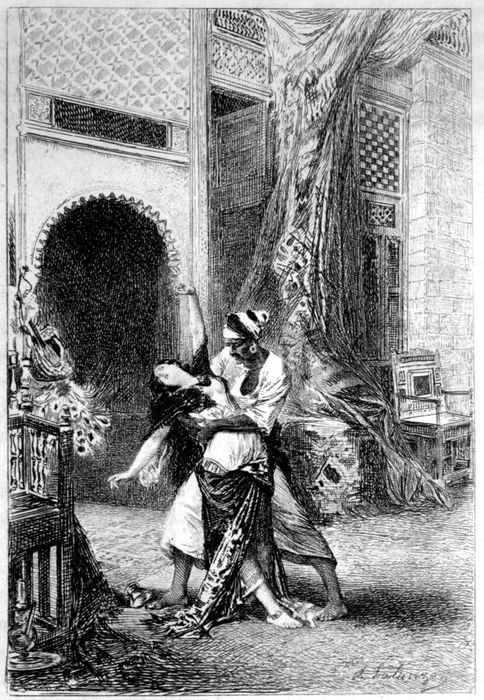
TIBETAN VERSION.
Under the title of “Krisa Gautami” in the collection of “Tibetan Tales from Indian Sources,” translated by Mr. Ralston from the German of Von Schiefner, we have what appears to be a very much garbled form of an old Buddhist version of our story. The heroine is married to a young merchant, whose father gives him some arable land in a hill district, where he resides with Krisa Gautami his wife.
When the time came for her to expect her confinement, she obtained leave of her husband to go to her parents’ house in order that she might have the attendance of her mother. After her confinement and the naming of the boy, she returned home. When the time of her second confinement drew near, she again expressed to her husband a desire to go to her parents. Her husband set out with her and the boy in a waggon; but by the time they had gone half way she gave birth to a boy. When the husband saw that this was to take place, he got out of the waggon, sat under a tree, and fell asleep. While he was completely overcome by slumber a snake bit him and he died. When his wife in her turn alighted from the waggon, and went up to the tree in order to bring him the joyful tidings that a son was born unto him, he, as he had given up the ghost, made no reply. She seized him by the hand and found that he was dead. Then she began to weep. Meantime a thief carried off the oxen. After weeping for a long time, and becoming very mournful, she looked around on every side, pressed the new-born babe to her bosom, took the elder child by the hand, and set out on her way. As a heavy rain had unexpectedly fallen, all the lakes, ponds, and springs were full of water, and the road was flooded by the river. She reflected that if she were to cross the water with both the children at once, she and they might meet with a disaster, and therefore the children had better be taken over separately. So she seated the elder 352boy on the bank of the river, and took the younger one in her arms, walked across to the other side, and laid him down upon the bank. Then she went back for the elder boy. But while she was in the middle of the river, the younger boy was carried off by a jackal. The elder boy thought that his mother was calling him, and sprang into the water. The bank was very steep, so he fell down and was killed. The mother hastened after the jackal, who let the child drop and ran off. When she looked at it, she found that it was dead. So after she had wept over it, she threw it into the water. When she saw that the elder was being carried along by the stream, she became still more distressed. She hastened after him, and found that he was dead. Bereft of both husband and children, she gave way to despair, and sat down alone on the bank, with only the lower part of her body covered. There she listened to the howling of the wind, the roaring of the forest and of the waves, as well as the singing of various kinds of birds. Then wandering to and fro, with sobs and tears of woe, she lamented the loss of her husband and her two children.