Front matter
Reading edition
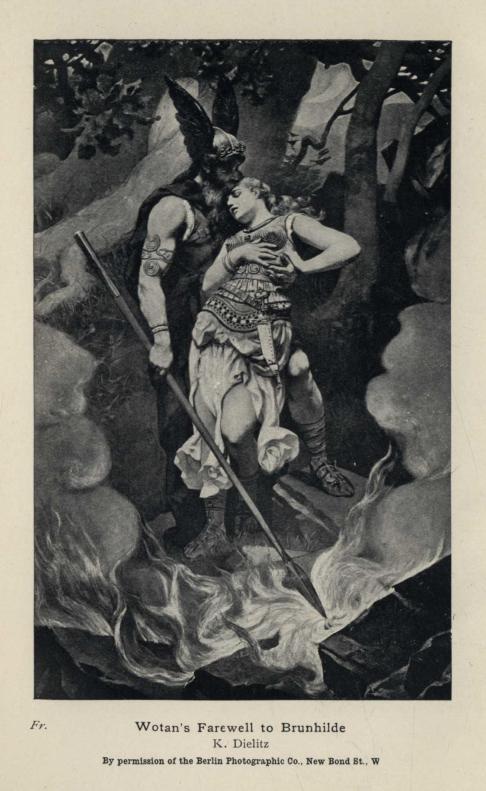
Wotan's Farewell to Brunhilde K. Dielitz By permission of the Berlin Photographic Co., New Bond St., W
STORIES FROM WAGNER
BY
J. WALKER McSPADDEN
AUTHOR OF "STORIES OF ROBIN HOOD" "STORIES FROM DICKENS" "STORIES FROM CHAUCER" ETC.
"He cometh unto you with a tale
which holdeth children from play,
and old men from the chimney-corner."
SIR PHILIP SIDNEY
LONDON GEORGE G. HARRAP & COMPANY 3 PORTSMOUTH STREET KINGSWAY W.C. 1912
Letterpress: The Riverside Press Ltd., Edinburgh
Illustrations: The Ballantyne Press, London
CONTENTS
INTRODUCTION
THE RING OF THE CURSE— I. The Rhine-Gold II. The War Maidens III. Siegfried the Fearless IV. The Downfall of the Gods
PARSIFAL THE PURE
LOHENGRIN THE SWAN KNIGHT
TANNHÄUSER THE KNIGHT OF SONG
THE MASTER SINGERS
RIENZI THE LAST OF THE TRIBUNES
THE FLYING DUTCHMAN
TRISTAN AND ISOLDE
LIST OF ILLUSTRATIONS
Wotan's Farewell to Brunhilde (K. Dielitz) . . . Frontispiece
The Rhine-Daughters (H. Hendrich)
"The Two were reunited in a fond Embrace" (H. Hendrich)
"Siegmund was supporting her Head upon his Knee" (J. Wagrez)
"Siegfried saw someone lying asleep beneath a heavy shield" (J. Wagrez)
"And straight into the Fire she rode" (J. Wagrez)
The Castle of the Holy Grail (H. Thoma)
"The Swan drew the Boat to Shore" (G. Rochegrosse)
Lohengrin and Elsa (E. Klimsch)
"O Queen, O Goddess, let me fly!" (J. Wagrez)
Tannhäuser and Elizabeth (E. Klimsch)
"Eva leaned her Head upon the good Shoemaker's Shoulder" (Victor Prout)
"'Senta!' he said, 'look at me!'" (Victor Prout)
"She flung herself from the Cliff into the raging Sea" (G. Rochegrosse)
"Suddenly she saw that a Piece was missing from the Point" (Victor Prout)
Tristan and Isolde. (Stella Langdale)
Introduction
It would be a longer story than all the "Stories from Wagner" put together, to tell where these tales began and how they grew. Centuries before they were set to music in the soul of Richard Wagner, some of them had been chanted around rude camp-fires by savage-looking men clad in the skins of animals. They were repeated by word of mouth long before even the rudest art of writing was learned; and in various lands they were known, though the stories often differed. For in those days men believed in spirits, good and bad, and in giants, dwarfs, gods and goddesses. They told these stories to their children, just as real history is taught to-day; and later the legends were treasured not only for their deep interest but also because they showed how people lived and thought, long ago "while the world was in the making."
When Wagner, the great music-dramatist of Germany, was writing his wonderful operas, he found much of this rich material lying ready at his hand. Other parts he adapted to suit his needs. And it is the form in which he used the tales that has been followed in the simple retelling in the present volume; hence the justice of the title—"Stories from Wagner." Let us pause a moment to see who this author was, and how he came to collect his themes.
Richard Wagner's career extended over the better part of the last century. He was born at Leipzig, May 22, 1813; he died at Venice, February 13, 1883. His whole life was a struggle, for his musical ideas were unlike any that had gone before. But he lived to witness a splendid triumph; and to-day his operas are produced more often than those of any other composer.
The following is the order in which the operas were first given:—
Rienzi, 1842 The Flying Dutchman, 1843 Tannhäuser, 1845 Lohengrin, 1850 Tristan and Isolde, 1865 The Master Singers, 1868 The Ring of the Nibelung, 1878 Parsifal, 1882
When Wagner was just beginning his career, he was in great doubt as to the choice of subjects for his operas. His first famous work, "Rienzi" was based upon Italian history. The English novelist, Bulwer-Lytton, has written a noted novel, using the same title and groundwork.
The legend of "The Flying Dutchman," which Wagner next chose, is one of the best-known sea-myths in existence. In every country sailors tell of a mysterious ship that is seen in times of danger or distress. The captain of this vessel bears many names, but it is believed that the varying tales are only versions of one original legend. The German poet, Heine, wrote one version, and from this Wagner obtained the first idea for his opera.
With "Tannhäuser," Wagner entered upon the purely German themes which he was thenceforth to find so rich a mine. This story like many others was extremely old, yet it had been treated only rarely. Ludwig Tieck had written some verses upon it, and from these Wagner got his idea. Owen Meredith, the English poet, has also given us a charming version entitled "The Battle of the Bards." While Tannhäuser himself has been seldom written about, Walter von der Vogelweide—the minnesinger, and friend of Tannhäuser in the opera,—is the subject of many poems, one of the last being by Longfellow. Sir Walter is set down in German history as an actual person, and many things are told about his marvellous gift of song.
Wolfram von Eschenbach—another historic character found in the operas—once wrote a famous old poem entitled "Parzival." Here Wagner discovered the germ of his beautiful story of "Lohengrin," following the lines of an old and well-nigh forgotten legend. The opera of "Parsifal" though not completed till more than thirty years later was also conceived at this time, and remained a cherished project. Legends of the Holy Grail, with which it deals, are familiar in every Christian country. There is much in the characters of both Parsifal and Lohengrin to remind us of Tennyson's Sir Galahad, in "Idylls of the King," which treats of the Holy Grail.
In "Tristan and Isolde" we have another legend which was well known during the Middle Ages. It was known in Wales, Ireland, Brittany and Germany where it was a frequent theme with minnesingers, or wandering minstrels, like Walter von der Vogelweide. One of the earliest German authors to write down a version of it was a certain Godfried of Strasburg; and Wagner had at his command this and numerous other versions. English poets, also, have been greatly attracted by the tale. Sir Walter Scott, in "Thomas the Rhymer," told the simplest version. Matthew Arnold, Tennyson, and Swinburne have given notable poems of some length on the subject.
During the Middle Ages, and particularly in the thirteenth century, the city of Nuremberg was the seat of a famous musical guild, or training-school for poets and singers. In his "Master Singers," Wagner has followed history for his scene, characters and traditions, though he has made droll use of them. The Master Singers have left substantial proof that they really lived. There are poems still in existence, signed by Sixtus Beckmesser, Veit Pogner and others; while Hans Sachs has left whole volumes behind, and his memory is so revered that he is looked upon almost as the patron saint of his city. Longfellow says in his poem on "Nuremberg":
"Here Hans Sachs, the cobbler-poet, laureate of the
gentle craft,
Wisest of the Twelve Wise Masters in huge folios
sang and laughed!"
Wagner also obtained his idea for the contest of song from one of Hoffmann's novels entitled "Sängerkrieg." He made use of the same idea in "Tannhäuser."
Although "The Ring of the Nibelung," Wagner's grand lifework, was not presented until 1876, he had been at work upon its four parts for more than twenty-five years previously. He had published the first two parts without their musical score, in 1853. The other operas which appeared in the meanwhile were but breathing-places, so to speak, in the greater labour he had set himself to perform.
Wagner was especially fortunate in his choice of subject. The Nibelungen myth was a great national epic—one of the oldest of the Teutonic race, dating back to the prehistoric era when Wotan, Fricka, Freia, Thor, Loki, and the other gods and goddesses were worshipped in the German forests. In the course of centuries several versions of the legend appeared, some being found even in Iceland under the name of "Eddas." In Germany a long epic poem came to be written by some unknown hand. It was called the "Nibelungenlied," and it is the most famous of all early German poems.
Of course Wagner had access to all this material. But he made so many changes from it in writing his own poem as to create a new story—one which, independent of the wonderful music which he wrote to accompany it, gives him place among the foremost writers of his nation. Volumes have been written pointing out the differences between his Nibelung story and the earlier legends.
But the purpose of this little book is not to criticise, dissect, or compare. After giving these few needful names and dates, we wish merely to follow the splendid fancy of this singer of songs and teller of tales wherever in the realm of storyland it may chance to lead us.
One further word, however, of frank admission. While the spirit of the original is adhered to, and very often the exact words are quoted, it has not been deemed best to follow the argument too closely. Instead, simplicity and directness have been considered preferable to the involved plots and symbolical actions of the operas.
The book is directed primarily to the needs of young people, and is sent out to them in the hope that some time they may hear the dull booming of the Rhine about the Gold, the magic fire as it sweeps to encircle the sleeping maiden, the forest voices which greet the young and fearless hero, the chorus of the pilgrims, and the song which won the bride for a prize. All these and many other good things are held in store by the future. Meanwhile "the story's the thing," and we who will never grow too old to believe in giants, dragons and dwarfs, and the brave heroes who ride over the world doing heroic deeds, can still be thankful that Wagner lived and dreamed his dreams of the past.
J.W.M.
The Ring of the Curse
(Der Ring des Nibelungen)
PART I
THE RHINE-GOLD
Hundreds of years ago in a wonderful time called the dawn of the world there lived many strange beings which do not now exist. Gods and goddesses dwelt in the clouds that hovered about the mountain peaks. Great untamed giants roamed amid the valleys. Swarthy, misshapen dwarfs, called Nibelungs[#], toiled in the caves of the under-world heaping up treasures of gold and silver which never did anyone any good. Ugly dragons crawled about on the earth; while beautiful water-nymphs lived in the rivers and seas. Lastly there were heroes and savage men who struggled together for the mastery in that far-off day when the world was in the making.
[#] Pronounced Nee-bel-oongs.
How the end came to all these strange things, and how the reign of the gods finally ceased, will be set down in this fourfold story I am about to tell you.
In the clear depths of the river Rhine, in Germany, once dwelt three water-nymphs—lovely maidens who were very like other maidens, except that they passed their whole lives under the water and could not be seen by ordinary eyes. Fair were they in face, and graceful in form. Their eyes beamed gladness, for they had never known sorrow; while their long golden hair floated about them like a garment, or tossed upon the wave-crest as they played some merry game of hide-and-seek amid the grottoes of their watery world. They were called the Rhine-Daughters, and thus in frolicsome play did they spend their days—free from all care save one. It was this care and the sorrow following close upon it that caused the present story to be told.
Upon one of the highest rocks, deep down in the bed of the Rhine, was stored a great lump of pure gold, brighter and more dazzling than any other treasure ever known. It was also more wonderful than any other gold, because it contained the power of making its owner master of all the world. This treasure had lain undisturbed in the river's bed for so long that it had come to be known as the Rhine-Gold. It was watched over by the Rhine-Daughters, in whose care their father had left it. This was their sole duty—to keep guard night and day lest some thief should come and steal the priceless treasure.
One bright morning the maidens seemed unusually merry. They darted in and out the caverns with a speed which left the flying-fish far behind. They laughed and chattered and sang, but glancing from time to time up at the precious Rhine-Gold, to see if it still glittered upon its protecting crag.
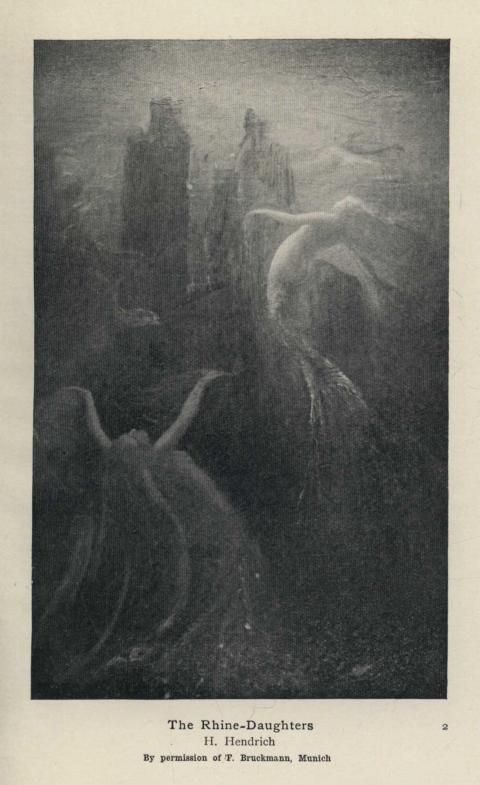
The Rhine-Daughters H. Hendrich By permission of F. Bruckmann, Munich
Presently their happy noise at play attracted a passer-by, who clambered upon one of the jutting rocks to see what it was all about. The new-comer stood in the greatest contrast to the three laughing girls. He was a dwarf, little and ugly and crooked, with a humped back and long, claw-like fingers to match the eager, grasping look in his small eyes. He was Alberich, of the race of the Nibelungs—the earth-dwarfs who dug for treasure in the underground caverns, and hammered and toiled without ceasing for the gold that never did them any good.
"Ho, ho!" he exclaimed to the maidens. "A fair morning to you!"
The nymphs started in alarm at the harsh, croaking voice. Nor did their first sight of the visitor reassure them. But they replied, civilly enough,
"A fair morning to you, sir!"
Then one of them darted swiftly upward, singing as she went
"Guard well the Gold;
'Twas just such a foe
Our father foretold."
Nevertheless Alberich had paid no attention to the Gold, so pleased was he by the nymphs and their gambols. And they in turn, losing their fear of the uncouth monster, and willing to tease him, asked him to catch them in their game of hide-and-seek. This he tried to do; but blinded by the unusual light, and stumbling awkwardly over the rocks, he could never keep up with their fairy-like antics. First one and then another would come near him or ascend the rocks, but it was always just beyond his reach. Finally their laughter and teasing made him angry, and he stopped short, refusing to be made sport of any longer.
Just then a ray of sunlight filtered down through the water and struck the Rhine-Gold. Instantly it glowed as though it were a mass of flame, reflecting a hundred shafts of light where one had smitten it. The whole river-bed was illuminated by the glorious rays.
The astonished dwarf looked toward the source of this splendour, and what he saw made his small eyes fairly bulge out with greed. Yet he concealed his amazement and waited to learn something about this splendid treasure without betraying his own interest. Fortune favoured him. His unspoken question was answered by the Rhine-maidens who surged upward with a glad cry of "The Rhine-Gold! The Rhine-Gold!"
"What is this Rhine-Gold you are talking about?" asked the dwarf with a great show of indifference.
"What! Haven't you ever heard of the wonderful Rhine-Gold?" asked one of the maidens thoughtlessly. "We supposed it was famed over all the world."
"But I dwell in the under-world and hear not the things which are spoken among men. Tell me of it, I pray."
Then the maiden forgot her father's warning to guard the treasure closely. She also felt nothing but contempt for this awkward little man from whom they could so easily escape. She told the secret of the Gold in the words of a song
"The realm of the world
To him shall it bring
Who out of this Gold
Shall fashion a Ring
Of magical power untold.
"Hum! Say you so?" said the dwarf, keeping his excitement down by a powerful effort, though his finger-nails fairly clawed into the flesh. "If your metal is as fine as all that, why doesn't someone lay hands upon it and do all these great things?"
"Sister, sister! be careful!" said another of the nymphs.
But the first only laughed and replied, "What can this silly old fellow do? Let us have some more fun teasing him!"
Then the third maiden floated gracefully near. "Why doesn't someone seize the Gold?" she repeated. "'Tis because no one has yet been able to pay the price."
"What is the price?"
"This is it," she answered. "Listen
"'He who forswears the might of love,
And all its pleasures manifold,
He only has the magic art
To mould the Ring from out the Gold.'"
"Pish! a pretty story you are telling me!" said the dwarf. "As though a little matter like doing without love should make a person master of the world!"
He made a great show of scorn while he said these words, but all the time he was edging quietly nearer the treasure.
"But love is the greatest thing in the world!" said the first maiden. "No one can do anything without its wonderful aid. Why, even you—poor old fellow!—would not dare forswear it."
"I would not dare forswear it—eh?" exclaimed the dwarf with a snap of his fingers and a wild laugh of triumph. "Love, forsooth! What is love to me, when gold is in question? Hark you, Rhine-maidens! I renounce love for ever! Be my witness!"
And he sprang rapidly forward, before the nymphs could prevent him, clambered up the jagged rock and seized the coveted treasure.
"Our Rhine-Gold! Our Rhine-Gold!" shrieked the maidens. But it was too late; already he had disappeared in one of the clefts of rock leading to his cavernous home, and though they darted after him they could not find him in the dark depths. Only his mocking laugh came back to them.
"Ho, ho! Love! When all the world shall be mine!"
Now we have already seen that the nymphs and the dwarfs formed only a part of the strange world, so long ago. At the very time when Alberich was stealing the Gold and preparing to make the Ring of Power down under the earth, there was an unusual happening in the home of the gods far up on the mountains.
For a long time Wotan, the greatest of the gods, had desired a palace large enough to contain his kingly court. But he could find no one strong enough to build it, until on a day two giants from the valleys below came into his presence. Large were they of shoulder and thigh, many times larger than ordinary men.
"We have come to build your palace," they said.
"Who are ye?" asked Wotan, looking piercingly at them with his single eye.
"I am Fafner, the frost-giant," answered one. "I can rend all these rocks asunder and build your palace in a single night, with the aid of my brother Fasolt, here."
Wotan was overjoyed to find someone who would undertake his cherished plan.
"What payment do you desire for this service?" he asked.
"You must give me the hand of your beautiful sister, Freia," answered Fafner.
Wotan frowned. He desired the palace above all things, just then, for it would enforce his visible rule over the world. But Freia was his favourite sister. Moreover, it was she who was the goddess of youth and beauty and who tended the tree of golden apples which kept the gods always young.
While Wotan was frowning and pondering to himself, his brother Loki whispered in his ear,
"Let them build the palace. We shall find another way out of the bargain."
Now Loki, god of fire, was the craftiest of all the gods. So when Wotan heard his whispered advice his brow cleared, and he looked at the giants.
"So be it!" he commanded. "Build me the castle 'gainst another sunrise. It shall be Walhalla—the supreme home of gods and men."
The giants bowed and went their way. Presently the sound of mighty blows was heard, and terrific crashes as of the bursting asunder of rocks. All that day and night the tumult continued, while the earth shook to its very foundations.
The next morning the rising sun lit up a splendid spectacle. There stood Walhalla, magnificent home of the gods, upon the crest of a towering cliff. Its white walls gleamed and glistened. Its towers and buttresses were built of stones so large that they seemed placed for all eternity; yet the whole mass appeared as light and graceful as a fairy vision.
"Beautiful! Wonderful!" cried the gods and goddesses in rapture.
"Let us take up our abode in our new home!" said Wotan, with the delight of a schoolboy.
But just then the two giants appeared clad in their shaggy skins of slain animals.
"Hold!" said Fafner. "First give us in payment the goddess Freia as you promised us."
"That I cannot do," replied Wotan. "You must think of some other way for me to reward you."
"Not so!" exclaimed the giants angrily, their hoarse voices making all the mountain quiver. "Give us the maiden, as you agreed, else we shall tear down the palace quicker than we built it."
And they placed themselves on each side of the trembling Freia.
"Touch her not!" cried two gods, as they sprang forth to protect their sister. "Do you not know," continued one, "that I am Thor, god of thunder, and that with one blow of my hammer I can crush you both?"
And he raised his hammer threateningly. But now the great Wotan interposed in his turn.
"Restrain your fury!" he commanded, stretching forth the dread Spear of Authority between the giants and the gods. "By this Spear the word of Wotan cannot be broken; and unless Fasolt and Fafner agree to accept other reward, they must e'en take our sister with them to the regions of frost."
At this command the contending ones fell back, but there arose a low cry of fear from the lovely Freia and a deep lamentation from the other gods. For how could they live without their sweet sister, she who gave them the apples of eternal youth?
Meanwhile Wotan had been casting his eyes impatiently from side to side. He was looking for his crafty counsellor, Loki, and wondering why he did not appear with his aid; since he it was who had promised to find a way out of the bargain.
"Come, decide!" said the giants, again stepping forward.
"Only one hour more," pleaded Wotan. "I must confer with my counsellor who is just now absent."
"Only one hour, then," replied the giants.
"Send out messengers in search of Loki, god of fire," commanded Wotan. "Let him be summoned instantly."
But at this moment who should appear but Loki himself, walking in unconcernedly and looking about in feigned surprise as though he were the last person anyone would wish to see.
"Good-morrow, all!" he said airily. "That is a beautiful castle I see upon yon mountain height. I have just been examining it from every side, and upon my word it would defy even my arts to destroy it!"
"Yes, yes," replied Wotan, impatiently, beginning to be a little ashamed of his fine Walhalla. "But that is not the point, just now. These giants demand our sister Freia as their reward; and you remember you promised to find a substitute for her."
The sly Loki arched his eyebrows in mock surprise.
"A substitute for her!" he exclaimed. "Why how could that be possible? I should think that Fasolt and Fafner would rather have her than all the treasures in the world. Is she not the goddess of youth and beauty?"
At this the two gods Thor and Fro raised their weapons in great anger, and would have fallen upon Loki, had not Wotan restrained them. He knew the cunning of the latter, and was persuaded that Loki had found a plan.
"Yes," proceeded Loki as calmly as though there had been no interruption, "all the riches in the world would not take the place of Freia. Even the far-famed Rhine-Gold would hardly answer. And, speaking of the Rhine-Gold, do you know that I have just heard a strange story.
"While passing along the banks of the Rhine, I became aware of the sound of pitiful weeping and wailing. I turned me about to see whence the doleful sound came, and I beheld the three Rhine-Daughters. They were no longer joyous and care-free as was their wont, but they were beating their breasts and tearing their hair while they cried, 'Our Rhine-Gold! Our Rhine-Gold! Stolen! Stolen!'"
"What! Have they suffered the Rhine-Gold to be stolen?" asked Wotan in alarm.
"'Tis as they said; for I stopped and questioned them. They said that the dwarf Alberich had seized upon the treasure and fled away to his earth-caverns, where he was even now making the magic Ring of Power. He has set himself up as King of the Nibelungs, and he purposes to rule the whole world."
The giants Fafner and Fasolt leaned eagerly forward and drank in every word of Loki's story—as indeed he had intended they should.
"Ah! that would be a prize worth having!" they exclaimed, rubbing their huge hands. "Mighty Wotan, if thou wilt wrest this treasure from the Nibelung and give it to us, we will release the goddess."
But Wotan again grew disturbed and silent. He knew that the Gold rightfully belonged to the Rhine-Daughters, and that it would prove a danger even to the gods themselves, unless it were returned. The giants saw their advantage and followed it up.
"Decide for yourselves," they said, laying bold hands upon Freia. "Our work is done and we claim the reward. Either this maiden or the Rhine-Gold. And until you decide, she must follow us to the frost-land."
And unmindful of her cries of distress the giants bore Freia away, across the cliffs and down the mountain-side, the gods standing powerless to prevent.
As they stood gazing in dismay a thin mist arose from the valleys, and it seemed to touch all the gods with blight, as it were a frost. For the goddess of youth and beauty was gone, and old age had already begun to lay hand upon those that remained.
"Come, this will never do!" exclaimed Loki in jeering tones. "Will you stand in your tracks and let old age blight you?"
And then he began to taunt each of the gods separately, as was his wont.
"Look!" cried Fricka, wife of Wotan, "the golden apples even now are withering. Wotan, husband, behold thy doom! See how thy compact hath wrought ruin and wreck for us all!"
Wotan started up, fired by a sudden resolution.
"Up, Loki!" he commanded. "Follow me. We must fare to the caverns of night and seize upon this Gold."
"And then——?" asked Loki. "The Rhine-Daughters implored thine aid. Wilt thou restore it to them?"
"'Tis idle talk," retorted Wotan moodily. "Freia the goddess of youth and beauty must be ransomed, else we shall all perish."
"Then let us hence," said Loki, who had gained the point at which he had aimed from the outset. "Let us hence. I know a cleft in the rock, which serves as a chimney for the Nibelung's forge fires. Perchance he is even now hammering out the Ring of Power. Come, let us descend into his cavernous dwelling."
So saying the god of fire wrapped his mantle about him and set forth, closely followed by Wotan with his dread Spear of Authority.
As two simple wayfarers they travelled down the rocky chasm—down, down, down, and still down, while the hammering from the forges grew louder and the sulphurous smoke came curling up more and more thickly, till it would have suffocated anyone but a god.
At last they emerged into a huge cave, around which hurried hundreds of queer little people, each as ugly and crooked and dirty as Alberich. They were blowing the fires, pounding away upon huge masses of metal, or scurrying about with arm-loads of gold, silver, and precious stones.
Just then the two wayfarers heard a quarrelling in a side passage of the cave, when in came Alberich himself dragging another dwarf shrieking by the ear. It was Mime, his own brother, but that made no difference with Alberich.
"Where's the helmet, you rogue?" he said. "It shall not be well with your skin if you don't give it up."
"Mercy, mercy!" howled Mime, the tears making little furrows down his dirty face. "I haven't got it done yet."
"Yes, you have! What is that you are trying to hide in your hands? Give it to me, I say!"
And Alberich seized the object which Mime had just dropped in terror.
"Ah! just as I thought!" continued the stronger brother. "Here is the magic helmet all complete; and this sly knave thought to keep it for himself. But I shall pay him for his treachery!
"Hark you, rascals!" he continued, turning to all the other dwarfs. "I am your king. Ye must henceforth serve me alone, and pile up all your treasure in the royal vaults. I have this day obtained the powers of magic which make you my servants. At this moment you see me not; but I shall make myself felt among you, I promise you!"
And with this speech he clapped the helmet upon his head and instantly vanished. But in his stead there came a pillar of mist, and out of the mist came his voice sternly commanding them to obey. Then the sharp lashes of a whip were heard right and left; and Mime fell groaning to the ground while the others retreated in terror, seemingly driven along a narrow way on the far side of the cavern. Alberich was beginning his reign with a vengeance!
Meanwhile the two celestial visitors had stood unnoticed in a side passage. While they debated as to the best means of making their presence known, Alberich came back in his true shape, carrying the helmet in his hand, fondling the Ring upon his finger and chuckling with glee. Then he espied the two gods, and his brow wrinkled darkly.
"Why come you to my caverns?" he demanded. "Know you not that I am king here, and that strangers are not welcome?"
"We have but come to see some of the marvels of which we have heard so much," said Wotan pacifically.
"Humph!" said Alberich. "You look quiet enough, but I think I know you both. Yet I fear you not, whether gods or men; for I am master here."
"And what if we are indeed gods, dear Alberich?" said Loki, taking off his mantle. "See, I am the god of fire, and your best friend. Do I not keep all your forges going?"
"Yes, that may be true," retorted Alberich. "But for all that I fear neither you nor Wotan the mighty. With this Ring made from the Rhine-Gold I can defy you all."
Alberich's accustomed low cunning had vanished before his sudden access of power. He was no match for the crafty god Loki.
"Oh, what a beautiful ring!" exclaimed the latter, bending forward admiringly. "Is it really made from the far-famed Rhine-Gold?"
"It is," said Alberich, swelling up. "I made it myself, and its possession gives me everything in the whole world except love."
"But some people think that love is the chief thing," said Loki.
"Pooh! that's because they haven't the gold I have. The two do not go together anyway, and never will. As for me, give me gold and power." And he kissed the Ring.
"But what if someone stole the Ring while you slept," persisted Loki.
"They couldn't," retorted the dwarf quickly. "See this helmet? That silly brother of mine yonder in the corner has just made it for me out of some more of this fine Rhine-Gold. With it I can change myself into any form I choose, and defy the slyest of robbers."
"Oh, that cannot be!" replied Loki. "Only the gods can do such things. Unless I saw such a marvel with my own eyes, I never would believe it."
Alberich looked with scorn upon this doubting fellow; then willing to prove his boast, he put the helmet upon his head and muttered a few words. Instantly he was gone, and in his stead a huge serpent came wriggling along the floor, stretching its hideous jaws toward Wotan and Loki. The latter fled in pretended terror, while Wotan laughed calmly. The snake then disappeared, and the dwarf once more stood before them.
"Now do you doubt my power?" he asked proudly.
"Oh, it was wonderful!" exclaimed Loki, rolling his eyes. "I couldn't have believed it possible! But I should think it would be a great deal harder to turn yourself into something small?"
"Not at all," replied the Nibelung. "Watch this!"
And before the gods were aware, he was gone again. They looked high and low, and there among the small stones a toad came hopping toward them.
"Quick, put your foot on him!" exclaimed Loki.
Wotan put his foot upon the toad, and instantly it was gone, and in its place Alberich lay struggling vainly to get out.
"Let me up! You are crushing me!" screamed the dwarf.
"Not until you give us every bit of the Rhine-Gold, the helmet and the Ring," said Wotan.
"You can have all but the helmet and the Ring; and there's a lot of it—beautiful Gold!" whined Alberich.
"No, all of it!" said Wotan.
"You can have the helmet, too. Ough! you're smashing me!"
"The Ring and all, I tell you! Here, Loki, bind him with that rope!"
"Then take the Gold, the helmet and the Ring!" cried the dwarf despairingly.
They bound him, and let him up. As soon as he could catch his breath, he continued,
"Take the Ring and all! But listen well to what I say. My curse rests upon it for ever. Cursed be he who owns it, whether eating or sleeping or waking. Cursed be he and all his, whether god or devil. Sorrow and unhappiness shall go with this Gold through all the ends of the earth!"
Notwithstanding this dread curse, the gods seized the Ring from off his finger and lost no time in making off with the treasure, leaving the dwarf grovelling upon the floor and muttering fierce words against them. All their care now was to ransom their sister and drive away the mists of old age.
On their way up the mountain height they met the two giants bearing away the struggling Freia in their clutches.
"Hold!" commanded Wotan; "bear her no farther. We have brought the gold to ransom her."
"Is it the far-famed Rhine-Gold?" asked Fafner.
"See for yourselves!" said Loki, casting the glittering heap upon the earth. "In all the world ye will not find its like."
The giants gazed greedily upon the hoard, and drew near to parley.
"'Tis indeed a wonderful treasure," they said; "but the mass must equal in height and breadth the stature of this comely goddess."
"So be it," answered Wo-tan, and he commanded that staves be set upright in the ground and that the Gold be heaped between them. Thor and Fro and others of the gods had now arrived upon the scene—all overjoyed at the prospect of Freia's release; for already the blighting mist was beginning to lift, though it yet concealed the fair towers of Walhalla. Meanwhile Loki had been careful to withhold the Ring and the helmet from the rest of the hoard, which was now quickly heaped up between the upright staves.
At last, just as the Gold was exhausted, the pile rose above the top of Freia's head.
"Here, take the treasure," said Wotan, "and release our sister unto us."
"Nay, not so," said Fafner. "I see a hole in the heap, and through it gleams the goddess's hair, brighter than any gold. You must fill the hole. Cast on the helmet which yonder Loki is bearing."
Wotan could scarce restrain his rage at this rude bartering of his sister, while the impetuous Thor fingered his mighty hammer nervously. But Wotan saw it was useless to refuse. He made a sign of command to the unwilling Loki, and the latter cast the helmet on the heap.
Fafner again walked around it looking closely on every side.
"Ah!" he exclaimed. "Here is just one more little crack. But through it I can see the gleam of the goddess's lovely eyes. You must place the Ring here to make the ransom complete."
"Never!" cried Wotan furiously.
"Very well, then. We shall be forced to take the goddess with us."
And once more Fasolt laid his rude hands upon the shrinking maiden.
Thereupon a great tumult began. The voices of the gods rose in entreaty to Wotan to give up the Ring and save their sister and themselves. Thor sprang forward with uplifted hammer, while the hoarse voices of the giants bade defiance to them all. Again the dread mist crept up from the valleys, and darkness descended from the clouds. Still Wotan remained defiant. He was turning away in anger from the tumult, when out of a cleft in the rock a weird bluish light broke forth, and there emerged a woman of dignified and noble mien. Her long black hair swept upon the ground, and her flowing robe seemed made of all the leaves and growing things of the soil. She was Erda, the spirit of Mother-Earth, gifted with wisdom and foresight such as was not given even to the gods themselves.
Erda stretched her hand out warningly toward Wotan.
"Yield, O Wotan!" she cried. "Escape the curse of the Ring, and all the hopeless woe it entails!"
"Who art thou, boding spirit?" demanded Wotan. And in a chanting voice came back the reply:
"All that was I know,
All that is I know,
All that ever shall be done,
This as well I know.
Erda the name I bear,
The Fates my daughters are,
Danger threatens dire,
This has drawn me near;
Hearken! hearken! hearken!
All that is shall end.
Heed ye well, ere dawn of doom,—
Beware the cursed Ring!"
As the chant ended, the bluish light died away and with it vanished the warning figure.
"O stay, dread spirit!" cried Wotan. "More would I learn!"
But only silence answered him; and after gazing into the darkness in anxious thought, he turned suddenly and approached the giants.
"Here is the Ring," said he sternly, drawing it from his finger and placing it upon the heap. "Begone, and leave us our sister! But a curse has fallen upon the Gold."
And so it proved. The gods themselves were witness of the first-fruits of the curse. For as the two giants fell greedily to work gathering up the treasure, a dispute arose. Fasolt claimed that Fafner was taking more than his rightful share. They came to blows over it, when Fafner smote Fasolt to the ground with a blow so heavy that it killed him. Then the victor, unmindful of his deed, hastily gathered up all the wealth and departed, while the gods stood around silent and amazed that the curse should descend so swiftly. And Wotan foresaw in this tragic moment the awful doom which was one day to descend upon them all, because the Gold had not been restored to the Rhine-Daughters.
But his gloomy thoughts were broken just then by a mighty crash, like a peal of thunder. There upon the cliff leading to the beautiful new palace which had cost so much, stood Thor wielding his hammer upon the encircling clouds. Flashes of lightning burst forth. The clouds and mist rolled away, revealing Walhalla in all its splendour; while from their feet, in dazzling radiance, gleamed a rainbow-bridge leading across the chasm to its portals.
"Come! let us go over to our new home!" said Wotan, taking his wife Fricka by the hand.
And followed by the laughing gods and goddesses, who surrounded Freia, fairest of the group, they went across the rainbow-bridge and entered the stately halls of Walhalla.
The setting sun shone brightly on the scene. The clouds had melted away into blue sky, leaving a soft radiance which seemed to encircle their new home in a halo of delight. The evening fragrance of the valleys came up to them redolent with the springtime of growing things. As they trod the shining pathway the jests and merriment of the gods showed their gladness in this new home that had been made for them at so great a cost.
Still Wotan was not happy. He had decided seemingly for the best; but as he crossed the arching bridge he heard voices from the valley far beneath him, rising like the tones of conscience or the warnings of fate. It was the mournful song of the Rhine-Daughters:
"Rhine-Gold! purest Gold!
How fair thy gleam,
Thy wealth untold!
But now thy rays
Light not the stream;
Ah! give them back—
Give back the gleam,
Rhine-Gold!"
PART II
THE WAR-MAIDENS
The new home of the gods proved to be as beautiful within as it had appeared without. When they had all crossed the arching rainbow-bridge, loud shouts of joy and admiration arose; for it was the most splendid palace that gods or mortals could ever imagine. Long porticos and galleries with huge sculptured pillars ran in every direction, leading to cool fruit arbours, or open courts where silvery fountains splashed. Great rooms opened up with ceilings so high that they seemed to take in the sky itself. The spacious floors were paved with burnished gold, and the walls set with polished stone and fine jewels, so that they blazed with light as bright as the noonday.
On every side of the palace were smooth greenswards, and groves of stately trees. And in the midst of the largest grove of all grew the wonderful tree bearing apples of gold, from which Freia fed all the divine family to make them immortal.
For a long time the gods and goddesses lived in Walhalla quite happily. Each morning they found some new beauty to admire. Each evening they came together for a feast or entertainment.
But in one heart there was no happiness, and that was the heart of the mighty Wotan himself. His beautiful home, the dream of his life, was finished. But at what a cost! The curse of the Rhine-Gold would come upon them, unless the stolen treasure were returned to its rightful guardians. The gods themselves would be destroyed, if they kept not their honour.
So Wotan sat apart from the rest, and his brow grew dark with forebodings. Fricka, his wife, gently chided him for his gloom but to no avail, and even the beautiful Freia could no longer make him smile. When any of the other gods praised the beauty of the palace, he would nod his head and answer; "Its price was great."
Finally Wotan could endure his anxiety no longer. Knowing that unless some way were found to restore the Gold they would be in constant peril, he resolved to consult Erda, the earth-spirit. So, one day he took his Spear of Authority and went forth into the world to find a way out of the trouble which had come to him with Walhalla.
The weeks grew into months and the months into years, while Wotan was gone. The other gods sought him in vain, but could hear no tidings. They wondered what had become of him, and the feasting and revelry gave way to sad forebodings. Only Fricka, the queen, went about with some measure of confidence.
"Be not sad," she said. "Wotan will return soon, bringing with him some great means of safety and content."
Fricka spoke true. One fair day at early dawn the gods were awakened by the sound of war-like singing. It was entirely different from their own music, and it seemed borne to them on the wings of the wind. Nearer and nearer came the song, swelling into a splendid strain of triumph. Then flying figures were descried, and the watchers at the window saw Wotan returning to them as it were through the clouds. He was in the midst of a company of maidens, whose faces were fair but who were strong and soldier-like. Each rode upon a powerful horse, and, wonder of wonders, the horses had wings like eagles and flew swiftly through the air!
There were nine of these horses and riders in all, and so fast did they ride that they had reached the palace gates, dismounted, and were being led within by Wotan almost before the first strains of music had died away.
You may believe that all the gods and goddesses were exceedingly glad when they saw Wotan again; and they hastened out upon the battlements to greet him and give him love and honour. To one and all he replied full pleasantly. His brow was clearer than it had been in many a day; and it was with the sprightliness of youth that he led the nine fair warriors up the broad palace steps. Then turning he addressed his court.
"These are the War Maidens," he said, "who come to guard our kingdom from its enemies. It is their mission to ride up and down in all the world, to choose the bravest heroes who have fallen in battle, and to bring them to Walhalla. With all these heroes we shall be protected from peril in the evil days to come."
Then Wotan introduced each War Maiden by name, beginning with Brunhilde who was the strongest and the loveliest. And they were welcomed royally to the palace by all who lived therein. The golden apples of life were given them to eat, and they became immortal.
Day by day the War Maidens rode forth into battle, seeking for the bravest men. Whenever they found one who had fallen in the forefront of conflict, they carried him to Walhalla where he became immortal. There was much fighting in the world in those days, so the palace soon received many mighty soldiers, and Wotan grew light of heart. For now, he thought, he could defy the dwarf's curse and all the powers of the underworld. So he trained his soldiers constantly, and had them continually in battle, one against another. And if one by chance received a wound it healed of itself through magic power.
Still the loss of the Gold and of the Ring was an ever-present danger. Wotan knew this, and cast about for some means to restore the treasure to the Rhine-Daughters so that the peril might be removed.
Now Fafner the giant had taken the Gold to a cave in the midst of a dense forest. By the aid of the magic helmet he had changed himself into a fierce dragon, and in this shape he guarded the mouth of the cave night and day. So you see that he wasn't getting very much pleasure out of his hoard.
Being a god, Wotan of course knew where Fafner the dragon lay hid. But neither he nor any of the gods could attack Fafner or lay hands upon the treasure. It had been given the giant in open barter and so was beyond their recall. But Wotan reasoned that if some earth-born hero could be found brave enough to slay the dragon, the Gold could be secured. Failing this, the dwarf Alberich might in the end be crafty enough to regain it and wreak his vengeance upon the gods.
The peril was still great therefore, in spite of the warriors in Walhalla. Wotan realised all this and resolved to journey again through the world in quest of a hero to attack the dragon. For many days he searched without success. Then he chose a son of his own for the great task, living with him as a simple forester while the boy grew up, and training him to warlike deeds. The boy's name was Siegmund, and as he reached young manhood he was straight as a young pine-tree in the forest and strong as the oak which defies the winds of heaven.
While Siegmund was still a youth a great sorrow befell him. Sieglinde a young girl of his own age with whom he had grown up, and whom he looked upon as a sister, was seized by a fierce hunter and carried away to his home in the forest. For many months Siegmund sought to rescue her, but without success. He grew to manhood with this object before him, and vowed eternal warfare against the hunter and all his clan,—a vow Wotan aided him to keep, until the very name of Siegmund became a terror to the hunter.
Then another sudden grief befell the young warrior. Wotan mysteriously went away one day, leaving no trace and no message save that when Siegmund should be in direst need he would find a trusty sword at hand to aid him. Siegmund now felt forsaken indeed; and he roamed about aimlessly in the forests, hunting the wild beasts, helping people in distress, or fighting against the hunter's tribe.
One night, utterly spent from his wanderings, he sought shelter in a house built in a peculiar manner round the trunk of a great oak-tree. Seeing no one within the main room he entered, closed the door behind him, and lay down exhausted in front of the fire, where he soon fell fast asleep.
Presently a maiden came into the room. She expected to find the hunter there, for this was none other than his house, although Siegmund did not know it. When instead of the master of the house the maiden saw the stranger lying upon the hearth, she sprang back in sudden fear. But the poor man did not move, so she came gently to his side, to see whether he were alive or dead. Siegmund stirred uneasily in his sleep, then, wakening, tried to utter a few words, but his parched lips gave forth little sound. Seeing his pitiable state, the maiden hastened to give him a drink. It revived him somewhat, and he sat up and gazed around. The maiden gave him more of the cup and gently asked him whence he came. He answered and began telling her of his wanderings without revealing his name. Just then the hunter himself arrived; but neither he nor Siegmund recognised the other as his sworn enemy; and the hunter noting the young man's distressed condition bade him welcome for the night and invited him to the table to share his food. Siegmund accepted the invitation joyfully, and soon found his strength returning to him in the meat and drink.
In answer to his host's questions, he told the story of his past adventures; and the hunter found, for the first time, that his guest was the foe whom he had long been seeking to slay.
"Ha! I know you now!" he exclaimed, springing to his feet. "It is you who have done so much harm to me and mine! I would make you answer for your deeds here and now, were it not for the sacred laws of hospitality. But to-morrow I shall meet you! At sunrise be ready to fight and give me full satisfaction!"
Siegmund was astonished in his turn, but could not refuse the challenge. The hunter left him with these words, bidding the maiden also go into another room.
Left to himself the young man fell again into heaviness of spirit. It seemed to him that sorrow and trouble had followed him all the days of his life. He mused over his present defenceless condition—alone, unarmed and under his enemy's very roof. Then he recalled his father's promise, that a sword would be ready at his hand when his need was direst. Somehow the thought of this promise brought comfort to him, and he fell into a quiet slumber.
After a time, during the stillness of night, a door opened softly and the maiden came toward him.
"Up!" she said, gently rousing him. "Up and flee for your life! The hunter has been planning mischief against you, but I gave him a sleeping draught."
"Why should I flee?" said Siegmund. "Give me but a sword and I turn my back upon no man! But who are you, fair lady, who do this kindness to a stranger? Methinks I have seen your face in earlier days than this."
"And I also seem to remember you," she answered, gazing at him earnestly. "My story is not a long one, but it is sad. When I was a little girl, this cruel hunter carried me away from home, and he has compelled me to live with him ever since. But one day during a feast a strange-looking man with only one eye came in, bearing a mighty sword. He drove the sword to the hilt in the trunk of yonder tree, with one sweep of his arm, declaring that it was for only one man—the man who should be able to pull it forth again. Many stout men that day and since have tried to claim the sword, but there it sticks, there you may see the firelight strike the handle. Perchance, poor stranger, it was left for you!"
"Ah, now I know my father's words were true!" Siegmund cried, joyously. "See! the sword is mine!"
And laying hold of the handle he drew the shining blade as easily as though the tree had been its scabbard.
"And thou, also, I know, my heart's best! Thou art Sieglinde, for whom I have sought all these years. Dost thou not remember thine old playmate Siegmund?"
She gazed at him first with startled look; then a tender light of memory and love dawned in her eyes. Siegmund stretched out his arms to her and the two were reunited in a fond embrace.
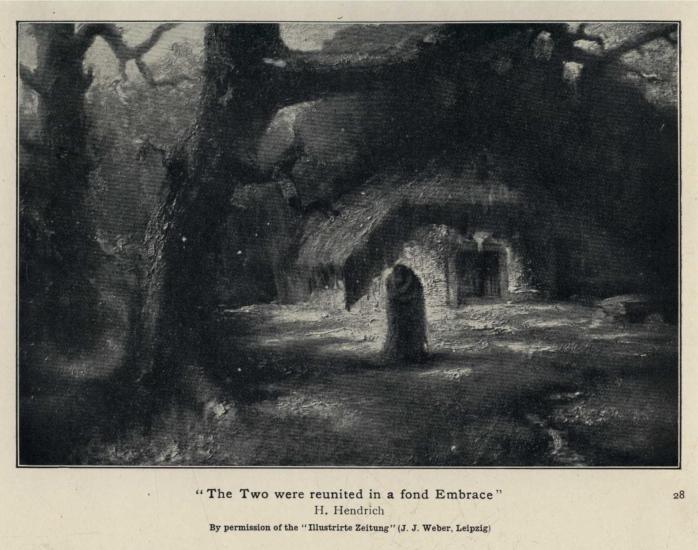
"The Two were reunited in a fond Embrace" H. Hendrich By permission of the "Illustrirte Zeitung" (J. J. Weber, Leipzig)
"Come!" said Siegmund; "now will I flee, and thou must go with me. My father's sword shall shield us both, and never again while I live shall this robber have thee in his clutches."
The moon was shining brightly on this warm night in early spring. The wide world seemed to beckon her two children forth; and answering her summons and the glad call of their own hearts they fled away.
King Wotan knew of all these things. He knew that his dearly loved son Siegmund had found the magic sword, and had fled from the hunter's home. He foresaw also that the hunter would rise up full of wrath the next day, and pursue Siegmund to kill him. This must be prevented. The god summoned Brunhilde before him.
"Wisest and fairest of War Maidens," he said, "in yonder mountain gorge thou wilt discover a young man and a maiden who are dear to me. The maiden has been stolen away from a hunter who held her against her will, and the hunter now pursues the young man with intent to slay him. It is my will that he be not slain, but that he gain the victory over the hunter. See thou to it!"
Brunhilde gladly listened to Wotan's behest.
"It shall be done as thou desirest!" she exclaimed. "Hoyo-to-ho!"—the musical shout of the War Maidens came from her lips as she sprang from cliff to cliff and disappeared.
But she had hardly gone before Fricka, Wotan's queen, entered in a chariot drawn by two rams. Now Fricka was goddess of love and justice, and it grieved her that Siegmund should be allowed to take Sieglinde away with him as he had done.
"Justice, O Wotan!" she cried, "against the young man Siegmund! The hunter from whose house he fled away, carrying the maiden Sieglinde, has called to me for help, and I have promised to aid him."
"The hunter held the maid against her will," replied Wotan.
"Nathless his right to her had become recognised among men. So she must be restored to him, else men will say that there is no justice in the world."
Wotan's brow was wrinkled moodily. He knew that Sieglinde had dwelt so many years under the hunter's roof that all men believed she rightfully belonged there. Yet in his heart he longed to protect his son.
Fricka saw the struggle but would not relent. She added many words to what she had said and urged her case so strongly that every law the gods had made seemed enlisted in the hunter's cause. At last Wotan, heavy in spirit, agreed to give the victory to him.
After Fricka had departed, he called Brunhilde again to him and told her of his last decision. Brunhilde was full of grief when she learned that she must aid the hunter against Siegmund.
"Why dost thou do this, O father?" she asked gently.
"Because the laws of the gods demand it," he answered.
Then the sorrow-stricken Wotan unburdened his heart to her and told her of the Rhine-Gold; of the Ring that had been fashioned from it; of the curse that had followed; and of many other things which we have set forth in this book.
"The curse of the Ring is the fate of Siegmund," he concluded. "That is why I am powerless to protect him. See that thou dost obey my latest command!"
So saying he departed, amid the rumblings of a thunder-cloud, leaving Brunhilde full of sorrow at the strange tale she had heard and the sad errand she must perform.
But she turned her steps dutifully down the mountain gorge, and there in a sheltering cave she found the young man and maiden. Sieglinde had become tired out from their wanderings, and Siegmund had borne her into the cave and was supporting her head upon his knee, while smoothing back the stray locks of gold from her lovely forehead. So intent was he upon this devotion that he did not see Brunhilde when she came into the entrance.
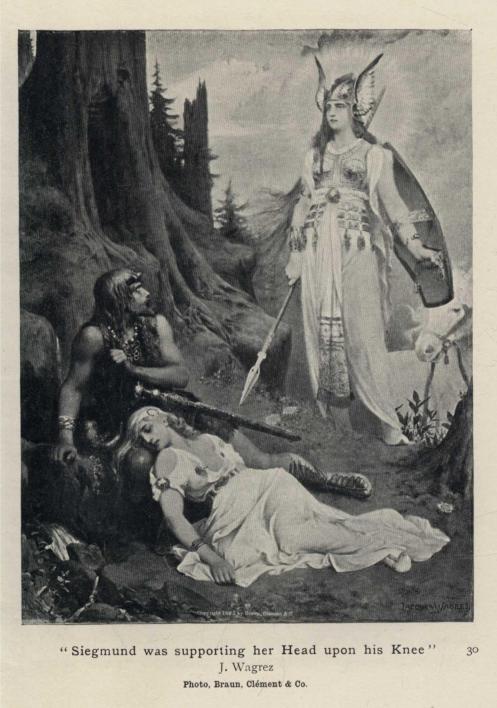
"Siegmund was supporting her Head upon his Knee" J. Wagrez Photo, Braun, Clément & Co.
If the War Maiden had longed to befriend these two before she saw them, how much more did her heart soften when she beheld this sweet picture! But her duty must be done. She called softly to Siegmund and he raised his head.
"I am the War Maiden," she said, "and am sent to warn thee of thy fate. Thine enemy follows hard upon thy heels; and none who look upon my face survive a battle."
"I fear not for the battle," answered Siegmund stoutly. "This magic sword was left me by my father, and with it I must surely be victorious!"
"It will avail thee not; for the gods have decreed that thou must die. But glory awaits thee in Walhalla, whither I am summoned to bear thee after death."
"What is Walhalla?" he asked.
"It is the Hall of Heroes, among whom thou wilt be first."
"Will I find my father there, and my sweet comrade Sieglinde?"
The search for these two had consumed the youthful warrior's whole life, so his voice trembled eagerly as he asked this question.
Brunhilde smiled, then shook her head sadly.
"Thy father?—Yes, in Walhalla shalt thou find him. But Sieglinde cannot come to thee there."
"Then take my greetings to Walhalla!" he exclaimed.
"Greet for me Wotan!
Hail to my father
And all the heroes!
Hail the War Maidens;
For now I follow not thee!"
By this time Brunhilde's heart had become so touched that she boldly resolved to disobey Wotan's last command, and do as he really desired. Smiling upon Siegmund, she bade him be of good heart, as she had only been testing his courage. Then she told him she would be with him and aid him in the coming strife.
Even while she spoke the hunter's horn was heard, and soon the man himself came hastening fiercely along. He did not see Siegmund at first, for a heavy storm had come up, while the heavens seemed rent with terrific crashes of thunder. The din finally aroused the sleeping Sieglinde, and she gazed around wildly. Siegmund had sprung out of the cave to confront his enemy; and there in front of the cave he stood revealed by a flash of lightning battling strongly with the hunter. Sieglinde uttered a cry of grief and was about to rush between them when another sudden blaze of light made her draw back. At one side she beheld the War Maiden standing ready to protect Siegmund. The young man pressed upon the hunter and was about to strike him to the earth with his trusty sword, when a glowing red flame burst through the clouds. Wotan himself appeared with his dread Spear and stretched it across the sword. The magic blade broke in sunder, and Siegmund fell dead, pierced by the hunter's weapon. But the hunter himself did not survive the conflict, for a glance from the single blazing eye of the angry god stretched him lifeless on the sward.
When Wotan appeared, Brunhilde started back amazed and fearful. She began to realise what it meant to disobey the god's command. Hastily seizing the fainting form of Sieglinde she sprang upon her winged steed and fled swiftly from the tragic scene. Far and fast through the storm she sped, glancing around fearfully ever and anon, and fancying each rumble of the thunder was Wotan's voice. Then she turned her horse's head toward the summit of a lofty crag. It was the usual meeting-place of all the War Maidens on their way to Walhalla. Soon the crag came in sight, and there awaiting her were her eight companions, hailing her swift approach with "Hoyo-to-ho!" their battle cry.
Hardly taking time to answer their joyous greetings, Brunhilde placed Sieglinde gently on the ground and cried,
"Save us, O my sister! Save us from the wrath of Wotan!"
"Why, what crime hast thou committed?" cried the other War Maidens in alarm.
"I have disobeyed the god's command, and even now he rides hard after me upon the wings of the tempest! Save this innocent mortal, at least! She has done no wrong."
"I do not wish for life!" exclaimed Sieglinde, who had just recovered consciousness. "Why should I live when Siegmund is dead? I pray you draw your sword and slay me!"
"Not so," said Brunhilde soothingly. "The Fates decree that thou must live. And see, I have saved for thee the Sword of Need which was broken in Siegmund's hands. Keep it for his son, the hero who shall know no fear, and he shall do mighty deeds with its mended blade."
So saying Brunhilde drew from the folds of her cloak the two pieces of the broken sword and gave them to Sieglinde and whispered in her ear words of tenderness and balm. And Sieglinde's face lost its hopeless look, and she promised to go wherever the War Maiden might direct.
"Haste thee, then!" urged Brunhilde. "The time is short. In only one place wilt thou be safe from Wotan, and that is the depth of yonder forest. There dwells Fafner the dragon, and there Wotan never ventures because of the curse of the Ring."
The tempest had increased in fury while Brunhilde was speaking. The dense darkness shielded Sieglinde while she hurried away. She was scarce gone, hugging the precious sword, when a terrific clap of thunder shook the whole cliff and Wotan appeared in a flash of light.
"Brunhilde! Brunhilde!" he called.
Brunhilde did not answer; and the other War Maidens, braving his anger through loyalty and love for their sister, hid her in their midst.
"Brunhilde!" again thundered Wotan, "stand forth! Art afraid to hear thy doom?"
"Not so, O mighty father!" replied Brunhilde; and she stepped forward proudly and knelt at his feet.
"Ah, Brunhilde! how couldst thou disobey my command?" asked Wotan more in sadness than in anger. "Thou hast brought thy fate upon thyself."
"I but tried to save one who was dear to thee," she answered.
"But thou didst violate my will, and henceforth can be a War Maiden no more. Thou must descend to earth, lose thy immortality, and live the life of any other woman."
On hearing this terrible decree, by which she lost the rank of goddess, Brunhilde sank upon the ground with a piteous cry.
"Have mercy, O Wotan!" she pleaded. "I tried to meet the wishes of thy heart, as given in thy first command. Do not banish me for ever from my dear sisters and thy beloved presence. Have mercy!"
"Have mercy!" cried her sisters stretching out their hands toward the god.
"Silence!" said Wotan solemnly. "I have spoken, and it must be done. Ah, dearly loved maiden, how gladly would I save thee if it were so decreed! But thou must sink to the ground in deep sleep. And it shall come to pass that in after years the man who shall awaken thee shall claim thee for his bride."
"As for ye other maidens," he continued, glancing around with a flash of the eye, "beware how ye fail to keep faith with me again! And come not again into my presence this day."
The War Maidens fled in woe and terror at this speech, leaving Brunhilde and Wotan alone upon the rock. The sky was clearing, the wind was dying away, and the moon came forth and looked down upon the scene. There was silence for many long moments, until Brunhilde, unable to endure it, rose slowly to her feet in all her beauty and pride, yet with wild entreaty in her voice.
"Oh, father, father!" she pleaded, "save me from this fate, for the honour of all the gods! Do not place me within reach of any coward among men, who might chance to awaken me. If I must fall asleep to wake a mortal woman, grant me this last request. Place me in some spot so hedged about with danger that none but the bravest of all men may find me and claim me for his own!"
Wotan gazed at her—all the old love and pride for her shining in his eyes. He gently drew her to him and kissed her upon the eyelids.
"It shall be as thou dost wish," he said. "I shall shield thee with a barrier of living fire so that none save a true hero can rescue thee. And now farewell, my darling child! How I shall miss thee in Walhalla, and on our rides of glory, thou dost little know. Farewell! farewell!"
Brunhilde clasped her arms about his neck and smiled for the last time in his face. He bent down and kissed her again, and yet again. A deep sleep came over her and she sank slowly down. Wotan carried her tenderly to a low mound of moss upon the very crest of the towering rock, and there he placed his shield over her to protect her from all harm. Again he gazed long and mournfully on her features, then closed the visor of the helmet she wore, and turning began a mystic waving of his Spear of Authority. He ended by summoning Loki, god of fire.
"Loki, hark,
Hitherward haste,
As I found thee first,
In a fiery waste;
As once thou didst fly
In fiery display;
As then I did call thee
I call thee to-day!
Arise with thy flaming—
Encircle this place,
To daunt the craven
Whom my spear could not face!
Loki! Loki! arise!"
At the last call he struck the rock thrice with his Spear, and instantly a stream of fire gushed forth and licked upward in tongues of flame from every side. Higher and wider they spread, leaping and crackling till they formed a complete circle round the mossy bed where Brunhilde lay sleeping. And as they swept upward in the night air they seemed to blend in strains of music sweet as the thrumming of a harp and soft as the lullaby of a mother crooning her child to sleep.
PART III
SIEGFRIED THE FEARLESS
Several years passed by while Brunhilde lay in her enchanted sleep. Summers and winters came and went, yet still she lay there unharmed in her magic circle of fire, and growing no whit older than when she first sank down in slumber, in all her youth and beauty.
Down in the depths of the forest far below the crag on which she rested, Fafner the dragon still guarded the Rhine-Gold and Ring. He had come to be known only as the dragon, because—giant though he was—he had always been afraid to leave this hideous shape lest someone should overcome him and seize the treasure.
And he had good cause to fear. Although the Gold bore a curse with it, there was more than one who sought to lay hand upon it. Wotan the mighty had even forsaken the beautiful palace of Walhalla which cost him so much, and was now roaming over the earth seeking some hero to slay the dragon. He had indeed come to be known as the "Wanderer" because of his constant search. The dwarfs also had by no means forgotten the glittering hoard which had been taken away from them. Alberich went about in sullen discontent, biding his time; while Mime, his brother who had made the magic helmet, could not forget the Gold night or day. Mime knew where the dragon lay hid, so he set about laying plans to outwit or slay him.
Now the dwarfs had always lived deep down in the caves of the earth. They had seemed actually afraid of the sunlight, and it may be that they were afraid of their own shadows, for no greater cowards ever lived. But with all their cowardice they were sly, and had a wonderful faculty of finding out all sorts of secrets. Mime had discovered the whole story of the Gold, the helmet, the Ring, the curse, the building of Walhalla, and the dread which had fallen upon the gods. He learned of all this and many other things; and he laughed and rubbed his hands craftily.
"Aha!" he said, "I will find a way to seize the Ring and rule the whole world! I will watch this dragon day and night, and sooner or later I shall surprise him."
So Mime the dwarf summoned up courage enough to appear above ground. He betook himself to Fafner's forest, where he soon found the huge monster crouched before the door of his cave. For many days and nights Mime lay hid, waiting for a chance to slip past the great beast, but no such chance came.
"I shall have to kill him," said Mime to himself. And at the bare thought his teeth chattered with fear. "But even if I had a sword stout enough and long enough to reach his heart, I should never have courage enough to wield it."
This thought was very discouraging to him, yet he was unwilling to give up hope of the Gold. For many more days he pondered and plotted, till at last he thought of a plan.
"I have it!" he exclaimed slapping his thigh. "I shall build a blacksmith's forge hard by here in the wood, where I shall make nothing but swords. At last my skill will bring forth the best blade in the world, and I shall offer it to the mightiest hero who may come riding by. Who knows? Perhaps one will be found brave enough to fight the dragon, when I tell him just how to do it. Then after he kills the dragon—we will see!"
He chuckled at the cunning plan he had made, while the evil light in his eyes boded no good for the after fate of the chosen hero.
This plan seemed wild, yet it was the best that offered, so Mime began at once. He built his smithy, and having been used to this trade all his life in the under-world, he speedily felt quite at home. Soon his forge-fires shone brightly through the forest, and the sound of his hammering disturbed the birds and beasts.
One day during a lull in his work he heard a faint tap at his door. He asked harshly who was there, but receiving no reply he peered cautiously outside. There on the threshold lay a poor woman feebly holding a little child in her arms. Her strength seemed spent, and even the rough Mime felt pity for her distress. He carried her into the smithy and laid her near the forge-fire, then hastened to pour some cordial down her throat. The drink revived her slightly and she sat up and tried to lift the child.
"Take care of him," she gasped. "His name is Siegfried. He comes from a race of heroes."
"How am I to know that he is of hero born?" asked the dwarf bluntly.
"Here, here!" she answered eagerly, drawing some fragments of a sword from the folds of her dress. "It was his father's sword—the wonderful Sword of Need. Keep it safe for him and he shall do—mighty—deeds——"
Her voice trailed into silence, and the dwarf bending down perceived that she was dead.
It was poor Sieglinde who had hid away from the wrath of Wotan, as Brunhilde had bidden her. At last her sad life was ended, and perchance her spirit found peace with that of Siegmund in some happier clime.
Mime now turned his attention to the little child for the first time. He saw that its limbs were sturdily knit, and that already it held its head erect and looked one squarely in the eye—which was more than the dwarf had ever done in his whole life.
"Who knows?" muttered Mime. "This may be the hero for whom I have been waiting. I will bring him up as my son, and train him to my set purpose. At any-rate he could soon be useful blowing the fire."
So he adopted the little Siegfried and cared for him, during his helpless days, in a dwarf's rude way. He hollowed out a log for the baby's cradle, and spread a bearskin over it. He gave him goat's milk to drink, and let him play with the broken handles of swords. Every fair morning he carried him out into the bright sunshine and left him to kick his heels and shout back answers to the singing birds. But the dwarf himself rarely ventured outdoors. He seemed to prefer the soot and smoke of his forge-fire. He hammered away, and hummed a moody tune, and took comfort in thinking of the day when this foster-child should be sent to slay the dragon.
But if Mime had expected the lad to mend the fires and work in the shop, he soon found himself mistaken. The little fellow thrived wonderfully and took to the life of the forest naturally. On the other hand, he had no use for the forge or, it must be confessed, for his foster-father. He soon came to despise the dwarf as a coward, for he himself showed no fear of anything. So he roamed every day in the forest returning only at nightfall with some animal he had slain. Once he harnessed a wild bear with ropes and drove it into the blacksmith's shop, nearly causing Mime to fly out of his wits from terror.
When Siegfried arrived at young manhood he was a goodly sight to look upon. His limbs were strong and powerful, yet rounded and graceful. His skin was tinged with the ruddy hue of outdoor life. His fair hair fell in soft curls to his shoulders, as the manner then was; and his blue eyes met one's look frankly and fearlessly.
Though he had been taught to look upon Mime as his father, Siegfried soon rejected this belief with scorn. He felt no love for the dwarf, such as a son would feel; and he could not help contrasting his own powerful frame and courage with the smith's weak, cringing way. The only tie which now bound them together was a promise made by the dwarf that he would forge a sword with which Siegfried could win every battle. The young man waited impatiently for this sword to be made; and Mime actually worked early and late to finish it. But alas! no sooner would he temper a blade so that it seemed perfect, when Siegfried would return from the chase and say,
"Ho! this is the sword you have made for me to-day!"
And he would shiver it to bits upon the anvil.
This went on day after day, until Siegfried lost all patience and began to threaten the dwarf.
"Hark you, Mime!" he cried. "Give me the stout blade you promised, or it will not go well with you to-morrow night."
"You would not harm your father!" whined the dwarf. "Remember how I have cared for you and sheltered you."
"I have long since paid that score in meat and skins," answered Siegfried. "And as for you being my father, you know that is false. Answer me directly! I would know who my father was!"
His manner was so threatening that the dwarf was thoroughly frightened.
"I—I—do not know who your father was," he stammered; "your mother was Sieglinde, a poor woman whom I sheltered here when you were a baby. She gave me an old broken sword. See, here it is!"
And he rummaged beneath a pile of skins and brought to light the pieces of the magic Sword of Need.
"Ha! that is good metal!" cried Siegfried, as he examined it. "I will have no sword but this. See to it that 'tis mended for me 'gainst another night."
The smith promised, though in a quaking voice, for he was by no means certain that he could mend the weapon. His fears were well founded. When he tried to do so, the next day, the pieces refused to unite in his hands. After making repeated attempts he sank down behind the anvil in despair.
At this moment a strange-looking man entered the doorway. He was tall and powerful. He wore a long dark cloak, and carried a spear instead of a staff. On his head was a large hat whose broad brim shaded one eye that was evidently injured or missing.
"The Wanderer!" muttered the dwarf in abject fear.
It was indeed Wotan the Wanderer.
"What are you doing here?" he demanded in a voice of thunder, pointing to the broken blade.
"I—I am trying to mend the—the Sword of Need," said the dwarf. He knew there was no use in telling an untruth, as Wotan had already recognised the weapon.
"Where did you get it?" Wotan asked.
"'Twas given me by Sieglinde the mother of Siegfried. Mercy, mercy! I cannot mend it!"
"Peace, fool! You speak truth. No one but the hero who knows no fear can weld those pieces together!"
So saying he struck his spear upon the floor with a noise like thunder and turning strode away into the forest.
Mime dared not look after him or ask any questions. Indeed, he was in such utter terror that he did not venture from behind the anvil, where he lay hid all day. And here it was that Siegfried found him when he returned home.
"Mime, have you got my sword done yet?" he called.
"Pardon! pardon!" whined the dwarf. "Oh, I have had such an awful scare!"
"A scare? What is that?" asked Siegfried.
"I mean, I have been in dreadful fear," answered Mime.
"Fear? What is that?" asked Siegfried.
"Know you not what fear is?" said Mime, starting up and remembering Wotan's words that only the hero who knew no fear could mend the sword.
The young man shook his head.
Mime pressed the subject further. "Suppose you should meet a great monster in the forest," he said; "a huge dragon whose eyes and mouth shot fire, whose tail lashed this way and that, tearing down the trees, whose tongue was sharp as a sword, and whose terrible fangs could crush you like an insect. Suppose this terrible dragon should come rushing down to devour you. How would you feel?"
"There is no such beast as that," replied Siegfried smiling.
"Oh, but there is!" urged the dwarf, his own eyes growing big with alarm as he thought of Fafner. "There is! Down in the depths of this very forest lurks a dragon ten times more dreadful than I have said. He lies crouched in a thicket before a cave, and even the gods are afraid to come near him."
"Then he would be worth fighting!" exclaimed Siegfried with flashing eyes. "Forge me this sword as you promised, and then show me the way to his lair!"
"I cannot mend the blade," confessed Mime sullenly. "Only he who has no fear in his heart can mend it or wield it."
Siegfried glanced at him a moment in anger; then as if despairing of getting the dwarf to do the work, he seized the fragments with one hand and the bellows with the other.
"Stand aside!" he commanded. "I will mend the blade."
And he set to work while the dwarf looked on in wonder.
First Siegfried took a file and began rubbing the steel into fine powder.
"Stop!" screamed the dwarf. "You are ruining it."
"Oh, no, I am not," laughed Siegfried, filing the faster.
Soon the sword, all but the handle, was changed into powder. Then Siegfried placed the powder over the fire and blew a bright blaze underneath it. And as he worked the bellows he sang from pure joy in his work,
"Hoho! hoho!
Hahei! hahei!
Bellows blow
The blaze on high!
Deep in the wood
There lived a tree:
Its ashes here
In the flames I see,
Hoho! hoho!
Hahei! hahei!
Bellows blow:
The tree must die!
But the flashing fire
Hath won its way;
It sputters and flares
In the metal's spray.
Hoho! hoho!
Hahei! hahei!
Bellows blow
The flame on high!
The Sword of Need
Will soon be made
And then aloft
I shall flash my blade!"
When he finished the song the powder had become a molten mass. He ran this into a mould and plunged it into the water. The loud hiss of cooling metal was heard. Presently he seized the new blade with a pair of pincers and heated it red hot. Allowing it to remain but a moment in the coals, he placed it upon the anvil and beat it mighty blows till the blade was sharp and thin. Then heating it once again he fastened it to the handle.
He swung the weapon critically and tested its temper. Again he heated it, and beat it till the shop was filled with flying sparks. But now it emerged bright and keen—the most perfect blade in all the world. Triumphantly he sang,
"Ah, Sword of Need!
Anew thou art wrought;
Back unto life and strength
Thou art brought!"
"See, Mime! This is the sword I wished you to forge!"
And making the sword whistle about his head he brought it down squarely upon the anvil. From top to bottom the heavy anvil was cleaved, falling into two pieces with a thunderous noise.
"Farewell!" cried Siegfried; "the smithy sees me no more from this day. I go to seek the dragon!" And he hurried forth with his wonderful new sword into the forest.
"Wait a moment!" called Mime, running after him; "you cannot find the cave unless I show you the way."
"I thought you were too great a coward for that," laughed Siegfried.
"Who's afraid?" panted the dwarf as he caught up with him. "Besides I am only going to point out the place. You are the one that's going to be eaten!"
In fact Mime was quite anxious to have the young man meet the dragon. No matter how the fight turned out, he reasoned that he himself would be the gainer. In the event of Siegfried killing the beast and escaping unharmed, Mime intended to give him a poisonous draught which he had prepared. Then with both these foes out of the way, the dwarf believed that the wonderful Gold of the curse would be his without any further struggle.
But in this Mime was wrong, for his brother Alberich, who had first stolen the Gold from the Rhine-maidens, was even then watching the dragon's cave and had been on guard there night and day. Wotan the Wanderer found him there upon this day of fate, and unheeding the dwarf's taunts and reproaches told him of Siegfried's and Mime's approach. Alberich now hid behind some rocks to watch what should happen.
"See, that is the cave," said Mime, pointing it out to Siegfried when they were still some distance away. "I can go no farther, as I am very tired from running to catch up with you. But go straight ahead, and I wish you success—and the dragon an equal amount!" The last words he muttered to himself, then scurried for a safe place where he could watch the fight.
It was a beautiful morning, and the birds were carolling sweetly in the tree-tops. Siegfried cast himself down upon the sward to rest himself and enjoy the quiet sylvan scene a little while. The birds seemed to be talking to him. He could not understand their sweet language, but he tried to imitate it upon a reed whistle. Failing in his attempt he seized the horn which was slung around his shoulders and blew a loud clear note as a challenge to the dragon. At once a tremendous crashing sound was heard in a near-by thicket.
"Ah! that must be the dragon!" said Siegfried craning his neck without getting up.
Again he heard the roar, followed by a terrible snorting and hissing and yawning, and out came a huge lizard-like serpent plunging through the underbrush toward him.
"Who are you?" it growled.
"Oh, you can talk, can you?" said Siegfried. "I am a man who has been sent to you to learn what fear is."
"You will find out if you live long enough!" roared the dragon showing its fangs and licking out a long forked tongue. "I will devour you in two mouthfuls."
"Oh no!" laughed Siegfried. "I object. But if you do not teach me what fear is, it will be the worse for you!"
This taunt angered the dragon, as Siegfried intended. It sprang forward, lashed about with its tail and poured forth flame and smoke from its nostrils. Siegfried leaped easily to one side and evaded both dangers. The dragon turned upon him at close range and struck again with its tail. Siegfried vaulted high in the air, so that the tail swept the ground smoothly under him without touching. Quick as a flash he smote the scaly back with his keen sword, so that the black blood poured forth in torrents. The dragon uttered loud bellows of rage and pain, and reared upon Siegfried with the forepart of its body in order to crush him; but as it reared, its breast was exposed, and Siegfried was swift to seize his advantage. With a powerful blow he drove the Sword of Need up to the hilt in the monster's heart.
"Woe is me!" gasped the dragon rolling upon the earth in a dying condition. "Reckless youth, do you know what you have done?"
"I know I have slain a foul beast because he would not teach me fear."
"Ah, I perceive you are the tool of others," said the dragon in a weak voice. "Know then that I am Fafner, the last of the giants' race. I guarded the Rhine-Gold; but beware of it! a curse follows all who possess it! Beware!"
Then with a dreadful groan the dragon expired.
Siegfried drew his sword from its breast, and as he did so a drop of blood fell upon his hand. It burned like a coal of fire, and instinctively he licked it with his tongue to stop the pain. Suddenly a strange new power came upon him. He knew not what it was, but stood silent and amazed waiting to discover what it could be. Then in the silence a bird sang to him from a linden-tree—the same song he had heard before; but this time he could understand it! It was as though the bird were speaking his own tongue!
"The Rhine-Gold is now yours," it sang. "There in the cave you will find it. Be careful to take also the helmet of darkness and the Ring of Power."
Siegfried thanked the friendly bird, and hastened into the cave. While he was gone, Mime and Alberich crept up and for the first time became aware of each other's presence. A violent quarrel at once began as to which should claim the treasure, but it was speedily silenced by the return of Siegfried clad in shining armour and bearing the helmet and Ring. The two dwarfs slunk away again unperceived by the young man, who walked thoughtfully along listening to the wood-bird, which had recommenced its song. And these were the words of the song:
"Ha! Siegfried now holds
Both the helmet and the Ring;
Beware of sly Mime—
Trust him not in anything!"
Siegfried again thanked the bird for its warning, which was indeed timely; for Mime now approached him with great pretended delight in his safety.
"Have you learned what fear is?" he asked with a grin.
"No, I have not," answered Siegfried.
"Then sit you down and rest, bravest of men!" said the dwarf. "And see, here is a cooling cup of mead I have brought for you. It will quiet you and cause you to forget your weariness."
"It is poison," retorted the young man. "Thanks to the dragon's blood, I can read all your wicked heart! Wretch, take your just deserts!"
With that he dashed the poison cup to the ground, and stretched the dwarf, with one blow, dead at his feet.
"It was his life or mine at the last," he said, as he wended his way thoughtfully into the forest. In spite of his victory over the dragon, he was not elated. Instead, he was thinking how barren his life had been without friends or kindred, and how aimless it seemed even now, despite the Gold. Sighing heavily he sat down upon a log and buried his face in his hands.
"Lonely, lonely! Of all men I am most lonely!" he cried.
"Would you find a love to comfort you?" sang the clear voice of the bird over his head. "I know where you might find the fairest lady in all the world.
"On a lofty crag she sleeps,
Her guard is a flaming fire;
And he must bravely pierce the blaze
Who would win his heart's desire."
Siegfried sprang to his feet. "This quest is to my liking! Tell me more about it!" he exclaimed.
"The bride to win,
Brunhilde to wake,
Is no coward's task,
Or whom fear doth shake."
Thus sang the wood-bird again, and Siegfried listened to him joyfully.
"Show me the way to the lofty crag, I pray you, good bird!" he exclaimed. "Show me the way, that I may greet the lady or look into the face of fear!"
By way of answer the little bird fluttered away toward the heights leading up the mountain-side. Siegfried eagerly followed, over stones, through thickets, beneath huge trees, across dangerous chasms, but always being careful not to lose sight of the bird.
At last they came to a wild rocky gorge, extending to the last line of cliffs, and there the bird suddenly disappeared. But Siegfried saw a narrow chasm like a giant's pathway leading upward to the crest, and this, he decided, was the route he must follow. After a last look to see where the bird had gone, he prepared to ascend the path, when he came face to face with Wotan.
Siegfried had never seen the god before, and now was in nowise dismayed, although the strange-looking figure in long cloak and broad hat was larger and more commanding than any he had ever met before this day. In Wotan's hand was the Spear of Authority, with which he ruled the world.
"Where are you going?" asked the god.
"I know not," replied Siegfried. "A little bird told me of a rock surrounded by fire, and of a lovely maiden who sleeps there. But now the bird is gone, and I must find my way alone."
"Do you not fear the fire?"
"Fear? That also have I come to seek. Know you the way?"
"It lies up through yonder rift," replied Wotan, wishing to test the young man's bravery yet further; "but the journey is one of terror. Upon the mountain-top the flames leap fiercely. Sheets of fire driven before the wind rage on every side."
"The fiery foe I challenge!" answered Siegfried. "I must rescue Brunhilde at any cost." And he strode toward the rocky chasm.
"Back, rash youth!" commanded Wotan, stretching out his Spear. "You shall not pass while this all-powerful weapon prevents!"
"It shall not avail against this magic blade!" replied Siegfried, drawing the Sword of Need.
Wotan started at sight of the fateful blade.
"Where got you the weapon?" he asked.
"At Mime's forge I made it—the best metal in the world!"
"But it shall not avail against the Spear, for by it was the Sword first broken," answered Wotan.
"Ah!" cried Siegfried, rushing forward. "Then you were my father's foe! On guard, before my Sword brings vengeance upon you!"
He swung the Sword with terrific force through the air. It met the Spear with a crash like thunder, and the once powerful Spear was broken. The owner of the Ring was indeed master of the world!
"Go forward!" said Wotan sadly. "No longer can I hold you. The doom of the gods was foretold before you came into the world. You are but the instrument of fate."
And he disappeared.
Siegfried glanced at the spot where he had stood, in astonishment. Then seeing no further bar to his progress, he ran lightly up the rough pathway. Presently he heard a dull roaring sound and saw, on the mountain height, a huge mass of flames which leaped in every direction and seemed to touch the very sky. Red and wrathful they shone, shutting off the pathway by what appeared to be a solid body of fire, while clouds of smoke hid the view on every side.
But Siegfried pressed forward undaunted. Putting his hunting-horn to his lips he sounded a merry note as if in challenge. And as he went on, a wonderful thing happened. The fire parted slightly to right and left, letting him pass by unharmed. On he went until he came to the inner circle which the flame had guarded; and now it vanished utterly, leaving the blue sky and the free air of heaven.
On the moss-covered rock Siegfried saw someone lying asleep, beneath a heavy shield. He lifted this and beheld what appeared to be a youth clad in bright armour. The helmet hid the face, but when he carefully removed the heavy head-dress a mass of beautiful golden hair was loosened. The features were those of the lovely Brunhilde.