Front matter (continued 2)
Reading edition
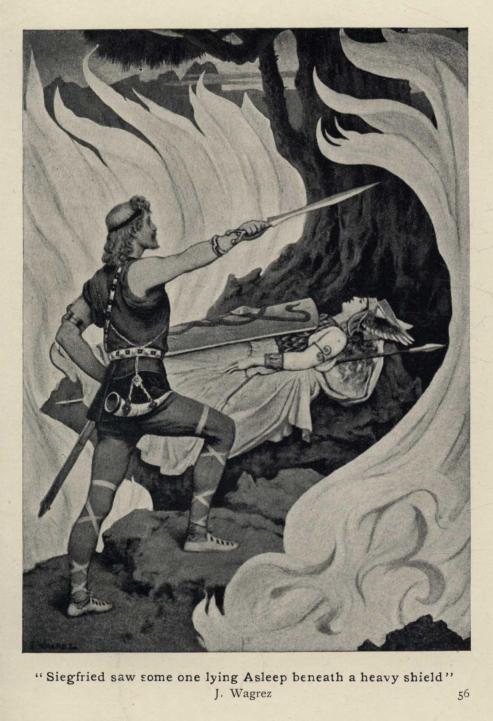
"Siegfried saw some one lying Asleep beneath a heavy shield" J. Wagrez
"Ah! it is not a man!" exclaimed Siegfried gazing at the face in rapture. "It is the maid I have come to seek! How still she is! How can I waken her from this slumber?"
He tried gently to rouse her by calling, but there was no response. Only her deep breathing told him that she was alive.
"'Tis the fairest vision I could ever have dreamed of seeing!" he murmured; "the one maid I could worship and serve! Now I cannot waken her, and all my past hardships have been in vain."
He knelt down and gazed long and rapturously into her face. Then unable to restrain his emotions any longer he bent and pressed his lips full and fervently upon hers.
Instantly the maid awoke. While Siegfried started back in rapture she sat up as easily as though yesterday had witnessed the beginning of her long sleep. She gazed about her in delight, and burst forth into a little cry of gladness:
"Hail to thee, Sun,
Hail to thee, Light,
Hail, thou luminous Day!
Deep was my sleep,
Long was the night!"
Then looking about she asked, "Who is the hero that has come to waken me?"
"I am Siegfried," he replied modestly.
"Siegfried, son of Sieglinde?" she cried. "Then I knew your mother in those past years before I fell asleep!"
"Oh, tell me of her and of my father!" he exclaimed, his eyes shining. "But, I am not thoughtful," he added in another tone. "You are in need of refreshment after your long slumber."
"I am a daughter of the gods," she answered, "and feel no faintness or weariness as mortals do."
Siegfried, who had come near to her, drew back as though struck by a blow.
"A daughter of the gods!" he exclaimed. "I—I hoped to claim you for my bride!"
In his ingenuous youth, his inner thoughts rose naturally to his lips.
Brunhilde smiled sadly and shook her head.
"See yonder horse, which also has been asleep?" she asked. "It is Grani, my winged steed, upon which I used to ride through the clouds with my sisters. Would you bid me stay upon earth?"
"Ah, Brunhilde, my love is selfish, I know! But if your heart could feel half the fire that burns in mine, you would gladly stay upon earth like other women!"
"Like other women!" the words brought back the decree of Wotan in a flash, and Brunhilde sat as though stunned. Then she looked proudly at the fearless hero with his frank face and deep blue eyes; and as she looked the love-light shining in his face was lit upon her own.
Siegfried knelt and pressed his lips to her hands, with bowed head. He dared not look again for very joy, and afraid lest the light he had seen should be vanished.
"Brunhilde! Brunhilde!" he whispered. "Can it be true?"
For answer Brunhilde clasped her arms around his neck and looked up laughingly into the sky. And again she sang—this time a note of glad renunciation. The proud War Maiden, the daughter of the gods, had found a joy in the mortal life of a loving woman, such as she had never dreamed.
"Away, Walhalla!
Glorious world!
Farewell thou gorgeous
Realm of the gods!
End in delight
O lofty race!
Night of destruction
Thy terrors are gone;
I stand in the glow
Of Siegfried's star!"
Then Siegfried in his turn sang of love and Brunhilde. And the two sweet voices blended together at the last in a triumphant strain,
"My own for ever,
And parting never,
For aye and ever.
Shining in Love!
And smiling at Death!"
PART IV
THE DOWNFALL OF THE GODS
When Brunhilde promised to become Siegfried's wife she well knew what it would cost her. She would no longer be of the family of the gods, nor would she have strength and wisdom beyond other mortal women. Yet she now had no regrets. Her love for her hero eclipsed every other thing, and she knew only that she was entirely happy in the present.
Long the lovers sat and talked, forgetful of all the outside world. Siegfried told Brunhilde of his adventures; his fight with the dragon; his possession of the Ring; and finally his encounter with the mysterious stranger whose spear he had shattered.
Brunhilde started up at this. She had recognised Wotan at once from the description.
"The spear was broken, you say?" she exclaimed questioningly. "Are you sure it was broken?"
"It fell shivered upon the ground beneath my sword."
"What did the stranger do?"
"He looked sadly at me, saying that he was powerless to hinder me further. Then he vanished suddenly."
"Ah, woe to the gods!" ejaculated the maiden. "Their doom is indeed coming upon them! Siegfried, the spear you broke was the dread Spear of Authority with which great Wotan ruled the world. Now, all the old order of things shall pass away. Walhalla itself must fall, because of the curse of the Ring."
"The curse of the Ring?" asked Siegfried in an astonished voice. "What is that?"
"It is the sad fate which has followed upon the heels of a bad deed," she answered. "King Wotan himself told me the tale upon that day so long ago when I disobeyed him." She shuddered slightly at the memory, then went on; "It is bound up in your own fate, so I will tell you also the story."
Then Siegfried listened with wide-open eyes while Brunhilde told him of the lost Rhine-Gold; the building of Walhalla; the reward of the giants; and the curse of the Ring. His breath was bated and his eyes were very moist when she told further of Siegmund and Sieglinde and the wrath of Wotan.
"Then you were the protector of my father and mother!" he said, embracing her joyfully. "Ah, how much love and devotion do I owe you, fairest and dearest of goddess-maidens!"
"Will you never forget me?" she asked.
By way of reply he drew the magic Ring from his finger and placed it upon hers.
"Let this be our troth," he said. "From this moment it becomes a blessing instead of a curse, and our lives shall be one life for evermore."
"It shall tell me always of you," answered Brunhilde. "For I know you cannot linger here, dearly as I should desire it. You come of a race of heroes, and great deeds await you upon earth. Your sword must not grow rusty in idleness, nor your strength weak through ease."
"'Tis true," he said, with a sad but resolute look in his blue eyes, as he glanced far over the nestling valleys. "'Tis true that my lifework is yet to be begun. But, alas! Brunhilde, how can I leave you? You are the only person I have ever known that gave me sympathy or love."
Brunhilde pressed his hands tenderly.
"My sympathy and love shall always be for you!" she whispered; "and here shall I wait your return to me. Loki will build his barrier of fire about me once more, and only you, the hero who knows no fear, can find your way back again.
"And now take with you Grani, my good horse. He can no longer fly through the clouds as formerly, when his mistress was one of the immortals. But he will go through fire and water for you, and will be your devoted slave."
The maiden called the beautiful horse, which had been aroused out of sleep at the same time she was awakened, and which was now grazing near by. Grani came to them whinnying gently. Siegfried patted the steed's soft nose, then took the bridle slowly, as if unwilling to speak. He girded on his sword, placed his helmet firmly upon his head, and slung his bugle around his shoulders.
"Farewell, beloved!" said Brunhilde softly.
"Farewell, beloved!" he answered. "My hunting-horn shall tell you from the valley all that I cannot say."
One lingering embrace, and he turned and led his steed down the steep path. Brunhilde watched his descent with shining eyes. Presently from the valley below she heard the mellow notes of the horn sweet and clear. Then the faint gallop of hoofs told her that Siegfried had gone forth into the world to play the part Fate gave him.
Several days passed by. Grani steadily and swiftly bore his rider over mountains, through valleys, and across rivers with untiring zeal. It was not until they reached the noble river Rhine that Siegfried drew rein. Upon the crest of a hill, across the stream from where they stood, rose a splendid castle. It seemed to belong to the king of the country, for it was very large, and a pennant floated from an upper turret. The current of the river was deep and swift at this point, but a small boat was moored not far from Siegfried.
"Come, Grani!" he said dismounting; "I will take the boat, while you swim beside me across the stream. This promises an adventure!"
Grani obeyed, and they were soon in the channel, heading toward the castle.
Now this castle was the seat of a king of an ancient and warlike tribe. His name was Gunther, and he tried to deal fairly with every man. He had a beautiful sister Gudrun; and, also, a half-brother named Hagen, a sly fellow who was always plotting mischief. Hagen, in fact, was the evil genius of the castle. You will not wonder at this when I tell you that he was of kin to the Nibelungs, Alberich and Mime.
Like all of dwarf blood, Hagen had a passion for gold, and was also adept at discovering secrets. He knew of the stolen Rhine-Gold; and he had also learned—perhaps through Alberich—of Siegfried's quest of Brunhilde. Thereupon he began to plot, and he told King Gunther just enough of his plotting to get the monarch's interest aroused.
On this very day when Siegfried had started across the river toward the castle, Hagen had been telling the King that he ought to find a queen. And then he told of the beauty of Brunhilde, and how she slept upon a lofty cliff surrounded by a barrier of fire.
"None but the bravest of heroes can rescue her," Hagen continued. "But there is one who is even now upon this quest. He is called the bravest of the brave, and his name is Siegfried."
Then turning to the Princess Gudrun, he added slyly, "Perchance Siegfried is the hero you have been awaiting, O Princess! He is handsome as he is brave."
Now Gunther liked not the idea of another man being braver than he. But he only said, "I should like much to see the fair Brunhilde; but if I could not pierce the flame, how could I persuade Siegfried to do so in my stead, seeing this is his own quest?"
"Leave that to me," laughed Hagen. "I would brew him a drink that would make him forget all his past—his plans and wishes—and he would love the first lady his eyes fell upon."
He looked again slyly at Gudrun, who blushed red, but wished within her heart that she could see this Siegfried. Her wish was soon to be gratified, for just as Hagen finished speaking they heard the sound of a horn, out on the river, blown in challenge.
"Who dares challenge Gunther in his own castle?" exclaimed the King starting up.
Hagen hurried to the battlements.
"I see a knight clad in glittering gold armour," he said. "He is in a boat alone; and by the boat swims a horse. With your favour I will meet him at the landing." And Hagen seized sword and helmet and hastened out.
King Gunther followed him, his curiosity being aroused by the challenge and Hagen's description. Together in silence they awaited the coming of the boat which made swift progress against the current, driven by Siegfried's muscular arms. Soon it touched the bank, and the young man sprang out. Drawing his sword he saluted the two and then placed himself on guard.
"I am Siegfried," he said simply, "and if any man gainsay my landing on these shores, I am ready to meet him in honourable combat!"
"Not so!" said Gunther, stretching out his hand cordially. "If your name be Siegfried, then am I right glad to welcome you! Much have I heard of your prowess, and more would I fain hear while you rest yourself at my board. I am Gunther."
Siegfried looked him frankly in the eye, then gripped his hand. Hagen also exchanged greetings with him and led Grani away to the stables. Hagen was overjoyed at the turn affairs had taken. With his swift cunning he lost no time in putting his own schemes into play; and before he joined the King and his guest he found time to brew the drink of forgetfulness, about which he had told the King only a few minutes previously.
Returning to the hall, Hagen found the King and his guest breaking bread together and chatting in a friendly way. Gunther with true hospitality had thrown open his home and realm to the hero. Siegfried on his part offered to serve the King with his sword and steed when any need should arise.
"But how did you know of me, or even that I am Siegfried?" he asked bluntly.
"We have already heard great things of your prowess," replied Hagen joining in the talk; "and the magic helmet would betray you, else."
"The magic helmet?" repeated the young man.
"Yes, the cap of darkness you have at your belt. Have you never tried its wonderful properties? By its aid you can assume any shape you choose."
Siegfried had never heard of the helmet's power before. He did not attempt to conceal his surprise, but said nothing.
Just then the beautiful Princess Gudrun entered the room. She bore a golden salver, upon which stood a goblet. She had already beheld the hero secretly, and now willingly brought him the fatal cup of forgetfulness which Hagen had made.
"Welcome to the palace of King Gunther!" she said with downcast eyes. "Will my lord Siegfried drink a refreshing brew?"
Siegfried thanked her courteously and placed the goblet to his lips. But though he bowed to her and the King, the toast which he whispered to himself was, "To the health of my Brunhilde! May her memory never grow dim!"
But alas! no sooner had he swallowed the potion than all his past life was blotted out! He seemed like one awakened from a heavy slumber, for he rubbed his eyes and glanced wildly about him.
"Where am I?" he asked, leaning upon a chair for support. "What has happened?"
Then his glance fell upon Gudrun who stood silent and ashamed of what she had done. As he looked, a flame of love was kindled in his heart for her, by the power of the magic draught.
"Who is this fair creature?" he asked, turning to the King. "Is she your wife?"
"She is my sister," answered Gunther. "I have no wife."
"It is not well for man to live alone; and all the more if he be king."
"That is what my brother Hagen has told me. But the one woman I could wish to win, methinks, is not attainable."
"How so?" asked Siegfried.
"She is hedged about by a barrier of fire."
"A barrier of fire?" said Siegfried, slowly, and rubbing his eyes again. "A barrier of fire?"
"She can only be reached by one who is brave enough to force his way through the flame," continued Gunther; "by one who knows no fear."
"One who knows no fear?" again repeated Siegfried. "I knew such a man once." But he shook his head sadly and gave up trying to think.
"Yes," added the King, "he who knows no fear can alone win Brunhilde for his bride."
Siegfried made no immediate reply. The potion had done its full work, and he had utterly forgotten Brunhilde. Presently he said,
"I know not the maid of whom you speak. But methinks she could not be as fair as your sweet sister."
Gudrun ran hastily from the room at this.
"I would be willing to go far to win her favour," he continued with the frankness of youth.
"Would you be willing to aid King Gunther's wooing?" asked Hagen.
"Right gladly," answered Siegfried. "But how?"
"Your magic helmet would give you his appearance," replied Hagen; "that is, if you would dare face the barrier of fire."
Siegfried's eyes flashed. "Dare? I dare anything, if only King Gunther and his fair sister give me their regard!"
The King sprang to his feet quickly.
"Spoken like a man and a brother!" he exclaimed. "Upon my soul, I love you! And if you will obtain Brunhilde for me, I shall undertake to win Gudrun for you."
"Done!" said Siegfried, grasping his hand. "I shall go with you when you wish."
Then the King ordered wine to be poured.
"Come, drink a pledge with me!" he said. "From this day we are brothers. And on the morrow we will set forth."
Together they drank the pledge and vowed vows of eternal friendship.
Meanwhile Brunhilde had grown very lonely. Although she had urged Siegfried to go out into the world and win greater fame, her heart still cried for him, and she wondered, as the days crept by, when he would return. She no longer thought of Walhalla, or the War Maidens. Her whole thought was of Siegfried the fearless.
One day as she sat and brooded, she heard the long-silent cry of the War Maidens, "Hoyo-to-ho!" and looked up in astonishment to see one of her sisters come flying on her steed through the clouds. The next instant the two maidens were sobbing upon each other's necks in the joy of reunion.
"How came you to brave Wotan's displeasure?" exclaimed Brunhilde. "Do you not know that I am cut off from you, and that you incur a great danger in coming thus to me?"
"Wotan no longer cares," answered her sister. "Since his Spear of Authority was broken he sits in Walhalla with moody brow. And, O my sister! that is why I have come to you! I heard him say that if you but gave up the Ring to the Rhine-maidens, of your own accord, the curse would be removed, and the home of the gods saved."
"But I cannot give it up!" exclaimed Brunhilde, wildly pressing the Ring to her heart. "It is my betrothal ring from Siegfried, and I have promised to guard it always!"
"That is the only way Walhalla can be saved! Surely you can do that little thing!" her sister entreated.
"What care I for Walhalla?" said Brunhilde, stormily. "I have so long been denied its halls that I have ceased to care. The love of Siegfried is the dearest thing I have in the world. Wotan cannot take that away from me. Go back and tell him so!"
"Then woe must come upon us all!" cried her sister; and seeing further entreaty was useless, she sprang hastily upon her steed and rode away.
Brunhilde made no effort to stay her, but fell again into brooding silence. Presently, however, she heard the sound of a horn and sprang eagerly to her feet. It was Siegfried's horn and he was returning! She rushed to the edge of the rock. The flames which had been burning fiercely parted to right and left, as once before, and the form of a man appeared. It was indeed Siegfried, but she did not recognise him. He had put the magic helmet upon his head and taken the form of Gunther. With Gunther's voice he also spoke to her.
In a tremble she asked, "Who has dared come where only the fearless hero finds a way?"
"I am Gunther the King," he answered, "and have come to claim you as my bride."
"That cannot be," she answered. "I am Siegfried's promised wife."
"Siegfried? You are mad! He is promised to another. Come with me."
"Away! It is not true!" she cried. "This is his Ring, and in its name I tell you to begone!"
She waved it threateningly, but he stepped forward.
"If that is his Ring, I must take it," he said. And before she could avoid him he seized her hand and removed the golden hoop from her finger.
"Come with me!" he commanded. "In the name of this bauble, I tell you to obey."
He had said the words in imitation of her manner, and not at all expecting her to yield so easily, for the power of the Ring also had gone from his memory. But what was his amazement to see her come forward meekly and prepare to go with him. Only as she left the rock, she turned her eyes toward the sky, and moaned.
"Ah, Wotan! I see thy hand in this! Forgive me for having defied thee!"
Siegfried could make nothing of this outcry; but delighted that he should succeed in his wooing for Gunther so easily, he led her down the mountain-side and bade her rest a moment by a fountain. She did so, when he went swiftly around a rock and disappeared. The real Gunther who had awaited him there now came forward in his stead with horses and bade Brunhilde mount. She sadly obeyed and rode with him toward his castle, while Siegfried dashed swiftly ahead to greet Gudrun and await their coming.
Hagen, meanwhile, had not been idle at the palace. He had seen Alberich and they had plotted together as to the best means to seize the Ring, no matter who should return wearing it. Hagen had also talked with Gudrun and easily persuaded her to accept Siegfried without delay upon his return.
Siegfried, therefore, found a pleasing welcome when he presently arrived; and he had exchanged vows with the Princess before the horns announced that the King was returning with his bride.
Siegfried and Gudrun with Hagen met the royal party at the landing.
"Welcome home, brother!" said Siegfried. "I am overjoyed to see that you have been as successful in your suit as I have been in mine."
Gudrun also had kissed her brother. Brunhilde, however, at sight of Siegfried started back.
"Siegfried! You here? Is it true then that you are plighted to another?"
"I am plighted to Gudrun," he answered calmly.
Brunhilde felt a deathly faintness come over her and came near falling to the ground. Siegfried sprang forward and supported her.
"Ah, Siegfried beloved! do you not remember me?" she asked faintly.
The voice stirred strange chords within him, but he did not understand them. He quietly seated her, then turning, said, "Gunther, your bride is ill." And as the King approached, he added to her, "You have been faint. See, here comes your husband."
As he pointed to the King, Brunhilde saw the fatal Ring gleaming upon Siegfried's finger.
"Ha! the Ring!" she cried. "Siegfried's Ring! My Ring! Where got you it, if you are not my hero himself?"
"She is excited and overcome by her journey," said Siegfried to the others. Then as if talking to himself he went on, "This Ring? Where did I get it, I wonder? It seems to me that some time, somewhere—I forget just where—I fought a dragon and wrested the Ring from him."
Siegfried knitted his brow and strove to recall the past. Hagen stepped quickly forward.
"This excitement is proving too much for both our brides and bridegrooms," he said gaily. "Come, let us within where a feast is spread in honour of the great day."
The King was swift to see his suggestion.
"Yes, order the trumpets to blow!" he ordered. "We will rest from our journey and have public feastings."
The party entered the castle, Brunhilde with the rest. She had looked once again beseechingly at Siegfried, but all his attention was bestowed upon Gudrun. At last the proud spirit of Brunhilde flashed up at what she deemed an insult. She, a daughter of the gods, to be wooed and then forsaken! She vowed revenge upon Siegfried for his rudeness.
However, she gave no sign of all this. She joined the feast, and sat smilingly at Gunther's side. She became his wife, while still her heart cried out for her hero, and cried in no less measure for revenge!
Hagen alone knew of the struggle that was going on in Brunhilde's mind. He watched anxiously her every action; and now that he saw her smile and accept King Gunther before them all, he rubbed his hands in glee, under the banquet board. He saw that his evil schemes were succeeding just as he had planned.
And so, after the feast was ended, while all was laughter and music within the hall, Hagen came up and talked to Brunhilde. At first it was only idle talk and hidden flattery; then he touched upon Siegfried.
"Speak not to me of him," said Brunhilde coldly.
"Why not?" asked Hagen in feigned surprise. "He is said to be the bravest hero in the world."
"He may be brave, but I care not to talk of him. He is the falsest man alive."
Some rash impulse made her say these words, and she regretted them as soon as spoken. But Hagen was quick to follow them up.
"You amaze and alarm me!" he said. "I had supposed him to be honourable. If he is false he is a menace to our kingdom, and I for one would wish that he were out of it."
"It would indeed be better if he were gone," said Brunhilde, her pride still making her utter rash things.
"I am glad you have advised me of his true character," said Hagen craftily. "The King purposes to give a hunting party to-morrow. Now if Siegfried should not return from it, do you think it would be better so?"
"Yes," said Brunhilde indifferently, and turned to speak to the King.
But if she gave no more thought to these fateful words, Hagen fairly hugged them in his heart. He saw in them a licence to do evil to Siegfried.
The next day, as he had said, the King gave a hunting party in honour of the two brides. All were to meet at noonday for a repast in a grove, but were at liberty to follow, that morning, wherever the chase might lead.
Siegfried's horse Grani soon outdistanced all the others and led him into a deep wood. There he started a bear, but after pursuing it for some time it disappeared, and Siegfried found himself upon a wild part of the banks of the Rhine. Being thirsty and weary he dismounted, drank at the river's brink and threw himself down upon a mossy knoll.
Just then he heard the sound of singing—a melodious but unearthly strain ending almost in a wail. Looking around, he saw three river nymphs rise out of the water and swim toward him. They were the Rhine-maidens, but Siegfried had never seen them before. However, he was undaunted at the vision, and sought to make a jest at their expense.
"Hail, fair maidens!" he exclaimed. "Some elf has led me astray, so I desire your aid. This elf was in the shape of a bear, and if he was not a friend of yours, I wish you would help me find him."
"What will you give us if we help you?" they asked.
"I have nothing to give until I catch him," replied Siegfried laughing. "What do you desire?"
One of the maidens swam to him with outstretched hand.
"A golden Ring enwraps your finger," she said. "Give us the Ring and we will help you find the bear."
"I think I slew a huge dragon to win this Ring," replied Siegfried lightly. "That would be a sorry trade for me to barter it for a bear."
"You are selfish," the maidens sang teasingly. "Be wise and give us the Ring!"
They dived in and out of the water and Siegfried laughed to watch them, secretly resolving to throw them the Ring before he left them, for it had no present value in his eyes. But soon the three maidens swam close to the shore and lifted up their arms warningly.
"Beware, Siegfried!" they exclaimed. "The Ring has a curse upon it! Better give it to us!"
"A curse?" he asked. "That makes it interesting! I must hear about this curse."
Then the Rhine-maidens sang,
"Siegfried! Siegfried! Siegfried!
Sorrow dire we foresee:
If thou wardest the Ring,
A curse it will be.
From the Gold of the Rhine
It was craftily wrought,
Then cursed by the dwarf
When its magic he sought.
Whoever shall own it
Is fated to fall;
The dragon thou slewest
Was but one among all.
To-day thou art stricken—
Thy doom we divine—
Unless thou returnest
The Ring to the Rhine!"
Siegfried heard the song through, then placed the Ring tightly on his finger.
"Ah, ye are trying to frighten me into giving up the trinket!" he said. "But ye have sung your song to the wrong ears. I know not what fear is and have been hunting it all my life."
"Beware, Siegfried!" the maidens cried entreatingly, sinking once more into the water's depths.
"Farewell!" he called after them laughingly. "I must hasten to join the hunt."
The sound of a far-away horn was now heard, and he answered it with his bugle, then hastily mounted Grani and rode away. Thanks to his swift steed he soon reached the spot agreed upon for the noontide repast. He greeted the two ladies, the King, Hagen and the retainers, and seated himself between Hagen and Gudrun. Brunhilde sat directly opposite, by the King's side.
As Siegfried had brought no game to the feast, it was jestingly decreed that he should entertain the company by telling some of his past adventures. Hagen passed goblets of wine to each one present, and took the opportunity to pour into Siegfried's cup a few drops of a potion which caused him to remember again some of his past.
So Siegfried began to tell of his early life in the forest with Mime; of how he harnessed the bear to frighten the dwarf; of his Sword of Need and the fight with the dragon.
The company applauded his story and begged him to go on. He gladly did so, for it now seemed new and strange to him also; or as if it had been a dream. Hagen poured more of the potion into his goblet.
"After I slew the dragon," continued Siegfried, "a strange thing happened. I chanced to get a drop of its blood upon my tongue, when I heard a bird singing to me and I understood all it said. It told me of this magic Ring I have on my finger and of the Rhine-Gold in a cave. It also told me of a maiden on a mountain height surrounded by a barrier of fire. Her name was—Brunhilde!"
He sprang to his feet, rubbed his eyes, and looked across the table.
"Her name was Brunhilde!" he exclaimed again; and then he stretched out his arms.
"Brunhilde, it was you, oh, my beloved! Where have you been so long?"
Brunhilde rose hastily as if to reply; but before she could utter a word Siegfried fell backward. Hagen had struck him treacherously from behind with his spear.
"What have you done?" shouted the King, while Gudrun leaned her head swooningly upon her knees.
"I have slain a traitor!" boldly replied Hagen. "Did you not hear him admit that he had sought Brunhilde before he was wed with the Princess Gudrun? And Brunhilde herself ordered his death."
"No, no!" shrieked Brunhilde, rushing to her dying hero's side. "Ah, beloved, I see it all now! The curse of the Ring was upon us and you knew not what you did!"
She lifted his head upon her lap and tried to pour wine down his throat. His eyes, which were already fast glazing, opened again at the touch of her hand.
"Brunhilde!" he whispered. "Where have you been? I—have—sought you——"
"Siegfried! Siegfried! forgive me! It has all been a cruel mistake! Do not die! Ah, beloved, look at me with your dear eyes again! Your kiss awakened me from a slumber of years. See, I kiss you and love you. Why do you not awaken as I did? Do not go away and leave me again! I shall not let you go!"
She pressed her lips wildly upon his, and the kiss stayed his soul yet a moment more.
"Brunhilde—mother—we will—not—part——"
The hero who knew no fear had ended his brief earth battle.
Brunhilde wept bitterly in the first outburst of grief. Then summoning all her pride and resolution, she rose and confronted Hagen.
"This is your evil deed!" she said. "You shall not fasten thoughtless words of mine upon it. There has been conspiracy here, and I fear that ye all are in it."
"There has indeed been conspiracy," the King answered sadly; "but Hagen alone is the doer of this deed, and for it he shall answer. Our conspiracy lay only in giving Siegfried a drink of forgetfulness. We did not know he had become plighted to you; and he himself was made to forget it by the potion. He served us in all innocence."
Brunhilde looked at Hagen, Gunther, and Gudrun scornfully; then turned to the retainers.
"Take up the body of Siegfried," she commanded, "and bear it to the river's brink. There we will burn it upon a funeral pyre, and there will I consign this Ring of the curse back to the Rhine-maidens."
They placed Siegfried upon his shield and laid the Sword of Need across his breast. Then they bore him as she had commanded to the bank of the river. At sunset a great funeral pyre had been erected, and the body was laid upon it. A torch was applied and as the heap burst into flame, Brunhilde called her steed Grani and mounted him.
"Hoyo-to-ho!" she cried, giving for the last time the call of the War Maidens. "Siegfried, beloved, I come to thee!"
And straight into the fire she rode, and the flames leaping high hid her and her steed from view. But out of the midst of the pyre her voice called to the Rhine-maidens.
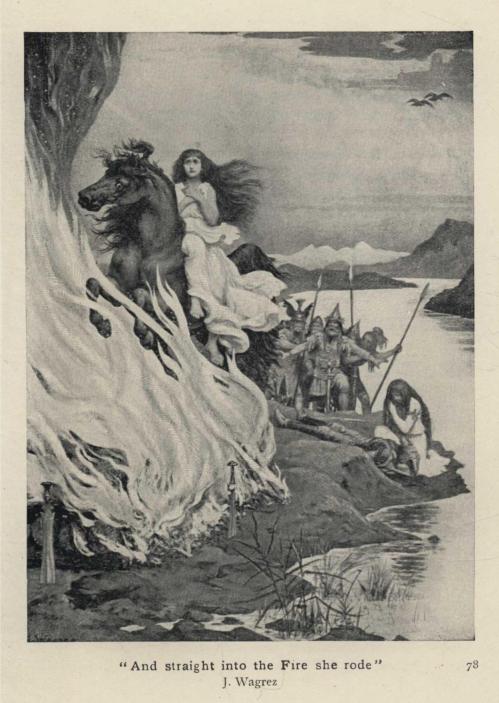
"And straight into the Fire she rode" J. Wagrez
"Behold the Ring; the Ring of the curse! Come, seize it, and may gods and men be relieved of its ban!"
At her cry a wondrous thing was seen by the watchers round about the pyre. A great wave rose out of the bed of the river, and on its crest the three Rhine-maidens appeared. Up over the bank rushed the wave, quenching the fire as it came and sweeping all before it into the water's depths.
Suddenly Hagen gave a fearful cry. He beheld the Ring again being swept from beyond his grasp, and he plunged into the current and attempted to take it from one of the maidens who held it exultingly aloft. But the other two twined their arms about him and dragged him down with them. When the wave had subsided he was no longer to be seen; nor was there any vestige of the funeral pyre or Brunhilde. The curse of the Ring was wiped away.
Just then a reddish glow was seen in the sky. Swiftly it grew and spread like the light of many auroras. In speechless amazement the onlookers beheld this awe-inspiring sight. The doom of the gods had come with the recovery of the Ring. Walhalla was being destroyed. Wotan's kingdom was at an end. Henceforth the world was to press forward to new and better things.
Parsifal the Pure
(Parsifal)
"Galahad, as Tennyson portrays him, will always hold the first place with English readers as the ideal Knight of the Holy Grail. The matchless diction of Tennyson has given the less perfect form of the legend a supreme charm and beauty. But Wolfram von Eschenbach's Persifal, as spiritualised and humanised in Wagner's lyric drama, will be seen to be in fuller accord with the whole cycle and development of the Grail legends, and at the same time gives the nobler story."—OLIVER HUCKEL.
You have just read of the downfall of the gods through broken promises, and of a great hero of those early days who fell a victim to fate. And now you may like to hear of another hero who was even greater, for he was superior to every enemy and every temptation to the end. The old order of things had long since passed away. The gods were indeed dead, and men believed instead in one true God and in His beloved Son. A beautiful legend had grown out of the last days of the Christ upon earth; and this legend is the golden thread upon which is hung our present story.
You remember that in the Bible account of the Last Supper, Christ took a cup and blessed the wine in it and gave it to His disciples to drink. The legend goes on to relate that Joseph of Arimathea, the man who provided a tomb for Christ, obtained the blessed cup of the sacrament, and that at the crucifixion he caught in it a few drops of blood from Christ's bleeding side.
Henceforth the Cup possessed the magical power of healing all wounds and sicknesses. It brought perfect peace to its possessor; and the mere sight of it was esteemed the greatest privilege on earth. But it was rarely seen of men. Spirited away by divine power, the Holy Grail—as it was called—was shown only on rare occasions and to the noblest and most self-sacrificing among its seekers. And so its quest came to be the highest task a man could set himself, for it meant the conquering of his own baser nature first of all, and the putting aside of every selfish interest.
You may have read the fine old story of the quest of King Arthur's Knights of the Round Table for this Holy Grail, and how it made them all nobler and better, although the inspiring vision was granted only to two or three. At that time it had no fixed place, and men did not know where or how to seek it. So it is no wonder that so few ever succeeded in the quest.
Finally in another land a brave knight, Titurel by name, decided to devote his whole life to seeking the sacred Cup. Taking with him his son, and a small but chosen body of knights, he set forth trusting to the mercy of Heaven to favour his search. Many days he led his little band across deserts, through valleys, and over stony mountain-sides. And as they went they aided every person who crossed their path; they forsook all worldly pride; and they spoke only in kindness and humility of spirit. Night and morning, also, they prayed that they might be led to the Holy Grail.
On and on they went, dusty and travel-worn and weary, but with the same brave hearts. Late one evening they stopped for the night in the shelter of a dense forest. They had travelled all day and had eaten little, but after resting a brief while something seemed to urge them forward.
"Rise, my brave knights," said Titurel standing stiffly upon his feet. "Rise, and let us go still farther into this wood. I feel that it is the divine will."
Without murmuring they once more resumed their march, and, wonderful to relate, the farther they went the less tired they grew. A strange feeling of rest and content came over them until in a great wave of joy they all fell upon their knees and gave thanks. They felt that at last they were nearing the Holy Grail!
As they knelt a great light, like noonday, shone round about them, and a voice said,
"Arise, ye blessed among mankind! For your labours are rewarded and it is given to you to guard the Holy Grail. Near unto you is a mountain which shall be called Mount Salvat, and thereupon must ye build a temple. And ye shall be called the Knights of the Holy Grail."
The voice ceased. The knights fell upon their faces in prayer and thanksgiving. When they arose the light had disappeared, but in each face was reflected a lofty purpose born of its glory.
The next morning they went their way to Mount Salvat and there built the temple. High were its walls, with lofty arches and beautiful windows, and its fame as the most imposing temple in all the world soon went abroad. And when it was finished and they held the solemn service of dedication, a light came and glowed steadily in the crypt. While all the knights fell upon their knees, Titurel drew near and lifted a veil. There in all its beauty shone the Holy Grail!
Then Titurel and the knights were filled with great joy, and they vowed eternal service to the sacred charge. They became, indeed, a sort of priesthood and forsook all other aims or desires. Daily they worshipped in the temple, and were fed from the holy altar. And if any among them became wounded or ill, the mystic fire which glowed about the Cup speedily restored them to health.
For many years they kept their charge with zealous faith. Titurel their head became an old man, and Amfortas his son was appointed chief guardian of the Grail in his stead.
Meanwhile, as you may suppose, many other knights were desirous of being admitted into the temple; but none save those who led pure and sincere lives were ever accepted. Among those who were rejected because they were unworthy was a powerful magician named Klingsor. When he failed to win entrance in the usual way he tried to bribe the keepers of the gates and to make use of other base methods, but without success.
In his rage, Klingsor swore vengeance and devoted all his wicked arts to overthrowing the Temple of the Grail. He made a beautiful garden on the other side of the mountain, which he filled with flowers, fruits, music and dancing girls. By this means he deluded many knights who had come from afar earnestly seeking the Holy Grail, so that, almost at the goal, they forgot their quest and tarried idly in the gardens.
Hearing of Klingsor's wicked arts, Amfortas was filled with righteous anger. He determined to go forth and strike down the magician with the sacred Spear, which was his high badge of office. This Spear was second only to the Grail itself in value. It was the same that had pierced the Saviour's side while He was on the cross. It gave to its bearer the power of overcoming all his enemies, so long as he was true to the faith. But Amfortas though zealous was too confident of his own strength. Going over the mountain hastily in search of Klingsor, he grew tired and thirsty; so when he came to a shady grove of fruit-trees by a splashing fountain, he did not recognise this as one of the wiles of the magician, but ate and drank, then threw himself down on the cool grass and fell asleep. The Spear was loosened from his grasp, in his slumber, and he was only awakened by a keen, smarting pain in his side. He found that he had been wounded; and as he sprang to his feet he confronted Klingsor who was waving aloft the Spear in triumph.
"Go back to your temple!" sneered Klingsor; "and bid the next man be not weary so soon!"
In shame and sorrow Amfortas departed, knowing that he had sinned and could do nothing against the Spear now in the hands of the enemy. Earnestly he did penance in the temple and confessed his fault, but the wound in his side never healed. It gave him daily torment, and the sight of the Grail which had once brought healing seemed only to increase the pain.
It had been Amfortas' duty to uncover the Grail each day at sacrament, but so dire was his suffering that he came to do it less and less frequently. The knights were very sorrowful because of these things, and they sent far and wide for healing balsams, but all remedies were powerless. Long did Amfortas kneel before the altar praying in his pain, and seeking for a word of hope from above. At length one day an added radiance glowed about the Grail, and he heard a voice saying,
"By pity enlightened,
My guileless one,—
Wait thou for him
Till my will is done!"
Amfortas could not understand these words, but somehow his heart was lightened, and he thanked God that one day, be it near or far, he should find relief. The other Knights of the Grail also heard with joy of the strange message, for they did not doubt that it meant healing and peace.
For many days they waited patiently and prayerfully without receiving any further sign. Amfortas strove to sustain his courage, but it was a bitter test. Daily he tried the baths and also the balms which his knights often went to much peril to obtain for him; yet the wound still showed no signs of healing, and deep gloom settled down over the temple.
One day while the aged keeper of the gate was sitting, as was his wont, with his face toward the little lake which nestled in the valley, his eye was attracted by a wild swan which soared peacefully above the lake. Suddenly it turned sidewise with a wild flutter of pinions and began to fall toward the water. The keeper saw that it was wounded by an arrow, and he hastened down to the lake to see who had done the deed; for it was forbidden to harm any creature, great or small, within sight of the temple.
Just as he reached the bank, the swan fell at his feet and expired, while at the same moment a youth ran up to claim his prize. He was clothed in motley animal skins, but he was strong and well knit, and with that frank look about the eye which denotes both fearlessness and innocence.
"Shame, shame upon you, boy, for shooting the swan!" said the old man sternly.
"Why, what have I done?" answered the youth. "Do not men hunt birds and beasts? Methought it was a fine thing that I struck the bird so high."
"But you are now within holy ground, where 'tis sacrilege to harm any creature. And think what sorrow you have brought with your idle deed. This beautiful bird will soar in the clouds no more. It may have a mate, or perhaps little ones awaiting its coming. They will never see it again."
The boy stood with downcast eyes and troubled face. "Indeed, I never thought evil," he said. And seized by a sudden impulse he broke his bow across his knee and flung his arrows away.
"What is your name, boy?" asked the knight.
"I am Parsifal," he answered simply.
"Whence come you?"
"I do not know."
"Where go you?"
"I go to become a knight," answered the boy. "I have always wanted to be a knight."
"But do you not know that great things are expected of a knight? They must do other deeds than roaming about shooting harmless swans."
The boy flushed, but looked straight at the stern old man. "I know that a man must be brave and true," he said; "and that he must keep his heart pure. My father, who died long ago, was such a knight, and my mother has always taught me to be like him."
"But you will have many strong trials before you can become a knight. You may have to wander all over the world and endure many hardships."
"I am ready for them," answered the boy sturdily.
"Truly you are a guileless fellow," said the old keeper; "but I like your spirit. Would you like to witness a service in the temple and hear the choir-boys sing? Perchance you would like to be a choir-boy for awhile?"
"Nay, but I came to be a knight. Nathless I will hear the singing."
The boy said this so calmly, that the knight was half sorry he had given the invitation; for chances to obtain entrance to the service were exceedingly rare. However, the word had been spoken and he would abide by it.
They cast the dead swan into the lake and went together up the hill. Service of the sacrament was just being begun in the temple as they entered its doors. High up in the organ loft the rolling waves of music poured forth, filling every arch of the lofty building. Then the sweet voices of boys were heard chanting the refrain to which Amfortas had set music:
"By pity enlightened,
My guileless one,—
Wait thou for him
Till my will is done!"
Parsifal plucked the old knight's sleeve. "What do they mean by that?" he asked.
"Hush. I do not know," replied the knight.
Parsifal thought it strange that they should sing words no one understood, but he kept silence and looked upon the solemn service with wide-open eyes.
The aged Titurel was present at the service. His days were almost numbered now, but he still had his couch conveyed into the presence of the beloved Grail when he felt strong enough. To-day he joined the other knights in urging his son Amfortas to uncover the Cup and serve the sacrament.
"Let me have the sacrament from out the blessed Cup once more before I die," said Titurel.
Amfortas shook his head and groaned aloud.
"Not yet, my father! I am unworthy to uncover the Grail!"
Nevertheless the feeble Titurel urged the point, and all the knights knelt with solemn upturned faces, until at last Amfortas went and unveiled the Cup and poured wine therefrom, so that all might partake. Then he fell to the floor with a shudder of pain. The old wound had broken open afresh. But Titurel and the other knights partook of the sacrament, while the choir-boys chanted responsively and the deep organ pipes thrilled all the lofty arches.
The old keeper of the gate went forward and partook with the rest, while the boy Parsifal stood spellbound behind a pillar and could make no meaning of what he saw.
At last the keeper came and led him forth again to the open air, and then the lad's tongue was loosed.
"I pray thee, why did the King fall to the floor as if in pain?" he asked.
"The wound in his side pained him," answered the keeper.
"Why doesn't it heal?"
"That is a long story. But the wound was made by the sacred Spear, and 'tis said that only the touch of that Spear again can make it well."
"Then why does he not go and lay hold of the Spear?"
"It is in a powerful magician's hands."
"Can no one take it from him?"
"No one has yet succeeded in the quest," answered the knight. "But, boy, how did you like the service of the Holy Grail?"
"I could make nothing of it," said Parsifal, turning as if to go.
"Could make nothing of it!" exclaimed the old knight. "Truly you would not be much of a choir-boy. But where are you going?"
"I go to seek the Spear that will heal the King," answered Parsifal.
The old knight let him go without further words. He even shook his head in some impatience.
"Truly a guileless youth," he said to himself. "A little knocking about in the world will not hurt him. He is too foolish to do us any good here. And as to being a knight—pish!"
But just then the closing words of the service came echoing through the windows, and caused the old man to start. He had heard again the mystic song,
"By pity enlightened
My guileless one!"
Now Klingsor the magician had cast a spell over a poor woman so that she was obliged to obey him in all things. Usually she was old and wrinkled, and passed for a witch in the countryside. But when Klingsor waved his wand over her she became the most beautiful maiden ever seen. Kundry was her name, and she it was who had charge of the groves and flowers and music and dancing girls which had caused so many knights to turn aside before ever they reached the Temple of the Grail. Kundry, indeed, had caused Amfortas himself to sin, on the day he lost the Sacred Spear.
But when the spell was removed from poor Kundry she always bitterly repented her misdeeds. She had been very sorry for Amfortas, in her wild way, and had herself brought balsam from distant lands to heal his wound, but without avail.
No sooner was Parsifal on his way in search of the sacred Spear, than Klingsor was on the alert. Once more he summoned Kundry and bade her prepare the same kind of a trap for Parsifal as had lured the knights aside. But Kundry hotly protested at this. She had seen the youth and greatly liked his open face and frankness. She rebelled against doing harm to one so harmless as he.
"Let him pass on his way," she pleaded. "He has done no evil and is too simple to find you unaided, and even if he did, he could not take the Spear from you."
"Do as I bid you!" replied the magician, angrily. "It is precisely because he is pure and innocent that I fear him. Such an one's coming has long been foretold."
So Kundry had nothing to do but sadly obey.
When Parsifal drew near, walking over the crest of the hill, the palace of Klingsor suddenly sank into the earth and vanished, leaving in its stead a lovely flower-garden. Presently Parsifal stopped and listened, for he heard strains of music.
"How sweet it sounds!" he said; "yet it seems to make the air heavy and uncomfortable. I wonder where it comes from?"
Louder grew the music, and with it came the sound of girls' voices. Just then he came to the entrance of the garden, where he paused spellbound. The flowers themselves were singing to him! Each flower was in the lovely tints of a rose, lily, pansy or carnation, and out of the centre of each blossom peeped the bright eyes and laughing face of a bewitching maiden.
"Come!" they sang to him; "come and rest by the fountains! Come, drink nectar, and let us sing to you while you rest in the shade!"
"Nay," said Parsifal, simply. "I like you all, and would gladly Listen to your song; but I cannot tarry, for I am on an urgent errand."
"Come!" they pleaded; and the flowers seemed to weave in and out in a wonderful dance, nodding to him and beckoning him. "Come! Only a little while! Then you will start forth rested and make better speed."
Parsifal shook his head. "I cannot enter," he said, and turned to go, when another voice softer than the rest called his name.
"Who called me?" he asked, turning about.
"I called thee, lad," said the sweet voice.
He looked whence it came and saw a leafy bower opened wide, and in it sat a maiden fairer than ever heart could dream. It was Kundry, the ugly old witch, transformed by the power of the magician into this glorious vision.
"How did you know my name?" he asked, bluntly.
"I knew thy mother, lad, and thy father, too. Wouldst hear of them?"
"Yes, yes!" he cried eagerly. "Tell me of them!"
"Then come within the bower and rest awhile. Here thou canst listen to the music and eat and drink and dance with these lovely flowers."
"Nay, but tell me now! Why should I pause when I am not faint? No good deed was ever done by stopping on the way."
"Thou art a foolish youth," said the maiden. "Why art thou in so great haste?"
"I seek a magician," he answered, frankly; "a magician who has stolen the sacred Spear."
"Ah, I can tell thee of him!" she cried—an evil light lurking in her eyes. "Come, sit by my side, and I will tell not only of him but of thy father and mother."
Parsifal turned at this, but entered the garden slowly. He knew no reason why he should not come in, and yet a great force seemed holding him back. "But how can I go on my errand," he thought, "unless I find the way?"
"I would hear about my mother first," he said, seating himself by the maiden's side. "Is she well?"
"She is well, but has mourned sadly since thou didst go away. I saw her only a few days ago, and she sent thee her love and a kiss."
Here the witch leaned forward suddenly and printed a kiss upon his lips. It was intended to enchant him, but for once it failed of its effect. Parsifal sprang up as if stung by an asp.
"Amfortas! O Amfortas!" he cried. "I know it now! The spear-wound in your side! Ah, the anguish of it has come upon me also!"
"Thou art wrong," said the woman softly. "I have harmed thee not. Only stay!"
"Not another moment!" exclaimed Parsifal. "Your garden is evil and brings death to men's souls."
He turned to go, but the witch called aloud to the magician, for she knew her power was gone. And as she called, Parsifal saw a dark, dreadful figure before him that blocked his way.
"Stay!" commanded Klingsor waving the sacred Spear aloft. "Those who enter my garden cannot leave it so easily!"
"Stand aside!" cried Parsifal. "I have done no hurt, and I fear you not!"
"Thou wilt fear me when thou dost feel this spear-point! 'Tis the same that undid Amfortas."
"Ha! say you so? Then I have come to claim it in his name."
"Take it!" shouted the magician angrily. And he threw the weapon straight at Parsifal with terrific force.
But miracle of miracles! it stopped of itself midway, and floated gently round about Parsifal's head. He grasped it reverently and made the sign of the cross.
"In this sign, perish!" he exclaimed. "Let all your wicked magic vanish from the face of the earth!"
As he uttered these words a tremendous crash was heard, followed by an earthquake. The garden, its flowers and music and running streams, were swallowed up in an instant, with all its inmates. Parsifal alone remained on solid ground.
He looked about him, but could see only a trackless forest with close spreading trees that shut out the blue sky and the light of the sun. He did not know which way to turn, or where stood the Temple of the Grail. But the sacred Spear was still in his hand, and its presence seemed to bring comfort. He knelt and prayed for guidance, and as if in answer, the words of the old knight came into his memory,
"You may have to wander all over the world and endure many hardships."
The young Parsifal wondered at this message. It seemed to come in answer to his prayer, and yet his spirit rose in questioning, "Why should I roam over the world when the King needs me so much, and his wound is not healed?"
But no other answer came, and no path led out of the forest. So he made no further questions but went his way, trusting to Heaven to guide him, and the sacred Spear to protect him. When at last he reached the borders of the wood he found himself in a strange country.
Thus it was that Parsifal began his pilgrimage. Long and hard it was, yet he did not falter or complain. And always his hand was ready to help the poor or the suffering, while little children came to him gladly knowing they had found a friend.
Often his path led over steep, rough mountains; again it lay in burning sands of the desert; and again it was close to treacherous quicksands or yawning pits. But steadily he pressed forward, learning many things as he went, but never parting from any of his early purity or courage.
Slowly, also, the great truth of the Holy Grail dawned upon him. He heard men speak of it with reverence and longing as the dearest treasure the earth possessed. Then he realised how lightly he had thrown away his own privilege through ignorance and why the old knight at the gate had turned from him with impatience, as "guileless." With humility and prayer he resolved that he would always try to be worthy of this vision, in the hope that it would again come to him. And in moments like this, when his whole soul was stirred with anguish, he seemed to hear an inner voice saying,
"Courage! The Holy Grail is not far away!"
Thus years passed by, and at last Parsifal, for true and heroic service, was made a knight. Never was there a comelier. Strong and straight and graceful he stood, while his face was fair and pleasing and seemed continually to glow with an inner light. His eye was the very mirror of truth. He was, indeed, the image of that ancient ideal, a knight without fear and without reproach; and always he sought the deed that was most valorous and the duty that was most severe, hoping that his steps might be directed again to the Temple of the Grail.
One night he heard the bleating of a lamb that had lost its way. Parsifal was far from shelter, and the night was stormy, yet he did not hesitate. He turned aside and sought in the darkness until he had found the little wanderer, when he wrapped it in his cloak and carried it to its mother. When he again sought his road he could not find it because of the storm. He wandered on, and presently saw that he was in the midst of a dense forest. Somehow even in the night it seemed familiar to him, and his heart gave a great leap. He felt that the Holy Grail was close at hand!
Then a flash of lightning disclosed to him a little cavern, hollowed out of a rock, and he entered it for shelter during the night, with thankfulness.
The next morning the sun shone bright and warm, gilding the wet leaves of the forest with radiance. Parsifal followed a shining beam of gold straight through the forest—and there before his feet lay the lake where he had shot the swan so long ago. On the hill near by stood the Temple of the Grail.
Parsifal stuck the Spear upright in the soil and knelt in prayer and rejoicing that his long pilgrimage was at an end; then rose and took his steps toward the hill.
"I wonder if the old knight of the gates is still alive," he said to himself; "I should dearly like to see him again."
No sooner had he said this, than he saw an aged man tottering feebly along, and lo! it was the keeper himself. By his side walked a woman whom Parsifal seemed to remember, but could not quite. It was Kundry the former witch of the flower-garden. After this garden was destroyed she had been released from the magician's spell, and she was now carrying water and doing other menial tasks around the temple in the hope of atoning for her past wickednesses.
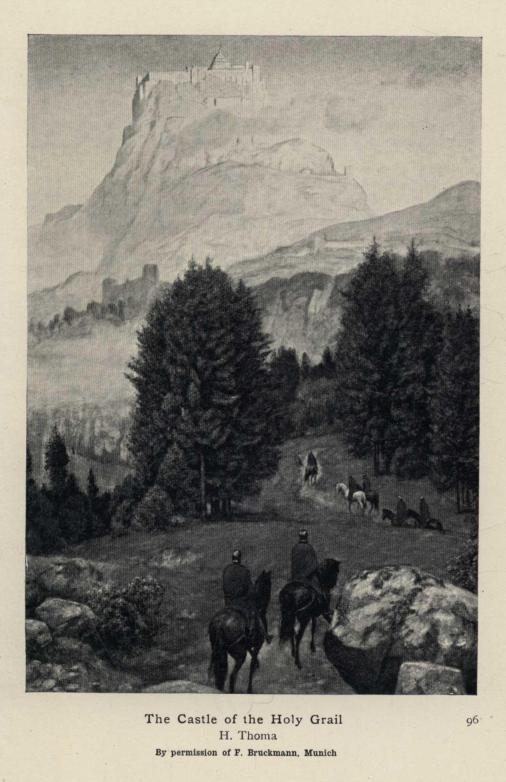
The Castle of the Holy Grail H. Thoma By permission of F. Bruckmann, Munich
When the keeper saw the knight in splendid armour standing there motionless, he greeted him courteously and said,
"Good-morrow, Sir Knight? Do you come seeking the Temple of the Grail? Then know that you are even now on consecrated ground, where it is forbidden to come bearing arms or with helmet closed."
For answer Parsifal once more thrust his Spear into the earth, and laying aside his helmet knelt with his face toward the temple. Then the old knight remembered him.
"It is the youth of the swan!" he exclaimed to Kundry. "And see what he has brought back with him! The sacred Spear! O happy day on which the Spear comes home!"
Then Parsifal rose to his feet, and seeing love and joy in the old man's face he opened his arms and the two embraced right gladly.
"All hail to thee, good friend!" cried Parsifal. "Long did I fear that I should never see thy face again."
"Dost thou remember me?" asked the keeper. "Long years have passed and much grief has bent my back, since the day I let thee go forth as guileless and crack-brained."
"As indeed I was," answered Parsifal, "but through failures and hardships and many trials the guileless one has been at last enlightened, even as they sang in that strange sweet song of the temple.
"But tell me," the young man continued, "is there not something changed about this holy place? Oft have I heard about it in my wanderings. Men told me that Mount Salvat was the abode of delight; that here the birds sang, the knights went hither and thither with joy upon their faces, and the very air was filled with the spring-time of gladness. Is it not so; or is this only an idle dream?"
"It was so," answered the old man sadly, "but dark days have come upon Mount Salvat. For pain of his wound, Amfortas has ceased entirely to serve the sacrament from the sacred Cup, and therefore are all the knights sad in their hearts. They have betaken themselves to cells like monks. The aged Titurel has died because he could no longer behold the Grail; and I am only living on in penance waiting till I can join him."
"Nay, but all these things must not be!" said Parsifal. "Dost thou remember telling me, long ago, that the sacred Spear—this Spear!—would heal Amfortas of his wound? I set forth to seek it that very day. Come, let us take it into his presence!"
"Pray God the oracle may come true!" exclaimed the keeper joyfully. "And thou dost come at a good season, for it is the Good Friday service to-day, and Amfortas has promised to uncover the Holy Grail once again, be the cost what it may. But before we go up, thou must rest and be cleansed at this spring; and I will procure a white robe for thee."
So Parsifal laved his face and his hands at the spring, while the old man went in haste for the white robe. And while he sat there, the woman came up timidly and knelt down and unfastened his sandals and washed his feet. Then Parsifal looked down and remembered her.
"Thou art Kundry," he said; "thou hast come a long hard way, even as I have come." He sprinkled her brow with a few drops of water from the spring. "I baptise thee into a new life," he said; "come with us this day to the temple."
The tears rained down glad Kundry's face; and as she knelt there, it was transformed again into the loveliness of the maiden of the flower-garden, but purer, sweeter, and of a radiance not of earth. She was redeemed!
Just then the soft chimes of the temple bells rang forth bidding them come to the service. The keeper returned with the garment which he put upon Parsifal and the three went up the path to the gates, Parsifal in the centre, bearing the sacred Spear.
They had no sooner entered than the procession of knights filed by, preceded by the choir-boys who sang of the Holy Grail. Last of all came Amfortas, slowly and as if in great pain. He paused before the shrine and made as if to open it, while all the knights gathered about in reverent waiting.
Suddenly he paused, clasped his hands to his side and cried out:
"No! no! I cannot do it! Death is so near me, only let me die! slay me with your swords and choose another Guardian of the Grail! I cannot bear to unveil the Holy Cup! Kill me, kill me, I pray you!"
His brow was wet with agony and he writhed with pain so that the knights drew back from him in terror.
Just then Parsifal drew near in his flowing white robe bearing the Spear aloft.
"Peace, O Amfortas!" he said quietly. "Only one weapon will ease thee of that pain: it is the one that caused it."
And with the sacred Spear he touched the wound; and lo! it was healed in an instant, and Amfortas' agony was changed to rapture as he knelt before the altar.
"Thou art forgiven," Parsifal's voice went on; "forgiven to continue in thy service of the Grail. But nevermore shalt thou be its Guardian. The words of the oracle have come true.
"'By pity enlightened,
My guileless one,—
Wait thou for him
Till my will is done!'"
Then Parsifal went reverently to the shrine and uncovered it, while all the knights fell on their knees and prayed, and the ransomed Kundry fell prostrate and bathed the altar steps with her happy tears. He drew forth the Holy Grail and held it aloft, and instantly a ray of dazzling light fell from above and struck within the Cup, so that it glowed with glory which flooded all the temple. And down from the lofty dome fluttered a pure white dove which hovered lightly over his head. The knights saw and understood the sign; a new Guardian of the Grail was come to them. The temple had awakened to a higher service through the stainless life of Parsifal.
Let us leave them there, in that holy service before Easter, while the music rose and swelled triumphant, telling of victory over sin and death!
Lohengrin the Swan Knight
(Lohengrin)
"Hear ye! hear ye! The King has come to Antwerp! Who fights upon the King's side?"
The silvery blast of a trumpet rang out, following the clear tones of a herald's voice; and in answer a great shout arose from a multitude of throats, for all the people in this wide stretching plain were eager to follow the standard of their warlike ruler.
It was in the days not long after Parsifal had come to the Temple of the Grail. The kingdom of Germany, so long a prey to warring states, had found a strong head in Henry the Fowler who protected the land from foes within and without. In times of peace it was his custom to travel from city to city holding court and listening to the grievance of everyone, great or small. In war time, he levied troops and led them in person. His visit to Antwerp, on this occasion, was for both purposes, as the Hungarians had lately declared war against him and were threatening to invade Germany.
Antwerp was capital of the ancient dukedom of Brabant, and one of King Henry's chief cities. On his coming, therefore, he was greatly troubled to find the state rent with quarrels and secret discontent.
The King held his court in the open air, under the spreading branches of a stately tree, called the "Oak of Justice," which stood on the bank of the winding river Scheldt. Here all the people gathered to pay him homage, and here—on the bright spring morning when our story opens—he caused the herald in brilliant livery to stand forth and blow upon a trumpet.
"Hear ye!" cried the herald again. "The King has come! Who fights for the King?"
Then all the people answered as with one voice, and came and knelt before the throne in token of allegiance.
The King's eye gladdened at the sight. "Verily," he said, "with such stout arms and loving hearts as these, we will drive the enemy into the sea!"
After he had greeted many by name, and many others had been presented to him, he saw one noble who had fought with him against the Danes.
"Come hither, Frederick of Telramund," he commanded. "As an oft-tried friend, I have a question to ask of you. How is it that Brabant has no head, but is rent with inner quarrels?"
Frederick of Telramund stepped forward and bowed low. He was a tall man, with beetling brows and deep, piercing eyes.
"I am thankful, my King," he began in a heavy voice and with ill-concealed excitement, "that you have seen our troubles and will lend ear to the story of them. I will tell you the truth. The former Duke of Brabant was my friend, and when he died he chose me as guardian for his children, Godfrey and Elsa. I brought them up as carefully as though they were my own, and looked forward fondly to the time when Godfrey should be duke; also—shall I confess it?—when I might win Elsa for my wife. But all these hopes were destined to fail. Elsa was a proud girl, and I fear now that she coveted the dukedom for herself, though she pretended to have great love for her brother.
"One day they went roaming in the woods and by the river's brink, as they often did. When night came, Elsa returned without her brother. She was pale and trembling, and when we asked her where he had gone, she would only reply by wringing her hands and sobbing. That is all the answer we have got from her, from that day to this, and we cannot help fearing that she drowned him, or laid other violent hands upon him.
"Of course, after this happening, I could no longer choose her hand in marriage. But I chose instead a lady whom I now wish to present to you—Ortrud, daughter of the brave King Radbod. In former times he was king over all this land; and in my wife's name I lay claim to Brabant."
As he finished speaking, Frederick took his wife by the hand and led her forward. She was a very handsome woman, though almost of masculine type, and her eye had a watchful look like that of a crouching tigress. She bent her head with the grace of a queen.
The King knitted his brow at the story, and looked about as though seeking someone else whom he might question. Seeing his doubt, Frederick resolved upon a bold stroke. Turning he addressed the people in a loud voice, saying,
"I accuse Elsa of Brabant of the murder of her brother. If there be any here who can deny my charge, I challenge him to come forth!"
No one moved, although there were mutterings here and there and sullen shakings of the head.
The King rose suddenly and hung his shield upon a limb of the tree.
"This is the Oak of Justice!" he said, "and I promise ye that I will not depart from its shade this day, until I have made trial of this charge.
"This shield no longer shall I wear
Till judgment is pronounced, I swear."
At a signal, the herald came forward again and announced, "Now shall this cause be tried as ancient law demands!" Then he blew a loud blast upon his trumpet and called upon Elsa of Brabant to come before her King for judgment.
The people had received the announcement, that the King would try the cause, with breathless eagerness. Now they parted to right and left and looked intently along the path Elsa was expected to come. They were not disappointed. After a few moments a train of ladies appeared walking slowly, two by two, toward the Oak of Justice. Among them was one dressed in pure white. Her head was uncovered, and her golden hair fell in soft curls about her shoulders. Her blue eyes had a far-away look in them, and her pale face was marked by lines that told of suffering. The lady Ortrud looked balefully at her as she came forward, but the people drew nearer to the maiden with marks of pity that showed their old love for her.
The King himself was struck by this fair vision. The set look came out of his eyes, and he leaned forward and gently took her by the hand.
"Are you Elsa of Brabant?" he asked.
The young girl bowed and wrung her hands in silence.
"You are accused of the murder of your brother," continued the King. "What have you to say?"
"Oh, my poor brother!" cried Elsa; and not another word would she answer to the charge.
"Speak!" said the King. "Do you not know that I must adjudge you guilty unless you confide in me?"
Elsa looked up at the King and seemed to gain courage. The people gazed on the scene with stillness as of death. Elsa's voice was low but clear, and its tones were distinctly heard.
"When I have been in deep trouble," she said, "I have prayed to Heaven for help. It has been many times of late—O, many, many times! At last I was answered. I have had a dream, and it is such a beautiful dream that I know it must come true. A knight in glittering armour appeared in a vision and promised to be my champion whenever I should call upon him. O King, I claim him for my champion to-day! He will prove my innocence!"
Her words answered nothing and proved nothing; yet such was her manner that the people believed in her and shouted aloud that she was guiltless. The King himself seemed to seek a pretext to let her go free; but Frederick of Telramund stepped boldly forward.
"A likely story this, your Majesty!" he sneered. "Dream knights never yet have done anything; and if the Lady Elsa can but find her champion upon earth, here I stand ready to fight him to decide this cause."
The King looked at the maiden anxiously, and her face lit up at once.
"I agree to these terms," she said.
Upon this the King gave orders that lists, or open spaces, should be cleared; and then he announced that, following ancient custom, they would rest the issue of Elsa's guilt or innocence upon single combat between champions. The herald once again came forward and blew a long blast upon his trumpet, and proclaimed,
"Let him stand forth by Heaven's right
Who would for Elsa's just cause fight!"
There was a painful silence, while Frederick and Ortrud looked in smiling disdain upon the poor girl.
"O my King!" she cried. "Summon him again! His home is far away and he may not have heard."
"Sound once again!" commanded the King, and again the trumpet call rang out.
Again there was intense silence. Elsa dropped upon her knees and prayed until it seemed as though her very soul would burst with emotion. Suddenly a man nearest the bank of the river startled the silence with a cry,
"A swan! a swan! And in its wake a boat bearing a knight!"
Every eye turned and gazed up the winding stream, and there, sure enough, was a beautiful white bird swimming easily and gracefully along and drawing a little boat with a knight in it.
"A miracle! a miracle!" shouted the people.
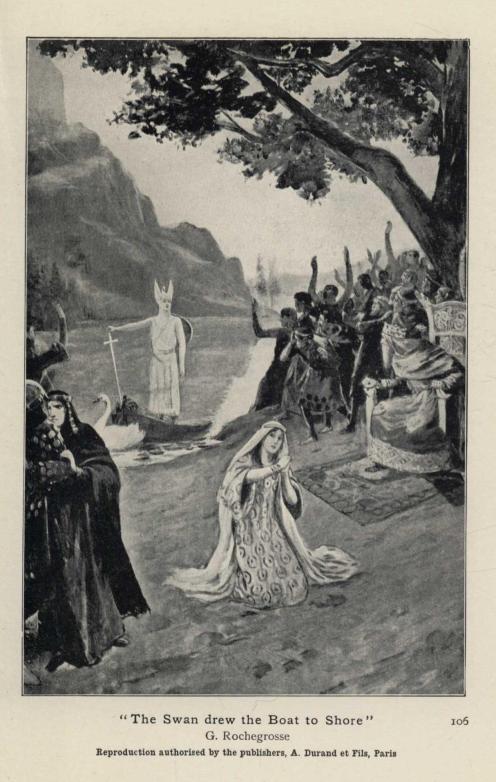
"The Swan drew the Boat to Shore" G. Rochegrosse Reproduction authorised by the publishers, A. Durand et Fils, Paris
As he drew near, they saw that the knight was clad in silver armour which shone dazzling white in the sun. Amid a general hush, the swan drew the boat to shore, and the knight stepped out. Before greeting the King or court, he dismissed the swan in a tender little song of farewell!
"I give thee thanks, my faithful swan,
Turn thee again and stem the tide;
Go back to that blest land of dawn
Where thou and I did once abide;
Full well thy loving task is done,
Farewell, farewell, beloved swan!
My faithful swan!"
Then while the swan bent its head in sad obedience and sailed away on the current, the knight turned to the King.
"Hail, O King!" he said courteously. "I have come in answer to your summons to do battle in Elsa's cause."
"You are right welcome, noble knight, from wheresoever you come," answered the King. Then turning to Elsa, he continued, "Do you accept this knight to be your champion?"
"'Tis the knight of my dream!" she murmured, sinking at his feet.
The King struck his shield three times with his sword.
"Sound the call to combat!" he commanded.
The call was given, and Frederick of Telramund took his place sullenly in the lists. He liked not the turn affairs were taking, but his word was given and could not be withdrawn.
The stranger knight lifted Elsa gently to her feet, then prepared to face his enemy. Another stroke upon the King's shield, and the two antagonists had crossed blades with a sharp crash.
But not long did they fight. Frederick was clearly outclassed from the first; and after a few wild, furious blows, which the other lightly parried, his sword was sent flying from his hand, and he was compelled to yield to the mercy of his conqueror.
The Knight of the Swan refused to take his life; but according to the law the defeated man was accounted a perjurer and doomed to exile. With downcast head he slunk away, followed by the proud Ortrud, who glared about defiantly to the last.
But the victorious knight now heeded them not. He had turned to where Elsa stood, and held out his hands in the old gesture which every maiden must one day understand. With a glad cry she ran and nestled in his arms.
"My hero!" she whispered.
Then the knight turned proudly toward the King, and said in the hearing of all,
"I would have the Lady Elsa as my wife."
"You have my consent with hers," replied King Henry, heartily. "And with her hand goes the dukedom of Brabant."
At this all the people shouted and threw their caps high in the air; for the new duke presented a handsome figure, while they had never liked the usurping Frederick.
"Only one promise must I exact from the fair Elsa," continued the champion. "If she cannot give it, I must release her from her silent pledge."
"What is that?" asked the King.
"She must never ask me my name, or whence I come. That I am well born and worthy of her she can decide for herself. But no question must be asked as to my past life. Can you promise this, my Elsa?"
He looked down anxiously at her, and she met his gaze frankly and trustingly.
"I promise—my husband!" she answered in low, sweet tones.
The Knight of the Swan kissed her upon the brow, while the King himself came forward and took each by the hand.
"I shall take this maiden in my charge," said Henry the Fowler, "and remain in Antwerp long enough to bestow her in marriage upon this man. Come, let us to the palace and prepare for the ringing of the joy bells!"
Then once again the people shouted with delight, and came crowding up to share in the scene. The King's shield was seized from the limb where it hung, and Elsa was placed upon it and borne forth in triumph, while the Swan Knight was likewise carried upon his own shield.
To have heard the noise and rejoicing you would have thought that there was no one in all Brabant who did not share in the general happiness. But there were two who found it gall and wormwood, and these two were Frederick and Ortrud. Deprived of their wealth and power, and in danger of their lives, they suffered a just punishment for their wickedness. Frederick was for leaving Brabant at once, and seeking their fortunes in other countries. But Ortrud, whose spirit remained unbroken, would not hear of this. All along she had been his evil counsellor, and now she set going other schemes of mischief.
The two stole forth at nightfall, clothed in beggar's tattered garments, and made their way to the palace steps, where they listened to the sounds of rejoicing within the palace.
"Ah! I should still be there, if I had not listened to you," groaned Frederick, who was a man of poor courage.
"Cease your complaining!" answered Ortrud. "We will win the victory yet, and you shall be in power again, if you listen to me now."
"What can we do?"
"Have you not heard of the promise made by Elsa to this Swan Knight? He is a magician, I warrant you, and all we need do is to prove it. She has promised never to ask his name. Now if we can get her to break that promise, he will vanish—mark my words!"
Frederick sat up and looked around eagerly.
"Ortrud, you are a genius!" he said. "But how can we do this? We are beggared and exiled."
"Trust me—but hush! I hear someone on the balcony!"
It was Elsa herself, who came out for a moment to look at the stars and commune with her own great happiness. At sight of the girl's face in the glow of the window, Ortrud crept softly round the balustrade and suddenly appeared before her startled gaze.
"Pardon—pardon!" cried the crafty woman in a low tone, and sinking on the step at Elsa's feet.
"Who are you?" demanded Elsa.
"I am an outcast. Out of your great happiness pity my deep misery!"
"It is Ortrud!" exclaimed the girl, her heart made tender by her own love. "Poor woman, I did not seek to harm you. Your husband brought it on himself."
"I had naught to say," coaxed the kneeling woman. "And now you would not send me forth from your door, to wander into the wide world a beggar!"
"No!" exclaimed the generous Elsa, "I will shelter and protect you. Come with me!"
She turned to order lights from two servants at the door; and Ortrud shot a quick glance of cunning triumph at her hidden husband, before entering the palace.
All that night Frederick lurked amid the shadows of the neighbouring cathedral and waited. He knew that their wicked schemes were in safe hands, with Ortrud on the inside; and although only a few short hours remained he took heart of hope.
The wedding had been set for early the next morning, so that Henry the Fowler could go to the wars.
Hardly had the sun struck the lowest range of windows on the building, before an army of servants appeared, as if by magic, and began decorating walls, porticos, and pillars with streamers and flowers. When the sunlight had penetrated every corner of the court a herald came out and announced the approaching wedding. The King's business demanded haste and so there had been no delay. The herald further announced that the stranger knight would not accept the dukedom, but would be styled simply the Protector of Brabant; and that he was to go with the King's troops and lead the men into battle against the Hungarians.
The herald had scarcely ceased ere four pages appeared on the palace steps crying, "Make way for the Lady Elsa!"
Again the ladies-in-waiting came forth, clad in white, and behind them came Elsa looking very lovely in her bridal robes and attended by her friends and some of the noblest ladies of the state. Near her walked Ortrud whom Elsa wished to honour, and who was attired in rich and costly robes.
Slowly the wedding party filed across the palace courtyard to the wide-open doors of the great cathedral. The maids arrayed themselves on either side to let their mistress pass; but just as Elsa reached the portal, Ortrud suddenly rushed in front of her exclaiming,
"No! you shall not enter first! I am higher born than you, and must take the lead!"
"What do you mean?" asked Elsa starting back.
"I mean that your nameless knight won his victory yesterday by fraud, and that I am still the rightful duchess of Brabant."
Elsa flushed red and answered her proudly, "A fitting return is this for my late kindness to you! And as to the victory it was won fairly in sight of all the people. Stand aside, rash woman, and let me pass!"
Ortrud stood unmoved. "You would wed a pretty champion!" she sneered. "Why, you do not know his name! And as for knowing his origin or character—forsooth!" (Here she snapped her fingers.) "I tell you he is a magician, and won his fight with my husband by the powers of evil!"
"It is false!" cried Elsa wildly. "You are a slanderous——"
"The King! the King!" shouted the attendants at this moment. "Make way for the King!"
The quarrel at the doorway ceased as the King approached followed by his knights. At his right hand came the Knight of the Swan, who seeing the commotion stepped quickly forward to Elsa's side.
"What is the trouble, beloved?" he asked quietly.
"This dreadful woman!" exclaimed the girl pointing to Ortrud. "She will not let me pass, and she has been saying wicked things about you."
The knight gave Ortrud one stern look before which even her vengeful spirit quailed.
"Stand aside!" he commanded in a low voice.
"What is wrong?" demanded the voice of the King, who had come up with the group.
"Nothing now, your Majesty. We will go forward," answered the Swan Knight, taking his trembling bride upon his arm and mounting the cathedral steps.
But at the threshold they met another interference. Frederick of Telramund, who had been lurking about watching all that happened, suddenly stepped from behind the door shouting,
"Stay a moment, Elsa of Brabant. You are being deceived, foolish girl! You do not know whom you are marrying. He is a sorcerer, and overcame me by magic!"
Elsa was like to swoon away at this unlooked-for happening. But the stranger knight whispered tenderly to her and reassured her.
The King, on his part, was thoroughly aroused by this second interruption.
"Begone, sirrah!" he exclaimed. "The fight was fair and the champion sent of Heaven. Come not into our presence again on peril of your life!"
Without farther hindrance the wedding party entered the church; and while the great organ pealed its strains of joyful music the knight and his lady were blessed and pronounced man and wife.
All that day the festivities lasted. The King had commanded that a feast be spread for every man, woman and child in the city. The new Protector of Brabant was publicly acclaimed in the afternoon; while, that evening, a state banquet was held in the palace.
Then following an old custom the maidens went ahead of the newly wedded couple to conduct them to the bridal-chamber. And as they entered its door they sang a beautiful refrain that has greeted the ears of countless brides from that day to this:
"Fairest and best
We lead thee on!"
There the maidens left them and went away singing as they had come. When the last sweet note had died away, the knight took his wife's two hands tenderly within his own.
"Elsa," he murmured, "do you indeed love me; or have you wed me only from a sense of duty?"
"I have loved you ever since I beheld you in my dreams," she answered. "But how came you to seek me out?"
"I am indeed Heaven-sent, as I told you. But without your peril, I think that Love would have guided me to you. For I love you dearly, Elsa!"
"Ah, how sweet my name sounds upon your lips!" she cried softly. "If I could but utter your own, my happiness would be full."
The knight gazed at her in silence a moment, then led her to an open casement.
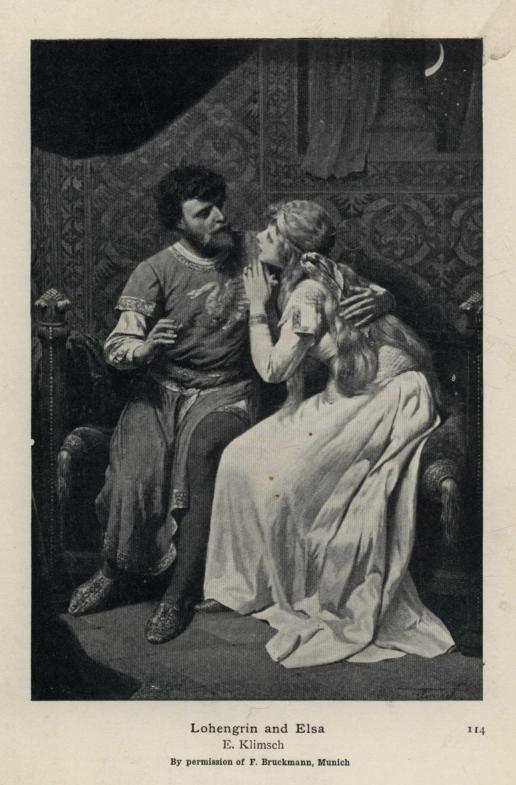
Lohengrin and Elsa E. Klimsch By permission of F. Bruckmann, Munich
"Breathe all the fragrance of eventide," he said. "Do you not distinguish many sweet odours beside the dew-laden roses near you? The breeze comes soft across the meadow and sea, bringing strange memories and hints of foreign shores. Is it not all the more delightful because we cannot penetrate all these mysteries? Love itself is the greatest mystery of all. Let us love then and be happy in each succeeding day; for when they are past we cannot recall them. We can only remember, but the mystery is gone!"
"Yes, let us love and be happy," she answered doubtfully. "But, O my husband, what shall I say when evil remarks are made, as like those by that wicked woman to-day?"
"Still thinking of her?" he replied with an attempt at lightness. "She will not annoy you again. For the rest, can you not trust me?"
"Can you not trust me?" she insisted. "Am I not your wife and worthy of some degree of confidence?"
"Elsa, once for all, this must not be! You have given your word to respect my secret. I assure you it is not a dark secret, and that I may look you frankly and joyfully in the face, as my wife. Isn't that enough?"
"But Frederick and Ortrud? What do they know about you? Why did they—oh, I cannot get their words out of my mind!"
Elsa was in fact growing hysterical. She clung to him wildly as they stood in the window. Poor girl! her recent trials had left her an easy prey to the insidious attack of this day.
The knight was very patient with her. He realised her unstrung condition, and tried to divert her mind by placing her gently in a chair where she could look out upon the river.
"See how white the waters gleam in the moonlight!" he said. "The river seems like a silver ribbon stretching away."
"And look!" she cried pointing. "There comes the swan-boat to take you from me! Ah, do not go!"
"Calm yourself, dear one! There is no boat."
"Oh, I cannot bear this mystery! I must question you!"
"Elsa!"
"I must, I must! What is your name?"
"Alas," he exclaimed. "Beware of what you say! Not another word I implore you!"
"Whence do you come?" she continued wildly.
At this moment a slight noise was heard at the door, and Frederick of Telramund burst in. He had enlisted the services of four of his former party, resolved to make one last bold stroke and kill the Knight of the Swan. But again he was no match for the knight. Alarmed by the noise, the latter sprang quickly for his sword and met Frederick midway in the room. A few swift strokes and that evil man lay dead upon the floor. The four nobles were seized with fear and came and knelt before the knight craving pardon.