Front matter (continued 4)
Reading edition
You may be sure this defeat sat ill with the haughty lords who had despised the common people and sneered at their champion. But they saw it would not do to employ force, as they were greatly outnumbered. So they decided to plot secretly against the Tribune while outwardly they bowed to his authority.
Accordingly when Rienzi held his first public audience, a few days later, in the audience-chamber of the Capitol, the barons were present, as well as ambassadors from foreign courts and many other dignitaries. It was an imposing assemblage worthy of a king. Messengers were despatched hither and thither with orders. Pages stood in waiting. Heralds announced each person who had business with the Tribune. Couriers, dust-covered, strode in to bring good news; one reported that the brigands had been suppressed; another, that all the roads were safe; another, that peace was an assured fact in all the country round about, and people were blessing the new Tribune's rule.
This news was received with great joy by all the court, with the exception of the barons. They saw in it a death-blow to their own power, and knew that so long as the Tribune held sway, the people would be more than a match for them. So they resolved to lose no time in putting Rienzi to death. That very day they met together—putting aside their own animosities for the time being—and laid their plans. Adrian who was present indignantly upbraided them, telling them they were breaking their word; but he was not heeded. Instead, his own father, who was head of the house of Colonna, asked him if he were going to turn against them, his own flesh and blood. Hot words rushed to Adrian's lips. He was on the point of replying that his country's welfare came first; but the barons did not pause to listen. They went in search of Rienzi, each with a dagger under his cloak.
Rienzi had been addressing the people from a gallery in the Capitol, when of a sudden Adrian ran swiftly from behind a row of pillars and whispered to him,
"Be on your guard! There are those who seek your life!" Then he darted away.
He did not have time to say more, for the group of conspirators were even then drawing near. They surrounded Rienzi under pretence of asking him some question with regard to the new government. Then quickly they drew their daggers and each one struck him in turn.
But the Tribune had been too vigilant for them. Suspecting treachery on their part he had taken the precaution to don a coat of mail, under his robe of state, and this turned aside all their blows.
Those below who had seen their dastardly attack cried aloud for vengeance.
"Seize them! Kill them! Murderers! Villains!" resounded on all sides; and in a jiffy the gallery was thronged with excited men, led by Cecco a burly blacksmith, and the conspirators were disarmed and bound. They were thrown into separate dungeons, and so fierce was the rage against them that they were glad to hear the heavy doors clang, for they had been afraid of being torn to pieces.
As it was, their hours seemed numbered, for the people surged about the chair of state whereon Rienzi had now taken his seat, and clamoured loudly for the execution of the barons. Rienzi also was justly indignant. He did not care so much for the attack made against his own person as for the barons' total want of honour and disregard of the state's welfare. He saw that they were working for their own interests to the ruin of everyone else, and that the people's new-found liberty would be safer if they were put to death. So he was about to yield to the popular clamour and sign their death warrant when Adrian and Irene entered.
The young nobleman had realised the serious danger threatening his father and the other barons when their attack failed. Wishing to save his kindred and friends, although he knew they deserved punishment, he had hastened in search of Irene and begged her to plead with her brother for the prisoners' lives. This the tender-hearted girl consented to do; and they now came to present the petition together. Falling on their knees before Rienzi they begged him to show mercy rather than justice and prove the greatness of his high office.
This was just the sort of petition that appealed to the high-souled Tribune. He impulsively tore up the sentence which he was about to sign, and calling the people together he addressed them again with that eloquence of which he was so great a master. He asked to be allowed to pardon the barons, as it was him only that they had attacked. The people gave their consent, though not without murmurs, and the prisoners were then summoned to the throne-room.
Rienzi received them in state, and for once they were cowed into submission. Indeed, they expected nothing less than sentence of death; and if any of them had been in Rienzi's place he would have lost no time in pronouncing this sentence. But as we have before seen, the chief fault of Rienzi was too great faith in the promises of other men. Now it led him into the great mistake of his life. To the utter surprise of the prisoners, the Tribune addressed them in words of kindness and pardon.
"Friends," he said quietly, "I have been deeply grieved by the outbreak for which ye are now in chains. As concerns my own life, I care not a straw. I will gladly offer it up at any moment for the good of my country. But in your late attack I cannot but see that ye were aiming at my country rather than me. Ye were violating your words. Ye were breaking the laws. If I regarded only the justice of the case and the requests of my people, I should order you to immediate execution; for this ye have deserved. But the teachings of holy church are that we shall temper our deeds with mercy. I have therefore asked the people, whom ye have offended, to forgive you for my sake. This they will do if ye renew your allegiance,—promising solemnly upon your honour as gentlemen and Christians to respect the laws of the people and my authority as their representative."
During this speech the barons looked at one another in doubt and amazement. Never had they heard its like. Their whole lives had been spent under the principle of "kill or be killed," and the nobility of this young dreamer struck no responsive note in their own breasts. But when he ended his speech of pardon with the condition that they take a new oath of allegiance, they saw it was their only hope of escape. And so they all promised, though sullenly and reluctantly, and each one resolving in his heart to pay no heed to a promise wrung from him by force of circumstances.
Thus you see the Tribune's good deed brought forth no good fruit—only evil; for as the prisoners were set free, their faces wore such heavy scowls and their teeth set so savagely that the people were filled with foreboding and for the first time began to doubt the wisdom of their ruler.
The citizens had good cause to be alarmed. That very night the barons secretly fled from the city, and the next day reports reached the market-place that they were collecting a large army in the provinces and would soon march against Rienzi to crush him. The reports were soon confirmed and grew more portentous day by day The people became terrified and openly reproached the Tribune for his lack of foresight. Yet they still clung to him as their leader, and implored him to save them from their enemies.
Rienzi went about with calm and cheerful countenance. His very presence inspired confidence, and his speeches brought the people flocking to his standard and ready to shed their last drop of blood in the beloved cause.
But there was one, in this troublous time, whose heart was torn with conflicting emotions. Poor Adrian did not know which way to turn. Loyalty to his kindred and father's house demanded that he side with the barons. A new-found devotion to his country and belief in Rienzi urged him to support the people. And in addition he had become deeply in love with the gentle Irene and felt that she responded to his devotion. It was indeed a heart-breaking situation for him and one that seemed more hopeless as the day of battle grew imminent.
Finally the barons' army drew proudly on the city, and halting before the gates demanded its instant surrender. The warders shouted back defiance, while from within came the sound of singing and marching men. Rienzi's forces approached the gates with resolute step keeping time to a sonorous war-chant. At their head rode the Tribune, his dark eyes flashing with the light of conflict. But before he could give orders to throw open the gates and meet the enemy on open ground, Adrian sprang forward and cast himself before Rienzi's charger.
"Halt! I beseech you, O Tribune!" he cried, while the steed reared and its rider drew in the reins sharply.
"What is the cause of this?" demanded Rienzi sternly.
"Let me plead with the barons once more!" begged Adrian. "Perchance they will listen to me, and there will be no need of bloodshed. Ah, let us have an armistice!"
"It is too late," replied the Tribune. "They have shown us that we can put no faith in speeches. Stand aside! What ho, warders! Open the gates, and let us give these rebels all the fighting they desire!"
And so they did! While the unfortunate Adrian was brushed aside, the gates were unbarred and the two armies rushed together in the shock of battle. Rome the ancient seat of many fierce struggles never saw one more fierce or deadly than this. The barons were spurred on by hatred and greed. The people were fighting for their liberties. And here and there and everywhere the black horse of Rienzi was seen, bearing his triumphant rider into the thickest of the fray. Rienzi's plume waving above his dark hair was the signal of victory. Rienzi's clear voice was encouragement and conquest.
Finally after fearful slaughter the barons broke and fled. The Tribune had once again defeated them. Among the heaps of slain was Adrian's father, the head of the house of Colonna. While the victorious citizens buried the dead, they sang praises to their leader, whom they idolised more than ever. And it did indeed seem that a bright day had dawned for Rome.
But though the barons were defeated and dispersed, they had by no means given up the struggle. They now tried by underhand means to gain their ends. The Emperor of Germany had for some time asserted sovereignty, in nominal fashion, over Rome. To him the barons now appealed saying that the city was in the hands of a dangerous rebel. They also visited the Pope at Avignon and artfully persuaded him that Rienzi was a dangerous heretic who openly scoffed at all authority. Though the Pope had formerly felt compelled to flee from Rome because of the barons, he now listened to their speeches and, strange to say, fell in with their plans. The Emperor also sent orders that his ambassadors were to be recalled.
This news, reaching Rome, caused a new upheaval in the minds of the fickle people. Many were ready, without delay, to turn against the man they had been worshipping. Their emotions were still further worked upon by some designing demagogues, one being Cecco, the blacksmith we have before noticed. Cecco and his band thought they could push themselves to power in this general disturbance, and they lost no chance of poisoning the ears of the crowd.
Finally, a new leader appeared. It was none other than Adrian, who, frantic with grief over the death of his father, now publicly announced that he had vowed to slay Rienzi, and called upon the people to help him to put down the usurper and tyrant. And soon the cry arose in this street and that, "Down with Rienzi!" For the people had forgotten—as people will forget.
But still there were others who argued stoutly for the Tribune's cause, so that words ran high and many citizens did not know what to believe.
In the midst of the disturbance the great bell of the cathedral rang out calling the people to worship. A public service of thanksgiving had been announced in celebration of the great victory; and presently the Papal Legate and all his train appeared going to the service. This made the crowd still more doubtful in their beliefs, though public sentiment began to veer again toward Rienzi.
"See!" they said, "the Pope himself is helping to celebrate the victory. Then surely he has not withdrawn his favour from Rienzi!"
Just then Rienzi himself appeared, leading his sister by the hand and proceeding with firm step to the cathedral. Adrian was among the throng who saw him pass; but though Adrian had vowed to slay him, and there were many in the press who had been shouting "Down with Rienzi!" there was not a finger stirred against him—such was the majesty of his calm demeanour. Adrian himself could not strike this man while he walked hand in hand with Irene!
Her face was pale, and her eyes bore traces of suffering as though she had feared for her brother's safety, or sorrowed over another's grief. Indeed, she had done both; and if Adrian could have looked upon her heart he would have seen a struggle as keen as the one he was undergoing; a grief whose reason would have caused him both pain and joy.
Just as Irene and Rienzi drew near to the door of the cathedral the crowd saw a startling scene. The Papal Legate came forth clad in the full regalia of the church and forbade them to enter. In a loud voice he pronounced a curse upon Rienzi. He was forbidden to partake of the sacrament or have any part in the church's privileges. All men, likewise, were forbidden to aid him in any way, lest they should incur a similar penalty.
This was what was known as excommunication. It was the severest punishment in the power of the church, and was usually directed only against criminals or desperate characters.
When Rienzi heard these unjust and unexpected words, he staggered back filled with amazement and horror. He had not looked for such reward as this for his great services, and he knew not which way to turn. The citizens on their part shrank away from him as from one smitten with the plague. Meanwhile, Adrian sprang to Irene's side.
"Come away with me!" he said gently. "The anathema was not directed against you, and I can conduct you to safety."
"No!" she cried, clinging the closer to her brother. "No! where he goes, there will I go! I will never forsake him or refuse to share his curses or his perils!"
"But you cannot protect him! Come while there is yet time!"
"No!" she again exclaimed, and, pressing to Rienzi's side, the brother and sister proceeded slowly down the street, while the crowd parted to right and left and watched them depart in sullen silence.
Though momentarily crushed by the blow, Rienzi was still undaunted. He believed that if he could yet gain the ear of the people he could win his cause with them, and then he would lay it in its true light before the Pope. Now his soul was filled with sorrow instead of anger, and as he went on his way he busied himself with new plans for the city's good.
"Let us go to the Capitol," he said in low tones to his sister. "There on the outer balcony I will address my people."
"No, no, dear brother, let us flee!" replied Irene. "Rome has been ungrateful and you owe her no further service. I pray you do not tarry in her gates!"
"And thus proclaim myself guilty?" answered Rienzi. "Not so. Besides, where could I go? Rome has been my one passion—my very life! Without her my life would be aimless. Ah, no! let me lay it down in her service, if she demands it, and it will be given gladly—if only Rome may rise up better for the gift!"
Irene shook her head sadly but did not remonstrate farther. In silence they drew near the Capitol and ascended its broad stone steps. The guards on each side saluted the Tribune as he passed. Once within, he gave certain orders to heralds who stood near, and went to an ante-room where he poured out his very heart in earnest prayer. But it was not for himself that he prayed; it was for the safety of his beloved Rome.
And how were the Romans requiting him? The news of the excommunication ran through the city like wildfire, and caused the most intense excitement. People talked of nothing else. Cecco and the other plotters made the utmost of it, assuring the crowds that Rienzi's many sins had found him out, and that he was too dangerous a man to be suffered to live another day.
Adrian, on the contrary, ashamed of his previous part, did all he could to turn the tide in favour of the wronged Tribune. But it was in vain. His own former words were shouted back against him, while the crowds that followed Cecco and the other plotters constantly grew larger and more noisy. They had heard that the Tribune had taken refuge in the Capitol; and to their increasing cry of "Down with Rienzi!" was added the still more ominous one of "Burn the Capitol!"
Finally Adrian saw that only the most desperate means would save the Tribune's life; nothing short of instant and secret flight would avail him. Hastening by side streets, the young nobleman burst into the Capitol, where he found Irene guarding the door to her brother's room.
"Where is Rienzi?" he said swiftly. "We must all flee! The people are coming with torches to burn the Capitol!"
"He is there, but he will not flee," she answered; "and my place is with him."
"Oh, Irene, Irene! Can you not see that my heart is burning up with love for you? I have loved you since that night I first saw you in the street. Come with me, I beseech you! We will implore your brother also to flee; but if he will not be persuaded, why need you sacrifice yourself?"
Then without waiting for her reply, he dashed past her into the room where Rienzi knelt in prayer.
"Come!" said Adrian, "the people are approaching to fire the Capitol! You and your sister will be lost, if you do not follow me by a secret way which I know. Listen! do you not hear the noise in the streets?"
The dull roar was indeed becoming louder and louder; But Rienzi only smiled.
"I am used to the people and do not fear them," he said. "But Irene, child, this is no place for you. I entreat you to go with this good friend."
Irene had also entered the room, and now flushed red, but said no word.
"I have asked her to go with me for always," said Adrian. "God knows how in this hour of distress I love her and will protect her! I pray you join your word with mine."
"Do you love this man, sister?" asked Rienzi gazing at her kindly.
Irene bowed a silent "yes" and then burst into tears, clinging to her brother's hand.
"Then go with him," he continued, placing her hand in Adrian's. "I, too, have loved, and the object of my love has been Rome. As you two must cling to one another now, so must I cling to my unhappy city. Go!"
It was high time. The advance guard of the mob was already surging into the square. Without waiting a moment longer Adrian wrung his friend's hand and lifted the swooning form of Irene. Carrying her down a dim corridor and through the secret passage of which he had spoken, he bore her speedily to safety.
But Rienzi! Faithful to the last to his noble endeavour, the brave Tribune ascended the open balcony in full view of the people and tried to address them. But Cecco and the other demagogues would not permit this. They were afraid lest his matchless eloquence should once more win the people's hearts. Hooting and yelling, they picked up great stones and hurled them into the balcony where he stood. Others of the mob applied torches to the balcony and other parts of the building. Soon the heavy smoke rolled up, and then the bright scorching flame. The smoke shut the dreadful scene from view, but in the light of the fire it again stood out clearly. There, with hands uplifted, Rienzi still sought to address the people. The splendid dreamer had no thought of flying from his martyrdom.
With a mighty crash the walls of the Capitol fell in—symbol of the destruction of the government. Long were the people to mourn their work of this day! A shower of burning embers rose into the sky, then slowly settled back again upon a grey and smoking pile. It was the tomb of the Last of the Tribunes.
The Flying Dutchman
(Der Fliegende Hollander)
Have you ever seen a full-rigged ship? What a creature of mystery and delight it is, as it rides at anchor! It seems to tell of distant shores and places far more wonderful than any we have ever seen. Then, as it spreads its broad white wings, it seems a thing of life, awaking out of sleep and eager to start again upon its travels. What majesty and beauty are then displayed as it turns and breasts the open sea—rising and dipping as though in challenge to its ancient enemy!
Our admiration for the ship is only heightened when we remember that for centuries such craft as this have ploughed the waves. They have discovered the uttermost ends of the earth. They have made all men neighbours, one with another,—sharing the fruits of the tropics with the grain of the colder zones. Ages before steam was put to use, sailing vessels much like this of the present time were busy in the service of man. And they will continue to serve him so long as men "go down to the sea in ships."
Seamen, since the beginning of time, have been a race unto themselves, having their own mode of life, customs and beliefs. They believe in lucky and unlucky days, signs, clouds, birds, and breezes; and so completely are they at the mercy of wind and wave, that we cannot marvel greatly at these superstitions. Above all they believe in an Evil Spirit of the sea, who delights to bring harm to mariners, send adverse winds and waves, and drag them down into the depths of the ocean. This Spirit, they say, can change a gentle breeze to a terrific gale in an instant. He can cause vessels to sink that have no leak. He can set strange lights ahead and thus lure a crew to dangerous reefs. Terrible is his wrath, also, if any sailor presumes to defy him. How this wrath was visited upon one reckless seaman is the subject of our present tale.
Many years ago a bold Dutch captain named Vanderdecken sailed the Southern ocean with a picked crew of hardy fellows. For months he traded in various ports until he grew exceedingly prosperous. The hold of his ship became so heavy with gold that the vessel set deep in the waves. Then Vanderdecken grew tired of his voyaging. He pictured to himself the joys of a cosy little home—such as his gold would buy—presided over by a loving wife. So he set all sail around the Cape of Good Hope, eager to reach his beloved Holland and bid the sea farewell.
But the Cape of Good Hope is ill-named, so mariners say, and it proved ill hope for Vanderdecken. A furious storm arose beating him directly in the face and keeping his ship from rounding the point of land. Again and again he turned his prow in the teeth of the gale, and tried to tack against it, but without success. Finally he became enraged and swore a fearful oath that he would sail around the Cape if it took him till doomsday.
The Evil Spirit heard this oath and laughed maliciously. He resolved to hold the captain to his word, and keep him sailing the ocean until the end of the world. So he cast a spell upon the whole crew, by which they could not die and their ship could not sink. Year in and year out they were compelled to sail wearily without ever reaching their journey's end. The ship grew crazy and worm-eaten, but still never sprang a leak. The sails were kept unharmed through magic, and in the course of time they became red as blood, as though all the life had been drawn from the hearts of the ghostly mariners who grew old and grizzled and shrivelled. They came to long for death, but all in vain would they face the gales with all sails set, or steer straight upon the angry reefs. On and on must they voyage, and but one ray of hope was left them. Their captain—who alone kept his youthful look—was told that if he could find a woman who would love him and be faithful until death, the curse would be removed. Once in every seven years he was permitted to land; but if he found no one to become his wife, he was obliged to set sail again upon his weary voyage.
Time after time Vanderdecken sought for the one who would save him, but without success. His strange appearance and the tales told of his "Phantom Ship," as it was called, daunted even the bravest. All the maidens shuddered when he approached, for did not their fathers and sweethearts say that of all ill omens this black ship with its blood-red sails was the worst? It was always met in a storm or before some great disaster. Sailors would cross themselves as they told how it would be met driving furiously before a gale, and how the spectral crew would hail them and ask where they were—pretending to have lost both chart and compass. Then they would ask leave to send a package of messages and letters home by them; and without waiting for reply, the ancient-looking sailors would row over in a battered boat, caring naught how high the seas ran. After they left their letters and rowed back, the Phantom Ship would plunge onward, while the wind whistled through its rigging. The sailors with whom the letters were left would perforce try to deliver them, for though it was deemed unlucky to take them it was still more unlucky to keep or destroy them. But no one to whom they were addressed was ever found, though often the old parish records would show there had been people of that name two hundred or, maybe, three hundred years before.
So the quest of the Phantom Ship passed into a proverb, and many were the tales told of its captain. He was known far and wide as the Flying Dutchman, and in the gloom of some gathering storm seamen spoke of seeing his pale face peering anxiously over the low prow of his black ship, seeking a way around the Cape of Good Hope. While at sunset, when the last rays tinged the dancing waves with ruddy glory, the children on the strand would be shown the Flying Dutchman's blood-red sail.
At the time when our story begins, a fierce storm had been raging in the North Sea. To escape its fury a stout Norwegian ship sailed hastily before the wind into the nearest port and cast anchor. Its captain, a stout weather-beaten man, was provoked at having to do this, as he was nearly home and anxious to get there and greet his only daughter, after a long voyage. Daland was the captain's name, and Senta that of his daughter. She had been left motherless when very young, and now lived quietly with her old nurse while her father was away upon his voyages. Senta was a quiet, dark-eyed girl given much to day dreams on account of her somewhat lonely life. She was devoted to her father, and believed in him implicitly.
Daland was not a bad man, but he had one great passion, and that was for gold. His life-long desire was to be rich, and this desire led to his taking long voyages and braving many dangers. Nevertheless, his money did not accumulate so fast as he wished—does it ever do that?—and Daland was often discontented.
His last voyage had been anything but a success. His ship had met one adverse wind after another, and in two heavy storms it had come so near sinking that they were forced to throw overboard some of the cargo. And now when they were within forty miles of home, another gale sent them scudding into the wrong harbour. It was hard luck, but sailor-like they prepared to make the best of it. Daland allowed all the weary crew to go below and get a good rest. He himself followed their example, leaving only one man at the wheel.
The air was heavy, as it often is during a thunderstorm, and the dark clouds rolled fiercely across the sky. But within the bay the water was comparatively quiet, and the ship rode easily at her anchor. The gentle motion and still air were too much for the man on lookout, and he, also, went to sleep with his head leaning upon the wheel.
While he slept, the storm burst again with increased fury just beyond, in the open sea; and out of the teeth of the gale sped another ship coming straight for the same harbour. The rising waves leaped high on all sides of her low black hull, threatening to engulf her. But if you could have seen the crew at work, you would have noticed that they paid no heed to the tempest except to shake their fists, perhaps, in defiance of it. On they came, the wind howling shrilly through the rigging and tugging vainly at the bulging sails. And, marvellous to relate, every one of these sails was set, as though it had been a clear day instead of a time to scud with bare poles; and the sails were red as blood!
Not until they had entered harbour and were close alongside Daland's ship did the crew furl sail or cast anchor. So quickly and noiselessly was the canvas dropped that the ship rode at anchor before any of the other crew were even aware of their approach. Then a boat was lowered from the newcomer's side, and the captain entered it and was rowed ashore. He was a strange-looking man, with long black hair, heavy eyebrows, and a hunted expression about the eyes. His skin was fair, despite his many other evidences of long sailing, and he had a certain air of gentleness and sadness which lent him an attractive—almost handsome—appearance. His crew were even stranger in looks, for they all seemed to be old men, grey and withered, despite the vigorous strokes with which they sent the longboat flying through the waves.
As the boat grated upon the sand the captain breathed a great sigh of relief, and leaped ashore without heeding the shallow water between him and dry land. He walked with the stiffness of a man who has long felt under his feet only the rolling decks of a ship. The first rock he met, jutting out of the beach, he fell upon his knees and embraced, out of very gladness to be on firm ground! Then he mounted the crag and looked landward.
"Seven long years!" he mused. "Thank God, that I am permitted to set foot upon dry land once more! When will my weary voyaging cease, and I become free of this fickle ocean?"
If was, as you have doubtless guessed, the Flying Dutchman, home on another search for the woman who would release him from his spell.
Just then his musings were cut short by a voice hailing him. "Skipper, ahoy!" it said.
Daland had awakened out of his slumber and come on deck to find his helmsman asleep and the strange ship anchored close by. He was both startled and provoked, but seeing the captain on shore he now addressed him through a speaking trumpet.
"Whence come you?" he asked, seeing the stranger turn and look at him.
For answer, the Dutchman made a wide sweep with his arms and then beckoned to Daland. Something in his manner so aroused the latter's curiosity that he ordered a boat lowered and rowed over to the beach.
"My name is Daland, a skipper of Norway," he said. "Whence and who are you?"
"I am a Dutchman and I have been around the world since I last set foot here," answered the stranger in a low voice.
"I should think you would be glad to come ashore again," said Daland. "I am, for I've had a precious rough voyage of it. Did you meet any storms?"
The Dutchman smiled. "Nothing but storms," he said, "but my ship will weather the best of them."
"What cargo do you carry?" asked Daland, mindful of his own unlucky experience.
"Oh, weighty enough; I've been trading in gold and precious stones," said the stranger indifferently.
An eager look came into Daland's eyes. "I should think you would hate to throw over any of that!" he said.
"There are a good many things I value more highly," replied the other. "I have known the time when I would gladly give it all for a little corner of dry land where I might live in peace."
"And I," laughed Daland, "leave my little corner and cruise around the world in search of that same gold."
It was now the stranger's turn to become interested.
"Do you live near here?" he asked.
"Aye, just around the next headland. There's a cosy hearthstone and cheering cup awaiting me there, and I should have been there now, if it had not been for this wretched storm."
"Perhaps it has blown you a little good luck," replied the Dutchman; "that is, if you really care for money."
"What do you mean?"
"Just this. I was in earnest, awhile ago, when I said I would give all my gold for a plot of dry land. My heart is hungry for a bit of home life; and if you will let me be your guest while we are ashore, I shall make you a rich man."
"Do you mean that?" asked Daland staring at him.
"I will pay you in advance," said the stranger. And he blew a shrill whistle to his crew and shouted out some orders in a strange tongue. In answer some of the curious-looking sailors ran down into the hold and came up again bearing a heavy chest which they brought to the strand and opened.
There before Daland's greedy eyes lay revealed a glittering mass of precious stones and fine gold, richer than anything of which he had ever dreamed. His fingers twitched and he fairly gasped with amazement.
"Gorgeous!" he exclaimed. "You must be the happiest man in the world to have all that!"
"Happy?" said the other, in a sad voice. "Of what use is this treasure if I have no treasure of the heart—no home, no wife, no family ties? For years I have wandered alone, till my soul is weary; and what I have longed for, it has been beyond the power of this paltry stuff to supply!"
And the Dutchman snapped his fingers in contempt at the chest.
Daland who was really good of heart was touched by the stranger's words.
"Come home with me," he said. "With or without reward you shall have the best my modest table affords, and my daughter Senta shall cook and serve it with her own hands."
"Then you have a daughter?" asked the stranger turning quickly. "How old is she?"
"She is grown now, though I can scarcely think of her save as a little girl. Winsome is she, as all my neighbours say, and a better girl never lived. My will has been her law ever since her mother died."
"Hark you, man!" said the stranger, gripping his hand and speaking swiftly and earnestly. "You must judge me by what you see of me. But if you will promise me your daughter's hand, provided I win her, all that this chest contains shall be yours!"
Daland looked at the stranger keenly. His clear-cut face and noble bearing told strongly in his favour.
"She is my only child," the Norwegian answered presently, "but I promise to further your suit. As you are generous, you show me a good and noble heart. Yes, I should be glad to see you my son-in-law. And were your wealth not half as great, I'd not choose another."
A glad smile broke over the wandering seaman's face as he heard these words. And as if in sympathy the sun broke forth from the bank of clouds in the western sky, the wind died down and the water grew calm.
"See! it is to be clear weather, after all!" he exclaimed.
"Yes, we can make the home harbour by nightfall. Come, let us weigh anchor and hoist sail!" said Daland.
"Lead on, and I will follow you presently. I have some sails to mend," replied the Dutchman. He well knew that his ship's strange appearance and red sails would arouse comment if he entered the harbour before night.
"So be it!" agreed Daland; and he went on board ship and ordered all sails set. Before a brisk little breeze his vessel scudded out of harbour, while the sailors, delighted with the prospect of soon being at home after their long, rough voyage, sang a rollicking song ending with the shout, "Hoho! Halloho!"
While her father's ship was nearing harbour that afternoon, Senta was in the midst of a merry group at her home. Several of her girl friends had come to pay her a visit, and, according to the quaint Norwegian custom, they had brought their spinning-wheels with them so that they might not be idle during the daylight hours. Now the wheels whirred and the maidens chattered at a lively rate. But strange to say, Senta was the idlest of the lot. Her hands would fall into her lap, and her gaze would wander into space. She was indeed a lovely picture as she sat thus, her great dark eyes glowing and the rich colour coming and going in her cheeks, called up by the romantic visions she saw.
"What, dreaming again, Senta?" exclaimed her old nurse and housekeeper, Maria, entering at one of these idle moments. "You are setting your visitors a fine example! And what if your father should come home and see you dawdling thus?"
Senta flushed, smiled, and took up her flax. The other girls laughed mischievously.
"You oughtn't to have told her that old ballad, Maria!" they said. "Now she can't get her mind off the Flying Dutchman. She sits here and gazes at his picture by the hour."
There was indeed an old print supposed to be a likeness of the wandering seaman, on the wall. It had been picked up with many other curious things by Daland upon his travels; and Maria who knew a ballad telling of the Dutchman's weary search for a wife had recited it to them. The story was just of the sort to attract Senta.
"'Tis strange," she murmured, as though speaking to herself, "strange that the poor Flying Dutchman is doomed to sail on forever, because he can find no one who will love him till death! Are we maidens, then, all so fickle and heartless?"
"No, we are not heartless, at anyrate!" laughed one of the girls. "But who wants to wed the captain of a Phantom Ship that comes to port only once in seven years?"
"And who will outlive you, and marry someone else, a hundred years from now?" chimed in another.
"No, no!" said Senta; "that would be because you did not love him!"
"But who could love him—a ghost like that? Ugh!" said a third.
"I could!" exclaimed Senta, her fine eyes flashing. "If I knew that I could save him, I would devote myself to him gladly!"
"Oh, Senta! What are you saying!" cried the girls in a chorus.
"You forget Erik!" said one.
Erik was a young hunter who lived in the mountains, and who was devoted in his attentions to Senta. She had always liked him, having grown up with him, but she had not given him all her love.
"No, I do not forget Erik," she said stoutly, "but he is not the Flying Dutchman."
"Nor do I want to be!" exclaimed a hearty voice, as Erik himself burst into the room. "What is this I hear, Senta? Be careful, or I shall grow jealous even of the Flying Dutchman!"
He greeted the visitors, and then continued: "But I just ran in to tell you that I sighted your father's ship rounding the headland, and back of it some distance is another vessel. Doubtless your father is bringing guests with him, so you had better tell the good Maria to bestir herself."
Senta jumped up and clapped her hands at the news of her father's return. Instantly the whole room was in confusion. The spinning-wheels were quickly set aside, and the maidens helped to bring the long table to the centre of the room and set it for the expected company. Then they hastily gathered up their belongings and bade their hostess good-day, leaving her alone with Erik.
"What was this I heard about the Flying Dutchman, Senta?" he asked in a tender voice.
"I was just expressing pity for his lonely lot," she answered.
"Doesn't my loneliness awaken any pity, then?"
"You do not deserve so much sympathy," she said lightly. "You are young and strong and—well, almost any of the girls here to-day would show you some interest. But the poor wandering seaman is compelled to sail on till doomsday because nobody cares."
"Come, come, Senta, you must be jesting!" said the hunter growing pale. "You surely cannot place this spectre ahead of all of us flesh-and-blood people in your regard!"
"Why does the thought alarm you so?" she said evasively.
"Because of a dream I had. It was so real that I have been able to think of nothing else all day."
"Was it about—him?"
"Yes, it was about the Flying Dutchman. I dreamed that your father came home from sea, bringing with him a mysterious stranger whom no one knew anything about, except that he was very wealthy. He was tall and gaunt, with pale face, flowing black hair and eager-looking eyes. As soon as he saw you he could not keep these eyes off of you, and he asked for your hand in marriage."
"And I consented?" asked Senta breathlessly.
"Oh, Senta! Yes, you left me at once and went with him. I followed you down to the beach imploring you to stay. But the stranger took you on board his ship, and hoisted a blood-red sail. You were gone with the Flying Dutchman—lost—lost forever!"
"No, not lost!" she cried. "It was a vision! It was my destiny!"
"Senta, Senta!" cried Erik almost beside himself with grief; and unable to control his emotion longer he rushed from the house.
And then—as if in answer to the dream, Senta thought—presently the door opened and her father came in, and with him—the stranger! He was like Erik's description, even like the old print that hung upon the wall; and as he directed his gentle blue eyes to her face, Senta knew instinctively that this was none other than the Flying Dutchman himself.
Springing to meet her father, she hid her face upon his shoulder and burst into tears. Daland kissed her and patted her upon the cheek.
"There, little daughter!" he said. "Have you really missed your old daddy while he was away? Well, he has missed you, too. But you are forgetting your manners. You have not yet greeted our guest."
Senta had by this time regained some of her composure, and she now turned to the visitor and greeted him, but in a cold, constrained voice. She was in reality holding herself in check, for her whole heart went out to him.
But her father thought, "She is cold, the little minx! I must tell her my wishes in this matter, and hint about the chest of gold." The foolish old captain measured everything by gold—even his daughter's affection, but this only showed how little he understood her.
So, while the evening meal was being prepared and the stranger had been shown to his room to make himself ready, Daland took his daughter aside and told her what little he knew of the stranger; that he had been a wanderer without kith or kin; and that he had immense wealth and was now desirous of settling down and having a home of his own.
"He has asked me to receive him as a guest," Daland concluded; "and he has also obtained my permission to sue for your hand. Will you be obedient to my wish in this as heretofore, and consent to become his wife?"
"I will give my answer to him, father," she replied quietly, "after I learn from his own lips how much or little he needs me."
Daland was fain to be content with this reply, but something in his daughter's tone reassured him, and he wisely decided not to press the matter further until the stranger had been given the chance to urge his own case.
There was an air of constraint about the evening meal, despite the host's attempts to be jovial after his long absence. 'Tis true Senta gave a willing ear to the story of his voyage, and asked questions from time to time which showed how anxious she had been for his welfare while he was away. But the guest courteously evaded all inquiries about his own wanderings, and though he strove to be agreeable, it was plain to see that he was long unaccustomed to quiet home life such as this.
Finally the supper was over, and Daland, saying that he had business that evening in the village, left Senta and the stranger alone.
Then the girl, with an almost bursting heart, heard her visitor cross the room slowly and come to her side.
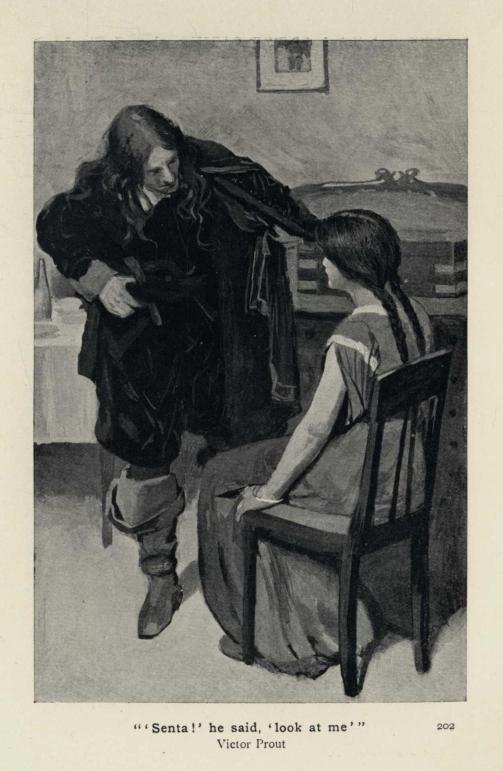
"'Senta!' he said, 'look at me'" Victor Prout
"Senta!" he said—and there was both authority and entreaty in his low tone—"look at me!"
She raised her eyes and met his gaze unflinchingly; and in that glance each saw the soul of the other laid bare and knew that each was beloved.
"Senta," he continued, taking her hand, "I am a plain, rough man of the sea, and know not how to mend my speech for gentle ears like yours. But from the first moment I saw you, I loved you. And your father has already given his consent to my suit. What is your answer? Do I read your eyes aright?"
"Yes," she answered simply; "it was Fate that brought you to me."
The seaman felt a great wave of joy rush over him. He was loved! Freedom from the Evil Spirit was within his grasp! Then for the first time he realised how much he was asking of this innocent young girl. A curse was hanging over him; how could he ask one he loved to share it?
"Stay!" he said, gently releasing her hand, "I have no right to obtain your promise thus. You do not know who I am."
A bright smile broke over Senta's face.
"Ah, but I do!" she exclaimed.
"What! Is it possible that you know I am a wretched wanderer over the earth——"
"You have been," she said.
"That men look upon me with superstition and dread——"
"We will change all that."
"In short, that a curse is upon me? Hear me out!" (He raised his hand, as she was about to speak again.) "Hear me out, and then send me forth into the night, where I belong! I sought you selfishly to-day, to obtain your aid in the lifting of this curse, of which I speak. The Evil One has decreed that I shall wander forever, unless some true woman gives me her love and remains faithful until death. If her faith in me should waver, the curse would descend upon her also. Before I had even seen you, I asked your father for you, and was willing to sacrifice you to my own selfish ends. I thought not at all of what I asked of you! I see now how selfish I was, and I release you. Will you not dismiss me, as I deserve? I shall remember you only with gratitude for the glimpse I have had of your brave heart."
"But do you not love me?" asked Senta.
"It is just because I do love you that I cannot ask this sacrifice," he replied, his pale face showing the struggle through which he passed.
"Then this is my answer. Here is my hand; my heart goes with it, and even to death will I be faithful!"
"She gives her hand, and promises to be faithful till death!" exclaimed the Dutchman, shaking his fist as if at some unseen foe. "Dost thou hear this—dread Spirit? I am free, and I defy thee!"
And falling upon his knees he pressed her hands again and again to his lips.
Just at this moment Daland reentered the room, and was overjoyed at the turn of affairs. He gave the two his blessing, saying,
"To-morrow I give a feast to my sailors, according to custom; and with your permission I shall announce your betrothal at once."
The next day dawned bright and clear. On board the Norwegian ship all was bustle and activity. The sailors were dressing it in its finest pennants and colours, making it ready for the visit of the townspeople and for the feast. All was noise and laughter and song, for they were as delighted as schoolboys when the long-looked-for vacation has come.
But on board the Dutch vessel everything was as quiet as the grave. No one was seen stirring above decks, and not a flag fluttered except a single tiny one which told that the captain was gone upon shore.
Then a group of laughing girls came down to the beach. Most of them we have already seen at Senta's house. They brought great baskets of fruit and dainties to the sailors and when Daland's crew saw this treat they lost no time in coming on shore. But still the Dutchman's black ship gave no sign of life.
"What is the matter with your fellow-voyagers?" asked the maidens.
"No fellows of ours," answered the Norwegians, "we never saw them until yesterday, and they haven't budged since they cast anchor last night."
"Hey, sleepy-heads!" called out the girls tauntingly. "Come out and be sociable!"
"You sleep like land-lubbers!" called a sailor.
But no answer came back.
"Let them alone," said another sailor; "if they don't care for good things to eat and drink, there will be just that much more for us."
"Greedy fellows!" laughed the girls.
"Well, if I was as old and grizzled as that greybeard crew yonder," said the one who had just spoken, "I wouldn't care for feasts either—nor yet for pretty girls." Here he gave a sly glance around.
"They look like the crew of the Phantom Ship," said another laughing. And lifting his voice he called; "Ho there, old black ship! What has become of the Flying Dutchman?"
At this call a cold wind swept along the shore, so that all the merrymakers shuddered, and a nameless dread seized them. Then a strange thing happened. The waves in the harbour remained calm, while just around the black ship they rose and tossed angrily as though in a violent storm. It grew dark, the wind howled through the rigging, and weird blue lights played about the mastheads. In the midst of the miniature tempest, the ship's crew appeared and began to hoist sail as though preparing to depart; and as they worked they sang a dirge-like song that told of the Flying Dutchman and his seven year quest. He was even now in search of the wife that would save them all, they sang.
This scene was too much for the merrymakers. The panic-stricken maidens fled in every direction, while the sailors seized with superstitious fear hastened to their ship and ran below, making the sign of the cross.
At sight of the panic, the strange crew burst into wild laughter, and the storm subsided as quickly as it had arisen, leaving the blue sky and clear water as before.
Just then the door of Daland's house opened, and Senta appeared and came down to the beach. She was followed by the hunter Erik, who had come to plead his cause once again. He could not bring himself to believe that his dream was coming true, and that Senta had plighted herself to the mysterious stranger, as he had just heard. He reminded her of their lifelong comradeship, and how he had, even as a little boy, claimed her as his future wife.
"Indeed you do belong to me!" he exclaimed, carried away by his emotion. "You gave me your heart—you know you did! Now you cannot take it away and give it to a stranger!"
"Oh, Erik! you misjudge me!" Senta replied, wounded deeply by his words. And sorry for his evident distress she tried to comfort him with sympathy and tenderness. She could not bear to see her old playmate suffer, or have him think badly of her.
Her attitude, however, was misunderstood by a third person who had approached unnoticed. It was the Flying Dutchman. He now believed that Senta was already regretting her promise to him, and with a wild, despairing cry of "Lost! All lost!" he sprang down the beach and prepared to take boat for his ship.
"What do you mean?" asked Senta, hastening towards him.
"Farewell, Senta!" he cried. "To sea, to sea, till time is ended! I release you from your promise! It is the only way I can save you from my fate!"
"Ah, do not go!" implored Senta. "I will not take back my word. I love you, love you! I knew you from the first moment I saw you, and wheresoever you go, there will I go!"
"Think what you are saying, Senta!" exclaimed Erik trying to restrain her. "They say that he and his ship are bewitched!"
"I care not for that! My place is by his side!" she said, struggling to free herself.
"Be advised by your friend," said the seaman, who had mastered his own emotion in some measure. "I am indeed under a spell. Ask any mariner who sails the seas, and he will tell you, with a shudder, to beware of the Flying Dutchman!"
But Senta did not shrink back as he expected. Instead she stretched out her arms triumphantly, crying, "Ah, I told you I knew you! Now you cannot go and leave me! I will save you in spite of yourself!"
Nevertheless the Dutchman turned away as though pushed forward by some unseen power.
"No! 'tis I who must save you!" he exclaimed. And going aboard his ship hastily he blew his whistle and ordered the ship to be got under way.
It had grown dark again, but through the gloom the blood-red sails glowed like a flame, while a strange signal-light burned in the prow, and the waves lapped eagerly about the bow as it began to move forward.
With a shriek Senta endeavoured to follow, but Erik and her father, who had just run up with other villagers, held her back. The Phantom Ship was now fast leaving the harbour and directing its course to the headland, when Senta by a quick movement wrenched herself free and fled swiftly along the shore to the jutting point of rock.
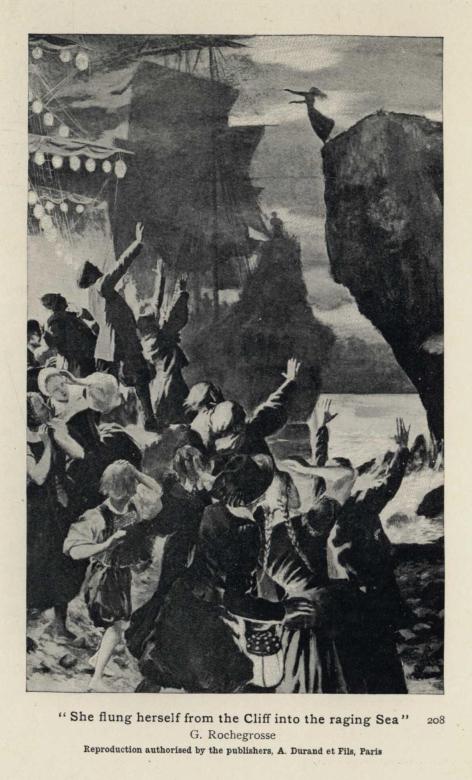
"She flung herself from the Cliff into the raging Sea" G. Rochegrosse Reproduction authorised by the publishers, A. Durand et Fils, Paris
"Senta, you are beside yourself!" the others cried, trying to follow her. But she outdistanced them all, leaping over boulders and across chasms in her flight, till she had reached the headland. The Phantom Ship was close beneath her in the seething spray.
"Senta!" cried Erik, hastening to the point of rock where she stood.
But she did not heed him. Instead, she stretched out her arms once more to the pale-faced man, standing in the prow of the oncoming vessel.
"Here stand I, faithful even unto death!" she exclaimed, a heroic light shining in her dark eyes. "Give thanks to heaven that one way was left for your salvation!"
With this she flung herself from the cliff into the raging sea. And instantly—wonder on wonder!—the waves grew calm. One last leap they gave as she touched them, and the Phantom Ship and all in it sank as she disappeared from view. But to the watchers on the shore a beautiful picture was given, which sent them their separate ways with peace in their hearts.
Above the spot where the Phantom Ship had gone down, never to be seen again, a rosy light hovered, making as it were a path leading straight through the bursting clouds to the bright sky beyond. And in this glory two figures were seen hovering, locked in each other's arms and rising upward. They were the radiant spirits of Senta and the lover she had saved. The Flying Dutchman's voyages were ended; the curse was lifted from him for evermore.
Tristan and Isolde
(Tristan und Isolde)
It will be interesting to compare this story with the version by Malory. The differences are characteristic of the distance between the colder ideals of Malory and the warmer and more human age of Wagner.
Once upon a time a brave knight of Brittany went across the English Channel to the court of King Mark of Cornwall. The knight was noted for his valiant deeds, so the King was right glad to welcome him and attach him to his retinue. The knight also was willing to tarry, for the King had a sister who because of her beauty was called the "White Lily." Indeed, the knight had fallen deeply in love with this fair Princess, and so he was overjoyed when at length he found that his love was returned. He obtained the King's consent to make her his wife; and after a splendid ceremony the knight and his lady set sail for their castle in Brittany. Fate had so smiled upon them, that they thought themselves the happiest people in the whole world, and that none had been so favoured as they.
But after a few short months of wedded life the knight fell sick and died. The poor bride was broken-hearted, and although a little boy was presently given to her, the child did not assuage her grief. Instead he reminded her constantly of the husband she had lost. She called the boy's name Tristan, which means "sadness."
Realising that she would soon follow her beloved husband she entrusted the boy to a trusty knight, Kurneval by name, to be taken over to her brother in Cornwall. Shortly afterward she died, and the little orphan was conveyed to his uncle as the mother had desired.
King Mark was without wife or children of his own, so he gladly received Tristan into his lonely home. He brought him up as his own son, and publicly proclaimed him heir to the throne of Cornwall.
Tristan grew rapidly in beauty and strength, finding so especial a delight in horsemanship and knightly warfare, that by the time he was fifteen he could joust with the best of the knights. Courteous in speech and bearing was he, likewise, for he had been carefully trained by the knight Kurneval. And so, when the time of his knighting had arrived, Sir Tristan was already famed for his chivalry and prowess alike. His name became a proverb for true knighthood, and there was no man in Cornwall who could stand against him.
A few years before this time, King Mark had been defeated in battle by the King of Ireland, and had promised to pay him a yearly tribute. Each year since that defeat the tribute had been collected by Sir Morold a gigantic knight whom all men feared because of his courage and cruelty. His demands grew heavier, year by year, until at last they became so great that the whole country groaned. Thus it went on until Tristan had become a knight, when eager for some splendid service to prove his spurs, he resolved to put an end to this oppression. So he challenged the huge warrior to mortal combat.
The challenge was promptly accepted, Morold liking nothing better than a fight, though—as he expressed it—he greatly feared this rash youth would not last long enough to get his blood warm. King Mark also was fearful of the fate of his foster-son, but the word had gone forth and could not be withdrawn.
The day came for the conflict, and many anxious spectators assembled to watch the champions fight—the one for the honour of Ireland, the other for the freedom of Cornwall. But Morold did not enter the lists fairly. Enraged that any one should presume to oppose him, he bore a poisoned spear which he flung at Tristan without warning. It made a slight wound which was unnoticed in the heat of the conflict that immediately began.
The young knight sprang forward with sword drawn and met his towering opponent fiercely but with the most finished skill. Morold soon found that he had met more than his match at sword play, and he tried by his superior strength to beat down his antagonist. But in this also he was defeated, after a thrilling contest. At last growing rash he raised his sword and brought it about with a terrific swish that would certainly have cut Tristan in two, if he had not leaped nimbly backward. Before the Irish knight could recover himself, Tristan sprang forward again and by one swift stroke cut his head from his body.
Cornwall was now free, and instead of sending his yearly tribute, King Mark sent the head of Morold back to Ireland to show this freedom for all time to come. Now Morold had been betrothed to an Irish Princess named Isolde; and when his severed head was received at court, she swore bitter vengeance against the one who had done this deed. Looking closely at the head, she chanced to find a bit of sword-point sticking in the skull, and she knew this must have been broken from the weapon which had done the deed. So she kept the sword-point carefully by her, in the hope that it might lead her to find her enemy.
Meanwhile Tristan, though showered with praises from the court and people he had delivered, was faring but ill. The wound from the poisoned spear refused to heal. The best physicians of the country were called in, but the wound only grew more grievous and painful, day by day. Finally, when Tristan was beginning to despair of his life, an old soothsayer told him to go to the land whence the wound was received and there he would find an antidote for the poison. So Tristan set forth without delay; but knowing that it would not be safe for him to travel in Ireland under his own name, he went alone as Tantris a wandering minstrel.
The fame of Isolde's skill in mixing draughts and potions presently reached his ears, and he directed his steps to the court. Both Isolde's mother and maid-servant knew the secrets of drugs and they had taught her many of these arts. So when a poor minstrel came to her attention, suffering from a poisoned wound, both her sympathy and skill were enlisted, and all the more because he seemed of noble bearing, and his eyes sought hers in an appealing way.
So Isolde called in her maid and they undertook to heal Tristan of his wound, applying many balsams and soothing herbs. It was a long time, however, before even their skill availed and the harper began to rally from his illness.
It chanced one day while he slept, that Isolde sat by his side watching the progress of his fever. And as she sat there she happened to notice the beauty of his sword-hilt, and wishing to examine it closely she drew the sword from its scabbard. Suddenly she saw that a piece was missing from the point. A thought occurred to her that made the blood rush to her head. She hastened to the place where she had concealed the broken piece, and placed it in the gap. It fitted exactly. She had been nursing her sworn enemy!
Just then Tristan called to her, and she turned and went to his bedside with the blade uplifted ready to strike. Neither spoke, but he read her purpose to slay him in her face and action; yet he did not flinch. He merely looked up sadly and tenderly with those eyes which she had found it so hard to resist, the first time she ever saw him. And instantly, she knew not why, the sword fell from her hand clashing upon the floor.
After that she continued to nurse him more tenderly than ever, but without either of them saying a word about the incident. Her care and skill were rewarded, and at last Tristan was wholly recovered and ready to set sail for home. Still he did not speak to the Princess of the strange new feeling that possessed him, for he thought that only pity on her part, for his defenceless state, had saved his life on that day when she guessed the truth. He contented himself with thanking her in the best phrases his oddly faltering tongue could repeat; begged permission to kiss her hand in token of the gratitude he could not utter; and asked leave to return upon some future day.
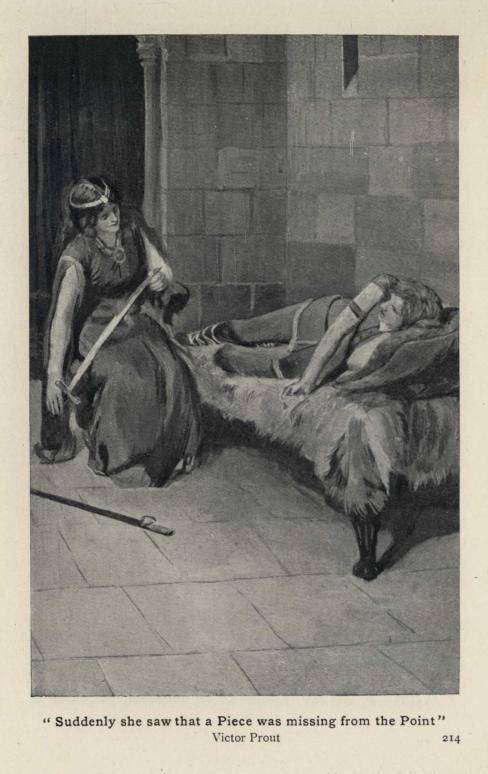
"Suddenly she saw that a Piece was missing from the Point" Victor Prout
When he had come to the court of Cornwall, he found the King overjoyed to see him, for he had given him up as dead. To the King and court he related his adventures, praising without stint the beauty and kindness of the Princess Isolde. Indeed he spoke with such youthful enthusiasm that it unwittingly set his hearers to thinking. Some of the courtiers had long been jealous of Tristan and wished to keep him from the throne. They had been trying to persuade the King to seek a wife and thus provide a son of his own for the kingdom. Now they urged him to ask for the hand of the Princess Isolde. It would cement the peace of the two kingdoms, they said, and from all accounts she was indeed worthy to be his Queen.
King Mark pondered long over this advice, and asked many questions of the unsuspecting Tristan; and the more the monarch thought of it, the more the picture of Isolde filled his fancy. Finally he decided to send a formal request for her hand; and as Tristan was familiar with the Irish court he was entrusted with the embassy.
The request of the King sent a sudden chill through Tristan's heart. He realised all at once how much Isolde meant to him. But his uncle had been a father to him, and he could not requite his kindness in any other way than by obedience. So he gave no outward sign, and prepared to execute his hard task.
When messengers came to Isolde and told her that Sir Tristan was come to seek audience with her, her heart leaped for joy. Surely, she thought, he had come in his own proper guise, as he promised, to say the things he dared not utter when he went away. So she hastened to greet him and show him all graciousness. But when she learned the truth of his errand, her new hopes were dashed. Anger and pride took their place, that she should be rejected by this man whom she had cared for—and pardoned despite her oath of vengeance! But hiding her emotions she instantly resolved to go to King Mark and become his Queen, without letting the world—least of all, Sir Tristan—know how she suffered.
To the King and Queen of Ireland the news of the embassy was welcome. They had become weary of the feud with Cornwall and were glad to conclude the peace and ally their house with that of King Mark. They received the ambassador, therefore, with every sign of honour, and held feasting and revelry until he should conduct the Princess to his ship.
But through it all Isolde remained cold and silent. Her conduct alarmed her mother, who wished her to be contented in the new home she was entering. So the Queen brewed a powerful love potion which she entrusted to Isolde's maid, Brangeane, telling her to give the potion to Isolde and her husband on the day of their wedding, when it would fill their hearts with mutual love and cause their after lives to be happy.
So Tristan conducted Isolde to his ship and set sail for Cornwall; and of the deep love which had come to fill his own heart he uttered no word; nor so much as by a look or sign would he betray the trust reposed in him by his uncle the King. Indeed, Tristan went to the farther side of caution, and when the Princess was once upon shipboard he did not linger in her presence or speak with her, but busied himself with the steering of the vessel.
This courteous reserve Isolde did not understand. She had been accustomed, all her life, to much attention and to seeing her lightest wish obeyed. And now it angered her more than ever that Tristan—who owed her so much—should treat her like the veriest stranger. She endured his neglect in sullen silence until the last day of the voyage, when the ship was within sight of the shores of Cornwall. Then despair at the thought of becoming the bride of a man she had never seen, and anger at the conduct of Tristan, overcame her. In a violent outburst she lamented her fate and wished that the waves could rise and swallow her up.
Brangeane her maid was alarmed at this unusual mood and endeavoured to calm her. Finally Isolde raised her head and looked out through the doorway. She was in a pavilion on a raised portion of the deck, which commanded a view of the entire ship. As she looked, her eyes rested upon Sir Tristan who stood at the wheel steering the vessel. His brown muscular arms were bare, as also was his head save for a wealth of soft brown curls. A cloak fastened about his shoulders swept in graceful folds to his feet. His whole frame spoke of grace and strength. But his clear blue eyes, fastened intently upon the vessel's course, had a tense look, almost stern in their sadness. He seemed, indeed, to be fighting a hidden grief. Isolde pointed to him and asked mockingly of Brangeane:
"What think you of our fine hero?"
"Who—Sir Tristan, my lady? He is said to be the bravest and knightliest man in Christendom."
"I care not what they say. He is an arrant coward!"
"Oh, my lady!"
"He is a coward, I tell you! Afraid to meet a woman's eyes! Conducting me to his royal master as though I were some kitchen wench! Go you to him and ask him why he has neglected our presence and treated us so coldly."
"Shall I request him to attend upon you?"
"No. Command him! Tell him it is the Princess Isolde who speaks!"
The maid was reluctant to deliver this message, and walked slowly along the deck. But finally she paused beside the wheel and said:
"A message, my lord, from the Princess Isolde."
"Isolde!" Tristan started at the name and almost released the wheel. Then recovering himself quickly he asked; "What is my lady pleased to say?"
"She commands you to wait upon her."
Tristan paid no heed to the wording of the message, but bade the maid excuse him in all courtesy to her mistress, saying that he could best serve her at that moment by steering the vessel safely between the dangerous rocks which lay off the coast of Cornwall.
The gruff old knight, Kurneval, who had attended Tristan upon the voyage, broke into a scornful laugh when he chanced to hear the message of the Princess.
"'Command' forsooth!" he exclaimed. "The slayer of Morold is the vassal of no one, be she even a queen!"
Isolde overheard this speech, and when her maid returned to her, bearing Tristan's refusal, her passion knew no bounds.
"Do you know who this ingrate is, who cannot find a moment's time for me?" she cried. "He is the minstrel whose life I saved in Ireland, and whom you helped me to nurse!"
"Can it be possible!" exclaimed Brangeane. "But 'tis strange that I did not know him again!"
"That is not the strange part," continued Isolde, storming. "I had sworn to take vengeance upon the slayer of Sir Morold. I found out that he was the slayer, and yet I pardoned him! And this is his gratitude!"
"My lady, my lady!" said Brangeane, trying to soothe her mistress. "Perchance Sir Tristan is not to blame for this. He is serving his King; and he shows you only the more honour, that he should woo you for the King instead of for himself."
"But I care not a whit for the King! Why should they all be forcing me into this loveless marriage—into a life of misery?"
"No, no, not that!" replied Brangeane eagerly. "It was your mother's dearest wish that you should be happy. See this casket? It contains a love potion which she brewed for you, and which will fill your heart and that of your husband with the truest devotion."
The sight of the potion diverted Isolde's mind into other channels. It reminded her that she herself could brew drinks and mix powders. She began at once to prepare a deadly poison, quietly telling her maid that it would make her forget her unhappy past.
By the time she had finished brewing this drink of death the ship had almost reached its anchorage; and Kurneval entered to announce that they would speedily land, and that Sir Tristan awaited to escort her to the King.
Isolde drew herself up proudly.
"Go back to Sir Tristan," she said, "and say that we await him here. We will not leave this place until he appears to offer an apology for his rudeness!"
Kurneval was moved to make some retort to this, but deeming that diplomacy was the wisest plan he returned to Tristan and advised him to wait upon the irate Princess.
Isolde, meanwhile, handed the poison flask to her maid, saying, "When he comes, give us to drink from it. We have much to forget, and I would be at peace with the world this day."
"Oh, my lady! What is it you would have me do?" asked Brangeane, terrified by her mistress's manner. But Isolde pressed her hand reassuringly.
At that moment Tristan entered, and with tones of the deepest respect he asked what the Princess's will was with him. But Isolde was in no mood to temporise, and she reproached him haughtily for his treatment of her during the voyage, asking what he meant by such neglect to her station.
It was such language as one would address to an underling, and Sir Tristan drew himself up with quiet dignity, replying that it was the custom in his country, when an ambassador brought a bride home to his lord, to refrain from intruding his presence during the journey.
Isolde replied scornfully, that if he was such a strict observer of custom, he would do well to recall one other which he had overlooked.
"What is that?" asked Tristan.
"The blood ransom," she answered, "for the life of Sir Morold!"
"But that feud is healed!" he responded quickly. "There is now peace between Cornwall and Ireland."
"But not between Tristan and Isolde!" she retorted. And she recalled to him the time when he had sought her care in disguise; how she had discovered his identity by the broken sword, and yet had spared his life and kept his secret when her own land was filled with his enemies. His life, she now claimed, was still forfeit to her.
Tristan had listened to her with varied emotions, but had made no move to interrupt her. Now with an indescribable air of sorrow and hurt pride he drew his sword and presented it to her, handle foremost.
"It is the same weapon that slew Sir Morold in fair fight," he said. "If you still so bitterly regret his death and your previous kindness to me, I pray you slay me!"
"Nay!" she answered, her face growing pale and red by turns. "Such deed would ill requite King Mark, whose ambassador you are. But we will declare a truce, if you will drink the usual cup of peace with me before we land."
And turning to Brangeane she commanded her to pour out the drink. The maid, pale and trembling, turned to fill the cup. Sounds from without now told them that the vessel was coming to anchor. Isolde took the cup and handed it to Tristan.
"Your unwelcome voyage is over," she said darkly, looking into his eyes, "will you drink with me?"
Tristan took the cup. He knew that Isolde had been plotting his death, and he now suspected that the drink was poisonous. Yet death seemed welcome to him at this moment.
"I thank you," he said calmly. "I drink in gladness, giving you my oath of truce for all time—the honour and the pain of Tristan!"
He put the cup to his lips and began to drink. But before he had drunk half its contents, Isolde with a suppressed cry snatched it from his hands and drained the rest. Then the massive cup fell to the floor, unheeded, and the two stood silent, looking at each other.
Only a few moments they remained thus, and yet it seemed ages to them. The drug had begun to take effect in a strange, unaccountable way. Instead of the icy chill of death, which they had expected to sweep through their veins, there came a wonderful tingle of life and love and bliss, all intermingled in a splendid wave drawing each nearer to the other.
"Tristan!"
"Isolde!"
The cries burst from their lips, as though they were in a trance; and forgetful of the whole world without, each sprang forward and was clasped in the other's arms.
"Alas! What have I done?" moaned Brangeane, wringing her hands. In her terror at giving the brew whose contents she feared, she had poured the love potion in its stead. Now she dreaded lest it should be the more fatal of the two in its consequences. But there was no way of escape. The voices of the sailors and soldiers on the near-by shore proclaimed the fact that King Mark was at hand. Brangeane hastily seized the robe and crown, which Isolde was to wear, and placed them upon her mistress, urging her to make herself ready.
Awakened from her brief dream of happiness, Isolde suffered herself to be clad in the royal attire and led forward, weak and almost fainting, to meet her future husband.
The generous and courtly King received her with every consideration. Noting that she was faint and pale, which he thought due to the voyage, he ordered rooms in his castle to be set aside for her and her maids; and he postponed the betrothal feast and other public events until she should be strong enough to undergo them. He and all his court were delighted with this fair Irish Princess, and looked forward to the time when she should adorn their throne.
The rooms set aside for her use were the choicest in the castle, opening directly out upon a private garden. Here the Princess was glad to take refuge for a few days, and thus put off the wedding as long as possible. She knew now that it was the love potion she and Tristan had swallowed, and so violent was her passion that she felt she could not live without seeing him. So she prevailed upon Brangeane to set a signal for her lover. A light was to be left burning in the window of the tower, and when it was extinguished Tristan knew that he would find Isolde in the garden. His love was no less ardent than hers, and he impatiently awaited the secret meeting. Now there was one knight in the court who had long tried to supplant Tristan in the King's favour. His name was Melot, and he was wily and treacherous. Always on the watch to trip up Tristan in some way, he had noticed his confusion and Isolde's weakness when the ship had come to land, and had rightly guessed the cause. So he now sought to surprise the lovers at a meeting and then inform the King.
Brangeane had noticed Melot's manner and warned her mistress against him, but Isolde was intent upon nothing else than seeing Tristan again. Scarcely was darkness come, upon the eventful evening, when she bade the maid put out the light which was to summon him; and when Brangeane hesitated, she herself extinguished it.
It was a beautiful moonlit night in early summer, when the flowers were in their first freshness and fragrance. It seemed to the Princess that all nature was rejoicing in her love. She was not, however, paying heed to the blossoms on every side. She was pacing eagerly back and forth listening for a welcome footfall. She had not long to wait, for Tristan sprang quickly through the shadows to meet her. Gladly the two greeted each other, without reserve, and wandered together down the path talking in low earnest tones of the happiness that had come to them. Isolde confessed that she had planned his death upon that fateful day on shipboard; while Tristan said he had expected nothing less, and would have welcomed it at her hands.
Meanwhile the faithful maid had been left upon the tower to keep watch. Several times she called in low warning tones that they would best not linger, but the lovers paid no heed to her, until Brangeane suddenly gave a cry of alarm. At the same instant Kurneval rushed upon the scene with drawn sword, imploring Tristan to fly. But it was too late; the sound of horns was heard, and the King and Melot appeared, followed by a hunting party.
Isolde, covered with shame, sank upon the ground. Tristan stood in front of her trying to shield her, but his own head was bent in trouble and he did not meet the King's gaze.
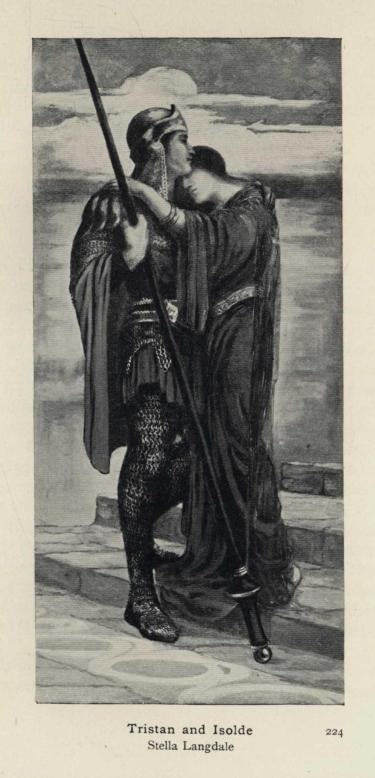
Tristan and Isolde Stella Langdale
"What does this mean?" demanded the latter.
"It means that my doubts have been correct, your Majesty!" answered Melot. "Sir Tristan has not been as faithful a servant as you supposed!"
Grief was stronger than anger in the King's heart. He had loved Tristan like a son, and had gloried in his knightly honour. He told Tristan this, in a quiet yet stern voice, and ended by banishing him from the kingdom.
Tristan was almost heart-broken. He realised that his punishment had been but just, and yet he seemed as though one in a dream, powerless to stem this current which was sweeping him away. He did not answer the King, but, instead, turned to Isolde and asked her if she would go with him into exile. She replied that wherever he went, there would she go, even to death itself.
At this new proof of her devotion Tristan's joy swept away all his doubts and fears. He drew her tenderly to him and turned proudly to face the King and his party.
"May the King and my foster-father pardon me out of his great kindness," he said in a low tone, "but Isolde has elected to follow me, and I can do nothing less than protect her. Farewell!"
The King still stood a prey to conflicting emotions. But the traitor Melot, enraged at the turn of affairs, sprang forward, drawing his sword and crying, "Think not to scape so easily, villain! I will avenge the King!"
"Ha, it is you, traitor, who would protect the King's honour!" said Tristan haughtily. "Defend yourself, Melot!"
He drew, and the weapons clashed sharply. But only for a moment did they meet. Tristan purposely lowered his guard, and before anyone could interpose, Melot had struck him with his sword.
"Disarm him!" commanded the King, himself seizing Melot's arm. Tristan, sorely wounded, sank to the ground, Isolde clinging to him and supporting his head, while Kurneval strove to raise his stricken master.
King Mark gave orders to certain of his attendants to wait upon Kurneval, and then strode slowly and sorrowfully away. He realised all too late the injustice he had done his nephew in sending him upon the embassy, but he could not understand this breach of faith; it was so unlike Tristan's knightly honour. It seemed to the old King that he regretted this more than the loss of his fair young bride.
Kurneval lost no time in conveying his master to the ancestral home in Brittany. Tristan had become unconscious, and only the promptest care could save his life. Kurneval vainly tried to nurse him back to health, but he had made the mistake of leaving Isolde in Cornwall. For her Tristan continually called, in his delirium, and her skill and loving care would alone avail to save him. Kurneval soon realised this and sent messengers entreating her to come to Brittany; and now with the return of the next ship he expected her to arrive.
On the day when the ship was looked for, Tristan who had awakened out of his fever, but was very weak, lay under a linden-tree. He had wished to look at the blue sky again, and Kurneval had carried his couch out in the courtyard. The place had long been deserted and was now overgrown with vines and bushes. The ancient tower was crumbling, and the huge drawbridge was in ruins. But to Kurneval this was home, and he hoped that the pleasant air and old surroundings would benefit his master.
Tristan was more nearly himself to-day, and asked many questions about how he had come here, how long it had been, and when the Lady Isolde was coming. Kurneval told him everything, and said that the Princess was looked for, that very day.
A smile broke over Tristan's face at this. "Ah! then I will live!" was all he said, and sank into slumber again.
Meanwhile a shepherd played upon his pipe, on the rocks below the castle, looking out to sea. The melody was low and plaintive, and as Kurneval listened to it his heart sank; for he had posted the shepherd there and bidden him play thus sadly so long as there was no sail in sight. Now he knew that if Isolde did not come that day, the sun would set upon his master for the last time.
And now, in his delirium, Tristan was telling of the ship which was bringing Isolde from Cornwall.
"Do you not see it?" he asked. "Look! the sails are all filled up, and the ship is steering straight for us. How high the waves pile up about the bows! There on deck is her- pavilion, just as it was on that other lonely voyage. And see! there she stands looking eagerly toward me, her hair garlanded with flowers and her arms outstretched! It is my Isolde! *Mine! She is forsaking all the world and its thrones to come to the side of a poor outcast. Ah, why is that music so sad? They should pipe merrily upon my wedding-day!"
As if in answer to his last words, the shepherd on the lookout suddenly changed his tune and piped shrilly and merrily. The faithful Kurneval sprang to his feet and ran hastily to the rocks. Yes, there was a broad sail and it was heading straight for them. And on the deck stood a slender, white-robed figure that waved a scarf. Unable to restrain himself, Kurneval hastened back to the sleeping knight.
"My lord, my lord!" he exclaimed, shaking him gently. "Awake! a ship is sailing straight to the foot of the castle. We hope it may be the Lady Isolde!"
"Yes, it is my dear lady," answered Tristan, sitting up. "I saw her in my dreams. Go to her and welcome her in my stead. Hasten, good Kurneval, hasten!"
Kurneval urged him to be as quiet as possible, and went to obey his commands. But Tristan could not be patient. Not knowing what he did, he rose from his couch, in his exertion tearing his bandages loose and causing his wound to bleed afresh. He staggered half-way across the courtyard, dizzy but unconscious of pain; for clear as a bell, from the rocks below, he heard his beloved's voice; "Tristan!"
"She is coming—my Princess!" he muttered. "That is the voice I have heard in my dream."
He tried to answer her, but could not. His knees tottered beneath him and he groped blindly as if in the dark.
"Tristan!" called the voice, nearer this time.
"Isolde!" he answered softly, as he sank to the earth. But the voice, weak as it was, had reached his beloved's ears, for she was bending over him trying to raise him up and imploring him to speak to her once again.
"See, I am here, Tristan—my heart's delight! I came as speedily as might be, but oh! how slow the ship sailed! Did you not hear my heart calling to you, day and night, Tristan, Tristan, Tristan! Now you will get well—you must get well—and we will be ah! so happy here in Brittany! But are you not glad to see me? Beloved, answer me!"
But the voice she so longed to hear again was stilled forever. Isolde tried in vain to rouse him, then a terrible dread seizing her, she sank unconscious across his lifeless body.
At this moment Kurneval was called from the pathetic sight by a great commotion outside; and the shepherd ran to him crying that a second ship had come to land and armed men were disembarking, followed by one who seemed to be a King. Kurneval's first glance told him that it was King Mark himself.. Fearing in his own wild grief that the monarch was pursuing the two lovers, he resolved to defend the castle gate to his last breath.
The first man to appear was Helot. Kurneval drew his sword and rushed upon him.
"Back, thou cursed spy!" he exclaimed.
"Peace, fool!" said Melot. "Unbar the gate!"
"Not to such as thee!" retorted the old knight, and began to engage him fiercely.
"Stop them! We come in peace!" called out the voice of King Mark.
"Mistress! Isolde!" It was Brangeane's voice that was now heard.
But the two combatants fought on. Presently Melot's sword inflicted an ugly wound.
"Ha, master, I will avenge you yet!" cried Kurneval. with a last mighty stroke, delivered as he sank to the ground, he gave Melot his death wound. Then the old knight crept slowly to his master's side and tried to make one last stand there, but sank back and breathed his last.
Just then King Mark burst in at the gate, and paused stricken with remorse at the scene which greeted his eyes. Brangeane, sobbing aloud, ran to her mistress and tried to revive her. The maid was frantic with remorse for she felt as though this tragedy was due to her. She had confessed to the King the secret of the love potion, and he had at once set sail to assure the lovers of his pardon and affection. He understood all at last, but now it was too late.
Brangeane brought her mistress to consciousness, and implored her to greet the King.
"He comes as your friend, and Sir Tristan's," she said; "he is here to aid you."
King Mark then hastened to speak to her, gently and kindly. In his courtesy he asked her pardon for the harm he had unwittingly done.
But Isolde paid no heed to his words. Her gaze was fixed upon Tristan, and when she spoke it was in praise of his constancy and truth. Then she told of a glorious land to which they both were going, where they should dwell free from sorrow and care and heartbreak.
"I know not where it is," she murmured, "but I know my Tristan will be there, and that will be for me a bliss supreme!"
A radiant smile overspread her face as she ended, and with a soft sigh her heart broke and she sank down and nestled her head close against that of Tristan. And while a sunset glory shone through the trees of the old courtyard and illumined the scene, as though it were some radiant picture, those who stood by fancied they could hear strains of music. Near and yet far-off it sounded clear and sweet, rising in soft waves as though bearing the souls of these two weary pilgrims to the land of rest and eternal love.
THE END
THE RIVERSIDE PRESS LIMITED, EDINBURGH
* * * * * * * *
Famous Myths Series
7s. 6d. net
Each of these handsome volumes contains more than 400 pages of letterpress, and 64 Plates by the best Artists of ancient and modern times. A feature of the Series is the very full Index to each volume.
Bindings—Cloth extra, gilt top, 7s. 6d. net. Full Persian Morocco, 10s. 6d. net. Three-Quarter Morocco or Vellum extra, 15s. net. Full Morocco extra, 21s. net.
THE MYTHS OF GREECE AND ROME.
Their Stories, Signification, and Origin. By H. A. GUERBER. With 64 Plates.
The Scotsman says:—"Mr Guerber has woven the classic mythology into a coherent history, and told with remarkable freshness of interest the familiar myths and traditions of Greek and Roman literature. The volume is at once a fascinating story-book and a valuable book of reference, and not its least attraction lies in the beautiful illustrations, all of which are reproductions of famous pictures, ancient and modern."