Front matter (continued 3)
Reading edition
"Bear him to the King," he said quietly pointing to his fallen foe. "An audience will be held at early sunrise under the Oak of Justice."
The men bowed humbly and went away with their burden.
Elsa had well-nigh fainted from the excitement, and now laid her head sobbing upon the knight's shoulder.
"Forgive me!" she cried. "I recall my thoughtless words."
For answer he kissed her lingeringly on the brow and then struck a gong which summoned her attendants.
"I leave the Lady Elsa in your hands," he said. "Array her as befits a bride, at the rising of the sun, and conduct her to the King. There I will answer all she asks."
The wondering maids hastened to Elsa's side. She held out her hands to the knight beseechingly, but he passed from the room in silence and with bowed head.
The next morning early the King held court again beneath the Oak of Justice. This was the day he was to start for the wars, and many knights and soldiers had assembled to march with their leader, the new Protector of Brabant. Henry had just come, and was answering the greetings of his captains, when the four nobles appeared bearing the body of Frederick of Telramund upon his shield, and followed by the weeping Ortrud.
In answer to the King's question as to the meaning of this, they replied that the Knight of the Swan would soon appear and explain everything. They had hardly finished speaking when Elsa and her maids came in view. Elsa was attired, as yesterday, in her bridal dress, but her face was woebegone, her hair dishevelled and her eyes red with weeping. So pitiable was her appearance that the crowd near broke into exclamations of pity, while the King rising hastily came forward and led her to a seat.
"What is the meaning of all this?" he demanded. "By Heaven, I will know the truth!"
"Your Majesty, the Knight of the Swan will soon appear and answer all questions," said one of the maids.
The King was about to make a quick remark, when the knight himself entered the throng. The men who expected to follow him into battle greeted him with cheers, but he made no response beyond a sad smile and shake of the head. He wore the same glittering armour of his first appearance, but his head was slightly bent as if in thought, and his steps were slow and reluctant.
The hot-blooded King could no longer restrain himself.
"I would know the meaning of these things!" he said, scarcely responding to the Swan Knight's silent greeting. He pointed to the body of Frederick. "Who has done this deed?"
"I slew him in self-defence," answered the knight. Then he told of the attack within his room, and took the four nobles to witness that he told the truth. "With your Majesty's permission I will leave the verdict to all the people," he ended.
Thus appealed to, the people cried loudly that he was innocent of wrong, and that Heaven had sent him to rid the land of a usurper and a coward.
"I also deem that you have done justly," said the King. "But what means the sorrow of this lady whom I took under my especial protection? Answer, and carefully!"
"I have promised the Lady Elsa to answer her questions, and I shall likewise answer yours," replied the knight, courteously. "The fighting men of Brabant—stout hearts and true—have gathered here to-day expecting that I shall lead them to the wars. This cannot be. I must tell my story and then bid farewell to all."
A general murmur of dissent arose at this, but the knight stood unmoved waiting for silence. Presently as a hush fell, he began to speak again, slowly and earnestly.
"In a far-away land," he said, "there stands a sacred hill called Mount Salvat. Upon this hill rise the walls and towers of a mystic castle, called the Temple of the Grail, for within it is preserved the most precious relic in all the world—the Holy Grail. The knights who guard this shrine are a close brotherhood who have renounced the world and given their lives to self-sacrifice and good deeds. In reward for this, the sacred Cup gives them power beyond that of other men. They may journey into distant lands to help the weak and relieve distress, and always will they be victorious. But if they disclose the secret of their power, they must return to Mount Salvat.
"Thus was I sent to become the Lady Elsa's champion; and I had fondly hoped to dwell among you and be worthy of her love and trust. But now this cannot be. Enemies have persuaded her that my name and rank must be revealed; so it only is left for me to tell my lineage. I am not ashamed of this. I am the son of Parsifal, chief Guardian of the Grail. My name is Lohengrin."
As he ceased speaking, amid the profound silence, voices were heard from the river's bank.
"The swan! the swan! See, he comes again!"
Elsa threw herself upon the ground in an agony of grief.
"Ah, do not go away!" she moaned, clasping the knight's feet. "Do not go away and leave me! I shall die!"
Lohengrin extended his finger sadly toward the bend in the stream, where the swan drew the boat majestically forward.
"It is the summons of Heaven," he said. "I have no other choice. Farewell, beloved, forever!"
He raised her and she clung wildly to him as though she could not let him go. He gently resisted her.
"See!" he said. "Here is my sword and ring and bugle, which will bring victory in every battle-field. Keep them for your brother, of whom I give you good news. He is alive and may return in safety one day. I had hoped to bring him back to you within the year if I had been permitted to remain."
"But you have failed, my fine hero!" cried a taunting voice which made them all turn quickly. It was Ortrud who had come forward for one last bitter triumph. "You have failed, so you and your pretty little bride may now hear the truth. It was I who caused her to ask those troublesome questions! And it was I who made away with her precious brother! I know one or two tricks of magic myself, and one of them turned the boy——into yonder swan! Ha, ha, ha!"
She laughed harshly and pointed to the mystic bird now at the river brink, while King and courtiers looked on in amazed silence.
Lohengrin alone remained calm at her outburst. He sank upon his knees and, lifting his noble face so that the sunlight seemed to irradiate it with a glory, he prayed to Heaven earnestly and silently for aid. Suddenly, down a beam of light, a white dove fluttered. It was the dove of the Grail. Accepting this as a sign that his prayer was answered, Lohengrin unfastened the swan from the boat, when the bird vanished beneath the surface of the water, and in its stead rose a fair young knight. Lohengrin took his hand and led him forward.
"This is Godfrey, the rightful Duke of Brabant!" he said. "Behold your chief, who will lead you to victory!"
Godfrey knelt in homage to the King who raised him up and embraced him, while the people promised him their glad allegiance. Then Godfrey and Elsa rushed into each other's arms in the joy of reunion. Overcome with rage, Ortrud sank swooning across the steps of the throne. Meanwhile Lohengrin, seeing that Elsa was in the arms of her brother, entered the boat, whose chains were seized by the tiny dove. A flutter of its wings, and lo! the boat moved easily out on the stream and went swiftly forward against the current.
When Elsa raised her eyes from her dear brother's face, she beheld the boat already far out upon the sunlit water. The knight stood leaning upon his shield, his whole figure shining, it seemed, with unearthly radiance, and alas! fading away like some splendid dream.
With a last despairing cry of "My husband! my husband!" Elsa sank prostrate upon the shore. Her dream it had been, and it was ended.
Tannhäuser the Knight of Song
(Tannhauser)
After the coming of Christianity into the world, people no longer believed in the old gods and goddesses. They were called evil spirits, or else people said that they had never really existed at all. But there was one goddess who was still believed in, although she was feared and even hated. She was Venus, goddess of Love, and in the heyday of her power she was worshipped in many lands. For did not Love stir the hearts of all men, and would it not rule all the world at the last? And so Venus had been given all honour and affection; and in return she had been the kindest of all the deities and had tried to make her subjects happier and more considerate one with another.
But now, as I say, all this was changed. People had ceased to worship Venus, and in revenge she began to do everything she could to injure them. Instead of pure affection which makes the heart glad, she sent a baser love which is only selfish and which brings jealousy and quarrels and heart-aches in its train. And Venus herself, from being a goddess, became a witch. She went to dwell in a deep cavern within a mountain in Germany which came to be called the Venusberg. Here she would lie in wait for men whom she would enchant and keep imprisoned within the mountain forever. They would forget their homes and loved ones—everything—while they served her and were subject to her wiles. They no longer saw the sun or moon or stars or the fresh green of the springing grass. Instead, they lived in a rose-coloured twilight filled with beautiful clouds, the heavy perfume of flowers, and the dancing, laughing figures of youths and maidens—spirits of this mysterious underworld ruled by the witch Venus.
One day while this enchantress was watching and waiting near the entrance to her grotto she saw a knight coming slowly over the mountains. He was young and handsome, with the first fine strength of early manhood, but just now he seemed moody and dispirited. Venus who could read the hearts of men knew who he was and whence he came, but as you have not yet heard, I will pause to tell you.
The young knight's name was Tannhäuser and he lived in the country of Thuringia. At this time there were many minstrels, or strolling singers, in the land, and so popular were they at all the courts that even the knights laid aside their swords and spears and forgot their joustings for the harp and its music and the contests of song. The King of this country, in his castle at Wartburg, had held many song contests or tournaments, and great was the honour to any knight or minstrel who won his prizes.
One of the best harpers and sweetest singers of them all was Tannhäuser. He had early shown a fine ear for music, and when the time came for him to enter the contests, he won many prizes and bade fair to outdistance all the others. Indeed, it was whispered that so appealing were his harp chords and so wonderful was his voice, that he had quite won the heart of the King's niece, the Princess Elizabeth.
Yet Tannhäuser was not entirely happy. He loved the Princess and he loved his music, but although both smiled upon him he felt vaguely dissatisfied. It seemed to him as though the honours and pleasures of the world had come with too little effort. He wanted to reach out beyond for other things still unattainable—he knew not what.
Finally he bade farewell to the Princess, and to his friends at the castle, saying that he was going to travel in distant lands. The parting was sorrowful, although he had fully resolved upon it; and now as he set forth across the mountains carrying only his harp he was doubly sad and cast down.
Suddenly the rock door of a cavern swung aside before his gaze as if by magic. In the dimly lighted entrance he saw a beautiful woman standing and stretching out her arms to him. Her figure was outlined by a halo, as it were, caused by the rosy glow which came from within the cave. It was Venus who sought to lure him. Her terrible witches' eyes were hid behind a smiling face, and she was once again the fairest woman in all the world. Now she wove a spell while she beckoned to him.
"Come," she said softly. "I have seen your unrest and alone can bring you happiness. In my blest land you will find all the music and beauty for which you seek. Come!"
Scarcely knowing what he did, the knight obeyed the enchantress and entered the portal. As he did so the heavy stone closed behind him and at the same moment the memory of his earth-life vanished like a dream. He had become in a moment a subject of Venus. Taking him by the hand she led him far into the depths of her mysterious realm, and at every step his wonder and delight increased. Here the very trees seemed attuned to harmony. There the waves of a deep blue lake sang of love as they beat upon the shore. Out on the water swam bewitching mermaids; while on the strand the light graceful figures of elves and sirens engaged in mimic warfare.
Here at last Tannhäuser thought he had found true beauty and happiness. And so he gladly served his queen for a whole year, thinking of it only as a single day. He had, in fact, completely forgotten his old life, and lived wholly in the present, content with the joys of the moment.
But at last a change came over him. Something, he knew not what, stirred within him and told him that he was a slave. He began to realise that he was under the power of a spell and that he had given up many things for which he now dimly longed. He began to grow restless and silent.
The watchful Venus saw this new mood almost before he was aware of it. Anxious to overcome it, she prepared new and wilder pleasures day by day. Dances, pageants, masquerades, tableaux, banquets and tournaments followed each in bewildering succession. Concerts were given which far excelled the music of earth. Her wiles seemed successful. For the time, Tannhäuser forgot his moodiness; and when Venus asked him to compose a song in her honour, he responded with one full of praise of her beauty and charm. Then he sang of the life at Venusberg and its attractiveness. But even as he sang his new found longing gained hold of him and he ended with an outburst which surprised even him:
"'Tis freedom I must win or die.
For freedom I can all defy:
In rose-hued grottos I am longing
For all the soft wood zephyrs thronging,
For vision of fair heaven's blue,
The songs of birds, the old earth's view!
Come life, come death, forth would I go
To taste of human joy or woe;
No more in slavery would I lie,—
O queen, O goddess, let me fly!"
Venus was full of anger at this direct appeal for freedom, in spite of all her arts; but she hid her feelings behind a smile and said in soft tones,
"Whither would you fly? Are not all things here in perfection? What more would you desire? Ask, and you shall be obeyed!"
"I want only freedom," said the knight mournfully.
"What is freedom? Where could you go? The earth you speak of has forgotten you. Here you are immortal and all things are yours."
"Still I would away," persisted Tannhäuser. "I know not where. O queen, give me leave to try another life for myself—something that will meet this new found longing within my breast! I will not be disloyal to your memory. Indeed, I will sing your praise, and yours alone. But give me leave to go!"
"Then depart!" said Venus, her voice growing cold with anger. "Out of my sight, ungrateful mortal! But heed well my warning. You have lost your hold upon the other world by lingering here, and men will shun you when they find whence you come. Some day you will return to me, and willingly. Till then, away!"
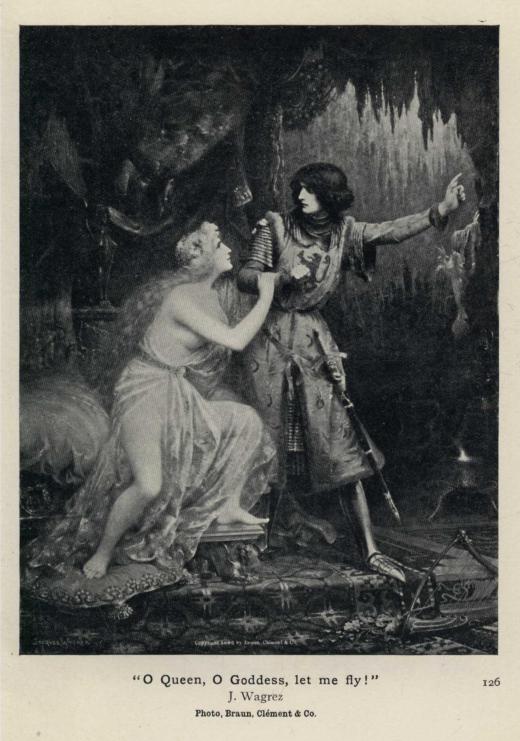
"O Queen, O Goddess, let me fly!" J. Wagrez Photo, Braun, Clément & Co.
She stamped her foot, and in a moment the scene changed like the dissolving picture upon a stage. Instead of the grotto with its perfume and dim lights and dancing figures, Tannhäuser found himself lying upon a grassy knoll under the wide blue sky of heaven and with the bright sunlight streaming full upon him. He rose as if waking from a deep sleep, stretched his limbs and took a long breath of the sweet pure air. As he did so he cast his eyes across the valley and instantly his past life came back to him fresh and distinct as if but yesterday.
There stood the noble castle of Wartburg where he had taken part in the contests of song; where the King had been gracious to him; and where the beautiful Elizabeth had smiled at his coming. A pang smote his heart when he remembered her sweet graciousness. Where was she now; and how long had it been since he proved so unworthy of her?
Near by, a shepherd played upon his pipe while his flock grazed contentedly near him. Presently the piper called the sheep and they followed him down the valley to fresh pastures.
Then the sound of men's voices singing came to the knight's ears from a distant mountain path. Slowly it drew near and grew more distinct—a mournful yet beautiful melody chanted by a group of pilgrims on their way to Rome. As the words of the penitential song reached him, the knight felt for the first time the weight of his sin in turning aside from the path of duty. Overcome with remorse he fell upon his knees before a wayside cross and prayed fervently for forgiveness.
While he knelt a new sound smote the air. It was the blast of hunting horns mingled with the joyous baying of hounds. Presently the King himself entered with a troop of huntsmen starting out upon the chase. As they passed near the kneeling knight the King recognised him, and reining his horse he asked kindly where Tannhäuser had been.
"I have been in strange lands, your Majesty," answered the minstrel knight sadly. "I went in search of many things, but I found them not. I pray you let me fare on my way."
"Not so," answered the King. "We have missed you greatly in the lists of song, and upon the chase. Stay with us at least for a time."
The other knights joined the entreaties of the King. To tell the truth, some were not over anxious for his return, as they remembered only too well how he had vanquished them in singing. But there was one of their number who had been Tannhäuser's steadfast friend—Wolfram von Eschenbach by name—who hastened to greet him and urge him to remain with them. Wolfram had been a rival of Tannhäuser, not only in song but also for the favour of the Princess. Yet this did not detract from his generous welcome.
But still the wandering minstrel hesitated to return; and it is probable that he would have gone on his way had not Wolfram said in a low voice,
"Let the welcome of still another win you back to us. There is one yonder in the castle to whom the sight of your face will bring back the light in her eyes and the smile on her lips. In sooth she has drooped sadly since you went away. And the contests of song which she was wont to grace with her presence are now forsaken by her. Need I tell her name to you? Have you indeed forgotten the fairest among maidens, the Princess Elizabeth?"
Tannhäuser trembled violently at the mention of her name. A deep longing came over him to behold her face once more and hear the sound of her voice, although he felt with tenfold anguish the sense of his own unworthiness. His eyes were full of tears as he turned and looked toward the castle shining in the sunlight upon the farther hill.
"I pray you lead me to her presence," he said simply.
"Come!" commanded the King, seeing Wolfram take Tannhäuser by the hand. And turning with all his cavalcade he escorted the wanderer back to the castle with all the pomp of a conqueror.
That very night had been set apart for one of the yearly contests of song; and though the lists had long been closed, the King gave command that Tannhäuser's name should be added. The Princess Elizabeth had not been visible when the company first returned to the castle. But she had heard of her knight's return, and had joyfully promised to attend the contest; so the occasion bade fair to be of more than usual splendour.
In the evening, before the expected guests were assembled, the Princess went to the Minstrels' Hall—a large circular chamber with high columns and arched roof—to attend personally to setting it in order, and also perchance, as her heart confessed, to catch an early glimpse of her beloved knight.
Fair was the Princess as a May morning, with deep blue eyes that had caught some of the far-off sky in them. Her hair was soft and golden and curly as that of a little child. Slight of frame was she, but with a gracefulness and height that gave her a queenly dignity. Her cheeks, too often pale of late, were to-day flushed with animation. She had indeed missed her minstrel sadly, and now her heart bounded at the news of his return.
Presently she heard a familiar footfall in the room, and knew without looking up that it was he.
"O Princess, forgive!" said a voice. Tannhäuser was kneeling at her feet, his hands stretched out imploringly.
"You must not kneel to me," she answered, gently endeavouring to raise him. "It is not for me to forgive. Only tell me where you have been so long."
"I cannot tell you that," he replied brokenly. "I have wandered far away from your dear presence; and between yesterday and to-day the veil of oblivion is dropped. Every remembrance has forever vanished save one thing only rising from the darkness,—the thought that some day I might behold your face again and hear you say, 'I forgive.'"
Elizabeth covered her face with her hands, but the glad tears trickled between her fingers; and Tannhäuser, beholding her emotion, realised how deeply he had been loved and what a pearl he had cast away.
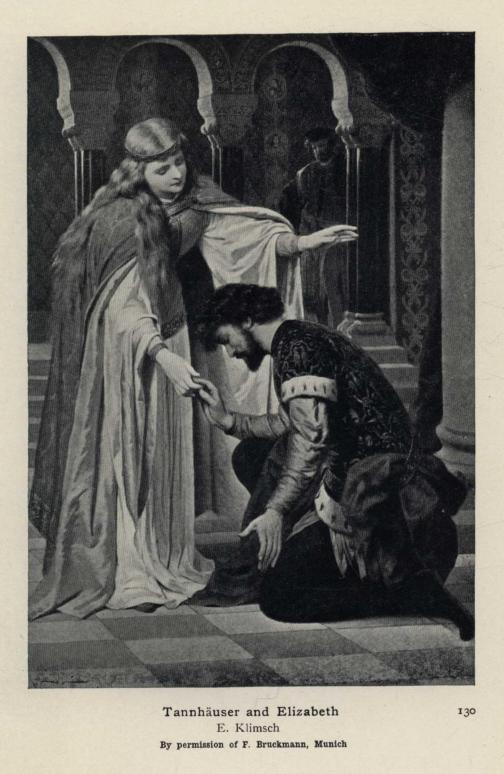
Tannhäuser and Elizabeth E. Klimsch By permission of F. Bruckmann, Munich
But the Princess like all loving women was forgiving. She asked no more questions of the minstrel, but when he took one of her hands and then the other, as all lovers will, she let them linger in his own in perfect content.
The entrance of the King broke upon their little scene of reconciliation. He saw it all at a glance and came forward with a frank smile.
"Ah, it is as I had hoped!" he said, as he took a hand of each and held it for a moment. "Now let us have no more quarrels, but live together as harmoniously as one of our minstrel's songs."
Thus it was that Tannhäuser realised, in a great wave of thankfulness, that his old life was still open to him, and not closed as Venus had said. He resolved to be worthy henceforth of his position and honours. Above all would he cherish this sweet Princess who loved him so unselfishly.
Not long after this, the sound of trumpets proclaimed that the contest was about to begin. The King and the Princess took their places upon a dais at one side of the hall, while Tannhäuser retired to make his proper entry with the other minstrel knights.
Soon the people began to throng the hall. Nobles and ladies came first and passed before the throne and bowed before taking their seats. Then came warriors and chosen guests. And finally with another flourish of the trumpets entered the singers of the evening. Each was a famous knight who like Tannhäuser had laid aside the sword in favour of the gentler harp. The fame of some of these knights, like Wolfram von Eschenbach and Walter von der Vogelweide, is known to this day. But among them all none was more handsome or of better renown than Tannhäuser.
As these knights did obeisance and took the places assigned to them, the King rose and thanked them all for their attendance. The subject of the songs, he said, was to be "Love"; and whoso should sing best on this lofty theme should receive the prize from the hand of the Princess Elizabeth. Let him ask what he would added the generous King, and it should be granted.
More than one of the knights had been a suitor for the Princess's hand, and they saw in this promise a reward for their dearest hopes. So you may imagine what a wave of suppressed excitement went around all the crowded hall at this announcement. The hands of the minstrels trembled as they drew lots for the order of their songs.
The lot of Wolfram came first, and amid a profound hush he rose to begin.
Thrumming the harp strings with a practised hand he began in a low clear voice to sing of unselfish devotion and chivalry. Wolfram had long loved the Princess, but had generously yielded place in favour of his friend Tannhäuser. Now his song showed the nobility of the man. He paid tribute to the ladies of the court among whom the Princess shone as some rare gem. Then, his voice rising steadily higher till it thrilled his hearers, he sang of the one true love that counted its highest joy the sacrifice of even life itself for the loved one.
When Wolfram had finished, the hall resounded with cries of acclamation; for indeed his song had been beautiful, and no less true. Tannhäuser alone did not join in the applause. While the song was being sung he had sat silent as one in a dream. Again before his eyes came the vision of the fairy grotto with its gorgeous pictures and entrancing music. He, seemed to see the bewitching figure of Venus and to hear his own voice as he promised her, "I will sing your praise and yours alone."
Scarcely knowing what he did, Tannhäuser sprang to his feet, before the applause for his rival had subsided, and began to sing an answer to Wolfram's strain. But how different was his theme! Instead of the pure exalted love which gloried in self-sacrifice, he sang of selfish desire which sought only for personal gratification. Truly the enchantment was still upon him, for he could think only of the life of the grotto and the round of pleasures which had been planned for him, rather than of any devotion upon his own part. But that was the way in which Venus, once the goddess of true love, now weakened men's minds.
When Tannhäuser began to sing, the audience gave him close heed. He had not proceeded far, however, with his strange theme, when murmurs of anger and dissent began to be heard, which increased until one of the minstrels at length sprang to his feet.
"The love you sing is false!" he cried; "false as your own heart! We will not hear it in silence, nor suffer you thus to cast a slur upon all true knights. I challenge you to mortal combat!"
These words were loudly cheered by other minstrels. The entire hall was in an uproar until the King arose and commanded silence. Then Wolfram was seen standing once more with harp in hand, beckoning to be heard.
In words of kindly reproach he rebuked Tannhäuser for his selfish and unworthy song. He could not know what real devotion was, Wolfram said, if he placed it upon so low a plane. Then Wolfram again touched his harp strings and sang a pleasing tender refrain in praise of the love to which they all aspired.
But Tannhäuser rudely interrupted him, and heeding not the clamour which broke forth again, he sang in wild reckless fashion of the life he had led during the past year. He told of the grotto, its music, its perfumes, its exquisite scenes and round of delights presided over by Venus herself.
"Your heroic self-sacrifice," he ended sneeringly, "is cold and tame in comparison with this! And the fairest women of earth pale into insignificance beside this wonderful goddess. Ah, Venus! I have kept my promise! Thine be the praise!"
He ended as one in a trance—as in truth the poor knight must have been. He stood motionless with gaze fixed as it were upon some hidden scene, while his harp fell clattering from his hand to the ground.
Then the outcry burst forth with redoubled fury. The minstrels surged forward tumultuously crying,
"He has been to the Venusberg! He has fallen under the power of the evil one! Away with him! Kill him!"
In their anger and horror of him they must have slain him, had not someone interposed. But quick as thought a slender, white-robed figure stood between them and the misguided knight, and held out her hands entreatingly. It was Elizabeth. She had sat there sick at heart listening to her chosen minstrel's song. All too well she saw how unworthy was the one to whom she had given her heart; but, once given, she could not recall it in a moment. She would pray for him, and live in the hope that he might yet prove worthy.
"Stop!" she cried to the nobles who circled about Tannhäuser, with swords drawn, "Stop, I command you! Would you slay him with all his sins ripe upon his head?"
"He has dishonoured knighthood!" muttered the minstrel who had previously challenged him. "He deserves no mercy."
"Then that is all the more reason why you should grant mercy," she answered.
By this time the King had asserted his authority, and soon the semblance of peace was restored. Then Elizabeth in all her sweet dignity pleaded the cause of Tannhäuser. Addressing now the King, now the nobles, and now the knight himself, she pointed out that Tannhäuser was still under the spell of evil into which he had fallen, and was not accountable for his deeds.
"Give him another opportunity, O my King!" she concluded. "Perchance in the doing of some penance or some gracious act, his better heart will assert itself, and he will then see how he has wounded all our hearts this day."
As she finished speaking she turned, to find at her feet the penitent knight. The vision had passed leaving him bowed down under the burden of his sin and unworthiness. He kissed the hem of her garment while tears flowed fast and unchecked from his eyes. For his life he cared not a straw. But that he should have sunk so low in the eyes of this noble woman—the thought smote his heart with keenest anguish!
Then the voice of the King came to him, as it were an echo,—
"One path alone can save you from perdition and everlasting woe, abandoned man! That path is now open to your steps. To-day a band of pilgrims are setting forth on their toilsome way to Rome. Depart with them and seek pardon for your sins."
Even as the King spoke, a chant was heard through the open portal. Tannhäuser recognised it as the same sweet strain he had heard that morning by the wayside cross. He kissed the hem of Elizabeth's robe once again and dared to look with mute entreaty into her eyes. Then he sprang quickly to his feet and addressed the King in two wild, hopeful words.
"To Rome!" he cried, and hurried from the hall to join the pilgrim band.
One year passed slowly by. Again it was spring-time, fragrant with the bursting of buds and melodious with the song of nesting birds. And now the return of the pilgrims was anxiously expected at Wartburg. But among them all, no heart was more anxious than Elizabeth's. Day after day she had sat in the casement overlooking the valley. Night after night she had knelt in fervent prayer for the safety of one who was a wanderer over the face of the earth. And daily would she go, attended by her maids, to the little wayside cross where Tannhäuser had knelt when the pilgrims passed by. Indeed, her whole life seemed to hang upon the love which she had given and could not recall. Her prayer was only that her loved one might be forgiven, and that she might see his face again before she died.
One afternoon just at sunset while she knelt, as her custom was, before the cross, Wolfram von Eschenbach approached her. His love was still as noble and unselfish as it had been in former days, and so he longed almost as earnestly as she for the return of her pilgrim, forgiven. That she might be happy and restored to health was his great desire. To-day the sight of her pale and wasted features alarmed him.
"Health to you, my Princess!" he said saluting her, and then continued, "Methinks it is now about the time of year when our pilgrim band should return."
"Hast heard any news?" she asked, starting up.
"None. But the hermit Peter is of opinion that they will be back before another change of the moon."
"Ah, God grant that they may!" the Princess said, wearily sinking again before the cross.
While Wolfram stood gazing sadly at her dear face, she suddenly turned her head, and a look of rapt attention came into her eyes.
"Listen!" she exclaimed softly while she sprang again to her feet. "Listen! do you not hear it? It is their song!"
It was indeed the far-off chant of the pilgrims which her quick ear had caught. They were returning at last!
Soon the little company came in sight, and then filed slowly by, rejoicing that their penance had been accepted and their sins forgiven. But to the eager eyes of the two onlookers one figure did not appear. Tannhäuser was not among them.
"He will never return!" said Elizabeth quietly; and giving one last despairing glance down the valley she fell upon her knees and made a last pitiful little prayer. It was that death might soon come to ease her aching heart. Until then she vowed devoted service to the church, and she asked in return that Tannhäuser might still be forgiven.
The prayer ended, Elizabeth rose and slowly walked away toward the castle. Wolfram looked after her, as long as she was in sight, with a strange foreboding clutching at his heart-strings,—it was that he would never see her again alive.
The sun had long since sunk, and the twilight was deepening, but Wolfram still lingered by the little cross made sacred by her presence. As he tarried, the evening star rose above the rim of hills and began to glow with peaceful brilliancy. It seemed to Wolfram as though the soul of Elizabeth were there, shining in that far-off sky. He began to sing a beautiful measure filled with this thought and beginning,
"O thou sublime, sweet evening star!"
Scarcely were the last notes silent when a pilgrim drew near. He was tattered, footsore and dejected, yet at the first glance Wolfram knew him.
"Tannhäuser!" he exclaimed. "What does this mean? Do not tell me that you have not received pardon, for the King would not allow you to return otherwise."
Tannhäuser did not reply to his questions, but merely said,
"Show me the road to the Venusberg. I have lost my way."
"You have indeed lost your way, unhappy man, if you would return to that evil place!" exclaimed his friend. "But first tell me, have you been to Rome?"
"I have been to Rome."
"Were not your sins forgiven?"
"You see how I return," answered Tannhäuser defiantly.
"I pray you, for old friendship's sake, tell me all!" pleaded Wolfram. "Did you not do penance, and then go before the Pope?"
"Aye, so I did! Every pain and penance set forth in the calendar I did faithfully perform. I afflicted my body with grievous blows. I gave all my substance to the poor. I ministered to the sick. I prayed night and morning before every shrine. I asked forgiveness continually, yet my soul felt heavy and oppressed. Then I went before the Holy Father and confessed all my sin. He had pardoned the other members of our band; but when he heard that I had lived a year in the Venusberg he was filled with horror and indignation.
"'Out of my sight!' he exclaimed. 'There is no mercy for such as you! As soon would I expect this staff in my hand to bud and bring forth green leaves.'
"Thus am I for all time accursed," continued the wanderer bitterly. "There is but one thing left for me to do. The enchantress told me that all men would renounce me and that when I was driven from the world I could find refuge again in her grotto. I must turn to her."
"Ah, do not go!" said Wolfram, laying a detaining hand upon his friend's shoulder. "Do not throw your last slender chance of salvation away; but live a life of good deeds and self-sacrifice! There was one who knelt at this cross only this evening and prayed to heaven for your pardon. Such prayers do not go unheeded!"
"Too late!" groaned Tannhäuser. "I am utterly unworthy and cast off! If you will not direct my steps to the Venusberg, I must summon the goddess herself to my aid."
And raising his voice he called aloud to Venus, under the name of goddess, and asked her to aid his distress.
Instantly the shades of evening were lighted by a ruddy glow, while a heavy fragrance smote the senses. In a radiant mist dim figures were seen which danced forward laughingly and beckoned and pointed. And down the bright broad pathway they trod, a flood of rose-coloured light streamed from a portal in the side of the hill, while there in the entrance stood Venus, a vision of evil beauty and charm.
"Farewell, forever!" cried Tannhäuser to his friend. "I go to the only haven left for me."
"No, no!" exclaimed Wolfram; "an angel is even now pleading your cause in Heaven. It is the soul of Elizabeth! See!"
He pointed as he spoke to a procession of woe that was filing out of the castle gate. It was a group of mourners bearing torches and chanting a solemn refrain. As it drew near a bier was discerned in the midst, and thereon lay the lifeless form of the Princess.
"Elizabeth! Ah, dear Lord have pity!" said Tannhäuser in hushed tones while he watched the procession advance. "Have pity and save me from the power of the evil one!"
At these words the magic light of the Venusberg vanished as suddenly as it had come. The enchantress realised that her victim was lost to her forever.
But Tannhäuser paid no heed to these things. He stood only gazing at the mournful procession which was passing by. At a gesture from Wolfram it halted; and then Tannhäuser came with slow, reverent steps to the side of the bier. As he sank upon his knees his strength suddenly left him and he felt as though his hold upon life were slipping away. But with it went his burden of sin and sorrow, leaving behind a blessed peace such as he had never known before.
"Elizabeth—dear saint in heaven—pray for me!" he murmured.
His head sank down until his forehead touched her hand.
Suddenly the intense stillness was broken by a thrilling cry from the outer edge of the circle.
"A miracle! a miracle!" said a voice.
Wolfram pushed his way gently to his friend's side. In his hand was the Pope's staff—and it had budded and brought forth green leaves!
"See the sign which God hath sent!" he said in hushed tones. "It is a token that all your sins are forgiven."
Tannhäuser's face brightened into a glorious smile, but he uttered no sound. Instead, his head fell forward again until it was pillowed by Elizabeth's white arm. The way-worn pilgrim had ended his journey. The Knight of Song had heard the harmony of true love sung by a celestial choir. His wandering steps had been guided by the faith of one steadfast soul into the ways of peace.
The Master Singers
(Die Meistersinger von Nürnberg)
You and I have just read of a song contest which ended sadly; so I know we shall be glad to read about another which ended in quite different fashion. But how that was, I cannot tell you beforehand. You must follow the story for yourself.
At the time when the knights were glad to be known as minstrels—or "minnesingers," as they were called in Germany—the plain citizens and tradespeople were likewise interested in the art of song-writing. Sometimes they formed musical societies, or guilds, which laid down certain rules and offered prizes; and anyone was at liberty to try for these prizes, provided he obeyed all the rules.
The quaint old city of Nuremberg was one of the chief music centres of the day, being widely noted for its guilds and contests. One of the leading societies was composed entirely of tradespeople, such as the butcher, the baker, and the candlestick-maker, and every fellow became so filled with the spirit of the times that he couldn't sharpen a knife or blow a bellows without keeping time with his feet and trying to whistle a brand new tune in the doing of it! In fact, Hans Sachs, the genial old cobbler, was perpetually hammering out new ditties with lusty blows upon his leather, so that many of his verses are known to this day.
The rules of this guild, I am telling you about, were somewhat odd. When a person composed a certain number of tunes he was called a singer. When he could compose the words to fit a given piece of music, he was called a poet. And when he could write both words and music he was given the title of Master Singer, spelled in capital letters, and mightily proud was he of this distinction! Of course, the music sung before this society had to conform to set principles which they believed right. But this was the great trouble with such societies; for while they fostered much song-writing, very little of it was original or different from the tweedle-dum, tweedle-dee which had gone before.
Nevertheless, the citizens of Nuremberg were quite vainglorious over their guild, and believed it turned out the finest singers in the land. Its yearly contests were widely attended, and great was the rivalry each year to secure the chief prize, which was the title of Master Singer.
But great as had been the contests of the past, the excitement was increased tenfold upon a day when the leading goldsmith of the city, Veit Pogner by name, announced a special prize for the coming contest. He said that he would give his fortune to the winner and also bestow upon him the hand of his daughter Eva. But one proviso was made to this generous offer; the suitor must be to some extent suitable to Eva herself. By this means Herr Pogner hoped not only to bring out new and great musicians at the contest, but also to wed his daughter only to a Master Singer—upon which last his heart had been set.
Eva herself had held quite different ideas on the subjects of music and marriage. A light-hearted and somewhat coquettish girl, her pretty head had been interested in many other things besides the monotonous singing of the butcher and baker, or the pompous airs of the dried-up little town clerk, Sixtus Beckmesser, who had long aspired in secret for her favour.
It must be confessed, indeed, that Eva was not always as sedate as she might be. On the day when our story opens, she had attended church very dutifully, but her eyes had wandered from her hymn-book more than once despite the energetic nudges of her maid Magdalen. The secret of Eva's inattention was revealed at the close of the service when, as they turned to leave the church, a handsome young knight stepped forward. His name was Walter von Stolzen, and although he lived in an adjoining province, this was not the first time he had sought speech with the pretty Eva.
To-day he had hastened to church to see her and ask her a momentous question. He had heard some rumours of her father's plan to wed her to a Master Singer and it had filled his heart with wild unrest.
"A word with you, I beseech," he said to Eva in a low tone as she and her maid drew near where he stood.
"Magdalen, I have forgotten my kerchief," said Eva, turning to the maid. "Will you not see if it is in the pew?"
The maid went in search of the missing article and presently returned with it.
"Oh, I am so careless!" exclaimed her mistress. "I had a little scarf-pin on, when I came in. See if I have dropped it thereabouts."
Magdalen went and after some little time she came back with the pin.
"Thank you. You are a good girl," said Eva. "Now if you will find where I have left my prayer-book, I think we will be quite ready to start."
The maid returned to the pew a third time, and when she brought the book, her mistress appeared immensely relieved. So did the handsome young knight, for, as you may guess, he had been making the most of these moments. The question which had so troubled him and which he had found time to ask Eva was this,
"Has your father promised your hand in marriage?"
"Yes," said the mischievous Eva; but seeing how cast down her reply made the young man, she added, "but the bridegroom has not yet been chosen."
"Not chosen? How can you be promised, else?"
Eva laughed teasingly, but as the maid would soon return she told him in a few hurried words about the contest of song.
"It is to be held to-morrow," she ended, "and whoever is declared the victor and Master Singer will also win my hand—so my father says."
The little light in her eyes as she added the last words would have set Walter's heart still farther at rest, if he had seen it; but as it was, his first keen anxiety had given way to a yet keener interest in the contest of the morrow.
"Tell me farther of the singing," he said entreatingly; "for you know I must needs take part in it. My whole happiness hangs upon the result!"
Eva felt her cheeks grow red. However the maid had come back for the third time, and she saw no excuse to tarry longer.
"Magdalen," she said, "this gentleman—one of my father's friends—has heard about the song tournament to-morrow. Can you tell him anything about it?" And Eva gave the young man a smile of encouragement and left the church.
Now Magdalen was not so blind as her mistress thought. She had seen the knight on other occasions and had liked his face and manner. "That's a good match!" she had whispered within herself. To-day she had gone back to the pew willingly enough, for her mistress wished it. Besides, was not David the sexton back there? And David was a likely lad himself, albeit he was somewhat awkward.
Magdalen did not tarry long after her mistress. She gave the knight a swift look out of her black eyes and said,
"There's David—he that's the sexton. Go ask him about the contest and tell him Magdalen sent you. Belike he can tell you all about it." She then curtseyed and hastened after Eva.
Without more ado the knight went in search of the sexton. David was easily found, for he had seen the handsome stranger talking with Magdalen and his own jealous interest had been aroused. But when Walter greeted him courteously and stated his errand, David grinned and pulled at a shock of sandy hair.
"Oho, my master!" quoth he, "so you would thrum a harp with the best of them to-morrow! But know you the rules?"
"No, I do not," answered Walter a trifle impatiently, "and that is what I would learn, an it please you."
"Ah, but the rules are the chief thing, good sir! They are not to be learned in a moment, and they are more important than the song itself. No one can be a Master Singer unless he knows the rules by heart. I have been learning both cobbling and singing from Hans Sachs, the shoemaker, and I do assure you, sir, it is no easy task."
"But can you tell me some of these rules?" persisted Walter.
"That can I, as far as I've gone," answered David. "You take your harp so, and hold it so, and you thrum a chord with your thumb sticking up in the air like this. Then you thrust one knee out in advance of the other until you go through your first measure, which must have so many beats and pauses."
"But what has that to do with the music?" cried Walter, almost in despair.
"Oh, everything, I guess!" said David; "only that's about as far as I've studied. But I'll tell you what to do. This very day they are going to hold an examination here in this chapel. You stay and apply for admission into the guild. Then you will see the rules you will have to follow. Here come the 'prentices now to get the chairs in readiness."
As he spoke a number of young men came in and began pushing a curtained platform out into the middle of the room. Around it they placed benches and chairs.
"That is the marker's box," said David, pointing to the platform.
"What is it for?" asked Walter.
"Why the marker sits inside, while the singing is going on, and marks up the mistakes on a slate. When a singer has seven marks against him, the marker declares that he is outsung and outdone."
The astonished knight was about to ask other questions when the door opened and members of the guild began to arrive. Among the first were Herr Pogner the goldsmith and Sixtus Beckmesser the town clerk. Beckmesser was to be marker and his usual sense of importance was much increased by the fact. He swelled out his thin chest and strutted grandly by the goldsmith's side, telling him of his own aspirations in the coming contest. Beckmesser was bald-headed and a widower who had seen the best side of fifty years, yet he felt that Eva would be doing well if she got him, especially if his dignity as town clerk was heightened by that of Master Singer. But when he saw Walter step forward and greet the goldsmith, who received him kindly, and begin to ask questions about the contest, Beckmesser's face grew glum, and he inwardly resolved that if this young fellow tried to enter as his rival, there would be plenty of marks against him on the marker's slate.
Hans Sachs the cobbler and all the other members of the guild now having taken their places, the roll was called by Beckmesser. Then Herr Pogner arose and stated the terms of the contest for the ensuing day, and repeated his offer to give his fortune and daughter to the winner of the prize. He continued,
"It is our purpose this day to enter candidates for the contest. So I have the pleasure of presenting one who has but now arrived and who hands me good letters from friends of mine in the neighbouring state of Franconia. His name is Walter von Stolzen."
Walter stood forward, and the members of the guild eyed him solemnly.
"Who taught you the art of music?" asked one.
"Nature has been my teacher," answered the young man modestly. "I have heard her voice in the rustling leaves, the babbling brook, and the singing birds."
"Humph!" said Beckmesser. "But who has taught you the rules?"
"I have known very few rules save only such as were taught me by Walter von der Vogelweide."
"A good master!" said the genial Hans Sachs.
"But long since dead! So what could he know of our rules?" grumbled Beckmesser.
After further questions and quibbling on the part of the members, they agreed to give the knight a trial and judge for themselves. So Beckmesser climbed into his curtained platform with alacrity, and Walter was asked to begin his song.
Walter did so, singing a sweet tender melody of his own, which he had undoubtedly composed to the accompaniment of the whispering winds. For while it was beautiful and original it paid no attention whatever to the artificial rules of the guild. Before he had sung two measures, Beckmesser thrust his head out of the curtain crying,
"Stop, stop! you are outsung and outdone!"
And the clerk showed a slate covered with marks.
"You should have let him finish his song," said Hans Sachs. "For my part, I thought it had great merit."
"No one asked for your opinion," said the clerk rudely. "If you do not know more than that about singing, you would better stick to your last and finish that pair of shoes you promised me to-morrow."
Hans Sachs laughed good-naturedly, but insisted that the singer be allowed to finish. Others took up the argument, and Walter finally ended the song, though amid some confusion.
But the verdict at the last, given with much solemn shaking of the heads, fell like lead upon Walter's hopes.
"Outsung and outdone!" they said.
So Walter was denied membership in the guild, and the chance of winning Eva's hand seemed slim indeed.
The only member who had been friendly to the young knight was Hans Sachs. This jolly cobbler lived just across the street from the goldsmith—his modest shop standing in sharp contrast to Herr Pogner's stately mansion.
That same evening while David the apprentice was keeping shop during his master's absence, a woman came cautiously out of the side gate of the mansion with a basket on her arm, and approached him.
"Good-evening, David," she said.
"Good-evening, Lena," he answered, for it was Magdalen the maid. "What have you got in your basket?"
"Look and see," she said, tipping the lid.
What he saw made his eyes grow large. There were cookies and doughnuts and pretzels so tempting that he at once forgot his own late supper.
"Who are they for?" he asked.
"Let me ask you a question first. How did it go with the young knight to-day?"
"Why, marry, he was declared outdone and outsung."
"Are you sure? Didn't you help him and teach him the rules as I told you to?"
"Marry, that did I. But he didn't sing my way and the judges——"
"A plague upon you and the judges!" exclaimed the maid much disturbed. "I will just take my cookies back home." And away she flounced, leaving David staring open-mouthed at the vanishing dainties.
Some other 'prentices who had been hiding behind the corner no sooner saw David's discomfiture than they raised a shout and began to make all manner of fun at his expense. They were a merry lot of rogues—these 'prentices—and lost no chance when their masters' backs were turned to get into mischief. Now as they began to dance around David he lost his temper and, willing to vent his rage upon someone, he fell to fighting the whole crowd. The noise was becoming uproarious when suddenly a stout man with ruddy cheeks strode briskly round the corner.
"Here you boys!" he shouted. "Be off home, every mother's son of you! And David, if I catch you fighting out here in the street again, you will have to hunt other shoes to cobble."
"They began it, sir!" whined David, while the other boys lost no time in taking to their heels.
"That makes no difference," said Hans Sachs. "Get in with you and help me finish those shoes for Herr Beckmesser."
David scratched his head ruefully, but obeyed his master; and soon the light streamed out from the little shop, and the cobbler's lusty blows were heard along the street, keeping time to a song of his own making.
Across the way there was one heart that was much cast down. Eva had learned from Magdalen the result of Walter's trial, and so she now approached her father in regard to the next day's festival. She did not, of course, mention the knight's name, but she asked about those who were to sing, and timidly suggested that perhaps she need not marry a Master Singer after all, if he did not suit either of them. But her father seemed more determined than ever, though he could not help wondering secretly, if she had heard about the young knight.
As she left her father, Eva heard the cobbler pounding away, and so she determined to find out if he knew anything about the contest. Hans Sachs had just dismissed his apprentice for the night when Eva tripped lightly to the door and looked in.
"A good-evening to you, old Peg-at-work," said she saucily.
"Why, 'tis my little Eve!" he exclaimed, his broad face smiling a welcome; for she was a special pet of his.
"What makes you work so—pound, pound, pound!—so that your neighbours cannot sleep?"
"I am finishing two pairs of shoes; one for your little feet to wear to-morrow at the festival; and the other for the worthy Sixtus Beckmesser who aspires to outsing us all."
"Oh, he can't do that, you know!" said Eva, laughing, but tossing her head uneasily. "Before we'd let him do that, you and I, why I would get you to mount the stump and outsing him. And then just think what a nice old husband you would be!"
Hans Sachs laughed heartily at her banter. He had known her all her life and was used to her ways by now. But he decided to set a trap and find out just where her affections lay.
"You have already had one narrow escape to-day," he said shrewdly. "There was a likely-looking young gallant up before the guild trying to sing. His name was Walter something-or-other, and he wanted to enter the contest to-morrow. But bless you! he couldn't sing—and it's a good thing for you that he couldn't. I'll warrant he's an idle fellow that will never amount to a side of sole-leather!"
"What do you know about him?" burst forth Eva indignantly. "I'll warrant your stupid crowd never gave him half a chance to sing. You ought to be ashamed of yourselves!"
But just then she caught sight of the broad grin upon the cobbler's face and realised she was betraying herself. Her cheeks reddened, and she turned and fled across the street, while Hans Sachs chuckled in great glee over the success of his scheme.
This was not the only game the shoemaker played that evening, as you shall presently see. For just then Walter came along the street looking for Eva. He had found opportunity to send word through Magdalen that he was coming, so Eva was on the lookout for him. But fearful lest her father should see her leaving the house, she had changed dresses with her maid; and it was as Magdalen that she now hastened out to join her lover.
But Hans Sachs' keen eyes, right across the way, were not to be deceived. He recognised both the young people at once; and as they drew under the shade of a linden tree that grew near his door, he was able to hear most of their words. He heard Walter tell Eva of his ill success that day, and how he would not be able to compete on the morrow because of a lot of musty old rules. Walter, in fact, was in despair and he now proposed the only way out that seemed possible to him.
"You must go away with me, dear Eve, this very night," he urged. "We will get the good minister on the farther side of the town to marry us, and I have horses and coach in waiting. By the time the sun rises on that contest we will be miles away from Nuremberg and nearing my old home in Franconia. Will you not come?"
Eva hesitated. She loved her father and did not want to bring him sorrow. But then that odious Beckmesser, or some other man who might become Master Singer!—Yes, she would go to the ends of the world with her dear Walter, she said.
Hans Sachs shook his head when he heard this. These foolish children must be held in check. So he arose and made as though he were opening the shutter of his door, at the same time setting his lamp in such a way that it threw a broad beam of light across the street. Walter and Eva would have to cross the lighted space, and this he knew they would not attempt, lest they should be seen.
The cobbler was unexpectedly aided in his ruse by the appearance of Beckmesser. The town clerk had decided to serenade Eva in the most approved style, by way of proving his devotion and also showing what he could do on the morrow.
While the two young people crouched still farther behind the tree, Beckmesser struck his harp vigorously and cleared his throat with a loud ahem! preparatory to launching forth upon his ditty. But before he could get started, Hans Sachs began pounding again upon his last, whack, whack, whack, whack! to the tune of a hearty cobbling-song.
"By all the powers!" groaned the clerk disgustedly. Then he called to the shoemaker, "Here, you, Hans Sachs! Don't you know you are disturbing the peace? Why don't you do all your work in the daytime?"
"Oh, I'm just working a little to-night to finish up that pair of shoes you were so anxious to have to-morrow," retorted Hans Sachs; "and I always sing at my work. It makes it go better."
Thereupon he began in a louder voice than ever.
Beckmesser was at his wits' end. He had sent word to Eva that he was coming to serenade her. Now he was afraid, in his conceit, that she would mistake the cobbler's song for his own. Just then Magdalen appeared at an upper window in Eva's dress. Beckmesser waved frantically to her and threw a kiss. Then he turned to the cobbler.
"I'll tell you what, Hans Sachs, you needn't mind about those shoes, to-morrow. I'm afraid the neighbours will make complaint against you."
"No, indeed," replied the cobbler, "they don't mind about my singing. They say it soothes them."
"Well, speaking of singing," persisted the clerk, "perhaps you would like to hear my new song that I have just composed and intend to sing to-morrow. Shall I go over it for you?"
"On one condition, and that is, to allow me to make note of every error by tapping upon my shoes. Thus I can criticise you and get my work done at the same time."
"Agreed," said the clerk, and began his song. But he was so nervous and irritated that his mistakes became more and more frequent. The cobbler's taps became hammering, and the hammering a constant clattering, while Beckmesser tried in vain to sing against the noise. Finally the uproar became so loud that windows were opened all along the street to see what was the trouble.
David was one of the first ones to look out upon the scene. His jealous eyes saw Beckmesser singing or rather shouting toward the window where Magdalen stood, and his rage was kindled in an instant. Springing from the window to the ground he seized the unlucky clerk and began to beat him soundly with a cudgel. The other apprentices, always ready for a fight, came rushing forth and, taking sides, joined in a general fisticuff.
Walter and Eva tried to take advantage of the tumult to effect their escape, but Hans Sachs was too quick for them. Pretending to mistake Eva for Magdalen he thrust her toward her own home, whose door was just then opened, and Herr Pogner, crying, "Lena!" pulled her within and closed the door. At the same moment, Hans Sachs dragged Walter into his own shop just as the sound of the approaching night-watch was heard. As if by magic the street was cleared of brawlers, and when the watchman sang in a sonorous voice, "Ten o'clock and all's well!" there was nothing in sight to dispute his assertion.
The morning of the festival dawned clear and bright. The friendly sun streaming through the open door into the cobbler's shop seemed to give promise of a perfect day. The cobbler was up early for he had a good many singing rules to look over before the time of the contest. While he was busily turning over the pages of a huge book David came sneaking in bearing a basket which looked suspiciously like the one his Lena had carried the evening before. Seating himself in a distant corner he began to busy himself with its contents, all the while watching his master with furtive glances. But Sachs was so intent upon his book that he paid no heed to his apprentice. This also made David uncomfortable. He thought his master was angry with him for the brawling of the night before; so he now tried to make his peace by offering some of the dainties to the cobbler. They were good-naturedly refused, Hans Sachs telling the young man to keep them for himself to eat at the festival. Then after hearing him sing his morning song, David was given his freedom for the day and joyfully departed.
Presently another person entered the shop, and this time the shoemaker looked up quickly.
"Why good-morrow, Sir Walter. Did you sleep well?" he asked kindly.
"Aye, what sleep I had was good, and thank you," replied the knight. "How was it with you?"
"Oh, so, so! There were so many serenades and lovers' meetings, the early part of the evening, that I lost some of my rest—but not enough to hurt."
The young knight smiled at his banter, then remarked,
"I had a marvellous sweet dream."
"Pray tell it to me."
"I am not able to do that, for it came to me as a song."
"Then sing it," urged the cobbler.
"What is the good of my singing?" replied Walter moodily. "'Tis not for me to sing upon this day above all others when my song might have been of some service."
"Tut, tut, my friend," said Hans Sachs. "You must not take things so hardly. We may yet find some way of making one of your songs count. Now do you sing me this one and I will mark down the errors in it, and show you why they are errors. Thus you will soon learn, perchance, how to sing a Master Song."
"But that soon will be too late."
"Come let us have the song."
So while the cobbler took paper and pen and prepared to set down the words as well as the mistakes, Walter began to sing:
"The morning dawned with rosy light;
The scented air—
With flowers rare—
A vision of beauty rose to my sight;
A garden a-gleam
This was my dream!"
"Good, good!" said Hans Sachs heartily. "That is all right. Now you must be careful to have the next stanza just like that; the same number of measures and beats."
Walter began again:
"There in the garden stood a tree,
A wondrous sight
Of rich delight:
Its boughs full-fruited, wide and free,
All golden did seem
In this my dream!"
"Upon my word!" cried the cobbler delightedly. "You have got the beginning of a rare good song there! And it conforms to all the rules! Now if you will complete it as well as you have begun it, and be careful to keep the measures just as I have set them down, you will win the next contest you try."
"But I have forgotten the rest of my dream," said Walter.
"Never mind. Perhaps it will come to you later," replied the cobbler. "You have made a fine start." And giving him a few other suggestions, he then bade his guest come into the living-rooms and don some festival finery. Walter obeyed, though he felt anything but merry over the occasion.
While they were absent from the room, who should come in but Beckmesser. His vanity had led him to come after his new shoes, if perchance they were ready; and now seeing that the shop was empty he began to prowl about to see what he might discover. Soon his eye lighted upon the fresh copy of verses which Hans Sachs had left behind on the cobbler's bench. He read them, saw their value, and decided to pocket them to use for himself. But the cobbler returning just then upset him somewhat, and he resolved to brazen it out.
"I thought you said you were not going to take part in the contest," said the clerk blusteringly.
"I meant it. I am not," replied Hans Sachs quietly.
"But I have proof that you are."
"What proof?"
"Why, this poem I have found on your bench."
"Hum. Then how did it get into your pocket?"
"That doesn't matter. You were intending to use it against me," sputtered Beckmesser, growing more and more red in the face.
"No, I wasn't going to use it against you. I repeat, I am not going to sing."
Beckmesser looked at him a moment in a sly way and then suddenly began to wheedle.
"You and I have always been good friends, Herr Sachs. I pray you to forgive me if I said anything hasty. I expect I shall need a good many shoes this winter. Now have you any objection to my using this song?"
"No, I haven't any objection," replied Hans Sachs with a smile.
"And you won't claim it as yours?"
"No, I won't claim it as mine."
"You are a good-hearted friend!" cried the clerk fairly hugging him in his delight, and then capering out of the door with his verses.
"And you are an evil-hearted fool!" said Sachs, looking after him. "But the pit you fall into will be of your own digging."
The cobbler knew that the clerk would never be able to find the right tune to fit the words, and that he was liable to forget even the words. So he felt no uneasiness when Beckmesser took them away with him.
The next visitor to his workshop was Eva, looking very winsome in her festival attire of white. She had come over to see what had become of Walter, though she had made another excuse for her errand.
"Herr Sachs," she said, answering his jovial greeting, "I came over to see what was the matter with one of these shoes you finished for me last night. It does not feel comfortable."
She placed one small foot upon a rest, and the cobbler knelt to see what was the matter. But he did not discover it until Walter, dressed in the rich garb of a knight, entered the room.
"Ah, that is where the shoe pinches!" he exclaimed quietly; and willing to allow the young people a few minutes to themselves he took off the shoe and went chuckling to his last, where he began to hammer furiously. But seeing that the two others were rather shy in his presence he paused and looked up.
"Mistress Eve," he said, "I take back what I said about this young man not being able to sing. He sang me a fine song awhile ago, but the last part was lacking. Perhaps he will sing it for you through to the end."
Thus encouraged and looking Eva in the face Walter began his song again. He sang the first two stanzas just as the cobbler had set them down; then gaining inspiration from his sweetheart's presence he added a beautiful third part filled with the hopes of love and desires of fame:—
"Lingered the stars in dance of delight
And rested there
Upon the hair
Of a maiden lovely, star-bedight!
The light of day
Had twofold ray—
"Her eyes—bright suns—on me shone down
With splendour sweet,
In bliss complete
I saw her take her heavenly crown—
Both Fame and Love
Came from above!
Ah, blest was I with joy extreme
In Love's sweet dream!"
"Hark, child!" exclaimed Sachs to Eva, who had been listening as if enchanted. "That is a true Master Song! Come, put on your shoe! Doesn't it feel better? You don't hear songs like that every day, even in Nuremberg!"
But Eva was so overcome with her emotions that she leaned her head upon the good shoemaker's shoulder and burst into tears.
"Tut, tut!" said he. "You know that the song wasn't as bad as all that! And as for you, master poet, rest easy about the contest! Just put yourself in my hands and we will see if we cannot still show the guild a few points about singing. Hark you, David!" (to his apprentice who had entered while the song was in progress) "bear witness with us that this is an original song belonging to Sir Walter and to none other. But you cannot bear witness, being an apprentice; so I herewith make you a journeyman!"
He accompanied these words with a sound slap on the ear, which was the quaint custom of releasing apprentices, and David overjoyed thanked him and hopped first on one foot and then on the other across the street to tell Lena his good fortune.
We will now leave the shoemaker's shop, where so many things have happened, and go with the throng of merrymakers to a broad grassy meadow lying just outside of Nuremberg. The whole town seems to be wending its way there, the 'prentices and their lasses, ribbon-decked, dancing on ahead, the burghers and their wives walking more sedately in the rear. These annual festivals were in fact noted for miles around; and the news of Herr Pogner's offer on the present event was bringing record-breaking crowds.
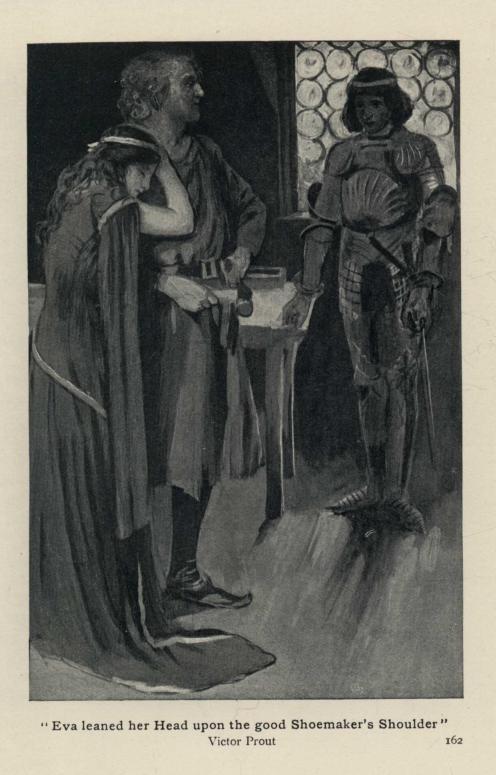
"Eva leaned her Head upon the good Shoemaker's Shoulder" Victor Prout
Before the singing began, a dance was held upon the green. In and out the merry parties weaved in May-pole fashion until a cry arose, "The Master Singers! the Master Singers!" and everybody fell back respectfully to make way for the members of the guild. Two by two they filed in, looking very important and taking seats reserved for them upon a stage.
Last of all came Herr Pogner, with his daughter leaning upon his arm, and Hans Sachs and Walter. You may be sure there were many curious glances directed toward the white-robed girl whose hand had been promised to the victor of the day, but she bore the ordeal bravely, albeit blushingly. The handsome knight walking along with the shoemaker also came in for his share of attention, and "Who can he be?" was on many lips, especially those of the maidens.
Hans Sachs was Master of Ceremonies for the day. He was one of the most widely beloved men in all Nuremberg town; so a hearty cheer went up as he came to the front of the platform to address the throng. In a neat little speech he told the purpose of the festival and spoke of the high regard in which the occasion had been held in the past. He spoke of the conditions governing the contest, and of the unusual prize offered by his esteemed fellow-townsman and neighbour to the victor of the day. At this there was still louder cheering by the crowd and still more blushing on the part of Eva. When the applause subsided, the speaker concluded his remarks by saying that the contest was now open to anyone, and the first singer to present himself would be listened to.
As Hans Sachs ceased speaking, and the final applause ended, there was a tremendous craning of necks to see who would be the first candidate. With a bow and a smirk, Beckmesser lost no time in coming forward. He was dressed with fantastic care, and as he clambered painfully up the steps to the singer's platform, people nudged one another and smiled. One pert young girl said to another, "What! that old fool?" and the other replied, "Wonder what his first wife would think of his capers?"
However, the town clerk did not hear any of these and other comments, but began thrumming the harp he carried, by way of a prelude. Then he lifted up his voice and sang—and such singing! He had tried at the last moment to adapt a tune of his own to Walter's poem. The tune did not suit the words, and moreover he had not had time to memorise them well—just as the shrewd cobbler had anticipated. He stumbled in the lines and tried to refresh his memory by looking slyly at the written copy he held in his harp hand. The result was a strange jumble of poem, song, and sense. So ludicrous was the ending that the people did not try to keep within bounds, but laughed aloud right in the unlucky singer's face.
Beckmesser was filled with shame and rage at the way his song had ended. Willing to put the blame upon someone else if he could, he threw the paper at Sachs' feet exclaiming,
"Well, at anyrate, it was not my song! There is the man you have been ridiculing—your dear Hans Sachs!"
The cobbler arose and quietly picked up the paper.
"No," he said, "this song is none of mine."
"Do you deny," raged the other, "that it is your writing and I found it in your workshop?"
"I do not deny it, but, as I told you, I will not claim it as mine; for it is not."
Then seeing that the people, as well as Beckmesser, were interested in what he had to say, he turned to them and told them the true history of the song—how that a young knight had composed and sung it to him only that morning. He had merely written down the words which had later been seized upon by Beckmesser, who had now tried to fit them to a tune of his own.
Beckmesser interrupted him here. He saw that he himself was standing upon very thin ice and it behoved him to bluster it out.
"A pretty story this!" he cried. "The young knight of whom he speaks was publicly discredited before all our guild only yesterday. He does not know how to write such a song as I have sung!"
"Thank Heaven that he doesn't!" retorted Sachs, amid general laughter. In a moment he continued, "Now I crave the indulgence of everyone here present. You have known me to be just with every man. All I ask of you is to be allowed to prove what I say. The true owner of this song is present here to-day and desires to sing it in the contest. Then you shall be the judge as to whether it be his or Beckmesser's."
"Yes, yes! let him come forward!" came an answering shout.
Hans Sachs turned and looked inquiringly at the members of the guild. They likewise nodded approval. Indeed, they would hardly have dared do otherwise, even if they had been so disposed, in the face of the popular desire. Then the Master of Ceremonies beckoned to Walter, and every eye was fastened upon him while he rose, bowed gracefully and walked toward the stage. As for Beckmesser he took advantage of the moment to slink away without waiting for his rival, and he was not seen again that day!
Before Walter began his song, Hans Sachs gave the paper to members upon the stage.
"Masters," he said, "I pray you note well this song—errors and all—and see if it be not indeed a Master Song!"
During the most intense silence Walter opened his lips and began the refrain of the morning. The first two stanzas were sung even more sweetly than he had sung them before, while the third and fourth—not even known to the clerk—proved a marvellously fitting close. As the last notes of the harp died away to the thrill of his rich voice the audience, masters, burghers, 'prentices and all, stood for a moment spellbound. Then like the crashing of a mighty wave upon the shore the applause broke. They shouted, they cried, they clapped their hands, they flung their hats into the air—even the most sedate of them—while their joy seemed to know no bounds.
For the Master Song had been sung! the event to this music-loving people would go down into history.
When order was in some measure restored Hans Sachs asked if there was another contestant. (He did not need to ask the verdict on the song.) No one else presented himself; and Herr Pogner walking forward publicly declared Walter von Stolzen a Master Singer and made him a member of the guild of Nuremberg.
"Personally, I am proud and delighted to welcome you among us and proclaim you victor," he said, genially, "and as to my daughter's hand, I leave you to plead your cause with her. If she proves intractable—sing to her. That will win her if anything!"
"I have already sung to her, and await my answer," said Walter clearly.
Her face radiant with rose-colour, which but set off the sparkling light in her eyes, Eva approached her knight and placed the laurel wreath upon his head, as he knelt there on the step before her.
And the people? Once again they fairly eclipsed all their previous efforts at applauding. Finally it ended in a spontaneous note of admiration and love for Hans Sachs who had found this rare singer for them, and made all things come about as they should.
"Hail, Sachs! Hans Sachs! Hail, Nuremberg's beloved Sachs!" they cried.
And Eva and Walter, listening with tears of joy, felt that all this sea of sound could not express a hundredth part of the gratitude which welled up in their two happy hearts.
Rienzi the Last of the Tribunes
(Rienzi)
In the days of Rome's early greatness there were leaders chosen by the people who were called Tribunes. These Tribunes, though subject to the popular will, often had vast power, for they could make laws, declare war, and do other things that few kings, even, have had power to do. But the Tribunes passed away, in the course of centuries, and after the mighty Roman Empire had fallen, the people often had no real governing head. They were the prey of strong enemies without, and of fierce quarrels within. So, you may believe, their lot was not happy, nor their state prosperous.
About the middle of the fourteenth century, Rome had fallen into the hands of several nobles, or barons, who fought among themselves and cared no whit for the rights of the common people. Chief among these barons were the rival houses of Orsini and Colonna. Each maintained strong retinues of armed men and lived in fortified castles; and as there was no real government to hold them in check they became a menace to the whole city. Shopkeepers hardly dared to open their places in broad daylight, lest they should be robbed. Merchants were afraid to send goods from one place to another, lest they should be seized. And the worst was that women and little children were in continual danger from the street brawls and sudden excursions of these cruel and lawless men.
So you may see how desperate was the condition of things at Rome and how sadly they needed someone to restore peace and safety. Even the authority of the Pope was disregarded, and he had to flee for protection to the city of Avignon.
But there was one young man, risen from the ranks of the people, who as he grew up was filled with noble ambition. He saw the distress of all his fellow-townsmen and he longed to avenge their wrongs and make the city free and prosperous as it was in the olden days. This desire was finally roused to a fever heat by a sad accident which happened within his own family. His little brother, a beautiful child with curly hair and engaging ways, was playing one day in the open street when a small company of soldiers belonging to the Orsini house dashed by. They were met by others of the Colonna faction, and in one of their usual fierce fights the little boy was slain. Yet the young lord who had chanced to do this dreadful thing rode away without a word of regret.
From that time forth Rienzi—for that was the name of the people's champion—worked constantly among the people, striving to rouse them to action. His fiery eloquence, his earnestness, and the justice of the cause, brought him a constantly increasing band of followers, until at last he had practically all the common people secretly enlisted under his banner and only awaiting the signal to rise against the barons and regain their liberties. And the people loved their enthusiastic young leader. They were willing to follow him anywhere and give him any title he might see fit to assume. But he chose the simple name of "Tribune" in memory of the former Tribunes who had led the people; and his earnest prayer was that he might prove worthy of it.
After the tragic death of his brother, Rienzi's affections centred in a sister, Irene, a fair young girl just reaching womanhood, who was no less devoted to her brother than he to her. A fine picture they made, sauntering along some quiet path together, he with his dark hair and dreamy eyes, she with her light hair and smile like an imprisoned sunbeam. Rienzi, indeed, was a dreamer and would have liked nothing better than his books or a stroll like this by the side of a stream, had not the stern call of his country roused him to heroic things. But the fine stuff that dreamers are made of—a trusting confidence in all men—was the one thing which unsuited him for leadership. This, however, you will see for yourself as we go on with our story.
While Irene was strolling alone one day, she had the misfortune to attract the notice of one of the Orsini noblemen. He fell in love with her, but, knowing that she would scorn him, he did not attempt to win her in an honourable way. Instead, he planned to carry her away by force from the shelter of her own home! This was a wicked and audacious thing to do; but the fact that such plots had actually succeeded before shows how dreadful were the times when Rienzi lived.
Accordingly, one dark night, an armed band stole quietly along under the shadow of the houses until they reached the one where dwelt Rienzi and his sister Irene. They were wise enough to choose a night when Rienzi was absent addressing the people, so Irene was left alone and helpless. Quickly placing their scaling-ladders to the windows of the house, they soon broke into it and seized the poor girl. Despite her frantic outcries and appeals for help, they were on the point of carrying her down the ladder and making good their escape, when a lucky intervention occurred. A young man bearing the arms of Colonna dashed up with a band of followers. Seeing his ancient foes, he lost no time in attacking them at the foot of the ladders. The Orsini, though taken by surprise, fought stoutly, and the noise of the conflict brought many people running to the scene. But meanwhile the leader of the Colonna forces found means to rescue the fainting girl and carry her to one side to a place of safety.
Among those whom the tumult attracted was the Papal Legate. He came into the midst of the throng and besought them to cease fighting in the name of religion and of the church, since they paid no heed to the law. But the nobles laughed at him, and would probably have resumed the fight, had not a commanding voice cried out, "Hold!"
It was Rienzi, who had just come. Addressing the people, who were his followers, he bade them respect the law; while he prayed the barons also to go quietly to their homes. The people cheered his words and drew back. The barons shrugged their shoulders at this champion of the people, and were fain to continue hostilities, but the company about Rienzi was now so large that they yielded and sheathed their weapons. But they agreed among themselves to meet on the morrow outside the city gates, where they could renew the contest without interruption.
No sooner had the barons withdrawn than Rienzi's followers began to urge him to do what he had so long been planning—strike a decisive blow against the barons and make the city free. Rienzi saw that this would be a good opportunity. He had heard the barons plan to withdraw outside the city. Now, when they went forth to fight on the morrow, why not close the gates against them, and not let them in again until they had sworn to obey the laws?
So Rienzi was only too willing to fall in with the popular suggestion, for he perceived that the temper of the people was with him. In an impassioned speech he begged them to uphold him now; to strike as one man for the freedom of the ancient city. Then he unfolded his plan to them. The next morning his banner should be unfurled and his trumpet should sound. Then let every man there present, and every neighbour of his, rally to the standard of liberty and peace!
Rienzi's speech was wildly applauded, and a unanimous support was pledged him. The crowd then dispersed, and Rienzi had opportunity, for the first time, to learn the cause of the tumult. He found that the girl who had been rescued was his own sister. She had recovered from her fainting fit and was now leaning against her doorstep, where she was being tenderly watched over by a young man.
"Irene! Adrian!" exclaimed Rienzi in alarm.
"All is well, dear brother," replied the girl. "But had it not been for this chivalrous stranger, I fear it would have been terribly different. Some men of Orsini invaded our home and tried to carry me away, when this gentleman interfered. Our thanks are due to him."
"And they are given in overflowing measure, Adrian!" said Rienzi, extending his hand to the nobleman. "We owe you much."
Adrian of Colonna, in fact, was a boyhood friend of Rienzi, though public matters and a difference in station had long kept them apart. The nobleman flushed and laughed, declaring that the service was nothing. He was afraid indeed, he said, that the sight of his enemy moved him to battle before ever he saw there was a lovely maiden in distress. Here he laid his hand upon his heart and bowed gallantly.
Meanwhile, Rienzi was troubled at heart. Realising that Adrian had heard his speech and therefore knew his plans, he feared the cause was undone. He swiftly decided to throw himself upon the generosity of the nobleman, whom he knew to be highly honourable, and he therefore asked him, for old friendship's sake, not to reveal anything he had heard that night.
Adrian at first hesitated. One word from him would put the barons—who had laughed at Rienzi's pretensions and did not suspect his strength—on their guard. What should he do?
Rienzi saw his hesitancy. "It is not alone for myself or my people that I ask it," he pleaded; "it is for Rome—the place of our fathers for generation upon generation. Let us restore the old government and the old glory to our country. Let its cause plead with you!"
"And let me also add my word of entreaty," said Irene timidly. "You have done so much for us already. Can we ask this one thing more?"
"I consent!" said the young man impetuously. "For my country—and for you!"
Irene blushed and her eyes could not conceal the little ray of pleasure that came into them. The young nobleman saw the gleam and his heart beat with a strange thrill, such as he had never known before. It seemed to him in a moment that he would give all he possessed—houses and lands and titles—if he could but call up that glance at his every coming!
The next morning the whole city was early astir. The barons and their adherents had withdrawn to a plain outside the walls as they had agreed. Rienzi and his followers meanwhile were busied with warlike preparations. Armed men ran hither and thither about the streets greeting other citizens. And it was seen that whenever a shopkeeper or craftsman was approached, he straightway forsook whatever he was doing and hastened to arm himself also and fall in line.
When the sun was well up in the heavens the sound of a trumpet was heard. It blew the call of Rienzi; and straightway through the streets came the steady tread of marching feet. At the head of a large body of determined-looking men rode Rienzi, clad in the glittering armour of a Tribune. Before the great square of the Capitol he turned and addressed the populace telling them to be valiant upon this day and stand for the honour and freedom of their beloved city and for their own security. Then giving orders, he posted men at the gates and upon the walls, where they awaited the return of the barons.
It was really an easy victory. For when the barons came back wearied and weakened by the fighting among themselves, they found the gates so securely barred and the walls so strongly defended that they were forced to make terms. They agreed to respect the laws and recognise Rienzi as Tribune, before ever they were allowed to enter or continue to their homes.