"A Boy's Adventures in China" (continued 5)
Reading edition
The moment the booming of the gongs ceased, Blunt drew back and shouted to know if any one had been hurt by the discharge of the great swivel; but though he waited and called again, he had good proof in the silence that no one was injured.
“Do you hear there?” he cried again. “Is any one—”
His words were drowned by a roar from the enemy’s gun, almost accompanied by the snarl-like noise made by its great charge, which came hurtling against the chests and bales this time, though a good half spattered angrily over the front of the stones.
“We mustn’t let them have it all their own way, Lynn, my lad, or they’ll come on with a rush full of confidence and do too much mischief. Now then, the distance is easy. Look yonder in the front of the junk: what can you see?”
“Two men pulling out the rammer of the long swivel-gun, and another pointing it, as it seems to me, exactly at this loophole.”
“I don’t believe he is, my lad, but it looks like it.”
“Now he’s taking the—linstock—don’t you call it?—from the man who is holding it, and is going to fire.”
“Don’t let him,” said Blunt sharply. “Take aim. Ready? Fire!”
In obedience to his companion’s orders, Stan had dropped on one knee, taken a long and careful aim, and then drew trigger.
For a few moments the soft grey smoke hung before the lad’s eyes and hid what was going on; but he did not waste time. Throwing out the empty cartridge, he began to fit in another, and as with trembling fingers he reclosed the breech he whispered sharply:
“Did I hit?”
“I fancy so; the man sprang up in the air and fell backwards. You’ve no time to look, so take it from me. They are carrying the man away.”
Stan drew in his breath with a hissing sound, but no time was given him to think of what he had done, for Blunt’s voice made him start, as he was bending over him.
“Loaded?” he said.
“Yes.”
“Take aim, then, at that man with the match. He is shifting the gun a little to allow for the distance the junk has floated with the stream.”
“Yes; I see.”
“Let him have it, then. Sharp! He must not fire that piece.”
Stan’s rifle rang out, and the Chinaman dropped behind the high bulwark and was seen no more.
“Load again, stupid!” cried Blunt, for Stan half-knelt behind the opening from which he had aimed, looking stunned and motionless, impressed as he was by his terrible success. But he started into active life again under the spur of his companion’s fierce words.
“Keep on firing slowly and steadily, Lynn,” said Blunt in tones which made the lad feel that he must obey, though the compunction was dying and he knew how necessary it was to render the big piece useless by checking the efforts of the gunners.
He fired again just in the nick of time, and the man who now held the linstock dropped it and stood gesticulating to his companions.
“You’ve missed him, Lynn,” said Blunt angrily. “Look! he has picked it up again.”
Stan needed no telling that he had only startled the gunner by sending a bullet close to his head, and before he could fire again a puff of smoke darted from the mouth of the piece, and Blunt struck him sharply across the back, spoiling his aim so that the bullet from his rifle went anywhere.
“Why did you do that?” he cried sharply, for the blow stirred him into making an angry retort, as he gazed through the smoke at his comrade. “I’ve done the best I could. I’m not used to this sort of—Why—what—Mr Blunt!” he cried, as he saw a peculiar look in the manager’s face, and that he was leaning sideways against the wall of bales. “Oh! you’re hurt!”
The manager tightened his lips and nodded sharply before letting himself subside, gliding down half-resting against the defensive building, and saving himself from falling headlong in his faintness.
“Here,” cried Stan, letting his rifle rest on the top of the bale from which he had fired, “let me bind up the wound. Where are you hurt?”
“Hah!” exclaimed Blunt, as if mastering a spasm of pain. “Never mind me. Go on firing, my lad. Don’t you see how close they are in? Fire away, and shout to the others to keep it up. Stop them from loading if you can; it may scare the next junk from coming on.—Ah, that’s better!”
For the sounds he heard were pleasant to his ears. There was no need for Stan to shout, and he took up his rifle again in obedience to his orders and went on aiming at the men on the junk who seemed to be most prominent. Firing was going on all around, and from the upper windows of the warehouse as well, the consequence being that the men at the sweeps fell one by one; and then the two men handling the huge steering-oar dropped away, with the result that, instead of the great junk being laid alongside of the wharf for the pirates crowding her to leap ashore, they were carried on down-stream, with her captain and officers raging frantically, till the chief man received a bullet through one of his upraised arms and sank back into the arms of a subordinate.
Chapter Twenty Six.
“Fire Away!”
The leading junk was soon some distance down the river, the confusion on board from the steady rifle-fire, which caused man after man to drop, checking all efforts to recover the lost ground; but the second junk had taken its place, and those on board were pouring in a hot fire from two clumsy swivel-guns, consisting of showers of rough missiles, bullets, broken iron, and the like.
But little damage was done to the sheltered defenders, who, animated by the example set from the little bastion, kept up a steady, regular fire, with certainly more than half the shots telling among the Chinamen working the guns or giving orders.
In the intervals of his firing, however, Stan kept on imploring Blunt to let him summon help, or cease firing and attend to the injury.
“Go on firing, as I told you,” cried the wounded man in an angry snarl. “Can’t you see that you are helping me by what you are doing.”
“But you must be getting faint.”
“I am,” said Blunt fiercely, “with the hard work to keep you at work. Do you think I want our men to be put out of heart because I am bowled over?”
“No,” said Stan, with his cheek against his rifle-stock, and he pulled the trigger, sending a leaden messenger at one of the enemy who was about to lower his smoking linstock, which produced a savage yell by its effect; for the man with the burning match flung up his hands, the linstock went flying overboard, and Stan’s frown deepened as he felt that he had desperately wounded the gunner, who was being borne away before the lad’s rifle was again charged.
“That was another hit, wasn’t it?” said Blunt anxiously.
“I think so,” was the reply, “but I’m not sure that it was my shot.”
“Never mind so long as it’s one murderer the less. Keep on firing, my lad, while you can get so good a chance. I can’t see what the rest are doing. It seems to me that they are only wasting powder.”
“Oh no,” said Stan; “men on the junk keep on falling. But there are two more junks coming close up.”
“And you haven’t checked them. Fire away! Try and hit the steersmen.”
“It’s hard work to see them so as to pick them out,” said Stan, “but I’ll do my best.”
The lad’s best was to aim carefully at the men holding the steering-oars of the second and fourth junks, but excitement combined with the distance affected the steadiness of his aim, and he uttered an impatient ejaculation as he saw the two great crowded vessels coming steadily onward.
“We shall be having all three close in together,” he muttered. “It’s impossible to keep them off.”
But better fortune had attended his efforts than he had given himself credit for. In each case his carefully aimed shot had taken effect, and they were supplemented by the shattering fire kept up by the defenders at the other loopholes. Certainly the third and fourth junks were coming in fast, but it was in an ungoverned way, and their action soon after produced a savagely furious volley from the captain of the second junk; for its companions came on to crash into it, with the accompaniment of falling masts and sails, and the confusion of top-hamper, a good deal of which came down upon the men, who yelled shrilly and angrily until they were extricated or able to get free.
In spite of the faintness and sinking caused by his wound, Blunt held tightly on by the cord binding the bale against which he had propped himself, and watched everything that took place with swimming eyes, but an intense feeling of satisfaction as he witnessed the disasters of the attacking pirates. And every now and again when the noise grew less overpowering he hurriedly went on giving his companion instructions to take careful aim at this one and that of the enemy’s force, and did not fail to give praise when the shot was successful.
“Bravo! Well done, lieutenant!” he said hoarsely. “That’s a murderer the more put out of action. Don’t shudder; three parts of them will unfortunately get better, but they’re done for this time.” Then: “Keep it up, my lad. You take my place now and lead the fighting. Nobody knows yet that I’m down. You’ll have to give the order soon to withdraw into the warehouse.”
“Not fight it out here?” cried Stan eagerly, for he was fast growing intoxicated with the wild excitement of the fray, and had forgotten all about the danger of his position.
“No; it is impossible. You are only hindering them now and crippling them as much as is possible, but before long they will come like a wave over the sides of the junks, and swarm up to the defence here, and you will not be able to resist them.”
“But we should all have a much better chance to shoot them down then.”
“Of course; and a dozen or two would be struggling on the stones. But if a hundred were shot down it would make no difference; they would come on all the same in their blind, savage fury, for they think nothing of those who fall. Here, leave your rifle where it is for a few moments. That’s right. Now take this whistle. Put it in your vest-pocket, where you can get at it easily, and after they have made their first rush, use it.”
“Yes,” said Stan huskily as he thrust the little instrument into his watch-pocket; “but about you? Hadn’t I better call a couple of the coolies to come and lift you into your room?”
“No!” snapped out Blunt, as if he were maddened by the pain he suffered. “Do you want to turn a brave resistance into a panic?”
“No; of course not, but—”
“Silence!” cried the poor fellow sternly. “The men are fighting splendidly now, and I want them to go on till such time as it is necessary to get inside and continue the defence from the upper windows. Do you hear?”
“Yes; and I’ll do all you wish, but I must have time to get you safe inside.”
“Leave that to me,” said Blunt slowly and in a more gentle tone. And then, as if warned by his sensations, he continued: “If I faint, use your own common-sense. Don’t hesitate: fight till it seems folly to hold on longer here; then blow the whistle with all your might. Some of them are sure to rush to your help. Then let a couple take me by the hands and drag me—don’t let them stop to carry me—drag me in through the first doorway.”
“I’ll take one hand myself.”
“You’ll do nothing of the kind,” cried Blunt passionately. “I order you to take my place as captain, and as your father’s son save us all from this murderous scum. You’re captain now—do you hear?”
Stan nodded.
“Then act sensibly. Do you want to give up directing and turn yourself into a coolie to save one helpless man, and perhaps sacrifice your own life?”
“But you are—”
“Only one,” snapped the manager; “and the most useless one here. Now back to your place, and go on firing as the captain should, to bring down more of the miscreants and encourage our brave fellows. If you fail now I’m not able to strike, the rest will be out of heart at once.”
“You are giving me more than I can do,” half-groaned Stan. “I’m only a boy.”
“Forget that, Stan,” said his wounded comrade harshly. “I say you’re acting like a man. Now fire at that giant of a fellow standing in the gangway waving his great broad-bladed sword—”
There was the sharp crack of Stan’s rifle, and the big, showily dressed Chinaman followed the direction in which he waved the sword—that is, shoreward—and literally dived off the junk into the river, to be seen no more by those in the bastion.
“Well done—for a boy!” cried Blunt mockingly as he passed his left hand over his streaming brow. “I only hope every man at the back and right and left is doing as well. Mind when you retreat that the doors are well barricaded.—Reloaded?”
“Yes,” cried Stan, who felt as if his companion’s words were goading him to act in a way contrary to his nature, and without further urging he fired again and again.
“Good—good!” panted Blunt. “I daren’t turn to look back, because I should expose myself—and I know that if I stirred I should faint—but tell me, how are the fellows behaving?”
“Keeping up a steady fire, just as you told them. I can see the poor wretches falling killed or wounded. There goes another into the river.”
“Hah!” sighed Blunt. “I can’t tell the difference between their firing and ours. It seemed, though, as if our fire was dropping off.”
“It isn’t that,” said Stan, passing his reloaded rifle into his left hand so as in turn to wipe his streaming face with his right, quite unconscious of the fact that he had covered it with the wet, black, exploded powder fresh from the breech of his piece and his used cartridges, and now leaving a broad black smudge across his forehead and down each cheek—“it isn’t that. I’m sure our men are firing splendidly, but the enemy are using their clumsy pieces now from the junks.”
“Yes, that’s it,” said Blunt slowly. “But what are they doing now? I can’t see for this cloud of smoke.”
“Getting the junks closer in with poles. They’re going to leap ashore, I think, and make a rush.—But there is no cloud,” he muttered to himself; “the wind is driving it away.”
“Be ready, then,” said Blunt. “Fire once more right into the thick of them, reload—and—then be ready—to sound retreat—to—sound—”
Stan took a quick aim, fired, threw open the breech of his piece with his fingers trembling, and then closed it again, using stern resolution to carry out his orders, though all the time he felt sure that Blunt was as he found him when he looked round—that is to say, lying motionless on the floor of the bastion, but with his fingers still crooked in the cord of the bale.
“It must be nearly time,” groaned Stan to himself, as he felt half-stunned for the moment.
But a moment only. The next he was grinding his teeth as he again passed his rifle into his left hand to feel for his knife with the right, take it out, and open the blade.
For he foresaw a terrible difficulty as he glanced first at Blunt’s hand still clinging to the cord, and in dread lest the desperate clutch might prove a hindrance, he bent down and, as quickly as he could, sawed through the tightly strained cord, which quivered and then, as the last strand was severed, sprang apart with a sharp crack, springing out of the wounded man’s fingers and leaving the arm free to fall across his breast.
Stan sighed as he replaced the knife and turned to fire once more; but he saw at once that if the retreat was to be made and a fatal hand-to-hand conflict, which could only terminate in their all being borne down, avoided, the signal must be given at once.
The time had come. In fact, as he placed the whistle to his lips he felt that the call had been deferred too long, for there was a furious yelling, accompanied by a deafening beating of gongs, and with a roar a human torrent came pouring out of the gangways and off the sides of the two nearest junks; while the crews of two more, which were interlocked with their companions, rushed on to the nearer decks to cross and supplement the attack.
“They’ll never hear it!” thought Stan as he blew with all his might, just as every holder of a rifle was making it spit its deadly cones of lead right into the thick of the enemy’s advance.
But he was wrong. At the first shrill chirrup of the silver whistle, its keen, strident tones cut through the heavy roar of the gongs and voices, and as the firing from the junks had ceased so as to allow the enemy to advance, so did that of the defence; and while Stan was drawing breath to repeat the piercing call, there was the quick sound of footsteps, and two of the clerks appeared at the back.
“Dead?” shouted one as he saw Blunt lying motionless.
“No,” shouted Stan. “Quick! A hand each, and drag him in. Off!”
The last words acted like an electric shock, and in less time than it takes to tell it the manager’s hands were seized, and with his head just clear of the ground, the two bearers doubled with him along the back of the tea-chest wall and in through the open doorway.
Stan followed them till he too reached the opening, and then stood back against the chests waiting while man after man dashed up to this and the farther door, till the last had passed in, and then with unconscious, bravery the lad followed.
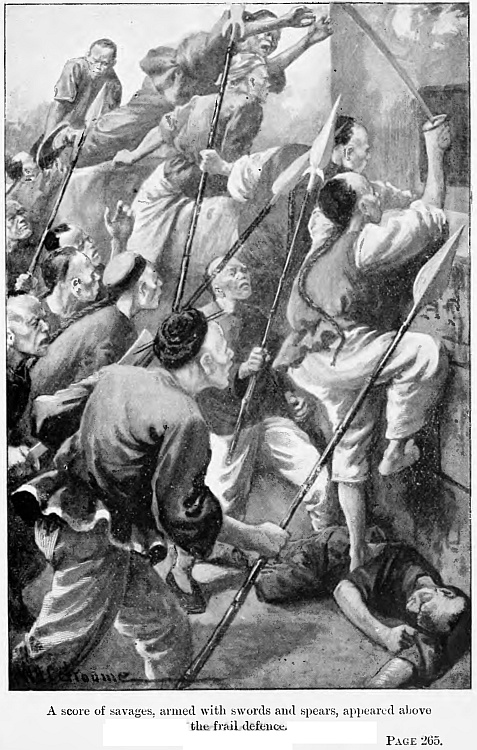
It was none too soon, for as he reached the lintel the hands of a score of savages, armed with swords and spears, appeared above the frail defence, assisted to the top by their fellows. Directly after they began to tumble over, heedless of the firing now being opened upon them again from the upper windows of the warehouse; and then, wild with fury as several dropped, they made a dash at the doorway into which some of them had seen Stan dive.
Chapter Twenty Seven.
“The Dangerous Task.”
It was none too soon, but soon enough, for as Stan rushed through, still blowing the whistle—for no reason at all save that he had forgotten to take it from his lips—the plan enforced by Blunt in his instructions acted like clockwork and the door was clapped to in the faces of the enemy with a sharp bang; half-a-dozen of the defenders stood fast with rifles presented ready to fire past the carpenters if there were need, and a doubt was rising in the breathless lad’s breast. It was this:
“Oh, if the others don’t secure that farther door!” The doubt was quelled by a second sharp bang, and a cheery voice—that of another doubter—cried: “It’s all right there.”
“Yes,” cried Stan as he thrust the whistle back into his pocket. “Splendidly done!”
There was no further talking, for the noise outside was deafening. The enemy, maddened at their check, were hard at work chopping frantically at the door with their heavy swords, and stabbing at the panelling with spears in a way which threatened to make short work of it. But all the time the right work was going on, the two great Chinese carpenters placing the prepared short lengths of timber in their places as coolly as if nothing was the matter, and screwing them tightly with wonderful celerity, till the highest piece was being adjusted, when Stan pushed quickly past the men waiting to fire if the need arose, and made his way to the farther door, to find, to his great delight, that the barricading was even further advanced than at the one he had left.
“Well done!” he shouted, to make his voice heard above the horrible din without. “Now one man will be enough to stay on guard here ready to raise the alarm if the enemy begin to get through; the rest off at once to man the windows. Mind, don’t waste a cartridge.”
Stan actually blushed in the semi-darkness as he gave the order in an imperative voice, and then felt ashamed of himself for daring to order these men. But a strange feeling of exultation ran through him the next moment, and he felt the pride of power, for there was a hearty cheer, and his command was obeyed with such alacrity that he ran back, and found the little party he had left waiting still as if for a similar order.
This was given loudly and quite as a matter of course, and from that moment Stan felt as if he really was in command, ready to do his best to protect the place, and as if he had only to speak to find the defenders ready to fight for him to the death.
It is a strange thing, that natural readiness of the human being to follow the lead of the one who leaps to the front and displays his contempt of danger, and it has often done work that history is proud to record.
“What next?” thought Stan as the last man dashed off, rifle in hand, to augment the dropping fire from the carefully protected windows.
The answer came from his heart quite silently: it was to go and see how Blunt had fared, and where he had been placed. But the intent was crushed out by the orders that had been given him—by Blunt’s own words about his only being one, and that Stan was not to do anything to sacrifice many lives for the sake of looking after one wounded.
His place, he knew the next moment, was to be on the upper floor, watching and directing, ready to send men here and there where the danger was most pressing, and above all to be on the watch for the great peril; and to this end he made his way to where the great water-casks stood ready filled, wishing to make sure that if the emergency arrived the coolies were at their posts ready to run here or there with buckets of water.
To his great delight, there they all were, every man stripped to the waist and with a great ready-bared knife stuck through his girdle, ready to salute him with a broad smile and seize a bucket to plunge into the open-ended casks.
“No, no—not yet!” cried Stan authoritatively. “Be ready.”
A grunting murmur of satisfaction followed him as he hurried back towards the broad stairs, at the foot of which the big carpenters and their two assistants stood, knife-armed like the rest, and having a great moving crowbar resting with one end upon the floor.
Stan was about to spring up the stairs with the intention of sending one of the clerks to the office to report upon his chief’s state, when he heard a shrill cry, and turning sharply, he became aware that Wing, in spite of his injuries, was up and dressed, and limping painfully in his efforts to overtake him.
“Ah, Wing!” he cried. “Up? You ought to be lying down out of danger.”
“Wing not lil bit ’flaid,” said the man quickly. “Wing look see if young Lynn allee light, quite well, casee you wantee know allee ’bout Misteh Blunt.”
“Yes, yes; I was going to send. I can’t come yet,” cried Stan eagerly.
“Wing t’ink muchee jus’ come tell young Lynn Misteh Blunt lie on back. Tablee. Close Wing. Wing see what matteh.”
“Yes, yes. Is he very bad?” cried Stan.
“Dleadful bad,” said the man solemnly. “Gottee big hole light floo heah.”
The position he denominated “heah” was pointed out by the Chinaman with his two thumbs, one placed on his shoulder-blade, the other on the upper part of his right chest.
“Oh! that must be dangerous,” cried Stan wildly.
“Yes, velly bad,” said Wing, frowning and shaking his head. “Wing findee bullet lead inside py-yama.”
“And you have tried to bind it up?”
Wing nodded importantly.
“Bad place,” he said. “Wind come out flont, blood lun out behind.”
“There must be a big bandage put over the place. Go and tear up a sheet.”
“No,” said Wing, still more importantly. “Gettee clean tablee-cloff—cuttee long piecee.”
“You have done that?”
“Yes,” said Wing, rather pompously now, as if exceedingly proud of his knowledge. “Wing know allee ’bout it. Mend bloken leg oncee. Big tub fallee flom clane when wind um up. Fall on coolie leg. Poo’ Chinaman. Wing mend leg. Misteh Blunt got hole floo heah,”—the thumbs illustrating again—“Wing get softee cotton, pushee piecee in flont hole, ’top wind come out; pokee piecee in back, keepee blood in. Allee blood lun out, Masteh Blunt die velly fast.”
“But have you bandaged the place well?”
“Bandage? Yes; tie velly long piece tablee-cloff lound and lound and oveh shouldeh. ’Top wind, ’top blood. Get well now.”
“Go and stop with him, Wing,” cried Stan excitedly. “I can’t come.”
“Wing know. Got tellee men how to fight.”
“Yes. Stop with Mr Blunt. You’re a splendid fellow, Wing,” cried Stan excitedly.
“Young Lynn glad Wing ’top place?”
“Yes, I tell you. Capital! Off with you back.”
“Yes, Wing go back. T’ink young Lynn like know.”
Stan only heard a part of this, for the firing was going on furiously, the enemy were battering at the doors, and just then there was a crash and a heavy report.
“They’ve begun to use the guns again,” panted the lad as he sprang up the broad warehouse stairs two at a time, to see half-way down the great store one of the windows wrecked as to its defences, bales and boards lying some feet in, the former tumbled over and the latter in splinters, while the two defenders who had been stationed there lay upon the floor.
“They’ve got one of the biggest guns to bear on the window,” said one of the defenders of the next window excitedly.
Stan nodded and ran to the weakened place, to go down on one knee and look out.
He was not cautious enough, for he was seen from the deck of one of the junks and saluted by a yell, followed directly after by the discharge of some half-dozen jingals, whose ill-directed bullets whistled by his ears.
“Take care!” shouted three or four voices.
“I should think I will,” muttered Stan, dropping on his face, his rifle striking the floor with a bang. Then quickly drawing back, he got behind one of the bales that had been driven in, rested his rifle upon it, and raising his head cautiously, prepared to fire.
For at his first look out he had seen all he wanted, and following almost directly upon the sharp clicking of his rifle-lock, the man nearest to him heard the lad draw a deep breath and fire.
Stan’s fresh companion peered from his side to see the object of the lad’s shot, and he uttered a loud “Bravo!” for Stan had continued his former luck, as, seeing that the gun on board the biggest junk was being reloaded, and that the firing-match was just about to be applied, he steadied himself, took the long breath the young clerk had heard, and then drew trigger, with the result that there was no heavy report and crash of another of the defences.
Another attempt was made to fire the gun, but a second man went down. A third fared no better, and amidst cheers from the different windows, joined in by the two injured men, who were stunned by the woodwork driven in upon them but not seriously hurt, one of the officers of the junk was to be seen raging about giving orders, which produced a ragged volley from the clumsy Chinese firelocks, bullets and pieces of iron hurtling through the window; but no more harm was done, except to the officer, who fell pierced by a shot from farther along the great goods floor.
While the party who had landed, quite seventy strong, were raging and tearing round the building, battering at door and barricaded window, and every now and then making a vain thrust with their spears at the firing party quite beyond their reach at the upper windows, and frequently getting a bullet in return which laid a desperate aggressor low, some of the more cautious sheltered themselves on the outside of the wall of bales and chests to begin firing up at the defenders. But with no advantage to themselves, for while crouching down behind the wall they could only bring their heavy, clumsy matchlocks to bear at such an angle that the charge went up high above the defenders’ heads. And whenever a man who had grown furious from several disappointments rose up to get a better aim, he went down to a certainty, riddled by a bullet sent home by one or other of the watchful clerks.
And all the while effort after effort was made by the leaders of the pirates to bring the swivel-guns of their junks to bear, but without avail; for, with a strong desire to emulate the success of Stan’s shots, quite half-a-dozen of the clerks and warehousemen who commanded the dangerous spots waited patiently and watchfully with presented piece and finger on trigger for the opportunities that were not long in coming. Man after man of those working the guns was shot down, till, in spite of yells and blows from their leaders, not a single pirate could be induced to carry out the dangerous task of loading, laying, or firing the heavy swivel-guns.
Chapter Twenty Eight.
“Fiery Missiles.”
The desperate fight had been going on for quite an hour from the time of the landing of the attacking party, and the men who had gained an entrance into the first defence had grown exhausted by the vain efforts they had made to break a way through, and contented themselves, such as could, with getting back outside to the shelter of the walls and, crouched there, watching their companions’ fire, while turning a deaf ear, and then sullen looks, towards their leaders on the junks, who kept on furiously yelling to them to go on.
They did not seem inclined to risk it, but scowled at those who ordered the attack, and waited. After a short consultation among the junk captains—a consultation carried on by shouts and yells from vessel to vessel, delivered through hands held trumpet fashion to the lips—it became evident to Stan and his little garrison that an attack was to be made upon a larger scale. For the crews of the junks manned the sweeps, and while those close in strove to lay their craft alongside the wharf above and below the spot where their three junks were grappled together, the other two began to creep up inshore as if to land their men where they could get right round to the back of the great hong and the outbuildings; while, to add to the peril, one of the men on the far side of the roof-ridge—a point of vantage from which several successful shots had been sent into the vessels—shouted the bad news that the first junk, which had been carried down the river till she had disappeared round a bend, was coming up again full sail, evidently to rejoin the others.
“It looks very bad now, Mr Lynn,” said Lawrence, the foreman, who had distinguished himself by the way in which he had maintained his coolness. “They’re going to make a grand attack now in force.”
“Yes,” replied Stan quietly, “it does look very bad. They’re too many for us.”
“But you won’t give in?” cried another anxiously. Before Stan could reply another broke out with: “They don’t want to kill us; only to plunder the hong. Why not take advantage of this lull and quietly get out on the other side, so as to get right away from the river? I don’t believe that they would pursue us.”
“Then you have a great deal more faith in the Chinese character than I have,” said the first speaker, “I believe that as soon as they saw our confession of weakness—”
“We should make no confession of weakness,” retorted another. “We should only retire.”
“They would think we were beaten, and come after us for certain,” said another bitterly.
“Yes,” said the first speaker sharply, “and follow us till we were surrounded and overwhelmed out yonder in the marsh, or paddy-fields.”
“But why should they take all that trouble for nothing?”
“For nothing? They wouldn’t call it for nothing when they would get all our rifles and ammunition, in addition to having the profound satisfaction of spearing and hacking to pieces a party, of what they call foreign devils. What do you say, Mr Lynn?”
“Only this,” said Stan quietly, “that if we are to be killed it would be better to fall fighting to the last in our own defence.”
“Then you will fight?” cried Lawrence eagerly.
“Of course,” was the reply. “I am obeying Mr Blunt’s instructions to defend the place to the last.”
“But isn’t this the last, sir?” said the clerk who had proposed the retreat.
“Oh no. We are as safe or safer than ever, and though there are going to be a great many more to make the attack, it does not follow that any of them will get in.”
“Hear, hear!” shouted Lawrence.
“And besides,” continued Stan, “when it does come to their beginning to break in, we have all our big, strong coolies to join us and help with their knives and bars. I feel sure that they will fight bravely.”
“So do I, Mr Lynn,” said Lawrence warmly.
“But they are brother natives,” said the objector.
“That’s the very reason why they will fight all the fiercer for us. They hate pirates like poison, and will enjoy sending them out of the world far more than we shall. It is only fair, though, Mr Lynn, that you should give any one who likes to make the attempt to escape free leave to go.”
“Yes,” said Stan; “it is not fair to force any one to fight who wishes to escape.”
To Stan’s surprise, there was a dead silence; and after waiting a few moments listening to the storm of voices without, Stan continued:
“Then we’re all going to stand by one another?”
“Yes, to a man, sir,” said the objector. “I dare say I’m wrong in my ideas, and I give way.”
There was a cheer at this. Every man went back to his shelter and examined his rifle, afterwards taking out and examining his revolver before thrusting it back in its holster, while Stan went from man to man to inspect his supply of cartridges, and ended by having a fresh box up and himself seeing to the refilling of every bandolier.
While this was in progress those who kept a strict watch found that no further attack was being made. The matchlock firing had ceased, and the men beneath the outer defence lay crouched close as if waiting for further orders.
But the preparations on board the junks were being made with a determination that augured a serious encounter at the next attack. Men were collecting, armed with spears and the great heavy curved Chinese swords which widened out in the blade from about an inch and a half at the handle to more than double that width near the point; while something fresh suddenly took Stan’s attention, and he pointed it out to those with him in the great store.
“Yes, sir,” said his chief backer in the late debate; “that’s the ugliest thing we’ve seen yet.”
“Why, it looks like the preparation for a procession. Every hatch on the different junks has seven or eight great Chinese lanterns; but they’re not yet lit, so far as I can tell in this bright sunshine.”
“They mean it for a procession,” said Lawrence, “and they think it is for our funeral.”
“What!” cried Stan. “But look; what’s that smoke?”
“They’re lighting stink-pots to throw, sir. Those and the lanterns are to burn us out.”
“Think so?”
“I feel sure,” was the reply.
“But why didn’t they use the stink-pots before?”
“Because they thought they could drive us out without. They didn’t want to set fire to the place for fear of damaging the loot they mean to take. They can find a market fast enough for tea and silk; but they’re getting savage now, and mean to make an end of us, even if they have to burn the place down.”
“Well,” said Stan coolly, “we must not let them. I’ll go down now and fetch up the warehousemen and coolies to do nothing else but pick up and hurl back the fire-pots, for of course they will try and fling them in at these open windows.”
“You couldn’t do a better thing, sir.”
“No,” said Stan thoughtfully. Then raising his voice, he cried: “If any one here can suggest anything more to be done, pray speak out.”
“Nothing more could be done, sir,” said a clerk. “Your arrangements are excellent.”
“Mr Blunt’s are, you mean,” said Stan, smiling. “Very well, then; I want to stay up here and watch. You, Mr Lawrence, go down and bring up the coolies, and tell them what they are wanted to do; but you had better leave half below to be ready to help with the water-buckets.”
The messenger went down, and returned with the sturdy body of Chinese labourers, who were placed at intervals from end to end of the great open space, well back in shelter; and as soon as this disposition of the defensive force had been carried out, and the young chief had satisfied himself that the men thoroughly grasped the duties they had to perform, Stan gave orders for all who handled rifles to be in readiness to take good aim and mark out for punishment every prominent leader amongst the enemy, so as to try and bring him down, and thus throw confusion amongst the men who were being led to the next attack.
Then began a weary wait, evidently caused by the leaders of the expedition holding their men in hand until the first junk had beaten up against the wind till she was some distance beyond the hong, when the watchers saw the sails suddenly begin to glide down and the great junk slacken and stop in its upward course; while directly after, with the sweeps on either side thrust out, she began, after hanging upon the current for a few moments, to drop down again, the huge oars being plied vigorously, so as to run her ashore just below the edge of the wharf.
“Now,” cried Stan suddenly, “four of you, fire at the steersmen.”
Three shots rang out simultaneously, with the result that the two steersmen went down. But two more sprang to their places, seized the great rudder oar, and the rowers toiling hard, the progress of the junk was apparently not checked, and she came steadily on.
Two more shots rang out, mere cracks in the vast space, but the junk still kept on, till her bows touched the ground and her stern swung round parallel with the wharf, while her crew uttered a fierce yell and crowded to the side; but they were some fifteen feet away from the wharf-edge.
“Hah!” said Stan to himself. “They mean business now;” for once more there was silence for a few moments before the old tactics were carried out, a signal was given, and full warning afforded to the defenders that the enemy was coming on. For on each junk men rushed forward and aft to begin belabouring the great hanging gongs with all their might, and this formed the accompaniment to a terrific chorus of yells.
“I should have liked to go down and see poor Mr Blunt once more,” said Stan to himself; “but I dare not go now.”
Then he started, for his words suddenly assumed a strange significance. It seemed to him as if his seeing Blunt once more meant that it would be for the last time, and something like a shudder ran through him.
He made an effort, however, and it was gone, leaving him firm and ready to an extent that startled him, for he could not believe that in the face of such terrible danger it would last.
There was no more thinking then. The enemy, keeping up the horrible din which was evidently intended to terrify the defenders of the hong into submission, came pouring now from the various junks, some over the sides to leap down from bulwark to wharf, some through the regular gangway, and those from the freshly returned junk making no scruple about dropping from the rail at the nearest point down into the river, to wade or swim ashore. The manoeuvre resulted in several unfortunates being crowded down, to rise after an interval, and in several instances to be swept away by the sharp current now running between the side of the junk and the wharf, where, as fast as the assailants gathered, they rushed yelling to the tea-chest barrier and began to climb.
All was wild excitement on the part of the assailants, who, as they pushed one another up, to be pulled up in turn by those at the top, kept up a continuous chorus of savage abuse and threats of the way that they would treat their victims as soon as they got them down; but the furious outburst seemed to have not the slightest effect upon the defenders, who, crouching well below their barricades, remained perfectly calm and firm. They knew their cut-out task, and contented themselves with the delivery of a well-directed shot now and again. There would be a well-concealed loophole, with nothing visible to the attacking pirates, giving them perfect confidence that the defenders were hiding away from them, and then all at once there followed a sharp, pale spurt of flame, a little puff of smoke, and some leading man of the attacking party would go down from the top of the wall, where he had been urging his followers on, while as he fell it was as often as not to lie perfectly motionless, unnoticed by his people; though upon some occasions, after staggering and falling, he would struggle to his hands and knees and crawl out of the hurrying crowd, to try and creep back to one or other of the junks.
But as fast as one man went down several came on in his place, and in a very short space of time the whole of the narrow alley between wall and store was full of hurrying fighting-men, carrying on the former tactics of battering with their weapons at door and window, some of the storming party holding their ground and keeping on thrusting their spears in savagely wherever there was a loophole to which they could gain access.
“Keep cool,” shouted Stan, though for his own part he seemed on fire. “They’ll get tired of hammering at the place in time.”
“Hadn’t we better try and shoot more of them, sir?” said one of the clerks.
“No; you must only shoot their leaders. If we went on firing at the crowd we should soon have no cartridges left.—What does that shouting mean?”
He raised himself a little to try and see the reason for a fresh burst of shouting below the window where he was watching.
The answer came at once, after a peculiar odour, and in the shape of a blazing earthenware pot of inflammable material which was thrown from the top of the tea-chest wall with such accuracy that it came flaring and fuming right in through the narrow opening, to fall heavily beyond Stan.
One such blazing missile, it was plain to all, would be sufficient to commence the destruction of the place, and in his excitement the young leader forgot his status of chief and director, for he made a dash towards the blazing pot, to stoop, seize it, and hurl it out. But just as he was holding his breath to avoid the smoke and flame, he was sent backward by a sharp concussion, sitting down involuntarily, and then trying to recover himself; but before he could get upon his knees he saw the burning pot travelling back through the window-opening with so good an aim that it fell on the far side of the wall, just where the enemy were thickest.
The man who had thrown it back after upsetting his leader turned upon Stan with hands blackened with the horrible resinous compound, and a deprecating look on his countenance as he murmured something in his native language, before ending up with his version of the English word “sorry.”
“All right,” shouted Stan, smiling, as he clapped the coolie on the shoulder. “Bravo! Capital! Go on.”
The coolie’s face lit up with satisfaction, and he turned sharply to field another blazing pot and return it as sharply as a clever wicket-keeper would a ball to the stumps which it had passed, and with such splendid effect that it struck and broke on one of the enemy, who was standing on the wall in the act of hurling another of the hideous missiles.
The effect was startling. In an instant the pirate’s blue cotton frock was covered with the blazing resin, and uttering frightful yells, he leapt down into the crowd of his comrades in the shelter of the wall beneath, forcing several to share in his misfortune as they were lighting up more of the horrible missiles to hand up to him for throwing.
There was a burst of flame through a cloud of smoke, out of which Stan—fascinated into looking out—saw something alive flaring as it rushed here and there, making for a party of its fellows dashing up with more of the pots.
It was all done in a few seconds, and had any of the assailants been ready and noticed the lad watching, he would have been shot down. But every eye was directed at the blazing figure, and, to his horror, Stan saw the end of the tragedy. For the instinct of self-preservation had made them doubly callous to their comrade’s sufferings. The man rushed on as if seeking help or in a blind effort to reach the river and plunge in; but he did not reach it of his own volition, being received upon the lowered spears of three or four of his comrades, and then he was thrust, shrieking horribly, over the edge of the wharf, a sullen puff of smoke from the surface of the water telling that the tragedy was at an end.
A frightful sensation of sickness made Stan’s head swim as he dropped back to the floor just in time to escape being struck by another of the fiery missiles; but the faintness was driven off by excitement, and it was with perfectly clear brain that the lad saw the burning Asiatic grenade hurled back amongst the yelling assailants. This proved to be with an effect that checked further effort for the moment and sent two of the pirates running to the edge of the wharf, to plunge in and climb out again dripping, but with no worse injury than a few smarting burns.
Stan was awake to the danger that was rapidly increasing, for after seeing that the smoking patches of pitchy resin on the floor were innocuous, he ran on towards where the far end of the great room was full of smoke, dreading greater mischief there; but, to his great relief, he found that, though quite half-a-dozen stink-pots had been hurled in through the windows, the coolies there had dashed them back at once. And here, too, he found that the enemy had suffered so painfully from their own weapons that the throwing had ceased.
Any doubt that might have lingered in the brains of the British defenders respecting the amount of confidence that might be placed in the Chinese labourers was now completely driven away; for though the men had been burned about the hands by the missiles they had returned, they made very light of the pain, laughing and congratulating one another upon the retaliation they had been able to inflict, for Stan soon gathered that here no less than three of the enemy had been seen to rush shrieking to the edge of the wharf and plunge in.
There was a brief cessation now from the attack, and the defenders, whose vision was a good deal obscured by the smoke that hung in the place, made out that the throwers were hanging back from where several stink-pots were burning away in the shelter of the wall, some of the men protesting loudly as one of their leaders furiously urged them on, and ended by trying to set his followers an example by stepping forward, seizing one of the vessels, coming back into sight again with the pot flaming as he held it by its loose handle, and then making a rush to a breach where a portion of the tea-chest wall had been torn down.
The act was one of barbaric bravery, and Stan saw him reach the top, swinging the pot to and fro and making the flames roar as they rushed away from his hands. Then as his arm was reached out backwards to its fullest extent, and he was about to launch the horrible missile at the opening in front, there was the sharp crack of a rifle, and he fell forward, pitching headlong to the ground beneath the window, while the blazing pot struck the stonework close to the foundation of the building, broke up, and went on blazing and sending up a dense cloud of pitchy smoke.
“Dead?” said the man who had fired, for Stan had reached forward to look out, but drew back again coughing.
“It’s impossible to see,” he cried. “The smoke is blinding.”
“And it will be setting something on fire,” said another voice out of the smoke.
“Ah! that’s right,” cried Stan, for the big coolie who had taken his place near them pressed forward with a bucket of water, which he set down while he thrust out his head to see exactly where the danger lay, before picking up the bucket again, reaching out, and dribbling the water down a little at a time, producing a cloud of steam to mingle with the black smoke, and putting an end to all danger of a fire starting at the lower barricaded windows.
As the cloud of steam and smoke passed off, one of the clerks risked thrusting out his head from the next window, but withdrew it sharply, for it resulted in a hasty discharge of jingals from the deck of the nearest junk.
“Hurt?” cried Stan, rushing to where the clerk had staggered back.
“Yes, sir, horribly,” was the reply. “Something—a piece of iron—or—a—a bullet—caught me—here—and—”
The words came at short intervals, and sounded confused. For the speaker was feeling about his head and neck, and drawing in his breath with pain.
“One moment,” cried Stan, reaching out a hand to take something from where it had lodged just within the poor fellow’s collar.
“Yes, that must have been it,” he said wonderingly. “Bit of stone. Hit me on the side of the head. But that couldn’t have come out of one of their matchlocks.”
“No,” said Stan; “it must have been chipped off the side of the window.”
“And there’s only a lump coming here. Doesn’t bleed, does it, sir?”
“No,” replied Stan. “You had a lucky escape.”
“What a close shave! Never mind; a miss is as good as a mile,” added the young fellow cheerily. “I saw the captain, though, or whatever he is, lying down at the foot of the warehouse quite dead.”
“Are you sure?” asked Stan, with his face contracted.
“Oh yes—quite. He wouldn’t be lying doubled up as he is if he were only wounded. I say, Mr Lynn, that wasn’t a bad shot.”
“No; excellent, and just in the nick of time. Who fired it?”
“Well,” said the young man, hesitating and speaking as if he were not so proud of the effort after further consideration, “I fired straight at him, as I thought, just as he was in the act of flinging that blazing pot; but I can’t say I am sure that I hit him.”
“But you are sure that he is dead?” replied Stan quietly. “Pray be cautious, though. Don’t run such a risk by looking out again.”
“You may take my word for it I won’t, sir,” said the young clerk, patting the side of his head softly as he spoke. “One taste like this will act as a reminder for some time.—Hullo! Look out. They’ve begun again.”
There was proof of a renewal of the attempt to destroy the place by fire in the presence of another of the pirates’ hand-shells, for one came sailing in through the farthest window, to break up with a crash about the middle of the flooring; and the defenders had a fine exemplification of the dangers to which they were exposed in seeing the half-liquid contents of the pot begin to flow, blazing steadily, in all directions.
One of the coolies rushed up at once to spread the contents of a bucket of water all over the burning patch, while another, regardless of the pain, ran here and there catching up the flame-licked fragments of the pot from where they had fallen, and kept on hurling them like little smoke-tailed comets back through the window-opening.
“More water,” shouted Stan, as the burning patch began to add another odour to its own, a fine, pungent smoke beginning to mingle with the dense black fume, indicating that the floor boards were beginning to catch.
“No, no, sir; this will be best,” said one of the warehousemen, and he dragged one of the silk-bales away from the nearest window.
“But that will catch fire,” said Stan.
“Too closely pressed together, sir,” was the reply.—“Here, you two, draw that backwards and forwards over the fire to smother it out.”
The two coolies caught at the suggestion, and seizing the bale together, they began to push it here and there over the burning place, with the effect of rapidly smothering out the flaming pitch, dense black smoke alone rising wherever the bale was passed; but unfortunately a heated gas kept on ascending from the blackened boards, and that caught fire again with a little explosion as the bale glided away.
Perseverance won, however, but none too soon, for all danger had hardly been swept away before another of the pots came hissing and fuming in, but without breaking; and this was jerked out, sending the attacking party flying from the place where it was expected to fall, the painful examples they had seen making the assailants pretty careful now.
This one was followed by several more, and then, to the great relief of the defenders, there was a cessation, and the assailants could be seen gathering together as if to listen to a mandarin-like officer who was risking his life while talking vehemently to his followers, who had now drawn away from the walls and were collected close to the edge of the wharf, many glancing at the junks as if disposed to rush on board.
“They’re beginning to turn tail now,” said Stan to the warehouseman who had spoken out so firmly. “I think we had better give them a volley and start them off with a run.”
“I’m afraid that it would be just as likely to enrage them all the more.”
“Yes, sir,” said Lawrence, Stan’s lieutenant; “perhaps we had better wait; but my fingers are itching to bring down that captain, or chief, or whatever he is.”
“He seems to be urging them on,” said Stan thoughtfully—very thoughtfully, for he had an idea in his head, one that would give the man a chance for his life, which might not be the case if he told his lieutenant to fire.
For now that the attack had ceased and the pirates’ fiery missiles had left off making his nerves quiver at the prospect of the fire gaining the mastery and driving them out of their stronghold, the lad felt anything but bloodthirsty; while he thought that if this leader, who seemed now to be the most prominent of all, were disabled, his followers might set the example of taking to flight.
“Look here,” said the lad suddenly; “I think I could hit that man from here.”
“Of course you could, sir,” cried his lieutenant eagerly. “I saw how you were firing at first and never seemed to miss. Will you have a try?”
Stan made no reply, but stood fingering his rifle for a few moments before, to the great delight of the party of defenders, he sank down on one knee, resting the barrel of his piece upon a bale, and then waited and watched the Chinaman who was haranguing his men wildly as he stood just at the edge of the wharf, now and then raising his arms as he pointed again and again at the great store.
As he finished there was a tremendous shout, and every man of the crowd of listeners began to wave his spear or sword.
Just then the crowd opened out as if to form in two parties for a rush at the warehouse, leaving their leader standing out quite clear, his tall, commanding figure looking huge in the sunshine.
“Here they come! Look out!” arose from within, and the whole body were in motion, when—
Crack!
The sharp report of Stan’s rifle was heard, followed by the floating up of a puff of grey smoke, and the sound seemed to act like magic, for the attacking party stood fast, staring in amazement at their chief, whose legs suddenly doubled up beneath him, and he fell back into the arms of two men who rushed forward to his help.
“Good shot!” cried several of the defenders.
“A dead man,” said Stan’s lieutenant.
“I was afraid I could not do it,” said Stan, smiling; “but he’s not a dead man, for I only fired at his legs. Look! they’re carrying him on board the junk.”
It was as the lad said: several of the men from the crowd went back to help, while the rest stood fast watching and waiting as if, losing their heads, they had suddenly been struck with a feeling of indecision. All the wild, savage desire for destruction had been discharged like so much electricity at the touch of a rod, and a feeling of hopefulness sprang up amongst the defenders as they could see that the whole of the attacking party were now gathered into groups talking eagerly, so that there was a low, buzzing hum instead of the chorus of savage yells and threats.
“Where’s Wing?” said Stan suddenly, as a thought struck him respecting taking advantage of the lull. “I know: he is with Mr Blunt. One of you go and tell him to send the servants with anything he can get together in the way of food. Another of you bring a bucket of drinking-water up here.”
The orders were carried out, and with watchful eyes and rifles ready to hand, the whole party partook of the rough refreshments passed round, the water proving, in their excited state, the principal object to which they directed their attention.
Wing limped up to Stan as soon as he had performed his task, to announce that Mr Blunt had gone “fas’ ’sleep. Velly weak; can’tee sit up. Dlinkee big lot wateh.”
Stan longed to go and see his chief, but duty kept him there watching the actions of the men still crowding the wharf, till some one in authority began to shout, when his followers crept up together as if for a fresh attack.
This brought the refreshing to a hasty end, every man hurrying at once to his post, but only to set up a subdued cheer, for, to Stan’s intense delight, the next order seemed to be one for making the fighting-men separate into half-a-dozen different parties, as if drilled to certain movements; but it only proved to be for forming up in the divisions belonging to each junk, on to which they now began to file, either direct from the wharf or across the nearest vessels to their own.
“They’ve had enough of it, sir,” said one of the clerks excitedly. “Hadn’t we better give them a cheer and a few parting shots?”
“No,” said Stan thoughtfully; “it would only be wasting ammunition. I can’t quite believe in their giving up so easily.”
“Easily!” said another to one of his companions. “Not much of that. Look at the dead and wounded.”
There was no need to draw attention to the poor wretches lying about, for their horrible presence was a burden to every one in the warehouse. Many were lying dead where they had received the fatal bullets, but many more lay where they had crawled painfully so as to get into shelter, evidently in the full expectation that if they did not get under cover they would be made the mark for fresh bullets. And oddly enough, as it seemed to the defender the cover most affected was the tea-chest wall, where those who crawled up lay close, with only a leg or arm visible to the watchers at the windows. They were, of course, so near that their groans came floating in through the openings, and now that they were hors de combat Stan became exercised in his mind as to whether he ought not to take some steps to give the poor wretches water, and he suggested it to his lieutenant.
“Yes,” said the latter, “I’ve been thinking something of the kind, sir; but it would be terribly risky work. They are savages to a man, and as likely as not they would turn upon the hand that came to their help. You see, they’re sure to have their knives and swords with them, and some of them their rifles. There, for instance,” he continued, pointing through the window where they stood to the stock of a jingal whose barrel was out of sight, being close under the wall where its owner lay.
“Yes, I’m afraid it would be risky; but if I went with a bucket of water and a tin dipper they never could be such wretches as to turn upon me.”
“My dear sir,” was the reply, “if one didn’t another would. But you couldn’t possibly do it.”
“I could, and I should feel plenty of confidence in their seeing what I meant.”
“Then your confidence would be misplaced, sir,” said the man decisively. “They’d all think you had gone out to poison them, and would turn upon you at once.”
“Oh, impossible!” cried Stan. “They’d be bound to see.”
“They’d see, sir,” said the man firmly, “but they wouldn’t understand. Men who go about getting their living by slaughtering their fellow-creatures can’t grasp the meaning of an act of self-denial. Besides, you couldn’t go.”
“I could: why not?”
“Because you are captain, and can’t leave your men.”
Stan made an impatient gesture.
“But I could, sir,” continued Lawrence quietly; “and if you order me I’ll go.”
Stan looked at him sharply.
“I mean it, sir,” said the man, with a peculiar smile; “but all the same I hope you will not send me.”
“I can’t,” said Stan. “How can I send you where I hold back from going myself?”
At that moment the man stretched out his hand sharply and caught the lad by the arm.
“What’s that for?” said Stan sharply.
“Look in that first junk.”
“Yes; I’m looking. They’re getting ready to hoist sail and go—No! I see now. They’re afraid to come to close quarters. They’re loading that gun.”
“That’s right; and the crews of the other junks are at the same game.”
Chapter Twenty Nine.
“One Cartridge Left.”
There was no doubt about the matter, for as they were speaking a tiny curl of smoke began to rise from the middle of the group of busy men on the nearest junk, and Stan’s voice rose, sounding hoarse and deep:
“Begin firing again, slow and careful shots, at the men carrying the matches. Stop; I’ll begin.”
He took aim across the bale of silk behind which he was kneeling, and—though he did not see it, others did plainly—the linstock flew up, jerked from the holder’s hand, described a curve, and fell overboard to be extinguished.
There was a yell at this, and half-a-dozen men or so began discharging their matchlocks at the window from which the accurate shot had come; while directly after there was a roar from another junk, whose men had charged their brass gun unseen, and the contents went crashing and spattering about the opening, making a great uproar, but doing very little harm.
It was a disillusionment for the defenders which roused them to a feeling of bitterness and nerved every one present with determination, and the duel between the junks and the hong went on fiercely, but with no serious harm to the defenders. The attacking party, however, suffered terribly, man after man of the crews, if they can be so called, of the guns falling killed or wounded from the slow, steady, accurate fire which picked off with almost unerring precision those who loaded and those who fired the junks’ artillery, till the pirates yelled with rage and fury, crowding over one another to take the disabled men’s places.
Meanwhile, in spite of the nerve-shattering discharges whenever the swivel-guns were fired, Stan’s followers kept up their slow, steady, irregular reply. Sometimes minutes passed without a rifle being fired, for want of what was looked upon as a good opportunity; and then shot after shot would snap out from one or another window, giving the enemy the work of carrying off as many dead or disabled men.
Again and again Stan deluded himself into the belief, caused by the cessation of the firing, that the enemy were once more out of heart; but the pauses proved to be only due to the failure of ammunition or a difficulty in bringing up the lighted match, and the firing recommenced, and more gunners were in retaliation shot down.
“At last!” cried Stan exultantly, after the hottest passage of the attack yet endured, when all at once the firing ceased. “Look! they’ve had some accident; that big junk is on fire.”
He pointed needlessly to a great body of smoke which seemed to be rising amidships of the first-coming junk but the last to be moored.
“Yes, there’s something wrong there,” said his lieutenant excitedly. “No, no, no! Look out! Here they come.”
To a man the defenders drew a deep breath, and their hands went to their bandoliers to feel for cartridges. For it was plain enough: discouraged but enraged by the ill-success of their firing, the Chinese leaders had given their orders to their men, who needed no inciting, but began pouring over the sides of the vessels again, many of them bearing their abominable fire-pots, of which a number had been made ready in the hold of one of the junks; and, without leaders or any formation beyond that of a yelling, surging crowd, the enemy began running up to the hong to gain the shelter of the wall of chests.
Here there was a halt for a few seconds till the front wall was crowded, while not a shot was fired by the defenders, who, in full expectation of what was coming, had seen their young leader order up two-thirds of the coolies, one half to deal with the fire-pots, and return them blazing amongst the enemy, and the other to be ready with buckets and bales to smother out any fire which might arise.
The smoke of the pots was rising in a cloud, from the front of the wall, and though they could not see, the defenders surmised correctly enough that the bearers of the direful missiles were swinging them in the air to get them into a high state of combustion before beginning the assault; and all waited with knitted brows, wondering how long it would be before the bewildering roar of the gongs began again, for the delay seemed, in their over-excited state, to be long and strange.
Just when the excitement of waiting was becoming unbearable, there was a diversion, the quaint-looking, pig-tailed head of Wing rising slowly from the stairway, followed by the rest of him, and he began to limp painfully towards where Stan crouched rifle in hand, with its deadly charge waiting to bring down the first prominent leader upon whom he could bring the sight to bear.
He was about the only one of the defenders who did not see the coming of Wing, and he started as he felt the man’s soft fingers touch his arm.
“Ah, you, Wing!” he cried sharply. “What do you want here?”
“Misteh Blunt send Wing young Lynn.”
“Hah! Then he is awake?”
Wing nodded.
“Is he better?”
“No. Velly bad. Say smokee chokee. Tell Wing come say you takee ca’e fi’ no get to magazine and blow up allee ca’tlidge.”
“Yes, yes; I’ll take care. Tell him we are doing our best, Wing, and that I can’t come down to see him.”
“No; can’tee come down. B’long warehouse. Mustee stop kill big lot pilate.”
“Go down now, Wing,” said Stan impatiently. “You’ll only be in the way here.”
“Yes, go down soon fight begin.”
“And stay with Mr Blunt; he may want water.”
“No stay ’long Misteh Blunt—no. Say Wing makee ’self useful. B’long wa’ehouse now. Stop see if fi’ begin to buln, and put um out ’gain with bucketee wateh.”
“Very well; do that, then.”
“Yes, Wing go stand ’longside ca’tlidge place. See no stinkee-pot come floo.”
“Yes; good. Be off; I’m going to fire.”
“Go fi’?” said Wing. “Yes; no shootee Wing. Get ’way now.”
It was quite time, as the Chinaman felt. Limping along the floor, he made for the stairway, and had just reached it when, with a roar and dash, the fierce enemy climbed to the top of the little wall and began to discharge their jingals and fire-pots, no less than three of these latter falling inside at the first discharge.
It was a repetition of the first assault, but earned on with more savage energy, in spite of the calm, steady reply in single shots from the defenders, who kept to their former tactics, with the result that nearly every time a rifle sent forth its jet of flame and faint puff of smoke it meant a message of death or temporary disablement to some miscreant who was more prominent than his fellows in the assault.
But they were as far, apparently, as ever from carrying the place, and when, enraged by their ill-success, about a score of the most desperate dropped from the wall to try and batter in the doors, covered by a fierce discharge of the fire-pots through the windows above, Stan, terrible as the time was, felt an old incident of schoolboy life flash across his brain.
It was no time of fire, although it was mimic battle royal, for it was an episode of snowballing when the weaker side were driven to take flight and shelter themselves behind the dwarf wall of the covered-in portion of the playground, where no snow had of course fallen, while just outside it lay piled up consequent upon the roof having been swept after a heavy fall. Stan and his fellows were therefore in the position of being without ammunition, while their adversaries were standing knee-deep in the midst of abundance.
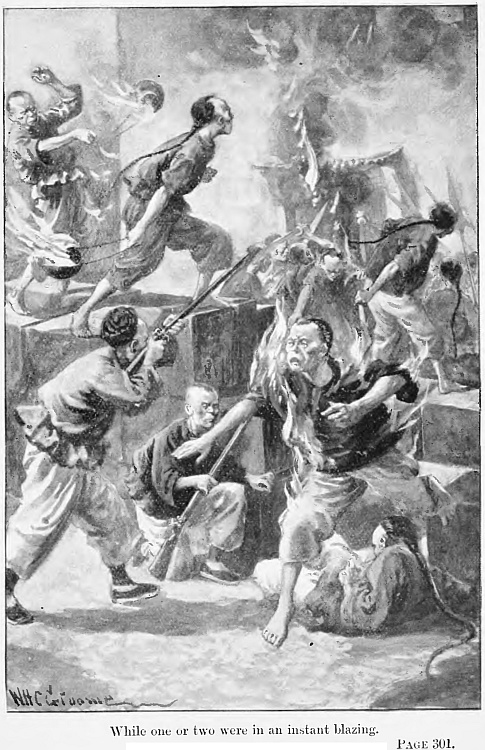
There seemed to be nothing left but ignominious surrender, when the idea occurred to Stan which enabled his party to turn the tables. It was merely to catch the ready-made balls of snow and return them instantly to the throwers. And with this memory coming to him in the emergency, just when the stink-pots were coming thickest and the doors below threatened to give way to the battering and hacking they received from the furious party beneath the windows, Stan brought his coolies together and gave his orders, which were to raise the blazing pots with crowbars and carry them to the openings over the threatened doors, after the barricading bales had been dragged away; and then, just when the attack was at its worst, two half-dozens of the blazing grenades were quietly dropped at once amongst the constituents of the Chinese forlorn-hope.
The effect was as instantaneous as it was horrible. Several of the men at each door were splashed with the burning resinous material, while one or two were in an instant blazing. There was a wild yelling of pain and despair, and, as much to avoid their fellows as the missiles flung after them, the whole of the attacking party took to flight to gain the other side of the wall, such of them as were burning making for the river.
This stopped the assault upon the doors, but only increased the fury of the enemy’s firing from their shelters, while more blazing pots were being brought rapidly down from the junks, to be handed up to the throwers and then hurled in as before.
“Never mind,” shouted Stan; “we’ve checked them a bit. Fire away at the men who bring the stink-pots.—Eh—what? Getting to the last cartridges? Plenty more.—Here, Mr Lawrence,” he continued, turning to his lieutenant; “there’s a whole case in the magazine; fetch them up.”
“Is the trap-door locked?” said the man thoughtfully.
“No—only shut down. Quick! We must not slacken our fire now.”
Lawrence placed his rifle against the breastwork from behind which he had been bringing down enemy after enemy, ran along the great store floor, and narrowly escaped being hit by one of the fiery missiles which came flying in; but he reached the broad stairway in safety, plunged down, and returned in a marvellously short space of time with an open case of ammunition in his hands.
“Here, cartridges—cartridges!” shouted two of his fellows as he hurried by where they were firing; but he paid no heed to their cries, trotting on to where Stan was as busy as the rest, and with a fierce growl banged the case at his feet.
“Well done!” shouted Stan. “Quick! Hand the packets round. What!” he cried. “Dripping wet?”
“Yes!” cried the bearer of the case and the most dire news that could be carried to men in so sore a strait—treachery. “The trap-door was thrown back, and some cursed scoundrel had emptied a bucket into the open chest. Look! The cases are saturated. I had to pour a gallon of water out into the iron bucket that was standing just below.”
Stan’s jaw dropped, and he stared for a moment or two helplessly at Lawrence.
The cry of “Cartridges—this way!” brought him back to himself.
“Patience!” he shouted as loudly as he could, and throwing open the breech of his rifle, he took out the full cartridge waiting to be fired and replaced it in his bandolier. Then, to break open one of the little packets in which the contents of the fresh case were wrapped, he snapped the string and tore off the sodden paper, which, as he crushed it in his hand and then dropped it, fell with a soft dab on the floor.
The next instant he had placed one of the new cartridges in the chamber of his rifle, closed the breech, turned, took aim at once at the most active of the jingal bearers, and drew trigger.
Click!
Just the falling of the hammer, and nothing more.
“That is the last case,” said Stan softly, and without showing the slightest emotion, as he merely withdrew the little cylinder, to whose detonator the water had evidently penetrated, though part of the powder might still have remained unspoiled.
“Yes, sir, the very last. What’s to be done now?”
“One moment,” said Stan quietly as he once more put in the dry cartridge from his bandolier. “Just you try one from another packet,” he whispered.—“Halt!” he shouted down the room. “Cease firing.—Now try one.”
Another packet from the next layer was tried, but the wrapper was if anything wetter, and a click! was the result.
“Oh, they’re all spoiled,” said Lawrence bitterly. “The game’s up, so only let us die fighting.”
“Of course,” said Stan coolly enough; “but we’ve not used our revolvers yet. We’ll give them a volley from our rifles, and then we must take to our pistols and wait till they come to close quarters.”
“What do you say to retreating to the office after the volley, and then defending the door as the brutes try to get at us? The revolvers will tell splendidly there, too, as we shall be firing into the dense mob who crowd into the passage.”
“The very thing,” said Stan; “and we shall be defending Mr Blunt at the same time. Of course; and we must set the coolies at work then to help us with their knives.”
“Yes,” said Stan’s lieutenant, “the coolies—Chinamen. Mr Lynn,” he cried in a hoarse whisper, “it must have been one of those dogs who were to be ready to stop the fire with their buckets.”
“It couldn’t have been,” said Stan. “They were all up here.”
“Then it was that cunning Chinese fox, Wing,” growled Lawrence angrily; “and if we’re to die he shall go first.”
“Oh, impossible!” said Stan excitedly.
“I’ve got but one cartridge left,” shouted a man at the far end of the room.
“And I,”—“And I,”—“And I,” cried others, while some of the rest confessed to having two or three.
“And the enemy are coming on for a fresh attack of some kind. There’s quite a mob making for your window, Mr Lynn.”
“And they’ve got about a dozen stink-pots with them, sir,” cried another.
Stan glanced round, and there was the situation plainly enough. Some ten men were in the front of a cluster of about forty of the enemy, who were coming steadily on with levelled jingals, obviously making for the centre of the building.
“Now’s your time, sir,” whispered the lieutenant. “Let’s give them one good roar.”
“Yes,” said Stan, and he shouted to the occupants of the other windows to close up round him and bring the coolies to stand ready for the fire-pots close behind.
The evolution, if such it can be called, was performed at once, the little party of riflemen placing themselves in three rows behind their barricade, the first kneeling, the second stooping a little to fire over their fellows’ heads, and the back row perfectly upright, with the barrels of their rifles resting on the shoulders of the second line.
“We must risk the fire-pots, gentlemen,” said Stan; “but I hope to give the wretches one good, startling volley before they are able to throw. Right into the thick of them, mind, and then, before the smoke rises, every man must dash down below and into the office. I mean to hold that now.”
“But hadn’t we better fill up our belts first, sir, with cartridges?”
“They have all been soaked with water,” said Stan quietly. “There has been treachery here.”
His words were received with a groan.
“Then it’s all over,” said one young fellow piteously.
“Not while we have our revolvers,” said Stan. “We can stop them from reaching the office, I think, and our Chinese helpers will have a chance to do something then.”
A hearty cheer arose at this, for the cloud of despondency that was gathering had been chased away, and once more every eye was bright and nerves strung for the final effort.
“They’re nearly close enough,” said Stan quietly. “When they are at the densest, and the order is given to advance, I shall utter the word. Then fire right into the centre; never mind the fire-pot throwers. Let’s try to startle them if we can.”
There was a low murmur of assent, and then all waited, glaring past the bristling barrels of their rifles at the coming enemy, who, contrary to their former action, now crowded closely together as they came in something like discipline, their movements pointing to the fact that they were about to deliver fire from their jingals and then to make a rush. What they intended with the stink-pots which were being carried was not evident until they were closer in, when the fire-bearers struck off suddenly to the left as if to deliver them from a fresh point.
At this moment, as if to excite and drive the party on into making a more desperate attack, and to fill the defenders with dismay, the gongs on every junk suddenly boomed out with a terrific din; the fresh party uttered a yell, and then stopped short to fire.
Stan’s voice was almost drowned, but not quite. There was enough of his order heard to animate his little body of defenders. Trigger was drawn before a single match could be lowered upon the powder-pans of the jingals, and the rifles made almost one report, their bullets tearing through the group of pirates, who were not twenty yards away. Then, blind to the effect of their volley, screened as everything was by the smoke, the defenders started back from the window and hurried down the stairway to make for the office, where Blunt, to the surprise of all, was found sitting back in a cane chair, with Wing assiduously operating to keep him cool with a palm-leaf fan.
“Wouldn’t stop lying down,” began Wing to the nearest man; but his explanation was not heeded, the men preparing to barricade their keep, only leaving space for the rest to file in.
Chapter Thirty.
“To Certain Death?”
In the minutes that elapsed before the enemy could make their way into the deserted portion of the defences Stan and his Englishmen worked hard, making the coolies bring in a sufficiency of water for the hot and thirsty, while watch and ward was kept, and wonder was expressed as to what had been done with the stink-pots.
“I’m expecting,” said the lieutenant, “that we shall know by the crackling of burning wood what has become of them.”
But there was nothing to break the silence, no rush to indicate that the enemy had climbed in, and all attempts made to take an observation from the chinks of the boarded-up windows of the office were useless; for these latter only resulted in the examiners seeing the far-stretching verdant country, no sweep of the river being visible from that portion of the building.
“What does it mean?” said Stan at last. “Some trap?”
All listened again for some minutes before Stan, pistol in hand, led the way to the foot of the warehouse stairs, where they stood listening for a few minutes before the lad planted his foot on the first step.
“No, no, sir; let me lead,” whispered his lieutenant—“let me go this time. The first thing you’ll hear will be the swish of one of their great swords. They’re lying ready to take off the heads of all who begin to show.”
“But we must get to know what they’re doing,” said Stan.
“Then let the carpenters take down the top plank of one of the doors, sir; it’s only screwed, and we can see everything then. If they begin with their spears, a volley from our pistols will drive them back till the board is screwed on.”
“But I don’t believe that any one can be upstairs after all,” cried Stan impatiently. “How foolish to have all the windows closed up without leaving a hole!”
“Hasn’t proved very foolish, sir,” said the lieutenant dryly, “according to my ideas. Holes for us to peep out at mean places for the enemy to send spears through. Where we could reach from inside they could get at from outside.”
“Listen,” said Stan; and for nearly five minutes silence was maintained, without a sound being heard.
“There!” whispered Stan triumphantly; “do you mean to tell me that the enemy would be able to keep as still as that if they were up there?”
“I’m afraid they would if they had laid a trap for us.”
“Oh, impossible!” replied Stan.
“Perhaps you are right, sir,” said the lieutenant; “but I’ve been working out here in China for the last twenty years, mixing with the people and learning their ways, and I’m ready to say that they’re about the most artful beggars under the sun.”
“Then you really believe that they are upstairs in hiding?”
“I do, sir. What is it they want to do?”
“Murder us, of course.”
“Exactly; and they’ve been trying to do that for the last hour, losing men heavily all the time. Force has done no good, and now they’re trying some artful trick to get hold of us without losing any more men.”
“Then why don’t they burn us out? That seems to be the most likely thing to do.”
“Yes; only they’d burn all the rich loot they want to take. They haven’t attacked us here for nothing. Of course, they’d go back rejoicing after hacking us to pieces, but they don’t want to sail away back with empty junks.”
“There’s something in that,” said Stan thoughtfully.
“It’s a trap, sir, and if you want any proof of their cunning, you’ve just had one over those cartridges.”
Stan frowned and looked sharply in the speaker’s eyes.
“You don’t doubt that it was Chinese work?”
“No,” whispered back Stan; “we must have a traitor among us.”
“Yes; one who felt that the enemy would get the upper hand.”
“Do you know who did it?”
“I think so, sir,” was the reply; “and did at first, though I’ve had my doubts since.”
“Well, that’s all over. What we want to see now is whether the enemy are on the upper floor.”
“I say they are, sir; and if one of us goes up, the next thing we shall hear will be a horrible thud from one of their swords, and we shall be a man short.”
Stan stood listening in silence again for a few moments, gazing up the stairs from out of the semi-darkness into the light which came down from above.
“I don’t care,” he said at last; “there’s something more in this than you say.”
“Perhaps so, sir; but the grim death I can see is quite enough for me.”
“You’re all wrong, and I’m going up to see what’s the meaning of this silence.”
“What’s the good, sir?”
“The good?” cried Stan. “What an absurd question! To know, of course.”
“And what’s the good of your knowing when you won’t be able to tell us?”
“You mean I should be killed at a blow, and not be able to come back and say what I had seen?”
“Of course, sir.”
“Ah, well!” said Stan bitterly, “that wouldn’t matter. If you didn’t hear me cry out, you’d know you were right by my not coming back. Now then, lend me another pistol, and I’ll rush up at once.”
The lieutenant glanced round at those who were with him, and then stepped before the lad.
“You’re not going to run such a risk, sir,” he said.
“What! Who’s going to stop me?”
“I am, sir; and the rest are going to help me.”
“Mr Blunt put me in command, for all of you to obey me.”
“Yes, sir, to defend the place—fight for it with us.”
“And you are beginning a mutiny,” cried Stan angrily.
“No, sir; only going to stop you from doing a mad thing.”
“Mad?”
“Yes; going to throw your life away, when we want you to help us.”
Stan hesitated.
“I don’t want to do anything mad,” he said more quietly. “But we must know the meaning of what is going on upstairs and outside. The enemy may be laying a mine to blow us all up.”
“No, they may not, sir. In their selfish cunning they will not do anything to destroy the place.”
“Absurd!” cried Stan. “Why, they’ve been trying since the beginning to burn the place down.”
“Oh no, sir; there you’re wrong. Only to drive us out—stifle us with their stink-pots. As soon as they had done that they would have been the first to drown out any fire that had taken hold. Come, sir; I’ve fought my best and tried to prove to you that I was staunch, so take my advice—wait.”
“No one could have been more brave and true,” cried Stan warmly. “Forgive me if I have spoken too hotly, but don’t try and stop me now. I must make a dash for it.”
“It’s your duty to Mr Blunt and your people, sir, to stand fast and order us to go up.”
“To certain death?”
“Yes, if it means it, sir.”
“Then you have your doubts,” cried Stan. “There! I’m going to make a rush up. Who’ll follow?”
“All of us,” came in a burst.
“Ready, then,” cried Stan, cocking his pistol. “Now then; once more—ready?”
No one spoke, but there was a sharp clicking of pistol-locks, and then a pause, while Stan stood with his left foot on the second stair, ready to bound up, but listening intently.
“No one there,” he said in a sharp whisper, and rushed up into the light.
Chapter Thirty One.
“A Traitor.”
No movement above him, no swish and horrible thud of a great two-handed sword, but a free course for the lad to spring from the last step into the long room, its blackened, pitch-besmirched floor covered with charred patches, and pieces of pitch, broken pots, and, above all, scores of empty cartridge-cases lying scattered about, and all lit up by the bright sunshine which streamed in through the open barricaded windows, Stan stopped short, with his follower crowding up and pressing upon him, pistol in hand, and gave a sharp look at every barricade to see if any of the enemy were crouching behind the holes in the window-opening; and, satisfied that the place was free, he waved one of the revolvers he held above his head and led off in a wild and excited—“Hip! hip! hip! hurrah!”
The shout was taken up and repeated with all the force of his companions’ lungs, while as the lad made a rush to the nearest window and gazed out on to the river, his lips parted for another cheer and his revolver-armed hand rose for a fresh wave.
But his lips closed again, his hand dropped to his side, and nothing but a hoarse, murmuring sound came forth in the words:
“I can’t—I can’t; I’m dead-beat now.”
“Hold up, my lad!” cried the lieutenant wildly as he sprang forward just in time to catch Stan as he reeled, and eased him down into a sitting position upon one of the bales, supporting the lad’s head against his breast. “Where are you hurt?”
“Nowhere,” said Stan in half-suffocated tones. “Done up, I suppose—too much for me. Water, please. Here,” he added feebly, “give the cowards one more cheer. No, no,” he added huskily and with more animation; “we’ve all done enough. Thank you!”
He took the tin of water dipped for him from one of the buckets brought up for extinguishing fire, drank with avidity, and then rose and staggered to the bucket-side, dropped upon his knees, and bent over to bathe his burning temples and smarting eyes.
“Hah!” he ejaculated as he rose and began drying his face with his blackened handkerchief. “It was very weak and cowardly, but I couldn’t help it. Sort of reaction, I suppose, after such a strain. I can’t help feeling a bit ashamed.”
“Of being so cowardly, sir?” said the lieutenant dryly.
“Yes; it was very weak,” replied Stan.
“Oh yes, very,” said the lieutenant, with a curious croak in his throat. “I never saw such a cowardly lot as we all are in my life.—Eh, lads?”
A wild, half-hysterical laugh arose from the party, and the next minute a most absurd performance was gone through, the men all beginning to shake hands with one another, the biggest fellow present with tears running down his cheeks.
“Shocking cowards, all of us, Mr Lynn,” said the lieutenant huskily; “but we’ve sent them flying with fleas in their ears.”
“Yes, yes,” cried Stan excitedly now, as he fast recovered from his weakness. “Oh! it was bravely done, but you ought to have had a man to lead you. Here, we must go down and let Mr Blunt hear the news.”
“Yes, directly,” said the lieutenant; “but when I tell him—I mean, we tell him—all that has been done, I think I know what he’ll say.”
“Say?” cried Stan, staring at the speaker. “What will he say?”
“That he couldn’t have done it better himself.”
A tremendous cheer arose at this, and the colour began to return to the young leader’s face, while to turn the conversation, which was growing painful, Stan suddenly said, addressing all:
“Why, it must have been that last volley!”
“Yes,” said the lieutenant; “that was too much for them. They stopped, though, to carry off all their wounded.”
This last was said as they stood gazing out of the windows at the six great junks gliding slowly up against the current with all sail set, but no remark was made about the way in which the broad river was dotted with ghastly-looking objects floating away with the stream and, fortunately for those at the hong, fast growing more distant; but all knew how busy the defeated enemy must have been plunging those who had fallen into the river before they sailed away.
“Now let us go down, sir, and see if Mr Blunt is well enough to hear the news.”
“Yes; he ought to have been told before.”
“We left him half-asleep,” said the lieutenant meaningly. “I wouldn’t wake a wounded man, sir, even to give him the best of news.”
“Perhaps it would be best to wait,” said Stan wearily, and looking as if all the spirit in him before had completely gone.
“Feel done up, sir?”
“Yes, horribly,” replied Stan as they reached the head of the stairs, and both glanced round and then looked in each other’s eyes.
“What were you looking round for?” said Stan.