"A Boy's Adventures in China" (continued 2)
Reading edition
“Matter? Nothing at all. There! peg away, my lad. Make a good breakfast. I always do. Splendid beginning for a good day’s work.—What!” he roared, as there was the merest suggestion of a fresh outburst, which calmed down directly, “Yes, you’d better tear me away from my bones! You do, and I’ll turn tiger. Ah! you’ve thought better of it. Lucky for you!—Nice row that; just as I said, about nothing. Divide themselves into two parties; my coolies on one side, the junk’s crew on the other. If I hadn’t gone and yelled horrid Chinese threats at them there would have been a fight, and half the men unfit to work for the rest of the day. You’ll get used to them, though, I dare say. Not bad fellows, after all, when they’ve got some one over them who won’t let them bite, kick, and scratch like naughty children. Well, how did you leave the governors?”
“Oh, very well, considering what a scare we had the other night. I thought the villains would kill us.”
“Yes, but you wouldn’t let them. I told your uncle the last time I saw him that he didn’t take precautions enough, but he said he didn’t believe any one would dare to attack a place so near the city. Revolvers are all very well at close quarters, but not heavy enough for a horde of savages who think nothing of fighting to the death. Got a revolver?”
“Yes,” said Stan; “and a gun.”
“That’s right. And after what you said, I suppose you know how to use the pistol?”
“I can shoot with it a little,” said Stan, colouring slightly. “I suppose you have one?”
“What! Living out in this unprotected place? Well, rather! I’ll show you my little armoury after breakfast.”
“Have you ever been attacked?”
“Not yet; but it’s safe to come some time or other, so I hold myself ready. It’s not quite so bad as I said last night.”
“No; I didn’t think it was,” replied Stan coolly; and he was conscious that his host was watching him keenly.
“But without any nonsense, you may have to fight, my lad, if you stay here.”
“I hope not,” said Stan, breaking the top of an egg.
“So do I,” said the manager. “I don’t want my people scared, and the place knocked to pieces or burned. That’s the worst of a wooden building like this. Ah! it’s a risky trade, and your people deserve to make plenty of profit for their venture.”
Little more was said till the breakfast was at an end, when the ting of a table-gong brought Wing into the room.
“Take away,” said the manager sharply; “and as soon as you have done, I want you to hire a boat and go up-river to stop at all the villages that were not touched at before you went away. We must do more business with the places higher up. You go and see the headmen of some of the tea-plantations there who have never dealt with us yet. Understand?”
The man nodded sharply, and the manager turned to Stan.
“Now then,” he said; “let’s look at the tools.”
He led the way into a warehouse-like place, one end of which was furnished with an arms-rack holding a dozen rifles, bayonets, and bandoliers. In a chest beside them were a dozen revolvers; and after displaying these, every weapon being kept in beautiful order, a trap-door in the floor was pointed out, regularly furnished with keyhole and loose ring for lifting.
“Key hangs in my room, if you want it when I’m out,” said the manager meaningly.
“I’m not likely to want the key of the cellar,” said Stan, smiling.
“Cellar? Nonsense! That’s the little magazine. Oh no! the cases down there are not cases of wine, but of cartridges for rifle and revolver.”
“Oh!” said Stan thoughtfully, for the announcement was of a very suggestive nature—one which brought up the night of the attack in Hai-Hai.
“There we are, then, if we have to fight,” said Blunt.
“With whom?” asked Stan sharply.
“Ah! who knows?” said Blunt, laughing. “River pirates; wandering bands of Chinese robbers; disbanded soldiers of the Government; anybody. China’s a big country, my lad, and abominably governed, but a splendid land all the same, teeming with a most hard-working, industrious population, eager to engage in trade, and on the whole good, honest folk who like dealing with us, and are free from prejudices, excepting that they look upon us as a set of ignorant barbarians—foreign devils, as they call us. But it doesn’t matter much. We know better—eh?”
“Of course,” said Stan, laughing. “But you have a good many Chinese at work for you here; don’t you ever feel afraid of them rising against you and the English clerks?”
“One way and another, there are about ten of them to one of us; and as in the case of a row the whole countryside would take part with them, you might say they would be a hundred or a thousand to one against us and still be within bounds.”
“It seems very risky,” said Stan thoughtfully; “and of course you and the clerks dread a rising against you.”
“Against us, you ought to say now, my lad,” said Blunt, smiling. “But we are not a bit afraid, and when you have been here a few months you won’t be either.”
Stan flushed a little, and said hurriedly:
“Of course, it is excusable for me to feel a bit nervous at first. You see, I had such a nasty experience the other night.”
“To be sure,” said Blunt. “And mind, I don’t say but what we live in a constant state of alarm about an attack like that, but not of our own people. They wouldn’t go against us.”
“Why?” said Stan.
“Because the round, smooth-faced beggars like me.”
The thought of what he had heard from Wing, and learnt from his own observation of the manager, had such a perplexing effect upon the lad that his countenance assumed an aspect of so ludicrous a nature that Blunt burst into a roar of laughter.
“I see,” he cried; “you can’t digest that. It doesn’t fit with my roaring and shouting at them just now? Well, it doesn’t seem to, but it does. You’ll see. You’ll soon find out that the men all like me very much, and I believe that if we were in great trouble they’d fight to the death for me—to a man. Like to know why?”
“Of course,” said Stan.
“Well, then, I’ll tell you. I’m master, king, magistrate, doctor, everything to them. They come to me about their quarrels and their ailments; to get their money, and then bank it with me; and the reason I believe in them and they believe in me is because I am just as fair as in me lies. If I find a man skulking and kick him, do you think the others side with him?”
“I should expect them to,” said Stan.
“Then you’re wrong. They roar with laughter, and enjoy seeing their fellow punished. They’re shrewd enough, and know that the idler is putting his share of work upon them. If there’s a quarrel amongst them they come to me to settle it. If a man’s sick he comes to me, and I try to set him right. Nurse him up sometimes. When they want a treat they come to me to draw out part of their earnings that I have banked for them. Bah! I’m not going to preach a sermon about what I do. I’m just to them, I tell you, and they know it. I trust them, and they trust me. Come along; let’s go and see how they’re getting on with the unloading. Let’s go in here, though, first.”
He led the way by stacks of bales and piles of tea-chests, all neatly arranged like a wall—a great cube built up from floor to ceiling—and passing through an opening, went down a narrow alley in the great store-room, with a wall of half-chests built up on either side, and entered an open doorway to where half-a-dozen clerks and warehousemen were busy. The former were making out bills of lading and entries in books, the latter sampling teas—one with little piles of the dried leaves in cardboard trays, which he was testing in rotation; while another sat at a table upon which was a copper contrivance standing upon a slab of granite, with a glowing charcoal fire burning beneath a bright urn, the fumes and steam being carried off by a little metal tube funnel which passed out through the top of an open chimney.
Right and left of this employee was a row of little earthenware Chinese teapots, and as many cups and saucers; the pots being labelled as they were used with cards attached to the handles, and marked with letters and numbers corresponding with those on the little cardboard trays containing the dried tea.
“Mr Stanley Lynn, gentlemen,” said the manager sharply. “He has come in his uncle’s place to stay with us for a time.”
The introduction was brief, and then the lad was hurried out on to the wharf, where the manager made his appearance suddenly. His presence acted like a stimulus, setting every one working at a double rate of speed, in spite of the scorching sun, which was beginning to glow with so much fervour that the strange gum used to caulk the seams of the great junk in process of being unloaded began to ooze out and form brown globules like little tadpoles with tails.
Everything was new and interesting to Stan, and the day passed very quickly, the manager seeming eager to explain everything to his new colleague; and, saving when now and then he burst out into fierce invectives against offending coolies and the tindal of the junk, he was mildness itself.
Stan could hardly believe it when closing-time came and the men ceased work.
“Didn’t think it was so late?” said Blunt, laughing.
“No; the time has gone like lightning.”
“But don’t you want your dinner?”
“No,” said Stan promptly; “I don’t feel—Yes, I do,” he cried. “I didn’t till you mentioned it.”
“Shows that you have been interested, my lad. There! come along; let’s have a wash and brush up, and then we’ll see what the cook has for us. I’m afraid you’ll have to put up with a makeshift meal again, as Wing is on the wing, as one may say, and I don’t expect him back till to-morrow night, for he has a good way to go, and the boat will sail slowly against stream. When he comes back with his report, I expect it will be necessary for me to go up and see some of the little native growers. We might take our guns and get a bit of sport among the snipes in the paddy-fields; what do you say?”
“I shall be delighted,” cried Stan eagerly.
“Like big-game shooting?” said the manager carelessly, but with a twinkle in his observant eye.
“I never had the chance to try,” replied Stan; “and I’m no hand at all with a gun. I had two days’ rabbit-shooting in England just before I came away; that’s all.”
“Hit any of the rabbits?”
“Five.”
“Out of how many shots?”
“About twenty,” said the lad, colouring; “but, you see, I’ve had no practice.”
“You’ll get plenty here, and I’ll teach you the knack of bringing down snipe.”
“But you said something about big game,” said Stan hesitatingly. “What did you mean—pheasants—turkeys?”
“Pheasants—turkeys!” cried the manager scornfully. “There are plenty of pheasants in the woods, but I mean tigers.”
“Tigers?”
“Yes, my lad, tigers; hungry savages who carry off a poor Chinese labourer working in the fields now and then. There! wait a bit, and we’ll mix up a bit of sport with our work.”
That night Stan went to his bedroom and stood looking at the moon silvering the river, thinking that perhaps after all he might end by being good friends with the manager.
“He’s just like a chestnut,” thought the boy—“all sharp, prickly husk outside; good, rich brown skin under the husk; and inside all hard, firm, sweet nut. I say, it doesn’t do to judge any one at first sight. I wonder what he thinks of me. I hope he likes me, but I’m afraid not, for he seems disposed to sneer at me now and then.”
Chapter Seven.
“You’ll soon learn your Lesson.”
It seemed to be directly after he had lain down that the thumping at the wooden partition-wall came again, and Stan leapt out of bed to hurry to his bath.
Then came a friendly meeting and breakfast, with quite a procession of boats, nagas and sampans, with an occasional junk, going up and down the river heavily laden with produce, or returning to the plantations bordering the river-bight.
Breakfast ended, Blunt proposed another walk through the warehouses to begin marking off the stock that was to form part of the return cargo in the loading up of the vessel by which Stan had come.
“I want you to get to be at home with all these things,” said the manager quietly, “so that I can leave you in charge while I run up the river now and then on such a journey as I have sent Wing upon this time. By the way, I wonder whether he’ll be back to-day?”
Stan shook his head.
“What makes you think not?”
“I did not mean that,” said Stan quickly. “I was thinking that it will be some time before I am fit to trust with such an important charge as you say.”
“Oh, I don’t know, Mr Modesty. It all depends upon whether you take an interest in the work,” replied Blunt. “There! come along; you’ll soon learn your lesson, I dare say.”
“I shall try hard,” said Stan gravely. “Everything here is so interesting!”
“Glad you find it so, youngster. For my part, it took a precious lot of resolution to make me stick to the work as I have done. My word! it has been dull and lonely sometimes. It has quite spoiled my temper. I might tell you that I was a nice, pleasant, mild-speaking young fellow like you when I was your age, but you wouldn’t believe it,” said the manager, with a laugh.
“No, I don’t think I should,” said Stan as they crossed an open enclosure and entered the warehouse, where the men were busy arranging the packages brought up the river by the tindal’s boat.
The manager began giving his orders for a fresh arrangement of certain of the packages, while Stan stood looking on, an opening just in front giving him a good view of all that was being done.
That day went like magic, and the following one too; everything was so fresh and animated, so full of interest; while when Blunt was not falling foul of some of the men, or, as one of his principal overlookers—a bluff, straightforward, manly fellow, who informed the new-comer that his name was Lawrence and his duties that of a Jack-of-all-trades—expressed it to Stan, in a state of eruption, the lad found him most agreeable, and always willing to explain anything.
Stan thanked Blunt in the evening for the trouble he was taking to make him fully acquainted with the routine of the business.
“Humph!” he grunted, with a curiously grim smile; “that’s just like me. I always was an idiot.”
Stan stared.
“I don’t understand you,” he said.
“I thought I talked plainly enough,” was the reply. “I say that’s just like me, to be such an idiot as to tell you everything.”
“Why?” said Stan quietly.
“Because I’m showing you all about the management of the men that it has taken me much study and patience to acquire.”
“I’m sure it must have,” said Stan eagerly.
“Well, then, am I not a donkey to teach you till you know as much as I do?”
“Certainly not,” said Stan warmly.
“Then I think I am, my fine fellow; but we will not quarrel about it.”
“No; for one can’t,” said Stan, laughing, “and I shall not.”
“Nor I, my lad, but I shall think a great deal; but it’s weak all the same. As soon as I have made you fit to manage here, I shall be packed off and you’ll be pitchforked into my post.”
“I don’t think it is likely that my father would put an inexperienced boy to perform the duties of one like you,” said Stan quietly; “and I’m sure neither father nor uncle would behave unfairly to any one.”
“Good boy!” said the manager sharply, and with one of his half-mocking smiles. “Always stick up for your own people. But, to be fair, I think just the same as yourself. They wouldn’t, and I know them better than you do. But to change the conversation. Look here; as soon as old Wing comes back, I’m going to send him right up the country among our trading people upon another expedition. You have to learn, and I’ve been thinking that you may as well begin to pick up business and the knowledge of the people at once. What do you say to going up the river lands and gardens along with him?”
“I should like it,” said Stan. “But I’m afraid that I should be no use to him. What should I have to do?”
“Nothing,” said the manager, laughing. “Only keep your eyes open. You could do that?”
“Oh yes, I could do that,” replied Stan.
“Wing would do the judging of the crops. One does not want to buy tea blindfold.”
“I thought you bought it by tasting.”
“Yes; but we look at it first. That’s settled, then. I tell you what you shall do: sail up the river to the extreme of your journey, and come back overland so as to visit some of the plantations right away from the stream.”
“And stop at hotels of a night?”
“Certainly. Capital plan,” said the manager dryly, “if you can find them.”
“I meant inns, of course,” said Stan, flushing.
“And I shouldn’t advise that. They would not be comfortable. No, no,” added the manager, with a laugh; “you made a mistake, and I began to banter. You will find some of our customers hospitable enough. It is only the ignorant common people who are objectionable.”
“And the pirates,” cried Stan, smiling.
“Oh yes, they’re bad enough,” said Blunt. “The difficulty is to tell which are pirates and which are not. You see, there are so many unemployed or discharged soldiers about. They get no pay, they’ve no fighting to do, and they must live, so a great number of them become regular banditti, ready to rob and murder.”
“This seems a pleasant country,” said Stan.
“Very, if you don’t know your way about. But you are not nervous, are you?”
“What! about going up the country? Not at all.”
“That’s right. Make your preparations, then, just as slight as you can, and it will make a pleasant trip, in which you will have a good view of a beautiful land, and learn a good deal about the people.”
The next morning, to Stan’s surprise, he found that a fresh boat was moored to the wharf—one that resembled a miniature junk—a boat manned by three or four men, and just large enough to display a good cabin aft, with windows and sleeping accommodation, while the crew had an enclosure forward to themselves.
“The boss’s boat,” said the chief warehouseman, Lawrence, as he saw the lad examining the outside. “Nice, comfortable boat for up-river work. Mr Blunt goes up in her sometimes to visit the plantations. Our man Wing came back in her during the night.”
“Oh, has he come back?” cried Stan eagerly.
The words had hardly passed his lips before the pleasant, smiling face of Wing appeared, as he slid back a window and came out of the cabin, looking particularly neat and clean in his blue frock and white trousers, and ready to salute his young master most deferentially.
“Morning, Mr Lynn,” came the next minute in the manager’s harsh voice. “So you’re beforehand with me. Have you arranged with Wing?”
“No; of course not,” was the reply. “I have not said a word.”
“That’s right.—Here, Wing!”
The Chinaman stepped on to the wharf, and a short conversation ensued, during which Stan stepped forward with Lawrence, who chatted with him about the boat and its capabilities.
“Very little room,” he said; “but there are arrangements for cooking, and any one could spend a month in her up the river very comfortably.”
“Wing,” shouted the manager, “we’ve done our business, so we may as well chat over the arrangements for your start.”
“Yes. When will it be?” asked Stan.
“The sooner the better. Wing here is always ready. I should suggest an early dinner, and then making a start so as to get as high up the river as you can before night.”
Wing smiled assent, and then played the part of captain by leading the way on board and doing the honours of the boat.
After this there was a little discussion about stores, which the Chinaman was ordered to obtain, and in half-an-hour Stan found himself within measurable distance of making a start. That afternoon there was a hearty send-off, and Stan was waving his cap in answer to the cheers of the party gathered upon the wharf, while the light boat glided along in obedience to the action of its tall, narrow matting sail, the big building rapidly beginning to look dwarfed; while as soon as the Chinese boatmen had got their sails to draw well they squatted down in the forepart of the boat, one keeping a lookout, and their chief, aft behind the cabin, holding the long steering-oar.
Stan had the main deck (if a portion of the boat in front of the cabin door that had no deck could be so called) all to himself, for Wing was inside, evidently intent upon making his arrangements for his young chief perfect before it was time for the evening meal.
The space was very small, but there was plenty to be seen, and a movement or two on the part of one of the boatmen squatting forward with an earthen pot between his knees taught the lad that he was looking down at the kitchen, and also that the earthen pot was the range—the man, who was arranging some scraps of charcoal in a little basket, being evidently the cook—while soon after the men were doing feats with chopsticks in getting rice into their mouths.
Stan had had some experience of Wing’s catering while on the up-river journey coming from the port, and had seen the man play what seemed to be conjuring tricks with a melon-shaped piece of chinaware which was plaited all over with bamboo basket-work.
This came out of its basket jacket, and disgorged cups, saucers, and a sugar-basin, before turning into a teapot; and a glance at another squarish box with rounded angles was very suggestive of its being fitted up for dinner use, as was afterwards proved.
All in good time, as they glided onward to the glowing west, Stan saw as if in rapid succession, so great was the novelty, his own tea made ready, the men forward seated round a steaming heap of rice, his own supper prepared, and then the night coming on as they made for a wooded part of the bank, off which the sails were lowered and the boat moored; and soon after all was painfully still, only the faint gurgling of the water breaking the silence as it rippled beneath the bows. Then, almost before the lad could realise his position, all was dark beneath the glistening stars, and he felt ready to ask himself whether it was true that he, who used to watch the stars out of the dormitory windows of his school in far-away England, could be now in such a helpless position, right away there on the swift waters of one of the great rivers of the mighty Chinese Empire.
“It doesn’t seem real,” he said. “I could almost fancy that it was all a dream.”
He felt the same soon after, when, for want of something to relieve the monotony of his position, he went into the cabin and lay down on the stuffed bamboo shelf which formed his bed.
“Suppose one of the great dragon-eyed junks coming down the river should run us down,” he thought, after lying awake for some time.
And then he began to think of the consequences, and whether he could manage to reach the surface and strike out for the shore.
Next he began to think of his father and Uncle Jeff; then of the manager, who did not seem such a bad fellow after all; then of himself and his lonely position; and then of Wing, who gave him a broad hint that he was sharing his cabin. Lastly, the lad began to think of nothing at all, not even the huge forces of the mighty river, for a listener would have come to the conclusion that he was trying to mock the remarks made by Wing.
Then it seemed to the lad that it was only a few minutes since he lay down in the darkness.
But it could not have been, for all at once something in a great reed-bed cried “Quack, quack!”
And Stan knew that it was once more morning, with the sun shining brightly, and the boat gliding swiftly up the stream; the men being clever enough in their management, in spite of their stupid looks, and steering close inshore where the current was slack.
Chapter Eight.
“Come cuttee Head off.”
The night’s rest had chased away all the dull feelings that had troubled Stan, and he woke up bright, elastic, and eager for the adventures of the day. Look where he would on either shore, everything was attractive. The country was highly cultivated, and dotted with farms and dwellings belonging to what seemed to be a large and peaceable population.
But his wondering gaze was soon checked by Wing, who came out of the cabin smiling, with the announcement that “bleakfas’” was ready—an announcement as pleasant in the confines of Asia as in homely Britain; and, to the lad’s delight, he found everything quite as civilised and good.
Wing played the part of body-servant as ably as that of agent at the hong; and after the meal was over, and the lad had returned outside to watch the glorious panorama spread on either side of the river, his guide came deprecatingly behind him rubbing his hands.
“Young Lynn wantee Wing?” he asked.
“Yes; tell me,” said Stan, “how far have we to go up the river?”
“Velly long way,” replied the Chinaman, holding up his left hand with the digits spread out, and using his right index-finger for a pointer as he counted, “One, two, flee, fow, fi’. Plap sick if wind no blow.”
“And is it all beautiful?”
“Yes; allee velly beautiful. Wing countly velly fine place.”
“But are we going to sail right on up the river like this?” asked Stan.
“Yes. ’Top many time. Buy cake—buy egg—buy fluit—buy duck—buy chicken—buy lil pig. Plenty good to eat. Got lice, tea, suga’. You likee have gun shoot duck?”
“No,” said Stan; “there’s too much to look at without bothering about a gun.”
“You likee ketchee fishee? Boy get line leady, put bait hook, young Lynn ketchee fish? Velly good eat.”
“Not to-day,” replied Stan. “I want to use my eyes.”
“Yes; velly good. Young Lynn use long eyes.”
And before the lad had half-grasped the man’s meaning, Wing had shuffled back into the cabin, to return directly with his young master’s black leather binocular-case.
“Wing load long eyes—nocklah—leady to shoot?”
“Not yet,” said Stan, smiling, as he took the case, and then seated himself in a squeaking cane chair placed ready for his use, and sat back to continue watching what at times looked to him like so much beautifully painted china on a large scale.
Finding that his services were not required, Wing settled himself down upon a stool just inside the cabin entrance, and at once became busy without attracting his young master’s notice, till the boat came abreast of a beautifully shaped pagoda, evidently built with blue and white tiles, and having a marvellously striking effect in the bright sunshine, as it rose from a verdant gorge half-way up a rugged mountain-side whose slope ran steeply down to the river, which bathed its rocky foot.
“What a landmark!” thought Stan. “If one were lost, how easy it would be to look out for that tall temple and make for it!”
The glittering tiers of glazed earthenware rose one above the other, each with its wavy, puckered eaves and points bearing little bells, the topmost stories looking as if the builders had possessed ambitious ideas of making the highest pinnacle pierce the soft blue sky; and as the new-comer kept his admiring eyes fixed upon the beautiful work, the boat glided on, forcing him to turn his head a little more and a little more, till it was wrenched round so much that Wing began to appear at the left-hand corners of his eyes, and interested the lad so much by the busy interest he took in his work that Stan’s gaze became gradually transferred from the temple to the man, who went on with what he was about in profound ignorance of being observed.
It was something fresh to Stan, who more than ever realised the fact that, in spite of being heavy and plain of feature, Wing was a bit of a buck in his way, and one who took great pains to impress upon the common coolies with whom he came in contact that he belonged to a higher grade of native—one of a class who never dreamed of defiling their hands with hard work, and kept up at great trouble by many signs, in the shape of finger-nails, of their being head and not hand craftsmen.
When Stan first caught sight of him, Wing was very carefully taking off what looked like a wooden thimble, which had been formed by scraping and filing down a suitable portion of a joint of bamboo; and as this thimble-like piece was removed, the man again laid bare a long, curved finger-nail, whose point, carefully polished and smoothed, was quite an inch above the quick, and evidently “still growing.”
“What silly nonsense!” thought Stan. “What an absurd idea! Why, if he caught that nail in anything it would break down and become a painful hang-nail.”
But it soon became evident that Wing did not mean to break down that nail, for after a certain amount of scraping and polishing it was carefully covered with its thimble-like sheath, before the index-finger on his left hand was uncovered to go through the same process as its fellow.
As Stan watched he became aware of the fact that the left middle finger-nail had met with a mishap, having in all probability been broken right down, and was now being nursed up again to an aristocratic height.
All at once the man raised his eyes as if to see how his young master was getting on, and started as he saw that he was being watched.
“Are we likely to see any pirates up the river here?” said Stan quietly.
The man shook his head.
“Wing no tell,” he said gravely as he began to cover up his much-petted nails. “Plaps many bad man—plaps not none ’tall. Plenty pilate evely-wheah. Plenty bad soljee. Wing hope nevah see none no mo’. Velly glad leave boat and begin walk back. Plenty pilate on livah; plenty bad soljee way flom livah.”
“Then the discharged soldiers are worse than the pirates, Wing?” said Stan, smiling.
“Not laugh at,” said the man solemnly. “Allee dleadful bad man. Killee people and takee evely-thing away. Lun fass?”
“What do you mean—can I run fast?”
“Yes; lun velly fass?”
“Yes; I think so. Do you think we shall have to run away from some of these men?”
“Yes. Lun away and hide.”
“Oh, I suppose I could run well enough,” replied Stan; “but of course I don’t want to.”
“No; Wing don’t want lun away, but pilate—soljee makee him. Velly fass; come cuttee head off.”
“This is pleasant!” thought Stan. “It sounds like jumping out of the frying-pan into the fire.”
The consequence of this conversation was that whenever Stan could tear his eyes from the beauty and novelty of the shore on either side he was narrowly scanning the various vessels which came into sight, the greater part being small sailing-boats. But every now and then in the course of the day the tall matting sails of some towering junk would come gliding round a bend, partially hidden, perhaps, by the trees which fringed the banks; and as soon as this was seen, Stan noted that there was a little stir among the quiet, placid-looking boatmen, who began to whisper among themselves. Then, if Wing had not seen the stranger, one of them moved to where he stood and drew his attention to the distant object.
The guide seemed to be gifted with wonderfully powerful sight, which he generally used with the result that every man was placed at his ease at once. But not always. To use a nautical phrase, Wing was not upon every occasion satisfied with the cut of the stranger’s jib, and upon these occasions he turned to his young master.
“Young Lynn lettee Wing look flou’ double eyeglass?”
The binocular was handed at once, and after a great deal of focussing, handed back.
“No pilate. Tea-boat. Allee good man.”
Or he might speak with a greater tone of reverence as he shaded his eyes:
“Big junk muchee fullee silk. Wing think junk go down whalf see Misteh Blunt.”
“Not enemies, then?” said Stan.
“No; velly good fliend.”
“But there are the big eyes painted on each side of the bows.”
“Yes,” said Wing, smiling; “but good boat. No cally stink-pot to flow on boat and set fi’. No big bang gong and lot fighting-man all ovah. No. That velly good boat, and not hu’t people. Wing tell when he sees bad boat. Lun away then.”
“On shore?”
“Tly go down livah get away. Pilate come too fass. Lun to side and go light away.”
“But what will become of the boat?” asked Stan.
“Pilate send man. Take allee good thing. Set fi’.”
“Mr Blunt would not like that.”
“No. Velly angly. Kick up big low and say Wing gleat fool.”
“And what would you say?” asked Stan. “Say velly solly. Gleat pity lose nice topside boat b’long Blunt.”
“Of course.”
“But much gleat pity let pilate man choppee off Wing head and all men head. Can makee nicee boat again; can’tee makee velly good boatman.”
Stan agreed that this was a perfectly sound argument, and during the rest of the little voyage up the river he always felt greatly relieved when his guide was able to announce that the boats they passed were men of peace and not men-o’-war.
But as day succeeded day in lovely weather, and the journey continued through a glorious country, the bugbear pirates died out of the lad’s thoughts; and on the last evening, when Wing announced that they would land at a big city in the morning, and leave the boat to go back to the hong, Stan was ready to believe that his guide had been playing alarmist a great deal more than was necessary, and told him so. But Wing shook his head. “No,” he said; “pilate velly bad sometime.”
“But we shall find the land journey no worse—there will be no discharged soldiers wandering about ready to interfere with us?”
“Wing hope allee gone, but can’tee tell. Plenty fliend people heah. Tell Wing when soljee come. Young Lynn and Wing lun away.”
Chapter Nine.
“A Fierce Struggle Ensued.”
Stan altered his opinion the next day when they reached a busy city built on both sides of the river, for Wing gave him a quiet hint to look, and upon turning, the lad found that they were gliding by a towering junk whose deck swarmed with villainous-looking men all well armed, while at intervals they passed four more.
“Allee bad,” whispered Wing. “No lookee; pletend can’t see pilate ship.”
Five more were passed, all of which were given a bad character; but their occupants were lying about, smoking and sleeping, eating and drinking; and being close up to the quays and warehouses of the teeming city, the men were upon their best behaviour, and not disposed to seize and plunder such small fry as the little boat from the hong.
Hence it was that Stan’s sampan remained untouched, and reached the disembarking place in safety.
Here, evidently so as not to draw attention to his young chief, Wing slung a few necessaries, scale fashion, at either end of a bamboo, balanced his load across his left shoulder, and after giving the boatmen a few instructions which led to their setting off at once on the return journey, he led Stan away from the riverside, right into the busy part of the city, where no notice was taken of them. A short time after the lad found himself at the house of one of the Chinese merchants, who gave him a warm welcome, and talked with him in pidgin-English about his father and uncle.
Stan noticed that he exhibited no little inquisitiveness about his further proceedings, shaking his head and looking very solemn as he hinted that the country was in a very disturbed state.
“But Mr Wing will know how to take care,” he said. “He will know, too, that the farther you keep from the river the less likely you are to meet with pirates or wandering bands of soldiers. You must take care.”
Wing evidently meant to take care, for that evening, after dark, he laid his hand upon Stan’s shoulder and drew him away from the window.
“Too many bad man,” he said, directing the lad’s attention to the rough-looking armed people lounging about the street. “See young Lynn and say, ‘Foleign devil. What want heah?’ No look out window. Go to bed. Sleep.”
Stan laughed at the ultra-precautions taken, but obeyed, and for want of something to occupy himself, lay down quite early, to listen to the shuffling of feet and the loud conversation going on below his window, thinking the while that he would most likely lie awake all night. But before he could make an effort to combat the drowsiness that had seized upon him he was fast asleep, and the next thing he knew was that Wing was shaking his arm.
“What is it?” he cried. “Coming to bed?”
“Get-up time,” replied the Chinaman. “Mollow molning. Come ’long.”
“But,”—began Stan. He said no more, his mouth stretching wide in a portentous yawn; and, still half-asleep, he suffered himself to be led out of the house and along a dark, uneven street, the air of which felt chilly, as if the morning was close at hand.
Twice over he began to question Wing, but received a hurried whisper to be silent, and by degrees it dawned upon him that their land journey had commenced, and that Wing was nervously anxious lest their departure should become known.
“Soljees,” he whispered, and put his hand to his lips.
“Why, there’s not a soul about,” said Stan to himself, feeling sleepy, and out of temper to a degree that made him ready to quarrel with his guide for taking such unnecessary precautions.
But he remained silent, and trudged on close behind his companion, stumbling every now and then in the darkness, and longing the while for the coming of broad daylight, so that he could avoid the rough stones and mud-holes which seemed to be always in his way.
He was surprised, too, at the extent of the city, for no sooner was one devious street passed than they plunged into another, their wanderings lasting for what must have been close upon half-an-hour, before they plunged into a narrower passage than ever—one where the overhanging eaves on either side seemed to nearly touch—while right in front a huge wall towered up, looking jetty black, all but a square patch on a level with their feet.
“Why, this must be a big house into which we are going,” he thought.
But the idea had no sooner crossed his mind than he felt his arm gripped, and Wing checked him so suddenly that he came heavily against his guide’s chest.
“What’s the matter?” whispered Stan.
“St! Big gate. Plentee soljee fass sleepee,” whispered Wing. “Now come ’long, quick, quick.”
He slipped his hand down to the lad’s waist as he spoke, and drew him along past where Stan dimly made out a group of men sitting and lying upon a big bench beneath a great shadowy house.
There was no time to see more before they were out on the other side, with the great building reared up in the gloom behind them, and a feeling of freedom as of an open space in front.
So great a sense of relief came over the lad that he felt bound to speak; but certain sounds behind checked him once more, and he turned cold at the proximity of the danger they had escaped.
For a deep, gruff voice growled out something he could not interpret, and this was replied to by another voice, evidently that of a man newly aroused from sleep.
The brief conversation was carried on angrily, and interrupted again and again as if the speakers kept listening.
This was proved to Stan by the firm pressure of Wing’s hand, and the twitches it kept on giving as he stood otherwise quite motionless.
Stan’s heart beat till a feeling of suffocation began to oppress him, while with straining eyes he tried to penetrate the dark shadows behind. At last, however, the talking ceased, and he felt the hand which Wing had at liberty pressing upon the top of his head as if to make him stoop down. Grasping his guide’s wishes, he bent low, and immediately felt himself drawn onward, the pair stealing along softly in the darkness as silently as possible, and as quickly, for before they had gone many yards Stan was conscious of the fact that there was a long, pale line of light right ahead, and that it was not so dark; for on glancing over his shoulder he could dimly see the gate through which they had come, a huge structure with curving roof and vast eaves, dominating a high wall which went off into the darkness right and left.
“Velly neah ketchee ketchee,” said Wing, with a sigh of relief.
“But suppose they had caught us,” said Stan; “I am an English subject, and you are my attendant. They dared not have kept us.”
Wing uttered a funny little squeak.
“Eh?” he cried. “Wheah Englis’ sailoh? No Englis’ man-o’-wha, and big gun go bang two time. Chinaman velly much aflaid when Englis’ soljee—sailoh heah. Not heah now; Chinaman laugh; say, ‘Don’t ca’e mandalin button.’ Chinese soljee ketchee young Lynn—Wing. Say, ‘Don’t ca’e nobody.’ Puttee in plison. P’l’aps nevah come out again. Velly bad.”
“Ah, well! they didn’t see us,” said Stan, “so let’s go on faster.”
“Yes; go fastee now. Go long way, have bleakfast. Don’tee want see soljee. Plentee don’t ca’e lobbah. Steal dollah. Takee young Lynn gold watch. Velly bad, wicked man.”
“We shan’t meet any of them now, I suppose?” said Stan as he gave an uneasy look round at the fast-broadening dawn.
“Wing no know. Velly likely bad soljee come. Velly likely no bad soljee come. Allee same pilate on livah. Don’t know quite safe till get home. Wing velly glad get home to hong. S’pose get home and no young Lynn. Misteh Blunt say, ‘Where young Lynn?’ and Wing say been gone lose young Lynn. Misteh Blunt call Wing dleadful name. Nea’ly kill Wing.”
“Then you must not lose me, Wing.”
“No; no must lose young Lynn. Takee gleat ca’e young Lynn.”
He nodded and smiled as he hurried his companion along, till the great gateway began to grow small in the distance, and the glazed tiles of the roof glittered and flashed and grew confused; while in the distance, far down the rough track, a temple seemed to rise out of a clump of trees, at whose edge a few humble-looking houses appeared beyond where the regularity of the enclosures told of cultivation.
A short time later Wing’s next words sent a thrill of satisfaction through Stan, for he laughed, chuckled, and rubbed his hands.
“Good bleakfast,” he said. “Plenty eat, plenty tea. Wing know allee people.”
Before they had gone much farther Stan was in possession of the information that the place they were approaching was a large tea-farm, with its warehouses, and sheds where tea-chests were made; and that for a long time past the produce of this farm had been sent down regularly to the hong by one or other of the trading-junks that bore the up-country produce to the stores of the foreign merchants.
This was interesting enough, and suggestive of the journey now becoming perfectly peaceful. But Stan’s main ideas at this time were in connection with the expected meal, so that plenty of energy was brought to bear to get over the intervening distance; while, to make matters better, it soon became evident that they were seen. People came out to stand in the sunshine, shading their eyes and watching the coming visitors. Wing’s signals were answered, and a couple of young men came running and recognised the guide, when the visitors were eagerly welcomed to join the morning meal that had been prepared.
The troubles of the early morning were soon forgotten, while, but for the strangeness of his surroundings, there were moments when Stan could have fancied that he was enjoying the hospitality of some farmer’s family thousands of miles away in old Devon. But the satisfaction was only short-lived, for the meal was hardly at an end before the door and windows were darkened prior to being thrown open by a crowd of rough-looking men bearing clumsy weapons.
Wing was seated with his back to the door, and at first saw nothing, for Stan, who had the fresh-comers in full view, felt that the best plan would be to sit perfectly calm and unconcerned.
And this he did till Wing, startled by the darkening of the window, looked quickly round and sprang to his feet.
“Lun! lun!” he whispered sharply to his young charge; and catching at his wrist, he tried to drag him towards the door in the back of the place.
He was too late.
A rush was made by the rough-looking soldiers, several of whom literally pounced upon Stan, hurling him down to the floor; and as he, naturally enough, made a brave dash for liberty, a fierce struggle ensued, in which the lad had ample proof of the futility of a half-grown boy trying to resist the united efforts of half-a-dozen heavily built men.
Of course, the struggle did not last many minutes before Stan found himself upon the earthen floor of the Chinese house, with four men seated upon him, leaving him hard work to get his breath, as he stared wildly round to see how his companion had fared.
But he looked in vain, for in the noise and confusion Wing had managed to get behind some of the people of the house, who willingly helped him to pass outside, leaving Stan to his fate.
“A coward!” muttered the boy as soon as he had satisfied himself that Wing had gone.
“No,” he added after a few moments’ thought; “he couldn’t help it, poor fellow! I know: he has escaped. He’ll go down the river to warn Mr Blunt, and he’ll get help from the port. They’ll send men up from one of the ships to get me set at liberty. For these people will not dare to hurt me. I’ll be bound to say that Mr Blunt will soon get to know, and if these scoundrels are not punished severely for this it is strange to me.”
Chapter Ten.
“Cowardly Brutes!”
Stan had the stout old tea-farmer who owned the place to thank for the rescue from his extremely awkward position. For, making tremendous use of his tongue, in words which, if interpreted, undoubtedly would have proved to mean, “Let the lad get up, you brutes; can’t you see that you are nearly stifling him?” the farmer supplemented his fierce verbal abuse with blows and thrusts which, in spite of being armed, the invaders made no attempt to resist. They gave way good-humouredly enough, evidently being quite satisfied with their capture; and after taking the precaution to station a spearman at each door and window, they allowed Stan to rise, and then bound him hand and foot to the framework of a cane chair, which they planted full in sight in the middle of the room, before crowding to the well-spread table and making a raid upon the food.
This evoked another torrent of abuse, in which the farmer was stoutly aided by two sturdy young fellows—apparently his sons—his fat wife, and a couple of men.
The farmer seemed to be blessed with a grand vocabulary, and to be well skilled in giving volleys of abuse; but he might have spared his breath for all the effect his words had upon Stan’s captors. They listened calmly enough, and as the boy looked on it seemed to him that all the bullying did was to give the rough party of soldiers an excellent appetite. In fact, the more the farmer raved the more they ate and gave orders for the big teapot to be filled; while, when the farmer ceased shouting, the visitors ceased eating and took out their pipes to a man.
A few minutes later the table had been cleared by the tea-farmer’s people, and a couple of the biggest soldiers rose at an order from their leader, seized the chair by its two sides, and then heaved together, lifting it on high and dropping it upon the table, where Stan had the misery of finding himself the observed of all observers; being treated as a newly captured foreign devil planted there for inspection, every man staring hard after precisely the stupid, open-mouthed fashion of some of our own country louts.
Now and then a remark would be passed by some smoker which brought the angry blood to the lad’s cheeks; for, though not to be exactly interpreted, its meaning was evidently derisive, and afforded amusement to the lookers-on at Stan’s expense.
“Cowardly brutes!” he muttered; and that was the only satisfaction he could get, save that of indulging in hopes that Wing was well on his way to the big city, where he would be sure to get into communication with some one or other of the principal traders, and from them obtain an audience with the chief mandarin, who, as a Government official, would feel himself bound to interfere on behalf of the young Englishman who had been seized.
And so a couple of hours dragged slowly along, at the end of which time the prisoner began to come to the conclusion that he had allowed Wing time to get to the river city, and that when he had patiently waited another two hours Wing would have fulfilled his mission and be on his way back with some of the mandarin’s guards.
But, to his dismay, Stan found that he was not to wait there till Wing returned; for all at once the man in command of the rough soldiery growled out an order, which resulted in a clumsy tumbling together of the party and the production of two very large, thick bamboo poles.
These were laid right in front of the farmhouse, and then the chair was seized and lifted down, to be carried out to where the bamboos lay, these being passed between the legs and there lashed.
“Am I to be turned into a Guy Fawkes?” muttered Stan angrily, as he gave himself a wrench in his seat to try and loosen his bandages.
But the result was vile. The captain of the party uttered a furious growl and made-believe to draw his sword, while a couple of his men seized the prisoner, holding him down fast, and a third dropped upon his knees and proceeded to tighten the thongs with such savage violence that the pain turned the lad faint, making him hang back quite lax, with the great drops of perspiration gathering on his forehead.
It was while everything seemed to be sailing round him that he became conscious of a peculiar, shaking motion which sharpened the pain he suffered. But the sickening sensation passed off, and he became fully conscious, to his great disgust, that he was being made the principal figure—carried shoulder-high as he was—in a triumphal procession on its way, so far as he could judge, back towards the great gate, which he could dimly see towering up in the distance.
They were right out in the country, with rice-fields and plantations in all directions, so that the inhabitants were scarce; but the people of the farm closed up as near as his captors would allow, and as they tramped slowly along, Stan from his elevated, swaying perch could see men at a distance throwing down the tools with which they were working, and trotting along with their tails bobbing between their shoulders, some to overtake, others to meet, and all to join in the procession.
“Why, they treat it as if it were some show—the wretches!” said Stan to himself. “Ugh! How I should like to give it to some of them! Grinning at me! Yes, actually grinning at me! Why, I believe they look upon me as a newly caught foreign devil, and they’re following to see me executed, or—Oh, surely they won’t do that!”
A sudden thought had flashed across his brain—an echo or reflection of something he had read or seen in connection with some poor wretch being kept as a captive by the Chinese and exhibited in a great bamboo cage.
The first effect of the thought was to send a shiver through him, chilling him to the bone; the following minute a sensation of heat made him flush to the temples, and he ground his teeth.
“Yes,” he said to himself, “they’d better! No, they daren’t. They’re pig-headed enough, but they must know that I’m an Englishman—well, an English boy, then,” he added correctively. “Oh, they daren’t! I’m only my father’s son—plain Stanley Lynn—but as soon as they knew at headquarters they’d send a gunboat to demand me; and—of course—yes, it’s a fine thing to be a British subject, for even if I am only a boy, our English Minister wouldn’t have a hair of my head injured—if he could help it.”
Stan thought this addition to his musings in a very different spirit to that which had preceded it. One minute he was proud and elated at the idea that he was an Englishman, with a general touch-me-if-you-dare sort of sensation making his eyes flash and sparkle and his cheeks glow; the next he was fully awake to the fact that he was a tightly bound prisoner, having a most abominable ride to some cage, alone and helpless among an inimical race of ignorant people who were delighted to see the predicament he was in—so much alone that, failing Wing, not one would raise a hand in his behalf. He was quite right about Consul and Minister and the stupendous machinery that would be set in motion to rescue his insignificant self, but there was the setting it in motion. All depended upon Wing.
“But where is Wing?” he said half-aloud, and he wrenched his head round to look back along the procession, half-expecting to see the poor fellow aloft in another chair, a prisoner, bound as well.
There was a savage growl at his movement, which made the chair sway, and bang! one of the soldiers brought the spear he shouldered heavily against the cane frame, making Stan start and then dart an angry glance at the man.
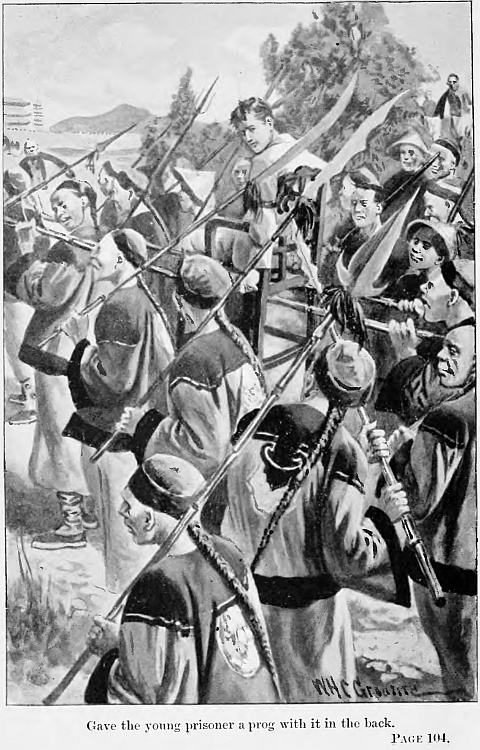
Bang! came the shaft again, and Stan winced once more, but bit his lips with annoyance, for his captors yelled with laughter, and others struck at the chair.
They struck in vain now.
“Its to make me squirm—to make the foreign devil squirm,” muttered Stan; “but I’m not going to now. I’d die first.”
Whether Stan would have gone as far as he mentally asserted is open to question, but he was able to maintain sufficient control over himself to sit fast; not even flinching when, after several heavy blows had been given, without result, to the chair, one of the most facetious of the guards—a big, broad-faced, smooth-headed fellow—lowered his spear and gave the young prisoner a prog with it in the back.
It hurt, for Stan’s white flannels were thin; but the poke was not given with sufficient force to go through the material, and further manifestations of the kind were put a stop to by a fierce shout from the captain, though the men all joined in a hearty laugh.
“Brutes!” muttered Stan; and he sat forward, sweeping the country before him, as he devoted himself to wondering what had become of Wing.
It was evident that he had not been made a prisoner, for he was nowhere to be seen; and now, as the chair went on, jig, jog—jig, jog, Stan’s brain was agitated by the terrible thought that his poor attendant might have been struck down badly wounded, if not killed, in the sharp struggle, for he had no reason to hope that he had escaped.
“If I could only ask!” thought Stan. But he could not. He had picked up a few words and sentences since he had been in the country, but felt very doubtful about making himself understood; while, when he did at last make up his mind for the effort, and leant forward to venture a question to one of his bearers, all he elicited was a derisive burst of laughter, interspersed with mocking imitations of his attempts at the Chinese tongue.
“Brutes!” he muttered again; and he rode on in silence for some time, till his anxiety to know more of Wing’s fate proved too much for him, and this time he appealed to the soldier who had used his spear.
But the only reply was a menacing gesture, accompanied by a scowl, for the man had not forgiven him for being the cause of a sharp reproof from the captain, though it is doubtful whether Stan could have made himself understood.
Fortunately for the prisoner, the pain he suffered from his blows and bonds grew more bearable as the procession jogged slowly on; for the sun was hot, pauses had to be made from time to time to exchange bearers, and nobody seemed to be in the slightest hurry. The result was that after a couple of hours’ tramp the great gate-tower seemed to be nearly as far off as ever, and Stan had sunk into a gloomy state of thinking, in which he divided his time between determining to make the best of things and forcing himself to take as much notice as he could of the devious track they followed through the rice-fields, whose beautiful, tender green seemed to refresh the poor fellow’s weary eyes.
“Yes,” he said to himself, “I may be able to escape, and I might do worse than make straight for the farmhouse. The people there are friendly, and I could reckon upon their helping me to the river and some boat. Once in a boat with some provisions, I could float down to the hong easily enough, even if it took days or a week or two because of my being forced to hide in the reeds by day and only go on by night. But why go to the farm first when, if I could get to the river from the town, I could start on at once? I shall see,” he muttered; “and there can be no harm in noticing the country along here. It might be useful to know. But I wonder what has become of poor old Wing.”
He sat on all through the heat of the day, drooping as well as wondering, but growing more low-spirited as he swayed forward, jog, jog, jog, jog, in wearisome fashion, and having hard work at times to sit erect. And but for a couple of halts that were made for the men to rest and smoke as they lay about in the thick grass at the edge of some paddy-field, he would have sunk forward as far as his bonds allowed and fallen into the stupor of exhaustion.
After the last halt, which was greatly prolonged, the way led along a much more beaten road; and now the great gate seemed to have loomed up with wonderful suddenness through the hot haze of the Asiatic afternoon. The sight of the huge building and the walls seemed to give the prisoner more energy, making him gaze excitedly at what he could see of the dwarf buildings beyond the encompassing walls, and wonder where the prison would be situated that was to be his halting-place.
He now recalled, too, the tramp through the darkness of the early morning with Wing, the way up to the sleeping guards from inside, and the narrow escape from being taken when the great gate was approached.
It now seemed certain to the lad that they must, after all, have been seen by some one of the guards, and quietly pursued and trapped at the farm; and after settling this in his own mind, he turned once more as he swayed along on his bearers’ shoulders to wonder where he would be imprisoned, questioning himself as to what sort of a place it would be—whether very strong, high up in a tower, or low down in a dungeon. Where?
“If poor old Wing were only here!” he groaned to himself as they approached and passed under the gate. “We could perhaps escape together. But he must have been killed.—Oh, if I only knew where they are going to put me!”
His head was feverish from his hot and weary ride, which was fast bringing on a strange delirium which made him feel as if it were only a dream after all.
Then it was no dream. Everything was wakeful and a fact, for he knew where he was to be imprisoned, the bearers halting and setting down his chair at the beetle-browed entrance of what proved to be the great guard-room of the gateway tower.
Chapter Eleven.
“Tchack! Tchack!”
“They’ll give me some tea,” thought Stan as, with head throbbing so that he could not hold it up, he sank down in the place to which he had been led, too much exhausted by all he had gone through to do more than glance round and see that it was literally a cage, whose floor and bars were of thick bamboos, opening upon a kind of yard from which came a sickening odour.
That was all he could note in the gloom, feeling only too glad to sink down against one side, which also seemed to be formed of bars. Then his eyes closed and he fell into a kind of stupor, in which the whole of the day’s adventures passed before him, from the earliest start till he staggered into his prison and heard the door banged to and fastened behind him. There it all was again, seeming to be beaten into his head with some great mallet with sickening reiteration, till sleep came after burning hours of misery, and the beating upon his brain ceased in oblivion.
Mingled with the thump, thump, thump, thump, as of his troubles being driven into his head so that he should never forget them, he had some consciousness of a door opening and a great red paper lantern appearing through the wall, shining like the moon seen through a thick fog.
Then there was a bang as of some heavy pot being placed on the floor, followed by another which splashed over his hand. Some one seemed to be speaking to him in a hoarse, deep, guttural voice, followed by a surly grunt; but he could not rouse himself sufficiently to answer what seemed in his dream-like state to be questions in the Chinese tongue; while directly after there was a tremendously loud rattling, such as might have been produced by a great staff being drawn over bars. Then further rattling, with shouts as if some one yelled the syllables “Ho, yo fi yup, yup, yup!” close by his head, with the effect of producing other sounds full of rage, snarling, squeaking, and squealing, while bang! bang! bang!—it was as if some great cat, a tiger or leopard, were bounding heavily about its cage.
Then came the rattling as of the great staff being drawn across the bars again, a grunt or two, the banging of the heavy door, and silence.
It was to Stan as if he had been roused out of his trance-like sleep to hear all this, as the great, ruddy, moon-like lantern burned more hotly into his eyes; and then all was closed in darkness, silence, and oblivion once more.
Cock-a-doodle-doo—oo—oo!
A long-drawn crow, hoarse and croaky as ever cochin-china fowl uttered after heavily flapping its wings, and Stan was back in Old England, dull, aching, stupidly drowsy, and in a confused way feeling that he was by a farmyard with the window open.
But his eyelids did not part, and those of his brain seemed to be quite dark still, for he had not the most remote conception of anything more.
And so he lay in a hutched-up, awkward position, with the back of his head against some upright bamboos, without stirring. It was almost dark, but the cool grey of the coming morning was filtering down into a vile, close yard, and spreading slowly in through the bars of a great cage, divided in two by the uprights against which the lad had sunk; and as slowly as the light stole into the great cage, so stole in the prisoner’s power to think.
At last it began to seem—it can be called nothing else—that something was fidgeting his hair about. At first there was a gentle touch or two as if it were parted, and then something tickled close up to the crown, and Stan gave his head a twitch, but he did not open his eyes.
The tickling sensation ceased, however, and he was slowly sinking back into oblivion, when the fidgeting and tickling began again, making him jerk his head.
Again the fidgeting feeling passed off, and he was nearly unconscious once more, when he was aroused, and this time he opened his eyes wonderingly, to grasp some notion of there being a softly diffused and faint light gradually coming down in a sloping way through thick bars; and then there was the tickling, and the stirring of his hair.
Wakefulness and reason were slowly asserting themselves now, making the lad turn his head slightly on one side and try to look up.
He did so in a dreamy kind of belief that he was somewhere in a place with a huge spider, one far bigger than he had ever imagined before; that it was hanging from the ceiling; that it kept on lowering its legs till they were near enough to touch his head; and that then it began to softly stir his hair.
So Stan, after screwing his head sideways, raised one eye to the fullest extent and looked wonderingly up for that great spider. But he did not see it, for the simple reason that the spider was not there.
But he saw something else, which brought his full senses back in an instant, making him utter a hoarse cry, and, scrambling up, bound right across to the other side of the great bamboo cage into which he had been thrust.
It was sufficiently startling, and must have had a similar effect upon one older and sturdier than he.
For as he brought his eye to bear, there, just above his scalp, was suspended what at the first glance through the dim light seemed to be the head and neck of a large snake, softly dancing up and down before descending to touch his hair. But that was only his first idea, for the second glance was sufficient to make him grasp the fact that it was no snake, but a long, thin-fingered hand with quivering, pliable fingers, smooth below but hairy at the back, and at the end of a very long, thin, hairy arm which had been thrust between two upright bamboos.
It was only momentary, for as Stan uttered his hoarse cry the hand darted out of sight as rapidly as if it had been made of india-rubber, to be followed by the sound of a bump as if its owner had made a bound across the part of the divided cage in which Stan now stood with every nerve quivering, and his brain actively at work bringing back the incidents of the previous day.
“Another prisoner,” thought Stan, and he shuddered with horror, for slight as was the glance he had obtained, it was enough to raise up plenty of horrors. The hand and arm were frightfully attenuated, and he felt that if this were a fellow-prisoner, the poor creature must have suffered the most terrible starvation to bring him to such a state. He was a prisoner too, and so horrible were his feelings for the next few moments that the confusion and semi-delirium of the previous night threatened to return.
But after he had rested, his thoughts grew calmer again in the silence and the soft grey light.
He was a prisoner, but an English prisoner, he felt, and the Chinese guard would not dare to injure him.
He gazed rather wildly at the place from which he had leaped, to see upright bamboos very close together, but with space enough between for a very thin hand and arm to be thrust through; and now the disposition to speak to one who must, whoever he was, be a fellow-sufferer came uppermost.
But he did not speak; his thoughts took another direction, and he mastered his position.
He was, in fact, in a great cage—such a one as might have been used by a keeper of wild beasts for the dwelling of some animal.
The floor was, as before stated, composed of bamboo bars similar to those which formed the front; and as the light broadened slightly, Stan could just make out that there was a light wall only a few feet away, and that the wall was continued upward some ten or a dozen feet.
Turning his eyes to the spot from which he had leaped, Stan swept the open division again, noting the while that all was perfectly still. But he could see nothing, till all at once he fancied that he detected the tip of one of the thin fingers again; but at the slightest movement he made, the finger, if it had been there, was withdrawn.
It was impossible to help a shuddering sensation creeping through him, for there was something strangely uncanny about that hand seen in the dim twilight; and the thought of being so close a fellow-prisoner of so weird a personage grew more and more repellent as the utter silence continued.
But there was one satisfactory thing to make matters more bearable, and that was the fact that the light was steadily increasing; and as, after trying hard to penetrate the mysterious screen, Stan once more looked about his prison, and above all examined the doorway through which he had been thrust, he caught sight of two clumsy-looking pots, which, though the produce of the land which gave us porcelain, were of such rough, coarse earthenware that it would have been considered too rough for flower-pots at home.
But the prisoner’s throat felt parched and his lips hot and cracked, while a rapid inspection proved to him that one of the vessels contained water.
It was no time for being nice. Obeying the natural craving, Stan sank upon his knees, raised the pot with both hands, and the next minute he was drinking deeply of the cool, grateful fluid, which trickled down with a sensation that was delightful, and he had drunk long and deeply before the questioning thought came:
“Is it clean?”
He set the pot down again close to the wall, and shuddered slightly, for the dank, cool morning air was distinctly tainted with a horrible odour which he believed came from the yard.
Putting all suggestive thoughts from him, he turned his attention to the other pot, and saw that a couple of sticks rose above one side; and to test whether his surmise was correct, he took them both in hand, raised them towards the faint light, and found that he had judged rightly, for he brought up a lump of boiled rice adhering to the chopsticks, which he dropped suddenly on hearing a faint noise to his left.
There was no doubt about the cause; for there, looking more weird and strange than at first, was the limb which had first startled him, with the long, thin hand outstretched, and the fingers twitching in a most unmistakable fashion.
A sense of relief came over Stan now, for he saw at once that this was not the half-mummified hand of some starving prisoner, but that of a large ape; and without hesitation the lad stooped down again, seized the chopsticks, and scooping up with them as much of the wet rice as would stay on, he stepped across to the extended hand, which closed round the food on the instant and disappeared between the bars.
Tchack! came in a low, quick utterance, followed by other sounds which plainly indicated what was becoming of the rice.
“I can’t eat that stuff,” thought Stan; and visions of one of his customary breakfasts floated before his eyes, in company with wondering ideas about how long it would be before any one came and he would have an opportunity to appeal or order the man to put him in communication with some one in authority.
“It’s out of ignorance,” he said to himself. “They dare not keep me here.”
Tchack! came again, this time in quite a cheerful tone, and Stan’s thoughts were again diverted. His face crinkled into a smile, for he felt that this was a fellow-prisoner with whom he could make friends at once; and without hesitation he dug out some more rice with the chopsticks, and dabbed the lump into the once more extended hand.
“Is it good, old chap?” he said in a friendly tone; and for response came:
Tchacker!
“Monkey pidgin—eh?” said Stan as the hand disappeared, leaving some wet grains sticking to the bamboo bars, a fact which resulted in another hand appearing on the prisoner’s side and the attenuated fingers cleaning off every grain with wonderful celerity before it disappeared.
“Let’s see what you’re like,” said Stan, putting his face to the bars, to find that there was light enough now to show him a similar division to his own, with a dumpy, solidly built monkey squatting down on the far side, nursing the handful of rice against its broad chest, and picking it up rapidly grain by grain.
As Stan looked through, the creature raised its head, which seemed joined without neck to its chest, and displayed a pair of keen-looking, very human eyes, peering at him from beneath their straight, overhanging brows; and as they twinkled brightly, there was a third flash from a double set of very white teeth, which were displayed in a grin.
Then the eating went on as if there were not a moment to lose, till Stan fell back half-startled, for as the last white grain disappeared behind the thin, tightly drawn lips, the animal rose upon a pair of short, crooked legs, sprang at the bars, to hold on with its feet, and once more a long, thin, spidery arm and hand came through.
“Hungry—eh?” said Stan, half-annoyed with himself for his display of dread.
Tchack! was the reply, and the fingers curved upward in so suggestive a way that Stan raised the pot and poured into the palm as much as it would hold.
In went the hand again, and Stan stood holding the pot against his breast, listening to the sound made by the monkey eating.
The natural result was that the odour given off by the wet rice rose to the prisoner’s nostrils; and it was not enticing, for it was not unlike that of wet clay. But the holder knew that it was rice, and that it was eatable, though unappetising, and it awakened in him a feeling of longing consequent upon its being many hours since he had touched food; so, taking up some of the sticky grains on one of the chopsticks, he raised it to his lips, with the result that they curled slightly in disgust.
But nature was hungry, and not to be disappointed from any fastidiousness displayed by a pair of lips, nor yet by the disgust of a tongue. It was only the first step that cost, and after making an attempt to eat, Stan went on, to find that the mess, though anything but nice, was satisfying; and he was busy at the second suggestion of a mouthful when he had to draw back sharply, for like a flash the weird hand darted out, grabbed the edge of the pot, and tugged it towards the bars.
But Stan’s arm was round the vessel, and his withdrawal carried it away out of the animal’s reach.
“Manners!” cried Stan; and he was at once attacked by what seemed to be meant for a volley of reproaches, in tones which somehow seemed familiar and connected with the troubles of the past night, especially as they were accompanied by sounds caused by the animal bounding backwards and forwards, hurling itself from the division bars to those which faced the yard, till bang! bang! bang! came a tremendous beating against the door, followed by one angry roar of Chinese adjurations.
Wow! came in a piteous tone from beyond the bars, as the noise outside ceased; and directly after the hand was thrust out, palm upwards, and the fingers twitching.
Stan paid no heed for a few moments, but stood waiting for the door to be opened, ready to attack his jailer, whoever he might be, with such Chinese as he knew; but all remained silent, and a feeling of angry indignation swept over the lad, enraged now as the knowledge of his position flashed through him.
“Insolent brutes!” he said half-aloud. “I’m a foreign devil, am I? And I’m to be shut up in the next cage to a great monkey, am I? What do you mean? To make a show of me? Oh, it’s unbearable!”
Tchack!
“You think so too, do you?” cried Stan aloud.
Tchacker!
“You think it’s worse? Well done. You’re a wiser monkey than I thought, then. There, old chap—fellow-prisoner—you shan’t find me a bad friend. Here, peg away!” And half-laughing the while—a laugh full of mocking indignation—Stan thrust the pot down close to the bars. In an instant one long arm was holding it tight against them like a band of bone and muscle, and the other was working to and from it like an animated spoon.
“Poor brute!” said Stan softly, and he raised one hand with extended index-finger to touch the hook-like arm.
Ur-r-r-r-r! came in a savage, malicious snarl, and the free hand came down spang upon his wrist, seizing it with startling violence, and snatching it towards the bars, against which it struck heavily.
There was a momentary struggle, during which in imagination the lad saw his fingers being crushed between two trap-like jaws, and then he was free.
“Why, you savage beast!” he cried fiercely.
Tchack! said the monkey; and the hand was going and coming calmly enough now, and almost without a sound.
“Humph!” grunted Stan. “My fault, I suppose. Thought I was going to take away its food;” and he stood rubbing his wrist gently where it had been bruised against the bamboo bar, and watched the monkey’s hands till the last grain had been cleared out of the pot, which was released and allowed to fall over upon its side.
“Finished?” said Stan, good-humouredly now, for the pain had passed away.
Tchack!
The sound—cry, ejaculation, whatever it may be called—was evidently a reply, and as it was uttered the hand came out towards the prisoner once more.
“Why, you hungry brute!” said Stan. “No more. All gone,” he cried; and he stooped down to take away the pot.
It was incautiously done, and in an instant the animal’s fingers had closed round his hand tightly. For the moment Stan was about to obey his natural instinct and tear his hand away, but it struck him that the grasp was not meant inimically, and that even if it were he must be the stronger of the two, and could prevent his strange adversary from dragging his arm sufficiently through the bars to make use of its teeth. So he stood fast, and found that, in place of tearing hard and trying to drag the hand it had secured through the bars, it was contenting itself with pressing the hand firmly and nestling its own fingers within his grasp, as if the sensation were satisfactory and it enjoyed the proximity of a companion.
“Want to be friends?” said the lad quietly.
Snar-r-r-r-r! went the animal savagely, snatching its hand away, and with one bound leaping to the other side of its cage.
The reason was made plain the next moment. Its hearing was the keener, and it first heard approaching footsteps.
The next minute great bars were being rattled down from the door, which was thrown open, and three rough-looking Chinese soldiers entered; the first going straight to the barred division and drawing the shaft of his spear cleverly along the bamboos before thrusting the butt through and making prods and savage thrusts with it at the wretched monkey, which shrieked and chattered and bounded about, with noise and turmoil which brought back vividly now the strange sounds Stan seemed to have dreamed in the confused and feverish wanderings of the night.
Chapter Twelve.
“I wish you were a Dog.”
While one of the soldiers teased and brutally ill-used the monkey, which fought savagely with its aggressor, ending by getting hold of the spear-shaft with teeth and all four hands, and displaying an amount of strength that was wonderful in so small a creature, the other two looked on and laughed till their comrade was tired and merely held on to his spear. Then they condescended to turn their attention to their new prisoner, examining and giving him credit for the empty rice-pot; and after a glance at the other pot, which was half-full of water, one of them, watching for an opportunity, threw its contents all over the monkey, with the result that the poor brute uttered a shriek, loosened its hold of the spear-shaft, and contented itself with dodging the thrusts made at it by its aggressor.
He too now turned to Stan, and made a thrust at him with the spear-butt, and then stared with astonishment at the result.
For Stan’s temper boiled over at once.
“You insolent hound!” he roared, striking the bamboo aside, as he sprang at the man. “How dare you!”
Stan’s aspect was tragic, for, in spite of the disproportion between him and his enemy, the man started back, and the scene became a farce.
The great cowardly brute fell against one of his comrades, who responded by giving him a heavy thrust which sent him against the third, who raised his knee so suddenly that Stan’s assailant cannoned off and fell heavily against the cage-like partition.
“Hergh!” he growled savagely as he began to gather himself up slowly, glowering at Stan the while and muttering threats. But the next minute he uttered a yell and sprang to his feet, but only to fall back, with his head giving a heavy, resounding rap against the bamboo uprights, where Stan saw that it was held tightly, while his big, round face, turned towards the spectators of his trouble, was wrinkled up into distortions caused by fear and pain.
For the moment Stan was puzzled, and the more so at seeing the other two begin roaring with laughter as their companion continued to yell for help, while they stamped about the prison, thumping the butts of their spears upon the open floor.
“Why doesn’t he get up?” thought Stan.
A strange, snarling, growling noise gave the explanation. It was just such a sound as would be given out by a hound worrying a fox, and now it was that Stan grasped what had happened. For the enraged monkey had seen its opportunity when its tormentor had fallen and the back of his head struck the partition; it had darted its long, sinewy hand and arm through, and snatched them back, drawing soldier’s pigtail into the den. Then, with a snarl of triumph, a grab was made with the other hand and feet, the steel-trap-like jaws closed upon the thickest part of the plait, and holding on with bulldog-like tenacity, and more than double that animal’s strength, the fierce little creature growled and worried and tore away till Stan’s rage evaporated in something very much like enjoyment of the victim’s discomfiture.
“Well done, monkey!” he said to himself, and then waited to see the termination of the encounter.
One thing was very evident, and that was the impossibility of the man freeing himself, for at every struggle to draw the tail from the little animal’s grasp, and any increase of the distance between the imprisoned head and the bars, there was a fierce, worrying noise, and the monkey made a bound back which drew the head against the bars with a heavy thump, to the increase of the man’s agony, as it forced from him fresh yells for help and more laughter from his companions.
This went on and on, the sufferer running up and down a whole gamut of appeals, cries that were doubtless Chinese oaths hurled at his friends, threats of what he would do to the monkey, and orders to Stan—at least they seemed to be, for he stared furiously at the lad as he shouted, and at last so piteously in the midst of a savage worrying, which sounded as if the monkey was beginning to tear at the sufferer’s head, that Stan’s compassion was moved, and he went forward to try and get the man free.
But the others dashed at him at once, and holding their spears horizontally, thrust him back, growling out what evidently meant “No, no, no!” and completely debarring the lad from giving any aid.
At last, not from good fellowship, but from growing tired of the sport, the two soldiers began to lend an ear to their comrade’s appeals; and after a little banter from one, and a few shouts from the other to the monkey, which seemed to Stan to be incitements to the animal to go on worrying, a word or two passed between them, resulting in one picking up the water-pot, putting his spear in a corner, and stepping out into what seemed to be a passage.
Seeing this, a wild idea crossed Stan’s mind that now would be his time—that is, to seize the spear and make a dash for liberty.
But he made no attempt, for he felt that a better chance must come, and he waited, to see the man step back directly with the heavy pot brim full. This he bore towards the sufferer, who yelled at him savagely, words which Stan felt certain were a bullying, insulting order to make haste, for he saw the Chinese Aquarius exchange a malicious grin with his comrade, who stood leaning on his spear; and then the whole of the contents of the pot were discharged full at the partition, but with so mischievous an aim that the imprisoned head received a larger share than the monkey on the other side.
But the result was freedom.
Once more the monkey uttered a shriek at the unexpected bath, and darted away, while its victim scrambled up, feeling at his tail, which was ragged and torn frightfully about six inches or a foot from his head.
As the gallant warrior felt how terribly the noble appendage had been damaged, he burst forth into a piteous howl, and then literally blubbered with misery like a great, fat-headed booby of a boy.
“Oh, how-w!” he cried—“oh, how-w!” and once more his comrades stamped about and thumped the floor with their spear-ends in the exuberance of their delight.
“I wish I thoroughly understood Chinese,” said Stan to himself as, quite forgetting his own troubles, he listened to the crying soldier’s string of reproach poured out upon his comrades, till, after wiping the water from his head and clothes, and feeling his tail again from end to end, the pause he made over the gnawed and tattered portion was too much for him.
Uttering a howl of rage, he dashed at his spear, seized it from where it leaned, made for the partition, and thrust the sharp point through.
The monkey took this for a challenge, and uttered a chattering yell of defiance, while Stan saw it advance bravely to meet the fresh assault.
This could only have had one result, but the poor beast found an unexpected ally in Stan, who stepped forward just in time.
The spear was half its length through the bars, and on a level with the monkey’s broad breast, as the soldier made his thrust, one which must have spitted the little, dwarfish creature through had not Stan made a thrust at the same moment, diverting the man’s aim. The result was that the spear met with no opposition, and the fierce energy with which the stroke at the monkey was made carried the soldier crash against the partition and within reach of the animal’s hands, which passed through the bars, caught him by the ears, and held on for a moment or two—not more.
For the man threw himself back with a yell of dismay, escaped, and, now more enraged than ever, turned upon Stan with his spear.
It would have gone hard with the lad, for the soldier was furious, but his comrades interfered with angry word and action, dragged the spear from him, and bundled him out of the place, before refilling the water-pot and half-filling the other vessel with cold boiled rice.
While these proceedings were taking place Stan attacked the two soldiers verbally with the best Chinese he could command, assuring them that they had made a great mistake in arresting him, an Englishman, bidding them find out what had become of Wing, and ordering them to go straight to the merchant’s house at the other side of the town to tell him of what had happened, and then inform the mandarin of the city, so that the speaker might be released at once.
All of this the prisoner emphasised with great volubility. The two soldiers smiled and listened and nodded their heads, before going out and fastening the door after them, leaving poor Stan with the determination upon him to wait patiently until the messages were delivered, but all the time with his heart sinking and his common-sense telling him that his present jailers had not grasped a word he said.
“Oh dear!” he cried bitterly; “they didn’t understand a word. Oh, dear! why didn’t the Doctor teach me Chinese instead of all that Latin and Greek? They would have understood me then; while now I’m perfectly helpless, the brutes treating me just as if I were some newly discovered wild beast. Whatever shall I do?
“I know,” thought the lad at last: “wait till it’s dark. These bars are only bamboo, and it will be strange if I can’t get through as soon as I set to work. And what then? Why, the river! I must be able to find some boat or another. Pooh! I’m not going to despair.
“No,” he added gloomily after a few moments’ thought; “I can’t go alone, and leave poor old Wing in the lurch. He wouldn’t leave me, I know. I will make for the farm. Perhaps Wing is over there after all, and for aught I know he may be following me up, and is perhaps hunting for me even now. There, I’m not going to be heart-sick and despairing. I shall get away back to the hong after all.”
“Tchack!”
As Stan talked to himself he was gazing at the prison door, but this sound brought him round in the other direction, to see a pair of bright brown eyes watching him, and the fierce Chinese mountain monkey with its long, thin arm stretched through the bars.
“Hullo, savage!” cried Stan aloud. “I’d forgotten you. Nice game this, making me your companion. What do the contemptible brutes mean? To send us both to their wretched Zoological Gardens in Peking? I should like to catch them at it! Well, you’re not handsome, but, my word, you are a plucky little chap! Think of your tackling that great hulking John Chinaman as you did! I say, though, it was nearly all over with you with that spear.”
“Tchack!” said the monkey coolly.
“Say Jack, if that’s your name,” said Stan, smiling.
“Tchack!”
“Oh, very well! Tchack! I say, though, who’d ever think that there was so much strength in that skinny arm? What do you want? You can’t be hungry. Want to shake hands?”
“Tchack!” said the monkey quietly, and it strained out its fingers as far as it could, while its fellow-prisoner could see that it was clinging to the upright bar with the hand-like feet.
“Want to shake hands?” said Stan. “Now, I wonder whether monkeys have sense enough to know the difference between friends and enemies. Dogs do, of course, but you look a risky one. I’ve no tail for you to grab, but you might get hold of me and give me an uncomfortable grip. You might drag my hand through and bite and tear it horribly. Perhaps, though, I’m as strong as you are, if it came to a tussle. Yet I don’t know; you are wonderfully powerful for such a little chap.”
“Tchack!”
“Does that mean shake hands? Well, I’m just in the humour to risk it. Perhaps you do know I’m friendly, after all, for you don’t look so fierce as you did.”
Stan took a step or two nearer, bringing himself so close that he had only to raise his hand to take that of the fierce-looking little animal; while it was now light enough for him to see every twitch and wrinkling of its restless forehead as its eyes searched his keenly. Then he waited, occupying the time in calculating his chances.