"A Boy's Adventures in China" (continued 4)
Reading edition
Stan forgot his own nervousness, and burst out laughing, at which the whole party of Europeans broke out into a cheer.
“Thank ye, my lads,” said the manager in his grimmest way. “I did feel a bit puzzled.—Now then, Wing, tell the coolies and the rest that we’re in for a big fight. They’ll understand you better than they will me. Tell them that every one who doesn’t mean to stand by us can go off in the boat with you. Be fair with them, and tell them that there’ll be a lot of bad fighting.”
Wing nodded, and made a most animated speech to his yellow-looking, sun-tanned audience, who received it with a series of grunts.
“What do they say, my man?”
“Say wantee big fight. Shalpen knives and cuttee lot heads off.”
“You didn’t make them understand how dreadful it is going to be.”
“Yes; said velly dleadful—pilate kill plenty men.”
“Tell them again.”
Wing spoke to the little crowd, and as he finished the coolies set up a tremendous shout.
“What do they say now?” cried Blunt.
“Say don’tee ca’e half mandalin button fo’ all pilate on livah.”
“Well done!” cried the manager. “What else?”
“Allee wantee fight velly bad. Knife all cuttee cuttee like lazo’. Wantee shave bad man head off.”
“Then they mean to stop and back me up?”
“Yes. Say kill plenty mo’e pilate. No habbee big fightee long time ago, and say Wing go in boatee all alonee and get out way.”
“Off with you then, my man,” cried Blunt; “they’re quite right. You’ll be in the way.—Well, do you hear?”
Wing nodded.
“Not go ’long till Misteh young Lynn quite leady.”
“But don’t you understand? Mr Lynn is going to stop and fight.”
“Yes. Wing stop take ca’e of um.”
“What!” cried Stan, laughing.
“Yes. Wing tellee old Lynn and Uncle Jeffley takee gleat ca’e young Lynn. How takee gleat ca’e if Wing lun away in boat? Wing go ’top along takee ca’e young Lynn.”
“No, no, Wing. You had better go and get out of danger,” said Stan warmly.
“Young Lynn talkee talkee big piecee nonsense stuff. Wing go back in boat Hai-Hai; Uncle Jeff say, ‘Hullo, you! What double dickens you do along young Lynn?’ What Wing say? ‘’Top topside house fightee fightee.’ Misteh Olivee say, ‘Why Wing not ’top topside house fight too, kill pilate, bling young Lynn quite safe?’ Misteh Olivee old Lynn quite light. Wing no go lun away in boat. Young Lynn come, Wing go. Young Lynn no go, Wing ’top along takee ca’e young Lynn.”
“Stop, then,” cried the manager abruptly, “and let’s see whether you can fight.”
“Yes,” said the Chinaman coolly enough. “’Top ’long young Lynn. Fight muchee. Kill plenty pilate.”
“There! we’ve all talked enough,” cried the manager, turning up his sleeves. “Now then for work.—You, Wing, go right up to the top of the big warehouse and watch the river. As soon as you see the tip of a junk-sail you’ll give us warning.”
“Misteh Blunt lendee Wing two-eye pull-out glass?”
“My double telescope? Yes, take it; and mind you let us know in time.—Now, Stan Lynn, we’ve got some man’s work to do. You can’t afford to be a boy any longer. This way.—Now, my lads, follow on. If the bloodthirsty wretches will only give us plenty of time they shall have such a reception as will open their diagonal slits of eyes.”
Five minutes later Wing was perched at the very top of the great warehouse, with his eyes glued to Blunt’s lorgnette, and his blue cotton frock filling out in the breeze and shrinking again in the most grotesque fashion. One minute the Chinaman was blown out like a man in the transition state of turning into a balloon. The next minute he was convex one side, concave the other, while directly after he seemed to have been furnished with an enormously huge bun upon his shoulders. But he noticed neither wind nor sunshine; his eyes were strained up the main reach of the river, and the glass was sweeping bend after bend in search of the coming danger in the shape of the top of some tall matting junk-sail seen across the country where the great river pursued its serpentine course.
Chapter Twenty.
“Now then, Cartridges!”
There was an end to peaceful mercantile pursuits at the great warehouse and wharf, and all was hurry and bustle, but with little confusion, for Blunt had suddenly become military in his orders and issue of directions; while, full of excitement now, Stan dashed at the task in hand, proving himself a worthy lieutenant to the fighting manager. The men began busily handling boxes and bales, and at first sight it seemed as if they were preparing to load a trading-junk with the contents of the storehouse, so actively were they engaged in bearing out silk-bales and tea-chests; but the pleasant herb which cheers but does not inebriate was to be put to a very different purpose.
“You take that job in hand, Lynn,” cried Blunt, “and make the fellows plant the chests down right along the front, just as if you were building a wall of blocks of stone; but after the second row is placed, leave a loophole between every second and third chest so that we can fire through, while I set to work and make a breastwork with the silk-bales at every door and window. No bullets or shot that the enemy can fire will go through the soft, elastic silk.—Work away, my lads.”
Englishmen and Chinamen cheered together, and worked with might and main, every one feeling that it was a race against time, but growing lighter-hearted as they went on, the materials being so close at hand; and as they were brought down from above or taken from the huge stacks on the ground-floor, they were rapidly formed outside into a light but strong loopholed wall extending along the wharf and facing the sea. One easy enough to tear down, no doubt, if the enemy determinedly faced the storm of bullets poured upon them from the loopholes, but good enough to protect the defenders and keep the assailants in check for a time; while, when it began to yield, the besieged party had only to rush into the warehouse offices and dwelling, close and barricade the doors, to help to defend what formed the keep or stronghold of the mercantile fort, and continue the firing from behind the silk-bales advantageously placed as breastworks behind the first-floor windows, where they could fire down upon any of the pirates who tried to shelter themselves behind the tea-chest wall.
It was wonderful with what rapidity the wall and breastworks rose, while the Chinese carpenters, whose general work was the making of the chests, sawed and hammered away, barricading the lower windows, and placing planks ready for closing up the two doors that were left for temporary use.
“They’ll never get past the chest wall,” panted Stan excitedly as Blunt came down from where he had been showing his men how to wedge the silk-bales together so as to stand tightly in the windows.
“Don’t you be too sure, my boy,” said Blunt. “They are regular fiends, these half-wild Chinamen, and they’ll come swarming over the wall like monkeys.”
“And I thought it so strong that nothing but fire would have any effect upon it,” said Stan gloomily.
“Fire would have hardly any effect upon it,” said Blunt, “unless there was a strong wind. The chests might burn, but the tea would only smoulder away.”
“I am disappointed,” said Stan, wrinkling up his forehead.
“Not a bit. I’m delighted with what you have done. It is strong, but a party of our sappers and miners would laugh at it all and say it was as weak as so much cobweb.”
“But I say, if they come, how will they attack?”
“Like civilised savages: pour in a hail of swivel-gun balls, scrap-iron, and pebbles from the junks till they land, and then come on with spears, pitchforks, tridents, and swords. Some of them will have long jingals—matchlocks, you know—and no doubt muskets and rifles as well. Then, too, I dare say they will bring plenty of stink-pots to throw—earthen jars full of burning pitch. We shall have a high old time of it, Stan, my lad, as soon as the fight begins.”
“Oh!” exclaimed Stan suddenly, with a look of dismay.
“Hullo!” cried Blunt, looking at his companion in a peculiar way. “Beginning to think it will be too much of a good thing?”
“No-o-o-o!” cried Stan angrily. “That I wasn’t. I was thinking of the stink-pots.”
“Well, of course they’ll stink, as ’tis their nature to,” said Blunt merrily.
“Of course they will; but burning pitch—it will stick.”
“Pitch has a habit of doing so, my son,” said Blunt mockingly.
“Oh, you don’t see what I mean,” cried Stan excitedly. “The warehouse—wood—they’ll set the whole place on fire and burn us out.”
Phee-ew!
Blunt gave forth a long-drawn whistle.
“By Saint Jingo, the great fighting-man,” he cried, “I never thought of that Stan Lynn, you’re a regular Todleben—a prince of engineering defence. Why, of course! They’d roast us out, and it would hurt horribly, without reckoning how they would poke us back with their tridents to go on cooking if we tried to run away.”
“You see now, then?” said Stan.
“See? Yes. I can almost feel. I am glad you thought of that. All right. We’ll have half-a-dozen casks in the middle of the big office, and I’ll set a line of men to work across the wharf with buckets to fill the casks from the river.”
“So as to nip any little fire in the bud?” cried Stan eagerly.
“I don’t see how you can nip a fire in the bud,” said Blunt, with sham seriousness.
“Oh yes, you can,” cried Stan laughingly. “Nip it in the bud before it blossoms out into a big blaze.”
“Good boy, Stan! But the old people ought to have called you Solomon. Come on; let’s get the men at work filling the water-casks, and then we’ll serve out the firearms.”
In very few minutes the empty casks were in place, and two lines of coolies at work dipping water from the edge of the wharf, passing it from hand to hand along one line to where it was emptied into the open casks, and sending the empty buckets back along the other line to be refilled.
“Goes like clockwork,” said Stan as he watched the men.
“Thanks to you, my lad,” said Blunt. “Now then, let us consult the oracle.”
“Eh?” asked Stan.
“Old Wing,” replied Blunt; and stepping outside, he hailed the Chinaman where he was perched upon the extremity of one gable, using the glass most energetically.
“Ahoy, there! Hullo, Wing!” shouted the manager. “How many junks can you see, and how many pirates in each?”
“No see not one yet while,” cried Wing, lowering his glass. “Velly, velly long time coming.”
“And a good job too, my man. Have you looked right out yonder where the river bends round?”
“Yes; Wing look evelywheh. No junk come yet.”
“That’s right. Keep on looking out.”
“You think junk full o’ pilate come now?”
“Of course I do. Didn’t you say they were coming?”
“Yes. Wing think allee junk come long ago.”
“Which means he is getting very tired of sitting perched up there,” said Stan, laughing.
“Yes; and we’re getting very tired of working down here, but it has to be done,” responded Blunt. Then aloud: “Never mind what you expected, Wing; keep a sharp lookout all round, and don’t miss the enemy unless you want to have a sharp something round your neck, and your head off before you know it.”
“Yes, Wing look all alound. No wantee head choppee off by pilate man.”
“That’s right,” said Blunt, turning away.—“Well, we are getting into a good state of defence even now, and of course we are bound to have a couple of hours’ notice, unless the enemy make their attack in the dark.”
“In the dark?” said Stan, whom the idea quite appalled.
“Yes; they may wait till dark, and then drop down slowly with the stream. It will be bad for us if they do, but we must take things as they come; but I should like it to be daylight for our job.”
Stan felt ready to shiver, but he suppressed it.
“You see it is of no use to be nice about this bit of business, my lad,” said Blunt gravely. “There’ll be no compunction on the part of the enemy. They’ll come on with the intention of massacring us all, and they’ll do it if they can.”
“But they can’t,” said Stan hoarsely.
“They shan’t,” said Blunt; “for, as I said, it will be no time for being nice. We’ve got to kill every one of the wretches if we can.”
“For the benefit of humanity,” said Stan eagerly.
“I suppose so, my lad, but principally for the benefit of ourselves. We want to live out our time, and we’ll do it too, so we must shoot them when the game begins. There! don’t let us talk about what may be; the pirates haven’t arrived yet. All we’ve got to do is to be ready for them if they do come.”
“Then you think that perhaps, after all, they may not attack us?”
“No, I don’t,” said Blunt in the roughest manner. “I trust Wing—as far as one can trust a Chinaman—but it is always on the cards that the scare is not so bad as he made out. Now then, let’s see about the shooting-tackle.”
Blunt led the way quickly, and with a decision in his step that showed how much he was in earnest, to the portion of the warehouse set apart for the arms-rack, chest, and the magazine.
“This is the sort of thing your people at Hai-Hai ought to set up,” said Blunt. “I hinted at it when I was over there, but your father said so plainly that he preferred to trust to the police there that I said no more, only made up my mind that, as we have no police or protection of any kind here, I was quite right in being prepared for the worst. What do you say?”
“I hate the idea of using such things,” said Stan gravely, “but it must be right here.”
“Of course; and you won’t mind using a rifle?”
“I shall mind very much,” replied Stan, “but I’m going to use one.”
“That’s right. Here we are,” said Blunt, unlocking and raising the trap-door in the floor by its ring, and descending half-a-dozen steps into a bricked-in place with something resembling a wine-bin of three shelves on one side, in which were stacked a few boxes not unlike cases of wine.
“Here! let’s have them out at once,” said Blunt, and he handed up to his young companion case after case.
“Set them on that big table,” he said. “Mind be careful. I don’t know whether if one were dropped the cartridges would explode, but I shouldn’t like to try it. There you are; two cases for the rifles, and one for the revolvers. We’ll leave the rest here, with the key in ready if wanted. Now for the tools themselves.”
He stepped out, closed the trap, and turned to the arms-rack.
“You, Stan, take to the arms-chest and open it ready. I’ll serve out the rifles; you do the same with the revolvers.—Hi, you!” was shouted to one of the clerks busy helping to pass out more tea-chests for the continuation of the wall-building; “pass the word for the men to come for their rifles.”
The order was given, and as the men filed up each received a Martini-Henry, bandolier, and revolver, afterwards proceeding to the big table to wait till the weapons were supplied to all who needed them.
“There you are,” said Blunt as the last one was supplied. “Splendid new weapons that shoot perfectly straight if you hold them so. Now then, cartridges!”
Packets of large and small cartridges were handed to the men for rifle and revolver, several of them receiving instructions how to fit the little rolls of powder and lead into the clips of the bandoliers, before they marched out, ready for the great emergency, keeping their weapons with them now as they went on with their several duties of finishing the defences.
Chapter Twenty One.
“Why, he’s Asleep!”
“The enemy do not come, Lynn,” said Blunt a short time later, when they had both filled their bandoliers and pistol-pouches.
“And a good thing too, for we’re hardly ready yet.”
“What! with our defences? Well, let’s take a good look round and see what more there is to be done.”
It was getting late in the afternoon, and the westering sun was pouring down its rays with a violence peculiar to a Chinese summer, though the winters are so intensely cold that the people go about with clothes piled upon clothes, so that a wealthy man often resembles an animated feather-bed, and in fact has his garments so quilted with feathers and down that if picked to pieces, though he might not furnish enough for a bed, he could respectably fill a bolster and pair of pillows. There was very little breeze, and Blunt and his companion were longing for that which would come in the evening.
“Only there’ll be a great drawback to it,” said Stan—“the darkness will come too.”
“Yes, the darkness will come too,” said Blunt thoughtfully, for his eyes were wandering over the tea-chest defence-wall inside which they were walking; “but,” he added in words which proved that his thoughts were not upon the darkness, “I don’t like that ending off. It’s weak.”
“What! where it turns round the end of the warehouse?” replied Stan. “Yes; the enemy might make for that corner and come round.”
“And attack us in the flank, as soldiers would say,” exclaimed Blunt. “It won’t do.—Here, three or four of you, get some more tea-chests out and build this end up higher. There ought to be quite a dwarf tower here.”
“No more chests, sir,” said the clerk addressed. “We’ve used them all as far as they’d go.”
“Then use bales. Call up a dozen coolies, and build up a rounded corner as quickly as you can.”
“Yes, sir,” was the eager response, and the man addressed trotted off, followed by his comrades.
“Odd that we shouldn’t have noticed that before. The corner at the other end is strong, and I meant in my hurried mental plans for this to be like it. Stopped, of course, by the material running out. Our weak spot, Lynn; and they say a chain is only as strong as its weakest link. Our chain of defences—eh?”
“I hope we shall not find any more weak points,” replied Stan.
“Then we had better not look round any farther, my lad, for in this hasty knocking up of our defences we shall find plenty.”
“Let’s know the worst,” said the lad warmly. “Yes; we’ll have no falser confidence,” replied Blunt; and they continued their inspection of the ground-floor with its two doors and the ample material ready for barricading them if the defenders were driven in. Then they ascended to the first floor, after standing aside for a few minutes to allow the bearers of the bales to pass along with their loads ready for making the little extemporised bastion at the end.
But they found no weak places upstairs. Every window had its protecting breastwork where a man could use his rifle in comparative safety and well cover the spots likely to be attacked.
“Capital,” said Blunt; “far better than I expected. If the enemy do come, all I can say is that they will be mad to attack us, for they must leave scores of their party shot down before they could carry our outer wall. Now then, we’ll go down and see how the corner is getting on; then hail Wing, and if he has nothing to report, we’ll call the men together for a good hearty meal, and over it I’ll tell off the different stations they are to occupy.”
“What are you going to do about giving orders when the firing begins?” said Stan. “There’ll be the noise of the guns and shouting.”
“This,” said Blunt, taking a large silver whistle from his pocket. “I shall explain that when this whistle is blown all are to run towards the place from which the sound comes, so as to command plenty of strength in hardly-pressed places. Two shrill whistles mean, make for the upper windows.”
“Retreat?”
“Yes.”
“And what about barricading the two doors?”
“I shall station the two carpenters and four men at those doors, ready to close them up when necessary. Tut, tut, tut!”
“What’s the matter?” said Stan, startled by his companion’s ejaculations.
“In the hurry and excitement I haven’t found time to say a few words to the Chinamen about fighting for us. Never mind; I’ll have a few words with them over the supper, dinner, or whatever it is.”
They passed down and went outside on to the wharf, where, before inspecting the addition to their defences, they both looked up, and Blunt hailed Wing, who was still seated astride the gable, shading his eyes from the ardent sun and slowly sweeping the horizon.
“Well, Wing,” cried Blunt; “see anything of the enemy?”
“No. Not come yet. Velly long time.”
“And a good job, too,” said Blunt to his companion, who, after another good look at the patient figure in the blue frock, crouching all of a heap and looking like a very amateurish beginner astride of a huge razor-backed horse, said:
“Don’t let us forget to send the poor fellow up some tea and bread-cake. He must be half-famished.”
“So must everybody be,” said Blunt. “I know I am. Here, how are you getting on, my lads?” he continued, turning to the working party.
“I think we’ve got on as far as we can, sir,” replied the clerk. “I was hoping that you’d come soon and tell us what more to do. We’ve packed in nearly fifty bales, as you see.”
Blunt inspected the work in silence, with its double wall loopholed, and with extra shelters for the men who would be firing therefrom, and finally stood thinking.
“Well,” he said to the men who were watching him anxiously, “I can suggest nothing more. You have done your work admirably. So now knock off and come into the big store-room for refreshments.”
The men cheered and followed into the great place, which, minus its piles of tea-chests carried out to build the wall, looked vast; but the trestle and boards spread ready, and pretty well covered with a substantial tea by Blunt’s Chinese servants, made the place look welcome in the extreme; and upon the men being bidden to fall to, Europeans and Asiatics set to work eagerly, talking, laughing, eating, and drinking, and more resembling a strange picnic party than a number of men expecting to be engaged at any hour in a desperate fight for their lives against a savage foe.
There were only two of those present who looked moody and were silent. These were Blunt and Stan, the former washing down his food with draughts of tea as with frowning brow he cogitated over his plans; the latter, now that the excitement of preparation was over, feeling a strange sense of sinking which the bread and tea did not remove. He wanted to preserve his firmness and show Blunt that he was no coward, but there was what seemed to be a dark mental cloud ahead, and in spite of every attempt to pierce it, there it hung ominously like a portent of what was to come, and as if fate was kindly hiding from him the horrors in store.
Stan set his teeth hard and made a tremendous effort at last.
“I must eat,” he said to himself, “or I shall be as weak as a child, and I must drink to quench this horrible feeling of delirious thirst. Oh, I wish I wasn’t such a weak coward! I’m sure no other fellows of my age can be like me.”
Forcing himself then, he began to eat and drink hurriedly, all the while recalling old school fights into which he had entered with fear and trembling, but without recalling how he had come out.
Then all that he had read of Chinese horrors, and the indifference of these people to life, came floating before his eyes—anecdotes that he had read of their atrocities and savage treatment of their enemies—there they all were, till, instead of seeing any longer that black, cloud-like curtain, the lad now seemed to be seeing red, and he started violently when his companion brought him to himself by suddenly rising and blowing his silver whistle. Then in the silence that immediately ensued Blunt explained his plans to his listeners, and had his words well interpreted to such of the Chinese workers as were not perfect in their knowledge of English.
Blunt spoke briefly, but every word of his instructions was to the point, and the listeners rose from their rough benches at last well drilled in their duties as to the places they were to occupy, the Europeans finding a leader to reply and declare how to a man they would fight to the death; while, when the manager had done, the head of the Chinamen rose and declared that his comrades thoroughly hated all pirates and murderers, and that to a man they too would fight for the good, just master who always behaved to his men as if he were their father.
Blunt smiled and nodded, and then said a few words to the leader about his comrades having rifles. But these were declined, the Chinaman declaring that he and his fellows could do more good with their long knives and hatchets when the enemy came to close quarters; and this he said, as Stan noticed, with a fierce glow in his eyes which proclaimed that, in spite of the speaker being as a rule a mild-spoken, peaceful carpenter, there was Chinese Asiatic savage instinct beneath the skin—showing, too, that he and his fellows were going to prove themselves dangerous foes to the bloodthirsty enemy when they approached.
“Then now we all understand each other,” said Blunt sternly. “I have only this more to say—that as soon as it is dark three parts of you will lie down to sleep. I shall place sentries to give the alarm if the enemy come on in the night. Then every man will run to his post, and Heaven help us all to do our best!”
A tremendous cheer greeted the close of Blunt’s speech, and after giving all present a sharp gratified look, with a nod of the head, Blunt turned to his young companion.
“Come along,” he said. “You and I will go and order poor Wing down, and keep a lookout from the little bastion while he comes and has his tea.”
“Yes, quick!” said Stan; “my conscience has been smiting me all the time you were talking, but of course I could say nothing then.”
“Of course not I had quite forgotten him. I had so much else to think about. Now then, take your rifle. Here’s mine. We must make these our companions now.”
Stan obeyed the order he had received, following his companion’s example as Blunt took his rifle from the corner where he had placed it; and together they stepped out into the shelter behind the wall, then climbed over on to the wharf, looked at the broad, clear river, bright in the evening glow, but with nothing visible to mar its peaceful beauty, and then as they reached the end of the wall—
“We shall have no enemy to-night,” said Blunt.
“Why do you say that?”
“Because we can see for miles, and there is not a sign of danger. They will not surprise us; they want daylight for their attack.—Ahoy, there! Wing! See anything?”
There was no reply.
“Look at that,” said Blunt, smiling. “Nice sort of a sentry that!”
“Why, he’s asleep!” whispered Stan.
Asleep the poor fellow was, and no wonder. Duty to his employers had a strong hold, but nature and exhaustion, after hours of baking and fasting upon the roof with straining eyes, were stronger; and but a very short time before the appearance of his European masters, Wing’s head, in spite of a desperate struggle to keep it firm, had begun to nod, then to make long, slow, graceful bows at the western sky, till at last, as if the strain upon his eyes in watching had affected the poor fellow’s brain with an uncontrollable drowsiness, his head went right down, to rest between his knees. There he crouched as if in a saddle; and then he was motionless, and looking wonderfully like a beautifully carved finial placed by a cunning builder as an ornament to the great gable-end.
“Poor beggar! It was too bad to leave him so long,” said Blunt. “I suppose I mustn’t bully him. But suppose the enemy had been coming down the river and had surprised us.”
“We should have been to blame for not having more sentries on the lookout.”
“Right, my young Solon,” said Blunt; “but it would have been a startler for him, and a lesson too, if he had been woke up by a shot.”
“Yes, that’s right,” said Stan, smiling at a thought which flashed across his brain.
“What are you laughing at?” said Blunt sharply. “I was thinking how it would make him jump if I fired a shot now.”
“Ah, to be sure! Slip a cartridge into your rifle and fire in the air.”
“I am loaded,” said Stan, who began to repent of his words.
“Of course. Fire away.”
“No, no; it would be too bad.”
“Fire—away!” said Blunt in a stern, angry tone; and feeling at once the impulse to obey, the lad held his rifle up pistol-wise at arm’s-length, drew the trigger, and then, as the report rang out, winced at the kick the piece gave, and as the smoke rose, stared in horror at the result of his shot.
Chapter Twenty Two.
“’Top Littlee!”
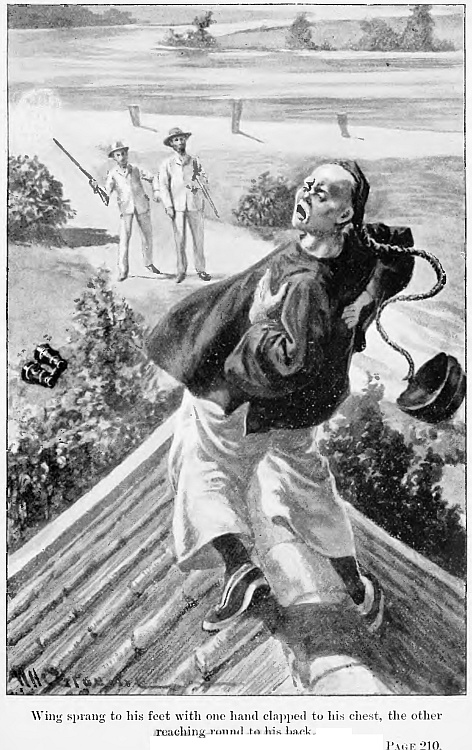
Stan Lynn had good reason to stare, for at the sharp report of the rifle poor Wing’s aspect of being a part of the gable disappeared instantly. He sprang to his feet with one hand clapped to his chest, the other reaching round to his back, both busily searching for his wound, as he uttered a dismal cry.
The next moment both hands were in the air clutching for something to hold on by so as to save himself, but clutching in vain. For his foot as he stood erect had slipped on the sharp slope of the tiled gable-end, and in far less time than it has taken to describe the catastrophe, the poor fellow had fallen upon his back and was sliding rapidly down.
But he had not quite lost his presence of mind. Making a tremendous effort he wrenched himself round so as to bring his chest underneath; and as he went on gliding down, Stan could see him striving hard to get a hold with his crooked fingers, which he vainly tried to drive in between the interstices of the tiles. They were too closely fitted, however, and it was not till he was three parts down that he was able to check his downward course.
“That’s right!” shouted Blunt hoarsely, for, though Stan strove to speak, no sound came from his parched lips. “Hold on; we’ll soon help you.”
Then, turning to the first of the men, whom the report of the rifle had brought rushing out to make for their posts to repel the imaginary attack:
“Run up, some of you, with a rope. Get up on to the roof-ridge and lower one of the men down to get hold of him.”
There was a rush back into the warehouse, but before half the men were inside, Wing’s weight had proved to be too much for his fragile hold. He slipped suddenly and glided down sideways till one foot caught beneath the eaves, and he made here a desperate effort to save himself, brought his other foot alongside the first, with his soft heels in the gutter, and then tried to turn over to plant his toes where his heels rested; but he only succeeded in dislodging them, so that he came down with his crooked fingers clutching in the hollow, and there he held on.
“That’s right; hold tight!” cried Blunt again. “Help coming.”
Stan would have added his voice could he have found utterance, but he could only think and stand half-paralysed at the sight of the poor fellow swinging by his crooked fingers to the frail gutter.
Had he remained perfectly still, it is possible that he might have hung till some one descended to him with a rope; but most probably the Chinaman felt his fingers giving way, and before they were dragged from their hold by his weight he made one more desperate effort to perform an impossibility. For, contracting his muscles, he slowly drew himself up by his arms till his chin was on a level with his hands, and meanwhile his toes were tearing at the wall to find a footing—trying, but finding not, for the soft boot-toes kept gliding over the wall beneath the eaves. Once by a desperate struggle he got what seemed to be a firm footing, but it was only to hasten the disaster, for all at once as those below gazed upward they saw that the poor fellow’s knees were close up to his chest, and he hung like a stout package by his arms. At the same moment there was an encouraging shout, and one of the most active of the clerks, bearing a coil of rope, and followed by several more, appeared on the ridge.
“That’s right,” roared Blunt. “Be smart! Let yourself be lowered down. Hold hard, Wing!”
His words were supplemented by a shout from below, where half the employees of the warehouse were assembled, all impotent to render any assistance to the unfortunate sentry.
Instantly following the shout, which sounded to Stan as if meant derisively, the end came, for, as suggested, Wing’s desperate effort only meant putting greater strain upon the fingers in the guttering, forcing them right off, so that he fell like a light bundle rapidly through the air fully thirty feet, and as he reached the bottom, passing out of sight behind the wall, but really to rebound about a couple of feet, and then lie all of a heap just inside the little bastion so lately made.
The dull thud which struck heavily upon Stan’s ears acted like magic. The moment before the lad had stood looking upward feeling quite paralysed. Then every nerve and muscle quivered, and, rifle in hand, he bounded to the bale wall, climbed over, and, wild with excitement, dashed to where poor Wing lay, to drop upon one knee by the sufferer, whom he fully expected to find lying dead.
The same thought was shared by those who followed the lad and climbed to the top of the wall, for directly after Blunt said hoarsely:
“Lift his head gently, Lynn. Is he dead?”
“No—not bit dead,” said the poor fellow in a plaintive voice as he slowly turned his face towards the questioner and opened his eyes. “Only velly bad indeed. Bloken all to bit. Poo’ Wing! I velly solly fo’ him.”
The removal of the painful tension suffered by the lookers-on was so sudden that to a man they broke out into a loud laugh. Not a mirthful-sounding explosion of mirth, for it was painful and hysterical. Every one had expected to hear Stan answer “Yes” to the manager’s question, while the supposed-to-be-dead man’s statement sounded inexpressibly droll, and his next words, in spite of a strong feeling of commiseration, only brought forth another burst that really was now one of merriment. For the poor fellow said piteously:
“Not’ing to laugh at. Wing velly, velly bad.”
“They don’t mean it,” whispered Stan, whose own face was still convulsed. “They laugh because they are so glad you are not killed.”
“Here, let me come,” cried Blunt. “I am a bit of a doctor in my way;” and he too bent down on one knee. “Now, Wing, my lad, cheer up. Let’s see what’s the matter with you.”
“Plea’ don’t touch, Misteh Blunt,” cried the poor fellow piteously. “Tumble down such long way. Come all to piecee.”
“No, no; not so bad as that. Come, come; I’ll be gentle with you. I want to see where you’re hurt before I have you lifted up.”
“No, no; plea’ don’t,” sobbed the poor fellow, with the tears running down his cheeks. “Not quite dead yet.”
“No, no; of course not.”
“Don’t let the boys buly me yet a bit. Velly dleadful; makee poo’ man flighten.”
“Bury you? Nonsense! Who’s going to bury a live man?”
“Only half alive. Oh deah! oh deah! Oh-h-h!”
“Come, come; be a man,” said Blunt gently as he softly raised the poor fellow’s head, manipulating it gently the while, and laying it down again. “Does that hurt very much?”
“N-no,” sighed the sufferer. “Not head bleak. All to piecee evely place, not head.”
“Then you’re not going to die, I hope,” said Blunt. “Your skull is not fractured, and the hinges of your neck are not broken.”
“You suah?”
“Quite sure, my lad. You wouldn’t be talking like that if your neck was broken.”
“P’l’aps not,” sighed Wing. “Bleak to bit evelywheh, no alm, no leg. Oh deah! oh deah!”
“Now then, I want to lay you out straight so as to feel your body all over.”
“Lay stlaight?” cried the poor fellow, with more animation. “Leady to buly poo’ Wing?”
“Nonsense!” cried Stan warmly. “No one thinks of such a thing. Let me lay that arm close beside you.”
“No, no,” sighed the poor fellow. “Wing don’t wantee see aim come off.”
“It won’t come off, my man,” said Blunt kindly.—“That’s right, Lynn. Well done! It’s not broken. Neither is this,” he continued as, with the patient still groaning, the other arm was tenderly examined and laid straight.—“Hurt you very much, Wing?”
“Not velly much. Bloken off. Wing can’t feel.”
Stan glanced at Blunt, and saw him frown and look more stern as he met his companion’s eyes to exchange a look full of intelligence.
“Now his legs,” said Blunt then. “Both together. Lay them out straight.”
This was done, Wing groaning softly the while.
“Bones all right,” said Blunt half to himself; “joints move easily—no dislocation. That hurt you very much, Wing?”
“N-no. Hultee evelywheh else.”
“Does that mean the spine is injured?” whispered Stan anxiously.
“I’m afraid so,” was the reply.
Wing looked sharply from one to the other.
“Young Lynn say bote leg bloke light off?”
“No,” said Blunt, smiling; “he didn’t say anything of the kind. They’re quite sound. Now then, I will not hurt you much. I’m going to feel whether your ribs are broken.”
“No, no; much betteh let be. All bloke littlee bit.”
“I don’t think so,” said Blunt, passing his hands softly down the man’s sides over and over again from armpits to hips. “Now breathe, Wing.”
“Wing keep on bleathe lil bit longeh. Not dead yet.”
“‘Not dead yet: see the Quiver,’” said Blunt softly to himself, as, incongruously enough, there came to his mind the words on one of the great bills which appeared upon nearly all the hoardings in London many years ago.
“Breathe again, Wing,” continued Blunt. “Draw in as long a breath as you can.—Well, do you hear me?”
“Wing ’flaid,” was the reply.
“Afraid? What of?”
“’Flaid nevah bleathe again; so bad.”
“Stuff! Do as I tell you.”
“Oh deah! oh deah!” sighed the poor fellow as he obeyed, and retained his breath for some time.
“Well, does that hurt you very much?”
“N-no, n-no,” sobbed the man. “Not velly much.”
“Then there are no broken ribs, Lynn. Look here.”
As he spoke Blunt passed his hands firmly about the sufferer’s chest, even going so far as to press the ribs inward, without eliciting more than a faint groan.
“There!” said Blunt; “nothing is broken. The injury must be to the back.”
“Yes,” said Wing, uttering a whimper. “Back. Velly, velly bad.”
“Come, let’s see,” said Blunt. “We’ll have you carried into the big office now, and knock you up a bed of some kind. Give me your hand.—Take the other, Lynn, and let’s raise him up into a sitting posture. Gently, mind.”
“No, no; plea’, plea’ don’t!”
“Why not?” said Blunt, who was watching the man keenly.
“Back bloke. Come in two bit. Bleak light off. Leave poo’ Wing leg lie all alone.”
“Well, well!” said Blunt gently; “never mind; be a man. If you come right in two we’ll fasten you up tightly again with sticking-plaster. You’ll soon grow together again.”
“Eh?” exclaimed Wing, looking sharply from one to the other, but looking in vain, for Stan took his cue from his companion and preserved a perfectly serious countenance.
“Now,” said Blunt; “both together. Lift.”
Wing uttered a louder groan than ever as he was drawn right up into a sitting posture and lowered down again.
“Did that hurt much?”
“Oh, velly, velly much!” said Wing, with the tears trickling down his plump face.
“Yes, you are a good deal shaken, Wing, my man, but you are not broken in half.”
“Misteh Blunt suah?”
“Yes, quite,” replied Blunt. “You have had a wonderful escape from being killed. You are hurt, of course, but I believe that if you were helped you could stand right up.”
“Wing velly much ’flaid.”
“I suppose so, but you are going to try.”
“Must?”
“Yes, you must.—Now, Lynn, take one side; I’ll take the other.—Come, Wing; just for a minute. Up with you like a man.”
Wing gave each a piteous look, but said nothing, as he was again raised into a sitting position, and then allowed his arms to be drawn over his helpers’ shoulders as they bent down over him and rose together, brought him up standing, and held him there.
“Now then, you can feel that you are not broken to bits, Wing?” said Blunt.
“Yes; but hult velly bad.”
“Of course it hurt, Wing; but you’ll soon get better.”
“Get betteh? No go die and be bulied?”
“You’ll not die and be buried this time.—Do you see what saved him, Lynn?”
“Yes—of course. I see now. He must have come down upon those piled-up silk-bales.”
“To be sure; and they are so yielding and springy that they threw him off again so that he fell on to the stones inside.”
“Yes,” said Wing piteously; “tumblee all togetheh. Come bump, bump on silk-bales. Flow um off again on to stones and bang back dleadful bad.”
“Yes; a very narrow escape for you,” said Blunt firmly.—“Bring a board here, some of you.”
Two of the coolies hurried off, to return in the fast-increasing gloom with a broad plank, which was set down and Wing then lifted carefully upon it, bearing the moving very well, and only uttering a groan or two.
“Now carry him into the office.—We’ll make that the hospital, Lynn.”
“’Top littlee! ’Top littlee!” cried Wing.
“What’s the matter?” said Blunt sharply, speaking as if he felt that he had spent enough time on his patient.
“Wing wantee say much ’blige, t’ank you. Um feel deal betteh now.”
“That’s right,” said Blunt.
“Wing velly much ’flaid when he fall. Much mo’ ’flaid when come down bump, bang on stones. Misteh Blunt, young Lynn, makee feel velly happy. Not bloke all bits. Going to live long time.”
“That’s right,” said Blunt brusquely. “But look here; all your trouble came from your going to sleep when you were on sentry.”
“Yes,” said Wing dolefully. “Velly muchee solly. Sun hot—velly hungly—velly dly mouth. Can’t help go ’sleep. Misteh velly angly poo’ Chinaman?”
“Not very, Wing, for you have been severely punished.”
“Wing nevah do so no mo’e.”
“That’s right,” said Blunt, who hurried away as soon as he had seen the injured man lying comfortably; and Stan was about to follow, but Wing caught his sleeve and signed to him to bend down.
“Young Lynn know who shot Wing?” he whispered.
“Yes,” said the lad frankly.
“Young Lynn tell Wing.”
“Yes, some day,” replied the lad, who felt the blood flush to his face, but it was now so dark in the office with the blocked-up windows and the coming night that the questioner could not see.
“Young Lynn tell Wing some day. Wing betteh now. Thought bloken allee piecee. Not bloken allee piecee. Don’t ca’e mandalin button now.”
“That’s right,” said Stan. “Look, they’re bringing you some bread and tea. Think you can eat and drink?”
“Velly much indeed,” said the Chinaman.
“Begin at once, then,” said Stan. “Here, I must go.”
He hurried after Blunt, and as he went to where the latter was standing sweeping the dimly seen surroundings with his glass, it suddenly occurred to him that after firing the shot to startle Wing he had not replaced the empty cartridge.
He opened the breech, and at the sound of its being closed upon the cartridge Blunt turned upon him suddenly.
“Hullo, young fellow!” he cried. “Going to fire again to startle me?”
“No,” replied Stan. “I was thinking that I might have to shoot again, and it would not do to find that my rifle was not loaded.”
“No,” said Blunt thoughtfully. “I’m sorry, though, that I gave you that order. For a time I was quite under the impression that you had aimed at and hit the poor fellow. But he’ll soon be right again.”
“I hope so,” said Stan. “Can you see anything with the glass?”
“Just the dim country, that’s all. There! we’ll set our sentries and let all who can be spared lie down for a rest till we change guard, for we must be military now. I shall take the first part of the night for visiting the posts every hour; you will have to take the second half. Mind, you will have to visit each sentinel and see that he is awake and watchful. You understand?”
“Quite,” was the reply, given in a firm voice, though the lad could not help shrinking a little from the great responsibility about to be placed upon his shoulders.
“Come along, then.”
Stan followed, and a short time after half-a-dozen sentries were leaning upon their rifles in different places, keeping a strict watch upon the river, the direction from which danger was most likely to come; while, his part of the duties performed, the lad went to lie down on the bare boards in the office, near to where Wing was sleeping soundly. As he listened to the man’s hard breathing a feeling of envy came over him. He wished that he too could sleep and forget the danger, if only for an hour. He was completely fagged with the day’s exertions; the heat was great, and his brain was in a state of wild activity which made him feel that he had never been so wakeful before in his life.
All was very still without, and as he turned upon the hard boards it seemed that every one must have gone off to sleep at once, while he was growing more and more wakeful. Now and then he started up on one arm to listen to a strange cry that suggested the approach of the enemy; but after two or three repetitions he came to the conclusion that it must have come from some riverside bunting, heron, or crane, and he lay down again, but only to ask himself whether he might not just as well get up and join Blunt, to share the night-watch, for he was more sure than ever that it was impossible to sleep under such circumstances as these.
“Yes,” he said to himself, with a feeling of satisfaction, “I’ll do that;” and it seemed to him that he got up to go and join the manager out on the dark wharf, where he could see him standing on a pile of stones close to the river-edge, leaning upon his rifle and gazing up-stream for the first sight of the enemy who might at any moment come.
Blunt turned upon him at once in the darkness, looked down, stretched out one hand and caught him by the shoulder, to say in a sharp whisper:
“Now then, my lad, time’s up!”
Chapter Twenty Three.
“Am I going mad?”
Stan made no reply, but stared straight up at him, to feel the grasp upon his shoulder tighten, while Blunt said again: “Now then, my lad, time’s up!”
But this time there was an addition—“Do you hear?”
“Yes—of course,” whispered back the lad; “but I don’t know what you mean. What time’s up?”
“Why, your time. Hang it all! You take it pretty coolly, when at any moment some hundreds of savage cut-throats may be down upon us. I couldn’t have slept like that.”
“Like what?” said Stan sharply.
“In the way you have done.”
“I? I’ve not been asleep.”
“Oh, haven’t you? Why, you’re asleep now.”
“If I’d been asleep, how—Oh, what nonsense! If I was asleep, how could I have come out here to keep you company?”
“What!” cried Blunt, with a soft, chuckling laugh. “Well, you are a rum fellow! Do you know where you are?”
“Yes; standing out here on the wharf, with the river flowing softly down at our feet.”
“Stoop down and put your hand in it, then.”
Stan stretched out his right hand at once, and felt the rough boards, while at the same moment Wing drew one of those deep breaths which are so like snores.
The next moment Stan was sitting up feeling for his rifle.
“Here, I say, I haven’t been asleep?”
“Of course not. You said you hadn’t, and I can’t doubt the word of a gentleman.”
“Oh, how stupid!” said Stan in a hoarse whisper, as he felt his rifle, and sprang up at once. “What time is it?”
“Just struck two by the American clock in the big warehouse.”
“Then I have been asleep.”
“I think it’s very likely,” said Blunt dryly.
“Then I must have been dreaming that I came out to you on the wharf because I couldn’t sleep.”
“And instead of your coming to me, my lad, I came to you. There! come along outside in the cool air; that will wake you up thoroughly; and I want to give you a few instructions and then lie down for an hour or two to get a little rest before the enemy come in the morning.”
“Then you think they will come?”
“Most likely,” said Blunt dryly. “Come along.”
Stan was wide enough awake now, and proved it as soon as they were out on the wharf, where a pleasantly fresh breeze came off the water.
“Did you visit all the six posts?” he said.
“Yes, every one.”
“Regularly?”
“Of course.”
“Find any one asleep?”
“No; everybody was keenly on the watch.”
“How did you know when the hours were up?”
“Guessed it,” said Blunt quickly. “Are you wide awake enough now, my lad? You know where all the men are stationed?”
“Oh yes.”
“Repeat the places.”
Stan ran rapidly through the posts—east, west, north, south, back and front—and Blunt grunted his satisfaction.
“Good!” he said. “The fresh men have relieved those who watched with me, and there is a new password. Don’t forget it. As soon as you approach you’ll be challenged with ‘Who goes there?’”
“Yes; I understand,” said Stan eagerly.
“No, you don’t. What word will you give to prove that you are a friend?”
“Don’t know.”
“Of course not. Remember it, then. ‘Cartridge.’ Understand?”
“Yes, perfectly.”
“Then I’m off. I’m dead-beat, my lad. Every hour, mind, as near as you can guess. Take hold of my whistle, and keep a sharp lookout up the river from where I did.”
“What! from up on that pile of stones at the edge of the wharf?”
“Eh?” said Blunt sharply. “How did you know I watched from that heap of stones at the edge of the wharf?”
“I saw you there.”
“What! When did you come?”
Stan was silent, feeling quite confused,
“Did you come and look at me before you went to sleep?”
“No,” said Stan slowly—“no; I’m sure now that I did not.”
“But you said you saw me there, and I never told you nor any one else that I was going to make that my post of observation.”
“You didn’t tell me,” said Stan; “and it seems very strange. I thought I came out to you and you caught me by the shoulder.”
“You did not, and I did not catch you by the shoulder till I came and shook you to wake you up.”
“Then I must have dreamed it,” said Stan, “for I certainly seemed to see you there in the darkness.”
“Yes, you must have dreamed it; but it seems very strange.”
“Horribly,” said Stan.
“Don’t you get dreaming any more of that sort of stuff, then,” said Blunt shortly. “Here, catch hold of this whistle; but mind, you are not to use it unless the enemy come in sight. Then blow as if you wanted to bring the place down. Pleasant watch to you. I’m off. If I don’t go and lie down I shall fall down and sleep on these stones.”
“Good rest to you,” said Stan quietly. “One moment: where are you going to lie down?”
“On the planks that formed your bed. They’re nice and soft now, I suppose.”
“No; horribly hard. Put some bags under you.”
“Not I,” said Blunt gruffly. “I could sleep now on a row of spikes. Good-night—morning, or whatever it is.”
The manager walked quickly to the nearest opening in the wall of chests and passed through it, leaving Stan to his watch, which he commenced by giving a good searching look up river and down, and then placing his hand behind his ear to listen, before, feeling satisfied that all was right, he stepped to the bottom of the piled-up block of stones, mounted it carefully, rested the butt of his rifle at his feet, felt whether his revolver was within easy reach of his hand, and then began to think about his dream and the strangeness of his imagining that he had walked out to get to the wharf and had then seen his brother-officer, as Blunt seemed to have become now, standing exactly where he had taken his own place.
“All imagination,” he said to himself at last, for he could make nothing else of it, and forcing himself to think of something fresh, he began to peer into the darkness in every direction, and long for his first hour to pass so that he could have something more active to employ his time and go and visit the different posts.
“Let me see,” he mused; “they will challenge me by saying, ‘Who goes there?’ and I shall answer, ‘Stranger, quickly tell’—Nonsense! ‘A friend.’ No, no; that’s wrong. What did Mr Blunt tell me to say? Why, I’ve forgotten the word. I remember that he told me something, but it seems to have gone right out of my head. How stupid, to be sure! I couldn’t have been half-awake after all.
“What shall I do?” thought Stan again, after striving vainly to recall the word. “I must go and ask him again, and that means waking him up. Why, he’ll call me an idiot. I know; I’ll go to the nearest sentry and ask him.”
The lad stopped short in his musings, for a cold chill ran through him at the thought of the risk he would have to run—the idea of the risk coming to his brain with the thought:
“Why, if I can’t give the answer just when he challenges me, he’ll fire and send a bullet through my head.”
The more the lad thought and strove to recall the password, the more confused his brain seemed to grow. Hundreds of words flowed through, but not one which suggested that which was correct. Time, too, was gliding steadily on, and in imagination he felt that he must be getting very near the end of the hour when his duty would lead him to the first post—for what? He felt ready to groan as he told himself that it was to be shot at.
“Whatever shall I do?” he said at last, when he stood on the stone pile fully believing that the time was past, and that if he did not visit the posts the sentries would grow uneasy and give some alarm, the result of which would be that Blunt would wake up; and how could he meet him after being guilty of such a contemptible lapse of duty?
“He’ll look upon me as a complete idiot,” thought the lad; “just, too, when I was trying so hard to behave in a manly way, and making him begin to believe in me. It’s dreadful; it’s horrible! Am I going mad?”
In utter despair, Stan let his rifle-barrel sink into the crook of his left arm, and turning his hands into a binocular, gave a long, careful look up the river, half-expecting to see some tall-sailed junk dropping quietly down the stream. In his excitement he turned trees into masts, and projections from the banks and a solitary long low hut into vessels; but after further inspection he was bound to believe that there was no sign of danger, and at last, with a sigh of weariness, he sank down into a sitting position, with his legs hanging over the side of the pile and his rifle across his knees, to make one more desperate effort to recall the password from the black depths of his brain into which it seemed to have sunk down.
But all his efforts were in vain; his head seemed to grow more and more dense, and he felt that he must rouse himself and run all risks. He determined to walk towards the first sentry, and the moment he was challenged in the darkness call out loudly who he was and say frankly that he had forgotten the password.
“The sentry will think I’m half-mad, and I believe I am. It’s the excitement, I suppose, and the risk and dread. I never felt anything like it before. It’s dreadful. Yes, it is the excitement.”
But he did not give the true cause, for he did not grasp the position—to wit, that it was due to brain weariness from the overstrain of thought and want of proper rest. For if, when his inability was at its worst, he had been able to lie down and sleep soundly for a few hours, he would have wakened up with his mind perfectly clear and the missing word ready to come quite readily.
“There! it is of no use,” he said to himself at last; “the time must have gone by ever so long ago. I must get up and go. It’s very risky, but I am bound to risk everything so as to do my duty. Here goes; and if I am shot at, I am shot at. It’s a hundred to one that the sentry couldn’t hit me in the darkness, hurry, and confusion, and before he could reload and fire again I might rush up to him and explain. Oh, horrible, to have to tell the fellow what a weak-minded muff I am!”
Grown perfectly desperate now, as he felt the minutes seem to gallop away, Stan took up his rifle, rose to his feet once more, and descended to the level of the wharf, perplexed by another thought which had come to torment him.
“He’ll fire at me, of course,” he said, “and I must run in before he can reload, as I said; but what about his revolver? Well, I can’t help it,” he muttered; “I must risk it. And perhaps I can make him understand before he can draw the pistol out of the holster.”
Drawing a deep breath, he nerved himself for the encounter, and began to walk steadily for the corner where the first sentry was stationed, and in the effort of action felt stronger and firmer.
“I may find him asleep,” he thought, “and pounce upon him before he wakes up to challenge.
“Not likely. Our men here are not like poor Wing; but—Ah! that’s possible,” he said to himself excitedly. “I forgot to do so; why shouldn’t he have done the same? He may not have loaded, and if he has forgotten to slip in a cartridge—Oh! Think of that!” he cried half-aloud, for the missing word had come.
Just in the nick of time, too, for the lad’s ejaculation had been heard, and in an instant the challenge came out of the darkness:
“Who goes there?”
“‘Cartridge,’” said Stan promptly; and the next moment he was conversing with the first sentry, feeling as if a tremendous load had been taken off his mind.
The man had nothing whatever to report, and Stan went on towards the next.
“Mustn’t let that cartridge go off again,” he said to himself, with a little laugh. “How stupid it seems now! Cartridge—cartridge! How could I have forgotten it like that?”
There was nothing to report at either of the other posts, and Stan returned to his old station, feeling calm and refreshed, to pass the rest of the hours, which did not prove weary, though there was nothing more exciting than the occasional cry of a bird, a rustling of wings overhead, and now and then a splash in the river which suggested the possibility of part of a night spent in a boat with fishing-rod and line. He found himself wondering what Chinese river fish would be like, and whether they bore much resemblance to those of Old England—thoughts which brought up memories of days spent by pond and lake in school excursions.
But whenever the lad’s ideas wandered off like this, they were brought up short again by the stern aspect of the present, and he felt ready to blame himself for letting his thoughts go astray when possibly a terrible fate might be awaiting them all, and he was bound to keep his attention fixed upon the broad stream in front.
Fortunately it was a beautiful night, and before the watcher could think it possible the stars grew faint, a long, pale, soft line of light began to appear in the east, and soon after as it broadened there was a twittering and whistling in the belt of reeds across the river where all was rural, half-woody, half-cultivated land, with waving corn and sugar-grass. Then a loud flapping and splashing began in the river, whose farther side proved to be a perfect colony of ducks; while after a time the trees, which had during the night been visible only where seen against the lighter parts of the horizon, grew plainer and plainer, till they gradually showed in their natural green. For high up orange flecks were appearing, and before long, as Stan watched, it seemed impossible that anything horrible could be on the way, so grand was the transformation taking place from night to a glorious day.
“Poor old Wing must have taken fright at nothing at all,” said Stan to himself; and with the terrors of the night seeming to have passed away like a dream, he visited his posts and chatted with the men, joining in the general anxiety whose subject was common to all—namely, how long would it be to breakfast, and would a good, hearty one be spread?
In due time the party were relieved by a couple of men who were sent up with glasses to the roof of the warehouse, after being duly cautioned not to meet with such a fate as that of poor Wing; and as soon as they were stationed Blunt made his appearance, looking eager, refreshed, and ready for anything that might come.
He greeted Stan warmly, and they went together to see how Wing was, the injured man having been fast asleep when Blunt arose.
“Well,” said the latter, as they found him now awake, “how are the broken pieces?”
“Allee quite wellee,” said the man, with a broad smile. “Wing going get up to bleakfas’.”
“That’s good news,” said Stan. “Shall I help you?”
“Help? No; Wing get up all ’lone.”
He tried to rise as he spoke, smiling the while, but his whole aspect changed, his face wrinkling up like that of an old man, as he sank back groaning with pain.
“Muchee achee all oveh,” he said piteously. “T’ink all bleaky af’ all.”
“Oh no,” said Blunt, smiling. “You’re stiff and bruised, and naturally you’ll feel pain as soon as you move; but do you know what you’ve done, sir?”
“Yes; fallee down. Almos’ bleak all to piecee.”
“No, no; I mean, giving us all such a scare. Where are your Chinese pirates?”
“Allee up livah. Long way.”
“Yes; and a very long way, too. They won’t come to attack us.”
“You t’inkee?” said Wing softly. “Ah! you wait lil bit, you see. Wing see velly hollible t’ing. Pilate fight, kill. Suah come soon.”
“Why are you sure?” said Blunt quickly.
“Pilate in junk. Come flom up livah. Mus’ come pas’ Lynn Blothee hong. No othey way.”
“Unless they go back,” said Blunt. “Well, we shall soon see. Can you eat some breakfast?”
“Wing velly ’ungly, sah. Quite empty. No eat nothing allee day yes’day.”
“Hungry—eh? That’s a capital sign. Well, you lie still for a day or two, and your stiffness and pain will soon go off.”
“No wantee Wing come fightee?”
“No; we can kill all the pirates who are likely to come.”
Wing smiled very feebly, and then winced, for in making a deprecating movement with his hands he brought bruised muscles of his back into play, giving himself an agonising pain.
“That’s his conscience pricking him for deceiving us about the attack, Lynn,” said Blunt dryly. “There! let’s see if this coffee is hot.—You, Wing; we’ll send you something to eat. And you understand, you are to lie still. Oh, here comes some one to say breakfast’s ready. I told them to set it in the long store.”
For as he was addressing Wing one of the Chinese servants hurried in to say that all was waiting.
“We must drop ceremony now, Lynn, and feed together, coolies and all. Be thankful to get anything at all under the circumstances. It isn’t a scare. The enemy are on the way.”
“What! you’ve seen them?”
“No; but I’ve seen that Wing’s tale is true, for not a boat has come down here with provisions this morning. Things are all wrong up-river or we should have had boats with vegetables, fruit, fish, poultry, butter, milk, and bread, while now—”
Bang!
Chapter Twenty Four.
“Dutch Courage.”
It was the report of a rifle in the clear morning air, fired from the warehouse gable occupied by the two lookout men.
“The pilates!” shouted Wing exultantly.
“It’s our breakfast knocked over, Lynn,” cried Blunt. “Come along, lad.”
He led the way out at the double, and the next minute was hailing the men on the roof.
“See them coming?” he shouted, with his hand to the side of his mouth.
“Yes, sir; half-a-dozen big junks yonder, right across the land there, in the second great bend of the river, I think.”
“Miles away, then?”
“Yes, sir; four or five.”
“Then the wind will be sometimes with them, sometimes against. That’s good news, Lynn; we shall be able to have our breakfast in peace, and digest it in war. Come along in.”
“Oh, I couldn’t eat now!” cried Stan excitedly, for his heart was giving big thumps as he gazed right away overland towards where the river curved round the end of a mountain-spur.
“I thought you meant to help us to beat the enemy off.”
“Of course I do,” cried Stan.
“Well, a steam-engine won’t work without coal, and a human being can’t fight unless you feed him. Come! no nonsense. All our preparations were made yesterday, so we’ve nothing to do but man our works.”
“So as to be ready?” panted Stan, whose breath came short from excitement.
“We don’t want to be ready two hours too soon, and tire the men out with anxious watching before the enemy come near. We’re going to have a regular good hearty meal to put strength and courage into us.”
“Dutch courage,” said Stan rather contemptuously.
“Can’t be Dutch courage, because we are all English who are not Chinese. But that’s a stupid old expression, my lad, meaning, of course, that the Dutch are cowardly. Now, I don’t know much about history, but whenever I’ve read anything about the Dutch in war, it has gone to prove that the Hollanders are a thoroughly sturdy, brave, and obstinate set of men. There! don’t get in a nervous state of flurry; it will spoil your shooting, and I shall want you to fire steadily and well. Why, you don’t want to go into action with your veins jumping and your nerves all of a slack quiver.”
“Of course not,” said Stan huskily.
“That’s right. You want every string screwed up tight and in the best of tune, so that you can play an air that will make the savage scoundrels dance a figure that is quite new to them. Eh?”
“Yes, that’s what I want to do,” said Stan; “but—”
“Never mind the butting; leave that to the pirates. Let them come and butt their heads against our wharf. Here, I’m captain of the good ship Lynn Brothers, and you’re only lieutenant, so obey orders.—It’s all right, gentlemen,” he continued coolly and pleasantly the next moment to the little crowd of his people who had hurried out and were waiting for their orders; “the enemy are coming, just when it seemed as if, after all our preparations, they had got wind of what was waiting for them and had made up their minds to disappoint us.”
He was interrupted here by a loud cheer, in which the Chinese employees joined with a peculiar yell, which did not improve the heartiness of the cheer, but gave it a fierce, rasping, savage tone.
But it evidently meant business, all the same, and altogether seemed to thrill Stan from top to toe and make him feel, as he put it to himself, in better heart.
“That sounds right,” said Blunt as the cheers died out into what was a series of vocal Chinese exclamations. “Now listen; we’ve got a sharp fight before us, in which we are going to show those savage scoundrels that they have made the greatest mistake they ever made in their lives.”
There was another cheer at this, one in which Stan found himself joining and waving his cap, just as if it were at home and the cheering had something to do with a football victory.
“Now,” continued Blunt, “I reckon that we have two hours of waiting to do before the music begins to play, so we’ll spend part of the time in enjoying the breakfast I have ordered to be ready for every one here. In the name, then, of our employers’ son and nephew, I ask you to come and breakfast with him—all but you two gentlemen up yonder. You must stay and continue your lookout, but my Chinese servants will bring you up all you want.”
There was another cheer at this—one that threatened to be terribly prolonged—but Blunt held up his hand.
“That will do for the present; keep the rest of the shouts till we have driven off the enemy. Now then, pile arms and file in to breakfast. No ceremony; we must all be equal over this meal, as we shall be when we are fighting the enemy.”
“Yes, sir! Yes, sir!” came in chorus, and the men began to flock in.
“Stop a minute,” cried Stan excitedly, catching at his captain’s arm.
“What is it?”
“The men on the roof want to say something.”
“Do they?—Ahoy, there! What is it?”
“Can’t we have a big bamboo up here, sir?” said the clerk who had been waiting to speak.
“A big bamboo?” cried Blunt. “Do you want to bastinado your comrade?”
“No, no, sir. One of the biggest down yonder in the yard. If you sent us up a rope, sir, we could haul the great pole up and lash it to this chimney-stack. We feel as if we ought to have a Union-jack hoisted up here.”
“Why, of course,” cried Stan excitedly.
“Yes—of course,” cried Blunt. “I’m glad you mentioned it. I never thought of that. But there’s plenty of time. Breakfast first, and the flag afterwards. Come along, Lynn.”
“Oh, don’t—pray don’t take things so coolly,” whispered Stan as they climbed in over the tea-chest wall.
“Why not? We must be cool, my lad, if we wish to win.”
“Yes; I suppose so. But hadn’t we better get the flag up first, and then it will be done?”
“No,” said Blunt shortly. “I’m not going to do anything till all our men have had a good meal. I’m not going to drive my team till every horse has had his corn, so in with you.”
“I suppose he’s right,” thought Stan; “but I couldn’t take matters like that with the enemy coming slowly and surely on.”
Right or wrong, Blunt took the head of the table, and made ready for Stan to sit on his right. Directly after the rattle of knives and forks began, the Chinese servants placed great steaming mugs of coffee at every man’s side, and the thick slices of bread-and-butter which kept coming in relays seemed to melt off the dishes as if they were a confection of ice, while the tall coffee-urns ran more and more dry, till there was a general falling-off in the demands for more, and the manager’s stores had shrunk to the lowest ebb.
“Now then,” he cried suddenly, rising and beating the side of his coffee-mug with a spoon, “there’s plenty of time, so file off quietly; but every man will now take his place. All of you remember this, however—that Mr Lynn and I want prudence, not rashness. When the firing begins every man is to make as much use as he can of his shelter. Some of us must be hit, but the fewer the better.”
There was a cheer at this.
“No more cheering,” cried Blunt firmly. “This is business, not pleasure. Now, one more thing I want you all to remember. When you aim at a man and draw trigger, it is not for the sake of making a noise, but for every one to prove his marksmanship and get rid of one enemy. That is all; now in silence, please, every man to his appointed station.”
The men, Europeans and Asiatics, filed out quietly, each man taking his rifle from where he had leaned it against the wall, and Stan turned to Blunt’s chief servant.
“Have you taken breakfast to Mr Wing?” he said.
The man smiled and nodded.
“Did he eat it?”
“Yes; eat and dlink muchee,” replied the man, with a broad smile, just as Blunt turned to the lad.
“I’ve got a flag about as big as a moderate tablecloth,” he said. “We’ll send that up to the roof by one of the stoutest Chinamen, along with a rope. Come and let us make two of the others pick out a large bamboo.”
This was all quickly done. The rope was lowered from where the two sentries and the sturdy picked Chinaman were standing by the chimney-stack, and directly after a stout twenty-foot pole was made fast, hauled up, and the flag secured to the end; and as there were no halyards attached, it was raised against the chimney-stack and secured by the big Chinaman, the rope having been cut in half so as to lash the bamboo in two places, and wedges driven in afterwards to tighten the rope to the greatest extent.
Another cheer which arose was not checked, for it was when the light morning breeze made the folds open out to float well over the centre of the big building, even Blunt and Stan joining in the salute of the flag whose united crosses seemed to promise victory for the brave defenders of the solitary hong.
“That’s a good job done, Lynn,” said Blunt; “and I’m very glad it was suggested. The men will fight all the better for it. I almost feel as if I shall.”
“Yes; it seems to put courage and confidence into one,” said the lad warmly; and then he coloured a little, for it seemed to him just then, as he met his leader’s eye, that Blunt was watching in a curiously inquiring way, looking, Stan thought, as if he felt a good deal of doubt as to how the lad was going to behave.
And all this time the great junks came slowly and steadily on, growing more and more distinct from the defences, but still seeming as if they were sailing right through the waving fields of growing grain.
Blunt had his glass in hand now where he stood in the little bale-made bastion, and after a good look he handed it to his companion.
“Have a good squint, my lad,” he said. “I make it that it will be quite half-an-hour before the leading junk comes round the bend into the straight part of the river, and even then it will take another half-hour before they have run down to us.”
“Yes; I can see the matting sails very clearly now,” said Stan after a good look, “but the hulls are quite hidden by the fields.”
“Yes, and will be till they reach the straight reach of the river. But I expect they are all crammed with men. How many junks can you make out?”
“Six,” said Stan.
“Yes, that is what I saw. Now let us have a quiet walk round amongst the men and see if anything is needed to better the defence.”
Stan followed his leader, whose first examination was of the two doorways through which the defenders must pass when they gave up or were driven from their fragile wall.
Everything was as it should be; the doors were wide-open, but ready for closing, and half-a-dozen short, stout pieces of plank were standing in sight, waiting for placing and securing inside the door after it was closed. Even the holes were made ready for the insertion of big screws instead of nails, and all was in charge of two Chinese carpenters, with assistants ready to hold the plank while it was being screwed tightly to the door-posts.
Both doors were in the same state of preparation, and Blunt nodded his satisfaction.
“Capital,” he cried.
“If the men are not scared away by a rush of the enemy,” said Stan thoughtfully.
“That we must chance,” said Blunt. “But I do not think we shall be troubled that way, for the men who are retiring from the wall must keep the enemy in check. I propose being at the farther door: do you feel as if you could stand your ground with some of the men to hold this door till all is safe?”
“I haven’t much confidence in myself,” said Stan rather excitedly, “but I will try my best.”
“You can’t do better,” replied Blunt quietly.
“You see, I am not a man,” added Stan.
“No, not in years; but you can try to act like one.”
“Yes, I’ll do that,” said Stan.
“And here’s a bit of encouragement for you. I shall have four of our best fellows at each of the windows over these two doors. They’ll keep up such a rifle-rattle as is bound to check the Chinamen for a bit, besides which the men with you will keep on shooting till the last board is in its place.”
“And what about fire?”
“Ah! that’s the weak spot, my lad,” said Blunt, with a sigh. “They may not think of burning us out, but if they do—well, we have our supply of water and the buckets all ready. We can do no more. If they do start a blaze we must put it out. That is all that need be said: must put it out; and we will.”
A look round on the first floor showed everything ready for the defence that could be devised, and after inspecting this, with the open windows and breastworks ready for firing over, Blunt descended with his young lieutenant to inspect the cartridge supplies, one of the most trusted clerks being in charge of these. And then, to Stan’s intense satisfaction, for he had long been all of a fret, Blunt led the way out to the wharf, where the lad started in wonder, if not in alarm, to see the progress the junks had made: for there they were, six in all, well in the strait, and sailing steadily down like gigantic, great-eyed water-dragons making for the victims it was their mission to destroy.
For clearly enough now, as they were seen end-on by the watchers, each displayed on either bow a huge, grotesque, but cleverly painted eye, giving them the aspect of fabled monsters of the deep which had risen to the surface in search of prey, and were now leering with malicious satisfaction as they glided on.
Chapter Twenty Five.
“Kill allee Pilate.”
“This will be your station, Lynn,” said Blunt as they passed along inside the thickest wall till they reached the bale bastion, where the manager halted. “You take that wide loophole shelter yourself at the side; there’s a capital place for resting your rifle, and with such a steady support, and as you will be able to cover so wide a sweep of the enemy’s advance, I shall expect you to make a good score.”
“A good score!” said Stan in a tone of voice full of disgust. “Any one would think I was going to shoot at a target.”
“At a good many targets,” said Blunt.
“Yes, human beings. You don’t really mean to say you want me to kill as many of those unfortunate wretches as I can?”
“Unfortunate? They haven’t proved to be unfortunate until they are badly beaten. Yes, that is what I mean. I want you to kill or disable every one of the enemy at whom you can get a shot.”
“And do you think I could be so bloodthirsty?”
“I think you know us all pretty well here, and would be sorry to see us cut to pieces by a set of savages who are coming down in full force to the attack.”
“Cut to pieces!” said Stan contemptuously.
“Yes,” continued Blunt sternly; “cut to pieces—literally. I am making use of no high-flown figure of speech. I know from what I have heard and seen that these piratical Chinamen, after shooting down the people they attack, finish by spearing or beheading every fallen man; and then the braves, as they call themselves, go round with their big razor-edged swords and hack their victims to pieces.”
“Ugh!” ejaculated Stan, with a shudder of horror.
“I think you will see that it is better for you to help us to the best of your ability with your rifle and bring down as many as possible. Mercy is a fine thing, and I dare say I should be content with taking a man prisoner who dropped upon his knees and threw down his arms; but Chinese pirates neither drop upon their knees nor throw down their arms. Now look here, my lad; you are young and naturally shrink from shedding blood, but this is no time for being squeamish. You are not going to fight against ordinary human beings, but against a set of fiends who live by robbery and the murder of their victims—men, women, and innocent children.”
Stan was silent for a few moments, and in that short period his face grew so lined that he looked years older.
“Is this perfectly true, Mr Blunt?” he said at last in a husky voice that did not sound like his own.
“On my word as a man who is about to stand up and face death, and may before an hour is over be lying on his back with his dead eyes gazing straight up beyond the clouds. You hear me?”
“Yes,” said Stan firmly.
“And you’ll do your best for the sake of those who would be ready to encourage you if they were here, for our sake, and for your own?”
“Yes, I’m quite ready now,” replied Stan firmly.
“That’s right. Then shake hands, my lad.”
“What for?” asked Stan.
“Because,” was the reply, given in a grave, solemn tone, “we may never have the chance again.”
“You think it is as bad as that?”
“Quite,” was the reply as hand pressed hand. “There! we shall be at it soon, and I’m sorry, Lynn. When you first came I thought I should always detest you as a young meddler sent here to be in my way.”
“But you don’t think so now?” said Stan, smiling.
“Quite the contrary, my lad. There! we’ve talked enough. Only one word or so more. Keep cool, load steadily, and fire only when you feel sure of your man. Never hurry. Recollect that one carefully taken shot is worth a score of bad ones, which mean so much waste of ammunition. There! I’m off now to talk to the rest. I’ll come and be with you as much as I can.”
“Thank you; but I can see what you have done. You’ve put me in one of the best-sheltered places, and you are going to expose yourself in the most dangerous.”
“You are only partly right, my lad. I have not put you in one of the best-sheltered places, but I am going to expose myself in one of the worst as much as I can, and that is here—the place where I have stationed you.”
Stan’s next words slipped out unconsciously:
“Why have you put me in the most risky place?”
“Because I saw that you liked shooting since you brought your gun and revolver, and I gathered so, too, from your conversation and the way in which you handled that rifle. Now are you satisfied?”
Stan nodded, and the next minute he was alone, but with men at all the loopholes near.
As soon as he was left to himself a peculiar chill came creeping over him. Blunt’s words seemed to be ringing in his ears about being face to face with death, and in imagination he pictured the aspect of his newly made friend lying stark and stiff gazing up into the skies. He would have given anything in those brief minutes to have seen him come back, not to act as a shield from the firing too soon to begin, but so as to have his companionship; for, near though the others were, the little bastion seemed to be horribly lonely, and the silence about the great warehouse too oppressive to bear.
But as the boy—for he was a mere boy after all—stood at the opening with his hand grasping the barrel of the rifle whose butt rested between his feet, and gazing out at the glittering river, his image-forming thoughts became blurred; the figure of Blunt passed away, and another picture formed itself upon the retina of his eyes. There before him were the smoking ruins of a native village, and, so horribly distinct that he shuddered and turned cold again, there lay in all directions and attitudes the slaughtered victims of the pirates’ attack, and all so ghastly that the lad uttered a peculiar sibilant sound as he sharply drew in his breath between his teeth.
The next instant the chill of horror had been swept away with the imaginary picture—imaginary, but too often real in a country where the teeming population hold human life to be cheap as the dirt beneath their feet—and Stan, with his brows knit, was carefully cocking and uncocking his rifle to see if the mechanism worked accurately, before throwing open the breech to take out and replace the cartridge, when he closed it smartly and looked out at the coming junks, which glided nearer and nearer like fate.
They were so nearly within ken now that Stan could see that they were crowded with men, each a desperate and savage enemy.
“I wonder whether I can hit the first one who takes aim at me. I must or he’ll hit me,” muttered the lad. “But I shall have to be quick or he may hit me first.”
He had hardly dwelt a moment upon this thought before he heard Blunt’s voice in the long, narrow opening between the tea-chest wall and the buildings proper of house, offices, and stores, where the soft, shuffling sounds of feet could be plainly heard—sounds which Stan, who had been long enough in China to recognise them, knew to be caused by the collecting of the coolies.
Proof was afforded the next minute by Blunt’s brisk voice addressing them with—
“Now, my lads, I want you to fight your best for us. How many of you can manage rifles?”
There was a few moments’ silence, and then a deep voice said:
“No wantee lifle. Takee big ilon clowba’, sha’p chip-chop knifee. Kill allee pilate, evely one.”
“That will do. Wait, then, till the wretches rush in, and then use the bars and your knives. I see you mean to fight.”
There was further shuffling of soft feet, and though he could see nothing, Stan knew that the big picked Chinamen, whose muscles were hardened by their tasks of handling and running to and fro over gangways with heavy bales, casks, and chests, were being posted in places of vantage ready to receive the enemy when they landed at the wharf and made their first onslaught.
Stan turned to watch the junks, whose sails were now lowered as unnecessary and stowed lengthwise to be out of the way, while great sweeps had been passed out, not to urge on the vessels, but to keep a little way on and make them answer the steering-gear, the force of the current being enough for the enemy’s purpose, which was to lay them alongside the wharf after—as was proved ere long—a sharp discharge from their clumsy artillery.
“How long they seem in coming!” thought Stan, though in reality the time was very short; and then he started, for Blunt had come close up behind him unperceived.
“Here I am,” he said. “We are all ready, and our people are waiting for you to open the ball.”
“For me?” cried Stan, who felt startled.
“You. You will fire the first shot when I give the word. That will be the signal that I consider the enemy sufficiently close, and the men will begin picking the wretches off. I say, look; clumsy as the great craft seem, they come on very steadily and well. There is no confusion. See what a line they keep of about a couple of hundred yards apart. Their captains are not bad sailors after all.”
“Yes, they come on slowly and surely,” said Stan in a sombre tone.—“I wish I didn’t feel so nervous.”
“It’s quite natural,” said Blunt. “I feel just as bad as you.”
“You do?” cried Stan, staring. “Nonsense!”
“Indeed I do,” said Blunt. “I’m in what schoolboys call a regular stew. Every one in the place feels the same, I’ll venture to say. It’s really quite natural; but as soon as the game begins—”
“Game!” cried Stan bitterly.
“Oh, very well; drama, if you like. I say as soon as it begins we shall all be too busy to feel fear, and be working away like Britons. Here, it’s going to begin sooner than I expected. By your leave, as the porters say, I want a look through my glass. Yes,” he continued as he carefully scanned the leading junk, “they’ve got a big brass swivel-gun there, and they’re loading it. How’s your rifle sighted now?”
“For two hundred yards.”
“That will do nicely. You shall have a shot soon. But they’re going to let us have it. Keep well in cover. I hope the lads are all doing the same.”
“Yes, they’re going to begin,” said Stan excitedly. “Bravo, good eyes! How do you know?”
“Because I can see a man going along the deck with something smoking.”
“That’s right. Yes: I can see it. It’s the linstock or slow-match. Keep under cover, for we shall have a hail of ragged bullets of all kinds directly. They’ve laid the gun, and the man is waiting to apply the match.”
“Yes: I can see that too. Look out: here it comes. I saw the smoke seem to make a dart downwards.”
“Quite right; and I can see with the glass that the burning end is resting on the touch-hole.”
“But it doesn’t go off,” said Stan excitedly.
“No; the priming must have been knocked off, or be damp or badly made. It’s a failure, certainly. There! I wish you could see with the glass; it’s all as clear as if it was close to us. One of the men close to the breech of the long piece is priming it again.”
“I can’t see that—only that the men are busy,” said Stan as the great leading junk, with its leering eyes, glided onward till it was somewhere about a hundred and fifty yards from the wharf and being swept closer inshore. “Now then,” cried Stan; “look out!”
For he could just distinguish the downward movement of the smoking match, which was followed directly after by a couple of puffs of smoke, one small from the breech, the other large and spreading, followed by a bellowing roar, almost following a strange rattling and crash as of stones about the face and surface of the wharf. There was a dull pattering, too, over the head of the watchers, and dust and scraps of stones ran down the front of the building.
Stan made some remark, but it was drowned by a deafening roar—nothing to do with barbaric artillery, but coming from the throats of hundreds of men, beginning with those in the first junk, right along from those which followed, to the very last; and to make the sounds more ear-stunning, men began belabouring gongs in every junk with all their muscle brought to bear.
“Nice row that, Lynn,” said the manager coolly. “Just shows what fools these barbarians are. Of course, you know why they beat these gongs?”
“To frighten us, I suppose,” said Stan.
“That’s it; and I don’t feel a bit alarmed. Do you?”
“Pooh! No; but I did feel scared when the charge of that big swivel-gun came rattling about us.”
“Yes, and with reason, too,” said Blunt quietly. “Their ragged bits of lead and scraps of iron make horribly painful wounds. I don’t want to get a touch of that sort of thing.”