"A Boy's Adventures in China" (continued 3)
Reading edition
“If I do let him grip my hand,” he said to himself, “and he tries to drag it between the bars, I have only to plant a foot against the bars and hold back. He can’t get at me to bite unless I let him drag my hand right through, and I’m not going to be such a coward as to shrink. I’ve been kind to the little brute, and fed him. All animals are ready to be friends with those who feed them, so here goes.”
But here did not go, for another thought struck the lad, and he gave utterance to it.
“What nonsense!” he said. “I’d better think of making my escape instead of trying experiments with monkeys. I might give him a little more to eat, though. Perhaps that’s what he wants after all.”
Stan stood blinking his eyes at the monkey, and the monkey blinked its eyes at him.
“Hungry?” he said aloud.
“Tchack!” was the reply.
“Not much of a conversationalist for a fellow-prisoner,” said Stan, laughing; and stooping quickly, he caught up the two chopsticks, dug a portion of the rice from the pot, and held it out. “Here you are,” he said.
The twitching of the animal’s face was wonderfully quick, and its eyes twinkled as it stared at its new companion, but for a few minutes it made no offer to take the rice.
“Aren’t you hungry?” cried Stan.
“Tchack!” was the reply, as the hand moved delicately, a couple of fingers pinching off a few grains, which were raised to the animal’s nostrils, snuffed at, and then crumbled so that they fell to the floor, while the hand remained outstretched.
“Not hungry? What does it mean, then—a trap?”
There was no reply, and after pitching back the chopsticks into the pot, Stan looked the animal full in the eyes, stood well on the alert, quite ready to plant his right foot against one of the bamboo bars, and then very slowly let his hand go down till it lay in the long, narrow, outstretched palm.
It was the crucial moment then, and hard work to keep from snatching it away, for the long, thin fingers closed over it gently but tightly. But that was all. The animal breathed heavily—it sounded like a sigh—but there was no sharp flashing of the keen brown eyes, only a softened look as they blinked gently; and the fierce little beast just held on as if it enjoyed having company and being talked to, for, perhaps oddly enough, the satisfied feeling began to be mutual, and in what followed the English lad seemed as if he were taking his fellow-prisoner into his confidence in an apologetic way.
“Seems stupid to make friends with a savage monkey,” he said slowly; and as he spoke he began to softly manipulate the long, thin fingers. “I don’t see why. A fellow would not be long in taking up with a strange dog if he were locked up alone as I am. He’d be precious glad of the chance, and you seem ever so much more intelligent than a dog. Like that?”
“That” was a gentle pressure of the hand; but there was no reply, so Stan went on talking gently:
“I wish you were a dog, old chap—our dog, so that I could write a note, tie it to your collar, and send you off with it to the hong. As a monkey, you must have more gumption than a dog; but if I did tear a leaf out of my pocket-book, write a message on it, and then tie it to your neck, do you know what you’d do?—No, you don’t.—Well, I’ll tell you. You’d take it and pick it all into little pieces, and perhaps chew them up. That’s about what you’d do; but I dare say I could teach you in time.
“Well,” continued Stan after a short pause, “I don’t believe you mean to bite. Let’s see if I can’t make you feel that you can trust me.”
It was venturesome, and Stan half-expected to see the hand snatched away, for he did see the eyes open more widely and begin to flash; but he went on with what he purposed doing, slowly and quietly raising his left hand, noticing that he was carefully watched, till it was just beneath the one he held. Then he supported it with his left hand, and began to stroke it gently with his right, smoothing the long, hairy fingers; and as this went on there was another soft, long-drawn sigh, and the animal’s eyes nearly closed.
“There!” said Stan suddenly; “that’s lesson the first. Now I’m going to see if there is a way out of this horrible dog-hole.”
He released the hand, and walked quickly away along the front bars, peering through into the yard, but seeing nothing but blank wall, and then crossed to the door, to stand listening.
But he had not been there many seconds before the monkey uttered an uneasy whine, bounded up the bars of the partition, sprang across to those at right angles, bounded back again higher up, and then, with wonderful activity, lowered itself down, clung fast, and thrust a hand through again.
“Oh, but I can’t keep on with that game!” said Stan cheerily. “Here, I’ll take hold again for a minute. Then I must sit down and think. No; I’ll try if I can eat some of that horrible rice.”
He went boldly up to the partition this time, and without hesitation took hold of the monkey’s hand, saw that it was supporting itself by clutching the bars with its feet, and the next moment two hands were thrust through, ready to be patted and held, a long-drawn sigh of satisfaction being uttered; and as Stan gazed in the intelligent brown eyes, he was ready to declare that the animal smiled.
“Well, it hasn’t taken long to get to be friends with you, old chap,” he said. “There! that will do. I’m going to have my breakfast now.”
Dropping the two hands, he stepped back to the two pots; and as soon as his fellow-prisoner was released it began to bound about the great cage with marvellous agility, snuffling, panting, and snorting, and ending by leaping at the partition, clutching the bars, and holding on, while it watched in perfect silence as Stan took a hearty draught of the water and then sat down with the rice-pot between his knees and began to eat the tasteless, unsatisfactory mess.
A few minutes later, when the prisoner looked up, his wild companion in adversity was out of sight—but not out of hearing, for from somewhere, apparently at the top, a peculiar tearing and crackling sound began. Sometimes it was a mere gnawing such as might have been made by a rat; then there would be a pause, followed by a sharp crack as a piece of cane was being ripped off. But Stan could see nothing, and coming to the conclusion that the monkey was amusing itself by tearing at some piece of board, he went on with his wretched breakfast, paying no heed till a couple of loud cracks came in succession, followed by quick footsteps and the unfastening of the door.
At the first sound of steps the noise ceased; and as the door was flung open and a couple of soldiers stepped hurriedly in, the prisoner looked up from his mess of rice to find that they were looking at him curiously, then round the place, till, apparently satisfied by seeing how peacefully their charge was employed, they drew back and shut the door, when silence once more reigned.
Chapter Thirteen.
“The Uproar was Tremendous.”
That day passed wearily away, but there were a couple more visits from the jailers, who looked at the prisoner curiously before going back.
At the second visit they brought more rice and water—nothing more—and to all Stan’s questions about Wing, the mandarin, and the merchant to whom he had sent a message, there was nothing but a dull, stolid, exasperating stare, and then once more he was left.
Twice over there was the cracking and tearing sound as if the monkey was working away at the wood, but with darkness all was silent within the gate-tower. Plenty of sounds arose from outside, but the prison was evidently right at the back, and the trampling and voices heard from time to time seemed far away.
That night sleep was long in coming, for Stan had much thinking to do, and he carefully examined his prison while the monkey clung to the bars asleep. As far as he could make out, there was not much prospect of escape. By working hard Stan felt that he could perhaps have succeeded in getting through into the monkey’s partition, but nothing would apparently be gained by that, and he sank into a moody fit, full of discontent at his ill-fortune, wishing that he had refused to come up the country, and that he had stayed with father and uncle; ending by working himself up into a low, despondent state, from which he was released by sleep.
Three days dragged their slow course along without change. Plenty of soldiers came in with the jailers to stare at him, and from time to time parties of men and women were admitted to the narrow yard, where they divided themselves between staring at him and the monkey, till the lad grew at times half-maddened.
“Oh,” he groaned to himself, “the miserable, conceited brutes! To be treated like a curiosity! I believe they look upon me as no better than that monkey. Well,” he added mockingly, “it’s only fair. I don’t look upon them as being as good. Poor wretch! How every one teases and ill-uses it! I wish he’d do one of the miserable cowardly wretches some harm.”
But as time went on in a horribly monotonous state of imprisonment, Stan noted that, in spite of the way in which the soldiery prodded and struck at the poor beast with their spear-shafts, it seemed less vicious. When he and the monkey were free from interruption, its great delight was to come to the bars of the cage and thrust out its long, thin arm, while if Stan would take its hand it was perfectly still and happy.
What it was doing up by the top of the bamboos Stan could not make out, but from the beautifully white, sharp state of its two great rows of teeth, the lad came to the conclusion that it was following the example of carnivorous animals and sharpening and cleaning them upon the woodwork; but after that hurried visit from the men when Stan first heard the cracking and splintering noise, they came no more save at regular times, when they made sure that he was safe, and treated all his attempts to make himself understood as if he were some lower-class animal kept for show.
And during the next two days this seemed to be more and more the case, for the soldiers kept on ushering in common-looking country-people, till at one time the yard was nearly full of gaping spectators, for whose delectation the monkey would be sent bounding about its cage, flying up the bars in front to avoid the shaft of some spear thrust in brutally, but, in spite of rapid strokes, rarely striking it. For the active little creature made prodigious leaps, or swung itself from side to side by its long, thin, muscular arms; and as often as not it scrambled up the partition bamboos to take refuge in the corner farthest from the front, to hold on in full view of Stan, keeping itself in position close to the roof by clinging with both arms round a couple of the bamboos, its head being thrust away in the extreme angle.
There it would stick, well out of reach of the soldier who played showman, till the spectators were turned out of the yard, when it would suddenly snatch its head out of its nook, turning it sharply to look down and listen, keeping quite motionless and on the qui vive to hide itself ostrich fashion if there was another sound; but if not, it would hold on by the two bamboos with all four hands and shake them savagely, making them rattle again, snarling and chattering savagely at its fellow-prisoner, and snapping its sharp ivory trap-jaws as if to show how it would bite if it had a chance, before uttering its favourite cry, tchack!
“Poor old chap!” Stan always said. “I should like to see you get loose among them.”
No sooner had he spoken than the quaint-looking little creature loosened its hold slightly and slid down the two bars, to squat at the bottom and thrust one hand into Stan’s compartment, reaching in as far as possible for it to be taken, when it held on tightly, drooping its head as if enjoying the sympathy shown for it. But not for long. Suddenly drawing its hand back, it began to trot like a dog about its cage, to keep on picking up, examining, and smelling the scraps of food and fruit that had been thrown in by the people, stopping to eat some tempting piece, before scrambling up the bars again to the corner nearest the front, where the cracking and tearing noise went on again in the part of the cage beyond the reach of Stan’s eyes.
There had been more visitors than usual, with a fresh jailer to play the part of showman, and while some of the people stood gaping stupidly at Stan, the monkey was hunted about till those who watched it were tired, when it took refuge out of reach, refusing to come down.
Upon this the party shifted their attention to Stan, joining the rest in their miserably stupid, gaping stare, which exasperated the lad into imitating the monkey’s tactics and turning his back in the far corner, but of course on the floor.
Instead of doing good, Stan found it result in harm, for a most irritating form of annoyance began, the people beginning to take aim and pelt him with oranges, bananas, and pieces of bread-cake; all of which the prisoner, who was simmering with wrath, ignored, declining to make a spectacle of himself, and remaining quite motionless till he felt a heavy dig in his back.
This made him turn sharply, to find that his fresh custodian was reaching in as far as he could, holding his spear by the extreme end of the shaft, and poking at him with his cheek close against the bars and one hand extended to the full extent of his arm.
“Beast!” growled Stan, with a jerk forward, as he flung out his arm; and the next moment, as much to his own surprise as to that of his jailer, he had caught hold of the spear-head and jerked the weapon out of the man’s hand.
The little crowd uttered a yell of delight and excitement, while the soldier burst forth into a torrent of bad—Chinese—language, leaping about, shaking his fist at the prisoner, and evidently threatening what he would do if the spear was not handed back on the instant.
But this last affront had made Stan regularly boil over, and a fresh yell came in chorus from the crowd as they saw him swing the spear round to make a thrust at the owner, who shrieked aloud as he darted back, while the swift drawing of the spear-shaft across the bamboos made every one in the yard utter a yell of dismay and begin tumbling one over the other to reach the yard door; an example followed by the gallant warrior, whose speed was hastened, and who began thumping the backs of those who hindered, when Stan thrust the spear out between the front bars and gave him a few digs in the back.
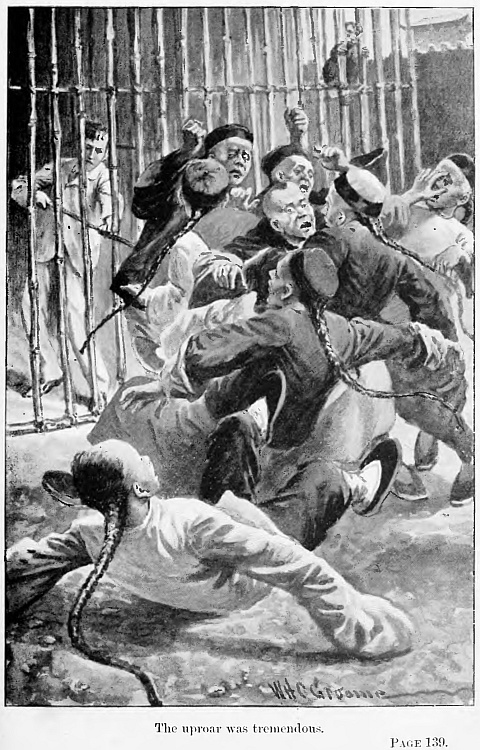
The uproar was tremendous, and increased by the excitement of the monkey, who, upon seeing his friend armed with the instrument used for torturing him, began to bound about, leaping at and shaking the bars, and chattering savagely, till the last of the occupants of the yard had escaped by the door, which was banged to.
Then, seeing that Stan had drawn in the spear again to stand upon his guard, the monkey stopped short too, watching him, and, like his companion, gazing hard at the inner door, beyond which there was a fierce buzz of voices, the shuffling of feet, and other sounds which announced the coming of more soldiers to disarm the prisoner. But Stan felt in no humour for being disarmed. There was something invigorating in feeling possessed of a weapon, and at the first indications of the prison door being opened he stepped back, drove the head with a thud into the wood, snatched it back, and then, after a step to the rear, he brought the stout elastic shaft across the door with an echoing bang, which had the double effect of silencing and putting to flight the braves in the passage and making the monkey shriek, chatter, and rattle the bars in a way that helped the retreat.
“Hah!” ejaculated Stan as he stood with the spear-head lowered ready to make a thrust at the first man who appeared. “Let them come. I don’t care now.”
This was a fact, for the lad had grown reckless, and determined to attack, extra nerved as he was by the thought that if he made a bold charge with the spear the Chinese soldiers would turn tail, and if he followed them up he might in the confusion escape.
But he neither charged nor escaped, for the simple reason that the door was not unfastened; and after waiting for some time Stan came to the conclusion that the Chinese braves would not attack, but would probably try to starve him into a state of submission—thoughts which became strengthened later on.
After waiting some time, watching the inner door alternately with that which opened out of the yard, Stan turned to speak to the monkey.
“Hullo, Tchack! Did I frighten you?” he said.
But there was no reply, and no fellow-prisoner in sight, the poor beast being so much alarmed by seeing the torturing spear in the hands of its friend that it had climbed up the bars into its favourite place out of sight, and declined to be coaxed down.
The time went on, and no one returned to the yard, or even ventured, as far as Stan could make out, into the passage; so that the afternoon and evening were passed with the prisoner in the novel position of guard, playing sentry, and waiting for the next jailer to attack.
Chapter Fourteen.
“It’s all over!”
Night had long taken the place of day, and sound after sound in the great gate-house had put Stan on the alert; but no one had come to the door, and as he rested upon the spear-handle the prisoner underwent pains which endorsed his ideas that he was to be starved into submission. In fact, he grew so hungry that all his pride died out, and in the darkness he humbled himself so that he was glad enough to allay his starving pains by seeking for and picking up some of the fruit and scraps of cake that had been thrown to the strange foreign devil, or wild beast, that the guard of the gate had on view.
“Oh, it’s horrible to come down to this!” muttered Stan as, tired out with standing in spite of the support from the spear-shaft, he sat down and ate sparingly just enough, as he put it, to keep himself from feeling faint. But he was terribly hungry, and cake, bread, bananas, and an orange proved, in spite of being gleaned from the cage floor, not bad; so that he did not content himself with enough to keep him from feeling faint, but unconsciously ate heartily, and felt much better. His spirits began to rise, and after a good, hearty draught from the water-pot, which, fortunately, he had not exhausted, he was so far from being starved into submission that he cut something very much like a caper as he threw himself into an attitude with the spear, looked in the direction of the doorway, and crying, “Come on!” muttered afterwards, as he made a thrust at an imaginary enemy, “Oh, how I should like to serve some of you out for this!”
He listened, but there was not a sound to be heard. Then he seated himself with his back to the side-wall, so that he commanded the open partition facing him, the door being to his right, and the front of the cage to his left, while he held the spear ready for action across his knees.
“They’ll wait till they think I’m asleep,” he muttered, “and then pounce on me. But I’m not going to sleep, and if any one does come sneaking in he’ll have a prick from this spear that will send him out quicker than he came in. Wonder what father would think if he could see me now! And Uncle Jeff. I wish he were here. No, I don’t. I shouldn’t like any one I know to be in such a predicament. I say, I don’t feel frightened, for they are cowards and no mistake. Fancy their being ready to run from a boy like me! They won’t dare to hurt me, because I’m English. I’d give something, though, to have poor old Wing here. I do hope he has escaped—’scaped—I’d—’scape—hah-h-h-h!”
This last very softly, and then Stan heard no more, for weariness and his large meal had proved too much for him. He was fast asleep.
He was not wide awake when he sprang to his feet with spear levelled, ready to drive it at the first Chinese soldier who made a rush at him from the door he believed to have been burst open with a sharp, crackling sound.
The thrust was not delivered, because no one made a rush; in fact, all was perfectly still. And when, after a long pause, during which his imagination had been very busy peopling the dark cage with crouching enemies in various corners waiting for their opportunity to spring at him, he began cautiously to make little pushes with the steel point here and there, without result and ended by advancing softly towards the open door, to be checked by the spear bringing him up short with the point in the wood, it began to dawn upon him not only that the door was shut, but that he must have been asleep.
“How queer!” he muttered. “I was perfectly certain that the door was burst open, and I’m sure I heard a crackling sound.”
Thoroughly satisfied, after a little feeling, that the door was close shut, he turned round to face the bars, finding that while all elsewhere was pitch-dark, there was a faint suggestion of light there; inasmuch as he could just make out the black bamboo bars with the darkest of grey streaks between them, clearly enough cut save in one place, where, high up, there was a big blur.
He stood with his heart still beating heavily, consequent upon the startling manner in which he had been awakened.
And as he stood gazing with eyes whose pupils were dilated in the darkness, that blur, high up towards the top of the bars, seemed to wear a familiar shape, which idea grew and grew upon him to such an extent that he tried to give it a name, and said softly:
“Tchack!”
He was right, for in an instant it began to glide down the bars like a couple of the beads on a scholastic numeration frame, reaching the bottom lightly, to utter the same word.
“Why, however did you get out there?” said Stan excitedly. “What nonsense! I’m looking at the side instead of the front.”
He turned sharply, extended his hand, and the next moment touched the partition bars, and grew more confused.
“It isn’t the side,” he muttered; “this is the side; and that is the front, by the light coming there. Have you got out, Tchack?”
Stan’s heart beat fast at the idea, for it was full of suggestions of escape.
But a soft, peculiar sound changed the current of his thoughts, and looking to his left, he was conscious of the dark blur passing quickly up to the top of the bamboo bars, and passing horizontally along; then, as the blur died out in the darkness, he heard the monkey come closer, working itself high up from bar to bar of the partition against which he stood, and glide swiftly down, brushing his breast with one hand as it dropped to his feet.
Tchack! it said softly, and the next moment the thin, sinewy hand was foraging about him to get at his, into which it nestled, and the poor animal uttered a low, heavy sigh of content.
For some minutes Stan could only think in a puzzled, confused way, feeling that he must be dreaming; but at length things settled themselves in an orderly way in his brain, till it became perfectly clear to him that the monkey must have some way out of the top of its cage which enabled it to pass along to his place.
If so, he reasoned, the yard must be open to it; and if it could get into the yard, it was quite possible that it could get through the doorway or over the wall; and if so, it was probable that it could get into some court or lane by the gate-house.
If the monkey could do this, he argued directly after, why could not he?
And now he could think clearly, his reason suggested that the crackling and splintering noise he had so frequently heard must have been caused by the animal trying to gnaw its way out, the noise which woke him having been made during the final efforts.
Stan’s heart began to beat faster and his ideas to flow more freely. He wondered now why it had not all seemed clear to him at once, for it was evident that if he could get through the partition and into the monkey’s cage, there was the way open for him also to escape. He had never troubled himself about the bars between him and his fellow-prisoner. Why should he have done so? He did not want to escape from one cage to the next. But now he recalled that the bamboos were smaller than those in front; a few touches of his hand confirmed this, and withdrawing the other from the monkey’s grasp, he seized two of the bars, and the animal sprang up them at once.
“Oh, if I could only climb like you!” said Stan to himself as he went from bar to bar, trying them and giving them a shake, when, after a few trials, to his surprise he heard one of those he held creak in a peculiar way; and upon seizing it with both hands, to his astonishment and delight he found it give way with a sharp crack, the middle having been gnawed through, while, climbing up a little, he was able to use it lever fashion and wrench it so much on one side that in another minute he managed to force himself through and stand in the place from which the monkey had escaped.
It is only the first step that costs, the French say in their proverb, and Stan found it so here. After a time he was able to make out what the monkey did to escape, for, close up in the left corner, he made out that instead of the bars looking regular black streaks against the grey light, there was one large, ragged patch of grey; and upon climbing up, by clinging leg helped, to a couple of the bars, he soon reached the top, where one had been gnawed right through and was now a splintery, sharp mass of fibres. Here, after some difficulty and a good deal of tearing, Stan managed to get through and slide down outside the bamboos, to drop the next minute into the yard.
It seemed too good to be true, and he paused in doubt to look round for and speak to the monkey; but he could not make out where it was, and he had no time to spare.
There was no sound of sentry near, no sign of danger; so, making for the gateway, he found it possible to climb, and soon reached the top of the wall in which it was placed.
Still no sound—nothing but darkness around; and thoroughly strung up now, the lad lay flat on the wall for a few moments, before lowering his legs, hanging at full length, and then dropping, to come down heavily upon rough paving-stones, but with the delight thrilling through him contained in the thought that to some extent he was now free.
He hesitated for a few moments, listening and looking to right and left, thinking of the dark and devious lane along which he had passed with Wing upon that unlucky morning, and wondering whether he could retrace his steps. But he felt that it would be madness to attempt it; and besides, his one great idea was to reach the river, feeling sure that sooner or later he would find an empty boat moored somewhere, and once on board that, he felt that he would be safe.
He had determined to start off and follow the first turning he came to, in the hope of reaching the riverside before daylight, when something seemed to induce him to look up.
His blood began to turn cold, for there on the wall above, dimly seen in the darkness, he could make out the head of some one intently watching his every movement.
It was for life and liberty that, giving a violent start, he dashed off; breathing freely the next minute, for he realised the fact that he had been watched by his dumb fellow-prisoner, the monkey starting as violently as he did at the first movement, and disappearing instantly into the precincts of the prison.
For the moment Stan felt as if, owing so much as he did to the quaint-looking animal, he would have liked to coax it to follow him; but common-sense told him that he would be wasting valuable time, and perhaps sacrificing the liberty he was on the point of securing, so he kept right on, feeling damped by the fresh thought that perhaps he was on the wrong side of the great city-wall.
“Can’t help it,” he said; “there is no choice. This one may turn out the best.”
In the spirit of this thought he hurried along the narrow lane, which was so dark that he could hardly pick his way, and seeing nothing but that it was shadowed by low-roofed, overhanging houses, whose occupants were so far silently asleep; but from the way in which house and hong followed one another, he felt what he had noted when with Wing, that the city must be densely populated, and that he must find some hiding-place before daybreak.
He tramped on for quite a couple of hours through what seemed to be a deserted city, doubling here and there, but without a sign of the main artery he sought, till, just as he was in despair and ready to sink with weariness and the thought that all his toil had been in vain—for the tops of the houses were beginning to show clearly against the grey sky—he came upon a wider turning. Glancing hesitatingly down it to see if it offered anything like a hiding-place, he rushed forward at once; for there, stretching to right and left, was the black, flowing river, with big junks moored close together, and beyond them and the smaller boats crowding the stream were the house-boats and dwellings by the farther shore.
A couple of minutes later Stan was on the hither bank, hurrying by boat after boat, but all too big to be manageable; and he kept on and on, feeling that he had not a minute to spare, for at any moment early risers might be on the move, and the sight of a fugitive English lad would be sufficient to raise a shout—and a hue and cry to hunt him down.
“It’s all over!” he groaned to himself suddenly; and he made a dart forward to get in the shelter of a great junk aground right up to the bank, for all at once he heard the splash of an oar, and a boat was being pushed off from the far side, looking wonderfully plain now in the fast-broadening dawn.
It was for liberty, so there was no time to put in practice the familiar old proverb of “Look before you leap,” Stan was running as he placed the stranded junk between him and the rowers, so he made a bound as he reached the lowest part midway between the high bows and the towering stern, springing from a rough kind of wharf on to the junk’s deck, which seemed to be about a couple of feet lower than the wharf.
The leap was nerved by despair; he had a good take-off, and for a brief moment or two he saw flowing water below him; then he came down on the rough bamboo deck. There was a soft, crushing sound, and he went through some of the rotten wood down into darkness, to fall upon his side and lie motionless, looking up at the grey, ragged patch he had made, and holding his breath as he listened for the coming of the boatmen, who must have heard the noise.
Chapter Fifteen.
“Chinese Men-of-War.”
Stan Lynn lay holding his breath and straining his ears, till he uttered a hoarse gasp, and all the while the murmur of voices and the plashing of an oar came nearer and nearer. Then the sounds were so close that he raised himself a little to look round for some hiding-place in the depths of the vessel, and then dared not stir. But all at once, just as he felt that the boat must be alongside, relief came in a hearty laugh uttered by one of the boatmen, the plash, plash, plash of the oar grew more distant, and he let nerve and muscle relax till he felt limp and helpless ready to do nothing but lie panting amongst the rotten wood, resting and trying to recover his failing powers.
The light overhead increased, and as his eyes wandered here and there he could see bright cracks and rifts in the deck and high up in the sides, all evidences that he had found a sanctuary in some dilapidated, half-rotten junk which had been drawn close inshore ready for breaking up, its services being evidently at an end.
The morning grew brighter, and fresh sounds of plashing came near, tempting him to creep through the half-darkness to where the first gleams of the morning sun streamed through a rift in the side. Upon reaching it and applying his eyes, he found that he could command a good view of the river to right, left, and across, with the water becoming animated, boats large and small passing and repassing, the opposite shore waking up, and smoke beginning to rise from the house-boats moored close to the bank, and all the morning business of a great city appearing around.
If only the old junk were left alone, Stan felt that he might lie in hiding till night. There might be a possibility of his marking down some boat, and as soon as it was dark wading or swimming to it, when, if he could loosen it from its moorings and secure the mast, sails, or oars, escape would be simplicity itself. But, as the lad argued, there were so many ifs.
“But I oughtn’t to grumble,” he muttered. “I have got out of the prison, and I am here in a capital hiding-place where nobody is likely to come.”
Just about the time when he had come to this conclusion a waft of some peculiar odour from food being cooked seemed to float down the river and reach his nostrils, producing a sensation that was repeated again and again with increasing violence, till the poor fellow uttered a low moan of misery.
“If this goes on I shan’t be able to bear it,” he muttered; and then, setting his teeth hard, he groaned out through them, “I must—I must. Oh, what a coward I am! I’ve only got to wait till it’s dark, and then surely I can land and find something somewhere.”
But even as he tried to console himself with these words, he felt more and more hopeless, not seeing for a moment where he was to search, and all the time suffering more and more keenly.
For in all directions smoke was rising from the hundreds upon hundreds of house-boats that lined the shores, as well as from the many one-storied houses clustering together, and a strange mingling of the most maddening scents came floating around—literally maddening to one whose sole sustenance for many hours had been a couple of bananas and a piece of cake.
It was all so horribly civilised, too. The fugitive was in far-away Asia, but his nostrils were assailed with the steam of fragrant tea, freshly roasted coffee, newly baked bread, frying fish, and appetising bacon.
No wonder the starving lad called it maddening as he crouched down in the darkness and tried to think of other things.
Before long, however, he had something else to take his attention, for a procession of nearly a dozen huge junks came slowly down the stream, each with its leering, painted eyes and gay dragon-like gilded ornamentations.
They were full of men armed with spear, fork, and trident, besides in parts bristling with matchlock barrels, while fore and aft the watcher could see that they carried big service-guns.
“Chinese men-of-war, full of soldiers!” Stan mentally exclaimed; but only to alter his opinion directly, for he had some little experience of the Government troops, and knew that the men all wore a grotesque kind of uniform.
They were not merchant-vessels, he thought, for though many of the trading-junks carried armed men, those before his eyes were out of all proportion.
“Could they be pirates?” he asked himself; but the sight of the leading junk casting anchor in midstream—an example followed by the rest—put an end to his surmises, for they were evidently at peace with the people in the vessels about them and on shore, many landing and mingling with the men who came to the sides and crowded in boats about the anchored vessels to supply them with food.
So much was going on all about him in this latter way that every now and then Stan felt that, come what might, he must land and seek for something, even if it was only a loaf of bread, to appease his hunger; but he knew it meant surrendering his liberty, for there would be a crowd round him at once; while doubtless by this time it was known that the foreign devil had escaped:
Stan watched till the morning was well advanced, longing for the night to come even though the sun was not yet at its height, while now a fresh agony assailed him; the rugged deck overhead began to get hotter and hotter, and the air about him suffocating, till at last he felt that at all hazards he must crawl up and trust to his not being seen while he crept to some spot where the remains of the lofty stern would act the double part of shading him from the sun and the curious eyes of those who passed.
There are limits to human endurance. Stan had not slept for above an hour during the previous night, and the bodily and mental toil he had gone through were tremendous. Hence it was that when his sufferings were at the worst, the faintness produced by his hunger and the heat more than he could bear, a half-delirious kind of insensibility stole over him—half-stupor, half-sleep—which tided him over the hottest part of the day, rendering him oblivious to all that was going on, till he awoke suddenly, to find, to his amazement, that it was twilight in his hiding-place, and on looking out through a rift he could see the river glowing like blood from the reflection of the sunset clouds.
In his excitement at the beauty of the scene which met his eyes lower down the river, he clapped his hands together, and had hard work to refrain from shouting aloud, merely standing gazing out through the open rift in the planking, and feeling giddy now in his joy.
Hunger and heat were forgotten, and he gazed out till his eyes grew dim and he had to make an effort to avoid yielding to the giddiness and swimming which attacked his head.
Strange that one in such a terrible position should feel such ecstasy upon seeing a glorious vision in the sunset beauties of that far-eastern river? Not at all. Stan Lynn was in no sentimental mood to be moved to such excitement by a few orange-and-gold clouds reflected in the water, or the gay aspect of the thronging people haunting the great warlike junks still moored higher up. Stan’s beautiful vision was something far more simple. It was that of a lad of about his own age seated in a sampan which he had moored about a hundred yards lower down the stream. There he was, sitting alone, unnoticing and unnoticed save by the watcher in the crumbling junk’s hull, who saw him pull up a silvery fish, and then, after putting it into a basket between his feet, proceed to rebait his hook and cast it in again.
Was it hunger, then, which produced a longing for a few raw fish? Again nothing of the kind. As Stan’s eyes lighted upon that small boat, which seemed to have a little mast and matting sail laid with the oars and pole projecting over the stern, the idea had struck him that this was exactly the kind of boat for which he longed. Could he but gain possession thereof and get rid of the boy who was fishing, while retaining his lines and bait, the hong, no matter how many days’ journey distant, was within easy reach; and hence when Stan clapped his hands it was after coming to the determination that he would have that boat at all costs.
But how?
Chapter Sixteen.
“Oh!—hah!”
“Where there’s a will there’s a way,” says the old proverb.
It is not quite true, but there’s a great deal of truth in it; and Stan had made up his mind how to gain possession of the boat almost before the boy had caught another fish.
The first idea was to wait till it was quite dark, so that his proceedings might not be seen by people in the many boats or from either shore; but he dared not wait, for at any moment the boy might be satisfied with the fish he had caught—scores, for aught Stan could tell—pull up his anchor, and row ashore, and the chance of getting the means of reaching the hong would be gone. What he did must be done at once, Stan concluded, and he prepared to act.
Fortune was favouring him, for the boat swung by a rope from the bows, and the boy was at the other end, facing the stern, over which he hung his line. And consequently he was sitting with his back to him who was planning the onslaught upon his peace.
Stan’s thoughts ran fast as he watched through the gap in the side of the junk and completed his plans, getting them so compact and clear that at last, as the boy fished on, it seemed as if he had nothing to do but make a start and succeed; but when at last he was quite strung up to the sticking-point, obstacle after obstacle began to appear and suggest impossibilities.
He was safely hid in the hold of the junk, but the moment he appeared on deck in his white flannels he would be a mark for every eye, from the crews on the high poops and sterns of the great junks to the people on the house-boats and shore, as well as the busy folk paddling here and there in the little sampans which were constantly on the move up, down, and across the river.
He seemed to hear the shout raised, “Foreign devil!” and to see the fishing boy, warned thereby, jumping up in his boat, pulling up the little wooden anchor, and rowing out of his reach, while scores of eager people joined in to hunt him down.
Stan’s venture seemed to become more and more mad, and he breathed hard, feeling that he must give it up. But there was the river before him, one wide-open way, flowing down and ready to bear him onward night and day toward his friends.
But he wanted the boat, and the only way was to seize it—steal it, he told himself, though he comforted himself with the thought that he was a prisoner trying to escape from his enemies, and that such a reprisal would be just.
“I must—I will do it,” he panted. “Oh, I wish I wasn’t such a coward to hesitate like this!—And there’s another fish. He must have caught enough to leave me a good meal, and I am so, so hungry! Now then! Once to be ready!” he muttered, with his old school-games rising before him.
“Twice to be steady!”
He paused here long enough to see the boy hook and draw in another fish, then bait again, and—
Stan was in agony, for the boy hesitated, paused to pick up a basket and examine its contents, and then he seemed as if he were satisfied and about to haul up his anchor and make for the shore.
“Too late!” groaned Stan. “I ought to have tried before. It’s all over. I must look out for another boat.”
He was casting his eyes in other directions, when, with a feeling of relief that is impossible to describe, he saw the boy drop down again and continue fishing.
Stan’s nerves and muscles were now like steel, and he began to crawl for the broken portion of the deck, got well hold of a cross-piece of bamboo with both hands, and commenced swinging himself to and fro from his hands till he could get one foot up, then the other, level with his face; and by a clever effort he raised himself so that he could, thanks to old gymnastic games at school, fling himself on to the unbroken part, where, after a few moments’ pause, he began to crawl to the edge of the deck where the bulwarks had broken and rotted away. Then, feeling that he must dare everything now, he lowered himself down, his feet sinking, and the water rising about him as he stretched his arms out till it was up to his hips.
And there he hung, a white figure in the evening glow, right in view for a few moments, as he hesitated before making the final effort.
“Suppose he shows fight,” he thought to himself. “Well, I must show fight too. I’ve licked English chaps as big as myself, and it will go hard if I can’t lick a Chinese.”
At this point he straightened his fingers, which were crooked over a ragged piece of bamboo, and plosh! he went down feet first with a heavy, sucking noise; the water closed over his head with a deep, thundering roar, and keeping himself quite rigid and his eyes wide-open, he waited till, after what seemed an immensely long time in darkness, his head rose above the ruddy surface of the water, and he found that he had turned as the current carried him along, so that he was looking at the rotten old vessel he had left.
Stan was skilful swimmer enough to reverse his position, and found it none too soon, for there was the boat he sought to reach some forty yards away, and so much out of the course he was taking that he had to begin swimming till he was well in a line with his goal, but so much nearer that as he ceased striking out he was close upon the anchor-line.
The next minute he had touched it gently, and at the happiest moment for his success, the boy having hooked a fish—a large one—which took up his attention so much that Stan softly seized the bow with both hands, let his legs float on the swift current, and then by a quick effort drew himself well up and rolled over into the bottom of the boat, where he lay quite still beside the folded-up little matting sail.
The boat rocked so that the owner looked sharply over his left shoulder, but not far enough to see the invader of his boat; and probably attributing the movement to his own exertions, he went on playing his big fish; while, reaching up his hands, Stan got hold of the painter and began to haul, till, to his great delight, he weighed the little anchor, and saw that the stream was carrying them down.
Still the boy did not turn, but hauled away at his line and gave it out again, as if afraid that if he were too hard upon his prize it would break away.
This went on for a good five minutes, till, apparently satisfied, the boy sank upon his knees and reached over the stern, hanging down so as to get a shorter hold, and ended by bringing the fish’s head well within reach, and while holding on with his left hand, he crooked his right finger ready, so as to turn it into a gaff-hook.
Stan saw a part of what was going on, and suspected the rest, as he seized his opportunity to get hold of the anchor-stock.
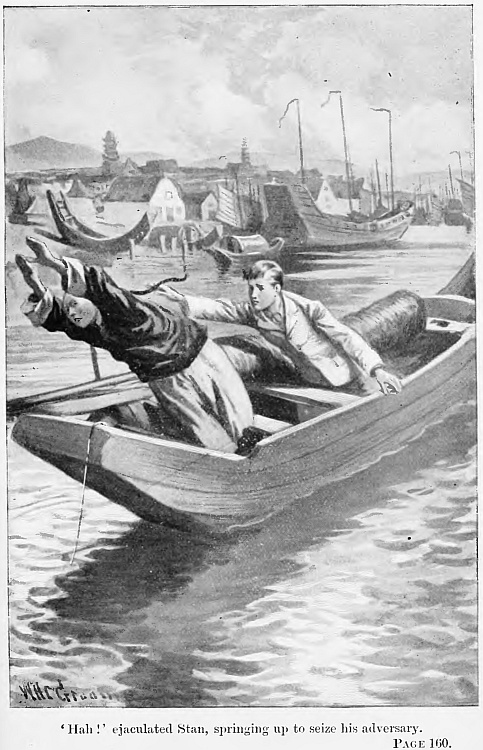
The next moment the fisher had raised himself up and swung a fish of some five pounds weight flop into the boat; while, as if acting by a concerted motion, Stan reached over and swung in the little grapnel—the actions of the lads bringing them round, from being back to back, now face to face.
Flop! flap! flap! went the fish.
Bang! bang! went the anchor.
“Oh!” ejaculated the Chinese lad, opening his mouth wide.
“Hah!” ejaculated Stan, springing up to seize his adversary.
But the latter did not wait to be seized.
Grasping the fact that the boat was gliding down-stream, and that he was face to face with a foreign devil, he raised his hands together well above his head and dived over the side in the easiest, most effortless way, gliding over like a blue seal blessed with a bald head and a big tail; when, as Stan dropped down in the boat, keeping only his head over the side, he saw him rise again far enough behind, and begin swimming with all his might for the shore.
Stan had something else to do besides watch the boy. He had some knowledge of boat management, and felt that he must risk everything now in the way of being seen; so, seizing the little mast, he stepped it, hauled up the yard and with it the matting sail, found it easy enough to get in position, and in five minutes more, as he drifted rapidly down with the stream, he had the mat sheeted home, and an oar over the stern for rudder. With the evening breeze quite sufficient for the purpose, he found himself gliding rapidly down the river, able to steer while lying down upon his back pretty well out of sight, and not a sound behind announcing that there was any pursuit.
“Hah!” he panted out at last. “They’ll have to come fast to catch me now. I wonder how far that poor fellow has to go before he can get help and another boat. Oh! if it would only turn dark, I could escape.
“What’s that?” he ejaculated, raising his head; for there was a loud smack as if something had struck one of the planks of the boat, and he turned cold with a despairing feeling, being sure that something had happened to check his flight.
But three or four more sharp spangs on the bottom of the craft enlightened him directly after, and he bore smilingly upon his oar so as to give a junk anchored in the river a wide berth, thinking the while of the shore lower down and a fire, if it was to be had, at which he could try his hand at cooking; for he knew with joy in his heart that the noise was made in the expiring efforts of what he meant to be his supper trying to leap over the side and failing dismally.
“Hah!” sighed Stan again. “I never saw it turn dark so rapidly before. In another few minutes it will be impossible for any one to see me from the shore.”
In fact, as he glided abreast of the anchored junk he saw a man busy at work hoisting a great round yellow paper lantern to the mast-head, too busy to pay any heed to him; and soon after he could see light after light beginning to dot the broad surface of the stream.
“I’m going to escape,” cried the poor fellow exultantly. “Oh, if I only can!”
Flap! said the fish softly, turning his thoughts into another groove.
“Yes, I hear you,” said Stan. “Fish—roast fish must be as good as fried. I wonder whether there’s a lantern anywhere on board. If there is there’ll be—Hooray! I’ve got my little silver box of matches in my revolver-pocket. I only wish I had my pistol too. But even if I hadn’t got the matches, I could glide up quietly to one of those boats, lower down and steal a lantern in the dark, and slip away.
“Steal! Yes, steal,” he said, laughing bitterly. “That’s the way these things grow. I begin by stealing the Chinese soldiers’ prisoner; then I steal a boat with a lot of fish; and now I’m thinking quite coolly of stealing a lantern. Who’d ever have thought that I should turn out such a thief?”
The fish gave one more flap, and lay still in the bottom of the boat like something of silver very dimly seen.
“I’m horribly hungry,” muttered Stan; “but the boat goes splendidly, and I’ll eat some of that fish raw before I’ll run her ashore to make a fire. Why not? I dare say it wouldn’t taste bad, and I only want just enough to keep me alive. I shall eat a piece as soon as it’s quite dead.”
An hour later he was tasting raw fish for the first time, and finding that it tasted very fishy indeed, but not more so than a big oyster just torn from its newly opened shell.
Chapter Seventeen.
“What’s the Matter?”
The night proved to be brilliant, for the moon was nearly at its full, so that, the wind being favourable and the current swift, sunrise the next morning found the fugitive far beyond pursuit. There was not a boat in sight, and as far as he could see on either side stretched the wide-open country, from the winding river’s banks right away to the distant hills; and when at times as the day wore on, with the boat gliding down fast, any craft came in sight, Stan had his choice of sides to take on the great river, and naturally he hugged the shore opposite to that taken by the trading-junk or smaller boat. Now and then he could see farm-buildings or clusters of village cottages, with an occasional pagoda. Once he passed a more pretentious collection of houses, like a small town, but it was some distance up a stream that joined the river; and as he sailed farther on, it was into cultivated land where traces of inhabitants were very few. Towards evening he took advantage of the fact that there was neither house nor boat in sight to run his little craft ashore where a patch of woodland came right down to the stream; and here in an opening he collected sufficient dead branches and twigs to make a fire, whose smoke was diffused among the boughs overhead, feeding it well till there were plenty of glowing embers, over which he roasted the best of his fish. He spent an hour or so in eating heartily and, after roasting, cooling down enough in a pot he found in the boat so as to have an ample supply for the next two days.
Grilled fish and cold river water seemed to ask for something else, but Stan had plenty of strong young appetite, and he was ready to congratulate himself upon having done so well; and in excellent spirits he quenched the fire with the water-pot when he had done, and pushed off at once.
That late afternoon and evening he sailed on till the moon was right overhead, when, feeling more secure, he made fast to a tree; and utterly unable to battle against an overpowering feeling of drowsiness, he slept in the bottom of the boat, with the matting sail for cover, till the morning sun was well up.
That day, as he was passing a solitary house about a hundred yards from the bank, where he could see a couple of women at work in an enclosed field, he ran the boat inshore, the women in answer to his signs coming to the bank to stare at him. Then by means of the little Chinese he knew, and the offer of the figured white silk neckerchief he wore in exchange, he not only obtained a good supply of cake-bread and some eggs, but the women made him some tea before he pushed off again.
Encouraged by his success, he fished the next day, had excellent sport, and bartered some of his prizes at a house for a couple of dozen fine potatoes, whose fate it was later on to be roasted in the embers of one of his fires.
And in this fashion, without any noteworthy experience, Stan dropped down the river, losing count of the days in the monotony of the journey, but always obtaining a sufficiency of provisions of some kind or another in exchange for the plentiful supply of fish he caught in the evenings after sundown, or else for some portion of his clothes—for his watch, money, and knife had disappeared in the prison, he never knew how.
In fact, the escape down the river, under the happy circumstances which fell to his lot, was simple in the extreme, it being easy enough to avoid the boats and junks he met, as well as the more inhabited parts of the shore.
He kept a sharp lookout during the last three days, expecting every hour to catch sight of the great hong towering up by the right bank of the river; but it was far longer than he expected before it appeared, and even then proved to be much more distant than he could have believed.
At last, however, there it was, with a river-boat drawn up to the wharf, and by degrees he made out one of the big coolies; then Lawrence, the foreman, came out of the office door, but he took no notice of the white figure in the little native boat when Stan stood up and waved his hand.
“Why, I should have thought he would have known me directly,” grumbled Stan to himself. “Ah! now we shall see,” he cried joyously as a tall familiar figure came out, crossed the wharf, and stood talking to some one in the river-boat.
Stan waved his hand so excitedly now that he was seen, and he noted that the tall figure shaded its eyes and then turned to speak to one of the boatmen, who hurried in through the door of the warehouse and returned with something which the tall figure held up to its eyes.
“He’ll see me now,” said Stan to himself.
He was right, for the next minute a hand was being waved by the manager, who stood ready to exchange grips with Stan as he ran his boat up alongside the wharf and stepped ashore.
That evening was passed in the relation of adventures and a discussion about the fate of Wing.
“I’m afraid—very much afraid—that he was killed by the savages,” said Stan sadly at last.
“Savages—cowardly savages!” cried Blunt angrily. “But I don’t know; old Wing is a very slippery gentleman, and knows his way about pretty well. I’m not going to give him up for a bad job yet.”
“You think he has escaped?” said Stan excitedly.
“I hope so,” was the reply. “Things are not so bad as they might have been. You see that amongst the soldiery there is a feeling of respect for the English name.”
“Respect!” cried Stan indignantly. “You don’t fully grasp how they treated me.”
“Yes, I do, Lynn; for they didn’t kill you, and with people who hold life so cheaply that is saying a great deal. Well, my lad, it has been an adventure that you will never forget, and I’m very glad you have escaped so well. You don’t feel much the worse for it all?”
“Not in the least. But it’s delightful to get to civilisation again, and I’m looking forward to lying in a clean bed once more. I shall sleep to-night after what you have said about Wing.”
“I suppose so. But I say,” continued Blunt dryly; “wouldn’t you have liked to bring that monkey away with you?”
“I should,” cried Stan eagerly.
“Yes, of course; but it’s as well not. I know those chaps. They’re wonderfully strong and vicious. Only safe in a cage. We couldn’t have done with him here. I say, shouldn’t you like to make one with me in an expedition to knock that prison to pieces?”
“Yes,” cried Stan eagerly. “Could it be done?”
“Yes, if we went to war; but I dare say if proper application were made we could get compensation. We shall see I say, though, what about that gathering of war-junks you saw? Not piratical craft, were they?”
“I don’t know,” replied Stan. “I had thought no more of them. I thought more, however, of that poor boy’s boat that I took.”
“Ah! that was a bit of an annexation. Never mind; I’ll send it back to the Chinese merchants we deal with; they’ll find out whom it belongs to.”
“’Longs to,” said Stan slowly.
“Hullo!” cried Blunt. “What’s the matter? Feel ill?”
“Hi? I—Oh, I can’t help it; I’m so stupidly sleepy I can’t keep my eyes open, and I could hardly understand what you said last—so dreadfully drowsy I don’t know what to do.”
“I’ll tell you,” said Blunt, smiling.
“Do, please. Go and bathe my face?”
“No,” said Blunt. “Off with you and tumble into bed.”
Chapter Eighteen.
“Not a bit Dead.”
“What will you do about poor Wing?” said Stan the morning after his return, when he was out on the wharf, all the better for bed, bath, and breakfast.
“Wait,” said Blunt, frowning.
“Wait? In such an emergency, with the poor fellow regularly murdered?”
“We don’t know that yet, youngster,” said the manager. “You did not see him murdered, and you did not see his body.”
“No; but—”
“Exactly; but I’ve known Wing longer than you have. He is a very quiet fellow, but he is full of resource, and being amongst his fellow-countrymen, I think it very doubtful about his having been killed.”
“I only hope you are right,” said Stan; “but there was a desperate fight.”
“No—not desperate. You see that though you were one they looked upon as an enemy they did not kill you, and evidently never intended anything of the kind.”
“Well, no; I don’t think they meant to kill me.”
“I’m sure they did not. If they had, they would have done it. In fact, I hardly know why they took you at all. It seems to me more out of idle recklessness than anything else; a party of rough soldiery with nothing to do, and under very little control. They have some discipline, but it is very slight. It’s a rarity for them to get any pay, even when they are on duty. There seems to have been a detachment hanging about the gate of the city, doing as they pleased, and dependent upon the people coming in to the market for their supplies. They saw you, a stranger, passing the place; and as there was no one to check them, they followed and pounced upon you.”
“But what for?”
“Ah! what for? I can only place one construction upon the act.”
“And what is that?” asked Stan.
“The one you suggested.”
“I? I suggested none.”
“Yes—by your words. What did you say they did?”
“Nothing but behave to me in a very insulting way, and refuse to carry a message or fetch help.”
“Yes, they did.”
“Yes, I see what you mean. The insolent creatures! They treated me just as if I were another monkey.”
“To be sure; and made a show of you.”
“Yes,” said Stan, beginning to swell with indignation. “Brought no end of people into the yard beyond the bars of the prison grating.”
“And who were the people?”
“Oh, I don’t know. Rough-looking country-folk.”
“To be sure. People coming in from the country; and if we knew the truth of the matter, depend upon it, they took some toll in some kind of provisions for giving them a peep at the Tchili monkey and the foreign devil they had caught.”
“Oh, I say, Mr Blunt, don’t!” cried Stan quickly. “It’s horrible. It’s so degrading.”
“Well, it was not pleasant, my lad,” said the manager, smiling; “but you couldn’t help its being degrading, and you gave them the slip.”
“But you’ll send a report to my father and uncle, so that they can lay the matter before the Consul?”
“I will if you like; but if I do, it will be a very long business. It will be to maintain the English dignity, but only at the expense of a few poor wretches in a distant part of the country, who will be taken and bastinadoed—perhaps decapitated.”
“Oh! I don’t wish that,” cried Stan quickly.
“Whether you wish it or not it will be done, to quiet the foreign settlers and traders and to keep up our prestige. It may be right, only the mischief is that the right men will not be punished.”
“What! not the soldiers?”
“No,” said Blunt; “they’ll escape for certain. The mandarins will never catch them.”
“Then I shouldn’t like to feel that I had been the cause of the punishment of innocent people. But I do feel that such a crime as the murder of poor Wing ought not to go unpunished.”
“So do I,” said Blunt; “and it must not. But, as I say, we don’t know that he is dead yet.”
“But where is he?”
“I don’t know: Let’s wait a bit and see. It is quite possible that he is making his way back by land, as the boat was sent home, and it may be days yet before we see him. It is quite as possible that we may not see him for a long time, for he will be afraid to show his face here on account of losing you.”
“But he’ll get to know that I escaped,” cried Stan.
“Some day, perhaps. Then he’ll come—delighted. Let’s wait, for it may be some days or weeks, hanging about as he will be in the country, which is terribly unsettled, as I have just learned, by a fresh incursion of pirates and disbanded soldiers. Wait, my lad—wait. By-and-by perhaps I may be able to come down heavily upon one of the up-country mandarins for compensation; but we shall see. China is a place where matters move very slowly, and law and order are very seldom at home. I don’t like the news at all that I have been hearing about what is going on up-country. It hinders trade, too. I’m very glad, however, that you are safely back, instead of being weeks wandering about from plantation to plantation.”
“Then you feel pretty sure that Wing is not dead?”
“No, not pretty sure,” replied Blunt; “only very hopeful about his being alive. What do you think of that?”
“That I feel much better satisfied. It would have been bad enough if any poor servant of the hong had suffered, but horrible for Wing to have come to so sudden an end. I liked Wing.”
“So did—So do I,” said Blunt, correcting himself. “Cheer up. He’ll come along smiling some day, as soon as he hears you are back.”
Something happened much sooner than either of the Europeans at the hong anticipated.
The next day Stan talked a good deal with Lawrence, the foreman of the coolies, and several of the clerks about Wing’s absence, and could not find one who believed that the man was dead.
“Unless he has fallen amongst pirates,” said Lawrence. “That would be different. He had charge of you, and he lost you. Ergo, as the old fellow in Shakespeare says, he’s afraid to meet Mr Blunt. I should feel just the same if I were Mr Wing.”
Stan felt more encouraged still; and the very next morning, as he was going through the big warehouse, his attention was suddenly caught by a figure stepping out of a small sampan which had just reached the side after crossing the river.
“Hi! Mr Blunt!” cried Stan. “Look through that window. Isn’t that Wing?”
“Wing?” replied the manager thoughtfully as he bent down to examine the Chinese brand on one of a stack of tea-chests. “Not likely yet. He has a long way to come overland.”
“But I’m sure I saw him step out of a boat on to the wharf.”
“Hardly likely. These fellows look so much alike in their blue frocks and glazed hats. Where did you see him?—Why, hullo! Well done! It is he after all.”
For just then the object of their conversation came slowly in through the open door, ragged, worn out, and dejected, the very shadow of the trim, neat Chinaman familiar to Stan. Coming out of the bright sunshine, he stood with puckered face blinking and looking about, and so weak and weary that he seemed to be glad to hold on by the first pile of bales he reached.
There he stood, peering about till he dimly made out the tall, upright, unmistakable figure of the manager in his white garb, when he made a deprecating movement with his hands as if about to salaam like a Hindu, and he was in the act of bending down when he suddenly saw Stan.
In an instant the man’s whole manner was changed. Throwing up his hands, he uttered a hoarse cry, and ran forward to throw himself upon his knees at the lad’s feet, flinging his arms about his legs, and then burst forth into a fit of sobbing, crying like a woman, and the next minute laughing hysterically.
“Wing t’ink young Lynn go dead. Wing t’ink bad soljee man killee dead young Lynn. Oh deah! oh deah! Come along. Walkee allee way tellee Misteh Blunt. Ha, ha, ha! Allee light now. Give poo’ Wing eatee dlinkee. Feel dleadful bad. Allee light now. Oolay! oolay! oolay!”
The poor fellow began his cheer fairly, but ended it in a miserable squeak, and then loosened his grasp of Lynn, and pressing his sleeve-covered hands to his mouth to stifle the hysterical cries struggling to escape, he began to rock himself to and fro; while Stan, who felt touched by the poor fellow’s display of emotion, stood patting his shoulder and trying to calm him.
“No, no, Wing; not a bit dead,” he said, with a husky laugh. “They took me prisoner and shut me up. Why, I’ve been thinking you were killed. What became of you? How did you get away from the brutes?”
“Wing tellee soon. Wing tellee soon. Allee chokee chokee. Got floatee velly full. Makee cly like big boy so glad young Lynn allee ’live.”
“Well, it makes me ready to laugh to find you’re alive,” said Stan, though his features did not endorse his words. “Here, tell us where you have been.”
“Evelywheh,” said the poor fellow. “Bad soljee put big pitchfolks to Wing, makee lun away. Keep folly Wing. Wing tly come back. Soljee put pitch-folk to Wing back and dlive light away. Makee lun velly fass. Come light away tell Misteh Blunt. Allee way soljee, allee way pilate. Wing wantee lie down and die. Wantee come tellee young Lynn plisneh. Wing t’inkee nevah get back to hong. Come at las’ find young Lynn allee ’live. Wing leady lie down die now.”
The poor fellow sank over sideways as he said the last words very feebly, and it was quite evident that he was not very far from death’s door through his exhaustion.
“Poor beggar!” said Blunt gruffly. “There’s no deception here. Get something out for the poor fellow at once, Lawrence. Look at him; he must have suffered horribly. He looks as if he has been travelling night and day. My word! I’ll never think him a coward again. Fancy coming to meet me with such news as that! I should have been ready to kill him if it had been true.”
Chapter Nineteen.
“Big Junk Boat.”
Poor Wing lay for about a couple of hours, during which everything possible was done, and then he began to recover rapidly, when, after superintending, the manager insisted upon the poor fellow doing nothing but try and sleep.
“Wing wantee tell Misteh Blunt evelyting,” he said, with a piteous look.
“Not now,” said Blunt sharply. “Get well first.”
“Allee velly dleadful,” said the poor fellow feebly.
“Yes, I know; but I’m not going to blame you, my man. You did your best. Get strong again, and tell me all about the troubles then.”
Wing gave him a horrified look, glanced at Stan and then back at Blunt, his countenance looking drawn and his complexion more sallow than ever, while his lips moved as if he was speaking, but no sound came.
“Well, why don’t you rest?” cried Blunt. “What’s the matter with you? Been so much frightened?”
Wing nodded sharply, and gave Stan a look full of horror and despair.
“Why, what’s the matter with the fellow? Not been wounded, have you?”
Wing shook his head.
“Why don’t you speak?” cried Blunt, so roughly that the man held out his hands in a gesture evidently intended to mean deprecation. It was as if he meant to say, “Don’t be angry with me; it is not my fault.”
“Well, I see you’re upset, my man,” cried the manager, softening his manner. “Perhaps you had better ease your mind. Speak out. Now then, what’s the matter? Have you lost the money I gave you?”
“No, no, no,” cried Wing, shaking his head violently. “Velly solly—velly solly,” he murmured.
“Very sorry for what?” cried Blunt, catching the man’s arm and looking at him sternly.
Wing, who seemed weak in the extreme, shivered as he shrank from the manager’s eyes, and turned appealingly to Stan as if begging him to intercede.
“The poor fellow doesn’t seem to know what he is saying,” said Stan quietly, “and he’s frightened of you.”
“Humph!” replied Blunt. “I thought I spoke gently enough to him.—Here, Wing, don’t look at me in that scared way. I told you that I was not going to blame you. Speak out. What is it? You have something else to say?”
The man nodded.
“Bad news?”
Wing nodded again sharply.
“Out with it, then, and let’s know the worst.”
The trembling Chinaman hesitated for a few moments more, and then pressed up towards his chief and whispered something quickly in his ear.
“What!” roared the manager, catching him fiercely by the shoulders and making the poor fellow utter a piteous wail as he turned to Stan as if for help.
“Wing can’t help,” he cried. “Wing no want tell baddee news.”
“Then you’ve brought bad news?” said Stan excitedly.
“Velly bad news. Wing can’t help. T’ink bes’ come tell Misteh young Lynn dead and allee bad news.”
“Yes, yes,” said Stan impatiently.—“The poor fellow’s half-frightened out of his wits, Mr Blunt. You’re too harsh with him now he’s in such a weak state.—Look here, Wing; it’s all right. You see matters are not so bad. I’m not hurt, and Mr Blunt does not blame you.”
“But Wing can’t help,” pleaded the poor fellow. He waved his hands and looked round at the clerks and warehousemen, who were drawing up wondering why their chief had seized the returned agent so fiercely; while some of his fellow-countrymen also began to draw near, the sight of “the Boss,” as they called him, apparently about to punish one of them being irresistible, and whispers ran round in two languages, Anglo-Saxon and the base alloy known as “Pidgin,” inquiring what Wing had done.
There was silence now for quite half-a-minute, during which time the pressure of the manager’s hands, or that of poor Wing’s feelings, had the effect of squeezing out a few tears, which swelled and swelled till they were big enough to roll over the man’s eyelashes and find their way into a couple of curved creases which made his mouth look as if it had been placed between parentheses.
Down these gullies in the Chinaman’s skin the tears ran till they dripped from his chin, and possibly it was the sight of them that brought Blunt out of his stern fit of thinking, for he suddenly loosed his hold and dropped his hands to his sides, saying hoarsely:
“Now then, say that out aloud for every one to hear.”
“Wing speakee quitee loud?” said the Chinaman, rolling his head slowly like a ball in its socket, as if he were trying to find out where any damage had been done to the mechanism.
“Yes; let’s have it. Look sharp.”
Evidently satisfied that none of his vertebra were damaged, a look of satisfaction smoothed the wrinkles in Wing’s face, which became round again, and in place of the painful parenthetic curves, pleasantly mirthful lines began to appear; his eyes became two diagonal slits with something twinkling between the edges, and he reached up both hands to take hold of his ribbon-tied pigtail, which he gave a whisk to right and left before he let it fall down between his shoulders.
“Misteh Blunt wantee Wing tell evelybody whole tluth?”
“Yes; and be sharp about it,” was the angry reply.
“Misteh Blunt no knockee Wing head on tea-box, makee sore?”
“No, I shall not touch you again, however bad the news is,” said the manager gravely.
“Misteh Blunt plomise like gentleman no killee poo’ Chinaman?”
“No, I tell you! Now then, out with it! But mind this: if what you say is not true, sir, you may make tracks out of this place, and never show your face here again.”
“Yes,” said Wing calmly enough. “Make tlack an’ lun away velly fass.”
“For look here, sir; if you create a bad scare to frighten every one here you deserve to be hung.”
“Flighten me too. Flighten velly much. But Misteh Blunt no hang poo’ Chinaman?”
“As sure as I’m here, I will, sir—by your pigtail—”
Wing’s hand went up to the black appendage, and he took hold and gave it a gentle pull as he glanced at Stan, to say softly:
“Make poo’ Chinaman cly. Oh deah! oh deah! Misteh Blunt hang Wing up so?”
“Yes, to the crane, and give you a few dips in the river to wash the lies out of you.”
“Wing no got tell lie. Allee velly tlue. Gleat tlouble come. Soljee gleat many up livah-side; pilate man gleat many up livah. Big junk. Allee buln missionaly house, killee foleign devil, killee evelybody. Buln village, pull up tea-bush, stealee tea-box, buln go-down. Gleat many fightee; cuttee float, dlown. Oh, velly, velly dleadful up livah! Wing lun away, come tell Misteh Blunt, evelybody. Come down livah velly soon.”
“Nice bit of news this, Mr Lynn,” said Blunt, turning his frowning face to Stan, who noted that there was a fierce, lowering glow in the half-shut eyes.
“Yes,” replied the lad; “but perhaps very much exaggerated.—Here, Wing, is all this quite true?”
“Oh, allee quitee tlue. Wing nevah tellee big thumpy. Too much ’flaid Misteh Blunt find out. Knock down.”
“One reason for telling the truth,” said Blunt bitterly. “But that is quite true; I should if I found him out.”
“Plenty man lun away up to mountain; soljee, pilate come lob house, buln evelyting up. Shoot bang. Wing, only lun away like evelybody.”
“I’m afraid it’s all true,” said Blunt sombrely.
“Eh? No!” cried Wing excitedly. “Blunt tell big lie now; not ’flaid a bit. Makee Chinee pilate muchee flighten. Makee lun away.”
“Perhaps,” said the manager grimly. “But how far away are these people, Wing?”
“Come velly soon. Big junk sail down livah. Wing see um.”
“Well, you all hear?” said the manager sternly. “No; you are not all here. Call every one. I want everybody to hear how we stand.—You, Wing, if you’re well enough, get all the Chinamen together.”
Wing went off to the far end of the warehouse and wharf, one of the clerks to the offices, and in a few minutes every man, European and Asiatic, was present, and heard of the threatened attack; after which the manager looked in Stan’s direction and said sharply:
“There! you have all heard how we stand, and there are two courses open. One is to crowd on board the river-boat and set all sail down to the port, and get out to sea and coast along north for Hai-Hai.”
“No gettee big junk boat,” cried Wing excitedly. “Capen velly muchee flight. Pull up anky. Lun away. Misteh Blunt lookee.”
The manager glanced sharply at the window, and, true enough, there was the junk with all sail set, gliding down the river, and now a quarter of a mile away.
“Hah!” ejaculated the manager, giving one foot an angry stamp. “That settles one plan. No; we could collect some small boats if we had time. But the other course is to barricade the place, leaving loopholes, and fight to the last. We might beat them off. Now, I am manager here, and responsible for everything, but I feel that I have no right to call upon any man to risk his life against these murderous wretches. But I should like to hear Mr Lynn’s opinion.—This place is the property of your uncle and father, sir, and if we give it up without striking a blow, by to-morrow morning the valuable store of tea and silk, with the building, will be only a heap of ashes. What is your opinion about the matter, Mr Lynn?”
“It seems very horrible,” said Stan, with something like a shudder.
“Very, sir,” replied Blunt rather sarcastically.
“If we escape in boats we shall save all our lives.”
“Perhaps,” said Blunt bitterly. “Likely enough, though, we shall be pursued by half-a-dozen junks or so, and shot down or sunk before we could reach the banks; while if we took refuge ashore—”
“Pilate lun afteh evelybody, choppee head off.”
“Most probably,” said the manager, smiling.—“Now, Mr Lynn, you hear the state of affairs.”
“Yes,” said Stan, speaking with a slight quiver in his voice; “but I don’t like to give my opinion. There was, as you know, an attack made upon our place, and my father and uncle fought hard to save it, even when the enemy set it on fire. They held out—”
“They? Didn’t you help them, sir?”
“Yes, a little,” replied Stan; “and the enemy were kept off till help came from the city. If we defend this place for a time, is it likely that help will come?”
“Not a bit,” said the manager. “There is no help to be got here for above a week.”
“But I don’t think my father and uncle would wish these people here to run such a fearful risk as to fight for the place against terrible odds.”
“Sooner lose about ten thousand pounds’ worth of tea, dyewoods, and silk that I have been hard at work collecting with the help of Mr Wing here?”
“Yes,” said the Chinaman, nodding his head like an image. “Velly much money. Velly dleadful let pilate man come and buln. Aha, ha, ha! Ayah, ayah, ayah!”
Stan stared. It seemed as if the poor fellow had suddenly gone mad; for after uttering a series of piercing yells, evidently intended for a war-whoop, he clapped his hands together as hard as he could, and then made a run at a big, half-nude coolie, whom he caught by the waist, twining his arms round him, and, to the astonishment of all present, lifted him from the floor and tried to throw him.
But Wing had reckoned without his host. He was a plump, soft man, unaccustomed to hard work, while the adversary he sought to overthrow was tough-muscled and hard, besides proving to be an adept at wrestling. Instead of falling, he came cleverly down upon his feet, attacked in turn, and before any one had time to interfere in poor Wing’s favour, there was defeat, the latter being hurled staggering backward; while with a yell the man who had freed himself made a dash, vaulted through the window, ran across the wharf, jumped down into a boat, cut the rope which held it swinging in the river, and thrust it forth into the stream, where he seized a long oar and began to paddle the boat along.
As Wing recovered himself he shouted to the coolies to follow, and made for the door.
“No; stop!” said the manager sternly. “The fellow would have got too long a start before we could get a boat off. Let him go. Why, it’s that new man I took on a few days ago.”
“Yes,” said Wing, shaking his fists in the air. “Baddee man, got blue malk on aim. Come spy, see how muchee tea, silk in go-down. Lun away now tell pilate. Misteh Blunt no askee Wing whetheh new man good man. Wing su’e spy pilate come to see.”
“Yes; I made a mistake there,” said Blunt bitterly; and as Stan watched the escaped man and saw him lay down his oar and hoist a matting sail, which filled at once and sent the boat gliding away up-stream, he suddenly became aware of the fact that Blunt had disappeared.
But the next minute he was back with a rifle in his hand, busily thrusting in a cartridge.
“Are you going to shoot him?” said Stan huskily as he saw the manager drop on one knee, lay the rifle-barrel across the window-sill, and take aim.
“If I can,” said the manager gruffly. “Why not?”
“It seems so cold-blooded: an unarmed man.”
“It may mean our lives or his, sir.”
“Yes, but—”
“Very well,” said the manager roughly; “but we needn’t argue the point. Look there at the man’s artfulness. Or rather, don’t look, for you can’t. I shouldn’t hit him if I tried. It takes a good shot to hit so small a mark as a hand in a fast-sailing boat—eh?”
“Yes,” said Stan, with a feeling of relief, for he felt a horror of seeing the poor wretch flying for his life shot down.
“An Englishman wouldn’t have thought of that,” continued Blunt as he rose from his knee and let the butt of his rifle rest upon the floor, while all watched the cunning of the escaped spy, who was now lying down in the boat, holding the sheet of the sail with his left hand, and the steering-oar with his right, nothing of him being visible but the fingers which grasped the oar.
“Now then,” said Blunt sternly, “we have settled nothing. What is it to be, Mr Lynn? You are the governor’s son: is it to be run for our lives like cowards and, if we escape, face the principals with the best tale we can tell, or fight?”
“If we defend the place and are not able to beat them off, I suppose they will burn the hong and us in it?”
“Most likely,” said Blunt savagely; “but some of them will not live to see the flames rising. I’m afraid you don’t want to fight, Mr Lynn.”
“I don’t,” said Stan frankly. “The idea of shedding a fellow-creature’s blood is horrible.”
“Yes, of course,” said Blunt, with something like a sneer. “You ought to jump into one of the boats yonder and run down-stream as hard as you can to fetch help if the warehouse is to be saved.”
Yes, that would be grand. I could have a boat?
“Oh yes, you can have a boat.”
“Wing get boat, Wing hoise sail, stee’ boat beautifully.”
“I could bring back a lot of armed men to your assistance,” said Stan eagerly.
“To be sure,” said Blunt coolly. “Only you’ll have to be pretty sharp about it.”
He turned his back upon the lad and took a step towards the excited group of men, who were talking hurriedly in whispers.
“Now, my lads,” he said, “we can’t give up this place to a mob of savages without making a bold defence for the sake of our employers. Some of you will, I hope, stick to me, but others will like to get out of the scrimmage. So those of you who have no stomach for a fight had better join Mr Lynn here, who is going off to Hai-Hai to fetch help.”
“No, I am not,” said Stan quietly.
“What! Why, you said you were.”
“I said I should like to,” said Stan, “but I said so without thinking of the distance. I see now that it would be impossible to get help in time.”
“Quite, sir,” said the manager, staring at the lad. “Well, at all events you are going off in the boat with Wing.”
“Indeed I am not,” said Stan, speaking slowly and thoughtfully. “It seems to me that we must make as brave a defence as we can. We may be able to beat off the enemy.”
“Then you mean to stay?” cried the manager, his eyes lighting up.
“Of course.”
“And fight?”
“As well as I can,” said Stan rather sadly; “but I don’t think I shall—”
He got no farther, for his words were drowned by a loud cheer given heartily by the little band of European employees; while the strong gang of sturdy coolies and native workpeople, taking it for granted that they ought to follow their white fellow-workers’ example, cheered lustily as well.
“Do I understand you to mean that you will stop with us and fight it out?” said Blunt.
“Yes.”
“Don’t be deceived. Do you understand the danger?”
“I think I do.”
“You don’t, my lad, and I will not keep it back from you. Fight with Europeans, and if you are beaten you are taken prisoners; fight with the lower order Chinese, and you will have a set-to with some of the most savagely unmerciful people on the face of the earth. You had better think again. It may mean lying wounded and seeing the flames creeping towards you while you can’t raise hand or foot to get away.”
“Don’t talk like that, Mr Blunt, please,” cried the lad, “or you’ll make me a greater coward than I feel I am.”
“I want you to know what you may expect to meet,” said the manager coldly.
“But I don’t want to know. I know more now than I can bear.”
“Then you will go?”
“Yes, if you do,” cried Stan eagerly.
“I’m going to stay and do my best to save the place and goods I have in my charge, Mr Lynn,” said the manager sternly.
“And I’m going to help you, then,” said Stan quietly.
“Do you mean it, in spite of all I have said?” cried Blunt.
“Yes.”
Stan’s hand was seized in such a grip that he flinched and the blood flushed into his cheeks.
“Thank you, my lad,” cried the manager hoarsely.
“I can’t say thank you,” said Stan, whose face was twitching from the pain he felt. “I say, don’t shake hands again like that.”
“Hurt?”
“Horribly.”
“I beg your pardon, then. But look here: ’pon my word, Mr Lynn, I don’t understand you a bit. For the last ten minutes I’ve been thinking that you were a downright coward.”
“That’s quite right,” said Stan quietly; “I am. My hands are all of a tremble.”
“Well, then, all I can say is that you’re the most curious coward I ever saw.”
“That’s because you are right in what you said, Mr Blunt. You don’t understand me a bit.”
“Ah, well! perhaps I shall by-and-by,” said the manager.
Wing had disappeared during the above little verbal passage, but just then he reappeared, in time to be of use.
“You, Wing, come here,” cried the manager. “I shall want you directly.—Now, gentlemen,” he continued, turning to the European employees, “you have been here long enough to know what a fight with a party of Chinese pirates means—hard blows and no quarter. Now’s your time: any of you who feel that you have not stomach for such an encounter will only be in our way here. There’s a boat ready to take you down-stream. Step out, all who want to go.”
Quite half the men took a step or two forward, but the others stood fast.
Then after a whisper and several uneasy glances back at their companions, one of the forward party acted as spokesman.
“You see, Mr Blunt, sir,” he said, “we don’t feel that we should be at home fighting. We are clerks and writers, warehousemen. We all think—”
“No, we don’t,” growled one of the men who had stood fast.
“But you all agreed just now that it would be better to chance it and go.”
“Yes, a bit back,” said another of the men; “but six of us here, after seeing you step out, feel as if it would be un-English to sneak off and leave Mr Blunt and the young partner in the lurch. You fellows look as if you are ashamed of yourselves.”
“That’s about what I am,” said one of the party with the spokesman. “I’m going to stop.”
As he said these words he stepped back into the rear rank.
“Same here,” said another; and he too dropped back.
“Oh, I say,” said another; “it’s shabby to leave us here like this.”
“Shabby? It’s dirty,” cried the spokesman. “I wouldn’t have said what I did for all of you if I’d known. Hang me if I’m going almost alone!”
“Nor I—nor I,” cried two others.
“In for a penny, in for a pound,” cried another man. “I’m not going in the boat.”