THE LITTLE RED CANAL-BOAT.
Reading edition
BY M.A. EDWARDS.
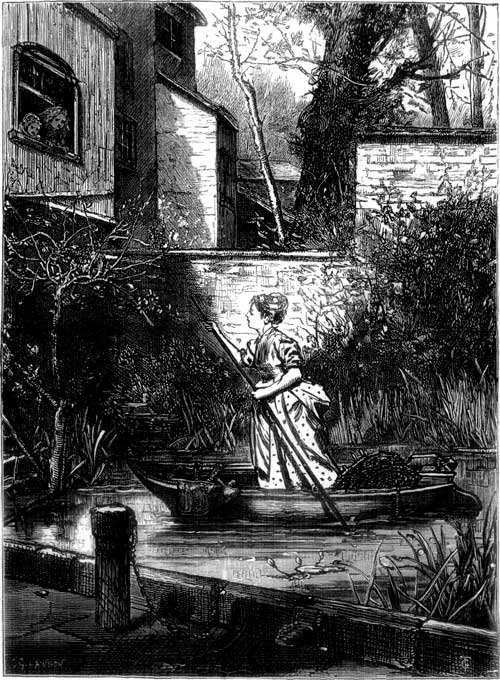
The morning sun had not mounted high enough in the sky to send his rays into Greta's room, when she was awakened by a noise. She listened. It was the sound of a boat grating against the side of the canal. Who could be coming to their back door so early? She sprang out of bed, and ran quickly to the open window. A disappointment awaited her. It was only her father's boat, which the maid-servant Charlotte was pushing along, slowly making her way to the landing-stairs.
"Where have you been so early, Charlotte?" called out Greta.
"Are you there, youngsters?" said Charlotte, looking up at the two bright faces at the window; for the little Amelia had been roused by her sister's wild jump from the bed, and had also run to the window.
"Bad Charlotte, to wake us so early!" cried Amelia.
Charlotte laughed. "You wouldn't think me bad, Minchen, if you knew all the good things I've been buying at market. Have you forgotten your cousins are coming to-day, all the way from over the sea? I'm sure they'll be hungry enough."
"What you got?" asked Amelia (usually called Minchen).
"Fine Beemster cheese, sweet butter, fresh salad, and plenty of fruit. And there are lots of good things at the bottom of the basket. I'll leave you to find out what they are." And Charlotte made the boat fast, and carried the heavy basket into the house.
It was not necessary for Charlotte to remind these little girls of the cousins who lived in the city of New York, in the far-off land of America. For the last month little else had been talked of in the Van Schaick mansion besides the expected visit of the Chester family. Mrs. Van Schaick and Mrs. Chester were sisters, and this was but the second visit the latter had paid her old Holland home since her marriage. On the first visit her children were not with her; but now Mr. Chester was coming, and the two boys. Many were the wild speculations the girls indulged in with regard to Americans,—what they would look like, and what they would say and do.
Great, then, was their surprise, when the travelers arrived, to find that their aunt Chester was very like their mother in appearance and dress. Mr. Chester did not in the least resemble their father, but he was not unlike many other men they had seen, and he did not dress in wild-beast skins. As for the boys, Greta poured her tale of woe into the ears of the sympathizing Charlotte. "They are just like English boys!" she said, contemptuously. Greta had often seen English boys, and there was nothing uncommon about them.
This was soon forgotten, however, when Greta discovered what pleasant companions the boys were, and that they could put the Dutch words together almost as correctly as Greta herself. Will Chester, who had reached the dignified age of thirteen, had felt much troubled at the thought that he would have "only girls" to play with at Zaandam, especially as Greta was a year younger than himself. But when the two girls, instead of bringing forward their dolls and tea-sets with which to entertain their visitors, produced from their treasures two good-sized toy canal-boats, fully equipped with everything a canal-boat needed, he admitted to himself that girls who liked to sail boats might be good for something.
Secretly, however, he thought that a canal-boat was a poor kind of vessel to have, and wished his cousins owned such beautiful ships as he and Martin had; for among the last things bought before leaving New York were two little sailing-vessels—the "America" and the "Columbus." Mr. Chester said Holland was full of water, and these were proper toys to take there.
The two canal-boats, being precisely alike, were distinguished from each other only by their names. Greta's had "Wilhelmina" painted on the side in black letters, while Minchen's had "Gouda" in red letters. They were similar to American canal-boats in shape, and of a dark red-brown color. Will thought them stumpy and heavy-looking; and he did not admire the red sails with crooked gaffs, and smiled at the blue pennants, stretched out on stiff frames that turned with the wind. But when Greta showed him a tiny windlass on the deck, by means of which she easily raised and lowered the mast, he came to the conclusion that a Dutch canal-boat was not to be despised.
"I do this when we pass under bridges," she explained.
"Where are your mules for drawing your boat?"
"My boat sails!" she said, proudly. "If there is no wind, I drag it along myself. That is the way we do in our country."
"CHARLOTTE WAS PUSHING THE BOAT ALONG, MAKING HER WAY TO THE LANDING-STAIRS."
The American vessels were now unpacked and displayed. When the girls saw these sharp-prowed, graceful ships, with their tapering masts and pretty[Page 542] sails, their eyes glistened, and they declared that never before had they seen anything so lovely. Their, pride in their canal-boats suffered a woful downfall. The boys proposed to try all the vessels on the canal at the back of the house, but Greta objected.
"Mother never lets us go there to sail our boats," she said. "It is a dirty place, and she is afraid we will fall in. But there is a beautiful stream by the mill where we are going to-morrow, and there we can try our boats, and see which goes the fastest."
"Let us take a walk, then," said Martin. "I want to look at this queer place."
The Van Shaicks lived in Zaandam, and it is indeed a queer place to American eyes. It is a large town, with but two streets, one on each side[Page 543] of the Zaan River; but these two extend for a long distance, and are crossed at frequent intervals by canals, so that Martin soon got tired counting the little bridges the children passed over in their walk. Will was not quite sure whether the brick-paved street was all road-way or all sidewalk.
"I don't see any carriages," he said, after studying this matter for some time.
"People don't ride much here," said Greta. "There are plenty of carriages in Amsterdam."
"How do you get about, then?"
"On our feet and in boats. Look at our fine river, and there are ever so many canals! What do we want with carriages?"
"It must be jolly going everywhere in boats," said Will. "I should like that!"
"We have some very pretty boats," said Greta, much pleased. "Oh! wouldn't you like to go fishing? I'll ask father to take us some day soon. I saw a net in the market-boat this morning."
"Well, if that isn't funny!" cried Martin, with a burst of laughter. Will joined in the laugh, and Greta looked around in vain to discover the cause of their merriment.
"Looking-glasses on the outside of the houses!" explained Martin, pointing to one opposite. "I guess they're put there for the girls to look in as they walk along," he added, mischievously. "They can't wait to get home to admire themselves."
Sure enough, there was a mirror outside the window, set at such an angle that the persons inside the house could see who was passing up and down the street. And there was a mirror on the next house, and the next.
"Why, they are on all the houses!" said Will.
"To be sure!" said Greta. "What is there funny in that? And the girls don't look in them any more than the boys, Mr. Martin. Don't you ever want to know what is going on in the street?"
"Of course I do."
"How are you going to do it without the looking-glass to tell you?"
"Use my own eyes, to be sure!"
"Whose eyes do you use when you look in a glass?" said Greta.
Martin looked puzzled, and had no reply ready; and Will thought his cousin Greta very clever, although she was a girl, and a year younger than himself.
But Martin soon recovered his composure.
"What lots of flowers!" was his next comment. "They are everywhere, except in this brick pavement, and nothing could grow here, it is so clean."
"And such pretty houses in the gardens!" said Will.
"But they are so small," said Martin, "It would take a dozen of them to make a New York house."
"My goodness!" said Greta, turning her head back as far as she could, and looking at the sky. "How do you ever see up to their roofs?"
"Divide Martin's twelve by four, and you will come nearer the truth," said Will, laughing. "But, at any rate, the houses are pretty—painted green and yellow, with red-tiled roofs."
The next thing the boys observed was the loneliness of the streets. In America a town of twelve thousand inhabitants would have more of an air of bustle, they said. Will liked the quiet, "for a change," as he expressed it, and because it made him feel, somehow, as if he owned the place. Martin declared it to be his opinion that the people kept out of the streets for fear that their shoes would soil them, and that accounted for the almost spotless cleanliness everywhere.
The streets were not deserted, however; for, at intervals, there were row-boat ferries across the river, and occasionally a man or woman would be seen in one of these boats.
There were also a number of children, and some women, in the streets. These apparently belonged to the poorer classes. Hats and bonnets were scarce among them, though all the women, and many of the little girls, had on close-fitting muslin caps. They wore short, loose sacques, and short dress skirts, made up without trimmings. The boys were dressed in jackets and baggy trousers. All wore clumsy wooden shoes.
The Van Schaick family followed the French fashions, as we do in America; the difference between the two countries being that here every one attempts to follow the prevailing style, while in Holland this change of fashion is confined to the wealthy; the middle and lower classes preserving the same style of costume from generation to generation.
A good many of the children in the street were carrying painted iron or stone buckets, with a tea-kettle on the top. After proceeding some distance up the street, Will and Martin saw some of them coming out of a basement door-way, still with the buckets in their hands; but clouds of steam were issuing from the tea-kettle spouts!
"What place is that?" asked Will.
"It is the fire-woman's," said Greta.
"And who and what may she be? I have heard of water-women, sometimes called mermaids, but never before did I hear of a fire-woman."
"She don't live in fire," said Greta; "she sells it. What do the poor people in your country do in summer without a fire-woman? Come and look in."
AT THE FIRE-WOMAN'S.
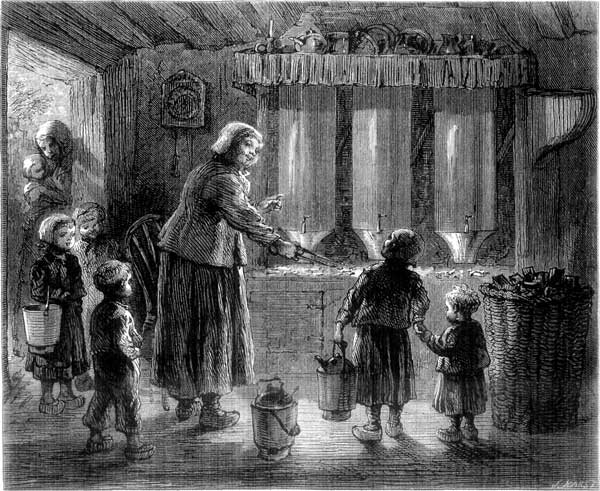
By this time they had reached the place. Over the door was the sign "Water en vuur te koop."1 [Page 544] It was not necessary for the children to go inside. They could see the whole apartment through the wide-open door-way. An old woman stood by a stove, or great oven, with a pair of tongs, taking up pieces of burning peat and dropping them into the buckets of the children, and then filling their tea-kettles with boiling water from great copper tanks on the stove. For this each child paid her a Dutch cent, which is less than half of one of ours.
"I understand it," said Will, after they had stood at the door some time, amused at the scene. "This saves poor people the expense of a fire in the summer-time. They send here for hot water to make their tea."
"Yes," said Greta, "and for the burning peat which cooks the potatoes and the sausage for their supper."
"Why don't they use coal?" asked Martin. "It is ever so much better."
"No, the peat answers their purpose much better," said Will. "It burns slowly, and gives out a good deal of heat for a long time."
"And the smell of it is so delicious," added Greta.
A little further on; the children came out on an open space, which gave them a good view of the surrounding flat country, and of the wind-mills that stand about Zaandam—a forest of towers. It was a marvelous sight. Hundreds of giant arms were beating the air, as if guarding the town from invisible enemies.
Greta was proud and pleased that her cousins were so impressed with the great numbers of towers and the myriads of gigantic whirling spokes.
"My father says there is nothing grander than this in all Holland," she said. "There are four hundred of them, and more, but you can't see them all from here. Do you see that mill over yonder? That is my father's, and we are going there to-morrow."
The boys could not distinguish one tower from another at that distance.
"What kind of mill is it?" asked Will.[Page 545]
"A flour-mill."
"Are all these flour-mills?"
"Oh no! There are saw-mills, colza-oil mills, mustard-mills, flax-mills, and other kinds I don't remember."
It was now nearly supper-time, and the little group returned home.
The next morning, the whole party—four grown-up people, four youngsters, and four boats (the "Wilhelmina," the "Gouda," the "America," and the "Columbus")—were all taken up the Zaan River in a row-boat for about three miles, and then up a small stream to the mill where they were to spend the day.
The first thing in order was the inspection of the mill, which was unlike anything they had ever seen in America. The tower was of brick. It was three stories high, over a basement. In the basement were the stables and wagon-house; over this was the granary, and flour and meal store; above this were the bolting-rooms, the ground wheat running through spouts to the store-rooms below. On the next floor above were the mill-stones, and the simple machinery that turned them. And, above all, at the very top of the tower, was the main shaft of the great wings outside. These wings caught the winds, and compelled them to work the machinery with such force as to make the strong tower tremble. There were balconies around the first and third stories of the mill. It was quite a picturesque object standing among low trees on a pretty, quiet stream, the banks of which were higher and more uneven than was usual in that part of the country.
The miller lived in a small house near the mill with his wife and his little daughter Hildegarde, the latter of whom was near Greta's age.
The boys did not take as much interest in the miller's house as their parents took; but when they were shown into a large outer room, and were told it was the cow-stable, they had no words with which to express their astonishment. They would have said it was the show-room of the place. There was not a speck on the whitewashed walls; the pine ceiling was so clean it fairly glistened; there were crisp, white muslin curtains at the windows. The raised earthen floor was covered with pure white sand, arranged in fancy designs. There were some small round tables standing about, and on them were ornaments of china and silver, and a variety of knick-knacks.
During the summer the cows were in the pasture day and night, but in the winter they occupied this room. Then the tables were removed, but the place was kept very neatly. This was necessary, for the stable adjoined the house, and the party passed into the barn through a door in the cow-stable.
All except the two boys. Will hung back and motioned to Martin not to go into the barn.
"I am tired of this sort of thing," he said. "Let us go and sail our boats."
"Very well," said Martin, "I'll call the girls."
"No," said Will; "there are too many of them. They'll only be in the way. They'll have a good time together, and we'll have some fun by ourselves."
Martin seldom dissented from Will's decisions, so the two boys went back into the house to get their ships, and passed out of another door to the bridge and across the stream. They had gone but a short distance when Martin, who had seemed very thoughtful, stopped opposite the mill.
"There is a man in the balcony," he said. "I'll ask him to call to the girls to come. It isn't fair to go without them. You know Greta thought so much of sailing her boat with ours."
"Nonsense," said Will. "She has got other company now. I don't believe they know how to manage their boats, and we will have to help them. Girls always have to be taken care of."
"But," persisted Martin, "you said that Greta was real smart and a first-rate fellow—girl, I mean."
"She is well enough for girls' plays; but what can she know about boats? Come along!"
Martin said no more, and the boys proceeded for some distance up the stream.
"If we go around that bend," said Will, "we will be out of sight of the mill, and can have our own fun."
Around the bend they found a bridge, and a little way above this the stream widened into a large pool, the banks of which were shaded by willows. There they launched the schooner "America" and the sloop "Columbus" with appropriate ceremonies. The sails and the rudders were properly set for a trip across the pool. The ships bent gracefully to the breeze, and went steadily on their course, the little flags waving triumphantly from the mast-heads. They moved so gracefully and behaved so beautifully that Martin expressed his sorrow that the girls were not there to see them. Will made no reply, but he felt a twinge of remorse as he remembered how Greta had looked forward to this sail as a great event. He tried to quiet his conscience with the consideration that it was much better for her not to be there; for she would certainly have felt mortified at the contrast between their pretty vessels and the poor canal-boats.
The boys crossed the bridge, and were ready for the arrival of their vessels in the foreign port. Then they started them on the return voyage and recrossed the bridge to receive them at home.
This was done several times, but at last there was[Page 546] an accident. Will's schooner, the "America," from some unknown cause, took a wrong tack when near the middle of the pool, and going too far up, got aground upon a tiny, grassy island. She swayed about for a minute, and the boys hoped she would float off, but soon the masts ceased to quiver. The "America" had quietly moored herself on the island as if she intended to remain there forever. What was to be done? The longest pole to be found would not reach the island from either bank, or from the bridge, and the pool was deep. Will began to think it was a pretty bad case.
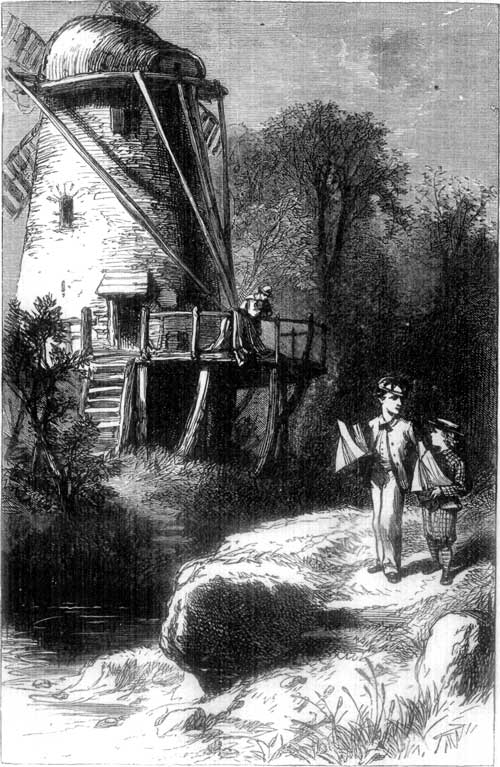
THE BOYS WITH THEIR BOATS.
"What a beauty!" "Isn't it just lovely!" "Pretty! pretty! pretty!"
These exclamations came respectively from Greta, Hildegarde, and Minchen, and had reference to the "Columbus," which was gliding up to the bank where the boys stood, with its sails gleaming in the sunshine, while it dipped and courtesied on the little waves. The girls were coming around the bend. Greta and Minchen had their canal-boats, and Hildegarde carried a great square of gingerbread.
"That's the most beautiful thing I ever saw!" cried Greta. In her admiration of the vessel, she had forgotten her wounded dignity. For she had arranged with Hildegarde that, after giving the[Page 547] boys their share of gingerbread, they should walk proudly and silently away.
As Greta had broken the compact by speaking, Hildegarde entered upon an explanation: "We have been down the stream looking for you—" But here she was interrupted by a frown from Greta, who suddenly recollected the slight that had been put upon them.
"Naughty boys to run away!" said little Minchen. "You sha'n't see my boat sail!"
"My ship is aground on that island," said Will, willing to change the subject. "I have no way of getting her off. I wonder if the boat we came in is too large to be got up here."
"The boat was taken back to Zaandam," said Hildegarde, "and our boat is away, too."
"The 'America' will have to stay where she is, then," said Will, trying to speak cheerfully.
"Pretty ship is lost! Too bad!" said Minchen, pityingly. Then brightly: "I'll give you mine!-may be," she added in a doubtful tone, as her glance fell lovingly upon the boat she was hugging under her arm.
Meantime, Greta had been studying the situation. She now turned to Will. "I can get your ship off," she said. "Take care of my boat till I come back, and don't sail her on any account. I wont be gone long."
She handed her boat to Will, and was around the bend in an instant; and it was not very long before the anxious group heard the sound of her rapid footsteps returning. Will thought she had gone to the mill to get some one to help them, but she came back alone, and all she brought with her was a large ball of cord.
Martin and Minchen asked her twenty questions while she made her preparations, but she would not reveal her plans, although it was evident from the way she went to work that she had a very clear idea of what she intended to accomplish.
In the first place, she said the whole party must go further up the bank, so as to get above the "America," which was on the lower edge of the little island. When they had gone far enough, she tied one end of the cord to the rudder-post of her canal-boat. Then she turned the cunning little windlass, and slowly up went the mast to its full height. The next thing was to unfurl the sail, set it properly, and set the rudder,—all of which she did deftly and correctly, making Will feel ashamed of what he had said about the ignorance of girls.
She placed the boat on the water. The sail filled, and off went the "Wilhelmina" with a slow, true, steady motion, her red sail glowing in the sunshine, and her stiff little pennant standing straight out in the wind. As the boat crossed the pool, Greta played out the cord carefully, so as not to impede its motion. When it reached the other side and had gently grounded on the shelving shore, Greta gave the line into Will's hand.
"If you will hold this," she said, "I will go across the bridge."
"Don't trouble yourself to do that," said Will, "I will go over."
"No," said Greta, "I wish to go. I am captain of my own craft, and I know how to manage my 'Wilhelmina.'"
"I had no idea she was so pretty," said Will. "She is a true, stanch little sailer."
"She don't show off until she is on the water," said Greta, smiling, "and then she sails like a real boat. Do you know what I am going to do when I get to the other side?"
"I can guess. You will send your boat back to me from below the island while I hold this end of the cord. That will bring the line around my ship and pull her off."
"I thought of that, but it is too risky. If anything should go wrong with my boat, the line might get tangled; or there might be too great a strain, and the ship would come off with a jerk and be tumbled bottom upward into the water. I intend to untie the cord from the boat, and you and I must walk slowly down toward the 'America,'—I on that side, and you on this. We must hold the cord low so as to catch the mast under the sail, if we can."
"All right," said Will.
Greta walked quickly down the bank, across the bridge, and up the other side until she reached the "Wilhelmina." Placing the boat on the bank for safety, she took the cord off, and, holding it firmly, walked slowly down toward the island. Will did the same on his side of the pool. The cord went skimming over the surface of the water, then it passed above the tops of the long grass on the island. This brought the line on a level with the top-sail. This would not do; for a pressure up there might capsize the schooner. Both of the workers saw that they must slacken the line a little to get it into the proper place. Now was the critical time; if the line was too much slackened it might slip under the vessel and upset it that way. Gently they lowered it until it lay against the mainmast below the sail.
"Take care!" screamed Will to Greta.
"Go slow!" screamed Greta to Will.
Gently they pulled against the schooner, and, inch by inch, she floated off into the open water.
"Hurrah!" shouted Will, as the "America" gave herself a little shake, and, catching the wind, sailed slowly and somewhat unsteadily for the home port, which, however, she reached in safety. "Wind up the cord!" shouted Greta, just in[Page 548] time to prevent Will's throwing it aside. He wondered what further use she had for the cord. It might go to the bottom of the pool for aught he cared, now that the ship was safe. But he wound it up as directed. It would have been quite a grief to the thrifty little Dutch girl if so much fine cord had been wasted.
Thus ignominiously came in the stately ship "America," which Will had set afloat with such pride! And it is doubtful whether she would have come in at all, but for the stanch Dutch canal-boat that he had regarded with a good deal of disdain.
If Will had been a girl, he would have exhausted the complimentary adjectives of the Dutch language in praise of his cousin; but being a boy, he only said, "Thank you, Greta."
The children remained at the pool until called to dinner; and after that meal, they went back again and stayed until it was time to return to Zaandam, so fascinated were they with sailing their vessels. These changed hands so often that it was sometimes difficult to tell who had charge of any particular boat, and a good deal of confusion was the result. In justice to the "America," it must be stated that she cut no more capers, and was the admiration of all.
Will had his faults, and one of these was the very high estimate he placed on his own opinions. But he was generous-hearted, and he admitted to himself that Greta had shown more cleverness than he in the "America" affair. "She was quicker, anyway," he thought. "It is likely that plan would have occurred to me after a time, but she thought of it first. And it was good of her to help me; for she knew that I went away so as not to play with her." It was not pleasant to him to know that a girl had shown herself superior to him in anything he considered his province; but he magnanimously forgave her for this, and he said to Martin, after they were in bed that night:
"I've pretty much made up my mind to give my schooner to Greta. I believe she thinks it the prettiest thing ever made."
"If you do that," said Martin, "I'll give my sloop to Minchen."
This plan was carried out, and the girls were more delighted than if they had had presents of diamonds. But they insisted that the boys should accept their canal-boats in exchange, the result of which was that the Chesters, on their return to America, produced quite a sensation among their schoolmates. For American-built vessels could be bought in many stores in New York, but a Dutch canal-boat, with a red sail, and a mast that was raised and lowered by a windlass, was not to be found in all the city.