MASTER MONTEZUMA.
Reading edition
(With Illustrations copied from Mexican Hieroglyphics.)
By C.C. Haskins.
[Note.—Montezuma II., the last of the Aztec (or native Mexican) emperors, was born about 1480. He was taken prisoner by Hernando Cortes, the commander of the Spanish army which conquered Mexico, and, in the hope of quelling an insurrection which had arisen among his former subjects, he consented to address them from the walls of his prison. Stung by the apparent desertion of their leader to the cause of the enemy, the Mexicans assaulted him with stones and other missiles. He was struck on the temple by one of the stones, and died from the effects in a few days. The illustrations are true copies of old Mexican pictures, which appeared originally in the "Collection of Mendoza," a work frequently referred to by all writers on ancient Mexico.—C.C.H.]
The Emperor Montezuma was a great man, and historians have recorded much about him, but of his earlier life, when he was plain Master Montezuma, comparatively little is known of this rising young gentleman.
Master M. commenced his earthly career as a crying baby, in the year "one cane," which, when properly figured down according to the Gregorian calendar, would be about the year of our Lord 1480.
No sooner had Master M. reached the fourth day of his existence, than the nurse, under instructions from his anxious mamma, took off what few clothes the poor boy had on, and repairing to the baptismal font in the yard, sprinkled cold water upon his naked breast and lips, presented his credentials in the shape of offerings to propitiate the gods of war, agriculture, etc., whose names you will find further along in this history, repeated a prayer in which "the Lord was implored to wash away the sin that was given him before the foundation of the world, so that the child might be born anew," and told the three little boys who sat near by, what Master M.'s name was to be. The three little boys left off eating their parched corn, and boiled beans, repeated the name, and the little baby was christened.
Now, if Master M. had been a girl—which he was not—the offerings would have been a mat, a spinning machine and a broom, all of which would have been buried under the metate, the stone where corn was ground. As it was, the offerings were implements of war, articles of metal, pottery, etc., and these were buried, as near as they could guess at the location, where they either hoped or feared there might some day be a battle with their enemies.
When Master M. had eaten and slept and kicked and cried for sixteen days longer, his parents took him to the priest, and to the teacher, and promised that he should be instructed by these worthy gentlemen in war, politics, religion, and other branches of general education. They promised that he should be an Alfalqui, or priest, and should also serve in the army as a soldier. In that little, wiggling baby, that seemed all fists and mouth, it was impossible to foresee the future Emperor of Mexico, whose name has since become familiar to the civilized world.
Young Master M. worried along pretty well, and up to six years of age had done nothing remarkable. At this age he was granted one and one-half rolls at a meal, and commenced doing little errands and picking up scattered beans and corn in the Tianquez, which is what the Mexicans called the market-place.
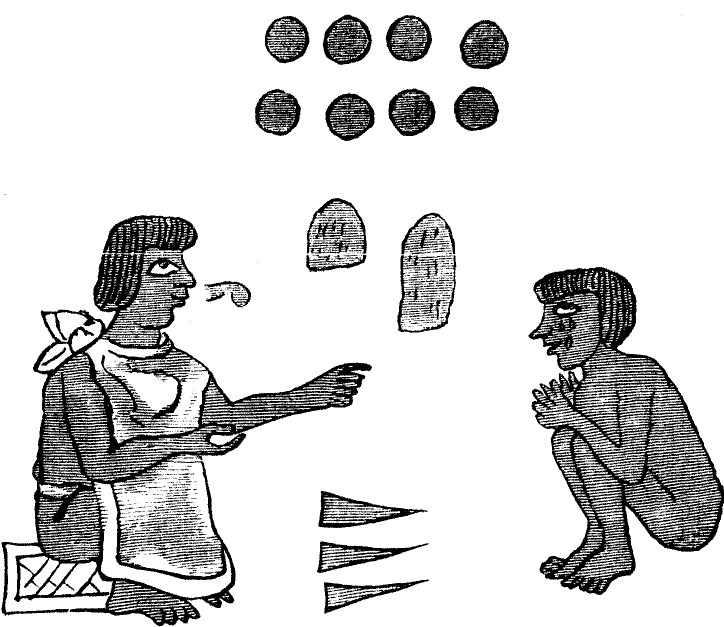
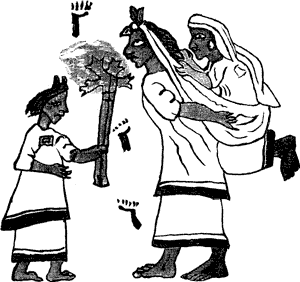
The restless spirit of a military chieftain now began to show itself in the embryo warrior, and, by the time he had reached his eighth year, discipline became necessary to curb his growing inclination to despotism. He was fast becoming one of that class of boys who think "it's too bad to be good all the time." In the second picture see the scalding tears! Whether Master M. is sorry that he has done wrong, or whether he only fears being pricked with those terrible thorns of the aloe with which he is threatened, or is crying because he is cold, who shall tell? It is hard, sometimes, to tell what eight-year-old boys are crying for, whether they live in the United States or in Mexico.
Master M. may have been better than most boys, and it may be that his father was a better driver than leader for his little ones. Some fathers are. In any event, when Master M. was ten years old there came another opportunity for weeping and wailing, and Master M. was submitted to the mortification of lying on the damp ground all day while he listened to a parental lecture; and this, too, after he was twelve years old!
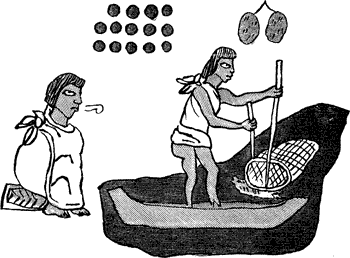
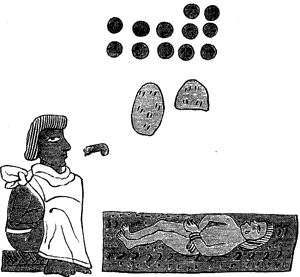
Then Master M. reformed, and became an industrious, faithful boy. I have sometimes questioned whether he wasn't hungry, and if he had been better fed whether he would not have done better. At fourteen years of age they gave him two rolls at a meal, and he was instructed in the art of fishing with a net. You can tell how old the boy is by the number of round marks in the picture, and the person who is speaking is denoted by a tongue in front of the mouth.
When his fifteenth year came, Master M. found he would have plenty to do. After this, old Mr. M. had no trouble with him. It is curious—the[Page 536] more we have to do, the less liable we are to do something we should not, and—let us all study on that half an hour, some day, and see what we can make of it.
MASTER MONTEZUMA'S PARENTS TAKE HIM TO THE PRIEST AND THE TEACHER.
He had two teachers, the priest and the military professor. It seemed as if everything was to be learned. There was arithmetic, he learned to make figures. A round, blue dot stands for one.
Five of them make five, and ooooo-o (five and one) is six, and in that way it runs up to ten. If he wanted to say "twenty" he made a flag, and for forty he made two flags.
Just imagine such a multiplication table as this: Five times four is one flag. Flag times flag is one plume. Flag times plume is one purse! Let's see; a purse, then, would equal 8,000. Yes, and if he wanted to write 4,000 he would draw only half a purse. All the examples in their arithmetic were worked by such tables as these.
Then there were lessons in time. He had to learn that five days make a week, four weeks make a month, and eighteen months make a year; and as all that footed up only three hundred and sixty days, they threw in what they called the five unlucky days that belonged to no month, to fill up before they commenced a new year. And then he found another arrangement for doing what we do with our leap-year, for, once in fifty-two years they put in twelve and one-half extra days, which is something like setting the clock ahead when you find it is too slow by the town bell or the fire alarm.
MASTER MONTEZUMA MUST BE PUNISHED.
He learned that this kind of calendar had been in use a long time, and was the result of careful study and calculation by the wise priests of the olden time; and, when he wanted to know how long, he counted up the bundles of reeds which represented centuries, and found that it had been in use over four hundred years. And all this, you must remember, was before San Salvador was discovered[Page 537] by Columbus. Then he had to study all about the naming of the years and the cycles. How, if this year was "one rabbit," next year would be "two cane," the third "three flint," the next "four house," and these four elements, representing air, water, fire, earth, would be thus repeated up to thirteen, and then they would commence at one again, so that the fourteenth year would be "one cane," etc., and in four of these cycles of thirteen they would reach a cycle of fifty-two years, or, as they called it, a "bundle," and as the twelve and one-half days additional would end one cycle of fifty-two years at midday, and the next at midnight, they bundled two of these together and called it "an old age."
MASTER MONTEZUMA IS TAUGHT HOW TO FISH.
The number fifty-two was an unlucky number, and these old Mexicans believed that at the end of a cycle of that number of years, at some time, the world would be depopulated, the sun put out, and, after death and darkness had reigned awhile, it would all begin afresh with a new race of people.
So, when a cycle or bundle was completed, all fires were extinguished and not rekindled during the five unlucky days. Household goods which could no longer be of any service, dishes, household articles, etc., were broken; every one gave up all hope, and abandoned himself to despair while awaiting the expected ruin.
On the evening of the fifth day of sorrow, the priests gathered the people together in a procession and marched to a temple, about two leagues from the city.
MASTER MONTEZUMA IS TALKED TO BY HIS FATHER.
Here they would sit like bumps on a log until midnight, and then, when the constellation which we call the Pleiades came exactly overhead, the danger was over. Two sticks were rubbed together over the breast of a captive who had been selected for the sacrifice, until fire was produced by the friction, the funeral pile was lighted, the body burned, and messengers, many of whom could run long distances, at the rate of seven or eight miles an hour, would light their torches and spread the joyful news of danger averted, while carrying the "new fire" into all parts of the empire. Then would follow a regular old-fashioned frolic, something like a centennial,—a jollification few had ever seen and most would see but once in a life-time. There must be no drunkenness, however; that was a high crime, in some instances punished by death. If the intemperate party, man or woman, was over seventy years of age, however, no notice was taken of it,—they were old, and had rights and privileges not granted to younger members of the community.
Master M. had much to learn about deities. At the head of these stood one, infinite, supreme ruler, "the unknown God," and next beneath him came[Page 538] Tezcatlipoca, the "son of the world," supposed to be the creator of the earth.
CARRYING THE BRIDE.
Huitzilopotchli was the god of war, a sort of Mars, but with very much more name. Then there was the god of air, Quetzatcoatl, who controlled vegetation, metals, and the politics of the country. Here is something Master M. was taught to believe of him:
When this god, whom we will call Q, was on earth, vegetation was so wonderfully prolific that a single ear of corn was all a man could carry. Everything the people needed grew spontaneously. Cotton grew more beautifully tinted than the dyers of the present time could color it. Richest perfumes loaded temperate breezes, and everywhere the gaudiest-colored birds filled the air with most entrancing harmonies. Q had some little difficulty, however, with the rest of the gods, and was obliged to leave his little paradise. When he embarked in his wizard snake-skin canoe on the shore of the gulf, he told his friends that his descendents would one day return and bless the land as he had done, and that they would be like him,—tall, fine looking, with dark hair, white skins, and flowing beards. Alas! this belief was in no small degree the cause of their ruin; for the invading Spaniards quite nearly answered this description of Q's descendants.
THE WEDDING OF MONTEZUMA.
There were thirteen of the principal deities, as Master M. learned, each of whom required sacrifices more or less horrible. For instance, there was the "soul of the world," I forget his other name. He must be propitiated now and then. A year before the fatal day, a tall, beautiful, well-formed, unblemished captive was selected to play the part of this god for one year. He must have all these qualifications to make the resemblance as perfect as possible. He was now treated as a god. Everything he could wish, everything it was thought could possibly conduce to his pleasure, comfort, or happiness, was furnished without stint. He slept on the softest of couches in the most gorgeous of chambers; his raiment was profuse and expensive, and the whole surroundings were, as far as possible, in keeping with his high and holy estate. Birds and music, flowers and rare perfumes pleased every sense, and everything, save liberty, was his. This happy-go-lucky sort of life continued until the day fixed for the sacrifice. Then joy gave way to sadness, pain, death! Stripped of his costly raiment, he was taken by a procession of priests to a royal barge, thence across a lake to a temple about a league from the city, where, as he mounted the weary steps of the huge edifice, he flung aside the garlands of flowers and broke the musical instruments which had been a joy to him in his past days. At the summit of the temple, in full view of the assembled multitude below, he was barbarously put to death by a priest, in order to propitiate the cruel god to whom the temple was dedicated. And Master M. was taught that the moral of all this savagery was, that human joys are transitory, and the partition between sorrow and happiness is a[Page 539] very thin one, or words to that effect.
Master M. learned that there were many other inferior gods, each of which had festivals, sacrifices, etc., proportioned to his rank and power; that nearly every hour of the day was dedicated to some god or other; but I cannot tell you all he learned of these strange deities.
A PEACE-OFFERING IN THE YEAR ONE RABBIT.
He studied the history of the temples, and learned why they were four or five stories high with the stairs on the outside, and why he had to go entirely round the temple to find the next flight of stairs as he went up or down; and why each story was smaller than the next lower, and learned that some of these buildings were over one hundred feet square and as many feet high, and had towers forty or fifty feet high on their summits; and all about the everlasting fire which burned on the tops of these temples, and that there were so many of these that the whole country for miles around was always brilliantly illuminated.
I must pass over a long period in the life of Master M. with the mere remark that he graduated in both his military and religious classes with the highest honors, and acquitted himself to the most perfect satisfaction of both the alfalquis, or priests, and the teachcauhs, which is nearly the same as our word teachers.
Master M. had, for a long time, cherished a hope that some day he might press the throne as king of Mexico. So, like the Yorkshire lad who begged salt of a stranger eating eggs near him, so as to have the salt ready in case any one should ask him to accept an egg, he prepared himself fully for the possible emergency, and became not only a military general, but a leading alfalqui.
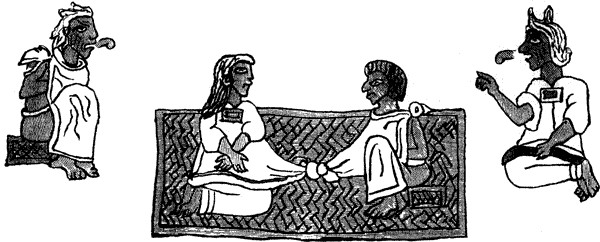
And then he married. I have not room to give you the whole picture, but here is the way it was done.
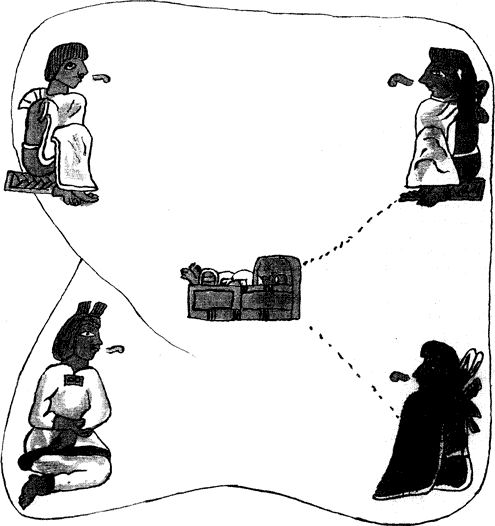
A lady whose position in society required her to negotiate the match, having previously made all the necessary arrangements, one evening, hoisted the happy damsel on her back, and accompanied by four young women (I have drawn only one) each bearing a torch, headed the joyous procession and marched to the house of Master M., where she dropped her cargo of precious humanity. Then the alfalqui asked them if they were mutually agreed on matrimony, and of course, they said "yes," when he proceeded to tie their clothes together. Then two old patriarchs and two good old grandmothers (one of each of which I have copied for you) delivered little sermons suited to the occasion. The new couple walked seven times round a blazing fire, partook of a feast with their friends, heard a final sort of a "ninety-ninthly and to conclude" parting word from the four old people, and then, just as all married people do, went to housekeeping, and having their own way as much as possible. One thing they could not do. There was no law of divorce to appeal to then; death was the only judge who could entertain the question of separation.
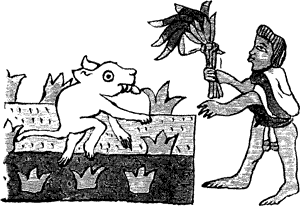
PROTECTING THE GRAIN FROM RATS, IN THE YEAR ONE RABBIT.
Master M. will now disappear, to re-appear as the Emperor. In the year "ten rabbits," or A.D. 1502, the monarch died, and the electoral college selected Master M. to supply his place. In the household of each monarch there was an electoral board of four nobles, whose duty it was, on the death of the ruler, to elect his successor from among the sons and nephews of the crown. Having[Page 540] done this, and so notified the successor, they selected four nobles to fill their own places, and vacated their electoral chairs. Master M. when waited upon to be notified of his election to fill his uncle's place, was very busy sweeping down the stairs in the great temple dedicated to the god of war!
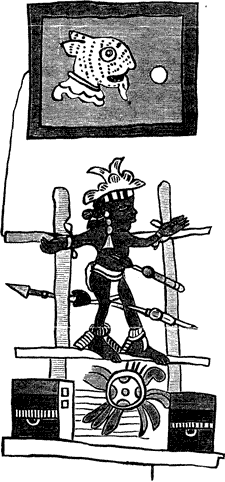
Four years after becoming emperor, Montezuma, to appease the gods, made a sacrifice of a young gentleman captive by transfixing him with arrows. This, you see, was in the year "one rabbit." It is recorded that in this year the rats overran the country so completely that the inhabitants had to stand guard at night with blazing torches to prevent their devouring the grain sown in the fields.
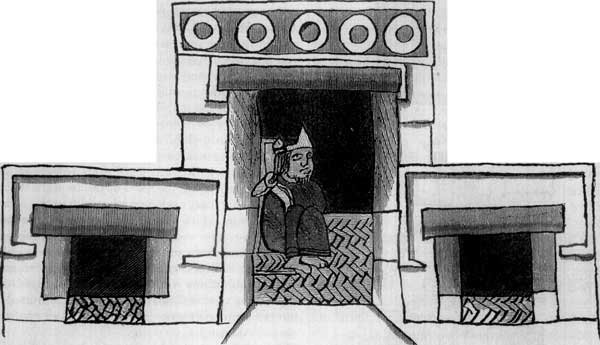
With the last picture, I take pleasure in introducing to you Master M. in his new position as Emperor of Mexico, seated in the royal halls.
For further particulars, read "The Conquest of Mexico," by Prescott.
THE EMPEROR MONTEZUMA, SEATED IN THE ROYAL HALLS.