CRUMBS FROM OLDER READING.
Reading edition
BY JULIA E. SARGENT.
III.—THOMAS CARLYLE.
"Shakespeare says we are creatures that look before and after. The more surprising, then, that we do not look around a little, and see what is passing under our very eyes."
So writes Thomas Carlyle.
Although he politely says "we," when speaking of people in general, that part of the "we" known as Thomas Carlyle certainly keeps his eyes wide open. So wide, indeed, that much that is disagreeable comes under his notice, as always will be the case with those who choose to see everything.
I once watched the round, red sun as it crimsoned the sparkling waters in which it seemed already sinking. When, at last, I turned my dazzled eyes away, all over lake and sky I saw dancing black suns. Perhaps it is through dwelling long on one idea that Carlyle sees only spots of blackness on what others call clear sky. The great want of that foggy, smoky city where he lives is pure, health-giving light, and this we also miss in his writings, which, like London, have not enough sunshine.
But, whatever people may say, when Carlyle speaks the world is quite ready to listen.
Who is Thomas Carlyle?
He is a Scotchman, a philosopher, an essayist, an historian, a biographer, and an octogenarian.
What has he done to be so famous?
He has written twenty books. But you might live to be an octogenarian yourself without meeting twenty persons who would have read them all. It would not be a hard matter, though, to find those who have read one of his books twenty times; perhaps this very green-covered book with "Sartor Resartus" on the back.
What does it mean, and what is it all about?
It means "The Tailor Re-tailored," and Carlyle says it is a book about clothes. But you need not look for fashion-plates; there are none there. You will hear nothing about new costumes; for this book is full of Carryle's own thoughts, clothed in such words that you will surely enjoy the book.
Hear how he tells us that nothing that we do is really "of no matter," as we so often think:
"I say, there is not a red Indian hunting by Lake Winnepeg can quarrel with his squaw but the whole world must smart for it: will not the price of beaver rise?"
You think it would not make much difference if the price of beaver should rise? Let us look at the matter. First, Mr. B. Woods, the trader, must pay a larger price for his beaver, and therefore must sell for more to the firm of Bylow & Selhi. These shrewd gentlemen do not intend to lose on their purchase, so they pay a less sum to Mr. Maycup, the manufacturer. This reduction in his income causes Mr. Maycup to curtail family expenses. So his subscription to ST. NICHOLAS is discontinued, and the youthful Maycups are overwhelmed with grief, because of that unfortunate quarrel which raised the price of beaver.
But why should the price change because of that?
Really, Mr. Carlyle should answer you. Perhaps the Indian in his quarrel forgets to set his traps, or the whole neighborhood may become so interested in the little affair that beavers are forgotten.
"Were it not miraculous could I stretch forth my hand and clutch the sun? Yet thou seest me daily stretch forth my hand and clutch many a thing and swing it hither and thither. Art thou a grown baby, then, to fancy that the miracle lies in miles of distance, or in pounds avoirdupois of weight; and not to see that the true miracle lies in this, that I can stretch forth my hand at all?"
What is it that Carlyle thinks so wonderful? See how quietly my hand rests on this table. Why should it move any more than the table on which it rests? Is not Carlyle right when he calls every movement of my hand a wonder? You never thought of it before? That is as Carlyle says: "We do not look around a little and see what is passing under our very eyes."
It was this great old man whose hand brushed the clinging mud from a crust of bread, and placed it on the curbstone, for some dog or pigeon, saying, "My mother taught me never to waste anything."
Here is a word for those who are always planning what great things they will do—who think so much about doing that no time is left for the doing:
"The end of man is an action, and not a thought, though it were the noblest."
Now, for our final crumb, comes a well-clothed thought that I like better than quarreling Indians or familiar wonders. It is the reason why selfish people are never really happy. Carlyle thinks they have only themselves to blame, for he says:
"Always there is a black spot in our sunshine; it is even, as I said, the shadow of ourselves."
[Page 566]
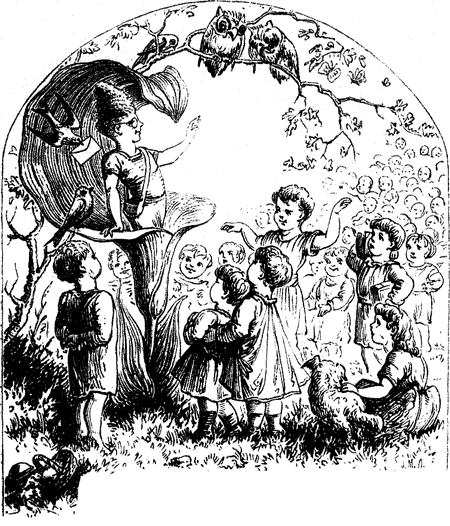
JACK-IN-THE-PULPIT.
Hurrah for June!—bright, rosy June! "Joy rises in me like a summer's morn!" as one of those pleasant people, the poets, has said.
Let everybody be glad! But most of all, you, my youngsters! The month properly belongs to you. Don't I know? Wasn't it set apart by Romulus, ages and ages ago, especially for the young people, or "Juniores," as they then were called? And hasn't their name stuck to it ever since? Yes, indeed! So, be as merry as you can, my chicks; but, with all your fun and frolic, be thankful, and make June weather all about you. June time—any time—is full of joy when hearts, brimming over with thankfulness, carry cheer to other hearts, making
"A noise like of a hidden brook In the leafy month of June, That to the sleeping woods all night Singeth a quiet tune,"—
like the little stream that bubbles by the foot of our meadow.
Now to business. First comes a letter about
A ROPE OF EGGS.
Brooklyn, N.Y. My Dear Jack-in-the-Pulpit: I know about a rope of eggs, and I will tell you. It is in Japan. The eggs are plaited and twisted into ropes made from straw, and so it is safe and easy to handle them. Just think how queer it would seem to buy eggs by the yard! AMY M.
CONVERSATION BY FISTICUFFS.
After being flurried by clouds of paragrams about sphygmographs, and phonographs, and pneumatic telegraphs, and scores of other extraordinary scientific ways of communication, I'm not in the least surprised to learn that ants converse by one tapping another's head.
I'm told that an Englishman named Jesse once put a small caterpillar near an ants' nest, and watched. Soon an ant seized it; but the caterpillar was too heavy to be moved by one ant alone, so away he ran until he met another ant. They stopped for a few moments, during which each tapped the other's head with his feelers in a very lively manner. Then they both hurried off to the caterpillar, and together dragged it home.
A HORSE THAT LOVED TEA.
Roxbury, Mass. Dear Jack-in-the-Pulpit: This is a true story of Mary's horse. He was just as black as a coal all over, except a pretty white star on his forehead.
Once in two or three weeks Mary had him take tea with her and her little brother and sisters. She went to the stable where he lived with Kate and Nell, two pretty twin ponies, and said to him:
"Come, Jack! Don't you want some, tea?"
At that, he came right up to her, and found out the buttons on her dress, and tried to pull them off, and then untied her apron strings.
"Now, Jack," Mary said, "tea is all ready. Come along!"—and he followed her along the walk to the back door and up the three steps into the house.
What a clatter his iron shoes made along the entry to the dining-room!
Harry and Annie and Fanny rushed out, crying:
"Oh, mamma! Here's Jack coming to tea!"
Then mamma filled a large bowl with tea, put in plenty of milk and three or four pieces of white sugar (for Jack had a sweet tooth), and cut a slice of bread into pieces, and put them on a plate, with a doughnut or piece of gingerbread. And Mary said:
"Now, Jack, come up to the table!"
You see, he was too big to sit in a chair; but he came close up to the table and stood there, and drank his tea without slopping any over, and ate up his bread and cake. And when he had done, what do you think he did? Why, he went up to the piano that stood in a corner of the room and smelled the keys, and looked round at Mary. That was to ask her to play him a tune before he went home.
Then she said, "Oh, you dear Jack! I know what you want!" And she sat down and played some merry tune, while he pricked up his ears and put his nose down close to her fingers, he was so pleased. Then he rubbed her shoulder with his nose, and Mary played another tune for him.
"Now, Jack," mamma said, "you've had a nice time; but you must go back to your stable. Kate and Nell will miss you if you stay longer."
Then Mary opened the dining-room door, and Jack followed her down the long entry and out to the stable, just like a dog.—Yours truly, B.P.
TONGUES WHICH CARRY TEETH.
You've heard of folks with biting tongues, I dare say, and very disagreeable they are, no doubt, though, of course, they do not actually bite with their tongues. However, there really is an unpleasant fellow whose tongue carries twenty-six thousand eight hundred teeth! A capital one for biting, you'd suppose. He is nothing but a slug, though, and his army of teeth only scrape, not bite, I'm told. Then, too, there is a sort of cousin of his, a periwinkle, who has a long ribbon-like tongue, armed with six hundred crosswise rows of hooks, about seven in a row.
You can make sure of these surprising facts, my dears, with the aid of patience and a microscope.
DIZZY DISTANCES.
The other day, one of the school-children said to a chum, "The Little Schoolma'am told us this morning that some parts of the ocean are more than four miles deep!"
That's easy to say, thought I, but try to think it, my dear! Fix on a place four miles away from you, and then imagine every bit of that distance stretching down under you, instead of straight before you. Perhaps in this way you may gain an idea of the depth of the ocean; but just consider the height of the air—which, I'm told, is a sort of envelope about the earth—more than nine times the depth of the ocean! Yet, what a wee bit of a[Page 567] way toward the moon would those thirty-six miles take us! And from the earth to the moon is only a very little step on the long way to the sun.
Oh dear! Let's stop and take a breath! Why did I begin talking of such dizzy distances?
LAND THAT INCREASES IN HEIGHT.
Here is a letter in answer to the Little School-ma'am's question which I passed over to you in April, and it raises such startling ideas, that, may be, you'd do well to look farther into the matter:
DEAR JACK: We suppose that the Little Schoolma'am and her writers on Greenland will concede its accidental discovery by Gunnbjorn, as narrated by Cyrus Martin, Jr., in his "Vikings in America" [ST. NICHOLAS, Vol. III., page 586]. We have always thought Iceland appropriately named, and Greenland the reverse.
And now about that question of temperature. If portions of Greenland are colder than formerly, may it not be because less heat comes through its crust from subterranean fires, as well as because the surface is constantly gaining in height, as some report?—Very truly yours, NED AND WILL WHITFORD.
THE ANGERED GOOSE.
The picture of which you here have an engraving formed at first a kind of panel of a wall, and occupied a space beneath one of the cartoons of Raphael, the great Italian painter, whose grand picture of "The Transfiguration" is thought to be his chief work. This panel-picture, also, was painted by Raphael, as some say, though others think it may be the work of one of his pupils.
"THE ANGERED GOOSE."
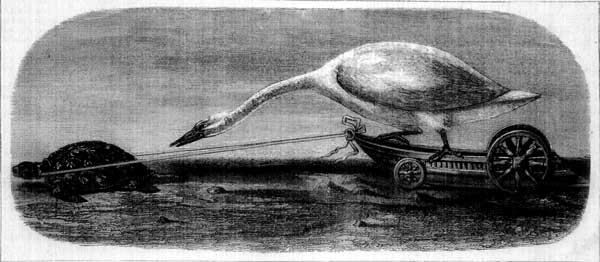
A curious thing about the picture is this: the goose is so excited, and scolding its tortoise so angrily for going slowly, that it has forgotten its own wings, when, if it would only use them, it could fly to its journey's end long before the tortoise could crawl there. Now, there are other two-legged geese who let themselves get angered and excited easily, and so lose many chances of serving others and helping themselves. Perhaps you may know some of them.
That is what the Deacon says; but, for my part, I never knew a goose that hadn't two legs.
A CITY UNDER THE WATER.
In past ages, as the Deacon once told some of his older boys in my hearing, the people of some parts of Europe used to live above the surfaces of lakes, in huts built on spiles driven into the water.
Well, now I hear that some one has found, under the water of Lake Geneva, a whole town, with about two hundred stone houses, a large public square, and a high tower; and, from the looks of the town, the shape of the houses, and the way the stones are cut, some say that the place must have been built more than two thousand years ago!
Now, I can understand how men were able to live in the way the Deacon described, but it strikes me that this other story has something in it that's harder to swallow than water.
Who ever heard of men living in cities under the water, as if they were fishes?
REFLECTION.
The Red School-house.
MY DEAR JACK-IN-THE-PULPIT: Many thanks for putting into your April sermon the picture and letter which I sent to you. Now, I must let you know about the explanations that some of your bright chicks have given.
Arnold Guyot Cameron, S.E.S., O.C. Turner, Louise G. Hinsdale, and the partners E.K.S. and M.G.V. guessed the right word, which is "Reflection"; and, of course, it needed some "reflection" to find it out. The lady in the picture is absorbed in "reflection" upon something she has been reading in her book; but, besides this, the water is represented as sending back a "reflection" of nearly every other object in the picture.
Several others of your youngsters wrote, but they were not so fortunate in their attempts. "Mignon" suggests the word "Heads," for the reason that the guessing has given employment to many heads. John F. Wyatt thinks that "Beautiful" is the word. Alfred Whitman, C.H. Payne, and Nellie Emerson, though writing from three places far apart, agree in giving the word "Reverie" as their notion of the right one. George A. Mitchell thinks it is "Study"; Arthur W. James guesses "Meditation"; and Hallie quietly hints "Calm." "P.," however, believes that the word is "Misrepresented," which he inclines to write, "Miss represented." But Nathalie B. Conkling puts forward the exclamation "Alas!" as the proper solution, spelling it "A lass."
Now, puns are not always good wit, and these two are not puns of the best kind; but they, as well as the other guesses, show that your chicks have lively minds, able to see a thing from more than one point of view, even although their conjectures do not hit the very center of the mark in every instance. I am much obliged to them all for their letters, and to you, dear Jack, for your kindness.—Sincerely your friend, THE LITTLE SCHOOLMA'AM.
[Page 568]