HOW TO MAKE A TELEPHONE.
Reading edition
BY M.F.
What is a telephone?
Up go a hundred hands of the brightest and sharpest of the readers of ST. NICHOLAS, and a hundred confident voices reply:
"An instrument to convey sounds by means of electricity."
Good. That shows you have some definite idea of it; but, after all, that answer is not the right one. The telephone does not convey sound.
"What does its name mean, then?" do you ask?
Simply, that it is a far-sounder; but that does not necessarily imply that it carries sounds afar. Strictly speaking, the telephone only changes sound-waves into waves of electricity and back again. When two telephones are connected by means of a wire, they act in this way,—the first telephone changes the sound-waves it receives into electric impulses which travel along the wire until they reach the second telephone, here they are changed back to sound-waves exactly like those received by the first telephone. Accordingly, the listener in New York seems to hear the very tones of his friend who is speaking at the other end of the line, say, in Boston.
Still you don't see how.
It is not surprising, for in this description several scientific facts and principles are involved; and all boys and girls cannot be expected to know much about the laws of sound and electricity. Perhaps a little explanation may make it clearer.
The most of you probably know that sound is produced by rapid motion. Put your finger on a piano wire that is sounding, and you will feel the motion, or touch your front tooth with a tuning-fork that is singing; in the last case you will feel very distinctly the raps made by the vibrating fork. Now, a sounding body will not only jar another body which touches it, but it will also give its motion to the air that touches it; and when the air-motions or air-waves strike the sensitive drums of our ears, these vibrate, and we hear the sound.
You all have heard the windows rattle when it thunders loudly, or when cannons have been fired near-by. The sound waves in the air fairly shake the windows; and, sometimes, when the windows are closed, so that the air-waves cannot pass readily, the windows are shattered by the shock. Fainter sounds act less violently, yet similarly. Every time you speak, your voice sets everything around you vibrating in unison, though ever so faintly.
Thus, from your every-day experience you have proof of two important facts,—first, sound is caused by rapid motion; second, sound-waves give rise to corresponding motion. Both these facts are involved in the speaking telephone, which performs a twofold office,—that of the ear on the one hand, that of our vocal organs on the other.
To serve as an ear, the telephone must be able to take up quickly and nicely the sound-waves of the air. A tightened drum-head will do that; or better, a strip of goldbeaters'-skin drawn tightly over a ring or the end of a tube. But these would not help Professor Bell, the inventor of the telephone we shall describe, since he wanted an ear that would translate the waves of sound into waves of electricity, which would travel farther and faster than sound-waves could.
Just when Mr. Bell was thinking how he could make the instrument he wanted, an important discovery in magnetism was made known to him—a discovery that helped him wonderfully. You know that if you hold a piece of iron close to a magnet the magnet will pull it, and the closer the iron comes to the magnet the harder it is pulled. Now, some one experimenting with a magnet having a coil of silk-covered wire around it, found that when a piece of iron was moved in front of the magnet and close to it without touching, the motion would give rise to electric waves in the coil of wire, which[Page 550] waves could be transmitted to considerable distances.
This was just what Mr. Bell wanted. He said to himself, "The sound of my voice will give motion to a thin plate of iron as well as to a sheet of goldbeaters'-skin; and if I bring this vibrating plate of iron close to a magnet, the motion will set up in it waves of electricity answering exactly to the sound-waves which move the iron plate."
So far, good. But something more was wanted. The instrument must not only translate sound-waves into electric impulses, but change these back again into sound-waves; it must not only hear, but also speak!
You remember our first fact in regard to sound: it is caused by motion. All that is needed to make anything speak is to cause it to move so as to give rise to just such air-waves as the voice makes. Mr. Bell's idea was to make the iron plate of his sound-receiver speak.
He reasoned in this way: From the nature of the magnet it follows that when waves of electricity are passed through the wire coil around the magnet, the strength of the magnet must vary with the force of the electric impulses. Its pull on the plate of iron near it must vary in the same manner. The varying pull on the plate must make it move, and this movement must set the air against the plate in motion in sound-waves corresponding exactly with the motion setting up the electric waves in the first place; in other words, the sound-motion in one telephone must be exactly reproduced as sound-waves in a similar instrument joined to it by wire.
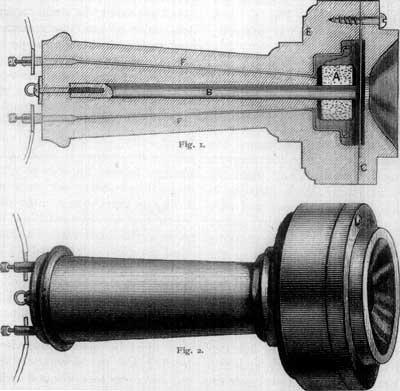
Experiment proved the reasoning correct; and thus the speaking-telephone was invented. But it took a long time to find the simplest and best way to make it. At last, however, Mr. Bell's telephone was perfected in the form illustrated below. Fig. 1 shows the inner structure of the instrument. A is the spool carrying the coil of wire; B, the magnet; C, the diaphragm; E, the case; F, F, the wires leading from the coil, and connecting at the end of the handle with the ground and line wires. Fig. 2 shows how a telephone looks on the outside.
BELL'S TELEPHONE.
So much for description. You will understand it better, perhaps, if you experiment a little. You can easily make a pair for yourself, rude and imperfect, it is true, but good enough for all the tests you may want to apply.
For each you will want: (1) a straight magnet; (2) a coil of silk-covered copper wire; (3) a thin plate of soft iron; (4) a box to hold the first three articles. You will also want as much wire as you can afford, to connect the instruments, and two short pieces of wire to connect your telephones with the ground. (Two wires between the instruments would make the ground-wires unnecessary, but this would use up too much wire.) The magnet and the coil you will have to buy from some dealer in electrical apparatus. They need not cost much.[Page 551] A small cigar-box will answer for the case.
A 'CIGAR-BOX' TELEPHONE.
In one end of the box cut a round hole, say, three inches across. Against this hole fasten a disk of thin sheet-iron for the vibrator or "diaphragm." For a mouth-piece use a small can, such as ground spices come in, or even a round paper box.
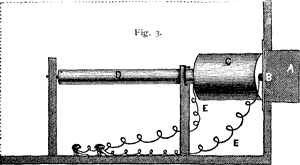
Now, on the inside of the box, place the magnet, the end carrying the coil almost touching the middle of the diaphragm, and fix it firmly. Then, to the ends of the copper wire of the main coil fasten two wires,—one for the line, the other for the "ground-wire."
This done, you will have an instrument (or rather two of them) very much like Fig. 3. A is the mouth-piece; B, the diaphragm; C, the coil; D, the magnet; E, E, the wires.
The receiving and sending instruments are precisely alike, each answers for both purposes; but there must be two, since one must always be hearing while the other is speaking.
When you speak into the mouth-piece of one telephone, the sound of your voice causes the "diaphragm" to vibrate in front of the magnet. The vibrations cause the magnet's pull upon the diaphragm to vary in force, which variation is answered by electrical waves in the coil and over the wires connected with it. At the other end of the wire the pull of the magnet of the speaking telephone is varied exactly in proportion to the strength of the electric impulses that come over the wire; the varying pull of the magnet sets the diaphragm in motion, and that sets the air in motion in waves precisely like those of the distant voice. When those waves strike the listener's ear, he seems to hear the speaker's exact tones, and so, substantially, he does hear them. The circumstance that electric waves, and not sound-waves, travel over the wires, does not change the quality of the resulting sound in the least.
I think you now understand Bell's telephone.
The telephones of Edison, Gray, and others, involve different principles and are differently constructed.
One invention very often leads to another, and the telephone already has an offspring not less wonderful than itself. It is called the speaking-phonograph. It was invented by Mr. Edison, one of the gentlemen, just mentioned.
Evidently, Mr. Edison said to himself: "The telephone hears and speaks; why not make it write in its own way; then its record could be kept, and any time after, the instrument might read aloud its own writing." Like a great genius as he is, Mr. Edison went to work in the simplest way to make the sound-recorder he wanted. You know how the diaphragm of the telephone vibrates when spoken to? Mr. Edison took away from the telephone all except the mouth-piece and the diaphragm, fastened a point of metal, which we will call a "style," to the center of the diaphragm, and then contrived a simple arrangement for making a sheet of tin-foil pass in front of the style. When the diaphragm is still, the style simply scratches a straight line along the foil. When a sound is made, however, and the diaphragm set to vibrating, the mark of the style is not a simple scratch, but an impression varying in depth according to the diaphragm's vibration. And that is how the phonograph writes. To the naked eye, the record of the sound appears to be simply a line of pin points or dots, more or less close to each other; but, under a magnifier, it is seen to be far more complicated.
Now for the reading. The impression on the foil exactly records the vibrations of the diaphragm, and those vibrations exactly measure the sound-waves which caused the vibrations. The reading simply reverses all this. The strip of foil is passed again before the diaphragm, the point of the style follows the groove it made at first, and the diaphragm follows the style in all its motions. The original vibrations are thus exactly reproduced, setting up sound-waves in the air precisely like those which first set the machine in motion. Consequently, the listener hears a minutely exact echo of what the instrument heard; it might have heard it a minute, or an hour, or a year, or a thousand years before, had the phonograph been in use so long.
What a wonderful result is that! As yet, the phonograph has not been put to any practical use; indeed, it is scarcely in operation yet, and a great deal must be done to increase the delicacy of its hearing and the strength of its voice. It mimics any and every sort of sound with marvelous fidelity, but weakly. Its speech is like that of a person a long way off, or in another room. But its possibilities are almost infinite.
[Page 552]