WISE CATHERINE AND THE KABOUTERMANNEKEN.
Reading edition
By Howard Pyle.
In old times, there was once a quaint little dwarf, who was known as the Kaboutermanneken of Kaboutermannekensburg.
In the very ancient times of good King Broderic and Frederic Barbarossa, he constantly lived above ground, and many times was seen trudging along through the moonlit forest with a bag over his shoulder. What was in the bag nobody exactly knew, but most people supposed it to be gold.
The Kaboutermanneken was a peppery little fellow, and at the slightest word his rage would fire up hotly. Since he was quite able, small as he was, to thrash the strongest man, he was very generally avoided.
It is a well-assured fact that, as churches increase, dwarfs and elfin-folk diminish; so, at last, when the town of Kaboutermannekensburg was founded, and a church built, the Kaboutermanneken was fairly driven to the wall, or, rather, into the ground, where he lived in the bowels of the earth, and only appeared at intervals of a hundred years. But, upon the last day that terminated each of these series of a hundred years, he would re-appear in his old haunts, and, I believe, continues the practice to the present day, in spite of railroads, steam-engines, and all the paraphernalia of progress, so destructive to fairy lore.
I.—The Golden Cup.
Once upon a time, after the Kaboutermanneken’s visits had become events of such rarity, there lived a worthy wood-chopper, who had a daughter named Catherine; a pretty little maiden of sixteen, and yet the wisest woman in the kingdom of Kaboutermannekensburg. Shrewd as she was, she had yet the best, the kindest, and the most guileless heart in the world; and many a sick man, troubled woman, and grieved child had cause to bless her and her wisdom. One winter, when labor was cheap and bread expensive, the wood-chopper, whose name was Peter Kurtz, chopped his hand instead of the stump he was aiming a blow at, and, in consequence, rendered himself unfit for work for many a day. During his sickness, the whole care of the family devolved upon Kate; for Peter’s wife had died nearly two years before; so it was Kate who tended the baby, dressed Johann, mended Wilhelm’s small-clothes, and attended to the wants of her father; for in those days a sick man was more complaining than a child two years old. Beside these acts of labor, she had to cook the meals, wash the dishes, sweep the house, run of errands, chop the wood, make the fire, and many other little odd duties of the kind; so that, upon the whole, her time was pretty well occupied.
There seemed a probability now, however, that one of these duties would be dispensed with, namely, cooking the meals; not that there was any indolence upon Catherine’s part, but because the necessary materials were not forthcoming. Indeed, the extent of the larder at present consisted of half a bowl of cold gravy, and about a quarter of a loaf of bread.
When Catherine, that cold morning, inspected the woeful emptiness of the cupboard, she wrung her cold blue hands in despair; but, wring her poor little hands ever so much, she could not squeeze good bread and meat out of them; something must be done, and that immediately, if she would save the children from starving. At length she bethought herself that many rich people of Kaboutermannekensburg were fond of burning pine-cones instead of rough logs, not only on account of the bright, warm and crackling fire they produced, but also because of the sweet resinous odor that they threw out, filling the house with a perfume like that which arose from the censers in the cathedral.
It was woeful weather for Catherine to go hunting for pine-cones. The snow lay a good foot deep over the glossy brown treasures, and she herself was but thinly clad; yet the children must have bread. Not having eaten any breakfast that morning, she slipped the remnant of the loaf into the basket to serve as lunch, and then started to face the wind toward the forest.
Bitterly cold blew the wind from the bleak north; tearing through the moaning pine forest, that tossed and swayed before the tempest, gnawing Catherine’s nose and fingers, and snatching up, as it were, handfuls of snow, and hurling them in a rage through the air. Poor Catherine was nearly frozen, yet she struggled bravely on through the drifting snow. Suddenly she caught sight of a quaint little cottage that she had never seen before, much as she had traveled this portion of the forest; but a more welcome sight still was the gleam of a cheery fire within, that illuminated the frost-covered panes with a ruddy glow.
Catherine, stumbling, sliding, struggling through the drifts, reached the cottage at last, raised the latch, and entered a door-way so low that even she, small as she was, had to stoop her head in passing.
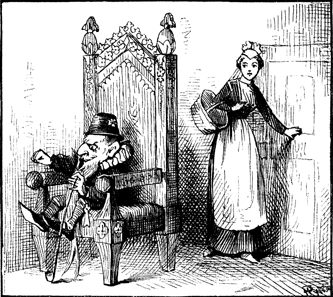
“Shut the door!” shrieked a shrill voice, with startling abruptness; and, for the first time, Kate perceived a very little old man seated in a very large chair, and smoking a very long pipe. A great beard reached below his dangling feet and touched the floor.
“a very little old man seated in a very large chair.”
“May I warm myself at your fire, kind gentleman?” said Kate, dropping a courtesy. The little old man grunted without looking at her.
“May I warm myself at your fire, sir?” repeated Kate, in a louder voice, supposing he must be deaf.
“I heard you!” growled the old dwarf, with sudden rage. “You don’t suppose I’m deaf, do you? I said yes. You don’t want to argue, do you?”
Kate murmured her thanks, feeling much astonished and very uncomfortable at the old gentleman’s conduct. Thus they sat in silence for a long while, the little old man smoking like a volcano. At length:
“Are you hungry?” said he, abruptly.
“Yes, sir,” said Kate, bethinking herself of her bread.
“So am I!” said the old man, shortly, at the same time resuming his smoking. Removing his pipe after another pause, “I haven’t had anything to eat for one hundred years; I feel kind of empty,” said he.
“I should think so,” thought Kate to herself; then, after regarding him in silence for a few minutes, she said, timidly, “I—I have a—a piece of bread in my basket, sir, if you would like to have it?”
“Like to have it? You speak as though you had no sense. Of course, I should like to have it! Why didn’t you offer it to me sooner?”
Kate, in spite of her hunger, that had recommenced gnawing her, now that she was warm, handed him the piece of bread. The old man seized it ravenously, opened his mouth to an astonishing extent, bolted the large morsel as one does a pill, and then resumed his smoking as though nothing of any note had occurred. Kate regarded him with silent astonishment.
“What are you doing out in this kind of weather?” said the old man, suddenly.
“I came to gather pine-cones to sell in the town,” said Kate.
“You’re a fool!” snapped the old man. “How do you suppose you can gather pine-cones in twelve inches of snow, not to mention the drifts?”
“Nevertheless, sir, I have to get the children something to eat, and father——”
“Oh! don’t bother me with that story!” said the old man, impatiently. “I know all about it. Your father’s Peter Kurtz, isn’t he?”
“Yes, sir.”
“Umph!” grunted the dwarf. Then, after another pause, “go to the closet yonder, and take one of the cups there, in return for the bread you gave me.”
“Indeed, sir,” said Kate, earnestly, “I do not care for any return for——”
“Do as I tell you!” bellowed the dwarf, in a fury.
Kate crossed the room, opened the cupboard, and—what a sight met her eyes! All the dishes, bowls, cups and saucers were of pure gold.
“Take one of the cups?” said Kate, in breathless doubt.
“That’s what I said, wasn’t it?” snarled the dwarf. “You are just like all women, never contented with what you receive.”
Catherine was far too wise to answer foolish abuse with useless excuse; she silently took one of the beautiful cups and put it in her basket. She was so overcome that she did not think of any word of thanks until she had reached the door; then, turning: “May heaven bless you, sir, for——”
“Shut the door!” screamed the dwarf.
Kate hurried home, but before reaching the town she wisely covered the cup with snow, that no gossiping neighbor might catch sight of it; for she well knew that gossip was like the snow-ball that the little boys start rolling from the top of a hill—small in the commencement, but sure to grow before it ends its course.
“Where have you been all this time?” whined Peter.
When Kate recounted her adventure, her father could hardly believe her, and when she had carefully removed the snow from the cup, he could hardly believe his eyes. He placed it upon the table, and then, sitting down in front of it, he examined it with breathless astonishment and delight.
The cup was of solid gold, heavy and massive; carved upon it in bold relief was a group of figures representing a host of little elves at a banquet. So exquisitely were they engraved that they appeared actually to move, and it seemed as though one could almost hear their laughter and talk. A glittering, carved golden snake, curled around the brim of the cup, served as a handle; its eyes were two diamonds. After Peter Kurtz had feasted his eyes upon this treasure for a long time, he arose suddenly, and, without saying a word, wrapped up the cup in a napkin, drew his cowl more closely around his face, and, taking his staff, prepared to leave the house.
“Where are you going, father?” said Kate.
“I am going,” said Peter, “to take this cup to our master, the Baron von Dunderhead; that will be far more to our advantage than selling it to some petty goldsmith or other.”
“Take care what you do, father!” said Kate, quickly. “I foresee that danger will come of it, if you fulfill your intention.”
“Bah!” said Peter, and, without deigning another word, he marched out of the house; for Peter, like a great many men in those days, had a very poor opinion of the feminine intellect, and a very good opinion of his own. So off he marched boldly toward castle Dunderhead.
“he examined with astonishment and delight.”
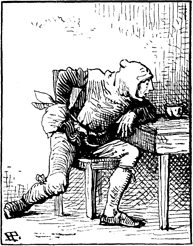
When Peter presented the golden cup to the baron, with a low bow, that nobleman could not find sufficient words to express his admiration. He sighed with rapture, and examined the cup from every side with the utmost minuteness.
“Give this worthy man,” said he, “four bags of guilders; money is nothing to the acquisition of such a treasure of beauty.”
Here Peter secretly hugged himself, and chuckled at his daughter’s warning. Meanwhile, the baron examined the cup with huge satisfaction. Suddenly turning to Peter, “Where is the saucer?” said he.
“The saucer?” repeated Peter, blankly. “Please you, my lord, it never had a saucer!”
“Never had a saucer?” repeated the baron. “You don’t mean to tell me that such a cup as that was ever made without a saucer to go with it!”
“Nevertheless, my lord, I have no saucer,” said Peter, humbly.
“You are deceiving me,” said the baron, sternly. Then, fixing his eye upon poor Peter, “Where did you get that cup?” said he, abruptly. “Me-thinks you are rather a poor man to possess such a treasure.”
“Oh, good my lord!” cried poor Peter, “I will tell you the whole truth. An old man in the forest gave it to my daughter Kate.”
“Do you expect me to believe such a story as that?” exclaimed the baron. “You stole it, you thief!” he roared, at the same time seizing Peter by the collar. “Ho! guards! Arrest this man, and throw him into the dungeon,” cried he to his attendants.
“Mercy! mercy, my lord!” cried poor Peter, falling on his knees. But the guards dragged him off in spite of his cries, and popped him into a dungeon, where he was left to meditate over his folly in not heeding his daughter’s advice.
II.—The Goose that was to lay the Golden Egg.
Catherine waited anxiously for her father’s return, but her fears told her all when night came and he came not.
After she had put the children to bed, having given them each a piece of bread, which she had borrowed from a kind neighbor, she threw a shawl around her head and started off in the direction of Castle Dunderhead, where her fears told her only too plainly her father was. The bars of the dungeon windows came upon a level with the ground, like those of a cellar.
“Father!” murmured Catherine.
“Oh, Kate!” was the response, followed immediately by the sound of violent crying, and Catherine knew her father was there. “Oh, Kate! if I—I had but l-listened to you!” sobbed the poor fellow; for, now that the discovery was too late to avail him, he felt perfectly sure of his daughter’s superior intelligence. Then, with much sobbing, he recounted all the particulars of his interview with the baron. “Can’t you do something to get your poor old father out?” continued he.
Kate was thoughtful for a moment. “I’ll try, father,” said she, at length; and, bidding him a hasty adieu, she hurried off. She ran, without stopping, to where the little cottage stood in the forest; but, as you have already probably guessed, the old man was the Kaboutermanneken, his day’s visit was over, and he had descended once more into the obscurity of the earth; consequently Catherine, much to her perplexity, could not discover the little cottage. After vainly seeking for some time, she at length saw the hopelessness of her task, and wended her way sorrowfully homeward. She lay awake nearly all night, vainly cudgeling her brains for some plan by which to deliver her father from his confinement. At length an idea occurred to her, and, smiling to herself, she turned on her pillow and fell asleep until the sun shining in her eyes awakened her. Then, arising, she donned her best frock and neatest cap, and proceeded to the Castle Dunderhead. She was directly presented to the baron.
“My lord!” said she, falling upon her knees.
“Well, my pretty damsel,” said he; for Kate looked very sweet in her saucy cap.
“My lord,” continued she, and the tears rose to her eyes as she spoke; “you have my father in custody.”
“Ha!” exclaimed the baron, frowning,—“Peter Kurtz?”
“Yes, my lord.”
“Bring forth Peter Kurtz!” cried the baron to the guard, and soon Peter made his appearance, crying like a good fellow. “Now that I have you confronted with each other,” continued the baron, “where did your father get that cup?”
“He did not get it, my lord; an old man in the forest gave it to me,” answered Catherine.
“Humph!” grunted the baron. “Your father has taught you prettily.”
“My lord,” resumed Catherine, “I came to buy my father’s liberty.”
“Ha!” cried the baron, eagerly, “have you brought the saucer?”
“No, my lord.” The baron’s countenance fell. “But, if you release my father, we have a goose at home that I will give you, and every egg it will lay for you shall be of pure gold.” The baron’s countenance lifted again. “This, my lord, I offer you.”
Peter’s eyes had been opening in wide astonishment as Kate proceeded.
“Why, Kate,” exclaimed he, “I don’t know about——”
“Be quiet, father!” said Catherine.
The baron thought Peter’s exclamation arose from his regret at parting with such a treasure; so his eagerness arose in proportion.
“Can you swear to the truth of this?” asked the baron.
“I can!” said Kate, firmly.
Peter could contain himself no longer.
“Why, Kate! how can you——”
“Be quiet, father!” interrupted Catherine, again.
“He shall have his freedom,” cried the baron, eagerly, “and the cup to boot.”
“We do not want the cup, my lord,” answered wise Catherine.
“Yes, but we do!” cried Peter; for, as the prospect of his pardon increased, respect for his daughter’s wisdom diminished in direct ratio.
“You shall have it!” cried the baron; “release him, guards!”
“One thing more,” said Catherine; “a proclamation must be issued stating that you will never arrest my father again in connection with this affair.”
“It shall be done!” said the baron; upon which he dismissed them both with the golden cup, which Peter had accepted in spite of his daughter’s protestations.
That same afternoon the proclamation was issued, and Catherine carried a large gray goose to Castle Dunderhead.
“Father,” said she, when she returned, “since you have accepted the golden cup, you must leave this place, for the baron will always look enviously upon you. Had you left it with him he would have paid no more attention to you, but now it is different.”
“Why so?” said Peter; “hasn’t the baron given his promise that he will never arrest me or mine again? And about that goose——”
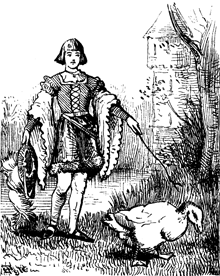
“a page was appointed to escort it.”
“Never mind the goose, father,” interrupted Kate. “I say again that every egg the goose lays shall be of pure gold.”
“Well, I’m sure I don’t understand it,” said Peter, testily; “and, moreover, I am not going to leave Kaboutermannekensburg. The idea of your trying to teach me wisdom!”
“No, I could never do that,” murmured Kate, with a sigh.
“No, I should think not, indeed!” said Peter, pompously.
The baron could not make enough of his goose. He had a splendid pen made for it, of ebony inlaid with silver, the nest was of purest eider-down, and a special page was appointed to escort it every morning to the water and back. It was fed upon sweet herbs and sponge-cake; it grew enormously fat; and, as time went on, its voice, its appetite, and its healthy condition increased to an astonishing extent. Only one thing troubled the baron, and that was it did not lay. Every day he himself went to the nest expecting to find the much-looked-for golden egg, and every day he did not find it. So matters continued for a long time.
One morning, as Kate and her father were at breakfast, a squad of soldiers, headed by the high-sheriff, marched into the house.
“Peter Kurtz and Catherine Kurtz, you are to consider yourselves under arrest,” said the sheriff.
“But the baron has issued a proclamation that he will never arrest me again,” said poor Peter.
“You are arrested,” continued the sheriff, without paying the slightest attention to Peter, “in the king’s name, upon suit of the Baron von Dunderhead, for obtaining goods under false pretense.”
Catherine said never a word—not even “I told you so”—but submitted, whilst poor Peter cried like a very child.
They were thrown into separate dungeons, in default of bail. Not many days elapsed, however, before they were brought forth to be tried by the grand tribunal.
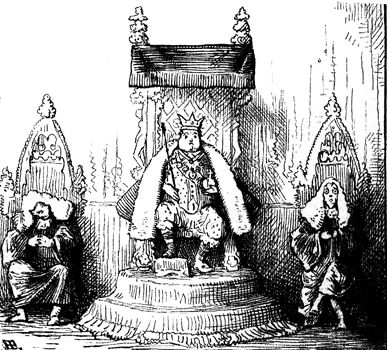
The king sat upon a chair of state, with a learned judge at each side, to decide the extraordinary cases that were brought before him.
Peter and Catherine were led up to the bar, the latter calm and collected, the former weeping bitterly, and continually crying, “if I had but minded her! if I had but minded her!”
This doleful cry, which was continued in spite of the violent vociferations of “order in the court!” at length aroused the king’s curiosity, and he inquired what he meant. Amid many sobs, Peter contrived to tell the king the whole story. “Had I minded,” said he, in conclusion, “when she advised me not to take the cup to the baron; had I minded when she advised me not to receive it back again; or, had I minded when she advised me to leave Kaboutermannekensburg, I had never gotten myself into this trouble—miserable wretch that I am!” Here he commenced sobbing afresh with great vehemence.
The king put on his spectacles and looked at Catherine. “Faith!” said he, “thou art much wiser than most girls of thy age, and—ahem! very pretty, too, I vow!” Then, turning to the baron, “Prefer your charge, baron,” said he. Hereupon the baron told how Catherine had given him the goose for her father’s freedom and the golden cup, and how she had sworn that every egg it should lay would be of pure gold.
“Well,” said the king, “did she forswear herself?”
“N-no, not exactly,” hesitated the baron.
“I said that every egg it laid for you should be of pure gold, did I not?” said Kate to the baron.
“Yes, you did,” snarled the baron, whose anger was commencing to boil.
“And I say again,” said Kate, calmly, “that every egg it lays for you shall be of pure gold.”
“Well, then, what is the matter?” said the king, scratching his nose in great perplexity.
“the king sat upon a chair of state, with a learned judge at each side.”
“Why, your majesty,” bellowed the baron, losing all control of himself, “it is a gander!”
The king burst into a roar of laughter.
“Faith!” said he, turning to Kate, “thou art the shrewdest maiden in the world.” Then, to the baron: “The maid was right, and every egg the goose lays shall be of pure gold.” And so Baron Von Dunderhead and his case were dismissed.
Catherine had made a great impression upon the king, both on account of her shrewdness and beauty; so, being a jolly monarch, he conceived the notion of marrying her to the heir apparent. The heir apparent had no objection, and so the ceremony was consummated with great state.
Even to this day the good folk of the kingdom of Kaboutermannekensburg look back with longing to the time when Catherine the Wise was queen, and ruled not only her husband, but his kingdom also.
As for Peter, he was appointed lord chief justice, for one did not have to be very wise to be a judge in those days.
Open the snowy little bed, And put the baby in it; Lay down her pretty curly head, She’ll go to sleep in a minute.
Tuck the sheet down round her neck, And cover the dimples over, Till she looks like a rose-bud peeping out From a bed of sweet white clover.