THE THREE HORSE-SHOES; OR, MARSHAL DE SAXE AND THE DUTCH BLACKSMITH.
Reading edition
By David Ker.
Maurice de Saxe was a son of the King of Saxony, and a fine lad he was—tall and strong and handsome, and as brave as a lion. But the king, like a certain old woman of whom you may have heard, had so many children that he didn’t know what to do; and so, as Maurice had such a lot of elder brothers as to have not much chance of inheriting the crown, or anything else that would keep him in bread and butter, his father sent him out to seek his fortune, like many another prince in those days. So he went over to France, and entered the army of King Louis XV.
Now, at that time there was always a war going on somewhere or other, and the French armies were fighting in every part of Europe; and the king cared very little who his officers were, or where they came from, if they were only brave men and clever fighters, and ready to go wherever he liked to send them. So, as you may think, it was not long before our friend Maurice, who was quite as brave as any of them, and a good deal cleverer than most, began to make his way. First, he got to be a lieutenant, then a captain, then a major, then a colonel, and at last, while he was still quite a young man, he came out as Count de Saxe, and Field-Marshal of the Army of Flanders, with fifty thousand men under him! That was pretty good promotion, wasn’t it?
But, although he had got on so fast, no one could say that it was more than he deserved; for he was by far the best general that France had had for many a day. He beat the Germans, and he beat the Flemings, and he beat the English, though they fought against him as stoutly as men could; and, at last, his soldiers got to have such faith in him, that whenever he appeared the battle seemed to turn at once, as if the very sight of him brought good fortune along with it. And a gallant sight it was to see him prancing along on his fine black horse in front of the line of battle, with his plumed hat and laced coat glittering in the sunshine, and his sword gleaming in his hand, and his dark handsome face and large black eyes kindling like fire the moment the first gun was heard. Every picture-shop in Paris had his likeness in the window; and King Louis himself had the marshal’s portrait hung up in his cabinet, and liked nothing better than to invite him to dinner, and hear him tell of all the battles that he had won. Indeed, such a favorite did he become at court, that at last nothing would serve the king but he must go to the war too, and see how his friend Monsieur de Saxe disposed of the enemy. Saxe gained the victory, as usual; and after all was over, there was a great supper on the battle-field, and the king himself hung the Cross of St. Louis around the marshal’s neck, and the marshal sat at his right hand in triumph, and thought himself the finest fellow in the whole world.
But, curiously enough, the one thing that this great general specially prided himself upon was neither his skill in warfare nor his favor at court, but simply his strength. There was nothing he enjoyed so much as showing off the power of his muscles, and astonishing the people about him by bending an iron bar, or felling a horse with one blow of his fist; and he was fond of saying that he would give his purse and all the money in it to any man who was stronger than himself, if he could ever fall in with him.
Now, it happened that, one day, while the French and German armies were lying pretty close to each other, Marshal de Saxe sent a message to the enemy’s camp, asking some of the German officers to dine with him; and after the meal he began to boast of his strength, as usual, till at last an old German general, who sat at his left, said that he would like to see a specimen of what his Excellency could do. Saxe made no answer, but took up a large silver dish, which was standing before him, in his strong white fingers (for, big and powerful as his hands were, they were white and smooth as any lady’s, and he was very proud of them), and, without more ado, rolled it up like a sheet of paper!
“Can your Honor unroll that dish again?” asked he, handing it to the German; and, although the general was a strong man, and tried his best, he found the task too hard for him, and was forced to own himself beaten.
“Your Excellency’s strength is very great,” said he, “but, nevertheless, I venture to think that there is one man in Flanders who can match it.”
“And who may he be?” asked Saxe, frowning.
“A blacksmith in the village of Scheveningen, Dirk Hogan by name. All the country around knows of his exploits; and when I met with him myself I saw such things as I should have thought impossible, had my own eyes not witnessed them.”
When the marshal heard this, he looked blacker than ever; and the first thing he did next morning was to send off messengers in every direction to inquire for a village called Scheveningen, and a man named Dirk Hogan. And, sure enough, some of them came back with news that there was such a village, and that Dirk Hogan, the smith, had been living there till quite lately; but that now he had sold his forge and gone away, and nobody knew what had become of him.
This was a decided disappointment for our friend Saxe, but he had something else to think of just then. The enemy’s army had lately received strong re-enforcements, and seemed inclined to attack him; and he was riding out one morning to reconnoiter their position, when suddenly his horse stumbled and cast a shoe.
“There’s a village just ahead of us, your Excellency,” said one of his officers. “Shall I ride on and see if I can find a blacksmith?”
“Do so,” answered Saxe; and the officer came back presently to say that he had found what he wanted. So the horse was led up to the door of the smithy, and the smith himself came out to have a look at it.
The moment he appeared, the marshal fastened his eyes upon him as if he would look him right through. And well he might; for this smith was such a man as one does not see every day—very nearly as tall as Saxe himself, and even broader across the shoulders, while upon his bare arms the huge muscles stood out under the tanned skin like coils of rope. The marshal felt at once that he could never be comfortable till he had had a trial of strength with this sturdy-looking fellow; so he bade him bring out one of his best horse-shoes.
The smith did so; and Saxe, looking at it, said quietly: “This ware of yours is but poor stuff, my friend; it will not stand work. Look here!”
He took it in his strong hands, and with one twist broke the iron like a biscuit.
The smith looked at him for a moment, and then, without seeming at all taken aback, brought out a second horse-shoe, and a third; but Saxe broke them as easily as he had broken the first.
“Come,” said he, “I see it’s no use picking and choosing among such a trashy lot; give me the first shoe that comes to hand, and we’ll cry quits.”
The smith produced a fourth shoe, and fitted it on; and Saxe tossed him a French crown—a coin about the size of a silver dollar. The Dutchman held it up to the light, and shook his head.
“This coin of yours is but poor metal, mynheer,” said he, saying the words just as the marshal had spoken his. “It wont stand work. Look here!”
He took the coin between his finger and thumb, and with one pinch cracked it in two like a wafer. [B]
It was now the marshal’s turn to stare; and the officers exchanged winks behind his back, as much as to say that their champion had met his match at last. Saxe brought out another crown, and then a third; but the smith served them in like manner.
“Come,” said he, imitating the marshal’s voice to perfection, “I see it’s no use picking and choosing among such a trashy lot. Give me the first crown that comes to hand, and we’ll cry quits.”
The Frenchman looked at the Dutchman—the Dutchman looked at the Frenchman—and then both burst into a roar of laughter, so loud and hearty that the officers who stood by could not help joining in.
“Fairly caught!” cried the marshal, suddenly, and added, “What’s your name, my fine fellow?”
“Dirk Hogan, from Scheveningen.”
“Dirk Hogan!” cried Saxe. “The very man I’ve been looking for! But I’ve found him in a way I didn’t expect!”
“So it seems,” said the smith, grinning. “I needn’t ask who you are—you’re the Count de Saxe, who was always wanting to meet with a stronger man than himself. Does it seem to you as if you had met with him now?”
“Well, I rather think it does,” quoth Saxe, shrugging his shoulders; “and as I promised to give him my purse whenever I did meet with him, here it is. And now, if you’ll come along with me, and serve as farrier to my head-quarters’ staff, I promise you that you shall never have cause to repent of having met with Maurice de Saxe.”
And the marshal was as good as his word.
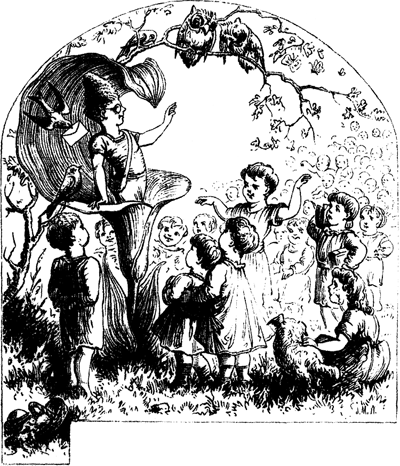
JACK-IN-THE-PULPIT.
It is beginning to feel something like spring. However, we mustn’t be too certain, for April is the month for little tricks of all kinds. Let us be careful and not be caught by make-believe spring weather.
hair-braids in the olden time.
I’m told that, eight centuries ago, girls and women wore their hair in braids. Each woman had two braids, which she slipped separately into long, narrow cases of silk, or some other material, and wound with ribbon. They hung like base-ball bats. On the statue of a queen of those times, the braids, cased in this style, reached lower than the knees.
Years ago, every British sailor dressed his hair in a pigtail at the back, so that it hung
“Long and bushy and thick, Like a pump-handle stuck on the end of a stick.”
I heard of one sailor whose mates did his hair so tightly that he couldn’t shut his eyes, and he nearly got punished for staring at his commanding officer,—a hair-breadth escape, as somebody called it.
knots and the north pole.
My feathered friends tell me of a bird called the knot, something like a snipe in shape, whose color is ashen gray in winter and bright Indian red in summer. They say he is very particular about the weather, and likes best fine bracing days with sunshine and a moderate breeze; so, in winter he flies south, but in summer he goes farther north than man has yet been able to go.
Now, I’ve been told that the farther north you go, the colder is the climate; but this bird, who likes pleasant weather so much, goes beyond the coldest places known! Perhaps he has found a cheerful and comfortable summer home, bright and bracing, somewhere near the North Pole, on which somebody will find him, may be, one of these days, quietly perched, preening himself, and looking at a distance like a bit of red cloth on a broomstick. If he has found a cozy spot away up there, he’s smarter than any Arctic explorer I ever heard of.
the trailing arbutus.
Johnstown, Pa., March, 1878.
Dear Jack-in-the-Pulpit: Some of your other chicks may like to hear what my uncle has just told me about the mayflower, or trailing arbutus, so as to know where to hunt for it as soon as spring comes. It grows chiefly in New England, New York, and Pennsylvania, and is always to be found among mountains, hills, and high lands. Late in March or early in April, under the brown and withered leaves of last year, you will find it—cool, shiny, fragrant, with clusters of star-like blossoms, the color being of all shades of pink from very deep to a pinkish white. Yet farther under the leaves you will find the trailing stems. I hope many will join in the search for this first sweet flower of spring.—Your true friend, Amanda S. K.
mira in cygnus.
On clear nights, during the first half of this month, my dears, the star called Mira, in the constellation Cygnus (or “The Swan”), can be seen in full luster. This is what the owl tells me; and he adds that it is one of those strange stars which vary in brightness. It shines for about a fortnight very brightly indeed; then by degrees it fades away, until, at the end of three months, it cannot be seen. After remaining five months out of sight, it gradually brightens up again. May be you’ve heard all about this before; but now is your time to see Mira twinkle her bright eye at you. I’ll take a peep at her from my pulpit, myself, if I can manage to catch sight of her.
a rare specimen.
Brookline, Mass.
Dear Jack-in-the-Pulpit: Did you ever hear this story about Agassiz? If not, please show it to the other boys and girls.—Yours truly, Nellie Chase.
One day, a man put together parts of various insects and submitted them to Agassiz as a rare specimen. He also pretended not to know to what species it belonged, and asked the professor to tell him. It was April Fools’ Day. Agassiz gave a single glance at the object and, looking up, said “Hum-bug.”
a sardonic grin.
Here’s a bit of advice which Deacon Green once gave to the boys of the red school-house. It came back to me all at once the other day as I was watching a plump little darkey eating a sour pickle, and making very wry faces.
The Deacon said: “Whenever you come across a word that you don’t understand thoroughly, don’t rest until you have found out all you can about it.”
Sometimes words grow out of queer things and in very odd ways. There’s “sardonic,” for instance. As applied to a grin, it means one that a man makes if he is forced to laugh when he doesn’t want to, or tries to smile when he really is ready to cry out with pain.
Now, the birds tell me that in the island called Sardinia there used to grow a plant with a very disagreeable taste; and whenever a piece of it was put into anybody’s mouth, it made his face pucker up into a broad, unwilling smile—made him “laugh the wrong side of his mouth,” as I’ve heard boys say. Well, in course of time, the name of the island was given to the plant, and then, with a slight change, it was used to describe the wry face the taster made.
So you see, my dears, some words are like puzzles. By the way, I’d like to know what you yourselves can find out about this same word “sardonic,” for it may be that those chattering little friends of mine, the birds, have been trying to make an April fool of your Jack,—perhaps, just to see if I can smile a “sardonic” smile when I find out what they’ve done.
a poser from the little schoolma’am.
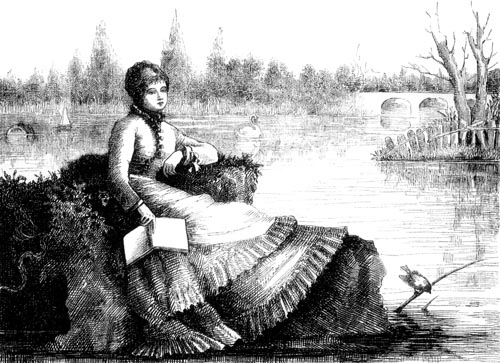
This letter, and the picture I give you with it, have just come to me. Now let’s see what your wits are worth, my dears.
The Red School-house.
My Dear Jack: I have a favor to ask of you. Will you please show to your chicks a copy of the picture which I now send to you, and ask them to give you the one word which will express the meaning of it. You can tell them, as a clue, if you like, that by means of what the picture means they can find out what it means.—Truly your friend, The Little Schoolma’am.
greenland.
Letters have come from Andrew A. Bateman, Frank Polley, M. E. Andrews, Edward Liddon Patterson, Bessie B. Roelafson, and Horatio Warren, all telling much the same story—that a man named Eric sailed from Iceland in the year 983, and, reaching the west coast of Greenland, saw there large herds of reindeer browsing on the meadows. This pleased him, and he called the country “Greenland.”
The Little Schoolma’am says that this is correct, and adds that in some parts Greenland is much colder than it used to be. She wants to know if you can give any reason why.
the feast of kites.
In Japan, the 23d of April is a splendid day for boys, I should think. I’m told that the Feast of Kites is held on that day, with kite-fights and kite-dances, and all sorts of good fun. Who knows anything more about this?
Answers to the “Tobacco” and “Cares” riddles were sent by W. P., N. E., W. L. and F. H. Amerman, Nellie J. Towle, A. B. Easton, “Ned,” L. C. L., E. E. B., Nessie E. Stevens, “Mione,” Mary H. Barnett, “Bessie,” “Lucy and Annie,” A. R. S., and Wm. V. F. Several sent amended versions of both riddles, but no one has given a satisfactory answer to Archbishop Whately’s rhymed puzzle. “Lucy and Annie” send this verse as the solution:
“To him who cons the matter o’er, A little thought reveals,— He heard it first who went before Two pair of soles and ’eels.”
I’m afraid it is not the right answer, and I’m beginning to think that the archbishop made the riddle on the First of April!