PUCK PARKER.
Reading edition
By Lizzie W. Champney.
“Boom-er-oom, a boom-er-oom, a boom, boom, boom! Zim-er-oom, a zim-er-oom, a zim, zim, zim!”
It was a familiar sound, that of the great bass-drum. Puck Parker and Snarlyou and Kiyi had all heard it, time and time again. These little friends lived in Paris during the late war between Germany and France, when the German army was besieging the city, and soldiers were always marching about to the sound of the drum. This morning all three of them were at the kitchen door that opened into the corridor, which led into the court where you had a view of the street. Snarlyou was a little white Angora cat, and she puffed out her tail and waved it angrily over her back as she snarled fiercely at Kiyi, who was a little Prussian pup. Unlike the army he represented, he was getting the worst of the fray, and stood yelping in a cowardly way behind the scraper. Puck was doing all he could to encourage the dog by waving his porridge spoon at him, but it was of no use.
“puck was leaning over the little gate in the kitchen door.”
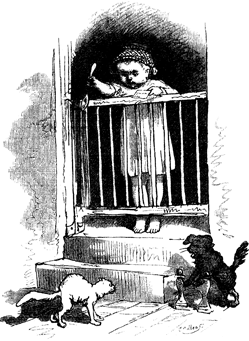
Puck Parker was a fat-faced little boy, who was leaning over the little gate in the kitchen door. He had been very naughty this morning, having run away with Kiyi, giving his nurse, Augustine, a regular hunt for him. She found him at last, wandering quite independently in beautiful Park Monceaux, a favorite resort for nurses and babies, where she had often gone with him before; and she could have forgiven him easily enough for running away, had he not sprawled himself upon the walk and kicked and screamed so that she could scarcely get him home.
This Augustine was a peasant woman, and when a little girl she had tended the sheep in the mountains of Auvergne, wearing the picturesque peasant-costume and carrying her distaff with her. She now had two children of her own, and every morning early before they were up she would kiss them good-bye, leaving them in her sister’s charge while she went to take care of the little American boy, of whom she became very fond. She would often tell stories to him and sing funny songs.
As we have said, Puck was leaning against the little gate which had been placed across the door to keep him from running away, though it was of no use now, for he was big enough to climb over it. Augustine, to punish him for his naughtiness, as well as to guard against such a thing happening again that morning, had undressed him, knowing that he would not be likely to run away with nothing on but his little shirt.
At first, Puck was at a loss for amusement, and so wandered disconsolately upstairs into his mamma’s room. She was seated at his papa’s writing-desk, while in front of her lay lots of little cards, like this, “Mr. and Mrs. Franklin Parker, P.P.C.”
Some of these she put into small envelopes, directed to people that she knew, and the rest she shut up in her card-case.
“What are those?” asked Puck.
“These are cards,” said his mother, “which your papa and I are sending to our friends, to let them know that we are going away from the city. The letters ‘P.P.C.’ in the corner stand for ‘Pour prendre congé,’ which is French for ‘To take leave.’”
“Is oo doin away,” asked Puck, “an’ me too?”
“Yes, you are going with us,” replied his mother.
“Den me wants some tards, too,” said the little fellow; and Mrs. Parker, taking a number of blank cards, wrote upon them, “Puck Parker, P.P.C.”
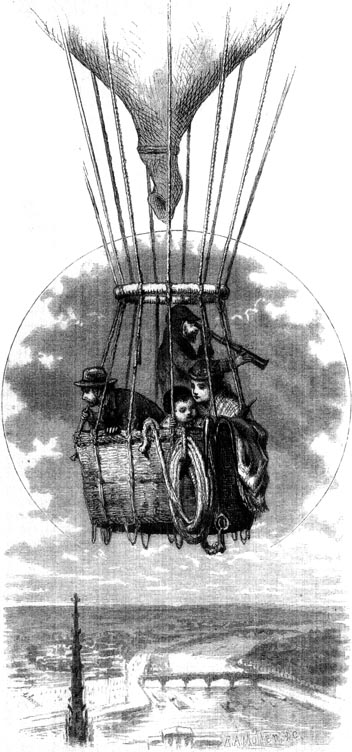
“up in a balloon.”
Cramming his mother’s work-basket upon his comical little head, he seized his cards and trudged away to distribute them among his friends. If he could only have gone out-of-doors, he could have found friends enough to have given them to; but he knew that Augustine would not relent so soon, and so contented himself with carrying them down to Snarlyou and Kiyi. But they were both out in the court, and would not come to him, even when he dropped porridge on the steps to tempt them.
Puck did not have many opportunities to distribute his cards, for the next day, while he was at dinner with his father and mother, they all heard a sound which went
“Boom-er-oom, a boom-er-oom! A boom! boom! boom!”
It sounded as if some one was playing an immense bass-drum, a long way off, and playing very slowly.
“Listen!” Puck’s father explained. “It is time we were off; there are the cannon again, outside of the city.”
And so that very afternoon they left Paris. Can you guess how? Not by the railway, or by boat, or by omnibus, or by any ordinary means of travel. Guess again—something queer this time. Not perched on the back of a dromedary, or sent by express labeled “This side up with care, C. O. D.,” or telegraphed, or shot through the air in a bomb-shell, though the last is something like it. Yes, you are right now; they did go by balloon.
There were Puck and his father and his mamma, and an accomplished aëronaut to guide the balloon, which was one of the best kind, and, as the professor said, perfectly easy to manage. You know, perhaps, that during the siege of Paris it was almost impossible for any one to leave the city unless he went up in a balloon, and floated off above the besieging army. A great many persons escaped from Paris in this way.
Poor Augustine was very sorry to lose little Puck, who gave her one of his cards when he bade her good-bye; and Kiyi set up a doleful howl when they all left the court, as though he knew he should never see them again.
When everything was ready, the balloon rose into the air, and Puck nestled down in his mother’s arms and watched the ground and the roofs of the houses sink away beneath him. That is, he looked over the side of the car once, and saw them falling; but it made him dizzy, and he did not try it again. His mother saw the sick look about her little boy’s mouth, and said, pleasantly:
“Isn’t it nice? It’s better than having wings. And then you can make believe you are in a big ship; see all those ropes stretching away up there; they look just like rigging.”
Puck gave a quick, frightened glance up, then shuddered and said, faintly:
“Yes, it’s awful nice; but me’s ’fraid, and so cold.”
The cold was, indeed, intense; and his mamma wrapped Puck as warmly as she could in a shawl, and held him tightly, and very soon he was fast asleep. When he awoke, he found that his mother was also asleep, and his father was holding him. He had forgotten all about the balloon while he was asleep, and so looked dazed and startled when he opened his eyes; and his father, to keep up his failing courage, sang cheerily:
“Up in a balloon, boys, Up in a balloon, All among the little stars That twinkle round the moon.”
“Don’t see any stars crinkle,” said Puck; “nuffin but ugly gray fog.”
His mother awoke just then, and she caught her breath with a gasp as she looked up, for all the rigging of the imaginary ship had disappeared, and a dense fog was folded close around them. The balloon seemed, too, to have met with a new current of wind, for it was rushing along with fearful velocity, whither,—even the professor himself could not guess. Looking downward, they saw the same impenetrable fog, and the professor concluded to let the balloon drift on in its course for a while.
Presently, Puck exclaimed: “Mamma, don’t oo hear ze bears g’owl?” For some time, the others had heard a low menacing grumble. It sounded like the roar of machinery, with the falling of a heavy trip-hammer at regular intervals, and it seemed possible that they were in the vicinity of a manufacturing town. There was a little light in the eastern horizon, and Puck suddenly exclaimed, “T’ere’s anoder b’loon!” It was the full moon, instead, that rose majestically, and the fog seemed to be disappearing. Looking down, the professor thought he could see the land, and he allowed the balloon to slowly descend. By and by, they could all see that the ground was marked with white streaks and spots, which they supposed to be snow.
Lower and lower sank the balloon, and still Puck’s bears continued to “g’owl.”
Suddenly, the professor uttered an exclamation of horror—only two words, “The sea!” But they sounded like a sentence of doom to the travelers. They were floating over a wide and angry sea!
The professor threw overboard a bag of ballast, and the balloon darted upward again into space. Where were they? Was it the Bay of Biscay, the North Sea, the English Channel, or the open Atlantic?
Very soon, the balloon began to descend again. The roar of the waves was louder than ever, and they beat the same tune that the great bass-drum and the cannon had played:
“Boom-er-oom, a boom-er-oom! A boom! boom! boom!”—
for they were striking against a rocky wall, and the white cliffs of Dover rose ghostly in the moonlight before them.
The professor threw overboard his last bag of ballast; Puck hid his face in his mother’s dress, while she, in the presence of that mighty danger, sang a hymn. Mrs. Parker was one of the singers in the choir of a church at Paris, and her voice had been much admired; but she had never sung before as she sang now. Her voice was sustained instead of drowned by the roar of the sea, and was re-echoed back from the rocky cliff marvelously clear and pure, as she sang “Save me, O God, from waves that roll.”
Slowly the balloon seemed to climb that sheer, chalky precipice, frightening the sleepy sea-gulls from their nests, but never grazing against the wall, as it seemed as if it inevitably must. Slowly it reached the summit, paused a moment poised over the edge, then swept landward a little way, when the guide-rope (which had been dragging in the water) caught on the rocks, and it stopped. The professor opened the escape-valve, and they alighted from the car, and then walked to the brink of the abyss and, silently and solemnly, looked down.
This was the last of aërial navigation that any of the party ever indulged in. The professor packed up his balloon and went to the United States to exhibit it. Puck Parker left one of his “P.P.C.” cards in the car of the balloon, and his parents were glad enough to get to a land where they did not forever hear the “Boom-er-oom, a boom-er-oom, a boom, boom, boom,” and the “Zim-er-oom, a zim-er-oom; a zim, zim, zim.”