EASTER IN GERMANY.
Reading edition
By F. E. Corne.
“Oh, look! look! all those pretty little Easter things in the window already!” exclaimed my little sister one day, as we passed one of the largest confectionery stores in Stuttgart; and, true enough, though Lent was but half over, there they were, a pretty show. Eggs, of course, in quantities and of all sizes, from that of an ostrich to a humming bird’s, made of chocolate or of sugar, and gayly decorated with little ribbons and pictures. Then there were fat little unfledged chickens, some just emerging from their shells, some not an inch long, and others large as life; pure white lambs, with ribbons and bells round their necks; paste-eggs, with holes at the ends, and, looking through, behold, a panorama inside! and eggs with roses on one side, which, when blown upon, emit a musical sound.
an easter carriage.
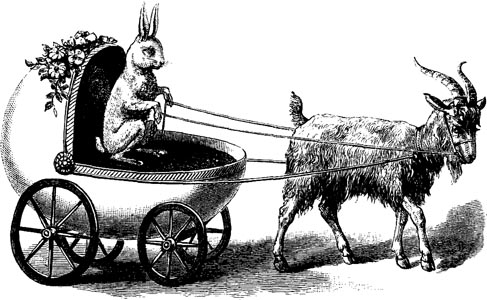
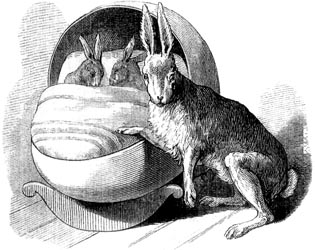
But odder than all these were the goats playing on guitars, or dragging behind them fairy-like egg-shaped carriages, with little hares gravely driving; and in others of these carriages were reclining one or two (generally two) baby hares, or a hare mother rocking her little one in an egg cradle; there were sugar balloons, in the baskets of which hares watched over their nests full of eggs; wheelbarrows full of eggs, and trundled by a hare; and dainty baskets of flowers, with birds perched upon each handle, peering down into nests of eggs half hidden amidst the blossoms. When one knows that each nest comes out, and forms the cover to a box of bonbons neatly concealed underneath, this pretty structure certainly loses none of its attractiveness.
an easter fancy.
In all directions signs of the approaching season begin to appear. Every old woman in the market-place offers for sale a store of hard-boiled eggs, smeared over with some highly colored varnish, besides candy chickens, hares, etc., in abundance. All the various shop windows display pretty emblematic articles. Besides the sugar and chocolate eggs, there are eggs of soap and of glass; egg-shaped baskets and reticules; leather eggs, which really are ladies’ companions, and filled with sewing implements; wooden eggs and porcelain eggs, and even egg-shaped lockets made of solid gold.
It would be difficult to explain why these things appear at Easter, and what they all mean. The eggs, as every one knows, we have at home, and where they are in such abundance chickens will not be very far away. For the lamb and the goat we can find scriptural interpretations, but the rabbit and the hare—what can they have to do with Easter? Nine persons out of ten can only answer, “The hares lay the Easter eggs.” Queer hares they must be, indeed, but the children here believe it as devoutly as they do that the “Christ-kind” brings their Christmas presents, or as our own little ones do in Santa Claus. No one knows exactly whence came this myth. Many think it a relic of heathen worship; but a writer named Christoph von Schmid, in an interesting story for children, suggests this much prettier origin:
an easter cradle.
Many hundred years ago, a good and noble lady, Duchess Rosilinda von Lindenburg, at a time when a cruel war was devastating the land, was obliged to fly from her beautiful home accompanied only by her two little children and one old man-servant.
They found refuge in a small mining village in the mountains, where the simple but contented and happy inhabitants did what they could for their comfort, and placed the best of all they had at the disposal of the wanderers. Nevertheless, their fare was miserable; no meat was ever to be found, seldom fish, and not even an egg; this last for the very good reason that there was not a single hen in the village! These useful domestic fowls, now so common everywhere, were originally brought from the East, and had not yet found their way to this secluded place. The people had not even heard of such “strange birds.” This troubled the kind duchess, who well knew the great help they are in housekeeping, and she determined that the women who had been so kind to her should no longer be without them.
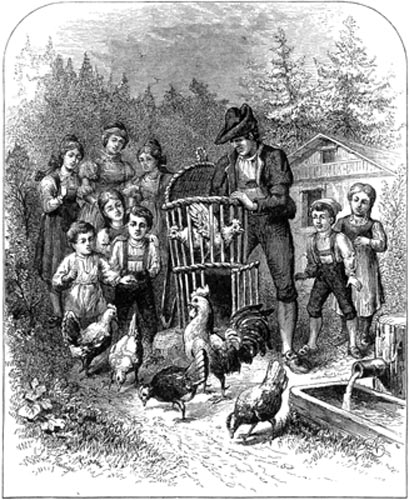
Accordingly, the next time she sent forth her faithful old servant to try and gather news of his master and of the progress of the war, she commissioned him to bring back with him a coop full of fowls. This he did, to the great surprise of the simple natives, and the village children were greatly excited a few weeks later at the appearance of a brood of young chickens. They were so pretty and bright, were covered with such a soft down, were so open-eyed, and could run about after their mother to pick up food the very first day, and were altogether such a contrast to the blind, bald, unfledged, helpless, ugly little birds they sometimes saw in nests in the hedges, that they could not find words enough to express their admiration.
The good lady now saved up eggs for some time, then invited all the housewives of the village to a feast, when she set before them eggs cooked in a variety of ways. She then taught them how to prepare them for themselves, and, distributing a number of fowls among them, sent the dames home grateful and happy.
an easter load.
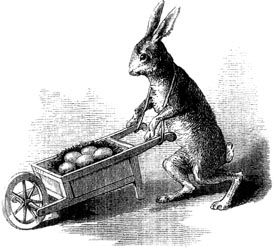
When Easter approached, she was anxious to arrange some pleasure for the village children, but had nothing to give them, “not even an apple or a nut,” only some eggs; but that, she concluded, was, after all, an appropriate offering, “as an egg is the first gift of the reviving spring.” And then it occurred to her to boil them with mosses and roots that would give them a variety of brilliant colors, “as the earth,” said she, “has just laid aside her white mantle, and decorated herself with many colors; for the dear God makes the fruit and berries not only good to eat, but also pleasant to look upon,” and the children’s pleasure would be all the greater.
Accordingly, on Easter Sunday, after the church service, all the little ones of about the age of her own met together in a garden; and, when their kind hostess had talked to them a while, she led them into a small neighboring wood. There she told them to make nests of moss, and advised each to mark well his or her own. All then returned to the garden, where a feast of milk-soup with eggs and egg-cakes had been prepared. Afterward they went back to the wood, and found to their great joy in each nest five beautiful colored eggs, and on one of these a short rhyme was written.
The surprise and delight of the little ones when they discovered a nest of the gayly colored treasures, was very great, and one of them exclaimed:
“How wonderful the hens must be that can lay such pretty eggs! How I should like to see them!”
the old servant brings a coop full of chickens.
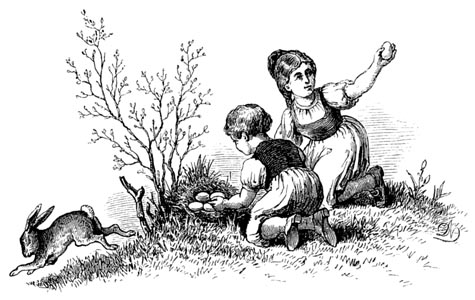
“Oh! no hens could lay such beautiful eggs,” answered a little girl. “I think it must have been the little hare that sprang out of the juniper bush when I wanted to build my nest there.”
Then all the children laughed together, and said, “The hares lay the colored eggs. Yes, yes! the dear little hares lay the beautiful eggs!” And they kept repeating it till they began really to believe it.
Not long afterward the war ended, and Duke Arno von Lindenburg took his wife and children back to their own palace; but, before leaving, the Duchess set apart a sum of money to be expended in giving the village children every Easter a feast of eggs. She instituted the custom also in her own duchy, and by degrees it spread over the whole country, the eggs being considered a symbol of redemption or deliverance from sin. The custom has found its way even to America, but nowhere out of the Vaterland are the eggs laid by the timid hare.
To this day children living in the country go to the woods just before Easter, and return with their arms full of twigs and moss, out of which they build nests and houses, each child carefully marking his own with his name. They are then hidden behind stones and bushes in the garden, or, if the weather be cold, in corners, or under furniture in the house. And on Easter morning what an excitement there is to see what the good little hare has brought! Not only real eggs boiled and colored, but sugar ones too, and often wooden ones that open like boxes, disclosing, perhaps, a pair of new gloves or a bright ribbon. He even sometimes brings hoops and skipping-ropes, and generally his own effigy in dough or candy is found trying to scamper away behind the nest.
“the hares lay the colored eggs.”
Then what fun they have playing with the eggs, throwing them in the air and catching them again, rolling them on the floor, exchanging with each other, and knocking them! This game is played by two, each child holding an egg firmly in his hand, so that only the small end appears between the thumb and forefinger, or under the little finger. The two eggs then are knocked smartly against each other until one cracks, when it becomes the property of the victorious party, who adds it to his stock. Those who have never tried to break an egg in this way will be astonished to find how many hard taps it is able to stand. But, as the game called “picking eggs” is played in some parts of the United States during the Easter holidays, it may be that many of our readers know all about this matter, and understand very well how to select the eggs that shall prove strong and victorious.
In Germany, presents are frequently bestowed upon servants at this season, and exchanged between friends; and on Easter morning the churches are crowded by many who scarcely ever think of entering at any other time. On Good Friday only, considered here the holiest day in the whole year, are they still more largely attended. The music is usually fine, but one misses the beautiful flowers which adorn our home altars.
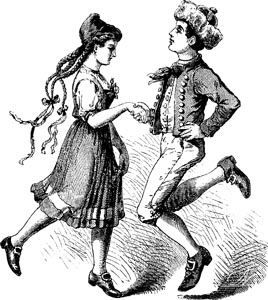
Easter Monday is looked upon as a grand holiday by the peasantry in many parts of the country. Weddings are often deferred to this day, and many village games are reserved for this season. The lads and lassies all appear in their gala costumes; the girls with short, dark skirts, braided with gold or silver, snowy aprons and full white sleeves, bright colored bodices and odd little caps; the boys with knee-breeches, white stockings, low shoes, and scarlet or yellow vests, the solid gold or silver buttons on which are often their whole inheritance. But when they are dancing gayly together on the green, they look a good deal happier than if they were little kings and queens.
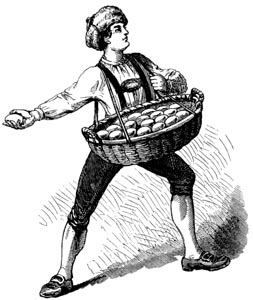
the thrower.
Games vary in different villages throughout the country, but one example will give some idea of what they are like.
Two of the leading young men of the place take entire charge of the day’s amusements, selecting for the purpose as the scene of festivities some inn or Wirthschaft, to which is attached a large garden or meadow.
For several preceding evenings, when work is over, they go about from house to house, dressed in their best, and carrying large baskets on their arms. Everywhere they are kindly received, and bread with wine or cider is placed before them. While they eat and drink, the baskets are quietly slipped away by some member of the family, a generous donation of eggs is placed within them, and they are secretly returned to their places. The eggs are not asked for, neither are they alluded to in any way; but the object of the visit is well understood and prepared for long beforehand.
the catcher.
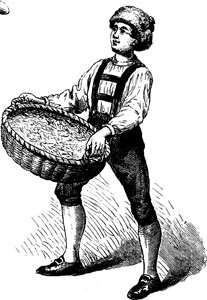
When Monday morning dawns, the inn is found to have been gayly decorated with garlands of green and flowers, and fluttering ribbons of many colors. The tree nearest the house is ornamented in like manner, and on it the prize to be contended for, conspicuously hangs. On the smooth grass hard by, a strip, a few feet wide and perhaps a hundred long, has been roped in, and at either end of this narrow plot a large, shallow, round-bottomed basket, called a Wanne, is placed, one filled with chaff and the other with eggs, dozens upon dozens, cooked and raw, white and colored.
The plan of the peculiar game which follows is that one player is pitted to run a given distance, while another safely throws the eggs from one basket to the other, he who first completes his task being, of course, the winner. Accordingly, when the young men and maidens have arrived, two leaders draw lots to determine who shall run and who shall throw. That decided, the contestants are gayly decked with ribbons, a band strikes up a lively air, a capering clown clears the way, and the game begins. He who throws takes the eggs, and one after another swiftly whirls them the length of the course, and into the chaff-filled basket, which is held in the hands of an assistant. Occasionally he makes a diversion by pitching a hard one to be scrambled for by the crowds of children who have assembled to see the sport. Meantime (while wagers are laid as to who will likely win) the other contestant speeds the distance of a mile or two to an appointed goal, marks it as proof of his having touched it, and if he succeeds in returning before all the eggs are thrown, the victory and the prize are his, otherwise they belong to his opponent. The game finished, the prize is presented to the victor with due ceremony and amid the cheers of the crowd; the hard eggs are distributed among the company, and the raw ones carried uproariously into the neighboring inn, there to be cooked in various ways and eaten.
The remainder of the day is spent in dancing and merry-making, and if a wedding can possibly be arranged to take place on that afternoon the fun is wilder than ever.
“happier than little kings and queens.”