TOO MANY BIRTHDAYS.
Reading edition
By Fanny M. Osborne.
The king of the island was the father, and the queen the mother, of the little princess about whom this story is told. For many generations there had been but one child born to the royal family; but goodness and beauty being hereditary, these only children were beloved by all the subjects of the realm; and although they ran a great danger of being spoiled, they never were, but remained all through their lives as simple, gentle, and unpretentious as though born to the humblest lot.
Of course, the event of the birth of one of these children had been, from time immemorial, the occasion of the greatest and most sincere rejoicing, and the enthusiasm of the people seemed even greater at each repetition of these blessed anniversaries.
In this happy island crimes were almost unknown; and so generous and confiding were the people, that they imagined all the world were as good as themselves. It is not surprising, therefore, that when the great physician Aigew came from a far distant land to attend the grandfather of the little princess on his death-bed, no one in all the island suspected that he was anything else than the best and kindest of doctors. It is true that the former court physician, now displaced by Aigew, had his doubts about his successor. But it is best not to trouble ourselves with what we cannot understand; and whether or not Aigew was as good as he pretended to be, the king and queen were altogether pleased with their new doctor. Knowing him to be wise and of great book-learning, they admitted him to the closest intimacy in their private life, consulted him upon all questions of state, and accepted his guidance and counsel as that of a superior being. It was to his influence that the islanders owed their great birthday law, by which it was enacted that, on each recurrence of the princess's anniversary, every child in the kingdom was to be allowed his or her way, without restraint, from sunrise until sunset; and, during the day, the use of the word "no" was forbidden to all fathers and mothers and nursery-maids, from one end of the island to the other.
Everybody thought this one of the best enactments of the reign. "What a beautiful thought!" said they. "All the children in the land rejoicing with their princess! When they are grown men and women, they will always think of her with pleasure, for she will be associated with the most delightful memories of their childhood."
It certainly did seem very charming at first. But the day after was harvest-time for the great physician and his assistants, who kept flying hither and thither post-haste.
Still, every one said it was a good law. It was true the children were not quite so well next day; but then, what a fine moral effect! and what a pleasant sight it was to see them all thoroughly happy for at least one day in every year!
Now, just after the fourteenth birthday had been celebrated, Aigew was called in to see to the princess. He gave her a little medicine, which she took in the prettiest way, without jelly.
"That's a nice, good girl," said the grave doctor. "I have offered you no birthday gift as yet; but it is in my power to give you anything you wish. Say—what shall it be, sweet princess?"
"It is enough to give me your kind care," answered the princess. "Everything else I have. The best part of all to me was the enjoyment of the other children. Ah! how I wish I could have a birthday whenever I choose!"
"Even that," said the doctor, "is possible," as he took something from his bosom, smiling curiously to himself as he did so. "I give you this little casket upon two conditions," said he. "One is that you are never to mention the circumstance to a living soul; you are not even to speak of it to me. The other I will tell you after I have explained the nature of the gift. Inside this box are eighty crystal figures; each one represents a birthday, and lies, as you see, in a separate compartment. Begin at the right hand, and whenever you wish to have a birthday, you have only to place one of these in your little mouth, and it is here."
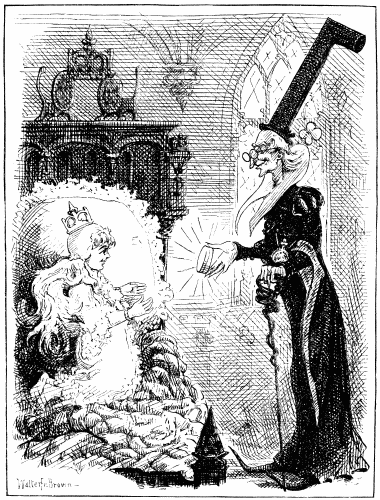
THE DOCTOR PRESENTS THE CASKET TO THE PRINCESS.
The princess, trembling and faint from a strange perfume in the air, took the box in her hand.
"But the other condition?"
"It is merely this: that no one but yourself ever tastes the contents of the magical box. If any one should, the worst consequences would follow; and, among others, all these birthdays, with all that they have occasioned and all the presents that have been given in their honor, will pass away and become as nothing. Remember this." And he was gone.
The princess examined her singular present with the most intense interest. It looked wonderfully like a pill-box; but inside, lying in the tiniest compartments, were marvelously small and beautiful figures exactly like herself in miniature, except that, beginning at the right, each one was a little older in appearance than the one preceding.
The next morning, before the rising of the sun, the little princess lay awake, with the casket in her hand.
"Shall I? or shall I not?" said she. "I think I shall."
And the first figure from the right melted on her lips. The taste was sweet; but that was soon forgotten in her surprise at the unusual bustle which sprang up immediately in the city. Cannons were firing; the populace was shouting, "Long live the princess!" and great vans came thundering up to the entrance, laden with gifts. Yes, it was all true; she might have a birthday whenever she chose. It passed off like the fourteen that had gone before. On the morrow, another was celebrated; another, after the interval of one day; and another in a week from that; so that the whole kingdom was kept in a continual uproar of festivity.
Dr. Aigew sent to his own country for many more learned doctors and chemists. He built great laboratories, where, all day and all night, pills and draughts and mixtures (of which I hope never even to know the names) were zealously compounded. The huge chimneys sent forth black clouds of physic-laden smoke, which began to hang like a pall over the city. The fields, once yellow with corn, were now only cultivated for the production of rhubarb and senna and camomile. The children of the nation grew as yellow and bilious as Aigew himself. All the wealth of the island was pouring into the coffers of the doctor. There were no shops open but those of chemists and confectioners. No other trade had an opportunity to flourish. The country was plainly going to ruin.
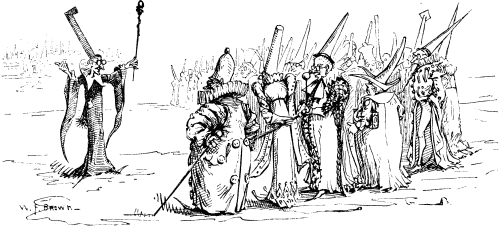
THE DOCTOR SUMMONS OTHER DOCTORS AND CHEMISTS.
The old king saw but one way to save his people. He must send his daughter away. This made him very sad, for he loved her dearly, and could not bear to have her know the truth.
"What shall I do?" he asked the queen.
"It is quite plain," answered she. "Marry her."
This was easily done. The fame of her beauty and gentleness had reached other lands; and a marriage was soon arranged between the little princess and a handsome young prince, who was the son and heir of a neighboring king.
In due time, the prince with his retinue started, in much pomp and magnificence, to visit the bride; and he made such good speed, in his impatience, that he arrived in the island several days before the time appointed. Within the city gates, the cavalcade halted for a moment that the prince might rest.
"I am very weary," said he to the chamberlain. "Call the first gentleman-in-waiting, and ask him to tell the page to tell the butler to send a servant with some wine. Or, stay! I'd like to taste the national beverage, whatever it may be."
So the chamberlain told the first gentleman-in-waiting to tell the page to tell the butler to tell a servant to ask some one for the national beverage. The servant returned from a confectioner's shop, and told the butler, who told the page, who told the first gentleman-in-waiting, who told the chamberlain, that the people generally drank lemonade, but, on account of the celebration of the princess's birthday, none was to be had.
"There is some mistake!" cried the prince, who was tired and a little cross, and very thirsty; "there is some mistake! The princess's birthday will be the day after to-morrow, the date for which we were invited. Go and find out the meaning of this riddle."
Soon the chamberlain returned, bringing the confectioner with him.
"My lord," says he, "this man tells so strange a story, that I have brought him here lest you should suspect me of falsehood. He declares that he has furnished confections, creams, and fruits for the princess's birthday, forty-one distinct individual times."
"It is the truth, my lord," said the confectioner.
"It cannot be!" gasped the prince. "Make further inquiries. Tell the chamberlain to tell the gentleman-in-waiting to tell the page to tell the—ah! I am deathly faint. Forty-one, and I but twenty last month!"
Voices were heard and approaching footsteps. The chamberlain had brought six reverend men, dignitaries of the town, all of whom testified that on forty-one several occasions the birthday of the princess had been celebrated.
"It is enough! In fact, too much!" cried the prince. "We return immediately. This insult shall not pass unavenged."
So all the horses turned their heads where their tails had been; the musicians changed their tune from "See, the conquering hero comes" to "Take me home to die;" and the prince returned whence he came.
The king, his father, was not so wroth as the prince had expected.
"I have been wrong," said he. "The prince is 'O'er young to marry yet,' while I have been a widower for many years, and perhaps should marry first and set him an example. If the match proves unfortunate, I shall not have so long to endure it, from the difference in our ages. From my experience, he may learn wisdom. Yes, like a true father, I will sacrifice myself. It is I who shall marry the lady. You say she is fair and gentle, and only forty-one? I will sacrifice myself."
The other king and his court were much surprised when the news came that the prince repudiated all thoughts of the marriage, and that the father proposed to take his place as bridegroom. They were at first disposed to be indignant; but then something had to be done, or the kingdom would soon be ruined. And besides, the king was already on his way; he was known to be of a fiery temper; he had at his command a large and powerful standing army; and if he chose to make war, there was no possibility of resisting him, for the soldiers of the island had turned their swords into plowshares, and were engaged in raising senna.
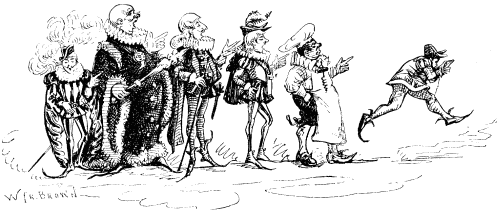
DELIVERING THE PRINCE'S MESSAGE.
The princess, as you may imagine, was not pleased with this change of bridegrooms; but, used to obedience, she acquiesced in everything, and told no one of the bitter tears she nightly shed upon her pillow. She tried to be as cheerful as possible in presence of her parents, and diverted her mind by having continual birthdays.
The bridegroom king halted at the gates of the town, with great dignity. He, too, arrived on a different day from the one appointed. It was a week later, at least. Age (the king was sixty, if he was a day) travels with more care and deliberation than hot-headed youth.
While waiting for the gates to be opened, the king could not forbear smiling at the horror of the young man when told of his bride's age.
"Forty-one is not so old," thought he. "Perhaps this is the very confectioner's where they furnished the information, but could not furnish any refreshment."
Turning to an attendant, he gave the order:
"Bring me from yonder house a draught of whatever is mostly used in the city."
It was not the confectioner's house, as he supposed, to which he pointed, but one of Aigew's laboratories. His majesty's commands were carried thither; and the chemist, gray and wizen, came forth, bearing a goblet filled with a dark liquid of peculiar odor. He bowed his knee, and held it toward the king, who took it in his hand, sniffed his royal nose suspiciously, and said:
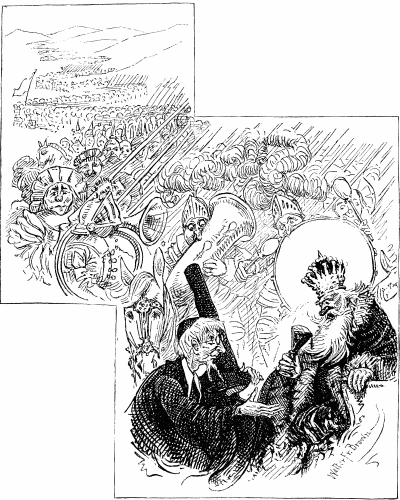
THE CHEMIST PRESENTS THE BEVERAGE TO THE KING.
"It has a disagreeable smell! What is it called?"
"Rhubarb and senna, your majesty; it is the only drink taken the day after the princess's birthday. Merry-making and feasting, when indulged in too freely, are necessarily followed by physic and fasting."
"I'll none of it," cried the king. "The princess's birthday! I thought her birthday had passed weeks ago."
"Of that I know nothing," replied the chemist. "I only know that yesterday we celebrated her seventy-second birthday. I am an old man, as your majesty sees, and not likely to tell that which is false."
The king was purple with rage. He said but the one word "Home!" In a few moments, he and his retinue had turned their backs, and they speedily disappeared behind the hills. There was only left a cloud of dust, and an occasional strain of "The girl I left behind me," borne back upon the wind from the distance.
This last blow fell heavily on the father of the princess. He flew into a rage; he had had too much of birthdays and bridegrooms, and determined he would be a party to no more of either.
"Get you gone to a convent!" he cried to his weeping, frightened daughter. "Don apparel suitable to your years, and offend my sight no more!"
They placed upon the princess's yellow curls a beldame's cap, robed her in a plain gown of black, and made ready to take her away.
"I cannot understand," thought she, "the cause of the misfortunes that have befallen me and all the world. Can it be Dr. Aigew's casket?" She took it from her bosom.
"I fear me I shall want no birthdays in the convent," said she, sadly. "So there, little birds, take what is left."
As she strewed the sugary mites, the little birds caught them up and flew away.
A sudden earthquake convulsed the land, a violent hurricane swept over it. During these changes of nature, everything that had been affected by the unnatural birthdays returned to its former state. All remembrance even, connected with them ever so remotely, was wiped from the memory of man.
I am not sure, but I think the prince did afterward visit the island, and was much impressed by its quiet, sylvan life and the incomparable beauty of the princess; and they do say——