SNEEZE DODSON'S FIRST INDEPENDENCE DAY.
Reading edition
By Mrs. M.H.W. Jaquith.
The usually quiet town of Greenville was in a hurly-burly of excitement on this Fourth of July morning, because of the great Sunday-school picnic, which was to take place on a fine ground, two miles distant. In the fervor of patriotism and the bustle of preparing for the picnic-celebration, almost every house in the village resounded with shouts and noises; and all the children were on the tip-toe of expectation and delight. Deacon Ebenezer Dodson sat in the arm-chair in the "spare room," staring out of the window, and trying to think up the speech he was to make that day. For he had been chosen by the town-committee to open the exercises upon the stand with an appropriate oration; and though he had mused and muttered and studied over it, from the day when he was first requested to "perform" until this eventful morning itself, he had not yet succeeded in composing a speech which satisfied him.
"The flies bother the horses so, I can't practice on it in the field, and my only chance is o' nights," he had often explained to his wife; but his nightly meditations on it had been disturbed by such foreign remarks as this:
"I say, Eb" (that was her family name for him; away from home she always said "Deacon"), "you haint gone off to sleep, be you? I should feel masterly cut up ef my cake should be heavy, an' everybody on the grounds will know it's mine from the marks o' my name I'm goin' to put on the frostin',"—by which she meant her initials done in red, white, and blue powdered sugar.
And again:
"Do you remember Mis' Deacon Pogue's pound-cake at the d'nation party las' winter? She'd bragged on it to every livin' soul, an', when they came to cut it, there was a solid streak of dough right through the middle from eend to eend. She didn't happin to be 'round when 'twas cut, an' I thought it was my duty to let her see a piece, so she'd know how to better it next time, and she was so mad, she's turned up her nose at me ever sence."
The Deacon here murmured something beginning "Ninthly," for he had arranged his speech in heads; but she kept on with such inspiring memories, that he had poor chance to get up that "Speech by Deacon Dodson," the sight of which legend on the printed programme had aroused in him a fixed determination to do or die. But it seemed to him, as he sat there, that it would be die; for not one "head" could he call up clearly, and ever and anon his wife would cry out for wood or water, or to state some fact concerning her cake or chickens.
Just now her rusk was the all-absorbing topic of thought. More than twenty times she had looked at the dough and reported its "rise" to the unsympathetic Deacon, who was pumping his arms up and down, and trying to disentangle his "firstly" and "secondly."
"The procession is going to form at nine o'clock punctial, and march to the grounds, and so there's no use of dressing Bubby twice," Mrs. Dodson had said, so that youth of three summers was wandering around in his night-gown, and had taken so active an interest in the proceedings that Mrs. Dodson had several times sent him to his father, complaining, "I never did see him so upstroferlous before."
Sneeze—so called because he was named for his father, and it was necessary to distinguish them—was hurried in from the barn; his ears were boxed for "not bein' 'round to take care of Bubby," and then he was sent with him to the barn.
Deacon had been duly badgered and pestered about household troubles. He had helped to put on Bubby's shoes—now far too small—and tried to hook Mrs. Dodson's dress—similarly outgrown. But he was at length exasperated into saying:
"By George! I can't think of a word of my speech, you bother me so!"
"You fairly make my blood run cold to be sayin' sech words as that on this Fourth o' July mornin', which you always said was nex' door to swearin'!" replied his wife; but her stream of talk was frozen up for the time, and they were at length dressed, packed, and rattling over the stony hills in a lumber-wagon.
"Wal, this seems quite like Independence Day," she said musingly. "I remember once goin' to a reg'lar picnic when I was about the bigness of Sneeze there, an' we had an awful good time. Mother'd plegged herself to git up somethin' that nobody else'd have, an' finally she made a lot o' figger four doughnuts to stand for Fourth o' July, you know, an' Aunt Jane, she that was a Green, Uncle Josiah's first wife, was kind o' jealous 'cause people noticed them more'n her cookin', an' she said they was shortened with toughening till nobody couldn't eat 'em. It come right straight back to mother, an' they never spoke for better'n a year—no, 'twas just a year, come to think, for mother took sick in bed very nex' Fourth, an' then Aunt Jane confessed humble enough, and they made up."
Sneeze had been listening, and while his mother paused for breath, he asked, "What do we keep Fourth of July for, an' what makes 'em call it Independence Day? I heard Reub Blake say that was the true name of it."
"Why, Sneeze, I'm 'shamed of you that you don't know that much. It is because George Washington was born on that day, or died; which was it, father? An' he fought for our independence. Besides, he never told a lie, as it tells about in the spellin'-book."
"Yes, it was something of that natur'," said the Deacon; "you'll know all about it to-day when we come to speak and make our orations."
"Yes, Sneeze, an' Cynthia Ann, your father is goin' to be a speaker on the stage; but you mus'n't feel set-up over the other girls an' boys whose fathers an' mothers aint app'inted as speakers an' on the table committee. You must listen to what father says."
They promised faithfully, and this is what Sneeze would have heard if he had kept his pledge; but to tell the truth, he was at that time going around with another boy looking into the baskets, and speculating on the length of time before dinner.
"Deacon Ebenezer Dodson, the first speaker on the programme, will now address the assembly," announced the chairman in a stentorian voice, after the procession had formed, marched, settled down, and were ready for the "exercises of the day." The Deacon stepped forward, and, with very evident shaking of the knees, with coughs and ahems, glancing to the right of him and to the left of him, to the heavens above and the earth beneath, with trembling voice he began:
"Firstly, my friends and fellow-citizens of this great country, this institution which we have come here to celebrate was instituted a great many hundred years ago,—leastways, if not quite so long, since this institution was instituted all men are free and equal"—(a long pause); "and since this institution was instituted in this great country, we have Sunday-schools and can go to church." Another pause.
"Secondly, little children, friends and fellow-citizens of this great country, let us all use rightly and not abuse the advantages of this institution which has been instituted for us, and go to church and Sunday-school, and—and—I see Deacon Pogue is waiting to make some remarks, and my friends and fellow-citizens of this great country, I will detain you no longer to dwell upon this institution, which was instituted to—to—" Here somebody benevolently thought to cheer, and the "Hip, hip, hurrahs!" were taken up so lustily by the small boys, that the magnetic sound warmed the Deacon into "Thirdly;" but Deacon Pogue had stepped briskly forward, and so with a bow, and "Good-by, my friends and fellow-citizens of this great country," he descended to his delighted wife, who received him with many proud and joyful congratulations.
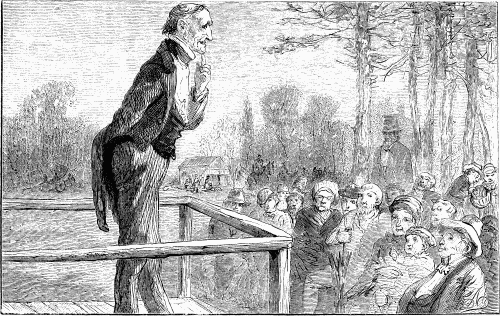
DEACON DODSON'S ORATION.
Deacon Pogue was more ready and noisy, but spoke quite as much to the point as Deacon Dodson. He was followed by several others, none of whom could be omitted without giving offense, and at length, with a great flourish, the chairman announced "The orator of the day, Captain Buzwell, from Thornton, who has kindly consented to honor us," etc.
He was a lawyer with a gift of tongues, and his first few words brought all the hitherto indifferent assembly quietly near the stand. After a few well-put anecdotes, he said: "But to come back to the subject in hand: one of your eloquent speakers has called this Fourth of July an 'institution.' That was a novel and happy idea. It is an 'institution,' and upon it are founded all of our institutions,—free schools, free religion, free speech, free press, free ballots, free action: freedom everywhere for all men free and equal is founded on this glorious 'institution,' the corner-stone of which was laid Fourth of July, 1776."
At this point so great was Mrs. Dodson's conjugal pride, and so fearful was she that her husband was not attending to the speaker's flattery, that she poked him with her parasol till the Deacon was "fain to cry out," as Bunyan says. When quiet was restored, the speaker continued:
"Another gifted orator has said,"—and, quoting something from Deacon Pogue's pointless remarks, he made them also seem full of meaning; and so on through the list of "distinguished speakers," till each one felt that he himself had spoken most effectively.
Having thus pleased and interested all parties, he followed with an instructive, historical speech, to which Sneeze, doughnut and cheese in hand, listened so intently, that he found out at last "why they kept Fourth of July."
After the speech and "appropriate instrumental music by the band," which consisted of a drum and a bass-viol, the people dispersed to amuse themselves as they saw fit, till dinner should be announced.
Mrs. Dodson, as "Table Committee," was disposed to magnify her office. She kept the Deacon standing guard over her basket till nearly all the rest were emptied, having reserved conspicuous places on the table for her goodies. Taking advantage of her rival's presence, smiling sweetly, she said as she opened the basket, "Mis' Pogue, your vittles look so nice, I'm real 'shamed to bring mine out at all."
"But all the while I knew she was proud as Lucifer over 'em, and thought she'd throw me quite in the shade," Mrs. Pogue told her next neighbor that afternoon. "Her big cards of rusk did look nice, but her mince-pies had slipped over into the custards, and they had dripped onto her cake so it looked just awful! and that red-headed Sneeze had squeezed her jelly-cake into flap-jacks, most likely by settin' on the basket. I never see anybody so cut up in my life; her face was redder than a beet."
And Mrs. Dodson said to the Deacon that night, "I did feel despritly morterfied over my squashed vittles, with Mis' Pogue a-lookin' on with all her eyes."
But when "the orator of the day" ate of her rusk, and said, "Mrs. Dodson, these rusk have a peculiar taste, just such as those my dead mother used to make for me when I was a boy, and I want you to give me the recipe for my wife," and he took it down in his note-book, there was full compensation for all her trials.
When all had eaten all they could, the young folk and children swung, played ball, or "chased the squirrel" with the delightful penalty of kissing it when caught, or rambled about at will, while the mothers gathered the dishes together, and exchanged recipes and confidential remarks on somebody's cookin'.
By four o'clock the babies were fretful; children of Bubby's age complained that their shoes and clothes were too tight; somebody suggested going home. In vain the young people protested—an hour from that time the grounds were deserted; the lumber of the stage, made sacred by such oratory, had been gathered up with the seats and tables, and where so much of life had been, all was silence.
A neighbor's hired man was riding home with the Dodsons, but as Mrs. Dodson did not mind him, she at once began to congratulate her husband on his maiden speech. "Cappen Buzwell said you made the best oration there was made to-day, Deacon. Did you pay 'tention, Sneeze, an' hear what he said 'bout your father's speakin'?"
The Deacon modestly put in a faint, "Now, mother, don't," but she interrupted him: "Yis I shall, for it's so, father, an' I'm goin' to say my say. Besides, he told me, with tears in his eyes, that my rusk tasted just like his dead mother's. But ef you'd only seen him tryin' to eat one o' Mis' Pogue's doughnuts as if they was real good, when I could see they was half chokin' of him!"
"That there man from town did make a purty considerable speech," said the Deacon; "not so hefty as some I've heard, but real instructing. It made me feel as though I wanted to fight somebody—purty much as I used to when I was a boy, and heard my father tell how he fit in the war of eighteen hundred and twelve, and his grandsir in the Revolutionary war."
"I guess you wasn't in any o' them wars?" stated the hired man, inquiringly.
"No; I wasn't born then, and o' course I couldn't; but my father used to tell us about it on trainin'-day nights. Trainin'-day was a great time, with its uniforms and feathers; my father was a sarjint, and we had gingerbread and federal cake."
"Well," burst out Sneeze, "if ever I get a chance I'm goin' to be a soldier, an' fight for my country, as George Washington did. I just wish we'd have trainin'-day now, and that Fourth of July came every day. Then, too, when I'm a man, I'm goin' to marry Eliza Johnson, for she—"
"Shut up, Sneeze!" put in Mrs. Dodson. "Little boys like you ought to be seen and not heard; when your parents make speeches and rusk at Fourth o' July celebrations that them that was good judges says was most interestin', you had ought to be listenin' to their talkin' and learnin' o' them. Here's Bubby a tunin' for somethin' to eat; give him one of them rusk out of the basket, an' stop your nonsense."
Sneeze's face was as red as his hair, and not another word did he say; but his dreams that night were a mixture of feathers, soldiers and pound-cake, Eliza Johnson, mother and speeches, and thus ended his first memorable Independence Day.