THE BARBECUE.
Reading edition
(The "Tolerbul" Bad Boy again.)
By Sarah Winter Kellogg.

Marley came bolting into Aunt Silvy's cabin. This is what he usually did when things vexed him.
"It's mean!" he said, snatching off his large straw hat and wiping the perspiration from his brow.
Aunt Silvy was peeling peaches for drying—great, luscious Indian peaches, too, beet-red from down to pit.
"Seems like yer's al'ays fin'in' somethin' mean," she said, as the long peeling dropped into the pan, and she proceeded to stone the peach, which looked as though pared by machinery. "What's de matter now? Somethin' 'bout de barb'cue?"
"Yes, the committee's been 'roun' here to see what Pa'd subscribe, an' he signed for o-n-e shoat! Think how it'll look!—'Wm. Coleman, one shoat.' An' the paper's goin' all over the county; everybody'll see it,—General Bradshaw, and Mandy, and all the girls! If I couldn't give anything but a mean ole shoat, I wouldn't put my name down 'tall."
"Neber had no sich puffawmances at yer granpaw Thompson's. He uster su'scribe a heap er deaf an' dum' an'mals. I 'members one Foaf July he su'scribed,—lem me see ef I kin 'member what all he did su'scribe. Thar wus two oxes an' 'leven milk cows, an'—"
"I don't b'lieve it," Marley interrupted.
"It's de bawn troof," said Aunt Silvy, solemnly. "I 'members dar wusn't nuff cows lef' ter git milk fer de white folks' coffee nex' mawnin arter dat barb'cue. But, law, Mah'sr Mawley! dat wusn't haf' yer granpaw Thompson su'scribed. Thar wus fou'teen fat shoats, an'—lem me see how many tuckies; twenty-fou' tuckies, thutty-fou' Muscovy ducks, fawty chickuns, sebenteen geese an' ganders, an'—"
Marley gave a long whistle.
"Well, if that isn't the biggest story that ever I heard sence I was created!"
"He did so. I could prove it by yer maw, but her wus sich a little gal when it happened, her's fawgot. I 'members we all didn't hab no geese ter pick arter dat barb'cue, 'cept one ole gander; an' I 'members goin' to de hen-house, an' seein' not a sol'tary human critter lef in dat dar hen-house 'cept de ole saddle-back rooster. An', law! I fawgot de hams,—a heap er hams,—more 'n a hundud; an' de sheeps—law! I dunno how many sheeps dar wus."
"An' didn't he subscribe a team of mules an' a half-dozen negroes?" said Marley. "An' I want to know where my gran'pa got all the wagons to haul all the things to the barbecue? I reckon it would take fifty wagons to do it; I'm goin' to ask Pa."
"Law! I wouldn't go pesterin' master 'bout it. I neber say yer granpaw tuck um ter de barb'cue; I say he su'scribed um."
"Then he didn't pay what he subscribed?"
"Shucks! Mah'sr Mawley. I can't make yer un'erstan' nuffin. Yer neber did know nuffin sca'cely."
"I know why they keep the Fourth of July. You don't, do you?"
"Of cou'se! Law, chile! I's 'scended from a Rev'lution cullud genulmon what wus presunt at de fuss Foaf July dar ever wus."
Marley laughed and laughed at this till Aunt Silvy began to sulk. He couldn't afford to have her offended; he wanted her to do something for him. So he checked his laughter, and said:
"You know everybody in the county is invited to the barbecue."
"Ob cou'se. De suckit-riders gives it out at all de 'p'intments. Ev'ry pusson's 'vited, cullud pussons an' white folks. Thar'll be a heap er folks thar."
"Now, look yere, Aunt Silvy; you b'long to me, you know. You always said—"
"Yer b'longs ter me, mow like; an' yer maw b'longs ter me, too. I nussed her when she wus a baby, an' yer too. Law! I owns yer bofe."
"Well, then, I'm your boy, an' I want you to do somethin' for me."
"I'll be boun' yer does."
"I felt so 'shame 'bout Pa's one shoat, that I went out to the front gate, an' when the committee came to go away, I tole 'em I'd bring somethin' to the barbecue."
"Mussy! yer aint got nuffin ter take."
"If I had a 'coon-dog, I might catch a 'coon or a 'possum. Look yere! can't you borrow Boston's ole Rum for me?"
Boston was Aunt Silvy's husband, and belonged on another plantation, and Rum was Boston's 'coon-dog.
"Ob cou'se I kin. Bos'on's mighty good ter min' me. But, law! yer aint 'quainted wid ole Rum; yer couldn't manage him no more'n nuffin. 'Sides, 'coons an' 'possums aint good now tell arter pussimon-time. Folks ud duspise yer 'coon an' 'possum, kase they's so poo'."
"Well, what can I take? I know Pa wouldn't let you bake me anything."
"Mussy, no! Law! yer oughter seed de roas'in' an' fryin', an' all de gwyne-ons at yer granpaw Thompson's. One Foaf we all tuck—lem me see, how many cheese-cakes an' tauts wus it?"
"But what can I take?" said Marley, impatiently.
"I reckons some fresh fish would tas' tolerbul good."
"That's just it," Marley cried, springing to his feet; and he went on talking excitedly about a splendid cat-fish hole, and where he could find perch, and how he could keep them alive, etc. At length he said: "Pa says I can't go unless I take Sukey on behine me. I'd a heap rather walk than go in that poor folks' way. Mandy Bradshaw ud be sure to see us, an' she'd turn up her nose higher'n she did when I rolled the mandrake-apple to her."
"Needn't turn up her nose at a ha'f Thompson. I wus 'quainted wid de Bradshaws when dey wus poo' es yaller dirt,—had jis fou' ole niggers, an' dey wus mos' all womens an' childuns."
"But General Bradshaw's tolerbul rich now,—a heap richer'n Pa."
"He got rich hoss-racin'," said Aunt Silvy, contemptuously.
But Marley was thinking about the hardship that Sukey was.
"She's such a coward," he said, "in riding. She hol's on to me so hard that she pinches like sixty, an' mos' tears my clothes off. An' if the horse goes out of a walk, she hollers that she's goin' to fall off. I don't want to go pokin' up to the barbecue like it was the first time I ever was on horseback in my life. But I'll have to go that way, or with Sukey clingin' to me an' hollerin'."
"Reckon I might pussuade her ter stay to hum."
"Oh no!" Marley said, warmly. "Sukey must go; she'd be so disappointed, I'd a heap rather stan' Mandy's gigglin' than Sukey's cryin'. No; Sukey's got to go if she rides on my head."
"I'll tell yer," said Aunt Silvy. "Bos'on's got leave to tote dat little bay mule uv Patrick's over here fer me ter ride ter de barb'cue. Her name's Jinny, an' her racks tolerbul easy. I kin take Miss Sukey in my lap an' Barb'ry Allen on behine."
Marley thought this a capital plan, and went away to make his preparations for the Fourth. He brought an immense cotton-basket from the gin-loft, and nailed it against the side of the little log spring-house, after having half sunk it in the branch that flowed through the building. This is where he meant to put his fish to keep them fresh for the barbecue. Of these he felt sure, for the plantation lay along a noble "run," abounding with creatures. He captured his fish in a way not sportsman-like—by nets and night-hooks; but then there was need of expedition, for there were only two days to the Fourth. When he went to look at his lines, he always took his rifle and Rover; he might, per-chance, encounter some game. The first day he shot a red squirrel. But the next day—oh, the next day! It was late in the afternoon when he went to the run. He was about descending the bluff which overhung one of his lines, when he saw something that made his heart stand still, and then leap as though it would jump from his body. He was never so excited in his life. There, with its nostrils in the water, was a strange animal. In an instant, he knew it. Rover, too, knew it, and gave a low growl. Quickly Marley put his hand on the dog's head, and whispered, "Down, Rover, down! good fellow, down!" But the wary creature at the drink had heard something. Two antlers were suddenly flung up, and a face turned to windward. Marley, with his knee on Rover, hardly dared to breathe, yet aimed his rifle. "Down, Rover! good dog, down!" he again whispered. Then the sharp crack of the rifle broke the silence, and Marley, on his feet, strained his eager eyes through the smoke. Was that a fallen deer, or was it the shadow of cypress-knees? He and Rover went running and leaping to the spot. Yes, he had killed a fine buck with ten tines. He was a happy boy, you may believe. Here was a contribution to the barbecue worthy of the glorious day. When he had turned the animal over and over, and wondered where it came from, and how it happened to be there alone, he left Rover to guard it, and hurried back for help to get it home. He ran every step of the way. Then, mounted on black Betts, and accompanied by Jim, he returned to the heroic spot, and there found the faithful Rover and his dead charge. The game was strapped behind Marley's saddle, and old Betts was made to go galloping back to the house. Then, after everybody had looked at the deer, and handled it in every possible way, and wondered about it, and Marley had told over and over the story of the shooting, the game was dressed and put down in the spring-house, to keep cool for the morrow, which was the Fourth.
Marley rose early the next morning, and waked Aunt Silvy by firing his rifle into her cabin. Then he saw the shoat and venison put in the wagon, and a barrel of spring-water, crowded with darting fishes. After breakfast, he dressed-up in his best clothes, and stuck two cotton-blooms—one white, the other red—in his button-hole. He did not wear these for ornaments, as the cotton-blossom, which opens white and then quickly turns crimson, is as large and coarse as a hollyhock, which it somewhat resembles; but among the planters it is considered an honor to display the first cotton-blooms.
He was early on the barbecue ground, located near a fine clear spring, about which were hung a score of gourd dippers. He found the campers already humming like a hive. There were coaches and buggies and lumber-wagons, and scores upon scores of tethered horses and mules, which had brought people to the scene; and other carriages and riding-horses were momently dashing in. Whole families came on horseback,—not infrequently three riders to a mule or horse. Streams of negroes were pouring in, usually on foot. There were well-dressed gentlemen and gay ladies, and a fair sprinkling of shabby people; and Marley wondered where they all came from. In a short time after his arrival, he caught sight of Aunt Silvy; he knew her by the faded pink satin bonnet which she had worn ever since he could remember. She had Sukey on her shoulder, and was tugging up the hill from the spring. Boston had failed to bring over "pacing Jinny" for his wife to ride, so the faithful negro had brought Sukey all the way on her shoulder. Marley was quite touched when he realized this, and he made up his mind that he'd take Sukey back behind him, if Mandy Bradshaw should giggle her head off about it. Why should he care for her mocking more than for the comfort of Aunt Silvy, his life-long friend? He went over, and offered to escort Sukey around to see the sights, but she preferred to stay with Aunt Silvy; so he felt free to wander where he pleased. And he pleased to wander everywhere, and to see everything. He was greatly interested in all the proceedings,—the spreading of the long, long tables under the oaks and beeches; the unloading of the wagons; the clatter of dishes; the great boiling kettles down by the spring, where negroes were dressing shoats and sheep and great beeves—every animal being left whole, but split to the back-bone.
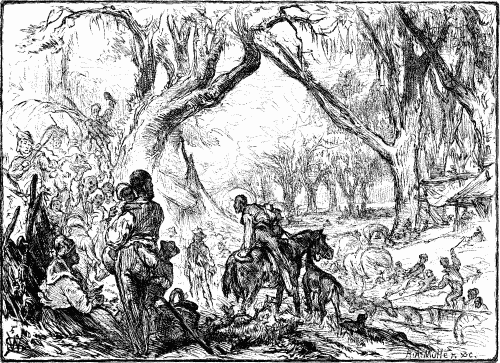
GOING TO THE BARBECUE.
Then there was a rostrum, covered with forest-boughs and decorated with wreaths and flags, where the Declaration of Independence was to be read and the oration was to be given. "Yankee Doodle" the band was playing from it when Marley strolled by, and about it were the Washington Rifles, in their pretty uniform of blue and white, waiting to open the programme by a salute and some special maneuvering.
But to Marley the most wonderful and interesting of all the sights was the barbecuing. There were long, broad ditches, floored with coals a foot deep, over which the great carcasses of hogs and bullocks were laid on spits, as on a gridiron. Beyond these trenches, great log-fires were kept blazing, that the ditches might be replenished with coals. Ever and anon, an immense iron kettle would be seen, borne between two negro men, and filled with glowing coals. Such hissing and sissing as there was above those lines of fire! What savory odors were in the air! How important and fussy the cooks at the spits! How splendid the great log-heap fires! How grand the high-mounting flames and the columns of blue smoke! Marley was in a mood to enjoy it all, for "the committee" had expressed special pleasure with his contribution; it was the only game on the ground, and they were warm in their compliments of his sportsmanship.
But after a while, Marley, in his strollings about the grounds, saw a written placard tacked to a tree. Of course he read it, and then he stood confounded by the revelation it made to him. Can't you guess what it was? An advertisement for an escaped pet deer! He knew by the description (the ten tines, the slashed ear, etc.) that it was the deer he had shot. To have shot anybody's pet deer, and to know that it was at that moment over the coals, would have been mortification enough; but it was the name at the foot of the advertisement which carried to Marley's heart the sorest dismay he had ever felt in his life. Whose deer had he killed? Guess! Why, Mandy Bradshaw's! He was so chagrined, so bitterly distressed, that he would have said he could never smile again. What was he ever to do about it? Of course, there was but one manly thing to do: confess the whole matter to General Bradshaw. But he felt sure he'd rather die than do this. He went over to where Aunt Silvy was barbecuing the deer, the most melancholy-looking boy, perhaps, that ever was at a barbecue with a cotton-bloom in his button-hole. To her he told the truth, and felt better the instant he had spoken it. But when he asked her advice, she replied:
"I don't devize nuffin. Yer granpaw Thompson uster say thar neber wus no use in devizin' nobody, kase a wise man didn't need no device, an' a fool wouldn't take no device. But ef I wus yer, I'd jis go ter Mandy an' tell her how it happen."
Marley saw that it must come to this, and wisely decided that the sooner it was done the better. So he began to hover around Mandy, lying about on the grass, sitting on stumps and logs near her, and sauntering back and forth. Finally, he saw her standing alone, her girl mate having run off after a yellow butterfly. He walked in a dizzy kind of way to her side. He said, "Howdy, Mandy?" and she answered, "Howdy?" looking at him with a question in her look.
Marley knew she was wondering what he had come for, and that he was now committed to some sort of explanation. He blushed and blushed, till it seemed to him he never could stop blushing.
"Don't be mad at me," he said, pleadingly.
"I'm not mad at you," she said.
"But you will be when I tell you. I didn't go to do it. I wouldn't have done it for the world, but I thought it was a wild deer and shot it."
"Oh! you're talkin' 'bout my deer; you shot my deer?"
"Yes," said Marley, hoarsely. He thought he was going to choke to death. "They are barbecuing it now. I never was so sorry in my life. I'll pay for it, or I'll get you another, or I'll do anything in the world you tell me to."
Mandy burst out laughing, and said: "How absurd to talk so about that deer. But you wouldn't do anything I tell you. You wouldn't go up on the rostrum there, an' stan' on your head."
"Yes, I would, if it would keep you from being mad at me," said Marley.
"Well, I'm not, mad at you. I don't care much about that deer; he used to scare me nearly to death, and Pa was going to bring him to the barbecue. You've brought him instead of Pa—that's all the difference. I shouldn't have thought you'd have told about it when you felt so badly. I reckon you're tolerbul plucky. Why don't you ever come over to see brother Bob."
"Don't know; 'cause he never asked me to, I reckon."
"I know he'd like to have you. Look yere! He's got some Roman candles he's goin' to fire off to-night; so you stop as you go home this evening. It's right on your way. Can't you?"
"I reckon so," answered Marley, his heart throbbing with pleasure.
"Look here, Marley," Mandy added, suddenly. "Don't say anything about that deer, and I wont tell; so nobody'll know anything about it."
"I must tell General Bradshaw. There he is coming this way now, to take you to 'the stand.'"
"Well, tell him, and I'll ask him not to tell."
When Marley had "owned up," the General gave him a hearty slap on the back, calling him a brave lad and a good shot, and promised Mandy never to tell as long as he lived. When Marley spoke of the antlers, etc., he was told that he should keep them.
Then they went up to "the stand," and not a boy in the assemblage felt in a better mood than Marley for applauding the patriotic music, and the old "Declaration," and Mr. Delaney's ardent oration. At every allusion to the star-spangled banner, Marley cheered; and when the orator apostrophized the national bird, perched with one talon an the Alleghany and the other on the Sierras, dipping his beak now in the Atlantic and now in the Pacific, preening his feathers with the mighty Lakes as his mirror, our Marley shouted in a patriotic transport from a stump, and threw up his cap, and threw it up till it lodged in a tree, and he could toss it no longer. He shook it down just as the marshal of the day announced that he would proceed to blow the horn for dinner, to which everybody, rich and poor, bond and free, was most cordially invited—ladies to be served first, then the gentlemen, then the colored people. They would please form by twos, and march to the tables as the band played "Hail Columbia!"
Then a great bullock's horn, decorated with our blessed colors, was raised to the marshal's lips, and he blew and blew and blew such blasts; and when he had ended, the multitude—especially the boys—shouted such shouts as might have leveled the walls of another Jericho, if horn-blasts and shouts could do such things in these days.
Then the people, in long, fantastic line, wound in and out among the trees to the tables in the thick shade; and Marley walked beside Mandy Bradshaw, keeping step to the spirited music, and feeling heroic enough to charge an army.