BIRDS AND THEIR FAMILIES
Reading edition
By Prof. W.K. Brooks.
In this paper we will talk a little about the different ways in which birds bring up their children, and will say something, too, about the young birds themselves. There is almost as great a difference in the domestic habits and customs of birds as in those of human beings.
You have all heard how the ostrich lays its eggs in the sand, where the sun can shine upon them, and keep them warm, while the parent birds are away in search of food during the middle of the day. The South American ostrich (an engraving of which is given on the next page) makes use of the warmth of the sun and sand in the same way. According to Darwin, the mother does not show the least affection for her young, but leaves the labor of hatching the eggs entirely to the father, who attends to it very faithfully, but is, of course, compelled to leave the nest occasionally in search of food, selecting the middle of the day for this purpose, as the heat of the sun is then sufficient to keep the eggs from growing cold.
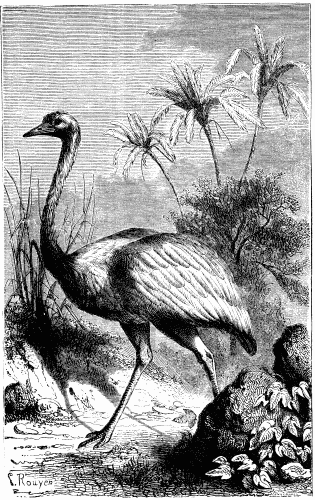
SOUTH AMERICAN OSTRICH.
I suppose most of you know that if a quantity of wet decaying leaves or straw is raked together into a large pile, and covered up with a thin layer of sand or earth, and then left exposed to the sun and rain, the heat given off by the decay of the vegetable matter forming the inside of the pile will be retained until, after a few weeks, the interior of the heap becomes so warm that, when the mound is broken open, a thick cloud of smoke and steam will rise from it. The mound-building "brush-turkey" of Australia, New Guinea, and the neighboring islands, has somehow learned this fact; and also, that the steady and equal heat generated is sufficient to hatch its eggs. So, instead of making a nest and sitting upon the eggs until they are hatched, this bird, which has very large and powerful feet, scratches up a huge pile of decaying twigs, leaves and grass, thus making a mound often six or eight feet high, and containing enough material to load several wagons, in which the eggs are buried. The young birds are not helpless when hatched, like the young of most of our singing birds, but are quite strong and active, and able to burrow their way out of the mound, and take care of themselves immediately.
Some birds provide for their young in still another way. They neither sit and hatch their own eggs, nor provide an artificial incubator; but go quietly and drop an egg into the nest of another bird, and allow this bird to act as a nurse, hatching the egg and finding food for the young bird. The most notable example of this habit among birds is the case of the European cuckoo. This bird never builds a nest, or shows the least love or even recognition of its young. The cuckoo always selects the nest of a bird much smaller than itself, and as its eggs are much smaller than those usually laid by a bird of its size, they are no larger than those which properly belong in the nest; so that the owners do not appear to discover the deception put upon them, but treat all the eggs alike. As soon as the young cuckoo is hatched he begins to grow very fast, and as he is larger and stronger than the other nestlings, he manages to get the lion's share of the food which the old birds bring to the nest. It would seem as if robbing his foster brothers and sisters of part of their nest, of the attention and care of their parents, and of nearly all of their food, might be enough to satisfy the young cuckoo; but it is not. He wants not part, but, everything—the whole nest, all the care of the old birds, and all of the food—for himself; so, when the old birds are away, he pushes himself under one of the little nestlings, which is of course too small and weak to help itself, and throws it out of the nest to die. In this way he murders all his foster-brothers, and if any eggs are still unhatched he throws them out too. He now has all the attention of the old birds to himself, for they continue to treat him as affectionately as if he were really one of their own children, and go on bringing him food, and attending to all his wants, long after he has grown to be as large as themselves, or even larger.
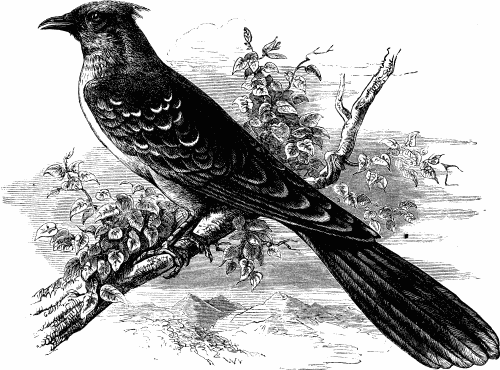
THE CUCKOO.
We have two species of cuckoo in the United States, but each of them builds a nest of its own, and rears its own young, although our yellow-billed cuckoo is a very bad nest-builder, and is said often to desert its young, leaving them to starve unless other birds take pity upon them and bring them food. Most of our smaller birds are very sympathetic during the breeding season, and are ready to give food and care to any young bird which needs it, even if it is not one of their own species.
Although our American cuckoos have not, as a general thing, the bad habits of those of Europe, we have another very common bird which is hatched and brought up by strangers. Every boy who lives in the country knows the cow-bird, cow-blackbird, or cow-bunting, for it is called by all these names. It is a small bird, a little larger than the bobolink and of much the same shape. The male has a dark-brown head and a bright greenish-black back and wings, but the female is so much lighter in color that you would hardly believe that they belong to the same species. These birds are very abundant in the spring and summer, and may be seen in flocks flying and feeding in company with the red-winged blackbirds. They are often found among the cattle and sheep in the pastures and barn-yards, and they derive all of their common names from this habit. Although nearly related to the orioles, which make such wonderful nests, the cow-birds make none at all, but lay their eggs in the nests of other birds, such as the blue-bird, chipping-bird, song-sparrow, yellow-bird, and some thrushes and fly-catchers. Like the cuckoo, this bird usually chooses the nest of a bird much smaller than itself, but as its egg is not small, the deception is at once discovered, and the birds whose nest has been selected for this purpose are very much disturbed. It is necessary for the female cow-bird to find a nest in which the owners have just begun laying, for if the owners have no eggs of their own they will desert the nest, and if their own eggs are somewhat advanced before the cow-bird's egg is laid, their own young will hatch first, and the parents will then leave the nest to hunt for food, thus allowing the cow-bird's egg to become cold and die.
When the female cow-bird is ready to lay her egg, she often has great trouble in discovering a nest at just the right stage. She leaves the flock and perches upon some tree or bush, where she can have a good view of all that is going on. When she discovers a nest by watching the actions of its owners, she waits for an opportunity when both the owners are away, when she approaches it very stealthily, but quickly, keeping a very sharp watch, to be sure that she is not observed. If she finds that the nest is fit for her purpose,—that is, if the birds have laid only a part of their regular number of eggs,—she drops one of her own eggs into it, and then disappears as swiftly and quietly as she came. If she is unable to find a suitable nest in her own vicinity, she goes in search of one, examining every thicket and bush—sometimes for a long distance—until she finds one. A gentleman once followed a cow-bird along the shore of a stream for two miles before she succeeded in finding a nest which satisfied her. Occasionally, two or more cow-birds' eggs are found in the same nest. It is not known whether both of these are laid by the same bird, but it is more probable that in such a case as this two cow-birds have visited the same nest.
The egg of the cow-bird has one interesting and important peculiarity. It is necessary, as we have seen, that this should be hatched before the other eggs; for if it were not, the old birds would stop sitting and allow it to become cold as soon as their own young were hatched. This danger, however, has been provided against, since the egg of the cow-bird needs only eight or nine days of incubation, while the eggs of those birds in whose nests it is usually found require from twelve to fifteen days. A short time after the young cow-bird is hatched, all the other eggs disappear, and they may sometimes be found on the ground, broken, at a considerable distance from the nest,—so far away that the young cow-bird could not possibly have thrown them there. The way in which they are removed from the nest is not known, as no one has yet watched closely enough to say whether the parents themselves destroy them, or whether the female cow-bird returns to the nest and removes them, to give more room for her own young when hatched.
I have already said that the smaller birds are very much disturbed and troubled when they find one of these eggs in their nest, and are very apt to desert it and go to another place if they have not yet any eggs of their own. Our common yellow-bird, however, is sometimes wise enough to find a better way out of its trouble. It values its neatly finished nest too highly to desert it, and it is not strong enough to lift the big egg and throw it over the edge, so it gathers a new supply of hay and hair, and makes a false bottom to cover up the egg. Then it makes a new lining to the nest, and lays its own eggs upon that, so that the cow-bird's egg does not receive any of the warmth from its body, and never hatches.
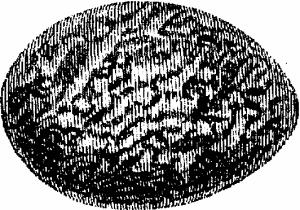
EGG OF COW-BIRD.
I have given you several reasons for believing that birds are able to think for themselves; but I do not see how anything could prove this more clearly than this expedient of the yellow-bird for saving its young from destruction by preventing the hatching of the cow-bird's egg.
Before leaving the subject of birds'-nests, I must say a few words about the immense number of birds which sometimes gather in one place for the purpose of raising their young. The enormous flocks of wild pigeons, which from time to time visit certain parts of the United States, have a definite portion of the woods, often several miles in extent, where they gather every night. This is called the "roost," and here they build their nests and rear their young. There are so many at these roosts that it is not always safe to go under the trees, for large branches are often broken off by the weight of the birds and their nests.
If you wish to know more about these pigeon-roosts, you will find long accounts of them in the books about birds, by those two celebrated men, Wilson and Audubon. Audubon's account of a roost which he visited in Kentucky is very interesting and well worth your reading. It is printed in the first volume of his "Ornithological Biography," and also, I believe, in the "Life of Audubon, the Naturalist."
In these books, and in the other works of Audubon and Wilson, you will also find much instructive and entertaining information in regard to all of our common birds. Most of our sea-birds are very wild, as they are much hunted by man, and on this account they build their nests and rear their young on inaccessible and uninhabited rocky islands, and the number of sea-birds which gather upon these islands during the breeding season is almost beyond belief; but the following account of Ailsa Craig, by Nathaniel P. Rodgers (the "Craig" is a rocky island on the west of Scotland), will give some idea of their abundance at such places:
It was a naked rock, rising nine hundred and eighty feet abruptly out of the sea. A little level space projected on one side, with a small house on it. We could not conjecture the use of a habitation there. The captain of the steamer said it was the governor's house. We asked him what a governor could do there.
"Take care of the birds," he replied.
"What sort of birds?" we asked him.
"Sea-fowl of all sorts," he said. "They inhabit the Craig, and ye'll may be see numbers of them. They are quite numerous, and people have been in the habit of firing to alarm the birds, to see them fly."
He ordered his boy to bring the musket. The boy returned, and said it had been left behind at Glasgow.
"Load up the swivel, then," said the captain; "it will be all the better. It will make quite a flight, ye'll find. Load her up pretty well."
The steamer meanwhile kept nearing the giant craig, which was a bare rock from summit to the sea. We saw caves in the sides of the mountain. We had got so near as to see the white birds flitting across the black entrances of the caverns like bees about a hive. With the spy-glass we could see them distinctly, and in very considerable numbers, and at length approached so that we could see them on the ledges all over the sides of the mountain.
We had passed the skirt of the Craig, and were within half a mile, or less, of its base. With the glass we could now see the entire mountain-side peopled with the sea-fowl, and could hear their whimpering, household cry, as they moved about, or nestled in domestic snugness on the ten thousand ledges. The air, too, about the precipices seemed to be alive with them. Still we had not the slightest conception of their frightful multitude. We got about against the center of the mountain when the swivel was fired, with a reverberation like the discharge of a hundred cannon, and what a sight followed! They rose up from that mountain—the countless millions and millions of sea-birds—in a universal, overwhelming cloud, that covered the whole heavens, and their cry was like the cry of an alarmed nation. Up they went,—millions upon millions,—ascending like the smoke of a furnace,—countless as the sands on the sea-shore,—awful, dreadful for multitude, as if the whole mountain were dissolving into life and light; and, with an unearthly kind of lament, took up their lines of flight in every direction off to sea! The sight startled the people on board the steamer, who had often witnessed it before, and for some minutes there ensued a general silence. For our own part, we were quite amazed and overawed at the spectacle. We had seen nothing like it before. We had never witnessed sublimity to be compared to that rising of sea-birds from Ailsa Craig. They were of countless varieties in kind and size, from the largest goose to the small marsh-bird, and of every conceivable variety of dismal note. Off they moved, in wild and alarmed rout, like a people going into exile; filling the air, far and wide, with their reproachful lament at the wanton cruelty which had driven them away.
This is only one of these breeding-places, but most of the rocky, inaccessible cliffs and uninhabited islands of the northern and southern shores of both continents are visited, at certain seasons, by sea-birds in equally great numbers.
No subject connected with the history of birds furnishes more interesting material for study than that of instinct. Young birds of different species show that they have very different degrees of instinctive knowledge. Some are able to take the entire care of themselves, and do not need a mother to watch over them; others, on the contrary, are perfectly helpless, and need teaching before they can do anything for themselves, except breathe, and swallow what is put into their mouths. The young chicken, a short time after it leaves the egg, knows how to take care of itself nearly as well as the young mound-bird. It can run after its mother, use its eyes, pick up food, and answer the call of the old hen; and it does all this without instruction. How different it is in all these respects from the young barn-swallow! This is blind, and unable to run, or even to stand, knowing only enough to open its mouth when it hears the old bird return to the nest, and to swallow the food placed in its open bill. Far from knowing by instinct how to use its wings, as the young chick does its legs, it does not learn this until it is well grown, and has had several lessons in flying; and even then it flies badly, and improves only after long practice. After it has learned to fly, it is still very helpless and baby-like, and very different from the active, bright-eyed, independent little chick of the barn-yard; and, indeed, the young of all the Rasores, or scratching birds, such as the hen, the quail, the partridge, the pheasant and the turkey. In the admirable picture of an English pheasant and its brood, on page 610, you will see how very much like young chicks the young pheasants are.
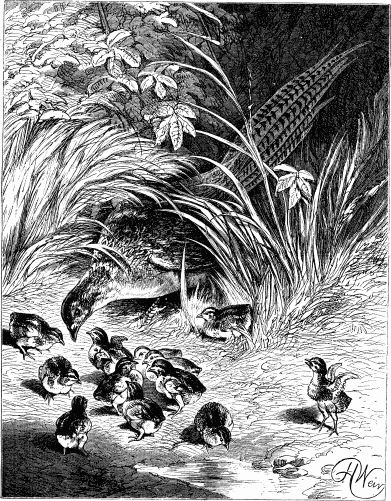
ENGLISH PHEASANT AND YOUNG.
The scratching birds are not the only ones which can take care of themselves at an early age. This is true of the running birds, such as the ostrich; and the same is the case with many of the wading birds, such as the woodcock; and among the swimming birds, there are several kinds that take full care of themselves soon after leaving the shell.
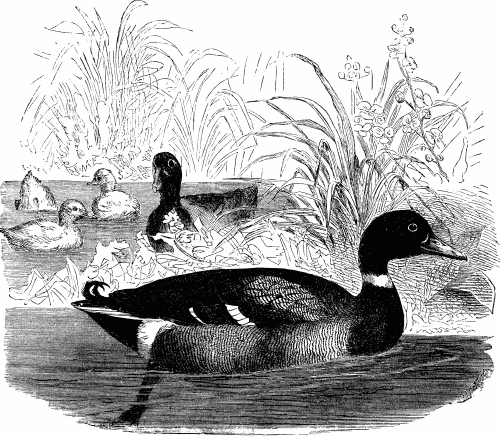
MALLARD DUCKS.
In the picture on the preceding page you have a pair of mallard ducks with three young ones, which are all able to swim and dive as well as their parents. You all know that, far from standing in need of instruction, young ducks take to the water by instinct, even when they have been brought up by a hen; and they know that they are perfectly safe upon it, although the anxious hen tries in every way to restrain them and to call them back. There are many ways in which some of our young birds show their really wonderful instincts, but there is nothing more curious in this respect than the habits of the little chickens, which most of us have opportunities of noticing,—if we choose to take the trouble. These little creatures, almost as soon as they are born, understand what their mother "clucks" to them; they know that they must hide when a hawk is about; they often scratch the ground for food before they see their mother or any other chicken do so; they are careful not to catch bees instead of flies; and they show their early smartness in many ways which are well worth watching.
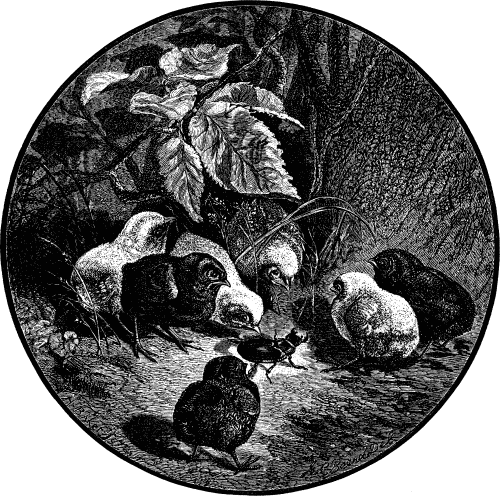
But, sometimes, a brood of these youngsters find something that puzzles them, as when they meet with a hard-shelled beetle, who looks too big to eat and yet too small for a playmate.