9. THE NATURE OF METEORITES
Reading edition
So far in this book we have dealt with meteorites indirectly, chiefly in connection with their fall, distribution, and recovery. In this chapter, however, we are shifting our attention to the meteorites themselves, and will tell what the main types of meteorites are, what meteorites are made of, what they look like, and how to tell them from ordinary rocks.
First of all, meteorites neither all look alike nor have the same composition. The general term “meteorite” applies to any mass that reaches the earth from space. Such masses are made up of metals and minerals in varying proportions. The term “meteorite” is nearly as general in meaning as the word “rock,” which geologists apply to bodies, large and small, that are formed by earth processes and are composed of various kinds of minerals. Actually, there are almost as many different kinds of meteorites as there are kinds of rocks; so you can see that in meteorites a wide range of composition and appearance is possible.
All recognized meteorites belong to one of three main divisions,[7] irons, stones, and stony-irons.
The irons are composed of an alloy of iron and nickel which may contain small inclusions of nonmetallic minerals.
119
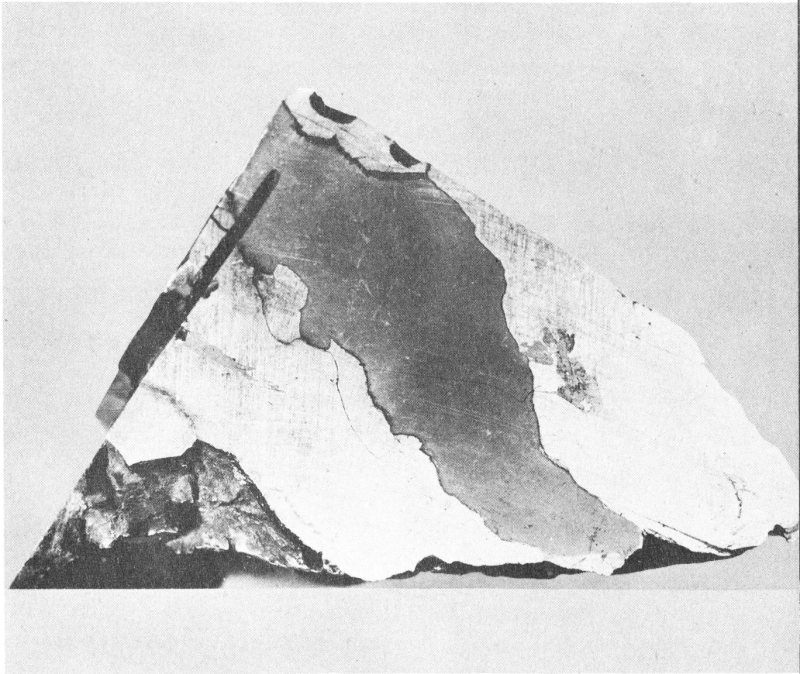
Internal structure revealed when the “etching” process is applied to that type of meteorite known as a “granular hexahedrite.” See p. 120.
120
After a cut section of an iron meteorite has been polished, the flat surface, except for possible inclusions, is mirror-like and resembles stainless steel. It appears to be remarkably uniform and uninteresting, but this appearance is misleading. A characteristic and beautiful structural pattern develops when such a polished nickel-iron surface is treated with, for example, a special mixture of nitric acid, alcohol, and Arabol glue.
This process of treatment is known as “etching.” The different structural patterns brought out by such etching give us the basis for classifying the iron meteorites.
If the etching process reveals certain features from which we can infer a cubic, or 6-faced, crystalline structure, we classify the iron meteorite as a hexahedrite.
If etching produces a certain special pattern from which we can infer an 8-faced, or octahedral, crystalline structure, we recognize the second subdivision of iron meteorites: the octahedrites. This remarkable pattern was discovered and first described by Alois von Widmanstätten, of Vienna, in 1808.
The third subdivision of iron meteorites consists of the “structureless” ataxites. (From the Greek for “without arrangement.”) On an ataxite, etching brings out only a finely granular pattern with a stippled appearance.
The stones are composed chiefly of minerals that are combinations of various elements with silicon and oxygen—for example, olivine (Mg, Fe)₂SiO₄. Meteorites belonging to this division also contain combinations of elements with oxygen—such as magnesium oxide (MgO) and aluminum oxide (Al₂O₃). Usually, the stony groundmass contains scattered specks, grains, and thin veins of the same shiny nickel-iron alloy that makes up the iron meteorites almost in their entirety.
121
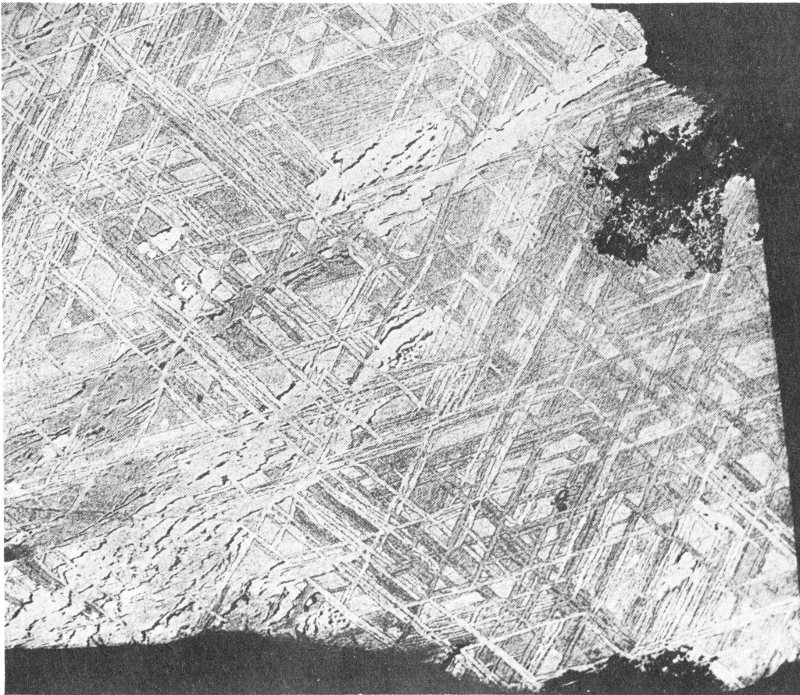
A. BREZINA & E. COHEN PHOTO Widmanstätten pattern which emerges when the carefully polished surface of that type of iron meteorite technically known as a “fine octahedrite” is “etched.”
122
The stony-irons, as the name indicates, are an “in-between” division. Some of the stony-irons, called pallasites, are sponge-like but rigid networks of nickel-iron alloy in which the smoothly rounded openings in the sponge enclose small gemlike masses of olivine. A cut and polished section of a pallasite showing round and oval gems of yellow-green olivine set in a silvery mesh of nickel-iron is a beautiful museum specimen indeed!
In the silicate-siderites, another type of stony-iron, a nickel-iron matrix is studded with angular fragments, shreds, and splinters of silicate minerals of all sizes. In the photograph, we can see that each of the various areas of the nickel-iron matrix (lighter in color) exhibits its own distinct crystallographic orientation, as is clearly indicated by the different Widmanstätten patterns.
Even a hasty comparison of polished sections of silicate-siderites and pallasites will leave no doubt that two quite distinct modes of formation were required to produce stony-irons of such different types.
Meteoritic nickel-iron has the following average chemical composition. To the nearest tenth, this alloy contains: Iron (Fe), 90.9%; nickel (Ni), 8.5%; cobalt (Co), 0.6%. This alloy gave scientists the key to the development of commercial stainless steels. It may also contain small amounts of phosphorous, sulfur, copper, chromium, and carbon.
The average chemical composition of stony meteoritic material is somewhat more complicated. To the nearest tenth, the “stones” contain: oxygen (O), 41.0%; silicon (Si), 21.0%; iron (Fe), 15.5%; magnesium (Mg), 14.3%; aluminum (Al), 1.6%; calcium (Ca), 1.8%; sulfur (S), 1.8%. The stony material may also contain smaller percentages of nickel, cobalt, copper, carbon, chromium, and titanium.
123
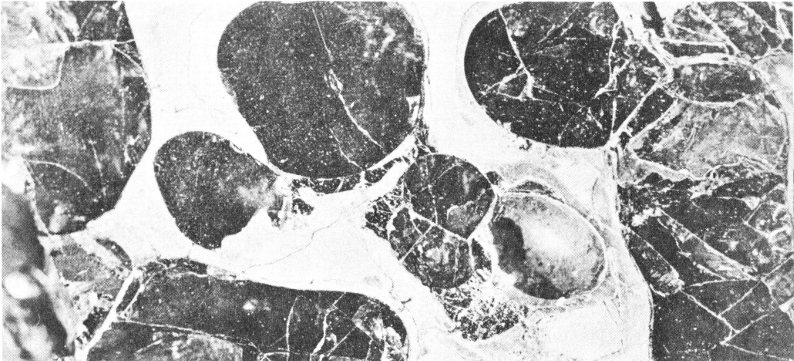
A. BREZINA & E. COHEN PHOTO Enlarged section of a stony-iron meteorite showing rounded olivine grains (dark in color) set in a network of nickel-iron alloy (light in color).
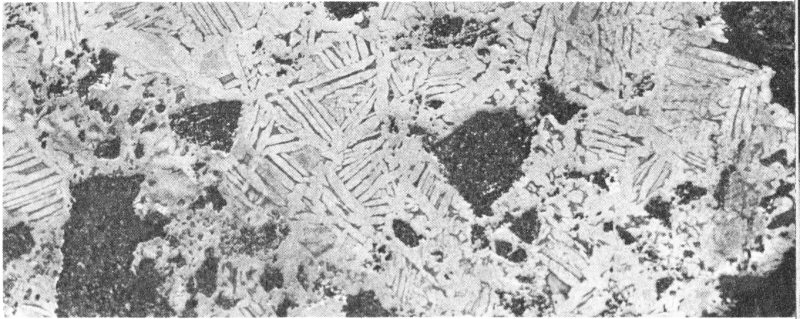
A. BREZINA & E. COHEN PHOTO Polished and etched section of a silicate-siderite showing angular fragments of silicate minerals (dark in color) imbedded in a metallic matrix.
124
In the stony-iron meteorites, we analyze the nickel-iron and stony portions separately. On the average, each of these portions has about the chemical composition that is given for it above.
Mineralogists have identified a variety of familiar minerals in meteorites. These include olivine, the plagioclase feldspars, magnetite, quartz, chromite, and, rarely, microscopic diamonds. All of these minerals are found here on earth in such igneous rocks as basalts and peridotites.
On the other hand, the meteoritic nickel-iron alloys (kamacite, taenite, and plessite, for example) and such meteoritic minerals as schreibersite (nickel-iron phosphide) and daubreelite (iron chromium sulfide) do not occur naturally on the earth.
We should stress here that although unusual combinations of known elements are present in meteorites, no new elements have been discovered during the increasingly intensive study of these masses during the last 150 years.
The majority of stony meteorites show a structure not found in terrestrial rocks. These meteorites are made up of rounded, shot-like bodies called chondrules (from the Greek word for “grain”). The individual chondrules may vary in size from those as large or even larger than a walnut down to dust-sized grains. The most common size is about that of peppercorns. The chondrules are often composed of the same material as the groundmass in which they are imbedded and unless the meteorite containing them is a very fragile one, they will break with the rest of the mass, as will sand grains in a quartzite. If the meteorite is fragile, however, the individual chondrules can generally be broken out whole. Meteorites containing chondrules are called chondrites.
125
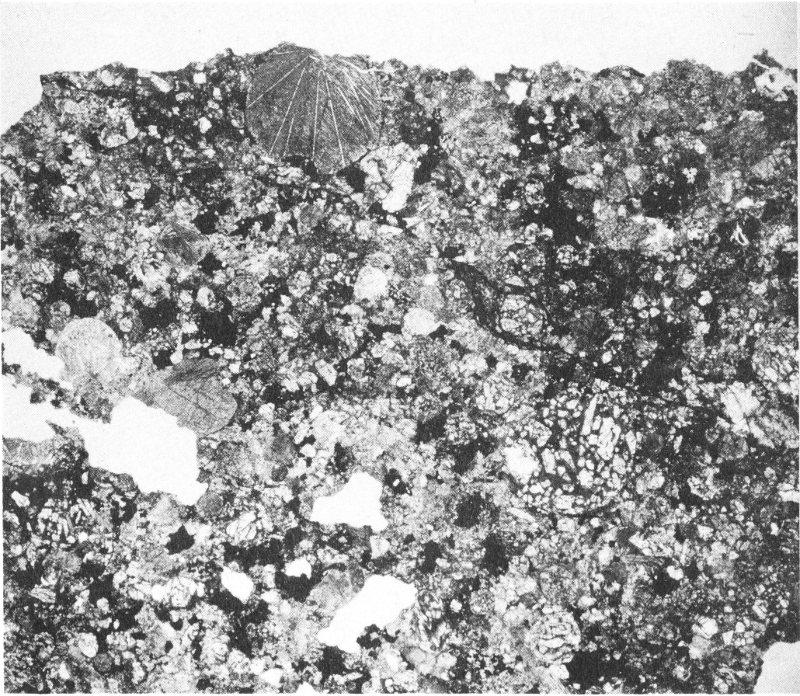
COURTESY OF AMERICAN MUSEUM OF NATURAL HISTORY Microphotograph of a thin section of a chondrite, showing the circular, or nearly circular, cross sections of a number of chondrules, including one of large size at the upper edge of the section.
126
A small percentage of stony meteorites have no chondrules. These meteorites are known as achondrites (meaning “not chondrites”) and they resemble terrestrial rocks more closely than the chondrites do. Some achondrites contain almost no trace whatever of metal, although in others (for example, the Norton County meteorite, of Chapter 2) small lumps and specks of nickel-iron are sparsely distributed through the stony groundmass.
Meteorites are as variable in shape as they are in composition and structure. Many are cone-shaped; others shield-, bell-, or ring-shaped; still others pear-shaped. One iron fragment recently recovered from the Glorieta, New Mexico, fall has been described as “macro-spicular,” meaning needle-shaped on a very large scale. The photographs opposite illustrate a number of the commoner forms known. The Glorieta specimen has been nicknamed “Alley Oop’s shillelagh,” for only a person of great strength could wield this 13-pounder with ease!
In general, the shape of meteorites depends upon the amount of mass lost by “evaporation” during passage through the earth’s atmosphere. This factor, in turn, depends not only upon the speed of transit, but also on such physical characteristics of the meteorite as its tensile strength and whether or not it contains certain alloys and minerals that vaporize more easily than the rest of the meteorite. The ring-shape of the Tucson, Arizona, iron is believed to have resulted from the “melting away” of a huge inclusion of stony material during the descent of the meteorite.
127
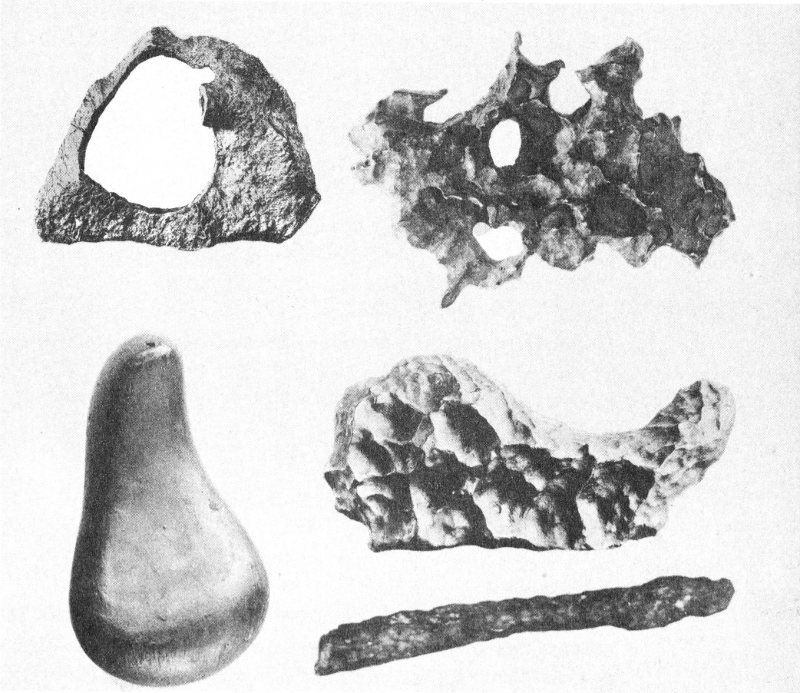
CHICAGO MUSEUM OF NATURAL HISTORY PHOTOS (BOTTOM RIGHT) INSTITUTE OF METEORITICS PHOTO A few of the many shapes exhibited by meteorites: ring-shaped, perforated and highly irregular, pear-shaped, jaw shaped, needle-shaped.
128
When meteorites are recovered and taken to the laboratory for study, one of the first things scientists do is to weigh them. If a meteorite is very large, special scales sometimes have to be constructed for this purpose. Such was the case for the largest meteorite so far weighed: the giant Ahnighito, Greenland, meteorite, which Peary brought to New York City by ship. (See Chapter 3.) A specially constructed scale on which this huge mass is now mounted gives for its weight about 68,000 pounds. Other meteorites famous for their great size are: the Bacubirito, Mexico, 27 tons; Willamette, Oregon, 14 tons; Morito, Mexico, 11 tons; and the Bendego, Brazil, 5 tons. All of these are irons.
The largest stone meteorite so far recovered as one mass is the so-called Furnas County, Nebraska, stone, which is the principal fragment of the Norton, Kansas, fall, and weighs about 2,360 pounds.
At the other end of the size-range, investigators have recovered meteoritic masses weighing no more than a small fraction of a gram. From a stone shower that occurred at Holbrook, Arizona, field searchers have found some of the very smallest specimens in anthills. The insects had carried these tiny meteorites along with sand and garnet grains in building their hills!
129
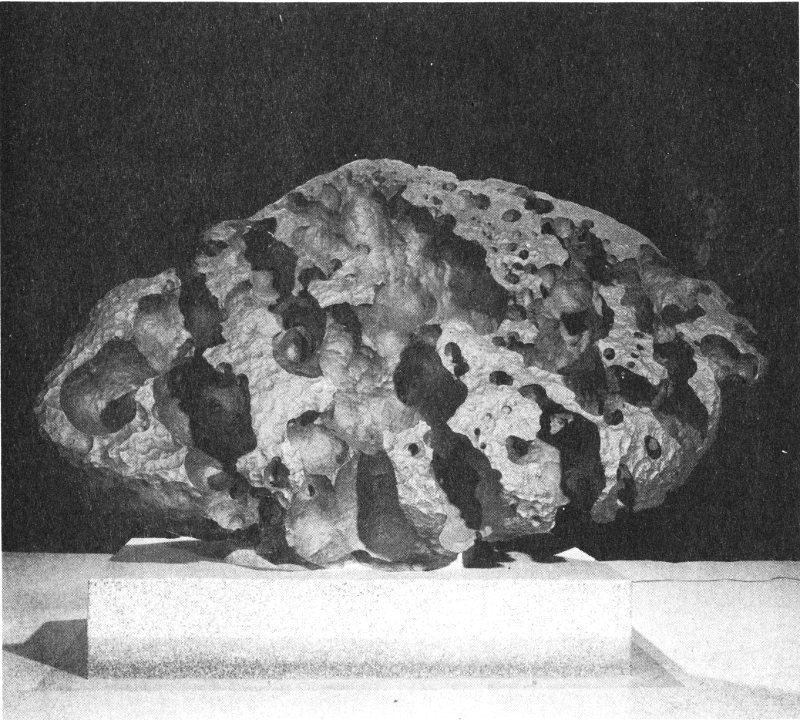
COURTESY OF AMERICAN MUSEUM OF NATURAL HISTORY The Willamette iron, famous for its great size and weight (14 tons), on exhibit at the Hayden Planetarium, New York City. See pp. 36, 39.
130
The only sure way to determine whether or not an object is a meteorite is to have a small piece of it (say, a fragment the size of an egg) tested chemically and microscopically by an expert on meteorites. Nevertheless, there are several questions whose answers will help you to decide whether or not you are on the right track in suspecting that a “rock” you have found may be a meteorite:
Is your specimen especially heavy?
Does your specimen show a thin blackish or brownish crust on its outer surface?
Does your “rock” have shallow, oval pits on its outer surface?
If the specimen has a corner knocked off, do you see specks and grains of metal on the broken surface?
Is your specimen especially heavy? The iron and stony-iron meteorites are very heavy. A 1-inch cube of iron meteorite weighs approximately 8 times as much as a 1-inch cube of ice. Even the stones, which are only about half as dense as the irons, are much heavier than ordinary rocks.
Does your specimen show a thin blackish or brownish crust on its outer surfaces? You will recall that specimens of both the Ussuri and Norton meteorites showed a “glaze” of fused material which we call fusion crust. Most freshly-fallen meteorites are covered with such a crust. To illustrate how this crust forms, consider a snowball that you bravely hold in your freezing hand until the outer surface melts. If you then were to leave the snowball outside overnight, the melted outer surface would freeze into a hard crust.
131
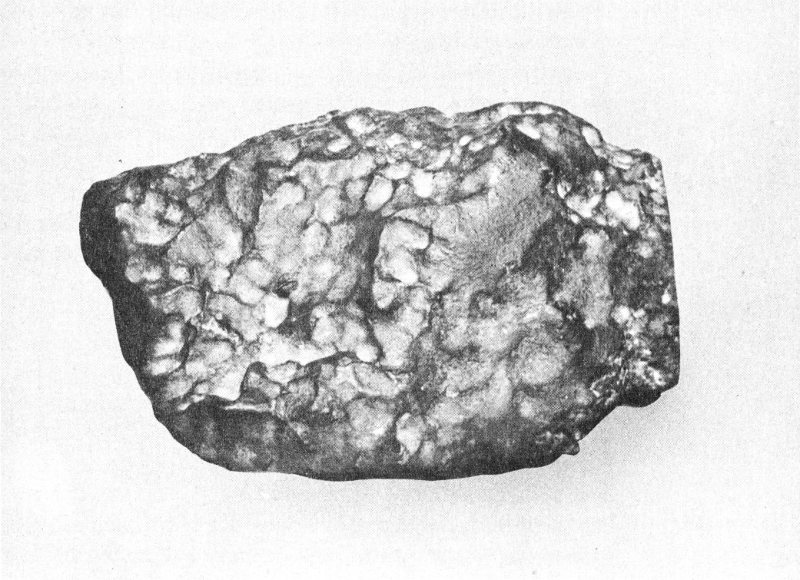
Piezoglyphs (oval pits resembling thumb-prints) in a stone meteorite, found at Belly River, Canada. See p. 132.
132
In similar fashion, the surface of a meteorite melts during the blazing-hot part of its flight through the air, only to “freeze” into a hard, firm coating in the lower, cooler portions of its path. This hardened coating, the fusion crust, is of much importance. Its presence is one of the best indications that a “rock” is really a meteorite. From the character of the fusion crust, experts can piece together a good deal about what happened to a meteorite on its way down to earth. If you should be lucky enough to find a meteorite, don’t break off the fusion crust. A whole encrusted specimen in the hand is worth 200 crustless fragments scattered at your feet!
Does your “rock” have shallow, oval pits or depressions on its outer surface? Such features are known technically as piezoglyphs (Greek piezein, to press + glyph, to carve) and popularly as “thumb-prints.” They were formed during the meteorite’s flight through the atmosphere when the softer portions of its outer shell were “eroded” away, leaving small scooped-out places. These pittings are very similar to the prints that would be made by the human hand in a lump of modeling clay or bread dough. In one case, they gave rise to the false idea that the meteorite had fallen in a plastic state and that the imprints had been formed when its finders first pulled the mass out of the ground by hand.
If the specimen you have found already has a corner knocked off, do you see specks and grains of metal on the broken surface? Such scattered bits of nickel-iron (not to be confused with 133 the shiny mica flakes often seen in igneous rocks) characteristically occur in the grayish or brownish groundmass of stony meteorites. If your specimen is unbroken, hold it lightly against a spinning carborundum wheel or use a file to grind a small flat surface upon it, and then examine this surface for specks of metal.
If the answers to these questions are yes, then there is a good possibility that you have found a genuine meteorite.
If meteorites remain buried in the ground for a long period of time, their characteristic surface-features may weather away. Under such conditions, iron meteorites develop heavy-layered coatings of rust (iron oxide) as much as several inches in thickness. If irons stay in the ground long enough, they may rust away almost completely and turn into shale balls, like those found near the ancient Wolf Creek, Australia meteorite crater. (See Chapter 4.) Stone meteorites buried in the ground for any great length of time may disintegrate and become completely unrecognizable as meteorites.
The fact that meteorites of all kinds are attacked by weathering has always argued strongly in favor of their prompt recovery. In the case of witnessed falls, prompt recovery is even more important, for only thus can specimens still retaining measurable amounts of various short-lived radioactivities be made available to physicists eager to investigate them with the most modern radiometric equipment.
134