10. TEKTITES, IMPACTITES & “FOSSIL” METEORITES
Reading edition
Before southern Australia was occupied by the white man, the native tribesmen of that region treasured certain small rounded pieces of black glass as medicine stones, rainmaking stones, and message stones. The Wadikali tribe referred to these objects as mindjimindjilpara, a word meaning “eyes that look at you like a man staring hard.” The early European settlers of the area called the same black glassy masses “blackfellows’ buttons.” Both phrases applied to objects that modern scientists call “australites,” which are now one of the best known types of tektites (Greek: tēktos, molten).
These Australian tektites and the tektites from many other countries around the world are a problem to meteoriticists. The question is, are they really meteorites? Many investigators believe that the answer is yes, and they are inclined to add to the three main divisions of true meteorites listed in the preceding chapter, a fourth: the tektites.
These mysterious glassy objects occur in such widely separated localities as Czechoslovakia, the Philippine Islands, Borneo, the Ivory Coast of Africa, Australia, Indo-China, Texas, Malaya, and Java. In these and still other areas, they have been found by the thousands in surface deposits of sand, clay, and gravel.
135
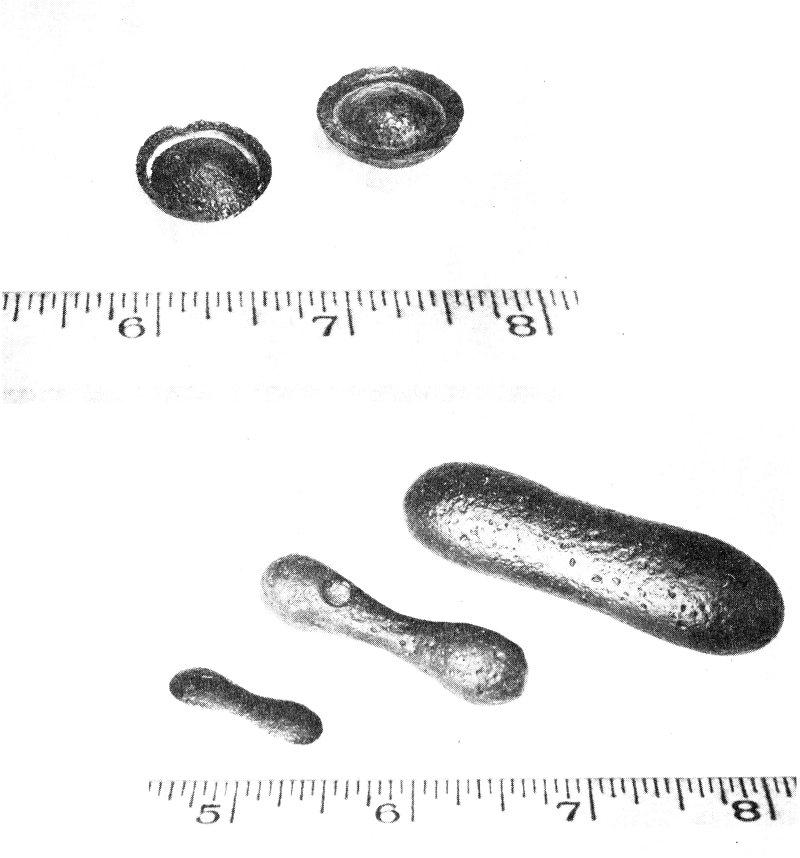
(left) “Flanged buttons” from Australia. (right) Several sizes of “dumbbells” from Australia. See p. 136.
136
Tektites have never been seen to fall. In spite of this fact, as we noted above, a number of scientists believe that, like the meteorites, the tektites really did come from outer space but, that they fell to earth before man was here to see them come down—or at least before he had acquired the means and skill to make lasting records of such an occurrence.
Tektites are usually quite small, weighing between 1 and 100 grams, although a few of much larger size have been found. One large specimen from the Philippines weighed about ½ pound. Two giant tektites, one weighing ¾ pound and the other over 1 pound, are in the collection of the British Museum. In composition, tektites are an impure silica-glass containing low percentages of the oxides of such elements as iron, magnesium, calcium, and titanium.
If tektite fragments are held under a lamp and observed by reflected light, their thicker parts generally appear to be jet-black. If, however, these same specimens are held up between the observer and the light, then their thin razor-sharp edges are seen to be bottle-green, yellow-green, brownish, or even colorless.
In shape, many tektites are roundish or oval. Others are shaped like dumbbells, ladles, canoes, and teardrops. So they are known by those descriptive terms. One particularly interesting example is the unusual “flanged button” of Australia. Tektites of this type look like miniature South American gold-pans, the bateas, heaped high with pay dirt. Australian gold-field workers regarded these tektites as magical, and used them as good-luck charms. Superstitious American gold-seekers brought them into the United States all the way from Australia!
137
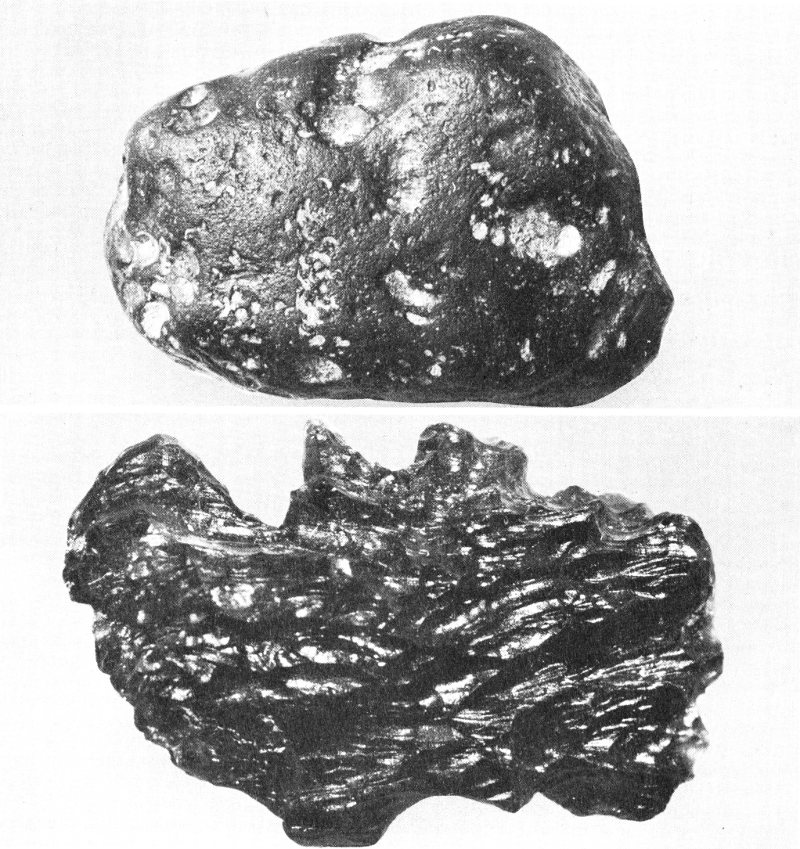
(above) Rounded tektite from Texas. (below) Deeply grooved bediasite from Texas.
138
Some tektites (for example, many of the “bediasites” from Texas) are deeply grooved and channeled, and have a very jagged and irregular appearance. Even the smoother tektite surfaces are characterized by flow lines, flow ridges, and bubble pits.
Many weathered pebbles and fragments of obsidian somewhat resemble the tektites superficially. There is a very simple test by which you can distinguish true tektites from obsidian. If you hold a thin splinter of tektite glass in a blowpipe flame, the glass melts quietly but only with the greatest difficulty. On the contrary, when you test in the same flame the terrestrial glass, obsidian, it froths up much more easily, into a bubbly, whitish mass.
Although the question of where the tektites came from is still not entirely settled, most scientists agree that all tektites did have a common origin. For example, tektites from widely scattered localities on the earth’s surface show not only similar queer shapes and surface markings (technically known as “sculpturing”), but also have very much the same chemical composition and, in particular, the same content of radioactive elements.
Because the tektites chemically resemble certain terrestrial rocks, scientists at first believed that some kind of earth process must have created them. One suggestion was that lightning had fused dust particles suspended in the air to form them; another, that they had come from volcanoes; still another, that the tektites were simply inclusions that had weathered out of terrestrial rocks. A few scientists once took seriously the possibility that tektites were refuse from primitive glass factories!
139
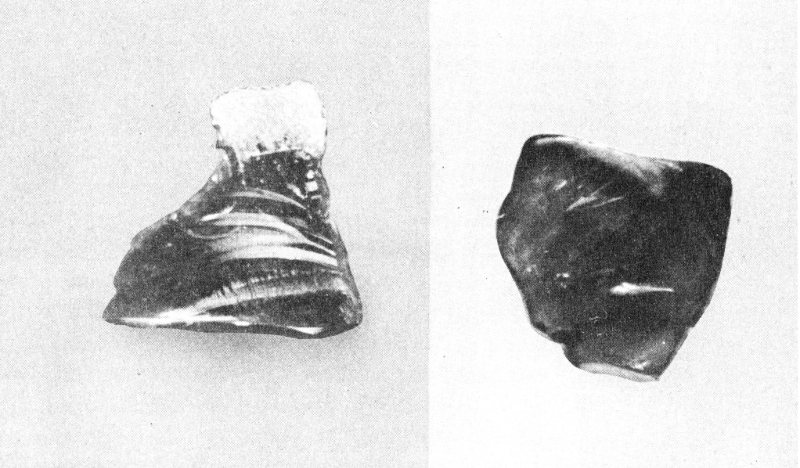
Tektite vs. obsidian, after blowpipe test.
140
While such theories have not yet been completely discarded, most scientists now feel that the tektites had their origin somewhere outside the earth. There are several reasons for this belief. First, the shape of such unusually symmetrical forms as are found, for example, among the australites, indicates that these small bodies at one time were members of a swarm of freely-spinning liquid masses. Again, flow features observed on the surfaces of certain tektites (and the fusion crust definitely identified on one specimen) show that these bodies at some time must have traveled through the earth’s atmosphere at high velocity.
If, then, the tektites were not produced by earth processes, where did they come from? According to primitive legends, they were “rocks” or “pebbles” from the moon. Indeed, one of the earliest scientific theories as to their origin (proposed by the Dutch authority Verbeek in 1897) likewise attributes them to debris jetted out from the moon. Another holds that tektites are fragments of the outermost glassy layers of some so-called “meteorite-planet,” or planets.[8] Still another idea is that tektites are what is left of a comet when it passes so close to the blazing-hot sun that the “ices” which make up most of the cometary nucleus (head) are all distilled away.
These theories of the origin of the tektites are based primarily on their observed shapes, surface features, and compositions. The senior author of this book has suggested still another possible theory based on the very unusual nature of the observed distribution of the tektites on the face of the earth.
To explain this theory, we first recall that the planet on which we live is more nearly a true sphere than are such familiar 141 “spherical” objects as baseballs or basketballs. Consequently, any plane through the center of the earth cuts its surface in a curve that to all intents and purposes is what geometers refer to as a great circle.
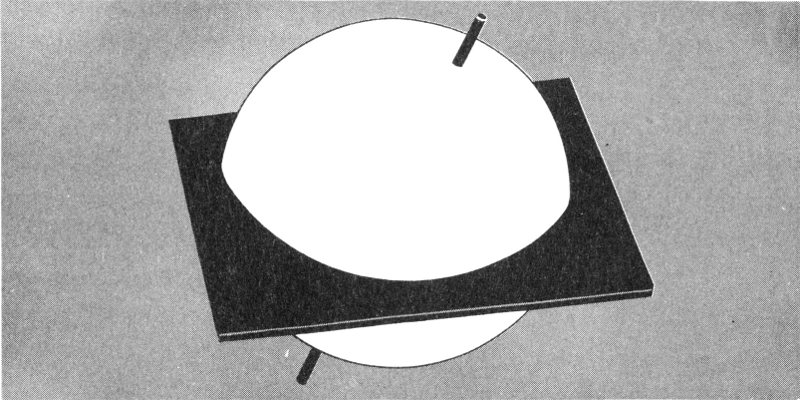
Every plane passing through the center of a sphere intersects the surface in a great circle. In this figure, only the front half of the great circle cut out by the plane is shown.
Now the significant fact is that all the tektite deposits known at present are located on or very near to three great circles on the earth’s surface. Mathematics shows that if some earth process had created the tektites at random over the surface of the 142 earth, then the odds would be very strongly against the existence of this peculiar “great-circle distribution.” But such distribution along great circles would be expected if the tektites had resulted from what might be likened to “chain-falls” upon the earth of objects like nearby satellites moving in orbits encircling our globe.
This notion brings up the interesting possibility that at some time in the remote past, the earth may have been the proud possessor of a set of equatorial rings. These rings would have been similar to those at present circling in the plane of Saturn’s equator. (Jupiter, too, may once have had its own set of equatorial rings.) The rings of Saturn are known to be made up of countless very small meteorites. In the same way, the “earth rings” of prehistory could have consisted of swarms of tiny nearby meteoritic satellites—the tektites—moving about the earth in the plane of its then-existing equator.
Eventually, the innermost of these small natural satellites collapsed onto the earth’s surface, falling along the old equator. At least twice thereafter, this process was repeated, the points of impact of the later tektite falls again lining up along whatever great circle of the earth happened to be the equator at the time of fall.
As the geologists and other investigators have shown, major shifts have occurred in the position of the earth’s equator during past geologic ages. This fact is well-substantiated by discoveries of fossil shells and plants on the cold Antarctic continent and of glacial deposits in hot South Africa. Therefore, we could hardly expect the tektite deposits, which are believed to 143 have fallen at widely separated intervals of time, to have all occurred along a single great circle on the earth’s surface.
As you can see, the so-called “tektite-puzzle” is a complex one. As if this were not bad enough, Mother Nature has added to the confusion by creating in addition to the tektites another type of silica-glass not only found along the very same three great circles sprinkled with true tektites, but also having other features in common with the tektite glasses.
At Mount Darwin in Tasmania and at Wabar in the Rub’ al Khali desert of Arabia, large and small fragments of this curious silica-glass have been collected. At Wabar the masses of silica-glass were found in and about the rims of a series of meteorite craters formed in nearly pure sand, as we pointed out in Chapter 4. These meteorite craters are known to have resulted from the high-speed impact of iron meteorites upon the sand dunes of the Wabar site. Since the silica-glasses of Wabar have been found to contain countless spherules of nickel-iron of the same composition as the iron meteorites discovered about the Wabar meteorite craters, it seems quite certain that both the sand of the earth target and the nickel-iron of the falling meteorites were vaporized by the intense heat generated at impact. Consequently, it is natural that these Wabar masses of congealed silica-glass and nickel-iron be called impactites. They are silica-glasses, created chiefly from terrestrial materials by the impact of large crater-forming meteorites. This same name is now applied to all silica-glasses believed to have the same origin as those at Wabar.
As regards size if not composition, the crater-forming meteorites 144 responsible for the Wabar and other impactites may have been big brothers of the small-fry responsible for the showers of true tektites. Or these big ones may have moved about the earth in orbits distinct from those followed by the tektite swarms but lying in the same plane as one of these swarms.
In addition to the curious puzzle of the tektites, meteoriticists have also run up against the problem of “fossil” meteorites or, more exactly, the problem of the lack of “fossil” meteorites. As we have already mentioned, no positively identified meteorite has ever been found in other than the most recent rock layers. With all the mining—particularly coal mining—that has gone on throughout the world in historic times, this fact does seem astonishing.
A number of explanations can be suggested for this absence of ancient meteorites. In the geologic past, meteorite falls may not have occurred as often as they do today. For example, the primeval atmosphere of the earth may have been so much denser than at present that even quite large meteorites were totally vaporized as they passed through it and therefore never reached the ground. Again, even if the rate of infall of meteorites was the same in the remote past as now, still various weathering processes active ever since the earliest meteorites fell may have so changed them in appearance and composition that they are no longer recognizable for what they are.
Several unusual lumps of rock from England and a mass of iron from Austria, all found at some depth by coal miners, have been tentatively put forward as “fossil” meteorites. But studies of these masses have so far produced no conclusive results. Still, we should not ignore the possibility that someday meteorites may be found and identified in rocks of considerable age.
145
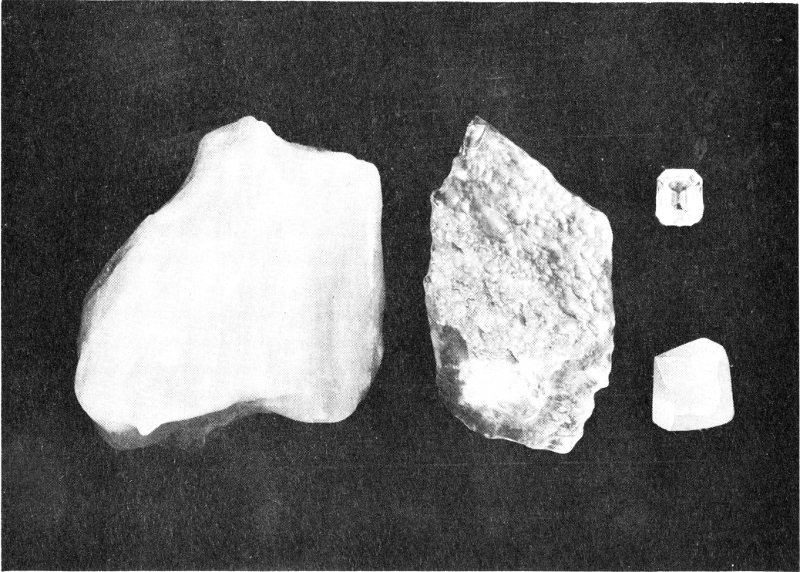
L. J. SPENCER PHOTO COURTESY OF AMERICAN MUSEUM OF NATURAL HISTORY Mysterious glass objects found in the Libyan Desert. (right) Cut and polished specimens.
146
Does it seem as if we have posed more problems than we have solved in this chapter? It is very true that we have done just that. In speaking briefly about the tektites, the impactites, and the absence of “fossil” meteorites, we have by no means tried to present the last word on the troublesome but highly interesting problems connected with these objects—problems that admittedly may take scientists years or even decades of further research to solve. Perhaps you will find here the kind of unusual and thought-provoking problems that make the study of meteorites a rather special challenge. If so, you may wish to take an active part someday in unraveling these puzzles.
147