6. FINDERS FOOLISH, FINDERS WISE
Reading edition
People find a great many meteorites that were not seen to fall. Most of these landed on the surface of the earth at some time in the remote past or happened to fall in an originally unpopulated portion of the land area of the globe. Generally, such meteorites are discovered entirely by accident, although in recent years quite a few recoveries of unwitnessed falls have been made by design. This has been the case during the systematic surveys with meteorite detectors conducted around such recognized meteorite crater areas as Canyon Diablo, Arizona; Odessa, Texas; and Wolf Creek, Australia.
The different modes of discovery of meteorites not seen to fall are interesting in themselves. The largest percentage of finds has unquestionably been made by farmers. The Plymouth, Indiana, meteorite, for example, was plowed up or, as the farmer nursing the rib bruised by his bucking plow would probably prefer to say, “plowed into.” So were such meteorites as the Algoma, Wisconsin; the Bridgewater, North Carolina; the Carlton, Texas; and the Chesterfield, South Carolina, to name only a few. A farmer found the Kenton, Kentucky, iron while he was cleaning out a spring. Another farmer was removing debris from an abandoned water well in an attempt to revive it when he discovered the Richland, Texas, iron. A field drainage project brought the Seeläsgen, Poland, iron to light. A man planting an apple tree near his house dug out the Mount Joy, Pennsylvania, 76 iron, and a farmer hoeing tobacco turned up the Scottsville, Kentucky, iron.
The second largest percentage of finds probably has been made by miners. Prospectors and placer miners have mistaken numerous iron meteorites for lumps of silver ore. Among these are the Murfreesboro, Tennessee; Lick Creek, North Carolina; and Illinois Gulch, Montana, irons. The Aggie Creek, Alaska, iron was raised by a gold dredge. The gold miners recognized this meteorite as an unusual “haul” when it announced its presence by clanging loudly on the metallic screen of the dredge.
Men at work on road construction are also to be thanked for chancing upon meteorites of unwitnessed fall, for example, the irons found by road crews at Bear Lodge, Wyoming, and at Bald Eagle, Pennsylvania.
Some meteorites have been “found twice.” At Opava, Czechoslovakia, archeologists discovered seven pieces of meteoritic iron in a buried Stone Age campsite—the oldest meteorite collection so far on record! Apparently the paleolithic inhabitants of the Opava region had gathered the heavy masses together and used them to bolster the fireplaces in their rude encampment.
Investigators discovered the Mesaverde, Colorado, iron in the Sun Shrine on the north side of the Pipe Shrine House, and the Casas Grandes, Mexico, iron in the middle of a large room of the Montezuma temple ruins, carefully wrapped in linen cloth like a mummy. Members of an early archeological survey found the small Anderson Township, Ohio, meteoritic specimens on altars in mounds of the Little Miami Valley group of prehistoric earthworks. Some scientists believe that the American Indians transported these specimens to Ohio from the site of the Brenham meteorites in Kiowa County, Kansas.
77
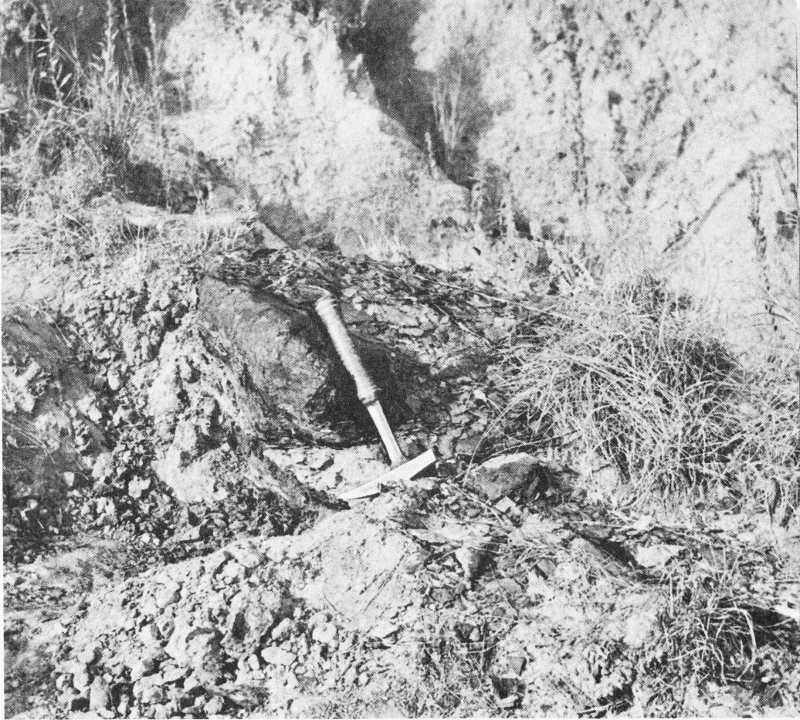
The Lake Murray, Oklahoma, iron meteorite in place, just as it was found. See p. 80.
78
Other modes of discovery fall into no pattern and must be regarded as merely curious. A farmer plowing his field near Pittsburgh, Pennsylvania, came across a snake. In looking for a suitable stone with which to kill it, he first seized upon a mass of iron too heavy to lift. After he had killed the snake with a handy rock, the farmer’s attention was drawn back to the small but remarkably heavy mass he had first tried to pick up. He carted it off to the city, where eventually it was recognized as a meteorite.
In another unusual recovery, fishermen brought the Lake Okeechobee, Florida, stone up from the waters of the lake in a net—the only such recovery recorded in the whole literature of meteoritics, although three-fourths of all meteorites must necessarily fall into water on our ocean-covered globe. Again, the members of the Australasian Antarctic Expedition of 1911-1914 were surprised to find the Adelie Land, Antarctica, stone lying on the snow some 20 miles west of Cape Denison.
Because the true nature of meteorite finds has often been unrecognized—sometimes for many years—these masses have been put to some rather lowly uses. The finder of the Rafrüti, Switzerland, iron meteorite used it as a footwarmer, and many of the heavy irons have been employed as haystack, fence, and barrel-cover weights, or as anvils, nutcrackers, and doorstops.
79
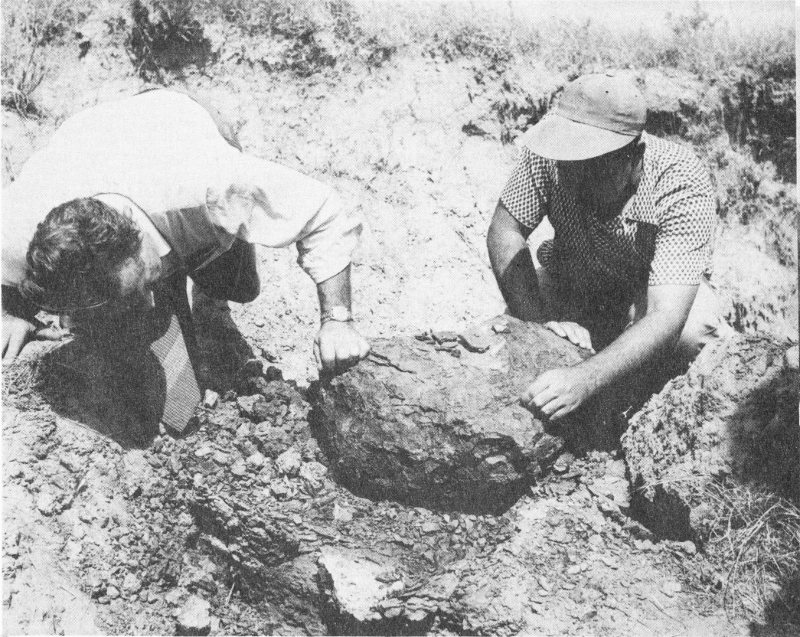
It’s a whopper! See p. 80.
80
Some have fared better, as did the 1,375-pound La Caille, France, meteorite, which the people of the village used for two centuries as a seat in front of their church. Others, however, have fared even worse. Blacksmiths and assayers have smelted up and destroyed a number of iron meteorites either in the making of tools (like plowshares, axe-heads, and knife-blades) or in the quest for precious metals. Nearly all of the iron meteorite that was found by the farmer near Pittsburgh was worked up by a blacksmith and lost to science. Even the stone meteorites have occasionally fallen victims to man’s greed for gold. Miners who believed that the 80-pound San Emigdio, California, stony meteorite was gold-bearing mashed it to powder in an ore-crusher.
On the contrary, people who, in one way or another, have become acquainted with the characteristics of meteorites have brought a number of these objects to the attention of scientists. For example, one of the University of Nebraska men who worked on the excavation and removal of the large Furnas County stone meteorite (see Chapter 2) became keenly interested at that time in meteorites in general, and took the trouble to learn as much as he could about them. Several years later, after he had become director of a state park museum in southern Oklahoma, a large metallic mass was reported to him. The finder of this mass of metal had known of its existence for some 20 years, but had never succeeded in getting anyone to examine it carefully. The former field worker took one look at the object and, on the basis of his knowledge of meteorites, concluded that it probably was a huge iron meteorite. He immediately called the Institute of Meteoritics by long distance and was able to give such a wealth of significant details that a field party left at once for the site. In this way, the Lake Murray, Oklahoma, meteorite was identified and recovered.
81
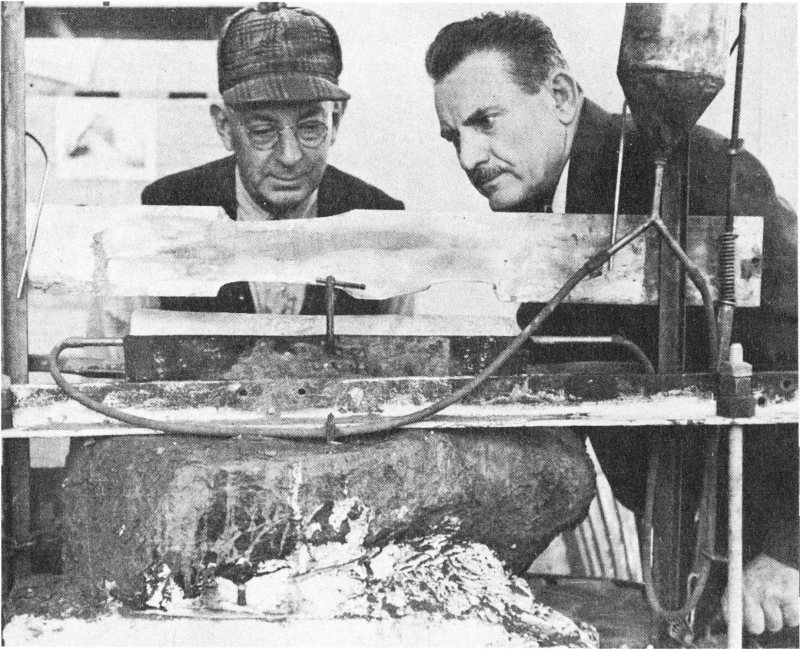
The Lake Murray core mounted on the meteorite saw which cut it in half. One of the worn soft iron saw-blades is held above the meteorite by the saw guides. See pp. 167, 168.
82
The unoxidized central core of this iron weighed more than 600 pounds. Before excavation this core was surrounded by a “shell” of oxidized meteoritic material several inches thick, as shown on page 77. Such a shell of oxide clearly indicated that the meteorite had been subjected to weathering in the ground for many thousands of years.
In general, meteorites seen to fall—possibly because of the magnitude and impressiveness of the light and sound effects connected with their descent—have received respectful treatment after recovery. Most of them have been presented to men of science for study and eventual display in some museum collection. Even when kept by their finders, the specimens usually have been well cared for. After the fall of the Flows, North Carolina, meteorite in 1849, the owner of the land on which it came down set the stone in a place of honor on top of a barrel fixed to a post. On the post he put up the notice:
“Gentlemen, sirs—please not to break this rock, which fell from the skies and weighs 19.5 pounds.”
This landowner obviously realized that nearly everyone has the unfortunate urge to hammer on strange rocks.
Of course, there have been exceptions to the respectful treatment of meteorites seen to fall. The finder of one fragment of the Zhovtnevy Hutor, Russia, fall tossed it into the stove, and a farm woman lost another by throwing it at an unruly horse. A peasant who thought meteorites possessed miraculous powers powdered up a piece of the diamond-bearing Novo-Urei, Russia, stone and ate it!
83
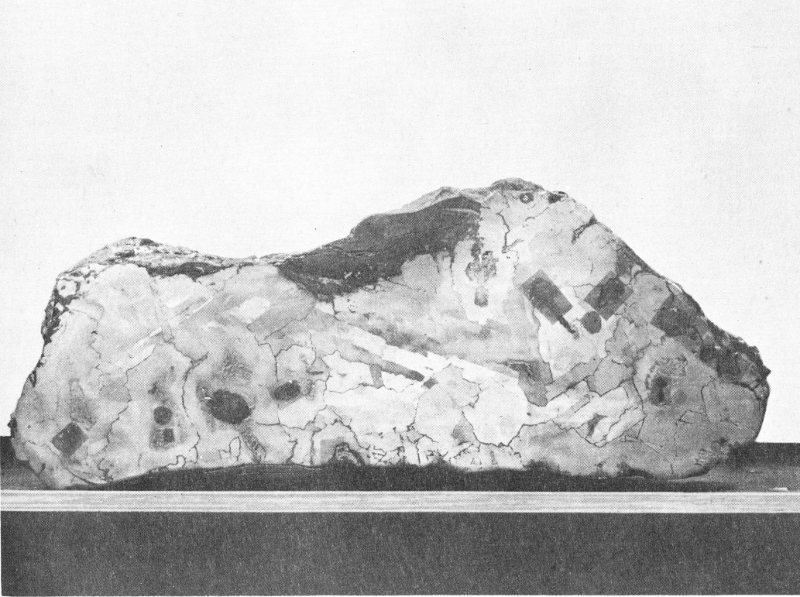
A polished and etched face of the Lake Murray meteorite. The length of the cut is a good 23 inches.
84