7. LANDMARKS, SKYMARKS & DETECTORS
Reading edition
The chemist can easily obtain materials for his research work from reliable supply houses. The meteoriticist (as a scientist who studies meteors and meteorites is known), is not this lucky. He must search for the specimens he wishes to investigate wherever they may have landed on the wide, wide earth. This “needle-in-a-haystack” problem could rarely be solved if it were not for certain mathematical and instrumental aids that swing the balance in favor of the meteorite hunter. When meteorites are seen to fall, these aids can be brought into play only if certain information is supplied by eyewitnesses of the falls. For this reason, everyone ought to be acquainted with the facts about meteorite falls that scientists will need to know in order to make finds, and should understand how these facts must be reported in order to be of maximum use to field parties.[5]
The problem of working out the path a fireball has followed in the sky boils down to this. The investigating scientists must be able to fix the position in space of certain important points on the fireball’s path. This idea of fixing points is not really difficult at all. Suppose, to take an analogy from baseball, we have base runners on first and third. These two players are intently watching their team’s clean-up hitter, who is “crowding the plate.” Consequently their lines of sight intersect at home plate and give a very good “fix on” its position, as navigators say. This is the way a fix can be obtained in two dimensions; that is, essentially, in the plane of the earth’s surface.
85
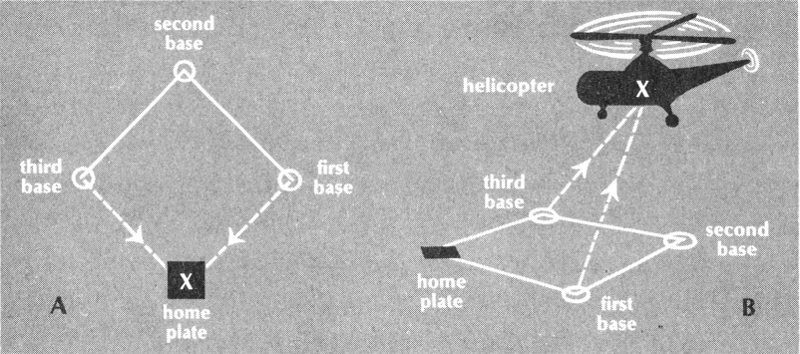
A. A fix determined in two dimensions. The lines of sight of the runners on first and third intersect at x.
B. A fix determined in three dimensions. The lines of sight of the runners on the first and third intersect at x.
Now, let us move into the third dimension, since a fireball’s path through the atmosphere lies in space, not in the “flat” plane of the earth’s surface. Returning to our baseball diamond, let us suppose that a helicopter with an enterprising photographer aboard hovers over the centerfield bleachers so that he can take pictures of the record crowd. While the umpire is dusting off home plate, the two runners on first and third simultaneously sneak a look to see what the helicopter is doing. Their lines of 86 sight now intersect at the helicopter and fix its position in space.
Similarly, the location of a fireball path in space is determined by the fixing of certain points on the luminous streak seen in the sky. Instead of using only two intersecting lines of sight (those of the runners on first and third in our analogy), scientists investigating a meteorite fall try to collect as many different lines of sight as possible from people in the region above which the fireball streaked. The more commonly determined points are those of the fireball’s appearance and disappearance and those where “explosions” took place. These points are generally located by use of the method we have described in some detail above, the so-called intersecting-lines-of-sight method.
The most important point on a fireball path is the point of disappearance. The most valuable single piece of information you can supply about a meteorite fall is as accurate an answer as possible to the question: In what compass direction were you looking when you last saw the fireball? This question has often been twisted around in newspaper and radio accounts into the meaningless question: In what direction was the fireball going when you saw it?
One person cannot give the answer to the second question because from a single station it is impossible to determine the true direction of motion of an object seen in the sky. One person can report only an apparent direction of motion, which is of little or no value in locating the last point on the luminous path, generally referred to as the “end-point.” Therefore, though you cannot by yourself determine the actual direction in which a fireball is moving, you can report the direction in which you 87 were looking when you last saw the fireball, that is, due south, southwest, northeast, etc.
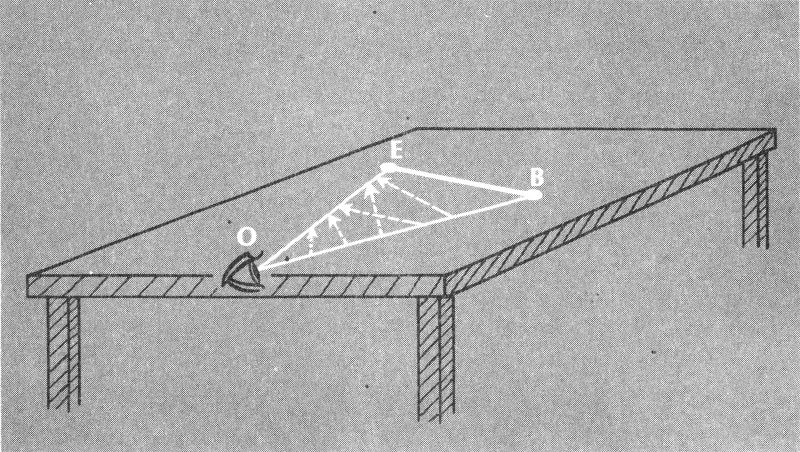
O is an observer squinting along the top of a ping-pong table. A ping-pong ball rolls along the top of the table from B (beginning) to E (end). To the observer at O, however, the ball would appear to start at B and end at E if it rolled along any one of the dashed lines leading from OB to OE. By means of a similar space-figure, it can be shown that a single observer at O cannot determine the true direction of motion of a luminous object in the sky, like a meteor.
Scientists are eager to obtain reliable reports on the compass direction to the fireball’s point of disappearance from as many widely separated eyewitnesses as possible. They then can plot the individual lines of sight on a good map, marking exactly where these lines intersect. In this way, the investigators can 88 make reasonably accurate fixes of the position of the point on the earth’s surface that is situated directly below the end-point of the fireball path, as this end-point was seen in the sky by each pair of eyewitnesses.
Instead of using the ordinary compass direction to a fireball’s point of disappearance, you may prefer, as do astronomers, to use the azimuth. What we have been calling a “compass direction” is one that is expressed in terms of the cardinal points: north, south, east, west. An azimuth is a direction stated in degrees. Rough azimuths can be taken with a compass, but for accurate work, a graduated circle, like that on a transit or theodolite, must be used. Astronomical azimuths begin at the south point and continue clockwise full circle to 360°. For example, the lines of sight in the diagram, p. 87, could very well have been given as astronomical azimuths. And, in the diagram, p. 91, the line of sight C₁ could have had the precise designation 118° and C₂ that of 222°.
Every fix serves to guide field parties to areas that are to be carefully searched for fallen meteorites. Extra-thorough searches are made if the people living in a particular area reported that they heard meteorite fragments hissing and whining on their way to earth or heard the thumps of their impacts on the ground.
You will notice that so far we have been treating our problem as a two-dimensional one. We have been working with directions only and have plotted out direction indicators on a map representing the plane of the earth’s surface. Now, as we did in our baseball analogy, let us move into the third dimension.
89
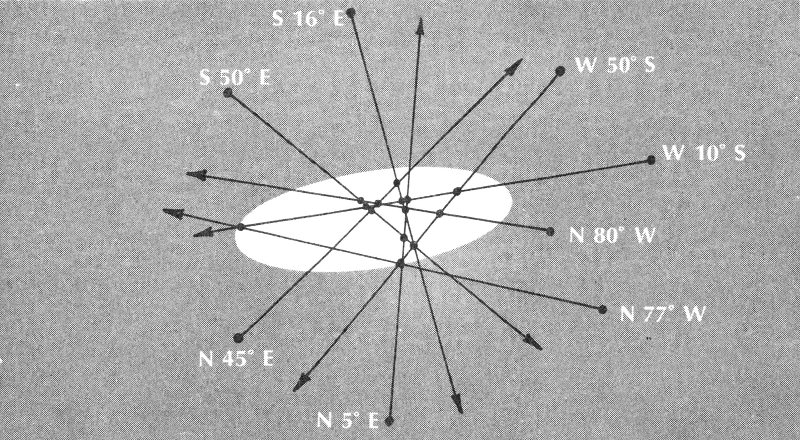
Diagram (not drawn to scale) showing plotted compass directions to the last visible point on a fireball path. (The point denoted by L in next diagram.) Black dots represent positions of various observers. Each arrowed line is directed toward the last visible point as it was estimated by the individual observer. The oval area, which includes points of intersection of all observed lines of sight taken in pairs, marks out region in which meteorites have probably fallen.
90
If, in addition to compass directions to the observed endpoint, scientists can also obtain the apparent elevation, in degrees, of this point as seen by the various eyewitnesses, then with the help of a little trigonometry, they can fix the position in space of the end-point itself rather than the position of its projection on the surface of the earth.
This same procedure can be followed in fixing the space-position of any well-observed point on the fireball path. It therefore becomes possible when both elevations and compass directions are reported for several points on the fireball path to determine the flight-path or, as it is technically called, the trajectory, of the falling meteorite through the atmosphere. Trajectory determinations are of great scientific value.
You can estimate the compass directions and elevations to the important points on a meteorite trajectory at the actual time of fall. Or you can have the scientific field party make or check your measurement at some later time by setting up a surveying instrument at the very point from which you saw the fireball.
The accuracy of your measurements can be improved if you have been able to “line up” the point, L, at which you saw the fireball disappear, with some familiar object on the horizon, such as a church steeple, a tall tree, a telephone pole, or a lightning rod on a farm building. You will recall that an eleven-year old girl provided one of the field parties from the Institute of Meteoritics with an excellent observation of the point of disappearance of the Norton fireball. She was able to do this because she remembered just where it went out of sight behind a familiar landmark.
91
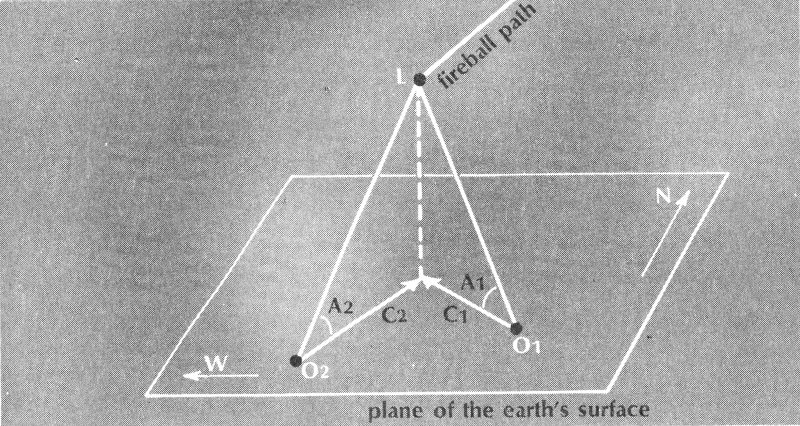
Method for locating a point on a fireball path. (In this case the point of disappearance, L.)
O₁ First observer.
A₁ Apparent height of point of disappearance (50°).
C₁ Compass direction of point of disappearance (N 62° W).
O₂ Second observer.
A₂ Apparent height of point of disappearance (45°).
C₂ Compass direction of point of disappearance (N 42° E).
92
If the fall occurs at night, you can help investigators greatly if you are familiar enough with the brighter stars to use them as “skymarks.” You simply note as quickly and sharply as you can just where the fireball path was in reference to those prominent stars. This alert observation of yours will at least be a great aid to investigators who are searching for meteorites that may have fallen from the fireball; and, moreover, there is no telling what else your quick eye might have captured for science.
While looking through a window, Kayser, the Polish astronomer, saw a fireball appear at Rigel and move to Sirius, where it disappeared. This observation of his proved to be one of the most accurate and significant ever made of the fall of a meteorite. For it enabled the German mathematician, Galle, to show that the Pultusk meteorite, which produced the fireball Kayser saw, came into the Solar System from interstellar space!
It is very essential to carefully notice and mark the exact spot from which your observation was made so that you can return to it if scientists wish to set up surveying instruments there.
The map and side view of the Norton County, Kansas, meteorite trajectory show the practical results that the Institute obtained by use of the intersecting-lines-of-sight method. The fireball accompanying the Norton meteorite fall appeared at A. The first “explosion” took place at E₁, the second at E₂, and the fireball disappeared at L.
If markers were dropped straight down to earth from each point along the trajectory or flight-path of a meteorite through the atmosphere, the line joining the points where the markers fell would be the earth-trace of this trajectory. The directions of sight to these various points are indicated for people living in the towns along and near the earth-trace of the Norton meteorite fall. The solid-line arrows represent the direction of the point of disappearance; the dotted-line arrows, the point of appearance; the dash-dot arrows, E₁; and the dashed arrows, E₂. The probable area of fall is shown as an oval-shaped area, the longer axis of which is identical with the direction of motion of the meteorite.
93
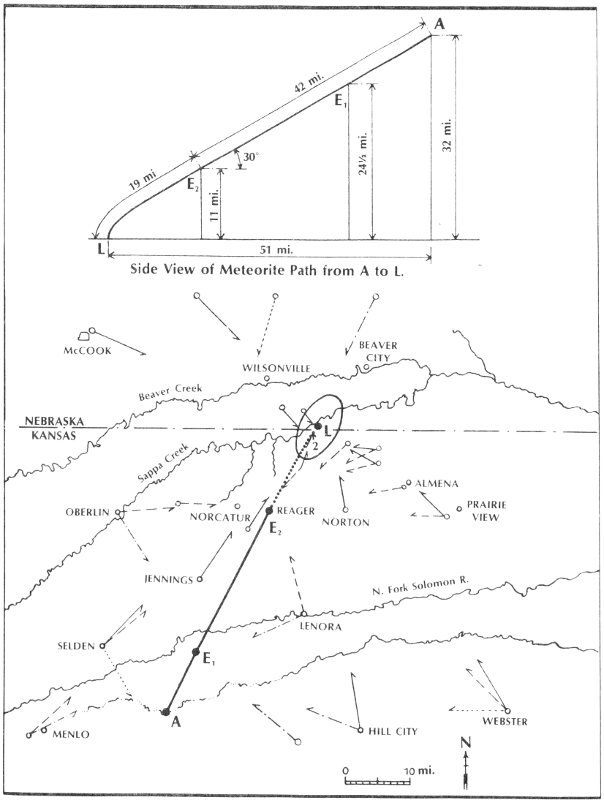
Path of the Norton meteorite.
94
The many fragments of all sizes recovered from the Norton fall were all found within the bounds of this oval-shaped area, although unavoidable errors of observation placed the center of the oval about 4 miles too far to the north.
In addition to the questions about direction and elevation, there are a few more that investigators of meteorite falls would like to have observers answer.
At what time (determined as accurately as possible) did the fall occur? Knowledge of this time is necessary if the path in which the meteorite was moving about the sun is to be calculated by scientists.
Did you hear any sounds, either while you were watching the fireball or after it disappeared? If you heard such sounds as the whining or hissing of meteorite fragments flying through the air or the heavy thumps of their impacts on the earth, then you were very close to where the meteorite came down!
How many minutes and seconds (again determined as accurately as you can) passed between the time when you saw the 95 fireball vanish and the instant when you first heard sounds from it? Such sound data permit rough determination of the distance from the observer to the point where the meteorite fell.
How long did the sounds set up by the meteorite last, and in what direction did these sounds seem to die out?
If you or your neighbors find fragments that you suspect are pieces of the meteorite, these specimens should be shown to the investigating field parties at once—preferably undisturbed and in the very places where they fell. In any event, the suspect masses should not be hammered on and broken up! Even as late as 1958 in a country as science-conscious as Germany, a beautiful stony meteorite, seen to fall and speedily found by an alert group of children playing out of doors, was deliberately broken up into 5 pieces in order that each of the children (aged 9 years and up) might take home a “souvenir” of the event. Later, these pieces had to be laboriously reassembled by scientists before any idea could be gained of the original shape and surface features of the meteorite.
Even when thorough searches are made, not all the meteorite fragments in the area of fall may be found for many months. But if the people living in the region have been alerted and are on the lookout for unusual specimens or signs of meteoritic impact (such as freshly made holes or “craters” in the ground, shattered tree limbs, and so forth), the chances of ultimately finding many or most of the fallen masses are good.
As we have already mentioned, numerous fragments of the 96 Norton meteorite (including one weighing 130 pounds) were found within two to three months after its fall on February 18, 1948. But the main mass was not discovered until the following August, when a caterpillar tractor nearly tipped over into the large impact funnel that this huge stone had made in the earth. Fortunately, field searchers from the Institute had already talked to one of the farmers using the tractor and had told him that just such a “crater” might be found in the very area under cultivation. Consequently, the crater was promptly reported.
In surveys concerned with the location and recovery of meteorites not seen to fall, we find that sometimes meteorite fragments, particularly the smaller ones, lie on the surface of the ground or at shallow depth. Such fragments were probably too light to penetrate deep into the ground or, in the years since their fall, the action of rain, wind, and frost has uncovered them.
In such cases, a party of searchers generally spreads out in order to get over as much ground as possible and each member of the group looks for meteorite specimens without using instrumental aids. Visual searches of this type have been very successful, for example, around the Canyon Diablo crater, where almost the entire plain out to several miles from the rim once was sprinkled with large and small fragments of meteoritic nickel-iron. This type of meteorite hunt is of only limited effectiveness because the specimens (or at least a part of each one) must be visible to the searchers.
97
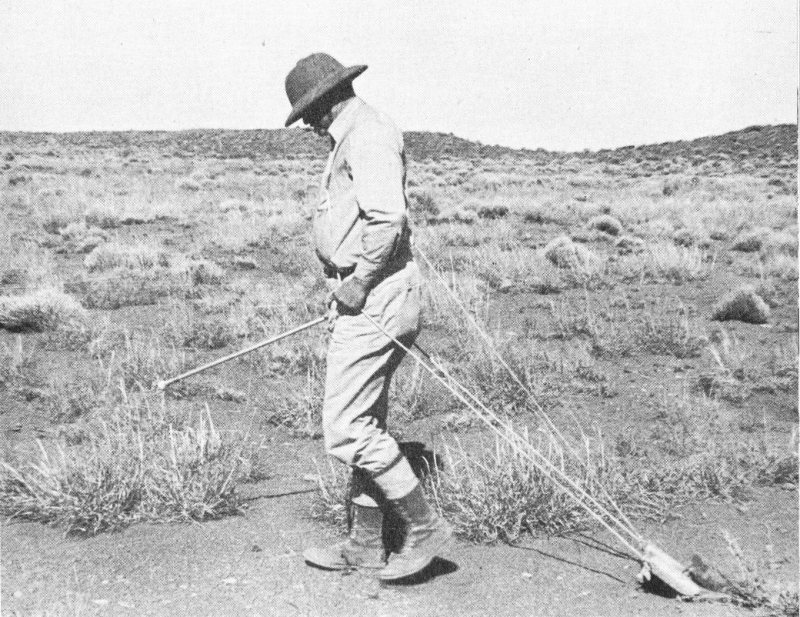
Collecting small surface specimens of meteorites with portable detecting devices: a powerful alnico magnet mounted on a light wooden sled, and a horseshoe magnet at the end of a cane. See p. 98.
98
To increase recoveries, searchers have employed, in addition to their eyes, various types of permanent magnets, either mounted on the end of a cane and used to probe the upper few inches of loose soil, or dragged behind the searcher on a small, light sled. Meteorite hunters have also used more powerful portable electromagnets to collect large amounts of meteoritic material (both solid iron and iron-shale) not only from the surface but also from shallow depths. Even the best of these simple magnetic devices, however, are useless in the detection of really deeply buried meteoritic material.
Meteorites do not merely fall upon the earth (as most astronomical textbooks still insist), but usually penetrate into it—often quite deeply. In fact, one of our mathematical investigations showed that perhaps 100,000 times as much meteoritic nickel-iron is concentrated below maximum plow-depth (approximately one foot) as lies above that depth. Clearly, some form of instrument capable of detecting deeply buried meteorites needed to be devised if this wealth of buried material was not to be lost to science. This need was answered by the development of special meteorite detectors.
Although meteorite detectors working on several different principles have been constructed, we shall limit attention here to the simplest and most field-worthy design. The essential principle on which it operates is one familiar to any Boy or Girl Scout who has used a magnetic compass. The first lesson Scoutmasters teach is not to read compass directions from such an instrument when it is held near a mass of iron of considerable size, such as an automobile. Such a large iron mass alters or distorts the local magnetic field of the earth on which the direction-finding ability of the ordinary compass depends. It is this very characteristic, so bothersome to the user of a compass, that is the principle on which meteorite detectors work. For if an electrically driven meteorite detector capable of generating its own magnetic field is carried over a deeply buried iron meteorite, the instrument’s magnetic field will be distorted by the presence of the metal mass, just as the local magnetic field of the earth was distorted by the metal of the automobile.
99
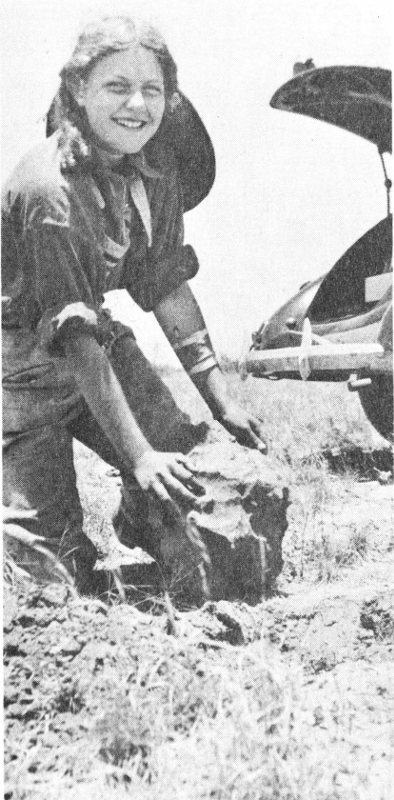
A 146-pound iron, found by this girl without the use of instruments although only a small corner of the meteorite was visible above the surface of the ground.
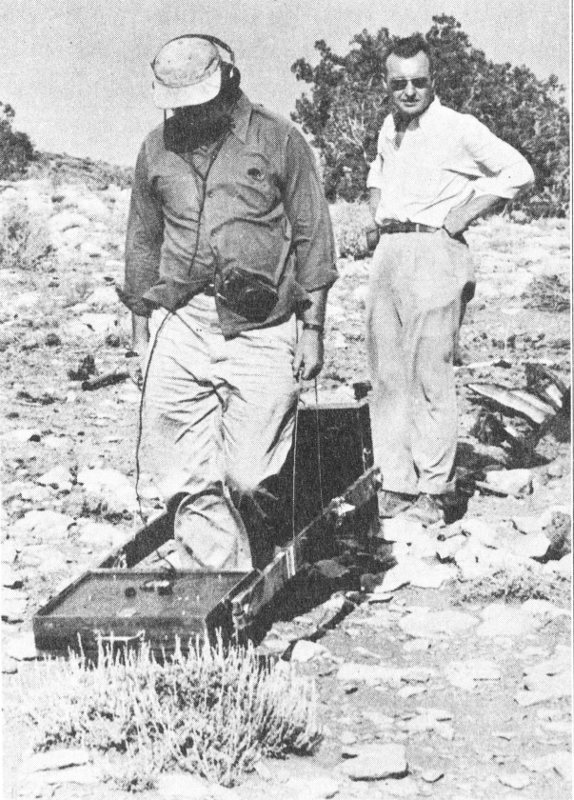
A commercially built meteorite detector in operation.
100
The operator of such a meteorite detector wears earphones and watches a signal needle in plain sight on the top panel of the detector. Since the phone and signal-needle circuits of the meteorite detector are in balance only when the magnetic field generated by the detector is undistorted, the disturbing presence of a deeply buried meteorite is at once revealed by a shrill note sounding in the earphones and simultaneous motion of the signal needle. If, as in all buried treasure stories, we use “X” to stand for the spot where the signals from the detector are strongest, then the meteorite-hunter has only to dig deep enough at “X” to recover the celestial treasure-trove he is after.
101