THE IRON CHALICE (continued 4)
Reading edition
"All right; as I said, I dived into the lake and found 'at the water wasn't so cold atter all. I paddled and kicked ontel I'd worked my way deep down in the lake. Thar I took yore coat out from the inside o' my shirt, ketched it by the bottom, and let myself come back to the top o' the water. The minute my head pops up into the wind, it mighty nigh freezes off, o' course. How I spluttered and puffed and blowed! Tot was a-standin' on the bank onder the beech; she was a-leanin' out toward me.
"'Did ye find him?' she says, anxious-like. 'Did ye find Little Buck fo' me? Oh,' she says, 'don't ye dare to tell me you never found him, Cat-Eye!'
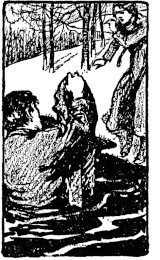
"I swims to Tot, and reaches yore coat up to her.
"'He'd lodged ag'in a rock ledge down thar,' I tells her, wi' my teeth a-chatterin' from the cold wind. 'I ketched him by the bottom o' the coat; but he slipped out of it, and rolled off o' the rock ledge, and sunk on down, hundreds o' feet in 'at black hole! He's gone, pore little gyurl,' I says. 'He's gone forever. What a pity it was he couldn't swim!' I says.
"And Tot she stands thar a-starin' at me wi' them 'ar big, fine, purty blue eyes o' her'n filled wi' the tarment o' hell itself. I'll own up 'at I did feel jest a bit mean over what I was a-doin'—you ta' keer, or I'll pull the trigger and put out yore blasted eyes! Don't you make nary 'nother move like as ef ye was a-goin' to jump at me, neither; do ye onderstand me?
"Well, I crawls a-drippin' out in that turrible cold wind, and says to Tot, 'As I'm jest about to freeze to death,' says I, 'I reckon I'd better run to the fire.'
"Git his hat fo' me,' begs Tot.
"I jumps in the lake and brings her yore hat. She wanted to know ef I'd done every blessed thing I could do to save ye, and I swore I shorely had. I went to the house, and stirred up the fire, and stood afore it, a-turnin' fust one side to it and 'en t'other. Tot she didn't foller me to the house. I watched her through a window. She stood out thar in the awful cold, wi' yore wet coat and hat pressed to her bosom, fo' two solid hours afore she moved a single inch.
"And I says to myself, I says, 'Mebbe I hain't a-gittin' even and square wi' you fo' a-turnin' me down and a-takin' that 'ar light-headed artickle you took fo' a husband! Mebbe I hain't a-gittin' even and square wi' you!' I says to myself. I——"
"You yellow-hearted scoundrel!" Wolfe exploded.
"Ta' keer! Ta' keer!" Mayfield cautioned. "You hain't in no p'sition to be a-callin' me ugly names. I never did like to be called ugly names, and I hain't a-goin' to put up with it."
Wolfe sank back in his chair. "All right," he said, "get the rest of it out of you."
"Well," the other pursued, "I knowed wimmen was scatter-brained and foolish when they was in love. I know the wimmenfolks and their ways, y' see. I'd figgered it out 'at Tot she would drownd herself to be wi' you in death. Wimmen's awful crazy when they're in love. And 'specially these here mountain wimmen. You know how they loves when they loves at all. So as I watched Tot through the window, I shorely expected to see her jump in the lake and go down. But she didn't. She fin'ly come to the house and set down afore the fire. Yore coat and hat was still in her arms, and they was froze stiff now—yore coat and hat was. Her face it was all pinched and blue wi' the cold.
"When she'd warmed up a little, she says to me, 'Tell me how it happened.'
"'It was this a-way,' says I. 'Little Buck he follered me over to a creek, and ketched me thar. He was a-bringin' me in, and we was a-walkin' along aside o' the lake, and his foot slipped on the ice. You know all o' the rest,' I says.
"'You pushed him in, you brute!' she says to me. 'You pushed him in, you brute!'
"'That's pow'ful foolish talk, little gyurl,' says I. 'You hain't got no right to 'cuse me o' sech a thing, atter I resked my life a-tryin' to git him out. It makes me feel plum' bad,' I says.
"But she stuck to it 'at I was the cause o' yore death, and all the argyfyin' I could do didn't change her notions a dang bit. And fin'ly I tells her this here:
"'Have it yore way, like wimmenfolks allus does,' I says. 'You can shoot me ef ye want to. I promise ye I won't raise a hand to keep ye from it,' I was jest a-bluffin', ye onderstand.
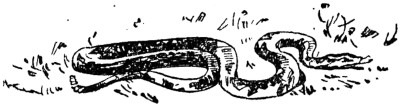
"'The only reason I hain't already shot ye,' Tot says, 'is 'at I'm afeard blood on my soul, even the blood of a rattlesnake like you, might keep me from a-goin' to Little Buck when I die. Even the blood of a snake is red,' says she.
"And I won't never fo'git how she looked when she told me that. Ef it hadn't ha' been fo' my hate fo' you, Little Buck Wolfe, I'd ha' quit right thar, shorely.
"Well, I laid down on the floor afore the fire, and soon drapped off to sleep. When I woke up, daylight was a-breakin'. Tot she was still a-settin' thar a-holdin' yore wet clo'es to her bosom. Her breath it was a-comin' wheezy and quick, and she had a scratchy sawt o' cough; her eyes they was as bright as coals o' fire, and her face was a-burnin' wi' fever.
"You contemptible devil!" cried Wolfe, every nerve in his body at taut as a violin string.
"Keerful now!" said Mayfield, his finger feeling for the trigger. "You hain't in any p'sition to be a-callin' me ugly names."
Wolfe quieted himself by a supreme effort. "Tell the rest," he urged.
It was all very plausible, just the thing, in fact, for Mayfield to do. Therefore, it did not occur to Wolfe that the wretch had lied to him—and the wretch hadn't.
"The' hain't a dang bit o' use in a-bein' so allfired fidgety," said Mayfield. "I'll git to the p'int in my own good time. I'm a-holdin' it off a purpose to see you wriggle. It's the biggest kind o' fun to me, to see you wriggle like a worm in hot ashes.
"All right. Well, as soon as it was broad daylight, Tot she gits up and goes out to the bank o' the lake whar she thought you'd went in at. I watched her through the window. I seed her stoop down clost to the water and pick up yore rifle, which I'd laid thar to fool her. She made shore it was yore'n, and took it to her bosom wi' yore coat and hat. Atter a little while o' standin' thar a-starin' down into the lake, she comes back to the house. She was a-staggerin' now; she was as wild as a rabbit in her head, jest plum' delirrus, and she commenced a-talkin' to you.
"'Little Buck,' she says, 'whar are you at, honey? I want you now,' she says. 'Why don't you answer me, Little Buck? Whar are you at? Why don't you come to me? Why don't you come to yore Tot?' she says; and she sobs a little at the last.
"And I knowed as I listened to her a-talkin' that a-way 'at my big vict'ry was at hand. Then I heerd her say, reel soft, this here:
"'I remember—I remember, now. How lonesome you must be down in that black hole without me!' she says—ta' keer thar, Little Buck Wolfe, ta' keer!
"Tot she goes to the table and puts down yore rifle, hat and coat. She takes a little Bible-book from the mantel, and puts it in her bosom. I watches her clost. She went out to the big beech aside o' the lake. I follered her, a-keepin' whar she wouldn't notice me. She turned her burnin' eyes uppards, and raised both arms. I seed the light o' the risin' sun sparkle on the di'mont o' the ring 'at was on her finger. Her copper-colored hair it looked like gold. I bit the inside o' my mouth ontel it bled, acause I was somehow afeard.
"'I'm a-comin' to ye, honey,' she says delirruslike. 'It's better to lay down thar in that etarnal night wi' you 'an to live on in this lonesome, lonesome world. Open yore arms fo' me, Little Buck,' says she, 'like ye used to—I'm a-comin' to be wi' you, my own!' she says.
"And she walked straight down in the water and went onder; and the last I seed o' her was one little, white hand——"
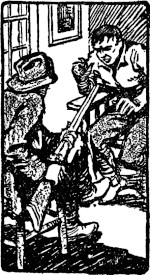
"One little, white hand—" Wolfe interrupted in a terrible voice. He could govern himself no longer—he straightened on his sound leg and sprang, his hands before his eyes to protect them from the powder. There was an oath from the lips of Mayfield, and immediately afterward came a great flash and a great roar. Wolfe found himself groping in a stifling white cloud of powder smoke—but he had not been burned in the least degree!
He dropped to his hands and knees and peered under the slowly-lifting cloud. He saw Cat-Eye Mayfield lying supine on the floor, with the old shotgun across his narrow chest. He crept forward, meaning to kill the unspeakable reptile with his bare hands—meaning to strangle the wicked life out.
When he reached Mayfield, he saw that the shotgun, which had been loaded beyond its power of resistance, had split for eight inches at the breech—and Mayfield's lean face was burned as black as that of an Ethiopian; his eyes were perfectly and incurably blind! The monster of his own foul brain's creation had turned upon him.
Wolfe uttered a cry that makes the finest description puny. He seized the other's slender throat in a viselike grip. The blind eyes stared toward him. Then he recalled the words of Tot.
"Even the blood of a snake is red."
His hands left Mayfield's neck. He rose and limped out of the cabin, and went to the big beech that stood beside Tot's beautiful Lake of Peace. There he saw many of his wife's small footprints in the snow——
Lying in the edge of the water, he found a dark blue shawl that she had been wont to wear about her shoulders when the weather was cold. Beside it lay a tortoise-shell comb. A branch that hung low over the lake had kept for him a few strands of hair that was of the color of dark copper. He wrung the water from the shawl and put it, with the other little treasures, on the snow beside him. Almost he wished, now, that he had killed Mayfield——
A sudden weird, skittering shriek split the air like a knife. He turned his head quickly. Through the mist of his sorrow he saw blind Cat-Eye Mayfield rushing toward the lake. Mayfield's thin lips were parted and jerking; his blackened face was contorted and hideous. No man may be himself when he has suffered as young Wolfe had suffered; Wolfe laughed thickly, oddly, mimicking the hoarse laugh that was Mayfield's.
"Haw-haw-haw!"
The sightless man fell to his hands and knees and began to grope for the edge of the lake. Soon he had found it. Then he straightened and turned his hideous face—a singular thing, and inexplicable—as squarely toward Little Buck Wolfe as though he had eyes to see him.
"I'm a-goin' to give up what the' is left o' me to make you suffer more!" Mayfield gibbered. "I'm a-goin' to lay down thar in 'at black hole wi' her—wi' Tot Singleton—I'm a-goin' to be buried in the same grave wi' her, yore wife, and he'p yeself ef ye can!"
Yes, the man was insane. Hatred had absorbed all his faculties.
Wolfe stood like a work in bronze, and stared. Mayfield ran into the water, cursing as he went, and sank like a stone, down, down, down to darkness eternal. Wolfe even went whiter as he watched the bubbles and lessening ripples that marked the spot where the worst man in the world had died that his devilish triumph might be a little greater.
His lips moved, and it was to say this, brokenly, "My cup—of bitterness—is brimming. Why, my God, why?"
He made his way back to the lonesome cabin. He threw the burst shotgun out to the snow, which hid it mercifully, and tossed Mayfield's slouch hat into the fire.
There was a little of sweet, sad comfort in handling the things that had been his wife's. When he could no longer bear to look upon them, he pushed a chair to the cabin's front doorway and sat down, unmindful of the cold, and absently watched the chilled sun sink behind the snowy forest.
A great silence was about him. There was not even a wind to sigh in the tops of the giant hemlocks. It was quite as though he were the sole inhabitant of some lost, dead world.
XXIII
When darkness had fallen, Wolfe closed the door and went to the low-burned fire.
He slept none that night, none the following day, and became pitifully thin and haggard. Loss of sleep and grief's steady gnawing had made him half-delirious. Hallucinations began to distress him. A dozen times he imagined he heard Tot's voice calling to him from the bluish-black depths of the lake. He imagined that he saw her ghost-white hand thrust above the water, and that it beckoned to him. Then came Mayfield's triumphant, taunting laugh, and he saw the lusterless blind eyes staring at him through a window——
"I must put an end to this," he told himself in a whisper, when night had come again. "I'll go to bed, and I'll go to sleep. Tomorrow I'll hunt for the money and my rifle. When I'm able to walk, I'll go to Conradsville, and from there on—on."
He went to bed and he went to sleep. When he woke the next morning, he felt stronger, though his grief was as poignant as it had ever been. He determined that he would bear his burden bravely; Tot would want him to do that, if she could know.
Seven hours he spent in a search for the money and his rifle, and found neither. Mayfield, he told himself, might have carried the money to the bottom of the lake with him.
Thirty very long days went by. Winter had passed, and the first breath of spring had come. Puccoons and pale-green ferns were beginning to peep from the rich black earth in sheltered spots. The buds of the hickories were swelling, and squirrels were rioting among them.
"Tomorrow I'll go," said Wolfe to himself. "I'll start early. With the help of a cane, I can walk pretty well."
It was during the last of the sunset hour. He sat in a chair just inside the front doorway, watching the dull-gold sun without seeing it as it burned a hole through the fringe of jackpines that grew along the crest of the western mountain. Then he bent his head to his breast and began to think. He knew that the hardest good-by of his life was at hand.
A little red ant that lived under the doorstep crawled up Wolfe's boot, up his leg, and to the back of his hand. Wolfe frowned, jerked up his head, brushed the insect away, and began to stare toward the sinking dull-gold sun again.
Thanks to the little red ant, he saw a flicker of officer-blue in the distance!
A fever of fear seized him. How relentless Whitney Fair was! Of course, Fair had sent this man after him—of course! He rose so abruptly that he overturned his chair, caught up a cane and a bundle that contained provisions, his spare clothing and the clothing that Tot, his wife, had left—he would never part with that, never—and rushed out by way of the back door. As rapidly as he could go he crossed the open space and entered the eastern half of Doe River Wilderness. At the edge of the thick forest, he paused long enough to fling out a hand toward the lake in farewell.
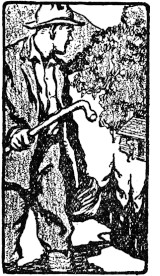
When he had reached the crest of a ridge half a mile from the lake, he looked back. The man in officer-blue was entering the cabin by the front doorway.
Wolfe hurried on breathlessly, going straight toward Virginia. He walked nearly all of that night, guiding his movements by the stars, and slept the next day hidden in a dense thicket of laurel and ivy. Not until he had placed forty rugged, hard-won miles between him and the head of Doe River, did he dare to travel in the daytime. His debt to the law must wait—until his debt to man was paid!
In an extremely wild section just across the Tennessee-Virginia State line, he ran upon a logging-camp that was sorely in need of a woods foreman. He decided that there was small chance of his being apprehended in this out-of-the-way place, so he asked for the job for one month and got it.
The pay was good, and in the four weeks he saved enough money to defray all expenses of the journey to the Northwest. Then he hastened to the nearest railway station, bought a fare, and caught a westbound train.
XXIV
The Wolfes had been in the State's prison at Nashville a little more than four years. They now stood convinced that they had erred, that they had wilfully violated a law that was absolutely just, and they were atoning like men. There was about them none of the grimness, none of the moroseness, none of the sullen bitterness that is usually found in the hillman when he has had iron bars and walls of stone placed between him and his liberty. If they pined for home and the great dim-blue mountains with their trees and rocks and sparkling streams, there was certainly no outward sign of it.
Only one of them had felt the cold touch of the white plague, the scourge that so frequently cuts short the life of the imprisoned mountaineer. This was Brian Wolfe's son, Charley, who was not much more than a boy for all of his six feet in height. But Charley didn't whine about it; to have whined about it, to him, would have been the part of a yellow dog. In point of fact, Charley Wolfe kept his afflictions so well hidden that no one else even suspected it.
It was pitiful how he did that. In the daytime he staved off the telltale cough by means of a force of will that was truly remarkable; at night he buried his head in the folds of his blankets and smothered the cough. He laughed lightly at his increasing thinness and at the hectic flush that glowed in his cheeks in the afternoons—when anybody chanced to mention it.
Christmas Day came snowy and cold, with a biting north wind. The spirit of peace and good-will had found its way through the high and forbidding stone walls of the penitentiary. The convicts were not kept in their cells, nor were they made to work, on this day. Even Bully McCrary, who had been an incorrigible and the fighting man of the prison before the coming of the Wolfes, cried "Merry Christmas!" to every person he met—which included his former sworn enemy, a sad-eyed, intelligent fellow nicknamed and named Pale Tom Ledworth.
Now it was customary for the Fiddling Governor, Tennessee's best loved man, to give the inmates of the State's prison a fine dinner on Christmas Day; and on this occasion, he had decided that he would drive out to say grace over it himself.
He arrived half an hour before noon-time. The warden met him at the office door, bowed almost reverently, for the Governor was a man whose faults were so magnificently human that they were almost virtues, and greeted him with the compliments of the season. He entered, drew off his overcoat and gloves, and sat down before the glowing stove.
Just then Old Buck Wolfe, an iron gray giant whom stripes seemed altogether unable to disgrace, appeared before the door of heavy iron-lattice that stood between the office and the prison proper. His range of vision did not take in the distinguished visitor.
"Warden," said he, "will you please see if you can't get a fiddle for me—just for this one afternoon, sir? I used to fiddle. I don't think I've forgot how. If it's not asking too much, that is."
The warden looked toward his caller.
"It's Christmas Day, Warden," the Governor said. "Get one if you can. I think I can understand how a fiddler feels when he hasn't touched a fiddle for several years. Who is it, Warden?"
"The chief of the Wolfes, sir."
At that the Governor rose, went to a desk, sat down beside it and reached for a telephone receiver. He asked for his residence, got the connection, and ordered that his own fiddle be sent at once to the penitentiary!
Old Buck Wolfe turned away the gladdest and proudest man in the sovereign State of Tennessee.
When he had gone, the Governor asked of the warden, "How are these mountaineers behaving now?"
"Men couldn't conduct themselves better than our mountaineers, sir," the warden answered. "They've done finely, all of them. The old man had a fight soon after his arrival here, but we couldn't blame him for it; he was very much in the right, sir. I'd be glad to tell you about that fight."
"I'd be glad to hear about it, Warden."
"The Wolfes," the prison official began, "had just finished putting on their first stripes when the supper gong rang. We marched them to a table that was all taken up on one side by Bully McCrary and his following. They had always made trouble among the other prisoners, the McCraryites had, and we kept them to themselves when it was convenient.
"Old Buck talked in mountaineer dialect then—Pale Tom Ledworth has since taught the Wolfes how to read and write and speak correctly, as well as a great many other things; oh, they've made the best of their prison term! Well, as I was saying—Old Buck looked across the table, straight at McCrary, drew his shaggy brows, and drawled this:
"'You fellers over thar bend yore heads down'ards a little. I am now a-goin' to ax the blessin'. The' hain't no use in a-bein' damned hawgs jest acause we happens to be here in the penitenchy.'
"McCrary and his outfit roared with laughter, and began to make sport of Old Buck Wolfe. Old Buck's eyes flashed like the fire of powder. He turned to his kinsmen and said, 'See 'at not more'n five o' them weasels over thar jumps on me at oncet.'
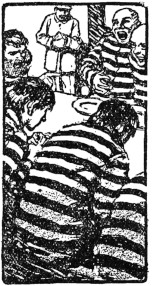
"Then he went straight across the table and its dishes, and collared McCrary; and before the guards could stop the fight, McCrary had received a mighty good pounding. I—I guess the guards were not in much of a hurry to interfere, to tell the truth about the matter; you see, sir, Bully McCrary was only getting what was coming to him.
"Old Wolfe went around to his place at the table, sat down, and eyed the McCrary crowd sharply.
"'You fellers over thar bend yore heads down'ards a little,' he repeated very quietly. 'I am now a-goin' to ax the blessin'. The' hain't no use in a-bein' damned hawgs jest acause we happens to be here in the penitenchy.'
"Every prisoner in the mess-hall bowed his head. So did the guards. And so, for that matter, did I. Since that time, Old Buck has said grace at every meal. He's held up his banner like a soldier, and most of the others have flocked to it. He was born to leadership, I'd say, born to rule. He's a king of his kind, sir."
Shortly afterward a messenger arrived with the fiddle and bow in a leathern case. The Governor took the case and put it on the desk at his side. The ringing of the gong announced that dinner was ready, and Warden Gray escorted the State's high light to the big mess-hall. They found the convicts seated at the long tables, which were well laden with the good things to eat one expects on Christmas Day.
Then the chief executive bared his head and raised one fine, white hand. In clear and impressive tones he repeated the old-fashioned blessing that he had heard so many thousands of times back in his boyhood home in Happy Valley.
Old Buck Wolfe echoed fervently the "Amen!" and added in the voice of a Goliath, "God bless the Governor!"
Pale Tom Ledworth rose and held up his glass of innocent wine in a hand that wasn't quite steady.
"The Governor," he cried, "God bless him!"
The other prisoners went to their feet and lifted their glasses high.
"The Governor," they cried, "God bless him!"
It rang and rang and rang.
Tennessee's best-loved man was suffering keenly at the heart. He was thinking of the lonesome and desolate homes of these men who were paying their debts to the law and to society, of the saddened firesides and empty chairs of this Christmas Day. He was thinking of the longing of women, and the prayers of women, and of the heavy crosses men make their mothers bear—their mothers, the finest fighters in the world.
"Warden," he whispered, his eyes bright and twinkling, "you'd better get me out of here."
"This way, sir."
The two of them went back to the office, sat down, and silently watched the whirling snow through the windows. When dinner was over, they went again to the mess-hall, and the Governor placed his fiddle and bow in the hands of Old Buck Wolfe.
"If you can play 'Buffalo Gals,'" he smiled, "play it. It comes very near to being my favorite jig."
"It's mine, my favorite," the big hillman exclaimed happily, "by a long shot!"
He handled the beloved instrument with reverence. It seemed that he feared his knotty, work-hardened hands would scar it. On his countenance was the light of a rapture that the owner of that fiddle, being himself a fiddler, understood. Old Wolfe began to play his favorite; his left foot kept time on the stone floor, and his huge body swayed rhythmically to and fro. Soon every other person present was tapping the floor with a restless foot. There is no gloomy note in "Buffalo Gals."
When the delighted mountaineer's wrists and fingers had become too weary to function properly, he lowered the instrument amid much applause. Then somebody lifted the cry, "One little tune from the Governor!" Others took it up, and it became a roar.
The Fiddling Governor took the fiddle and tightened two of its strings a trifle.
Because it was Christmas Day, the day of peace on earth and good will toward men.
"What shall it be, boys?" His eyes twinkled pleasurably.
Bully McCrary never made a greater mistake, though it came out all right in the end.
"Home, Sweet Home, if you please, sir," he begged.
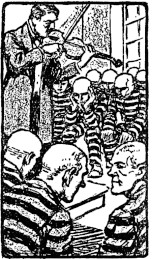
The State's leading official rubbed his chin thoughtfully. Of course, he did not want to play that; there were those who would feel very much upset, if he did—why, it would be torture. But McCrary's gaze pleaded so hard; the melodramatic McCrary was ready to preach, pray, shout hallelujahs, sing, dance, or fight. The Governor put the fiddle into place and began, striving purposely to give a poor interpretation. But his fingers trembled in spite of him, rendering a delicate and soulful vibrata. The prisoners stared toward one another with wide, friendly eyes. Then, one by one, they began to stare toward the floor.
Only a few bars had been played when Charley Wolfe, who had tried manfully to be a credit to his name, who had so bravely hidden all signs of his affliction, crumpled to his knees and cried out in the musical hill dialect two unbidden words in one—"Goddle-mighty!"
Just that.
The Governor quickly passed his fiddle and bow into the hands of the warden, knelt beside Charley Wolfe, and swept back from the clammy brow the thick, dead-black hair. He lifted the lean face, saw a trace of red at each corner of the quivering, sensitive mouth, and knew. Charley Wolfe no longer had a secret.
"He's got the bugs, sure," very sympathetically said Bully McCrary, who also had seen. "He's got 'em, sure."
"Warden," the Governor asked, "how much is there left of this boy's sentence?"
"Let's see: with eight months counted off for good behavior—about three more months, sir."
The executive went to his feet. "I'll see that he's pardoned at once, Warden. While the matter is being arranged, keep him in the hospital; and tell the doctors to give him plenty of medicines and instructions when he starts for home—don't forget it."
"If you don't mind," Charley Wolfe murmured, rising with his father's help, "I'd like to stick it out, sir. I consider that this is a debt I owe. A Wolfe always pays his debts, and tells the truth, and keeps his word. I—I want to stick it out."
"You're going home," frowned Old Buck. "You've got to go, so you can get well. We'll be there with you, in about three more months. Don't say anything against it, Charley."
He was still the chief of the Wolfes. There was no disobeying him. Before the sick young man's mental vision there flashed scenes of home and loved ones and the majestic dim-blue mountains with their trees and rocks and sparkling streams. A great longing came to him, the longing he had fought away so many times. He caught the Governor's hand.
Three months later, the rest of the Wolfes walked proudly out of the State's prison and started for the railway station. They were dressed in the clothing of Southern gentlemen, and they attracted no little attention on the street.
"Say, but we're sure goin' to miss 'em," remarked Bully McCrary to Pale Tom Ledworth. "Look at Warden Gray; even him, he's got that I-wonder-will-I-ever-be-happy-again look on him. Say, take this from me, Pallid, them was all men, them Wolfes."
"It's not being free that makes them so glad," Pale Tom replied in his soft voice. "They had a letter from home this morning, and it told them that Charley was improving rapidly. That's what makes them so glad."
XXV
It came to pass in June.
There alighted from an early morning train in Conradsville, North Carolina, a tall and muscular, smooth-faced and sober-visaged, youngish man wearing boots that were laced high in front, a suit of blue serge, a blue flannel shirt, a slim, black tie, and a broad-rimmed black hat. He sent his baggage on to Johnsville, Tennessee, bought for himself a week's supply of traveling rations, and set out immediately, on foot and alone, for the heart of Doe River Wilderness.
It was, of course, Little Buck Wolfe, the Arnold Mason that was. He had been in the great Northwest, dealing in timberlands, for a little more than seven years.
His rise had not been meteoric, but it had been steady. He began by obtaining an option on a wide and finely-timbered boundary of woodland; soon afterward, he won the interest of a group of Eastern lumbermen, and arranged a transfer that gave him a cash base to build upon. Gradually he became known as a timber Midas. In the seven years he had cleared enough money to pay back all that had been lost in the Wolfe's Basin fire, and he was now on his way to pay it. Then the law could have him, if it still wanted him. But first he had to visit the little cabin that stood on the shore of the lake that was the source of Doe River.
During all that time, he had not written once to Colonel and Mrs. Mason. He considered his reason for not writing a very good one, indeed. Whitney Fair was post master at Johnsville. Wolfe's fear of being arrested before his purpose was accomplished had become an obsession, overshadowing everything, except the purpose itself. And then, the fine humility of the man had convinced him that without the money necessary to pay the colossal debt he was a nonentity, nothing, non-existent.
He reached Doe River at a point some two miles below the lake shortly before midnight. This bank of the stream was for the most part cliffs, and, as there was no visible way of effecting a crossing, the remainder of the journey to the cabin would of necessity have to be made in the daytime. Wolfe lighted a fire under a tree, rolled himself in his blanket, and went to sleep.
Early the next morning he rose and climbed down to the crystal-clear river's brink to bathe his face and hands. As he turned from the edge of the stream, he saw, lying on a nearby low ledge of the cliff, where some high water had left it years before, a bare and bleaching human skeleton.
Wolfe stood aghast, dumb, frozen. It had come from the lake, of course, but whose—which was it? Was it the skeleton of a man, or that of a woman?
He approached it slowly, knowing not whether to bless it or to curse it, to hold it sacred or to hate it. Then he saw on one of the arm bones, the unmistakable mark of a bullet, and he knew; it was the mark of the bullet that poor old Grandpap Singleton had fired that long gone day in Devil's Gate to save his, Wolfe's, life. The bones were those of Cat-Eye Mayfield.
The realization clenched Wolfe's fists iron hard, sent him as white as a man in the grip of certain death. He would stone the accursed thing—he would crush to bits all that was left of that most unspeakable of wretches.
No, he wouldn't. He would do as Tot would have him do if she could know; this had been the motto, the balance-wheel, the guiding light of his seven years in exile. With his hands he made a hole in the soft black earth at the cliff's base, and buried the skeleton. When it was done, he felt glad that he had obeyed the finer impulse. And it was a consolation to know that Mayfield had been cheated of the last mean part of his triumph.
Wolfe looked up and down the river's banks for the other skeleton, and didn't find it. When one has drained the iron chalice, Fate is very apt to be merciful!
The little cabin was much dilapidated. Half the stone-and-clay chimney had tumbled down before the eternal onslaughts of wind and rain; a storm had carried away a fourth of the split-board roof. Ferns and rattleweed grew over the doorstep as though trying to bar the way to feet that might profane. Wolfe crossed the feeble green barrier, and entered his holies of holies, the place that had seen enacted his life's one perfect chapter. The interior was damp and musty and mildewed. The rafters were lined with the tiny homes of mudwasps. A copperhead lay coiled comfortably in the little pit where they had kept their savings hidden; he killed the snake with one shot from his revolver and threw it out.
There were a few mementoes of the gloriously happy days. A rusted table knife, a rusted spoon, a broken dish, two mother-of-pearl buttons, a rusted wire hairpin, a rotting mealbag window-curtain that Tot's own fingers had hemmed. He fondled them for a little while, a sort of Pagan worship in his eyes; then he put them down on the mildewed table and went out and sat in the lush grass beside the bluish-black lake for a long time. The milestones of his life trooped back to him there, passed before him one by one, like soldiers in review.
Two days and two nights he spent there in the silence.
He set out for Wolfe's Basin at daybreak of a fine morning. Yellowhammers and squirrels were making love and quarreling everywhere in the forest about him. Bright-winged butterflies were busily sipping honey from the tiny blossoms of the rattleweed; wild bees were humming about the pink-eyed bloom of the ivy and the white and waxen cups of the laurel flowers. It was springtime for every living thing on earth but him.
After walking hard all that day and all the next and one hour more, he reached the rugged, pine-fringed crest of a mountain that he believed to be his home mountain, the Big Blackfern. He strained his eyes to the westward, trying to make out in the darkness the shape of bald and majestic Picketts Dome above the Lost Trail. He saw dimly a peak that he believed to be Picketts Dome.
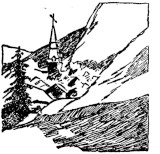
Then he went on, and halted at a point from which he could look down into the long, broad valley that lay below. In a building that stood in the center of that valley, there was a series of lighted windows.
"It's Sunday night, and that's a church," he said to himself. "I've lost my way. There's no church in Wolfe's Basin. That must be Beechwood. Perhaps—wait! Maybe I've——"
A fine hope broke into his heart; he was no very religious man—churches went with civilization's advance, always. When he reached the level land it was late, and there was not a light to be seen anywhere; a perfect stillness reigned. He found himself walking along a graveled street between two rows of vine-covered cottages. The mingled perfume of honeysuckles and roses was well-nigh intoxicating. He passed between a church and a schoolhouse, both of which were painted white.
There was a wide concrete bridge that had been built across a rippling, tinkling creek. He went over and turned up the stream, looking for a stately willow that stood over a bar of white sand. If he could but find the willow, he would know.
He found it, and he knew!
For the present, this was enough. He would wait until morning to meet his people. Besides, he dreaded having to tell the Singletons about poor Tot. He stretched his weary figure out on his blanket, and watched the bright stars—Grandpap Singleton's promises—through the branches of the patriarchal tree until he went to sleep. He dreamed then that he sat on a burning desert with a heavy cup in his hand; and that a woman, in flowing white, came and took the cup from him, and dashed it away.
Little Buck Wolfe woke in a cold sweat. It was hard for him to go to sleep again.
When he woke again, broad daylight had come. He rose, combed his hair with his fingers, put on his hat, and looked about him. Nearby stood an especially home-like cottage with an inviting veranda in front. All manner of sweet, old-fashioned flowers bloomed in the spacious yard. He went slowly toward it.
Sitting in a deep and comfortable veranda rocker, he saw a very old woman in dark-figured calico; she wore a red bandanna about her perfectly white head, and there was a long-stemmed clay pipe in her toothless mouth. It was Granny Wolfe, yet alive.
"Buck, is 'at you?" she asked shrilly as he approached. "'Pears like it's yore walk, and 'pears like it hain't. But whoever it is, come right on in and set down here wi' me. Hey?"
She was now almost blind. The strapping figure of her grandson was only a blur to her eyes.
Wolfe bent over her. "Don't you know me, grand—grammaw?"
The poor old creature did not recognize his voice. "Not from Adam's off ox, nor a side o' sole-leather!" she cried. "You're a stranger to me, shorely! And might I ax, dad-burn it, what ye're a-sellin'—lightnin'-rods, sewin'-machines, patent churns, spec's, potater-peelers, or hillside plows; hey?"
Wolfe dropped into a chair facing hers, and picked up one of her pitifully thin hands.
"I—I'm Little Buck, grammaw," he said, a trifle unsteadily.
She pulled her hand away quickly. "Stuff! Stuff!" she exclaimed. "It's a durned pore joke, stranger! Little Buck, pore boy, he's been dead a long time. And ef ye try to spring 'at joke on me ag'in, I'll bust ye acrost the forrard wi' my stick—ef I don't, I wisht I may drap dead right here in my tracks, and never git another breath!"
Wolfe shrugged, then he asked anxiously, "Are the Masons still living? And who—who has died here in the last seven years?"
"The Masons is both alive. Hain't been but one grown pusson died here in the last seven year; 'at was pore old Grandpap Bill Singleton, the Prophet. Pore old Bill! Yes, he's done went up to his little shelter in the skies."
The assurance that both his fathers and both his mothers still lived filled Wolfe's heart with thankfulness. "If you'll only listen, grammaw," he pursued, "I'll prove to you that I'm Little——"
"Hush yore mouth!" she cut in angrily. "I hain't a-goin' to listen to no sech danged fool talk! But—" and she lowered her creaking voice to a whisper—"but I mustn't be so consarned loud. The widder woman I live with here she's a-sleepin', and she mustn't be woke up. Pore gyurl, she set up mighty nigh it the whole night wi' Lon Singleton's little boy, Robert Bob, who went and et a whole wagon-load o' green apples yeste'day."
"So Lon is married?"
"Why, shore; he married Hallie Wolfe, o' course," rather irritably. "He was the fust pusson 'at ever married a Wolfe and kep' his own name. But sence then, the's been sev'ral Singletons married Wolfes and kep' their own names, jest as the's been sev'ral Wolfes married Singletons and kep' their names. I can tell ye, stranger, them 'ar Singletons is good folks, every one of 'em."
Wolfe looked thoughtfully out across the bottom of the great basin. Suddenly he realized that he was staring at one of a series of yawning holes that had been made in the base of the Blackfern. Those holes had not been there seven years before, certainly. He asked his grandmother about them.
"Iron," said the old woman.
"Iron!"
"Yes, iron." Three puffs at her clay pipe. "What they calls magnetic iron ore, and the finest in Ameriky—says the Colonel. Both mountains is chuck a-bustin' full of it. My son, Buck, he found it whilst he was hid in a cave from the law. The depity he chased Buck back in the cave a hundred yards, and thar Buck found it. It was the treasure the dyin' stranger talked about a long, long time ago, and which Buck he allus thought was gold."
Her grandson gasped. She went on in her garrulous way.
"The colonel he took a-holt of it. He borried money from the bank, and bought t'other side o' both mountains, bought out t'other part owners o' the lumber comp'ny, and built the narrer-gauge railroad on down to the big blast furnace at Johnsville. This here—this here—er, what'n the devil was I a-talkin' about' anyhow? Oh, yes—iron. I never slep' none last night. Why, yes—the colonel he paid the bank back mighty soon, I'm a-tellin' ye, Mister!
"The colonel he gives all o' us Wolfes and Singletons work at plum' scan'lous good pay. Bless the bones of him, he built us a church and a schoolhouse, and brung in a fine teacher and a fine preacher; and he put up a big gen'al store and a post office fo' us, too. Utopia, 'at's the name o' the post office. Utopia, Tennessee. Purty, hain't it? And the colonel he gi' us all land in the name o' pore Little Buck, and he he'ped us to build dandy houses like these ye see. Se we're all happy 'cept fo' one thing, which is the losin' o' pore Little Buck. God rest the ashes o' him!
"Mister, I—" Again she caught herself and lowered her voice. "Durn my old pickcher, I allus was a fool fo' talkin'. Why, I bet I've done woke her up." (It was a safe bet) "I wisht these here drotted boys'd keep them wagon-loads o' green apples out o' their blasted little bellies, so's she could stay home o' nights whar she belongs. Anybody gits sick—she's the nuss and doctor."
The heart of Wolfe throbbed wildly. His most roseate hopes, long lost, had never touched so perfect a fulfilment of his dream, his big dream. If only he had Tot! If only she could know! The insufferableness of it made him weak. He slumped down a trifle in his chair.
The front door's screen opened and closed softly, and he heard the pattering of small feet beside him. It was a very little boy, chubbily-built; he was strutting proudly in his first pair of knee-trousers, real knee-trousers.
"Good morning, Judge!" smiled Wolfe.
"Good mawnin', suh!" the very little boy said sweetly, in a grown-up fashion that was delightfully ludicrous—and Wolfe knew then that the child had been much associated with old Colonel Mason, Southern gentleman. Granny Wolfe jumped out of the edge of a nap.
"Why, Bobolink!" she cackled. "You've come out here to show off yore new britches, you honey-dumplin'! His name, Mister, is Bob Taylor Wolfe; but the's so danged many Bob Taylor Wolfe's here in Utopia 'at we calls him mostly Bobolink to make a diffunce. He's got another name, too, which, down in the hearts of us, we likes the best; I think it was his granpaw, Old Buck, my son, who put him up to it. Now, Bobolink, tell the stranger yore other name."
It came promptly, "Littlest Buck Wolfe."
Little Buck Wolfe went as white as chalk. He looked straight into the boy's wide, serious, unflinching eyes, and the light broke suddenly—he was looking into his own eyes. But he dared not hope. It couldn't be. Tot was dead; she had been dead for seven eternities of years. Still——
It was at that moment that the Littlest Buck Wolfe's mother came to the door. She was round-figured, mature, magnificent; her face was that of a Madonna; her hair was of the color of dark copper.
Her husband shot up straight.
"Tot!"
After they had succeeded in convincing Granny Wolfe that she had been talking to her own grandson, Wolfe told the story of the tragedy, as he knew it, that had taken place at the lake that was the source of Doe River.
"Mayfield deceived us both," said Tot. "Most of what he told you was true. But instead of going down in the lake, I took the stolen money and my rifle and came back here to prove your innocence of the charge of robbing the company's safe. Mayfield had been threatening to kill me if I didn't marry him and run away to Virginia with him. I escaped by some means, I never could remember just how, for I was really sick and delirious; I got back here only after days and days of wandering. How he must have hated you, to die as he did! But he was blind.
"And the man in officer-blue was Lon, my brother!" she went on. "He had himself made a deputy-sheriff, and went to hunt Cat-Eye Mayfield. He didn't take any irons along; he meant to kill Mayfield. And that miserable little ant—what a tiny, tiny thing to keep us apart for so long! But life is like that."
"Well, we won't be separated again," said Wolfe, "unless Whitney Fair has me prosecuted for helping my people get away."
"Whitney Fair is dead, and his family don't live in Johnsville any more," Tot replied. "I'm sure nobody else will remember it against you."
In which she was correct.
News of Little Buck Wolfe's return spread rapidly. The people of Utopia hastened to welcome him; the Masons came up in a little passenger car carried by the daily ore train. It was a gala day, a Christmas, a July Fourth, and a Thanksgiving Day, all in one.
When the pointed shadow of Picketts Dome was reaching for the crest of the Big Blackfern, Wolfe stole away with his wife to pay his respects, as it were, to the one soul that had not been there to greet him. Tot led the zigzag way up the bald peak, upon which the ironwood cross still stood. They gathered sheafs of waxen-white laurel bloom, and later they put these in reverence on a mound between the great cross and a great boulder, the last earthly resting place of Grandpap Singleton, who had been called the Prophet.
"There, look," Tot said in the hushed voice of one who speaks in an atmosphere of holiness. She pointed. "The colonel had that done."
High on the even face of the huge stone had been cut in bold letters;
GRANDPAP WILLIAM SINGLETON
He, too, had drained life's iron chalice bravely. Wolfe's eyes dimmed.
And below the name, in the old hill dialect, had been chiseled in smaller letters this gem from the Prophet's crude philosophy, which well might ring down the centuries to come:
To Them As Thinks The' Ain't No God The' Ain't None, So Far As They're Concerned