THE IRON CHALICE (continued 2)
Reading edition
"You ort to be hung as high as Haman or higher, Buck Wolfe!" the old woman cried. "You go home! Some says a old fool is the biggest fool on earth, and some says a young fool is the biggest; but me, I say you settle the question forever. Now you go on home!"
"Nobody hain't axed you fo' none o' yore edvice," growled her son.
"By gyar," Granny Wolfe retorted witheringly, "you need edvice, as shore as the Old Scratch hain't a jaybird."
Colonel Mason turned to his waiting horse, and swung himself into the saddle with the agility of a cavalryman. Tot seemed only half-conscious, only half-alive, and it was with some difficulty that the colonel and Granny Wolfe lifted her to the saddlefront. The grizzled mountain man stood and watched it with a face like a mask of stone.
Then the horseman left the old hillwoman berating her son mercilessly, and rode toward the basin's bottom.
"Now, little lady," he said when they had come to level ground, "I'll take you to your mother in short order. I'm afraid to try to take you to Johnsville; it would probably be too much for you. It'll be all right for you to go home. Your father is sorry he was so hasty with you."
Tot stared wide-eyed into his patrician old face. Her spirit fluttered up quickly.
"I want to go back to Mis' Mason," she told him.
"Oh!" smiled the colonel. "Back to Mrs. Mason, eh? Very well. Perhaps it would really be better. You may need the services of a doctor, and you couldn't get one out here—though I'd never dare to tell Granny Wolfe that! And I fancy, little lady," he added pleasantly, "that Mrs. Mason will be right glad to have you back."
They soon met young Wolfe, who had just ridden through Devil's Gate. He heard the story as they rode toward Johnsville, and made no comment, though there was a glint in his eyes that his foster-father hadn't been accustomed to seeing there.
Mrs. Mason saw them coming, and called the doctor by phone. Then she ran to make ready the bed in the blue-and-white room upstairs.
It was a case of utter physical exhaustion and high nervous strain, the doctor said; there was some fever now, and would doubtless be more before morning. Tot watched him as though she were not the least interested. After an hour, Doctor Rice left medicine and directions for giving them, and turned homeward.
Another hour went by. The patient spoke to the anxious-faced little woman who sat at her bedside.
"That tombstone. I can see it as plain as daylight. Ef I look somewhar else, it moves whar I look. 'Hear lays Little Buck Wolfe.' Are you shore he ain't dead, Mis' Mason, plum' shore?"
"Very sure," promptly. "He's perfectly safe."
"Ef you don't keer, Mis' Mason," and Tot strove to lift herself to an elbow, "I'll jest step downsta'rs and see."
"Delirium," the colonel's wife whispered to herself. Aloud, "No, you mustn't get up! Wait, dear; I'll call him."
Wolfe entered the blue-and-white bedroom a minute later. He went to the bedside and knelt there, took one of the hot and fluttering hands and caressed it awkwardly.
"I'm all right," he told her over and over. "Don't you see? Everything is all right."
She appeared to be satisfied, and accepted a teaspoonful of queer-tasting liquid without a murmur.
But the fever kept going higher in spite of the queer-tasting liquid, and the doctor was summoned again. He gave a powder, left others, and departed. Out in the hallway, Wolfe paced the floor anxiously. On the veranda the colonel sat smoking and swearing under his breath at the forces that had brought themselves together in a mighty attempt to crush him that was as flesh and blood of his own.
Wolfe stopped his nervous pacing at the sound of soft footfalls behind him, turned, and faced his foster-mother.
"I don't think you need worry yourself like this, Arnold; the case isn't so desperate," said Mrs. Mason, half-whispering. She went on smilingly, "If you hadn't told me about Alice, I'd think you were about to fall in love with Tot—or that you'd already fallen in love with her! She's handsome, honey boy, isn't she?"
"Very," he agreed, "but I'm not in love with her, mother."
Mrs. Mason gave him a wise look. "Of course, you aren't, not yet. It's gratitude and appreciation, now. But a man of your make-up could hardly help caring for a girl like Tot—after she has had a little polish, you know. That was a boyish affair you had with Alice, a sort of flashlight affair; you hadn't been much used to women, and she dazzled you. You'll see the day, dear boy, when you'll be quite thankful that Alice wouldn't have you. Now go straight off to bed, Arnold!"
"You'll call me if she gets worse?"
The colonel's wife promised. Wolfe went to his room. He shook his head and smiled a trifle bitterly at that which Mrs. Mason had said concerning "a flashlight affair." He thought she didn't understand.
But she did.
At noon of the next day, Sheriff Alvin Starnes, tall and lank, brave and illiterate, rose from his office chair and went to a telephone instrument on the wall. He asked for Colonel Mason's residence.
"This is Sheriff Starnes," he growled into the transmitter. "Is the young lady still improvin'?"
"Doing finely, thank you, Sheriff." It was Little Buck Wolfe talking. "The colonel told you about her, eh?"
"This mornin', sir. I think I'd better go after Mayfield, Mr. Mason. I ain't forgot that I promised to let you run that end o' the county, on account o' your kinfolks; but Mayfield ain't your kinfolks."
"Go ahead!" laughed Wolfe. "Hope you catch him."
"Startin' right now," replied Starnes. "Goo'-by!"
He hung up the receiver, rang off, crossed the room and took his broad-brimmed black hat from a nail that had been half driven up in the corner of a board lettered boldly: NO SWARING ALOUD. He buckled on a revolver-laden cartridge-belt, and took a pair of buckskin riding gloves from a drawer of his desk.
Just then there came a slow, heavy rapping at the door, the rapping of a rifle's butt.
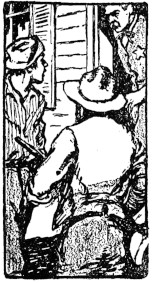
The sheriff's lean face showed signs of annoyance. He went to the door. Two men stood a few feet from the steps. One of them was loosely-built, angular, and bullet-headed; the other was a big, square-chested man with sunburned black hair and beard. Only the big man was armed.
"You're the high sheriff o' this here county; hey?" said Alex Singleton.
"I am, sir."
"Then you arrest this here rattlesnake—take him off o' my hands afore I lose what little holt I've got on myself and put out his blasted light!" old Singleton roared. His voice was hoarse, rasping, like the sound a dull file makes when drawn across a thin steel edge. "He tried his best to kill a man I call my friend, Little Buck Wolfe; and the damned yaller dawg"—he was blind with rage, choking full—"he struck the one and only gyurl I've got——"
"And arrest him, too," Mayfield broke in desperately—"arrest him, too, fo'——"
"Shet yore mouth!" cried Singleton. His eyes blazed gloriously now, and his voice held a note of triumph. He wheeled and faced Sheriff Alvin Starnes again.
"And arrest me," he said, "fo' a-killin' Mort Gibson in a cyard game, over on Shelton Laurel, five year ago come eight o'clock o' the night o' next September the thirteenth!"
Alex Singleton, winner as well as loser, passed the officer his rifle and a revolver, and held out his wrists for manacles.
X
It was the third of August, and one of the warmest days of the summer. The extremely dry weather had withered all small vegetation; even the leaves of the laurel, that evergreen chaplet of the hills, were curled into little tubes and drooping. The majestic bald peak called Picketts Dome shimmered in the pale blue heat-haze. The ragged fringe of jackpines on the uneven, rockbound crest of the Big Blackfern stood motionless for lack of a breeze, seeming much like soldiers turned to stone in a battle-line that had previously suffered from the galling fire of some invincible enemy.
Grandpap Singleton, the Prophet, mopped his old brow frequently with a faded bandana as he followed the Devil's Gate trail, going northward. He walked with a dogwood cane, his other hand resting on his rheumatic left hip; but in spite of his decrepitude there was about his movements an eagerness that suggested an objective point of no little importance.
When he was barely through the Gate, he came upon old Granny Wolfe, who was kneeling beside the trail and trying to tie the ends of a 'coonhide shoestring that was somewhat too short.
Before she knew that he was anywhere near her, he leaned over, touched her lightly on the shoulder, and cried out like some mischievous boy, "Boa!"
The old hillwoman, startled, went stiffly to her feet.
"Well, I wisht I may never! My sakes, Grandpap Bill Singleton, you skeered me mighty durned nigh it to death! Now what'n Tophet do ye mean, anyhow, a-slippin' up on folks that a-way?" She tried to appear very angry, and failed altogether.
"Huh-huh!" laughed Grandpap Singleton, tugging at his long white beard. "How's yore old bones this mornin', Jane Wolfe?"
Granny Wolfe smiled the smile she had been holding in with difficulty for half a minute.
"Bill Singleton," she said, bending toward him, "ef it wasn't fo' the dad-burned old rheumatiz', I'd feel like a yearlin' colt! I've been a-totin' a buckeye-nut in my pocket, but it never done me a hoot's wo'th o' good. 'Bout the onliest thing 'at ever helped me any was good luck, lampile, and tarpentine. Ever try it, Bill, honey?"
Some thirty feet back in the laurel, a huge and gaunt man whose black hair and beard were not without threads of silver, knelt before a ginseng plant. He had been listening, and he had heard every word of the little conversation that had just passed between his mother and the father of his bitterest enemy. Once he had whispered to himself, "Well, I'll be danged!"
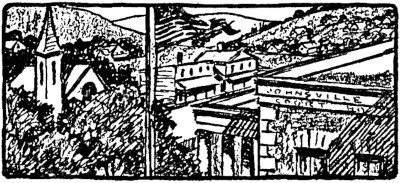
"I've tried everything, Jane," nodded Grandpap Singleton. "Well, I'm a-goin' down to the upper end o' Little Buck's railroad to see Little Buck, Jane. My pore son Alex his trial was to take place over in town yeste'day, and Little Buck he'll shore know about it, o' course. I shorely am a-hopin' they've done went and turned Alex loose; and yit—and yit, Jane, he ain't never come back home!"
"And when is Cat-Eye Mayfield to have his trial?" Granny Wolfe wanted to know.
"Done had it," the Prophet answered. "He got a-lackin' one day of a year in jail, at hard labor. May I ax whar you'd started to, Jane Wolfe?"
"Me? Oh, I'd jest started down to gass wi Little Buck fo' awhile, Bill. My shoe it got ontied, and I was a-tryin' to fix it up when here comes you to skeer me mighty nigh to death. I've allus heerd, Bill Singleton, 'at when anybody's shoe it got untied it was a shore sign 'at somebody was a-thinkin' about 'em. Hain't you?"
The aged hillman nodded. Then he went to his knees before her, drew up the ends of the 'coonhide lace, and tied them securely.
"I reckon ye ain't no objections ef we walk down thar together, ha' ye Jane?" he asked as he straightened.
"Shorely I hain't, Bill," with a twinkle in her old eyes. "Jest so's ye don't try to flirt wi' me like ye used to do! When me and you was young and frolicsome, a-livin' with our folks back in the Balsam Cone section, Bill, ye know; hey? Do ye rickollect, Bill Singleton, that 'ar night when me and you was a-goin' home from Mariar Spinnett's weddin' dance, and you slipped one o' yore arms around my waist?"
"Heh?" The old man almost jumped. "O' course I rickollect it, Jane. Perish me ef you didn't slap my jaw so hard I couldn't taste nothin' but red pepper fo' two weeks!"
Then his lined countenance became very sober. "And may I ax ye now, Jane, atter so many years is gone sence, why it was you married Sackett Wolfe 'stid o' me? I allus felt like I wanted to know, Jane."
"Well, I'll be danged!" Old Buck Wolfe muttered into his beard.
"Well," Granny Wolfe creaked, "I thought ye begun to boss me too soon, Bill. But don't misonderstand me; I hain't no regrets about a-marryin' who I did, though the day I tied up to Sack I reckon I loved you the best."
Back in the laurel, Old Buck Wolfe sank down on his heels, the ginseng root entirely forgotten. Grandpap Singleton took off his hat and shook his snowy head sadly.
"And so come on, Bill, honey," smiled Granny Wolfe, "and le's me and you go down to see Little Buck; hey?"
Together, side by side, they limped down the narrow trail, each of them wondering what the difference would have been if they had married each other in the wild and glorious morning of their lives. Old Buck Wolfe crept from the thick underbrush and followed them stealthily, for he, too, wished to know the outcome of Alex Singleton's trial.
The bed of the toy railroad had forged its way, like the path of some monstrous serpent, to a point easily within three miles of Devil's Gate. The geared locomotive had been put into service, and the laying of light steel rails was progressing rapidly. Already the sawmill and logging machinery had been unloaded from the new siding that the C. C. & O. had put in for the Unaka Lumber Company.
The aged couple found the company's general manager talking with his foreman under a great yellow poplar that was to be cut to make way for the road's bed. Wolfe dismissed Weaver, and turned to shake hands very cordially with his visitors.
"What about the trial o' pore Alex, my son?" Grandpap Singleton asked forthwith.
Wolfe had been expecting inquiry of this nature. He had his answer cut and dried, as the saying is.
"Alex will be back pretty soon—" and Old Buck the eavesdropper clenched his fists—"according to what Tot says about it. The trial was postponed, and now they'll have to bring Cat-Eye from jail to testify. Alex will stick to a straight story, and claim self-defence. Mayfield will be the only witness the State will have, and we think Alex will be cleared altogether.
"I hope the devil gits Cat-Eye Mayfield afore night!" cried Granny Wolfe. "The rawzum-chawin' pup—his durned eyes allus 'minded me of a spread-head snake's in dawg days!"
"And how's Tot a-comin' along in town?" asked Grandpap Singleton.
"She's doing remarkably well under Mrs. Mason's teaching," Wolfe told them. "You'd hardly know her, already! She's studying grammar almost day and night, and she wears her clothes like a lady."
"And when," inquired the garrulous grandmother, "is you and her a-goin' to marry, Little Buck?"
Wolfe gave the old woman an odd look. "Never, perhaps."
"Well, now, that 'ar beats the Old Scratch." Granny Wolfe's face was troubled. "Shorely, honey, you hain't never axed her!"
Old Buck pressed forward a little in the concealing laurel that he might not fail to catch the rest of it.
"No," said his son, "I haven't asked her. And I probably won't, because she wouldn't accept me if I did. I learned that much, anyway!"
Old Buck clicked his teeth. "Well, I'll be damned!" he muttered into his beard.
XI
It was the first of October, which in the mountains means clear and frosty nights and days like rare old wine. The pointed shadow of bald Picketts Dome was reaching for the jagged summit of the Big Blackfern; it was, therefore, almost four o'clock. Granny Wolfe sat huddled low in the doorway on the sunny side of her old cabin; she was trying hard for a nap. Her little black dog Wag lay at her feet, now and then snapping at a bothersome fly.
The old hillwoman was in an irritable mood. She had slept almost none the night before, which had been occasioned by her worrying over the day when the little railroad would reach Devil's Gate, the basin's mouth; she feared, and with good reason, that blood would be shed then. Her son Buck was harder than ever, more grim, more silent, more terrible than ever.
"Wag, drot ye," she said indistinctly, "ye'll gi' me fleas, ye little devil."
There came then a long drawn, lonesome sound from somewhere near the foot of Big Blackfern Mountain. It is no common thing to hear the mournful cry of a whip-poor-will in the daytime. Granny Wolfe rubbed her aching eyes and looked up in sudden anxious interest. Less than a week had passed since Sarah Wolfe had told her that Preacher Longley Thrash's wife's sister had said that her husband's uncle had said that the cry of a whip-poor-will when the sun was shining meant a death within three days unless the bird was killed promptly.
Granny Wolfe rose with a rheumatic groan, took down from its wooden hooks over the doorway an old, old rifle that her departed husband had loved next to her, and went toward the foot of the Big Blackfern.
"I'll git ye!" she mumbled to herself. "I'll git ye, drot ye!"
It came again when she had gone a hundred yards: "Whip-poor-will!"
"Plague on yore pickcher of ye!" she muttered, quickening her step so much that her little dog was forced to trot in order to keep up with her heels. "Ye imp o' Satan, ef I don't shoot a hole through ye wi' this here old rifle o' Sack's big enough fo' a bay hoss to jump through, I hope I may sink! Consarn ye to thunder! I hain't a-havin' enough bad luck, I reckon," bitterly, "and so you had to happen along."
Shortly afterward, she drew back the hammer of the old rifle and limped into the border of laurel. Something moved slightly on a log a few rods up the mountainside, and she saw it. She rested the long barrel in the fork of a sapling, and began to try for an aim, when a cracked old voice came down to her.
"Don't ye shoot me, Jane Wolfe!" half laughing, half afraid. "Heh! Don't ye shoot me, Jane Wolfe!"
"Ef it hain't Grandpap Bill Singleton, the Prophet!" Granny Wolfe cried, greatly relieved. "Why, Bill, 'at's jest the way you used to call me down to the big beech on the creek when you and me was both young and frolicsome, ain't it? My pap he didn't like it fo' you to come to see me, ye'll rickollect! Now I might ha' knowed, dang the luck, what it was when I fust heerd it!"
She went on soberly, "Now what'n the name o' goodness do ye want to see me about, Bill? You shorely hain't a-courtin'!"
"Heh! No, not a-courtin'," he said.
He moved slowly toward her, and she noted that he carried a worn leather-backed Bible under one arm.
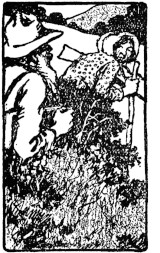
"Yes," he told her, "it was me a-whistlin' like a whip-pore-will fo' you, Jane. I didn't much like the idee o' goin' down thar in the inemy's country to see ye, Jane. I wanted to have a talk wi' ye. About the lumber track. Jane, Little Buck he told me 'at the track it would shorely git to the basin tomorrow!"
Because Granny Wolfe had known that already, she expressed no surprise. She leaned the rifle against a tree, and rested her hands on her thin old hips.
"I'm a-listenin', Bill," she reminded him. "You ain't done a-talkin'."
"I wondered, Jane," thoughtfully, "ef the' was anything on earth you and me could do to stop the bloodshed afore it comes."
"The' hain't!" Granny Wolfe exclaimed. "Bill Singleton, the's a-goin' to be trouble sech as even me and you never seed afore. My son Buck he has done passed his word 'at the railroad shain't never come into the basin; Little Buck, bless his heart of him, has passed his word and promise 'at it shall—and they're both Wolfes. Little Buck he's got to put the thing through or die a-tryin', ef he's a-goin' to be hon'rable to them 'at sold all o' their property to back him up. He cain't call the law in to help him, acause that would—you know, Bill, jest what it would mean. May the Lord ha' mussy on us all, Bill Singleton! I jest don't know what to do! I've done wore mighty nigh it all the hide off my pore old screakin' knees a-prayin' fo' peace. I've talked to my son Buck ontel I was as black in the face as my dawg.
"And I've tried to pe'suade the rest o' the Wolfes to foller Little Buck 'stid o' Old Buck," she went on gloomily. "But they won't do it. They're like sheep a-follerin' a bell-sheep. All but Nathan, that is. Nath he's allus loved Little Buck, somehow. And Nath he tried to talk his pap into a-seein' the crookedness o' his ways, but it never done no good at all. Lord ha' mussy on us all, Bill Singleton!"
"What did Old Buck say to Nath?" the Prophet wanted to know, one palsied hand burying itself in his patriarchal white beard.
"He never said nothin' to him," was the answer. "He hit him in the mouth wi' his fist. Pore Nath! Bill, I was jest so sorry fo' Nath, and so durned mad at Buck, 'at I could jest—I could jest ha' died right thar in my tracks."
"Well," Grandpap Singleton said hopefully, "mebbe it'll all come out right in the end. Le's me and you both go to Old Buck and talk to him; heh? Both o' us together, Jane. It may not do no good; but ontel we've done it we hain't done all we could do, Jane. What do ye say; heh?"
"All right," Granny Wolfe nodded. "He's out the mountain thar a-makin' a run on his moonshine 'still. He'll be mad when he sees us together, mebbe; but ef you don't keer, I shorely don't. Bill Singleton, hain't it a dad-burned shame fo' a man as good as him to be as lowdown mean as he is?"
"Yes, Jane, yes. Ha' ye got a weensy teensy bit o' pipe tobacker about ye, Jane? I fo'got to bring mine along, and I'm jest a-sufferin' fo' a smoke."
"I ain't never without it, Bill, shorely," the old woman told him. "I plants my tobacker afore I plants my bread cawn. We hain't got no fire to light our pipes with, though."
"Good excuse fo' a-goin' out to Buck's still," said Grandpap Singleton. He fished a blackened clay pipe from a trousers pocket. "The tobacker, Jane."
She took a dry twist of homegrown tobacco from a pocket in her faded calico dress, and passed it to him. He courteously filled her pipe first. Then they went limping out the side of the Big Blackfern, these two, over ground carpeted softly with leaves of brilliant saffron, pale yellow, mottled scarlet, deep red, and several shades of brown. Neither spoke, for each was saddened by a keen realization that it was autumn for them in more ways than one.
After fifteen minutes of traveling thus, they entered a narrow and deep, dark gash filled with hemlocks and laurel, through which flowed a very small, clear stream of water.
"Why, the still it hain't far from the fambly buryin'-ground, is it, Jane?" observed Grandpap Singleton as they stepped into a path that wound its way dimly through the undergrowth.
"Which is jest as it should be, Bill, honey," returned Granny Wolfe, her voice heavy with meaning.
"Heh! Yes, Jane," her companion agreed.
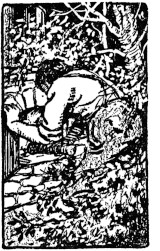
Old Buck Wolfe was in no good humor that afternoon. For one thing, he had been absentmindedly allowed a "run" to boil over, and the whisky tasted like pickled beets. The decrepit pair found him on his knees before the crude little stone-walled furnace; he was lustily blowing the fire to make it catch to fresh wood. Another run was on.
Grandpap Singleton walked up silently, to all appearances unaware that he was on forbidden land. He bent stiffly over and scooped a live coal into the bowl of his pipe. A few puffs lighted the tobacco for him, and he passed the coal to the pipe of the old woman. Then he very calmly seated himself on a downward-turned mash tub.
"Buck," he said seriously to the moonshiner, who had been eyeing him hard, "whar are ye a-goin' to when ye die?"
"I am a-goin' to a place," very readily, "which is knowed as a three-by-seven, a grave, a hole in the ground, a last restin'-place, and a last ditch, whar I'll rot down to plain dirt."
He sat back on his heels, and stared at Grandpap Singleton in open defiance.
"Oh, no, Buck," and the aged mountaineer shook his snowy-white head emphatically. "You hain't a-goin' to stop thar. No, sirree. Ef you hain't quick to blaze a new trail, Buck, you're a-goin' as straight to Hell as a honey-bee to its comb."
"How do you know?" snapped Old Buck Wolfe.
The Prophet took his worn Bible from under his arm, put it flat on his outstretched left hand, and touched it with a shaking forefinger as each word was formed on his lips.
"I knows it by the Word o' God, sir." After a silent moment, he continued, "Buck Wolfe, in some ways you're a most pow'ful smart man."
"I'm smart enough," the moonshiner replied, "not to be ketched a-believin' in things I cain't see, anyhow."
"And so you hain't a-believin' the's anything in the nachur of a hereafter, Buck?"
"Nor no Heaven, nor no Hell," the leader of the Wolfe clan snarled—"nor no God."
His mother began to wring her hands. "Buck, honey, it skeers me to hear you talk that a-way," she moaned. She sat down on the leaves, took the red bandana from her white head, and wiped nervously at her eyes.
"My friend," said Grandpap Singleton, his voice ready to break, "you shorely are mistaken. Didn't ye ever look at the stars at night, and think about the beginnin' of 'em, and the endin' of 'em? Didn't ye ever think 'at they was allus new, as old as they are—heh? Who else but a God A'mighty could ha' made them stars—and the sun, and the moon, and the earth?
"And about the res'rection, Buck. Take mighty nigh it the least thing in the world, a mustard-seed. You put it in the ground, and it rots back to dust jest the same as the human body does; and it comes up in the spring, and without any o' the rot or the blackness—but, to save yore life, Buck Wolfe, you cain't cut a mustard-seed open and find out what makes it grow! I tell ye, the mortal soul has its June as well as the mustard-seed. Buck, any man wi' even hoss sense in his head can argy hisself out of a God ef he only tries. And to them as thinks the' ain't no God, the' ain't none, so far as they're concerned...."
And after a long, still minute: "Here's another proof, Buck. The' never was a nation on earth but what wushipped somethin', whether it was a image, the sun, or the true and livin' Almighty; and ef that hain't the c'lestial spark handed on down and down from old Grandpap Adam, what is it; heh?"
"Fear!" cried Old Buck Wolfe, jutting out his great, bearded jaw. "Most o' good people is good acause they're afeard not to be, and fo' no other reason. Take yore own case, Grandpap Singleton. It hain't been so many years sence you was counted one o' the wickedest, fightin'est men in the country—'Cracker'-Singleton, they called ye then. You never made a change ontel you seed 'at yore best days was done past. You jumped at the hope o' life everlastin' beyant the grave only atter the confidence you had in yoreself was gone. Deny that, ef ye can!"
Old Singleton's countenance became infinitely sad. "I cain't deny it," he muttered brokenly. "I did put it off ontel I'd done turned the crest o' life's journey. And it's acause I put it off fo' so long 'at I'm a-doin' all I can now to build me a pore little shelter in the skies afore I'm called on to go."
"Humph!" Old Buck Wolfe rose too. "Ef the' is sech a Bein' as you think the' is, Grandpap Singleton, the's a-goin' to be some o' the woolpullin'est times on the Day o' Jedgment ever you seed. I'd shore ruther take my chances as I'm a-takin' 'em; not as a damned coward, but as a onbeliever acause I hain't never had nothin' proved to me. Well, I've got a run o' yaller-cawn licker to take keer of, and I tharfore hain't got no more time to fool away wi' you. Tomorrow's a-goin' to be a busy day here in the basin, as shorely as you're knee-high to a tomtit. You better shell out fo' home, is my guess."
"One more minute," begged Grandpap Singleton. "You shorely hain't a-goin' to give Little Buck any trouble in his lumber business, heh?"
"He hain't got no lumber business," flatly.
"I mean this here little railroad and the sawmill——"
"Hain't I done said 'at they shain't come?" sourly. "You've knowed me long enough to know I keeps my word, hain't ye? And hain't I done told ye I've got a run o' licker to take keer of? You take my edvice, old man, and shell out fo' home."
Grandpap Singleton realized that his mission had failed utterly. The disappointment was so great that it threw his feeble mind into one of its temporary breaks. He knelt and lifted his hands, with the Good Book clasped between them, and began to mutter unintelligibly. Old Buck Wolfe, in a sudden rage, struck down the palsied hands, and sent the Bible flying to the leaves; then he seemed sorry. He lifted old Singleton to his feet, and pointed toward the southern end of the basin.
"Go on home," he said.
The Prophet found his Bible and went off slowly, his shoulders drooping, his head bent low. The moonshiner turned to his mother, expecting another lashing from her sharp old tongue.
"Begin!" he commanded.
She said in tones so low that he barely heard, "My son, you'd ort to take off yore boots, acause you're a-standin' on ground that pore old man's knees made holy."
Before he thought, Old Buck looked downward. He bent over, his eyes suddenly wide, his jaw hanging, and caught his breath quickly. Cut there in the tightly packed earth was the sign of the cross, about seven inches by five!
"Who done that?" he roared, straightening like a jack-in-a-box.
"What? Oh!" frightenedly. His mother, too, had seen the sign. "It's a warnin', Buck, honey—a warnin' to you!"
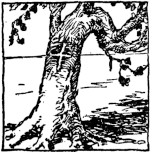
She wrung her hands. Her son looked about him queerly. Cut in the bark of a nearby tree was the cross again, seven inches by five. And he remembered distinctly that Grandpap Singleton had placed one hand on that tree to steady himself as he went.
"Who done that?" he roared again. "You, mother, you done it. Old Bill Singleton couldn't ha' done it without me a-seein' him. I'd ha' seed him, I tell ye!"
"I didn't, Buck," came promptly. Granny Wolfe was quivering with a fear that was certainly genuine. "It's a warnin' to you—Buck, it's the crook o' His finger!"
Old Buck swore roundly. He caught up an ax and chopped away the sign of the cross that had been cut in the bark of the tree. With his boot-heels he quickly effaced that which had been cut in the ground. Then he knelt before his false god, the moonshine still.
A voice cried out from the laurel, the voice of the Prophet. It seemed to hang in the air, like smoke—smoke of burning incense.
"'He came unto his own, and his own received him not.'"
XII
Dawn of that memorable day at Devil's Gate found the general manager of the Unaka Lumber Company dressed and standing in the opening of the tent he shared with Weaver. The foreman, too, was awake; he sat on a box inside, busily lacing his boots. Wolfe hadn't slept well because of that which bore so heavily upon his mind; he was quite nervous, which was exceedingly unusual for him; strive as he would, he could not rid himself of the feeling that disaster was very near.
After a few minutes spent in absentmindedly watching the antics of a playful squirrel on the side of a nearby hickory, he turned to Weaver. Weaver was fully acquainted with the circumstances; Wolfe had found him extremely solid, and he had confided in him unreservedly. The two had grown to like each other well in the few months they had spent in working together.
"You're sure," Wolfe asked, "that we've got enough ties cut and piled at the Gate to reach to the mill-site?"
"There's four thousand in that pile, sir," said the foreman.
"It ought to be enough. I'm going down to the engine, Weaver, to see if Tom's got her fired up. Wake the camp, and let's get out as early as we can."
The foreman went out, put his cupped hands to his mouth and shouted an echoing, "Coo-ee!" In response to it, the tents of the negroes became instantly alive, and laughter and joking began to fill the morning air. There came from the cook's canvas domain the rattling of cast-iron. Soon the laborers were kneeling beside the sparkling creek with soap and towels. Not long afterward, many nostrils were sniffing hungrily at the mingled odors of frying bacon and steaming coffee.
Wolfe found his geared locomotive already lifting at its safety-valve spring. He passed the negro engine-man a word of praise, and returned to the camp by an indirect route, trying to engage his worried mind with the autumnal splendor of the woods as he went.
Breakfast was eaten as heartily as though no one expected anything out of the ordinary that day—and no one did, except for Weaver and Wolfe; the laborers had sensed nothing of the barrier that awaited the little railroad at the basin's mouth.
Less than an hour later, the slow but powerful locomotive drew its string of lumber flats to a halt at a point near where the rails ended; it was a short distance below the Gate. The crew sprang to the ground, each man of it with a pick or a shovel, a spike-driving hammer or a crowbar, an ax or a saw. The work began forthwith.
Wolfe and his foreman walked ahead to the lower edge of the Gate, entrance to the forbidden land. They stopped near a slender young poplar that had been felled squarely across the trail during the night just gone; it reached from one side of the pass to the other, and it was strong testimony to the nice calculation of the person who had cut it. Weaver looked puzzled, then he faced Wolfe.
"Who did this?"
"This," Wolfe answered correctly, turning to his companion, "is the deadline."
"You mean your father——?"
"Nothing else." Wolfe picked up a leaf of transparent yellow, and began to tear it to pieces without even seeing it.
Weaver suddenly wheeled and looked off down the creek. "I wonder what's wrong back there?" he grumbled. "The boys have quit singing, and they don't do that when everything is moving along smoothly. Suppose we see if anything's happened; eh?"
He retraced his steps of a few minutes before, with Wolfe following at his heels. They found the crew, even to the engineer, standing grouped under a crooked water-oak; all their jaws were sagging, and all their eyes were staring upward.
Suspended by a white cord, some twenty feet from the ground, was a foot-square piece of cardboard which bore in pencil this crudely-printed warning:
BLACK MAN DON'T LET THE SUN GO DOWN ON YE HEAR
"Say, Boss Weaver, suh," inquired a dozen uneasy voices at once, "what do that mean, suh?"
Weaver did not answer the question. He looked toward Wolfe. It was Wolfe's place to answer. But there was only silence.
The driver of the locomotive approached the foreman then. "What them mountain people gwine do to us black men effen the sun go down on us heah, Boss Weaver, suh?" he asked frightenedly.
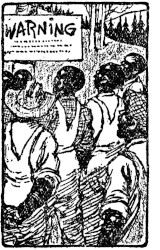
Before Weaver could utter the "I don't know" that was on his tongue, there came from a point a few rods above in the laurel the keen report of a rifle. The white cord parted, and the piece of lettered cardboard fluttered to the ground. It was a forceful answer to the negro engineer's question.
"Good marksman, all right," Weaver observed.
"Stay right here until I come back, boys," ordered Wolfe.
He hurried up the rugged steep, searched the laurel and the rocks, and saw no sign of any one. He climbed to the top of a huge boulder, and looked in all directions from that point of vantage. Then he saw a huge, gaunt man with a rifle under his arm step from the underbrush below and walk rapidly toward the settlement of the Wolfes. It was his iron-hearted father.
"I thought so," he muttered.
He went back to Weaver and the negroes.
"I'll answer for your safety, boys, until the middle of the afternoon," he told the crew. It would require that long, he figured, to build the railroad to the deadline. "You know very well that you can trust me to keep my promises. Double pay from now on. Go to it."
The laborers resumed their work, but not very willingly. There was a spirit of certain danger in the air they breathed.
A few minutes later, Wolfe faced this pointed inquiry from his foreman: "Well, sir, have you any plans as to what we're going to do after the middle of the afternoon?"
"I must admit, Weaver," promptly, "that I haven't."
He thought, then, of something he had once said to Colonel Mason: "When I get to the barrier, I'll go over it, or under it, or around it, or through it."
The little speech had seemed dramatic enough at the moment of its utterance. Now it seemed tragic and pitiful.
"See here," said Weaver, gripping Wolfe's arm firmly, "there's only one way out for you. I'll not deny that it's a hard way; it will cripple or kill your first purpose, the—er, elevating of your people; but there's no alternative. The law, I mean; that's your one way out. When you cross the deadline with the track, your dad and his men will be up there on the Big Blackfern's side of the Gate with rifles in their hands—all but your brother Nathan—and the devil will be to pay. After that, you won't be able to keep the law out; don't you see, sir?"
"The law——"
"Yes," Weaver nodded. He continued, "It wouldn't be hard for Starns and a picked posse to steal upon them from behind while their attention is turned toward your crossing the deadline, and arrest them; it could be done without any trouble, I think. Then they could be kept—er, out of harm's way until they promised to behave themselves. I'm only your foreman, I know, sir. But I don't want to see you fail!"
Wolfe shook his head. "Even granting that the arrest could be made without hurting anybody, it isn't the thing for me to do," he said gloomily. "My people would refuse to work when they were put into jail; they'd be starved to it; it would build up a hatred for me that no length of time could wipe away. It is useless to talk about it, Weaver."
"But there's no other way, sir!" the foreman insisted.
"No other way?" echoed Wolfe. He faced Weaver sternly. "I'll show you. There must be another way. It's up to me to make another way."
The other smiled a rather mirthless smile. "All right," he said. "Go the limit. I'll try to be there with you, if you need me, no matter what or where the limit may be. I'm no quitter, sir."
"I'm very much obliged to you," Wolfe said earnestly, "but——"
He never finished it.
The work went on sluggishly. The negroes were afraid of the men who could so easily cut down a hanging thread with a rifle's bullet. Weaver had learned well the subtle diplomacy necessary to his trade; but, try as he would, he was unable to get those under him to move beyond a certain pace.
Just before noon, Little Buck Wolfe went to see his father. Old Buck sat in his cabin's front doorway; he was moodily whittling at a stick of soft red cedar. The son stopped at the rickety gate, and leaned lightly against one of the decaying posts.
"Good morning, father," he said brightly.
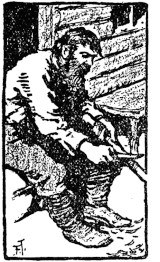
The big mountain man looked up, saw his namesake, and went to his feet. His face was the face of a savage now. His coal-black eyes glared his unspeakable contempt. Every big, hard muscle in his body seemed to be gathering itself for action. He was a human tiger.
"What in hell do ye want here?" he demanded in a voice that was as cold and as merciless as death itself.
"I came to ask you for advice," quietly. "I'm very much up against it, as the saying is. If you were in my place, trying to help your people, trying to make good for the sake of those who put up everything they had to back you, trying to win out without recourse to law—I say, if you were in my place, what would you do? You know the circumstances. Please advise me."
The shot failed to tell. It glanced off without leaving the slightest impression as a shot.
"Ef I was in yore place," came readily and sneeringly, "I'd change my name to Singleton—or Dawg—and 'en I'd go out in the woods and sp'ile a good rope by a-hangin' myself with it. That's edzactly what I'd do ef I was in yore place."
"That's no answer to my question," the younger Wolfe protested, trying hard to hold his temper in leash and succeeding barely. There were times when education fought almost a losing fight with his hot hill blood, the blood that was not so far removed from the dark wildernesses and their animal skins and clubs with heads of stone, and this was one of those times.
"Yes, it is, too," blared Old Buck Wolfe. "Ef the's anything else ye wants to know, spit 'er out; ef the' hain't, make some quick tracks away from here!"
"One thing more," said the son, with enforced calmness. "Do you actually mean to make murderers and outlaws of yourselves in the attempt to keep me out of the basin?"
His father took up from beside the doorstep a repeating rifle of heavy caliber. Old Buck held the weapon in his left hand, and with his right forefinger slowly tapped the blued-steel barrel.
"The fust man 'at drives a spike on this side o' the little poplar in the Gate will be shot by me, myself," he declared in a voice that had become hoarse. "Now ye've got my word fo' that, and you know mighty well 'at I keeps my word."
"The first man to drive a spike on this side of the deadline," Little Buck Wolfe replied, "will be me. You know that you could never shoot your own son. Our people never would stand for that. You wouldn't be chief of your 'clan' any longer. You'd be cast out, just as you've cast me out. And if it's necessary, I'll drive all the spikes that remain to be driven."
This was a shot that made an impression. Old Buck had gone ashen behind his beard, and his eyes were wide and staring. But he was not long in a quandary. His rage had drawn him deep into the vortex of primitive passion. The ties of blood were none too sacred now. He advanced a few steps, and shook a great fist at his fifth son.
"Ef you don't believe I'll shoot you fo' a-drivin' the fust spike on this side o' the little poplar, jest try it and see!" he cried. "I'll do it ef I haf to shoot myself wi' the next ca'tridge in my rifle. I'll do it ef I haf to shoot every man Wolfe by name. And ef you think you can send a sheriff's posse out here to take me, try it. The' hain't no sheriff's posse 'at can take me!"
He meant every word of it. He was almost a madman now. It drove young Wolfe into the depths of despair.
"I'm not going to send a sheriff's posse out here," he said broken-heartedly. He had a strangle-hold on his temper now. "I'm not going to resort to law. I'm even forgetting that I'm an officer of the law myself. I think—perhaps—I'd better—I'm going to drive that first spike and let you shoot me. It's the only honorable way out for me. Good-by, and maybe I'll meet you at another Gate after we've met again at the Devil's!"
He turned and walked off blindly.
Blindly, and bitterly. The fates were set against him. The fates were laughing in their sleeves at the failure of his strongest efforts, at the defeat of his best impulses. In his despondency he really believed that it would be best to drive the spike of destiny, take the bullet from the cruel, never-erring rifle and die, and go out honorably along with the soul of his iron father. Only two need die this way. The work would be carried on by others, the Masons would not lose, and his benighted people would ultimately be led into the paths of light. The result, surely, would be worth the sacrifice.
He found difficulty awaiting him when he reached the workers below the Gate. The negroes had talked matters over among themselves, and they were anxious to be off from the place where danger lurked everywhere. Wolfe went into their midst, and prevailed upon them finally to stay with him for two more hours. The little railroad began to creep toward the deadline once more.
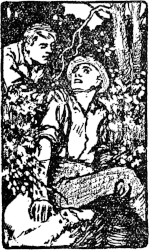
Wolfe seated himself beside the old trail, on a stone the size of a small barrel, and watched the work almost without seeing anything of it. A hand placed lightly on his shoulder from behind brought him back to himself. He turned his head and saw a tall, slender but very muscular, finely-featured young mountaineer smiling down upon him. Through the newcomer's sharp resemblance to Tot Singleton, Wolfe recognized him as her brother, "Fightin' Lon"—the only brother she had.
"Hello!" said Wolfe. He rose and proffered his hand. Young Singleton took the hand and shook it warmly.
"We've jest had a letter from pap," said Fightin' Lon, in his musical drawl. "Tot she sent it out from town by a hunter. Pap says he had to git a real lawyer to write the letter fo' him, and we had to ax the hunter to read it fo' us. Pap he said 'at he was acquitted on grounds of self defense and 'count of no one believing Cat-Eye Mayfield and 'at he'd be a-comin' home right off, and he said fo' us to light in and he'p you any way we could, Little Buck. So we gethered ourselves together and cut the mustard right down here to he'p you build yore railroad, all of us."
As though he had given a signal, more than a score of stalwart, strapping hillmen emerged from the thick laurel, not one of them armed, and formed a half-circle before Wolfe. The Unaka Lumber Company's general manager shook hands with the last man of them.
"We heerd you a-talkin' to them 'ar darkies, Little Buck," smiled Fightin' Lon. "You needn't to keep 'em a minute longer. We'll lay yore road fo' ye, clean smack-dab to the top o' the Dome ef ye wants it to go thar. And it shain't cost ye a red copper cent!"
Wolfe began to stare at the brown and gold carpet of autumn leaves under his feet. Here was a dilemma, indeed. He didn't dare refuse the assistance of the Singletons, on their own account; on account of his own people, he didn't dare to accept that assistance. He wondered it were possible to make Lon and his kinsmen understand. That appeared to be his only hope.
"Men," he said impressively, "first I want to say that I don't know how to thank you as I'd like to thank you, for this. Remember that. I'm grateful. Now pay close attention to what I'm going to say to you."
He made them an eloquent address there in the mellow autumn sunlight, there amid the sad glory of falling and fallen leaves. He appealed with impassioned words to the good that he knew slumbered in their half-savage breasts. There was little in his heart, indeed, that he did not lay bare to them. But he saw their faces cloud in spite of all that he could say. They could not, or would not, see far enough into the truth to grasp his point of view.
"Let loose o' that 'ar pizenvine-and-honey stuff!" Fightin' Lon finally interrupted. "You're a-wastin' puffectly good breath a-doin' it!"
The Singletons had reasoned, of course, that they were bending their pride close to the breaking-point by conferring this great favor. They had debated the question warmly upon receiving the letter from old Alex from Nashville, and the affirmative had carried only because of the stubborn insistence of Lon. Consequently, Lon was now by far the angriest of them all. He drew himself up as straight as an Indian, and, like an Indian, folded his fine sun-browned arms over his ample chest. He held his head high, and looked down along his aquiline nose and to the pale face of Little Buck Wolfe.
"Yore own folks has done cut you off," he said, his voice dry and hard and pinched. "They even put up a tombstone wi' yore name on it as a sign 'at you was dead fo'ever so far as they was concerned. I know 'em, Little Buck, and I know 'at you cain't never be at peace with 'em. We're mad at this, o' course. We got a danged good right to be mad. We had to fo'git a lot o' things to come down here this a-way, and it hurts to be turned down flat. We come willin' to work the blood o' our hearts out through our hands fo' ye. We come willin' to fight fo' ye ef ye need it!"
He swallowed hard, and continued hotly. "Halfway stuff don't go wi' us at all. I give ye this here: you can either put us to work without any pay, or else we'll take the Lost Trail's side o' the Gate and stop yore railroad afore it gits to the poplar tree deadline! Well," impatiently, "which one is it a-goin' to be?"
"I believe," said Wolfe, "that I told you my people would fire on you the minute you went to work for me. I explained to——"
He stopped trying to talk. It was of no use to talk.
"Didn't I tell ye," almost shouted Lon Singleton, "'at we was willin' to fight fo' ye as well as work? Why, fightin' it's our middle names, dang it to the devil!"
It was here that Weaver the foreman took a hand. He walked angrily up to Singleton.
"Don't you see that you're tormenting him for nothing?" he asked. "He's got the right dope, sure; you're wrong, absolutely. And it won't pay to try sniping at us from the rocks up there, so take my advice and don't. Now take your men away, won't you?"
He was fumbling nervously at the butt of the big revolver he wore at his right hip. The Singletons glanced at each other, winked, turned into the laurel and were gone like so many spirits. Wolfe beckoned to his foreman.
"They'll be back pretty soon, Weaver. If they have to go home to get their rifles, it'll be an hour—but they won't have to go home to get their rifles. We'd better let the men go. Tell them——"
A rifleshot rang out sharply. A bullet struck a negro's shovel, ricocheted, and buried itself deep in a tree with a quick and spiteful snak! Another rifle bullet came whining down and splintered the handle of a pick. Still another leaden warning struck a light steel rail that rested on a laborer's shoulder, gave forth a nasty ting! and dropped, flattened, to the ground. The blacks let out a wild howl of fright, and broke incontinently for the shelter offered by the four thousand ties. Once there, they looked reproachfully toward Wolfe; he had promised to answer for their safety, and they were certainly not safe now!
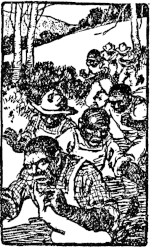
Wolfe and Weaver also went to the shelter of the ties. They did not succeed in convincing even one of the crew that they had not foreseen the immediate thing they were facing.
Before long the Singletons separated, a man to himself, seeking to get at all sides of the refuge the negroes had chosen. They did not mean to shoot to kill; they meant only to shoot to scare. If they stopped the building of the little railroad, that which they considered their injured pride would be healed.
Then they opened fire again with hair-fine aim. But a glancing bullet drew blood from the engineman's forearm—and Wolfe heard bitter words of blame directed toward himself. It put Wolfe at the end of the tether that had been strained so hard. He could have held himself in no longer. The primitive part of him rose above his better self. He snatched his revolver from its holster, and turned upon Weaver almost savagely.
"We're going to fight, my friend," he said calmly but with a dangerous glitter in his eyes. "Their bluff is getting serious—if it's a bluff. A barricade all around us first—at it, boys!"
The ties made it. When it was done, Little Buck Wolfe, bright-eyed, white in the face, straightened behind it and began to look for a Singleton. He wanted to see Fightin' Lon. He had forgotten now that Lon was Tot's only brother; that Tot had loved him nearly all her life; and that Tot had saved him from death at the hands of the murderous Cat-Eye Mayfield—the vise of circumstance had pressed it entirely out of his memory in that moment of crisis.
He caught a glimpse of Fightin' Lon, and he fired six shots at him!
And Fightin' Lon, safe behind a tree, laughed down, "Bah! You couldn't hit the United States, Little Buck, wi' a double-barreled scatter-gun!"
Wolfe growled out one of the few oaths of his responsible years, and began to reload his revolver's cylinder hastily. A Singleton bullet jumped his hat tantalizingly on his head, but he paid no attention whatever to it. When he began to fire again, the foreman joined in with his own revolver. The air in the barricade became thick with powdersmoke. The echoes of the firing became one continuous roar.
Then one of the hillmen cried out in pain, and following that, the acting-chief of the Singletons shouted in a black rage, "You've got blood now, Little Buck Wolfe! We're a-goin' to shoot to kill from now on!"
Weaver caught the general manager by a shoulder and drew him down and out of danger. Bullets began to fairly pepper the barricade. The real seriousness of their position smote Wolfe like a blow. He wasn't used to this.
"Look up there!" said Weaver, pointing toward the Big Blackfern's jaw of Devil's Gate.
Old Buck Wolfe and his men, all of them armed, stood in plain view up there among the boulders.
"If your people don't help us," Weaver went on, "right here is where we either stick up a white flag, or check out. We can't handle the Singletons; there's too many of them. Let me ask your father for help!"
"No!" Wolfe objected. "No to the white flag, too!"
But Weaver was already shouting lustily to the leader of the Wolfes.
And Old Buck roared back this, "No, sirree! I've done promised I'd never start another fight wi' the Singletons!"
Then a great silence fell over everything. The Singletons were saving ammunition, and waiting patiently for a man inside the puny barricade to show his head. Wolfe knew they wouldn't wait long. He knew they would become impatient, and rush the barricade. He looked around at the groveling negroes. Their lives were in his keeping; he was responsible for their safety. For their sake, he decided that he would humiliate himself in the eyes of both the Singletons and the Wolfes.
He drew from his pocket a white handkerchief, ever the emblem of rank cowardice to the mountaineer, and began to knot a corner of it to a sourwood switch.
But it was not necessary that he suffer the humiliation of being looked upon as a coward. A big, square-chested man came running up the track; he bellowed two words that were as magic—"Go home!"
The attacking party turned unhesitatingly to obey!
Wolfe leaped over the barricade to meet the newcomer. Wolfe was altogether himself now. The spirit of civilization was again in the ascendency.
"Alex Singleton, by the grace of God!" he cried dramatically.
XIII
Five minutes after the coming of the old chief of the Singletons, the Unaka Lumber Company's general manager was the one man left in the immediate vicinity of the piles of ties. Alex Singleton had driven his kinsmen homeward, telling them in no uncertain language as they went just what he thought of them for the grievous mistake they had made. His brother Eli turned upon him angrily, and so did his son Lon; he quite promptly knocked them both down.
Weaver had been sent with the negro laborers to Johnsville, where he was to do the paying off. The Wolfes had disappeared silently from the eastern side of the Gate.
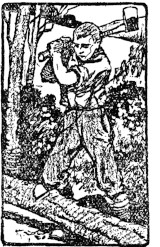
The one man left on the scene of the recent fight did not ponder the situation for long. He took up an ax and went to cut the deadline tree twice and remove the piece. He had not struck half a dozen blows when he saw coming toward him from the basin, as fast as she could possibly walk, his grandmother; the old woman carried her sourwood staff horizontally, and the bowl of her clay pipe was turned carelessly downward. When she saw her grandson alive, she stopped, threw up her hands, and let her pipe fall to the grass at her feet. She appeared to be unable to believe that he was really safe.
"Little Buck, honey," she called fearsomely, "is 'at shore enough you a-choppin' that 'ar tree the same as ef—as ef ye wasn't hurt none? Or does I see a sperit?"
"I'm all right, grandmother," he answered cheerily; then he asked solicitously concerning her rheumatism.
"My rheumatiz? I'd durn nigh' fo'got it." She picked up her pipe, and limped to him. "But I hain't no 'count, honey, at all. I'm skeered ontel I hain't got as much sense as a last year's bird nest. I was shore 'at ye'd been killed by them devilish fools. I dramp' it last night, too. I wisht I may never git another breath ef it don't jest look like the good Lord has fo'got ye, Little Buck, darlin'! But He ain't. He jest got ye in the pot to b'ile ye down to see what the' is to ye, honey. You stick; you show 'em. Yore pap hain't a-goin' to shoot at ye. Yes, I knows about it. So does the rest o' the Wolfes. They all says 'at he won't shoot at you. Why, he's dang nigh all to pieces!
"Or he was this mornin' early, anyhow," she ran on. "He found a cross cut in his bedroom floor, seven inches by five! And the' hadn't been nobody in the room but him and yore mother, neither; and yore mother she never done it. Now ye needn't to ax me nothin' about it, acause I shore don't know nothin' about it! But it makes me afeared to stay by myself at night, Little Buck; I can tell ye that. Well, what about the shootin'?"
He told her.
"I knowed it was the Singletons, acause most of it was done from the Lost Trail side," she chattered. "Well, Alex he'll hold 'em down fo' ye now. So you jest go right on ahead like ye've been a-goin', and ye're shore to win out, honey."
"I hope to," he said uncertainly, "but I don't see how. I need men, and I can't ask anybody to come in here and risk being sniped. I—I don't know what I'm going to do about it, grandmother."
She cocked her head to one side. "Would Nath he'p any?"
"Yes," quickly. "I'd like to have Nathan. I wonder if he'd dare to come over to me?"
"Little Buck, jest you ax him!" exclaimed the old woman, bringing her staff down on the little poplar with a clatter. "And say, honey, listen; don't call me 'grandmother'. Call me 'grammaw' like ye used to when ye was a weeny teeny boy. Hey?"
"All right, grammaw," without the quiver of an eyelash, "I'll ask Nathan the first chance——"
A man, tall, black-bearded, sad-faced, his mouth still showing signs of the bruise made by an iron-willed father's fist, stepped from the undergrowth and confronted Little Buck Wolfe squarely. There was a repeating rifle in his hand. There was a dimness in his eyes. It was Nathan himself. He shook hands silently with his brother.
The younger of the two men spoke first. "You've just come down from the Lost Trail, Nathan, I see; what were you doing up there with a rifle?"
"I wanted to he'p you out."
"I see," gratefully. "You didn't shoot?"
"I never got thar in time," said Nathan Wolfe. "When old Alex he comes a-runnin' up to you, I was jest a-fixin' to let Fightin' Lon have it atween the eyes; and ef I'd ha' pulled the trigger, they'd shorely ha' been another buryin' in the Lost Trail dirt. Little Buck, I heerd ye a-wonderin' to Granny thar ef I would dare to come over to ye. Yes, I would dare. I'm to ye, wi' pick or shovel, rifle or club, sink or swim, live or die, ef ye reelly do want me."
"I really do want you," his brother hastened to assure him. "Well, we'll go to work right now. While you finish cutting this piece out of the deadline tree, I'll go back and throw some ties and rails on the upper lumber flat. We'll try to get the track here by nightfall. The grading is all done this far, you see, and the rest of it is all level ground."
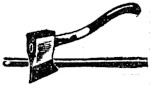
Nathan put his rifle down on the leaves. "Gi' me that 'ar ax," he grinned; and soon the woodland began to ring as his powerful arms drove the steel blade up to the eye at each blow in the soft yellow wood.
By the coming of darkness, the two perspiration-soaked men had finished the narrow-gauge road to the deadline. Then they sat themselves down before a crackling brushwood fire, and ate heartily a meal of their grandmother's cooking.
They slept beside the fire that night.
Granny Wolfe also furnished them with breakfast on the following morning. When they had eaten, they rose silently, each thinking the same thought, a thought concerned with the driving of a certain very important railroad spike. The shadow of the Big Blackfern was slowly falling from the crest of the Lost Trail and the base of bald Pickett's Dome. A few birds were singing their good-by songs to the lingering spirit of summer. A few sleek squirrels ran here and there in the trees or on the ground, choosing only the finest of nuts or none at all, now and then shaking their bushy tails saucily.
The old hillwoman was hopeful. She wore her red petticoat wrong side out; she had seen, the evening before, the new moon over her left shoulder and not through brush; she had dreamed of being at a wedding, too, a wedding that had taken place in a big white house that stood in the very center of a wide garden of flowers. All this, of course, could mean nothing but good luck!
"It was you and Tot!" she whispered to Little Buck. "And how her blue eyes was a-shinin'! Blast me ef I cain't see 'em yit, her eyes. Now I keep a-wonderin', honey, how Tot she's a-gittin' along in town? Is she a great, fine lady now, Little Buck? She shorely hain't got to be stuck-uppish, has she; hey?"
"Not a bit," smilingly. "She's getting along well, and learning fast; it's remarkable, they say. She's a fine lady, all right! But she's hardly 'stuck-uppish,' grammaw. No fine lady could possibly be stuck-uppish, you know."
"Well, I wisht—now hain't that the truth! Well, I'm a-botherin' of ye, honey. You and Nath wants to go to work. So go ahead. Yore pap he'll break his word, and 'en the goin'll be as smooth as ile. He—honey, ef here don't come pore old Grandpap Bill Singleton, the Prophet! How d'ye come on this fine mornin', Bill Singleton?"
The aged mountaineer's lips wore a smile, but there was worry in his eyes. He limped up to the trio.
"Ef ever I've seed a drier summer and fall," he began, "I don't know when it was. Why, what'm I a-talkin' about? I don't keer nothin' about the weather now; what I want to know now, Jane Wolfe, is what has become o' pore little Tot?"
Granny Wolfe straightened. "Hain't she at Johnsville, Bill?"
"She 'cided to come back wi' her pap yeste'day," said Grandpap Singleton, "and he hain't seed her—nor none of us has—sence he outrun her when he heerd the shootin'. Alex he's s'arched the woods all down thar below, and mighty nigh it everywhar else, and he never found no sign of her at all. Little Buck, please try to find her!"
"Perhaps she went back to the Masons—though it's not likely that she'd run from a fight that her own people were mixed up in," young Wolfe muttered. "We've a 'phone at the camp. Maybe I'd better go down there and 'phone the Masons."
The old mountain man's eyes flitted to the silent locomotive.
"Ef ye go on the ingyne, I'd like to go wi' ye," he said. "I hain't never—heh!—rid on no train nor nothin' like it."
"All right," nodded Wolfe. "Want to go with us, grammaw?"
"Shore," eagerly; "I hain't never rid on no train neither."
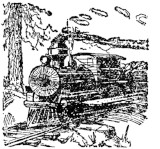
Wolfe helped the two old people to the cab seats, uncoupled the locomotive, sprang aboard and loosed the brakes. They were off for the now deserted camp.
The Masons hadn't seen Tot Singleton since the morning of the day before! Wolfe frowned hard at the tidings. After a few minutes spent in talking with the colonel, he hastened back to the locomotive, which was now trembling under a fair head of steam. He delivered his message to Grandpap Singleton, and reached for the throttle-lever.
"Honey," smiled Granny Wolfe, seeming somehow like a guilty child, "ef you won't git mad at me—I know whar Tot is! As we left the aidge o' the basin, I seed her a-peepin' down at us from the laurels on the Lost Trail side! I know I'd orter told ye, honey; but I hadn't never rid on no train afore, and I—I was jest mighty nigh it a-dyin' to ride!"
"That's all right, grammaw," said her grandson. "I wonder why she didn't go to her father's?"
Neither of his hearers could answer the question. He opened the throttle, and a sharp staccato of exhaust shattered the woodland peace.
When he stepped from the cab at a point near the upper end of the track, Nathan met him and said in a series of hoarse whispers, "The's dozens and dozens o' eyes on us right now, Little Buck. Gethered up thar on the Lost Trail is the Singletons, men, wimmen, childern, and dawgs; the Wolfes is the same way on the Blackfern side. I cain't locate pap, which ain't no good sign, Little Buck. I've been a-thinkin' purty hard, sence you left fo' the camp. Pap he's plum wild. He's a-goin' to shoot the man who drives the fust spike, and 'an he's a-goin' to shoot hisself—to keep his word is his religion, and it's his only way out. That's why he's hid out away from the rest of 'em. You don't think he'll do it, hey? None o' the rest of 'em does. But he will! Now, I've b'iled it all down to this here, Little Buck; listen clost——
"Ef you was to have pap and t'others o' the clan arrested and kep' in jail ontel ye could git through wi' buildin' the road and the mill, they'd burn the mill and the timber-woods as shore as shootin' when they got out. Then the law'd come out here wi' big posses, or mebbe the militia, and the'd be a awful fight, and deaths and deaths. So ye cain't do that. The one thing left is fo' me to drive the spike, and let pap shoot me and keep his word; that'd turn all o' our people over to you, acause they'd never stand fo' pap a-shootin' his own son. This way, they'd be jest pap and me killed; t'other way, they'd be dozens killed, and more dozens o' pore, daddyless little childerns left to suffer.
"So I'll drive that spike, Little Buck," he smiled. "I hain't a-goin' to let you do it. You're wo'th so much more'n what I am. You can carry on the business, and I couldn't. Asides, I've been a awful mean man in my day, and I want to do this here to sawt o' square things up wi' the Almighty. And so good-by, Little Buck, and good luck to ye as long as ye live!"
He caught up a hammer and a spike, and ran toward the section of loose rails his own hands had placed the proper distance apart just beyond the deadline.
His brother, shaken with emotion, started after him, to catch him and hold him back, to take the hammer and the spike from him and to drive the spike himself; but he tripped and fell, and before he found his feet again Nathan had placed the big iron nail and was raising the hammer to strike it.
"Wait, Nathan!" cried Little Buck Wolfe frantically. "Stop!"
Nathan did not wait. The hammer fell with a force that sent the big iron nail halfway to the heart of the oaken tie. Again the fine, muscular arms lifted the pointed hammer, and again did the hammer fall—then there came from the eastern jaw of Devil's Gate the roaring, murderous sound of a shot.
But Nathan paid no attention to it! He worked on determinedly. Before the echoes of the report had died completely away, two more spikes had been driven up to the head beyond the deadline. Little Buck Wolfe went to help, and soon the entire section of rails was made fast. A victory was won. For the first time in his life, Old Buck Wolfe had failed to keep his word.
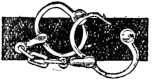
The two brothers straightened then, and looked in all directions. A moment later, they saw Sheriff Alvin Starnes and a posse of men that represented the flower of the county's manhood, step into the Gate trail from the undergrowth; and they held as prisoners Old Buck Wolfe and nineteen other Wolfes, all of them disarmed and handcuffed!
The general manager of the Unaka Lumber Company went pale. He ran toward the sheriff's party.
"Sheriff Starnes," he protested hotly, "this is my own affair! You must let my people go. I never can do anything with them if you take them to jail, never! I promised my father that—at least, I told him—that I would not resort to law. He can't ever be made to believe that I didn't send for you; he thinks I've lied to him, don't you see? They didn't harm me, or my brother Nathan. The fact that you found them with rifles amounts to little; they're never without rifles. Please let them go!"
"One minute, Mr. Mason!" the illiterate, but brave Sheriff Starnes was somewhat angry. "We didn't arrest these men for nothin'. It was like this. One o' my deputies and me watched your father, while the rest o' the posse watched the other nineteen; your dad was some little distance away from the other nineteen, y'see. When the first spike your brother drove was goin' down, your dad lifted his rifle and said to hisself, and loud enough for me to hear, 'I'll git him in the edge o' the leg, anyhow, and keep my word.' I fired off my revolver as a signal for my men to cover the rest of 'em, and my pardner and me took charge o' your father.
"They've got to stay in jail, sir," he continued sharply, "until they can give a peace bond; and they cain't give a peace bond until they promise to not harm you or the business you're managin'. Maybe you don't know it yet, Mr. Mason, but Mr. Whitney Fair is buyin' out all o' the stock-holders in this thing but you and the colonel, which will give him a controllin' interest—and you know how he stands on sentiment!"
Whitney Fair! Alice's father. It was very bad news, indeed. Wolfe clenched his fists instinctively. Whitney Fair was a—a hog.
"We'll make no sech of a promise to nobody!" stormed the ashen-faced old clan chief.
The nineteen others repeated the declaration grimly, and some of them striped it with oaths.
"If I was to let 'em go," the sheriff went on, his voice now not so hard, "what then? You couldn't finish buildin' your operations, and you couldn't operate your operations even if you had 'em built. Jail's the only cure for this contrary twenty, sir. It'll take some o' the pepper out of 'em, and it won't do the everlastin' harm you think it will, either."
Thereupon Starnes and his posse half led, half dragged, their prisoners toward Johnsville.
Once more young Wolfe found himself in despair. What meddlesome person had brought the interference of the law? Whitney Fair? Who had told Fair about the crisis? Had it not been for that interference, the day would have been signally won for him. True, Nathan would have been shot in the leg.
But what was a fleshwound to such a victory! For his people would have discountenanced even that slight wounding of Nathan, who had so nobly laid himself on the altar of sacrifice, so much that they would have ceased to look to his father. His people would have come over as Nathan had come over. Thrown down, broken-spirited, his father himself might—possibly—have come over to the right way of thinking.
He didn't blame Starnes for taking the nineteen others also. Starnes could not have taken any one of the clan; he had to take the entire faction or none of it.
Weaver arrived from Johnsville. The moment Wolfe saw his foreman, he did something that was rather unusual for him; he jumped at a conclusion.
"What right had you to send the sheriff out here?" he thundered. "If you would take care of your own affairs, and leave mine to me, no doubt you would——"
The look of intense hurt he saw on the face of his friend stopped his speech abruptly. It was long before he forgot that look.
"They'll pay you what's due you at the office," he went on grimly, and Weaver went off down the track.
A slender figure in a blue dress sprang out of the laurels and confronted Wolfe. It was the missing Tot Singleton!
"He didn't do it!" she breathed. "I did it—I did it because I just c-c-couldn't bear the thought o' you being killed. I met Mr. Weaver going to town yesterday, and I made him tell me everything. Then I went for the sheriff and a posse—but I made the sheriff promise he wouldn't act unless it was to prevent bloodshed. Mr. Weaver took all o' the blame to save me. Call him b-back and ask him to excuse—to pardon you!"
Wolfe had been seeing her too often, and he had been too busy, to fully appreciate the vast improvement she had made in her language—even when he wasn't beside himself with anger. He gave her a queer, narrow smile now, then called Weaver back and apologized.
"And will you forgive me, Little Buck?" plaintively whispered Tot, when the foreman had turned away.
The bitter answer of Little Buck Wolfe, who in this black hour was mostly mountaineer, came promptly.
"I don't think I will," he said.
XIV
It was with a growing feeling of contempt for himself that Wolfe watched Tot Singleton go silently and broken-heartedly toward her old home in the south end of the basin. He knew that he had been grossly unkind to her, to say the least. She had done that which she had done only because of her deep interest in his own welfare. She had been his guardian angel, ever ready to make any sacrifice for him, and she had never asked anything of him but—forgiveness.
He grappled with the foolish primitive pride that had more than once come near to being his undoing, and put it down.
"Wait, Tot!" he said.
Instead of waiting, she began to run from him. She, too, had a certain amount of primitive pride.
And he frowned and let her go.
Not long afterward, Alex Singleton appeared with twenty-seven of his kinsmen, among whom was his son. He proffered the services of himself and the twenty-seven strapping hill princes in the work of finishing the railroad. Under the new circumstances, he believed Wolfe would feel free to accept. Wolfe did accept, with gratitude, and the little lumber track began once more to move onward.
When the mill-site was reached, the Singletons, with old Alex as foreman, went to one of the big coves and began to wage war upon the giant oaks and poplars. A better force of woodsmen never felled trees.
Wolfe hurried out the necessities for the building of the monster sawmill as fast as they could be shipped. Following the material, came carpenters, masons, and millwrights. The plant went up with a rapidity that was next to amazing. The first day of November saw all the machinery installed and belted, and a huge pile of perfect logs waiting to be converted into export stock worth above a hundred dollars a thousand feet. Since entering the basin, there had not been a single hitch anywhere.
And in October, that month of silences, dying leaves and soft, hazy skies, Wolfe did something besides watch over the building of the sawmill. On the spot where his father's rambling, rotting, leaky cabin had stood, an extra force of workmen had put up a very comfortable dwelling of six rooms; it was furnished throughout with modern furnishings, and lying on one of the cabinet mantels was a beautiful orange-and-brown violin. The whole was to be a surprise present for the elder Buck Wolfe. After some persuasion from the colonel and his good wife, Sheriff Starnes had agreed to bring the old clan leader out to see it.
The son was counting upon this surprise present to do much toward softening the hard iron of his father's heart. He had drawn his salary for fifteen months in advance, in order that he might build and furnish the house and buy the violin. It had put him to wearing cheap blue shirts and corduroys; he was saving his one presentable suit for special occasions.
The mill was to be started at noon. The Masons and Tot Singleton, Alice Fair—who was still dazzlingly pretty—and her father had come out to see it. Whitney Fair now owned a controlling interest in the company, which was no fault of Colonel Mason's, and he wasn't going to miss anything. Physically, Fair was a big fellow, corpulent and florid, with an unlikeable cleft in his chin and eyes that were a little too small for the rest of his features.
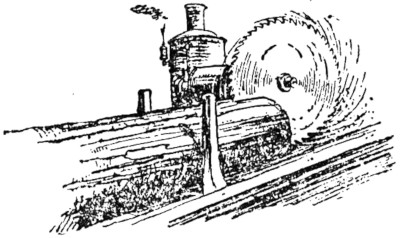
Promptly at twelve o'clock the great whistle blew and awoke ten thousand echoes from the walls of the basin; Progress the Brobdignagian was once more defying the spirits of the wilds. The sawyer threw a log to the carriage by means of a powerful steam apparatus; he thrust his main lever forward, and the foot-wide ribbon of steel dove into the wood with a scream like that of some victorious medieval warrior. The edgers and trimmers and slashers began to roar intermittently; it was like the quarreling of demons. Fine yellow poplar panel stock began to drift down the transfer chains and to where an inspector stood with a new rule in one hand and a new tally-book in the other.
The Masons and the Fairs shook Wolfe's grimy hands in congratulation. The humming of machinery and the sounds of the saws made speech impossible; but the man who had built the mill understood.
Then Wolfe missed Tot Singleton, and wondered where she had gone. Her absence was, somehow, a fly in this ointment. He left the Masons and the Fairs, and went down the outside stairway to the ground. The Singletons met him in a body. He found himself on old Alex's shoulders, while the rest of them cheered. When he was set on his feet, Granny Wolfe appeared with her staff and her dog; she put her arms proudly around his neck, drew his head down and kissed him on the forehead.
"Granmaw's so happy today, honey," she told him brokenly, "'at she could jest drap dead in her consarned old tracks. Kiss grammaw!"
He did, quite affectionately. Old Grandpap Bill Singleton then shook his hand as heartily as his poor strength would permit, and said to him, "Well done! You shorely ain't a slothful servant."
But the fly was still in this ointment of Wolfe's. Tot had stolen away to keep from meeting him. She was still angry with him, and the thought was oddly annoying!
His footsteps led him, it seemed without the aid of his will, up the creek and to the stately old willow that still towered over its bar of pure white sand. He came upon Tot standing motionless against the body of the gently whispering tree. She met his eager gaze with a pair of blue eyes that were half-curious and half-defiant.
It was Tot that spoke first. "I understood that the mill was to be set in the very center o' the basin. This tree is in the very center o' the basin. Why didn't you put your mill here, Mr. Wolfe?"
He stared at her. Then he took a sort of grip on himself.
"Because I didn't want to—er, desecrate this fine old spot," he told her. "Now please don't call me 'Mr. Wolfe' any more!"
"Oh, Mr. Wolfe," with the very queerest, chilliest little smile, "how many times did you figure out the amount o' lumber you could get from this tree before you mag-nan-i-mously decided to let it stand—Mr. Wolfe?"
He winced. A sharp reply sprang to his lips, but he kept himself from giving it voice.
"If you don't mind," he said, "I'd rather you wouldn't tease—now."
"Well," and her eyes scintillated peculiarly, "'Little Buck' sounds so much like an outlaw's name, or the name of an ox, you know."
She was strikingly handsome in that moment. A sudden feeling that he was her inferior kept him from being very much exasperated. He looked down at his ragged and greasy corduroys, at his grimy hands, at his worn old boots. He touched the short, stubby beard on his chin with finger and thumb. But he must offer his long-delayed apology.
"I wanted to ask pardon, Tot," said he, "for telling you a month ago that I didn't think I'd forgive you for sending the sheriff out here. I've seen you but twice since that day, and you avoided meeting me both times, or I'd have apologized sooner. Will you pardon me, Tot, and try to forget that I was such a brute?"
The mountain heart within her leaped wildly. What was an apology, the mere uttering of a few courteous words, compared to the nights and nights of poignant suffering his wounding her had brought? She had drawn deeply from self-pity for solace, without knowing that self-pity is one of the most poisonous weeds in the garden of life. She remembered more keenly than ever now. The wrong was magnified in her intensely human breast. And—she loved him.
Tot Singleton straightened proudly and proudly lifted her head. Deliberately she repeated the words that he had said to her when it was she that begged forgiveness.
"I don't think I will."
"Tot, you can't mean that!"
"But I do mean it," quite calmly.
"Then I'm mighty sorry, little girl."
He faced about slowly and left her, going toward his sawmill.
"I'm lowdown!" she whispered to herself when he had disappeared in the bush. "I made fun o' his name, and how could he help his people if he used any other name? Oh, I'm lowdown—He's such a fine man, and I—I have to watch myself, or I can't even talk proper!"
She turned her face to the body of the old willow that had been a witness to so much in her life, and sobbed because she hated herself for having taken her revenge.
XV
Thirty days in jail had not made the Wolfe clan into better men. Contrary to the expectations of Sheriff Starnes, not one whit of the pepper had been taken out of them. They were as grim, as silent, and as bitter on the thirtieth day of their imprisonment as they had been on the first. They had stolidly refused to help in the building of good roads for the county until a diet of plain bread and water forced them to it; and then they had worked slowly and sullenly, shirking at each and every opportunity. Not a man of them but watched by day and night for some avenue of escape. For escape, to the twenty mountaineers, was the one and only alternative of rotting in jail.
Several times Sheriff Starnes had called Old Buck to him and said in the kindliest possible fashion. "If you'll give me your word that you won't allow your son or the lumber business out there to be harmed, I'll sure raise a peace-bond for you and the others, and let you go home. Promise?"
The stubborn old hillman had not once stooped to give the officer a verbal answer to the question. He had not even shaken his shaggy head. He had said once that he would never make such a promise, and once was enough to say anything.
The jail gang had come in from work on the evening of the day that had seen the starting-up of the big sawmill out in Wolfe's Basin. Much to his surprise, Old Buck found himself alone and unguarded in the little room that served as a lavatory. He peered down the long, narrow corridor that led to the jail's main entrance. There was no person in sight. He had but to make a determined dash for liberty, and liberty would be his. The dusk was thick outside now.
But he didn't make the dash! It was not according to his code of honor to go free himself and leave the other men of his name behind bars. Where one Wolfe went, all the Wolfes must go; when one Wolfe suffered, all the Wolfes must suffer; it was part of the clan's religion. The big hillman threw away his opportunity to escape without the slightest regret.
He drew himself up almost ludicrously straight, walked to the main entrance, and shouted for Alvin Starnes. The sheriff and John Bird, the night jailer, appeared before him.
"What're you doin' out here?" Starnes asked puzzledly.
"Lookin' fo' somebody to lock me up, that's what," growled the mountaineer. With intense scorn, he went on, "You two is a purty pair o' rose-geraniums, hain't ye? Yau ain't fitten to gyard geese, let alone a real man-size man like me. Now smoke that in yore pipe, you tin-can sheriff! Put down yore guns, and I'll thrash ye both."
"I reckon not," smiled the sheriff.
"I reckon not," parroted the jailer.
"Cowards!" retorted Wolfe. "Well," impatiently, "are ye a-goin' to keep me a-standin' here all night? Ef ye hain't a-goin' to tangle up wi' me, stop a-standin' thar a-gawpin' at one another like a pair o' sick hound pups, and le' me into my res'dence!"
Shortly afterward a door of iron bars was closed and locked behind him.
Old Buck ate his supper greedily, wiped his bearded mouth with a blue bandana, and stretched himself out on his hard and narrow bed. Everything was quiet now, save for the ceaseless chirping of a cricket somewhere under the jail floor. The rays of the little electric in the corridor lighted the cell but dimly, and threw the shadows of the door's bars in weird, snaky, black lines against the outer stone wall. Old Buck looked slyly across to where his cellmates, his son Oliver and Cat-Eye Mayfield, sat on a pair of soap boxes. He glanced toward the door, rose and tiptoed over to them.
"I reckon we'll try it tonight, boys," he whispered. "Tonight'll do as well as any other time, I reckon. Ef it fails, it'll jest haf to fail. Better go to bed, both o' ye. But don' take off nothin' but yore boots. Watch me; and when ye see me give the signal, take yore place whar we've done agreed. Now rickollect, boys, the feller 'at makes the least bobble gits the thrashin' of his life from me!"
The two nodded and began to remove their footwear. The old clan chief went back to his bed, pulled off his boots and threw them noisily to the floor as was his wont, and hid his huge figure under the gray blankets.
All through the hour that followed, Old Buck watched the corridor covertly. Then he saw just what he expected to see and had been waiting for: John Bird brought a small table, a chair and a newspaper, and proceeded to make himself comfortable a few feet from the iron-latticed door.
Now this night jailer never failed to become drowsy at about the time when most people are going to bed, and nobody knew it better than the men he guarded. Soon he began to nod in spite of himself, and Old Buck Wolfe rose without a betraying sound; he took from his bed ten feet of strong wire, which he had cunningly smuggled into his cell a few days before, and very deftly made a slip-noose at one end of it. This done, he threw out a hand toward Mayfield and his son Oliver; they rose noiselessly, and stole to a point beside the iron door.
The high light of the scheme crept forward cautiously. He thrust the slip-noose out, dropped it over the shoulders of the nodding jailer, and with a violent backward surge, jerked him from his chair and pinned him hard against the door's bars. Oliver Wolfe quickly put an arm through and caught Bird around the neck; with the other hand he shut off the outcry Bird strove so desperately to make. Cat-Eye Mayfield snatched a big revolver and a ring of heavy keys from the jailers figure, and within another moment he had shot back the bolt that had held him a prisoner!
"Bring them 'ar three new wash towels from the washin' room, Cat-Eye," whispered Old Buck. "We're shorely a-goin' to do this here thing up right and tight whilst we're about it."
One of the new towels was knotted hard and fast over John Bird's mouth, making it impossible for him to call out; the other two were used to bind Bird's hands and feet. The three mountaineers then pulled on their boots, found their hats, put the night jailer into the cell they had so recently occupied and locked the door upon him, and hastened to liberate the rest of the Wolves.
"Now," grinned the leader, after they had gained the cover of the outside darkness, "now fo' the basin and a big kag o' yaller cawn-juice edzactly seventeer year old come next berry-pickin' time. I was a-savin' it, Cat-Eye, fo' my friends to drink at my fun'ral."
Twenty minutes later, they climbed aboard an eastbound C. C. & O. coal train, which had stopped at Johnsville to take on water for the locomotive. There would be no difficulty whatever in getting off at the sharp grade just beyond Wolfe's Creek.
John Bird did not succeed in ridding his mouth of the towel, though he struggled until he was faint. He resigned himself to the inevitable, and there was a deathlike silence in the jail—save for the ceaseless chirping of a cricket somewhere under the floor.
XVI
When the first afternoon's sawing was done, Little Buck Wolfe went to his adoring old grandmother's cabin for his supper. He had been taking his meals at the new house; but his mother was now entertaining the Masons and the Fairs, and she had her hands full without caring for him. Shortly after nightfall, he turned toward a small, rough building that stood not far from the mill. This little building had two rooms; one of them was furnished with a cheap bed and a cheap dresser, while the other contained a desk and a chair, a table, and an iron safe that now held four weeks' pay for the twenty-six carpenters, masons, and millwrights. Wolfe stopped at the door of his office and looked upward; except for a thick bank of clouds that lay low in the west, the sky was filled from horizon to zenith with very bright stars.
A moment later, he sank into his swivel chair, took a tally-sheet from his desk, and began to figure by the light of an oil lamp. The mill had, he found, cut two thousand dollars' worth of choice lumber in five hours! There were, he told himself, big gold mines that did not pay as this sawmill was going to pay.
Just then there came to his ears the hum of merry voices, which was followed by a sharp rap at the door. He called out an invitation to enter. The door swung stiffly inward, and the Masons, the Fairs, Granny Wolfe, Tot Singleton and her father and a spotted hound came trooping in. Fair and the colonel wore overcoats; the women wore wraps.