IN MEMORY OF HENRY CLAY MANLEY
Reading edition
By THOMAS McMORROW
WHERE WOULD YOU TURN IF YOUR WHOLE FUTURE DEPENDED ON YOUR EARNING CAPACITY AT THE END OF EIGHTEEN MONTHS—AND YOU WERE OUT OF A JOB? AN INTERESTING QUESTION TO A CERTAIN YOUNG AMERICAN, AND WITH AN INTERESTING ANSWER
I
"Now, if I was running this country," said Paul Manley, lighting a new cigarette, and ending a diatribe against things as they were in the U. S. A. in the year 1920, "I tell you what I'd do! First I'd——"
A customer descended hurriedly from One Hundred and Twenty-fifth Street into Hepp's Bargain Basement where Paul was employed as sales clerk.
"Want a pair of shoes!"
"What kind of shoes?" grumbled Paul. He would have liked his job in Hepp's Bargain Basement well enough if it weren't for customers always coming in and taking his mind off important affairs.
"A good, strong shoe I'm not hard to suit," said the customer, a gray-haired and well-dressed business man.
"You're going to wear them—not me, mister," said Paul, yawning. He rose slowly from the bench at the back of the little shop, and came forward. He was a tall and skinny youth of about twenty.
"Sit down, will you?"
The customer sat down, thrust out his foot, and glanced at the clerk. Manley had walked away toward the shelves. The customer grunted, pulled a foot-rest to him, and began to unlace his shoe.
"I don't want a tan shoe," he said a moment later.
"I'm no mind-reader, mister," said Paul. He slapped the rejected shoe back into the box, and pulled out another pair.
"I don't want a vici kid," said the customer.
"That's the style nowadays."
"I don't care. I don't want it!"
"Well, try it on, can't you?" grumbled Paul. "There, how does it feel?"
"It's too tight That's not my size."
"It certainly is your size! It's a 9-D, and that's what you've got on right now. Don't tell me my business, mister. Look—see? That's your size."
"I say it doesn't fit! And I don't want a vici kid, anyway. I can have a good strong walking shoe if I want it, can't I?"
"Oh, you want a shoe for walking! Why didn't you say so in the first place and save my time? Sure, you can have it; I got no objection. What do you want to pay?"
"About six dollars."
"We don't keep cheap shoes, mister," said Paul, getting up from his knees.
"I don't want a cheap shoe."
"Yes, you do! What do you call a six dollar shoe, if it ain't a cheap shoe? Say, I might sell you one shoe for that."
"Young fellow," growled the customer, pulling on his own shoe again and jabbing viciously at the eyelets, "you couldn't sell me any shoe at all. You need a lesson in good manners, you do!"
"Go along now, mister," said Paul, reclining again on his bench. "You're in the wrong store, see?
"I guess I showed that fresh guy where he got off," he chuckled satisfiedly as the enraged customer went stamping up the iron stairs to One Hundred and Twenty-fifth Street.
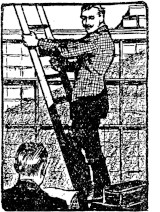
"Yah," grunted Ernest Birdsong, his fellow clerk from the ladder where he was sorting stock. Ernest was a recent arrival from Europe.
Paul sprawled on the bench and lit a cigarette, which he "ate" in long, lung-filling inhalations.
"There you go," he went on, "working your fat head off. You'll learn better, or I miss my guess! You're some of this here blamed pauper labor that wants to come here and lower the American standard of living. You ain't got the mind of a free man, Birdy. Go ahead, and work yourself to death, and see what you get for it! Old Hepp doesn't care a whoop for you or for me, except what he can get out of us. I'm telling you. That's where the old tight-wad's head is level; I don't care a whoop for him except for what I can get out of him, see? He's a blood-sucking capitalist, that's what old Hepp is. Pretty soft for him—five stores, and not a blamed thing to do but go around from one to the other, and crash the cash-register!"
"Yah, Mr. Paul," murmured Ernest inattentively.
"Aw, gosh!" yawned Paul. "I'm feeling all in today. Had a big time last night, Birdy. Yep, we had a large time. Punished a quart between three of us, we did. Say, Birdie, I know where I can get genuine Old Cobbler, rye, for six bucks a bottle. You want some good booze?"
"No, Mr. Paul."
"Say, Birdy, I feel like taking in a movie today. There's nothing doing here, and you're going to stay anyhow, ain't you? Old Hepp won't be back until six, or half-past. You can take care of the store by yourself, can't you? I'll do as much for you some time. If old Hepp pops in, you say I got sick, and went around to see a doctor. So long—see you some more. Don't take any wooden money!"
II
He pulled on his overcoat, which was built out at the shoulders until it gave Paul still another of Jack Dempsey's dimensions. He adjusted it until he was as wide on one side as on the other, pulled out his cravat until it bowed, slanted his velour hat over one eye, and strode from the store. He strode; Paul's self-respect depended on his clothes. He never strode in a bathing-suit. When he was in a bathing-suit he sidled, and walked modestly, and even somewhat slinkingly, feeling distressingly naked. But now he strode, swinging his wide shoulders, and looking the world in the eye to stare it down.
He went over to the Belvedere—continuous, eleven to eleven, fifteen cents for the best seat in the house.
He had a crush on the young lady cashier of the Belvedere, who sat in a box in the middle of the foyer from eleven to eleven with intervals out, and worked an apparatus which caused tickets to sprout in the slab before her as often as she was paid fifteen cents. Her single eye to his fifteen cents had titivated Paul's interest; as she could gaze upon him without excitement he thought she must be a very superior person. She had a share in securing his steady custom for the Belvedere.
"It'll be a nice day, if it don't rain," he said to her, and smiled fascinatingly.
She made an assenting noise through her broad, common sense nose, and did her trick with the apparatus.
"It'll be a long day, if it don't shrink!" he tried again, with a fixed grin. Paul could not afford a vaudeville show more than twice per week, and he tried to remember the jokes.
She looked up at him with a slight contraction of her brows. "I beg your pardon?" she said.
Paul leaned on the slab, and twisted his mouth sideways to spring the gag again; he felt that he had her going, at least a little.
"Shake it up!" called an impatient patron from the line.
Paul turned his shoulders slowly about, and surveyed the line, and knitted his black brows at a little man whose eyes were as innocent and timorous as a rabbit's.
"Are you in a hurry?" he asked in a bass voice.
"No!" exclaimed the little man.
"Then don't try to hurry me!" said Paul, swinging his shoulders back again, and letting his heavy frown rest on the young lady cashier for a moment, so that she might see what kind of a man he was.
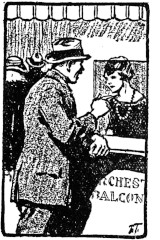
He came out of the Belvedere at half-past five. His face was flushed from generous emotion and bad air, and his eyes were glassy from protracted staring at "Black Roger of Brimstone Gulch." An intending patron was talking to the young lady cashier.
"I say I give you a two!" shouted the patron.
"It was a one," said the cashier patiently. "Take your change, please. There's the dollar you gave me."
"That's a dollar fast enough," said the patron, "but it ain't the dollar I give you, because I didn't give you no dollar. I give you a two!"
"Do you want your dollar back?"
The patron, a short and dark-faced young man, drew back, lifted his shoulders, sighed noisily, and uttered an oath. It was not a very gross imprecation—he recognized that he was talking to a lady, and the rather suave way in which he swore almost robbed the utterance of offence.
"Here!" called Paul. "How dare you use language to a lady?"
"Is that so?" breathed the patron, turning.
Paul Manley narrowed his eyes and looked very bleakly at the low-set young man. "You heard me," he said.
"Wait a minute, lady," said the patron, waving a hand behind him as he lurched toward Paul. "Just wait a minute. Listen, fellow, what are you butting in for? Do you want a good smack in the nose?"
"Well, that's no way to talk to a girl," said Paul, weakening.
"Then I'll talk to you the same way!" He crowded up against Paul and shoved him back against the wall of the foyer. "Come on, you big cake-eater, and put up your hands! So you're working with her, are you?"
"Knock the big stiff out, Jimmy!" yelled a comrade joyfully.
"She's nothing to me," mumbled Paul, his bluff caving completely. "On the level, she isn't! Don't hit me. I didn't mean anything—honest, I didn't!"
"You're a liar," snarled Jimmy, roused to fury by the prospect of an easy victory. With sound military instinct he swung his fist for Paul's jaw, leaping forward and pivoting with the blow.
"Cheese it, Jimmy!" yelled his ally. "She's coming out!"
The young lady cashier had blown her police whistle and had flung open the door of her cage. She had evidently a reputation for peace-keeping, for Jimmy, who was tearing at Paul like a wolf at a sheep, now bent forward and hunched his shoulders toward his ears and ran off. Paul had crouched and covered up, and had taken the weight of his vicious blow on the forearm, but it had staggered him, and shaken his velour hat over his nose and dislocated the shoulders of his overcoat.
"Let me alone!" he yelled, when he felt her hand on his arm.
"He's gone," she said.
He straightened, coughed, and shook himself into order. She was gazing at him soberly, understandingly, and yet with an effect of admiring him.
"You're terribly hot-tempered, aren't you?" she said.
"That fellow was enough to make anybody mad."
"It was nice of you to take my part," she said. "I'm awfully obliged. As a usual thing I blow my whistle and get the policeman; there aren't many fellows will step up and take a girl's part, like you!"
"Well," said Paul, in a deeper and more assured tone, "that's the kind of man I am, I guess! I always stand up for a lady!"
"It was very brave of you. You're all right now, aren't you?"
"You bet I'm all right. Lucky for him he took me unawares. Why, say, I could work around him like a copper around a barrel!"
"I bet," she said. And she smiled at him again, nodded, and skipped back into her box.
Restored to his own good opinion by her deftness, Paul swaggered back to Hepp's Bargain Basement. He knew that she had seen the episode, and that she could not have misinterpreted it; but still he had not lost face.
Hepp was waiting for him. "Where were you the last two hours?"
"Aw, I wasn't feeling right."
Hepp, a short and big-bellied man with a pink and shining head, compressed his lips. "Look here, Manley, did you make this sale?"
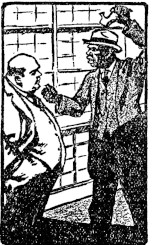
"Yes," said Paul, glancing at the sales-slip. "That's some of my work, Mr. Hepp!"
"I might have recognized it. You sold this pair of shoes to a colored fellow, and he left his old shoes to be sent home. Well, he was in here just now, raising Cain, and threatening to cut me. You sent him a pair of ladies' dancing pumps in the box instead of his shoes, and he says he forgot the ten dollar bill that he had hidden in his old shoe. And he wanted it!"
"Aw, he's a liar!"
"Maybe so, but I was in no position to argue. Here's two dollars."
"What for? Thank you, Mr. Hepp!"
"For your pay up to tonight—twelve dollars, less the ten that I had to give to the colored fellow. Manley, you've got too much brains for the shoe business. You've got too much on your mind besides selling shoes. So we're going to part company. Keep your hat and coat on."
"You want me to quit?"
"Exactly," said Hepp, walking away. "Good luck, and good-by!"
"Then I'll quit!" shouted Paul indignantly. "I'll quit right here and now! Say, Hepp, I want to tell you a few. The matter with you is you don't know how to treat a white man. You're a blamed old slave-driver, that's what you are! You're a mean, stingy old tight-wad! Where do you get that stuff—trying to fire me? Why, say, you old dumb-bell, I forgot more about the shoe business than you ever knew! I got too much brains for you—that's what's the matter. What do you know, anyhow? Put your hat on, you old fool—you're half-naked!"
He left the store hurriedly, and ran to the street. He had not had time to remember all the gags which he had saved up in loving anticipation of just this occasion, but he felt he had done pretty well.
"I guess I told him where he got off!" he jubilated.
III
Paul lay in bed late the following morning. He was not much worried; he was out of a job, but he had been out of a job often before. He argued himself into feeling no shame at his discharge; after all, that was the natural end to any term of employment. He twisted and rolled in bed, holding his eyes shut, trying to hang onto sleep, but it finally escaped him.
He rose, dressed slowly, pushed over his ninety-eight cent alarm clock and walked down the stairs of his rooming-house.
"Mail, Mr. Manley!" called his landlady.
Paul glanced at the inscription of the envelope—"Beaks & Sipperman, Attorneys-at-law, 32 Nassau Street, New York City." Under his landlady's curious gaze he dropped it into his pocket.
He opened it in the cafeteria while eating his twenty-cent Club Breakfast.
Nov. 16th, 1920.
Dear Sir:
If you are the nephew of Henry Clay Manley, formerly of this city, we beg to inform you that your uncle died in August last in Omaha. The will is to be probated in this state, and our Mr. Beaks is nominated as executor and trustee. As you are the only heir-at-law of the testator, and are also a beneficiary under said trust, we request that you call upon us at your first convenience to receive citation and to be advised of your interest. Your uncle left a considerable estate.
Ask for our Mr. Beaks.
Very truly yours.
"Uncle Harry!" exclaimed Paul with shining eyes. "After all the letters I wrote him asking him to do something for me, and getting nothing out of him but hot air and advice, he dies and leaves me his fortune! Well, that is what I call handsome of him!"
He did not know his uncle Harry personally; Henry Clay Manley had gone to the West before Paul was born, and had never revisited New York. Paul had then no sentiment toward him, other than the anomalous kindliness which anyone must feel toward a stranger who has been good enough to die and leave him money. He was even able to see that his uncle had shown foresight and wisdom in turning down his begging letters.
He scalded his mouth with hot coffee, and ran from the lunchroom to the subway kiosk. He saved a nickel by running the three blocks; he saved another nickel by dropping into the turnstile at the station a metal slug which a shifty-eyed street fakir had sold him at six for five, and which was as good as a nickel for all the purposes of the Transit Company, save one. Paul beat his fare when he could, and refused to see harm in it; it cost the traction company nothing extra to carry him, whereas paying his fare would have made to him the poignant difference of a nickel.
He entered the Mutual Life building at 32 Nassau Street and wandered through the ramifying halls of that commodious and old-fashioned structure until he found a door upon whose ground glass was lettered Beaks & Sipperman.
Mr. Beaks was at his piled desk in his private room. He was a big, old man with faded blue eyes; his manner was suave and cold.
"I'm in conference, Miss Prouty, until Mr. Manley leaves," he said to the office-girl. "Don't disturb me. Sit here, Mr. Manley."
He picked a red-ribboned document from a pigeonhole, snapped it open, stared at it, and blew through his lips softly and reflectively.
"This is your uncle's will. Did you know him very well?"
"Never saw him. He always lived out West."
"It's an unusual will, Mr. Manley. Did you ever write to your uncle, asking money of him?"
"More than once," grinned Paul.
"Yes; he left a queer will, and I'm not very thankful to him for making me trustee. However—he was an old friend. There's a trust provision here, Mr. Manley, for your benefit—or for the benefit of the Platte County Home for the Feeble-minded, as the event may prove. Your uncle's estate, Mr. Manley, should amount to ninety-five or one hundred thousand dollars after debts, funeral expenses, inheritance taxes, etc., have been paid. Are you working?"
"Not just now."
"What salary were you getting last?"
"Seventeen dollars per week."
"Listen to this clause, Mr. Manley:
"I have given much thought to the question of my responsibility toward my sister's son, Paul Manley, of the City and State of New York, who is my nearest relative and my only heir-at-law. It has seemed to me that this, my nephew, was an idle and worthless youth; nevertheless I feel that I should fail in my duty toward him, and toward the memory of my beloved sister, if I should make no provision for him in this my last will and testament.
"I do therefore ordain as a first charge upon the trust fund, that my said nephew shall receive monthly during the term of his natural life a sum equal to the monthly wage, salary or income which he is earning at any honest employment. So that my said nephew may make fullest avail of this bequest, I direct that the earned income above referred to shall be the earned income of which he is in receipt eighteen months after he has been given personal notice of the terms of this provision. After my said nephew's decease, the principal of the trust fund with accumulations shall be paid over to the Platte County Home for the Feeble-minded, on the single condition that the name of that institution be changed to The Henry Clay Manley Memorial.
"So far," continued Mr. Beaks, looking over his spectacles at Paul, "we have plain sailing. You have now been put on notice. Eighteen months from today payments to you will begin, on the basis of the salary you are then earning."
"How much could I get?" breathed Paul.
"Between five and six thousand per year; between four and five hundred dollars per month."
Paul's eyes dilated. "But how am I to live until then?"
"You might begin to earn it."
"Work!" exclaimed Paul indignantly. "With all that money coming to me?"
"Your uncle," said Beaks, removing his glasses to polish them leisurely, "seems to have understood your bent of mind. You may work little or much as you please. But you will receive a stipend equal only to the income you are earning from honest work eighteen months hence! I see that term is ungrateful to you, here is one which you may like better:
"The above provision is upon the express term and condition that my said nephew shall engage in no remunerative work after he begins to receive this income from the trust fund. There shall be deducted from the payments to be made him sums equal to any moneys which he shall be receiving from any other sources; so that, to take full advantage of this provision for him, my said nephew shall be required to abandon all efforts to support himself, and to engage in no remunerative work whatsoever.
"In other words," said Beaks, "you are debarred from earning your own living so long as you take this money; you are expressly forbidden to work!"
"Is there anything else?" asked Paul, wondering why Beaks paused.
"You have no objection to that?"
"Of course not! You don't think I'd be fool enough to work if I didn't have to, do you? That's only common sense, that part. Up to six thousand per year—why, say, I'll live in clover!"
"Your confidence is inspiring," said Beaks in a tone that was slightly nasal. "There is one further provision, covering the contingency that you will refuse to accept the proposed annuity according to its terms."
"You need not bother to read that part, Mr. Beaks," said Paul politely.
But Beaks proceeded to read it, unheeding:
"If my said nephew shall refuse to accept the said beneficial interest according to its terms, he shall receive nothing whatever from my estate, but my entire estate shall be divided, share and share alike, among the institutions named in the sealed letter of instructions which will be found in my vault of deposit and which will be given unopened to my executor and trustee. To avoid raising expectations which might be disappointed, and to prevent any attempt at collusion between my said nephew and possibly venal officials of these institutions or any of them, I hereby enjoin and direct my said executor and trustee to preserve this letter of instructions inviolate and unopened until my said nephew shall, at the end and termination of the said period of eighteen months, have definitely refused and rejected the above mentioned life-estate in the trust fund."
"When I do," nodded Paul. "Believe me, if they are going to wait until I throw that easy money over my shoulder they are going to wait!"
"There is the letter to which the will refers," said Beaks, pointing to the pigeonhole. "As it is to all effects and purposes a part of this will, it should be proven with the will; the Surrogate may decide that the institutions referred to are entitled to citation. On the other hand, the will vests me with the power of sale during the eighteen months, so that there is no suspension of the power of alienation. We may have to withhold the will from probate until the end of the eighteen-month period.
"However," he said, sitting up to his desk again, "these worries do not interest you! I shall find a way to carry out my old friend's wishes. Good day, Mr. Manley! Don't forget to come here eighteen months from today, and after you have formally accepted the bequest I shall commence to pay you seventeen dollars a week."
"Seventeen dollars per week!"
"Unless the wage-level should fall, Mr. Manley, as some economists predict. After having had the pleasure of knowing you, it seems to me highly improbable that I shall be required to pay you more."
"Well," said Paul, suddenly troubled, "it will be a whole lot more than that—but—where in thunder am I to get a job that will pay me five or six thousand per year?"
"That is for you to discover," said Beaks, smiling moonishly at him through his glasses. "You will certainly be a very exceptional young man if you get it. Here is a copy of the will. Ponder it. Digest it. Note the provision that the trust is to lapse as to you if you contest it. You have my best wishes, and I am sure that you had the best wishes of your uncle, as well as his lively distrust. You have eighteen months during which you may fix the income you shall receive during the lifetime of inactivity whose prospect seems to please you. You may call me up, if there is anything I can explain. Good day!"
He picked up his desk telephone. "The conference is ended, Miss Prouty," he said.
IV
Paul went down into the subway in a daze; so distraught was he that he dropped a real nickel into the turnstile.
Five or six thousand per year! He didn't know anybody who made such a royal salary. He knew, by hearsay, that such lucky fellows existed; he supposed that the towering buildings of lower New York must house a number of them. He had heard that movie actors made a million dollars per year apiece, but such large sums meant nothing to him—as, in all probability, they mean nothing to many movie actors. Men in banks, where money is visible in heaps, made no such salaries; he knew a paying-teller in a Harlem bank who sat amid currency like a junkman amid bundles of old newspapers, and he made per week only twenty-three dollars.
But, if he could only get it, what couldn't he do with five or six thousand per year! Why, he couldn't waste time working if he was ever to spend so much money; his uncle had shown sense there. For ten dollars per week he could get a large and sunny room in a swell apartment, with hot and cold water, steam heat, electric light, and breakfast optional. He would have a belted dressing-gown—five dollars in Sonnenthal's—and a smoking table with Virginia and Turkish and English cigarettes. After his optional breakfast he would lay off in an easy chair, and read three or four newspapers—he had never had time to read newspapers thoroughly. He would smoke cigarettes, yawning and tapping his mouth, and glancing occasionally through the window to see ordinary people hurrying about their work.
If the day was fine he would take a stroll down Seventh Avenue—he pictured the apartment as situated on Seventh Avenue—and in the afternoon he would take in a matinee; the best matinees in Harlem could be taken in complete for a dollar. When the show was done he would stroll and saunter some more, across One Hundred and Twenty-fifth Street, slapping his stick jauntily against his faultlessly creased trouser-leg, watching common working people exuding wearily from stores and offices and lofts, nodding slightly to his friends. He would dine at a Greek restaurant, a rotisserie, at a secluded little table beneath a pink shade, waving the obsequious waiter and the menu away, and ordering the Regular Dinner like a lord.
He would invite fellows to his rooms—he did not see that he could utilize more than one room, but rooms would be the right word. He would have a square-face of gin in his rooms—he could get it for two and a half, and the real stuff—and he would have rye, and a bottle of pale and smoky Scotch.
But all this would not exhaust five or six thousand per year. Sometimes he would go to other fellows' rooms, and would drink free of their rye and their Scotch. He would have a lot of money left over, week after week.
Well—he could play the ponies! He had always wanted to play the ponies, but the game had been too rich for his blood. But five or six thousand per year would be ample. It would be more than he could use. Why, even fifty per week would be wonderful; that would be three times the salary on which he had been managing to get along. He didn't know any fellow who was making fifty per week. He would be as snug inside it as a worm inside a nut. But——
He had to get it. Even if he was modest enough to be satisfied with it, he would not get it until he had earned it. What had possessed his old fool of an uncle to stick such a joker in? Why, Paul could not begin to earn fifty per week in a month of Sundays! Spend it? Well, yes, there was some chance of that. But earn it? Get some miserable tight-wad of an employer to put into his glad hand five big, crinkly, glistening, vividly green ten-dollar bills every Saturday? He could see him doing it—yes, he could!
So, sunk in an April state of mind, alternating glorious sunshine and overcast weather, he arrived at One Hundred and Twenty-fifth Street again, walked west, toward the Belvedere. He did not know why he was going there; but there was one person who knew something about him, one person who had caught a glimpse of him, one person upon whom he had not imposed a fictitious Paul Manley.
The pleasant-faced cashier was just going to lunch. Paul lifted his hat; she was passing him with a curt nod when she noticed that his face was troubled.
"Listen," he said, "could I talk to you a little bit? I want to ask you something. Can I take you to lunch?"
"If you let me pay my own."
"Oh, sure, that will be all right! Let's go over to the Palace cafeteria; that's a nice place and they got tables for ladies."
He escorted her into the lunchroom, and took off his hat when he sat down. The numerous unaccompanied men in the place wore their hats.
"Let's have some of that ox-tail braise," he suggested. "It's nice here. It's made out of the tail of an ox."
"Maybe," she said. "We have it in our house on Mondays, ox-tail soup—my mother makes it out of the neck of a chicken!"
They laughed. "Two ox-tail braises," ordered Paul.
"Listen," he said, after they had exchanged introductions, "An uncle of mine died, and left me a big fortune!"
"You always have a new one, Mr. Manley," she said with expectant smile. "Well, go ahead and spring it."
"Spring what?"
"The joke! Or am I supposed to ask something? Who is your uncle, or what did he die of, or something like that? I'm awful slow, Mr. Manley."
"This ain't a joke. Well, it is a kind of a joke, too. Read over this letter, and then I'll tell you about it."
She read the letter, and then he told her about it. "So now you see what I'm up against. Where in heck am I to pull down five or six thousand per year?"
"Oh, you could do it if you put your mind down to it. What do you work at?"
"Well, just now I am not working. To tell you the truth, I got canned yesterday. I was working over in Hepp's Bargain Basement, and the boss got me sore, and I got right up and told him where he got off. You know I got a hot temper."
"What were you getting?"
"Seventeen dollars."
"That's not much for a fellow like you. Don't you know any trade?"
"Nothing better than selling shoes."
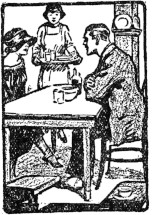
He spoke in a low tone of voice, glancing guardedly about him to see that he was not overheard. Mingled with his humiliation, he felt a certain rare pleasure in telling this girl the truth; but he was quite content to enjoy this pleasure at her expense only, and would probably have been very unhappy if it had been broadcasted that Paul Manley had been fired from a job which paid seventeen dollars a week.
"Oh, I can get another job easily enough," he said. "I've had so many jobs that I know about what to say. It's always easier to get a job than to hold it, is my experience."
She stared at him in reflection. "Do you know what I would do, if I were you?"
"That's just what I'm asking."
"Then listen here. You're going to get as much money as you're earning a year and a half from now, isn't that so? Very well. Now what are you going to earn it at? The thing you know best is selling shoes. But if you go into a shoe store and ask for a job, they're going to ask where you worked last, and then it will come out that you were fired. You will start off with a black eye. The best thing you can do is to go right back to Hepp's, and ask for your job back."
"I should say not! Me ask that old crab for a job?"
"Supposing he is an old crab, what do you care? All you want is to work up to a good salary, isn't it? And you are not going to stay there for good. If you stayed there for a year and a half, and worked up to a good salary, then he would be sorry to lose you, and you could get right up and tell him to keep his old job!"
"Do you really think he would be sorry to lose me?" asked Paul doubtingly.
"Why, certainly! And that would be some satisfaction, wouldn't it?"
"Well, I guess he will not give me the job back. He didn't know how to appreciate a man, Hepp didn't!"
"You are worrying too much about Mr. Hepp, and what he thinks. Will you go around and ask him for the job back?"
"I would not do it for anybody else in the world, but I will," he said, bowing his high spirit. "Since you ask me to, Miss Hazeltine! I will give Hepp one more chance!"
V
He found Hepp in his Lenox Avenue store; Hepp had five of these basement establishments, devoted to selling samples and jobs at cut prices.
"Well?" snapped Hepp, contracting his flaxen eyebrows.
"Mr. Hepp," mumbled Paul, "I find I made a mistake."
"About time you found that out—seeing that you've been making nothing but mistakes ever since I took you on. Well, what do you want me to do about it?"
"I'd like my job back, Mr. Hepp. I've been thinking it over, and I see where I was wrong, and I see the right thing to do is to come back and tell you. If you take me on again, Mr. Hepp, you'll never get a chance to fire me again!"
Hepp grunted, with a twinkle of malice in his eyes. "I don't know what you want to work for a slave-driver like me for."
"You're not a slave-driver, Mr. Hepp. You always treated me pretty white!"
"Excepting for the salary. Seeing that I am a darned old tight-wad and that you know all about the shoe business already, I don't see what you want to come in here for. I'm nothing but an old fool!"
"I take it all back, Mr. Hepp."
"Very well, Manley," said Hepp, nodding and walking away.
"Do I get my job back, Mr. Hepp?"
"No!" cried Hepp, who was not at all forgiving.
Paul lingered by the door for another word. He had made up his mind to have this job. He felt that he must have it. And with matters so, with the scales tilted against him, he looked at the stairs and saw descending the gray-haired gentleman whom he had dismissed so cavalierly from the One Hundred and Twenty-fifth Street store the day before. By a cruel stroke of fortune, the customer was still seeking the shoes which Paul had denied him, and now he had come here to ruin Paul's slim chance. He would recognize Paul, complain to Hepp, and Paul would be finished.
Paul scowled at him as he entered. The customer looked at him.
With sudden recklessness Paul dismissed his scowl, put on an urbane smile, and stepped forward.
"Good afternoon, sir!" he said, chafing his hands together.
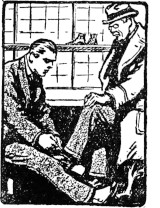
"Want a pair of shoes," grumbled the customer. "And for heaven's sake, hurry up!"
"Yes, sir," said Paul, springing to a foot-rest, and snapping it into place under the gentleman's foot. "A good, strong walking shoe, I suppose? Something about six dollars?"
"Exactly!" said the customer with surprise.
"We have the very thing will please you, sir," said Paul, putting his customer's unshod foot down with reverence.
"You're not taking my size!"
"I will if you wish, sir, but I should say a 9-D would be about right."
"It is right," said the customer, who had not recognized Paul.
"This is our style A515, sir. May I try it on? We sell these mostly to customers of your standing. It's a strong shoe, but still rather dressy."
"Feels pretty good," said the customer, standing up. "The left one is a little snug in the toe."
"I'll stretch it a bit, if you wish. Or would you rather try a larger size. I wouldn't advise you to, but it won't be any trouble to try it. That's what we're here for!"
"No, these will do. You might stretch that left one a bit at the toe."
Hepp had stalked menacingly forward, but had halted when he saw that the customer could not be disengaged from Paul without a small scene. He stood by, watching. Paul carried away the offending shoe.
"You know your business, young man," said the customer satisfiedly.
"We do our best to please people," smiled Paul.
"Not all of them do," frowned the customer. "I was in a shoe store yesterday, and had words with the laziest and most impudent young puppy I ever met in my life! But you seem to know how to handle people here. Well, good day to you. You'll see me again!"
He left the shop.
"Mr. Hepp," said Paul, "can I have my job back?"
"You took it!" grinned his employer. "You might as well keep it now!"
During his supper hour he hurried up to the Belvedere, and spoke to Miss Molly Hazeltine through her little window. It was half-past six, and she was not busy.
"Fine!" she said, smiling at him with warm and friendly eyes. "I knew you could do it!"
"I didn't," said Paul. "Gosh, it takes a girl to show a fellow what he can do. If you would only stay my friend, Miss Hazeltine, and keep tipping me off to things I can do, I bet I will have a salary in eighteen months that will make that old crab of a lawyer look sick. We will see if he is going to pay me any seventeen dollars a week!"
"That's the talk," she said. "Show him how much he knows—it is a whole lot better than just telling him."
"You got Sunday off, haven't you?"
"Every Sunday."
"Maybe we could take a little walk. I got an awful lot to discuss with you, Miss Hazeltine. If I could take a walk with you every Sunday, and come around and see you between times——"
"You could come around and take me for a walk next Sunday, Mr. Manley. Or what do you say if you come around to dinner first, and meet my mother? I was telling her about you."
"Next Sunday!"
VI
It may help us to understand the change in Paul Manley if we shadow him while he is in the company of Miss Molly Hazeltine. Paul had resolved well; but a long course of conduct, as many can tell, is not stably founded on any mere resolution. It must be founded on character; on some one else's character, if need be, until repetition breeds habit in the subject.
"Here's an ad in the paper today," said Molly, "that says, 'Corporation formed complete for fifty-seven dollars.' That does not look as if a corporation amounted to so much. What is a corporation anyway, Paul?"
"Gosh, Molly, you've got your asking clothes on today again! You wouldn't know any more about these matters if I was to talk to you all day."
"You know so many things that I don't," she said regretfully. "Oh, Paul, I met the nicest fellow over at the church supper last night! He's an instructor at Columbia, and he knows more than any man I ever met, excepting you, Paul. I'll ask him, Paul, but he doesn't explain half so nicely as you do."
"Well, I'm a practical business man," said Paul. "Naturally, I would understand about practical matters better than any college professor. Don't mind asking him, now."
"What is this here about Stormy Meeting In Board of Estimate? What do they do?"
"I got to run along, Molly," said Paul, frowning at his watch. "See you some more, Molly!"
That afternoon, in his free time, he strolled into the local Y. M. C. A. reading room, to pass an hour with the magazines on file. He read an exciting story of life among savages in the South Seas, and another about a young man's great fight against a grasping corporation in the Yukon country. These stories thrilled him, as ever, but the thrill was not followed by the old reaction of dissatisfaction and discouragement; he was learning that there was place and opportunity for the most strenuous young man even in New York. He put the magazine back in the rack, and sauntered to the bulletin-board.
"What's civics?" he inquired at the desk. "I see there's a course to be given in that."
"It tells you all about Government. You ought to take that, and then you'll know what you're voting about. It's free, except that you have to buy the book."
"Put me down for it, will you?" requested Paul. "Lots of questions pop into my mind about such things, and I can't think of the answer!"
One Sunday night Molly treated him to the performance at the Belvedere.
The picture had to do with the perils and triumphs of an American youth in a banana republic. The hero of the picture had been nobody in particular in the United States, but he was an American, and when he arrived in the capital of the southern country he promptly took the center of the stage by right of birth. He had failed in business in the United States, but down there he seized hold of affairs—economic, social, political—with amazing verve and ability. In due course, he married the beautiful daughter of the dictator, and arranged to take over the country in bulk—but we have only to do with the episode wherein he was rescued from man-eating land-crabs by a detail of U. S. Marines.
"Yea-a!" exhaled Paul with delight and relief when the forefront of the gallant Marines appeared on the jungle trail, spurring to the rescue with excellent horsemanship.
"You're hurting my hand," said Molly. "They do look fine, don't they? I just love soldiers!"
"Good old leathernecks," sighed Paul. "I tell you what, Molly, it takes us Americans to show those people where they get off!"
"It certainly does," said Molly. "I bet you could get to be a dictator of one of those countries, too, Paul."
"Well," said Paul slowly, "seeing that I am an American, I guess I would have the bulge on them all right."
"Some of those South Americans look awfully mean. You would have to watch out for them, Paul. That was a machine-gun that he killed Don Henriquez' army with, wasn't it? How does a machine-gun work, Paul?"
"Well, it is quite a complicated mechanism. I do not think I could explain it to you so you would understand."
"Did you ever see one?"
"Not so as to examine it. Not real close. But I learn quickly about firearms. I had a pistol once, and my mother took it off me, or I bet I would be a dead shot by now."
"You would look grand in a uniform, Paul. I always say a real tall man looks grand in a uniform!"
"Not so poor, I guess."
"Listen, Paul, Pete Forest's regiment in the National Guard has got a smoker on for next Saturday night, and Pete told me he has to bring along an outsider. So I promised him you would go with him. I told him you would carry the flag for them, and he said he would speak to the color-sergeant about it, but meanwhile for you to come around."
"You might have asked me first."
"But I knew you'd enjoy it. It's just camping out, Paul, and that's fun. Pete Forest says you'll have the time of your life, being that you are fond of walking; and if you get tired or hungry, you can tell the complaint-sergeant and he will see about it. You'll go, won't you?"
"Oh, I suppose so!"
VII
"Mr. Manley," said the office-girl.
"Show him in," said Mr. Beaks, glancing at the calendar which showed a date in May, 1922.
Paul and Molly entered. Paul looked nervous but determined; Molly wore that look of tranquil beatitude which the world cannot give to a girl, unless it has first given her an engagement ring with a genuine solitaire diamond in it. She was wearing the ring, and not trying to hide it.
"Good afternoon, Mr. Beaks," said Paul. "Miss Hazeltine—Mr. Beaks!"
Chairs were taken.
"I suppose you have come in regard to the trust under your uncle's will," said Beaks, reaching into the pigeonhole for the red-ribboned document. "May I ask you, Mr. Manley, what salary you are receiving?"
"Thirty-two dollars per week. I'm manager of one of Hepp's Bargain Basements, up in Harlem."
"Indeed! That is a great improvement over an earning capacity of seventeen dollars per week, and no employment. I congratulate you, Mr. Manley! You must have worked hard and steadily during the past eighteen months."
"I worked," nodded Paul curtly. He did not like Beaks.
"You are coming into a very nice thing," purred Beaks. "Thirty-two dollars per week for the term of your natural life! Many lawyers don't net that much, Mr. Manley. You should be able to live very nicely on it."
"Listen to me," said Paul gruffly. "That part about my not working any more; I've been talking that over with Miss Hazeltine here, and we've decided to make you a proposition! I'm a business man, and I'm talking business. I can make a whole lot more than thirty-two dollars per week later on, but on the other hand I don't see why I should have to lose all that money. I'll take half of it—sixteen dollars a week—and the Feeble-minded Home can have the other sixteen—providing you take out that part about my not working! Come, is that fair?"
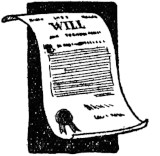
"A very fair proposition," said Mr. Beaks, polishing his glasses with his bandanna. "I should certainly advise the officials of the Home to accept it, if it rested with me. But, unfortunately, Mr. Manley, I am simply a trustee, and I must abide by the terms of the trust instrument which created me. I have no discretion. You must take thirty-two dollars per week, with the stipulation that if you earn any money it will be deducted—or you must take nothing. As the will is drawn, and as I construe it, you must make your final and binding decision today.
"I beg to point out to you that you have no reason to feel harshly toward your uncle. You have already received incalculable benefits from his provision for you. When you came here eighteen months ago, you would have taken your then salary of seventeen dollars per week and you would very willingly have refrained from ever working again. You will pardon me if I say that you were at that time unfit to be given money; you were idle, unambitious, and I think, rather dissipated. I am an old man, Mr. Manley, and an old lawyer, and I have seen many times the deplorable effects of freeing young men from the discipline of honest work. You have had now before you for eighteen months an incentive to do your best—the hope of never having to work again. You now confront the fact that you don't want what you strove so hard to get. That's a common human experience, Mr. Manley. I can do nothing for you; if you refuse to accept this money according to its terms, it must all go to the institutions named in the letter of instruction here."
Paul looked into Molly's eyes, and then he straightened.
"I'm not going to take it," he said.
"This is your final decision?"
"It is. I'm not a bum; I can make my own living. When I can't—why, then I'll move into the Home for the Feeble-minded!"
"Oh, Paul!" cried Molly. "I'm so glad!"
"Allow me to congratulate you again, my boy," said Beaks, rising and clasping Paul's hand. "I'm sure you've done exactly what your uncle hoped. If you took this money it would have ruined you, or, better, it would have proven you lazy and worthless. Your uncle was a shrewd and penetrating man of affairs; in this matter he has shown no feeble-mindedness worthy of commemoration."
He bowed the young couple out.
They had entered the hall, and were waiting for an elevator, when the office-girl came running out to them.
"Mr. Beaks wants you again, please!"
They re-entered the law office. Beaks waved them to chairs, and continued his study of the letter of instructions, which he had opened upon their leaving.
They waited in silence.
He turned abruptly, and thrust, into Paul's hand the single sheet of heavy paper which had been contained in the letter of instructions. Upon it, in pen and ink, were these words only:
Institutions referred to in my will which are to receive the principal of my estate upon my only nephew's refusal to accept trust provision.
NONE.
Henry Clay Manley.
"What—what does it mean?" asked Paul.
"It means," said Mr. Beaks, "that your uncle died intestate, except for the provision for the payment of funeral expenses, debts, taxes and my fees. The trust has terminated, and I am now required to pay over the principal to the rightful heirs. Inasmuch as he has made no disposition of his estate, it must go according to the Table of Descent."
"To whom?"
"To you, Mr. Manley!" said Mr. Beaks. "You are the only heir-at-law. Your uncle had the right to leave the money elsewhere, but he has not done so."
"Then I'm to get the whole thing," muttered Paul dazedly. "I—I don't understand this. Don't joke with me. I don't believe it. Six thousand per year! No, no. Are you telling me the truth? Molly, you heard him? Prove it to me. Give me five hundred dollars!"
"Currency?"
"Yes, real money."
They watched Beaks bending down before his safe, and twirling the knob, and methodically counting a sheaf of greenbacks.
"Here it is, Mr. Manley. And I wish to say——"
He stared after them. Paul had caught Molly by the hand and was hurrying with her to the door.
He bundled her into an elevator, and then pulled her out into Nassau Street.
"What's the matter, Paul?" she cried, joyously but perplexedly.
"The Municipal Building closes at four o'clock!" he said, urging her on. "If we don't get there in ten minutes, we can't get the marriage license today! No, tomorrow won't do! Hurry up, Molly, can't you run a little faster? I've had dreams like this before, and I'm not going to sleep again until this one comes true!"