THE IRON CHALICE (continued 3)
Reading edition
"You be the spokesman, Alex," said Colonel Mason, with a sly wink at the general manager.
Old Singleton tugged at his sunburned, black beard and laughed like a happy, healthy boy.
"How about a 'possum-hunt, Little Buck?" he asked.
"It's too dry, isn't it?" said Wolfe. "I'm afraid a dog couldn't pick up a trail at all, tonight."
"It hain't rained—durned ef I know when it was!" chattered Granny Wolfe. "Wisht I may die ef ever I seed another sech a dry summer and fall sence I was borned. Would ye gi' me a match, Little Buck, honey? This here contrary old pipe it's gone out ag'in."
"Why not have a cigar?" Whitney Fair suggested sportively, drawing a light-brown weed from a vest pocket.
"I be consarned ef I don't try it oncet, anyhow!" laughed the garrulous old woman. "I allus would try 'most anything oncet."
She applied a burning match to the cigar, and went to puffing with all her might, greatly to Whitney Fair's amusement.
"Yes," Alex Singleton agreed seriously, "it's too dry fo' a dawg to trail good. A feller just couldn't catfoot atter squirrels at all now! But these here folks they're all dead sot on a 'possum-hunt, and I've done j'ined my symp'thies wi' their'n. The's a lot o' pe'simmon-trees jest a-hangin' full down thar clost to whar yore little railroad meets the big railroad, and we might find a 'possum or two in them trees 'thout havin' to depend on the dawg to trail. And as the steam hain't went down in the ingyne yit, we wondered ef we couldn't have what Miss Alice thar calls a 'scursion as well as a 'possum-hunt. We could put some chairs on a lumber flat, ye know."
"Come along, like a good fellow," urged Fair, smiling a cold smile that temporarily effaced the cleft from his chin. "The safe will be all right, won't it?"
"I don't see why it shouldn't be," Wolfe answered. He threw off his weariness, and entered into the spirit of the thing. "I'll run up to the mill and get the locomotive and a flat," he continued, "and pick you up somewhere on the track below. While you're waiting for me, Alex, you might ask my mother for half a dozen chairs, and get about two lanterns ready, eh?"
Singleton nodded joyously. The seven callers and the dog then hastened into the cool, starry night.
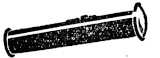
Wolfe shaved himself and put on his one presentable suit of clothing, which required fifteen minutes. When this was done, he thrust a pair of buckskin gloves and a small flashlight into his pocket, and hurried toward the mill.
His brother Nathan, the watchman, challenged him faithfully. He instructed Nathan in case of trouble to call Weaver, who was now the mill's foreman, and who stayed at the big and rough boarding-house that had been erected for the accommodation of the "furriners" of the operating crew. Then Wolfe went to the geared locomotive, threw fresh coal into the furnace, and coupled to a lumber flat.
He met the others at a point close to the new dwelling that was to be given to his father, and took them aboard. Alex Singleton rode on the fireman's seat with his dog in his lap.
They stopped near the C. C. & O. siding. Granny Wolfe knocked the fire from her first cigar, and put the half-smoked weed in her pocket to save it. Alex Singleton took up one of the lighted lanterns, and set his feet in a narrow, laurel-lined trail that led off westward. Behind him in the order named went Granny Wolfe, the Masons, the Fairs, young Wolfe, and Tot Singleton.
Miss Alice Fair began to lag purposely, and soon there was a distance of some fifteen yards between her and her father, who carried the second lantern.
"That bank of clouds ahead looks like rain, Arnold," she said—plainly, to make conversation.
"Yes," agreed Wolfe; "and we need it."
"You've been avoiding me, Arnold."
He admitted it.
"Because you didn't want to be near me—which, of course, is a very simple conclusion!"
"Er, yes," he said.
"Why didn't you want to be near me?"
"Because we have nothing in common now, Alice," he told her. "It's—er, your own decree, and it's the best for both of us, I'm sure. I'm not the kind of fellow you'd care for with the only affection worth while. We'd be unhappy if we were married to each other. The time to part ways is now. Don't you agree with me, Alice?"
"I certainly do!" There was a tiny note of desperation in her voice; she had tried to make up, and failed. "I don't wonder at your forgetting me so easily," she went on. "You fell in love with me so easily, you know."
"Yes. I'm twenty-four. I felt the real need of the fine, understanding companionship of a good woman. You were the only young woman I knew intimately; I'd studied almost day and night trying to make up for a youth that had been entirely lost, so far as education was concerned, and I hadn't time to be a sociable fellow. I didn't stop to consider whether we'd be suited to each other—you were so pretty, you know, Alice."
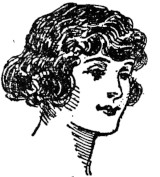
"Thanks!" with stinging sarcasm. "But I'm fading now—am I?"
"I think you'll always be pretty," he said very seriously.
She looked backward and laughed at him scornfully. "But the impossible Miss Singleton——"
"She's not impossible," interrupted Wolfe, who was now somewhat incensed. "In fact, she's one of the finest specimens of humanity I've ever met."
Without another word, Miss Fair hurried on and overtook her father.
Suddenly a hand was placed lightly on Wolfe's arm from behind. He stopped and faced about, and confronted a slender, but well-rounded figure, a feminine figure in dark blue. It was Tot Singleton, and she was trembling violently.
"I overheard—I eavesdropped!" she whispered nervously. "I feel mean about it, Little Buck, and I wanted to tell you for my conscience's sake. To—to think that you, after the way I treated you this afternoon, would take up for me to Miss Alice! It hurts, and I'm ashamed o' myself. Please forgive me, if you can, will you?"
He took both her hands and pressed them warmly. The touch gave him a comfortable thrill. "Forget it!" he smiled.
"You're so nice to me," she cried softly. "But you're mistaken in what you told Miss Alice. I'm little, and mean. I'm just beginnin' to l'arn about myself. I'm a-findin' that half o' the fruit o' the tree o' knowledge is tears. Listen, will you—mountain dialect again! I wonder if I'll ever quit thinking in it? Understand me, Little Buck; I'm not exactly ashamed of the mountain dialect."
Wolfe laughed. "You can't go all the way at one leap, Tot, of course; be patient, and keep trying!"
"In some ways, I'm worse than I used to be," she said dejectedly. "I've got so afraid of the dark that it was easy enough for me to make myself believe that I kept close to you and Miss Alice because I didn't dare to stay far enough behind to be out of hearing. I wasn't afraid of the night when I lived back here in these hills. I wonder a lot about that, Little Buck. Maybe it was because I was a part of the night myself then!"
Wolfe looked at her with increased interest. She was beginning to show new facets. There was something quite wonderful about her.
"I'll be falling in love with you, Tot," he told her, "the very first thing you know."
"That's not likely," laughed Tot.
She hurried past him, and soon disappeared around a sharp bend in the narrow trail.
Wolfe walked on rapidly, and overtook the rest of the party just as the deep music of the dog's baying fell upon the chilly air.
The voice of Alex Singleton boomed out, "By the Eternal, ef he hain't treed a'ready! Treed by sight! Hold the 'possum, Rock! Hi, thar, Rock—don't ye lose him! Good old dawg, Rock!"
"I'll be durned ef this here hain't good luck," said Granny Wolfe. "Light out atter him, Alex!"
They followed their guide, who turned to his right and picked his way through a copse of laurel, and drew up at a persimmon tree laden with frost-bitten fruit. Singleton kept his lantern swaying behind him, while his alert gaze searched the branches of the tree for a pair of round and glistening black eyes. He wished he had a good pine torch!
"I see him!" he cried finally. "Le's hide the lights onder our hats, Mr. Fair, and everybody look right in the tiptop o' the tree."
They saw between them and the starry sky a round, dark bulk that was as motionless as the mountain under their feet. The old hillman passed his lantern to Colonel Mason, sat down, and removed his boots. A few minutes, and he had climbed to a point within ten feet of the persimmon-eater.
"Look out below thar!" he shouted.
He began to shake the uppermost branch with both hands. There was a sudden dull thump on the ground below. With a yelp of delight, the spotted dog dashed forward and seized the little animal by the throat. The opossum stiffened, and feigned death perfectly, but the hound was not one whit deceived. Alex Singleton climbed down, tied a stick in the 'possum's mouth to prevent its sharp teeth doing damage, pulled on his boots, rose and led the others proudly to another persimmon. For one night, old Alex was king.
The sport kept up until midnight, when Colonel Mason suggested that they return to the basin.
Just as those on the flat were settling themselves for the run, just as Wolfe was reaching for the throttle-lever, there came tearing through the stillness the dull but mighty roar of the sawmill whistle. It was somehow like a death-knell. It blanched the cheeks of every member of the party. The long blast died out in its own echoes. Then there came a short blast that ended abruptly; it was as though the hand that had held the whistle-cord had been suddenly stricken down.
Wolfe opened the throttle as far as he dared. With the other hand he opened the valve to the sandbox.
When they had covered three miles, a voice from the flat ahead sent tremors to Wolfe's heart. The voice said but one small word, but that one small word meant destruction.
"Fire!"
Fire, when the fine, new mill had run but half a day!
It was a cataclysm.
XVII
Soon the now thickly overcast heavens became lighted everywhere ahead by a lurid, blood-red glow. It was evident that the conflagration was great and steadily growing. Granny Wolfe knelt on the lumber flat, turned her seamed and troubled face toward the Omnipotent, and begged that a rain might come and put to rout the element that is at once mankind's best friend and worst enemy. The rest of the party kept grimly silent.
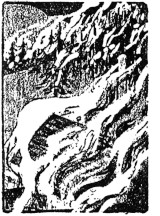
When the little locomotive pushed its one car through the jaws of Devil's Gate and into the basin, those on board were greeted by a spectacle that was nothing less than appalling. Every one of the deep and finely-timbered coves was a raging furnace of dead leaves, dead wood, and resinous pine, which were as dry as tinder. The big mill itself was a raging furnace. It was already too late for any rain except a cloudburst to save anything whatever. The devastation promised to be complete within a very short time.
"This is the end," Wolfe kept saying bitterly to himself. "This is the end of it all."
The locomotive and its flat came to a jarring, grinding halt a hundred yards from the burning mill, and the hunting party alighted. The "furriners" of the mill crew, most of the Singletons, and the women and children of the Wolfes were gathered together before the blazing plant in an awed, helpless mass of humanity. The children were crying with fear; some of the women were sobbing aloud; the men were pale and silent.
Weaver, the foreman, and Nathan Wolfe, the watchman, hurried to meet the party that had just arrived. The watchman was burned about the hands and face and arms; his clothing was scorched and blackened and torn.
"Well?" the general manager said unsteadily.
The foreman looked toward Nathan Wolfe, then turned his face away. Nathan Wolfe gulped, and tears began to sting in the broken blisters of his cheeks.
"Here's how it was, Little Buck," he said in a shaken drawl. "A fire was started up in every cove, it seemed to me, at about the same time. As soon as I seed it, I made a streak fo' the whistle-cord. Somebody slipped up and grabbed me from ahind o' me, and throwed me down hard. This man was half-drunk, but he was as strong as a bear all the same, and I jest couldn't git loose to save my life. Three other men carried bucket atter bucket o' mile-ile upstairs, and poured it out, and 'en set it afire. When the ile it was a-burnin' good, the big man he le' me go.
"I tried awful hard to put the fire out, Little Buck, but I jest couldn't do it. The water I throwed on the burnin' ile didn't do nothin' but spread the fire. Then I made fo' the whistle-cord ag'in, and this time I got to it. I'd done blowed one long blow, and was a-startin' to blow ag'in, when the same man 'at grabbed me afore grabbed me and throwed me out o' the ingyne-room door and kep' me out. Mr. Weaver and them 'ar other furriners they run in then, but they met about twenty men wi' clubs, and they couldn't do nothin'. And purty soon it was too late to even try to save anything. Was the mill inshored, Little Buck?"
"The insurance men were to be out tomorrow," Little Buck Wolfe answered hoarsely. "They'd refused the risk twice before. But you didn't tell me who set the mill and woods on fire, Nathan."
"I hates to tell ye, Little Buck," sadly, "but you're plum' shore to find it out anyhow. It was our own people. They must ha' broke jail. It was pap who grabbed me the twicet, and it was Unc' Brian Wolfe and our brother Oliver and Cat-Eye Mayfield who carried the ile upstairs and set the mill afire. The whole outfit of 'em was a-drinkin' hard."
Young Wolfe straightened under this, the greatest blow of his life, and folded his arms across his deep, broad chest. He stared toward the furnaces that lighted the whole of the basin as bright as noonday and roared as though they were Gehennas filled with lost souls; his hopes were all in those fires and burning, burning to gray ashes. Everything was gone. The Masons were left practically penniless in their old days; it was this, perhaps, that hurt him most—he could have wept over it. There had come to his whitened countenance a look that kept away even those of his friends and kinsmen who loved him best.
Suddenly there appeared from the bush to the eastward the Wolfe clan and Cat-Eye Mayfield. They reeled a little, and they were full of defiance. The Wolfes were now armed with rifles, which they had taken from their homes after their womenfolk and children had gone to the burning mill. They halted a few rods from the awed multitude. Their leader, staggering for the first time under alcoholic influence, shook his great fist toward the man who was losing most, and lifted his Goliath voice in tones of black triumph:
"Who wins now?"
The son did not even appear to be aware that the father had addressed him. There fell a silence that the noise of the nearby hungry flame was scarcely able to dissipate. Now no woman sobbed; no child wept.
"Who wins now?" the giant mountaineer repeated.
At last Little Buck Wolfe turned his head and looked toward his half-drunken father. A great deal of the suffering left his face, and a pity that was akin to the divine shone from his eyes. The old clan chief went pale in spite of himself. Came at that moment an old voice that seemed to hang in the air, like the smoke of incense——
"'And they bring him unto the place Golgotha, which is, a-bein' interp'eted, The place o' a skull.' Saint Mark; fifteen, twenty-two."
Like a John the Baptist out of the wilderness, Grandpap Singleton, the Prophet, stepped before them. Until this moment, his people had not seen him since the time of the mill's starting. His mind was almost completely broken. His snow-white head was bare, and his lean face was strangely haggard. In one hand he carried a dark, round object that the others did not then recognize for the pitiful, tragic thing it was.
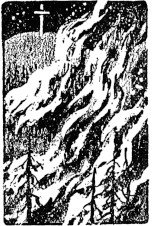
He went to a point close beside the young man whom his good old heart had loved so truly and so well. He stretched one of his long, thin arms toward Picketts Dome, which stood out plainly in the fire's light and in bold relief against the red, red heavens. The others looked, and saw on the summit of the peak a great ironwood cross. He had erected it there in the hope that his children and the children of his children might see it when temptation assailed them, and not forget.
"Finish it!" he cried to Old Buck Wolfe, and it was a terrible condemnation. "Finish it! Loose the silver cord, and break the golden bowl—break the pitcher at the fountain, and the wheel at the cistern! Take this good man, yore own flesh and blood, up thar and nail him hand and foot. Spit upon him, and give him vinegar and gall to drink when he axes fo' water. Pierce his side, and cast lots fo' his clothin'. Finish it!"
The demented patriarch held up the dark, round object he had brought. It was a crudely woven crown of thorns. He pressed it down upon the brow of Little Buck Wolfe, the Arnold Mason that was, who stood as dumb and as motionless as a tree; and if the thorns that sent several tiny drops of blood trickling down the pallid face gave pain, there was not the least sign of it.
Save for the Wolfe clan, Cat-Eye Mayfield and Whitney Fair, the multitude groaned at the sight. It was eerie, and it was also somehow holy. Tot Singleton sank to her knees and sobbed aloud. The Wolfe clan, and even Cat-Eye Mayfield, became suddenly sober. Old Buck shuddered. Long forgotten things were gripping his soul and making him ashamed of himself. He dragged a tremulous, grimy hand across his forehead and started slowly, drawn irresistibly, toward the best of his five sons; and his footsteps led him all too near the burning plant.
Young Wolfe removed the chaplet of thorns from his brow, and put it down at his feet.
"It makes me afraid," he muttered; "it makes me afraid," and he went to meet his father.
Then the great, hot smokestack swooped downward with a mighty swishing roar. It was Little Buck who saw Old Buck's imminent danger first.
He leaped forward, shouting, "Out of the way! Run! Quick!"
His father stopped as though the words had paralyzed him. He appeared to be unaccountably dazed. The great stack loosened a beam from the roof which flew out and struck him across his shoulders, and bore him to the ground on his face.
"He'p me!" he screamed smotheredly. "I'm a-burnin' to death—he'p me, fo' God's sake!"
Every man of those present dashed toward him. There was no time to be lost in looking for levers; if the wheels of fate were to be cheated, bare hands must lift the smoldering beam; human flesh must voluntarily be seared.
"Drag him out, Little Buck, when we raise; all together, boys—go to it!" Alex Singleton bellowed.
They went to it all together, Wolfes and Singletons face to face and shoulder to shoulder, and there rose the sickening scent of scorched flesh. Little Buck Wolfe dragged his father's giant figure to safety. The others dropped the searing beam and ran. A blazing wall fell and hid the spot where Old Buck had lain.
"His pore back!" wept Granny Wolfe. "It's all burnt and blistered! He'p me to take him home, Nathan, honey. Will ye go home, Buck, pore boy?"
And her favorite son answered weakly, "I'll go anywhar ye wants me to go, mother. Fo' because I'm already in hell."
It began to rain then. It was a slow, drizzling rain that could have saved nothing, had it begun hours before.
XVIII
Ten minutes after the slow rain set in, the grounds about the almost consumed building were deserted save for the general manager. Wolfe had not been able to leave the thing that had been his palm of victory and the pride of his heart. Colonel Mason and a number of others had insisted upon his seeking shelter, to no avail; they had then insisted upon remaining with him, but he wouldn't permit it. He walked slowly and alone, like a sentinel upon his beat, and watched the flames die down and leave a great pile of glowing coals and red-hot, twisted iron and steel. When finally he turned toward the house he had built for his father, he was wet to the skin.
Just as he left the dimming red glare, there came to his ears a dull rumbling that was like an explosion of dynamite. He paid little attention to it then, though he remembered it vividly enough afterward.
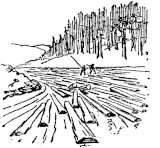
Already he had decided upon a course for the future. He would go to one of the lumbering districts of the Northwest, and establish himself there; he would pay back, the Masons first, every cent of the money that had been lost in the ill-starred Unaka Lumber Company. It would require the best part of his life, perhaps, but he would do it. It should be his one purpose.
Whitney Fair met him on the new house's veranda. They were about to pass, when Fair said gruffly, "I'll take the key to the office door, if you please."
Wolfe frowned. He knew why Fair was going to the office. The wonder of it was that Fair had not demanded the key sooner. He meant, of course, to telephone Sheriff Starnes at Johnsville, and notify him of the outrageous doings of the escaped prisoners.
"The key, if you please!" Fair growled.
In no heart are the ties of blood stronger than in the mountain heart. Wolfe drew back. His kinsmen had wronged him deeply, it was true, but they were still his kinsmen. They hadn't had the advantage that had been his.
He took the key from his pocket, and gave it over. There was, plainly, nothing else to do. Anyway, he told himself, the chances were that the jail delivery had already become known, and Sheriff Starnes and his posse were perhaps even then on their way out to the basin. Whitney Fair turned the collar of his greatcoat up close around his neck, and hastened toward the crude little office.
Wolfe entered the new house without rapping. There was a cheery log fire in the living-room. Old Buck Wolfe, his blistered back bandaged, sat very straight on a couch.
"Where are the others?" his son asked.
"I run 'em out," sourly.
"Why?"
"I wanted to be by my lowdown self, damn it," answered the old mountaineer. "Whose fine dwellin' is this here?"
"Yours and mother's. I built it for you."
Old Buck nodded thoughtfully. "That's what they told me, but I jest couldn't believe it was the truth to save my life. And whose fine fiddle is that up 'ar on the mantel?"
"Yours. I bought it for you."
Old Buck cleared his throat. "That's what they told me, but I jest couldn't believe it. I figgered you'd got married to Alex Singleton's Tot and lived here wi' her. Hadn't ha' been fo' them Singletons, I reckon I'd ha' done been burnt to a cinder; wouldn't I?"
"There's no doubt of it," promptly.
"Little Buck," the father said with striking earnestness, "no man cain't be the same atter he's look death in the eyes, and tasted of it, like I've done tonight. Death it showed me things. Death and the cross and the crown of thorns. I'm a-tellin' ye, son, a man can shorely live a whole etarnity in his one dyin' minute—though I'm no coward, and don't ye fo'git that. I reckon I been the meanest, lowdownest polecat 'at ever lived, hain't I?"
"I guess not." Wolfe the younger turned his face away. "There are worse men than you."
Silence fell between them. Old Buck's fifth son then went gloomily to the semi-darkness of the veranda, and dropped into a chair.
After what seemed a very long time to Little Buck Wolfe, a slim feminine figure, in clothes that were wet and bedraggled, ran through the gateway, ran up to him, and put a hand rather hard on his shoulder.
"Tot!" he exclaimed. "Where've you been, Tot?"
"I followed Mr. Fair," breathlessly. She dropped to her knees beside his chair and went on, "He told Sheriff Starnes everything over the phone. They'd already found out about the escape, and Deputy Sheriff Howard Cartwright'll be here with a posse before very long. And—listen! The office safe has been dynamited and robbed! Mr. Fair found your gloves and flashlight lyin' on the floor, Little Buck, and he thinks you did it! He thinks that's why you stayed behind. He told the sheriff it was you. Oh, I'm so sorry; it seems that the—the Lord is tryin' to see how much you can bear!"
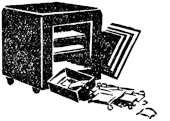
"I heard the explosion that opened the safe," Wolfe told Tot. "How I wish I'd investigated then!"
He felt through one of his pockets after another. Both gloves and flashlight were gone.
"I must have left them in the locomotive's cab," he reasoned aloud, "and some ransacker found them. Afterward the ransacker found the dynamite in the tool-house, and the safe in the office. It all fits in very nicely, Tot."
"Yes. How much money was there in the safe?" she asked.
"Twenty-eight hundred."
He went to his feet, and at that instant his father appeared on the veranda. Old Buck walked slowly and with considerable pain. He had overheard the conversation between his son and the daughter of old Alex Singleton.
"The fire it was all my fault," he confessed. "Ef it hadn't ha' been fo' me, nothin' wouldn't ha' been set afire at all. I headed the whole thing, me and a kag o' licker did. Tot, I want you to go and tell Oliver and Brian and the others 'at they must light a rag out o' here and keep from a-bein' arrested. Tell 'em to go away back to the Balsam Cone section. Their wimmenfolks and children can foller 'em atter a little while. I made this here debt, and I'll pay it all myself. Tell 'em that, Tot, please."
Tot Singleton looked questioningly toward Little Buck, who said no word, gave no sign.
"Please, Tot," the old hillman begged, "go and tell Oliver and Brian and the rest what I said. The debt it's all mine, and I hain't a-goin' to let nobody else pay none of it. Please go, Tot!"
"Must I?" Tot whispered to Little Buck.
She had no answer whatever. After half a minute of waiting, she disappeared in the rainy night.
A quarter of an hour afterward, the clan stole hurriedly up to its leader. Old Buck asked them to go while there was yet time. But they would not agree to it. They wouldn't be yellow. One man should not pay all of the debt to the law.
"Ef you'd jest go along wi' us, Buck," finally said Brian Wolfe, "then we might go."
"But I cain't hardly walk!" Old Buck exclaimed. "I'd be nothin' but a drawback and dead weight on ye. Go on, boys! You cain't resk a-bein' sent to the State penitenchy, a-leavin' yore famblies to make their own way; don't ye see? It hain't fair to 'em! Yore fust duty lays to yore wimmenfolks and children, boys; hain't ye got hoss sense enough to know that much?"
Little Buck Wolfe caught his strapping brother Oliver by the shoulders and shook him.
"You've got to do it, Oliver," he said hoarsely. "I'll hide him—" he pointed to his father, and looked covertly toward the open front door—"somewhere; and when he's able to travel he can follow the rest of you to the Balsam Cone country. You've got to do it!"
"Atter the way we treated you?" Oliver Wolfe's voice was almost pathetic. "You'll shorely hide him?"
"I certainly will. You'd better hurry, or it'll be too late, Oliver."
Not until they were gone did Little Buck Wolfe realize fully just what he had done. He had put himself into the place of an accessory to the crime of arson, and he was liable to almost as much punishment as the principals themselves! The thought was staggering to him. He began to pace the veranda floor nervously.
Tot Singleton appeared before him. She understood fully. She strove to make him feel that he had but done right.
"Don't feel so blue about it, Little Buck," she said to him gently. "What else could you do? Their families need them more than the prison needs them. They're as sorry now as the penitentiary ever could make them. Besides, the mountain man can't stand imprisonment for long; most of 'em wouldn't live through the fifteen years—that's what I understood Mr. Fair to say it would be. You m-mustn't worry, Little Buck!"
Wolfe stepped to his father and took him by the arm.
"We must go," he whispered. "Cartwright will soon be here. I must have you hidden before he comes. We must go!"
"I guess," Old Buck demurred, "I'd better let Cartwright have me."
"No! Let's go—for mother's sake. You must think of her, and not of yourself. You've been too unkind to her in the past." He was fairly dragging his sire toward the steps. "Quick—we must be quick. Fair may come back at any minute, and he—let's go!"
Old Buck permitted his son to lead him out of the yard and away in the murky drizzle.
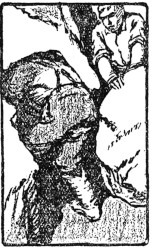
A bleak, gray dawn was slowly breaking over the scene of black desolation when the two men arrived at a small-mouthed cavern in the side of the Big Blackfern. The elder of the pair squeezed himself through the rocky opening with some difficulty. The other placed a great flat stone over the hole, and almost ran back to the new house to tell his mother and the Masons and Tot Singleton good-by; he meant to start for the far-away Northwest immediately.
Whitney Fair met him at the gate. Fair had discovered that every man of the escaped Wolfes had disappeared; he was purple in the face, and his small, pale-blue eyes glittered like those of an angry animal.
He seized one of the lapels of Wolfe's coat and cried savagely, "You'll pay for this! You warned them, and that makes you as guilty as they are—give me the money you took from the safe!"
"I didn't take any money from the safe," Wolfe replied with a level calmness that surprised even himself.
"You did!"
"Be careful, Mr. Fair!"
Whitney Fair went ashen instead of purple. "And there are some other things against you, too," he fumed. "You had an agreement by which you were to have this land for a pittance an acre when the sawing was done; you drew your salary for—er, more than a year in advance. Oh, but I'll have the net around you good and hard before you know what's happened! Hand that money right back, you thief!"
There was a quick step behind him. Colonel Mason, tall, patrician, and now white, caught his arm.
"Let him go, sir!" the colonel ordered hotly. "He is no thief—and anybody that says he is, sir, lies outright!"
Fair sniffed like a disgusted hound. "Meaning that I have lied outright, Colonel?"
"Exactly that," the old Southerner said quickly. "If the shoe doesn't fit, take it off!"
The cleft in Whitney Fair's chin deepened in a black scowl. He swore. He took his right hand from Wolfe's coat lapel, tore his arm from Colonel Mason's grip, and struck Colonel Mason in the chest——
The world turned as red as blood to Little Buck Wolfe. He couldn't stand idly by and see the man who had been to him a better father than his own father thus brutally mistreated. He went at Fair like a combination of cyclone, pile-driver and battering-ram and, with his two fists pounded Fair until his coarse face was almost unrecognizable. The worsted man sank dazedly to the wet ground.
"The next time you feel like striking anybody that's seventy-five pounds lighter and twenty years older than you," advised Wolfe, "be sure that there's no son of his near to take his part."
He led the colonel aside, and took him by the hand.
"I'm going away," he whispered, and he hastily explained why. "You can see that the evidence is big against me, and I can't possibly spare the time that it would take to spend a term in prison. I'll write when I think it's safe. Tell my two mothers and Tot good-by for me. I——"
Strong man that he was, he had choked. Colonel Mason choked, too.
"Son," he whispered thickly, "be careful when you write. Fate has left nothing undone, it seems—Fair is soon to be appointed postmaster at Johnsville! But you don't owe us anything, Arnold, my boy. We are willing to accept life's brimming cup of bitterness along with life's honey-sweetness. It was not your fault, certainly! But I must admit that the case against you looks bad, for Fair is undoubtedly influential, and you really had better get out from under. Good luck to you, and God be with you always——"
He was unable to say more. Mrs. Mason and Old Buck Wolfe's wife ran toward them from the house. The two women had seen and overheard much; they had easily guessed the truth. Wolfe embraced them tenderly, and kissed them on the cheek with reverence. Then he tore himself from their arms, and went rapidly toward the foot of scarred Lost Trail Mountain.
Once behind the border of burned and blackened laurels that stood along the edge of the basin's bottom, he noted that the slow rain had ceased, and halted and looked back. He could see the long, strong arm of the law, in the shape of the doughty Deputy Sheriff Howard Cartwright and a posse, coming by way of Devil's Gate!
Wolfe ran toward the other end of the basin, keeping always behind the border of blackened laurel. Before he had covered half a mile, he met Alex Singleton and his son, Fightin' Lon. Both the Singletons wore thick bandages over their palms. They questioned Wolfe anxiously, and he told them all there was to tell.
"You shorely can't slip out o' the basin now," declared old Alex. "That man Cartwright, I knows him. He used to be a revenuer. He's got eyes like forty hawks; they say he never fails to bring in his man. Better stay hid in the basin untel tomorrow night, anyhow, Little Buck. I'll hide ye in the apple-hole onder my cabin floor, and they cain't never find ye thar! Come on wi' me—quick."
The fugitive was hidden among bushels and bushels of green and yellow pippins. The boards were put back into place above him, and a crude table was dragged over the spot. Lying down there under the floor, he heard Alex Singleton and his son take chairs to the front doorway and sit down noisily. He heard stout Mrs. Singleton whistling one of her old-fashioned hymns in the lean-to.
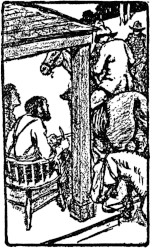
A long hour afterward, there came to his sensitive ears sounds made by the tramping of dozens of human feet and ironshod hoofs.
Cartwright accosted the Singleton leader sharply. "Seen any o' the Wolfes?"
"Seed 'em all last night at the fire," quite readily, "and I seed Little Buck a-runnin' toward the Lost Trail from his pap's new house somethin' like a hour and a half ago."
The deputy then demanded pointedly, "Are any of them here?"
It had become, after a fashion, a battle of wits. Alex Singleton rose in the doorway.
"Howard Cartwright," he almost roared, "d'ye thing fo' a minute 'at I'd have little enough sense to hide anybody from the law? I hain't a-hankerin' atter the penitenchy sence I've seed the inside of it, and le' me tell ye that. But ef you think I'm a-lyin', s'arch my house and satisfy yoreself!" It was adroit.
The posse had already surrounded the cabin. Cartwright entered and looked carefully in the loft, under the beds, in the two big chimneys of stone—everywhere but in the apple-hole.
He apologized after he had finished searching the premises. They told him that it was entirely and absolutely all right. Mrs. Singleton even stopped her everlasting whistling long enough to tell him that it was all right.
XIX
Old Buck Wolfe found the darkness stifling. He crept back to the cavern's narrow mouth, rested himself on an elbow, and looked through a small aperture. He watched his son whip Fair. He watched his son bid the Masons and his mother good-by, and run toward Lost Trail Mountain. He saw the minions of the law enter the basin, saw them searching, saw them go away empty-handed, and because they had gone empty-handed, a slow, pale smile of triumph spread over his bearded face.
But the smile did not last. His keen gaze soon picked out a tall and powerful figure in officer-blue that was sneaking back on foot along the fire-blackened side of the Lost Trail. Deputy Sheriff Cartwright, who had never failed to bring in his man, had not yet given up; he hid himself at a point that commanded a fair view of the whole basin, and began to wait with the patience of Job.
Everything was so very still now. Not a breath of air was stirring. The clouds had lifted somewhat, and Old Buck Wolfe's gaze came to rest on the great ironwood cross that poor Grandpap Singleton, the broken-minded, had erected on the summit of majestic Picketts Dome as a reminder to his people. The same queer, shuddery feeling that had assailed the chief of the Wolfes the night before now gripped him again. Between him and the sacred emblem of life and death the misdeeds of his past stood up like the spirits of gaunt, grim, evil giants. Finally a sense of utter shame overpowered him, and he wiped at his eyes with a big, blue bandana. Words out of the mouth of Grandpap Singleton, the Prophet, came back to him forcefully, and brought him face to face with his own soul:
"To them as thinks the' ain't no God, the' ain't none, so far as they're concerned."
His lips jerked, then moved stiffly.
"Who but a All-Pow'ful Bein' could ha' made the sun and the moon and the stars and the world? These things had to have a beginnin', shorely. They never jest happened. Sech big things as them cain't jest happen. From this day on, I'm mebbe a-goin' to do my little argyin' on t'other side o' the fence."
The clouds lowered, like a broad, feathery blanket dropped from the skies, and the ironwood cross was hidden from his sight.
By nightfall he was very hungry. He had eaten nothing since his last meal in the jail at Johnsville. But he bore it with fortitude, and in his uncouth way tried to be thankful for the tiny stream of water that trickled out of a crevice in the rocks a few yards behind him. The long, dark hours dragged by, and midnight came. Still no one had come to bring him food. He stretched himself out on his side, with his great, shaggy head pillowed on a forearm, and went to sleep.
When morning dawned, he crept to the aperture and peered through cautiously. He saw nothing of Howard Cartwright, but that fact was not proof that the officer had quit the watch. The chances were that Cartwright had only changed positions.
The day passed, and night fell again, and still Old Buck Wolfe had had nothing to eat. He was ready to run any ordinary risk to satisfy his gnawing hunger now. He put his hands against the flat stone that his son had placed over the narrow mouth of the cavern, and overturned it. Another minute, and he was standing beside an upright, charred shaft of wood that had been a fine yellow poplar tree. Something drew his gaze upward; he saw millions of frosty, brightly-twinkling stars—promises, Grandpap Singleton had called them.
He began to move slowly and soundlessly down toward the deep gash that had hidden for so long his moonshine still. Save for its upper edges, this little hollow had escaped the fire.
Then a big, dark form stepped suddenly before him, and a voice that he recognized instantly inquired in low and guarded tones, "Buck, old feller, is that you?"
Old Buck choked back an oath that had come unbidden to his tongue. Had not Alex Singleton helped to save him from death in the worst of all its shapes, death by burning?
"Yes, Alex," he answered in a small voice, "it's me. I'm mighty nigh it starved plum' to a shadder. I jest had to git out, Alex, and try to find me somethin' to eat."
"Now le's be awful keerful," Singleton whispered. "Le's go to the cave, Buck."
Wolfe led the way in. Singleton followed close behind him. The two groped their way several rods back into the pitchy darkness before they stopped.
"I'd ha' done brung ye somethin' to eat, Buck," old Alex said, as they sat down together, "ef Cartwright hadn't ha' been a-watchin' so hard. Here, take this here basket; it's got three fried chickens, half of a whole b'iled hawg ham, and a big pone o' cawnbread in it. And take this here cawfee-pot; the cawfee's all sweetened and ready. Tot she fixed it all up fo' ye, Buck, and the cawfee's got a tear in it—damned ef I didn't see it drap, myself. Now, old feller, eat ontel ye blamed nigh bust, ef ye wants to!"
Wolfe took the basket of food and the pot of coffee with an eagerness that was wholly pitiful.
"Alex," he said tremulously, "I'm so glad to git this here grub 'at I'd ax the blessin' ef I jest knowed what to say. Would you mind a-doin' it fo' me, Alex? I'll sartainly be obleeged to ye."
"Shorely, I will," Singleton agreed gladly.
Old Wolfe ate ravenously, while his companion explained, "Yore folks'd ha' fetched ye somethin' to eat afore now, Buck, but they didn't know whar ye was at. Little Buck never had much of a chanst to tell 'em, I guess. But he told me, and I'm a-goin' to take keer of ye. Little Buck he's in a tight place now, as sartain as hell's hot. Robbin' the safe, he'pin' you men git away from the law, assault and batt'ry on Mr. Fair—dang it, they'll pen him fo' life ef they ketch him! But they ain't likely to ketch him, Buck."
The food in Wolfe's mouth began to taste like wood. He rose there in the cavern's darkness, and made an odd noise in his throat.
"Pore boy—he liked me so much 'at he even named hisself atter me," he choked. "And me—I've treated him like a dawg. Alex, I want ye to do me a big favor. Will ye do it?"
Singleton nodded in the pitchy gloom. "I promise, o' course. Anything on earth."
"Then," Old Buck said shakily, "I want ye to git a mule-killin' hick'ry club, and beat me mighty nigh it to death on my sore back fo' a-bein' what I've been and a-doin' what I've done. Hurry, Alex. I look to ye to keep yore promise."
"I won't do it!"
"You shorely wouldn't be a liar fo' me, Alex!" surprisedly.
"I'd be a durned sight more'n that fo' you, Buck, old feller!"
"By God!" exclaimed Old Buck Wolfe, amazed. "Whar," he asked a moment later, "is Little Buck at?"
"He's jest started on foot through the mountains fo' Virginny," the Singleton leader answered. "He traded me his hoss and saddle and watch fo' a rifle and two hunderd ca'tridges, two blankets, a supply o' grub, a fryin' pan and some tools to eat with, and forty dollars in money. Atter things sawt o' blows over, he'll git on a train thar in Virginny, and go away off to the No'thwest, whar he's a-goin' to make his forchune and pay back all 'at was lost in the fire."
To old Alex, it seemed a very long time before Wolfe spoke again.
"Alex, I want to ax ye about somethin'. It's bothered me a heap. A few weeks ago, I found a little cross cut in the ground afore my still, and another one cut in the bark of a tree, and yit another one cut on my cabin floor. Do ye know how come it them crosses was thar?"
"It was pap," Singleton explained. "He takes spells o' wanderin' in his mind, ye know. He cut 'em a night or two afore you found 'em, and them at the still he'd covered wi' leaves so's you wouldn't see 'em ontel he'd oncovered 'em. Pap is a pow'ful feller to plan ahead, pore old feller. Well, I'll go now, Buck, but I'll be back at the fust good chanst. You be keerful!"
When his friend had gone, Wolfe crept out of the cavern to get away from the tormenting black stillness. The stars were brighter than ever, and a thin veil of frost had settled down over the ashes of the great fires. The deep mystery of the mountain night was everywhere; it awed Old Buck, and for minutes on end he stood as motionless as the blackened tree-shafts about him. He came to himself with a jerk——
"Robbin' the safe," he mumbled, "he never done it. It was hatched up ag'in him."
He went down to the little whisky still that his own hands had built and operated. The mash-tubs and the copper boiler and worm were all white with frost. He touched the boiler, and felt that it was a contaminating thing—it stung him. There welled up in his bosom a great hatred for it.
"It was you," he said bitterly, "'at made me do what I done. And when I gits through wi' you, you ain't a-goin' to look nothin' at all like yoreself!"
Old Buck had forgotten that the sheriff's ultra-cunning deputy might be near him. His injured back, also, was forgotten. He drew an ax from the cold furnace, and with mighty blows destroyed his false god.
Then he bent his two knees to something that was neither a ginseng root, a woodchuck's den, nor a moonshine still.
XX
Little Buck Wolfe seemed much like a soldier fitted out in heavy marching order with his blanket-roll on his shoulder, and his pack on his back, and his rifle in his hand. He stopped and faced about when he had reached the crest of the Big Blackfern. The darkness of the night could not conceal from him the desolation that lay below; he saw it with his eyes shut! The candles in the cabins of the basin's bottom glowed like pale yellow stars in the gloom.
He centered his attention upon the light that shone from the nearest window of old Alex Singleton's cabin, and wondered whether Tot had put it there as a last pitiful shred of farewell to him. He was glad that he had kissed her—it had been an act of impulse—when they parted. The memory of that would be with him, sweet and tender, throughout the years that he must spend buried in the hardest work before the colossal debt could be paid in full. He was convinced now that he really loved Tot Singleton. And he did. He wouldn't have been human if he hadn't. As for marrying her—there was the debt! He couldn't afford to marry.
It was with a painful swelling of heart and throat that he turned away. Just then a feminine voice called his name. He halted quickly and looked around. A slender figure was hurrying up the dim path toward him.
"Tot!" he cried.
"Yes," she panted. "Wait!"
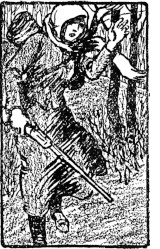
In her hands she carried a rifle. Over one of her shoulders was a blanket-roll that contained two spare dresses and some other things. She wore dark-blue, and about her head and neck was a heavy scarf that Wolfe himself had bought and given her as a birthday present.
"Where are you going, Tot?" he asked, as she drew up before him.
She hung her head. The butt of the repeater that had been the pride of her brother Lon's heart dropped heavily to the ground. Wolfe stepped closer to her, and took one of her hands.
"Where are you going, Tot?" he repeated softly.
She looked up. "I want to go with you!" in a certain desperation, and more or less tearfully. After all, she was more child than woman.
"But——"
Tot Singleton interrupted, "You'll be lonesome away out there in the cold Northwest. You'll need me. I can do so many things for you. I can cook for you, and wash and mend your clothes and keep 'em nice for you, and—and maybe I can comfort you when the blue days come. I couldn't ever bear it back here now, knowin' that you was so far away and so much alone. I—I wa-want you to m-m-marry me and take me with you, Little Buck! I wanted to ask you when you t-t-told me good-by, but I just c-c-couldn't——"
It ended smotheredly. She had recited it; she had been saying that speech over and over to herself all the way up the tortuous side of the Blackfern. But the simple earnestness of even the recital was one of the most striking things that had come into the life of Little Buck Wolfe.
He drew her hand to his breast and caressed it. The action was wholly involuntary.
"I wish I could take you, Tot," he told her sadly. "I know that I'll need you in a thousand ways. But because I do love you, I can't cheat you of the education that is only fairly begun; I can't take you from the worthwhile things and put half my load on your shoulders. Besides, I'm a fugitive now, you know. And there'll be real hardship. I'm not going straight to the Northwest, Tot."
"But you said——"
"Yes," he nodded. "I decided since leaving your father's house that I'd spend the winter in the wilderness that lies about the head of Doe River, which is probably the wildest place in America; it is very rarely that anybody goes in there, even to hunt. You see, Tot, I won't be safe anywhere out in the world until my so-called crimes"—in spite of himself, he winced—"are sort of forgotten. And there's another reason.
"When I was a small boy, Tot, there came to my father's cabin one day a stranger, a youngish man, who was about ready to die. We gathered from his delirious talk that he had come to the mountains for his health. He had with him a funny-looking pointed hammer, and a big magnifying-glass. Just before he passed out, we caught this from his babbling—I haven't forgotten a single syllable of it:
"'It's a trick of fate. Wealth—hundreds of thousands—and I've got to die and leave it all—after having been poor all my life! Fate, old girl, you're a damned trickster.'
"He had mentioned Doe River Wilderness," Wolfe pursued. "My father thought he must have found gold there. Not very long after the stranger's death, my father and my Uncle Brian went to Doe River Wilderness and spent a few days in a half-hearted search for gold. They found nothing that even looked like it.
"Of course, Tot, I know that the sick man might have been the victim of hallucinations. The chances are strong that he was. But as it's best that I stay hidden for a few months, I may as well try my luck; it will keep my mind occupied, anyway. So you see, Tot, there'll be real hardship."
"But you said you loved me," and one of the arms of the innocent temptress crept slowly around his neck. "If you love me, Little Buck, Doe River Wilderness will be the finest place in the world to me; it'll be parad-d-d-dise. And I'd do all I could to make it the finest place in the world for you, too. I'd rather lie down and die than to stay behind! Please, won't you let me go?"
Wolfe was entirely human. His resolve began to tremble.
"You might get sick out there," he said uncertainly. "We might not be able to get a doctor at all."
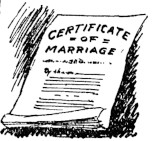
"I'm never sick, Little Buck," she replied quickly. "As for the hardship, I'm used to that; what mountain woman isn't? Listen. I sent Lon to Johnsville for a marriage license, and I've got it here. We can pass by old Preacher Longley Thrash's cabin, and get him to marry us. Oh, Little Buck, honey, you must—I just can't stay here now. Why, I—I'll be your d-d-dog!"
He stared at her in amazement. She continued.
"If you think I'm oversteppin'—I'd been believin' you loved me; when you kissed me good-by tonight, I knew it, I knew! I told myself you didn't ask me to go with you because you loved me too much to ask me; and that was exactly the way of it. You're lookin' at it wrong. I'll not stand between you and that old d-debt; I'll help you pay it! Can't you see, Little Buck, you ol' dahlin'?"
Her rifle fell to the ground. Both her arms were around his neck and drawing his face down to hers. Among the stars that were mirrored in her sea-blue eyes was the tenderness that few ever look upon save in the eyes of young mothers when they behold first their first-born. Her countenance was enraptured with the spirit of an adoration that was beyond the understanding of mortals, and that was strong enough to defy utterly the rules and conventions of the world.
All this he saw, and it wrought the ordinarily warm feeling he had for her into the grand passion, the great flame that burns never more than once. He knew that she was his mate, his woman, just as she knew that he was her mate, her man; he put his arms around her fine shoulders, and pressed her to him with a fervor that might have frightened another woman.
"And you'll let me go, won't you?" she rejoiced.
"Let you go?" he laughed. "Why, I'd steal you and carry you off now, if you didn't want to go!"
She gave the man who was soon to be her husband a folded paper, which he thrust into an inside pocket. They hastened to the mountaineer minister's home, and were married. According to his custom, old Longley Thrash gave them his blessing, an ax, and a side of acorn-fatted, pepper-cured bacon. Wolfe gave the preacher a banknote.
Because of the hawk-eyed deputy, the couple dared not spend the night anywhere in the Wolfe's Basin country. It was only after more than four hours of brisk walking that they stopped under a giant hemlock that stood beside a dashing creek, and made a bed of boughs and the blankets they had brought.
Two and a half days were required for the completion of their exceedingly unusual wedding journey. They were footsore and weary, and their clothing was somewhat torn, when at last they reached the heart of Doe River Wilderness.
But their eyes brightened at the sight which greeted them there. Before them lay an open and level space of half a dozen acres, which was dotted sparsely with big gray-barked, leafless beeches. In the very center of it was the source of Doe River, a small lake, or great spring, of such depth that the water was bluish-black. Wolfe and his wife went to it, their tired feet swish-swishing in the thin carpet of brown and yellow beech leaves. Had they known that it was here the iron chalice—but they couldn't know.
They threw up a temporary shelter of hemlock boughs. On the next morning, Wolfe set out alone to the eastward, and found his nearest neighbor at a distance of eight miles. This neighbor, for a consideration, agreed to go to Conradsville—which was in North Carolina and twenty-four miles away—for nails, traps, window-lights and a few other articles. Then Wolfe bought a bag of cornmeal from the man, promised to return three days later, and hurried back to his waiting and naturally anxious wife.
Just ten days from the time of their starting their little log cabin, Wolfe nailed the last split board on the roof and finished the lumpy stone-and-clay chimney. It was all very crude, of course. The two narrow doors were made of split-oak slabs; there were but two small windows; the floor of flat stones was rough and uneven; the few pieces of furniture were homemade and unsightly. But the man and the woman who dwelled there loved each other, and were happy in spite of all there was to make them unhappy, and it was home—that dearest of all earth's places.
The days stole into the past rapidly, as joyful days always go, and the last of February came. Wolfe had searched faithfully for the treasure that the stranger of the long ago had babbled about on his deathbed, but to no avail; he had found nothing that in any way resembled gold. The trapping had been good, however, and neighbor Ivins had been accommodating, and Wolfe had succeeded in saving enough money to take him and his wife to Oregon in the spring. As for Tot—Tot was a full blown rose of a woman now, and to her husband, quite properly, the most wonderful person he had ever known.
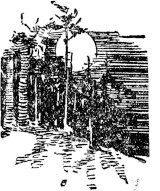
One of the last of the winter's snows had just ceased to fall. The white blanket was nearly a foot in depth on the ground; it lay heavily upon the branches of the trees. They stood together at one of the small windows, watching the twilight shadows fall in the forest. The full moon peeped above the crest of the long, low mountain that formed the eastern horizon, and heaven's own pure white began to glisten like a field of diamonds. Over the whole scene hung a silence so deep that Wolfe and his wife felt that they could touch it, almost, with their hands.
"So you're through with the gold hunt," Tot murmured.
Her husband nodded slowly, thoughtfully. "It seems useless to go any farther with it. If I hadn't known that gold has been found in these hills now and then for ages, I wouldn't have had the heart to stick to the search these three and a half months. When this snow is gone, if you don't mind, Tot, we'll start for Oregon."
"I don't mind, of course," Tot replied dutifully. "Whenever you think we ought to go, we'll go. Little Buck, the stranger's treasure surely wasn't gold."
Her surmise was correct!
Wolfe suddenly leaned forward and pulled the mealbag window-curtain into place, and led his wife from the window. There was a look of mild concern on his countenance. Tot found herself in the grip of a nameless fear.
"I saw something glint in the moonlight; it was a gun barrel, I think," Wolfe said quietly. "I'll go out and investigate, and I'll let myself out by the back door; drop the bar into place after me, Tot, and don't be a bit afraid."
"Do you think it's an officer?" she whispered breathlessly.
He shook his head. "Probably not. But I'll see, anyway."
But there was the possibility that it was an officer, and Wolfe carried no weapon with him; he would run from the law, but he wouldn't fight it. He went, stooping low, the instinct of the woodsman strong within him, across the open space; as noiselessly as a shadow, he stole along the edge of the forest, going from bush to bush and from tree to tree, and crept up very near to an angular, slouching figure that was peering toward the cabin from behind a huge oak. The unknown had an old-fashioned, single-barreled muzzle-loading shotgun in his hands; it was a gun that no officer would carry, and Wolfe drew a breath of relief.
Then the fellow meant mischief. Of that there was no doubt. It angered Wolfe to see this serpent in his Garden of Eden. He crouched low, and with a spring like that of a panther landed on the back of the unknown and bore him to the snow on his face.
"What are you snooping around here for?" he demanded hotly. "Who are you, anyway?"
He tried to turn the other's face upward. The stranger was strong and wiry; he kept his countenance hidden very effectively. Wolfe rose, seized the man by his collar and jerked him to his feet.
"I'll see you, all right," he growled.
The stranger wheeled with all the quickness of a cat, and struck Wolfe in the chest, staggering him. Wolfe loosed his hold on the man's collar, and struck out hard. His fist met only the air. The unknown turned and ran through the deep snow and into the denser shadows of the woodland, leaving the shotgun lying under the oak. Wolfe followed and caught the fellow by his ragged coat; there was a tearing sound, and something that jingled musically dropped to the snow.
The stranger, seeming spurred by a sudden frenzy of fear, doubled his efforts, ran into a thick copse of underbrush—and escaped.
When Little Buck Wolfe picked up the thing that had dropped with a musical jingle from inside the lining of the mysterious person's coat, he was filled with amazement. It was a canvas bag containing more than twenty-four hundred dollars in banknotes, gold and silver.
The robber who had dynamited the Unaka Lumber Company's safe on the night of the fire had just slipped through his fingers!
XXI
Wolfe groveled in the deep snow for the old-fashioned shotgun his antagonist in the struggle of a few minutes before had lost. He found the long muzzle-loader, and hastened to the cabin's front door. Tot let him in, and he told her of his little adventure. They sat down before the wood fire, and counted the money.
"If you were to catch the robber and have him arrested," Tot asked hopefully, "wouldn't it clear you o' the charge o' stealin' this money?"
"Yes, it would clear me of that. But, you see," and Wolfe frowned, "it wouldn't wipe out the charges that I am an accessory after the fact to a felony and—and the other things. Whitney Fair is a hard man, Tot, and he's shrewd. He'd go to any end to make me smoke, on account of the beating I gave him. I couldn't risk going back, if that's what you're thinking about. I believe this would be our best plan:
"Tomorrow, I'll set out after the robber, and follow him by means of his track in the snow. I'll catch him, and we'll take him over to Ivins' place. We'll instruct Ivins to keep him for ten days, and then turn him over to the sheriff at Conradsville. You and I will steal into Conradsville, express the stolen money to Colonel Mason, and immediately afterward board a train for Asheville. In Asheville, you'll buy two fares for the Northwest, and I'll join you on the train; this to break possible pursuit. Ivins likes us, Tot, and he won't let our man talk him into doing anything we don't want done. Eh?"
"You ought to know what's best for us, honey," Tot answered promptly. "But I'll be anxious while you're gone after the robber. You see, it's Cat-Eye Mayfield you're goin' after."
"Of course—that is, it's probable."
"And if you're not mighty careful," seriously, "you'll follow him into a trap of some kind."
Her husband laughed boyishly. "Don't you think I'm capable of matching wits with Cat-Eye Mayfield?" he said. "I'll have the advantage of being armed, you know."
Tot poked the fire before she spoke again. Wolfe noted that her now ruddy face was decidedly troubled.
"It's like fightin' a snake in the dark!" she warned. "Cat-Eye maybe hasn't got any gun; but he's got the cunnin' of a fox, and the cunnin' of an Indian, and the cunnin' of a man born to be a killer all in one. I tell you again, Little Buck, if you're not mighty careful, you'll follow him into a trap. He knows you'll try to track him down, and he'll be ready for you. Remember, that man hates you a lot more than you can ever, ever understand, Little Buck!"
Wolfe laughed at her fears, though in this instance it was she that was the wiser of the two.
"I'll be careful," he promised.
They took a flat stone from the floor next to the hearth, exposing a tiny pit beneath. The canvas bag and its burden went into the pit with their savings money, and the stone was put back into place. Then they saw that the little cabin's doors and windows were securely fastened, and retired for the night.
An hour before the coming of the next dawn found them up and busy with the preparation of breakfast. When Wolfe had eaten, he strapped a full belt of cartridges around his waist, took up his rifle and his hat and a bundle of food, kissed his wife fondly and set out on his journey. The day promised to be clear, but the wind was out of the north and stinging, biting cold.
The footprints led him in an almost straight line to the southward. The robber had deviated only that he might avoid a cliff or a dense thicket of undergrowth. It was very evident that Mayfield, if Mayfield it was, had traveled with a fair knowledge of the wilderness and with some goal definitely in view from the start.
The air became even colder as the day wore on. Wolfe was forced to keep his feet moving at a lively rate, and to frequently beat his gloved hands together, to prevent frostbite. The snow now had a crust that impeded his going somewhat, and made his tramping noisy. He began to be a little nervous because of his everlasting, expectant watching ahead. Wolfe was not a man who bore suspense easily.
By the middle of the afternoon he had covered, he judged, fifteen miles. He now found himself in a perfect jungle of tall virgin timber that would have widened his eyes in admiration had the circumstances been different; it was spread over a rugged, rocky valley that few men, except for Cherokee Indians, had ever entered; the very primitiveness of it was at once both beautiful and terrible. A weird light reigned between the green of the treetops overhead and the white of the snow under foot. There was no sound except for the soughing of the wind through the needles of the gaunt, spectral hemlocks.
It was in here that the man whom Wolfe had been following had made camp. A pile of coals that were still glowing marked the spot. Wolfe paused for less than two minutes to warm his hands over the remains of the unknown's fire, then struck out at a faster gait than ever along the fresher trail; and he remembered Tot's warning, and tried to keep his wits about him.
Then he was suddenly confronted by a little canyon, in the bottom of which flowed a clear and sparkling mountain stream edged with ice. The footprints of the unknown ended abruptly at the brink. He knelt and peered over. The snow on the ledges below him had not been disturbed. His man had crossed, he figured, for there was no backward track—but how?
"He didn't fly over!" muttered Wolfe to himself. "And yet——"
Ever suspecting trickery, he searched the thick woodland around him with his eyes. Everything seemed quite as it should be. Another moment, and his gaze fell upon a great wild vine that hung within arm's reach of him; it ran almost to the top of a tall hemlock, and—it had been cut at a point near the snowy ground.
"I see—" Wolfe smiled—"he swung himself across by means of this!"
It was not an unreasonable conclusion. The distance over was not more than thirty feet; the vine's first fastening was on a branch fully twenty yards above. Human destinies sometimes hinge upon the tiniest things; if Wolfe had but noted that there were no footprints on the other side of the little canyon, for instance——
He tested the vine; it held his weight with no sign whatever of giving away. He looked below, and considered; if he fell, he would be hurt: neither the snow that covered the farther half of the canyon's bottom, nor the water that covered the nearer half, would keep him from being hurt if he fell. Therefore, he tested the strength of the vine again. Again it held his weight without the least sign of breaking or tearing loose in the tree overhead.
"I should be able to do anything that the other fellow can do," he told himself.
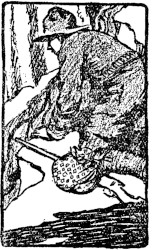
With that, Wolfe proceeded to fasten his rifle and the bundle of food to his cartridge-belt. Then he took a firm hold on the vine, stepped fifteen steps backward, ran forward swiftly, and launched himself out over the chasm—and the vine parted high in the tree with a sharp snap. He loosed his grip on it and flung out his arms, turned completely twice in the air, and landed hard upon the ice-coated stones beside the rippling creek. A few seconds of spasmodic writhing, a faint moan, and he lay face-downward, motionless and silent.
Had he been unconscious for long, doubtless he would have frozen. Perhaps the penetrating chill helped to bring him to. He sat up dazedly, and dazedly noted that his hat, coat, rifle, cartridge-belt and rations were gone—and that there were dozens of fresh footprints, the same footprints that he had been trailing, in the snow about him.
In spite of his watchfulness, he had fallen into a trap very neatly!
Wolfe tried to get upon his feet then. A fiery streak of pain in his right leg wrung a hoarse cry of pain from him. He dragged himself to the shelter of a nearby overhanging ledge, and on the way came upon his bundle of food; it had been torn from his belt in the fall, and the friendly snow had hidden it from the robber's eyes. He sat up on the dry earth, and hurriedly took stock of his injuries. His forehead was bruised and swollen; six inches above his right ankle there was a fractured bone.
A small heap of driftwood lay nearby. Wolfe took a knife from his pocket, whittled a few handfuls of shavings from a stick of dry heart-pine, and started a fire to keep off the bitter cold. When the wood was burning well, he tied a handkerchief about his throbbing head, removed his right boot and ripped the trousersleg to the knee, and bound his injured limb in a set of crude splints. The pain of the fracture was now as much as he could bear without shrieking.
He stretched himself out on his left side, with his back to the rock wall. Suddenly he realized that he was staring at the smaller end of the wild vine. It had been smoothly cut; his man had been waiting for him in the top of the hemlock that had supported it.
"Of course, that was it!" nodded Wolfe, with a bitter little smile. "I—I might have known."
Perhaps the robber, thinking him done for, had gone away for good. Then he would put out the fire, that the smoke from it might not reveal the fact that he was still alive. Anyway, he must begin dragging himself homeward. If Tot became so uneasy that she followed him, and something happened to her—the thought made Little Buck Wolfe's face as hard as a mask of marble.
But his precaution was for nothing. A pair of opaque, uncanny black eyes watched him toss the burning wood to the snow. He chanced to look toward the hemlock above; he saw Cat-Eye Mayfield standing with one lean shoulder touching the body of the tree. Mayfield wore Wolfe's coat and hat over his own coat and hat; around his slender waist was Wolfe's cartridge-belt, and in his hands was Wolfe's repeater.
The two men glared at each other for a full minute without speaking. Mayfield was proud of his cunning; his villainous triumph was written over his narrow, dark face and in his lustreless eyes. Wolfe was defiant, and so full of rage that every nerve and fibre of him trembled; the veins in his temples stood out and throbbed violently.
"Well?" snapped Wolfe.
"Haw-haw-haw!" laughed Mayfield. "Howdy, and hello! A-judgin' from the way ye've got that 'ar leg o' yore'n fixed up, Little Buck, I'd say ye'd missed yore callin'. Ye'd ort to been a doctor, shorely! Ye could git plenty o' cases o' bots and pip, anyhow—haw-haw-haw!"
Wolfe set his teeth together, and refused to reply. Mayfield became demoniacally sober, and asked abruptly, "How'd ye like to be shot?"
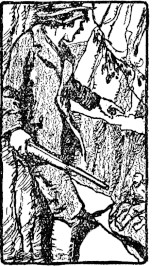
There was certainly no levity anywhere in the question. Wolfe knew very well that he was facing the open jaws of death, knew that his life depended entirely on Mayfield's whim. Mayfield had little to fear. A man's bones might lie there in that wilderness, bleaching and bare, for years upon years before they were found. As for Tot—the man beside the hemlock figured that he could very easily take care of Tot!
"Have ye got any pa'tickler choice about jest whar ye'd ruther be shot?" he inquired with tantalizing calmness.
The man below forced himself to speak steadily: "There's no other way out? You're determined to top it all off with murder; eh?"
"Shorely." Mayfield's opaque eyes narrowed wickedly. "Shorely. I've lived my whole life to git to this one minute. Ef ye wants to say yore little 'Now I Lay Me,' git at it!"
Wolfe shuddered in spite of himself, though he bravely kept the other from seeing it. Death seemed inevitable. If he must go the long, long way, he would go as nearly without pain as he might; besides, he believed that a bold front would go farther than anything else toward saving him—and the wretch should not have the satisfaction of even suspecting that he was afraid.
"Harm Tot, if you dare—and if a man can rise from his grave I'll rise from mine," he said quietly. "Let's see whether you can hit my fingernail, Cat-Eye."
He put the tip of his right forefinger squarely on the center of his badly-bruised forehead. His hot mountaineer blood was thrumming in his ears now.
"Hold it thar!" said Mayfield.
Wolfe held it there. Mayfield drew back the rifle's hammer, and began to take aim without a rest; he was a good enough marksman for that. Wolfe watched Mayfield as though there was something about the villain that fascinated him. A minute passed, an eternity in sixty seconds, and then a spirit of terror seized the man below. The suspense bore down upon him with a weight that was smothering. He felt that he must cry out to Mayfield and implore him to put an end to it. But he kept his lips resolutely closed, and his gaze remained riveted unfalteringly upon the unwinking black eye beyond the sights of his own repeater.
"Huh!" Mayfield grunted suddenly.
There is no doubt that Wolfe's quite terrible gaze had something to do with it—Cat-Eye Mayfield lowered the rifle, and shrugged his narrow shoulders oddly.
"Huh!" he grunted again. "It wouldn't last nigh long enough to suit me, Little Buck."
The pain in Wolfe's injured limb was greater than ever in that moment, but he kept from wincing, for he knew that the other would certainly regard it as an exhibition of fright.
"What do you mean?" he asked sharply.
"Jest what I said; nothin' more, and nothin' less. I'm purty shore I can fix up somethin' 'at'll beat killin' ye this a-way. Yeuh, I'm purty dang shore I can."
"Probably," nodded Wolfe.
"Ye see," Mayfield went on devilishly, "I might hatch up some way to sep'rate you and Tot, or somethin' like that, ye know. Well, I reckon ye hain't never heerd what happened to yore pap and his outfit atter you and Tot left the basin, have ye? Ef ye hain't, I'll find big pleasure in a-bein' the one to tell ye. Hey?"
"What happened to them?"
"Well," and Mayfield caught the repeater into the hollow of an arm and began to chafe his cold hands, "well, Depity Cartwright he ketched yore pap on his knees clost to his moonshine still, which same he'd done tore all to pieces, a-prayin' to beat hell. Cartwright he took off his hat and waited untel Old Buck was through, when he chased Old Buck back to his cave whar he'd been a-hidin' at; and fin'ly Cartwright he ketched yore pap and took him down to the jail at Johnsville. How's that fo' news, Little Buck; hey?"
"It's news, all right," growled Wolfe. "Anything else?"
"Shorely!" grinned Mayfield. "Well, atter he had Old Buck all tight in jail, Cartwright—he's a reg'lar heller!—he watched the Wolfe wimmen; and when they went to their men folks over in the Balsam Cone section, he follered 'em. And 'en Cartwright he went back to Johnsville and got up a big posse, and went back and ketched every one o' the rest o' the clan. How's that fo' news?"
Wolfe had gone ashen. He believed, somehow, that Mayfield had told him the truth. And Mayfield really had.
"The whole outfit of 'em had a trial," the man beside the hemlock went on eagerly, "and they was all sent up to the State prison at Nashville fo' five year!"
That, also, was truth. Violently-suffering Little Buck Wolfe bent his head in gratitude for the silver lining to the cloud; five years was not half the sentence usually meted out for the crime of arson. A beautifully bright spot, too, was the turning of his iron father.
"I reckon you're a-wonderin' why I hain't never caused you to be ketched by the law, hain't ye?"
Mayfield's voice jarred. Wolfe shook his head.
"Not a bit, Cat-Eye. You're wanted, too, and you've no great wish to get anywhere near the authorities."
The man above eyed the man below peculiarly for a moment. Then the man above drawled, "Little Buck, you talk like a book. You look like a book. And you act like a book!"
Wolfe jumped as though he had been struck. His wife had told him that word for word one cold evening when they sat at their fireside; but she had said it admiringly, for she knew it was because he had, as it were, lived on a diet of books for eight years, so hungry had he been for education.
He knew that Cat-Eye Mayfield had eavesdropped at their cabin!
"I didn't tell anybody whar ye was at," said Mayfield. "Acause I had more ag'in ye 'an the law's got. Little Buck," and the lustreless eyes had never seemed so diabolical as now, "I've hated you all o' my life. I've hated ye so long and so much 'at I'm all hate; from the crown o' my head to the sole o' my feet, I'm all hate fo' you. Every dawg has his day, ye know. You've done had yore'n. Now I'm a-goin' to have mine. I'm a-goin' to make you wisht ye'd never been borned. I'm a-goin' to make ye wisht ye could die!"
Wolfe gave him a silent, unflinching stare. Mayfield continued.
"I hain't got it all planned out yit. But I think I can promise ye one thing faithf'ly; you hain't never a-goin to set yore two eyes on Tot Singleton any more."
"You cut-throat!" cried Wolfe.
"And," Mayfield grinned suddenly, "I plum' mighty nigh it fo'got to tell ye this here:
"Ye know a half a gallon o' licker and a half a gallon o' water makes a whole gallon o' licker, when a little tobacker or lye is put in it to stouten it up, don't ye? And it's considered a lowdown trick, as ye also know. Well, a long time ago, yore pap he sent me up to Alex Singleton's atter a gallon o' cawn-lightnin' when his still-worm had friz and bu'sted; and I swiped half o' the licker, and added water an a big leaf o' tobacker to make out. So when yore pap he found the tobacker in the jug, he went straight ater old Alex, which was the startin' o' the fightin' atwixt the Wolfes and Singletons. Some more news, hain't it? Haw—haw—haw! Well, I guess ye can make it to the lake in about three days o' good, hard crawlin' like a lizard. So long to ye, and bad luck!"
He disappeared. The sounds of his footsteps died away quickly, and there was silence save for the rippling of the creek and the soughing of the wind among the needles of the hemlocks.
Wolfe's heart was torn afresh with fears for Tot's safety. Mayfield possessed more cunning than he had been willing to believe; the plot, whatever it was, would be as black as the Pit and, probably, successful. Spurred to the highest degree of desperation, Wolfe stuffed his package of rations inside his shirt, and took a crude crutch from the pile of driftwood; then he began to make his way slowly and painfully down the stream. He soon came upon a rotting tree trunk lying across the creek, and by means of this he went to the other side of the canyon's bottom and to the base of a series of ledges that promised escape.
Twenty minutes later, he was crawling determinedly along the path that his feet and Mayfield's had made in the snow.
That journey through the frozen forest was difficult and terrible. He was forced to halt occasionally to rest himself, and always he built a little fire that he might not take cold while his overworked and trembling muscles were relaxed. He labored on all that night and all the next day, without stopping more than half an hour at a time. When there were yet five miles between him and the great spring that Tot had named "The Lake of Peace," he became utterly exhausted; the physical machine that was him was fine, but it had reached the limit of its endurance.
Since it was not humanly possible for him to go farther without rest and sleep, he made a fire in a sheltered spot and put on wood that would last for hours. This done, he fashioned himself a thin couch of laurel branches, collapsed upon it, and at once was wrapped in a slumber so deep that it was akin to death itself. But vague dreams tormented him when the first keen edge of his exhaustion was worn off; he heard Tot calling to him again and again, and he awoke in a fever of anxiety while it was yet night. He sat up stiffly. He had to go!
When he had eaten the last of the food that his wife had prepared for him, he took up his brushwood crutch and set out to the northward once more. He strove hard to make himself believe that Tot had been neither outwitted nor deceived by the foxlike and dastardly Mayfield. But the fear would not be driven away.
The middle of the afternoon had come when at last he reached the open space that lay around the head of Doe River. His heart ached with apprehension because Tot did not come out to meet him. He opened his lips to call and couldn't speak her name. Fear had made him dumb.
XXII
Wolfe crumpled on the icy doorstep. With the palm of one of his half frozen hands he beat against the door. The only answer he had was the dull rattle of the wooden latch. He struggled upward, seized the coonhide latch-string, and gave it a nervous jerk. The door creaked slowly inward. There was no person in the cabin. Wolfe entered on his hands and knees, reached a crude chair beside the hearth, and drew himself into it with difficulty.
A fire burned brightly in the wide stone fireplace, and in a corner of the room lay a little heap of wood with particles of snow still clinging to it; the cabin had not long been deserted, certainly. After he had rested for a few minutes, Wolfe went first to the door at the rear and then to the door at the front, and looked for his wife's footprints in the snow outside. He recognized only the footprints of Cat-Eye Mayfield and himself.
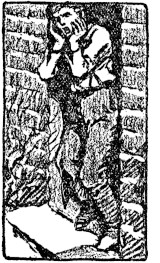
More anxious than ever, he leaned weakly against the jamb, put his cupped hands to his mouth, and shouted.
"Tot! Tot!"
The rockbound hills sent her name back to him in echoes that were worse than maddening.
"Tot!" he called again; and again came the echo, Tot!
Once more he called, and this time the voice that floated back to him was a little broken. He felt that he was about to fall. He crept dizzily to his chair, pushed it closer to the fire and climbed into it, and put out his hands and feet to warm them.
As the cold's numbness left him, his mind became clearer. He began to look about him. Tot's spare clothing lay nicely folded on a shelf beside his own, as usual. Tot's rifle was not in its place over the smoked log mantel. Every cent of their savings and the other money was gone. The bed was rumpled badly on one side. A few scattered bits of food and an unwashed frying-pan on the rough dining-table gave it a distinctly untidy appearance. These tokens offered Wolfe scant reason to hope that his wife was safe. All manner of fearful possibilities came to torture his already over-wrought brain. Perhaps——
His thoughts were broken into rudely by the sounds of masculine footsteps in the crusty snow beyond the doorstep. A rasping voice began to sing a snatch of foolish song:
"Sally she had a dream last night; It was a pow'ful droll one. She dremp' she had a petticoat Made o' her mammy's old one!"
Wolfe switched his gaze toward the open doorway. Cat-Eye Mayfield entered and stamped the snow from his run-over cowhide boots noisily. In one hand he carried the rusty, old-fashioned, muzzle-loading shotgun that he had lost a few evenings before.
"And so ye got back, did ye?" he said hoarsely; he was suffering from a severe cold in his throat. "I told ye it wouldn't take more'n three days o' good, hard crawlin' like a lizard, didn't I?"
"Where's my wife?" Wolfe demanded.
Mayfield laughed gratingly. It was not forced. Wolfe's anxiety delighted him. He dropped into the other homemade chair and trained the shotgun across his lap, straight at Wolfe's face.
"Where's my wife?"
"Now you jest be keerful 'at ye don't start somethin' 'at ye cain't stop," Mayfield warned, at the same time thumbing back the old muzzle-loader's hammer. It was a clumsy thing. "I'll tell ye whar yore wife is at, Little Buck, in my own good time, and not a minute afore; please git that, will ye?
"I reckon," he went on forthwith, "you're a-wonderin' what I've done about the rifles and the money, hain't ye? Well, I broke Tot's rifle, and throwed it in the lake; I hid yore rifle whar I hid the money. This here old shotgun is all the weapon I want fo' you. I hain't a-wantin' to kill ye. It would end yore mis'ry too soon. I want ye to suffer a long time, and I'm a-goin' to make ye suffer a long time! The' hain't nary grain o' lead in this here old gun. The' hain't nothin' but powder—six loads o' powder, all tamped in tight wi' clay. You couldn't never guess what I'm a-goin' to do with it, so I'll tell ye.
"I'm a-goin' to shoot ye in the face wi' powder, and black it fo' good jest like a nigger's, and put yore eyes out—atter I've told ye what I've got to tell ye. Fust off, you're a-goin' to spend the rest o' yore days a-wanderin' in Doe River Wilderness as blind as a bat, a-eatin' leaves and grass and roots—keerful ther, Little Buck Wolfe, or I'll shoot right now!"
His voice rang with hatred and—insanity! But Wolfe was in no condition to take note of the latter. Wolfe was sitting up straight, his eyes glittering, his hands gripping the sides of his homemade chair as though they would crush the wooden splints. For a moment he seemed about to defy the threatening shotgun and attack its owner in spite of his badly injured leg.
But the wicked eagerness he saw in Mayfield's lean face caused him to relax. He did not doubt that Mayfield would pull the trigger at the slightest provocation. It would be best to wait. If he waited, there might be a chance——
"Tell me about Tot," he said unsteadily. "And if you've harmed her, Cat-Eye——"
"Now don't go so dang fast," broke in Mayfield, crossing his lanky legs without in the least spoiling the shotgun's aim. "I hain't even laid the weight o' my little finger on Tot. I shorely hain't. I managed my revenge another way. It was right cute, too! Well, here's the whole thing. Little Buck; and ef ye tries to git at me whilst I'm a-tellin' it, I'll shoot—and when I shoot, black goes yore face and out goes yore eyes. I hopes ye onderstand me.
"All right," he ran on, enjoying every moment of it. "When I got here, it was sev'ral hours atter night, and the moon it was a-shinin' as bright as day. The' was a light in the cabin window here—to show you the way home, I reckon. I hides myself ahind of a tree, and watches fo' a little while. Tot she'd come to the door every few minutes, and look out. Once she must ha' imagined she'd heerd you a-comin', acause she runs out in the woods a-callin' you.
"'Little Buck, whar are you at, honey?' she says. 'Do come on, honey; you must be half froze,' she says, jest the same as ef you was a kid! Bah!
"But the only answer she got was none. So she goes back in the house here, whar she sets down and cries, jest like wimmen will, ye know—now you be keerful thar, Little Buck. You can see, shorely, I'm mighty nigh it a-dyin' to shoot.
"Well," he continued, "I done already had everything planned out to a fare-you-well finish afore I got here. I took yore rifle down to the aidge o' the lake thar at the big beech, and laid it down half in the water and half out. I throwed yore hat out in the lake, and it floated jest like I'd figgered it would float. I doubles up yore coat, and puts it inside o' my shirt. I hides yore ca'tridge-belt in a clump o' laurel. Then I picks up a great, big rock from the lake's bank and holds it up above my head in both hands, and waits fo' a lull in the wind.
"When the wind it had lulled a little I throwed the big rock out in the lake. It made a pow'ful noisy splash jest like I'd wanted it to do. And 'en I commenced a-bellerin' as loud as I could beller and not bust a lung wide open.
"'Swim Little Buck swim! Kick wi' yore feet and paddle wi' yore hands! Swim! Swim!' I bellers. 'It's pow'ful deep and ef ye don't swim,' I bellers, 'you're shore to drownd!'
"And 'en I kicked in the water wi' one foot, and bellered a little more.
"Well, Tot she comes jest a-flyin' from the cabin here, which was edzactly what I'd looked fo' her to do. What makes some wimmen so dang foolish about one man when the world's full o' menfolks was allus more'n I could onderstand. And in the bright moonlight I could see 'at her face was as white or whiter'n the snow onder her feet. Her hands they was both stretched out in front o' her.
"'Little Buck,' she says, bad skeered, 'whar are you at, honey—whar are you at? says she.
"I goes to meet her, o' course. And I acted as ef I was shore turrible bad excited.
"'He fell in the lake!' I tells her. 'He slipped and fell in the lake! Le's git a rope, or a long pole, and mebbe we can git him out afore he's drownded!' Haw—haw—haw!
"I had—keerful, Little Buck; you cain't slip on me!—had already spotted a pole. I picks it up and runs back to the big beech, and holds it out over the water.
"'Ketch a-holt o' this here, Little Buck!' I squalls. 'Ketch a holt o' this here!' Then I stoops and looks out over the black lake. 'He's done went down,' I says to Tot, who was a-standin' aside o' me a-wringin' her hands. 'Pore boy; I cain't see nothin' but his hat a-floatin' out thar,' I says.
"'And you pushed him in, you brute!' says Tot, all a-sobbin'. 'Go in and try to git him out, Cat-Eye!' she says.
"'I didn't push him in,' says I; 'but I'll do all I can to git him out. It may gi' me my death o' cold,' I says, 'but I wouldn't mind anything fo' yore sake, little gyurl!'
"Keerful thar——
"And wi' that, I yanks off my old ragged coat and throws it and my old ragged hat to the snow, and dives right in head-foremos'. The water it wasn't so awful cold, it a-bein' nothin' but a monst'ous big spring—springs is allus cold in the summer and warm in winter, y' know—but it made me hoarse in my talk, as ye've done noticed, I reckon. I've been a-doctorin' my throat the best I could; but I'm still hoarse——"
"Never mind stretching it out like that!" Wolfe interrupted angrily. "Go on with it!"
Mayfield grinned a broad, evil grin. He was enjoying to the fullest his hour of triumph.
"Why," he leered, "you're danged anxious to have it over with and git yore face burnt black and yore eyes burnt out, hain't ye?